SEMINAR
ON
CORONARY ARTERY DISEASE
Anish Kumar
CORONARY ARTERY DISEASE
 Coronary artery disease is the
narrowing of the coronary arteries that
prevents adequate blood supply to the
heart muscle.
 Usually its caused by atherosclerosis, it
may progress to the point where the
heart muscle is damaged due to lack of
blood supply. Such damage may result
in infarction, arrhythmias, and heart
failure.
CORONARY ARTERY DISEASE IS
ALSO KNOWN AS;
ATHEROSCLEROTIC HEART DISEASE
CORONARYATHEROSCLEROSIS
CORONARYARTERIOSCLEROSIS
CORONARY HEART DISEASE
CORONARY ATHEROSCLEROSIS
 CORONARY ATHEROSCLEROSIS is the
abnormal accumulation of lipid or fatty
substances or fatty atheroma (plaque) in the
lumen of coronary artery
RISK FACTORS
Non
Modifiable
Modifiable
MODIFIABLE
 High blood cholesterol level
 Cigarette smoking, tobacco use
 Hypertension
 Diabetes mellitus
 Lack of estrogen in women
 Physical activity
 obesity
NON MODIFIABLE
 Family history of CAD
 increasing age
 Gender(male)
 Race(non white populations)
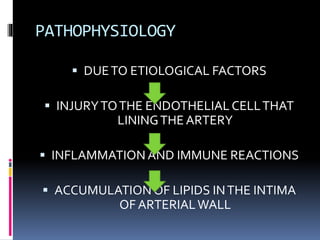
PATHOPHYSIOLOGY
 DUETO ETIOLOGICAL FACTORS
 INJURYTOTHE ENDOTHELIALCELLTHAT
LININGTHEARTERY
 INFLAMMATION AND IMMUNE REACTIONS
 ACCUMULATIONOF LIPIDS INTHE INTIMA
OF ARTERIALWALL
 T LYMPHOCYTESAND MONOCYTESTHAT
BECOMESAS MACROPHAGES INFILTRATE
 THE AREATO INGESTTHE LIPIDS AND DIE
 PROLIFERATIONOF SMOOTH MUSCLE CELLS
WITH INTHEVESSEL
 FORMATION OF FIBROUS CAP OVER DEAD
FATTY CORE (ATHEROMA)
 PROTRUSION OF ATHEROMA INTOTHE
LUMEN OFVESSEL
 NARROWINGAND OBSTRUCTION
 IF CAP ISTHINTHE LIPID CORE MAY GROW CAUSING ITTO
RUPTURE
 HEMORRHAGE INTO PLAQUE ALLOWINGTHROMBUSTO
DEVOLOP
 THROMBUS AND OBSTRUCTTHE BLOOD FLOW LEADINGTO
SUDDEN CARDIAC DEATH OF MYOCARDIAL INFARCTION
 ANGINA AND OTHER SYMPTOMS
SIGNS & SYMPTOMS
 Chest pain (Angina pectoris)
Myocardial infarction
Diaphoresis
Ecg changes
Dysarrithmias
Chest heaviness
Dyspnea
Fatigue
DIAGNOSIS
•History collection
•Physical examination
•Cardiac enzymes
•Electrocardiograms
•Echocardiograms
•Stress Tests
•Nuclear Imaging
•Angiography
ELECTROCARDIOGRAMS (ECGS
OR EKGS)
•Provide a record of the heart's electrical
activity.
•This test records any abnormal findings in
the heart's electrical impulses. Electrodes
are placed on the arms and chest to monitor
electrical activity.
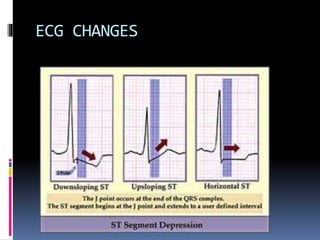
ECG CHANGES
ECHOCARDIOGRAMS
It is ordered if the patient is suspected of
having problem with the heart muscle or one
of the valves that channel blood through the
heart.
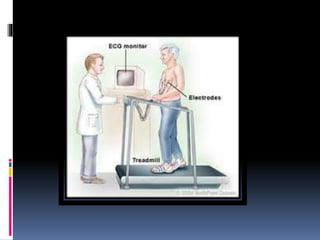
STRESS TESTS
They are used to show how the heart reacts
to physical exertion. Exercise stress tests
are usually performed on a treadmill or
exercise bicycle.
ANGIOGRAPHY
•Is the most accurate means by which to
examine the coronary arteries
• It requires a surgical procedure called
cardiac catheterization. During the
procedure, catheters (small thin plastic
tubes) are placed in the artery of the leg or
arm, and directed using an x-ray machine to
the opening of each of the coronary arteries
COMPLICATIONS
 Chest pain (angina)
 Heart attack
 Heart failure
 Abnormal heart rhythm (arrhythmia).
MANAGEMENT
PHARMACOLOGICAL THERAPY
 ANTI ANGINAL MEDICATIONS like
 Nitrates(ISD,)
 Beta adrenergic blockers (ATENOLOL)
 Calcium channel blockers (NEFIDIPINE)
 Ace inhibitors (CAPTOPRIL)
 Statins
 Imipramine for analgesia
SURGICAL INTERVENTION
•ANGIOPLASTY
•STENTS
•CORONARY ARTERY BYPASS GRAFTING
(CABG)
•PTCA
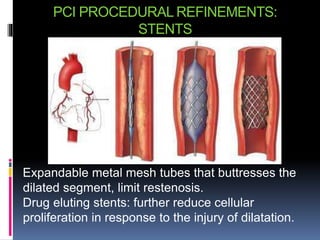
PCI PROCEDURAL REFINEMENTS:
STENTS
Expandable metal mesh tubes that buttresses the
dilated segment, limit restenosis.
Drug eluting stents: further reduce cellular
proliferation in response to the injury of dilatation.
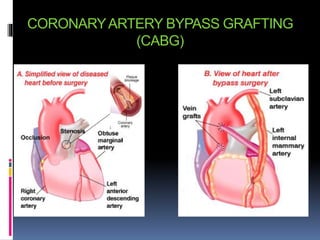
CORONARYARTERY BYPASS GRAFTING
(CABG)
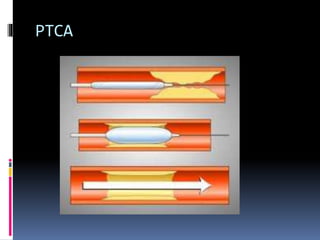
PTCA
•Lifestyle changes:
Lifestyle changes that may be useful
in coronary disease include:
•Weight control
•Smoking cessation
•Exercise
•Healthy diet
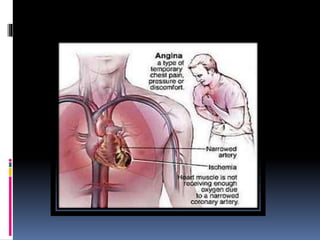
ANGINA PECTORIS
 Angina pectoris is a clinical syndrome usually
characterised by paroxysms of pain or
pressure of anterior lobe.the cause is usually
insufficient blood flow
TYPES
 Stable angina
 Predictable consistent pain that occurs in
exertion and is relieved by rest
 Unstable angina
 Also called preinfarction angina
 Symptoms occur frequently and last longer than
stable angina
 Pain may occur at rest
 Variant angina
 Also called prinzmentals angina.
 Pain at rest with reversible ST segment elevation
thought to be caused by coronary artery
vasospasm
 Microvascular angina
 Otherwise angina X syndrome
 Patient have chest pain but do not seem to have
any blockage in coronary artery
 The pain may be due to tiny vessels that feed
heart,arm and neck are not working properly
 Silent ischemia
 Objective evidence of ischemia (such as
electrocardiographic changes with a stress test)
but patient report no symptoms
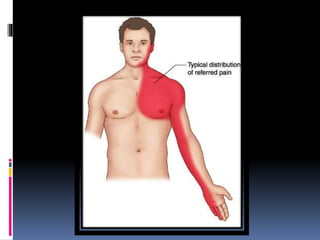
ANGINA PAIN FEATURES
 Squeezing, burning, tightening, aching across
chest usually starting behind the breast
bone.
 The often spread to neck, jaw, arms,
shoulders, throat, back, or even teeth
 Attack of stable angina last for 1 – 5 minutes
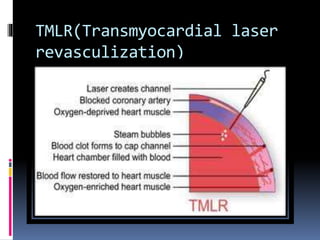
TMLR(Transmyocardial laser
revasculization)
MYOCARDIAL INFARCTION
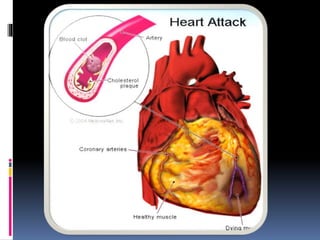
 Myocardial infarction refers to the dynamic
process in which one or more regions of the
heart experience a severe prolonged
decrease in oxygen supply because of
insufficient coronary blood flow,
subsequently necrosis or death to myocardial
tissue.
CLASSIFICATION
BASED ON PATHOLOGY
Transmural
 associated with atherosclerosis involving a major
coronary artery.
 It can be subclassified into anterior, posterior,
inferior, lateral or septal.
 Transmural infarcts extend through the whole
thickness of the heart muscle and are usually a
result of complete occlusion of the area's blood
supply.In addition, on ECG, ST elevation and Q
waves are seen.
Subendocardial:
 involving a small area in the subendocardial
wall of the left ventricle, ventricular septum,
or papillary muscles.The subendocardial area
is particularly susceptible to ischemia. In
addition, ST depression is seen on ECG.
ETIOLOGY
Reduced blood flow in the coronary artery
due to atherosclerosis, increased oxygen
demand and decreased oxygen supply
Complete occlusion of artery by emboli or
thrombus
Sudden narrowing of coronary artery
(vasospasm)
Acute blood loss(Anemia)
Risk factors
 Nonmodifiable risk factors
 Family history of premature coronary heart disease
 Male
 Modifiable risk factors
 Smoking or other tobacco use
 Diabetes mellitus
 Hypertension
 Hypercholesterolemia and hypertriglyceridemia,
including inherited lipoprotein disorders
 Dyslipidemia
 Obesity
 Sedentary lifestyle and/or lack of exercise
 Psychosocial stress
DEGREE ‘S OF MI
 ZONE OF NECROSIS
 Death of heart muscle caused by extensive and
complete oxygen deprivation,irreversible damage
 ZONE OF INJURY
 Region of muscle surrounding the area of
necrosis,inflammed and injured but still visible if
adequate oxygenation can be restored
 ZONE OF ISHCHEMIA
 Region of heart muscle surrounding the injurywhich
is sischemic and viable not endaged until extension
of infarction occurs
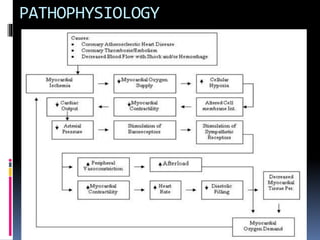
PATHOPHYSIOLOGY
CLINICAL FEATURES
 Chest pain
Pain in only one part of body, or it may move from
chest(SUBSTERNAL) to arms, shoulder, neck, teeth, jaw, belly
area, or back.
 The pain can be severe or mild.
 It can feel like:
 A tight band around the chest
 Bad indigestion
 Something heavy sitting on chest
 Squeezing or heavy pressure
 The pain usually lasts longer than 20 minutes. Rest and a
medicine called nitroglycerin may not completely relieve the pain
of a heart attack. Symptoms may also go away and come back.
 Other symptoms of a heart attack can include:
 Anxiety
 Cough
 Fainting
 Light-headedness, dizziness
 Nausea or vomiting
 Palpitations (feeling like your heart is beating too
fast or irregularly)
 Shortness of breath
 Sweating, which may be very heavy
DIAGNOSTIC TESTS
 A doctor or nurse will perform a physical
exam and listen to your chest using a
stethoscope.
 The doctor may hear abnormal sounds in
lungs (called crackles), a heart murmur, or
other abnormal sounds.
 a fast or uneven pulse.
 blood pressure may be normal, high, or low.
 Electrocardiogram (ECG) to look for heart
damage.
 A troponin blood test can heart tissue damage.
This test can confirmatory test
 Coronary angiography may be done right away
or when if patient is more stable.
 (This test uses a special dye and x-rays to see
how blood flows through heart)
 Echocardiography
 Exercise stress test
 Nuclear stress test
MANAGEMENT
 PHARMACOLOGICAL
 Medications given to treat a heart attack include:
 Aspirin
 Aspirin reduces blood clotting, thus helping maintain blood flow
through a narrowed artery.
 Thrombolytics
 These drugs, also called clotbusters, help dissolve a blood clot that's
blocking blood flow to your heart.
 Superaspirins
 These include medications, such as clopidogrel (Plavix) and others,
called platelet aggregation inhibitors.
 Other blood-thinning medications
.such as heparin, to make blood less "sticky" and less
likely to form more dangerous clots. Heparin is given
intravenously or by an injection under your skin and is
usually used during the first few days after a heart
attack.
 Pain relievers
 If chest pain or associated pain is great, you may
receive a pain reliever, such as morphine, to reduce
discomfort.
 Nitroglycerin
 This medication, used to treat chest pain (angina),
temporarily opens arterial blood vessels, improving
blood flow to and from heart.
 Beta blockers.
 These medications help relax heart muscle, slow
your heartbeat and decrease blood pressure
making heart's job easier. Beta blockers can limit
the amount of heart muscle damage and
prevent future heart attacks.
 Cholesterol-lowering medications.
 Examples include statins, niacin, fibrates and
bile acid sequestrants. These drugs help lower
levels of unwanted blood cholesterol and may
be helpful if given soon after a heart attack to
improve survival.
SURGICAL MANAGEMENT
 Coronary angioplasty and stenting.
 Emergency angioplasty opens blocked coronary
arteries, letting blood flow more freely to your heart.
Doctors insert a long, thin tube (catheter) that's passed
through an artery, usually in your leg or groin, to a
blocked artery in your heart. This catheter is equipped
with a special balloon. Once in position, the balloon is
briefly inflated to open up a blocked coronary artery. At
the same time, a metal mesh stent may be inserted into
the artery to keep it open long term, restoring blood
flow to the heart. Depending on your condition, your
doctor may opt to place a stent coated with a slow-
releasing medication to help keep your artery open.
 Coronary artery bypass surgery. In some cases,
doctors may perform emergency bypass surgery
at the time of a heart attack. Usually, your
doctor may suggest that you have bypass
surgery after your heart has had time to recover
from your heart attack. Bypass surgery involves
sewing veins or arteries in place at a site beyond
a blocked or narrowed coronary artery
(bypassing the narrowed section), restoring
blood flow to the heart.
Thankuuuuuu…….

Coronary heart diseases

  • 1.
  • 2.
    CORONARY ARTERY DISEASE Coronary artery disease is the narrowing of the coronary arteries that prevents adequate blood supply to the heart muscle.  Usually its caused by atherosclerosis, it may progress to the point where the heart muscle is damaged due to lack of blood supply. Such damage may result in infarction, arrhythmias, and heart failure.
  • 3.
    CORONARY ARTERY DISEASEIS ALSO KNOWN AS; ATHEROSCLEROTIC HEART DISEASE CORONARYATHEROSCLEROSIS CORONARYARTERIOSCLEROSIS CORONARY HEART DISEASE
  • 4.
    CORONARY ATHEROSCLEROSIS  CORONARYATHEROSCLEROSIS is the abnormal accumulation of lipid or fatty substances or fatty atheroma (plaque) in the lumen of coronary artery
  • 5.
  • 6.
    MODIFIABLE  High bloodcholesterol level  Cigarette smoking, tobacco use  Hypertension  Diabetes mellitus  Lack of estrogen in women  Physical activity  obesity
  • 7.
    NON MODIFIABLE  Familyhistory of CAD  increasing age  Gender(male)  Race(non white populations)
  • 8.
    PATHOPHYSIOLOGY  DUETO ETIOLOGICALFACTORS  INJURYTOTHE ENDOTHELIALCELLTHAT LININGTHEARTERY  INFLAMMATION AND IMMUNE REACTIONS  ACCUMULATIONOF LIPIDS INTHE INTIMA OF ARTERIALWALL
  • 9.
     T LYMPHOCYTESANDMONOCYTESTHAT BECOMESAS MACROPHAGES INFILTRATE  THE AREATO INGESTTHE LIPIDS AND DIE  PROLIFERATIONOF SMOOTH MUSCLE CELLS WITH INTHEVESSEL  FORMATION OF FIBROUS CAP OVER DEAD FATTY CORE (ATHEROMA)  PROTRUSION OF ATHEROMA INTOTHE LUMEN OFVESSEL
  • 10.
     NARROWINGAND OBSTRUCTION IF CAP ISTHINTHE LIPID CORE MAY GROW CAUSING ITTO RUPTURE  HEMORRHAGE INTO PLAQUE ALLOWINGTHROMBUSTO DEVOLOP  THROMBUS AND OBSTRUCTTHE BLOOD FLOW LEADINGTO SUDDEN CARDIAC DEATH OF MYOCARDIAL INFARCTION  ANGINA AND OTHER SYMPTOMS
  • 11.
    SIGNS & SYMPTOMS Chest pain (Angina pectoris) Myocardial infarction Diaphoresis Ecg changes Dysarrithmias Chest heaviness Dyspnea Fatigue
  • 12.
    DIAGNOSIS •History collection •Physical examination •Cardiacenzymes •Electrocardiograms •Echocardiograms •Stress Tests •Nuclear Imaging •Angiography
  • 13.
    ELECTROCARDIOGRAMS (ECGS OR EKGS) •Providea record of the heart's electrical activity. •This test records any abnormal findings in the heart's electrical impulses. Electrodes are placed on the arms and chest to monitor electrical activity.
  • 14.
  • 15.
    ECHOCARDIOGRAMS It is orderedif the patient is suspected of having problem with the heart muscle or one of the valves that channel blood through the heart.
  • 16.
    STRESS TESTS They areused to show how the heart reacts to physical exertion. Exercise stress tests are usually performed on a treadmill or exercise bicycle.
  • 18.
    ANGIOGRAPHY •Is the mostaccurate means by which to examine the coronary arteries • It requires a surgical procedure called cardiac catheterization. During the procedure, catheters (small thin plastic tubes) are placed in the artery of the leg or arm, and directed using an x-ray machine to the opening of each of the coronary arteries
  • 19.
    COMPLICATIONS  Chest pain(angina)  Heart attack  Heart failure  Abnormal heart rhythm (arrhythmia).
  • 20.
  • 21.
    PHARMACOLOGICAL THERAPY  ANTIANGINAL MEDICATIONS like  Nitrates(ISD,)  Beta adrenergic blockers (ATENOLOL)  Calcium channel blockers (NEFIDIPINE)  Ace inhibitors (CAPTOPRIL)  Statins  Imipramine for analgesia
  • 22.
  • 23.
    PCI PROCEDURAL REFINEMENTS: STENTS Expandablemetal mesh tubes that buttresses the dilated segment, limit restenosis. Drug eluting stents: further reduce cellular proliferation in response to the injury of dilatation.
  • 24.
  • 25.
  • 26.
    •Lifestyle changes: Lifestyle changesthat may be useful in coronary disease include: •Weight control •Smoking cessation •Exercise •Healthy diet
  • 27.
    ANGINA PECTORIS  Anginapectoris is a clinical syndrome usually characterised by paroxysms of pain or pressure of anterior lobe.the cause is usually insufficient blood flow
  • 29.
    TYPES  Stable angina Predictable consistent pain that occurs in exertion and is relieved by rest  Unstable angina  Also called preinfarction angina  Symptoms occur frequently and last longer than stable angina  Pain may occur at rest
  • 30.
     Variant angina Also called prinzmentals angina.  Pain at rest with reversible ST segment elevation thought to be caused by coronary artery vasospasm  Microvascular angina  Otherwise angina X syndrome  Patient have chest pain but do not seem to have any blockage in coronary artery  The pain may be due to tiny vessels that feed heart,arm and neck are not working properly
  • 31.
     Silent ischemia Objective evidence of ischemia (such as electrocardiographic changes with a stress test) but patient report no symptoms
  • 32.
    ANGINA PAIN FEATURES Squeezing, burning, tightening, aching across chest usually starting behind the breast bone.  The often spread to neck, jaw, arms, shoulders, throat, back, or even teeth  Attack of stable angina last for 1 – 5 minutes
  • 34.
  • 35.
    MYOCARDIAL INFARCTION  Myocardialinfarction refers to the dynamic process in which one or more regions of the heart experience a severe prolonged decrease in oxygen supply because of insufficient coronary blood flow, subsequently necrosis or death to myocardial tissue.
  • 37.
    CLASSIFICATION BASED ON PATHOLOGY Transmural associated with atherosclerosis involving a major coronary artery.  It can be subclassified into anterior, posterior, inferior, lateral or septal.  Transmural infarcts extend through the whole thickness of the heart muscle and are usually a result of complete occlusion of the area's blood supply.In addition, on ECG, ST elevation and Q waves are seen.
  • 38.
    Subendocardial:  involving asmall area in the subendocardial wall of the left ventricle, ventricular septum, or papillary muscles.The subendocardial area is particularly susceptible to ischemia. In addition, ST depression is seen on ECG.
  • 39.
    ETIOLOGY Reduced blood flowin the coronary artery due to atherosclerosis, increased oxygen demand and decreased oxygen supply Complete occlusion of artery by emboli or thrombus Sudden narrowing of coronary artery (vasospasm) Acute blood loss(Anemia)
  • 40.
    Risk factors  Nonmodifiablerisk factors  Family history of premature coronary heart disease  Male  Modifiable risk factors  Smoking or other tobacco use  Diabetes mellitus  Hypertension  Hypercholesterolemia and hypertriglyceridemia, including inherited lipoprotein disorders
  • 41.
     Dyslipidemia  Obesity Sedentary lifestyle and/or lack of exercise  Psychosocial stress
  • 42.
    DEGREE ‘S OFMI  ZONE OF NECROSIS  Death of heart muscle caused by extensive and complete oxygen deprivation,irreversible damage  ZONE OF INJURY  Region of muscle surrounding the area of necrosis,inflammed and injured but still visible if adequate oxygenation can be restored  ZONE OF ISHCHEMIA  Region of heart muscle surrounding the injurywhich is sischemic and viable not endaged until extension of infarction occurs
  • 43.
  • 44.
    CLINICAL FEATURES  Chestpain Pain in only one part of body, or it may move from chest(SUBSTERNAL) to arms, shoulder, neck, teeth, jaw, belly area, or back.  The pain can be severe or mild.  It can feel like:  A tight band around the chest  Bad indigestion  Something heavy sitting on chest  Squeezing or heavy pressure  The pain usually lasts longer than 20 minutes. Rest and a medicine called nitroglycerin may not completely relieve the pain of a heart attack. Symptoms may also go away and come back.
  • 45.
     Other symptomsof a heart attack can include:  Anxiety  Cough  Fainting  Light-headedness, dizziness  Nausea or vomiting  Palpitations (feeling like your heart is beating too fast or irregularly)  Shortness of breath  Sweating, which may be very heavy
  • 46.
    DIAGNOSTIC TESTS  Adoctor or nurse will perform a physical exam and listen to your chest using a stethoscope.  The doctor may hear abnormal sounds in lungs (called crackles), a heart murmur, or other abnormal sounds.  a fast or uneven pulse.  blood pressure may be normal, high, or low.
  • 47.
     Electrocardiogram (ECG)to look for heart damage.  A troponin blood test can heart tissue damage. This test can confirmatory test  Coronary angiography may be done right away or when if patient is more stable.  (This test uses a special dye and x-rays to see how blood flows through heart)  Echocardiography  Exercise stress test  Nuclear stress test
  • 48.
    MANAGEMENT  PHARMACOLOGICAL  Medicationsgiven to treat a heart attack include:  Aspirin  Aspirin reduces blood clotting, thus helping maintain blood flow through a narrowed artery.  Thrombolytics  These drugs, also called clotbusters, help dissolve a blood clot that's blocking blood flow to your heart.  Superaspirins  These include medications, such as clopidogrel (Plavix) and others, called platelet aggregation inhibitors.
  • 49.
     Other blood-thinningmedications .such as heparin, to make blood less "sticky" and less likely to form more dangerous clots. Heparin is given intravenously or by an injection under your skin and is usually used during the first few days after a heart attack.  Pain relievers  If chest pain or associated pain is great, you may receive a pain reliever, such as morphine, to reduce discomfort.  Nitroglycerin  This medication, used to treat chest pain (angina), temporarily opens arterial blood vessels, improving blood flow to and from heart.
  • 50.
     Beta blockers. These medications help relax heart muscle, slow your heartbeat and decrease blood pressure making heart's job easier. Beta blockers can limit the amount of heart muscle damage and prevent future heart attacks.  Cholesterol-lowering medications.  Examples include statins, niacin, fibrates and bile acid sequestrants. These drugs help lower levels of unwanted blood cholesterol and may be helpful if given soon after a heart attack to improve survival.
  • 51.
    SURGICAL MANAGEMENT  Coronaryangioplasty and stenting.  Emergency angioplasty opens blocked coronary arteries, letting blood flow more freely to your heart. Doctors insert a long, thin tube (catheter) that's passed through an artery, usually in your leg or groin, to a blocked artery in your heart. This catheter is equipped with a special balloon. Once in position, the balloon is briefly inflated to open up a blocked coronary artery. At the same time, a metal mesh stent may be inserted into the artery to keep it open long term, restoring blood flow to the heart. Depending on your condition, your doctor may opt to place a stent coated with a slow- releasing medication to help keep your artery open.
  • 52.
     Coronary arterybypass surgery. In some cases, doctors may perform emergency bypass surgery at the time of a heart attack. Usually, your doctor may suggest that you have bypass surgery after your heart has had time to recover from your heart attack. Bypass surgery involves sewing veins or arteries in place at a site beyond a blocked or narrowed coronary artery (bypassing the narrowed section), restoring blood flow to the heart.
  • 53.