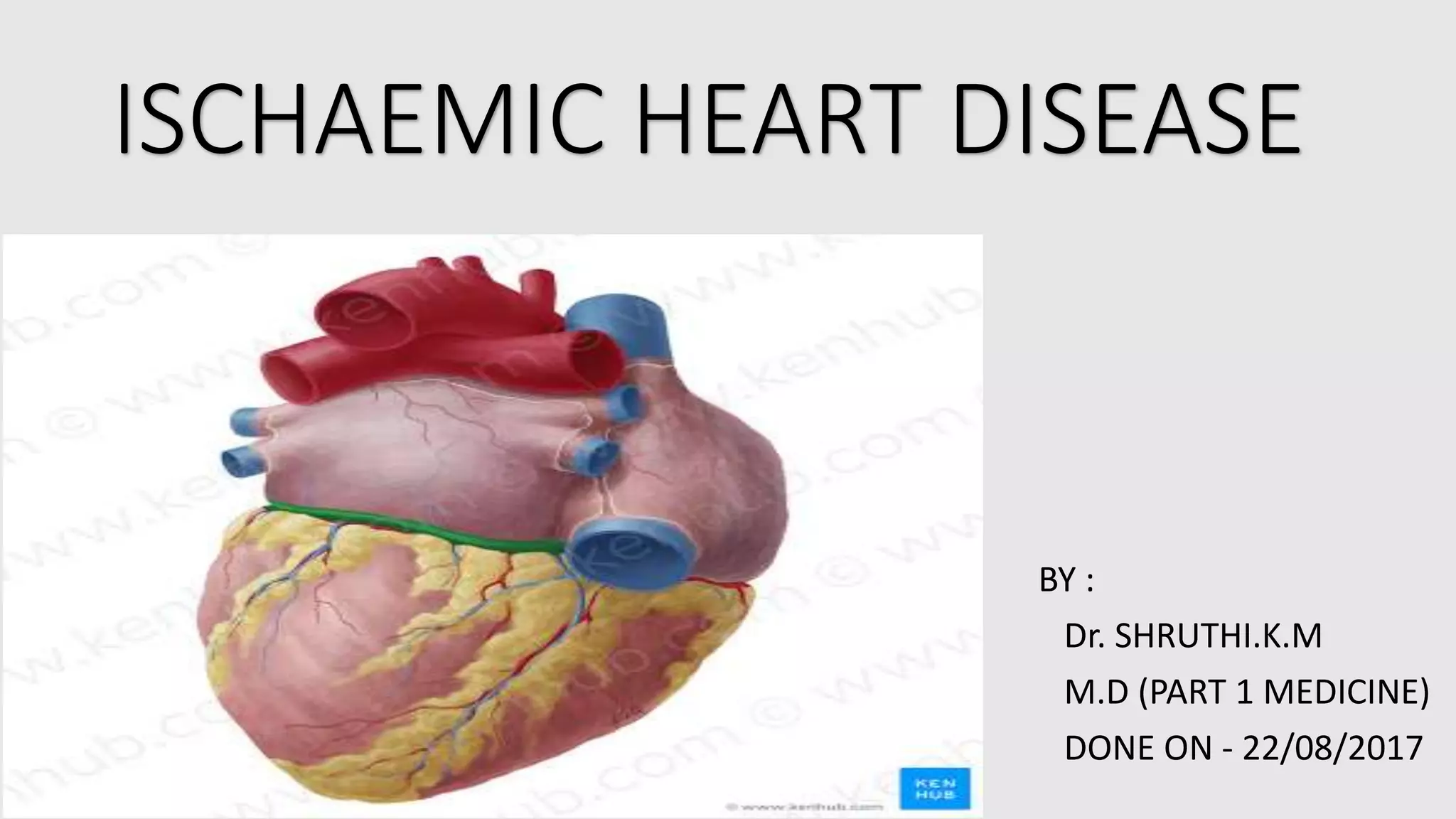
ISCHAEMIC HEART DISEASE
BY :
Dr. SHRUTHI.K.M
M.D (PART 1 MEDICINE)
DONE ON - 22/08/2017
INTRODUCTION :
• Ischaemic heart disease (IHD) is characterised by myocardial
impairment due to imbalance between coronary blood flow and
myocardial requirement.
• The blood vessels are narrowed or blocked due to deposition of
cholestrol plaques on their walls.
• This reduces the supply of oxygen and nutrients to the heart
musculature, which is essential for normal functioning of heart.
• This may eventually result in a portion of the heart being suddenly
deprived of its blood supply leading to the death of that area of heart
tissue, resulting in heart attack.
EPIDEMIOLOGY :
• Cardiovascular disease accounts for approximately 12 million deaths
annually and is the commonest cause of death globally.
• While the incidence of coronary artery disease has reduced by 50% in
the west. In India, it has doubled in the last 25 years. In 1990, 25%
deaths in India were attributable to cardiovascular diseases.
• In rural india, the CAD prevalence increased two fold from 2 to 4%.
• In urban India, the increase was three fold from 3.45 to 9.45%.
CORONARY CIRCULATION :
• coronary circulation is the circulation of blood in the blood vessels of
the heart muscle (myocardium).
• vessels that deliver oxygen rich blood to the myocardium are the
coronary arteries.
• coronary arteries are also called end circulation, since they represent
the only source of blood supply to myocardium.
• vessels that remove deoxygenated blood from the heart muscle are
known as cardiac veins.
left post. aortic sinus
ant. aortic sinus
right aortic sinus
PATHOPHYSIOLOGY :
• Pathophysiology of myocardial ischemia is the concept of myocardial
supply and demand.
• In normal conditions, for any given level of a demand for oxygen,
the myocardium will control the supply of oxygen-rich blood to
prevent under perfusion of myocytes and the subsequent
development of ischemia and infarction.
• The major determinants of myocardial oxygen demand (MV02) are
heart rate, myocardial contractility, and myocardial wall tension
(stress).
• An adequate supply of oxygen to the myocardium requires a
satisfactory level of oxygen-carrying capacity of the blood
(determined by the inspired level of oxygen, pulmonary function,
and hemoglobin concentration and function) and an adequate level of
coronary blood flow.
• Blood flows through the coronary arteries in a phasic fashion, with
the majority occurring during diastole.
• About 75% of the total coronary resistance to flow occurs across
three sets of arteries:
(1) large epicardial arteries (Resistance 1 = R1),
(2) prearteriolar vessels (R2),
(3) arteriolar and intramyocardial capillary vessels (R3).
• In the absence of significant flow-limiting atherosclerotic obstructions,
R1 is trivial, the major determinant of coronary resistance is found in R2
and R3.
• The normal coronary circulation is dominated and controlled by the
heart's requirements for oxygen. This need is met by the ability of the
coronary vascular bed to vary its resistance (and, therefore blood flow)
considerably while the myocardium extracts a high and relatively fixed
percentage of oxygen. Normally, intramyocardial resistance vessels
demonstrate a great capacity for dilation (R2 and R3 decrease).
• For example : the changing oxygen needs of the heart with exercise and
emotional stress affect coronary vascular resistance and in this manner
regulate the supply of oxygen and substrate to the myocardium
(metabolic regulation).
• The coronary resistance vessels also adapt to physiologic alterations in
blood pressure to maintain coronary blood flow at levels appropriate to
myocardial needs (autoregulation).
• By reducing the lumen of the coronary arteries, atherosclerosis limits
appropriate increases in perfusion when the demand for flow is
augmented, as occurs during exertion or excitement.
• When the luminal reduction is severe, myocardial perfusion in the
basal state is reduced.
• A reduction in the oxygen carrying capacity of the blood, as in
extremely severe anemia or in the presence of carboxyhemoglobin,
rarely causes myocardial ischemia by itself but may lower the
threshold for ischemia in patients with moderate coronary
obstruction.
• Myocardial ischemia also can occur if myocardial oxygen demands are
markedly increased and particularly when coronary blood flow may
be limited, as occurs in severe left ventricular hypertrophy (secondary
to HTN) due to aortic stenosis.
• The latter can present with angina that is indistinguishable from that
caused by coronary atherosclerosis largely owing to subendocardial
ischemia.
• Abnormal constriction or failure of normal dilation of the coronary
resistance vessels also can cause ischemia. When it causes angina,
this condition is referred to as microvascular angina.
AETIOLOGY / RISK FACTORS :
• The commonest cause of IHD is atherosclerotic coronary artery
disease (CAD).
• Nonatherosclerotic causes of myocardial ischaemia are rare and
include coronary spasm (Prinzmetal’s angina), coronary artery
embolism, coronary arteritis (polyarteritis nodosa, Takayasu’s disease,
systemic lupus erythematosus), cocaine abuse or spontaneous
dissection of coronary arteries.
• The National Heart Lung and Blood Institute of USA initiated the
Framingham Heart Study in 1949 and by 1961, the concept of risk factors
for CHD was established with hypertension and hypercholesterolaemia
being identified for intervention.
• Risk factors are :
• Asian Indians have the highest ethnic risk of CAD despite lower rates
of smoking, hypertension, obesity and higher vegetarianism.
 Fixed :
• Male age >35 years
• Female age >45 years
• Family history of premature CAD (at age <55 years)
 Modifiable : Non-lipid
• Hypertension
• Cigarette smoking/tobacco abuse
• Diabetes mellitus/insulin resistance syndrome
• Apple obesity or body mass index >23
• Homocysteine >10 mmol/L High PAI – 1
 Modifiable: Lipid
• Total cholesterol >150 mg/dL
• Triglycerides >150 mg/dL
• LDL cholesterol >100 mg/dL
• ApoA lipoproteins <100 mg/dL
• HDL <40 mg/dL males, <50 mg/dL females
 Modifiable: Lipoprotein ratios
• TC/HDLc >4.5
• LDLc/HDLc >3.5
• ApoA/ApoB <1.2
• The INTERHEART study (2004) on 25,000 myocardial infarction
patients confirmed nine risk factors attributing to CAD are :
ApoB/ApoA-1, smoking, diabetes, hypertension, abdominal obesity,
psychosocial, fruits and vegetable intake, exercise and alcohol.
• Of these ApoB/ ApoA-1 and smoking were especially associated with
increased incidence of myocardial infarction in younger patients.
MYOCARDIAL ISCHAEMIA :
CLINICAL PRESENTATION :
• The typical clinical presentation of angina refers to poorly localised
retrosternal discomfort with radiation to neck, shoulders, arms, jaws,
epigastrium or back; usually, not above the jaw and not below the
umbilicus.
• Angina is typically triggered by physical activity, emotional stress,
exposure to cold, consuming a heavy meal or smoking.
• Pain is poorly localised, vague chest discomfort which may be
described as squeezing, burning, tightness, choking, heaviness, hot or
cold sensation, dyspnoea, fatigue, weakness, lightheadedness,
nausea, diaphoresis, altered sensorium and syncope.
• Pain lasts for 2 to 8 minutes. Ischaemia seldom lasts more than 30
minutes without causing acute myocardial infarction (AMI).
• Pain is relieved with rest or sublingual nitroglycerine in 2 to 5
minutes.
• It is less likely to be angina if it is localised (finger pointing), less than
30 s, or more than 30 min without AMI, exclusively at rest (except
unstable/Prinzmetal), pricking or jabbing and changing sites of pain,
• presence of diffuse retrosternal pain and aggravation with exertion,
relief on rest, chest pain is likely to be due to underlying CAD in 90%
of patients.
• In presence either of one factor (atypical chest pain), underlying CAD
is likely in 50% of patients.
• If both the factors are absent, the cause of pain is most likely non-
cardiac.
• A few patients have walk-through angina (pain gets relieved while the
patient continues to walk). Decubitus angina is believed to be caused by
blood volume shifts towards the lungs, resulting in rise in LV end-diastolic
pressure.
• Nocturnal angina may be associated with nightmares.
• Prinzmetal’s angina attributable to intense coronary vasospasm was
described first in 1959 by Prinzmetal with a consistent yet atypical pattern
of angina at rest (non-threshold angina) precipitated by cold, emotional
stress and smoking which was associated with ST-segment elevation.
Paradoxic responses consistent with endothelial dysfunction have been
described. Intense vasospasm is also seen in subjects who abuse cocaine
and amphetamine. Provocative testing by inducing hyperventilation or
administering intracoronary acetylcholine or ergonovine typically
precipitate an attack of variant angina associated with focal spasm.
PHYSICAL FINDINGS :
• The physical finding may reveal risk factors of CAD. These include
elevated BP, corneal arcus, xanthelasma, retinal arteriolar changes,
diagonal earlobe crease, etc.
• The cardiovascular system (CVS) examination is normal (except for
audible S4) in most individuals with stable angina.
• The presence of systolic murmur may suggest underlying aortic
stenosis, mitral valve prolapse (MVP) or hypertrophic obstructive
cardiomyopathy (HOCM) as cause of angina.
DIFFERENTIAL DIAGNOSIS OF CHEST PAIN:
1. Cardiac - angina
2. Oesophageal - acid peptic diseases, GERD
3. Musculoskeletal - costochondritis, cervical disc disease, trauma or
strain
4. Infections - Herpes zooster
5. Psychological - Panic disorder.
DIAGNOSTIC :
• The patient should be evaluated for presence of underlying diabetes
mellitus (Fasting and post-prandial blood sugar levels, HbA1C),
• dyslipidaemia (raised total cholesterol, LDL-C, VLDL-C, triglycerides,
ApoB and reduced HDL-C).
• The presence of markers like hs-CRP, lipoprotein (a), homocysteine,
tPA, PAI-I, fibrinogen, etc. can be indicators of underlying
atherosclerosis.
 Baseline Electrocardiogram :
• This is likely to be normal in over 90% cases and only helps to
recognise LVH, bundle branch block, old MI or pre-excitation.
 Stress Testing :
• Exercise is a common physiological stress used to elicit cardiovascular
abnormalities not present at rest and to determine the adequacy of
cardiac function.
• As exercise progresses, in individuals with underlying CAD, there
occurs a mismatch between oxygen supply and demand which may
manifest with electrocardiographic, regional wall motion or
myocardial perfusion abnormalities.
• The commonly used exercise stress tests to diagnose underlying CAD
are—treadmill stress test, dobutamine stress echocardiography and
stress perfusion imagining.
 Treadmill stress test :
• Treadmill stress test remains a cornerstone of cardiovascular evaluation. It
is a simple, safe and cost-effective test in the diagnosis of coronary artery
disease.
• The average present sensitivity and specificity of exercise testing in
diagnosing coronary artery disease in 68% and 77%. In single vessel
disease, the sensitivity ranges from 25% to 71% while that for left main
and triple vessel disease is 86%.
• The results are less specific with more false positive outcomes in patients
with marked resting ST-segment depression, digitalis effect, valvular heart
disease, hypokalaemia and young female subjects with non specific T wave
changes. Stress echocardiography and thallium stress testing increase the
diagnostic yield especially in the above subsets.
 Stress perfusion imaging and myocardial cellular metabolism
assessment :
• After injecting gadolinium, contrast IV images are acquired during rest
and after achieving pharmocological stress using IV adenosine dose of
140ug/kg body weight for 4 to 6 minutes.
• Hibernating myocardium shows perfusion defect on stress that may
not be present at rest.
• The regional wall motion abnormality seen at rest improves after
stress and there is no delayed contrast enhancement.
 Echocardiography and stress echocardiography in CAD
• Use of ultrasound for analysing the structure and function of the heart
provides useful non-invasive information in the overall assessment of a
patient of CAD.
• Global LV systolic function frequently guides the choice of therapy.
Segmental wall motion abnormalities are useful and specific. These wall
motion abnormalities can be segmentally scored.
• Various complications of CAD such as dyssynergic areas, aneurysm,
intramural clot, free wall rupture, pseudoaneurysm formation, pericardial
effusion, mitral filling patterns, assessment of aetiology and severity of
mitral regurgitation, assessment of tricuspid regurgitation, deduction of
PA pressure and LVEDP can be performed.
• Myocardial viability assessment can be performed using dobutamine
stress echocardiography in patients with CAD and LV dysfunction.
• Stunned myocardium is a transient myocardial dysfunction that
occurs after an acute episode of ischaemia and may occur despite the
restoration of normal blood flow. This may last several days to weeks.
• Contrast echocardiography and cardiac MRI are techniques that
reliably identify ‘stunned myocardium’. Impaired regional myocardial
energy production, calcium overload, free radical injury and ischaemic
damage to extracellular matrix may be underlying mechanisms for
stunning.
• Dobutamine echocardiography is an established technique for the
identification of hibernating myocardium. A segmental comparison of
systolic thickening before and after administration of dobutamine is
performed using recorded images. Low-dose dobutamine inducing
increased systolic thickening at low dose that deteriorates at high dose
(‘biphasic response’) is most specific for predicting response to
revascularisation. The greater the number of viable segments, the greater
is the chance of survival after revascularisation.
• There are thus several techniques for identification of viability. PET is the
‘gold standard’ but dobutamine echocardiography may be the most
specific for prediction of improvement following revascularisation.
However, cardiac MRI probably identifies scar tissue the best with
excellent reproducibility and will probably be used more extensively to
make decisions about intervention in the future.
 Ambulatory Electrocardiographic Monitoring :
• Silent myocardial ischaemia is defined as documented episodes of
ischaemia not associated with any typical or atypical symptoms that occur
among patients with obstructive coronary artery disease.
• Holter monitoring is required to identify these clinically asymptomatic
events. The asymptomatic MI and ischaemic episodes are common in
diabetics.
 Cardiac Biomarkers :
• cardiac biomarkers become detectable in the peripheral blood
• The CPK-MB is used most commonly.
• Troponins are more specific
• Myoglobin is less specific.
 Coronary Angiography
• The coronary arteries can be visualised by either invasive or
computed tomography (CT) coronary angiography.
• The major epicardial branches and their second- and third-order
branches can be visualised using coronary arteriography.
• CAD is considered to be significant when more than 70% stenosis of
arterial diameter is seen in one or more.
• Subcritical stenoses of less than 50% are best characterised as non-
obstructive CAD; obstructive CAD is classified as one, twoor three
vessel disease of these vessels or more.
 Multislice CT Coronary Angiogram :
• CT scan in CAD has multiple potential uses : assessment of ventricular
function, visualisation of coronary arteries and evaluation of coronary
artery calcification.
• The detection of even large amounts of coronary calcium does not
imply the presence of significant stenosis, but the complete absence
of coronary calcium rules out significant CAD.
• Thus, multislice CT, in experienced hands is a modality that can
ruleout significant CAD in low-risk population non-invasively.
MANAGEMENT :
 Lifestyle modification :
• Smoking cessation,
• healthy diet - vegetarian with less than 10% fat and avoid diary
products. limit saturated fatty acids and trans fatty acids.
• regular exercise, maintaining ideal body weight, improving fitness
• These may forestall the need for pharmacologic measures to reduce
coronary risk.
 Pharmacologic
• Anti-platelets
• Lipid lowering agents
• Nitrates
• Beta-blockers
• Calcium channel blockers
 Adjunctive treatments
• Metabolic modulation: Trimetazidine
• LV Dysfunction
• ACE-inhibitors
• Aldosterone antagonists
 Gene therapy
Stem cell therapy
Percutaneous coronary intervention
Surgical revascularisation
HOMEOPATHIC MANAGEMENT :
• Coronary, insufficiency - aran-ix, aur, CRAT, dig, hed, lat-m, prot, visc.
• heart block - stront carb.
THANK YOU........

Ischaemic heart disease

  • 1.
    ISCHAEMIC HEART DISEASE BY: Dr. SHRUTHI.K.M M.D (PART 1 MEDICINE) DONE ON - 22/08/2017
  • 2.
    INTRODUCTION : • Ischaemicheart disease (IHD) is characterised by myocardial impairment due to imbalance between coronary blood flow and myocardial requirement. • The blood vessels are narrowed or blocked due to deposition of cholestrol plaques on their walls. • This reduces the supply of oxygen and nutrients to the heart musculature, which is essential for normal functioning of heart. • This may eventually result in a portion of the heart being suddenly deprived of its blood supply leading to the death of that area of heart tissue, resulting in heart attack.
  • 4.
    EPIDEMIOLOGY : • Cardiovasculardisease accounts for approximately 12 million deaths annually and is the commonest cause of death globally. • While the incidence of coronary artery disease has reduced by 50% in the west. In India, it has doubled in the last 25 years. In 1990, 25% deaths in India were attributable to cardiovascular diseases. • In rural india, the CAD prevalence increased two fold from 2 to 4%. • In urban India, the increase was three fold from 3.45 to 9.45%.
  • 5.
    CORONARY CIRCULATION : •coronary circulation is the circulation of blood in the blood vessels of the heart muscle (myocardium). • vessels that deliver oxygen rich blood to the myocardium are the coronary arteries. • coronary arteries are also called end circulation, since they represent the only source of blood supply to myocardium. • vessels that remove deoxygenated blood from the heart muscle are known as cardiac veins.
  • 6.
    left post. aorticsinus ant. aortic sinus right aortic sinus
  • 8.
    PATHOPHYSIOLOGY : • Pathophysiologyof myocardial ischemia is the concept of myocardial supply and demand. • In normal conditions, for any given level of a demand for oxygen, the myocardium will control the supply of oxygen-rich blood to prevent under perfusion of myocytes and the subsequent development of ischemia and infarction. • The major determinants of myocardial oxygen demand (MV02) are heart rate, myocardial contractility, and myocardial wall tension (stress).
  • 9.
    • An adequatesupply of oxygen to the myocardium requires a satisfactory level of oxygen-carrying capacity of the blood (determined by the inspired level of oxygen, pulmonary function, and hemoglobin concentration and function) and an adequate level of coronary blood flow. • Blood flows through the coronary arteries in a phasic fashion, with the majority occurring during diastole. • About 75% of the total coronary resistance to flow occurs across three sets of arteries: (1) large epicardial arteries (Resistance 1 = R1), (2) prearteriolar vessels (R2), (3) arteriolar and intramyocardial capillary vessels (R3).
  • 10.
    • In theabsence of significant flow-limiting atherosclerotic obstructions, R1 is trivial, the major determinant of coronary resistance is found in R2 and R3. • The normal coronary circulation is dominated and controlled by the heart's requirements for oxygen. This need is met by the ability of the coronary vascular bed to vary its resistance (and, therefore blood flow) considerably while the myocardium extracts a high and relatively fixed percentage of oxygen. Normally, intramyocardial resistance vessels demonstrate a great capacity for dilation (R2 and R3 decrease). • For example : the changing oxygen needs of the heart with exercise and emotional stress affect coronary vascular resistance and in this manner regulate the supply of oxygen and substrate to the myocardium (metabolic regulation). • The coronary resistance vessels also adapt to physiologic alterations in blood pressure to maintain coronary blood flow at levels appropriate to myocardial needs (autoregulation).
  • 11.
    • By reducingthe lumen of the coronary arteries, atherosclerosis limits appropriate increases in perfusion when the demand for flow is augmented, as occurs during exertion or excitement. • When the luminal reduction is severe, myocardial perfusion in the basal state is reduced. • A reduction in the oxygen carrying capacity of the blood, as in extremely severe anemia or in the presence of carboxyhemoglobin, rarely causes myocardial ischemia by itself but may lower the threshold for ischemia in patients with moderate coronary obstruction.
  • 12.
    • Myocardial ischemiaalso can occur if myocardial oxygen demands are markedly increased and particularly when coronary blood flow may be limited, as occurs in severe left ventricular hypertrophy (secondary to HTN) due to aortic stenosis. • The latter can present with angina that is indistinguishable from that caused by coronary atherosclerosis largely owing to subendocardial ischemia. • Abnormal constriction or failure of normal dilation of the coronary resistance vessels also can cause ischemia. When it causes angina, this condition is referred to as microvascular angina.
  • 13.
    AETIOLOGY / RISKFACTORS : • The commonest cause of IHD is atherosclerotic coronary artery disease (CAD). • Nonatherosclerotic causes of myocardial ischaemia are rare and include coronary spasm (Prinzmetal’s angina), coronary artery embolism, coronary arteritis (polyarteritis nodosa, Takayasu’s disease, systemic lupus erythematosus), cocaine abuse or spontaneous dissection of coronary arteries.
  • 14.
    • The NationalHeart Lung and Blood Institute of USA initiated the Framingham Heart Study in 1949 and by 1961, the concept of risk factors for CHD was established with hypertension and hypercholesterolaemia being identified for intervention. • Risk factors are :
  • 15.
    • Asian Indianshave the highest ethnic risk of CAD despite lower rates of smoking, hypertension, obesity and higher vegetarianism.  Fixed : • Male age >35 years • Female age >45 years • Family history of premature CAD (at age <55 years)  Modifiable : Non-lipid • Hypertension • Cigarette smoking/tobacco abuse • Diabetes mellitus/insulin resistance syndrome • Apple obesity or body mass index >23 • Homocysteine >10 mmol/L High PAI – 1
  • 16.
     Modifiable: Lipid •Total cholesterol >150 mg/dL • Triglycerides >150 mg/dL • LDL cholesterol >100 mg/dL • ApoA lipoproteins <100 mg/dL • HDL <40 mg/dL males, <50 mg/dL females  Modifiable: Lipoprotein ratios • TC/HDLc >4.5 • LDLc/HDLc >3.5 • ApoA/ApoB <1.2
  • 17.
    • The INTERHEARTstudy (2004) on 25,000 myocardial infarction patients confirmed nine risk factors attributing to CAD are : ApoB/ApoA-1, smoking, diabetes, hypertension, abdominal obesity, psychosocial, fruits and vegetable intake, exercise and alcohol. • Of these ApoB/ ApoA-1 and smoking were especially associated with increased incidence of myocardial infarction in younger patients.
  • 18.
  • 19.
    CLINICAL PRESENTATION : •The typical clinical presentation of angina refers to poorly localised retrosternal discomfort with radiation to neck, shoulders, arms, jaws, epigastrium or back; usually, not above the jaw and not below the umbilicus. • Angina is typically triggered by physical activity, emotional stress, exposure to cold, consuming a heavy meal or smoking. • Pain is poorly localised, vague chest discomfort which may be described as squeezing, burning, tightness, choking, heaviness, hot or cold sensation, dyspnoea, fatigue, weakness, lightheadedness, nausea, diaphoresis, altered sensorium and syncope.
  • 20.
    • Pain lastsfor 2 to 8 minutes. Ischaemia seldom lasts more than 30 minutes without causing acute myocardial infarction (AMI). • Pain is relieved with rest or sublingual nitroglycerine in 2 to 5 minutes. • It is less likely to be angina if it is localised (finger pointing), less than 30 s, or more than 30 min without AMI, exclusively at rest (except unstable/Prinzmetal), pricking or jabbing and changing sites of pain, • presence of diffuse retrosternal pain and aggravation with exertion, relief on rest, chest pain is likely to be due to underlying CAD in 90% of patients. • In presence either of one factor (atypical chest pain), underlying CAD is likely in 50% of patients. • If both the factors are absent, the cause of pain is most likely non- cardiac.
  • 22.
    • A fewpatients have walk-through angina (pain gets relieved while the patient continues to walk). Decubitus angina is believed to be caused by blood volume shifts towards the lungs, resulting in rise in LV end-diastolic pressure. • Nocturnal angina may be associated with nightmares. • Prinzmetal’s angina attributable to intense coronary vasospasm was described first in 1959 by Prinzmetal with a consistent yet atypical pattern of angina at rest (non-threshold angina) precipitated by cold, emotional stress and smoking which was associated with ST-segment elevation. Paradoxic responses consistent with endothelial dysfunction have been described. Intense vasospasm is also seen in subjects who abuse cocaine and amphetamine. Provocative testing by inducing hyperventilation or administering intracoronary acetylcholine or ergonovine typically precipitate an attack of variant angina associated with focal spasm.
  • 23.
    PHYSICAL FINDINGS : •The physical finding may reveal risk factors of CAD. These include elevated BP, corneal arcus, xanthelasma, retinal arteriolar changes, diagonal earlobe crease, etc. • The cardiovascular system (CVS) examination is normal (except for audible S4) in most individuals with stable angina. • The presence of systolic murmur may suggest underlying aortic stenosis, mitral valve prolapse (MVP) or hypertrophic obstructive cardiomyopathy (HOCM) as cause of angina.
  • 25.
    DIFFERENTIAL DIAGNOSIS OFCHEST PAIN: 1. Cardiac - angina 2. Oesophageal - acid peptic diseases, GERD 3. Musculoskeletal - costochondritis, cervical disc disease, trauma or strain 4. Infections - Herpes zooster 5. Psychological - Panic disorder.
  • 26.
    DIAGNOSTIC : • Thepatient should be evaluated for presence of underlying diabetes mellitus (Fasting and post-prandial blood sugar levels, HbA1C), • dyslipidaemia (raised total cholesterol, LDL-C, VLDL-C, triglycerides, ApoB and reduced HDL-C). • The presence of markers like hs-CRP, lipoprotein (a), homocysteine, tPA, PAI-I, fibrinogen, etc. can be indicators of underlying atherosclerosis.
  • 27.
     Baseline Electrocardiogram: • This is likely to be normal in over 90% cases and only helps to recognise LVH, bundle branch block, old MI or pre-excitation.
  • 28.
     Stress Testing: • Exercise is a common physiological stress used to elicit cardiovascular abnormalities not present at rest and to determine the adequacy of cardiac function. • As exercise progresses, in individuals with underlying CAD, there occurs a mismatch between oxygen supply and demand which may manifest with electrocardiographic, regional wall motion or myocardial perfusion abnormalities. • The commonly used exercise stress tests to diagnose underlying CAD are—treadmill stress test, dobutamine stress echocardiography and stress perfusion imagining.
  • 29.
     Treadmill stresstest : • Treadmill stress test remains a cornerstone of cardiovascular evaluation. It is a simple, safe and cost-effective test in the diagnosis of coronary artery disease. • The average present sensitivity and specificity of exercise testing in diagnosing coronary artery disease in 68% and 77%. In single vessel disease, the sensitivity ranges from 25% to 71% while that for left main and triple vessel disease is 86%. • The results are less specific with more false positive outcomes in patients with marked resting ST-segment depression, digitalis effect, valvular heart disease, hypokalaemia and young female subjects with non specific T wave changes. Stress echocardiography and thallium stress testing increase the diagnostic yield especially in the above subsets.
  • 31.
     Stress perfusionimaging and myocardial cellular metabolism assessment : • After injecting gadolinium, contrast IV images are acquired during rest and after achieving pharmocological stress using IV adenosine dose of 140ug/kg body weight for 4 to 6 minutes. • Hibernating myocardium shows perfusion defect on stress that may not be present at rest. • The regional wall motion abnormality seen at rest improves after stress and there is no delayed contrast enhancement.
  • 33.
     Echocardiography andstress echocardiography in CAD • Use of ultrasound for analysing the structure and function of the heart provides useful non-invasive information in the overall assessment of a patient of CAD. • Global LV systolic function frequently guides the choice of therapy. Segmental wall motion abnormalities are useful and specific. These wall motion abnormalities can be segmentally scored. • Various complications of CAD such as dyssynergic areas, aneurysm, intramural clot, free wall rupture, pseudoaneurysm formation, pericardial effusion, mitral filling patterns, assessment of aetiology and severity of mitral regurgitation, assessment of tricuspid regurgitation, deduction of PA pressure and LVEDP can be performed.
  • 34.
    • Myocardial viabilityassessment can be performed using dobutamine stress echocardiography in patients with CAD and LV dysfunction. • Stunned myocardium is a transient myocardial dysfunction that occurs after an acute episode of ischaemia and may occur despite the restoration of normal blood flow. This may last several days to weeks. • Contrast echocardiography and cardiac MRI are techniques that reliably identify ‘stunned myocardium’. Impaired regional myocardial energy production, calcium overload, free radical injury and ischaemic damage to extracellular matrix may be underlying mechanisms for stunning.
  • 35.
    • Dobutamine echocardiographyis an established technique for the identification of hibernating myocardium. A segmental comparison of systolic thickening before and after administration of dobutamine is performed using recorded images. Low-dose dobutamine inducing increased systolic thickening at low dose that deteriorates at high dose (‘biphasic response’) is most specific for predicting response to revascularisation. The greater the number of viable segments, the greater is the chance of survival after revascularisation. • There are thus several techniques for identification of viability. PET is the ‘gold standard’ but dobutamine echocardiography may be the most specific for prediction of improvement following revascularisation. However, cardiac MRI probably identifies scar tissue the best with excellent reproducibility and will probably be used more extensively to make decisions about intervention in the future.
  • 37.
     Ambulatory ElectrocardiographicMonitoring : • Silent myocardial ischaemia is defined as documented episodes of ischaemia not associated with any typical or atypical symptoms that occur among patients with obstructive coronary artery disease. • Holter monitoring is required to identify these clinically asymptomatic events. The asymptomatic MI and ischaemic episodes are common in diabetics.  Cardiac Biomarkers : • cardiac biomarkers become detectable in the peripheral blood • The CPK-MB is used most commonly. • Troponins are more specific • Myoglobin is less specific.
  • 38.
     Coronary Angiography •The coronary arteries can be visualised by either invasive or computed tomography (CT) coronary angiography. • The major epicardial branches and their second- and third-order branches can be visualised using coronary arteriography. • CAD is considered to be significant when more than 70% stenosis of arterial diameter is seen in one or more. • Subcritical stenoses of less than 50% are best characterised as non- obstructive CAD; obstructive CAD is classified as one, twoor three vessel disease of these vessels or more.
  • 40.
     Multislice CTCoronary Angiogram : • CT scan in CAD has multiple potential uses : assessment of ventricular function, visualisation of coronary arteries and evaluation of coronary artery calcification. • The detection of even large amounts of coronary calcium does not imply the presence of significant stenosis, but the complete absence of coronary calcium rules out significant CAD. • Thus, multislice CT, in experienced hands is a modality that can ruleout significant CAD in low-risk population non-invasively.
  • 42.
    MANAGEMENT :  Lifestylemodification : • Smoking cessation, • healthy diet - vegetarian with less than 10% fat and avoid diary products. limit saturated fatty acids and trans fatty acids. • regular exercise, maintaining ideal body weight, improving fitness • These may forestall the need for pharmacologic measures to reduce coronary risk.
  • 43.
     Pharmacologic • Anti-platelets •Lipid lowering agents • Nitrates • Beta-blockers • Calcium channel blockers  Adjunctive treatments • Metabolic modulation: Trimetazidine • LV Dysfunction • ACE-inhibitors • Aldosterone antagonists
  • 44.
     Gene therapy Stemcell therapy Percutaneous coronary intervention Surgical revascularisation
  • 47.
    HOMEOPATHIC MANAGEMENT : •Coronary, insufficiency - aran-ix, aur, CRAT, dig, hed, lat-m, prot, visc. • heart block - stront carb.
  • 48.