Ischemic Heart
Diseases
Pathophysiology Unit-II
-Ms. S. B. Gaurkar
Ischemic Heart Diseases
• Ischemia is inadequate blood supply to a local area due to blockage of the blood
vessels supplying the area.
• Myocardial ischemia means heart is not getting enough blood and oxygen.
• Ischemic heart disease or IHD represents a group of related problems resulting from
myocardial ischemia.
• Simply it is an imbalance between myocardial supply (perfusion) and cardiac demand
for oxygenated blood.
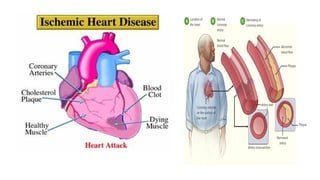
• Narrowing or blocking of coronary arteries → decreased blood flow→ low O2 supply
to the heart → low tissue perfusion myocardial ischemia.
• Narrowing can be caused by a blood clot or by constriction of the blood vessel, most
often it is caused by buildup of plaque, called atherosclerosis.
• Ischemic heart disease, also called coronary heart disease (CHD) or
coronary artery disease.
Etiology of IHD
• Common cause of ischemic heart disease is a reduction in coronary arterial blood
supply due to atherosclerosis of the coronary arteries.
• Hypertension, diabetes mellitus, smoking, high cholesterol, high levels of low
density lipoprotein, and genetic factors also causes IHD
• Other causes are vasospasm, coronary artery stenosis, inflammation of coronary
arteries, thrombotic disease, trauma, aneurysms and compression.
Pathogenesis of IHD
• Typically associated with a critical stenosis, defined as a reduction in the lumen of
one or more coronary arteries by atherosclerotic plaque.
• With this level of fixed obstruction, the augmented coronary blood follow that may
occur as a result of compensatory coronary vasodilation.
• So it is insufficient to meet even moderate increase in myocardial oxygen demand.
• In chronic, fixed atherosclerotic plaques, various superimposed lesions are
responsible for the development of myocardial ischemia.
• Clinical Manifestations:
I. Myocardial infarction (MI), in which ischemia causes frank cardiac necrosis
II. Angina pectoris (Literally "chest pain"), in which ischemia is not severe enough to
cause infarction, but nevertheless signify risk
III. Chronic IHD with heart failure
IV. Sudden cardiac death (SCD).
V. Arrhythmia: altered conduction due to ischaemia or infraction.
Angina Pectoris
• Angina pectoris is the result of myocardial ischemia caused by an imbalance between
myocardial blood supply and oxygen demand.
• Sudden onset of chest pain due to myocardial infarction.
• Chest pain is a symptom of lactic acidosis (lactic acid is by-product of anerobic
metabolism in the absence of oxygen).
• Angina pectoris is a clinical syndrome usually characterized by episodes of pain or
pressure in the anterior chest.
• Symptoms of Angina
i. Chest pain and discomfort, possibly described as pressure, squeezing, burning or
fullness.
ii. Pain in arms, neck, jaw, shoulder or back.
iii. Dizziness, Fatigue, Nausea, Shortness of breath and Sweating
Angina Pectoris
Types of Angina:
There are 3 overlapping clinical patterns of angina pectoris with some differences in
their pathogenesis:
I. Stable or typical angina
II. Unstable or crescendo angina
III. Prinzmetal's variant angina
Angina Pectoris
I. Stable or typical angina:
• This is the most common pattern of angina.
• Attacks of pain following physical exertion or emotional excitement.
• The pain is often also aggravated by anger or excitement.
• The pain is relieved within 2-10 min by rest, Rarely the pain will disappear even
though exertion continues.
• ECG shows ST segment depression due to poor perfusion to the left ventricle
Angina Pectoris
II. Unstable or Crescendo Angina:
• Also known as 'pre-infarction angina' or 'acute coronary insufficiency.
• Most serious pattern of angina.
• Recurrent episodes of angina on minimal effort or at rest
• on ECG, acute MI characterised by ST segment elevation while unstable angina may
have non-ST segment elevation MI.
Angina Pectoris
III. Prinzmetal's / Variant Angina:
• Pain at rest and has no relationship with physical activity.
• ECG shows ST segment elevation due to transmural ischaemia.
• Pain occurs principally at rest, usually unprovoked, but since coronary artery disease
may coexist, pain may also be provoked by exercise.
Etiology of Angina
• Most commonly caused by myocardial ischaemia which results from a mismatch
between myocardial blood supply and oxygen demand.
• Atherosclerosis- Restriction of myocardial blood flow usually results from
atherosclerotic narrowing of an epicardial coronary artery
• Endothelial dysfunction: Abnormal vasodilatation or even vasoconstriction resulting
from impaired endothelial function.
• Use of vasoconstricting drugs .eg, cocaine, nicotine and emotional stress also can
trigger coronary spasm.
Pathogenesis of Angina
• i. Pathogenesis of Stable angina: Due to chronic stenosing coronary atherosclerosis
that cannot perfuse the myocardium effectively in increased workload of heart.
• ii. Pathogenesis of Unstable angina: Due to stenosing coronary atherosclerosis,
complicated coronary plaques (eg. superimposed thrombosis, haemorrhage, rupture,
ulceration etc), platelet thrombi over atherosclerotic plaques and vasospasm of
coronary arteries
• iii. Pathogenesis of Prinzmetal's Angina: The exact pathogenesis of Prinzmetal's
angina is not known.
• It may occur due to sudden vasospasm of a coronary trunk induced by coronary
atherosclerosis, or may be due to release of humoral vasoconstrictors by mast cells in
the coronary adventitia.
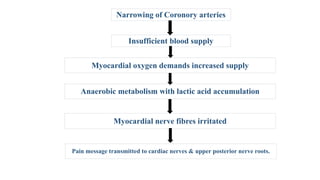
Insufficient blood supply
Narrowing of Coronory arteries
Myocardial oxygen demands increased supply
Anaerobic metabolism with lactic acid accumulation
Myocardial nerve fibres irritated
Pain message transmitted to cardiac nerves & upper posterior nerve roots.
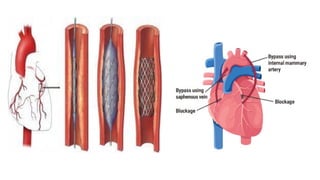
Treatment of angina
Treatment options include:
i Rest
ii. Medications (Nitroglycerine, B-blockers, calcium channel blockers),
iii. Percutaneous transluminal coronary angioplasty (PTCA), or
iv. Coronary artery bypass graft surgery (CABG).
COMPLICATIONS:
• Higher probability of being exposed to cardiac arrest if not detected and diagnosed in
time.
• If left ignored and untreated can lead to a heart attack.
• Strict changes in lifestyle and immediate medication to reduce the chance of a cardiac
arrest.
Ischemic Heart Diseases-Angina pectoris.pptx