INTERNSHIP REPORT
Name of the Learner: Randhir Kumar Yadav
Name of the Programme: MAPC (Second year, July 2019)
Enrolment Number: 188178309
Year: 2018-2020
Regional Centre: IGNOU Regional Centre, Delhi-2 Gandhi Smriti & Darshan Samiti Rajghat, New
Delhi- 110002
Name of the Organization: Brain Behaviour Research Foundation of India
Discipline of psychology
School of social sciences
Indira Gandhi National Open University
Maidan Garhi, New Delhi-110068
lOMoARcPSD|25238877
DECLARATION
I Mr. Randhir Kumar Yadav hereby declare that I am a Learner of M.A. Psychology (Part II), July 2019
year, at the Study Centre Code 29046D, Regional Centre Delhi-2, Gandhi Smriti & Darshan Samiti
Rajghat, New Delhi- 110002 and I want to do my Internship (MPCE-025) at Brain Behaviour Research
Foundation of India (BBRFI), New Delhi on my own free will. I will adhere to the standards of the
organization and display professionalism during my internship.
Signature of the Learner:
Name of the Learner: Randhir Kumar Yadav Date: 27/7/2020
Enrolment No: 188178309 Place: New Delhi
lOMoARcPSD|25238877
REFERENCE LETTER
To,
Date: 16th
June 2020
Brain Behavior Research
Foundation of India
Rajghat, New Delhi- 110002
Dear Sir/ Madam,
This is state that Mr. Randhir Kumar Yadav, Enrollment No. 188178309 is a student of IGNOU and is
presently pursuing MA in Psychology from IGNOU Regional, Delhi-2 Gandhi Smriti & Darshan
Samiti Rajghat, New Delhi- 110002 and Vision Institute of Advanced Studies. Study Centre. As a
part of
MA Psychology programme he has to carry out internship (MPCE-025) for 240 hours. You are
requested to kindly provide him with permission to undergo internship at your esteemed organization.
You are also requested to assign one supervisor under whom the learner will carry out his
internship. The supervisor will also have to evaluate the learner as per the given criteria.
Yours faithfully,
Study-Centre Coordinator
lOMoARcPSD|25238877
CONSENT LETTER (Agency Supervisor)
This is to certify that the internship in MPCE-025 for the partial fulfilment of MAPC Programme of
IGNOU will be carried out by Randhir Kumar Yadav, Enrolment No. 188178309, under my
supervision.
(Signature)
Name of the Agency Supervisor: Priyanka Pandey
Designation: Clinical Psychologist (RCI Regd., CRR NO. A62932)
Address: Brain Behaviour Research Foundation of India (BBRFI)
1, Jawahar Lal Nehru Marg, Rajghat, New Delhi - 110002
Date: 20th June, 2020
lOMoARcPSD|25238877
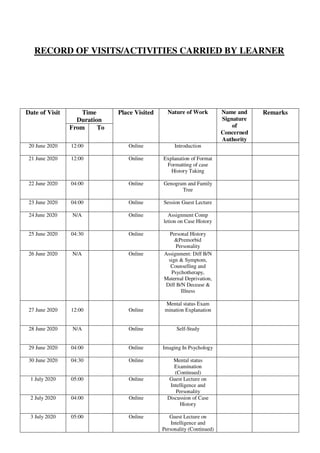
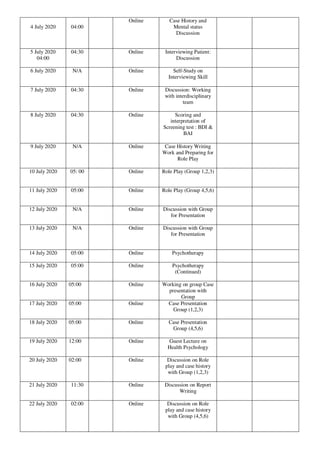
RECORD OF VISITS/ACTIVITIES CARRIED BY LEARNER
Date of Visit Time
Duration
Place Visited Nature of Work Name and
Signature
of
Concerned
Authority
Remarks
From To
20 June 2020 12:00 Online Introduction
21 June 2020 12:00 Online Explanation of Format
Formatting of case
History Taking
22 June 2020 04:00 Online Genogram and Family
Tree
23 June 2020 04:00 Online Session Guest Lecture
24 June 2020 N/A Online Assignment Comp
letion on Case History
25 June 2020 04:30 Online Personal History
&Premorbid
Personality
26 June 2020 N/A Online Assignment: Diff B/N
sign & Symptom,
Counselling and
Psychotherapy,
Maternal Deprivation,
Diff B/N Decease &
Illness
27 June 2020 12:00 Online
Mental status Exam
mination Explanation
28 June 2020 N/A Online Self-Study
29 June 2020 04:00 Online Imaging In Psychology
30 June 2020 04:30 Online Mental status
Examination
(Continued)
1 July 2020 05:00 Online Guest Lecture on
Intelligence and
Personality
2 July 2020 04:00 Online Discussion of Case
History
3 July 2020 05:00 Online Guest Lecture on
Intelligence and
Personality (Continued)
lOMoARcPSD|25238877
4 July 2020 04:00
Online Case History and
Mental status
Discussion
5 July 2020
04:00
04:30 Online Interviewing Patient:
Discussion
6 July 2020 N/A Online Self-Study on
Interviewing Skill
7 July 2020 04:30 Online Discussion: Working
with interdisciplinary
team
8 July 2020 04:30 Online Scoring and
interpretation of
Screening test : BDI &
BAI
9 July 2020 N/A Online Case History Writing
Work and Preparing for
Role Play
10 July 2020 05: 00 Online Role Play (Group 1,2,3)
11 July 2020 05:00 Online Role Play (Group 4,5,6)
12 July 2020 N/A Online Discussion with Group
for Presentation
13 July 2020 N/A Online Discussion with Group
for Presentation
14 July 2020 05:00 Online Psychotherapy
15 July 2020 05:00 Online Psychotherapy
(Continued)
16 July 2020 05:00 Online Working on group Case
presentation with
Group
17 July 2020 05:00 Online Case Presentation
Group (1,2,3)
18 July 2020 05:00 Online Case Presentation
Group (4,5,6)
19 July 2020 12:00 Online Guest Lecture on
Health Psychology
20 July 2020 02:00 Online Discussion on Role
play and case history
with Group (1,2,3)
21 July 2020 11:30 Online Discussion on Report
Writing
22 July 2020 02:00 Online Discussion on Role
play and case history
with Group (4,5,6)
lOMoARcPSD|25238877
23 July 2020 04:30 Online Mental and Physical
well-Being
24 July to 29 July
2020
N/A Online Report
Writing and Discussion
Faculty for Doubts
31 July 2020 N/A Online Farewell and thought
Sharing
Signature of the Learner Signature of Academic Counsellor
lOMoARcPSD|25238877
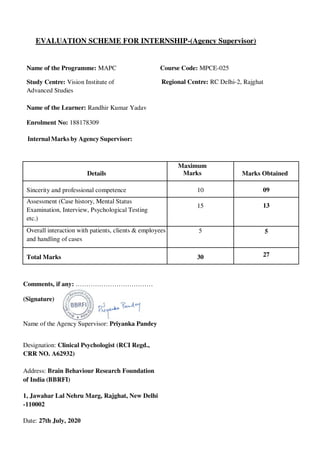
EVALUATION SCHEME FOR INTERNSHIP-(Agency Supervisor)
Name of the Programme: MAPC Course Code: MPCE-025
Study Centre: Vision Institute of
Advanced Studies
Name of the Learner: Randhir Kumar Yadav
Enrolment No: 188178309
Internal Marks by Agency Supervisor:
Comments, if any: ………………………………
(Signature)
Name of the Agency Supervisor: Priyanka Pandey
Designation: Clinical Psychologist (RCI Regd.,
CRR NO. A62932)
Address: Brain Behaviour Research Foundation
of India (BBRFI)
1, Jawahar Lal Nehru Marg, Rajghat, New Delhi
-110002
Date: 27th July, 2020
Regional Centre: RC Delhi-2, Rajghat
Details
Maximum
Marks Marks Obtained
Sincerity and professional competence 10 09
Assessment (Case history, Mental Status
Examination, Interview, Psychological Testing
etc.)
15 13
Overall interaction with patients, clients & employees
and handling of cases
5 5
Total Marks 30 27
lOMoARcPSD|25238877
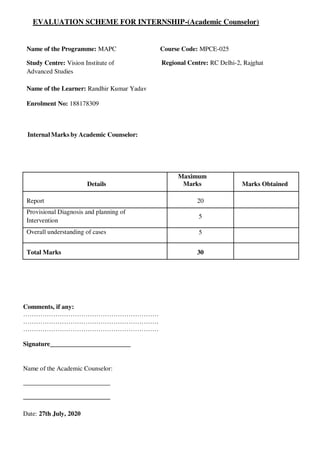
EVALUATION SCHEME FOR INTERNSHIP-(Academic Counselor)
Name of the Programme: MAPC Course Code: MPCE-025
Study Centre: Vision Institute of
Advanced Studies
Name of the Learner: Randhir Kumar Yadav
Enrolment No: 188178309
Internal Marks by Academic Counselor:
Comments, if any:
………………………………………………………
………………………………………………………
………………………………………………………
Signature_________________________
Name of the Academic Counselor:
___________________________
___________________________
Date: 27th July, 2020
Regional Centre: RC Delhi-2, Rajghat
Details
Maximum
Marks Marks Obtained
Report 20
Provisional Diagnosis and planning of
Intervention
5
Overall understanding of cases 5
Total Marks 30
lOMoARcPSD|25238877
EVALUATION SCHEME FOR INTERNSHIP-(External Examiner)
Name of the Programme: MAPC Course Code: MPCE-025
Study Centre: Vision Institute of
Advanced Studies
Name of the Learner: Randhir Kumar Yadav
Enrolment No: 188178309
External Marks: (Viva Voce):
Comments, if any:
………………………………………………………
………………………………………………………
………………………………………………………
………………………………………………………
(Signature)
Name & Address of External Examiner
_______________________________
_______________________________
_______________________________
Date:
Regional Centre: RC Delhi-2, Rajghat
Details
Maximum
Marks Marks Obtained
Viva 40
Total Marks
lOMoARcPSD|25238877
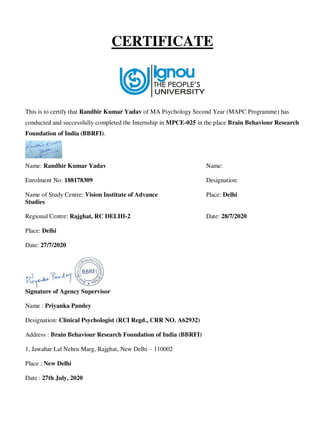
CERTIFICATE
This is to certify that Randhir Kumar Yadav of MA Psychology Second Year (MAPC Programme) has
conducted and successfully completed the Internship in MPCE-025 in the place Brain Behaviour Research
Foundation of India (BBRFI).
Name: Randhir Kumar Yadav Name:
Enrolment No: 188178309 Designation:
Name of Study Centre: Vision Institute of Advance
Studies
Place: Delhi
Regional Centre: Rajghat, RC DELHI-2 Date: 28/7/2020
Place: Delhi
Date: 27/7/2020
Signature of Agency Supervisor
Name : Priyanka Pandey
Designation: Clinical Psychologist (RCI Regd., CRR NO. A62932)
Address : Brain Behaviour Research Foundation of India (BBRFI)
1, Jawahar Lal Nehru Marg, Rajghat, New Delhi – 110002
Place : New Delhi
Date : 27th July, 2020
lOMoARcPSD|25238877
ACKNOWLEDGEMENT
At the outset, I would like to show my gratitude for my internship opportunity at Brain Behaviour Research
Foundation of India, which has been a great chance for learning and professional development. I consider
myself to be a blessed and lucky individual to be provided with this opportunity. I extend my heartfelt
gratitude for having an amazing opportunity to meet so many wonderful professionals in the field of Mental
Health and Clinical Psychology; all who have led me to this have a very comprehensive internship
experience.
It is with my radiant respect that I owe my deepest sense of gratitude to Dr. Meena Mishra (Chairperson), to let
me work under her department with her team of clinical psychologists; And to Ms. Priyanka Pandey (Clinical
Psychologist). It is for her careful and precious guidance, monitoring and constant encouragement which have
been extremely valuable for my educational understanding; both theoretical and practical. The blessing, help and
guidance given by her from time to time shall always stay with me and help me move forward to a long way in
the journey of life on which I am about to embark. I will always remain grateful for her natural affection and able
guidance.
Name: Randhir Kumar Yadav
Enrolment Number: 188178309
MAPC (Counseling Psychology), IGNOU
lOMoARcPSD|25238877
Brain Behaviour Research Foundation of India
Brain Behaviour Research Foundation of India is a National level research trust registered under the Indian
Trust Act 1882. It is working to develop new techniques, tools & methods to solve the Mental Health
problems in India. BBRFI is the only charitable organization in India that is working towards scientific and
evidence-based guidance and counseling in career, interpersonal and intrapersonal relationships.
The Trust is an amalgamation of diverse professionals with the common aim of ‗Promoting Positive Mental
Health & Well-being for All‘ by guiding the children and youth towards careers matching their talent using
4-Dimensional Brain Analysis, a unique diagnostic tool innovated by BBRFI.
There is a large ‗gap‘ between the needs of the society and delivery of mental health services. Team
members at BBRFI are striving to bridge this gap by targeting children and youth- helping them realize their
true potential in studies, career and relationships which is the core to an individual‘s happiness along with
addressing common problems of depression, suicidal tendency amongst others.
Specialized services:
 Psychoanalysis & Counseling
 De-addiction
 Brain Mapping
 Psychological Disorder Testing
 Attention Deficit disorders
 Emotional and Behavioral issues
 Relationship Problem
 Adjustment Problem
 Depression
 Stress and anxiety management
 Career counseling
 IQ Testing
 Marriage Counseling
Ms. Priyanka Pandey, M.Phil. In Clinical Psychology (RCI registered) and MA in Clinical
Psychology, is associated with Brain Behaviour Research Foundation of India as Consultant Clinical
Psychologist. She has 9 years of experience in clinical psychology and is expert in full range of de-
addiction which includes Clinical Evaluations, Psychotherapies, Group Therapies, and 12 Step Programs,
Projective Test, Memory Test, personality and aptitude tests along with career guidance.
lOMoARcPSD|25238877
TABLE OF CONTENT
1. CASE STUDY 1:______________________________________________________________15
2. CASE STUDY 2:______________________________________________________________23
3. CASE STUDY 3:______________________________________________________________32
4. CASE STUDY 4:______________________________________________________________42
5. CASE STUDY 5:______________________________________________________________53
6. CASE STUDY 6:______________________________________________________________61
7. CASE STUDY 7:______________________________________________________________67
8. CASE STUDY 8:______________________________________________________________75
9. CASE STUDY 9:______________________________________________________________83
10. CASE STDUY 10:_____________________________________________________________89
lOMoARcPSD|25238877
CASE STUDY 1
Date: 02/02/2020
Socio-demographic Data:
Name : Client-2
Age : 37 years
Gender : Male
Marital Status: Unmarried
Occupation: Employed (Labourer)
Education : 08th
Std.
Religion : Hindu
Residence : Rural
Language : Hindi
Informant : Elder Brother of Client-2
 40 years old
 Formally educated up to B.A & is doing marketing business
 Not living with the Client-2
 Well- wisher of the Client-2
 No h/o past psychiatric illness
 Appears to be of sound mind
Reliability & Adequacy: Poor
Course: Continuous and Progressive
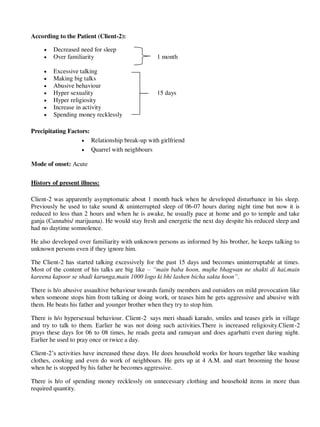
Chief Complaints:
According to the Informant:
 Developed over familiarity with unknown persons
 Keeps talking to unknown persons even if they ignore him 1 month
 Started talking excessively - 15 days
lOMoARcPSD|25238877
According to the Patient (Client-2):
 Decreased need for sleep
 Over familiarity 1 month
 Excessive talking
 Making big talks
 Abusive behaviour
 Hyper sexuality 15 days
 Hyper religiosity
 Increase in activity
 Spending money recklessly
Precipitating Factors:
 Relationship break-up with girlfriend
 Quarrel with neighbours
Mode of onset: Acute
History of present illness:
Client-2 was apparently asymptomatic about 1 month back when he developed disturbance in his sleep.
Previously he used to take sound & uninterrupted sleep of 06-07 hours during night time but now it is
reduced to less than 2 hours and when he is awake, he usually pace at home and go to temple and take
ganja (Cannabis/ marijuana). He would stay fresh and energetic the next day despite his reduced sleep and
had no daytime somnolence.
He also developed over familiarity with unknown persons as informed by his brother, he keeps talking to
unknown persons even if they ignore him.
The Client-2 has started talking excessively for the past 15 days and becomes uninterruptable at times.
Most of the content of his talks are big like – “main baba hoon, mujhe bhagwan ne shakti di hai,main
kareena kapoor se shadi karunga,main 1000 logo ki bhi lashen bicha sakta hoon”.
There is h/o abusive assaultive behaviour towards family members and outsiders on mild provocation like
when someone stops him from talking or doing work, or teases him he gets aggressive and abusive with
them. He beats his father and younger brother when they try to stop him.
There is h/o hypersexual behaviour. Client-2 says meri shaadi karado, smiles and teases girls in village
and try to talk to them. Earlier he was not doing such activities.There is increased religiosity.Client-2
prays these days for 06 to 08 times, he reads geeta and ramayan and does agarbatti even during night.
Earlier he used to pray once or twice a day.
Client-2‘s activities have increased these days. He does household works for hours together like washing
clothes, cooking and even do work of neighbours. He gets up at 4 A.M. and start brooming the house
when he is stopped by his father he becomes aggressive.
There is h/o of spending money recklessly on unnecessary clothing and household items in more than
required quantity.
lOMoARcPSD|25238877
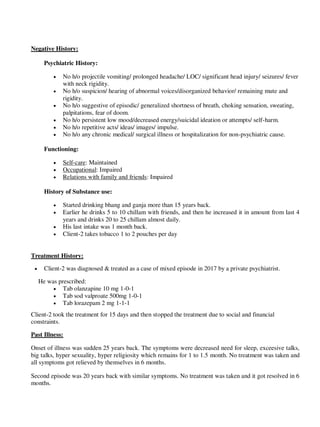
Negative History:
Psychiatric History:
 No h/o projectile vomiting/ prolonged headache/ LOC/ significant head injury/ seizures/ fever
with neck rigidity.
 No h/o suspicion/ hearing of abnormal voices/disorganized behavior/ remaining mute and
rigidity.
 No h/o suggestive of episodic/ generalized shortness of breath, choking sensation, sweating,
palpitations, fear of doom.
 No h/o persistent low mood/decreased energy/suicidal ideation or attempts/ self-harm.
 No h/o repetitive acts/ ideas/ images/ impulse.
 No h/o any chronic medical/ surgical illness or hospitalization for non-psychiatric cause.
Functioning:
 Self-care: Maintained
 Occupational: Impaired
 Relations with family and friends: Impaired
History of Substance use:
 Started drinking bhang and ganja more than 15 years back.
 Earlier he drinks 5 to 10 chillam with friends, and then he increased it in amount from last 4
years and drinks 20 to 25 chillam almost daily.
 His last intake was 1 month back.
 Client-2 takes tobacco 1 to 2 pouches per day
Treatment History:
 Client-2 was diagnosed & treated as a case of mixed episode in 2017 by a private psychiatrist.
He was prescribed:
 Tab olanzapine 10 mg 1-0-1
 Tab sod valproate 500mg 1-0-1
 Tab lorazepam 2 mg 1-1-1
Client-2 took the treatment for 15 days and then stopped the treatment due to social and financial
constraints.
Past Illness:
Onset of illness was sudden 25 years back. The symptoms were decreased need for sleep, exceesive talks,
big talks, hyper sexuality, hyper religiosity which remains for 1 to 1.5 month. No treatment was taken and
all symptoms got relieved by themselves in 6 months.
Second episode was 20 years back with similar symptoms. No treatment was taken and it got resolved in 6
months.
lOMoARcPSD|25238877
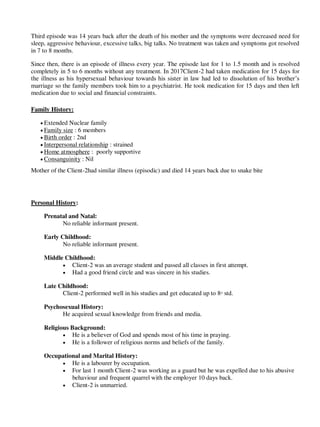
Third episode was 14 years back after the death of his mother and the symptoms were decreased need for
sleep, aggressive behaviour, excessive talks, big talks. No treatment was taken and symptoms got resolved
in 7 to 8 months.
Since then, there is an episode of illness every year. The episode last for 1 to 1.5 month and is resolved
completely in 5 to 6 months without any treatment. In 2017Client-2 had taken medication for 15 days for
the illness as his hypersexual behaviour towards his sister in law had led to dissolution of his brother‘s
marriage so the family members took him to a psychiatrist. He took medication for 15 days and then left
medication due to social and financial constraints.
Family History:
 Extended Nuclear family
 Family size : 6 members
 Birth order : 2nd
 Interpersonal relationship : strained
 Home atmosphere : poorly supportive
 Consanguinity : Nil
Mother of the Client-2had similar illness (episodic) and died 14 years back due to snake bite
Personal History:
Prenatal and Natal:
No reliable informant present.
Early Childhood:
No reliable informant present.
Middle Childhood:
 Client-2 was an average student and passed all classes in first attempt.
 Had a good friend circle and was sincere in his studies.
Late Childhood:
Client-2 performed well in his studies and get educated up to 8th
std.
Psychosexual History:
He acquired sexual knowledge from friends and media.
Religious Background:
 He is a believer of God and spends most of his time in praying.
 He is a follower of religious norms and beliefs of the family.
Occupational and Marital History:
 He is a labourer by occupation.
 For last 1 month Client-2 was working as a guard but he was expelled due to his abusive
behaviour and frequent quarrel with the employer 10 days back.
 Client-2 is unmarried.
lOMoARcPSD|25238877
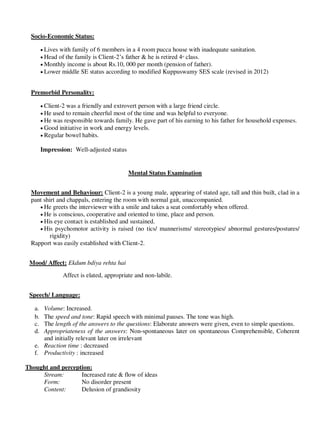
Socio-Economic Status:
 Lives with family of 6 members in a 4 room pucca house with inadequate sanitation.
 Head of the family is Client-2‘s father & he is retired 4th
class.
 Monthly income is about Rs.10, 000 per month (pension of father).
 Lower middle SE status according to modified Kuppuswamy SES scale (revised in 2012)
Premorbid Personality:
 Client-2 was a friendly and extrovert person with a large friend circle.
 He used to remain cheerful most of the time and was helpful to everyone.
 He was responsible towards family. He gave part of his earning to his father for household expenses.
 Good initiative in work and energy levels.
 Regular bowel habits.
Impression: Well-adjusted status
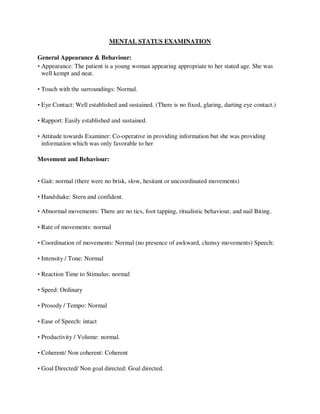
Mental Status Examination
Movement and Behaviour: Client-2 is a young male, appearing of stated age, tall and thin built, clad in a
pant shirt and chappals, entering the room with normal gait, unaccompanied.
 He greets the interviewer with a smile and takes a seat comfortably when offered.
 He is conscious, cooperative and oriented to time, place and person.
 His eye contact is established and sustained.
 His psychomotor activity is raised (no tics/ mannerisms/ stereotypies/ abnormal gestures/postures/
rigidity)
Rapport was easily established with Client-2.
Mood/ Affect: Ekdum bdiya rehta hai
Affect is elated, appropriate and non-labile.
Speech/ Language:
a. Volume: Increased.
b. The speed and tone: Rapid speech with minimal pauses. The tone was high.
c. The length of the answers to the questions: Elaborate answers were given, even to simple questions.
d. Appropriateness of the answers: Non-spontaneous later on spontaneous Comprehensible, Coherent
and initially relevant later on irrelevant
e. Reaction time : decreased
f. Productivity : increased
Thought and perception:
Stream: Increased rate & flow of ideas
Form: No disorder present
Content: Delusion of grandiosity
lOMoARcPSD|25238877
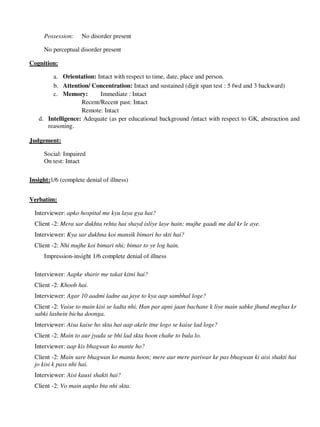
Possession: No disorder present
No perceptual disorder present
Cognition:
a. Orientation: Intact with respect to time, date, place and person.
b. Attention/ Concentration: Intact and sustained (digit span test : 5 fwd and 3 backward)
c. Memory: Immediate : Intact
Recent/Recent past: Intact
Remote: Intact
d. Intelligence: Adequate (as per educational background /intact with respect to GK, abstraction and
reasoning.
Judgement:
Social: Impaired
On test: Intact
Insight:1/6 (complete denial of illness)
Verbatim:
Interviewer: apko hospital me kyu laya gya hai?
Client -2: Mera sar dukhta rehta hai shayd isliye laye hain; mujhe gaadi me dal kr le aye.
Interviewer: Kya sar dukhna koi mansik bimari ho skti hai?
Client -2: Nhi mujhe koi bimari nhi; bimar to ye log hain.
Impression-insight 1/6 complete denial of illness
Interviewer: Aapke sharir me takat kitni hai?
Client -2: Khoob hai.
Interviewer: Agar 10 aadmi ladne aa jaye to kya aap sambhal loge?
Client -2: Vaise to main kisi se ladta nhi, Han par apni jaan bachane k liye main sabke jhund meghus kr
sabki lashein bicha doonga.
Interviewer: Aisa kaise ho skta hai aap akele itne logo se kaise lad loge?
Client -2: Main to aur jyada se bhi lad skta hoon chahe to bula lo.
Interviewer: aap kis bhagwan ko mante ho?
Client -2: Main sare bhagwan ko manta hoon; mere aur mere pariwar ke pas bhagwan ki aisi shakti hai
jo kisi k pass nhi hai.
Interviewer: Aisi kausi shakti hai?
Client -2: Vo main aapko bta nhi skta.
lOMoARcPSD|25238877
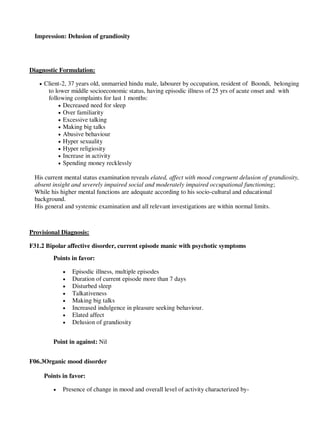
Impression: Delusion of grandiosity
Diagnostic Formulation:
 Client-2, 37 years old, unmarried hindu male, labourer by occupation, resident of Boondi, belonging
to lower middle socioeconomic status, having episodic illness of 25 yrs of acute onset and with
following complaints for last 1 months:
 Decreased need for sleep
 Over familiarity
 Excessive talking
 Making big talks
 Abusive behaviour
 Hyper sexuality
 Hyper religiosity
 Increase in activity
 Spending money recklessly
His current mental status examination reveals elated, affect with mood congruent delusion of grandiosity,
absent insight and severely impaired social and moderately impaired occupational functioning;
While his higher mental functions are adequate according to his socio-cultural and educational
background.
His general and systemic examination and all relevant investigations are within normal limits.
Provisional Diagnosis:
F31.2 Bipolar affective disorder, current episode manic with psychotic symptoms
Points in favor:
 Episodic illness, multiple episodes
 Duration of current episode more than 7 days
 Disturbed sleep
 Talkativeness
 Making big talks
 Increased indulgence in pleasure seeking behaviour.
 Elated affect
 Delusion of grandiosity
Point in against: Nil
F06.3Organic mood disorder
Points in favor:
 Presence of change in mood and overall level of activity characterized by-
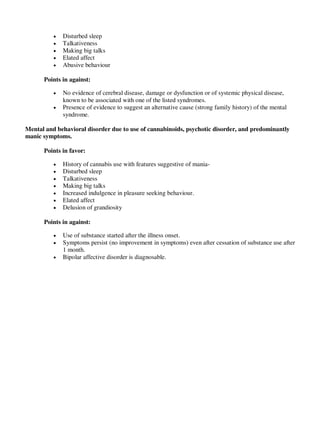
lOMoARcPSD|25238877
 Disturbed sleep
 Talkativeness
 Making big talks
 Elated affect
 Abusive behaviour
Points in against:
 No evidence of cerebral disease, damage or dysfunction or of systemic physical disease,
known to be associated with one of the listed syndromes.
 Presence of evidence to suggest an alternative cause (strong family history) of the mental
syndrome.
Mental and behavioral disorder due to use of cannabinoids, psychotic disorder, and predominantly
manic symptoms.
Points in favor:
 History of cannabis use with features suggestive of mania-
 Disturbed sleep
 Talkativeness
 Making big talks
 Increased indulgence in pleasure seeking behaviour.
 Elated affect
 Delusion of grandiosity
Points in against:
 Use of substance started after the illness onset.
 Symptoms persist (no improvement in symptoms) even after cessation of substance use after
1 month.
 Bipolar affective disorder is diagnosable.
lOMoARcPSD|25238877
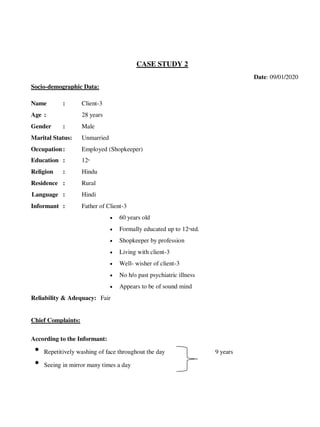
CASE STUDY 2
Date: 09/01/2020
Socio-demographic Data:
Name : Client-3
Age : 28 years
Gender : Male
Marital Status: Unmarried
Occupation: Employed (Shopkeeper)
Education : 12th
Religion : Hindu
Residence : Rural
Language : Hindi
Informant : Father of Client-3
 60 years old
 Formally educated up to 12th
std.
 Shopkeeper by profession
 Living with client-3
 Well- wisher of client-3
 No h/o past psychiatric illness
 Appears to be of sound mind
Reliability & Adequacy: Fair
Chief Complaints:
According to the Informant:
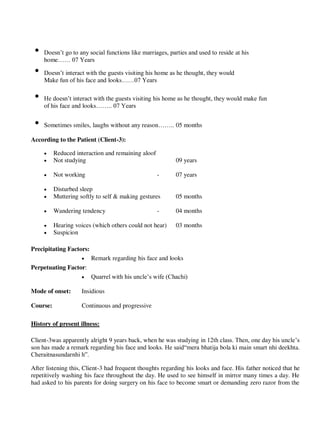
• Repetitively washing of face throughout the day 9 years
• Seeing in mirror many times a day
lOMoARcPSD|25238877
• Doesn‘t go to any social functions like marriages, parties and used to reside at his
home…… 07 Years
• Doesn‘t interact with the guests visiting his home as he thought, they would
Make fun of his face and looks……07 Years
• He doesn‘t interact with the guests visiting his home as he thought, they would make fun
of his face and looks…….. 07 Years
• Sometimes smiles, laughs without any reason…….. 05 months
According to the Patient (Client-3):
 Reduced interaction and remaining aloof
 Not studying 09 years
 Not working - 07 years
 Disturbed sleep
 Muttering softly to self & making gestures 05 months
 Wandering tendency - 04 months
 Hearing voices (which others could not hear) 03 months
 Suspicion
Precipitating Factors:
 Remark regarding his face and looks
Perpetuating Factor:
 Quarrel with his uncle‘s wife (Chachi)
Mode of onset: Insidious
Course: Continuous and progressive
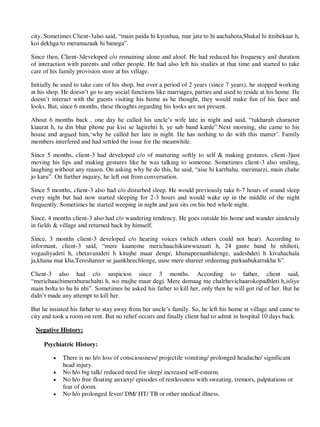
History of present illness:
Client-3was apparently alright 9 years back, when he was studying in 12th class. Then, one day his uncle‘s
son has made a remark regarding his face and looks. He said―mera bhatija bola ki main smart nhi deekhta.
Cheraitnasundarnhi h‖.
After listening this, Client-3 had frequent thoughts regarding his looks and face. His father noticed that he
repetitively washing his face throughout the day. He used to see himself in mirror many times a day. He
had asked to his parents for doing surgery on his face to become smart or demanding zero razor from the
lOMoARcPSD|25238877
city. Sometimes Client-3also said, ―main paida hi kyonhua, mar jata to hi aachahota,Shakal hi itnibekaar h,
koi dekhga to meramazaak hi banega‖.
Since then, Client-3developed c/o remaining alone and aloof. He had reduced his frequency and duration
of interaction with parents and other people. He had also left his studies at that time and started to take
care of his family provision store at his village.
Initially he used to take care of his shop, but over a period of 2 years (since 7 years), he stopped working
at his shop. He doesn‘t go to any social functions like marriages, parties and used to reside at his home. He
doesn‘t interact with the guests visiting his home as he thought, they would make fun of his face and
looks. But, since 6 months, these thoughts regarding his looks are not present.
About 6 months back , one day he called his uncle‘s wife late in night and said, ―tukharab character
kiaurat h, tu din bhar phone par kisi se lagirehti h, ye sab band karde‖.Next morning, she came to his
house and argued him,‗why he called her late in night. He has nothing to do with this matter‘. Family
members interfered and had settled the issue for the meanwhile.
Since 5 months, client-3 had developed c/o of muttering softly to self & making gestures. client-3just
moving his lips and making gestures like he was talking to someone. Sometimes client-3 also smiling,
laughing without any reason. On asking why he do this, he said, ―aise hi karrhahu. merimarzi, main chahe
jo karu‖. On further inquiry, he left out from conversation.
Since 5 months, client-3 also had c/o disturbed sleep. He would previously take 6-7 hours of sound sleep
every night but had now started sleeping for 2-3 hours and would wake up in the middle of the night
frequently. Sometimes he started weeping in night and just sits on his bed whole night.
Since, 4 months client-3 also had c/o wandering tendency. He goes outside his home and wander aimlessly
in fields & village and returned back by himself.
Since, 3 months client-3 developed c/o hearing voices (which others could not hear). According to
informant, client-3 said, ―mere kaanome merichaachikiawwazaati h, 24 gante band hi nhihoti,
vogaaliyadeti h, chetavanideti h kitujhe maar denge, khanapeenanhidenge, aadeshdeti h kivahachala
ja,khana mat kha,Tereshareer se jaankheechlenge, usne mere shareer ordeemag parkaabukarrakha h‖.
Client-3 also had c/o suspicion since 3 months. According to father, client said,
―merichaachimeraburachahti h, wo mujhe maar degi. Mere demaag me chalrhevichaarokopadhleti h,isliye
main bolta to hu hi nhi‖. Sometimes he asked his father to kill her, only then he will got rid of her. But he
didn‘t made any attempt to kill her.
But he insisted his father to stay away from her uncle‘s family. So, he left his home at village and came to
city and took a room on rent. But no relief occurs and finally client had to admit in hospital 10 days back.
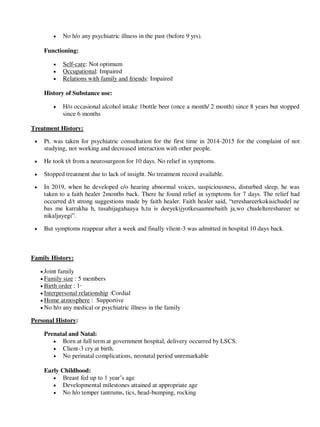
Negative History:
Psychiatric History:
 There is no h/o loss of consciousness/ projectile vomiting/ prolonged headache/ significant
head injury.
 No h/o big talk/ reduced need for sleep/ increased self-esteem.
 No h/o free floating anxiety/ episodes of restlessness with sweating, tremors, palpitations or
fear of doom.
 No h/o prolonged fever/ DM/ HT/ TB or other medical illness.
lOMoARcPSD|25238877
 No h/o any psychiatric illness in the past (before 9 yrs).
Functioning:
 Self-care: Not optimum
 Occupational: Impaired
 Relations with family and friends: Impaired
History of Substance use:
 H/o occasional alcohol intake 1bottle beer (once a month/ 2 month) since 8 years but stopped
since 6 months
Treatment History:
 Pt. was taken for psychiatric consultation for the first time in 2014-2015 for the complaint of not
studying, not working and decreased interaction with other people.
 He took t/t from a neurosurgeon for 10 days. No relief in symptoms.
 Stopped treatment due to lack of insight. No treatment record available.
 In 2019, when he developed c/o hearing abnormal voices, suspiciousness, disturbed sleep, he was
taken to a faith healer 2months back. There he found relief in symptoms for 7 days. The relief had
occurred d/t strong suggestions made by faith healer. Faith healer said, ―tereshareerkokisichudel ne
bas me karrakha h, tusahijagahaaya h,tu is deeyekijyotkesaamnebaith ja,wo chudeltereshareer se
nikaljayegi‖.
 But symptoms reappear after a week and finally vlient-3 was admitted in hospital 10 days back.
Family History:
 Joint family
 Family size : 5 members
 Birth order : 1st
 Interpersonal relationship :Cordial
 Home atmosphere : Supportive
 No h/o any medical or psychiatric illness in the family
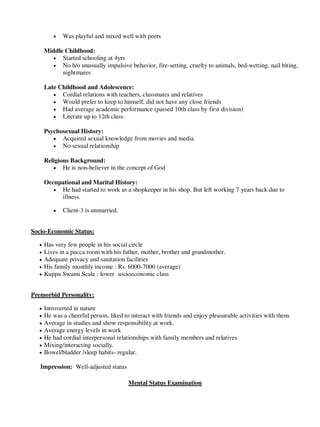
Personal History:
Prenatal and Natal:
 Born at full term at government hospital, delivery occurred by LSCS.
 Client-3 cry at birth.
 No perinatal complications, neonatal period unremarkable
Early Childhood:
 Breast fed up to 1 year‘s age
 Developmental milestones attained at appropriate age
 No h/o temper tantrums, tics, head-bumping, rocking
lOMoARcPSD|25238877
 Was playful and mixed well with peers
Middle Childhood:
 Started schooling at 4yrs
 No h/o unusually impulsive behavior, fire-setting, cruelty to animals, bed-wetting, nail biting,
nightmares
Late Childhood and Adolescence:
 Cordial relations with teachers, classmates and relatives
 Would prefer to keep to himself, did not have any close friends
 Had average academic performance (passed 10th class by first division)
 Literate up to 12th class.
Psychosexual History:
 Acquired sexual knowledge from movies and media
 No sexual relationship
Religious Background:
 He is non-believer in the concept of God
Occupational and Marital History:
 He had started to work as a shopkeeper in his shop. But left working 7 years back due to
illness.
 Client-3 is unmarried.
Socio-Economic Status:
 Has very few people in his social circle
 Lives in a pucca room with his father, mother, brother and grandmother.
 Adequate privacy and sanitation facilities
 His family monthly income : Rs. 6000-7000 (average)
 Kuppu Swami Scale : lower socioeconomic class
Premorbid Personality:
 Introverted in nature
 He was a cheerful person, liked to interact with friends and enjoy pleasurable activities with them.
 Average in studies and show responsibility at work.
 Average energy levels in work
 He had cordial interpersonal relationships with family members and relatives
 Mixing/interacting socially.
 Bowel/bladder /sleep habits- regular.
Impression: Well-adjusted status
Mental Status Examination
lOMoARcPSD|25238877
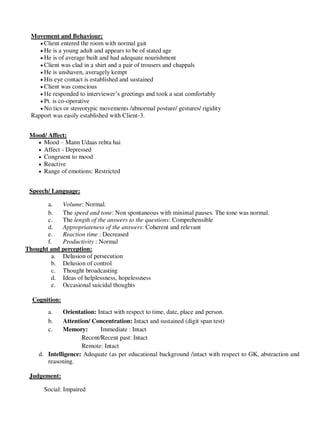
Movement and Behaviour:
 Client entered the room with normal gait
 He is a young adult and appears to be of stated age
 He is of average built and had adequate nourishment
 Client was clad in a shirt and a pair of trousers and chappals
 He is unshaven, averagely kempt
 His eye contact is established and sustained
 Client was conscious
 He responded to interviewer‘s greetings and took a seat comfortably
 Pt. is co-operative
 No tics or stereotypic movements /abnormal posture/ gestures/ rigidity
Rapport was easily established with Client-3.
Mood/ Affect:
 Mood – Mann Udaas rehta hai
 Affect - Depressed
 Congruent to mood
 Reactive
 Range of emotions: Restricted
Speech/ Language:
a. Volume: Normal.
b. The speed and tone: Non spontaneous with minimal pauses. The tone was normal.
c. The length of the answers to the questions: Comprehensible
d. Appropriateness of the answers: Coherent and relevant
e. Reaction time : Decreased
f. Productivity : Normal
Thought and perception:
a. Delusion of persecution
b. Delusion of control
c. Thought broadcasting
d. Ideas of helplessness, hopelessness
e. Occasional suicidal thoughts
Cognition:
a. Orientation: Intact with respect to time, date, place and person.
b. Attention/ Concentration: Intact and sustained (digit span test)
c. Memory: Immediate : Intact
Recent/Recent past: Intact
Remote: Intact
d. Intelligence: Adequate (as per educational background /intact with respect to GK, abstraction and
reasoning.
Judgement:
Social: Impaired
lOMoARcPSD|25238877
On test: Intact
Insight: Grade 3/6 (Awareness of being sick but blaming it on others)
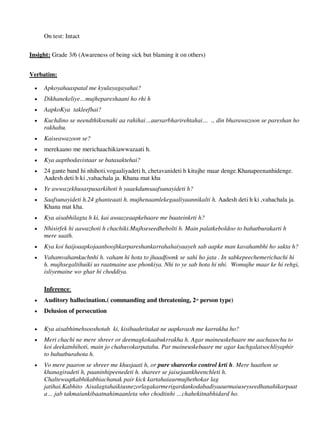
Verbatim:
 Apkoyahaaspatal me kyulayagayahai?
 Dikhanekeliye…mujhepareshaani ho rhi h
 AapkoKya takleefhai?
 Kuchdino se neendthiksenahi aa rahihai…aursarbharirehtahai… ., din bharawazoon se pareshan ho
rakhahu.
 Kaiseawazoon se?
 merekaano me merichaachikiawwazaati h.
 Kya aapthodavistaar se batasaktehai?
 24 gante band hi nhihoti.vogaaliyadeti h, chetavanideti h kitujhe maar denge.Khanapeenanhidenge.
Aadesh deti h ki ,vahachala ja. Khana mat kha
 Ye awwazekhusarpusarkihoti h yaaekdumsaafsunayideti h?
 Saafsunayideti h.24 ghanteaati h. mujhenaamlekegaaliyaannikalti h. Aadesh deti h ki ,vahachala ja.
Khana mat kha.
 Kya aisabhilagta h ki, kai awaazeaapkebaare me baateinkrti h?
 Nhisirfek hi aawazhoti h chachiki.Mujhseseedhebolti h. Main palatkeboldoo to bahutburakarti h
mere saath.
 Kya koi haijoaapkojaanboojhkarpareshankarrahahaiyaayeh sab aapke man kavahambhi ho sakta h?
 Vahamvahamkuchnhi h. vaham hi hota to jhaadfoonk se sahi ho jata . In sabkepeechemerichachi hi
h. mujhsegaltihuiki us raatmaine use phonkiya. Nhi to ye sab hota hi nhi. Womujhe maar ke hi rehgi,
isliyemaine wo ghar hi choddiya.
Inference:
 Auditory hallucination.( commanding and threatening, 2nd
person type)
 Delusion of persecution
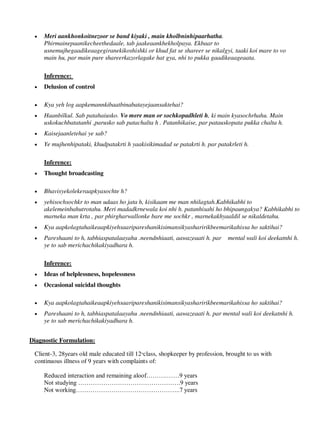
 Kya aisabhimehsooshotah ki, kisibaahritakat ne aapkovash me karrakha ho?
 Meri chachi ne mere shreer or deemagkokaabukrrakha h. Agar maineuskebaare me aachasochu to
koi deekatnhihoti, main jo chahuvokarpatahu. Par maineuskebaare me agar kuchgalatsochliyaphir
to bahutburahota h.
 Vo mere paaron se shreer me khusjaati h, or pure shareerko control krti h. Mere haathon se
khanagiradeti h, paaninhipeenedeti h. shareer se jaisejaankheenchleti h.
Chaltewaqtkabhikabhiachanak pair kick kartahaiaurmujhethokar lag
jatihai.Kabhito Aisalagtahaikiusnezorlagakarmerigardankodabadiyaaurmaiuseyseedhanahikarpaat
a… jab takmaiunkibaatnahimaanleta who chodtinhi …chahekitnabhidard ho.
lOMoARcPSD|25238877
 Meri aankhonkoitnezoor se band kiyaki , main kholbninhipaarhatha.
Phirmainepaanikecheethedaale, tab jaakeaankhekholpaya. Ekbaar to
usnemujhegaadikeaagegiranekikoshishki or khud fat se shareer se nikalgyi, taaki koi mare to vo
main hu, par main pure shareerkazorlagake hat gya, nhi to pukka gaadikeaageaata.
Inference:
 Delusion of control
 Kya yeh log aapkemannkibaatbinabatayejaansaktehai?
 Haanbilkul. Sab patahaiusko. Vo mere man or sochkopadhleti h, ki main kyasochrhahu. Main
uskokuchbatatanhi ,parusko sab patachalta h . Patanhikaise, par patauskopata pukka chalta h.
 Kaisejaanletehai ye sab?
 Ye mujhenhipataki, khudpatakrti h yaakisikimadad se patakrti h. par patakrleti h.
Inference:
 Thought broadcasting
 Bhavisyekolekeraapkyasochte h?
 yehisochsochkr to man udaas ho jata h, kisikaam me man nhilagtah.Kabhikabhi to
akelemeinbahutrotahu. Meri madadkrnewala koi nhi h. patanhisahi ho bhipaungakya? Kabhikabhi to
marneka man krta , par phirgharwallonke bare me sochkr , marnekakhyaaldil se nikaldetahu.
 Kya aapkolagtahaikeaapkiyehsaaripareshanikisimansikyasharirikbeemarikahissa ho saktihai?
 Pareshaani to h, tabhiaspatalaayahu .neendnhiaati, aawazeaati h. par mental wali koi deekatnhi h.
ye to sab merichachikakiyadhara h.
Inference:
 Ideas of helplessness, hopelessness
 Occasional suicidal thoughts
 Kya aapkolagtahaikeaapkiyehsaaripareshanikisimansikyasharirikbeemarikahissa ho saktihai?
 Pareshaani to h, tabhiaspatalaayahu .neendnhiaati, aawazeaati h. par mental wali koi deekatnhi h.
ye to sab merichachikakiyadhara h.
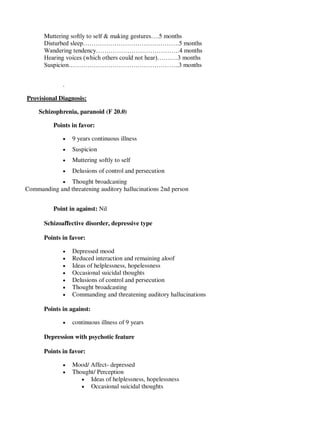
Diagnostic Formulation:
Client-3, 28years old male educated till 12th
class, shopkeeper by profession, brought to us with
continuous illness of 9 years with complaints of:
Reduced interaction and remaining aloof……….……9 years
Not studying ………………………………………….9 years
Not working…………………………………………..7 years
lOMoARcPSD|25238877
Muttering softly to self & making gestures….5 months
Disturbed sleep……………………………………….5 months
Wandering tendency………………………………….4 months
Hearing voices (which others could not hear)……….3 months
Suspicion……………………………………………..3 months
.
Provisional Diagnosis:
Schizophrenia, paranoid (F 20.0)
Points in favor:
 9 years continuous illness
 Suspicion
 Muttering softly to self
 Delusions of control and persecution
 Thought broadcasting
Commanding and threatening auditory hallucinations 2nd person
Point in against: Nil
Schizoaffective disorder, depressive type
Points in favor:
 Depressed mood
 Reduced interaction and remaining aloof
 Ideas of helplessness, hopelessness
 Occasional suicidal thoughts
 Delusions of control and persecution
 Thought broadcasting
 Commanding and threatening auditory hallucinations
Points in against:
 continuous illness of 9 years
Depression with psychotic feature
Points in favor:
 Mood/ Affect- depressed
 Thought/ Perception
 Ideas of helplessness, hopelessness
 Occasional suicidal thoughts
lOMoARcPSD|25238877
Points in against:
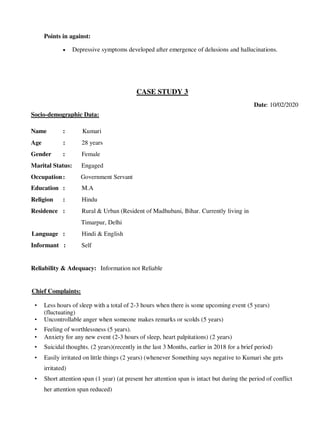
 Depressive symptoms developed after emergence of delusions and hallucinations.
CASE STUDY 3
Date: 10/02/2020
Socio-demographic Data:
Name : Kumari
Age : 28 years
Gender : Female
Marital Status: Engaged
Occupation: Government Servant
Education : M.A
Religion : Hindu
Residence : Rural & Urban (Resident of Madhubani, Bihar. Currently living in
Timarpur, Delhi
Language : Hindi & English
Informant : Self
Reliability & Adequacy: Information not Reliable
Chief Complaints:
• Less hours of sleep with a total of 2-3 hours when there is some upcoming event (5 years)
(fluctuating)
• Uncontrollable anger when someone makes remarks or scolds (5 years)
• Feeling of worthlessness (5 years).
• Anxiety for any new event (2-3 hours of sleep, heart palpitations) (2 years)
• Suicidal thoughts. (2 years)(recently in the last 3 Months, earlier in 2018 for a brief period)
• Easily irritated on little things (2 years) (whenever Something says negative to Kumari she gets
irritated)
• Short attention span (1 year) (at present her attention span is intact but during the period of conflict
her attention span reduced)
lOMoARcPSD|25238877
Predisposing factor
• Possibility of genetic factor (grandfather and uncle both had history of psychiatric illness)
• Childhood trauma
Precipitating factor
• When she was appointed for the job in her hometown.
Perpetuating factor
• Estranged relationship with mother, trouble in relationship with her fiancé.
Onset: Insidious
Course: Continuous and fluctuating
History of present illness:
• Kumari was alright about five years back.
• When she was studying in Class IV in Varanasi, one day her father had beaten up her mother
and sent Kumari along with her mother to her maternal grandmother's home in Bihar, where
the culture was different and Kumari's mother also left her and went in search of a job in New
Delhi. Kumari had no communication with her mother and grandmother. After that she started
to remain silent.
• After graduation she came to Delhi to live with her mother. She didn't find the same love and
attachment with her mother as it was earlier.
• In 2015 she had to come to Bihar again for her job as a primary school teacher. At this time
she started facing problems in sleeping. She couldn't sleep for as long as five days.
• During the job she found that she couldn't control her anger and one day slapped a school
student so hard that the child started bleeding. She stood transfixed over there not able to
process what had happened.
• Kumari returned to Delhi again and could not find the support from her family and
faced communication problems at work and home.
• When given extra work at office or a new event is ahead, she used to get very anxious and
felt like she could not do it. One day at the office when work was given, she had a
breakdown in front of colleagues.
“Maine ek baar office mein khaa bhi ki Mujhe zyada kaam milne se neend nahin aati.. aap
lOMoARcPSD|25238877
kamm kaam diya karo….to unhone kaha ki aap jaise bhi karo humein nahin pataa...To maine
aur higher authority ko bola to unhone kaha ki thoda thoda karke aap poora karlo.”
• Over a period of two years in Delhi she got attached to a male friend and proposed to marry
him but his family rejected her. Her family couldn't stand the rejection and thus her brother
commented- "teri naa to shakl achhi hai aur na body...aur tere kaaran hi papa ne humein
chhord diyaa." Since then she started blaming herself and assumed that no-one loves her and
she's ugly.
• After 3 months her male friend acted to be cheating on her and rejected her. She frequently
had suicidal thoughts like “mera mann karta tha ki mai metro ke aage aa jau ya fir zeher kha
luu” and had disturbed sleep. One day she took cough syrup to relieve her cough and had a
good sleep, after which she gradually started taking it to induce sleep.
• In 2019(end) “I tried to convince my mother to let me marry my friend and she started fighting
with me and in all this I lost my consciousness and fainted.”
• After sometime, parents agreed for marriage...but whenever someone said something she got
very angry and irritated. "jab bhi koi kuch meri marzi se alag bolta hai mann karta hai uska
sarr phod doon."
• Kumari told,"three months ago the boy refused to marry me over little fights. Us waqt mujhe
laga ki mei dange mei chali jau ya zehar kha lu ya koi mujhe goli maar de. Lekin phir mai ye
soch kar ruk gayi ki meri Maa ka kya hoga”.
Situation got normal, but now she feels angry and irritated whenever someone says something to
her. She also faces sleeping problems.
Negative History:
• No h/o vomiting
• No h/o substance use
• No h/o prolonged medical illness
• No h/o psychiatric illness in the past.
• No h/o of big talks or grandiosity.
Positive History:
• H/O Headaches present when unable to sleep when given new tasks/situations.
• H/O decreased self-esteem
• H/O loss of consciousness
• H/O deficiency of Vitamin B12 and Vitamin D
lOMoARcPSD|25238877
Medical History:
• Face paralysis at the age of 6. Recovered in 2 months.
• Diagnosed with TB in 2016. Medications taken for 1 month, test done again and the result for
TB came negative.
Functioning:
• Self-Care: Optimum
• Occupational: Fluctuating
• Interpersonal: Impaired with family members but shares her feelings with her fiancé and a
close friend
Family History:
• Type of family: Nuclear- extended
• No. of members/Family Size: 5
• Siblings: 2 (elder brother and an elder sister) Birth order: 3rd
• Interpersonal Relationships: Strained relationship with family members
• Family History of Medical/Mental illness: Paternal grandfather had a history of undiagnosed
psychiatric illness, along with her uncle. Elder sister consumes medicine for depression, but has no
proper diagnosis for a psychiatric illness.
Personal History
 Prenatal
• Full term pregnancy.
• Delivery at home.
 Early childhood
• Unwanted child, mother didn‘t see her face for 5 days.
• Breastfeeding for 3 years.
• No behavioral issue.
lOMoARcPSD|25238877
• Developmental milestones achieved at appropriate age.
 Middle childhood
• Started going to school at the age of 4 years.
• She was very shy in school, and her friend circle was large.
• She didn‘t speak in front of her teachers.
• She showed good academic performance.
• At the age of five, fecal incontinence due to fear of the teacher was observed.
• She had face paralysis at the age of 6 in the winter season.
• Bedwetting was observed till the age of 7 years.
• No behavioral issues like throwing tantrums, impulsive behaviour or nail biting were present.
 Late childhood and Adolescence
• Cordial relations with teachers, classmates.
• Fight issues with family members.
• Would prefer to keep to her, did not have any close friends.
• At the age of 12, head banging after a comment passed by aunt.
• From age 10-13, academic performance got weak due to change in place and lack of support from
family. After the age of 13 performance improved gradually
 Psychosexual History
• Acquired sexual knowledge through sister, boyfriend and internet.
 Adulthood
• Estranged relationship with family members.
• Cordial relations at the workplace.
• Mostly keeps to herself, have one close friend who was clinically treated for depression and shares
her emotions with fiancé.
 Adult Sexuality
lOMoARcPSD|25238877
• Active sexual history for the past 2 years.
 Religious behaviour
• Firm believer in God.
• Believes that God can provide solutions for problems. ―Jab mai bohot pareshan hoti hu to bhagwaan
se baat karti hu or unhe sab batati hu, aisa lagta hai vo hi sab theek kar denge‖
• Family has a strong faith in God.
• Father is a priest in a temple
Socio Economic Status
• Have very few people in her social circle.
• Lives in a pucca house with her mother, brother and sister in law.
• Inadequate privacy, adequate sanitation facilities.
• Her family monthly income: Rs. 90,000.
Mental Status Examination
Movement and Behaviour
• Client is a young adult and appears to be of stated age
• She is of average built and had adequate nourishment
• She is well kept and groomed well.
• Her eye contact is established and sustained
• Client was conscious
• She responded to interviewer‘s greetings and sat comfortably
• Client is co-operative
• Psychomotor Activity: Within normal limits ( No tics or stereotypic movements /abnormal posture/
gestures/ rigidity)
• Rapport was established easily with the client
Mood/ Affect
lOMoARcPSD|25238877
• Mood - ―Mann Udaas rehta hai‖
• Affect - Depressed
• Congruent to mood
• Range of emotions: Restricted
Speech/ Language
• Volume: Normal.
• The speed and tone: Non spontaneous with appropriate pauses. The tone was normal.
• The length of the answers to the questions: Comprehensible
• Appropriateness of the answers: Coherent and relevant
• Reaction time: Decreased
• Productivity: Normal
Thought process
• Linear and goal oriented
Thought content
• Ideas of helplessness, hopelessness
• Occasional suicidal thoughts “aaj kal corona faila hua hai, mai kisi corona patient ko chhu lu jisse
mujhe bhi ho jaye or mai marr jau”
Perception
• No signs or symptoms of hallucinations
Cognition
• Orientation: Intact with respect to time, date, place and person.
• Attention/ Concentration: Intact and sustained (digit span test)
• Memory: Immediate : Intact
• Recent/Recent past: Intact Remote: Intact
Intelligence
lOMoARcPSD|25238877
• Adequate (as per educational background /intact with respect to GK, abstraction and reasoning.)
Judgement
• Social: Intact
• On test: Intact
Insight
• Grade 5/6 (intellectual insight)
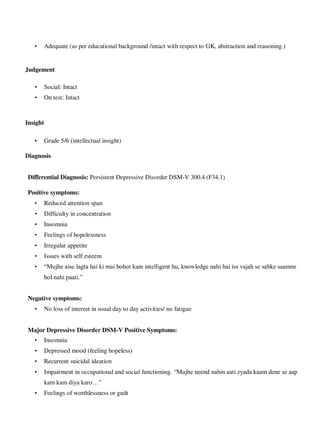
Diagnosis
Differential Diagnosis: Persistent Depressive Disorder DSM-V 300.4 (F34.1)
Positive symptoms:
• Reduced attention span
• Difficulty in concentration
• Insomnia
• Feelings of hopelessness
• Irregular appetite
• Issues with self esteem
• ―Mujhe aise lagta hai ki mai bohot kam intelligent hu, knowledge nahi hai iss vajah se sabke saamne
bol nahi paati.‖
Negative symptoms:
• No loss of interest in usual day to day activities/ no fatigue
Major Depressive Disorder DSM-V Positive Symptoms:
• Insomnia
• Depressed mood (feeling hopeless)
• Recurrent suicidal ideation
• Impairment in occupational and social functioning. ―Mujhe neend nahin aati zyada kaam dene se aap
kam kam diya karo…‖
• Feelings of worthlessness or guilt
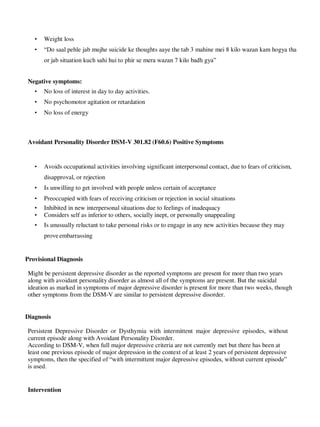
lOMoARcPSD|25238877
• Weight loss
• ―Do saal pehle jab mujhe suicide ke thoughts aaye the tab 3 mahine mei 8 kilo wazan kam hogya tha
or jab situation kuch sahi hui to phir se mera wazan 7 kilo badh gya‖
Negative symptoms:
• No loss of interest in day to day activities.
• No psychomotor agitation or retardation
• No loss of energy
Avoidant Personality Disorder DSM-V 301.82 (F60.6) Positive Symptoms
• Avoids occupational activities involving significant interpersonal contact, due to fears of criticism,
disapproval, or rejection
• Is unwilling to get involved with people unless certain of acceptance
• Preoccupied with fears of receiving criticism or rejection in social situations
• Inhibited in new interpersonal situations due to feelings of inadequacy
• Considers self as inferior to others, socially inept, or personally unappealing
• Is unusually reluctant to take personal risks or to engage in any new activities because they may
prove embarrassing
Provisional Diagnosis
Might be persistent depressive disorder as the reported symptoms are present for more than two years
along with avoidant personality disorder as almost all of the symptoms are present. But the suicidal
ideation as marked in symptoms of major depressive disorder is present for more than two weeks, though
other symptoms from the DSM-V are similar to persistent depressive disorder.
Diagnosis
Persistent Depressive Disorder or Dysthymia with intermittent major depressive episodes, without
current episode along with Avoidant Personality Disorder.
According to DSM-V, when full major depressive criteria are not currently met but there has been at
least one previous episode of major depression in the context of at least 2 years of persistent depressive
symptoms, then the specified of ―with intermittent major depressive episodes, without current episode‖
is used.
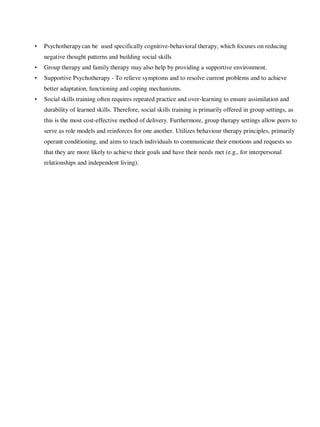
Intervention
lOMoARcPSD|25238877
• Psychotherapycan be used specifically cognitive-behavioral therapy, which focuses on reducing
negative thought patterns and building social skills
• Group therapy and family therapy may also help by providing a supportive environment.
• Supportive Psychotherapy - To relieve symptoms and to resolve current problems and to achieve
better adaptation, functioning and coping mechanisms.
• Social skills training often requires repeated practice and over-learning to ensure assimilation and
durability of learned skills. Therefore, social skills training is primarily offered in group settings, as
this is the most cost-effective method of delivery. Furthermore, group therapy settings allow peers to
serve as role models and reinforces for one another. Utilizes behaviour therapy principles, primarily
operant conditioning, and aims to teach individuals to communicate their emotions and requests so
that they are more likely to achieve their goals and have their needs met (e.g., for interpersonal
relationships and independent living).
lOMoARcPSD|25238877
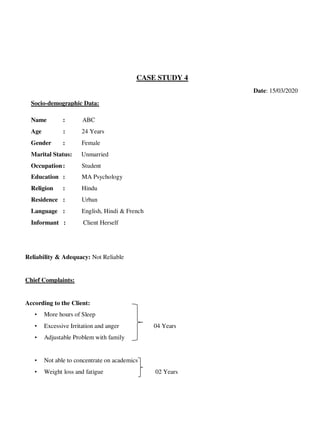
CASE STUDY 4
Date: 15/03/2020
Socio-demographic Data:
Name : ABC
Age : 24 Years
Gender : Female
Marital Status: Unmarried
Occupation: Student
Education : MA Psychology
Religion : Hindu
Residence : Urban
Language : English, Hindi & French
Informant : Client Herself
Reliability & Adequacy: Not Reliable
Chief Complaints:
According to the Client:
• More hours of Sleep
• Excessive Irritation and anger 04 Years
• Adjustable Problem with family
• Not able to concentrate on academics
• Weight loss and fatigue 02 Years
lOMoARcPSD|25238877
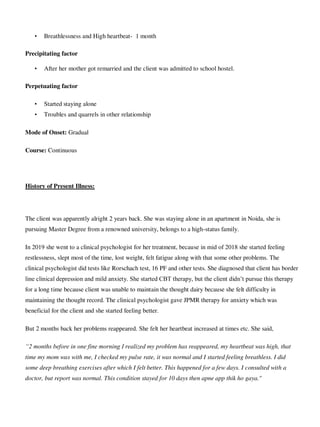
• Breathlessness and High heartbeat- 1 month
Precipitating factor
• After her mother got remarried and the client was admitted to school hostel.
Perpetuating factor
• Started staying alone
• Troubles and quarrels in other relationship
Mode of Onset: Gradual
Course: Continuous
History of Present Illness:
The client was apparently alright 2 years back. She was staying alone in an apartment in Noida, she is
pursuing Master Degree from a renowned university, belongs to a high-status family.
In 2019 she went to a clinical psychologist for her treatment, because in mid of 2018 she started feeling
restlessness, slept most of the time, lost weight, felt fatigue along with that some other problems. The
clinical psychologist did tests like Rorschach test, 16 PF and other tests. She diagnosed that client has border
line clinical depression and mild anxiety. She started CBT therapy, but the client didn‘t pursue this therapy
for a long time because client was unable to maintain the thought dairy because she felt difficulty in
maintaining the thought record. The clinical psychologist gave JPMR therapy for anxiety which was
beneficial for the client and she started feeling better.
But 2 months back her problems reappeared. She felt her heartbeat increased at times etc. She said,
“2 months before in one fine morning I realized my problem has reappeared, my heartbeat was high, that
time my mom was with me, I checked my pulse rate, it was normal and I started feeling breathless. I did
some deep breathing exercises after which I felt better. This happened for a few days. I consulted with a
doctor, but report was normal. This condition stayed for 10 days then apne app thik ho gaya."
lOMoARcPSD|25238877
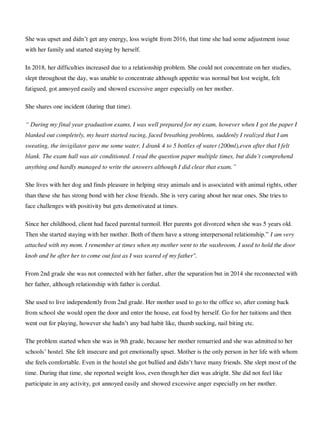
She was upset and didn‘t get any energy, loss weight from 2016, that time she had some adjustment issue
with her family and started staying by herself.
In 2018, her difficulties increased due to a relationship problem. She could not concentrate on her studies,
slept throughout the day, was unable to concentrate although appetite was normal but lost weight, felt
fatigued, got annoyed easily and showed excessive anger especially on her mother.
She shares one incident (during that time).
“ During my final year graduation exams, I was well prepared for my exam, however when I got the paper I
blanked out completely, my heart started racing, faced breathing problems, suddenly I realized that I am
sweating, the invigilator gave me some water, I drank 4 to 5 bottles of water (200ml),even after that I felt
blank. The exam hall was air conditioned. I read the question paper multiple times, but didn’t comprehend
anything and hardly managed to write the answers although I did clear that exam.”
She lives with her dog and finds pleasure in helping stray animals and is associated with animal rights, other
than these she has strong bond with her close friends. She is very caring about her near ones. She tries to
face challenges with positivity but gets demotivated at times.
Since her childhood, client had faced parental turmoil. Her parents got divorced when she was 5 years old.
Then she started staying with her mother. Both of them have a strong interpersonal relationship.‖ I am very
attached with my mom. I remember at times when my mother went to the washroom, I used to hold the door
knob and be after her to come out fast as I was scared of my father".
From 2nd grade she was not connected with her father, after the separation but in 2014 she reconnected with
her father, although relationship with father is cordial.
She used to live independently from 2nd grade. Her mother used to go to the office so, after coming back
from school she would open the door and enter the house, eat food by herself. Go for her tuitions and then
went out for playing, however she hadn‘t any bad habit like, thumb sucking, nail biting etc.
The problem started when she was in 9th grade, because her mother remarried and she was admitted to her
schools‘ hostel. She felt insecure and got emotionally upset. Mother is the only person in her life with whom
she feels comfortable. Even in the hostel she got bullied and didn‘t have many friends. She slept most of the
time. During that time, she reported weight loss, even though her diet was alright. She did not feel like
participate in any activity, got annoyed easily and showed excessive anger especially on her mother.
lOMoARcPSD|25238877
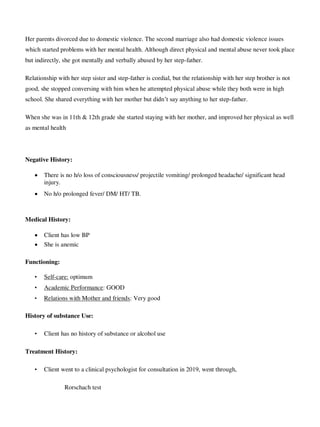
Her parents divorced due to domestic violence. The second marriage also had domestic violence issues
which started problems with her mental health. Although direct physical and mental abuse never took place
but indirectly, she got mentally and verbally abused by her step-father.
Relationship with her step sister and step-father is cordial, but the relationship with her step brother is not
good, she stopped conversing with him when he attempted physical abuse while they both were in high
school. She shared everything with her mother but didn‘t say anything to her step-father.
When she was in 11th & 12th grade she started staying with her mother, and improved her physical as well
as mental health
Negative History:
 There is no h/o loss of consciousness/ projectile vomiting/ prolonged headache/ significant head
injury.
 No h/o prolonged fever/ DM/ HT/ TB.
Medical History:
 Client has low BP
 She is anemic
Functioning:
• Self-care: optimum
• Academic Performance: GOOD
• Relations with Mother and friends: Very good
History of substance Use:
• Client has no history of substance or alcohol use
Treatment History:
• Client went to a clinical psychologist for consultation in 2019, went through,
Rorschach test
lOMoARcPSD|25238877
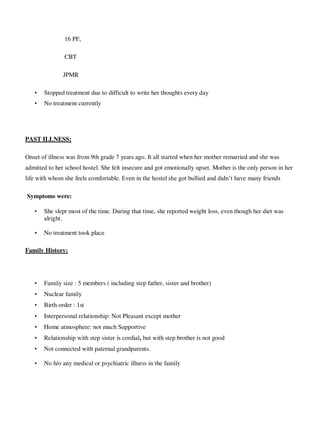
16 PF,
CBT
JPMR
• Stopped treatment due to difficult to write her thoughts every day
• No treatment currently
PAST ILLNESS:
Onset of illness was from 9th grade 7 years ago. It all started when her mother remarried and she was
admitted to her school hostel. She felt insecure and got emotionally upset. Mother is the only person in her
life with whom she feels comfortable. Even in the hostel she got bullied and didn‘t have many friends
Symptoms were:
• She slept most of the time. During that time, she reported weight loss, even though her diet was
alright.
• No treatment took place
Family History:
• Family size : 5 members ( including step father, sister and brother)
• Nuclear family
• Birth order : 1st
• Interpersonal relationship: Not Pleasant except mother
• Home atmosphere: not much Supportive
• Relationship with step sister is cordial, but with step brother is not good
• Not connected with paternal grandparents.
• No h/o any medical or psychiatric illness in the family
lOMoARcPSD|25238877
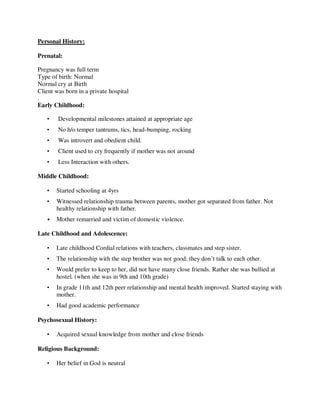
Personal History:
Prenatal:
Pregnancy was full term
Type of birth: Normal
Normal cry at Birth
Client was born in a private hospital
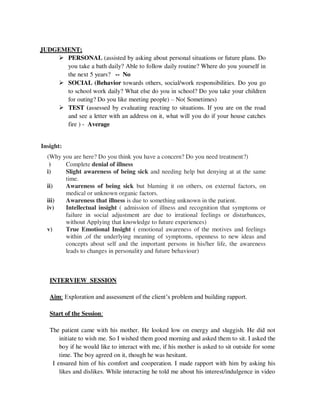
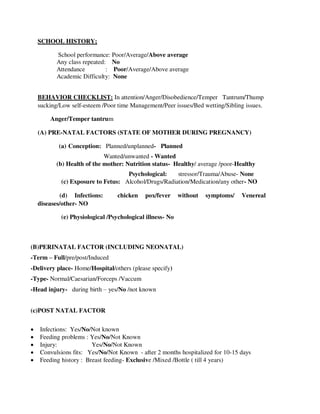
.
Early Childhood:
• Developmental milestones attained at appropriate age
• No h/o temper tantrums, tics, head-bumping, rocking
• Was introvert and obedient child.
• Client used to cry frequently if mother was not around
• Less Interaction with others.
Middle Childhood:
• Started schooling at 4yrs
• Witnessed relationship trauma between parents, mother got separated from father. Not
healthy relationship with father.
• Mother remarried and victim of domestic violence.
Late Childhood and Adolescence:
• Late childhood Cordial relations with teachers, classmates and step sister.
• The relationship with the step brother was not good; they don‘t talk to each other.
• Would prefer to keep to her, did not have many close friends. Rather she was bullied at
hostel. (when she was in 9th and 10th grade)
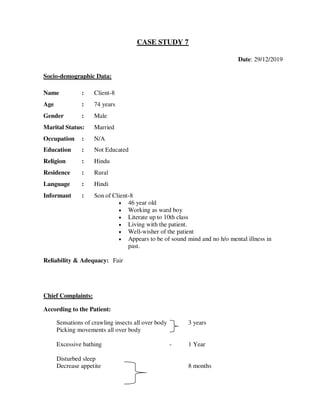
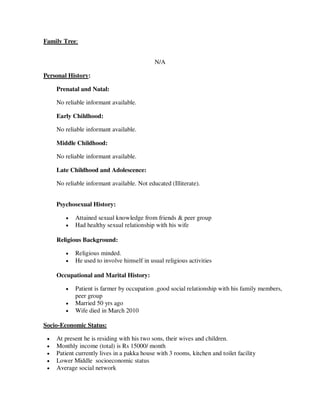
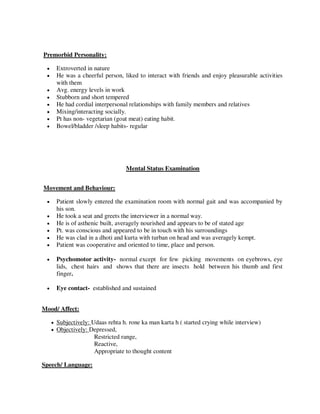
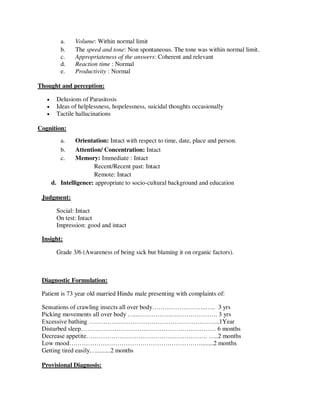
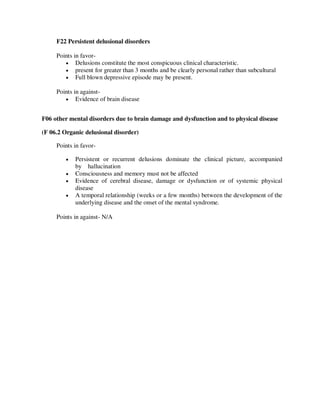
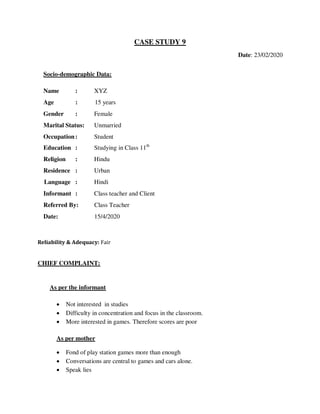
• In grade 11th and 12th peer relationship and mental health improved. Started staying with
mother.
• Had good academic performance
Psychosexual History:
• Acquired sexual knowledge from mother and close friends
Religious Background:
• Her belief in God is neutral
lOMoARcPSD|25238877
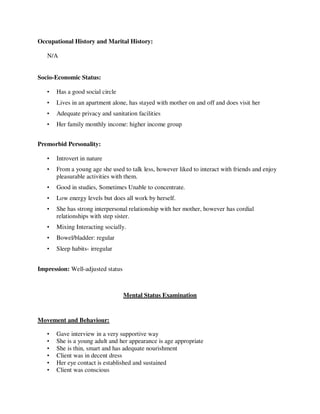
Occupational History and Marital History:
N/A
Socio-Economic Status:
• Has a good social circle
• Lives in an apartment alone, has stayed with mother on and off and does visit her
• Adequate privacy and sanitation facilities
• Her family monthly income: higher income group
Premorbid Personality:
• Introvert in nature
• From a young age she used to talk less, however liked to interact with friends and enjoy
pleasurable activities with them.
• Good in studies, Sometimes Unable to concentrate.
• Low energy levels but does all work by herself.
• She has strong interpersonal relationship with her mother, however has cordial
relationships with step sister.
• Mixing Interacting socially.
• Bowel/bladder: regular
• Sleep habits- irregular
Impression: Well-adjusted status
Mental Status Examination
Movement and Behaviour:
• Gave interview in a very supportive way
• She is a young adult and her appearance is age appropriate
• She is thin, smart and has adequate nourishment
• Client was in decent dress
• Her eye contact is established and sustained
• Client was conscious
lOMoARcPSD|25238877
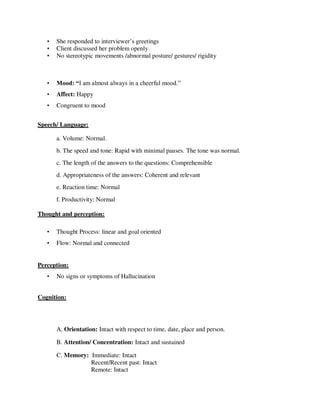
• She responded to interviewer‘s greetings
• Client discussed her problem openly
• No stereotypic movements /abnormal posture/ gestures/ rigidity

• Mood: “I am almost always in a cheerful mood.‖
• Affect: Happy
• Congruent to mood
Speech/ Language:
a. Volume: Normal.
b. The speed and tone: Rapid with minimal pauses. The tone was normal.
c. The length of the answers to the questions: Comprehensible
d. Appropriateness of the answers: Coherent and relevant
e. Reaction time: Normal
f. Productivity: Normal
Thought and perception:
• Thought Process: linear and goal oriented
• Flow: Normal and connected
Perception:
• No signs or symptoms of Hallucination
Cognition:
A. Orientation: Intact with respect to time, date, place and person.
B. Attention/ Concentration: Intact and sustained
C. Memory: Immediate: Intact
Recent/Recent past: Intact
Remote: Intact
lOMoARcPSD|25238877
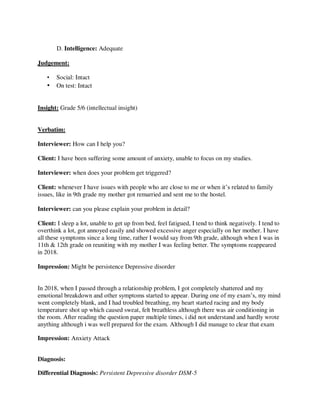
D. Intelligence: Adequate
Judgement:
• Social: Intact
• On test: Intact
Insight: Grade 5/6 (intellectual insight)
Verbatim:
Interviewer: How can I help you?
Client: I have been suffering some amount of anxiety, unable to focus on my studies.
Interviewer: when does your problem get triggered?
Client: whenever I have issues with people who are close to me or when it‘s related to family
issues, like in 9th grade my mother got remarried and sent me to the hostel.
Interviewer: can you please explain your problem in detail?
Client: I sleep a lot, unable to get up from bed, feel fatigued, I tend to think negatively. I tend to
overthink a lot, got annoyed easily and showed excessive anger especially on her mother. I have
all these symptoms since a long time, rather I would say from 9th grade, although when I was in
11th & 12th grade on reuniting with my mother I was feeling better. The symptoms reappeared
in 2018.
Impression: Might be persistence Depressive disorder
In 2018, when I passed through a relationship problem, I got completely shattered and my
emotional breakdown and other symptoms started to appear. During one of my exam‘s, my mind
went completely blank, and I had troubled breathing, my heart started racing and my body
temperature shot up which caused sweat, felt breathless although there was air conditioning in
the room. After reading the question paper multiple times, i did not understand and hardly wrote
anything although i was well prepared for the exam. Although I did manage to clear that exam
Impression: Anxiety Attack
Diagnosis:
Differential Diagnosis: Persistent Depressive disorder DSM-5
lOMoARcPSD|25238877
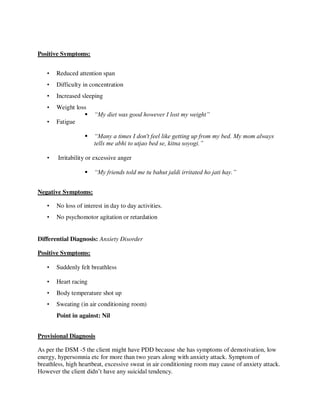
Positive Symptoms:
• Reduced attention span
• Difficulty in concentration
• Increased sleeping
• Weight loss
 “My diet was good however I lost my weight”
• Fatigue
 “Many a times I don't feel like getting up from my bed. My mom always
tells me abhi to utjao bed se, kitna soyogi.”
• Irritability or excessive anger
 “My friends told me tu bahut jaldi irritated ho jati hay.”
Negative Symptoms:
• No loss of interest in day to day activities.
• No psychomotor agitation or retardation
Differential Diagnosis: Anxiety Disorder
Positive Symptoms:
• Suddenly felt breathless
• Heart racing
• Body temperature shot up
• Sweating (in air conditioning room)
Point in against: Nil
Provisional Diagnosis
As per the DSM -5 the client might have PDD because she has symptoms of demotivation, low
energy, hypersomnia etc for more than two years along with anxiety attack. Symptom of
breathless, high heartbeat, excessive sweat in air conditioning room may cause of anxiety attack.
However the client didn‘t have any suicidal tendency.
lOMoARcPSD|25238877
Plan of action
1) Supportive individual psychotherapy
2) CBT
lOMoARcPSD|25238877
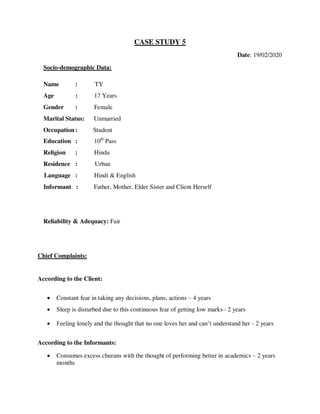
CASE STUDY 5
Date: 19/02/2020
Socio-demographic Data:
Name : TY
Age : 17 Years
Gender : Female
Marital Status: Unmarried
Occupation: Student
Education : 10th
Pass
Religion : Hindu
Residence : Urban
Language : Hindi & English
Informant : Father, Mother, Elder Sister and Client Herself
Reliability & Adequacy: Fair
Chief Complaints:
According to the Client:
 Constant fear in taking any decisions, plans, actions – 4 years
 Sleep is disturbed due to this continuous fear of getting low marks– 2 years
 Feeling lonely and the thought that no one loves her and can‘t understand her - 2 years
According to the Informants:
 Consumes excess churans with the thought of performing better in academics – 2 years
months
lOMoARcPSD|25238877
 Habit of sleeping with the books under her pillow with the belief that everything would
get inside her brain and studies almost nothing – 15 months
 Involved in unusual behaviours such as jumping off the roof with the belief of getting
good marks – 2 weeks back
Precipitating Factors
 Parents pressurization to get more marks
Perpetuating Factors
 Lack of caring from parents and unfavorable conditions at home for the behaviour.
Predisposing Factors
 There is no biological factor such as genetic vulnerability, but from the personality factor,
the patient being more impulsive and might have accounted.
Mode of Onset: Gradual
Duration: From Past 4 Years
Progress: Stable
Course: Continuous
History of Present Illness:
lOMoARcPSD|25238877
The client was apparently normal till 9th grade, had a lot of friends in her neighborhood and used
to spend time with them. The client was average in her academics till 9th std. and was very
active in extracurricular activities like drawing, playing piano etc.
According to the client's mother she started observing these unusual problems after she scored
very low in her 9th std and parents scolded her, after that she started getting overly involved in
superstitious activities slowly, going to temples and eating churans.
The behaviours persisted continuously and parents did not give that importance to the behaviour
until a week back the client tried jumping off the roof with the belief that she would gain good
marks in examination.
Negative History:
NIL
Positive History:
NIL
Treatment History:
 For present Illness:
The clients do not have any significant treatment history for the present illness
Medical History:
No significant medical history is reported by the client and the informant
Psychiatric History:
No history of past psychiatric illness
Family History:
lOMoARcPSD|25238877
• Family size : 4 members
• Nuclear family
• Birth order : 2nd
• Interpersonal relationship: Not Pleasant
• Home atmosphere: Not Supportive
• No h/o any medical or psychiatric illness in the family
Family Interaction Pattern
1. Communication – The client does not have open communication with family
members.
2. Leadership – The client‘s father is one who make decision making at home and
the client abides to it
3. Decision making – Usually the client herself decides and gets irritated if any
others interfere.
4. Role – Dominating role towards parents.
5. Family Rituals – The family has no ritual of having breakfast and dinner together
every day, as the patient sleeps during the day time.
6. Cohesiveness – Absent
7. Family burden – No significant family burden mentioned.
8. Expressed Emotions – Hostility (Family believed that the problems are actually
created by the client and the client don't want to get well)
Personal History:
Prenatal:
Pregnancy was full term
Type of birth: Normal
Normal cry at Birth
Early Childhood:
• Developmental milestones attained at appropriate age
• No h/o temper tantrums, tics, head-bumping, rocking
• Was introvert and obedient child.
• Client used to cry frequently if mother was not around
• Less Interaction with others.
Middle Childhood:
lOMoARcPSD|25238877
• Started schooling at 3yrs
• No history of usually impulsive behavior, fire setting, cruelty to animals, bed wetting,
nail biting
Late Childhood and Adolescence:
• Late childhood Cordial relations with teachers, classmates and relatives
• Prefer to keep to her, did not have any close friend
Psychosexual History:
• Acquired sexual knowledge from mother and close friends
Socio-Economic Status:
• Does not have a good social circle
• Lives in an apartment alone, has stayed with mother on and off and does visit her
• Adequate privacy and sanitation facilities
• Her family monthly income: higher income group
Premorbid personality
Attitude towards self and others- Before the onset of present illness, the patient was friendly,
caring, trusts others, sustained and maintained good relationships with his peers, family
members.
Moral & Religious attitudes and standards-The patient conformed to moral standards and she is
over religious compared to her other family members.
Work and Leisure- The patient used to spend his leisure time with his family members.
Mood- The patient had the stable mood and he was able to express her feelings
Fantasy Life- The client always was in her fantasy life.
Habits- The premorbid biological functions such as eating, sleeping and excreting are reported to
be normal.
lOMoARcPSD|25238877
MENTAL STATUS EXAMINATION
General Appearance & Behaviour:
• Appearance: The patient is a young woman appearing appropriate to her stated age. She was
well kempt and neat.
• Touch with the surroundings: Normal.
• Eye Contact: Well established and sustained. (There is no fixed, glaring, darting eye contact.)
• Rapport: Easily established and sustained.
• Attitude towards Examiner: Co-operative in providing information but she was providing
information which was only favorable to her
Movement and Behaviour:
• Gait: normal (there were no brisk, slow, hesitant or uncoordinated movements)
• Handshake: Stern and confident.
• Abnormal movements: There are no tics, foot tapping, ritualistic behaviour, and nail Biting.
• Rate of movements: normal
• Coordination of movements: Normal (no presence of awkward, clumsy movements) Speech:
• Intensity / Tone: Normal
• Reaction Time to Stimulus: normal
• Speed: Ordinary
• Prosody / Tempo: Normal
• Ease of Speech: intact
• Productivity / Volume: normal.
• Coherent/ Non coherent: Coherent
• Goal Directed/ Non goal directed: Goal directed.
lOMoARcPSD|25238877
Mood and Affect:
• Subjectively: normal but shows decreased energy due to lack of sleep
• Objectively: Normal
• Depth:
• Range: Normal
• Congruent to the Thought/ not congruent to the Thought: congruent to the thought.
• Appropriate/ inappropriate to the Situation: Appropriate
• Communicable / not communicable: Communicable.
Thought:
• Stream- Normal (thought blocking is not present.)
• Form-There is no evidence of flight of ideas, loosening of associations, tangentially, and
circumstantiality
• Possession- No presence of thought withdrawal, insertion and broadcasting.
• Content- no abnormal thought is present but feels that the patient feels no difference in the
presence and absence of his parents.
Perception:
• Auditory hallucinations nil
Cognitive Functions:
• Orientation: The patient is alert and intact to person, place and time.
• Attention & Concentration: Normal
lOMoARcPSD|25238877
• Memory:
➢ Immediate memory: claims to have problem but when the patient was made to perform
forward and backward digit span the patient did not show any difficulties.
➢ Recent memory: Intact.
➢ Remote memory: Intact as evidenced by his detailed recall of past events like the name of the
medicines etc.
• Abstraction: concrete/ conceptual/ functional: concrete
• General fund of knowledge: Average.
• General Intelligence: Above average.
Judgement:
Personal: intact
Social: intact
Test: Intact
Insight: Level 1 Complete denial of illness.
Provisional diagnosis: In reference of ICD-10
Obsessive-compulsive disorder, unspecified
F42. 9
Points in favor:
● Fears that if she doesn't do certain things in a certain way, something bad will happen
(fear something bad will happen to themselves or a loved one) to her (scoring low
marks in exam)
● Superstitious thoughts and an extreme fear of superstitions
● Follow a certain ritualistic pattern repeatedly until anxiety diminishes
● Performing certain compulsive behaviours at particular times of day.
lOMoARcPSD|25238877
CASE STUDY 6
Date: 15/02/2020
Socio-demographic Data:
Name : Undisclosed
Age : 18 Years
Gender : Female
Marital Status: Unmarried
Occupation: Student
Education : Pursuing B.A Political science
Religion : Hindu
Residence : Urban
Language : Hindi & English
POB : Gujarat, Ahmedabad
Informant : Sister of Client
1. 19 Years old
2. Pursuing BA History
3. Living with Client
4. No history of past psychiatric Illness
5. Appears to be of Sound mind
Reliability & Adequacy: Not fair or completely Reliable
Chief Complaints:
According to the informant:
• She blames everything on herself (7 years)
• She has isolated herself from family and friends (3 years)
• Low self-esteem (3 years)
• Lacks self-confidence (3 years)
lOMoARcPSD|25238877
• Not interacting with family members (6-8 months)
• Sleeping around 2-3 hours a night (3 months)
• Hygiene-not taking care of herself (3 months, approximately)
Precipitating Factors:
• Break up with boyfriend in August 2019
Perpetuating Factors:
• Remarks regarding her academics and capabilities
• Neglected by parents since childhood
Mode of Onset: Insidious
Duration: Approximately 1.5 Years
Course: Fluctuating
History of present illness:
Client has been symptomatic since 7th
grade. She had become distant and didn't come out of her
room. Even presently, if she comes out of her room and is sitting with family, she keeps quiet.
The informant said ―when our father is there she doesn‘t really speak much‖. ―Because
academics are one thing that makes our father happy, appearance doesn‘t matter to her and she
doesn‘t take care of herself‖.
The client tends to spend time alone, with herself. She isolates herself and doesn‘t talk to family
members that much.
End of her relationship with her boyfriend happened last year at the end of July which had an
effect on her thought process. Behavior didn‘t change apart from isolating herself.
From July to January, client seemed to feel continuous pain in the chest (tight and heavy feeling)
but it increased in November till January. The client used to fiddle with hands, shake legs to
distract her from thoughts.
lOMoARcPSD|25238877
After the relationship ended till March 2020, the client felt low and had negative thoughts about
her. She stopped doing her favorite things like playing the guitar. She lacked interest and
motivation to even do simple tasks.
NEGATIVE HISTORY
Past psychiatric/medical history:
• Client was diagnosed with PCOS, things are now normal
• PCOS was triggered in the past from stress and anxiety Took medicine for PCOS twice a
day and had to change lifestyle patterns
Functioning:
• Self-care- Not optimum
• College environment : Good
• Relationship with family and friends: Impaired (family), Good (friends)
History of substance use:
• Client has no history of substance or alcohol use
TREATMENT HISTORY
• Medicated PCOS
• Not on any medication currently
ONSET OF ILLNESS/PAST ILLNESS
Onset of illness was from 7th
grade, 6 years ago. It all started when one day the client's father
physically and verbally abused her. As the client used to fail in her studies, father used to say
demotivating things like ―Tumse padhayi nahi hogi, tum kabhi acha nahi kar paogi life mei, kuch
nahi ho sakta tumhara”. Sometimes her brother also used to say demeaning things. It was
because of these factors that the client developed low self-confidence and shut herself from
others.
Symptoms were- withdrawing from the whole family, didn‘t really interact with immediate or
extended family and friends.
No treatment was taken.
4 years later, symptoms began to reduce as the client started talking more with her brother, sister
and mother but relations with father were still strained. Main reason for reduction of symptoms
was good results in exams and getting accepted in a good college, that is when the client‘s
father‘s attitude began to change. However, the client's attitude has not changed towards father.
lOMoARcPSD|25238877
FAMILY HISTORY:
• Nuclear family
• Family size- Normal [7 members], currently only 5 are living together
• Birth order- 3rd [1 elder brother and 1 elder sister]
• Interpersonal relations are good, major arguments happen occasionally, cordial
relationship between brother, sister and mother
• Supportive home atmosphere
• Father‘s birth mother died at the age of 25 years due to choking, grandfather got
remarried to current grandmother
• Grandfather did not disclose that the client‘s paternal father‘s mother was not biological
and hence father held a grudge against them. He was abusive towards his children.
• Mother had suicidal thoughts when pregnant with the client, wanted to take the children
and go elsewhere
• Client is close to elder sister
• Belong to upper middle class family, above average monthly income
• They follow Hindu religion but do not strictly believe in rigid ritualistic practices and
beliefs
• Father and brother consume alcohol occasionally
• Alcohol consumption by females is culturally acceptable in the family
• No social restrictions on females
PERSONAL HISTORY
Prenatal and Natal
• Pregnancy was full 9 months
• Type of birth: C-Section
• Mother faced complications while delivery
• Doctor said either mother or only child could be saved, but both of them were fine
• Normal cry at birth
• Client was born in a private hospital
Early Childhood
• Client was breast fed after delivery and continued for a small period of time
• Became lactose intolerant at 2 months
• Was bottle fed from thereon
• No eating problems
• Client started walking a little early, at the age of 7 months
• Started talking at a normal age
• Client started sucking both her thumbs at the age of 2 months and continued till father
scolded her at the age of 2 years
lOMoARcPSD|25238877
• Client did not have strangers anxiety
• Client experienced maternal deprivation to some extent
• Was toilet trained at a normal age
• Personality of the client was restless, hyper
Middle Childhood
• Client started school at the age of 2 years
• Was not good at studies
• Client used to easily get distracted while studying
• Lacked concentration
• Was hyper and used to seek attention from family members, friends, teachers
• Did not have many friends
• Client used to be alone all the time
Late Childhood
• Client did not perform good in studies
• Failed in subjects like Math, Science, Social Sciences till class 10th
• Started doing academically good in class 12th
• Teachers used to treat the client differently, used to demotivate the client
• Relations with friends in school was average, did not have a lot of friends
• Relations with family members was strained
• Client faced emotional problems in adolescence but did not share them with anybody
• She lacked self-confidence and had low self esteem
Psychosexual History
• The client acquired sexual knowledge from friends and the media.
Religious Background
• Follows Hindu religion
• Does not staunchly believe in strict ritualistic practices and beliefs
Occupational and Marital History
• The client is a student
• The client is unmarried
PREMORBID PERSONALITY
lOMoARcPSD|25238877
• The client was extroverted, outgoing and cheerful.
• The client was not shy.
• She used to spend a lot of time with her family.
• The client engaged in lots of outdoor activities.
• She maintained a healthy lifestyle.
• Cordial interpersonal relationships
• Energy Levels - Normal (according to informant)
• Bowel / Bladders health - Normal
• Good at studies
IMPRESSION
The mother might have been going through antenatal depression during her pregnancy, which
however, was not diagnosed. Her father had a very strict and non-nurturing relationship with her
approximately seven years ago. Before this, he pampered the client and was very much
nurturing. It seems as though her relationship with her father later on became strained and is a
source of a lot of pain. Symptoms such as lack of interest and motivation in daily activities and
hobbies along with unkempt appearance, lack of self-esteem, sleeplessness and isolating oneself
may suggest that the client is suffering from moderate to severe depression or situational
depression due to the break-up of her relationship being a precipitating factor.
PLAN OF ACTION
Next, the client must undergo a Mental Status Examination. The client must be advised to take
the Beck Depression Inventory so that the therapist can evaluate the extent of her illness. A Beck
Anxiety Inventory test may also be recommended. Along with therapy for the client, it would
also be very helpful if her father would also agree to take part in therapy. We could work with
the automatic negative thinking cycle, by testing negative thoughts and beliefs. It is advised to
discuss suppressed emotions and coping mechanisms during therapy. Personality traits should be
assessed and analysed to find the client‘s personality type and characteristics.
One of things we should aim to achieve is to induce self-awareness of their thought processes
and psycho-education on problem-solving. Based on what understanding is gained from the
client's initial therapy session we can decide if we will employ CBT or psychotherapy in further
therapy.
lOMoARcPSD|25238877
CASE STUDY 7
Date: 29/12/2019
Socio-demographic Data:
Name : Client-8
Age : 74 years
Gender : Male
Marital Status: Married
Occupation : N/A
Education : Not Educated
Religion : Hindu
Residence : Rural
Language : Hindi
Informant : Son of Client-8
 46 year old
 Working as ward boy
 Literate up to 10th class
 Living with the patient.
 Well-wisher of the patient
 Appears to be of sound mind and no h/o mental illness in
past.
Reliability & Adequacy: Fair
Chief Complaints:
According to the Patient:
Sensations of crawling insects all over body 3 years
Picking movements all over body
Excessive bathing - 1 Year
Disturbed sleep
Decrease appetite 8 months
lOMoARcPSD|25238877
Low mood
Get tired easily
Precipitating &Perpetuating Factor:
1. Disturbed relationship with a boy
2. Disturbed relationship with parents
3. Family pressure for performance in career
Mode of onset: Acute
Course: Progressive and continuous
History of present illness:
Patient was asymptomatic 3 Year back, when he had developed complaint of headache, nausea
and vomiting, restlessness, fever, not clearly identifying family members and decrease oral
intake. The above mentioned complaints had occurred for 7-8 days.
For these complaints, pt visited a neuro-physician and CT head was advised.CT head shows
some abnormality, so, a further MRI head was adviced. After seeing MRI report, neuro-
physcian said ―Mareezkedeemag me keedonka infection h‖. This was also told to the patient.
Treatment was given andrelief occurs in above mentioned symptoms.
After 10 days of this pt had complaint of sensations of crawling insects in the head.
According to pt, insects are present in his head and they are very large in number and they
come out from his eyes, ears, nostrils and spread all over his body. He feels sensations of the
insects crawling on his body. The insects are very small in size, so not visible by naked eyes.
Since 3 yrs, Pt also had complaint of picking movements by hands all over his body in
response to the crawling insects. Pt picks insects from cheeks, lips, eye brows, eye lids, hairs
on chest and legs and tries to throw them away. Pt also doesn‘t allow anybody to use ceiling
fan as this will brings insects again on his body via air.
Pt says ―Ye keede main pakadpakadkefektahu, par ye vapas aa jate h. deemag se nikalkar ,
pure shareer par ghumte h or phirvapasdeemag me hi ghusjaate h‖.
Pt also had excessive bathing since 6 months. He used to take bath 4 to 5 times a day.
Previously he used to take bath less than 3 times a week. On asking why he do this, he says‖ in
keedokoshareer se nikalnekeliye main bar barnahatahu. Nahane se shreer me thandakmilti h‖.
Since 6 months,pt also had complaint of disturbed sleep. The sleep pattern got deteriorated
gradually over this period. Pt previously took 6-7 hrs sleep. But now pt takes only 1-2 hr sleep
in night. Pt wakes up in middle of night or early morning and started picking insects or
bathing.
lOMoARcPSD|25238877
Pt also had complaint of decrease appetite since 3 months. Previously pt used to take 4-5
chappatis/ day but now takes only 1-2 chhappatis/ day.
Pt also had excessive bathing since 6 months. He used to take bath 4 to 5 times a day.
Previously he used to take bath less than 3 times a week. On asking why he do this, he says―in
keedokoshareer se nikalnekeliye main bar barnahatahu. Nahane se shreer me thandakmilti h‖.
Since 2 months,pt also had complaint of disturbed sleep. The sleep pattern got deteriorated
gradually over this period. Pt previously took 6-7 hrs sleep. But now pt takes only 1-2 hr sleep
in night. Pt wakes up in middle of night or early morning and started picking insects or
bathing.
Pt also had complaint of decrease appetite since 2 months. Previously pt used to take 4-5
chappatis/ day but now takes only 1-2 chappatis/ day.
Since 2 months, pt also reported complaints of low mood and getting tired easily. Pt says
―merakisikaam me man nahilagta h, man bahutudaasrehta h. Ronekabhi man
kartah.Yehkeedokibimaripatanhikabhijayegiyanhi. Bahutpareshankrrakha h. Kabhikabhi to
marnekabhi mankarta h‖. But patient didn‘t make any attempt for this.But he later mentioned
that he would think of methods to end his life.
According to the informant, ptdoesn‘t talk or interact much to any family members and to the
guests visited his home and remaining sad. Pt prefers to spend his time by remaining alone and
busy in picking movements due to the crawling insects. Pt gets tired easily and feels very low
energy levels in the body.
Negative History:
 No H/o abnormal posturing, remaining mute and rigidity
 No H/o suspiciousness ,muttering, talking to self, hearing abnormal voices
 No H/o big talks, increase physical activities and decrease need for sleep
 No H/o repetitive activities, fear, Phobias, palpitation, sweating.
 No H/o neck rigidity, head injury, seizures
H/o Substance abuse:
 H/o occasional alcohol intake 1-2 pegs/ week (stopped just after illness started)
 H/o smoking since 40 years (due to peer pressure): usually 1-2 bidi at a time.
 Would become regular and vary maximum up to 5-6 bidi/day.
 Currently not smoking since about a week.
Functioning:
 Self-care: Intact
 Occupational: Impaired. Doesn‘t perform routine household works.
Just lying on bed and takes rest.
lOMoARcPSD|25238877
 Interpersonal: Impaired. Doesn‘t talk or interact much to anybody.
Treatment History:
 Illness was started 3 yrs back. Pt. consulted to Neuro-physician and NCCT done
which was suggestive of some pathology in brain and MRI brain was advised.
 MRI suggestive of inflammatory granulomas likely degenerating neurocysticercus
cysts and treatment started.
 Rx-tab phenytoin 100mg 1-0-2
 Tab clonazepam 0.5mg 1 HS
 Tab omeprazole 1 OD
 Tab ramipril 5mg BD
 This is continued for about 2 months. Initial symptoms get cured but sensations of
crawling insects appear 10 days after starting treatment.
On 26/11/2017, diagnosed as neurocysticercus is with psychosis
 Rx Tab phenytoin 100mg 1-0-2
 Tab Quetiapine 100mg ½- ½-1
 Tab clonezepam 0.5 mg 1 HS
 Tab ramipril 5mg BD
 But symptoms of sensations of crawling insects persists
On 18/05/2017
 Rx Tab phenytoin 100mg 1-0-2
 Tab Quetiapine 100mg 1- 1-1
 Tab clonezepam 0.5 mg 1 HS
 Tab ramipril 5mg BD
 This treatment is continued till now. But symptoms of crawling insects persist.
On 9/11/17 he consulted a psychiatrist at PCJ, diagnosed as neurocysticercus is with
psychosis and took treatment.
 Tab olanzapine 10mg BD
 Tab Lorazepam 2mg 1HS
Duration of this treatment not known. But no benefit occurs in complaint of
sensations of crawling insects.
Family History:
 Joint family
 Family size :06 members
 Birth order : 7th
 Interpersonal relationship: Cordial
 Home atmosphere : Seems to be supportive
lOMoARcPSD|25238877
Family Tree:
N/A
Personal History:
Prenatal and Natal:
No reliable informant available.
Early Childhood:
No reliable informant available.
Middle Childhood:
No reliable informant available.
Late Childhood and Adolescence:
No reliable informant available. Not educated (Illiterate).
Psychosexual History:
 Attained sexual knowledge from friends & peer group
 Had healthy sexual relationship with his wife
Religious Background:
 Religious minded.
 He used to involve himself in usual religious activities
Occupational and Marital History:
 Patient is farmer by occupation .good social relationship with his family members,
peer group
 Married 50 yrs ago
 Wife died in March 2010
Socio-Economic Status:
 At present he is residing with his two sons, their wives and children.
 Monthly income (total) is Rs 15000/ month
 Patient currently lives in a pakka house with 3 rooms, kitchen and toilet facility
 Lower Middle socioeconomic status
 Average social network
lOMoARcPSD|25238877
Premorbid Personality:
 Extroverted in nature
 He was a cheerful person, liked to interact with friends and enjoy pleasurable activities
with them
 Avg. energy levels in work
 Stubborn and short tempered
 He had cordial interpersonal relationships with family members and relatives
 Mixing/interacting socially.
 Pt has non- vegetarian (goat meat) eating habit.
 Bowel/bladder /sleep habits- regular
Mental Status Examination
Movement and Behaviour:
 Patient slowly entered the examination room with normal gait and was accompanied by
his son.
 He took a seat and greets the interviewer in a normal way.
 He is of asthenic built, averagely nourished and appears to be of stated age
 Pt. was conscious and appeared to be in touch with his surroundings
 He was clad in a dhoti and kurta with turban on head and was averagely kempt.
 Patient was cooperative and oriented to time, place and person.
 Psychomotor activity- normal except for few picking movements on eyebrows, eye
lids, chest hairs and shows that there are insects hold between his thumb and first
finger.
 Eye contact- established and sustained
Mood/ Affect:
 Subjectively: Udaas rehta h. rone ka man karta h ( started crying while interview)
 Objectively: Depressed,
Restricted range,
Reactive,
Appropriate to thought content
Speech/ Language:
lOMoARcPSD|25238877
a. Volume: Within normal limit
b. The speed and tone: Non spontaneous. The tone was within normal limit.
c. Appropriateness of the answers: Coherent and relevant
d. Reaction time : Normal
e. Productivity : Normal
Thought and perception:
 Delusions of Parasitosis
 Ideas of helplessness, hopelessness, suicidal thoughts occasionally
 Tactile hallucinations
Cognition:
a. Orientation: Intact with respect to time, date, place and person.
b. Attention/ Concentration: Intact
c. Memory: Immediate : Intact
Recent/Recent past: Intact
Remote: Intact
d. Intelligence: appropriate to socio-cultural background and education
Judgment:
Social: Intact
On test: Intact
Impression: good and intact
Insight:
Grade 3/6 (Awareness of being sick but blaming it on organic factors).
Diagnostic Formulation:
Patient is 73 year old married Hindu male presenting with complaints of:
Sensations of crawling insects all over body……………………..….. 3 yrs
Picking movements all over body …...……………….………………. 3 yrs
Excessive bathing ……………………………………………………...1Year
Disturbed sleep…………………………..…………………………… 6 months
Decrease appetite…………………………………………………. …..2 months
Low mood………………………………………………………........2 months
Getting tired easily….........2 months
Provisional Diagnosis:
lOMoARcPSD|25238877
F22 Persistent delusional disorders
Points in favor-
 Delusions constitute the most conspicuous clinical characteristic.
 present for greater than 3 months and be clearly personal rather than subcultural
 Full blown depressive episode may be present.
Points in against-
 Evidence of brain disease
F06 other mental disorders due to brain damage and dysfunction and to physical disease
(F 06.2 Organic delusional disorder)
Points in favor-
 Persistent or recurrent delusions dominate the clinical picture, accompanied
by hallucination
 Consciousness and memory must not be affected
 Evidence of cerebral disease, damage or dysfunction or of systemic physical
disease
 A temporal relationship (weeks or a few months) between the development of the
underlying disease and the onset of the mental syndrome.
Points in against- N/A
lOMoARcPSD|25238877
CASE STUDY 8
Date: 17/02/2020
Socio-demographic Data:
Name : XYZ
Age : 16 years
Gender : Female
Marital Status: Unmarried
Occupation: Student
Education : Studying in Class 12th
Religion : Hindu
Residence : Urban
Language : Hindi
Informant : Class teacher and Client
Referred By: Class Teacher
Date: 19/2/2020
Reliability & Adequacy: Fair
CHIEF COMPLAINT:
As per informant (teacher)
 She does not interact with other students.
 She does not participate in group activities.
 Parents do not participate in her school activities
 Her Father is alcoholic, once he came in PTM. He was drunk.
As per Client
 Kisi se baat karne ka man nahi hota
 Padhai mein mann nahi lagta
 Dar sa lagta rahta hai.
 Ghar jaane ka man nahi hota. Ghar mein ladai hoti hai to sar dard karta hai.
COURSE- Continuous
lOMoARcPSD|25238877
DURATION – one year
ONSET-
 Abrupt ( within 24-48 hrs) -
 Acute (1-1 and a half)
 Insidious ( 1 month or more)
 Chronic
 Precipitating factor- Psychological
HISTORY OF THE PRESENT ILLNESS:
Patient had been complaining of trust issues. She hesitates while talking to peers in class
and generally keeps it to herself. She got irritated if others tried to approach her for
interaction. She avoided group activities. Generally sits alone during break time. If
coaxed to perform in a group activity, her hands started to shiver so she preferred to be
dormant during the group work. She did not want to talk about her family with anyone.
 How is your appetite for past one week - Increased/Decreased/Normal
 How is your sleep pattern for past one week- Increased/Decreased/Disturbed/Normal
 Have you taken treatment /assessment from someone before- No
FAMILY HISTORY
Patient has been living with her parents and sister in a resettlement colony. Father is
alcoholic and mother has been working as maid. Father does not work and earn. So
family is being run by the mother. Her younger sister is studying in V class in Govt
School.
 Family structure: Nuclear/Joint/Separated
 Parenting style: Authoritarian/Permissive/Neglect
 Attachment style; Secure/Insecure
 Relationship with patient between other family members: Cordial/Ineffective
 Pattern of communication: Effective/Ineffective.

FAMILY HISTORY OF ILLNESS: Mental illness/Intellectual Disability, Suicide,
Alcohol/Drug dependence, Epilepsy/Organic disorder or any other significant physical illness-
- Father is alcoholic. He misbehaves with family members.
lOMoARcPSD|25238877
SCHOOL HISTORY;
 School performance : Poor/Average/Above average
 Any class repeated : No
 Attendance ; Poor/Average/Above average
BEHAVIOR CHECKLIST: In attention/Anger/Disobedience/Temper Tantrum/Thump
sucking/Low self-esteem /Poor time Management/Peer issues/Bed wetting/Sibling issues.
Low self esteem
(A) PRE-NATAL FACTORS (STATE OF MOTHER DURING PREGNANCY)
(a) Conception: Planned/unplanned- Planned
Wanted/unwanted - Wanted
(b) Health of the mother: Nutrition status- Healthy/ average /poor-Healthy
Psychological: stressor/Trauma/Abuse-
(c) Exposure to Fetus: Alcohol/Drugs/Radiation/Medication/any other- NO
(d) Infections: chicken pox/fever without symptoms/Venereal diseases- NO
(e) Physiological /Psychological illness- None
(B)PERINATAL FACTOR (INCLUDING NEONATAL)
 Term – Full/pre/post/Induced
 Delivery place- Home/Hospital/others ( please specify)
 Type- Normal/Caesarean/Forceps /Vacuum
 Head injury- during birth – yes/No /Not known
(C)POST NATAL FACTOR
 Infections: Yes/No/Not known
 Feeding problems : Yes/No/Not Known
 Injury: Yes/No/Not Known
 Convulsions fits: Yes/No/Not Known
 Feeding history : Breast feeding- Exclusive /Mixed /Bottle ( till 4 years)
DEVELOVEMENT HISTORY:- Normal
PRE-MORBID PERSONALITY:-
lOMoARcPSD|25238877
 Pre morbid mood- Pessimistic
 Use of leisure time- No use of leisure time
 Attitude to self -- Self-conscious, good
 Habits- - No specific habit
 Character traits - Introvert
 Initiative- - Low on initiation
MENTAL STATUS EXAMINATION
GENERAL APPEARANCE AND BEHAVIOUR
 Appearance : Healthy /Bizarre/Any other- Poor at hygiene, hairs ungroomed,
Shoes unpolished
 Facial expression : Appropriate /changing with subject/overt emotional displays
 Posture : Guarded/Relaxed/Bent/Erect
 Gait; Normal /Brisk/Slow /Unsteady/Poorly coordinated
 Eye Contact: Maintained/Not maintained/Fluctuating
 Dress: Neat & Clean/Dirty /Torn
 Motor behaviour: Increased /Restless/constantly moving/Decreased
 Rapport: Established easily/with difficulty/not established
 Attitude towards the examiner:
Cooperative/Friendly/attentive/increased/defensive/apathetic/hostile/ guarded
MOOD & AFFECT: Euthymic/Anxious/Depressed/Irritable/Elevated/Normal.
He comfortably walked in to the room.
SPEECH:
 Form of speech: Relevant & Coherent/Irrelevant & Incoherent
 Rate and quantity of production: Rapid/Slow/Easy/Hesitant/Pressured
 Pitch: High/Low/Std/Excited
 Tone: Monotonous/Moody/Sad/Happy/Excited/Aggressive/Normal
 Reaction time: Slow/Fast/Spontaneous
 Any abnormalities; Slurring/Stuttering/Articulation/Stammering- NO
CONSCIOUSNES: Time/Place/Person- Patient was conscious
lOMoARcPSD|25238877
ATTENTION& CONCENTRATION- She is able to sustain her attention towards
the conversation but showed hopelessness about improvement in her condition.
ABSTRACT THINKING: Poor/Average/Good
JUDGEMENT;
 PERSONAL (assisted by asking about personal situations or future plans. Do
you take a bath daily? Able to follow daily routine? Where do you yourself in
the next 5 years? - Yes
 SOCIAL (Behavior towards others, social/work responsibilities. Do you go
to school work daily? What else do you in school? Do you take your children
for outing? Do you like meeting people)
 TEST (assessed by evaluating reacting to situations. If you are on the road
and see a letter with an address on it, what will you do if your house catches
fire ) -
INSIGHT:
(Why you are here? Do you think you have a concern? Do you need treatment?)
i) Complete denial of illness -
ii) Slight awareness of being sick and needing help but denying at the same time.
iii) Awareness of being sick but blaming it on others, on external factors, on medical or
unknown organic factors.
iv) Awareness that illness is due to something unknown in the patient. -
v) Intellectual insight ( admission of illness and recognition that symptoms or failure in
social adjustment are due to irrational feelings or disturbances, without applying that
knowledge to future experiences)
vi) True Emotional Insight ( emotional awareness of the motives and feelings within ,of
the underlying meaning of symptoms, openness to new ideas and concepts about self and
the important persons in his/her life, the awareness leads to changes in personality and
future behaviour)-Yes
INTERVIEW SESSION
AIM: Exploration and assessment of the client‘s problem and building rapport.
START OF THE SESSION
The patient came in. She looked low on energy and sluggish. She did not initiate to wish
me. So I wished her good morning and told her to sit.
lOMoARcPSD|25238877
She looked dazed & confused. She appeared uninterested to talk. So I asked her to feel
comfortable & sit down.
She sat. I told her that I am a counsellor. She asked me: aap kya karte ho?
I told: main students ko unki problem ke solutions deta hun.
Patient: Apne mujhe yaha kyu bulyaya hai?
I told: muje pata chala ke apke friends nahi hain, aap zyada baat nahi karte kisi se class
mein.
She got silent when I said that. I asked her if I am correct! She did not revert. I repeated my
question.
Patient: haan muje zyada baat cheet achi nahi lagti.
I told: kyu?
Patient: kisi pe bharosa nahi ho pata na mujse
I told: kyu?
Patient: ajeeb sa lagta hai?
I told: kis bare mein?
Patient: kisi se kuch bhi share karne mein.
I told: par aap mujse abhi share hi to kar rahe ho.
Patient: haan par aap dost nahi ho na.
I told: kya doston se kuch share nahi kiya jata?
Patient: dost hona bhi tau chahiye koi.
I told: par apki class mein to bahut girls hain.
Patient: haan par sab mazaak banate hain. Ek baar mere papa PTM mein sharaab pee kar aa
gaye the, tab se sab mera Mazak banane lage muje acha nahi lagta to mai kisi se kuch
lOMoARcPSD|25238877
nahi kehti.
I told: kya papa ghar mein bhi sharab peete hain?
Patient: haan!!
I asked her of what her parents does. She replied that mother works as a maid and father is
an alcoholic so he does not work anywhere. She was embarrassed to share such details
of her family. I offered her water to calm her down. We took a pause for 01 minute. This
pause gave us the space to revive our energies.
I asked: are you comfortable? Are you ok?
Patient: yes
I told: kya mujse ye baat share karke apko thik laga?
Patient: haan par muje dar hai ke aap ye baat kisi ko bata na do? (she covered her face with
her hands while saying this)
I assured that I won‘t share these details with anyone. I asked her if I can call other students
in the room for the time being for a group activity to make her feel diverted, to which
she refused. I asked her the reason of refusal.
Patient: muje group mein kaam karne mein sharm ati hain. (she looked upon the floor and
did not give eye contact)
I told: kyu?
Patient: wo meri baat nahi samjhe tau?
I told: kyu nahi samjhenge?
Patient: ghar pe bhi to koi nahi samajhta!! Aapas mein ma-papa jhagadte hain, mai rokne ki
koshish karti hun to sunte nahi. Sar dard rehta hain mujhe.
I told her that they are your classmates who are of the same age group, there must be some
of them that she can probably trust and interact with. It will also help her to develop her
personality and confidence.
Patient: mere haath kapte hain sabke samne bolne mein. Aisa lagta hain wo kya sochenge
mere bare mein!!
I told her that she should feel positive and confident about her own personality first, once
lOMoARcPSD|25238877
she is confident everything else shall fall in place gradually. I explained that there are
certain things in life which are beyond our control (her father alcoholism) but for other
things related to her life she must take charge of.
The time allotted for the session was 50 minutes so I ended it by reminding her that she is
strong enough to feel positive about herself. Her confidence in herself shall build the
foundation of her relationships with others. She must recognise her potentials and should
not give space to self-doubts or inhibitions to interfere in her path of success.
I asked her if she would like to see me again to discuss and open up about her thoughts and
feelings, to which he agreed. We fixed upon to meet in the coming again. We both stood
and I patted her back before she left for her class.
Outcome
The patient looked relaxed towards the end of the session. Talking about her issues and
verbalizing her feelings eased her out to some extent. She showed improvement in
communication. There is possibility that she would gain confidence after few sessions.
DIAGNOSIS: Low Self- esteem, Confidence Issues and Anxiety (Mild)
TREATMENT
Plan of action:
Relaxation technique:-The child is asked to take deep breath through nose and release
through mouth. It is a happy technique of ―Balloon ―in the belly to have fun. This
increases intake of oxygen to the brain and reduces stress. This technique brings
positive result in reducing stress/anxiety.
Psychotherapy:- It is a kind of talk therapy where therapist focuses on current ability
to function , makes client learn to manage emotions that make her uncomfortable
,reduce impulsive behaviour by observing feelings rather acting on them ,make client
aware of others feelings.
Self-help techniques:- in this technique, patient learns to handle situation, focuses on
productive non –threatening things, deep breathing techniques, challenge fears, creative
visualization.
lOMoARcPSD|25238877
CASE STUDY 9
Date: 23/02/2020
Socio-demographic Data:
Name : XYZ
Age : 15 years
Gender : Female
Marital Status: Unmarried
Occupation: Student
Education : Studying in Class 11th
Religion : Hindu
Residence : Urban
Language : Hindi
Informant : Class teacher and Client
Referred By: Class Teacher
Date: 15/4/2020
Reliability & Adequacy: Fair
CHIEF COMPLAINT:
As per the informant
 Not interested in studies
 Difficulty in concentration and focus in the classroom.
 More interested in games. Therefore scores are poor
As per mother
 Fond of play station games more than enough
 Conversations are central to games and cars alone.
 Speak lies
lOMoARcPSD|25238877
COURSE- Progressive
Duration – Since 9th
grade .severity increased in 11th
class
ONSET-
 Abrupt ( within 24-48 hrs)
 Acute (1-1 and a half)
 Insidious ( 1 month or more)
 Chronic
HISTORY OF THE PRESENT ILLNESS:
 According to mother suffered from jaundice on 6th
day of birth
 Hospitalized for 10-15 days due to fits at the age of 2 months
 To show reluctance for going out, he bangs his head on the wall.
 On persuasion he understands and agrees.
 When glad, eats large portions at a time.
 How is your appetite for past one week - Increased/Decreased/Normal
 How is your sleep pattern for past one week- Increased/Decreased/Disturbed/Normal
 Have you taken treatment /assessment from someone before- Yes/N0 , if yes ,kindly
give the details— Sleep decreased due to play station games
FAMILY HISTORY
 Family structure: Nuclear/Joint/Separated
 Parenting style: Authoritarian/Permissive/Neglect
 Attachment style; Secure/Insecure
 Relationship with patient between other family members: Cordial/Ineffective
 Pattern of communication: Effective/Ineffective
 Boundaries- Rigid/Flexible/Permissible/Diffused
FAMILY HISTORY OF ILLNESS:
Mental illness/Intellectual Disability, Suicide, Alcohol/Drug dependence,
Epilepsy/Organic disorder or any other significant physical illness-
-Mother has thyroid issue
- Father has Hypertension
lOMoARcPSD|25238877
SCHOOL HISTORY;
School performance: Poor/Average/Above average
Any class repeated: No
Attendance : Poor/Average/Above average
Academic Difficulty: writing/comprehension
Writing: Slow
BEHAVIOR CHECKLIST: In attention/Anger/Disobedience/Temper Tantrum/Thump
sucking/Low self-esteem /Poor time Management/Peer issues/Bed wetting/Sibling issues.
Poor Time Management
A) PRE-NATAL FACTORS (STATE OF MOTHER DURING PREGNANCY)
(a) Conception: Planned/unplanned- Planned
Wanted/unwanted - Wanted
(b) Health of the mother: Nutrition status- Healthy/ average /poor-Healthy
Psychological: Stressor/Trauma/Abuse-
(c) Exposure to Fetus: Alcohol/Drugs/Radiation/Medication/any other- NO
(d) Infections: chicken pox/fever without symptoms/ Venereal diseases/other- No
(e) Physiological/Psychological issues- No
(B)PERINATAL FACTOR (INCLUDING NEONATAL)
-Term – Full/pre/post/Induced
-Delivery place- Home/Hospital/others (please specify)
-Type- Normal/Caesarean/Forceps /Vaccum
-Head injury- during birth – yes/No /not known
lOMoARcPSD|25238877
(C)POST NATAL FACTOR
 Infections: Yes/No/Not known
 Feeding problems : Yes/No/Not Known
 Injury: Yes/No/Not Known
 Convulsions fits: Yes/No/Not Known - After 2 months hospitalized for 10-15 days
 Feeding history : Breast feeding- Exclusive /Mixed /Bottle ( till 4 years)
DEVELOVEMENT HISTORY:- Normal
MENTAL STATUS EXAMINATION
GENERAL APPEARANCE AND BEHAVIOUR
 Appearance : Healthy /Bizarre/Any other
 Facial expression : Appropriate /changing with subject/overt emotional displays
 Posture : Guarded/Relaxed/Bent/Erect
 Gait; Normal /Brisk/Slow /Unsteady/Poorly coordinated
 Eye Contact: Maintained/Not maintained/Fluctuating
 Dress: Neat & Clean/Dirty /Torn
 Motor behaviour: increased /Restless/constantly moving/Decreased
 Rapport: Established easily/with difficulty/not established
 Attitude towards the examiner:
Cooperative/Friendly/attentive/increased/defensive/apathetic/hostile/ guarded
MOOD & AFFECT: Euthymic/Anxious/Depressed/Irritable/Elevated/Normal
SPEECH:
 Form of speech: Relevant &Coherent/Irrelevant & Incoherent
 Rate and quantity of production: Rapid/Slow/Easy/Hesitant/Pressured
 Pitch: High/Low/Std/Excited
 Tone: Monotonous/Moody/Sad/Happy/Excited/Aggressive/Normal/
 Reaction time: Slow/Fast/Spontaneous
 Any abnormalities; Slurring/Stuttering/Articulation/Stammering
ORIENTATION
Time; Place: Person;
ATTENTION& CONCENTRATION- Poor concentration
ABSTRACT THINKING: Average
lOMoARcPSD|25238877
JUDGEMENT;
 PERSONAL (assisted by asking about personal situations or future plans. Do
you take a bath daily? Able to follow daily routine? Where do you yourself in
the next 5 years? -- No
 SOCIAL (Behavior towards others, social/work responsibilities. Do you go
to school work daily? What else do you in school? Do you take your children
for outing? Do you like meeting people) – No( Sometimes)
 TEST (assessed by evaluating reacting to situations. If you are on the road
and see a letter with an address on it, what will you do if your house catches
fire ) - Average
Insight:
(Why you are here? Do you think you have a concern? Do you need treatment?)
) Complete denial of illness
i) Slight awareness of being sick and needing help but denying at at the same
time.
ii) Awareness of being sick but blaming it on others, on external factors, on
medical or unknown organic factors.
iii) Awareness that illness is due to something unknown in the patient.
iv) Intellectual insight ( admission of illness and recognition that symptoms or
failure in social adjustment are due to irrational feelings or disturbances,
without Applying that knowledge to future experiences)
v) True Emotional Insight ( emotional awareness of the motives and feelings
within ,of the underlying meaning of symptoms, openness to new ideas and
concepts about self and the important persons in his/her life, the awareness
leads to changes in personality and future behaviour)
INTERVIEW SESSION
Aim: Exploration and assessment of the client‘s problem and building rapport.
Start of the Session:
The patient came with his mother. He looked low on energy and sluggish. He did not
initiate to wish me. So I wished them good morning and asked them to sit. I asked the
boy if he would like to interact with me, if his mother is asked to sit outside for some
time. The boy agreed on it, though he was hesitant.
I ensured him of his comfort and cooperation. I made rapport with him by asking his
likes and dislikes. While interacting he told me about his interest/indulgence in video
lOMoARcPSD|25238877
games especially play station .Most of his conversation was about games. When I
asked about his studies, his interest seemed diminished and he questioned me ,‘ why
our studies have subject on games?. On asking whether he is able to concentrate on
his studies, he told me‘ I see only cars, bikes, racing and competing in it.‖
After finishing conversation with him, I called his mother and conversed with her.
During conversation she informed that he had jaundice on 6th
day of his birth, had fits
when he was 2 months old. His eating habits changed after that.
I observed that the pitch of the client was low; he did not seem to be attentive and
wanted to go to his home.
After conversation I understood what is needed to be done. She was told that some
psychological tests and therapies are required to be done. His mother agreed for
another session.
They left after exchanging greetings.
DIAGNOSIS: Video games addiction
Management plan:
Cognitive Behavioral Therapy:
This therapy allows the patient to divert his mind and thoughts and replace them with
positive and healthier thinking. It makes patient to learn overcome the thinking that causes
compulsion for games.
Self-control training techniques: The counsellor helps in reducing the urge by giving
self-control training programme.
Individual counseling: It helps the patient to focus on his goals in life. This shifts s the
thought process towards useful things.
Environmental Intervention: The support of surroundings defeating a thought of doing
addicted activity is useful. Here family, friend and society can play an important role.
lOMoARcPSD|25238877
CASE STUDY 10
Date: 17/01/2020
Socio-demographic Data:
Name : XYZ
Age : 11 years
Gender : Female
Marital Status: Unmarried
Occupation: Student
Education : Studying in Class 6th
Religion : Hindu
Residence : Urban
Language : Hindi
Informant : Father and Client
Referred By: Class Teacher
Date: 03/03/2020
Reliability & Adequacy: Fair
CHIEF COMPLAINT:
As per teacher
 Not interested in studies
 Lack of concentration in the class
 Low confidence
 Therefore scores are poor
As per father
 Child has school phobia, excessive sweating
 Anger, she breaks things, adamant.
 Refuses to go to school, changes clothes 3-4 times before going to school.
 Gets annoyed frequently without any reason
lOMoARcPSD|25238877
COURSE- Static
Duration – one month
ONSET-
 Abrupt ( within 24-48 hrs) Precipitating/Triggering factors
 Acute (1-1 and a half) New School, sitting arrangement
 Insidious ( 1 month or more) Perpetuating/Maintaining Factors- School
 Chronic- Protective factors
HISTORY OF THE PRESENT ILLNESS:
 She has taken admission in New School due to her father‘s transferable job.
 Sitting arrangement is bothering her since a boy and a girl sits alternatively.
This creates anxiety to her.
 How is your appetite for past one week - Increased/Decreased/Normal
 How is your sleep pattern for past one week- Increased/Decreased/Disturbed/Normal
 Have you taken treatment /assessment from someone before- Yes/N0
FAMILY HISTORY
 Family structure: Nuclear/Joint/Separated
 Parenting style: Authoritarian/Permissive/Neglect
 Attachment style: Secure/Insecure
 Relationship with patient between other family members: Cordial/Ineffective
 Pattern of communication: Effective/Ineffective
 Boundaries: Rigid/Flexible/Permissible/Difficult
FAMILY HISTORY OF ILLNESS:
Mental illness/Intellectual Disability, Suicide, Alcohol/Drug dependence,
Epilepsy/Organic disorder or any other significant physical illness-
- She is the only child and has got excessive love .She gets annoyed when threatened
to adopt another child. Her mother reported similar problem at the age of 11 yrs
before attaining puberty.
- Father has Hypertension
lOMoARcPSD|25238877
SCHOOL HISTORY;
School performance: Poor/Average/Above average
Any class repeated: No
Attendance : Poor/Average/Above average
Academic Difficulty: None
BEHAVIOR CHECKLIST: In attention/Anger/Disobedience/Temper Tantrum/Thump
sucking/Low self-esteem /Poor time Management/Peer issues/Bed wetting/Sibling issues.
Anger/Temper tantrum
(A) PRE-NATAL FACTORS (STATE OF MOTHER DURING PREGNANCY)
(a) Conception: Planned/unplanned- Planned
Wanted/unwanted - Wanted
(b) Health of the mother: Nutrition status- Healthy/ average /poor-Healthy
Psychological: stressor/Trauma/Abuse- None
(c) Exposure to Fetus: Alcohol/Drugs/Radiation/Medication/any other- NO
(d) Infections: chicken pox/fever without symptoms/ Venereal
diseases/other- NO
(e) Physiological /Psychological illness- No
(B)PERINATAL FACTOR (INCLUDING NEONATAL)
-Term – Full/pre/post/Induced
-Delivery place- Home/Hospital/others (please specify)
-Type- Normal/Caesarian/Forceps /Vaccum
-Head injury- during birth – yes/No /not known
(c)POST NATAL FACTOR
 Infections: Yes/No/Not known
 Feeding problems : Yes/No/Not Known
 Injury: Yes/No/Not Known
 Convulsions fits: Yes/No/Not Known - after 2 months hospitalized for 10-15 days
 Feeding history : Breast feeding- Exclusive /Mixed /Bottle ( till 4 years)
lOMoARcPSD|25238877
DEVELOVEMENT HISTORY:- Normal
MENTAL STATUS EXAMINATION
GENERAL APPEARANCE AND BEHAVIOUR
 Appearance : Healthy /Bizarre/Any other
 Facial expression : Appropriate /changing with subject/overt emotional displays
 Posture : Guarded/Relaxed/Bent/Erect
 Gait; Normal /Brisk/Slow /Unsteady/Poorly coordinated
 Eye Contact: Maintained/Not maintained/Fluctuating
 Dress: Neat & Clean/Dirty /Torn
 Motor behaviour: increased /Restless/constantly moving/Decreased
 Rapport: Established easily/with difficulty/not established
 Attitude towards the examiner:
Cooperative/Friendly/attentive/increased/defensive/apathetic/hostile/ guarded
MOOD & AFFECT: Euthymic/Anxious/Depressed/Irritable/Elevated/Normal
SPEECH:
 Form of speech: Relevant & Coherent/Irrelevant & Incoherent
 Rate and quantity of production: Rapid/Slow/Easy/Hesitant/Pressured
 Pitch: High/Low/Std/Excited
 Tone: Monotonous/Moody/Sad/Happy/Excited/Aggressive/Normal
 Reaction time: Slow/Fast/Spontaneous
 Any abnormalities; Slurring/Stuttering/Articulation/Stammering- NO
ORIENTATION
Time: Place: Person:
ATTENTION& CONCENTRATION- NORMAL
ABSTRACT THINKING: Poor/Average/Good
JUDGEMENT;
 PERSONAL (assisted by asking about personal situations or future plans. Do you take a
bath daily? Able to follow daily routine? Where do you yourself in the next 5 years? --
lOMoARcPSD|25238877
 SOCIAL (Behavior towards others, social/work responsibilities. Do you go to school
work daily? What else do you in school? Do you take your children for outing? Do you like
meeting people) –
 TEST (assessed by evaluating reacting to situations. If you are on the road and see a letter
with an address on it, what will you do if your house catches fire ) -
Insight:
(Why you are here? Do you think you have a concern? Do you need treatment?)
vi) Complete denial of illness
vii) Slight awareness of being sick and needing help but denying at at the same time.
viii) Awareness of being sick but blaming it on others, on external factors, on medical or
unknown organic factors.
ix) Awareness that illness is due to something unknown in the patient.
x) Intellectual insight ( admission of illness and recognition that symptoms or failure in
social adjustment are due to irrational feelings or disturbances, without applying that
knowledge to future experiences)
xi) True Emotional Insight ( emotional awareness of the motives and feelings within ,of the
underlying meaning of symptoms, openness to new ideas and concepts about self and the
important persons in his/her life, the awareness leads to changes in personality and future
behaviour)
INTERVIEW SESSION
AIM: Exploration and assessment of the client‘s problem and building rapport.
START OF THE SESSION
The girl came with her father. I greeted them and asked them to sit. I asked her father to sit
outside so that she could share openly what she feels.
The girl was making eye contact. I asked her to be relaxed. Told her that I am counselor and
would like to hear her problem and try to solve her problem. She was willing to share. I asked
her about herself. She started telling me about her likes and dislikes, hobbies. She told me,‖ I do
not want to come to this school‖. Upon asking the reason she told me in low pitch ,‖ In our
school, girls are made to sit between two boys. I don‘t feel comfortable sitting that way.‖ I asked
her the reason of her being uncomfortable. She replied that ‗They have harsh voice and use
lOMoARcPSD|25238877
rough language and smell bad. I feel like a rat trapped in a cage.‖ After finishing conversation
with the girl and ensuring her confidentiality, I called her father.
Her father seemed anguished and told that she starts sweating when ask to get ready to go to
school. She gets angry to the extent to breaking the things. She changes the clothes 3-4 times
before going to school. I told him that the girl has anxiety about her present condition and has
aversion for boys. They asserted what I assessed. I told them that we can fix the session for next
week for some psychological tests to check the intensity of the problem and appropriate
treatment plan.
DIAGNOSIS:- The client has been diagnosed with anxiety and aversion to boys.
TREATMENT
(1) Behavioral contract:- Agreement is made between parents and child where expectations
of both are mentioned and both will abide by that. This reduces the conflict and created a
better understanding.
(2) Relaxation technique:- The child is asked to take deep breath through nose and release
through mouth. It is an happy technique of ―Balloon ―in the belly to have fun. This
increases intake of oxygen to the brain and reduces stress. This technique brings positive
result in reducing stress/anxiety.
(3) Cognitive behaviour therapy:- ( story telling)- child is educated by telling stories of
gender sensitization . This sensitizes the child about aversions to boys. As a result child is
able to interact with every gender properly.
(4) Systematic desensitization:- In this technique, client is made to feel what she feels when
sits with opposite gender. She is asked to imagine in that situation and relax herself. As
soon as she starts to feel anxious she will again start relaxing.
(5) Supportive psychotherapy:- Client is made to feel adequate in facing her issues
confidently. Counsellor helps to make aware of her potential.
lOMoARcPSD|25238877
ACKNOWLEDGEMENT
This is to acknowledge that Mr. Randhir Kumar Yadav Enrollment No. 188178309 of MAPC
(2nd Year) has submitted the Internship Report at the Study Centre Vision Institute of
Advanced Studies (29046D) Regional Centre IGNOU Regional Centre, Delhi-2 Gandhi
Smriti & Darshan Samiti Rajghat, New Delhi- 110002
Date: Signature (with Stamp
Received By)
lOMoARcPSD|25238877

IGNOU Sample Internship File for MPCE025

  • 1.
    INTERNSHIP REPORT Name ofthe Learner: Randhir Kumar Yadav Name of the Programme: MAPC (Second year, July 2019) Enrolment Number: 188178309 Year: 2018-2020 Regional Centre: IGNOU Regional Centre, Delhi-2 Gandhi Smriti & Darshan Samiti Rajghat, New Delhi- 110002 Name of the Organization: Brain Behaviour Research Foundation of India Discipline of psychology School of social sciences Indira Gandhi National Open University Maidan Garhi, New Delhi-110068 lOMoARcPSD|25238877
  • 2.
    DECLARATION I Mr. RandhirKumar Yadav hereby declare that I am a Learner of M.A. Psychology (Part II), July 2019 year, at the Study Centre Code 29046D, Regional Centre Delhi-2, Gandhi Smriti & Darshan Samiti Rajghat, New Delhi- 110002 and I want to do my Internship (MPCE-025) at Brain Behaviour Research Foundation of India (BBRFI), New Delhi on my own free will. I will adhere to the standards of the organization and display professionalism during my internship. Signature of the Learner: Name of the Learner: Randhir Kumar Yadav Date: 27/7/2020 Enrolment No: 188178309 Place: New Delhi lOMoARcPSD|25238877
  • 3.
    REFERENCE LETTER To, Date: 16th June2020 Brain Behavior Research Foundation of India Rajghat, New Delhi- 110002 Dear Sir/ Madam, This is state that Mr. Randhir Kumar Yadav, Enrollment No. 188178309 is a student of IGNOU and is presently pursuing MA in Psychology from IGNOU Regional, Delhi-2 Gandhi Smriti & Darshan Samiti Rajghat, New Delhi- 110002 and Vision Institute of Advanced Studies. Study Centre. As a part of MA Psychology programme he has to carry out internship (MPCE-025) for 240 hours. You are requested to kindly provide him with permission to undergo internship at your esteemed organization. You are also requested to assign one supervisor under whom the learner will carry out his internship. The supervisor will also have to evaluate the learner as per the given criteria. Yours faithfully, Study-Centre Coordinator lOMoARcPSD|25238877
  • 4.
    CONSENT LETTER (AgencySupervisor) This is to certify that the internship in MPCE-025 for the partial fulfilment of MAPC Programme of IGNOU will be carried out by Randhir Kumar Yadav, Enrolment No. 188178309, under my supervision. (Signature) Name of the Agency Supervisor: Priyanka Pandey Designation: Clinical Psychologist (RCI Regd., CRR NO. A62932) Address: Brain Behaviour Research Foundation of India (BBRFI) 1, Jawahar Lal Nehru Marg, Rajghat, New Delhi - 110002 Date: 20th June, 2020 lOMoARcPSD|25238877
  • 5.
    RECORD OF VISITS/ACTIVITIESCARRIED BY LEARNER Date of Visit Time Duration Place Visited Nature of Work Name and Signature of Concerned Authority Remarks From To 20 June 2020 12:00 Online Introduction 21 June 2020 12:00 Online Explanation of Format Formatting of case History Taking 22 June 2020 04:00 Online Genogram and Family Tree 23 June 2020 04:00 Online Session Guest Lecture 24 June 2020 N/A Online Assignment Comp letion on Case History 25 June 2020 04:30 Online Personal History &Premorbid Personality 26 June 2020 N/A Online Assignment: Diff B/N sign & Symptom, Counselling and Psychotherapy, Maternal Deprivation, Diff B/N Decease & Illness 27 June 2020 12:00 Online Mental status Exam mination Explanation 28 June 2020 N/A Online Self-Study 29 June 2020 04:00 Online Imaging In Psychology 30 June 2020 04:30 Online Mental status Examination (Continued) 1 July 2020 05:00 Online Guest Lecture on Intelligence and Personality 2 July 2020 04:00 Online Discussion of Case History 3 July 2020 05:00 Online Guest Lecture on Intelligence and Personality (Continued) lOMoARcPSD|25238877
  • 6.
    4 July 202004:00 Online Case History and Mental status Discussion 5 July 2020 04:00 04:30 Online Interviewing Patient: Discussion 6 July 2020 N/A Online Self-Study on Interviewing Skill 7 July 2020 04:30 Online Discussion: Working with interdisciplinary team 8 July 2020 04:30 Online Scoring and interpretation of Screening test : BDI & BAI 9 July 2020 N/A Online Case History Writing Work and Preparing for Role Play 10 July 2020 05: 00 Online Role Play (Group 1,2,3) 11 July 2020 05:00 Online Role Play (Group 4,5,6) 12 July 2020 N/A Online Discussion with Group for Presentation 13 July 2020 N/A Online Discussion with Group for Presentation 14 July 2020 05:00 Online Psychotherapy 15 July 2020 05:00 Online Psychotherapy (Continued) 16 July 2020 05:00 Online Working on group Case presentation with Group 17 July 2020 05:00 Online Case Presentation Group (1,2,3) 18 July 2020 05:00 Online Case Presentation Group (4,5,6) 19 July 2020 12:00 Online Guest Lecture on Health Psychology 20 July 2020 02:00 Online Discussion on Role play and case history with Group (1,2,3) 21 July 2020 11:30 Online Discussion on Report Writing 22 July 2020 02:00 Online Discussion on Role play and case history with Group (4,5,6) lOMoARcPSD|25238877
  • 7.
    23 July 202004:30 Online Mental and Physical well-Being 24 July to 29 July 2020 N/A Online Report Writing and Discussion Faculty for Doubts 31 July 2020 N/A Online Farewell and thought Sharing Signature of the Learner Signature of Academic Counsellor lOMoARcPSD|25238877
  • 8.
    EVALUATION SCHEME FORINTERNSHIP-(Agency Supervisor) Name of the Programme: MAPC Course Code: MPCE-025 Study Centre: Vision Institute of Advanced Studies Name of the Learner: Randhir Kumar Yadav Enrolment No: 188178309 Internal Marks by Agency Supervisor: Comments, if any: ……………………………… (Signature) Name of the Agency Supervisor: Priyanka Pandey Designation: Clinical Psychologist (RCI Regd., CRR NO. A62932) Address: Brain Behaviour Research Foundation of India (BBRFI) 1, Jawahar Lal Nehru Marg, Rajghat, New Delhi -110002 Date: 27th July, 2020 Regional Centre: RC Delhi-2, Rajghat Details Maximum Marks Marks Obtained Sincerity and professional competence 10 09 Assessment (Case history, Mental Status Examination, Interview, Psychological Testing etc.) 15 13 Overall interaction with patients, clients & employees and handling of cases 5 5 Total Marks 30 27 lOMoARcPSD|25238877
  • 9.
    EVALUATION SCHEME FORINTERNSHIP-(Academic Counselor) Name of the Programme: MAPC Course Code: MPCE-025 Study Centre: Vision Institute of Advanced Studies Name of the Learner: Randhir Kumar Yadav Enrolment No: 188178309 Internal Marks by Academic Counselor: Comments, if any: ……………………………………………………… ……………………………………………………… ……………………………………………………… Signature_________________________ Name of the Academic Counselor: ___________________________ ___________________________ Date: 27th July, 2020 Regional Centre: RC Delhi-2, Rajghat Details Maximum Marks Marks Obtained Report 20 Provisional Diagnosis and planning of Intervention 5 Overall understanding of cases 5 Total Marks 30 lOMoARcPSD|25238877
  • 10.
    EVALUATION SCHEME FORINTERNSHIP-(External Examiner) Name of the Programme: MAPC Course Code: MPCE-025 Study Centre: Vision Institute of Advanced Studies Name of the Learner: Randhir Kumar Yadav Enrolment No: 188178309 External Marks: (Viva Voce): Comments, if any: ……………………………………………………… ……………………………………………………… ……………………………………………………… ……………………………………………………… (Signature) Name & Address of External Examiner _______________________________ _______________________________ _______________________________ Date: Regional Centre: RC Delhi-2, Rajghat Details Maximum Marks Marks Obtained Viva 40 Total Marks lOMoARcPSD|25238877
  • 11.
    CERTIFICATE This is tocertify that Randhir Kumar Yadav of MA Psychology Second Year (MAPC Programme) has conducted and successfully completed the Internship in MPCE-025 in the place Brain Behaviour Research Foundation of India (BBRFI). Name: Randhir Kumar Yadav Name: Enrolment No: 188178309 Designation: Name of Study Centre: Vision Institute of Advance Studies Place: Delhi Regional Centre: Rajghat, RC DELHI-2 Date: 28/7/2020 Place: Delhi Date: 27/7/2020 Signature of Agency Supervisor Name : Priyanka Pandey Designation: Clinical Psychologist (RCI Regd., CRR NO. A62932) Address : Brain Behaviour Research Foundation of India (BBRFI) 1, Jawahar Lal Nehru Marg, Rajghat, New Delhi – 110002 Place : New Delhi Date : 27th July, 2020 lOMoARcPSD|25238877
  • 12.
    ACKNOWLEDGEMENT At the outset,I would like to show my gratitude for my internship opportunity at Brain Behaviour Research Foundation of India, which has been a great chance for learning and professional development. I consider myself to be a blessed and lucky individual to be provided with this opportunity. I extend my heartfelt gratitude for having an amazing opportunity to meet so many wonderful professionals in the field of Mental Health and Clinical Psychology; all who have led me to this have a very comprehensive internship experience. It is with my radiant respect that I owe my deepest sense of gratitude to Dr. Meena Mishra (Chairperson), to let me work under her department with her team of clinical psychologists; And to Ms. Priyanka Pandey (Clinical Psychologist). It is for her careful and precious guidance, monitoring and constant encouragement which have been extremely valuable for my educational understanding; both theoretical and practical. The blessing, help and guidance given by her from time to time shall always stay with me and help me move forward to a long way in the journey of life on which I am about to embark. I will always remain grateful for her natural affection and able guidance. Name: Randhir Kumar Yadav Enrolment Number: 188178309 MAPC (Counseling Psychology), IGNOU lOMoARcPSD|25238877
  • 13.
    Brain Behaviour ResearchFoundation of India Brain Behaviour Research Foundation of India is a National level research trust registered under the Indian Trust Act 1882. It is working to develop new techniques, tools & methods to solve the Mental Health problems in India. BBRFI is the only charitable organization in India that is working towards scientific and evidence-based guidance and counseling in career, interpersonal and intrapersonal relationships. The Trust is an amalgamation of diverse professionals with the common aim of ‗Promoting Positive Mental Health & Well-being for All‘ by guiding the children and youth towards careers matching their talent using 4-Dimensional Brain Analysis, a unique diagnostic tool innovated by BBRFI. There is a large ‗gap‘ between the needs of the society and delivery of mental health services. Team members at BBRFI are striving to bridge this gap by targeting children and youth- helping them realize their true potential in studies, career and relationships which is the core to an individual‘s happiness along with addressing common problems of depression, suicidal tendency amongst others. Specialized services:  Psychoanalysis & Counseling  De-addiction  Brain Mapping  Psychological Disorder Testing  Attention Deficit disorders  Emotional and Behavioral issues  Relationship Problem  Adjustment Problem  Depression  Stress and anxiety management  Career counseling  IQ Testing  Marriage Counseling Ms. Priyanka Pandey, M.Phil. In Clinical Psychology (RCI registered) and MA in Clinical Psychology, is associated with Brain Behaviour Research Foundation of India as Consultant Clinical Psychologist. She has 9 years of experience in clinical psychology and is expert in full range of de- addiction which includes Clinical Evaluations, Psychotherapies, Group Therapies, and 12 Step Programs, Projective Test, Memory Test, personality and aptitude tests along with career guidance. lOMoARcPSD|25238877
  • 14.
    TABLE OF CONTENT 1.CASE STUDY 1:______________________________________________________________15 2. CASE STUDY 2:______________________________________________________________23 3. CASE STUDY 3:______________________________________________________________32 4. CASE STUDY 4:______________________________________________________________42 5. CASE STUDY 5:______________________________________________________________53 6. CASE STUDY 6:______________________________________________________________61 7. CASE STUDY 7:______________________________________________________________67 8. CASE STUDY 8:______________________________________________________________75 9. CASE STUDY 9:______________________________________________________________83 10. CASE STDUY 10:_____________________________________________________________89 lOMoARcPSD|25238877
  • 15.
    CASE STUDY 1 Date:02/02/2020 Socio-demographic Data: Name : Client-2 Age : 37 years Gender : Male Marital Status: Unmarried Occupation: Employed (Labourer) Education : 08th Std. Religion : Hindu Residence : Rural Language : Hindi Informant : Elder Brother of Client-2  40 years old  Formally educated up to B.A & is doing marketing business  Not living with the Client-2  Well- wisher of the Client-2  No h/o past psychiatric illness  Appears to be of sound mind Reliability & Adequacy: Poor Course: Continuous and Progressive Chief Complaints: According to the Informant:  Developed over familiarity with unknown persons  Keeps talking to unknown persons even if they ignore him 1 month  Started talking excessively - 15 days lOMoARcPSD|25238877
  • 16.
    According to thePatient (Client-2):  Decreased need for sleep  Over familiarity 1 month  Excessive talking  Making big talks  Abusive behaviour  Hyper sexuality 15 days  Hyper religiosity  Increase in activity  Spending money recklessly Precipitating Factors:  Relationship break-up with girlfriend  Quarrel with neighbours Mode of onset: Acute History of present illness: Client-2 was apparently asymptomatic about 1 month back when he developed disturbance in his sleep. Previously he used to take sound & uninterrupted sleep of 06-07 hours during night time but now it is reduced to less than 2 hours and when he is awake, he usually pace at home and go to temple and take ganja (Cannabis/ marijuana). He would stay fresh and energetic the next day despite his reduced sleep and had no daytime somnolence. He also developed over familiarity with unknown persons as informed by his brother, he keeps talking to unknown persons even if they ignore him. The Client-2 has started talking excessively for the past 15 days and becomes uninterruptable at times. Most of the content of his talks are big like – “main baba hoon, mujhe bhagwan ne shakti di hai,main kareena kapoor se shadi karunga,main 1000 logo ki bhi lashen bicha sakta hoon”. There is h/o abusive assaultive behaviour towards family members and outsiders on mild provocation like when someone stops him from talking or doing work, or teases him he gets aggressive and abusive with them. He beats his father and younger brother when they try to stop him. There is h/o hypersexual behaviour. Client-2 says meri shaadi karado, smiles and teases girls in village and try to talk to them. Earlier he was not doing such activities.There is increased religiosity.Client-2 prays these days for 06 to 08 times, he reads geeta and ramayan and does agarbatti even during night. Earlier he used to pray once or twice a day. Client-2‘s activities have increased these days. He does household works for hours together like washing clothes, cooking and even do work of neighbours. He gets up at 4 A.M. and start brooming the house when he is stopped by his father he becomes aggressive. There is h/o of spending money recklessly on unnecessary clothing and household items in more than required quantity. lOMoARcPSD|25238877
  • 17.
    Negative History: Psychiatric History: No h/o projectile vomiting/ prolonged headache/ LOC/ significant head injury/ seizures/ fever with neck rigidity.  No h/o suspicion/ hearing of abnormal voices/disorganized behavior/ remaining mute and rigidity.  No h/o suggestive of episodic/ generalized shortness of breath, choking sensation, sweating, palpitations, fear of doom.  No h/o persistent low mood/decreased energy/suicidal ideation or attempts/ self-harm.  No h/o repetitive acts/ ideas/ images/ impulse.  No h/o any chronic medical/ surgical illness or hospitalization for non-psychiatric cause. Functioning:  Self-care: Maintained  Occupational: Impaired  Relations with family and friends: Impaired History of Substance use:  Started drinking bhang and ganja more than 15 years back.  Earlier he drinks 5 to 10 chillam with friends, and then he increased it in amount from last 4 years and drinks 20 to 25 chillam almost daily.  His last intake was 1 month back.  Client-2 takes tobacco 1 to 2 pouches per day Treatment History:  Client-2 was diagnosed & treated as a case of mixed episode in 2017 by a private psychiatrist. He was prescribed:  Tab olanzapine 10 mg 1-0-1  Tab sod valproate 500mg 1-0-1  Tab lorazepam 2 mg 1-1-1 Client-2 took the treatment for 15 days and then stopped the treatment due to social and financial constraints. Past Illness: Onset of illness was sudden 25 years back. The symptoms were decreased need for sleep, exceesive talks, big talks, hyper sexuality, hyper religiosity which remains for 1 to 1.5 month. No treatment was taken and all symptoms got relieved by themselves in 6 months. Second episode was 20 years back with similar symptoms. No treatment was taken and it got resolved in 6 months. lOMoARcPSD|25238877
  • 18.
    Third episode was14 years back after the death of his mother and the symptoms were decreased need for sleep, aggressive behaviour, excessive talks, big talks. No treatment was taken and symptoms got resolved in 7 to 8 months. Since then, there is an episode of illness every year. The episode last for 1 to 1.5 month and is resolved completely in 5 to 6 months without any treatment. In 2017Client-2 had taken medication for 15 days for the illness as his hypersexual behaviour towards his sister in law had led to dissolution of his brother‘s marriage so the family members took him to a psychiatrist. He took medication for 15 days and then left medication due to social and financial constraints. Family History:  Extended Nuclear family  Family size : 6 members  Birth order : 2nd  Interpersonal relationship : strained  Home atmosphere : poorly supportive  Consanguinity : Nil Mother of the Client-2had similar illness (episodic) and died 14 years back due to snake bite Personal History: Prenatal and Natal: No reliable informant present. Early Childhood: No reliable informant present. Middle Childhood:  Client-2 was an average student and passed all classes in first attempt.  Had a good friend circle and was sincere in his studies. Late Childhood: Client-2 performed well in his studies and get educated up to 8th std. Psychosexual History: He acquired sexual knowledge from friends and media. Religious Background:  He is a believer of God and spends most of his time in praying.  He is a follower of religious norms and beliefs of the family. Occupational and Marital History:  He is a labourer by occupation.  For last 1 month Client-2 was working as a guard but he was expelled due to his abusive behaviour and frequent quarrel with the employer 10 days back.  Client-2 is unmarried. lOMoARcPSD|25238877
  • 19.
    Socio-Economic Status:  Liveswith family of 6 members in a 4 room pucca house with inadequate sanitation.  Head of the family is Client-2‘s father & he is retired 4th class.  Monthly income is about Rs.10, 000 per month (pension of father).  Lower middle SE status according to modified Kuppuswamy SES scale (revised in 2012) Premorbid Personality:  Client-2 was a friendly and extrovert person with a large friend circle.  He used to remain cheerful most of the time and was helpful to everyone.  He was responsible towards family. He gave part of his earning to his father for household expenses.  Good initiative in work and energy levels.  Regular bowel habits. Impression: Well-adjusted status Mental Status Examination Movement and Behaviour: Client-2 is a young male, appearing of stated age, tall and thin built, clad in a pant shirt and chappals, entering the room with normal gait, unaccompanied.  He greets the interviewer with a smile and takes a seat comfortably when offered.  He is conscious, cooperative and oriented to time, place and person.  His eye contact is established and sustained.  His psychomotor activity is raised (no tics/ mannerisms/ stereotypies/ abnormal gestures/postures/ rigidity) Rapport was easily established with Client-2. Mood/ Affect: Ekdum bdiya rehta hai Affect is elated, appropriate and non-labile. Speech/ Language: a. Volume: Increased. b. The speed and tone: Rapid speech with minimal pauses. The tone was high. c. The length of the answers to the questions: Elaborate answers were given, even to simple questions. d. Appropriateness of the answers: Non-spontaneous later on spontaneous Comprehensible, Coherent and initially relevant later on irrelevant e. Reaction time : decreased f. Productivity : increased Thought and perception: Stream: Increased rate & flow of ideas Form: No disorder present Content: Delusion of grandiosity lOMoARcPSD|25238877
  • 20.
    Possession: No disorderpresent No perceptual disorder present Cognition: a. Orientation: Intact with respect to time, date, place and person. b. Attention/ Concentration: Intact and sustained (digit span test : 5 fwd and 3 backward) c. Memory: Immediate : Intact Recent/Recent past: Intact Remote: Intact d. Intelligence: Adequate (as per educational background /intact with respect to GK, abstraction and reasoning. Judgement: Social: Impaired On test: Intact Insight:1/6 (complete denial of illness) Verbatim: Interviewer: apko hospital me kyu laya gya hai? Client -2: Mera sar dukhta rehta hai shayd isliye laye hain; mujhe gaadi me dal kr le aye. Interviewer: Kya sar dukhna koi mansik bimari ho skti hai? Client -2: Nhi mujhe koi bimari nhi; bimar to ye log hain. Impression-insight 1/6 complete denial of illness Interviewer: Aapke sharir me takat kitni hai? Client -2: Khoob hai. Interviewer: Agar 10 aadmi ladne aa jaye to kya aap sambhal loge? Client -2: Vaise to main kisi se ladta nhi, Han par apni jaan bachane k liye main sabke jhund meghus kr sabki lashein bicha doonga. Interviewer: Aisa kaise ho skta hai aap akele itne logo se kaise lad loge? Client -2: Main to aur jyada se bhi lad skta hoon chahe to bula lo. Interviewer: aap kis bhagwan ko mante ho? Client -2: Main sare bhagwan ko manta hoon; mere aur mere pariwar ke pas bhagwan ki aisi shakti hai jo kisi k pass nhi hai. Interviewer: Aisi kausi shakti hai? Client -2: Vo main aapko bta nhi skta. lOMoARcPSD|25238877
  • 21.
    Impression: Delusion ofgrandiosity Diagnostic Formulation:  Client-2, 37 years old, unmarried hindu male, labourer by occupation, resident of Boondi, belonging to lower middle socioeconomic status, having episodic illness of 25 yrs of acute onset and with following complaints for last 1 months:  Decreased need for sleep  Over familiarity  Excessive talking  Making big talks  Abusive behaviour  Hyper sexuality  Hyper religiosity  Increase in activity  Spending money recklessly His current mental status examination reveals elated, affect with mood congruent delusion of grandiosity, absent insight and severely impaired social and moderately impaired occupational functioning; While his higher mental functions are adequate according to his socio-cultural and educational background. His general and systemic examination and all relevant investigations are within normal limits. Provisional Diagnosis: F31.2 Bipolar affective disorder, current episode manic with psychotic symptoms Points in favor:  Episodic illness, multiple episodes  Duration of current episode more than 7 days  Disturbed sleep  Talkativeness  Making big talks  Increased indulgence in pleasure seeking behaviour.  Elated affect  Delusion of grandiosity Point in against: Nil F06.3Organic mood disorder Points in favor:  Presence of change in mood and overall level of activity characterized by- lOMoARcPSD|25238877
  • 22.
     Disturbed sleep Talkativeness  Making big talks  Elated affect  Abusive behaviour Points in against:  No evidence of cerebral disease, damage or dysfunction or of systemic physical disease, known to be associated with one of the listed syndromes.  Presence of evidence to suggest an alternative cause (strong family history) of the mental syndrome. Mental and behavioral disorder due to use of cannabinoids, psychotic disorder, and predominantly manic symptoms. Points in favor:  History of cannabis use with features suggestive of mania-  Disturbed sleep  Talkativeness  Making big talks  Increased indulgence in pleasure seeking behaviour.  Elated affect  Delusion of grandiosity Points in against:  Use of substance started after the illness onset.  Symptoms persist (no improvement in symptoms) even after cessation of substance use after 1 month.  Bipolar affective disorder is diagnosable. lOMoARcPSD|25238877
  • 23.
    CASE STUDY 2 Date:09/01/2020 Socio-demographic Data: Name : Client-3 Age : 28 years Gender : Male Marital Status: Unmarried Occupation: Employed (Shopkeeper) Education : 12th Religion : Hindu Residence : Rural Language : Hindi Informant : Father of Client-3  60 years old  Formally educated up to 12th std.  Shopkeeper by profession  Living with client-3  Well- wisher of client-3  No h/o past psychiatric illness  Appears to be of sound mind Reliability & Adequacy: Fair Chief Complaints: According to the Informant: • Repetitively washing of face throughout the day 9 years • Seeing in mirror many times a day lOMoARcPSD|25238877
  • 24.
    • Doesn‘t goto any social functions like marriages, parties and used to reside at his home…… 07 Years • Doesn‘t interact with the guests visiting his home as he thought, they would Make fun of his face and looks……07 Years • He doesn‘t interact with the guests visiting his home as he thought, they would make fun of his face and looks…….. 07 Years • Sometimes smiles, laughs without any reason…….. 05 months According to the Patient (Client-3):  Reduced interaction and remaining aloof  Not studying 09 years  Not working - 07 years  Disturbed sleep  Muttering softly to self & making gestures 05 months  Wandering tendency - 04 months  Hearing voices (which others could not hear) 03 months  Suspicion Precipitating Factors:  Remark regarding his face and looks Perpetuating Factor:  Quarrel with his uncle‘s wife (Chachi) Mode of onset: Insidious Course: Continuous and progressive History of present illness: Client-3was apparently alright 9 years back, when he was studying in 12th class. Then, one day his uncle‘s son has made a remark regarding his face and looks. He said―mera bhatija bola ki main smart nhi deekhta. Cheraitnasundarnhi h‖. After listening this, Client-3 had frequent thoughts regarding his looks and face. His father noticed that he repetitively washing his face throughout the day. He used to see himself in mirror many times a day. He had asked to his parents for doing surgery on his face to become smart or demanding zero razor from the lOMoARcPSD|25238877
  • 25.
    city. Sometimes Client-3alsosaid, ―main paida hi kyonhua, mar jata to hi aachahota,Shakal hi itnibekaar h, koi dekhga to meramazaak hi banega‖. Since then, Client-3developed c/o remaining alone and aloof. He had reduced his frequency and duration of interaction with parents and other people. He had also left his studies at that time and started to take care of his family provision store at his village. Initially he used to take care of his shop, but over a period of 2 years (since 7 years), he stopped working at his shop. He doesn‘t go to any social functions like marriages, parties and used to reside at his home. He doesn‘t interact with the guests visiting his home as he thought, they would make fun of his face and looks. But, since 6 months, these thoughts regarding his looks are not present. About 6 months back , one day he called his uncle‘s wife late in night and said, ―tukharab character kiaurat h, tu din bhar phone par kisi se lagirehti h, ye sab band karde‖.Next morning, she came to his house and argued him,‗why he called her late in night. He has nothing to do with this matter‘. Family members interfered and had settled the issue for the meanwhile. Since 5 months, client-3 had developed c/o of muttering softly to self & making gestures. client-3just moving his lips and making gestures like he was talking to someone. Sometimes client-3 also smiling, laughing without any reason. On asking why he do this, he said, ―aise hi karrhahu. merimarzi, main chahe jo karu‖. On further inquiry, he left out from conversation. Since 5 months, client-3 also had c/o disturbed sleep. He would previously take 6-7 hours of sound sleep every night but had now started sleeping for 2-3 hours and would wake up in the middle of the night frequently. Sometimes he started weeping in night and just sits on his bed whole night. Since, 4 months client-3 also had c/o wandering tendency. He goes outside his home and wander aimlessly in fields & village and returned back by himself. Since, 3 months client-3 developed c/o hearing voices (which others could not hear). According to informant, client-3 said, ―mere kaanome merichaachikiawwazaati h, 24 gante band hi nhihoti, vogaaliyadeti h, chetavanideti h kitujhe maar denge, khanapeenanhidenge, aadeshdeti h kivahachala ja,khana mat kha,Tereshareer se jaankheechlenge, usne mere shareer ordeemag parkaabukarrakha h‖. Client-3 also had c/o suspicion since 3 months. According to father, client said, ―merichaachimeraburachahti h, wo mujhe maar degi. Mere demaag me chalrhevichaarokopadhleti h,isliye main bolta to hu hi nhi‖. Sometimes he asked his father to kill her, only then he will got rid of her. But he didn‘t made any attempt to kill her. But he insisted his father to stay away from her uncle‘s family. So, he left his home at village and came to city and took a room on rent. But no relief occurs and finally client had to admit in hospital 10 days back. Negative History: Psychiatric History:  There is no h/o loss of consciousness/ projectile vomiting/ prolonged headache/ significant head injury.  No h/o big talk/ reduced need for sleep/ increased self-esteem.  No h/o free floating anxiety/ episodes of restlessness with sweating, tremors, palpitations or fear of doom.  No h/o prolonged fever/ DM/ HT/ TB or other medical illness. lOMoARcPSD|25238877
  • 26.
     No h/oany psychiatric illness in the past (before 9 yrs). Functioning:  Self-care: Not optimum  Occupational: Impaired  Relations with family and friends: Impaired History of Substance use:  H/o occasional alcohol intake 1bottle beer (once a month/ 2 month) since 8 years but stopped since 6 months Treatment History:  Pt. was taken for psychiatric consultation for the first time in 2014-2015 for the complaint of not studying, not working and decreased interaction with other people.  He took t/t from a neurosurgeon for 10 days. No relief in symptoms.  Stopped treatment due to lack of insight. No treatment record available.  In 2019, when he developed c/o hearing abnormal voices, suspiciousness, disturbed sleep, he was taken to a faith healer 2months back. There he found relief in symptoms for 7 days. The relief had occurred d/t strong suggestions made by faith healer. Faith healer said, ―tereshareerkokisichudel ne bas me karrakha h, tusahijagahaaya h,tu is deeyekijyotkesaamnebaith ja,wo chudeltereshareer se nikaljayegi‖.  But symptoms reappear after a week and finally vlient-3 was admitted in hospital 10 days back. Family History:  Joint family  Family size : 5 members  Birth order : 1st  Interpersonal relationship :Cordial  Home atmosphere : Supportive  No h/o any medical or psychiatric illness in the family Personal History: Prenatal and Natal:  Born at full term at government hospital, delivery occurred by LSCS.  Client-3 cry at birth.  No perinatal complications, neonatal period unremarkable Early Childhood:  Breast fed up to 1 year‘s age  Developmental milestones attained at appropriate age  No h/o temper tantrums, tics, head-bumping, rocking lOMoARcPSD|25238877
  • 27.
     Was playfuland mixed well with peers Middle Childhood:  Started schooling at 4yrs  No h/o unusually impulsive behavior, fire-setting, cruelty to animals, bed-wetting, nail biting, nightmares Late Childhood and Adolescence:  Cordial relations with teachers, classmates and relatives  Would prefer to keep to himself, did not have any close friends  Had average academic performance (passed 10th class by first division)  Literate up to 12th class. Psychosexual History:  Acquired sexual knowledge from movies and media  No sexual relationship Religious Background:  He is non-believer in the concept of God Occupational and Marital History:  He had started to work as a shopkeeper in his shop. But left working 7 years back due to illness.  Client-3 is unmarried. Socio-Economic Status:  Has very few people in his social circle  Lives in a pucca room with his father, mother, brother and grandmother.  Adequate privacy and sanitation facilities  His family monthly income : Rs. 6000-7000 (average)  Kuppu Swami Scale : lower socioeconomic class Premorbid Personality:  Introverted in nature  He was a cheerful person, liked to interact with friends and enjoy pleasurable activities with them.  Average in studies and show responsibility at work.  Average energy levels in work  He had cordial interpersonal relationships with family members and relatives  Mixing/interacting socially.  Bowel/bladder /sleep habits- regular. Impression: Well-adjusted status Mental Status Examination lOMoARcPSD|25238877
  • 28.
    Movement and Behaviour: Client entered the room with normal gait  He is a young adult and appears to be of stated age  He is of average built and had adequate nourishment  Client was clad in a shirt and a pair of trousers and chappals  He is unshaven, averagely kempt  His eye contact is established and sustained  Client was conscious  He responded to interviewer‘s greetings and took a seat comfortably  Pt. is co-operative  No tics or stereotypic movements /abnormal posture/ gestures/ rigidity Rapport was easily established with Client-3. Mood/ Affect:  Mood – Mann Udaas rehta hai  Affect - Depressed  Congruent to mood  Reactive  Range of emotions: Restricted Speech/ Language: a. Volume: Normal. b. The speed and tone: Non spontaneous with minimal pauses. The tone was normal. c. The length of the answers to the questions: Comprehensible d. Appropriateness of the answers: Coherent and relevant e. Reaction time : Decreased f. Productivity : Normal Thought and perception: a. Delusion of persecution b. Delusion of control c. Thought broadcasting d. Ideas of helplessness, hopelessness e. Occasional suicidal thoughts Cognition: a. Orientation: Intact with respect to time, date, place and person. b. Attention/ Concentration: Intact and sustained (digit span test) c. Memory: Immediate : Intact Recent/Recent past: Intact Remote: Intact d. Intelligence: Adequate (as per educational background /intact with respect to GK, abstraction and reasoning. Judgement: Social: Impaired lOMoARcPSD|25238877
  • 29.
    On test: Intact Insight:Grade 3/6 (Awareness of being sick but blaming it on others) Verbatim:  Apkoyahaaspatal me kyulayagayahai?  Dikhanekeliye…mujhepareshaani ho rhi h  AapkoKya takleefhai?  Kuchdino se neendthiksenahi aa rahihai…aursarbharirehtahai… ., din bharawazoon se pareshan ho rakhahu.  Kaiseawazoon se?  merekaano me merichaachikiawwazaati h.  Kya aapthodavistaar se batasaktehai?  24 gante band hi nhihoti.vogaaliyadeti h, chetavanideti h kitujhe maar denge.Khanapeenanhidenge. Aadesh deti h ki ,vahachala ja. Khana mat kha  Ye awwazekhusarpusarkihoti h yaaekdumsaafsunayideti h?  Saafsunayideti h.24 ghanteaati h. mujhenaamlekegaaliyaannikalti h. Aadesh deti h ki ,vahachala ja. Khana mat kha.  Kya aisabhilagta h ki, kai awaazeaapkebaare me baateinkrti h?  Nhisirfek hi aawazhoti h chachiki.Mujhseseedhebolti h. Main palatkeboldoo to bahutburakarti h mere saath.  Kya koi haijoaapkojaanboojhkarpareshankarrahahaiyaayeh sab aapke man kavahambhi ho sakta h?  Vahamvahamkuchnhi h. vaham hi hota to jhaadfoonk se sahi ho jata . In sabkepeechemerichachi hi h. mujhsegaltihuiki us raatmaine use phonkiya. Nhi to ye sab hota hi nhi. Womujhe maar ke hi rehgi, isliyemaine wo ghar hi choddiya. Inference:  Auditory hallucination.( commanding and threatening, 2nd person type)  Delusion of persecution  Kya aisabhimehsooshotah ki, kisibaahritakat ne aapkovash me karrakha ho?  Meri chachi ne mere shreer or deemagkokaabukrrakha h. Agar maineuskebaare me aachasochu to koi deekatnhihoti, main jo chahuvokarpatahu. Par maineuskebaare me agar kuchgalatsochliyaphir to bahutburahota h.  Vo mere paaron se shreer me khusjaati h, or pure shareerko control krti h. Mere haathon se khanagiradeti h, paaninhipeenedeti h. shareer se jaisejaankheenchleti h. Chaltewaqtkabhikabhiachanak pair kick kartahaiaurmujhethokar lag jatihai.Kabhito Aisalagtahaikiusnezorlagakarmerigardankodabadiyaaurmaiuseyseedhanahikarpaat a… jab takmaiunkibaatnahimaanleta who chodtinhi …chahekitnabhidard ho. lOMoARcPSD|25238877
  • 30.
     Meri aankhonkoitnezoorse band kiyaki , main kholbninhipaarhatha. Phirmainepaanikecheethedaale, tab jaakeaankhekholpaya. Ekbaar to usnemujhegaadikeaagegiranekikoshishki or khud fat se shareer se nikalgyi, taaki koi mare to vo main hu, par main pure shareerkazorlagake hat gya, nhi to pukka gaadikeaageaata. Inference:  Delusion of control  Kya yeh log aapkemannkibaatbinabatayejaansaktehai?  Haanbilkul. Sab patahaiusko. Vo mere man or sochkopadhleti h, ki main kyasochrhahu. Main uskokuchbatatanhi ,parusko sab patachalta h . Patanhikaise, par patauskopata pukka chalta h.  Kaisejaanletehai ye sab?  Ye mujhenhipataki, khudpatakrti h yaakisikimadad se patakrti h. par patakrleti h. Inference:  Thought broadcasting  Bhavisyekolekeraapkyasochte h?  yehisochsochkr to man udaas ho jata h, kisikaam me man nhilagtah.Kabhikabhi to akelemeinbahutrotahu. Meri madadkrnewala koi nhi h. patanhisahi ho bhipaungakya? Kabhikabhi to marneka man krta , par phirgharwallonke bare me sochkr , marnekakhyaaldil se nikaldetahu.  Kya aapkolagtahaikeaapkiyehsaaripareshanikisimansikyasharirikbeemarikahissa ho saktihai?  Pareshaani to h, tabhiaspatalaayahu .neendnhiaati, aawazeaati h. par mental wali koi deekatnhi h. ye to sab merichachikakiyadhara h. Inference:  Ideas of helplessness, hopelessness  Occasional suicidal thoughts  Kya aapkolagtahaikeaapkiyehsaaripareshanikisimansikyasharirikbeemarikahissa ho saktihai?  Pareshaani to h, tabhiaspatalaayahu .neendnhiaati, aawazeaati h. par mental wali koi deekatnhi h. ye to sab merichachikakiyadhara h. Diagnostic Formulation: Client-3, 28years old male educated till 12th class, shopkeeper by profession, brought to us with continuous illness of 9 years with complaints of: Reduced interaction and remaining aloof……….……9 years Not studying ………………………………………….9 years Not working…………………………………………..7 years lOMoARcPSD|25238877
  • 31.
    Muttering softly toself & making gestures….5 months Disturbed sleep……………………………………….5 months Wandering tendency………………………………….4 months Hearing voices (which others could not hear)……….3 months Suspicion……………………………………………..3 months . Provisional Diagnosis: Schizophrenia, paranoid (F 20.0) Points in favor:  9 years continuous illness  Suspicion  Muttering softly to self  Delusions of control and persecution  Thought broadcasting Commanding and threatening auditory hallucinations 2nd person Point in against: Nil Schizoaffective disorder, depressive type Points in favor:  Depressed mood  Reduced interaction and remaining aloof  Ideas of helplessness, hopelessness  Occasional suicidal thoughts  Delusions of control and persecution  Thought broadcasting  Commanding and threatening auditory hallucinations Points in against:  continuous illness of 9 years Depression with psychotic feature Points in favor:  Mood/ Affect- depressed  Thought/ Perception  Ideas of helplessness, hopelessness  Occasional suicidal thoughts lOMoARcPSD|25238877
  • 32.
    Points in against: Depressive symptoms developed after emergence of delusions and hallucinations. CASE STUDY 3 Date: 10/02/2020 Socio-demographic Data: Name : Kumari Age : 28 years Gender : Female Marital Status: Engaged Occupation: Government Servant Education : M.A Religion : Hindu Residence : Rural & Urban (Resident of Madhubani, Bihar. Currently living in Timarpur, Delhi Language : Hindi & English Informant : Self Reliability & Adequacy: Information not Reliable Chief Complaints: • Less hours of sleep with a total of 2-3 hours when there is some upcoming event (5 years) (fluctuating) • Uncontrollable anger when someone makes remarks or scolds (5 years) • Feeling of worthlessness (5 years). • Anxiety for any new event (2-3 hours of sleep, heart palpitations) (2 years) • Suicidal thoughts. (2 years)(recently in the last 3 Months, earlier in 2018 for a brief period) • Easily irritated on little things (2 years) (whenever Something says negative to Kumari she gets irritated) • Short attention span (1 year) (at present her attention span is intact but during the period of conflict her attention span reduced) lOMoARcPSD|25238877
  • 33.
    Predisposing factor • Possibilityof genetic factor (grandfather and uncle both had history of psychiatric illness) • Childhood trauma Precipitating factor • When she was appointed for the job in her hometown. Perpetuating factor • Estranged relationship with mother, trouble in relationship with her fiancé. Onset: Insidious Course: Continuous and fluctuating History of present illness: • Kumari was alright about five years back. • When she was studying in Class IV in Varanasi, one day her father had beaten up her mother and sent Kumari along with her mother to her maternal grandmother's home in Bihar, where the culture was different and Kumari's mother also left her and went in search of a job in New Delhi. Kumari had no communication with her mother and grandmother. After that she started to remain silent. • After graduation she came to Delhi to live with her mother. She didn't find the same love and attachment with her mother as it was earlier. • In 2015 she had to come to Bihar again for her job as a primary school teacher. At this time she started facing problems in sleeping. She couldn't sleep for as long as five days. • During the job she found that she couldn't control her anger and one day slapped a school student so hard that the child started bleeding. She stood transfixed over there not able to process what had happened. • Kumari returned to Delhi again and could not find the support from her family and faced communication problems at work and home. • When given extra work at office or a new event is ahead, she used to get very anxious and felt like she could not do it. One day at the office when work was given, she had a breakdown in front of colleagues. “Maine ek baar office mein khaa bhi ki Mujhe zyada kaam milne se neend nahin aati.. aap lOMoARcPSD|25238877
  • 34.
    kamm kaam diyakaro….to unhone kaha ki aap jaise bhi karo humein nahin pataa...To maine aur higher authority ko bola to unhone kaha ki thoda thoda karke aap poora karlo.” • Over a period of two years in Delhi she got attached to a male friend and proposed to marry him but his family rejected her. Her family couldn't stand the rejection and thus her brother commented- "teri naa to shakl achhi hai aur na body...aur tere kaaran hi papa ne humein chhord diyaa." Since then she started blaming herself and assumed that no-one loves her and she's ugly. • After 3 months her male friend acted to be cheating on her and rejected her. She frequently had suicidal thoughts like “mera mann karta tha ki mai metro ke aage aa jau ya fir zeher kha luu” and had disturbed sleep. One day she took cough syrup to relieve her cough and had a good sleep, after which she gradually started taking it to induce sleep. • In 2019(end) “I tried to convince my mother to let me marry my friend and she started fighting with me and in all this I lost my consciousness and fainted.” • After sometime, parents agreed for marriage...but whenever someone said something she got very angry and irritated. "jab bhi koi kuch meri marzi se alag bolta hai mann karta hai uska sarr phod doon." • Kumari told,"three months ago the boy refused to marry me over little fights. Us waqt mujhe laga ki mei dange mei chali jau ya zehar kha lu ya koi mujhe goli maar de. Lekin phir mai ye soch kar ruk gayi ki meri Maa ka kya hoga”. Situation got normal, but now she feels angry and irritated whenever someone says something to her. She also faces sleeping problems. Negative History: • No h/o vomiting • No h/o substance use • No h/o prolonged medical illness • No h/o psychiatric illness in the past. • No h/o of big talks or grandiosity. Positive History: • H/O Headaches present when unable to sleep when given new tasks/situations. • H/O decreased self-esteem • H/O loss of consciousness • H/O deficiency of Vitamin B12 and Vitamin D lOMoARcPSD|25238877
  • 35.
    Medical History: • Faceparalysis at the age of 6. Recovered in 2 months. • Diagnosed with TB in 2016. Medications taken for 1 month, test done again and the result for TB came negative. Functioning: • Self-Care: Optimum • Occupational: Fluctuating • Interpersonal: Impaired with family members but shares her feelings with her fiancé and a close friend Family History: • Type of family: Nuclear- extended • No. of members/Family Size: 5 • Siblings: 2 (elder brother and an elder sister) Birth order: 3rd • Interpersonal Relationships: Strained relationship with family members • Family History of Medical/Mental illness: Paternal grandfather had a history of undiagnosed psychiatric illness, along with her uncle. Elder sister consumes medicine for depression, but has no proper diagnosis for a psychiatric illness. Personal History  Prenatal • Full term pregnancy. • Delivery at home.  Early childhood • Unwanted child, mother didn‘t see her face for 5 days. • Breastfeeding for 3 years. • No behavioral issue. lOMoARcPSD|25238877
  • 36.
    • Developmental milestonesachieved at appropriate age.  Middle childhood • Started going to school at the age of 4 years. • She was very shy in school, and her friend circle was large. • She didn‘t speak in front of her teachers. • She showed good academic performance. • At the age of five, fecal incontinence due to fear of the teacher was observed. • She had face paralysis at the age of 6 in the winter season. • Bedwetting was observed till the age of 7 years. • No behavioral issues like throwing tantrums, impulsive behaviour or nail biting were present.  Late childhood and Adolescence • Cordial relations with teachers, classmates. • Fight issues with family members. • Would prefer to keep to her, did not have any close friends. • At the age of 12, head banging after a comment passed by aunt. • From age 10-13, academic performance got weak due to change in place and lack of support from family. After the age of 13 performance improved gradually  Psychosexual History • Acquired sexual knowledge through sister, boyfriend and internet.  Adulthood • Estranged relationship with family members. • Cordial relations at the workplace. • Mostly keeps to herself, have one close friend who was clinically treated for depression and shares her emotions with fiancé.  Adult Sexuality lOMoARcPSD|25238877
  • 37.
    • Active sexualhistory for the past 2 years.  Religious behaviour • Firm believer in God. • Believes that God can provide solutions for problems. ―Jab mai bohot pareshan hoti hu to bhagwaan se baat karti hu or unhe sab batati hu, aisa lagta hai vo hi sab theek kar denge‖ • Family has a strong faith in God. • Father is a priest in a temple Socio Economic Status • Have very few people in her social circle. • Lives in a pucca house with her mother, brother and sister in law. • Inadequate privacy, adequate sanitation facilities. • Her family monthly income: Rs. 90,000. Mental Status Examination Movement and Behaviour • Client is a young adult and appears to be of stated age • She is of average built and had adequate nourishment • She is well kept and groomed well. • Her eye contact is established and sustained • Client was conscious • She responded to interviewer‘s greetings and sat comfortably • Client is co-operative • Psychomotor Activity: Within normal limits ( No tics or stereotypic movements /abnormal posture/ gestures/ rigidity) • Rapport was established easily with the client Mood/ Affect lOMoARcPSD|25238877
  • 38.
    • Mood -―Mann Udaas rehta hai‖ • Affect - Depressed • Congruent to mood • Range of emotions: Restricted Speech/ Language • Volume: Normal. • The speed and tone: Non spontaneous with appropriate pauses. The tone was normal. • The length of the answers to the questions: Comprehensible • Appropriateness of the answers: Coherent and relevant • Reaction time: Decreased • Productivity: Normal Thought process • Linear and goal oriented Thought content • Ideas of helplessness, hopelessness • Occasional suicidal thoughts “aaj kal corona faila hua hai, mai kisi corona patient ko chhu lu jisse mujhe bhi ho jaye or mai marr jau” Perception • No signs or symptoms of hallucinations Cognition • Orientation: Intact with respect to time, date, place and person. • Attention/ Concentration: Intact and sustained (digit span test) • Memory: Immediate : Intact • Recent/Recent past: Intact Remote: Intact Intelligence lOMoARcPSD|25238877
  • 39.
    • Adequate (asper educational background /intact with respect to GK, abstraction and reasoning.) Judgement • Social: Intact • On test: Intact Insight • Grade 5/6 (intellectual insight) Diagnosis Differential Diagnosis: Persistent Depressive Disorder DSM-V 300.4 (F34.1) Positive symptoms: • Reduced attention span • Difficulty in concentration • Insomnia • Feelings of hopelessness • Irregular appetite • Issues with self esteem • ―Mujhe aise lagta hai ki mai bohot kam intelligent hu, knowledge nahi hai iss vajah se sabke saamne bol nahi paati.‖ Negative symptoms: • No loss of interest in usual day to day activities/ no fatigue Major Depressive Disorder DSM-V Positive Symptoms: • Insomnia • Depressed mood (feeling hopeless) • Recurrent suicidal ideation • Impairment in occupational and social functioning. ―Mujhe neend nahin aati zyada kaam dene se aap kam kam diya karo…‖ • Feelings of worthlessness or guilt lOMoARcPSD|25238877
  • 40.
    • Weight loss •―Do saal pehle jab mujhe suicide ke thoughts aaye the tab 3 mahine mei 8 kilo wazan kam hogya tha or jab situation kuch sahi hui to phir se mera wazan 7 kilo badh gya‖ Negative symptoms: • No loss of interest in day to day activities. • No psychomotor agitation or retardation • No loss of energy Avoidant Personality Disorder DSM-V 301.82 (F60.6) Positive Symptoms • Avoids occupational activities involving significant interpersonal contact, due to fears of criticism, disapproval, or rejection • Is unwilling to get involved with people unless certain of acceptance • Preoccupied with fears of receiving criticism or rejection in social situations • Inhibited in new interpersonal situations due to feelings of inadequacy • Considers self as inferior to others, socially inept, or personally unappealing • Is unusually reluctant to take personal risks or to engage in any new activities because they may prove embarrassing Provisional Diagnosis Might be persistent depressive disorder as the reported symptoms are present for more than two years along with avoidant personality disorder as almost all of the symptoms are present. But the suicidal ideation as marked in symptoms of major depressive disorder is present for more than two weeks, though other symptoms from the DSM-V are similar to persistent depressive disorder. Diagnosis Persistent Depressive Disorder or Dysthymia with intermittent major depressive episodes, without current episode along with Avoidant Personality Disorder. According to DSM-V, when full major depressive criteria are not currently met but there has been at least one previous episode of major depression in the context of at least 2 years of persistent depressive symptoms, then the specified of ―with intermittent major depressive episodes, without current episode‖ is used. Intervention lOMoARcPSD|25238877
  • 41.
    • Psychotherapycan beused specifically cognitive-behavioral therapy, which focuses on reducing negative thought patterns and building social skills • Group therapy and family therapy may also help by providing a supportive environment. • Supportive Psychotherapy - To relieve symptoms and to resolve current problems and to achieve better adaptation, functioning and coping mechanisms. • Social skills training often requires repeated practice and over-learning to ensure assimilation and durability of learned skills. Therefore, social skills training is primarily offered in group settings, as this is the most cost-effective method of delivery. Furthermore, group therapy settings allow peers to serve as role models and reinforces for one another. Utilizes behaviour therapy principles, primarily operant conditioning, and aims to teach individuals to communicate their emotions and requests so that they are more likely to achieve their goals and have their needs met (e.g., for interpersonal relationships and independent living). lOMoARcPSD|25238877
  • 42.
    CASE STUDY 4 Date:15/03/2020 Socio-demographic Data: Name : ABC Age : 24 Years Gender : Female Marital Status: Unmarried Occupation: Student Education : MA Psychology Religion : Hindu Residence : Urban Language : English, Hindi & French Informant : Client Herself Reliability & Adequacy: Not Reliable Chief Complaints: According to the Client: • More hours of Sleep • Excessive Irritation and anger 04 Years • Adjustable Problem with family • Not able to concentrate on academics • Weight loss and fatigue 02 Years lOMoARcPSD|25238877
  • 43.
    • Breathlessness andHigh heartbeat- 1 month Precipitating factor • After her mother got remarried and the client was admitted to school hostel. Perpetuating factor • Started staying alone • Troubles and quarrels in other relationship Mode of Onset: Gradual Course: Continuous History of Present Illness: The client was apparently alright 2 years back. She was staying alone in an apartment in Noida, she is pursuing Master Degree from a renowned university, belongs to a high-status family. In 2019 she went to a clinical psychologist for her treatment, because in mid of 2018 she started feeling restlessness, slept most of the time, lost weight, felt fatigue along with that some other problems. The clinical psychologist did tests like Rorschach test, 16 PF and other tests. She diagnosed that client has border line clinical depression and mild anxiety. She started CBT therapy, but the client didn‘t pursue this therapy for a long time because client was unable to maintain the thought dairy because she felt difficulty in maintaining the thought record. The clinical psychologist gave JPMR therapy for anxiety which was beneficial for the client and she started feeling better. But 2 months back her problems reappeared. She felt her heartbeat increased at times etc. She said, “2 months before in one fine morning I realized my problem has reappeared, my heartbeat was high, that time my mom was with me, I checked my pulse rate, it was normal and I started feeling breathless. I did some deep breathing exercises after which I felt better. This happened for a few days. I consulted with a doctor, but report was normal. This condition stayed for 10 days then apne app thik ho gaya." lOMoARcPSD|25238877
  • 44.
    She was upsetand didn‘t get any energy, loss weight from 2016, that time she had some adjustment issue with her family and started staying by herself. In 2018, her difficulties increased due to a relationship problem. She could not concentrate on her studies, slept throughout the day, was unable to concentrate although appetite was normal but lost weight, felt fatigued, got annoyed easily and showed excessive anger especially on her mother. She shares one incident (during that time). “ During my final year graduation exams, I was well prepared for my exam, however when I got the paper I blanked out completely, my heart started racing, faced breathing problems, suddenly I realized that I am sweating, the invigilator gave me some water, I drank 4 to 5 bottles of water (200ml),even after that I felt blank. The exam hall was air conditioned. I read the question paper multiple times, but didn’t comprehend anything and hardly managed to write the answers although I did clear that exam.” She lives with her dog and finds pleasure in helping stray animals and is associated with animal rights, other than these she has strong bond with her close friends. She is very caring about her near ones. She tries to face challenges with positivity but gets demotivated at times. Since her childhood, client had faced parental turmoil. Her parents got divorced when she was 5 years old. Then she started staying with her mother. Both of them have a strong interpersonal relationship.‖ I am very attached with my mom. I remember at times when my mother went to the washroom, I used to hold the door knob and be after her to come out fast as I was scared of my father". From 2nd grade she was not connected with her father, after the separation but in 2014 she reconnected with her father, although relationship with father is cordial. She used to live independently from 2nd grade. Her mother used to go to the office so, after coming back from school she would open the door and enter the house, eat food by herself. Go for her tuitions and then went out for playing, however she hadn‘t any bad habit like, thumb sucking, nail biting etc. The problem started when she was in 9th grade, because her mother remarried and she was admitted to her schools‘ hostel. She felt insecure and got emotionally upset. Mother is the only person in her life with whom she feels comfortable. Even in the hostel she got bullied and didn‘t have many friends. She slept most of the time. During that time, she reported weight loss, even though her diet was alright. She did not feel like participate in any activity, got annoyed easily and showed excessive anger especially on her mother. lOMoARcPSD|25238877
  • 45.
    Her parents divorceddue to domestic violence. The second marriage also had domestic violence issues which started problems with her mental health. Although direct physical and mental abuse never took place but indirectly, she got mentally and verbally abused by her step-father. Relationship with her step sister and step-father is cordial, but the relationship with her step brother is not good, she stopped conversing with him when he attempted physical abuse while they both were in high school. She shared everything with her mother but didn‘t say anything to her step-father. When she was in 11th & 12th grade she started staying with her mother, and improved her physical as well as mental health Negative History:  There is no h/o loss of consciousness/ projectile vomiting/ prolonged headache/ significant head injury.  No h/o prolonged fever/ DM/ HT/ TB. Medical History:  Client has low BP  She is anemic Functioning: • Self-care: optimum • Academic Performance: GOOD • Relations with Mother and friends: Very good History of substance Use: • Client has no history of substance or alcohol use Treatment History: • Client went to a clinical psychologist for consultation in 2019, went through, Rorschach test lOMoARcPSD|25238877
  • 46.
    16 PF, CBT JPMR • Stoppedtreatment due to difficult to write her thoughts every day • No treatment currently PAST ILLNESS: Onset of illness was from 9th grade 7 years ago. It all started when her mother remarried and she was admitted to her school hostel. She felt insecure and got emotionally upset. Mother is the only person in her life with whom she feels comfortable. Even in the hostel she got bullied and didn‘t have many friends Symptoms were: • She slept most of the time. During that time, she reported weight loss, even though her diet was alright. • No treatment took place Family History: • Family size : 5 members ( including step father, sister and brother) • Nuclear family • Birth order : 1st • Interpersonal relationship: Not Pleasant except mother • Home atmosphere: not much Supportive • Relationship with step sister is cordial, but with step brother is not good • Not connected with paternal grandparents. • No h/o any medical or psychiatric illness in the family lOMoARcPSD|25238877
  • 47.
    Personal History: Prenatal: Pregnancy wasfull term Type of birth: Normal Normal cry at Birth Client was born in a private hospital . Early Childhood: • Developmental milestones attained at appropriate age • No h/o temper tantrums, tics, head-bumping, rocking • Was introvert and obedient child. • Client used to cry frequently if mother was not around • Less Interaction with others. Middle Childhood: • Started schooling at 4yrs • Witnessed relationship trauma between parents, mother got separated from father. Not healthy relationship with father. • Mother remarried and victim of domestic violence. Late Childhood and Adolescence: • Late childhood Cordial relations with teachers, classmates and step sister. • The relationship with the step brother was not good; they don‘t talk to each other. • Would prefer to keep to her, did not have many close friends. Rather she was bullied at hostel. (when she was in 9th and 10th grade) • In grade 11th and 12th peer relationship and mental health improved. Started staying with mother. • Had good academic performance Psychosexual History: • Acquired sexual knowledge from mother and close friends Religious Background: • Her belief in God is neutral lOMoARcPSD|25238877
  • 48.
    Occupational History andMarital History: N/A Socio-Economic Status: • Has a good social circle • Lives in an apartment alone, has stayed with mother on and off and does visit her • Adequate privacy and sanitation facilities • Her family monthly income: higher income group Premorbid Personality: • Introvert in nature • From a young age she used to talk less, however liked to interact with friends and enjoy pleasurable activities with them. • Good in studies, Sometimes Unable to concentrate. • Low energy levels but does all work by herself. • She has strong interpersonal relationship with her mother, however has cordial relationships with step sister. • Mixing Interacting socially. • Bowel/bladder: regular • Sleep habits- irregular Impression: Well-adjusted status Mental Status Examination Movement and Behaviour: • Gave interview in a very supportive way • She is a young adult and her appearance is age appropriate • She is thin, smart and has adequate nourishment • Client was in decent dress • Her eye contact is established and sustained • Client was conscious lOMoARcPSD|25238877
  • 49.
    • She respondedto interviewer‘s greetings • Client discussed her problem openly • No stereotypic movements /abnormal posture/ gestures/ rigidity  • Mood: “I am almost always in a cheerful mood.‖ • Affect: Happy • Congruent to mood Speech/ Language: a. Volume: Normal. b. The speed and tone: Rapid with minimal pauses. The tone was normal. c. The length of the answers to the questions: Comprehensible d. Appropriateness of the answers: Coherent and relevant e. Reaction time: Normal f. Productivity: Normal Thought and perception: • Thought Process: linear and goal oriented • Flow: Normal and connected Perception: • No signs or symptoms of Hallucination Cognition: A. Orientation: Intact with respect to time, date, place and person. B. Attention/ Concentration: Intact and sustained C. Memory: Immediate: Intact Recent/Recent past: Intact Remote: Intact lOMoARcPSD|25238877
  • 50.
    D. Intelligence: Adequate Judgement: •Social: Intact • On test: Intact Insight: Grade 5/6 (intellectual insight) Verbatim: Interviewer: How can I help you? Client: I have been suffering some amount of anxiety, unable to focus on my studies. Interviewer: when does your problem get triggered? Client: whenever I have issues with people who are close to me or when it‘s related to family issues, like in 9th grade my mother got remarried and sent me to the hostel. Interviewer: can you please explain your problem in detail? Client: I sleep a lot, unable to get up from bed, feel fatigued, I tend to think negatively. I tend to overthink a lot, got annoyed easily and showed excessive anger especially on her mother. I have all these symptoms since a long time, rather I would say from 9th grade, although when I was in 11th & 12th grade on reuniting with my mother I was feeling better. The symptoms reappeared in 2018. Impression: Might be persistence Depressive disorder In 2018, when I passed through a relationship problem, I got completely shattered and my emotional breakdown and other symptoms started to appear. During one of my exam‘s, my mind went completely blank, and I had troubled breathing, my heart started racing and my body temperature shot up which caused sweat, felt breathless although there was air conditioning in the room. After reading the question paper multiple times, i did not understand and hardly wrote anything although i was well prepared for the exam. Although I did manage to clear that exam Impression: Anxiety Attack Diagnosis: Differential Diagnosis: Persistent Depressive disorder DSM-5 lOMoARcPSD|25238877
  • 51.
    Positive Symptoms: • Reducedattention span • Difficulty in concentration • Increased sleeping • Weight loss  “My diet was good however I lost my weight” • Fatigue  “Many a times I don't feel like getting up from my bed. My mom always tells me abhi to utjao bed se, kitna soyogi.” • Irritability or excessive anger  “My friends told me tu bahut jaldi irritated ho jati hay.” Negative Symptoms: • No loss of interest in day to day activities. • No psychomotor agitation or retardation Differential Diagnosis: Anxiety Disorder Positive Symptoms: • Suddenly felt breathless • Heart racing • Body temperature shot up • Sweating (in air conditioning room) Point in against: Nil Provisional Diagnosis As per the DSM -5 the client might have PDD because she has symptoms of demotivation, low energy, hypersomnia etc for more than two years along with anxiety attack. Symptom of breathless, high heartbeat, excessive sweat in air conditioning room may cause of anxiety attack. However the client didn‘t have any suicidal tendency. lOMoARcPSD|25238877
  • 52.
    Plan of action 1)Supportive individual psychotherapy 2) CBT lOMoARcPSD|25238877
  • 53.
    CASE STUDY 5 Date:19/02/2020 Socio-demographic Data: Name : TY Age : 17 Years Gender : Female Marital Status: Unmarried Occupation: Student Education : 10th Pass Religion : Hindu Residence : Urban Language : Hindi & English Informant : Father, Mother, Elder Sister and Client Herself Reliability & Adequacy: Fair Chief Complaints: According to the Client:  Constant fear in taking any decisions, plans, actions – 4 years  Sleep is disturbed due to this continuous fear of getting low marks– 2 years  Feeling lonely and the thought that no one loves her and can‘t understand her - 2 years According to the Informants:  Consumes excess churans with the thought of performing better in academics – 2 years months lOMoARcPSD|25238877
  • 54.
     Habit ofsleeping with the books under her pillow with the belief that everything would get inside her brain and studies almost nothing – 15 months  Involved in unusual behaviours such as jumping off the roof with the belief of getting good marks – 2 weeks back Precipitating Factors  Parents pressurization to get more marks Perpetuating Factors  Lack of caring from parents and unfavorable conditions at home for the behaviour. Predisposing Factors  There is no biological factor such as genetic vulnerability, but from the personality factor, the patient being more impulsive and might have accounted. Mode of Onset: Gradual Duration: From Past 4 Years Progress: Stable Course: Continuous History of Present Illness: lOMoARcPSD|25238877
  • 55.
    The client wasapparently normal till 9th grade, had a lot of friends in her neighborhood and used to spend time with them. The client was average in her academics till 9th std. and was very active in extracurricular activities like drawing, playing piano etc. According to the client's mother she started observing these unusual problems after she scored very low in her 9th std and parents scolded her, after that she started getting overly involved in superstitious activities slowly, going to temples and eating churans. The behaviours persisted continuously and parents did not give that importance to the behaviour until a week back the client tried jumping off the roof with the belief that she would gain good marks in examination. Negative History: NIL Positive History: NIL Treatment History:  For present Illness: The clients do not have any significant treatment history for the present illness Medical History: No significant medical history is reported by the client and the informant Psychiatric History: No history of past psychiatric illness Family History: lOMoARcPSD|25238877
  • 56.
    • Family size: 4 members • Nuclear family • Birth order : 2nd • Interpersonal relationship: Not Pleasant • Home atmosphere: Not Supportive • No h/o any medical or psychiatric illness in the family Family Interaction Pattern 1. Communication – The client does not have open communication with family members. 2. Leadership – The client‘s father is one who make decision making at home and the client abides to it 3. Decision making – Usually the client herself decides and gets irritated if any others interfere. 4. Role – Dominating role towards parents. 5. Family Rituals – The family has no ritual of having breakfast and dinner together every day, as the patient sleeps during the day time. 6. Cohesiveness – Absent 7. Family burden – No significant family burden mentioned. 8. Expressed Emotions – Hostility (Family believed that the problems are actually created by the client and the client don't want to get well) Personal History: Prenatal: Pregnancy was full term Type of birth: Normal Normal cry at Birth Early Childhood: • Developmental milestones attained at appropriate age • No h/o temper tantrums, tics, head-bumping, rocking • Was introvert and obedient child. • Client used to cry frequently if mother was not around • Less Interaction with others. Middle Childhood: lOMoARcPSD|25238877
  • 57.
    • Started schoolingat 3yrs • No history of usually impulsive behavior, fire setting, cruelty to animals, bed wetting, nail biting Late Childhood and Adolescence: • Late childhood Cordial relations with teachers, classmates and relatives • Prefer to keep to her, did not have any close friend Psychosexual History: • Acquired sexual knowledge from mother and close friends Socio-Economic Status: • Does not have a good social circle • Lives in an apartment alone, has stayed with mother on and off and does visit her • Adequate privacy and sanitation facilities • Her family monthly income: higher income group Premorbid personality Attitude towards self and others- Before the onset of present illness, the patient was friendly, caring, trusts others, sustained and maintained good relationships with his peers, family members. Moral & Religious attitudes and standards-The patient conformed to moral standards and she is over religious compared to her other family members. Work and Leisure- The patient used to spend his leisure time with his family members. Mood- The patient had the stable mood and he was able to express her feelings Fantasy Life- The client always was in her fantasy life. Habits- The premorbid biological functions such as eating, sleeping and excreting are reported to be normal. lOMoARcPSD|25238877
  • 58.
    MENTAL STATUS EXAMINATION GeneralAppearance & Behaviour: • Appearance: The patient is a young woman appearing appropriate to her stated age. She was well kempt and neat. • Touch with the surroundings: Normal. • Eye Contact: Well established and sustained. (There is no fixed, glaring, darting eye contact.) • Rapport: Easily established and sustained. • Attitude towards Examiner: Co-operative in providing information but she was providing information which was only favorable to her Movement and Behaviour: • Gait: normal (there were no brisk, slow, hesitant or uncoordinated movements) • Handshake: Stern and confident. • Abnormal movements: There are no tics, foot tapping, ritualistic behaviour, and nail Biting. • Rate of movements: normal • Coordination of movements: Normal (no presence of awkward, clumsy movements) Speech: • Intensity / Tone: Normal • Reaction Time to Stimulus: normal • Speed: Ordinary • Prosody / Tempo: Normal • Ease of Speech: intact • Productivity / Volume: normal. • Coherent/ Non coherent: Coherent • Goal Directed/ Non goal directed: Goal directed. lOMoARcPSD|25238877
  • 59.
    Mood and Affect: •Subjectively: normal but shows decreased energy due to lack of sleep • Objectively: Normal • Depth: • Range: Normal • Congruent to the Thought/ not congruent to the Thought: congruent to the thought. • Appropriate/ inappropriate to the Situation: Appropriate • Communicable / not communicable: Communicable. Thought: • Stream- Normal (thought blocking is not present.) • Form-There is no evidence of flight of ideas, loosening of associations, tangentially, and circumstantiality • Possession- No presence of thought withdrawal, insertion and broadcasting. • Content- no abnormal thought is present but feels that the patient feels no difference in the presence and absence of his parents. Perception: • Auditory hallucinations nil Cognitive Functions: • Orientation: The patient is alert and intact to person, place and time. • Attention & Concentration: Normal lOMoARcPSD|25238877
  • 60.
    • Memory: ➢ Immediatememory: claims to have problem but when the patient was made to perform forward and backward digit span the patient did not show any difficulties. ➢ Recent memory: Intact. ➢ Remote memory: Intact as evidenced by his detailed recall of past events like the name of the medicines etc. • Abstraction: concrete/ conceptual/ functional: concrete • General fund of knowledge: Average. • General Intelligence: Above average. Judgement: Personal: intact Social: intact Test: Intact Insight: Level 1 Complete denial of illness. Provisional diagnosis: In reference of ICD-10 Obsessive-compulsive disorder, unspecified F42. 9 Points in favor: ● Fears that if she doesn't do certain things in a certain way, something bad will happen (fear something bad will happen to themselves or a loved one) to her (scoring low marks in exam) ● Superstitious thoughts and an extreme fear of superstitions ● Follow a certain ritualistic pattern repeatedly until anxiety diminishes ● Performing certain compulsive behaviours at particular times of day. lOMoARcPSD|25238877
  • 61.
    CASE STUDY 6 Date:15/02/2020 Socio-demographic Data: Name : Undisclosed Age : 18 Years Gender : Female Marital Status: Unmarried Occupation: Student Education : Pursuing B.A Political science Religion : Hindu Residence : Urban Language : Hindi & English POB : Gujarat, Ahmedabad Informant : Sister of Client 1. 19 Years old 2. Pursuing BA History 3. Living with Client 4. No history of past psychiatric Illness 5. Appears to be of Sound mind Reliability & Adequacy: Not fair or completely Reliable Chief Complaints: According to the informant: • She blames everything on herself (7 years) • She has isolated herself from family and friends (3 years) • Low self-esteem (3 years) • Lacks self-confidence (3 years) lOMoARcPSD|25238877
  • 62.
    • Not interactingwith family members (6-8 months) • Sleeping around 2-3 hours a night (3 months) • Hygiene-not taking care of herself (3 months, approximately) Precipitating Factors: • Break up with boyfriend in August 2019 Perpetuating Factors: • Remarks regarding her academics and capabilities • Neglected by parents since childhood Mode of Onset: Insidious Duration: Approximately 1.5 Years Course: Fluctuating History of present illness: Client has been symptomatic since 7th grade. She had become distant and didn't come out of her room. Even presently, if she comes out of her room and is sitting with family, she keeps quiet. The informant said ―when our father is there she doesn‘t really speak much‖. ―Because academics are one thing that makes our father happy, appearance doesn‘t matter to her and she doesn‘t take care of herself‖. The client tends to spend time alone, with herself. She isolates herself and doesn‘t talk to family members that much. End of her relationship with her boyfriend happened last year at the end of July which had an effect on her thought process. Behavior didn‘t change apart from isolating herself. From July to January, client seemed to feel continuous pain in the chest (tight and heavy feeling) but it increased in November till January. The client used to fiddle with hands, shake legs to distract her from thoughts. lOMoARcPSD|25238877
  • 63.
    After the relationshipended till March 2020, the client felt low and had negative thoughts about her. She stopped doing her favorite things like playing the guitar. She lacked interest and motivation to even do simple tasks. NEGATIVE HISTORY Past psychiatric/medical history: • Client was diagnosed with PCOS, things are now normal • PCOS was triggered in the past from stress and anxiety Took medicine for PCOS twice a day and had to change lifestyle patterns Functioning: • Self-care- Not optimum • College environment : Good • Relationship with family and friends: Impaired (family), Good (friends) History of substance use: • Client has no history of substance or alcohol use TREATMENT HISTORY • Medicated PCOS • Not on any medication currently ONSET OF ILLNESS/PAST ILLNESS Onset of illness was from 7th grade, 6 years ago. It all started when one day the client's father physically and verbally abused her. As the client used to fail in her studies, father used to say demotivating things like ―Tumse padhayi nahi hogi, tum kabhi acha nahi kar paogi life mei, kuch nahi ho sakta tumhara”. Sometimes her brother also used to say demeaning things. It was because of these factors that the client developed low self-confidence and shut herself from others. Symptoms were- withdrawing from the whole family, didn‘t really interact with immediate or extended family and friends. No treatment was taken. 4 years later, symptoms began to reduce as the client started talking more with her brother, sister and mother but relations with father were still strained. Main reason for reduction of symptoms was good results in exams and getting accepted in a good college, that is when the client‘s father‘s attitude began to change. However, the client's attitude has not changed towards father. lOMoARcPSD|25238877
  • 64.
    FAMILY HISTORY: • Nuclearfamily • Family size- Normal [7 members], currently only 5 are living together • Birth order- 3rd [1 elder brother and 1 elder sister] • Interpersonal relations are good, major arguments happen occasionally, cordial relationship between brother, sister and mother • Supportive home atmosphere • Father‘s birth mother died at the age of 25 years due to choking, grandfather got remarried to current grandmother • Grandfather did not disclose that the client‘s paternal father‘s mother was not biological and hence father held a grudge against them. He was abusive towards his children. • Mother had suicidal thoughts when pregnant with the client, wanted to take the children and go elsewhere • Client is close to elder sister • Belong to upper middle class family, above average monthly income • They follow Hindu religion but do not strictly believe in rigid ritualistic practices and beliefs • Father and brother consume alcohol occasionally • Alcohol consumption by females is culturally acceptable in the family • No social restrictions on females PERSONAL HISTORY Prenatal and Natal • Pregnancy was full 9 months • Type of birth: C-Section • Mother faced complications while delivery • Doctor said either mother or only child could be saved, but both of them were fine • Normal cry at birth • Client was born in a private hospital Early Childhood • Client was breast fed after delivery and continued for a small period of time • Became lactose intolerant at 2 months • Was bottle fed from thereon • No eating problems • Client started walking a little early, at the age of 7 months • Started talking at a normal age • Client started sucking both her thumbs at the age of 2 months and continued till father scolded her at the age of 2 years lOMoARcPSD|25238877
  • 65.
    • Client didnot have strangers anxiety • Client experienced maternal deprivation to some extent • Was toilet trained at a normal age • Personality of the client was restless, hyper Middle Childhood • Client started school at the age of 2 years • Was not good at studies • Client used to easily get distracted while studying • Lacked concentration • Was hyper and used to seek attention from family members, friends, teachers • Did not have many friends • Client used to be alone all the time Late Childhood • Client did not perform good in studies • Failed in subjects like Math, Science, Social Sciences till class 10th • Started doing academically good in class 12th • Teachers used to treat the client differently, used to demotivate the client • Relations with friends in school was average, did not have a lot of friends • Relations with family members was strained • Client faced emotional problems in adolescence but did not share them with anybody • She lacked self-confidence and had low self esteem Psychosexual History • The client acquired sexual knowledge from friends and the media. Religious Background • Follows Hindu religion • Does not staunchly believe in strict ritualistic practices and beliefs Occupational and Marital History • The client is a student • The client is unmarried PREMORBID PERSONALITY lOMoARcPSD|25238877
  • 66.
    • The clientwas extroverted, outgoing and cheerful. • The client was not shy. • She used to spend a lot of time with her family. • The client engaged in lots of outdoor activities. • She maintained a healthy lifestyle. • Cordial interpersonal relationships • Energy Levels - Normal (according to informant) • Bowel / Bladders health - Normal • Good at studies IMPRESSION The mother might have been going through antenatal depression during her pregnancy, which however, was not diagnosed. Her father had a very strict and non-nurturing relationship with her approximately seven years ago. Before this, he pampered the client and was very much nurturing. It seems as though her relationship with her father later on became strained and is a source of a lot of pain. Symptoms such as lack of interest and motivation in daily activities and hobbies along with unkempt appearance, lack of self-esteem, sleeplessness and isolating oneself may suggest that the client is suffering from moderate to severe depression or situational depression due to the break-up of her relationship being a precipitating factor. PLAN OF ACTION Next, the client must undergo a Mental Status Examination. The client must be advised to take the Beck Depression Inventory so that the therapist can evaluate the extent of her illness. A Beck Anxiety Inventory test may also be recommended. Along with therapy for the client, it would also be very helpful if her father would also agree to take part in therapy. We could work with the automatic negative thinking cycle, by testing negative thoughts and beliefs. It is advised to discuss suppressed emotions and coping mechanisms during therapy. Personality traits should be assessed and analysed to find the client‘s personality type and characteristics. One of things we should aim to achieve is to induce self-awareness of their thought processes and psycho-education on problem-solving. Based on what understanding is gained from the client's initial therapy session we can decide if we will employ CBT or psychotherapy in further therapy. lOMoARcPSD|25238877
  • 67.
    CASE STUDY 7 Date:29/12/2019 Socio-demographic Data: Name : Client-8 Age : 74 years Gender : Male Marital Status: Married Occupation : N/A Education : Not Educated Religion : Hindu Residence : Rural Language : Hindi Informant : Son of Client-8  46 year old  Working as ward boy  Literate up to 10th class  Living with the patient.  Well-wisher of the patient  Appears to be of sound mind and no h/o mental illness in past. Reliability & Adequacy: Fair Chief Complaints: According to the Patient: Sensations of crawling insects all over body 3 years Picking movements all over body Excessive bathing - 1 Year Disturbed sleep Decrease appetite 8 months lOMoARcPSD|25238877
  • 68.
    Low mood Get tiredeasily Precipitating &Perpetuating Factor: 1. Disturbed relationship with a boy 2. Disturbed relationship with parents 3. Family pressure for performance in career Mode of onset: Acute Course: Progressive and continuous History of present illness: Patient was asymptomatic 3 Year back, when he had developed complaint of headache, nausea and vomiting, restlessness, fever, not clearly identifying family members and decrease oral intake. The above mentioned complaints had occurred for 7-8 days. For these complaints, pt visited a neuro-physician and CT head was advised.CT head shows some abnormality, so, a further MRI head was adviced. After seeing MRI report, neuro- physcian said ―Mareezkedeemag me keedonka infection h‖. This was also told to the patient. Treatment was given andrelief occurs in above mentioned symptoms. After 10 days of this pt had complaint of sensations of crawling insects in the head. According to pt, insects are present in his head and they are very large in number and they come out from his eyes, ears, nostrils and spread all over his body. He feels sensations of the insects crawling on his body. The insects are very small in size, so not visible by naked eyes. Since 3 yrs, Pt also had complaint of picking movements by hands all over his body in response to the crawling insects. Pt picks insects from cheeks, lips, eye brows, eye lids, hairs on chest and legs and tries to throw them away. Pt also doesn‘t allow anybody to use ceiling fan as this will brings insects again on his body via air. Pt says ―Ye keede main pakadpakadkefektahu, par ye vapas aa jate h. deemag se nikalkar , pure shareer par ghumte h or phirvapasdeemag me hi ghusjaate h‖. Pt also had excessive bathing since 6 months. He used to take bath 4 to 5 times a day. Previously he used to take bath less than 3 times a week. On asking why he do this, he says‖ in keedokoshareer se nikalnekeliye main bar barnahatahu. Nahane se shreer me thandakmilti h‖. Since 6 months,pt also had complaint of disturbed sleep. The sleep pattern got deteriorated gradually over this period. Pt previously took 6-7 hrs sleep. But now pt takes only 1-2 hr sleep in night. Pt wakes up in middle of night or early morning and started picking insects or bathing. lOMoARcPSD|25238877
  • 69.
    Pt also hadcomplaint of decrease appetite since 3 months. Previously pt used to take 4-5 chappatis/ day but now takes only 1-2 chhappatis/ day. Pt also had excessive bathing since 6 months. He used to take bath 4 to 5 times a day. Previously he used to take bath less than 3 times a week. On asking why he do this, he says―in keedokoshareer se nikalnekeliye main bar barnahatahu. Nahane se shreer me thandakmilti h‖. Since 2 months,pt also had complaint of disturbed sleep. The sleep pattern got deteriorated gradually over this period. Pt previously took 6-7 hrs sleep. But now pt takes only 1-2 hr sleep in night. Pt wakes up in middle of night or early morning and started picking insects or bathing. Pt also had complaint of decrease appetite since 2 months. Previously pt used to take 4-5 chappatis/ day but now takes only 1-2 chappatis/ day. Since 2 months, pt also reported complaints of low mood and getting tired easily. Pt says ―merakisikaam me man nahilagta h, man bahutudaasrehta h. Ronekabhi man kartah.Yehkeedokibimaripatanhikabhijayegiyanhi. Bahutpareshankrrakha h. Kabhikabhi to marnekabhi mankarta h‖. But patient didn‘t make any attempt for this.But he later mentioned that he would think of methods to end his life. According to the informant, ptdoesn‘t talk or interact much to any family members and to the guests visited his home and remaining sad. Pt prefers to spend his time by remaining alone and busy in picking movements due to the crawling insects. Pt gets tired easily and feels very low energy levels in the body. Negative History:  No H/o abnormal posturing, remaining mute and rigidity  No H/o suspiciousness ,muttering, talking to self, hearing abnormal voices  No H/o big talks, increase physical activities and decrease need for sleep  No H/o repetitive activities, fear, Phobias, palpitation, sweating.  No H/o neck rigidity, head injury, seizures H/o Substance abuse:  H/o occasional alcohol intake 1-2 pegs/ week (stopped just after illness started)  H/o smoking since 40 years (due to peer pressure): usually 1-2 bidi at a time.  Would become regular and vary maximum up to 5-6 bidi/day.  Currently not smoking since about a week. Functioning:  Self-care: Intact  Occupational: Impaired. Doesn‘t perform routine household works. Just lying on bed and takes rest. lOMoARcPSD|25238877
  • 70.
     Interpersonal: Impaired.Doesn‘t talk or interact much to anybody. Treatment History:  Illness was started 3 yrs back. Pt. consulted to Neuro-physician and NCCT done which was suggestive of some pathology in brain and MRI brain was advised.  MRI suggestive of inflammatory granulomas likely degenerating neurocysticercus cysts and treatment started.  Rx-tab phenytoin 100mg 1-0-2  Tab clonazepam 0.5mg 1 HS  Tab omeprazole 1 OD  Tab ramipril 5mg BD  This is continued for about 2 months. Initial symptoms get cured but sensations of crawling insects appear 10 days after starting treatment. On 26/11/2017, diagnosed as neurocysticercus is with psychosis  Rx Tab phenytoin 100mg 1-0-2  Tab Quetiapine 100mg ½- ½-1  Tab clonezepam 0.5 mg 1 HS  Tab ramipril 5mg BD  But symptoms of sensations of crawling insects persists On 18/05/2017  Rx Tab phenytoin 100mg 1-0-2  Tab Quetiapine 100mg 1- 1-1  Tab clonezepam 0.5 mg 1 HS  Tab ramipril 5mg BD  This treatment is continued till now. But symptoms of crawling insects persist. On 9/11/17 he consulted a psychiatrist at PCJ, diagnosed as neurocysticercus is with psychosis and took treatment.  Tab olanzapine 10mg BD  Tab Lorazepam 2mg 1HS Duration of this treatment not known. But no benefit occurs in complaint of sensations of crawling insects. Family History:  Joint family  Family size :06 members  Birth order : 7th  Interpersonal relationship: Cordial  Home atmosphere : Seems to be supportive lOMoARcPSD|25238877
  • 71.
    Family Tree: N/A Personal History: Prenataland Natal: No reliable informant available. Early Childhood: No reliable informant available. Middle Childhood: No reliable informant available. Late Childhood and Adolescence: No reliable informant available. Not educated (Illiterate). Psychosexual History:  Attained sexual knowledge from friends & peer group  Had healthy sexual relationship with his wife Religious Background:  Religious minded.  He used to involve himself in usual religious activities Occupational and Marital History:  Patient is farmer by occupation .good social relationship with his family members, peer group  Married 50 yrs ago  Wife died in March 2010 Socio-Economic Status:  At present he is residing with his two sons, their wives and children.  Monthly income (total) is Rs 15000/ month  Patient currently lives in a pakka house with 3 rooms, kitchen and toilet facility  Lower Middle socioeconomic status  Average social network lOMoARcPSD|25238877
  • 72.
    Premorbid Personality:  Extrovertedin nature  He was a cheerful person, liked to interact with friends and enjoy pleasurable activities with them  Avg. energy levels in work  Stubborn and short tempered  He had cordial interpersonal relationships with family members and relatives  Mixing/interacting socially.  Pt has non- vegetarian (goat meat) eating habit.  Bowel/bladder /sleep habits- regular Mental Status Examination Movement and Behaviour:  Patient slowly entered the examination room with normal gait and was accompanied by his son.  He took a seat and greets the interviewer in a normal way.  He is of asthenic built, averagely nourished and appears to be of stated age  Pt. was conscious and appeared to be in touch with his surroundings  He was clad in a dhoti and kurta with turban on head and was averagely kempt.  Patient was cooperative and oriented to time, place and person.  Psychomotor activity- normal except for few picking movements on eyebrows, eye lids, chest hairs and shows that there are insects hold between his thumb and first finger.  Eye contact- established and sustained Mood/ Affect:  Subjectively: Udaas rehta h. rone ka man karta h ( started crying while interview)  Objectively: Depressed, Restricted range, Reactive, Appropriate to thought content Speech/ Language: lOMoARcPSD|25238877
  • 73.
    a. Volume: Withinnormal limit b. The speed and tone: Non spontaneous. The tone was within normal limit. c. Appropriateness of the answers: Coherent and relevant d. Reaction time : Normal e. Productivity : Normal Thought and perception:  Delusions of Parasitosis  Ideas of helplessness, hopelessness, suicidal thoughts occasionally  Tactile hallucinations Cognition: a. Orientation: Intact with respect to time, date, place and person. b. Attention/ Concentration: Intact c. Memory: Immediate : Intact Recent/Recent past: Intact Remote: Intact d. Intelligence: appropriate to socio-cultural background and education Judgment: Social: Intact On test: Intact Impression: good and intact Insight: Grade 3/6 (Awareness of being sick but blaming it on organic factors). Diagnostic Formulation: Patient is 73 year old married Hindu male presenting with complaints of: Sensations of crawling insects all over body……………………..….. 3 yrs Picking movements all over body …...……………….………………. 3 yrs Excessive bathing ……………………………………………………...1Year Disturbed sleep…………………………..…………………………… 6 months Decrease appetite…………………………………………………. …..2 months Low mood………………………………………………………........2 months Getting tired easily….........2 months Provisional Diagnosis: lOMoARcPSD|25238877
  • 74.
    F22 Persistent delusionaldisorders Points in favor-  Delusions constitute the most conspicuous clinical characteristic.  present for greater than 3 months and be clearly personal rather than subcultural  Full blown depressive episode may be present. Points in against-  Evidence of brain disease F06 other mental disorders due to brain damage and dysfunction and to physical disease (F 06.2 Organic delusional disorder) Points in favor-  Persistent or recurrent delusions dominate the clinical picture, accompanied by hallucination  Consciousness and memory must not be affected  Evidence of cerebral disease, damage or dysfunction or of systemic physical disease  A temporal relationship (weeks or a few months) between the development of the underlying disease and the onset of the mental syndrome. Points in against- N/A lOMoARcPSD|25238877
  • 75.
    CASE STUDY 8 Date:17/02/2020 Socio-demographic Data: Name : XYZ Age : 16 years Gender : Female Marital Status: Unmarried Occupation: Student Education : Studying in Class 12th Religion : Hindu Residence : Urban Language : Hindi Informant : Class teacher and Client Referred By: Class Teacher Date: 19/2/2020 Reliability & Adequacy: Fair CHIEF COMPLAINT: As per informant (teacher)  She does not interact with other students.  She does not participate in group activities.  Parents do not participate in her school activities  Her Father is alcoholic, once he came in PTM. He was drunk. As per Client  Kisi se baat karne ka man nahi hota  Padhai mein mann nahi lagta  Dar sa lagta rahta hai.  Ghar jaane ka man nahi hota. Ghar mein ladai hoti hai to sar dard karta hai. COURSE- Continuous lOMoARcPSD|25238877
  • 76.
    DURATION – oneyear ONSET-  Abrupt ( within 24-48 hrs) -  Acute (1-1 and a half)  Insidious ( 1 month or more)  Chronic  Precipitating factor- Psychological HISTORY OF THE PRESENT ILLNESS: Patient had been complaining of trust issues. She hesitates while talking to peers in class and generally keeps it to herself. She got irritated if others tried to approach her for interaction. She avoided group activities. Generally sits alone during break time. If coaxed to perform in a group activity, her hands started to shiver so she preferred to be dormant during the group work. She did not want to talk about her family with anyone.  How is your appetite for past one week - Increased/Decreased/Normal  How is your sleep pattern for past one week- Increased/Decreased/Disturbed/Normal  Have you taken treatment /assessment from someone before- No FAMILY HISTORY Patient has been living with her parents and sister in a resettlement colony. Father is alcoholic and mother has been working as maid. Father does not work and earn. So family is being run by the mother. Her younger sister is studying in V class in Govt School.  Family structure: Nuclear/Joint/Separated  Parenting style: Authoritarian/Permissive/Neglect  Attachment style; Secure/Insecure  Relationship with patient between other family members: Cordial/Ineffective  Pattern of communication: Effective/Ineffective.  FAMILY HISTORY OF ILLNESS: Mental illness/Intellectual Disability, Suicide, Alcohol/Drug dependence, Epilepsy/Organic disorder or any other significant physical illness- - Father is alcoholic. He misbehaves with family members. lOMoARcPSD|25238877
  • 77.
    SCHOOL HISTORY;  Schoolperformance : Poor/Average/Above average  Any class repeated : No  Attendance ; Poor/Average/Above average BEHAVIOR CHECKLIST: In attention/Anger/Disobedience/Temper Tantrum/Thump sucking/Low self-esteem /Poor time Management/Peer issues/Bed wetting/Sibling issues. Low self esteem (A) PRE-NATAL FACTORS (STATE OF MOTHER DURING PREGNANCY) (a) Conception: Planned/unplanned- Planned Wanted/unwanted - Wanted (b) Health of the mother: Nutrition status- Healthy/ average /poor-Healthy Psychological: stressor/Trauma/Abuse- (c) Exposure to Fetus: Alcohol/Drugs/Radiation/Medication/any other- NO (d) Infections: chicken pox/fever without symptoms/Venereal diseases- NO (e) Physiological /Psychological illness- None (B)PERINATAL FACTOR (INCLUDING NEONATAL)  Term – Full/pre/post/Induced  Delivery place- Home/Hospital/others ( please specify)  Type- Normal/Caesarean/Forceps /Vacuum  Head injury- during birth – yes/No /Not known (C)POST NATAL FACTOR  Infections: Yes/No/Not known  Feeding problems : Yes/No/Not Known  Injury: Yes/No/Not Known  Convulsions fits: Yes/No/Not Known  Feeding history : Breast feeding- Exclusive /Mixed /Bottle ( till 4 years) DEVELOVEMENT HISTORY:- Normal PRE-MORBID PERSONALITY:- lOMoARcPSD|25238877
  • 78.
     Pre morbidmood- Pessimistic  Use of leisure time- No use of leisure time  Attitude to self -- Self-conscious, good  Habits- - No specific habit  Character traits - Introvert  Initiative- - Low on initiation MENTAL STATUS EXAMINATION GENERAL APPEARANCE AND BEHAVIOUR  Appearance : Healthy /Bizarre/Any other- Poor at hygiene, hairs ungroomed, Shoes unpolished  Facial expression : Appropriate /changing with subject/overt emotional displays  Posture : Guarded/Relaxed/Bent/Erect  Gait; Normal /Brisk/Slow /Unsteady/Poorly coordinated  Eye Contact: Maintained/Not maintained/Fluctuating  Dress: Neat & Clean/Dirty /Torn  Motor behaviour: Increased /Restless/constantly moving/Decreased  Rapport: Established easily/with difficulty/not established  Attitude towards the examiner: Cooperative/Friendly/attentive/increased/defensive/apathetic/hostile/ guarded MOOD & AFFECT: Euthymic/Anxious/Depressed/Irritable/Elevated/Normal. He comfortably walked in to the room. SPEECH:  Form of speech: Relevant & Coherent/Irrelevant & Incoherent  Rate and quantity of production: Rapid/Slow/Easy/Hesitant/Pressured  Pitch: High/Low/Std/Excited  Tone: Monotonous/Moody/Sad/Happy/Excited/Aggressive/Normal  Reaction time: Slow/Fast/Spontaneous  Any abnormalities; Slurring/Stuttering/Articulation/Stammering- NO CONSCIOUSNES: Time/Place/Person- Patient was conscious lOMoARcPSD|25238877
  • 79.
    ATTENTION& CONCENTRATION- Sheis able to sustain her attention towards the conversation but showed hopelessness about improvement in her condition. ABSTRACT THINKING: Poor/Average/Good JUDGEMENT;  PERSONAL (assisted by asking about personal situations or future plans. Do you take a bath daily? Able to follow daily routine? Where do you yourself in the next 5 years? - Yes  SOCIAL (Behavior towards others, social/work responsibilities. Do you go to school work daily? What else do you in school? Do you take your children for outing? Do you like meeting people)  TEST (assessed by evaluating reacting to situations. If you are on the road and see a letter with an address on it, what will you do if your house catches fire ) - INSIGHT: (Why you are here? Do you think you have a concern? Do you need treatment?) i) Complete denial of illness - ii) Slight awareness of being sick and needing help but denying at the same time. iii) Awareness of being sick but blaming it on others, on external factors, on medical or unknown organic factors. iv) Awareness that illness is due to something unknown in the patient. - v) Intellectual insight ( admission of illness and recognition that symptoms or failure in social adjustment are due to irrational feelings or disturbances, without applying that knowledge to future experiences) vi) True Emotional Insight ( emotional awareness of the motives and feelings within ,of the underlying meaning of symptoms, openness to new ideas and concepts about self and the important persons in his/her life, the awareness leads to changes in personality and future behaviour)-Yes INTERVIEW SESSION AIM: Exploration and assessment of the client‘s problem and building rapport. START OF THE SESSION The patient came in. She looked low on energy and sluggish. She did not initiate to wish me. So I wished her good morning and told her to sit. lOMoARcPSD|25238877
  • 80.
    She looked dazed& confused. She appeared uninterested to talk. So I asked her to feel comfortable & sit down. She sat. I told her that I am a counsellor. She asked me: aap kya karte ho? I told: main students ko unki problem ke solutions deta hun. Patient: Apne mujhe yaha kyu bulyaya hai? I told: muje pata chala ke apke friends nahi hain, aap zyada baat nahi karte kisi se class mein. She got silent when I said that. I asked her if I am correct! She did not revert. I repeated my question. Patient: haan muje zyada baat cheet achi nahi lagti. I told: kyu? Patient: kisi pe bharosa nahi ho pata na mujse I told: kyu? Patient: ajeeb sa lagta hai? I told: kis bare mein? Patient: kisi se kuch bhi share karne mein. I told: par aap mujse abhi share hi to kar rahe ho. Patient: haan par aap dost nahi ho na. I told: kya doston se kuch share nahi kiya jata? Patient: dost hona bhi tau chahiye koi. I told: par apki class mein to bahut girls hain. Patient: haan par sab mazaak banate hain. Ek baar mere papa PTM mein sharaab pee kar aa gaye the, tab se sab mera Mazak banane lage muje acha nahi lagta to mai kisi se kuch lOMoARcPSD|25238877
  • 81.
    nahi kehti. I told:kya papa ghar mein bhi sharab peete hain? Patient: haan!! I asked her of what her parents does. She replied that mother works as a maid and father is an alcoholic so he does not work anywhere. She was embarrassed to share such details of her family. I offered her water to calm her down. We took a pause for 01 minute. This pause gave us the space to revive our energies. I asked: are you comfortable? Are you ok? Patient: yes I told: kya mujse ye baat share karke apko thik laga? Patient: haan par muje dar hai ke aap ye baat kisi ko bata na do? (she covered her face with her hands while saying this) I assured that I won‘t share these details with anyone. I asked her if I can call other students in the room for the time being for a group activity to make her feel diverted, to which she refused. I asked her the reason of refusal. Patient: muje group mein kaam karne mein sharm ati hain. (she looked upon the floor and did not give eye contact) I told: kyu? Patient: wo meri baat nahi samjhe tau? I told: kyu nahi samjhenge? Patient: ghar pe bhi to koi nahi samajhta!! Aapas mein ma-papa jhagadte hain, mai rokne ki koshish karti hun to sunte nahi. Sar dard rehta hain mujhe. I told her that they are your classmates who are of the same age group, there must be some of them that she can probably trust and interact with. It will also help her to develop her personality and confidence. Patient: mere haath kapte hain sabke samne bolne mein. Aisa lagta hain wo kya sochenge mere bare mein!! I told her that she should feel positive and confident about her own personality first, once lOMoARcPSD|25238877
  • 82.
    she is confidenteverything else shall fall in place gradually. I explained that there are certain things in life which are beyond our control (her father alcoholism) but for other things related to her life she must take charge of. The time allotted for the session was 50 minutes so I ended it by reminding her that she is strong enough to feel positive about herself. Her confidence in herself shall build the foundation of her relationships with others. She must recognise her potentials and should not give space to self-doubts or inhibitions to interfere in her path of success. I asked her if she would like to see me again to discuss and open up about her thoughts and feelings, to which he agreed. We fixed upon to meet in the coming again. We both stood and I patted her back before she left for her class. Outcome The patient looked relaxed towards the end of the session. Talking about her issues and verbalizing her feelings eased her out to some extent. She showed improvement in communication. There is possibility that she would gain confidence after few sessions. DIAGNOSIS: Low Self- esteem, Confidence Issues and Anxiety (Mild) TREATMENT Plan of action: Relaxation technique:-The child is asked to take deep breath through nose and release through mouth. It is a happy technique of ―Balloon ―in the belly to have fun. This increases intake of oxygen to the brain and reduces stress. This technique brings positive result in reducing stress/anxiety. Psychotherapy:- It is a kind of talk therapy where therapist focuses on current ability to function , makes client learn to manage emotions that make her uncomfortable ,reduce impulsive behaviour by observing feelings rather acting on them ,make client aware of others feelings. Self-help techniques:- in this technique, patient learns to handle situation, focuses on productive non –threatening things, deep breathing techniques, challenge fears, creative visualization. lOMoARcPSD|25238877
  • 83.
    CASE STUDY 9 Date:23/02/2020 Socio-demographic Data: Name : XYZ Age : 15 years Gender : Female Marital Status: Unmarried Occupation: Student Education : Studying in Class 11th Religion : Hindu Residence : Urban Language : Hindi Informant : Class teacher and Client Referred By: Class Teacher Date: 15/4/2020 Reliability & Adequacy: Fair CHIEF COMPLAINT: As per the informant  Not interested in studies  Difficulty in concentration and focus in the classroom.  More interested in games. Therefore scores are poor As per mother  Fond of play station games more than enough  Conversations are central to games and cars alone.  Speak lies lOMoARcPSD|25238877
  • 84.
    COURSE- Progressive Duration –Since 9th grade .severity increased in 11th class ONSET-  Abrupt ( within 24-48 hrs)  Acute (1-1 and a half)  Insidious ( 1 month or more)  Chronic HISTORY OF THE PRESENT ILLNESS:  According to mother suffered from jaundice on 6th day of birth  Hospitalized for 10-15 days due to fits at the age of 2 months  To show reluctance for going out, he bangs his head on the wall.  On persuasion he understands and agrees.  When glad, eats large portions at a time.  How is your appetite for past one week - Increased/Decreased/Normal  How is your sleep pattern for past one week- Increased/Decreased/Disturbed/Normal  Have you taken treatment /assessment from someone before- Yes/N0 , if yes ,kindly give the details— Sleep decreased due to play station games FAMILY HISTORY  Family structure: Nuclear/Joint/Separated  Parenting style: Authoritarian/Permissive/Neglect  Attachment style; Secure/Insecure  Relationship with patient between other family members: Cordial/Ineffective  Pattern of communication: Effective/Ineffective  Boundaries- Rigid/Flexible/Permissible/Diffused FAMILY HISTORY OF ILLNESS: Mental illness/Intellectual Disability, Suicide, Alcohol/Drug dependence, Epilepsy/Organic disorder or any other significant physical illness- -Mother has thyroid issue - Father has Hypertension lOMoARcPSD|25238877
  • 85.
    SCHOOL HISTORY; School performance:Poor/Average/Above average Any class repeated: No Attendance : Poor/Average/Above average Academic Difficulty: writing/comprehension Writing: Slow BEHAVIOR CHECKLIST: In attention/Anger/Disobedience/Temper Tantrum/Thump sucking/Low self-esteem /Poor time Management/Peer issues/Bed wetting/Sibling issues. Poor Time Management A) PRE-NATAL FACTORS (STATE OF MOTHER DURING PREGNANCY) (a) Conception: Planned/unplanned- Planned Wanted/unwanted - Wanted (b) Health of the mother: Nutrition status- Healthy/ average /poor-Healthy Psychological: Stressor/Trauma/Abuse- (c) Exposure to Fetus: Alcohol/Drugs/Radiation/Medication/any other- NO (d) Infections: chicken pox/fever without symptoms/ Venereal diseases/other- No (e) Physiological/Psychological issues- No (B)PERINATAL FACTOR (INCLUDING NEONATAL) -Term – Full/pre/post/Induced -Delivery place- Home/Hospital/others (please specify) -Type- Normal/Caesarean/Forceps /Vaccum -Head injury- during birth – yes/No /not known lOMoARcPSD|25238877
  • 86.
    (C)POST NATAL FACTOR Infections: Yes/No/Not known  Feeding problems : Yes/No/Not Known  Injury: Yes/No/Not Known  Convulsions fits: Yes/No/Not Known - After 2 months hospitalized for 10-15 days  Feeding history : Breast feeding- Exclusive /Mixed /Bottle ( till 4 years) DEVELOVEMENT HISTORY:- Normal MENTAL STATUS EXAMINATION GENERAL APPEARANCE AND BEHAVIOUR  Appearance : Healthy /Bizarre/Any other  Facial expression : Appropriate /changing with subject/overt emotional displays  Posture : Guarded/Relaxed/Bent/Erect  Gait; Normal /Brisk/Slow /Unsteady/Poorly coordinated  Eye Contact: Maintained/Not maintained/Fluctuating  Dress: Neat & Clean/Dirty /Torn  Motor behaviour: increased /Restless/constantly moving/Decreased  Rapport: Established easily/with difficulty/not established  Attitude towards the examiner: Cooperative/Friendly/attentive/increased/defensive/apathetic/hostile/ guarded MOOD & AFFECT: Euthymic/Anxious/Depressed/Irritable/Elevated/Normal SPEECH:  Form of speech: Relevant &Coherent/Irrelevant & Incoherent  Rate and quantity of production: Rapid/Slow/Easy/Hesitant/Pressured  Pitch: High/Low/Std/Excited  Tone: Monotonous/Moody/Sad/Happy/Excited/Aggressive/Normal/  Reaction time: Slow/Fast/Spontaneous  Any abnormalities; Slurring/Stuttering/Articulation/Stammering ORIENTATION Time; Place: Person; ATTENTION& CONCENTRATION- Poor concentration ABSTRACT THINKING: Average lOMoARcPSD|25238877
  • 87.
    JUDGEMENT;  PERSONAL (assistedby asking about personal situations or future plans. Do you take a bath daily? Able to follow daily routine? Where do you yourself in the next 5 years? -- No  SOCIAL (Behavior towards others, social/work responsibilities. Do you go to school work daily? What else do you in school? Do you take your children for outing? Do you like meeting people) – No( Sometimes)  TEST (assessed by evaluating reacting to situations. If you are on the road and see a letter with an address on it, what will you do if your house catches fire ) - Average Insight: (Why you are here? Do you think you have a concern? Do you need treatment?) ) Complete denial of illness i) Slight awareness of being sick and needing help but denying at at the same time. ii) Awareness of being sick but blaming it on others, on external factors, on medical or unknown organic factors. iii) Awareness that illness is due to something unknown in the patient. iv) Intellectual insight ( admission of illness and recognition that symptoms or failure in social adjustment are due to irrational feelings or disturbances, without Applying that knowledge to future experiences) v) True Emotional Insight ( emotional awareness of the motives and feelings within ,of the underlying meaning of symptoms, openness to new ideas and concepts about self and the important persons in his/her life, the awareness leads to changes in personality and future behaviour) INTERVIEW SESSION Aim: Exploration and assessment of the client‘s problem and building rapport. Start of the Session: The patient came with his mother. He looked low on energy and sluggish. He did not initiate to wish me. So I wished them good morning and asked them to sit. I asked the boy if he would like to interact with me, if his mother is asked to sit outside for some time. The boy agreed on it, though he was hesitant. I ensured him of his comfort and cooperation. I made rapport with him by asking his likes and dislikes. While interacting he told me about his interest/indulgence in video lOMoARcPSD|25238877
  • 88.
    games especially playstation .Most of his conversation was about games. When I asked about his studies, his interest seemed diminished and he questioned me ,‘ why our studies have subject on games?. On asking whether he is able to concentrate on his studies, he told me‘ I see only cars, bikes, racing and competing in it.‖ After finishing conversation with him, I called his mother and conversed with her. During conversation she informed that he had jaundice on 6th day of his birth, had fits when he was 2 months old. His eating habits changed after that. I observed that the pitch of the client was low; he did not seem to be attentive and wanted to go to his home. After conversation I understood what is needed to be done. She was told that some psychological tests and therapies are required to be done. His mother agreed for another session. They left after exchanging greetings. DIAGNOSIS: Video games addiction Management plan: Cognitive Behavioral Therapy: This therapy allows the patient to divert his mind and thoughts and replace them with positive and healthier thinking. It makes patient to learn overcome the thinking that causes compulsion for games. Self-control training techniques: The counsellor helps in reducing the urge by giving self-control training programme. Individual counseling: It helps the patient to focus on his goals in life. This shifts s the thought process towards useful things. Environmental Intervention: The support of surroundings defeating a thought of doing addicted activity is useful. Here family, friend and society can play an important role. lOMoARcPSD|25238877
  • 89.
    CASE STUDY 10 Date:17/01/2020 Socio-demographic Data: Name : XYZ Age : 11 years Gender : Female Marital Status: Unmarried Occupation: Student Education : Studying in Class 6th Religion : Hindu Residence : Urban Language : Hindi Informant : Father and Client Referred By: Class Teacher Date: 03/03/2020 Reliability & Adequacy: Fair CHIEF COMPLAINT: As per teacher  Not interested in studies  Lack of concentration in the class  Low confidence  Therefore scores are poor As per father  Child has school phobia, excessive sweating  Anger, she breaks things, adamant.  Refuses to go to school, changes clothes 3-4 times before going to school.  Gets annoyed frequently without any reason lOMoARcPSD|25238877
  • 90.
    COURSE- Static Duration –one month ONSET-  Abrupt ( within 24-48 hrs) Precipitating/Triggering factors  Acute (1-1 and a half) New School, sitting arrangement  Insidious ( 1 month or more) Perpetuating/Maintaining Factors- School  Chronic- Protective factors HISTORY OF THE PRESENT ILLNESS:  She has taken admission in New School due to her father‘s transferable job.  Sitting arrangement is bothering her since a boy and a girl sits alternatively. This creates anxiety to her.  How is your appetite for past one week - Increased/Decreased/Normal  How is your sleep pattern for past one week- Increased/Decreased/Disturbed/Normal  Have you taken treatment /assessment from someone before- Yes/N0 FAMILY HISTORY  Family structure: Nuclear/Joint/Separated  Parenting style: Authoritarian/Permissive/Neglect  Attachment style: Secure/Insecure  Relationship with patient between other family members: Cordial/Ineffective  Pattern of communication: Effective/Ineffective  Boundaries: Rigid/Flexible/Permissible/Difficult FAMILY HISTORY OF ILLNESS: Mental illness/Intellectual Disability, Suicide, Alcohol/Drug dependence, Epilepsy/Organic disorder or any other significant physical illness- - She is the only child and has got excessive love .She gets annoyed when threatened to adopt another child. Her mother reported similar problem at the age of 11 yrs before attaining puberty. - Father has Hypertension lOMoARcPSD|25238877
  • 91.
    SCHOOL HISTORY; School performance:Poor/Average/Above average Any class repeated: No Attendance : Poor/Average/Above average Academic Difficulty: None BEHAVIOR CHECKLIST: In attention/Anger/Disobedience/Temper Tantrum/Thump sucking/Low self-esteem /Poor time Management/Peer issues/Bed wetting/Sibling issues. Anger/Temper tantrum (A) PRE-NATAL FACTORS (STATE OF MOTHER DURING PREGNANCY) (a) Conception: Planned/unplanned- Planned Wanted/unwanted - Wanted (b) Health of the mother: Nutrition status- Healthy/ average /poor-Healthy Psychological: stressor/Trauma/Abuse- None (c) Exposure to Fetus: Alcohol/Drugs/Radiation/Medication/any other- NO (d) Infections: chicken pox/fever without symptoms/ Venereal diseases/other- NO (e) Physiological /Psychological illness- No (B)PERINATAL FACTOR (INCLUDING NEONATAL) -Term – Full/pre/post/Induced -Delivery place- Home/Hospital/others (please specify) -Type- Normal/Caesarian/Forceps /Vaccum -Head injury- during birth – yes/No /not known (c)POST NATAL FACTOR  Infections: Yes/No/Not known  Feeding problems : Yes/No/Not Known  Injury: Yes/No/Not Known  Convulsions fits: Yes/No/Not Known - after 2 months hospitalized for 10-15 days  Feeding history : Breast feeding- Exclusive /Mixed /Bottle ( till 4 years) lOMoARcPSD|25238877
  • 92.
    DEVELOVEMENT HISTORY:- Normal MENTALSTATUS EXAMINATION GENERAL APPEARANCE AND BEHAVIOUR  Appearance : Healthy /Bizarre/Any other  Facial expression : Appropriate /changing with subject/overt emotional displays  Posture : Guarded/Relaxed/Bent/Erect  Gait; Normal /Brisk/Slow /Unsteady/Poorly coordinated  Eye Contact: Maintained/Not maintained/Fluctuating  Dress: Neat & Clean/Dirty /Torn  Motor behaviour: increased /Restless/constantly moving/Decreased  Rapport: Established easily/with difficulty/not established  Attitude towards the examiner: Cooperative/Friendly/attentive/increased/defensive/apathetic/hostile/ guarded MOOD & AFFECT: Euthymic/Anxious/Depressed/Irritable/Elevated/Normal SPEECH:  Form of speech: Relevant & Coherent/Irrelevant & Incoherent  Rate and quantity of production: Rapid/Slow/Easy/Hesitant/Pressured  Pitch: High/Low/Std/Excited  Tone: Monotonous/Moody/Sad/Happy/Excited/Aggressive/Normal  Reaction time: Slow/Fast/Spontaneous  Any abnormalities; Slurring/Stuttering/Articulation/Stammering- NO ORIENTATION Time: Place: Person: ATTENTION& CONCENTRATION- NORMAL ABSTRACT THINKING: Poor/Average/Good JUDGEMENT;  PERSONAL (assisted by asking about personal situations or future plans. Do you take a bath daily? Able to follow daily routine? Where do you yourself in the next 5 years? -- lOMoARcPSD|25238877
  • 93.
     SOCIAL (Behaviortowards others, social/work responsibilities. Do you go to school work daily? What else do you in school? Do you take your children for outing? Do you like meeting people) –  TEST (assessed by evaluating reacting to situations. If you are on the road and see a letter with an address on it, what will you do if your house catches fire ) - Insight: (Why you are here? Do you think you have a concern? Do you need treatment?) vi) Complete denial of illness vii) Slight awareness of being sick and needing help but denying at at the same time. viii) Awareness of being sick but blaming it on others, on external factors, on medical or unknown organic factors. ix) Awareness that illness is due to something unknown in the patient. x) Intellectual insight ( admission of illness and recognition that symptoms or failure in social adjustment are due to irrational feelings or disturbances, without applying that knowledge to future experiences) xi) True Emotional Insight ( emotional awareness of the motives and feelings within ,of the underlying meaning of symptoms, openness to new ideas and concepts about self and the important persons in his/her life, the awareness leads to changes in personality and future behaviour) INTERVIEW SESSION AIM: Exploration and assessment of the client‘s problem and building rapport. START OF THE SESSION The girl came with her father. I greeted them and asked them to sit. I asked her father to sit outside so that she could share openly what she feels. The girl was making eye contact. I asked her to be relaxed. Told her that I am counselor and would like to hear her problem and try to solve her problem. She was willing to share. I asked her about herself. She started telling me about her likes and dislikes, hobbies. She told me,‖ I do not want to come to this school‖. Upon asking the reason she told me in low pitch ,‖ In our school, girls are made to sit between two boys. I don‘t feel comfortable sitting that way.‖ I asked her the reason of her being uncomfortable. She replied that ‗They have harsh voice and use lOMoARcPSD|25238877
  • 94.
    rough language andsmell bad. I feel like a rat trapped in a cage.‖ After finishing conversation with the girl and ensuring her confidentiality, I called her father. Her father seemed anguished and told that she starts sweating when ask to get ready to go to school. She gets angry to the extent to breaking the things. She changes the clothes 3-4 times before going to school. I told him that the girl has anxiety about her present condition and has aversion for boys. They asserted what I assessed. I told them that we can fix the session for next week for some psychological tests to check the intensity of the problem and appropriate treatment plan. DIAGNOSIS:- The client has been diagnosed with anxiety and aversion to boys. TREATMENT (1) Behavioral contract:- Agreement is made between parents and child where expectations of both are mentioned and both will abide by that. This reduces the conflict and created a better understanding. (2) Relaxation technique:- The child is asked to take deep breath through nose and release through mouth. It is an happy technique of ―Balloon ―in the belly to have fun. This increases intake of oxygen to the brain and reduces stress. This technique brings positive result in reducing stress/anxiety. (3) Cognitive behaviour therapy:- ( story telling)- child is educated by telling stories of gender sensitization . This sensitizes the child about aversions to boys. As a result child is able to interact with every gender properly. (4) Systematic desensitization:- In this technique, client is made to feel what she feels when sits with opposite gender. She is asked to imagine in that situation and relax herself. As soon as she starts to feel anxious she will again start relaxing. (5) Supportive psychotherapy:- Client is made to feel adequate in facing her issues confidently. Counsellor helps to make aware of her potential. lOMoARcPSD|25238877
  • 95.
    ACKNOWLEDGEMENT This is toacknowledge that Mr. Randhir Kumar Yadav Enrollment No. 188178309 of MAPC (2nd Year) has submitted the Internship Report at the Study Centre Vision Institute of Advanced Studies (29046D) Regional Centre IGNOU Regional Centre, Delhi-2 Gandhi Smriti & Darshan Samiti Rajghat, New Delhi- 110002 Date: Signature (with Stamp Received By) lOMoARcPSD|25238877