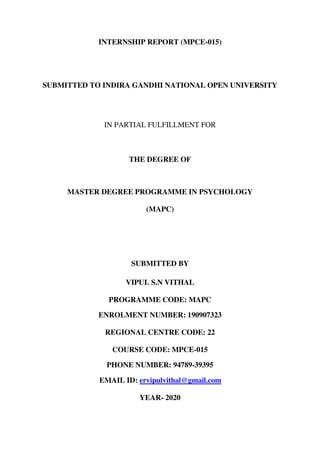
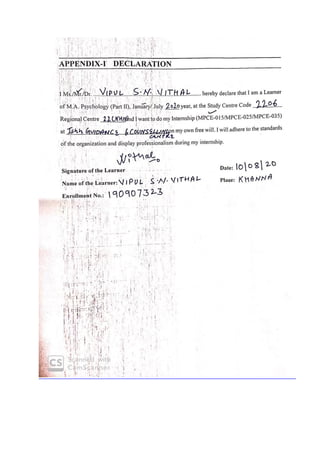
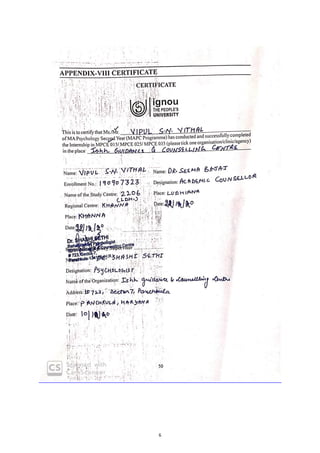
INTERNSHIP REPORT (MPCE-015)
SUBMITTED TO INDIRA GANDHI NATIONAL OPEN UNIVERSITY
IN PARTIAL FULFILLMENT FOR
THE DEGREE OF
MASTER DEGREE PROGRAMME IN PSYCHOLOGY
(MAPC)
SUBMITTED BY
VIPUL S.N VITHAL
PROGRAMME CODE: MAPC
ENROLMENT NUMBER: 190907323
REGIONAL CENTRE CODE: 22
COURSE CODE: MPCE-015
PHONE NUMBER: 94789-39395
EMAIL ID: ervipulvithal@gmail.com
YEAR- 2020
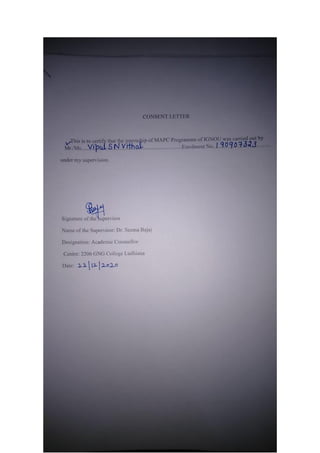
lOMoARcPSD|25238877
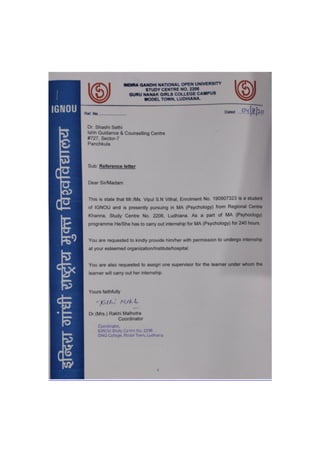
lOMoARcPSD|25238877
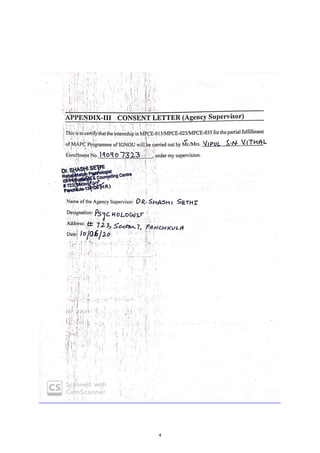
lOMoARcPSD|25238877
4
lOMoARcPSD|25238877
lOMoARcPSD|25238877
6
lOMoARcPSD|25238877
lOMoARcPSD|25238877
8
INTERNSHIP REPORT
SUBMITTED BY
VIPUL S.N VITHAL
ENROLLMENT NO. - 190907323
YEAR 2020
INTERNSHIP REPORT (MPCE-015)
SUBMITTED TO INDIRA GANDHI NATIONAL OPEN UNIVERSITY
NEW DELHI
IN PARTIAL FULFILMENT OF THE REQUIREMENT FOR THE DEGREE OF
MA(PSYCHOLOGY)
lOMoARcPSD|25238877
ACKNOWLEDGEMENT
With the profound reverence, I bow my head before the Almighty, whose invisible hand
guided me from darkness to light, from ignorance to knowledge, which helped me to achieve
my goals. His blessings led me towards the completion of this Internship work.
I wish to express my sincere appreciation to my Agency supervisor, Dr. Shashi Sethi, who
has the substance of a genius: she convincingly guided and encouraged me to be professional
and do the right thing even when the road got tough. Without her persistent help, the goal of
this conducting cases would not have been realized. She was kind and supportive enough to
be available for discussion throughout the internship. It was a great privilege and honour to
work and study under her guidance.
Special thanks to committee of IGNOU as the university has given enough amount of time
for the completion of the project.
I am also thankful to my Agency Supervisor Dr. Seema Bajaj (Academic Counselor) for
helping me out in doing Internship.
I am highly thankful to my family and friends for their love and support. They have
encouraged me emotionally to complete the work in time successfully.
Finally, I am grateful to everyone who has stood by my side in one way or the other during
my Internship.
Vipul S N Vithal
lOMoARcPSD|25238877
10
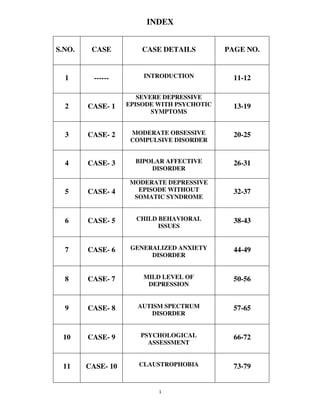
INDEX
S.NO. CASE CASE DETAILS PAGE NO.
1 ------ INTRODUCTION 11-12
2 CASE- 1
SEVERE DEPRESSIVE
EPISODE WITH PSYCHOTIC
SYMPTOMS
13-19
3 CASE- 2 MODERATE OBSESSIVE
COMPULSIVE DISORDER
20-25
4 CASE- 3 BIPOLAR AFFECTIVE
DISORDER
26-31
5 CASE- 4
MODERATE DEPRESSIVE
EPISODE WITHOUT
SOMATIC SYNDROME
32-37
6 CASE- 5 CHILD BEHAVIORAL
ISSUES
38-43
7 CASE- 6 GENERALIZED ANXIETY
DISORDER
44-49
8 CASE- 7 MILD LEVEL OF
DEPRESSION
50-56
9 CASE- 8 AUTISM SPECTRUM
DISORDER
57-65
10 CASE- 9 PSYCHOLOGICAL
ASSESSMENT
66-72
11 CASE- 10 CLAUSTROPHOBIA 73-79
lOMoARcPSD|25238877
INTRODUCTION
An internship is a trained and supervised experience in a professional
setting in which the student is learning and gaining essential experience and
expertise. Internship is meant for introducing candidates either full-time or part-
time to a real world experience related to their career goals and interests. It
may, but does not have to be related connected to one’s academic major or
minor. Internships can be done during the academic semester and or summer
depending upon the spaced out curriculum. There are several varieties of
internship: some are paid some are not and some offer credit towards graduation.
OBJECTIVES OF INTERNSHIP
The main objective of the internship course is to facilitate reflection
on experiences obtained in the internship and to enhance understanding of
academic material by application in the internship setting. Internships will
provide students the opportunity to test their interest in a particular career before
permanent commitments are made. Apart from it is more important because:
1. Internship students will develop employment records or reference that will
enhance employment opportunities.
2. Internship will provide students the opportunity to develop attitudes
conducive to effective interpersonal relationship.
3. Internship will provide students with an in-depth knowledge of the formal
functional activities of a participating organization.
4. Internship programs will enhance advancement possibilities of graduates.
5. Internship will help the trainees to develop skills and techniques directly
applicable to their careers.
6. Internship will provide students the opportunity to develop attitudes
conducive to effective interpersonal relationships.
PURPOSE OF INTERSHIP IN PSYCHOLOGY
1. To develop facility with a range of diagnostic skills, including: interviews, case
history-taking, risk assessment, child protective issues, diagnostic formulation,
triage, disposition, and referral.
lOMoARcPSD|25238877
12
2. To develop further skills in psychological intervention, including:
environmental interventions, crisis intervention, short-term, goal-oriented
individual, group, and family psychotherapy, exposure to long-term individual
psychotherapy, behavioral medicine technique, and exposure to psycho
pharmacology, case management, and advocacy.
3. To develop facility with a range of assessment techniques, including:
developmental testing (elective), cognitive testing, achievement testing, assessment
of behavior, emotional functioning, assessment of parent-child relationship and
family systems, and neuro psychological evaluation (elective). Assessment
training across will include both current functioning and changes in
functioning.
4. To develop facility with psychological consultation, through individual cases and
participation in multidisciplinary teams, including consultation to: parents,
mental health staff (e.g., psychiatrists, social workers) medical staff (e.g.,
physicians, nurses, PT, OT, etc.), school systems, and the legal system.
Consultation training occurs in both the inpatient and outpatient setting, both
downtown and in the suburbs, and ranges.
5. To learn the clinical, legal, and ethical involved in documentation of mental
health services within a medical setting.
6. To learn to promote the integration of science and practice, related to theories
and practice of assessment, intervention, and consultation. Interns are trained in
empirically-supported treatments (e.g., parent training groups, inpatient treatment
protocols for school avoidance, eating disorders), and behavioral medicine
protocols (e.g., medical noncompliance, pain management, headache treatment,
toilet training)
lOMoARcPSD|25238877
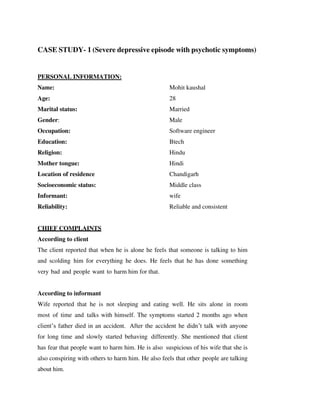
CASE STUDY- 1 (Severe depressive episode with psychotic symptoms)
PERSONAL INFORMATION:
Name: Mohit kaushal
Age: 28
Marital status: Married
Gender: Male
Occupation: Software engineer
Education: Btech
Religion: Hindu
Mother tongue: Hindi
Location of residence Chandigarh
Socioeconomic status: Middle class
Informant: wife
Reliability: Reliable and consistent
CHIEF COMPLAINTS
According to client
The client reported that when he is alone he feels that someone is talking to him
and scolding him for everything he does. He feels that he has done something
very bad and people want to harm him for that.
According to informant
Wife reported that he is not sleeping and eating well. He sits alone in room
most of time and talks with himself. The symptoms started 2 months ago when
client’s father died in an accident. After the accident he didn’t talk with anyone
for long time and slowly started behaving differently. She mentioned that client
has fear that people want to harm him. He is also suspicious of his wife that she is
also conspiring with others to harm him. He also feels that other people are talking
about him.
lOMoARcPSD|25238877
14
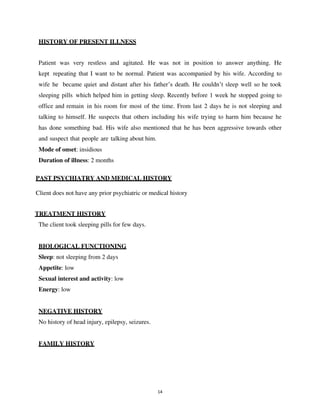
HISTORY OF PRESENT ILLNESS
Patient was very restless and agitated. He was not in position to answer anything. He
kept repeating that I want to be normal. Patient was accompanied by his wife. According to
wife he became quiet and distant after his father’s death. He couldn’t sleep well so he took
sleeping pills which helped him in getting sleep. Recently before 1 week he stopped going to
office and remain in his room for most of the time. From last 2 days he is not sleeping and
talking to himself. He suspects that others including his wife trying to harm him because he
has done something bad. His wife also mentioned that he has been aggressive towards other
and suspect that people are talking about him.
Mode of onset: insidious
Duration of illness: 2 months
PAST PSYCHIATRY AND MEDICAL HISTORY
Client does not have any prior psychiatric or medical history
TREATMENT HISTORY
The client took sleeping pills for few days.
BIOLOGICAL FUNCTIONING
Sleep: not sleeping from 2 days
Appetite: low
Sexual interest and activity: low
Energy: low
NEGATIVE HISTORY
No history of head injury, epilepsy, seizures.
FAMILY HISTORY
lOMoARcPSD|25238877
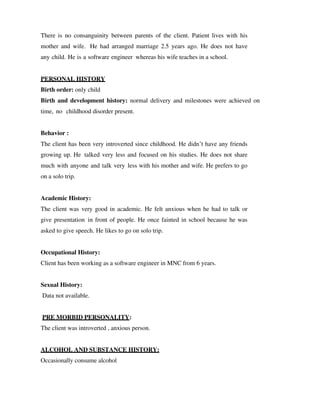
There is no consanguinity between parents of the client. Patient lives with his
mother and wife. He had arranged marriage 2.5 years ago. He does not have
any child. He is a software engineer whereas his wife teaches in a school.
PERSONAL HISTORY
Birth order: only child
Birth and development history: normal delivery and milestones were achieved on
time, no childhood disorder present.
Behavior :
The client has been very introverted since childhood. He didn’t have any friends
growing up. He talked very less and focused on his studies. He does not share
much with anyone and talk very less with his mother and wife. He prefers to go
on a solo trip.
Academic History:
The client was very good in academic. He felt anxious when he had to talk or
give presentation in front of people. He once fainted in school because he was
asked to give speech. He likes to go on solo trip.
Occupational History:
Client has been working as a software engineer in MNC from 6 years.
Sexual History:
Data not available.
PRE MORBID PERSONALITY:
The client was introverted , anxious person.
ALCOHOL AND SUBSTANCE HISTORY:
Occasionally consume alcohol
lOMoARcPSD|25238877
16
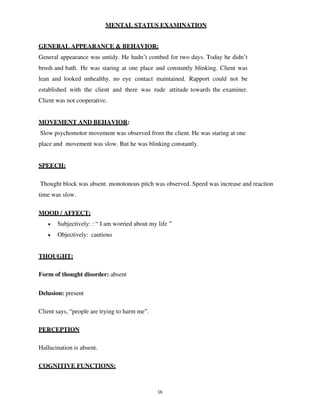
MENTAL STATUS EXAMINATION
GENERAL APPEARANCE & BEHAVIOR:
General appearance was untidy. He hadn’t combed for two days. Today he didn’t
brush and bath. He was staring at one place and constantly blinking. Client was
lean and looked unhealthy. no eye contact maintained. Rapport could not be
established with the client and there was rude attitude towards the examiner.
Client was not cooperative.
MOVEMENT AND BEHAVIOR:
Slow psychomotor movement was observed from the client. He was staring at one
place and movement was slow. But he was blinking constantly.
SPEECH:
MOOD / AFFECT:
• Subjectively: : “ I am worried about my life ”
• Objectively: cautious
THOUGHT:
Delusion: present
Client says, “people are trying to harm me”.
PERCEPTION
Hallucination is absent.
COGNITIVE FUNCTIONS:
Thought block was absent. monotonous pitch was observed. Speed was increase and reaction
time was slow.
Form of thought disorder: absent
lOMoARcPSD|25238877
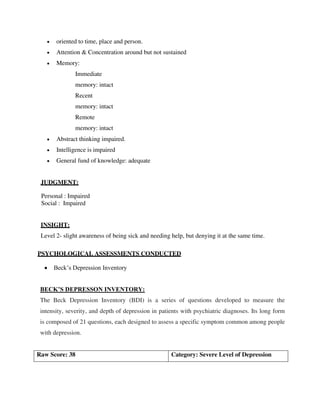
• oriented to time, place and person.
• Attention & Concentration around but not sustained
• Memory:
Immediate
memory: intact
Recent
memory: intact
Remote
memory: intact
• Abstract thinking impaired.
• Intelligence is impaired
• General fund of knowledge: adequate
JUDGMENT:
Personal : Impaired
Social : Impaired
INSIGHT:
Level 2- slight awareness of being sick and needing help, but denying it at the same time.
PSYCHOLOGICAL ASSESSMENTS CONDUCTED
• Beck’s Depression Inventory
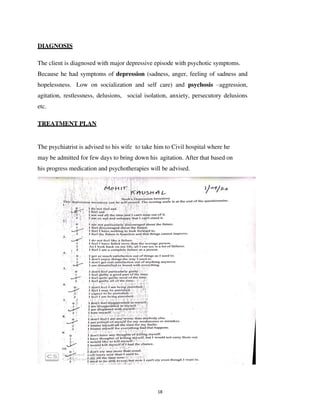
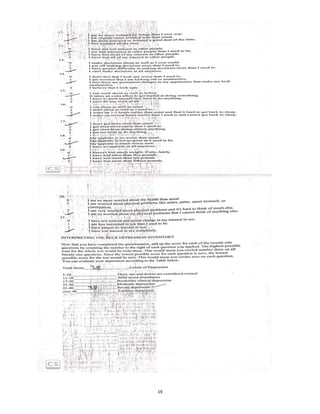
BECK’S DEPRESSON INVENTORY:
The Beck Depression Inventory (BDI) is a series of questions developed to measure the
intensity, severity, and depth of depression in patients with psychiatric diagnoses. Its long form
is composed of 21 questions, each designed to assess a specific symptom common among people
with depression.
Raw Score: 38 Category: Severe Level of Depression
lOMoARcPSD|25238877
18
DIAGNOSIS
The client is diagnosed with major depressive episode with psychotic symptoms.
Because he had symptoms of depression (sadness, anger, feeling of sadness and
hopelessness. Low on socialization and self care) and psychosis –aggression,
agitation, restlessness, delusions, social isolation, anxiety, persecutory delusions
etc.
TREATMENT PLAN
The psychiatrist is advised to his wife to take him to Civil hospital where he
may be admitted for few days to bring down his agitation. After that based on
his progress medication and psychotherapies will be advised.
lOMoARcPSD|25238877
19
lOMoARcPSD|25238877
20
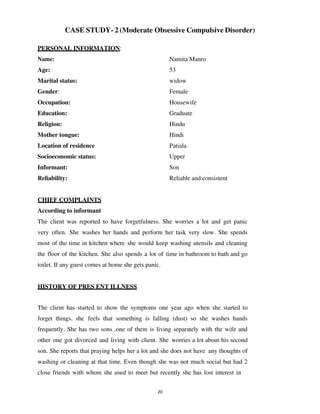
CASE STUDY- 2 (Moderate Obsessive Compulsive Disorder)
PERSONAL INFORMATION:
Name: Namita Manro
Age: 53
Marital status: widow
Gender: Female
Occupation: Housewife
Education: Graduate
Religion: Hindu
Mother tongue: Hindi
Location of residence Patiala
Socioeconomic status: Upper
Informant: Son
Reliability: Reliable and consistent
CHIEF COMPLAINTS
According to informant
The client was reported to have forgetfulness. She worries a lot and get panic
very often. She washes her hands and perform her task very slow. She spends
most of the time in kitchen where she would keep washing utensils and cleaning
the floor of the kitchen. She also spends a lot of time in bathroom to bath and go
toilet. If any guest comes at home she gets panic.
HISTORY OF PRES ENT ILLNESS
The client has started to show the symptoms one year ago when she started to
forget things. she feels that something is falling (dust) so she washes hands
frequently. She has two sons .one of them is living separately with the wife and
other one got divorced and living with client. She worries a lot about his second
son. She reports that praying helps her a lot and she does not have any thoughts of
washing or cleaning at that time. Even though she was not much social but had 2
close friends with whom she used to meet but recently she has lost interest in
lOMoARcPSD|25238877
21
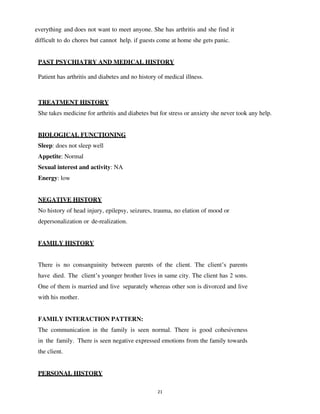
everything and does not want to meet anyone. She has arthritis and she find it
difficult to do chores but cannot help. if guests come at home she gets panic.
PAST PSYCHIATRY AND MEDICAL HISTORY
Patient has arthritis and diabetes and no history of medical illness.
TREATMENT HISTORY
She takes medicine for arthritis and diabetes but for stress or anxiety she never took any help.
BIOLOGICAL FUNCTIONING
Sleep: does not sleep well
Appetite: Normal
Sexual interest and activity: NA
Energy: low
NEGATIVE HISTORY
No history of head injury, epilepsy, seizures, trauma, no elation of mood or
depersonalization or de-realization.
FAMILY HISTORY
There is no consanguinity between parents of the client. The client’s parents
have died. The client’s younger brother lives in same city. The client has 2 sons.
One of them is married and live separately whereas other son is divorced and live
with his mother.
FAMILY INTERACTION PATTERN:
The communication in the family is seen normal. There is good cohesiveness
in the family. There is seen negative expressed emotions from the family towards
the client.
PERSONAL HISTORY
lOMoARcPSD|25238877
22
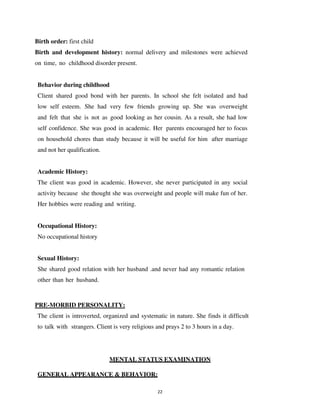
Birth order: first child
Birth and development history: normal delivery and milestones were achieved
on time, no childhood disorder present.
Behavior during childhood
Client shared good bond with her parents. In school she felt isolated and had
low self esteem. She had very few friends growing up. She was overweight
and felt that she is not as good looking as her cousin. As a result, she had low
self confidence. She was good in academic. Her parents encouraged her to focus
on household chores than study because it will be useful for him after marriage
and not her qualification.
Academic History:
The client was good in academic. However, she never participated in any social
activity because she thought she was overweight and people will make fun of her.
Her hobbies were reading and writing.
Occupational History:
No occupational history
Sexual History:
She shared good relation with her husband .and never had any romantic relation
other than her husband.
PRE-MORBID PERSONALITY:
The client is introverted, organized and systematic in nature. She finds it difficult
to talk with strangers. Client is very religious and prays 2 to 3 hours in a day.
MENTAL STATUS EXAMINATION
GENERAL APPEARANCE & BEHAVIOR:
lOMoARcPSD|25238877
23
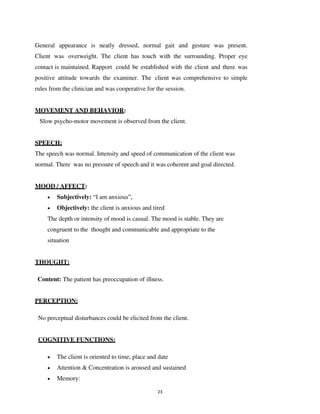
General appearance is neatly dressed, normal gait and gesture was present.
Client was overweight. The client has touch with the surrounding. Proper eye
contact is maintained. Rapport could be established with the client and there was
positive attitude towards the examiner. The client was comprehensive to simple
rules from the clinician and was cooperative for the session.
MOVEMENT AND BEHAVIOR:
Slow psycho-motor movement is observed from the client.
SPEECH:
The speech was normal. Intensity and speed of communication of the client was
normal. There was no pressure of speech and it was coherent and goal directed.
MOOD / AFFECT:
• Subjectively: “I am anxious”,
• Objectively: the client is anxious and tired
The depth or intensity of mood is casual. The mood is stable. They are
congruent to the thought and communicable and appropriate to the
situation
THOUGHT:
Content: The patient has preoccupation of illness.
PERCEPTION:
No perceptual disturbances could be elicited from the client.
COGNITIVE FUNCTIONS:
• The client is oriented to time, place and date
• Attention & Concentration is aroused and sustained
• Memory:
lOMoARcPSD|25238877
24
Immediate
memory: intact
Recent
memory:intact
Remote
memory: intact
• Abstraction : intact
• General fund of knowledge: adequate
JUDGMENT:
Personal : Intact
Social : Intact
INSIGHT:
The client has insight level of 6 which means she had true emotional insight.
PSYCHOLOGICAL ASSESSMENTS CONDUCTED
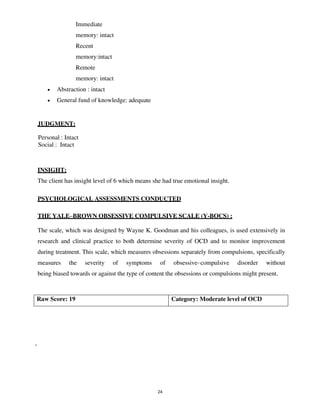
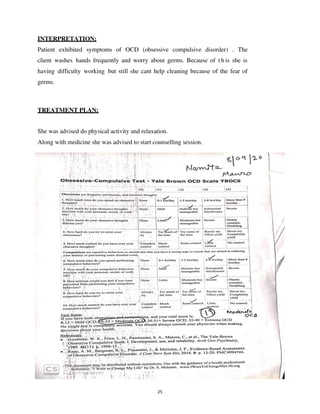
THE YALE–BROWN OBSESSIVE COMPULSIVE SCALE (Y-BOCS) :
The scale, which was designed by Wayne K. Goodman and his colleagues, is used extensively in
research and clinical practice to both determine severity of OCD and to monitor improvement
during treatment. This scale, which measures obsessions separately from compulsions, specifically
measures the severity of symptoms of obsessive–compulsive disorder without
being biased towards or against the type of content the obsessions or compulsions might present.
Raw Score: 19 Category: Moderate level of OCD
‘
lOMoARcPSD|25238877
25
INTERPRETATION:
Patient exhibited symptoms of OCD (obsessive compulsive disorder) . The
client washes hands frequently and worry about germs. Because of t h is she is
having difficulty working but still she cant help cleaning because of the fear of
germs.
TREATMENT PLAN:
She was advised do physical activity and relaxation.
Along with medicine she was advised to start counselling session.
lOMoARcPSD|25238877
26
CASE STUDY- 3 ( Bipolar affective disorder )
PERSONAL INFORMATION:
Name: Mr. ABHINAV KUMAR
Age: 26
Marital status: unmarried
Gender: Male
Occupation: Student
Education: BBA
Religion: Hindu
Mother tongue: Hindi
Location of residence: Mohali
Socioeconomic status: Upper
Informant: father and uncle
Reliability: Reliable and consistent but inadequate
CHIEF COMPLAINTS
According to the patient
“I have no problem. My mind is super fast and no one can match it.”
According to the informant
“he has become very aggressive and started abusing people. He had fights with his friends and
brother. He thinks that he is very intelligent and look down on others.”
HISTORY OF PRESENT ILLNESS
The onset of the illness is acute. The client was apparently well a week ago. Three
days before he got to know that he cleared his entrance exam in IIM-
Ahmedabad. He had been very ecstatic about it. Later in the evening he got
aggressive to his younger brother who jokingly said that he may have cheated in
entrance exams. He responded him saying that his mind is super fast and he does
not cheat like he does.
lOMoARcPSD|25238877
27
Next day while returning back home at bus station station he abused his best
friend and asked him to jump off in front of bus. he even tried to push him.
Next day he again abused his friend and got aggressive he kept repeating that no
one can match him. His father decided to bring him to the hospital. Currently
there is no significant change in his sleep pattern, he can maintain hygiene
however his energy level increased his appetite has decreased from past 2 days.
PAST PSYCHIATRY AND MEDICAL HISTORY
The patient does not have any kind of past illness/psychiatric illness Treatment History-
TREATMENT HISTORY
NIL
BIOLOGICAL FUNCTIONING
Sleep: client has not slept from 1 days
Appetite: decreased
Energy: very Active
FAMILY HISTORY
The patient family is a nuclear family. His father is a bank manager and
brother is doing his graduation. Family atmosphere is good. The patient financial
status is also good.
PERSONAL HISTORY
Birth order: first born, he has one younger brother.
Birth and development history:
-Birth history was normal, Birth cry was present, Birth weight 2 kilo,
Developmental milestones achieved before handed, no emotional or physical
problems were present in childhood.
Behavior during childhood
The patient was good in school and used to score good marks. He had many
friends growing up and is an extrovert.
lOMoARcPSD|25238877
28
Sexual history
Not elicited
Premorbid personality
The patient was extrovert and had many friends, he never showed any kind of
resistance earlier or aggressiveness
MENTAL STATUS EXAMINATION
GENERAL APPEARANCE & BEHAVIOUR:
He was good wearing a check shirt and pant, hair was properly made well
dressed and groomed, Behaviour was restless was wringing his hands and the
patient was uncooperative, hyperactive, restless but well dressed. Attitude
towards examines- uncooperative, Rapport could not be established.
MOVEMENT AND BEHAVIOUR:
Agitation was present and the patient was constantly moving his hands.
SPEECH:
Rapid, pressure of speech was
observed productivity–high
Reaction time was decreased
MOOD / AFFECT:
Mood - irritable, euphoric
Affect- broad–congruent with mood
PERCEPTION:
No perceptual disturbances are seen from the client
lOMoARcPSD|25238877
29
THOUGHT:
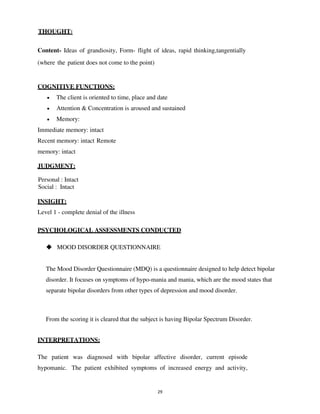
Content- Ideas of grandiosity, Form- flight of ideas, rapid thinking,tangentially
(where the patient does not come to the point)
COGNITIVE FUNCTIONS:
• The client is oriented to time, place and date
• Attention & Concentration is aroused and sustained
• Memory:
Immediate memory: intact
Recent memory: intact Remote
memory: intact
JUDGMENT:
Personal : Intact
Social : Intact
INSIGHT:
Level 1 - complete denial of the illness
PSYCHOLOGICAL ASSESSMENTS CONDUCTED
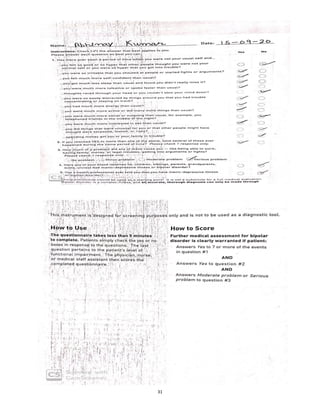
◆ MOOD DISORDER QUESTIONNAIRE
The Mood Disorder Questionnaire (MDQ) is a questionnaire designed to help detect bipolar
disorder. It focuses on symptoms of hypo-mania and mania, which are the mood states that
separate bipolar disorders from other types of depression and mood disorder.
From the scoring it is cleared that the subject is having Bipolar Spectrum Disorder.
INTERPRETATIONS:
The patient was diagnosed with bipolar affective disorder, current episode
hypomanic. The patient exhibited symptoms of increased energy and activity,
lOMoARcPSD|25238877
30
talkativeness, decreased need for sleep, irritability and currently experiencing
hypomanic episode.
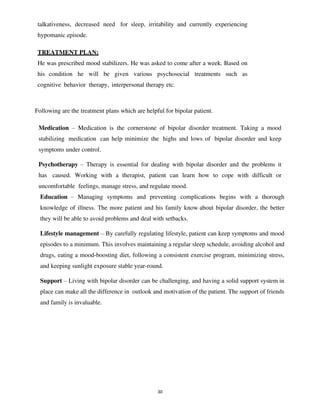
TREATMENT PLAN:
He was prescribed mood stabilizers. He was asked to come after a week. Based on
his condition he will be given various psychosocial treatments such as
cognitive behavior therapy, interpersonal therapy etc.
Following are the treatment plans which are helpful for bipolar patient.
Medication – Medication is the cornerstone of bipolar disorder treatment. Taking a mood
stabilizing medication can help minimize the highs and lows of bipolar disorder and keep
symptoms under control.
Psychotherapy – Therapy is essential for dealing with bipolar disorder and the problems it
has caused. Working with a therapist, patient can learn how to cope with difficult or
uncomfortable feelings, manage stress, and regulate mood.
Education – Managing symptoms and preventing complications begins with a thorough
knowledge of illness. The more patient and his family know about bipolar disorder, the better
they will be able to avoid problems and deal with setbacks.
Lifestyle management – By carefully regulating lifestyle, patient can keep symptoms and mood
episodes to a minimum. This involves maintaining a regular sleep schedule, avoiding alcohol and
drugs, eating a mood-boosting diet, following a consistent exercise program, minimizing stress,
and keeping sunlight exposure stable year-round.
Support – Living with bipolar disorder can be challenging, and having a solid support system in
place can make all the difference in outlook and motivation of the patient. The support of friends
and family is invaluable.
lOMoARcPSD|25238877
31
lOMoARcPSD|25238877
32
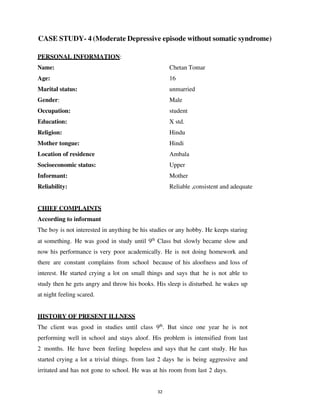
CASE STUDY- 4 (Moderate Depressive episode without somatic syndrome)
PERSONAL INFORMATION:
Name: Chetan Tomar
Age: 16
Marital status: unmarried
Gender: Male
Occupation: student
Education: X std.
Religion: Hindu
Mother tongue: Hindi
Location of residence Ambala
Socioeconomic status: Upper
Informant: Mother
Reliability: Reliable ,consistent and adequate
CHIEF COMPLAINTS
According to informant
The boy is not interested in anything be his studies or any hobby. He keeps staring
at something. He was good in study until 9th
Class but slowly became slow and
now his performance is very poor academically. He is not doing homework and
there are constant complains from school because of his aloofness and loss of
interest. He started crying a lot on small things and says that he is not able to
study then he gets angry and throw his books. His sleep is disturbed. he wakes up
at night feeling scared.
HISTORY OF PRESENT ILLNESS
The client was good in studies until class 9th
. But since one year he is not
performing well in school and stays aloof. His problem is intensified from last
2 months. He have been feeling hopeless and says that he cant study. He has
started crying a lot a trivial things. from last 2 days he is being aggressive and
irritated and has not gone to school. He was at his room from last 2 days.
lOMoARcPSD|25238877
33
PAST PSYCHIATRY AND MEDICAL HISTORY
NIL
TREATMENT HISTORY
NIL
BIOLOGICAL FUNCTIONING
Sleep: disturbed
Appetite: decreased
Sexual interest and activity: NA
Energy: low
NEGATIVE HISTORY
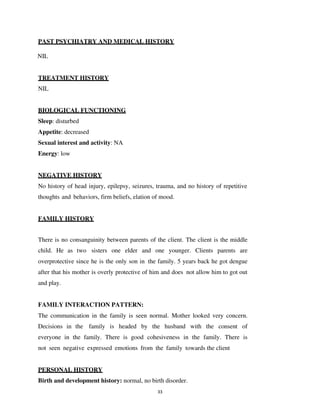
No history of head injury, epilepsy, seizures, trauma, and no history of repetitive
thoughts and behaviors, firm beliefs, elation of mood.
FAMILY HISTORY
There is no consanguinity between parents of the client. The client is the middle
child. He as two sisters one elder and one younger. Clients parents are
overprotective since he is the only son in the family. 5 years back he got dengue
after that his mother is overly protective of him and does not allow him to got out
and play.
FAMILY INTERACTION PATTERN:
The communication in the family is seen normal. Mother looked very concern.
Decisions in the family is headed by the husband with the consent of
everyone in the family. There is good cohesiveness in the family. There is
not seen negative expressed emotions from the family towards the client
PERSONAL HISTORY
Birth and development history: normal, no birth disorder.
lOMoARcPSD|25238877
34
Academic History:
The client was good in studies. But before one year he has started loosing
interest and get low marks.
PRE MORBID PERSONALITY:
Client was introvert. he was good in studies. He had good friends but recently
not going out to meet them. His hobby is painting and drawing .
MENTAL STATUS EXAMINATION
GENERAL APPEARANCE & BEHAVIOR:
General appearance is neatly dressed, normal gait and gesture was present.
The client has touch with the surrounding. Lack of eye contact observed.
The client was comprehensive to simple rules from the clinician and was
cooperative for the session.
MOVEMENT AND BEHAVIOR:
slow psycho motor movement is observed from the client.
SPEECH:
The speech was normal. Intensity and speed of communication of the client was
normal. There was no pressure of speech and it was coherent and goal directed.
MOOD / AFFECT:
• Subjectively: “I am sad”,
• Objectively: the client was sad and tearful
THOUGHT:
Content: The patient has preoccupation of illness.
PERCEPTION:
No perceptual disturbances could be elicited from the client.
lOMoARcPSD|25238877
35
COGNITIVE FUNCTIONS:
• The client is oriented to time, place and date
• Attention & Concentration is aroused and sustained
• Memory:
Immediate
memory: intact
Recent
memory: intact
Remote
memory: intact
• Abstraction: intact
• General fund of knowledge: adequate
• Judgment: Intact
INSIGHT:
The client has insight level of 5 which means client has intellectual insight.
PSYCHOLOGICAL ASSESSMENTS CONDUCTED
• Beck’s Depression Inventory
BECK’S DEPRESSON INVENTORY:
The Beck Depression Inventory (BDI) is a series of questions developed to measure the
intensity, severity, and depth of depression in patients with psychiatric diagnoses. Its long form
is composed of 21 questions, each designed to assess a specific symptom common among people
with depression.
Raw Score: 24 Category: Moderate Level of Depression
lOMoARcPSD|25238877
36
INTERPRETATION:
Moderate depressive episode without somatic syndrome. Client exhibited
symptoms of hopelessness, sadness, cries a lot, isolation etc.
TREATMENT PLAN
Doctor had prescribed him Antidepressant. He had asked him to come after 1
weeks. Doctor strongly advised to go for counselling. clearly he had symptoms of
depression cause of which is unknown.
lOMoARcPSD|25238877
37
lOMoARcPSD|25238877
38
CASE STUDY- 5 ( Child Behavioral Issues )
PERSONAL INFORMATION:
Name: Siyona
Age: 6.8
Marital status: unmarried
Gender: Female
Occupation: Student
Education: LKG
Religion: Hindu
Mother tongue: Hindi
Location of residence Panchkula
Informant: Mother
NEONATAL HISTORY
• 1st
in birth order
• Cesarean and Full- term delivery
• Immediate birth cry
• No complications during pregnancy
• Normal health and weight of the child during birth
CHIEF COMPLAINTS
According to the informant
“She has become very sensitive and gets scared easily.”
HISTORY OF PRESENT ILLNESS
The She gets angry easily since she was 1year old. This behaviour is getting worst
day by day as she cries a lot as well as she is moody regarding completing any task.
If she does not want to do something she will not do. She cries for approx 1/2 an
hour or longer periods until her mother soothes her.
She feels she should come first that makes her more scared and worried. She has
oversensitive nose.
lOMoARcPSD|25238877
39
PAST PSYCHIATRY AND MEDICAL HISTORY
The patient does not have any kind of past illness/psychiatric illness Treatment History
TREATMENT HISTORY
NIL
BIOLOGICAL FUNCTIONING
Sleep: Normal
Appetite: Normal
Energy: Very Active
FAMILY HISTORY
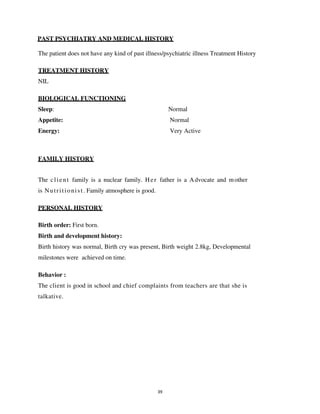
The client family is a nuclear family. Her father is a Advocate and mother
is Nutritionist. Family atmosphere is good.
PERSONAL HISTORY
Birth order: First born.
Birth and development history:
Birth history was normal, Birth cry was present, Birth weight 2.8kg, Developmental
milestones were achieved on time.
Behavior :
The client is good in school and chief complaints from teachers are that she is
talkative.
lOMoARcPSD|25238877
40
MENTAL STATUS EXAMINATION
ESTABLISH RAPPORT
GENERAL APPEARANCE & BEHAVIOUR:
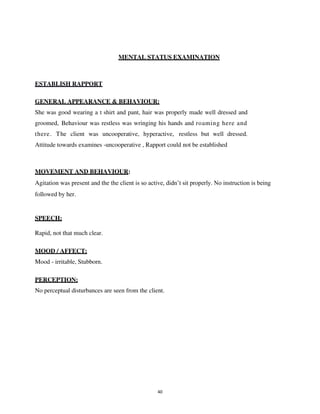
She was good wearing a t shirt and pant, hair was properly made well dressed and
groomed, Behaviour was restless was wringing his hands and roaming here and
there. The client was uncooperative, hyperactive, restless but well dressed.
Attitude towards examines -uncooperative , Rapport could not be established
MOVEMENT AND BEHAVIOUR:
Agitation was present and the the client is so active, didn’t sit properly. No instruction is being
followed by her.
SPEECH:
Rapid, not that much clear.
MOOD / AFFECT:
Mood - irritable, Stubborn.
PERCEPTION:
No perceptual disturbances are seen from the client.
lOMoARcPSD|25238877
41
THOUGHT :
Content- Lack of concentration, stubborn.
COGNITIVE FUNCTIONS :
• The client is little oriented to time, place and date
• Attention & Concentration is little bit.
• Memory: intact
JUDGMENT:
She is too young for it.
INSIGHT:
As she is just 6.8years old, don’t have any insight.
PROVISIONAL DIAGNOSIS
The client was diagnosed with behavioral issues.
PSYCHOLOGICAL ASSESSMENTS CONDUCTED
• VINE LAND SOCIAL MATURITY SCALE
• SEGUIN FORM BOARD
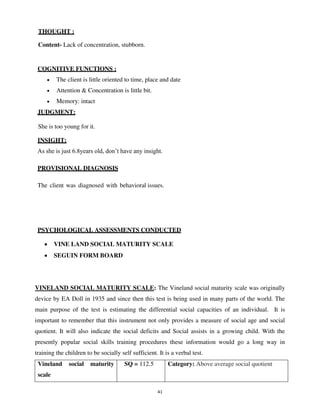
VINELAND SOCIAL MATURITY SCALE: The Vineland social maturity scale was originally
device by EA Doll in 1935 and since then this test is being used in many parts of the world. The
main purpose of the test is estimating the differential social capacities of an individual. It is
important to remember that this instrument not only provides a measure of social age and social
quotient. It will also indicate the social deficits and Social assists in a growing child. With the
presently popular social skills training procedures these information would go a long way in
training the children to be socially self sufficient. It is a verbal test.
Vineland social maturity
scale
SQ = 112.5 Category: Above average social quotient
lOMoARcPSD|25238877
42
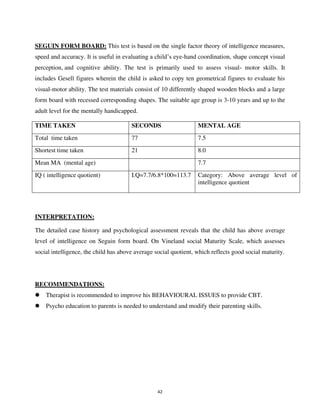
SEGUIN FORM BOARD: This test is based on the single factor theory of intelligence measures,
speed and accuracy. It is useful in evaluating a child’s eye-hand coordination, shape concept visual
perception, and cognitive ability. The test is primarily used to assess visual- motor skills. It
includes Gesell figures wherein the child is asked to copy ten geometrical figures to evaluate his
visual-motor ability. The test materials consist of 10 differently shaped wooden blocks and a large
form board with recessed corresponding shapes. The suitable age group is 3-10 years and up to the
adult level for the mentally handicapped.
INTERPRETATION:
The detailed case history and psychological assessment reveals that the child has above average
level of intelligence on Seguin form board. On Vineland social Maturity Scale, which assesses
social intelligence, the child has above average social quotient, which reflects good social maturity.
RECOMMENDATIONS:
⚫ Therapist is recommended to improve his BEHAVIOURAL ISSUES to provide CBT.
⚫ Psycho education to parents is needed to understand and modify their parenting skills.
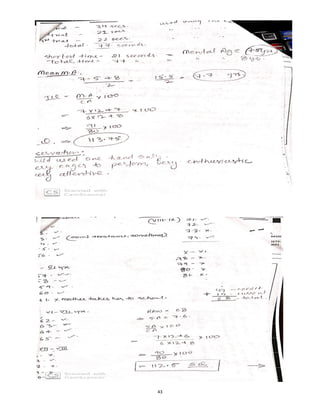
TIME TAKEN SECONDS MENTAL AGE
Total time taken 77 7.5
Shortest time taken 21 8.0
Mean MA (mental age) 7.7
IQ ( intelligence quotient) I.Q=7.7/6.8*100=113.7 Category: Above average level of
intelligence quotient
lOMoARcPSD|25238877
43
lOMoARcPSD|25238877
44
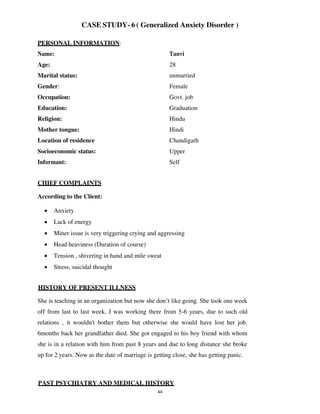
CASE STUDY- 6 ( Generalized Anxiety Disorder )
PERSONAL INFORMATION:
Name: Tanvi
Age: 28
Marital status: unmarried
Gender: Female
Occupation: Govt. job
Education: Graduation
Religion: Hindu
Mother tongue: Hindi
Location of residence Chandigarh
Socioeconomic status: Upper
Informant: Self
CHIEF COMPLAINTS
According to the Client:
• Anxiety
• Lack of energy
• Miner issue is very triggering crying and aggressing
• Head heaviness (Duration of course)
• Tension , shivering in hand and mile sweat
• Stress, suicidal thought
HISTORY OF PRESENT ILLNESS
She is teaching in an organization but now she don’t like going. She took one week
off from last to last week. I was working there from 5-6 years, due to such old
relations , it wouldn't bother them but otherwise she would have lost her job.
6months back her grandfather died. She got engaged to his boy friend with whom
she is in a relation with him from past 8 years and due to long distance she broke
up for 2 years. Now as the date of marriage is getting close, she has getting panic.
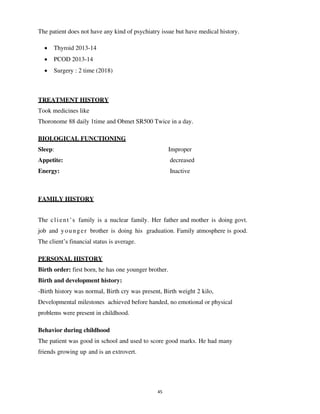
PAST PSYCHIATRY AND MEDICAL HISTORY
lOMoARcPSD|25238877
45
The patient does not have any kind of psychiatry issue but have medical history.
• Thyroid 2013-14
• PCOD 2013-14
• Surgery : 2 time (2018)
TREATMENT HISTORY
Took medicines like
Thoronome 88 daily 1time and Obmet SR500 Twice in a day.
BIOLOGICAL FUNCTIONING
Sleep: Improper
Appetite: decreased
Energy: Inactive
FAMILY HISTORY
The client’s family is a nuclear family. Her father and mother is doing govt.
job and younger brother is doing his graduation. Family atmosphere is good.
The client’s financial status is average.
PERSONAL HISTORY
Birth order: first born, he has one younger brother.
Birth and development history:
-Birth history was normal, Birth cry was present, Birth weight 2 kilo,
Developmental milestones achieved before handed, no emotional or physical
problems were present in childhood.
Behavior during childhood
The patient was good in school and used to score good marks. He had many
friends growing up and is an extrovert.
lOMoARcPSD|25238877
46
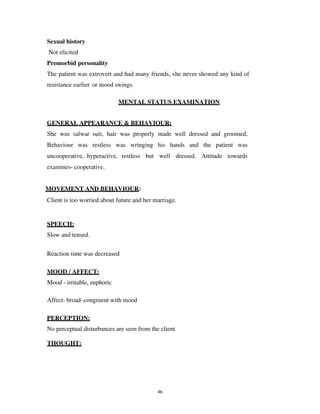
Sexual history
Not elicited
Premorbid personality
The patient was extrovert and had many friends, she never showed any kind of
resistance earlier or mood swings.
MENTAL STATUS EXAMINATION
GENERAL APPEARANCE & BEHAVIOUR:
She was salwar suit, hair was properly made well dressed and groomed,
Behaviour was restless was wringing his hands and the patient was
uncooperative, hyperactive, restless but well dressed. Attitude towards
examines- cooperative.
MOVEMENT AND BEHAVIOUR:
Client is too worried about future and her marriage.
SPEECH:
Slow and tensed.
Reaction time was decreased
MOOD / AFFECT:
Mood - irritable, euphoric
Affect- broad–congruent with mood
PERCEPTION:
No perceptual disturbances are seen from the client
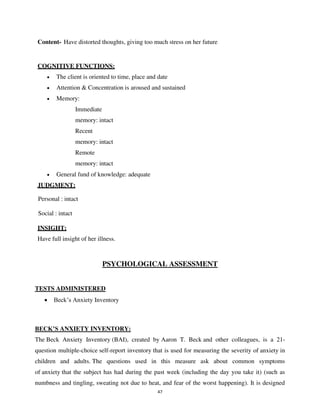
THOUGHT:
lOMoARcPSD|25238877
47
Content- Have distorted thoughts, giving too much stress on her future
COGNITIVE FUNCTIONS:
• The client is oriented to time, place and date
• Attention & Concentration is aroused and sustained
• Memory:
Immediate
memory: intact
Recent
memory: intact
Remote
memory: intact
• General fund of knowledge: adequate
JUDGMENT:
Personal : intact
Social : intact
INSIGHT:
Have full insight of her illness.
PSYCHOLOGICAL ASSESSMENT
TESTS ADMINISTERED
• Beck’s Anxiety Inventory
BECK’S ANXIETY INVENTORY:
The Beck Anxiety Inventory (BAI), created by Aaron T. Beck and other colleagues, is a 21-
question multiple-choice self-report inventory that is used for measuring the severity of anxiety in
children and adults. The questions used in this measure ask about common symptoms
of anxiety that the subject has had during the past week (including the day you take it) (such as
numbness and tingling, sweating not due to heat, and fear of the worst happening). It is designed
lOMoARcPSD|25238877
48
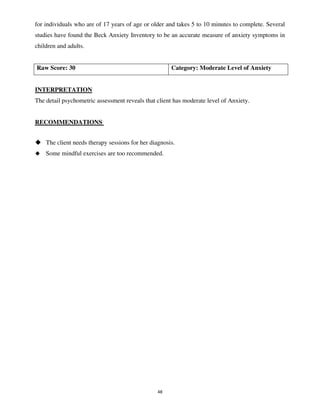
for individuals who are of 17 years of age or older and takes 5 to 10 minutes to complete. Several
studies have found the Beck Anxiety Inventory to be an accurate measure of anxiety symptoms in
children and adults.
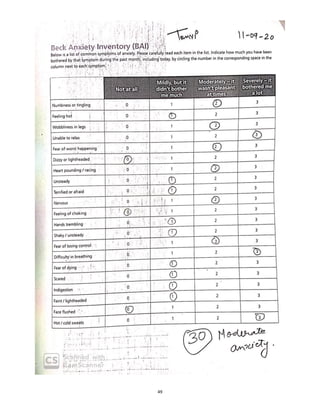
Raw Score: 30 Category: Moderate Level of Anxiety
INTERPRETATION
The detail psychometric assessment reveals that client has moderate level of Anxiety.
RECOMMENDATIONS
◆ The client needs therapy sessions for her diagnosis.
◆ Some mindful exercises are too recommended.
lOMoARcPSD|25238877
49
lOMoARcPSD|25238877
50
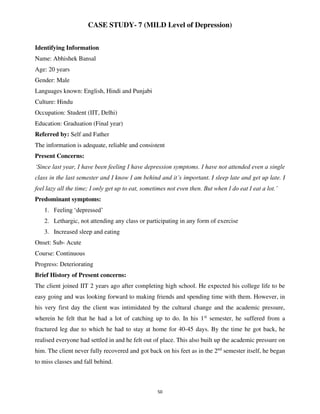
CASE STUDY- 7 (MILD Level of Depression)
Identifying Information
Name: Abhishek Bansal
Age: 20 years
Gender: Male
Languages known: English, Hindi and Punjabi
Culture: Hindu
Occupation: Student (IIT, Delhi)
Education: Graduation (Final year)
Referred by: Self and Father
The information is adequate, reliable and consistent
Present Concerns:
‘Since last year, I have been feeling I have depression symptoms. I have not attended even a single
class in the last semester and I know I am behind and it’s important. I sleep late and get up late. I
feel lazy all the time; I only get up to eat, sometimes not even then. But when I do eat I eat a lot.’
Predominant symptoms:
1. Feeling ‘depressed’
2. Lethargic, not attending any class or participating in any form of exercise
3. Increased sleep and eating
Onset: Sub- Acute
Course: Continuous
Progress: Deteriorating
Brief History of Present concerns:
The client joined IIT 2 years ago after completing high school. He expected his college life to be
easy going and was looking forward to making friends and spending time with them. However, in
his very first day the client was intimidated by the cultural change and the academic pressure,
wherein he felt that he had a lot of catching up to do. In his 1st
semester, he suffered from a
fractured leg due to which he had to stay at home for 40-45 days. By the time he got back, he
realised everyone had settled in and he felt out of place. This also built up the academic pressure on
him. The client never fully recovered and got back on his feet as in the 2nd
semester itself, he began
to miss classes and fall behind.
lOMoARcPSD|25238877
51
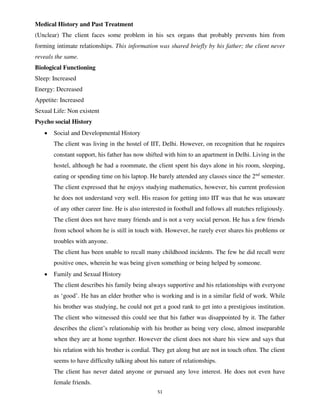
Medical History and Past Treatment
(Unclear) The client faces some problem in his sex organs that probably prevents him from
forming intimate relationships. This information was shared briefly by his father; the client never
reveals the same.
Biological Functioning
Sleep: Increased
Energy: Decreased
Appetite: Increased
Sexual Life: Non existent
Psycho social History
• Social and Developmental History
The client was living in the hostel of IIT, Delhi. However, on recognition that he requires
constant support, his father has now shifted with him to an apartment in Delhi. Living in the
hostel, although he had a roommate, the client spent his days alone in his room, sleeping,
eating or spending time on his laptop. He barely attended any classes since the 2nd
semester.
The client expressed that he enjoys studying mathematics, however, his current profession
he does not understand very well. His reason for getting into IIT was that he was unaware
of any other career line. He is also interested in football and follows all matches religiously.
The client does not have many friends and is not a very social person. He has a few friends
from school whom he is still in touch with. However, he rarely ever shares his problems or
troubles with anyone.
The client has been unable to recall many childhood incidents. The few he did recall were
positive ones, wherein he was being given something or being helped by someone.
• Family and Sexual History
The client describes his family being always supportive and his relationships with everyone
as ‘good’. He has an elder brother who is working and is in a similar field of work. While
his brother was studying, he could not get a good rank to get into a prestigious institution.
The client who witnessed this could see that his father was disappointed by it. The father
describes the client’s relationship with his brother as being very close, almost inseparable
when they are at home together. However the client does not share his view and says that
his relation with his brother is cordial. They get along but are not in touch often. The client
seems to have difficulty talking about his nature of relationships.
The client has never dated anyone or pursued any love interest. He does not even have
female friends.
lOMoARcPSD|25238877
52
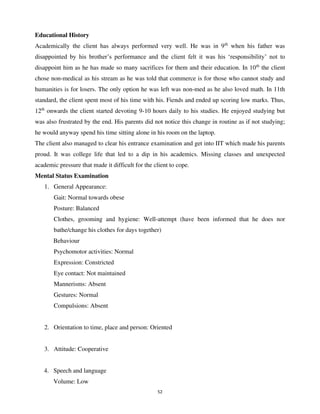
Educational History
Academically the client has always performed very well. He was in 9th
when his father was
disappointed by his brother’s performance and the client felt it was his ‘responsibility’ not to
disappoint him as he has made so many sacrifices for them and their education. In 10th
the client
chose non-medical as his stream as he was told that commerce is for those who cannot study and
humanities is for losers. The only option he was left was non-med as he also loved math. In 11th
standard, the client spent most of his time with his. Fiends and ended up scoring low marks. Thus,
12th
onwards the client started devoting 9-10 hours daily to his studies. He enjoyed studying but
was also frustrated by the end. His parents did not notice this change in routine as if not studying;
he would anyway spend his time sitting alone in his room on the laptop.
The client also managed to clear his entrance examination and get into IIT which made his parents
proud. It was college life that led to a dip in his academics. Missing classes and unexpected
academic pressure that made it difficult for the client to cope.
Mental Status Examination
1. General Appearance:
Gait: Normal towards obese
Posture: Balanced
Clothes, grooming and hygiene: Well-attempt (have been informed that he does nor
bathe/change his clothes for days together)
Behaviour
Psychomotor activities: Normal
Expression: Constricted
Eye contact: Not maintained
Mannerisms: Absent
Gestures: Normal
Compulsions: Absent
2. Orientation to time, place and person: Oriented
3. Attitude: Cooperative
4. Speech and language
Volume: Low
lOMoARcPSD|25238877
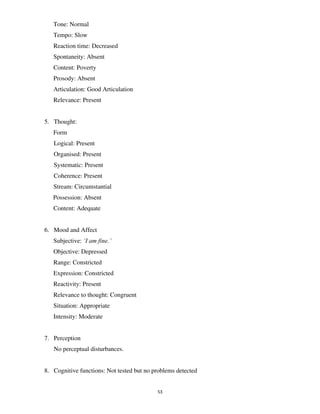
53
Tone: Normal
Tempo: Slow
Reaction time: Decreased
Spontaneity: Absent
Content: Poverty
Prosody: Absent
Articulation: Good Articulation
Relevance: Present
5. Thought:
Form
Logical: Present
Organised: Present
Systematic: Present
Coherence: Present
Stream: Circumstantial
Possession: Absent
Content: Adequate
6. Mood and Affect
Subjective: ‘I am fine.’
Objective: Depressed
Range: Constricted
Expression: Constricted
Reactivity: Present
Relevance to thought: Congruent
Situation: Appropriate
Intensity: Moderate
7. Perception
No perceptual disturbances.
8. Cognitive functions: Not tested but no problems detected
lOMoARcPSD|25238877
54
Insight: Grade III: Awareness of problems but does not know the reason or what to do to
get better.
Treatment and Interventions
Client’s internal dialogue represented his want to teach and learn Math had he been independent of
his parents and feeling guilty for not attending classes
1. Sentence Completion:
• Hard working
• Self conscious
• Worried about his future
• Body image issues
• Feeling lonely
• Low self-esteem
• Lack of emotional connections and bonding
2. Emotion Focused Therapy
Message: ‘Even though I find it difficult, it is important for me to go to college and be
regular.
I accept myself and I love myself.’
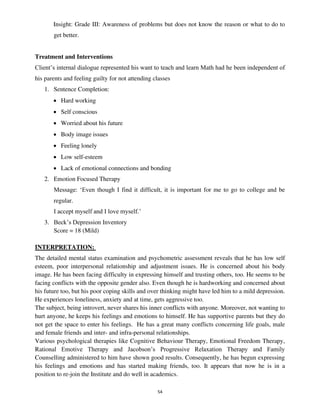
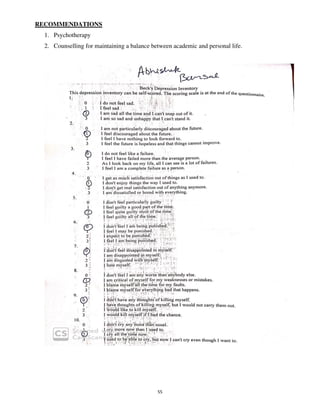
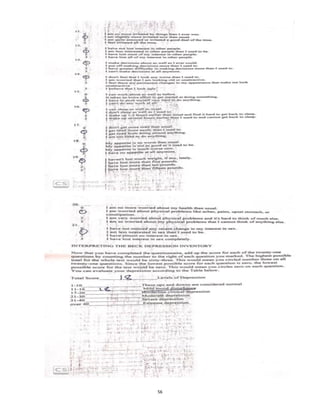
3. Beck’s Depression Inventory
Score = 18 (Mild)
INTERPRETATION:
The detailed mental status examination and psychometric assessment reveals that he has low self
esteem, poor interpersonal relationship and adjustment issues. He is concerned about his body
image. He has been facing difficulty in expressing himself and trusting others, too. He seems to be
facing conflicts with the opposite gender also. Even though he is hardworking and concerned about
his future too, but his poor coping skills and over thinking might have led him to a mild depression.
He experiences loneliness, anxiety and at time, gets aggressive too.
The subject, being introvert, never shares his inner conflicts with anyone. Moreover, not wanting to
hurt anyone, he keeps his feelings and emotions to himself. He has supportive parents but they do
not get the space to enter his feelings. He has a great many conflicts concerning life goals, male
and female friends and inter- and infra-personal relationships.
Various psychological therapies like Cognitive Behaviour Therapy, Emotional Freedom Therapy,
Rational Emotive Therapy and Jacobson’s Progressive Relaxation Therapy and Family
Counselling administered to him have shown good results. Consequently, he has begun expressing
his feelings and emotions and has started making friends, too. It appears that now he is in a
position to re-join the Institute and do well in academics.
lOMoARcPSD|25238877
55
RECOMMENDATIONS
1. Psychotherapy
2. Counselling for maintaining a balance between academic and personal life.
lOMoARcPSD|25238877
56
lOMoARcPSD|25238877
57
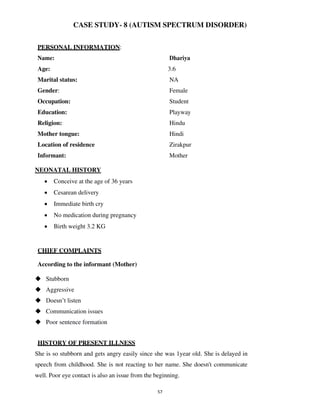
CASE STUDY- 8 (AUTISM SPECTRUM DISORDER)
PERSONAL INFORMATION:
Name: Dhariya
Age: 3.6
Marital status: NA
Gender: Female
Occupation: Student
Education: Playway
Religion: Hindu
Mother tongue: Hindi
Location of residence Zirakpur
Informant: Mother
NEONATAL HISTORY
• Conceive at the age of 36 years
• Cesarean delivery
• Immediate birth cry
• No medication during pregnancy
• Birth weight 3.2 KG
CHIEF COMPLAINTS
According to the informant (Mother)
◆ Stubborn
◆ Aggressive
◆ Doesn’t listen
◆ Communication issues
◆ Poor sentence formation
HISTORY OF PRESENT ILLNESS
She is so stubborn and gets angry easily since she was 1year old. She is delayed in
speech from childhood. She is not reacting to her name. She doesn't communicate
well. Poor eye contact is also an issue from the beginning.
lOMoARcPSD|25238877
58
PAST PSYCHIATRY AND MEDICAL HISTORY
The patient does not have any kind of past illness/psychiatric illness Treatment History-
TREATMENT HISTORY
NIL
BIOLOGICAL FUNCTIONING
Sleep: Normal
Appetite: Normal
Energy: Very Active
FAMILY HISTORY
The client family is a nuclear family. Her father is a Pharmacist and
mother is House wife. Family atmosphere is good.
PERSONAL HISTORY
Birth order: First born.
Birth and development history:
Birth history was normal, Birth cry was present, Birth weight 3.2 kg,
Developmental milestones were achieved on time but delayed in speech.
Behavior :
She is so aggressive and irritable in nature. She is so restless and she has very poor
eye contact and even after calling her name, she is not able to respond to that.
lOMoARcPSD|25238877
59
MENTAL STATUS EXAMINATION
ESTABLISH RAPPORT
GENERAL APPEARANCE & BEHAVIOUR:
Dhariyaa who is 3year and 6 months old girl, dressed simple with loose clothes, she always
making some noise and make able to talk with her mom clearly. I gave her a small toy scooter , she
just try to see his wheels and then i asked to her mom that is she is attracted towards any spinning
and revolving things and she said yes. She used to see fan and car wheels a lot. Then i started
taking full case history and side by side i was trying to catch the behaviour of dhairya. She has
very poor eye contact and even after calling her name, she is not able to respond to that. While
asking her case history i came to know she was delayed in speech too.
MOVEMENT AND BEHAVIOUR:
• repetition in words
• restless
• gets distract easily
• difficulty in comprehension
SPEECH:
Messy, not understandable, repetition of words.
MOOD / AFFECT:
Mood - irritable, Stubborn.
PERCEPTION:
No perceptual disturbances are seen from the client.
lOMoARcPSD|25238877
60
THOUGHT :
Content- Lack of concentration, stubborn.
COGNITIVE FUNCTIONS :
NA
JUDGMENT:
She is too young for it.
INSIGHT:
As she is just 6.8years old, don’t have any insight.
PSYCHOLOGICAL ASSESSMENTS CONDUCTED
• SEGUIN FORM BOARD TEST
• VINELAND SOCIAL MATURITY SCALE
• AUTISUM SPECTRUM DISORDERS QUESTIONNAIRE
• PEDIATRIC DEVELOPMENTAL SCREENING TEST
SEGUIN FORM BOARD: This test is based on the single factor theory of intelligence measures,
speed and accuracy. It is useful in evaluating a child’s eye-hand coordination, shape concept visual
perception, and cognitive ability. The test is primarily used to assess visual- motor skills. It
includes Gesell figures wherein the child is asked to copy ten geometrical figures to evaluate his
visual-motor ability. The test materials consist of 10 differently shaped wooden blocks and a large
form board with recessed corresponding shapes. The suitable age group is 3-10 years and up to the
adult level for the mentally handicapped. This is an effective test for the measurement of
intelligence below 11 years to form an idea about mental ability.
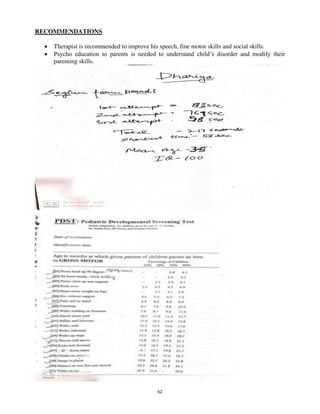
TIME TAKEN SECONDS MENTAL AGE
Total time taken 217 3.5
Shortest time taken 58 3.5
Mean MA (mental age) 3.5 3.5
IQ ( intelligence quotient) I.Q=3.5/3.5*100=100 100
lOMoARcPSD|25238877
61
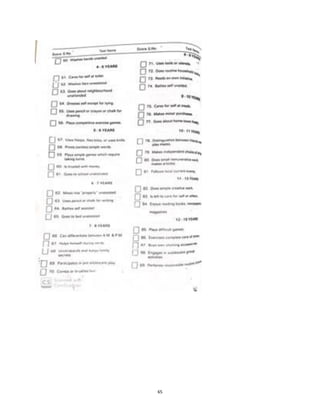
VINELAND SOCIAL MATURITY SCALE: The Vineland social maturity scale was originally
device by EA Doll in 1935 and since then this test is being used in many parts of the world. The
main purpose of the test is estimating the differential social capacities of an individual. It is
important to remember that this instrument not only provides a measure of social age and social
quotient. It will also indicate the social deficits and Social assists in a growing child. With the
presently popular social skills training procedures these information would go a long way in
training the children to be socially self sufficient. It is a verbal test.
Vineland social maturity scale S.Q=51 Category: Mild level of Social Quotient
AUTISUM SPECTRUM DISORDERS QUESTIONNAIRE
ASDQ is a screening instrument for identifying ASDs.This questionnaire can be administered on
parents or care takers individually by professionals in clinical and non-clinical settings for the
purpose of identification of ASD in children in the age group of 4 to 10 years.
Score of child on ASD – 7
A Cut off score of 5 or above is suggestive of ASD
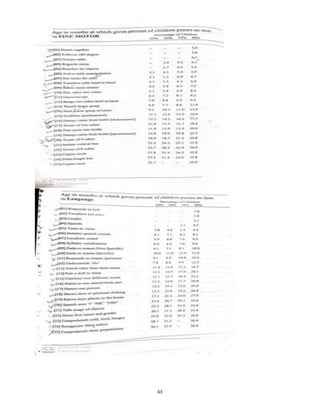
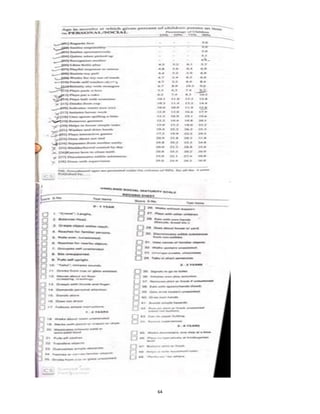
PEDIATRIC DEVELOPMENTAL SCREENING TEST
Area Age( months) Developmental Quotient
Gross motor 36 88
Fine motor 35 85
Language 36 88
Personal / social 36 88
Mean I.Q 88+85+88+88/4=87.25 87.85
INTERPRETATION
The detailed case history and psychometric assessment reveals that child falls in mild level of
Autism Spectrum Disorder; Moderate level of social quotient and has average level of intelligence.
From observation it was observed that she has poor eye contact; she often repeats words; she has
rigid behavior and is stubborn.
lOMoARcPSD|25238877
62
RECOMMENDATIONS
• Therapist is recommended to improve his speech, fine motor skills and social skills.
• Psycho education to parents is needed to understand child’s disorder and modify their
parenting skills.
lOMoARcPSD|25238877
63
lOMoARcPSD|25238877
64
lOMoARcPSD|25238877
65
lOMoARcPSD|25238877
66
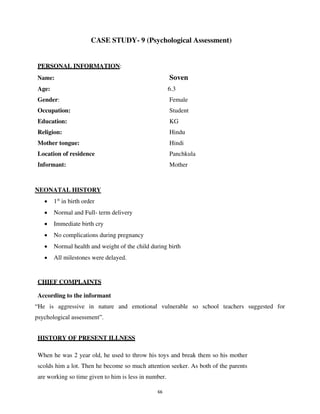
CASE STUDY- 9 (Psychological Assessment)
PERSONAL INFORMATION:
Name: Soven
Age: 6.3
Gender: Female
Occupation: Student
Education: KG
Religion: Hindu
Mother tongue: Hindi
Location of residence Panchkula
Informant: Mother
NEONATAL HISTORY
• 1st
in birth order
• Normal and Full- term delivery
• Immediate birth cry
• No complications during pregnancy
• Normal health and weight of the child during birth
• All milestones were delayed.
CHIEF COMPLAINTS
According to the informant
“He is aggressive in nature and emotional vulnerable so school teachers suggested for
psychological assessment”.
HISTORY OF PRESENT ILLNESS
When he was 2 year old, he used to throw his toys and break them so his mother
scolds him a lot. Then he become so much attention seeker. As both of the parents
are working so time given to him is less in number.
lOMoARcPSD|25238877
67
PAST PSYCHIATRY AND MEDICAL HISTORY
The patient does not have any kind of past illness/psychiatric illness Treatment History-
TREATMENT HISTORY
NIL
BIOLOGICAL FUNCTIONING
Sleep: Normal
Appetite: Normal
Energy: Very Active
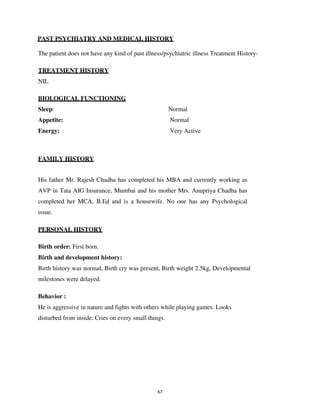
FAMILY HISTORY
His father Mr. Rajesh Chadha has completed his MBA and currently working as
AVP in Tata AIG Insurance, Mumbai and his mother Mrs. Anupriya Chadha has
completed her MCA, B.Ed and is a housewife. No one has any Psychological
issue.
PERSONAL HISTORY
Birth order: First born.
Birth and development history:
Birth history was normal, Birth cry was present, Birth weight 2.5kg, Developmental
milestones were delayed.
Behavior :
He is aggressive in nature and fights with others while playing games. Looks
disturbed from inside. Cries on every small things.
lOMoARcPSD|25238877
68
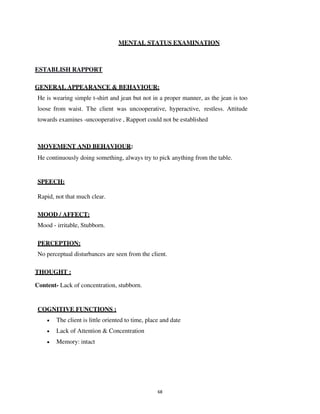
MENTAL STATUS EXAMINATION
ESTABLISH RAPPORT
GENERAL APPEARANCE & BEHAVIOUR:
He is wearing simple t-shirt and jean but not in a proper manner, as the jean is too
loose from waist. The client was uncooperative, hyperactive, restless. Attitude
towards examines -uncooperative , Rapport could not be established
MOVEMENT AND BEHAVIOUR:
He continuously doing something, always try to pick anything from the table.
SPEECH:
Rapid, not that much clear.
MOOD / AFFECT:
Mood - irritable, Stubborn.
PERCEPTION:
No perceptual disturbances are seen from the client.
THOUGHT :
Content- Lack of concentration, stubborn.
COGNITIVE FUNCTIONS :
• The client is little oriented to time, place and date
• Lack of Attention & Concentration
• Memory: intact
lOMoARcPSD|25238877
69
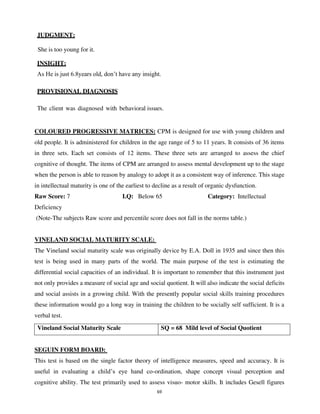
JUDGMENT:
She is too young for it.
INSIGHT:
As He is just 6.8years old, don’t have any insight.
PROVISIONAL DIAGNOSIS
The client was diagnosed with behavioral issues.
COLOURED PROGRESSIVE MATRICES: CPM is designed for use with young children and
old people. It is administered for children in the age range of 5 to 11 years. It consists of 36 items
in three sets. Each set consists of 12 items. These three sets are arranged to assess the chief
cognitive of thought. The items of CPM are arranged to assess mental development up to the stage
when the person is able to reason by analogy to adopt it as a consistent way of inference. This stage
in intellectual maturity is one of the earliest to decline as a result of organic dysfunction.
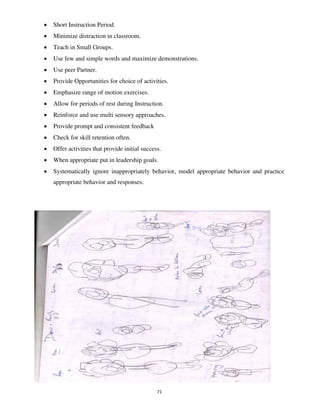
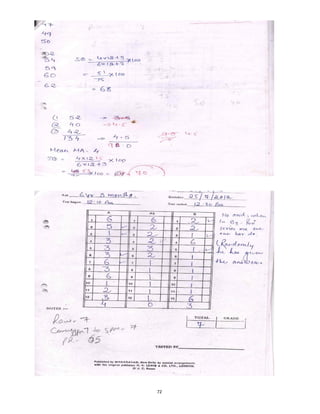
Raw Score: 7 I.Q: Below 65 Category: Intellectual
Deficiency
(Note-The subjects Raw score and percentile score does not fall in the norms table.)
VINELAND SOCIAL MATURITY SCALE:
The Vineland social maturity scale was originally device by E.A. Doll in 1935 and since then this
test is being used in many parts of the world. The main purpose of the test is estimating the
differential social capacities of an individual. It is important to remember that this instrument just
not only provides a measure of social age and social quotient. It will also indicate the social deficits
and social assists in a growing child. With the presently popular social skills training procedures
these information would go a long way in training the children to be socially self sufficient. It is a
verbal test.
SEGUIN FORM BOARD:
This test is based on the single factor theory of intelligence measures, speed and accuracy. It is
useful in evaluating a child’s eye hand co-ordination, shape concept visual perception and
cognitive ability. The test primarily used to assess visuo- motor skills. It includes Gesell figures
Vineland Social Maturity Scale SQ = 68 Mild level of Social Quotient
lOMoARcPSD|25238877
70
where in the child is ask to copy ten geometrical figures to evaluate visuo motor ability. Test
materials consist of 10 differently shaped wooden blocks and a large form bond with recessed
corresponding shapes. This is an effective test for measurement of intelligence below 11 years to
understand the mental ability.
TIME TAKEN SECONDS MENTAL AGE
Total time taken 134 4.5
Shortest time taken 40 4.5
Mean MA (mental age) 4.5
IQ ( intelligence quotient) 70 (Borderline Intellectual Functioning)
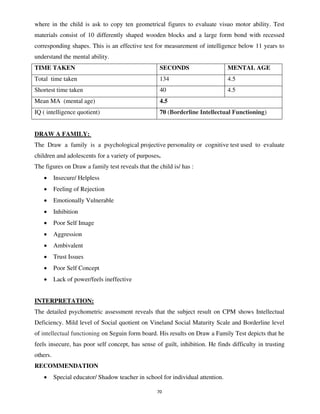
DRAW A FAMILY:
The Draw a family is a psychological projective personality or cognitive test used to evaluate
children and adolescents for a variety of purposes.
The figures on Draw a family test reveals that the child is/ has :
• Insecure/ Helpless
• Feeling of Rejection
• Emotionally Vulnerable
• Inhibition
• Poor Self Image
• Aggression
• Ambivalent
• Trust Issues
• Poor Self Concept
• Lack of power/feels ineffective
INTERPRETATION:
The detailed psychometric assessment reveals that the subject result on CPM shows Intellectual
Deficiency. Mild level of Social quotient on Vineland Social Maturity Scale and Borderline level
of intellectual functioning on Seguin form board. His results on Draw a Family Test depicts that he
feels insecure, has poor self concept, has sense of guilt, inhibition. He finds difficulty in trusting
others.
RECOMMENDATION
• Special educator/ Shadow teacher in school for individual attention.
lOMoARcPSD|25238877
71
• Short Instruction Period.
• Minimize distraction in classroom.
• Teach in Small Groups.
• Use few and simple words and maximize demonstrations.
• Use peer Partner.
• Provide Opportunities for choice of activities.
• Emphasize range of motion exercises.
• Allow for periods of rest during Instruction.
• Reinforce and use multi sensory approaches.
• Provide prompt and consistent feedback
• Check for skill retention often.
• Offer activities that provide initial success.
• When appropriate put in leadership goals.
• Systematically ignore inappropriately behavior, model appropriate behavior and practice
appropriate behavior and responses.
lOMoARcPSD|25238877
72
lOMoARcPSD|25238877
73
CASE STUDY- 10 (Claustrophobia)
PERSONAL INFORMATION:
Name: Mr. Suresh kumar
Age: 55
Marital status: Married
Gender: Male
Occupation: Businessman
Education: 12th
pass
Religion: Hindu
Mother tongue: Hindi
Location of residence Jaipur
Socioeconomic status: Upper
Informant: Brother
Reliability: Reliable and consistent
CHIEF COMPLAINTS
According to patient
“Whenever I am in crowd or I think about being in crowd then I feel uneasy and
get sensation of cold feet and hands. I feel like I will die”
“I have problem to be in closed places like lifts and planes. But I also feel anxious when I am
alone at home.”
Informant states that
“His condition is causing a lot of distress to his family and they are ready to do anything to get
him treated”
HISTORY OF PRESENT ILLNESS
Five years ago the patient had started showing symptoms of anxiety and panic
attacks. he would have such attacks when he is in closed space or is alone at
home. He would experience racing hearts, cold hands and feet, chest pain,
difficulty breathing and palpitation. He thought he had heart problem. As a
result, he had many physical examinations like ECG etc. But everything came
out normal. He had gone to many doctors for treatment including homeopathy,
naturopathy
lOMoARcPSD|25238877
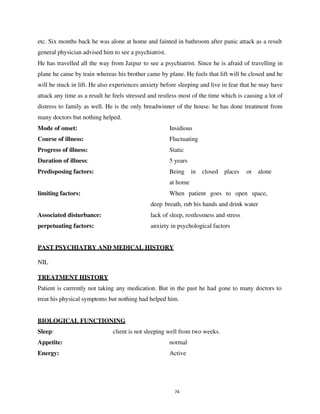
74
etc. Six months back he was alone at home and fainted in bathroom after panic attack as a result
general physician advised him to see a psychiatrist.
He has travelled all the way from Jaipur to see a psychiatrist. Since he is afraid of travelling in
plane he came by train whereas his brother came by plane. He feels that lift will be closed and he
will be stuck in lift. He also experiences anxiety before sleeping and live in fear that he may have
attack any time as a result he feels stressed and restless most of the time which is causing a lot of
distress to family as well. He is the only breadwinner of the house. he has done treatment from
many doctors but nothing helped.
Mode of onset: Insidious
Course of illness: Fluctuating
Progress of illness: Static
Duration of illness: 5 years
Predisposing factors: Being in closed places or alone
at home
limiting factors: When patient goes to open space,
deep breath, rub his hands and drink water
Associated disturbance: lack of sleep, restlessness and stress
perpetuating factors: anxiety in psychological factors
TREATMENT HISTORY
Patient is currently not taking any medication. But in the past he had gone to many doctors to
treat his physical symptoms but nothing had helped him.
BIOLOGICAL FUNCTIONING
Sleep: client is not sleeping well from two weeks.
Appetite: normal
Energy: Active
PAST PSYCHIATRY AND MEDICAL HISTORY
NIL
lOMoARcPSD|25238877
75
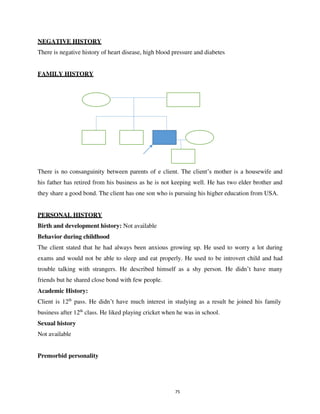
NEGATIVE HISTORY
There is negative history of heart disease, high blood pressure and diabetes
FAMILY HISTORY
There is no consanguinity between parents of e client. The client’s mother is a housewife and
his father has retired from his business as he is not keeping well. He has two elder brother and
they share a good bond. The client has one son who is pursuing his higher education from USA.
PERSONAL HISTORY
Birth and development history: Not available
Behavior during childhood
The client stated that he had always been anxious growing up. He used to worry a lot during
exams and would not be able to sleep and eat properly. He used to be introvert child and had
trouble talking with strangers. He described himself as a shy person. He didn’t have many
friends but he shared close bond with few people.
Academic History:
Client is 12th
pass. He didn’t have much interest in studying as a result he joined his family
business after 12th
class. He liked playing cricket when he was in school.
Sexual history
Not available
Premorbid personality
lOMoARcPSD|25238877
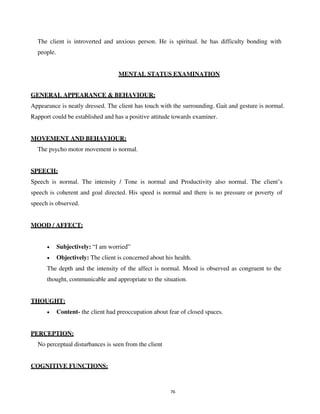
76
The client is introverted and anxious person. He is spiritual. he has difficulty bonding with
people.
MENTAL STATUS EXAMINATION
GENERAL APPEARANCE & BEHAVIOUR:
Appearance is neatly dressed. The client has touch with the surrounding. Gait and gesture is normal.
Rapport could be established and has a positive attitude towards examiner.
MOVEMENT AND BEHAVIOUR:
The psycho motor movement is normal.
SPEECH:
Speech is normal. The intensity / Tone is normal and Productivity also normal. The client’s
speech is coherent and goal directed. His speed is normal and there is no pressure or poverty of
speech is observed.
MOOD / AFFECT:
• Subjectively: “I am worried”
• Objectively: The client is concerned about his health.
The depth and the intensity of the affect is normal. Mood is observed as congruent to the
thought, communicable and appropriate to the situation.
THOUGHT:
• Content- the client had preoccupation about fear of closed spaces.
PERCEPTION:
No perceptual disturbances is seen from the client
COGNITIVE FUNCTIONS:
lOMoARcPSD|25238877
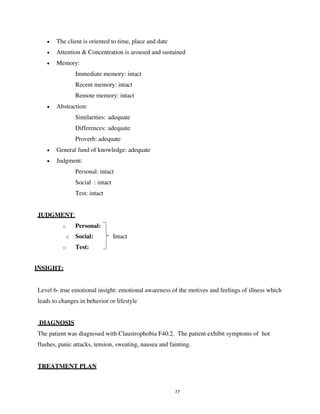
77
• The client is oriented to time, place and date
• Attention & Concentration is aroused and sustained
• Memory:
Immediate memory: intact
Recent memory: intact
Remote memory: intact
• Abstraction:
Similarities: adequate
Differences: adequate
Proverb: adequate
• General fund of knowledge: adequate
• Judgment:
Personal: intact
Social : intact
Test: intact
JUDGMENT:
o Personal:
o Social: Intact
o Test:
INSIGHT:
Level 6- true emotional insight: emotional awareness of the motives and feelings of illness which
leads to changes in behavior or lifestyle
DIAGNOSIS
The patient was diagnosed with Claustrophobia F40.2. The patient exhibit symptoms of hot
flashes, panic attacks, tension, sweating, nausea and fainting.
TREATMENT PLAN
lOMoARcPSD|25238877
78
The client was prescribed medicine to reduce the symptoms of anxiety. He was advised to start
psychotherapy as soon as possible. Doctor advised him to come again after two weeks.
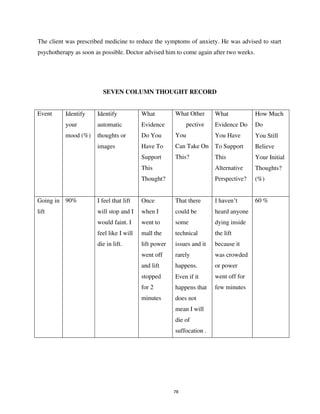
SEVEN COLUMN THOUGHT RECORD
Event Identify
your
mood (%)
Identify
automatic
thoughts or
images
What
Evidence
Do You
Have To
Support
This
Thought?
What Other
pective
You
Can Take On
This?
What
Evidence Do
You Have
To Support
This
Alternative
Perspective?
How Much
Do
You Still
Believe
Your Initial
Thoughts?
(%)
Going in
lift
90% I feel that lift
will stop and I
would faint. I
feel like I will
die in lift.
Once
when I
went to
mall the
lift power
went off
and lift
stopped
for 2
minutes
That there
could be
some
technical
issues and it
rarely
happens.
Even if it
happens that
does not
mean I will
die of
suffocation .
I haven’t
heard anyone
dying inside
the lift
because it
was crowded
or power
went off for
few minutes
60 %
lOMoARcPSD|25238877
79
In the first column he was asked to write about the situation which makes him feel anxious. In
the second column he was asked to write the negative emotions he was feeling from a scale of 0
to 100. In third column, to identify his automatic negative thoughts and images which comes to
his mind when he thinks of using lift. In fourth column, write his real thoughts and evidence
which supports his thought. In fifth column client wrote to introspect other perspective followed
by evidence which support the new perspective. At the end when client was asked about his
feeling he gave score of 60, which is a significant improvement from 90. We ended the session
with the client and asked him to come after a week.
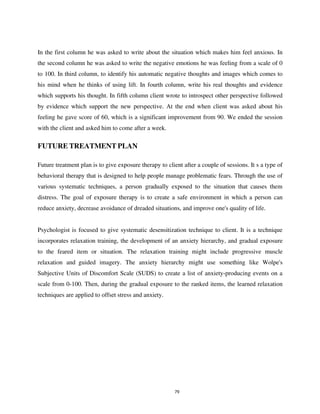
Future treatment plan is to give exposure therapy to client after a couple of sessions. It s a type of
behavioral therapy that is designed to help people manage problematic fears. Through the use of
various systematic techniques, a person gradually exposed to the situation that causes them
distress. The goal of exposure therapy is to create a safe environment in which a person can
reduce anxiety, decrease avoidance of dreaded situations, and improve one's quality of life.
Psychologist is focused to give systematic desensitization technique to client. It is a technique
incorporates relaxation training, the development of an anxiety hierarchy, and gradual exposure
to the feared item or situation. The relaxation training might include progressive muscle
relaxation and guided imagery. The anxiety hierarchy might use something like Wolpe's
Subjective Units of Discomfort Scale (SUDS) to create a list of anxiety-producing events on a
scale from 0-100. Then, during the gradual exposure to the ranked items, the learned relaxation
techniques are applied to offset stress and anxiety.
FUTURE TREATMENT PLAN
lOMoARcPSD|25238877
80
lOMoARcPSD|25238877
81
lOMoARcPSD|25238877

IGNOU Sample Internship File for MPCE015

  • 1.
    INTERNSHIP REPORT (MPCE-015) SUBMITTEDTO INDIRA GANDHI NATIONAL OPEN UNIVERSITY IN PARTIAL FULFILLMENT FOR THE DEGREE OF MASTER DEGREE PROGRAMME IN PSYCHOLOGY (MAPC) SUBMITTED BY VIPUL S.N VITHAL PROGRAMME CODE: MAPC ENROLMENT NUMBER: 190907323 REGIONAL CENTRE CODE: 22 COURSE CODE: MPCE-015 PHONE NUMBER: 94789-39395 EMAIL ID: ervipulvithal@gmail.com YEAR- 2020 lOMoARcPSD|25238877
  • 2.
  • 3.
  • 4.
  • 5.
  • 6.
  • 7.
  • 8.
    8 INTERNSHIP REPORT SUBMITTED BY VIPULS.N VITHAL ENROLLMENT NO. - 190907323 YEAR 2020 INTERNSHIP REPORT (MPCE-015) SUBMITTED TO INDIRA GANDHI NATIONAL OPEN UNIVERSITY NEW DELHI IN PARTIAL FULFILMENT OF THE REQUIREMENT FOR THE DEGREE OF MA(PSYCHOLOGY) lOMoARcPSD|25238877
  • 9.
    ACKNOWLEDGEMENT With the profoundreverence, I bow my head before the Almighty, whose invisible hand guided me from darkness to light, from ignorance to knowledge, which helped me to achieve my goals. His blessings led me towards the completion of this Internship work. I wish to express my sincere appreciation to my Agency supervisor, Dr. Shashi Sethi, who has the substance of a genius: she convincingly guided and encouraged me to be professional and do the right thing even when the road got tough. Without her persistent help, the goal of this conducting cases would not have been realized. She was kind and supportive enough to be available for discussion throughout the internship. It was a great privilege and honour to work and study under her guidance. Special thanks to committee of IGNOU as the university has given enough amount of time for the completion of the project. I am also thankful to my Agency Supervisor Dr. Seema Bajaj (Academic Counselor) for helping me out in doing Internship. I am highly thankful to my family and friends for their love and support. They have encouraged me emotionally to complete the work in time successfully. Finally, I am grateful to everyone who has stood by my side in one way or the other during my Internship. Vipul S N Vithal lOMoARcPSD|25238877
  • 10.
    10 INDEX S.NO. CASE CASEDETAILS PAGE NO. 1 ------ INTRODUCTION 11-12 2 CASE- 1 SEVERE DEPRESSIVE EPISODE WITH PSYCHOTIC SYMPTOMS 13-19 3 CASE- 2 MODERATE OBSESSIVE COMPULSIVE DISORDER 20-25 4 CASE- 3 BIPOLAR AFFECTIVE DISORDER 26-31 5 CASE- 4 MODERATE DEPRESSIVE EPISODE WITHOUT SOMATIC SYNDROME 32-37 6 CASE- 5 CHILD BEHAVIORAL ISSUES 38-43 7 CASE- 6 GENERALIZED ANXIETY DISORDER 44-49 8 CASE- 7 MILD LEVEL OF DEPRESSION 50-56 9 CASE- 8 AUTISM SPECTRUM DISORDER 57-65 10 CASE- 9 PSYCHOLOGICAL ASSESSMENT 66-72 11 CASE- 10 CLAUSTROPHOBIA 73-79 lOMoARcPSD|25238877
  • 11.
    INTRODUCTION An internship isa trained and supervised experience in a professional setting in which the student is learning and gaining essential experience and expertise. Internship is meant for introducing candidates either full-time or part- time to a real world experience related to their career goals and interests. It may, but does not have to be related connected to one’s academic major or minor. Internships can be done during the academic semester and or summer depending upon the spaced out curriculum. There are several varieties of internship: some are paid some are not and some offer credit towards graduation. OBJECTIVES OF INTERNSHIP The main objective of the internship course is to facilitate reflection on experiences obtained in the internship and to enhance understanding of academic material by application in the internship setting. Internships will provide students the opportunity to test their interest in a particular career before permanent commitments are made. Apart from it is more important because: 1. Internship students will develop employment records or reference that will enhance employment opportunities. 2. Internship will provide students the opportunity to develop attitudes conducive to effective interpersonal relationship. 3. Internship will provide students with an in-depth knowledge of the formal functional activities of a participating organization. 4. Internship programs will enhance advancement possibilities of graduates. 5. Internship will help the trainees to develop skills and techniques directly applicable to their careers. 6. Internship will provide students the opportunity to develop attitudes conducive to effective interpersonal relationships. PURPOSE OF INTERSHIP IN PSYCHOLOGY 1. To develop facility with a range of diagnostic skills, including: interviews, case history-taking, risk assessment, child protective issues, diagnostic formulation, triage, disposition, and referral. lOMoARcPSD|25238877
  • 12.
    12 2. To developfurther skills in psychological intervention, including: environmental interventions, crisis intervention, short-term, goal-oriented individual, group, and family psychotherapy, exposure to long-term individual psychotherapy, behavioral medicine technique, and exposure to psycho pharmacology, case management, and advocacy. 3. To develop facility with a range of assessment techniques, including: developmental testing (elective), cognitive testing, achievement testing, assessment of behavior, emotional functioning, assessment of parent-child relationship and family systems, and neuro psychological evaluation (elective). Assessment training across will include both current functioning and changes in functioning. 4. To develop facility with psychological consultation, through individual cases and participation in multidisciplinary teams, including consultation to: parents, mental health staff (e.g., psychiatrists, social workers) medical staff (e.g., physicians, nurses, PT, OT, etc.), school systems, and the legal system. Consultation training occurs in both the inpatient and outpatient setting, both downtown and in the suburbs, and ranges. 5. To learn the clinical, legal, and ethical involved in documentation of mental health services within a medical setting. 6. To learn to promote the integration of science and practice, related to theories and practice of assessment, intervention, and consultation. Interns are trained in empirically-supported treatments (e.g., parent training groups, inpatient treatment protocols for school avoidance, eating disorders), and behavioral medicine protocols (e.g., medical noncompliance, pain management, headache treatment, toilet training) lOMoARcPSD|25238877
  • 13.
    CASE STUDY- 1(Severe depressive episode with psychotic symptoms) PERSONAL INFORMATION: Name: Mohit kaushal Age: 28 Marital status: Married Gender: Male Occupation: Software engineer Education: Btech Religion: Hindu Mother tongue: Hindi Location of residence Chandigarh Socioeconomic status: Middle class Informant: wife Reliability: Reliable and consistent CHIEF COMPLAINTS According to client The client reported that when he is alone he feels that someone is talking to him and scolding him for everything he does. He feels that he has done something very bad and people want to harm him for that. According to informant Wife reported that he is not sleeping and eating well. He sits alone in room most of time and talks with himself. The symptoms started 2 months ago when client’s father died in an accident. After the accident he didn’t talk with anyone for long time and slowly started behaving differently. She mentioned that client has fear that people want to harm him. He is also suspicious of his wife that she is also conspiring with others to harm him. He also feels that other people are talking about him. lOMoARcPSD|25238877
  • 14.
    14 HISTORY OF PRESENTILLNESS Patient was very restless and agitated. He was not in position to answer anything. He kept repeating that I want to be normal. Patient was accompanied by his wife. According to wife he became quiet and distant after his father’s death. He couldn’t sleep well so he took sleeping pills which helped him in getting sleep. Recently before 1 week he stopped going to office and remain in his room for most of the time. From last 2 days he is not sleeping and talking to himself. He suspects that others including his wife trying to harm him because he has done something bad. His wife also mentioned that he has been aggressive towards other and suspect that people are talking about him. Mode of onset: insidious Duration of illness: 2 months PAST PSYCHIATRY AND MEDICAL HISTORY Client does not have any prior psychiatric or medical history TREATMENT HISTORY The client took sleeping pills for few days. BIOLOGICAL FUNCTIONING Sleep: not sleeping from 2 days Appetite: low Sexual interest and activity: low Energy: low NEGATIVE HISTORY No history of head injury, epilepsy, seizures. FAMILY HISTORY lOMoARcPSD|25238877
  • 15.
    There is noconsanguinity between parents of the client. Patient lives with his mother and wife. He had arranged marriage 2.5 years ago. He does not have any child. He is a software engineer whereas his wife teaches in a school. PERSONAL HISTORY Birth order: only child Birth and development history: normal delivery and milestones were achieved on time, no childhood disorder present. Behavior : The client has been very introverted since childhood. He didn’t have any friends growing up. He talked very less and focused on his studies. He does not share much with anyone and talk very less with his mother and wife. He prefers to go on a solo trip. Academic History: The client was very good in academic. He felt anxious when he had to talk or give presentation in front of people. He once fainted in school because he was asked to give speech. He likes to go on solo trip. Occupational History: Client has been working as a software engineer in MNC from 6 years. Sexual History: Data not available. PRE MORBID PERSONALITY: The client was introverted , anxious person. ALCOHOL AND SUBSTANCE HISTORY: Occasionally consume alcohol lOMoARcPSD|25238877
  • 16.
    16 MENTAL STATUS EXAMINATION GENERALAPPEARANCE & BEHAVIOR: General appearance was untidy. He hadn’t combed for two days. Today he didn’t brush and bath. He was staring at one place and constantly blinking. Client was lean and looked unhealthy. no eye contact maintained. Rapport could not be established with the client and there was rude attitude towards the examiner. Client was not cooperative. MOVEMENT AND BEHAVIOR: Slow psychomotor movement was observed from the client. He was staring at one place and movement was slow. But he was blinking constantly. SPEECH: MOOD / AFFECT: • Subjectively: : “ I am worried about my life ” • Objectively: cautious THOUGHT: Delusion: present Client says, “people are trying to harm me”. PERCEPTION Hallucination is absent. COGNITIVE FUNCTIONS: Thought block was absent. monotonous pitch was observed. Speed was increase and reaction time was slow. Form of thought disorder: absent lOMoARcPSD|25238877
  • 17.
    • oriented totime, place and person. • Attention & Concentration around but not sustained • Memory: Immediate memory: intact Recent memory: intact Remote memory: intact • Abstract thinking impaired. • Intelligence is impaired • General fund of knowledge: adequate JUDGMENT: Personal : Impaired Social : Impaired INSIGHT: Level 2- slight awareness of being sick and needing help, but denying it at the same time. PSYCHOLOGICAL ASSESSMENTS CONDUCTED • Beck’s Depression Inventory BECK’S DEPRESSON INVENTORY: The Beck Depression Inventory (BDI) is a series of questions developed to measure the intensity, severity, and depth of depression in patients with psychiatric diagnoses. Its long form is composed of 21 questions, each designed to assess a specific symptom common among people with depression. Raw Score: 38 Category: Severe Level of Depression lOMoARcPSD|25238877
  • 18.
    18 DIAGNOSIS The client isdiagnosed with major depressive episode with psychotic symptoms. Because he had symptoms of depression (sadness, anger, feeling of sadness and hopelessness. Low on socialization and self care) and psychosis –aggression, agitation, restlessness, delusions, social isolation, anxiety, persecutory delusions etc. TREATMENT PLAN The psychiatrist is advised to his wife to take him to Civil hospital where he may be admitted for few days to bring down his agitation. After that based on his progress medication and psychotherapies will be advised. lOMoARcPSD|25238877
  • 19.
  • 20.
    20 CASE STUDY- 2(Moderate Obsessive Compulsive Disorder) PERSONAL INFORMATION: Name: Namita Manro Age: 53 Marital status: widow Gender: Female Occupation: Housewife Education: Graduate Religion: Hindu Mother tongue: Hindi Location of residence Patiala Socioeconomic status: Upper Informant: Son Reliability: Reliable and consistent CHIEF COMPLAINTS According to informant The client was reported to have forgetfulness. She worries a lot and get panic very often. She washes her hands and perform her task very slow. She spends most of the time in kitchen where she would keep washing utensils and cleaning the floor of the kitchen. She also spends a lot of time in bathroom to bath and go toilet. If any guest comes at home she gets panic. HISTORY OF PRES ENT ILLNESS The client has started to show the symptoms one year ago when she started to forget things. she feels that something is falling (dust) so she washes hands frequently. She has two sons .one of them is living separately with the wife and other one got divorced and living with client. She worries a lot about his second son. She reports that praying helps her a lot and she does not have any thoughts of washing or cleaning at that time. Even though she was not much social but had 2 close friends with whom she used to meet but recently she has lost interest in lOMoARcPSD|25238877
  • 21.
    21 everything and doesnot want to meet anyone. She has arthritis and she find it difficult to do chores but cannot help. if guests come at home she gets panic. PAST PSYCHIATRY AND MEDICAL HISTORY Patient has arthritis and diabetes and no history of medical illness. TREATMENT HISTORY She takes medicine for arthritis and diabetes but for stress or anxiety she never took any help. BIOLOGICAL FUNCTIONING Sleep: does not sleep well Appetite: Normal Sexual interest and activity: NA Energy: low NEGATIVE HISTORY No history of head injury, epilepsy, seizures, trauma, no elation of mood or depersonalization or de-realization. FAMILY HISTORY There is no consanguinity between parents of the client. The client’s parents have died. The client’s younger brother lives in same city. The client has 2 sons. One of them is married and live separately whereas other son is divorced and live with his mother. FAMILY INTERACTION PATTERN: The communication in the family is seen normal. There is good cohesiveness in the family. There is seen negative expressed emotions from the family towards the client. PERSONAL HISTORY lOMoARcPSD|25238877
  • 22.
    22 Birth order: firstchild Birth and development history: normal delivery and milestones were achieved on time, no childhood disorder present. Behavior during childhood Client shared good bond with her parents. In school she felt isolated and had low self esteem. She had very few friends growing up. She was overweight and felt that she is not as good looking as her cousin. As a result, she had low self confidence. She was good in academic. Her parents encouraged her to focus on household chores than study because it will be useful for him after marriage and not her qualification. Academic History: The client was good in academic. However, she never participated in any social activity because she thought she was overweight and people will make fun of her. Her hobbies were reading and writing. Occupational History: No occupational history Sexual History: She shared good relation with her husband .and never had any romantic relation other than her husband. PRE-MORBID PERSONALITY: The client is introverted, organized and systematic in nature. She finds it difficult to talk with strangers. Client is very religious and prays 2 to 3 hours in a day. MENTAL STATUS EXAMINATION GENERAL APPEARANCE & BEHAVIOR: lOMoARcPSD|25238877
  • 23.
    23 General appearance isneatly dressed, normal gait and gesture was present. Client was overweight. The client has touch with the surrounding. Proper eye contact is maintained. Rapport could be established with the client and there was positive attitude towards the examiner. The client was comprehensive to simple rules from the clinician and was cooperative for the session. MOVEMENT AND BEHAVIOR: Slow psycho-motor movement is observed from the client. SPEECH: The speech was normal. Intensity and speed of communication of the client was normal. There was no pressure of speech and it was coherent and goal directed. MOOD / AFFECT: • Subjectively: “I am anxious”, • Objectively: the client is anxious and tired The depth or intensity of mood is casual. The mood is stable. They are congruent to the thought and communicable and appropriate to the situation THOUGHT: Content: The patient has preoccupation of illness. PERCEPTION: No perceptual disturbances could be elicited from the client. COGNITIVE FUNCTIONS: • The client is oriented to time, place and date • Attention & Concentration is aroused and sustained • Memory: lOMoARcPSD|25238877
  • 24.
    24 Immediate memory: intact Recent memory:intact Remote memory: intact •Abstraction : intact • General fund of knowledge: adequate JUDGMENT: Personal : Intact Social : Intact INSIGHT: The client has insight level of 6 which means she had true emotional insight. PSYCHOLOGICAL ASSESSMENTS CONDUCTED THE YALE–BROWN OBSESSIVE COMPULSIVE SCALE (Y-BOCS) : The scale, which was designed by Wayne K. Goodman and his colleagues, is used extensively in research and clinical practice to both determine severity of OCD and to monitor improvement during treatment. This scale, which measures obsessions separately from compulsions, specifically measures the severity of symptoms of obsessive–compulsive disorder without being biased towards or against the type of content the obsessions or compulsions might present. Raw Score: 19 Category: Moderate level of OCD ‘ lOMoARcPSD|25238877
  • 25.
    25 INTERPRETATION: Patient exhibited symptomsof OCD (obsessive compulsive disorder) . The client washes hands frequently and worry about germs. Because of t h is she is having difficulty working but still she cant help cleaning because of the fear of germs. TREATMENT PLAN: She was advised do physical activity and relaxation. Along with medicine she was advised to start counselling session. lOMoARcPSD|25238877
  • 26.
    26 CASE STUDY- 3( Bipolar affective disorder ) PERSONAL INFORMATION: Name: Mr. ABHINAV KUMAR Age: 26 Marital status: unmarried Gender: Male Occupation: Student Education: BBA Religion: Hindu Mother tongue: Hindi Location of residence: Mohali Socioeconomic status: Upper Informant: father and uncle Reliability: Reliable and consistent but inadequate CHIEF COMPLAINTS According to the patient “I have no problem. My mind is super fast and no one can match it.” According to the informant “he has become very aggressive and started abusing people. He had fights with his friends and brother. He thinks that he is very intelligent and look down on others.” HISTORY OF PRESENT ILLNESS The onset of the illness is acute. The client was apparently well a week ago. Three days before he got to know that he cleared his entrance exam in IIM- Ahmedabad. He had been very ecstatic about it. Later in the evening he got aggressive to his younger brother who jokingly said that he may have cheated in entrance exams. He responded him saying that his mind is super fast and he does not cheat like he does. lOMoARcPSD|25238877
  • 27.
    27 Next day whilereturning back home at bus station station he abused his best friend and asked him to jump off in front of bus. he even tried to push him. Next day he again abused his friend and got aggressive he kept repeating that no one can match him. His father decided to bring him to the hospital. Currently there is no significant change in his sleep pattern, he can maintain hygiene however his energy level increased his appetite has decreased from past 2 days. PAST PSYCHIATRY AND MEDICAL HISTORY The patient does not have any kind of past illness/psychiatric illness Treatment History- TREATMENT HISTORY NIL BIOLOGICAL FUNCTIONING Sleep: client has not slept from 1 days Appetite: decreased Energy: very Active FAMILY HISTORY The patient family is a nuclear family. His father is a bank manager and brother is doing his graduation. Family atmosphere is good. The patient financial status is also good. PERSONAL HISTORY Birth order: first born, he has one younger brother. Birth and development history: -Birth history was normal, Birth cry was present, Birth weight 2 kilo, Developmental milestones achieved before handed, no emotional or physical problems were present in childhood. Behavior during childhood The patient was good in school and used to score good marks. He had many friends growing up and is an extrovert. lOMoARcPSD|25238877
  • 28.
    28 Sexual history Not elicited Premorbidpersonality The patient was extrovert and had many friends, he never showed any kind of resistance earlier or aggressiveness MENTAL STATUS EXAMINATION GENERAL APPEARANCE & BEHAVIOUR: He was good wearing a check shirt and pant, hair was properly made well dressed and groomed, Behaviour was restless was wringing his hands and the patient was uncooperative, hyperactive, restless but well dressed. Attitude towards examines- uncooperative, Rapport could not be established. MOVEMENT AND BEHAVIOUR: Agitation was present and the patient was constantly moving his hands. SPEECH: Rapid, pressure of speech was observed productivity–high Reaction time was decreased MOOD / AFFECT: Mood - irritable, euphoric Affect- broad–congruent with mood PERCEPTION: No perceptual disturbances are seen from the client lOMoARcPSD|25238877
  • 29.
    29 THOUGHT: Content- Ideas ofgrandiosity, Form- flight of ideas, rapid thinking,tangentially (where the patient does not come to the point) COGNITIVE FUNCTIONS: • The client is oriented to time, place and date • Attention & Concentration is aroused and sustained • Memory: Immediate memory: intact Recent memory: intact Remote memory: intact JUDGMENT: Personal : Intact Social : Intact INSIGHT: Level 1 - complete denial of the illness PSYCHOLOGICAL ASSESSMENTS CONDUCTED ◆ MOOD DISORDER QUESTIONNAIRE The Mood Disorder Questionnaire (MDQ) is a questionnaire designed to help detect bipolar disorder. It focuses on symptoms of hypo-mania and mania, which are the mood states that separate bipolar disorders from other types of depression and mood disorder. From the scoring it is cleared that the subject is having Bipolar Spectrum Disorder. INTERPRETATIONS: The patient was diagnosed with bipolar affective disorder, current episode hypomanic. The patient exhibited symptoms of increased energy and activity, lOMoARcPSD|25238877
  • 30.
    30 talkativeness, decreased needfor sleep, irritability and currently experiencing hypomanic episode. TREATMENT PLAN: He was prescribed mood stabilizers. He was asked to come after a week. Based on his condition he will be given various psychosocial treatments such as cognitive behavior therapy, interpersonal therapy etc. Following are the treatment plans which are helpful for bipolar patient. Medication – Medication is the cornerstone of bipolar disorder treatment. Taking a mood stabilizing medication can help minimize the highs and lows of bipolar disorder and keep symptoms under control. Psychotherapy – Therapy is essential for dealing with bipolar disorder and the problems it has caused. Working with a therapist, patient can learn how to cope with difficult or uncomfortable feelings, manage stress, and regulate mood. Education – Managing symptoms and preventing complications begins with a thorough knowledge of illness. The more patient and his family know about bipolar disorder, the better they will be able to avoid problems and deal with setbacks. Lifestyle management – By carefully regulating lifestyle, patient can keep symptoms and mood episodes to a minimum. This involves maintaining a regular sleep schedule, avoiding alcohol and drugs, eating a mood-boosting diet, following a consistent exercise program, minimizing stress, and keeping sunlight exposure stable year-round. Support – Living with bipolar disorder can be challenging, and having a solid support system in place can make all the difference in outlook and motivation of the patient. The support of friends and family is invaluable. lOMoARcPSD|25238877
  • 31.
  • 32.
    32 CASE STUDY- 4(Moderate Depressive episode without somatic syndrome) PERSONAL INFORMATION: Name: Chetan Tomar Age: 16 Marital status: unmarried Gender: Male Occupation: student Education: X std. Religion: Hindu Mother tongue: Hindi Location of residence Ambala Socioeconomic status: Upper Informant: Mother Reliability: Reliable ,consistent and adequate CHIEF COMPLAINTS According to informant The boy is not interested in anything be his studies or any hobby. He keeps staring at something. He was good in study until 9th Class but slowly became slow and now his performance is very poor academically. He is not doing homework and there are constant complains from school because of his aloofness and loss of interest. He started crying a lot on small things and says that he is not able to study then he gets angry and throw his books. His sleep is disturbed. he wakes up at night feeling scared. HISTORY OF PRESENT ILLNESS The client was good in studies until class 9th . But since one year he is not performing well in school and stays aloof. His problem is intensified from last 2 months. He have been feeling hopeless and says that he cant study. He has started crying a lot a trivial things. from last 2 days he is being aggressive and irritated and has not gone to school. He was at his room from last 2 days. lOMoARcPSD|25238877
  • 33.
    33 PAST PSYCHIATRY ANDMEDICAL HISTORY NIL TREATMENT HISTORY NIL BIOLOGICAL FUNCTIONING Sleep: disturbed Appetite: decreased Sexual interest and activity: NA Energy: low NEGATIVE HISTORY No history of head injury, epilepsy, seizures, trauma, and no history of repetitive thoughts and behaviors, firm beliefs, elation of mood. FAMILY HISTORY There is no consanguinity between parents of the client. The client is the middle child. He as two sisters one elder and one younger. Clients parents are overprotective since he is the only son in the family. 5 years back he got dengue after that his mother is overly protective of him and does not allow him to got out and play. FAMILY INTERACTION PATTERN: The communication in the family is seen normal. Mother looked very concern. Decisions in the family is headed by the husband with the consent of everyone in the family. There is good cohesiveness in the family. There is not seen negative expressed emotions from the family towards the client PERSONAL HISTORY Birth and development history: normal, no birth disorder. lOMoARcPSD|25238877
  • 34.
    34 Academic History: The clientwas good in studies. But before one year he has started loosing interest and get low marks. PRE MORBID PERSONALITY: Client was introvert. he was good in studies. He had good friends but recently not going out to meet them. His hobby is painting and drawing . MENTAL STATUS EXAMINATION GENERAL APPEARANCE & BEHAVIOR: General appearance is neatly dressed, normal gait and gesture was present. The client has touch with the surrounding. Lack of eye contact observed. The client was comprehensive to simple rules from the clinician and was cooperative for the session. MOVEMENT AND BEHAVIOR: slow psycho motor movement is observed from the client. SPEECH: The speech was normal. Intensity and speed of communication of the client was normal. There was no pressure of speech and it was coherent and goal directed. MOOD / AFFECT: • Subjectively: “I am sad”, • Objectively: the client was sad and tearful THOUGHT: Content: The patient has preoccupation of illness. PERCEPTION: No perceptual disturbances could be elicited from the client. lOMoARcPSD|25238877
  • 35.
    35 COGNITIVE FUNCTIONS: • Theclient is oriented to time, place and date • Attention & Concentration is aroused and sustained • Memory: Immediate memory: intact Recent memory: intact Remote memory: intact • Abstraction: intact • General fund of knowledge: adequate • Judgment: Intact INSIGHT: The client has insight level of 5 which means client has intellectual insight. PSYCHOLOGICAL ASSESSMENTS CONDUCTED • Beck’s Depression Inventory BECK’S DEPRESSON INVENTORY: The Beck Depression Inventory (BDI) is a series of questions developed to measure the intensity, severity, and depth of depression in patients with psychiatric diagnoses. Its long form is composed of 21 questions, each designed to assess a specific symptom common among people with depression. Raw Score: 24 Category: Moderate Level of Depression lOMoARcPSD|25238877
  • 36.
    36 INTERPRETATION: Moderate depressive episodewithout somatic syndrome. Client exhibited symptoms of hopelessness, sadness, cries a lot, isolation etc. TREATMENT PLAN Doctor had prescribed him Antidepressant. He had asked him to come after 1 weeks. Doctor strongly advised to go for counselling. clearly he had symptoms of depression cause of which is unknown. lOMoARcPSD|25238877
  • 37.
  • 38.
    38 CASE STUDY- 5( Child Behavioral Issues ) PERSONAL INFORMATION: Name: Siyona Age: 6.8 Marital status: unmarried Gender: Female Occupation: Student Education: LKG Religion: Hindu Mother tongue: Hindi Location of residence Panchkula Informant: Mother NEONATAL HISTORY • 1st in birth order • Cesarean and Full- term delivery • Immediate birth cry • No complications during pregnancy • Normal health and weight of the child during birth CHIEF COMPLAINTS According to the informant “She has become very sensitive and gets scared easily.” HISTORY OF PRESENT ILLNESS The She gets angry easily since she was 1year old. This behaviour is getting worst day by day as she cries a lot as well as she is moody regarding completing any task. If she does not want to do something she will not do. She cries for approx 1/2 an hour or longer periods until her mother soothes her. She feels she should come first that makes her more scared and worried. She has oversensitive nose. lOMoARcPSD|25238877
  • 39.
    39 PAST PSYCHIATRY ANDMEDICAL HISTORY The patient does not have any kind of past illness/psychiatric illness Treatment History TREATMENT HISTORY NIL BIOLOGICAL FUNCTIONING Sleep: Normal Appetite: Normal Energy: Very Active FAMILY HISTORY The client family is a nuclear family. Her father is a Advocate and mother is Nutritionist. Family atmosphere is good. PERSONAL HISTORY Birth order: First born. Birth and development history: Birth history was normal, Birth cry was present, Birth weight 2.8kg, Developmental milestones were achieved on time. Behavior : The client is good in school and chief complaints from teachers are that she is talkative. lOMoARcPSD|25238877
  • 40.
    40 MENTAL STATUS EXAMINATION ESTABLISHRAPPORT GENERAL APPEARANCE & BEHAVIOUR: She was good wearing a t shirt and pant, hair was properly made well dressed and groomed, Behaviour was restless was wringing his hands and roaming here and there. The client was uncooperative, hyperactive, restless but well dressed. Attitude towards examines -uncooperative , Rapport could not be established MOVEMENT AND BEHAVIOUR: Agitation was present and the the client is so active, didn’t sit properly. No instruction is being followed by her. SPEECH: Rapid, not that much clear. MOOD / AFFECT: Mood - irritable, Stubborn. PERCEPTION: No perceptual disturbances are seen from the client. lOMoARcPSD|25238877
  • 41.
    41 THOUGHT : Content- Lackof concentration, stubborn. COGNITIVE FUNCTIONS : • The client is little oriented to time, place and date • Attention & Concentration is little bit. • Memory: intact JUDGMENT: She is too young for it. INSIGHT: As she is just 6.8years old, don’t have any insight. PROVISIONAL DIAGNOSIS The client was diagnosed with behavioral issues. PSYCHOLOGICAL ASSESSMENTS CONDUCTED • VINE LAND SOCIAL MATURITY SCALE • SEGUIN FORM BOARD VINELAND SOCIAL MATURITY SCALE: The Vineland social maturity scale was originally device by EA Doll in 1935 and since then this test is being used in many parts of the world. The main purpose of the test is estimating the differential social capacities of an individual. It is important to remember that this instrument not only provides a measure of social age and social quotient. It will also indicate the social deficits and Social assists in a growing child. With the presently popular social skills training procedures these information would go a long way in training the children to be socially self sufficient. It is a verbal test. Vineland social maturity scale SQ = 112.5 Category: Above average social quotient lOMoARcPSD|25238877
  • 42.
    42 SEGUIN FORM BOARD:This test is based on the single factor theory of intelligence measures, speed and accuracy. It is useful in evaluating a child’s eye-hand coordination, shape concept visual perception, and cognitive ability. The test is primarily used to assess visual- motor skills. It includes Gesell figures wherein the child is asked to copy ten geometrical figures to evaluate his visual-motor ability. The test materials consist of 10 differently shaped wooden blocks and a large form board with recessed corresponding shapes. The suitable age group is 3-10 years and up to the adult level for the mentally handicapped. INTERPRETATION: The detailed case history and psychological assessment reveals that the child has above average level of intelligence on Seguin form board. On Vineland social Maturity Scale, which assesses social intelligence, the child has above average social quotient, which reflects good social maturity. RECOMMENDATIONS: ⚫ Therapist is recommended to improve his BEHAVIOURAL ISSUES to provide CBT. ⚫ Psycho education to parents is needed to understand and modify their parenting skills. TIME TAKEN SECONDS MENTAL AGE Total time taken 77 7.5 Shortest time taken 21 8.0 Mean MA (mental age) 7.7 IQ ( intelligence quotient) I.Q=7.7/6.8*100=113.7 Category: Above average level of intelligence quotient lOMoARcPSD|25238877
  • 43.
  • 44.
    44 CASE STUDY- 6( Generalized Anxiety Disorder ) PERSONAL INFORMATION: Name: Tanvi Age: 28 Marital status: unmarried Gender: Female Occupation: Govt. job Education: Graduation Religion: Hindu Mother tongue: Hindi Location of residence Chandigarh Socioeconomic status: Upper Informant: Self CHIEF COMPLAINTS According to the Client: • Anxiety • Lack of energy • Miner issue is very triggering crying and aggressing • Head heaviness (Duration of course) • Tension , shivering in hand and mile sweat • Stress, suicidal thought HISTORY OF PRESENT ILLNESS She is teaching in an organization but now she don’t like going. She took one week off from last to last week. I was working there from 5-6 years, due to such old relations , it wouldn't bother them but otherwise she would have lost her job. 6months back her grandfather died. She got engaged to his boy friend with whom she is in a relation with him from past 8 years and due to long distance she broke up for 2 years. Now as the date of marriage is getting close, she has getting panic. PAST PSYCHIATRY AND MEDICAL HISTORY lOMoARcPSD|25238877
  • 45.
    45 The patient doesnot have any kind of psychiatry issue but have medical history. • Thyroid 2013-14 • PCOD 2013-14 • Surgery : 2 time (2018) TREATMENT HISTORY Took medicines like Thoronome 88 daily 1time and Obmet SR500 Twice in a day. BIOLOGICAL FUNCTIONING Sleep: Improper Appetite: decreased Energy: Inactive FAMILY HISTORY The client’s family is a nuclear family. Her father and mother is doing govt. job and younger brother is doing his graduation. Family atmosphere is good. The client’s financial status is average. PERSONAL HISTORY Birth order: first born, he has one younger brother. Birth and development history: -Birth history was normal, Birth cry was present, Birth weight 2 kilo, Developmental milestones achieved before handed, no emotional or physical problems were present in childhood. Behavior during childhood The patient was good in school and used to score good marks. He had many friends growing up and is an extrovert. lOMoARcPSD|25238877
  • 46.
    46 Sexual history Not elicited Premorbidpersonality The patient was extrovert and had many friends, she never showed any kind of resistance earlier or mood swings. MENTAL STATUS EXAMINATION GENERAL APPEARANCE & BEHAVIOUR: She was salwar suit, hair was properly made well dressed and groomed, Behaviour was restless was wringing his hands and the patient was uncooperative, hyperactive, restless but well dressed. Attitude towards examines- cooperative. MOVEMENT AND BEHAVIOUR: Client is too worried about future and her marriage. SPEECH: Slow and tensed. Reaction time was decreased MOOD / AFFECT: Mood - irritable, euphoric Affect- broad–congruent with mood PERCEPTION: No perceptual disturbances are seen from the client THOUGHT: lOMoARcPSD|25238877
  • 47.
    47 Content- Have distortedthoughts, giving too much stress on her future COGNITIVE FUNCTIONS: • The client is oriented to time, place and date • Attention & Concentration is aroused and sustained • Memory: Immediate memory: intact Recent memory: intact Remote memory: intact • General fund of knowledge: adequate JUDGMENT: Personal : intact Social : intact INSIGHT: Have full insight of her illness. PSYCHOLOGICAL ASSESSMENT TESTS ADMINISTERED • Beck’s Anxiety Inventory BECK’S ANXIETY INVENTORY: The Beck Anxiety Inventory (BAI), created by Aaron T. Beck and other colleagues, is a 21- question multiple-choice self-report inventory that is used for measuring the severity of anxiety in children and adults. The questions used in this measure ask about common symptoms of anxiety that the subject has had during the past week (including the day you take it) (such as numbness and tingling, sweating not due to heat, and fear of the worst happening). It is designed lOMoARcPSD|25238877
  • 48.
    48 for individuals whoare of 17 years of age or older and takes 5 to 10 minutes to complete. Several studies have found the Beck Anxiety Inventory to be an accurate measure of anxiety symptoms in children and adults. Raw Score: 30 Category: Moderate Level of Anxiety INTERPRETATION The detail psychometric assessment reveals that client has moderate level of Anxiety. RECOMMENDATIONS ◆ The client needs therapy sessions for her diagnosis. ◆ Some mindful exercises are too recommended. lOMoARcPSD|25238877
  • 49.
  • 50.
    50 CASE STUDY- 7(MILD Level of Depression) Identifying Information Name: Abhishek Bansal Age: 20 years Gender: Male Languages known: English, Hindi and Punjabi Culture: Hindu Occupation: Student (IIT, Delhi) Education: Graduation (Final year) Referred by: Self and Father The information is adequate, reliable and consistent Present Concerns: ‘Since last year, I have been feeling I have depression symptoms. I have not attended even a single class in the last semester and I know I am behind and it’s important. I sleep late and get up late. I feel lazy all the time; I only get up to eat, sometimes not even then. But when I do eat I eat a lot.’ Predominant symptoms: 1. Feeling ‘depressed’ 2. Lethargic, not attending any class or participating in any form of exercise 3. Increased sleep and eating Onset: Sub- Acute Course: Continuous Progress: Deteriorating Brief History of Present concerns: The client joined IIT 2 years ago after completing high school. He expected his college life to be easy going and was looking forward to making friends and spending time with them. However, in his very first day the client was intimidated by the cultural change and the academic pressure, wherein he felt that he had a lot of catching up to do. In his 1st semester, he suffered from a fractured leg due to which he had to stay at home for 40-45 days. By the time he got back, he realised everyone had settled in and he felt out of place. This also built up the academic pressure on him. The client never fully recovered and got back on his feet as in the 2nd semester itself, he began to miss classes and fall behind. lOMoARcPSD|25238877
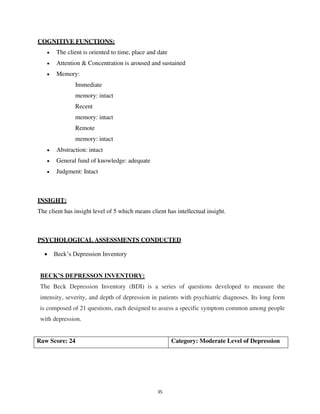
  • 51.
    51 Medical History andPast Treatment (Unclear) The client faces some problem in his sex organs that probably prevents him from forming intimate relationships. This information was shared briefly by his father; the client never reveals the same. Biological Functioning Sleep: Increased Energy: Decreased Appetite: Increased Sexual Life: Non existent Psycho social History • Social and Developmental History The client was living in the hostel of IIT, Delhi. However, on recognition that he requires constant support, his father has now shifted with him to an apartment in Delhi. Living in the hostel, although he had a roommate, the client spent his days alone in his room, sleeping, eating or spending time on his laptop. He barely attended any classes since the 2nd semester. The client expressed that he enjoys studying mathematics, however, his current profession he does not understand very well. His reason for getting into IIT was that he was unaware of any other career line. He is also interested in football and follows all matches religiously. The client does not have many friends and is not a very social person. He has a few friends from school whom he is still in touch with. However, he rarely ever shares his problems or troubles with anyone. The client has been unable to recall many childhood incidents. The few he did recall were positive ones, wherein he was being given something or being helped by someone. • Family and Sexual History The client describes his family being always supportive and his relationships with everyone as ‘good’. He has an elder brother who is working and is in a similar field of work. While his brother was studying, he could not get a good rank to get into a prestigious institution. The client who witnessed this could see that his father was disappointed by it. The father describes the client’s relationship with his brother as being very close, almost inseparable when they are at home together. However the client does not share his view and says that his relation with his brother is cordial. They get along but are not in touch often. The client seems to have difficulty talking about his nature of relationships. The client has never dated anyone or pursued any love interest. He does not even have female friends. lOMoARcPSD|25238877
  • 52.
    52 Educational History Academically theclient has always performed very well. He was in 9th when his father was disappointed by his brother’s performance and the client felt it was his ‘responsibility’ not to disappoint him as he has made so many sacrifices for them and their education. In 10th the client chose non-medical as his stream as he was told that commerce is for those who cannot study and humanities is for losers. The only option he was left was non-med as he also loved math. In 11th standard, the client spent most of his time with his. Fiends and ended up scoring low marks. Thus, 12th onwards the client started devoting 9-10 hours daily to his studies. He enjoyed studying but was also frustrated by the end. His parents did not notice this change in routine as if not studying; he would anyway spend his time sitting alone in his room on the laptop. The client also managed to clear his entrance examination and get into IIT which made his parents proud. It was college life that led to a dip in his academics. Missing classes and unexpected academic pressure that made it difficult for the client to cope. Mental Status Examination 1. General Appearance: Gait: Normal towards obese Posture: Balanced Clothes, grooming and hygiene: Well-attempt (have been informed that he does nor bathe/change his clothes for days together) Behaviour Psychomotor activities: Normal Expression: Constricted Eye contact: Not maintained Mannerisms: Absent Gestures: Normal Compulsions: Absent 2. Orientation to time, place and person: Oriented 3. Attitude: Cooperative 4. Speech and language Volume: Low lOMoARcPSD|25238877
  • 53.
    53 Tone: Normal Tempo: Slow Reactiontime: Decreased Spontaneity: Absent Content: Poverty Prosody: Absent Articulation: Good Articulation Relevance: Present 5. Thought: Form Logical: Present Organised: Present Systematic: Present Coherence: Present Stream: Circumstantial Possession: Absent Content: Adequate 6. Mood and Affect Subjective: ‘I am fine.’ Objective: Depressed Range: Constricted Expression: Constricted Reactivity: Present Relevance to thought: Congruent Situation: Appropriate Intensity: Moderate 7. Perception No perceptual disturbances. 8. Cognitive functions: Not tested but no problems detected lOMoARcPSD|25238877
  • 54.
    54 Insight: Grade III:Awareness of problems but does not know the reason or what to do to get better. Treatment and Interventions Client’s internal dialogue represented his want to teach and learn Math had he been independent of his parents and feeling guilty for not attending classes 1. Sentence Completion: • Hard working • Self conscious • Worried about his future • Body image issues • Feeling lonely • Low self-esteem • Lack of emotional connections and bonding 2. Emotion Focused Therapy Message: ‘Even though I find it difficult, it is important for me to go to college and be regular. I accept myself and I love myself.’ 3. Beck’s Depression Inventory Score = 18 (Mild) INTERPRETATION: The detailed mental status examination and psychometric assessment reveals that he has low self esteem, poor interpersonal relationship and adjustment issues. He is concerned about his body image. He has been facing difficulty in expressing himself and trusting others, too. He seems to be facing conflicts with the opposite gender also. Even though he is hardworking and concerned about his future too, but his poor coping skills and over thinking might have led him to a mild depression. He experiences loneliness, anxiety and at time, gets aggressive too. The subject, being introvert, never shares his inner conflicts with anyone. Moreover, not wanting to hurt anyone, he keeps his feelings and emotions to himself. He has supportive parents but they do not get the space to enter his feelings. He has a great many conflicts concerning life goals, male and female friends and inter- and infra-personal relationships. Various psychological therapies like Cognitive Behaviour Therapy, Emotional Freedom Therapy, Rational Emotive Therapy and Jacobson’s Progressive Relaxation Therapy and Family Counselling administered to him have shown good results. Consequently, he has begun expressing his feelings and emotions and has started making friends, too. It appears that now he is in a position to re-join the Institute and do well in academics. lOMoARcPSD|25238877
  • 55.
    55 RECOMMENDATIONS 1. Psychotherapy 2. Counsellingfor maintaining a balance between academic and personal life. lOMoARcPSD|25238877
  • 56.
  • 57.
    57 CASE STUDY- 8(AUTISM SPECTRUM DISORDER) PERSONAL INFORMATION: Name: Dhariya Age: 3.6 Marital status: NA Gender: Female Occupation: Student Education: Playway Religion: Hindu Mother tongue: Hindi Location of residence Zirakpur Informant: Mother NEONATAL HISTORY • Conceive at the age of 36 years • Cesarean delivery • Immediate birth cry • No medication during pregnancy • Birth weight 3.2 KG CHIEF COMPLAINTS According to the informant (Mother) ◆ Stubborn ◆ Aggressive ◆ Doesn’t listen ◆ Communication issues ◆ Poor sentence formation HISTORY OF PRESENT ILLNESS She is so stubborn and gets angry easily since she was 1year old. She is delayed in speech from childhood. She is not reacting to her name. She doesn't communicate well. Poor eye contact is also an issue from the beginning. lOMoARcPSD|25238877
  • 58.
    58 PAST PSYCHIATRY ANDMEDICAL HISTORY The patient does not have any kind of past illness/psychiatric illness Treatment History- TREATMENT HISTORY NIL BIOLOGICAL FUNCTIONING Sleep: Normal Appetite: Normal Energy: Very Active FAMILY HISTORY The client family is a nuclear family. Her father is a Pharmacist and mother is House wife. Family atmosphere is good. PERSONAL HISTORY Birth order: First born. Birth and development history: Birth history was normal, Birth cry was present, Birth weight 3.2 kg, Developmental milestones were achieved on time but delayed in speech. Behavior : She is so aggressive and irritable in nature. She is so restless and she has very poor eye contact and even after calling her name, she is not able to respond to that. lOMoARcPSD|25238877
  • 59.
    59 MENTAL STATUS EXAMINATION ESTABLISHRAPPORT GENERAL APPEARANCE & BEHAVIOUR: Dhariyaa who is 3year and 6 months old girl, dressed simple with loose clothes, she always making some noise and make able to talk with her mom clearly. I gave her a small toy scooter , she just try to see his wheels and then i asked to her mom that is she is attracted towards any spinning and revolving things and she said yes. She used to see fan and car wheels a lot. Then i started taking full case history and side by side i was trying to catch the behaviour of dhairya. She has very poor eye contact and even after calling her name, she is not able to respond to that. While asking her case history i came to know she was delayed in speech too. MOVEMENT AND BEHAVIOUR: • repetition in words • restless • gets distract easily • difficulty in comprehension SPEECH: Messy, not understandable, repetition of words. MOOD / AFFECT: Mood - irritable, Stubborn. PERCEPTION: No perceptual disturbances are seen from the client. lOMoARcPSD|25238877
  • 60.
    60 THOUGHT : Content- Lackof concentration, stubborn. COGNITIVE FUNCTIONS : NA JUDGMENT: She is too young for it. INSIGHT: As she is just 6.8years old, don’t have any insight. PSYCHOLOGICAL ASSESSMENTS CONDUCTED • SEGUIN FORM BOARD TEST • VINELAND SOCIAL MATURITY SCALE • AUTISUM SPECTRUM DISORDERS QUESTIONNAIRE • PEDIATRIC DEVELOPMENTAL SCREENING TEST SEGUIN FORM BOARD: This test is based on the single factor theory of intelligence measures, speed and accuracy. It is useful in evaluating a child’s eye-hand coordination, shape concept visual perception, and cognitive ability. The test is primarily used to assess visual- motor skills. It includes Gesell figures wherein the child is asked to copy ten geometrical figures to evaluate his visual-motor ability. The test materials consist of 10 differently shaped wooden blocks and a large form board with recessed corresponding shapes. The suitable age group is 3-10 years and up to the adult level for the mentally handicapped. This is an effective test for the measurement of intelligence below 11 years to form an idea about mental ability. TIME TAKEN SECONDS MENTAL AGE Total time taken 217 3.5 Shortest time taken 58 3.5 Mean MA (mental age) 3.5 3.5 IQ ( intelligence quotient) I.Q=3.5/3.5*100=100 100 lOMoARcPSD|25238877
  • 61.
    61 VINELAND SOCIAL MATURITYSCALE: The Vineland social maturity scale was originally device by EA Doll in 1935 and since then this test is being used in many parts of the world. The main purpose of the test is estimating the differential social capacities of an individual. It is important to remember that this instrument not only provides a measure of social age and social quotient. It will also indicate the social deficits and Social assists in a growing child. With the presently popular social skills training procedures these information would go a long way in training the children to be socially self sufficient. It is a verbal test. Vineland social maturity scale S.Q=51 Category: Mild level of Social Quotient AUTISUM SPECTRUM DISORDERS QUESTIONNAIRE ASDQ is a screening instrument for identifying ASDs.This questionnaire can be administered on parents or care takers individually by professionals in clinical and non-clinical settings for the purpose of identification of ASD in children in the age group of 4 to 10 years. Score of child on ASD – 7 A Cut off score of 5 or above is suggestive of ASD PEDIATRIC DEVELOPMENTAL SCREENING TEST Area Age( months) Developmental Quotient Gross motor 36 88 Fine motor 35 85 Language 36 88 Personal / social 36 88 Mean I.Q 88+85+88+88/4=87.25 87.85 INTERPRETATION The detailed case history and psychometric assessment reveals that child falls in mild level of Autism Spectrum Disorder; Moderate level of social quotient and has average level of intelligence. From observation it was observed that she has poor eye contact; she often repeats words; she has rigid behavior and is stubborn. lOMoARcPSD|25238877
  • 62.
    62 RECOMMENDATIONS • Therapist isrecommended to improve his speech, fine motor skills and social skills. • Psycho education to parents is needed to understand child’s disorder and modify their parenting skills. lOMoARcPSD|25238877
  • 63.
  • 64.
  • 65.
  • 66.
    66 CASE STUDY- 9(Psychological Assessment) PERSONAL INFORMATION: Name: Soven Age: 6.3 Gender: Female Occupation: Student Education: KG Religion: Hindu Mother tongue: Hindi Location of residence Panchkula Informant: Mother NEONATAL HISTORY • 1st in birth order • Normal and Full- term delivery • Immediate birth cry • No complications during pregnancy • Normal health and weight of the child during birth • All milestones were delayed. CHIEF COMPLAINTS According to the informant “He is aggressive in nature and emotional vulnerable so school teachers suggested for psychological assessment”. HISTORY OF PRESENT ILLNESS When he was 2 year old, he used to throw his toys and break them so his mother scolds him a lot. Then he become so much attention seeker. As both of the parents are working so time given to him is less in number. lOMoARcPSD|25238877
  • 67.
    67 PAST PSYCHIATRY ANDMEDICAL HISTORY The patient does not have any kind of past illness/psychiatric illness Treatment History- TREATMENT HISTORY NIL BIOLOGICAL FUNCTIONING Sleep: Normal Appetite: Normal Energy: Very Active FAMILY HISTORY His father Mr. Rajesh Chadha has completed his MBA and currently working as AVP in Tata AIG Insurance, Mumbai and his mother Mrs. Anupriya Chadha has completed her MCA, B.Ed and is a housewife. No one has any Psychological issue. PERSONAL HISTORY Birth order: First born. Birth and development history: Birth history was normal, Birth cry was present, Birth weight 2.5kg, Developmental milestones were delayed. Behavior : He is aggressive in nature and fights with others while playing games. Looks disturbed from inside. Cries on every small things. lOMoARcPSD|25238877
  • 68.
    68 MENTAL STATUS EXAMINATION ESTABLISHRAPPORT GENERAL APPEARANCE & BEHAVIOUR: He is wearing simple t-shirt and jean but not in a proper manner, as the jean is too loose from waist. The client was uncooperative, hyperactive, restless. Attitude towards examines -uncooperative , Rapport could not be established MOVEMENT AND BEHAVIOUR: He continuously doing something, always try to pick anything from the table. SPEECH: Rapid, not that much clear. MOOD / AFFECT: Mood - irritable, Stubborn. PERCEPTION: No perceptual disturbances are seen from the client. THOUGHT : Content- Lack of concentration, stubborn. COGNITIVE FUNCTIONS : • The client is little oriented to time, place and date • Lack of Attention & Concentration • Memory: intact lOMoARcPSD|25238877
  • 69.
    69 JUDGMENT: She is tooyoung for it. INSIGHT: As He is just 6.8years old, don’t have any insight. PROVISIONAL DIAGNOSIS The client was diagnosed with behavioral issues. COLOURED PROGRESSIVE MATRICES: CPM is designed for use with young children and old people. It is administered for children in the age range of 5 to 11 years. It consists of 36 items in three sets. Each set consists of 12 items. These three sets are arranged to assess the chief cognitive of thought. The items of CPM are arranged to assess mental development up to the stage when the person is able to reason by analogy to adopt it as a consistent way of inference. This stage in intellectual maturity is one of the earliest to decline as a result of organic dysfunction. Raw Score: 7 I.Q: Below 65 Category: Intellectual Deficiency (Note-The subjects Raw score and percentile score does not fall in the norms table.) VINELAND SOCIAL MATURITY SCALE: The Vineland social maturity scale was originally device by E.A. Doll in 1935 and since then this test is being used in many parts of the world. The main purpose of the test is estimating the differential social capacities of an individual. It is important to remember that this instrument just not only provides a measure of social age and social quotient. It will also indicate the social deficits and social assists in a growing child. With the presently popular social skills training procedures these information would go a long way in training the children to be socially self sufficient. It is a verbal test. SEGUIN FORM BOARD: This test is based on the single factor theory of intelligence measures, speed and accuracy. It is useful in evaluating a child’s eye hand co-ordination, shape concept visual perception and cognitive ability. The test primarily used to assess visuo- motor skills. It includes Gesell figures Vineland Social Maturity Scale SQ = 68 Mild level of Social Quotient lOMoARcPSD|25238877
  • 70.
    70 where in thechild is ask to copy ten geometrical figures to evaluate visuo motor ability. Test materials consist of 10 differently shaped wooden blocks and a large form bond with recessed corresponding shapes. This is an effective test for measurement of intelligence below 11 years to understand the mental ability. TIME TAKEN SECONDS MENTAL AGE Total time taken 134 4.5 Shortest time taken 40 4.5 Mean MA (mental age) 4.5 IQ ( intelligence quotient) 70 (Borderline Intellectual Functioning) DRAW A FAMILY: The Draw a family is a psychological projective personality or cognitive test used to evaluate children and adolescents for a variety of purposes. The figures on Draw a family test reveals that the child is/ has : • Insecure/ Helpless • Feeling of Rejection • Emotionally Vulnerable • Inhibition • Poor Self Image • Aggression • Ambivalent • Trust Issues • Poor Self Concept • Lack of power/feels ineffective INTERPRETATION: The detailed psychometric assessment reveals that the subject result on CPM shows Intellectual Deficiency. Mild level of Social quotient on Vineland Social Maturity Scale and Borderline level of intellectual functioning on Seguin form board. His results on Draw a Family Test depicts that he feels insecure, has poor self concept, has sense of guilt, inhibition. He finds difficulty in trusting others. RECOMMENDATION • Special educator/ Shadow teacher in school for individual attention. lOMoARcPSD|25238877
  • 71.
    71 • Short InstructionPeriod. • Minimize distraction in classroom. • Teach in Small Groups. • Use few and simple words and maximize demonstrations. • Use peer Partner. • Provide Opportunities for choice of activities. • Emphasize range of motion exercises. • Allow for periods of rest during Instruction. • Reinforce and use multi sensory approaches. • Provide prompt and consistent feedback • Check for skill retention often. • Offer activities that provide initial success. • When appropriate put in leadership goals. • Systematically ignore inappropriately behavior, model appropriate behavior and practice appropriate behavior and responses. lOMoARcPSD|25238877
  • 72.
  • 73.
    73 CASE STUDY- 10(Claustrophobia) PERSONAL INFORMATION: Name: Mr. Suresh kumar Age: 55 Marital status: Married Gender: Male Occupation: Businessman Education: 12th pass Religion: Hindu Mother tongue: Hindi Location of residence Jaipur Socioeconomic status: Upper Informant: Brother Reliability: Reliable and consistent CHIEF COMPLAINTS According to patient “Whenever I am in crowd or I think about being in crowd then I feel uneasy and get sensation of cold feet and hands. I feel like I will die” “I have problem to be in closed places like lifts and planes. But I also feel anxious when I am alone at home.” Informant states that “His condition is causing a lot of distress to his family and they are ready to do anything to get him treated” HISTORY OF PRESENT ILLNESS Five years ago the patient had started showing symptoms of anxiety and panic attacks. he would have such attacks when he is in closed space or is alone at home. He would experience racing hearts, cold hands and feet, chest pain, difficulty breathing and palpitation. He thought he had heart problem. As a result, he had many physical examinations like ECG etc. But everything came out normal. He had gone to many doctors for treatment including homeopathy, naturopathy lOMoARcPSD|25238877
  • 74.
    74 etc. Six monthsback he was alone at home and fainted in bathroom after panic attack as a result general physician advised him to see a psychiatrist. He has travelled all the way from Jaipur to see a psychiatrist. Since he is afraid of travelling in plane he came by train whereas his brother came by plane. He feels that lift will be closed and he will be stuck in lift. He also experiences anxiety before sleeping and live in fear that he may have attack any time as a result he feels stressed and restless most of the time which is causing a lot of distress to family as well. He is the only breadwinner of the house. he has done treatment from many doctors but nothing helped. Mode of onset: Insidious Course of illness: Fluctuating Progress of illness: Static Duration of illness: 5 years Predisposing factors: Being in closed places or alone at home limiting factors: When patient goes to open space, deep breath, rub his hands and drink water Associated disturbance: lack of sleep, restlessness and stress perpetuating factors: anxiety in psychological factors TREATMENT HISTORY Patient is currently not taking any medication. But in the past he had gone to many doctors to treat his physical symptoms but nothing had helped him. BIOLOGICAL FUNCTIONING Sleep: client is not sleeping well from two weeks. Appetite: normal Energy: Active PAST PSYCHIATRY AND MEDICAL HISTORY NIL lOMoARcPSD|25238877
  • 75.
    75 NEGATIVE HISTORY There isnegative history of heart disease, high blood pressure and diabetes FAMILY HISTORY There is no consanguinity between parents of e client. The client’s mother is a housewife and his father has retired from his business as he is not keeping well. He has two elder brother and they share a good bond. The client has one son who is pursuing his higher education from USA. PERSONAL HISTORY Birth and development history: Not available Behavior during childhood The client stated that he had always been anxious growing up. He used to worry a lot during exams and would not be able to sleep and eat properly. He used to be introvert child and had trouble talking with strangers. He described himself as a shy person. He didn’t have many friends but he shared close bond with few people. Academic History: Client is 12th pass. He didn’t have much interest in studying as a result he joined his family business after 12th class. He liked playing cricket when he was in school. Sexual history Not available Premorbid personality lOMoARcPSD|25238877
  • 76.
    76 The client isintroverted and anxious person. He is spiritual. he has difficulty bonding with people. MENTAL STATUS EXAMINATION GENERAL APPEARANCE & BEHAVIOUR: Appearance is neatly dressed. The client has touch with the surrounding. Gait and gesture is normal. Rapport could be established and has a positive attitude towards examiner. MOVEMENT AND BEHAVIOUR: The psycho motor movement is normal. SPEECH: Speech is normal. The intensity / Tone is normal and Productivity also normal. The client’s speech is coherent and goal directed. His speed is normal and there is no pressure or poverty of speech is observed. MOOD / AFFECT: • Subjectively: “I am worried” • Objectively: The client is concerned about his health. The depth and the intensity of the affect is normal. Mood is observed as congruent to the thought, communicable and appropriate to the situation. THOUGHT: • Content- the client had preoccupation about fear of closed spaces. PERCEPTION: No perceptual disturbances is seen from the client COGNITIVE FUNCTIONS: lOMoARcPSD|25238877
  • 77.
    77 • The clientis oriented to time, place and date • Attention & Concentration is aroused and sustained • Memory: Immediate memory: intact Recent memory: intact Remote memory: intact • Abstraction: Similarities: adequate Differences: adequate Proverb: adequate • General fund of knowledge: adequate • Judgment: Personal: intact Social : intact Test: intact JUDGMENT: o Personal: o Social: Intact o Test: INSIGHT: Level 6- true emotional insight: emotional awareness of the motives and feelings of illness which leads to changes in behavior or lifestyle DIAGNOSIS The patient was diagnosed with Claustrophobia F40.2. The patient exhibit symptoms of hot flashes, panic attacks, tension, sweating, nausea and fainting. TREATMENT PLAN lOMoARcPSD|25238877
  • 78.
    78 The client wasprescribed medicine to reduce the symptoms of anxiety. He was advised to start psychotherapy as soon as possible. Doctor advised him to come again after two weeks. SEVEN COLUMN THOUGHT RECORD Event Identify your mood (%) Identify automatic thoughts or images What Evidence Do You Have To Support This Thought? What Other pective You Can Take On This? What Evidence Do You Have To Support This Alternative Perspective? How Much Do You Still Believe Your Initial Thoughts? (%) Going in lift 90% I feel that lift will stop and I would faint. I feel like I will die in lift. Once when I went to mall the lift power went off and lift stopped for 2 minutes That there could be some technical issues and it rarely happens. Even if it happens that does not mean I will die of suffocation . I haven’t heard anyone dying inside the lift because it was crowded or power went off for few minutes 60 % lOMoARcPSD|25238877
  • 79.
    79 In the firstcolumn he was asked to write about the situation which makes him feel anxious. In the second column he was asked to write the negative emotions he was feeling from a scale of 0 to 100. In third column, to identify his automatic negative thoughts and images which comes to his mind when he thinks of using lift. In fourth column, write his real thoughts and evidence which supports his thought. In fifth column client wrote to introspect other perspective followed by evidence which support the new perspective. At the end when client was asked about his feeling he gave score of 60, which is a significant improvement from 90. We ended the session with the client and asked him to come after a week. Future treatment plan is to give exposure therapy to client after a couple of sessions. It s a type of behavioral therapy that is designed to help people manage problematic fears. Through the use of various systematic techniques, a person gradually exposed to the situation that causes them distress. The goal of exposure therapy is to create a safe environment in which a person can reduce anxiety, decrease avoidance of dreaded situations, and improve one's quality of life. Psychologist is focused to give systematic desensitization technique to client. It is a technique incorporates relaxation training, the development of an anxiety hierarchy, and gradual exposure to the feared item or situation. The relaxation training might include progressive muscle relaxation and guided imagery. The anxiety hierarchy might use something like Wolpe's Subjective Units of Discomfort Scale (SUDS) to create a list of anxiety-producing events on a scale from 0-100. Then, during the gradual exposure to the ranked items, the learned relaxation techniques are applied to offset stress and anxiety. FUTURE TREATMENT PLAN lOMoARcPSD|25238877
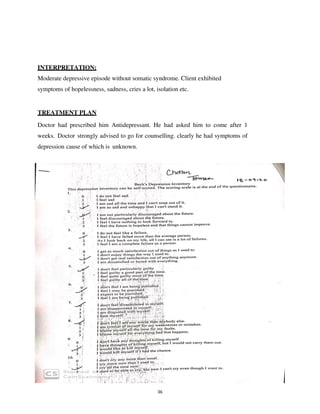
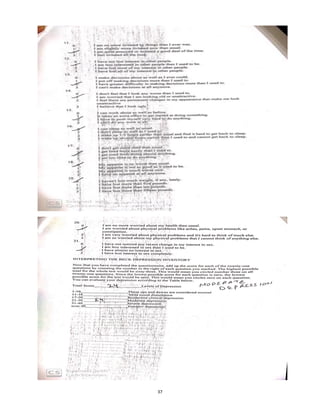
  • 80.
  • 81.