Master’s Degree Programme in Psychology
Discipline of Psychology
School of Social Sciences
Indira Gandhi National Open University
Maidan Garhi, New Delhi- 110068
HANDBOOK ON PRACTICUM
EXPERIMENTAL PSYCHOLOGY AND
PSYCHOLOGICAL TESTING (MPCL-007)
July, 2011
© Indira Gandhi National Open University, 2011
All rights reserved. No part of this work may be reproduced in any form, by mimeography or any other means,
without permission in writing from the Indira Gandhi National Open University.
Further information on the Indira Gandhi National Open University courses may be obtained from the
University's Office at Maidan Garhi, New Delhi-110 068
Printed and published on behalf of the Indira Gandhi National Open University, New Delhi, by Director, School
of Social Sciences.
Laser Typeset by : Tessa Media & Computers, C-206, A.F.E.-II, Jamia Nagar, New Delhi-110025
Printed at:
Print Production
Mr. Manjit Singh
Section Officer (Pub.), SOSS, IGNOU, New Delhi
Programme Coordinator
Prof. Vimala Veeraraghavan
Emeritus Professor, Psychology
SOSS, IGNOU, New Delhi
Preparation Team
Dr. Bhagwanti Jadwani
Asst. Professor, Psychology
IGNOU, New Delhi
Dr. Smita Gupta
Asst. Professor, Psychology
IGNOU, New Delhi
Dr. Monika Mishra
Asst. Professor, Psychology
IGNOU, New Delhi
Content Editor
Dr. Swati Patra
Reader of Psychology
SOSS, IGNOU, New Delhi
Dr. Suhas Shetgovekar
Reader of Psychology
SOSS, IGNOU, New Delhi
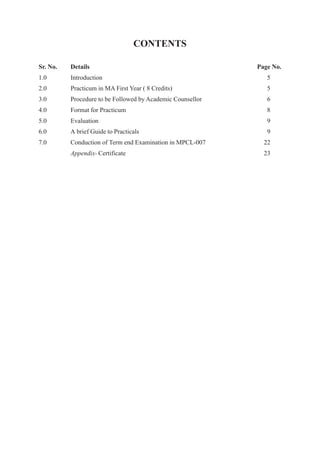
CONTENTS
Sr. No. Details Page No.
1.0 Introduction 5
2.0 Practicum in MA First Year ( 8 Credits) 5
3.0 Procedure to be Followed by Academic Counsellor 6
4.0 Format for Practicum 8
5.0 Evaluation 9
6.0 A brief Guide to Practicals 9
7.0 Conduction of Term end Examination in MPCL-007 22
Appendix- Certificate 23
4
5
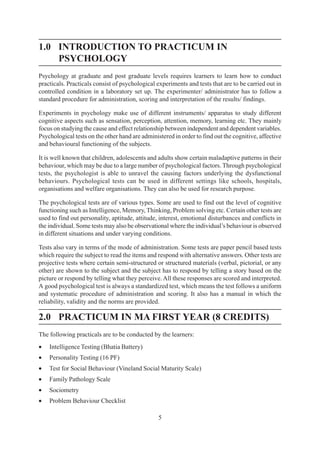
1.0 INTRODUCTION TO PRACTICUM IN
PSYCHOLOGY
Psychology at graduate and post graduate levels requires learners to learn how to conduct
practicals. Practicals consist of psychological experiments and tests that are to be carried out in
controlled condition in a laboratory set up. The experimenter/ administrator has to follow a
standard procedure for administration, scoring and interpretation of the results/ findings.
Experiments in psychology make use of different instruments/ apparatus to study different
cognitive aspects such as sensation, perception, attention, memory, learning etc. They mainly
focus on studying the cause and effect relationship between independent and dependent variables.
Psychological tests on the other hand are administered in order to find out the cognitive, affective
and behavioural functioning of the subjects.
It is well known that children, adolescents and adults show certain maladaptive patterns in their
behaviour, which may be due to a large number of psychological factors. Through psychological
tests, the psychologist is able to unravel the causing factors underlying the dysfunctional
behaviours. Psychological tests can be used in different settings like schools, hospitals,
organisations and welfare organisations. They can also be used for research purpose.
The psychological tests are of various types. Some are used to find out the level of cognitive
functioning such as Intelligence, Memory, Thinking, Problem solving etc. Certain other tests are
used to find out personality, aptitude, attitude, interest, emotional disturbances and conflicts in
the individual. Some tests may also be observational where the individual’s behaviour is observed
in different situations and under varying conditions.
Tests also vary in terms of the mode of administration. Some tests are paper pencil based tests
which require the subject to read the items and respond with alternative answers. Other tests are
projective tests where certain semi-structured or structured materials (verbal, pictorial, or any
other) are shown to the subject and the subject has to respond by telling a story based on the
picture or respond by telling what they perceive.All these responses are scored and interpreted.
A good psychological test is always a standardized test, which means the test follows a uniform
and systematic procedure of administration and scoring. It also has a manual in which the
reliability, validity and the norms are provided.
2.0 PRACTICUM IN MA FIRST YEAR (8 CREDITS)
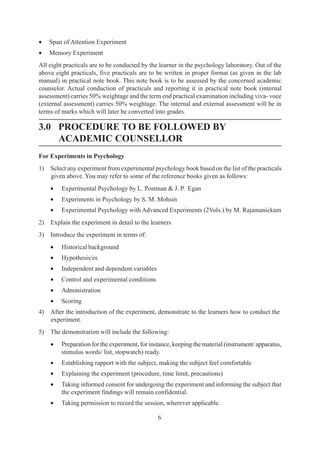
The following practicals are to be conducted by the learners:
• Intelligence Testing (Bhatia Battery)
• Personality Testing (16 PF)
• Test for Social Behaviour (Vineland Social Maturity Scale)
• Family Pathology Scale
• Sociometry
• Problem Behaviour Checklist
6
• Span of Attention Experiment
• Memory Experiment
All eight practicals are to be conducted by the learner in the psychology laboratory. Out of the
above eight practicals, five practicals are to be written in proper format (as given in the lab
manual) in practical note book. This note book is to be assessed by the concerned academic
counselor. Actual conduction of practicals and reporting it in practical note book (internal
assessment) carries 50% weightage and the term end practical examination including viva- voce
(external assessment) carries 50% weightage. The internal and external assessment will be in
terms of marks which will later be converted into grades.
3.0 PROCEDURE TO BE FOLLOWED BY
ACADEMIC COUNSELLOR
For Experiments in Psychology
1) Select any experiment from experimental psychology book based on the list of the practicals
given above. You may refer to some of the reference books given as follows:
• Experimental Psychology by L. Postman & J. P. Egan
• Experiments in Psychology by S. M. Mohsin
• Experimental Psychology with Advanced Experiments (2Vols.) by M. Rajamanickam
2) Explain the experiment in detail to the learners
3) Introduce the experiment in terms of:
• Historical background
• Hypothesis/es
• Independent and dependent variables
• Control and experimental conditions
• Administration
• Scoring
4) After the introduction of the experiment, demonstrate to the learners how to conduct the
experiment.
5) The demonstration will include the following:
• Preparation for the experiment, for instance, keeping the material (instrument/ apparatus,
stimulus words/ list, stopwatch) ready.
• Establishing rapport with the subject, making the subject feel comfortable
• Explaining the experiment (procedure, time limit, precautions)
• Taking informed consent for undergoing the experiment and informing the subject that
the experiment findings will remain confidential.
• Taking permission to record the session, wherever applicable.
7
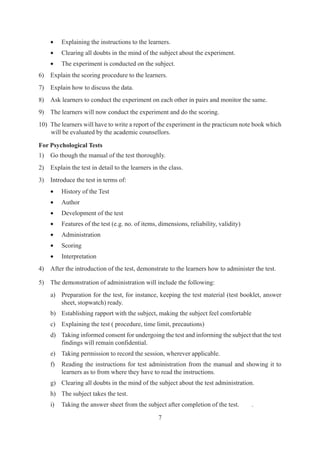
• Explaining the instructions to the learners.
• Clearing all doubts in the mind of the subject about the experiment.
• The experiment is conducted on the subject.
6) Explain the scoring procedure to the learners.
7) Explain how to discuss the data.
8) Ask learners to conduct the experiment on each other in pairs and monitor the same.
9) The learners will now conduct the experiment and do the scoring.
10) The learners will have to write a report of the experiment in the practicum note book which
will be evaluated by the academic counsellors.
For Psychological Tests
1) Go though the manual of the test thoroughly.
2) Explain the test in detail to the learners in the class.
3) Introduce the test in terms of:
• History of the Test
• Author
• Development of the test
• Features of the test (e.g. no. of items, dimensions, reliability, validity)
• Administration
• Scoring
• Interpretation
4) After the introduction of the test, demonstrate to the learners how to administer the test.
5) The demonstration of administration will include the following:
a) Preparation for the test, for instance, keeping the test material (test booklet, answer
sheet, stopwatch) ready.
b) Establishing rapport with the subject, making the subject feel comfortable
c) Explaining the test ( procedure, time limit, precautions)
d) Taking informed consent for undergoing the test and informing the subject that the test
findings will remain confidential.
e) Taking permission to record the session, wherever applicable.
f) Reading the instructions for test administration from the manual and showing it to
learners as to from where they have to read the instructions.
g) Clearing all doubts in the mind of the subject about the test administration.
h) The subject takes the test.
i) Taking the answer sheet from the subject after completion of the test. .
8
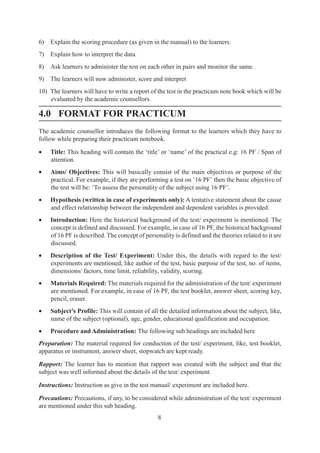
6) Explain the scoring procedure (as given in the manual) to the learners.
7) Explain how to interpret the data.
8) Ask learners to administer the test on each other in pairs and monitor the same.
9) The learners will now administer, score and interpret
10) The learners will have to write a report of the test in the practicum note book which will be
evaluated by the academic counsellors.
4.0 FORMAT FOR PRACTICUM
The academic counsellor introduces the following format to the learners which they have to
follow while preparing their practicum notebook.
• Title: This heading will contain the ‘title’ or ‘name’ of the practical e.g: 16 PF / Span of
attention.
• Aims/ Objectives: This will basically consist of the main objectives or purpose of the
practical. For example, if they are performing a test on ’16 PF’ then the basic objective of
the test will be: ‘To assess the personality of the subject using 16 PF’.
• Hypothesis (written in case of experiments only): A tentative statement about the cause
and effect relationship between the independent and dependent variables is provided.
• Introduction: Here the historical background of the test/ experiment is mentioned. The
concept is defined and discussed. For example, in case of 16 PF, the historical background
of 16 PF is described. The concept of personality is defined and the theories related to it are
discussed.
• Description of the Test/ Experiment: Under this, the details with regard to the test/
experiments are mentioned, like author of the test, basic purpose of the test, no. of items,
dimensions/ factors, time limit, reliability, validity, scoring.
• Materials Required: The materials required for the administration of the test/ experiment
are mentioned. For example, in case of 16 PF, the test booklet, answer sheet, scoring key,
pencil, eraser.
• Subject’s Profile: This will contain of all the detailed information about the subject, like,
name of the subject (optional), age, gender, educational qualification and occupation.
• Procedure and Administration: The following sub headings are included here
Preparation: The material required for conduction of the test/ experiment, like, test booklet,
apparatus or instrument, answer sheet, stopwatch are kept ready.
Rapport: The learner has to mention that rapport was created with the subject and that the
subject was well informed about the details of the test/ experiment.
Instructions: Instruction as give in the test manual/ experiment are included here.
Precautions: Precautions, if any, to be considered while administration of the test/ experiment
are mentioned under this sub heading.
9
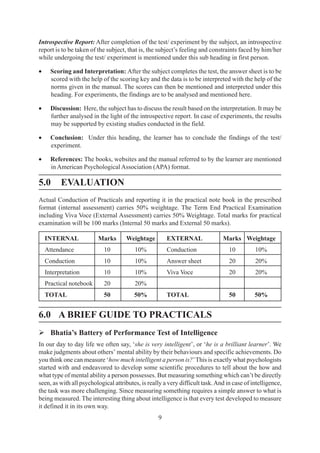
Introspective Report: After completion of the test/ experiment by the subject, an introspective
report is to be taken of the subject, that is, the subject’s feeling and constraints faced by him/her
while undergoing the test/ experiment is mentioned under this sub heading in first person.
• Scoring and Interpretation: After the subject completes the test, the answer sheet is to be
scored with the help of the scoring key and the data is to be interpreted with the help of the
norms given in the manual. The scores can then be mentioned and interpreted under this
heading. For experiments, the findings are to be analysed and mentioned here.
• Discussion: Here, the subject has to discuss the result based on the interpretation. It may be
further analysed in the light of the introspective report. In case of experiments, the results
may be supported by existing studies conducted in the field.
• Conclusion: Under this heading, the learner has to conclude the findings of the test/
experiment.
• References: The books, websites and the manual referred to by the learner are mentioned
in American Psychological Association (APA) format.
5.0 EVALUATION
Actual Conduction of Practicals and reporting it in the practical note book in the prescribed
format (internal assessment) carries 50% weightage. The Term End Practical Examination
including Viva Voce (External Assessment) carries 50% Weightage. Total marks for practical
examination will be 100 marks (Internal 50 marks and External 50 marks).
INTERNAL Marks Weightage EXTERNAL Marks Weightage
Attendance 10 10% Conduction 10 10%
Conduction 10 10% Answer sheet 20 20%
Interpretation 10 10% Viva Voce 20 20%
Practical notebook 20 20%
TOTAL 50 50% TOTAL 50 50%
6.0 A BRIEF GUIDE TO PRACTICALS
¾ Bhatia’s Battery of Performance Test of Intelligence
In our day to day life we often say, ‘she is very intelligent’, or ‘he is a brilliant learner’. We
make judgments about others’ mental ability by their behaviours and specific achievements. Do
you think one can measure ‘how much intelligent a person is?’This is exactly what psychologists
started with and endeavored to develop some scientific procedures to tell about the how and
what type of mental ability a person possesses. But measuring something which can’t be directly
seen, as with all psychological attributes, is really a very difficult task.And in case of intelligence,
the task was more challenging. Since measuring something requires a simple answer to what is
being measured. The interesting thing about intelligence is that every test developed to measure
it defined it in its own way.
10
What is Intelligence?
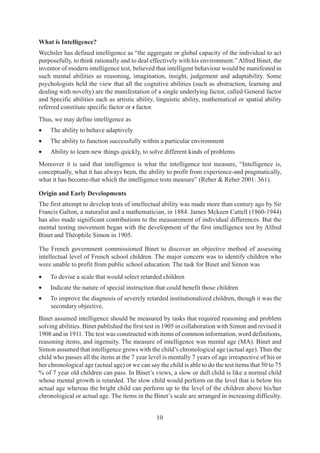
Wechsler has defined intelligence as “the aggregate or global capacity of the individual to act
purposefully, to think rationally and to deal effectively with his environment.” Alfred Binet, the
inventor of modern intelligence test, believed that intelligent behaviour would be manifested in
such mental abilities as reasoning, imagination, insight, judgement and adaptability. Some
psychologists held the view that all the cognitive abilities (such as abstraction, learning and
dealing with novelty) are the manifestation of a single underlying factor, called General factor
and Specific abilities such as artistic ability, linguistic ability, mathematical or spatial ability
referred constitute specific factor or s factor.
Thus, we may define intelligence as
• The ability to behave adaptively
• The ability to function successfully within a particular environment
• Ability to learn new things quickly, to solve different kinds of problems
Moreover it is said that intelligence is what the intelligence test measure, “Intelligence is,
conceptually, what it has always been, the ability to profit from experience-and pragmatically,
what it has become-that which the intelligence tests measure” (Reber & Reber 2001: 361).
Origin and Early Developments
The first attempt to develop tests of intellectual ability was made more than century ago by Sir
Francis Galton, a naturalist and a mathematician, in 1884. James Mckeen Cattell (1860-1944)
has also made significant contributions to the measurement of individual differences. But the
mental testing movement began with the development of the first intelligence test by Alfred
Binet and Théophile Simon in 1905.
The French government commissioned Binet to discover an objective method of assessing
intellectual level of French school children. The major concern was to identify children who
were unable to profit from public school education. The task for Binet and Simon was
• To devise a scale that would select retarded children
• Indicate the nature of special instruction that could benefit those children
• To improve the diagnosis of severely retarded institutionalized children, though it was the
secondary objective.
Binet assumed intelligence should be measured by tasks that required reasoning and problem
solving abilities. Binet published the first test in 1905 in collaboration with Simon and revised it
1908 and in 1911. The test was constructed with items of common information, word definitions,
reasoning items, and ingenuity. The measure of intelligence was mental age (MA). Binet and
Simon assumed that intelligence grows with the child’s chronological age (actual age). Thus the
child who passes all the items at the 7 year level is mentally 7 years of age irrespective of his or
her chronological age (actual age) or we can say the child is able to do the test items that 50 to 75
% of 7 year old children can pass. In Binet’s views, a slow or dull child is like a normal child
whose mental growth is retarded. The slow child would perform on the level that is below his
actual age whereas the bright child can perform up to the level of the children above his/her
chronological or actual age. The items in the Binet’s scale are arranged in increasing difficulty.
11
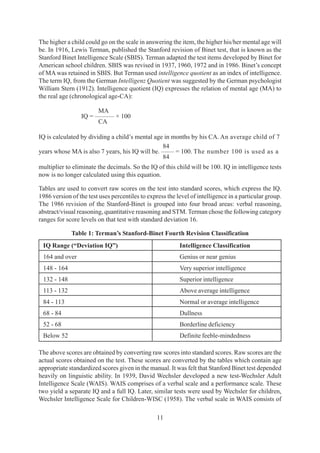
The higher a child could go on the scale in answering the item, the higher his/her mental age will
be. In 1916, Lewis Terman, published the Stanford revision of Binet test, that is known as the
Stanford Binet Intelligence Scale (SBIS). Terman adapted the test items developed by Binet for
American school children. SBIS was revised in 1937, 1960, 1972 and in 1986. Binet’s concept
of MA was retained in SBIS. But Terman used intelligence quotient as an index of intelligence.
The term IQ, from the German Intelligenz Quotient was suggested by the German psychologist
William Stern (1912). Intelligence quotient (IQ) expresses the relation of mental age (MA) to
the real age (chronological age-CA):
MA
IQ = ——— × 100
CA
IQ is calculated by dividing a child’s mental age in months by his CA. An average child of 7
84
years whose MA is also 7 years, his IQ will be. —— = 100. The number 100 is used as a
84
multiplier to eliminate the decimals. So the IQ of this child will be 100. IQ in intelligence tests
now is no longer calculated using this equation.
Tables are used to convert raw scores on the test into standard scores, which express the IQ.
1986 version of the test uses percentiles to express the level of intelligence in a particular group.
The 1986 revision of the Stanford-Binet is grouped into four broad areas: verbal reasoning,
abstract/visual reasoning, quantitative reasoning and STM. Terman chose the following category
ranges for score levels on that test with standard deviation 16.
Table 1: Terman’s Stanford-Binet Fourth Revision Classification
IQ Range (“Deviation IQ”) Intelligence Classification
164 and over Genius or near genius
148 - 164 Very superior intelligence
132 - 148 Superior intelligence
113 - 132 Above average intelligence
84 - 113 Normal or average intelligence
68 - 84 Dullness
52 - 68 Borderline deficiency
Below 52 Definite feeble-mindedness
The above scores are obtained by converting raw scores into standard scores. Raw scores are the
actual scores obtained on the test. These scores are converted by the tables which contain age
appropriate standardized scores given in the manual. It was felt that Stanford Binet test depended
heavily on linguistic ability. In 1939, David Wechsler developed a new test-Wechsler Adult
Intelligence Scale (WAIS). WAIS comprises of a verbal scale and a performance scale. These
two yield a separate IQ and a full IQ. Later, similar tests were used by Wechsler for children,
Wechsler Intelligence Scale for Children-WISC (1958). The verbal scale in WAIS consists of
12
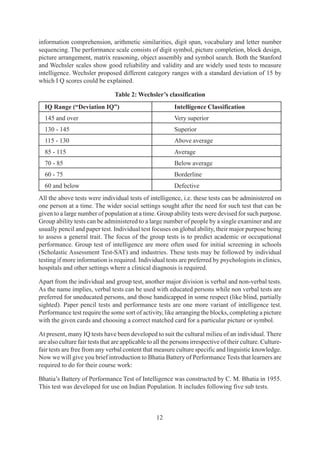
information comprehension, arithmetic similarities, digit span, vocabulary and letter number
sequencing. The performance scale consists of digit symbol, picture completion, block design,
picture arrangement, matrix reasoning, object assembly and symbol search. Both the Stanford
and Wechsler scales show good reliability and validity and are widely used tests to measure
intelligence. Wechsler proposed different category ranges with a standard deviation of 15 by
which I Q scores could be explained.
Table 2: Wechsler’s classification
IQ Range (“Deviation IQ”) Intelligence Classification
145 and over Very superior
130 - 145 Superior
115 - 130 Above average
85 - 115 Average
70 - 85 Below average
60 - 75 Borderline
60 and below Defective
All the above tests were individual tests of intelligence, i.e. these tests can be administered on
one person at a time. The wider social settings sought after the need for such test that can be
given to a large number of population at a time. Group ability tests were devised for such purpose.
Group ability tests can be administered to a large number of people by a single examiner and are
usually pencil and paper test. Individual test focuses on global ability, their major purpose being
to assess a general trait. The focus of the group tests is to predict academic or occupational
performance. Group test of intelligence are more often used for initial screening in schools
(Scholastic Assessment Test-SAT) and industries. These tests may be followed by individual
testing if more information is required. Individual tests are preferred by psychologists in clinics,
hospitals and other settings where a clinical diagnosis is required.
Apart from the individual and group test, another major division is verbal and non-verbal tests.
As the name implies, verbal tests can be used with educated persons while non verbal tests are
preferred for uneducated persons, and those handicapped in some respect (like blind, partially
sighted). Paper pencil tests and performance tests are one more variant of intelligence test.
Performance test require the some sort of activity, like arranging the blocks, completing a picture
with the given cards and choosing a correct matched card for a particular picture or symbol.
At present, many IQ tests have been developed to suit the cultural milieu of an individual. There
are also culture fair tests that are applicable to all the persons irrespective of their culture. Culture-
fair tests are free from any verbal content that measure culture specific and linguistic knowledge.
Now we will give you brief introduction to Bhatia Battery of Performance Tests that learners are
required to do for their course work:
Bhatia’s Battery of Performance Test of Intelligence was constructed by C. M. Bhatia in 1955.
This test was developed for use on Indian Population. It includes following five sub tests.
13
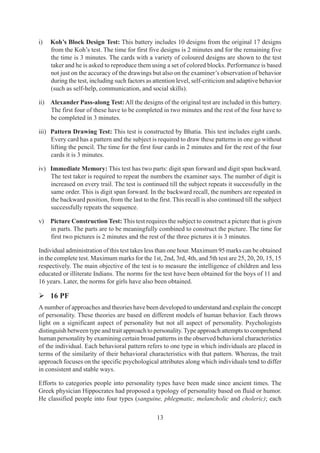
i) Koh’s Block Design Test: This battery includes 10 designs from the original 17 designs
from the Koh’s test. The time for first five designs is 2 minutes and for the remaining five
the time is 3 minutes. The cards with a variety of coloured designs are shown to the test
taker and he is asked to reproduce them using a set of colored blocks. Performance is based
not just on the accuracy of the drawings but also on the examiner’s observation of behavior
during the test, including such factors as attention level, self-criticism and adaptive behavior
(such as self-help, communication, and social skills).
ii) Alexander Pass-along Test:All the designs of the original test are included in this battery.
The first four of these have to be completed in two minutes and the rest of the four have to
be completed in 3 minutes.
iii) Pattern Drawing Test: This test is constructed by Bhatia. This test includes eight cards.
Every card has a pattern and the subject is required to draw these patterns in one go without
lifting the pencil. The time for the first four cards in 2 minutes and for the rest of the four
cards it is 3 minutes.
iv) Immediate Memory: This test has two parts: digit span forward and digit span backward.
The test taker is required to repeat the numbers the examiner says. The number of digit is
increased on every trail. The test is continued till the subject repeats it successfully in the
same order. This is digit span forward. In the backward recall, the numbers are repeated in
the backward position, from the last to the first. This recall is also continued till the subject
successfully repeats the sequence.
v) Picture Construction Test: This test requires the subject to construct a picture that is given
in parts. The parts are to be meaningfully combined to construct the picture. The time for
first two pictures is 2 minutes and the rest of the three pictures it is 3 minutes.
Individual administration of this test takes less than one hour. Maximum 95 marks can be obtained
in the complete test. Maximum marks for the 1st, 2nd, 3rd, 4th, and 5th test are 25, 20, 20, 15, 15
respectively. The main objective of the test is to measure the intelligence of children and less
educated or illiterate Indians. The norms for the test have been obtained for the boys of 11 and
16 years. Later, the norms for girls have also been obtained.
¾ 16 PF
A number of approaches and theories have been developed to understand and explain the concept
of personality. These theories are based on different models of human behavior. Each throws
light on a significant aspect of personality but not all aspect of personality. Psychologists
distinguish between type and trait approach to personality.Type approach attempts to comprehend
human personality by examining certain broad patterns in the observed behavioral characteristics
of the individual. Each behavioral pattern refers to one type in which individuals are placed in
terms of the similarity of their behavioral characteristics with that pattern. Whereas, the trait
approach focuses on the specific psychological attributes along which individuals tend to differ
in consistent and stable ways.
Efforts to categories people into personality types have been made since ancient times. The
Greek physician Hippocrates had proposed a typology of personality based on fluid or humor.
He classified people into four types (sanguine, phlegmatic, melancholic and choleric); each
14
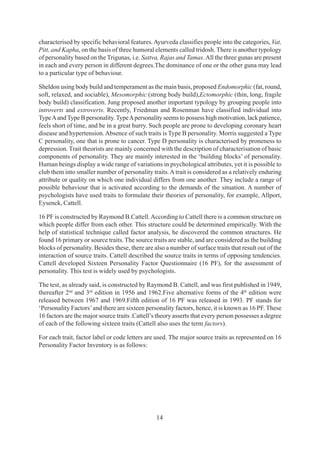
characterised by specific behavioral features.Ayurveda classifies people into the categories, Vat,
Pitt, and Kapha, on the basis of three humoral elements called tridosh. There is another typology
of personality based on the Trigunas, i.e. Sattva, Rajas and Tamas.All the three gunas are present
in each and every person in different degrees.The dominance of one or the other guna may lead
to a particular type of behaviour.
Sheldon using body build and temperament as the main basis, proposed Endomorphic (fat, round,
soft, relaxed, and sociable), Mesomorphic (strong body build),Ectomorphic (thin, long, fragile
body build) classification. Jung proposed another important typology by grouping people into
introverts and extroverts. Recently, Friedman and Rosenman have classified individual into
TypeAandType B personality. TypeApersonality seems to possess high motivation, lack patience,
feels short of time, and be in a great hurry. Such people are prone to developing coronary heart
disease and hypertension.Absence of such traits is Type B personality. Morris suggested a Type
C personality, one that is prone to cancer. Type D personality is characterised by proneness to
depression. Trait theorists are mainly concerned with the description of characterisation of basic
components of personality. They are mainly interested in the ‘building blocks’ of personality.
Human beings display a wide range of variations in psychological attributes, yet it is possible to
club them into smaller number of personality traits.A trait is considered as a relatively enduring
attribute or quality on which one individual differs from one another. They include a range of
possible behaviour that is activated according to the demands of the situation. A number of
psychologists have used traits to formulate their theories of personality, for example, Allport,
Eysenck, Cattell.
16 PF is constructed by Raymond B.Cattell.According to Cattell there is a common structure on
which people differ from each other. This structure could be determined empirically. With the
help of statistical technique called factor analysis, he discovered the common structures. He
found 16 primary or source traits. The source traits are stable, and are considered as the building
blocks of personality. Besides these, there are also a number of surface traits that result out of the
interaction of source traits. Cattell described the source traits in terms of opposing tendencies.
Cattell developed Sixteen Personality Factor Questionnaire (16 PF), for the assessment of
personality. This test is widely used by psychologists.
The test, as already said, is constructed by Raymond B. Cattell, and was first published in 1949,
thereafter 2nd
and 3rd
edition in 1956 and 1962.Five alternative forms of the 4th
edition were
released between 1967 and 1969.Fifth edition of 16 PF was released in 1993. PF stands for
‘Personality Factors’and there are sixteen personality factors, hence, it is known as 16 PF. These
16 factors are the major source traits .Cattell’s theory asserts that every person possesses a degree
of each of the following sixteen traits (Cattell also uses the term factors).
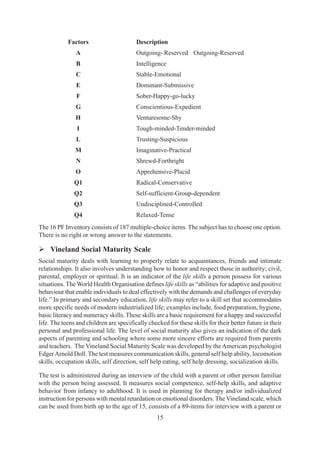
For each trait, factor label or code letters are used. The major source traits as represented on 16
Personality Factor Inventory is as follows:
15
Factors Description
A Outgoing- Reserved Outgoing-Reserved
B Intelligence
C Stable-Emotional
E Dominant-Submissive
F Sober-Happy-go-lucky
G Conscientious-Expedient
H Venturesome-Shy
I Tough-minded-Tender-minded
L Trusting-Suspicious
M Imaginative-Practical
N Shrewd-Forthright
O Apprehensive-Placid
Q1 Radical-Conservative
Q2 Self-sufficient-Group-dependent
Q3 Undisciplined-Controlled
Q4 Relaxed-Tense
The 16 PF Inventory consists of 187 multiple-choice items. The subject has to choose one option.
There is no right or wrong answer to the statements.
¾ Vineland Social Maturity Scale
Social maturity deals with learning to properly relate to acquaintances, friends and intimate
relationships. It also involves understanding how to honor and respect those in authority; civil,
parental, employer or spiritual. It is an indicator of the life skills a person possess for various
situations. The World Health Organisation defines life skills as “abilities for adaptive and positive
behaviour that enable individuals to deal effectively with the demands and challenges of everyday
life.” In primary and secondary education, life skills may refer to a skill set that accommodates
more specific needs of modern industrialized life; examples include, food preparation, hygiene,
basic literacy and numeracy skills. These skills are a basic requirement for a happy and successful
life. The teens and children are specifically checked for these skills for their better future in their
personal and professional life. The level of social maturity also gives an indication of the dark
aspects of parenting and schooling where some more sincere efforts are required from parents
and teachers. The Vineland Social Maturity Scale was developed by the American psychologist
EdgerArnold Doll.The test measures communication skills, general self help ability, locomotion
skills, occupation skills, self direction, self help eating, self help dressing, socialization skills.
The test is administered during an interview of the child with a parent or other person familiar
with the person being assessed. It measures social competence, self-help skills, and adaptive
behavior from infancy to adulthood. It is used in planning for therapy and/or individualized
instruction for persons with mental retardation or emotional disorders. The Vineland scale, which
can be used from birth up to the age of 15, consists of a 89-items for interview with a parent or
16
other primary caregiver. Personal and social skills are evaluated in the following areas: daily
living skills (general self-help, eating, dressing); communication (listening, speaking, writing);
motor skills (fine and gross, including locomotion); socialization (interpersonal relationships,
play and leisure, and coping skills); occupational skills; and self-direction. The test is un-timed
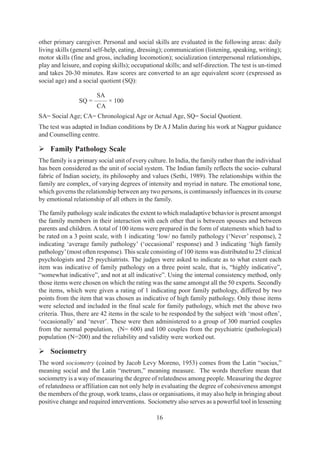
and takes 20-30 minutes. Raw scores are converted to an age equivalent score (expressed as
social age) and a social quotient (SQ):
SA
SQ = —— × 100
CA
SA= Social Age; CA= Chronological Age or Actual Age, SQ= Social Quotient.
The test was adapted in Indian conditions by Dr A J Malin during his work at Nagpur guidance
and Counselling centre.
¾ Family Pathology Scale
The family is a primary social unit of every culture. In India, the family rather than the individual
has been considered as the unit of social system. The Indian family reflects the socio- cultural
fabric of Indian society, its philosophy and values (Sethi, 1989). The relationships within the
family are complex, of varying degrees of intensity and myriad in nature. The emotional tone,
which governs the relationship between any two persons, is continuously influences in its course
by emotional relationship of all others in the family.
The family pathology scale indicates the extent to which maladaptive behavior is present amongst
the family members in their interaction with each other that is between spouses and between
parents and children. A total of 100 items were prepared in the form of statements which had to
be rated on a 3 point scale, with 1 indicating ‘low/ no family pathology (‘Never’ response), 2
indicating ‘average family pathology’ (‘occasional’ response) and 3 indicating ‘high family
pathology’(most often response). This scale consisting of 100 items was distributed to 25 clinical
psychologists and 25 psychiatrists. The judges were asked to indicate as to what extent each
item was indicative of family pathology on a three point scale, that is, “highly indicative”,
“somewhat indicative”, and not at all indicative”. Using the internal consistency method, only
those items were chosen on which the rating was the same amongst all the 50 experts. Secondly
the items, which were given a rating of 1 indicating poor family pathology, differed by two
points from the item that was chosen as indicative of high family pathology. Only those items
were selected and included in the final scale for family pathology, which met the above two
criteria. Thus, there are 42 items in the scale to be responded by the subject with ‘most often’,
‘occasionally’ and ‘never’. These were then administered to a group of 300 married couples
from the normal population, (N= 600) and 100 couples from the psychiatric (pathological)
population (N=200) and the reliability and validity were worked out.
¾ Sociometry
The word sociometry (coined by Jacob Levy Moreno, 1953) comes from the Latin “socius,”
meaning social and the Latin “metrum,” meaning measure. The words therefore mean that
sociometry is a way of measuring the degree of relatedness among people. Measuring the degree
of relatedness or affiliation can not only help in evaluating the degree of cohesiveness amongst
the members of the group, work teams, class or organisations, it may also help in bringing about
positive change and required interventions. Sociometry also serves as a powerful tool in lessening
17
the communication gap and reducing conflict by helping the group to analyse, examine and
evaluate its own dynamics. It can also be helpful in finding out the relevant areas or group that
requires therapy or training. It is a measure which helps in evaluating how individuals associate
with each other when acting as a group toward a specified end or goal (Criswell in Moreno,
1960, p. 140). Moreno himself defined sociometry as “the mathematical study of psychological
properties of populations, the experimental technique of and the results obtained by application
of quantitative methods” (Moreno, 1953, pp. 15-16).
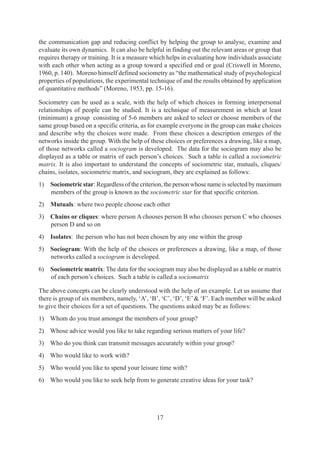
Sociometry can be used as a scale, with the help of which choices in forming interpersonal
relationships of people can be studied. It is a technique of measurement in which at least
(minimum) a group consisting of 5-6 members are asked to select or choose members of the
same group based on a specific criteria, as for example everyone in the group can make choices
and describe why the choices were made. From these choices a description emerges of the
networks inside the group. With the help of these choices or preferences a drawing, like a map,
of those networks called a sociogram is developed. The data for the sociogram may also be
displayed as a table or matrix of each person’s choices. Such a table is called a sociometric
matrix. It is also important to understand the concepts of sociometric star, mutuals, cliques/
chains, isolates, sociometric matrix, and sociogram, they are explained as follows:
1) Sociometric star: Regardless of the criterion, the person whose name is selected by maximum
members of the group is known as the sociometric star for that specific criterion.
2) Mutuals: where two people choose each other
3) Chains or cliques: where person A chooses person B who chooses person C who chooses
person D and so on
4) Isolates: the person who has not been chosen by any one within the group
5) Sociogram: With the help of the choices or preferences a drawing, like a map, of those
networks called a sociogram is developed.
6) Sociometric matrix: The data for the sociogram may also be displayed as a table or matrix
of each person’s choices. Such a table is called a sociomatrix
The above concepts can be clearly understood with the help of an example. Let us assume that
there is group of six members, namely, ‘A’, ‘B’, ‘C’, ‘D’, ‘E’& ‘F’. Each member will be asked
to give their choices for a set of questions. The questions asked may be as follows:
1) Whom do you trust amongst the members of your group?
2) Whose advice would you like to take regarding serious matters of your life?
3) Who do you think can transmit messages accurately within your group?
4) Who would like to work with?
5) Who would you like to spend your leisure time with?
6) Who would you like to seek help from to generate creative ideas for your task?
18
The only requirement is that, the members are required to choose only one person for each
question.
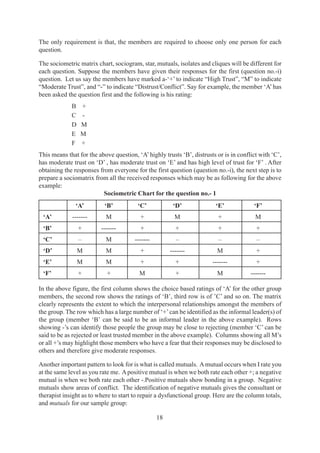
The sociometric matrix chart, sociogram, star, mutuals, isolates and cliques will be different for
each question. Suppose the members have given their responses for the first (question no.-i)
question. Let us say the members have marked a-‘+’ to indicate “High Trust”, “M” to indicate
“Moderate Trust”, and “-” to indicate “Distrust/Conflict”. Say for example, the member ‘A’has
been asked the question first and the following is his rating:
B +
C -
D M
E M
F +
This means that for the above question, ‘A’ highly trusts ‘B’, distrusts or is in conflict with ‘C’,
has moderate trust on ‘D’ , has moderate trust on ‘E’ and has high level of trust for ‘F’ . After
obtaining the responses from everyone for the first question (question no.-i), the next step is to
prepare a sociomatrix from all the received responses which may be as following for the above
example:
Sociometric Chart for the question no.- 1
‘A’ ‘B’ ‘C’ ‘D’ ‘E’ ‘F’
‘A’ ------- M + M + M
‘B’ + ------- + + + +
‘C’ – M ------- – – –
‘D’ M M + ------- M +
‘E’ M M + + ------- +
‘F’ + + M + M -------
In the above figure, the first column shows the choice based ratings of ‘A’ for the other group
members, the second row shows the ratings of ‘B’, third row is of ’C’ and so on. The matrix
clearly represents the extent to which the interpersonal relationships amongst the members of
the group. The row which has a large number of ‘+’can be identified as the informal leader(s) of
the group (member ‘B’ can be said to be an informal leader in the above example). Rows
showing -’s can identify those people the group may be close to rejecting (member ‘C’ can be
said to be as rejected or least trusted member in the above example). Columns showing all M’s
or all +’s may highlight those members who have a fear that their responses may be disclosed to
others and therefore give moderate responses.
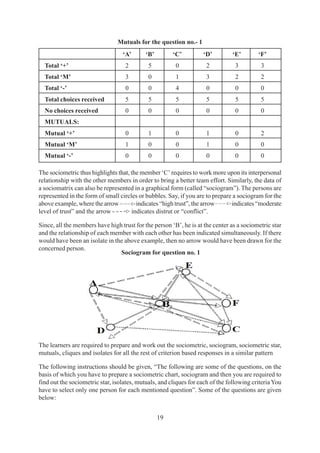
Another important pattern to look for is what is called mutuals. Amutual occurs when I rate you
at the same level as you rate me. Apositive mutual is when we both rate each other +; a negative
mutual is when we both rate each other -.Positive mutuals show bonding in a group. Negative
mutuals show areas of conflict. The identification of negative mutuals gives the consultant or
therapist insight as to where to start to repair a dysfunctional group. Here are the column totals,
and mutuals for our sample group:
19
Mutuals for the question no.- 1
‘A’ ‘B’ ‘C’ ‘D’ ‘E’ ‘F’
Total ‘+’ 2 5 0 2 3 3
Total ‘M’ 3 0 1 3 2 2
Total ‘-’ 0 0 4 0 0 0
Total choices received 5 5 5 5 5 5
No choices received 0 0 0 0 0 0
MUTUALS:
Mutual ‘+’ 0 1 0 1 0 2
Mutual ‘M’ 1 0 0 1 0 0
Mutual ‘-’ 0 0 0 0 0 0
The sociometric thus highlights that, the member ‘C’ requires to work more upon its interpersonal
relationship with the other members in order to bring a better team effort. Similarly, the data of
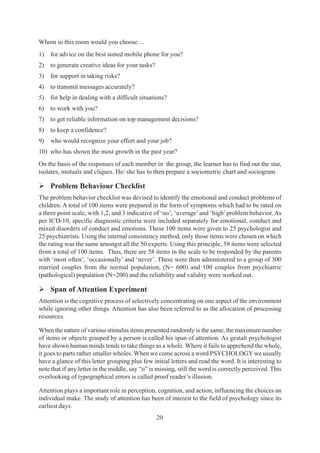
a sociomatrix can also be represented in a graphical form (called “sociogram”). The persons are
represented in the form of small circles or bubbles. Say, if you are to prepare a sociogram for the
above example, where the arrow indicates “high trust”, the arrow indicates “moderate
level of trust” and the arrow indicates distrut or “conflict”.
Since, all the members have high trust for the person ‘B’, he is at the center as a sociometric star
and the relationship of each member with each other has been indicated simultaneously. If there
would have been an isolate in the above example, then no arrow would have been drawn for the
concerned person.
Sociogram for question no. 1
The learners are required to prepare and work out the sociometric, sociogram, sociometric star,
mutuals, cliques and isolates for all the rest of criterion based responses in a similar pattern
The following instructions should be given, “The following are some of the questions, on the
basis of which you have to prepare a sociometric chart, sociogram and then you are required to
find out the sociometric star, isolates, mutuals, and cliques for each of the following criteria You
have to select only one person for each mentioned question”. Some of the questions are given
below:
20
Whom in this room would you choose…
1) for advice on the best suited mobile phone for you?
2) to generate creative ideas for your tasks?
3) for support in taking risks?
4) to transmit messages accurately?
5) for help in dealing with a difficult situations?
6) to work with you?
7) to get reliable information on top management decisions?
8) to keep a confidence?
9) who would recognize your effort and your job?
10) who has shown the most growth in the past year?
On the basis of the responses of each member in the group, the learner has to find out the star,
isolates, mutuals and cliques. He/ she has to then prepare a sociometric chart and sociogram.
¾ Problem Behaviour Checklist
The problem behavior checklist was devised to identify the emotional and conduct problems of
children. A total of 100 items were prepared in the form of symptoms which had to be rated on
a three point scale, with 1,2, and 3 indicative of ‘no’, ‘average’and ‘high’problem behavior. As
per ICD-10, specific diagnostic criteria were included separately for emotional, conduct and
mixed disorders of conduct and emotions. These 100 items were given to 25 psychologist and
25 psychiatrists. Using the internal consistency method, only those items were chosen on which
the rating was the same amongst all the 50 experts. Using this principle, 58 items were selected
from a total of 100 items. Thus, there are 58 items in the scale to be responded by the parents
with ‘most often’, ‘occasionally’ and ‘never’. These were then administered to a group of 300
married couples from the normal population, (N= 600) and 100 couples from psychiatric
(pathological) population (N=200) and the reliability and validity were worked out.
¾ Span of Attention Experiment
Attention is the cognitive process of selectively concentrating on one aspect of the environment
while ignoring other things. Attention has also been referred to as the allocation of processing
resources.
When the nature of various stimulus items presented randomly is the same, the maximum number
of items or objects grasped by a person is called his span of attention. As gestalt psychologist
have shown human minds tends to take things as a whole. Where it fails to apprehend the whole,
it goes to parts rather smaller wholes. When we come across a word PSYCHOLOGYwe usually
have a glance of this letter grouping plus few initial letters and read the word. It is interesting to
note that if any letter in the middle, say “o” is missing, still the word is correctly perceived. This
overlooking of typographical errors is called proof reader’s illusion.
Attention plays a important role in perception, cognition, and action, influencing the choices an
individual make. The study of attention has been of interest to the field of psychology since its
earliest days.
21
Wilhelm Wundt was one of the main persons to contribute to the study of attention. The
relationship between attention and perception is one of the first topics to be studied in experimental
psychology. Wundt held that attention was an inner activity that caused ideas to be present to
differing degrees in consciousness. Wundt suggested that the focus of attention could narrow or
widen. During late 19th century, Hermann von Helmholtz (1821-1894) argued that attention is
necessary for visual perception. Using himself as a subject and pages of briefly visible printed
letters as stimuli, he found that attention could be directed in advance of the stimulus presentation
to a particular region of the page, even though the eyes were kept fixed at a central point. He also
found that attention was limited. William James’s in his book on Principles of Psychology (1980)
described as taking possession by the mind, in clear and vivid form, of one of what seem several
simultaneously possible objects or trains of thought.
Any experiment based on span of attention, using tachistoscope, can be conducted by the learners.
¾ Memory Experiment
Memory is an ability to store, retain, and recall information and experiences. In other words, it is
also explained as the process of encoding, storage and retrieval of information. Encoding refers
to transformation of information in form of codes Storage is the process of putting the coded
information in to the memory and retrieval is the process of gaining access to the coded, stored
information. There are three types of memory based on the process of collecting and storage of
information, they are discussed as follows:
• Sensory memory: We receive several information from our environment through different
sense organs (for example, visual, auditory etc.) at a particular time. For instance, while
you are listening to the instructor, you are also looking at the instructor at the same time. We
pay attention to some information and reject others. The duration of information held here
is for few seconds.
• Short term memory- Once we pay attention to the selected information it is passed on to
the short term memory. At this juncture the information received through sensory memory
is held up to 30 seconds. The best example of this memory is the ‘serial position effect’. If
subjects are said to listen to certain words and then recall them instantly, it has been found
that the subjects will recall those items which appeared at the end (which is known as
recency effect) and the beginning (which is known as primacy effect) of the list, the items
encountered most recently are remembered well.
• Long term memory- Some of the information reaching short term memory is processed by
being rehearsed, that is, by having attention focused on it, perhaps by constantly
repeating the words. The duration of information stored in long tem memory can be for
life time. The information processed and stored here is systematically organised.
In 1885, Ebbinghaus found that the effects of memory can be seen more pragmatically with the
help of nonsense syllables (i.e., meaning less words like- mus, duv, tun). He found that if the
subjects are given to memorize a list of given words, and then asked to recall them after a certain
time period, the subjects could recall non sense syllables more effectively and quickly in
comparison to the meaningful words. He was later on criticized by Bartlett (1932) who said that
it is not only the non sense syllables, but the cognition, social and experimental environment
which equally effects memory, so these aspects should also be taken care of while measuring
memory. Several ways of measuring memory were developed later on. Today, one of the classic
22
techniques of measuring memory is the experiments done with the help of memory drum. Memory
drum is an apparatus which is cylindrical in shape and can be rotated clock wise. It is basically
a mechanical device for the serial presentation of syllables or words for regulated periods and at
regulated intervals.
Any experiment based on memory, using memory drum, can be conducted by the learners.
7.0 CONDUCTION OF TERM END EXAMINATION
IN MPCL 007
Duration: 3 hours
Conduction of the examination: The examination has to be conducted in the respective study
centres by the Regional Centres. During the examination, the learner will conduct the practicals
and submit the answer sheet.
The practical may be allotted to the learner by the way of lot system. Chits with names of various
practicals may be prepared before hand and the learner may be asked to pick one at the time of
the examination. S/he may then collect the test/ experiment material and start conducting the
practical. S/he will have to bring one subject along with her/him. Once the learner finishes
conducting the practical, s/he will have to report the findings in the answer sheet. The answer
sheet is then to be submitted to the internal examiner. This will be followed by the viva voce.
Viva voce will be conducted by both the internal examiner and the external examiner.
23
APPENDIX
CERTIFICATE
CERTIFICATE
CERTIFICATE
CERTIFICATE
CERTIFICATE
This is to certify that Ms/ Mr.______________________________________________________
of MA Psychology First Year has conducted and successfully completed the practical work in
MPCL- 007 Practicum: Experimental Psychology and Psychological Testing.
Signature of the Learner Signature of Academic Counsellor
Name: Name:
Enrolment No.: Designation:
Name of the Study Centre: Place:
Regional Centre: Date:
Place:
Date:

MPCL-007 Practicals.pdf

  • 1.
    Master’s Degree Programmein Psychology Discipline of Psychology School of Social Sciences Indira Gandhi National Open University Maidan Garhi, New Delhi- 110068 HANDBOOK ON PRACTICUM EXPERIMENTAL PSYCHOLOGY AND PSYCHOLOGICAL TESTING (MPCL-007)
  • 2.
    July, 2011 © IndiraGandhi National Open University, 2011 All rights reserved. No part of this work may be reproduced in any form, by mimeography or any other means, without permission in writing from the Indira Gandhi National Open University. Further information on the Indira Gandhi National Open University courses may be obtained from the University's Office at Maidan Garhi, New Delhi-110 068 Printed and published on behalf of the Indira Gandhi National Open University, New Delhi, by Director, School of Social Sciences. Laser Typeset by : Tessa Media & Computers, C-206, A.F.E.-II, Jamia Nagar, New Delhi-110025 Printed at: Print Production Mr. Manjit Singh Section Officer (Pub.), SOSS, IGNOU, New Delhi Programme Coordinator Prof. Vimala Veeraraghavan Emeritus Professor, Psychology SOSS, IGNOU, New Delhi Preparation Team Dr. Bhagwanti Jadwani Asst. Professor, Psychology IGNOU, New Delhi Dr. Smita Gupta Asst. Professor, Psychology IGNOU, New Delhi Dr. Monika Mishra Asst. Professor, Psychology IGNOU, New Delhi Content Editor Dr. Swati Patra Reader of Psychology SOSS, IGNOU, New Delhi Dr. Suhas Shetgovekar Reader of Psychology SOSS, IGNOU, New Delhi
  • 3.
    CONTENTS Sr. No. DetailsPage No. 1.0 Introduction 5 2.0 Practicum in MA First Year ( 8 Credits) 5 3.0 Procedure to be Followed by Academic Counsellor 6 4.0 Format for Practicum 8 5.0 Evaluation 9 6.0 A brief Guide to Practicals 9 7.0 Conduction of Term end Examination in MPCL-007 22 Appendix- Certificate 23
  • 4.
  • 5.
    5 1.0 INTRODUCTION TOPRACTICUM IN PSYCHOLOGY Psychology at graduate and post graduate levels requires learners to learn how to conduct practicals. Practicals consist of psychological experiments and tests that are to be carried out in controlled condition in a laboratory set up. The experimenter/ administrator has to follow a standard procedure for administration, scoring and interpretation of the results/ findings. Experiments in psychology make use of different instruments/ apparatus to study different cognitive aspects such as sensation, perception, attention, memory, learning etc. They mainly focus on studying the cause and effect relationship between independent and dependent variables. Psychological tests on the other hand are administered in order to find out the cognitive, affective and behavioural functioning of the subjects. It is well known that children, adolescents and adults show certain maladaptive patterns in their behaviour, which may be due to a large number of psychological factors. Through psychological tests, the psychologist is able to unravel the causing factors underlying the dysfunctional behaviours. Psychological tests can be used in different settings like schools, hospitals, organisations and welfare organisations. They can also be used for research purpose. The psychological tests are of various types. Some are used to find out the level of cognitive functioning such as Intelligence, Memory, Thinking, Problem solving etc. Certain other tests are used to find out personality, aptitude, attitude, interest, emotional disturbances and conflicts in the individual. Some tests may also be observational where the individual’s behaviour is observed in different situations and under varying conditions. Tests also vary in terms of the mode of administration. Some tests are paper pencil based tests which require the subject to read the items and respond with alternative answers. Other tests are projective tests where certain semi-structured or structured materials (verbal, pictorial, or any other) are shown to the subject and the subject has to respond by telling a story based on the picture or respond by telling what they perceive.All these responses are scored and interpreted. A good psychological test is always a standardized test, which means the test follows a uniform and systematic procedure of administration and scoring. It also has a manual in which the reliability, validity and the norms are provided. 2.0 PRACTICUM IN MA FIRST YEAR (8 CREDITS) The following practicals are to be conducted by the learners: • Intelligence Testing (Bhatia Battery) • Personality Testing (16 PF) • Test for Social Behaviour (Vineland Social Maturity Scale) • Family Pathology Scale • Sociometry • Problem Behaviour Checklist
  • 6.
    6 • Span ofAttention Experiment • Memory Experiment All eight practicals are to be conducted by the learner in the psychology laboratory. Out of the above eight practicals, five practicals are to be written in proper format (as given in the lab manual) in practical note book. This note book is to be assessed by the concerned academic counselor. Actual conduction of practicals and reporting it in practical note book (internal assessment) carries 50% weightage and the term end practical examination including viva- voce (external assessment) carries 50% weightage. The internal and external assessment will be in terms of marks which will later be converted into grades. 3.0 PROCEDURE TO BE FOLLOWED BY ACADEMIC COUNSELLOR For Experiments in Psychology 1) Select any experiment from experimental psychology book based on the list of the practicals given above. You may refer to some of the reference books given as follows: • Experimental Psychology by L. Postman & J. P. Egan • Experiments in Psychology by S. M. Mohsin • Experimental Psychology with Advanced Experiments (2Vols.) by M. Rajamanickam 2) Explain the experiment in detail to the learners 3) Introduce the experiment in terms of: • Historical background • Hypothesis/es • Independent and dependent variables • Control and experimental conditions • Administration • Scoring 4) After the introduction of the experiment, demonstrate to the learners how to conduct the experiment. 5) The demonstration will include the following: • Preparation for the experiment, for instance, keeping the material (instrument/ apparatus, stimulus words/ list, stopwatch) ready. • Establishing rapport with the subject, making the subject feel comfortable • Explaining the experiment (procedure, time limit, precautions) • Taking informed consent for undergoing the experiment and informing the subject that the experiment findings will remain confidential. • Taking permission to record the session, wherever applicable.
  • 7.
    7 • Explaining theinstructions to the learners. • Clearing all doubts in the mind of the subject about the experiment. • The experiment is conducted on the subject. 6) Explain the scoring procedure to the learners. 7) Explain how to discuss the data. 8) Ask learners to conduct the experiment on each other in pairs and monitor the same. 9) The learners will now conduct the experiment and do the scoring. 10) The learners will have to write a report of the experiment in the practicum note book which will be evaluated by the academic counsellors. For Psychological Tests 1) Go though the manual of the test thoroughly. 2) Explain the test in detail to the learners in the class. 3) Introduce the test in terms of: • History of the Test • Author • Development of the test • Features of the test (e.g. no. of items, dimensions, reliability, validity) • Administration • Scoring • Interpretation 4) After the introduction of the test, demonstrate to the learners how to administer the test. 5) The demonstration of administration will include the following: a) Preparation for the test, for instance, keeping the test material (test booklet, answer sheet, stopwatch) ready. b) Establishing rapport with the subject, making the subject feel comfortable c) Explaining the test ( procedure, time limit, precautions) d) Taking informed consent for undergoing the test and informing the subject that the test findings will remain confidential. e) Taking permission to record the session, wherever applicable. f) Reading the instructions for test administration from the manual and showing it to learners as to from where they have to read the instructions. g) Clearing all doubts in the mind of the subject about the test administration. h) The subject takes the test. i) Taking the answer sheet from the subject after completion of the test. .
  • 8.
    8 6) Explain thescoring procedure (as given in the manual) to the learners. 7) Explain how to interpret the data. 8) Ask learners to administer the test on each other in pairs and monitor the same. 9) The learners will now administer, score and interpret 10) The learners will have to write a report of the test in the practicum note book which will be evaluated by the academic counsellors. 4.0 FORMAT FOR PRACTICUM The academic counsellor introduces the following format to the learners which they have to follow while preparing their practicum notebook. • Title: This heading will contain the ‘title’ or ‘name’ of the practical e.g: 16 PF / Span of attention. • Aims/ Objectives: This will basically consist of the main objectives or purpose of the practical. For example, if they are performing a test on ’16 PF’ then the basic objective of the test will be: ‘To assess the personality of the subject using 16 PF’. • Hypothesis (written in case of experiments only): A tentative statement about the cause and effect relationship between the independent and dependent variables is provided. • Introduction: Here the historical background of the test/ experiment is mentioned. The concept is defined and discussed. For example, in case of 16 PF, the historical background of 16 PF is described. The concept of personality is defined and the theories related to it are discussed. • Description of the Test/ Experiment: Under this, the details with regard to the test/ experiments are mentioned, like author of the test, basic purpose of the test, no. of items, dimensions/ factors, time limit, reliability, validity, scoring. • Materials Required: The materials required for the administration of the test/ experiment are mentioned. For example, in case of 16 PF, the test booklet, answer sheet, scoring key, pencil, eraser. • Subject’s Profile: This will contain of all the detailed information about the subject, like, name of the subject (optional), age, gender, educational qualification and occupation. • Procedure and Administration: The following sub headings are included here Preparation: The material required for conduction of the test/ experiment, like, test booklet, apparatus or instrument, answer sheet, stopwatch are kept ready. Rapport: The learner has to mention that rapport was created with the subject and that the subject was well informed about the details of the test/ experiment. Instructions: Instruction as give in the test manual/ experiment are included here. Precautions: Precautions, if any, to be considered while administration of the test/ experiment are mentioned under this sub heading.
  • 9.
    9 Introspective Report: Aftercompletion of the test/ experiment by the subject, an introspective report is to be taken of the subject, that is, the subject’s feeling and constraints faced by him/her while undergoing the test/ experiment is mentioned under this sub heading in first person. • Scoring and Interpretation: After the subject completes the test, the answer sheet is to be scored with the help of the scoring key and the data is to be interpreted with the help of the norms given in the manual. The scores can then be mentioned and interpreted under this heading. For experiments, the findings are to be analysed and mentioned here. • Discussion: Here, the subject has to discuss the result based on the interpretation. It may be further analysed in the light of the introspective report. In case of experiments, the results may be supported by existing studies conducted in the field. • Conclusion: Under this heading, the learner has to conclude the findings of the test/ experiment. • References: The books, websites and the manual referred to by the learner are mentioned in American Psychological Association (APA) format. 5.0 EVALUATION Actual Conduction of Practicals and reporting it in the practical note book in the prescribed format (internal assessment) carries 50% weightage. The Term End Practical Examination including Viva Voce (External Assessment) carries 50% Weightage. Total marks for practical examination will be 100 marks (Internal 50 marks and External 50 marks). INTERNAL Marks Weightage EXTERNAL Marks Weightage Attendance 10 10% Conduction 10 10% Conduction 10 10% Answer sheet 20 20% Interpretation 10 10% Viva Voce 20 20% Practical notebook 20 20% TOTAL 50 50% TOTAL 50 50% 6.0 A BRIEF GUIDE TO PRACTICALS ¾ Bhatia’s Battery of Performance Test of Intelligence In our day to day life we often say, ‘she is very intelligent’, or ‘he is a brilliant learner’. We make judgments about others’ mental ability by their behaviours and specific achievements. Do you think one can measure ‘how much intelligent a person is?’This is exactly what psychologists started with and endeavored to develop some scientific procedures to tell about the how and what type of mental ability a person possesses. But measuring something which can’t be directly seen, as with all psychological attributes, is really a very difficult task.And in case of intelligence, the task was more challenging. Since measuring something requires a simple answer to what is being measured. The interesting thing about intelligence is that every test developed to measure it defined it in its own way.
  • 10.
    10 What is Intelligence? Wechslerhas defined intelligence as “the aggregate or global capacity of the individual to act purposefully, to think rationally and to deal effectively with his environment.” Alfred Binet, the inventor of modern intelligence test, believed that intelligent behaviour would be manifested in such mental abilities as reasoning, imagination, insight, judgement and adaptability. Some psychologists held the view that all the cognitive abilities (such as abstraction, learning and dealing with novelty) are the manifestation of a single underlying factor, called General factor and Specific abilities such as artistic ability, linguistic ability, mathematical or spatial ability referred constitute specific factor or s factor. Thus, we may define intelligence as • The ability to behave adaptively • The ability to function successfully within a particular environment • Ability to learn new things quickly, to solve different kinds of problems Moreover it is said that intelligence is what the intelligence test measure, “Intelligence is, conceptually, what it has always been, the ability to profit from experience-and pragmatically, what it has become-that which the intelligence tests measure” (Reber & Reber 2001: 361). Origin and Early Developments The first attempt to develop tests of intellectual ability was made more than century ago by Sir Francis Galton, a naturalist and a mathematician, in 1884. James Mckeen Cattell (1860-1944) has also made significant contributions to the measurement of individual differences. But the mental testing movement began with the development of the first intelligence test by Alfred Binet and Théophile Simon in 1905. The French government commissioned Binet to discover an objective method of assessing intellectual level of French school children. The major concern was to identify children who were unable to profit from public school education. The task for Binet and Simon was • To devise a scale that would select retarded children • Indicate the nature of special instruction that could benefit those children • To improve the diagnosis of severely retarded institutionalized children, though it was the secondary objective. Binet assumed intelligence should be measured by tasks that required reasoning and problem solving abilities. Binet published the first test in 1905 in collaboration with Simon and revised it 1908 and in 1911. The test was constructed with items of common information, word definitions, reasoning items, and ingenuity. The measure of intelligence was mental age (MA). Binet and Simon assumed that intelligence grows with the child’s chronological age (actual age). Thus the child who passes all the items at the 7 year level is mentally 7 years of age irrespective of his or her chronological age (actual age) or we can say the child is able to do the test items that 50 to 75 % of 7 year old children can pass. In Binet’s views, a slow or dull child is like a normal child whose mental growth is retarded. The slow child would perform on the level that is below his actual age whereas the bright child can perform up to the level of the children above his/her chronological or actual age. The items in the Binet’s scale are arranged in increasing difficulty.
  • 11.
    11 The higher achild could go on the scale in answering the item, the higher his/her mental age will be. In 1916, Lewis Terman, published the Stanford revision of Binet test, that is known as the Stanford Binet Intelligence Scale (SBIS). Terman adapted the test items developed by Binet for American school children. SBIS was revised in 1937, 1960, 1972 and in 1986. Binet’s concept of MA was retained in SBIS. But Terman used intelligence quotient as an index of intelligence. The term IQ, from the German Intelligenz Quotient was suggested by the German psychologist William Stern (1912). Intelligence quotient (IQ) expresses the relation of mental age (MA) to the real age (chronological age-CA): MA IQ = ——— × 100 CA IQ is calculated by dividing a child’s mental age in months by his CA. An average child of 7 84 years whose MA is also 7 years, his IQ will be. —— = 100. The number 100 is used as a 84 multiplier to eliminate the decimals. So the IQ of this child will be 100. IQ in intelligence tests now is no longer calculated using this equation. Tables are used to convert raw scores on the test into standard scores, which express the IQ. 1986 version of the test uses percentiles to express the level of intelligence in a particular group. The 1986 revision of the Stanford-Binet is grouped into four broad areas: verbal reasoning, abstract/visual reasoning, quantitative reasoning and STM. Terman chose the following category ranges for score levels on that test with standard deviation 16. Table 1: Terman’s Stanford-Binet Fourth Revision Classification IQ Range (“Deviation IQ”) Intelligence Classification 164 and over Genius or near genius 148 - 164 Very superior intelligence 132 - 148 Superior intelligence 113 - 132 Above average intelligence 84 - 113 Normal or average intelligence 68 - 84 Dullness 52 - 68 Borderline deficiency Below 52 Definite feeble-mindedness The above scores are obtained by converting raw scores into standard scores. Raw scores are the actual scores obtained on the test. These scores are converted by the tables which contain age appropriate standardized scores given in the manual. It was felt that Stanford Binet test depended heavily on linguistic ability. In 1939, David Wechsler developed a new test-Wechsler Adult Intelligence Scale (WAIS). WAIS comprises of a verbal scale and a performance scale. These two yield a separate IQ and a full IQ. Later, similar tests were used by Wechsler for children, Wechsler Intelligence Scale for Children-WISC (1958). The verbal scale in WAIS consists of
  • 12.
    12 information comprehension, arithmeticsimilarities, digit span, vocabulary and letter number sequencing. The performance scale consists of digit symbol, picture completion, block design, picture arrangement, matrix reasoning, object assembly and symbol search. Both the Stanford and Wechsler scales show good reliability and validity and are widely used tests to measure intelligence. Wechsler proposed different category ranges with a standard deviation of 15 by which I Q scores could be explained. Table 2: Wechsler’s classification IQ Range (“Deviation IQ”) Intelligence Classification 145 and over Very superior 130 - 145 Superior 115 - 130 Above average 85 - 115 Average 70 - 85 Below average 60 - 75 Borderline 60 and below Defective All the above tests were individual tests of intelligence, i.e. these tests can be administered on one person at a time. The wider social settings sought after the need for such test that can be given to a large number of population at a time. Group ability tests were devised for such purpose. Group ability tests can be administered to a large number of people by a single examiner and are usually pencil and paper test. Individual test focuses on global ability, their major purpose being to assess a general trait. The focus of the group tests is to predict academic or occupational performance. Group test of intelligence are more often used for initial screening in schools (Scholastic Assessment Test-SAT) and industries. These tests may be followed by individual testing if more information is required. Individual tests are preferred by psychologists in clinics, hospitals and other settings where a clinical diagnosis is required. Apart from the individual and group test, another major division is verbal and non-verbal tests. As the name implies, verbal tests can be used with educated persons while non verbal tests are preferred for uneducated persons, and those handicapped in some respect (like blind, partially sighted). Paper pencil tests and performance tests are one more variant of intelligence test. Performance test require the some sort of activity, like arranging the blocks, completing a picture with the given cards and choosing a correct matched card for a particular picture or symbol. At present, many IQ tests have been developed to suit the cultural milieu of an individual. There are also culture fair tests that are applicable to all the persons irrespective of their culture. Culture- fair tests are free from any verbal content that measure culture specific and linguistic knowledge. Now we will give you brief introduction to Bhatia Battery of Performance Tests that learners are required to do for their course work: Bhatia’s Battery of Performance Test of Intelligence was constructed by C. M. Bhatia in 1955. This test was developed for use on Indian Population. It includes following five sub tests.
  • 13.
    13 i) Koh’s BlockDesign Test: This battery includes 10 designs from the original 17 designs from the Koh’s test. The time for first five designs is 2 minutes and for the remaining five the time is 3 minutes. The cards with a variety of coloured designs are shown to the test taker and he is asked to reproduce them using a set of colored blocks. Performance is based not just on the accuracy of the drawings but also on the examiner’s observation of behavior during the test, including such factors as attention level, self-criticism and adaptive behavior (such as self-help, communication, and social skills). ii) Alexander Pass-along Test:All the designs of the original test are included in this battery. The first four of these have to be completed in two minutes and the rest of the four have to be completed in 3 minutes. iii) Pattern Drawing Test: This test is constructed by Bhatia. This test includes eight cards. Every card has a pattern and the subject is required to draw these patterns in one go without lifting the pencil. The time for the first four cards in 2 minutes and for the rest of the four cards it is 3 minutes. iv) Immediate Memory: This test has two parts: digit span forward and digit span backward. The test taker is required to repeat the numbers the examiner says. The number of digit is increased on every trail. The test is continued till the subject repeats it successfully in the same order. This is digit span forward. In the backward recall, the numbers are repeated in the backward position, from the last to the first. This recall is also continued till the subject successfully repeats the sequence. v) Picture Construction Test: This test requires the subject to construct a picture that is given in parts. The parts are to be meaningfully combined to construct the picture. The time for first two pictures is 2 minutes and the rest of the three pictures it is 3 minutes. Individual administration of this test takes less than one hour. Maximum 95 marks can be obtained in the complete test. Maximum marks for the 1st, 2nd, 3rd, 4th, and 5th test are 25, 20, 20, 15, 15 respectively. The main objective of the test is to measure the intelligence of children and less educated or illiterate Indians. The norms for the test have been obtained for the boys of 11 and 16 years. Later, the norms for girls have also been obtained. ¾ 16 PF A number of approaches and theories have been developed to understand and explain the concept of personality. These theories are based on different models of human behavior. Each throws light on a significant aspect of personality but not all aspect of personality. Psychologists distinguish between type and trait approach to personality.Type approach attempts to comprehend human personality by examining certain broad patterns in the observed behavioral characteristics of the individual. Each behavioral pattern refers to one type in which individuals are placed in terms of the similarity of their behavioral characteristics with that pattern. Whereas, the trait approach focuses on the specific psychological attributes along which individuals tend to differ in consistent and stable ways. Efforts to categories people into personality types have been made since ancient times. The Greek physician Hippocrates had proposed a typology of personality based on fluid or humor. He classified people into four types (sanguine, phlegmatic, melancholic and choleric); each
  • 14.
    14 characterised by specificbehavioral features.Ayurveda classifies people into the categories, Vat, Pitt, and Kapha, on the basis of three humoral elements called tridosh. There is another typology of personality based on the Trigunas, i.e. Sattva, Rajas and Tamas.All the three gunas are present in each and every person in different degrees.The dominance of one or the other guna may lead to a particular type of behaviour. Sheldon using body build and temperament as the main basis, proposed Endomorphic (fat, round, soft, relaxed, and sociable), Mesomorphic (strong body build),Ectomorphic (thin, long, fragile body build) classification. Jung proposed another important typology by grouping people into introverts and extroverts. Recently, Friedman and Rosenman have classified individual into TypeAandType B personality. TypeApersonality seems to possess high motivation, lack patience, feels short of time, and be in a great hurry. Such people are prone to developing coronary heart disease and hypertension.Absence of such traits is Type B personality. Morris suggested a Type C personality, one that is prone to cancer. Type D personality is characterised by proneness to depression. Trait theorists are mainly concerned with the description of characterisation of basic components of personality. They are mainly interested in the ‘building blocks’ of personality. Human beings display a wide range of variations in psychological attributes, yet it is possible to club them into smaller number of personality traits.A trait is considered as a relatively enduring attribute or quality on which one individual differs from one another. They include a range of possible behaviour that is activated according to the demands of the situation. A number of psychologists have used traits to formulate their theories of personality, for example, Allport, Eysenck, Cattell. 16 PF is constructed by Raymond B.Cattell.According to Cattell there is a common structure on which people differ from each other. This structure could be determined empirically. With the help of statistical technique called factor analysis, he discovered the common structures. He found 16 primary or source traits. The source traits are stable, and are considered as the building blocks of personality. Besides these, there are also a number of surface traits that result out of the interaction of source traits. Cattell described the source traits in terms of opposing tendencies. Cattell developed Sixteen Personality Factor Questionnaire (16 PF), for the assessment of personality. This test is widely used by psychologists. The test, as already said, is constructed by Raymond B. Cattell, and was first published in 1949, thereafter 2nd and 3rd edition in 1956 and 1962.Five alternative forms of the 4th edition were released between 1967 and 1969.Fifth edition of 16 PF was released in 1993. PF stands for ‘Personality Factors’and there are sixteen personality factors, hence, it is known as 16 PF. These 16 factors are the major source traits .Cattell’s theory asserts that every person possesses a degree of each of the following sixteen traits (Cattell also uses the term factors). For each trait, factor label or code letters are used. The major source traits as represented on 16 Personality Factor Inventory is as follows:
  • 15.
    15 Factors Description A Outgoing-Reserved Outgoing-Reserved B Intelligence C Stable-Emotional E Dominant-Submissive F Sober-Happy-go-lucky G Conscientious-Expedient H Venturesome-Shy I Tough-minded-Tender-minded L Trusting-Suspicious M Imaginative-Practical N Shrewd-Forthright O Apprehensive-Placid Q1 Radical-Conservative Q2 Self-sufficient-Group-dependent Q3 Undisciplined-Controlled Q4 Relaxed-Tense The 16 PF Inventory consists of 187 multiple-choice items. The subject has to choose one option. There is no right or wrong answer to the statements. ¾ Vineland Social Maturity Scale Social maturity deals with learning to properly relate to acquaintances, friends and intimate relationships. It also involves understanding how to honor and respect those in authority; civil, parental, employer or spiritual. It is an indicator of the life skills a person possess for various situations. The World Health Organisation defines life skills as “abilities for adaptive and positive behaviour that enable individuals to deal effectively with the demands and challenges of everyday life.” In primary and secondary education, life skills may refer to a skill set that accommodates more specific needs of modern industrialized life; examples include, food preparation, hygiene, basic literacy and numeracy skills. These skills are a basic requirement for a happy and successful life. The teens and children are specifically checked for these skills for their better future in their personal and professional life. The level of social maturity also gives an indication of the dark aspects of parenting and schooling where some more sincere efforts are required from parents and teachers. The Vineland Social Maturity Scale was developed by the American psychologist EdgerArnold Doll.The test measures communication skills, general self help ability, locomotion skills, occupation skills, self direction, self help eating, self help dressing, socialization skills. The test is administered during an interview of the child with a parent or other person familiar with the person being assessed. It measures social competence, self-help skills, and adaptive behavior from infancy to adulthood. It is used in planning for therapy and/or individualized instruction for persons with mental retardation or emotional disorders. The Vineland scale, which can be used from birth up to the age of 15, consists of a 89-items for interview with a parent or
  • 16.
    16 other primary caregiver.Personal and social skills are evaluated in the following areas: daily living skills (general self-help, eating, dressing); communication (listening, speaking, writing); motor skills (fine and gross, including locomotion); socialization (interpersonal relationships, play and leisure, and coping skills); occupational skills; and self-direction. The test is un-timed and takes 20-30 minutes. Raw scores are converted to an age equivalent score (expressed as social age) and a social quotient (SQ): SA SQ = —— × 100 CA SA= Social Age; CA= Chronological Age or Actual Age, SQ= Social Quotient. The test was adapted in Indian conditions by Dr A J Malin during his work at Nagpur guidance and Counselling centre. ¾ Family Pathology Scale The family is a primary social unit of every culture. In India, the family rather than the individual has been considered as the unit of social system. The Indian family reflects the socio- cultural fabric of Indian society, its philosophy and values (Sethi, 1989). The relationships within the family are complex, of varying degrees of intensity and myriad in nature. The emotional tone, which governs the relationship between any two persons, is continuously influences in its course by emotional relationship of all others in the family. The family pathology scale indicates the extent to which maladaptive behavior is present amongst the family members in their interaction with each other that is between spouses and between parents and children. A total of 100 items were prepared in the form of statements which had to be rated on a 3 point scale, with 1 indicating ‘low/ no family pathology (‘Never’ response), 2 indicating ‘average family pathology’ (‘occasional’ response) and 3 indicating ‘high family pathology’(most often response). This scale consisting of 100 items was distributed to 25 clinical psychologists and 25 psychiatrists. The judges were asked to indicate as to what extent each item was indicative of family pathology on a three point scale, that is, “highly indicative”, “somewhat indicative”, and not at all indicative”. Using the internal consistency method, only those items were chosen on which the rating was the same amongst all the 50 experts. Secondly the items, which were given a rating of 1 indicating poor family pathology, differed by two points from the item that was chosen as indicative of high family pathology. Only those items were selected and included in the final scale for family pathology, which met the above two criteria. Thus, there are 42 items in the scale to be responded by the subject with ‘most often’, ‘occasionally’ and ‘never’. These were then administered to a group of 300 married couples from the normal population, (N= 600) and 100 couples from the psychiatric (pathological) population (N=200) and the reliability and validity were worked out. ¾ Sociometry The word sociometry (coined by Jacob Levy Moreno, 1953) comes from the Latin “socius,” meaning social and the Latin “metrum,” meaning measure. The words therefore mean that sociometry is a way of measuring the degree of relatedness among people. Measuring the degree of relatedness or affiliation can not only help in evaluating the degree of cohesiveness amongst the members of the group, work teams, class or organisations, it may also help in bringing about positive change and required interventions. Sociometry also serves as a powerful tool in lessening
  • 17.
    17 the communication gapand reducing conflict by helping the group to analyse, examine and evaluate its own dynamics. It can also be helpful in finding out the relevant areas or group that requires therapy or training. It is a measure which helps in evaluating how individuals associate with each other when acting as a group toward a specified end or goal (Criswell in Moreno, 1960, p. 140). Moreno himself defined sociometry as “the mathematical study of psychological properties of populations, the experimental technique of and the results obtained by application of quantitative methods” (Moreno, 1953, pp. 15-16). Sociometry can be used as a scale, with the help of which choices in forming interpersonal relationships of people can be studied. It is a technique of measurement in which at least (minimum) a group consisting of 5-6 members are asked to select or choose members of the same group based on a specific criteria, as for example everyone in the group can make choices and describe why the choices were made. From these choices a description emerges of the networks inside the group. With the help of these choices or preferences a drawing, like a map, of those networks called a sociogram is developed. The data for the sociogram may also be displayed as a table or matrix of each person’s choices. Such a table is called a sociometric matrix. It is also important to understand the concepts of sociometric star, mutuals, cliques/ chains, isolates, sociometric matrix, and sociogram, they are explained as follows: 1) Sociometric star: Regardless of the criterion, the person whose name is selected by maximum members of the group is known as the sociometric star for that specific criterion. 2) Mutuals: where two people choose each other 3) Chains or cliques: where person A chooses person B who chooses person C who chooses person D and so on 4) Isolates: the person who has not been chosen by any one within the group 5) Sociogram: With the help of the choices or preferences a drawing, like a map, of those networks called a sociogram is developed. 6) Sociometric matrix: The data for the sociogram may also be displayed as a table or matrix of each person’s choices. Such a table is called a sociomatrix The above concepts can be clearly understood with the help of an example. Let us assume that there is group of six members, namely, ‘A’, ‘B’, ‘C’, ‘D’, ‘E’& ‘F’. Each member will be asked to give their choices for a set of questions. The questions asked may be as follows: 1) Whom do you trust amongst the members of your group? 2) Whose advice would you like to take regarding serious matters of your life? 3) Who do you think can transmit messages accurately within your group? 4) Who would like to work with? 5) Who would you like to spend your leisure time with? 6) Who would you like to seek help from to generate creative ideas for your task?
  • 18.
    18 The only requirementis that, the members are required to choose only one person for each question. The sociometric matrix chart, sociogram, star, mutuals, isolates and cliques will be different for each question. Suppose the members have given their responses for the first (question no.-i) question. Let us say the members have marked a-‘+’ to indicate “High Trust”, “M” to indicate “Moderate Trust”, and “-” to indicate “Distrust/Conflict”. Say for example, the member ‘A’has been asked the question first and the following is his rating: B + C - D M E M F + This means that for the above question, ‘A’ highly trusts ‘B’, distrusts or is in conflict with ‘C’, has moderate trust on ‘D’ , has moderate trust on ‘E’ and has high level of trust for ‘F’ . After obtaining the responses from everyone for the first question (question no.-i), the next step is to prepare a sociomatrix from all the received responses which may be as following for the above example: Sociometric Chart for the question no.- 1 ‘A’ ‘B’ ‘C’ ‘D’ ‘E’ ‘F’ ‘A’ ------- M + M + M ‘B’ + ------- + + + + ‘C’ – M ------- – – – ‘D’ M M + ------- M + ‘E’ M M + + ------- + ‘F’ + + M + M ------- In the above figure, the first column shows the choice based ratings of ‘A’ for the other group members, the second row shows the ratings of ‘B’, third row is of ’C’ and so on. The matrix clearly represents the extent to which the interpersonal relationships amongst the members of the group. The row which has a large number of ‘+’can be identified as the informal leader(s) of the group (member ‘B’ can be said to be an informal leader in the above example). Rows showing -’s can identify those people the group may be close to rejecting (member ‘C’ can be said to be as rejected or least trusted member in the above example). Columns showing all M’s or all +’s may highlight those members who have a fear that their responses may be disclosed to others and therefore give moderate responses. Another important pattern to look for is what is called mutuals. Amutual occurs when I rate you at the same level as you rate me. Apositive mutual is when we both rate each other +; a negative mutual is when we both rate each other -.Positive mutuals show bonding in a group. Negative mutuals show areas of conflict. The identification of negative mutuals gives the consultant or therapist insight as to where to start to repair a dysfunctional group. Here are the column totals, and mutuals for our sample group:
  • 19.
    19 Mutuals for thequestion no.- 1 ‘A’ ‘B’ ‘C’ ‘D’ ‘E’ ‘F’ Total ‘+’ 2 5 0 2 3 3 Total ‘M’ 3 0 1 3 2 2 Total ‘-’ 0 0 4 0 0 0 Total choices received 5 5 5 5 5 5 No choices received 0 0 0 0 0 0 MUTUALS: Mutual ‘+’ 0 1 0 1 0 2 Mutual ‘M’ 1 0 0 1 0 0 Mutual ‘-’ 0 0 0 0 0 0 The sociometric thus highlights that, the member ‘C’ requires to work more upon its interpersonal relationship with the other members in order to bring a better team effort. Similarly, the data of a sociomatrix can also be represented in a graphical form (called “sociogram”). The persons are represented in the form of small circles or bubbles. Say, if you are to prepare a sociogram for the above example, where the arrow indicates “high trust”, the arrow indicates “moderate level of trust” and the arrow indicates distrut or “conflict”. Since, all the members have high trust for the person ‘B’, he is at the center as a sociometric star and the relationship of each member with each other has been indicated simultaneously. If there would have been an isolate in the above example, then no arrow would have been drawn for the concerned person. Sociogram for question no. 1 The learners are required to prepare and work out the sociometric, sociogram, sociometric star, mutuals, cliques and isolates for all the rest of criterion based responses in a similar pattern The following instructions should be given, “The following are some of the questions, on the basis of which you have to prepare a sociometric chart, sociogram and then you are required to find out the sociometric star, isolates, mutuals, and cliques for each of the following criteria You have to select only one person for each mentioned question”. Some of the questions are given below:
  • 20.
    20 Whom in thisroom would you choose… 1) for advice on the best suited mobile phone for you? 2) to generate creative ideas for your tasks? 3) for support in taking risks? 4) to transmit messages accurately? 5) for help in dealing with a difficult situations? 6) to work with you? 7) to get reliable information on top management decisions? 8) to keep a confidence? 9) who would recognize your effort and your job? 10) who has shown the most growth in the past year? On the basis of the responses of each member in the group, the learner has to find out the star, isolates, mutuals and cliques. He/ she has to then prepare a sociometric chart and sociogram. ¾ Problem Behaviour Checklist The problem behavior checklist was devised to identify the emotional and conduct problems of children. A total of 100 items were prepared in the form of symptoms which had to be rated on a three point scale, with 1,2, and 3 indicative of ‘no’, ‘average’and ‘high’problem behavior. As per ICD-10, specific diagnostic criteria were included separately for emotional, conduct and mixed disorders of conduct and emotions. These 100 items were given to 25 psychologist and 25 psychiatrists. Using the internal consistency method, only those items were chosen on which the rating was the same amongst all the 50 experts. Using this principle, 58 items were selected from a total of 100 items. Thus, there are 58 items in the scale to be responded by the parents with ‘most often’, ‘occasionally’ and ‘never’. These were then administered to a group of 300 married couples from the normal population, (N= 600) and 100 couples from psychiatric (pathological) population (N=200) and the reliability and validity were worked out. ¾ Span of Attention Experiment Attention is the cognitive process of selectively concentrating on one aspect of the environment while ignoring other things. Attention has also been referred to as the allocation of processing resources. When the nature of various stimulus items presented randomly is the same, the maximum number of items or objects grasped by a person is called his span of attention. As gestalt psychologist have shown human minds tends to take things as a whole. Where it fails to apprehend the whole, it goes to parts rather smaller wholes. When we come across a word PSYCHOLOGYwe usually have a glance of this letter grouping plus few initial letters and read the word. It is interesting to note that if any letter in the middle, say “o” is missing, still the word is correctly perceived. This overlooking of typographical errors is called proof reader’s illusion. Attention plays a important role in perception, cognition, and action, influencing the choices an individual make. The study of attention has been of interest to the field of psychology since its earliest days.
  • 21.
    21 Wilhelm Wundt wasone of the main persons to contribute to the study of attention. The relationship between attention and perception is one of the first topics to be studied in experimental psychology. Wundt held that attention was an inner activity that caused ideas to be present to differing degrees in consciousness. Wundt suggested that the focus of attention could narrow or widen. During late 19th century, Hermann von Helmholtz (1821-1894) argued that attention is necessary for visual perception. Using himself as a subject and pages of briefly visible printed letters as stimuli, he found that attention could be directed in advance of the stimulus presentation to a particular region of the page, even though the eyes were kept fixed at a central point. He also found that attention was limited. William James’s in his book on Principles of Psychology (1980) described as taking possession by the mind, in clear and vivid form, of one of what seem several simultaneously possible objects or trains of thought. Any experiment based on span of attention, using tachistoscope, can be conducted by the learners. ¾ Memory Experiment Memory is an ability to store, retain, and recall information and experiences. In other words, it is also explained as the process of encoding, storage and retrieval of information. Encoding refers to transformation of information in form of codes Storage is the process of putting the coded information in to the memory and retrieval is the process of gaining access to the coded, stored information. There are three types of memory based on the process of collecting and storage of information, they are discussed as follows: • Sensory memory: We receive several information from our environment through different sense organs (for example, visual, auditory etc.) at a particular time. For instance, while you are listening to the instructor, you are also looking at the instructor at the same time. We pay attention to some information and reject others. The duration of information held here is for few seconds. • Short term memory- Once we pay attention to the selected information it is passed on to the short term memory. At this juncture the information received through sensory memory is held up to 30 seconds. The best example of this memory is the ‘serial position effect’. If subjects are said to listen to certain words and then recall them instantly, it has been found that the subjects will recall those items which appeared at the end (which is known as recency effect) and the beginning (which is known as primacy effect) of the list, the items encountered most recently are remembered well. • Long term memory- Some of the information reaching short term memory is processed by being rehearsed, that is, by having attention focused on it, perhaps by constantly repeating the words. The duration of information stored in long tem memory can be for life time. The information processed and stored here is systematically organised. In 1885, Ebbinghaus found that the effects of memory can be seen more pragmatically with the help of nonsense syllables (i.e., meaning less words like- mus, duv, tun). He found that if the subjects are given to memorize a list of given words, and then asked to recall them after a certain time period, the subjects could recall non sense syllables more effectively and quickly in comparison to the meaningful words. He was later on criticized by Bartlett (1932) who said that it is not only the non sense syllables, but the cognition, social and experimental environment which equally effects memory, so these aspects should also be taken care of while measuring memory. Several ways of measuring memory were developed later on. Today, one of the classic
  • 22.
    22 techniques of measuringmemory is the experiments done with the help of memory drum. Memory drum is an apparatus which is cylindrical in shape and can be rotated clock wise. It is basically a mechanical device for the serial presentation of syllables or words for regulated periods and at regulated intervals. Any experiment based on memory, using memory drum, can be conducted by the learners. 7.0 CONDUCTION OF TERM END EXAMINATION IN MPCL 007 Duration: 3 hours Conduction of the examination: The examination has to be conducted in the respective study centres by the Regional Centres. During the examination, the learner will conduct the practicals and submit the answer sheet. The practical may be allotted to the learner by the way of lot system. Chits with names of various practicals may be prepared before hand and the learner may be asked to pick one at the time of the examination. S/he may then collect the test/ experiment material and start conducting the practical. S/he will have to bring one subject along with her/him. Once the learner finishes conducting the practical, s/he will have to report the findings in the answer sheet. The answer sheet is then to be submitted to the internal examiner. This will be followed by the viva voce. Viva voce will be conducted by both the internal examiner and the external examiner.
  • 23.
    23 APPENDIX CERTIFICATE CERTIFICATE CERTIFICATE CERTIFICATE CERTIFICATE This is tocertify that Ms/ Mr.______________________________________________________ of MA Psychology First Year has conducted and successfully completed the practical work in MPCL- 007 Practicum: Experimental Psychology and Psychological Testing. Signature of the Learner Signature of Academic Counsellor Name: Name: Enrolment No.: Designation: Name of the Study Centre: Place: Regional Centre: Date: Place: Date: