REPORT OF INTERNSHIP
At
LADYHARDINGE MEDICAL COLLEGE
Presented to
THE FACULTY OF THE DISCIPLINE OF PSYCHOLOGY,
School of Social Sciences, IGNOU
In partial fulfillment of the requirements for the degree of
M.A. PSYCHOLOGY
ADVISORS‐
MR.
BY
Enrolment no.
2.
Page | 2
ACKNOWLEDGEMENT
Thisinternship would not have been possible without the kind
support and help of my Seniors and Colleagues and I would
like to extend my sincere thanks to all of them.
I am highly indebted to for their valuable
guidance and constant supervision during my internship at
Lady Hardinge medical college.
I would like to express my gratitude towards my Teacher
for their constant motivation and guidance.
11.
Page | 11
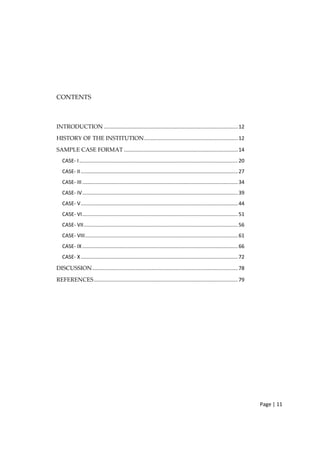
CONTENTS
INTRODUCTION.............................................................................................12
HISTORY OF THE INSTITUTION.................................................................12
SAMPLE CASE FORMAT ...............................................................................14
CASE‐ I..............................................................................................................20
CASE‐ II.............................................................................................................27
CASE‐ III............................................................................................................34
CASE‐ IV............................................................................................................39
CASE‐ V.............................................................................................................44
CASE‐ VI............................................................................................................51
CASE‐ VII...........................................................................................................56
CASE‐ VIII..........................................................................................................61
CASE‐ IX............................................................................................................66
CASE‐ X.............................................................................................................72
DISCUSSION.....................................................................................................78
REFERENCES....................................................................................................79
12.
Page | 12
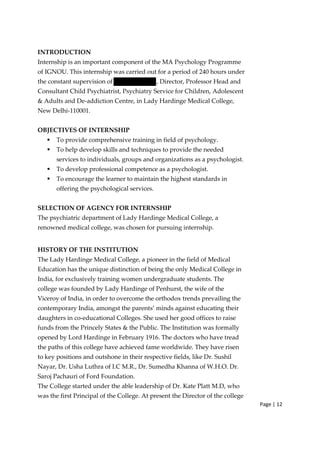
INTRODUCTION
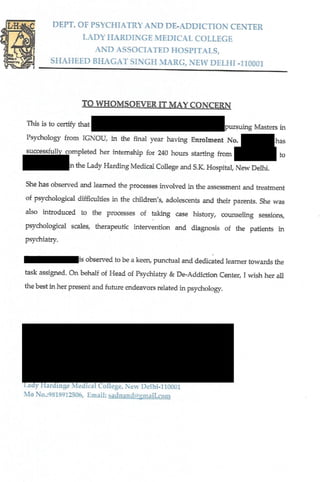
Internshipis an important component of the MA Psychology Programme
of IGNOU. This internship was carried out for a period of 240 hours under
the constant supervision of , Director, Professor Head and
Consultant Child Psychiatrist, Psychiatry Service for Children, Adolescent
& Adults and De‐addiction Centre, in Lady Hardinge Medical College,
New Delhi‐110001.
OBJECTIVES OF INTERNSHIP
ƒ To provide comprehensive training in field of psychology.
ƒ To help develop skills and techniques to provide the needed
services to individuals, groups and organizations as a psychologist.
ƒ To develop professional competence as a psychologist.
ƒ To encourage the learner to maintain the highest standards in
offering the psychological services.
SELECTION OF AGENCY FOR INTERNSHIP
The psychiatric department of Lady Hardinge Medical College, a
renowned medical college, was chosen for pursuing internship.
HISTORY OF THE INSTITUTION
The Lady Hardinge Medical College, a pioneer in the field of Medical
Education has the unique distinction of being the only Medical College in
India, for exclusively training women undergraduate students. The
college was founded by Lady Hardinge of Penhurst, the wife of the
Viceroy of India, in order to overcome the orthodox trends prevailing the
contemporary India, amongst the parents’ minds against educating their
daughters in co‐educational Colleges. She used her good offices to raise
funds from the Princely States & the Public. The Institution was formally
opened by Lord Hardinge in February 1916. The doctors who have tread
the paths of this college have achieved fame worldwide. They have risen
to key positions and outshone in their respective fields, like Dr. Sushil
Nayar, Dr. Usha Luthra of I.C M.R., Dr. Sumedha Khanna of W.H.O. Dr.
Saroj Pachauri of Ford Foundation.
The College started under the able leadership of Dr. Kate Platt M.D, who
was the first Principal of the College. At present the Director of the college
13.
Page | 13
isDr. G.K. Sharma.
The College has coma long way, retaining its unique character, still
marching ahead with the times and is upgrading itself dynamically in all
its fields of activities.
Since its inception, the institution has produced 6125 graduates and 2564
postgraduates in various medical and surgical specialities. The students
and faculty have constantly strived for academic excellence, state‐of‐the‐
art health care provision, and high quality research competing with the
best in the country. For the teaching and training of medical students, the
college has two full fledge hospitals‐ Smt. Sucheta Kriplani Hospital, and
Kalawati Saran Child Hospital with bed strength of 877 and 350
respectively. All the department of the hospitals are equipped with
modern facilities to provide tertiary level health care services to the people
of Delhi & adjoining areas. Since 1991 the hospital has been providing care
to the male clients also.
The Psychiatric Department is headed by , Director,
Professor Head and Consultant Child Psychiatrist, Psychiatry Service for
Children, Adolescent & Adults and De‐addiction Centre.
BRIEF DESCRIPTION OF THE INTERNSHIP
Internship under , Department of psychology, was started
from The internship included taking
whole case history of the patient as far as can be elicited with an aim to
arrive at the most probable causation and diagnosis of the disorder. The
cases taken by the interns were then described to the agency supervisor
for further suggestive investigations, pharmacological and therapeutic
interventions.
14.
Page | 14
SAMPLECASE FORMAT
Client’s Name‐
Date
Registration no‐
Age‐
Gender‐
Address‐
Educational qualifications‐
Occupation‐
Income‐
Marital status‐
Clients stay with parents‐
Stay with Spouses‐
Siblings, how many
Position in family‐ eldest/youngest/ middle/only child
Anyone in family suffered from mental disorder
Anyone in family suffered from physical disorder
Informant
• Relation‐
• Source of Referral‐
Presenting complaint (in words and as in sequence told by the client)
History of Present Illness‐
• Onset‐
• Treatment taken‐
• Got well any time in between, duration of such period
• Was there any precipitating factor at each relapse?
• How many relapse
• Any other treatment tried in between‐
• Effect of treatment‐
• Impact of illness on daily life‐
• Has to take leave from work place/ school/ college‐
• Cannot carry on routine work‐
15.
Page | 15
•Has to depend on others for everything‐
• Want to lie down and take rest‐
• Don’t want to do anything‐
• Others
Interview with family members
• Relationship‐
• Their view point‐
• In what ways illness caused inconvenience to them‐
• Educational history of client‐
• School / college‐
• How is academic performance‐
• Does client matches parents and teachers expectations‐
• How has the performance been over years?
• Any sudden deterioration in performance
• Any complaints received
• Has they done anything so far to correct it? What?
Past History
Family History
Mental status examination (except in coma and unconscious
clients/client with unknown language)
Presentation
Personal appearance
Social interaction with staff and others in waiting room
If someone accompanying and who
Personal grooming
Hygiene‐
If client dressed according to season appropriate
Talking to himself in waiting room
Pacing up/down the office floor
Rapport building
Appearance – if interested in self and grooming/ able to take care of self
Movement and behavior
16.
Page | 16
1.Gait
2. Posture
3. Coordination
4. Eye contact
5. Facial expressions
6. Walking / coordination problem if any
Affect
Over reaction / lack of response
Mood ‐clients answer‐ sad/ happy/ angry
Speech
Volume
Rate/speed
Length of answers
Appropriateness of answers
Clarity of answers
Thought content
Hallucinations
• Do you hear some voices telling you something to do?
• Do you hear some voices when no one present?
• Do you feel someone is talking about you and loudly saying
whatever u doing
Delusions
• Do you feel people are after you?
• Do you sometimes feel people are talking about you?
• Do you sometimes feel your phone is tapped
• Do you feel people are overhearing your conversation?
Dissociation
• What is your name
• Who are you?
• What work you do?
• Do you sometimes feel that you don’t know who you are?
Obsessions‐
• Any particular thought come into your mind again and again?
• Sometimes a strange idea or feeling comes in your mind, which is
not correct and how much you try the though don’t go off
• Any impulse to clean, wash hands, locks on doors repeated
17.
Page | 17
Thoughtprocess
• Irrelevant details
• Repeated words phrases
• Interrupted thinking
• illogical connections
Cognition
• Orientation – T/P/P
• Long term memory
• Short term memory
• Ability to perform a simple arithmetic task
• General intellectual level
• Ability to think abstractly
• Ability to name specified substances/ read / write complete
sentences
• Ability to understand and perform a task
• Ability to draw a simple map or copy a geometrical figure
• Inability to tell right left
Judgment – ask commonsense problem (as running out of a prescription
medicine, or find a sealed envelope on floor)
Insight – do you think you are ill?
• Any improvement with their efforts?
• When did they decide to consult a mental health specialist?
Work history
• Occupation
• Regular on work?
• Any complains of workplace? What?
• Any leaves? How long?
• Anytime reluctant to go to office?
• When was the time when client was reluctant?
• Reasons given by client for not attending work?
• Any complaint of performance?
• Client relationship with people in workplace
• Boss
• Colleagues
18.
Page | 18
•Subordinates
• Anyone bothering at workplace
Marital history
• Day to day dealings
• Sex life
• Work relationship (spouse is working if)
• Relationship with children
• Relationship with opposite sex
• Decision making
• Sharing of work at home
• Relationship with spouse’s relatives
• Relationship with spouse’s friends
• Answers to be in verbal language? How was client answering?
• Hesitant?
• Free communication?
• Evading any answer?
• Focusing on interview
• Diverted easily distracted
• Have the questions to be repeated no of times
• General demeanor of client
• Was client in hurry/ unwilling to continue interview
• Pause in certain questions
• Cooperative ready to answer
• Showing concern about his illness?
Summary
Provisional Diagnosis
Differential diagnosis
Suggested interventions
Page | 21
alongwith them. The complaints started after the Elder Brother got
married, a sum of 5 lac rupees was taken on Loan from a nearby Seth for
the marriage. But suddenly a change in behavior of the elder brother was
noted after marriage he started becoming aloof and stopped talking to the
other family members. The Money lender put pressure on the family for
getting his money back, but the elder brother showed no concern and
quarrels started happening between the client’s father and the elder
brother. The elder brother said that he won’t be giving any money and all
pressure came upon the client’s father, the client’s father a alcoholic
started getting more angry and everyday there were quarrels going on in
the house. The client is concerned about the pressure on the father and
gets scared from the fights which happen in the family. Though she was
closest to the elder brother she felt much neglected as the elder brother
stopped talking to her and her family properly after marriage. The client
said ` wo baat nai karte, seethe upar apne kamre mein chale jaten hai,
badal gaye hain’. She says ‘ab wo ghar mein paise bhi nai dete’. She says
‘bhabhi mana karti hai unhe baat karne se’, ‘bhabhi khud bhi theek se
baat nai karti, ‘ladai karati hai’
When enquired about the earning members it was elicited
• 1st sibling‐ the elder brother is doing Tent work. gets about 10,000
money per month.
• 2nd sibling sister is married
• 3rd
sibling sister ‐ who use to work has also left her work and is
now all day at home,
• 4th
sibling had joined some mobile shop, but goes on and off, so he
earns only when he goes
• She is the 5th
child
• And 6th sibling sister is in school in 12th class
Gradually the client started feeling very anxious and developed
palpitations. she said sone lagti hun to ghabrahat hoti hai , koi bhi awaaz a
jaye to darr lagta hai. Dimaag mein khayaal ate hain har waqt’. She is
thinking about how the financial condition could be stabilized how the
loan could be payed. She was taking tuitions for all subjects at home since
2 months from which she could just get a meager amount of 1350/‐. She
has her exams in June now and is now also tensed about her exams, she
said she had to fill her fees in college for giving exams but she gave the
22.
Page | 22
moneyto papa as they wanted it. She is very much anxious with the
financial constraint of the family. She is anxious about how her fees will
be filled and if she will be able to give the exams and if she will pass the
exams and her year is not spoiled.
She says ‘mummy sunti nai hai, mein bolti hun parr wo sunti nai hai’
The client is having tension and anxiety from any sudden noise, is crying
very often most of the times when alone, as she feels helpless. Her
Appetite is decreased, eats one chappati, she feels angry but is unable to
express it. The client hasn’t slept since 8 Days.
• Onset‐ 6 months back
• Treatment taken‐ No Treatment Taken
• Got well any time in between, duration of such period‐ No
• Was there any precipitating factor at each relapse? After the
marriage of Elder Brother (Financial Problems grew and brother
also became indifferent) Symptoms increase after quarrels at home
• Impact of illness on daily life‐ the client is not able to concentrate
on her studies, her exams is in June, but she is all time engrossed in
thoughts about the financial constraint
Interview with family members
• Relationship‐ Mother
• Educational history of client‐ Ist year student
• Their view point‐ The client thinks a lot due to which she could not
sleep, she hasn’t slept at all since 8 days, gets awake at night and
say she is anxious
• In what ways illness caused inconvenience to them‐ No
inconvenience but they are concerned as the client is not well
Past History‐ Nothing Significant
Family History
Father is a chronic alcoholic; else all family members are apparently
healthy.
23.
Page | 23
Mentalstatus examination
Presentation‐ Dressed in simple clothes as per season, hair groomed,
hygiene maintained
Personal appearance‐ Neat and Clean
Social interaction with staff and others in waiting room‐ Yes.
If someone accompanying and who‐ Brother and Mother
Talking to himself in waiting room‐ No, Sitting quietly
Pacing up/down the office floor‐ No
Rapport building‐ rapport was build by asking to sit comfortably and
relax. After the client was seated comfortably she was asked as per what is
the problem empathetically.
Appearance – if interested in self and grooming/ able to take care of self‐
Yes
Movement and behavior
7. Gait‐ Nothing abnormal detected
8. Posture‐ Nothing abnormal detected
9. Coordination‐ Present
10. Eye contact‐ Present
11. Facial expressions‐ Sad, anxious
12. Walking / coordination problem if any‐ No
Affect‐ Decreased response to whatever happening in the room
Mood ‐clients answer‐ Sad
Speech‐ Normal, no difficulty noted
Volume‐ Slow
Rate/speed‐ slow
Length of answers‐ neither too short nor too long.
Appropriateness of answers‐ Yes
Clarity of answers‐ Yes
Thought content‐ Positive
Hallucinations‐ No
Delusions‐ No
Dissociation‐ No
Obsessions‐ No
Thought process‐ No Irrelevant details, repeated words phrases,
interrupted thinking or illogical connections. Clear thought. But
interrupted thoughts due to concern about the family financial condition.
24.
Page | 24
Cognition
•Orientation – Well Oriented to Time/People and Place
• long term memory‐ Intact
• short term memory‐ Intact
• ability to perform a simple arithmetic task‐ Yes
• general intellectual level‐ Average
• ability to think abstractly‐ Yes
• ability to name specified substances/ read / write complete
sentences‐ Yes
• ability to understand and perform a task‐ Yes
• ability to draw a simple map or copy a geometrical figure‐ Yes
• inability to tell right left‐ Yes
Judgment – ask commonsense problem (as running out of a prescription
medicine, or find a sealed envelope on floor)‐ Yes
Insight – do you think you are ill‐ Yes
Work history
• Occupation‐ Taking tuitions for all subjects since 2 months
• Regular on work? Yes
• Any complains of workplace? What? She can’t concentrate on
teaching children
• Any leaves? How long? Yes , she is sometimes asking students to
come later, but she can’t do it always, as they will then stop the
tuitions , so the client is concerned
• Anytime reluctant to go to work? Yes, as she can’t concentrate and
also she have to study for her exams also
• When was the time when client was reluctant? Yesterday
• Reasons given by client for not attending work? she can’t
concentrate and also she have to study for her exams also
• Any complaint of performance? No
• Client relationship with people in workplace‐ Ok
• Anyone bothering at workplace No
Marital history‐ Unmarried
• Answers to be in verbal language? How was client answering? Yes
• Hesitant? No
25.
Page | 25
•Free communication? Yes
• Evading any answer? No
• Focusing on interview‐ No
• Diverted easily distracted‐ No
• Have the questions to be repeated no of times‐ No
• General demeanor of client‐ very laid back and tired, looking dull
• Was client in hurry/ unwilling to continue interview‐ No
• Pause in certain questions‐ Yes occasional.
• Cooperative ready to answer‐ Yes
• Showing concern about his illness? Yes
Summary
The client is a 18 year female suffering from anxiety and palpitation since
6 months. She is sleepless and all the time thinking about the financial
constraints because of which she can’t concentrate on her studies and
tuition students also. The anxiety and palpitations increase after any
episode of quarrel at home.
Provisional Diagnosis
Adjustment Disorder with Anxiety
Differential diagnosis
• Depressive disorders: Absence of sad, empty, or irritable mood,
ccompanied by somatic and cognitive changes that significantly affect
the individualʹs capacity to function.
• Post traumatic stress disorder: Absence of any trauma, or any
recurrent intrusive thoughts about any traumatic event, dissociative
reactions, flashblacks, avoidance to any stimuli associated with any
traumatic event.
• Personality Disorder: Absence of lifetime history of personality
functioning, vulnerability to distress, stressors may also exacerbate
personality disorder symptoms.
Suggested interventions
• Pharmacotherapy – Mood stabilizers were prescribed.
26.
Page | 26
•Cognitive behavior therapy‐ She was asked questions to increase her
cognitive thinking processes and again talked about her
responsibilities and courier and talked about to increase her thinking
process. She has been admitted, her mother is asked to bring her books
here so she can study here only. A time table was prepared for her to
follow( till she is in the In client department) so that she could
effectively manage her time in studies
• Deep Relaxation therapy‐ Including breathing exercises, focused
muscle tensing and progressive muscle relaxation techniques to
decrease anxiety and provide mental relaxation. A session of
Progressive muscle relation therapy was done with the client. By
asking her to close her eyes and try to relax the mind. She was asked to
take deep breaths. She was then asked to focus all her attention on the
left foot and to tighten it as much as possible, then she was asked to
relax it and similarly she was one by one asked to focus on different
parts of the whole body. After the session she feels little more at ease
and relaxed than before. She was asked to do the same exercise at
home before sleeping at night.
Follow Up
The client was admitted in In‐Client department to seclude her from the
home environment.
She has Slept last night after the medicine. But she is anxious and
palpitations occur at night. client complains of thoughts about home
coming in mind. She can’t concentrate on studies because of the thoughts.
She hasn’t done the relaxation exercise in the night. She is asked to do it
regularly.
Sleep has improved. She is less anxious now. Is doing the relaxation
exercise in night. She wants to go home and was discharged. A time table
has been prepared for her so that she can manage her time in home and
can spare as much time as possible for studying. She has been asked to
focus on her studies only and not to think very much and leave the big
decisions to elders.
Her mother and brother have been asked to be supportive to her.
27.
Page | 27
CASE‐II
Client’s Name‐
Date‐
Registration No‐
Age‐ 17 years
Sex‐ Female
Address‐
Educational qualifications‐ 1st year Student
Occupation‐ None, presently 1st
year Student
Marital status‐ Unmarried
Client stay with parents‐ Yes
Stay with Spouses‐ Not Applicable
Siblings, how many‐ 2 sisters and 2 brothers
Position in family‐ Fourth Child
Anyone in family suffered from mental disorder‐ Mother had a history of
maniac symptoms and was admitted 4 years back in lady Hardinge
medical hospital
Anyone in family suffered from physical disorder‐ Mother undergoing
treatment for arthritis and thyroid disorder.
Informant
Relation‐ Father
Source of Referral ‐ Self
Presenting complaint (As told by the informant)
• Not talking
• Gum sum rehti hai
• No Appetite
• Crying and laughing
Presenting complaint (As told by the client)
Client did not told any complaint so the informant was asked about what
happened and history was taken from the informant, then the client was
interrogated for more information.
28.
Page | 28
Historyof Present Illness‐
Client was apparently well 4 days back she was stressed and studying day
and night for exams, was not sleeping properly and taking her meals
properly, father concerned about the same scolded the client and slapped
the client once and didn’t talked with her for 2 days, since then the client
had stopped talking normally and is now less cheerful. She is eating less
and only when father feeds her, having vertigo and weakness and
insomnia.
Premorbid behaviour‐ cheerful and talkative.
The client says “I am mad” she refuses that she was scolded by her father.
Client is sitting quietly in a side.
• Date of onset of illness‐ 4 days back
• Treatment taken‐ Nothing
• Got well any time in between, duration of such period‐ No
• Was there any precipitating factor at each relapse? The client was
slapped and scolded by the father and also the father didn’t talked with
the client for 2 days (the client was most closest to the father and the father
had never scolded or talked with her in high tone)
• How many relapse‐ the problem is persisting since 2 days.
• Any other treatment tried in between‐ No treatment taken
• Effect of treatment‐ Not Applicable
• Impact of illness on daily life‐ The client had her exams coming and
now her study is getting affected.
• Has to take leave from work place/ school/ college‐ On a later follow up
it was seen that she dint appeared for her exams
• Cannot carry on routine work‐ Yes, earlier she was studying day and
night for exams, not eating properly but since the incident the client is
now quiet and sitting, not studying.
• Has to depend on others for everything‐ No
• Want to lie down and take rest‐ No
• Don’t want to do anything‐ No
• Others‐ She is now quiet and not talking. She is not as cheerful as
before.
Interview with family members
• Relationship‐ Father
29.
Page | 29
•Their view point‐ On questioning the father about the most probable
reason for her change of behavior the father said that it’s because of him
as he dint ever scolded the child and she has got a shock after he scolded,
slapped her and dint talked to her.
• In what ways illness caused inconvenience to them‐ the child is now
not as cheerful as before and also could not study, they are concerned if
her exams and studies will get affected.
• Educational history of client‐ College
• School / college‐ Government Girl Senior secondary school
• How is academic performance‐ Average (Getting 70% marks)
• Does client matches parents and teachers expectations‐ No
• How has the performance been over years? Average
• Any sudden deterioration in performance‐ Yes since 4 days is not able
to concentrate
• Any complaints received‐ Not gone to school after the incident
• Has they done anything so far to correct it? What? Brought to the
hospital for treatment and consultation.
• When did they decide to consult a mental health specialist? When after
2 days she wasn’t behaving normally.
Family History
All members are apparently well. Mother had a history of manic
symptoms 4 years back (started from 6‐7 days sleeplessness, headache,
laughing, talking, tearing clothes) for which treatment was taken from
lady Irwin medical college, and also taking treatment for Thyroid
disorder.
30.
Page | 30
Mentalstatus examination
Presentation‐ The client was well dressed and groomed suitable to the
occasion and season
Social interaction with staff and others in waiting room‐ Very less
interaction, talks only when asked something.
If someone accompanying and who‐ Father
Talking to himself in waiting room‐ No
Pacing up/down the office floor‐ No
Rapport building‐ Rapport was build with the clients by making her
comfortable by politely asking her about her complaints and daily life
and taking her outside for a casual walk so as to relieve her tension.
After this the client seems comfortable and was smiling and happy.
Appearance – if interested in self and grooming/ able to take care of self‐
Yes.
Movement and behavior
1. Gait‐ Body very stiff, very stiffness seems on walking; client seemed
much tensed and was not able to relax.
2. Posture‐ Stooped shoulders while walking
3. Coordination‐ Proper and intact
4. Eye contact‐ Intact
5. Facial expressions‐ Decreased facial expression
6. Walking / coordination problem if any‐ No
Affect‐ Decreased, low sad mood, Blankness of face
Mood ‐clients answer‐ Blank expression
Speech‐ decreased
Volume‐ Low
Rate/speed‐ Low
Length of answers‐ Short
Appropriateness of answers‐ Yes
Clarity of answers‐ Yes
Thought content‐ Present, but slow, takes time to answer
Hallucinations‐ No
Delusions‐ No
Dissociation‐ No
Obsessions‐ No
Thought process‐ Normal, no intrusive thoughts.
31.
Page | 31
Cognition
•Orientation – Well oriented to Time/People/Place
• Long term memory‐ Intact
• Short term memory‐ Intact
• Ability to perform a simple arithmetic task‐ Intact
• General intellectual level‐ Intact
• Ability to name specified substances/ read / write complete
sentences‐ Intact
• Ability to understand and perform a task‐ Intact, but slow++
• Ability to draw a simple map or copy a geometrical figure‐ Intact
• Inability to tell right left‐ Intact
Judgment‐ Present
Insight – Do you think you are ill? Not clear
Marital History: Unmarried
Work History: Not Applicable as student
• Answers to be in verbal language? How was client answering?
Yes
• Hesitant? No
• Free communication? Yes
• Evading any answer? No
• Focusing on interview‐ Yes
• Diverted easily distracted No
• Have the questions to be repeated no of times? Yes sometimes
• General demeanor of client‐ Lack of emotions and response
• Was client in hurry/ unwilling to continue interview‐ No
• Pause in certain questions‐ Yes, the client was asked to write her
name in different languages she wrote in English and Hindi and
when asked to write in Urdu which is also one of her subjects and
in which she is getting good marks in the subject, she suddenly
paused and said slowly no she don’t know how to write in Urdu.
She wanted to join Zakir Husain College, ( An Urdu Medium
School) but when asked to write Urdu she says she don’t know. On
insisting by mother she wrote her name lastly.
32.
Page | 32
•Cooperative ready to answer‐ Yes
• Showing concern about his illness? No
Summary
The client is a 17 year old female enrolled in 1st
year of college, who was
approaching exams. Due to her high expectations she was stressed a lot
and busy studying day and night for exams, not sleeping or eating
properly because of which father scolded and slapped by her. But since
then she has developed sudden change in behavior from premorbid
cheerful personality to now remaining quiet and aloof and not sleeping at
all.
Provisional Diagnosis
Adjustment Disorder
Differential Diagnosis
• Depressive disorders: Absence of sad, empty, or irritable mood,
ccompanied by somatic and cognitive changes that significantly affect
the individualʹs capacity to function.
• Post traumatic stress disorder: Absence of any recurrent intrusive
thoughts about any traumatic event, dissociative reactions,
flashblacks, avoidance to any stimuli associated with any traumatic
event.
• Personality Disorder: Absence of lifetime history of personality
functioning, vulnerability to distress, stressors may also exacerbate
personality disorder symptoms.
Interventions Done
• Pharmacotherapy – Mood stabilizers were prescribed.
• Cognitive behavior therapy‐ She was asked questions to increase her
cognitive thinking processes and again talked about her
responsibilities and courier and talked about to increase her thinking
process.
33.
Page | 33
•Deep Relaxation therapy‐ Including breathing exercises, focused
muscle tensing and progressive muscle relaxation techniques to
decrease anxiety and provide mental relaxation. A session of
Progressive muscle relation therapy was done with the client. By
asking her to close her eyes and try to relax the mind. She was asked to
take deep breaths. She was then asked to focus all her attention on the
left foot and to tighten it as much as possible, then she was asked to
relax it and similarly she was one by one asked to focus on different
parts of the whole body. After the session she feels little more at ease
and relaxed than before. She was asked to do the same exercise at
home before sleeping at night.
Follow up
The client seems better and cheerfulness has increased. The client has not
given the exams and is saying she will give exams after 2 months after full
preparation. She is positive and ambitious about her marks.
34.
Page | 34
CASE‐III
Client’s Name‐
Date‐
Registration no‐
Age‐ 7 years
Gender‐ Female
Address‐
Educational qualifications‐ Not gone to school
Marital status‐ Unmarried
Client stay with parents‐ Yes
Stay with Spouses‐ No
Siblings, how many‐ 1 elder brother (11 years) and 1 sister (7 years)
Position in family‐ eldest/youngest/ middle/only child‐ Younger
Anyone in family suffered from mental disorder‐ No
Anyone in family suffered from physical disorder‐ No
Informant
Relation‐ Mother
Source of Referral ‐ Relatives
Presenting complaint (in words and as in sequence told by the client)
• Paper khati hai
• Kehna nai manti
• Paglon ki tarah rehti hai
History of Present Illness‐
Client was a full term normal vaginal delivery, with birth cry present,
birth weight – 2.5 kg.
The child was increasingly active since birth, don’t use to listen or obey.
In class don’t use to do work, tears paper, writing on it, gets 10‐15 out of
20.the client’s behavior is full of anger, shouting, when mother sleeping
she do mischief, takes creams violini and lips. The client don’t play with
other children, use of hits other children, say to others that her mother hits
her. Dresses like teacher. Plucking of hairs (Alopecia due to
35.
Page | 35
trichotillomania).The complaints increase in summer weather. Sleep good
(10 pm‐ 9am) eats papers since 1‐2 Days.
• Date of onset of illness‐ since childhood.
• Treatment taken‐ No treatment taken so far
• Got well any time in between, duration of such period‐ N/A
• Has to take leave from work place/ school/ college‐ N/A
• Cannot carry on routine work‐ Yes
• Has to depend on others for everything‐ No
• Want to lie down and take rest‐ Yes
Interview with family members
• Relationship‐ Mother
• Educational history of client‐ KG class
• School / college‐ GRM Public Senior secondary School
• How is academic performance ‐ Average, 10‐15 out of 20
• Does client matches parents and teachers expectations‐ Yes
• How has the performance been over years? In KG Class
• Any sudden deterioration in performance‐ No
• Any complaints received‐ Hits other children in class, doesn’t
Sits/stay at one place.
• Has they done anything so far to correct it? What? No
• When did they decide to consult a mental health specialist? When
someone told her to come here and take treatment from here.
Past History‐ Nothing Significant
Family History‐ No history of any mental/ Physical disorder in family. All
apparently healthy and alive
Mental status examination
Presentation‐ The client is well oriented, friendly, and well‐groomed,
under shirt visible and is over the dress. A hairless patch noted on the
scalp. Dressed as per the season. Hygiene maintained.
Social interaction with staff and others in waiting room‐ Greeting the staff.
Greeting all the interns she knew as ‘ Hi didi’ ‘Hi didi’
36.
Page | 36
Ifsomeone accompanying and who‐ Mother
Talking to himself in waiting room‐ No
Pacing up/down the office floor‐ Yes, running all over the place, not
sitting for long at one place.
Rapport building‐ Rapport was build by greeting the client and asking her
some basic questions about herself.
Appearance – if interested in self and grooming/ able to take care of self‐
Yes
Movement and behavior
13. Gait‐ Nothing abnormal Detected
14. Posture‐ Nothing abnormal Detected
15. Coordination‐ Nothing abnormal Detected
16. Eye contact‐ Present
17. Facial expressions‐ as if getting bored.
18. Walking / coordination problem if any‐ No
Affect‐ Elated mood
Mood‐ Happy
Speech‐ Can’t pronounce words from `La’ and `ra’, Language articulation
Problem
Volume‐ High
Rate/speed‐ Normal
Length of answers‐ Short
Appropriateness of answers‐ Yes
Clarity of answers‐ Unclear
Thought content‐ Clear, Normal, Listening, Obeying, understands the
situation, no Intrusive thoughts
Hallucinations‐ No
Delusions‐ No
Dissociation‐ No
Obsessions‐ No
Thought process‐ Clear
• Irrelevant details‐ No
• Repeated words phrases‐ No
• Interrupted thinking‐ No
• illogical connections‐ No
37.
Page | 37
Cognition
•Orientation – Well oriented to time, people and place
• Long term memory‐ Intact
• Short term memory‐ Intact
• Ability to perform a simple arithmetic task‐ Yes
• General intellectual level‐ Average
• Ability to think abstractly‐ Yes
• Ability to name specified substances/ read / write complete
sentences‐ Yes, can name sentences, can’t write full sentences, can
write basic alphabets and numbers. Macrographia, writing big.
• Ability to understand and perform a task‐ Yes
• Ability to draw a simple map or copy a geometrical figure‐ Yes
• Inability to tell right left‐ Yes
Judgment and Insight– Present as per age
Work history‐ Not applicable
Marital history‐ Not applicable
• Answers to be in verbal language? How was client answering? Yes
• Hesitant? No
• Free communication? Yes
• Evading any answer? No
• Focusing on interview‐ Yes, but easily distracted
• Diverted easily distracted‐ yes
• Have the questions to be repeated no of times‐ No
• General demeanor of client‐
• Was client in hurry/ unwilling to continue interview‐ No
• Pause in certain questions‐ No
• Cooperative ready to answer‐ Yes
• Showing concern about his illness? No
38.
Page | 38
Summary
Clientis a 7 year old female child with hyperactive behaviour and
tendency to pluck the hair which has lead to a Hairless patch on the scalp.
Provisional Diagnosis
Attention deficit Hyperactivity disorder with trichotillomania
Differential diagnosis
• Oppositional defiant disorder: Absence of any negativity, hostility,
and defiance. No resistance to tasks given is observed
• Specific Learning Disorder: No serious concern noted in learning and
using acaedemic skills.
• Reactive attachment disorder: Absence of inhibited, emotionally
withdrawn behavior toward adult caregivers. High social and
emotional responsiveness to others.Good history of caregiving.
Suggested interventions
• Pharmacotherapy‐ To Decrease Hyperactivity
• Family therapy‐ To increase family support
• Behavior modification therapy‐ To increase wanted behavior and
decrease unwanted behavior.
39.
Page | 39
CASE‐IV
Client’s Name‐
Date‐
Registration no‐
Age‐ 12 Years
Gender‐ Male Child
Address‐
Educational qualifications‐ 3rd
Standard
Occupation‐ Student ‐
Marital status‐ Unmarried
Clients stay with parents‐ Yes
Stay with Spouses‐ No
Siblings, how many‐ One Younger brother
Position in family‐ Elder Child
Anyone in family suffered from mental disorder‐ No
Anyone in family suffered from physical disorder‐ grandfather paralyzed
at 60 years, Clients maternal uncle had history of seizures.
Informant
Relation‐ Father
Source of Referral‐ Relatives
Presenting complaint (in words and as in sequence told by the Father)
• Dimaag mein kami hai
• Jhooth bolta hai
• Khana nai khata, Kamzor hai
History of Present Illness‐
The client was born as a full term normal vaginal delivery at home, Birth
cry positive, Birth weight‐ 750 g (Pauna kilo). The mother had weakness in
extremities, Body ache, Heaviness from beginning of 2nd trimester. There
were financial strains and tensions during pregnancy as no one was
working then. The child was admitted 12 hours after birth due to fits, for
which he was treated for 22 days in the ICU. Then he was brought home,
where he developed diarrhea, vomiting. For which again allopathic
treatment was started and it got well. The client had his milestones on
40.
Page | 40
time.The client is now 20 Kg. Schooling since 3‐4 years, the child is very
notorious in school doesn’t do work at school.
• Date of onset of illness‐ Subnormal intelligence noted since he
started going school
• Treatment taken‐ No Treatment taken
• Has to take leave from work place/ school/ college‐ No
• Cannot carry on routine work‐ Can do routine work.
• Has to depend on others for everything‐ No
• Want to lie down and take rest‐ No
Interview with family members
• Relationship‐ Father
• Educational history of client‐ attended school till 3rd class
• School / college‐ Going to school, but poor performance
• How is academic performance ‐ Poor
• Does client matches parents and teachers expectations‐ No
• How has the performance been over years? Not improved
• Any sudden deterioration in performance‐ No, Bad from starting
• Any complaints received‐ Yes, don’t study, roams in the class
• Has they done anything so far to correct it? What? No
• Any improvement with their efforts? No
• When did they decide to consult a mental health specialist?
• Their view point‐ As per the father the child is very weak in
studies, can’t study as a normal child, and is very dull.
• In what ways illness caused inconvenience to them‐ No such
inconvenience as such but they are just concerned about the child’
intellect and his future, what will he do, if he will be dull.
Past History‐ Client born as underweight child.
Family History‐ All apparently well
Mental status examination
Presentation‐ Poor Hygiene, dressed well as per the season but looking
dirty, Infective itching rash over face and neck. Personal appearance‐ dirty
Social interaction with staff and others in waiting room‐ present
41.
Page | 41
Ifsomeone accompanying and who‐ father
Personal grooming‐ hair nicely groomed
Talking to himself in waiting room‐ No
Pacing up/down the office floor‐ No
Rapport building‐ rapport was build by making the client sit comfortably
and asking the client his name and what does he do.
Appearance – if interested in self and grooming/ able to take care of self‐
Less interested
Movement and behavior
19. Gait‐ Nothing Abnormal detected
20. Posture‐ Nothing Abnormal detected
21. Coordination‐ Intact
22. Eye contact‐ Intact
23. Facial expressions‐ Nothing Abnormal detected
24. Walking / coordination problem if any‐ No
Affect and Mood‐ Normal neither too happy nor sad
Speech‐ No speaking difficulty, normal speech but repeating end of
questions.
Volume‐ Low
Rate/speed‐ Normal
Length of answers‐ short but appropriate length
Appropriateness of answers‐ Yes
Clarity of answers‐ Yes
Thought content‐ Normal, No Intrusive thoughts
Hallucinations‐ No
Delusions‐ No
Dissociation‐ No
Obsessions‐ No
Thought process‐ Slow
• Irrelevant details ‐ Absent
• Repeated words phrases‐ Thinks and repeats questions, repeating
end of questions like when asked to tell a story he said kahani
sunaun, kahani sunaun, when as what does he like to eat ~ he said
`mujhe lagta hai, lagta hai’
• Interrupted thinking‐ No, Absent
• Illogical connections‐ No
42.
Page | 42
Cognition
•Orientation – Client well oriented to people, place and time
• Long term memory‐ Intact
• Short term memory‐ Intact
• Ability to perform a simple arithmetic task‐ No
• General intellectual level‐ Below Normal
• Ability to think abstractly‐ No
• Ability to name specified substances/ read / write complete
sentences‐ Decrease intellect can write words or sentences
• Ability to understand and perform a task‐ yes, verbal tasks
• Ability to draw a simple map or copy a geometrical figure‐ yes can
draw a circle
• Inability to tell right left‐ Yes
Judgment –Intact
Insight –Intact
Work history‐ None
Marital history‐ Unmarried
• Answers to be in verbal language? How was client answering? Yes
• Hesitant? ‐ No
• Free communication? Yes
• Evading any answer? No
• Focusing on interview‐ Yes
• Diverted easily distracted‐ No
• Have the questions to be repeated no of times‐ No
• General demeanor of client‐ slow
• Was client in hurry/ unwilling to continue interview‐ No
• Pause in certain questions‐ Yes in all questions requiring thinking
• Cooperative ready to answer‐ Yes
Summary
The client is a 12 year male child with decrease scholastic performance as
per his age.
43.
Page | 43
ProvisionalDiagnosis
Mild Mental Retardation
Differential diagnosis
Autism: Presence of Eye Contact, Good Social Skills, Absence of No
Repitative Behaviour.
Suggested interventions
• Behaviour Therapy‐ To encourage the child to learn and increase
his self confidence
• Family Therapy‐ To increase family support to the child, telling the
parents not to punish the child but in turn encouraging him to do
work and complimenting him on his works to increase self
confidence
44.
Page | 44
CASE‐V
Client’s Name‐
Date‐
Registration no‐
Age‐ 21 years
Gender‐ Female
Address‐
Educational qualifications‐ studied till 5th
standard
Occupation‐ None
Source of Income‐ Brother – Tikki Wala Shop
Marital status‐ Divorced
Clients stay with parents‐ Yes with Mother and Elder brother
Stay with Spouses‐ No
Siblings, how many‐ 2 Sisters and 1 elder brother
Position in family‐ Youngest‐ 4th Child
Anyone in family suffered from mental disorder‐ No
Anyone in family suffered from physical disorder‐ Clients father chronic
alcoholic died from paralytic attack
Informant
Relation‐ Mother and Brother
Source of Referral‐ Relatives
Presenting complaint (in words and as in sequence told by the client)
• Paglon ki tarah rehti hai, Khud se bolti hai
• Iske peeche jin padha hai
History of Present Illness‐
The client was married on 8th
July 2010, but she returned a week after to
her parent’s family as her husband was a criminal and was put in jail. She
had her divorce in 26th July 2011.
Her 3rd Sibling (sister) was married in 5th december2005, and got a child
after 4 years of marriage. She is very close to her jija and obeys his every
wish. Also the jija (who has a shop of Bidi, cigarette) gets angry and use to
45.
Page | 45
beathis didi also because of which her didi also now obeys whatever he
says.
The client was forcefully brought to the hospital for admittion, she created
a fuss in the waiting section where she got on the floor and was crying
very loudly in a knee elbow position.
On taking the case from the mother her mother said that ‘ye apne jija ki
baat itni maanti hai ki agar abhi wo phone karke bula le to bhaag ke unke
pass chali jaegi’.
On enquiry more about the history from the mother she told that the client
was staying with her 3rd
sibling (sister) after the birth of their child. There
only after some time, she had injured her leg for which her sister and jija
took her for treatment. As per the sister told the mother ‘ilaaz karva ke a
rhe the to railway ki patri pe gir gyi thi jahan se jin iske peeche lag gya’.
Since then the client started behaving abnormally, use to develop trance
like states? In which she use to scream a lot, after the state it was found
that her clothes use to be torn, also near her neck and chest, and she had
scratch marks over her body, face, chest, after every episode. She use to
scream and tell in altered voice reflecting that there is a male possessing
her body and he says he is possessing her as she looks like just his wife
and he needs her body and would not leave her. She got bed ridden and
use to cry all time. The client’s mother on seeing the day by day
deteriorating condition of the mother brought her to her own home. On
some relatives consultation she was taking the client to a dargah, on way
the client was speaking in altered voice and asking them not to take her to
the mosque there she was made to drink some holy water and some oil
was put in her ear. On returning from there client could not use her legs
and walk at all, the client said in an abnormal voice that because she was
taken to the mosque now the Jin had done this. Later she was taken to a
pooja where before going only the client stopped talking and it was said
that the jin is doing this, afraid from this the family members brought her
back to home. Since then the client is at home only and getting the
episodes of possessions, she is not talking else when she has an act of
possession. During the time of admission in IPD she was very reluctant
and doing tantrums and saying again and again to take her back. She was
saying no one could treat her. No doctor could treat her.
• Date of onset of illness‐ 6 months back
46.
Page | 46
•Treatment taken‐ No medical treatment taken
• Got well any time in between, duration of such period‐ No
• Was there any precipitating factor at each relapse? The illness is
continuing since 6 months, not got well in between but the
symptoms worsen whenever any type of treatment is thought to
start.
• Any other treatment tried in between‐ the client had been taken to a
dargah but after that client stopped using her lower limbs and after
she was taken to a pooja she stopped talking, now only talks when
the possession attacks comes.
• Effect of treatment‐ conditioned worsened because of no proper
medical treatment given.
• Impact of illness on daily life‐ she is not leading a normal life, is
bedridden and just lies on bed.
• Cannot carry on routine work‐ the client not doing any work, just
lying on the bed, the mother only looks after her, the client
indicates whenever there is any urge to urine or stool and mother
takes her. Has to depend on others for her care, want to lie down
and take rest.
Interview with family members
• Relationship ‐ Mother
• Educational history of client‐ studied till 5th standard
• Family members (Mother, brother and sister) are very much
stressed and worried about the client and want her to get ready.
The financial condition of the family is also not good.
• Their view point – On asking the mother she said that she suspects
the 3rd
sibling sister and her husband had done this to hide their
some wrong work, they had done something wrong with the client
and to hide that they had done made her eat something or done
something. Mother strongly suspects some connection of the jija
with the client’s illness as jija is not a good person. She wants to
keep the daughter away from them as the sister and jija may come
and tell the client not to take the treatment and the client will stop
the treatment immediately.
47.
Page | 47
•In what ways illness caused inconvenience to them‐ the brother’s
and mother’s work had been affected a lot because of the client’s
illness. There is financial strain due to it as they had to give their
time to look after the client.
Past History‐
Injury of leg – fall from stairs when in sister’s house – 6 months back
Fall on railway line‐ Injury on Head and back – 6 months back
Family History
Father was chronic alcoholic, got a paralytic attack in 2006, and was taken
to DDU and RML for treatment, died in December 2012.
All others apparently well and no other family history of mental/Physical
illness can be elicited.
Mental status examination
Presentation‐ Dressed in clothes as per the season hair, dry, rough and
uncombed, the client tored her dress after the attack in the OPD after
which she was admitted.
Appearance – Not interested in self and grooming
Social interaction with staff and others in waiting room‐ Absent
If someone accompanying and who‐ Mother, Brother and 2nd sibling
(sister)
Talking to himself in waiting room‐ client made a chaos in the waiting
room where she got on the floor and was crying very loudly in a knee
elbow position. She wasn’t moving there at all, was very stiff and wanted
to go home.
Pacing up/down the office floor‐ No
Rapport building‐ Could not be achieved as the client didn’t want to be
treated and admitted.
Movement and behavior
25. Gait‐ Not Walking
26. Posture‐ Stiff lying in knee‐elbow position
27. Coordination‐ Present
28. Eye contact‐ Present
29. Facial expressions‐ Of Anger alternating with crying
30. Walking / coordination problem if any‐ Not Walking
48.
Page | 48
Affect‐Over reaction
Mood ‐Client’s answer‐ anger alternating with crying spells
Speech‐ No difficulty in speech could be elicited when the client is crying
as she speaks then.
Volume‐ High
Rate/speed‐ Normal
Length of answers‐ Neither too long nor too short
Appropriateness of answers‐ Yes sometimes she answers as when we
respond to what she is screaming. Else she don’t answers and is busy
screaming ‘ le chalo’ ‘Le chalo yahan se’
Clarity of answers‐ yes
Thought content‐ ok
Hallucinations‐ Client not answering to questions
Delusions‐ Client not answering to questions, No as per the mother.
Dissociation‐ Client not answering to questions
Obsessions‐ Client not answering to questions
Thought process‐ Client not answering to questions
• Irrelevant details‐ No
• Repeated words phrases‐ repeating ‘le chalo’ ‘yahan se le chalo’
• Interrupted thinking‐ No
• illogical connections‐ No
Cognition
• orientation – client is well oriented to Time/People/Place
• long term memory‐ Could not be elicited
• short term memory‐ Could not be elicited
• ability to perform a simple arithmetic task‐ Could not be elicited
• general intellectual level‐ Could not be elicited, looks average
intelligence, as sometime after when we left the client she came out
of her room on floor and when it was tried to take her back, she
knew how to get her feet entangled in the furniture so as to resist,
once the leg was freed in the next bed she again tangled her leg.
• ability to name specified substances/ read / write complete
sentences‐ Could not be elicited
• ability to understand and perform a task‐ No
• ability to draw a simple map or copy a geometrical figure‐ Could
not be elicited
49.
Page | 49
•inability to tell right left‐ Could not be elicited
Judgment – Could not be elicited
Insight – do you think you are ill? She says that her illness can’t be treated
by any doctor
Work history‐ N/A as client not working
Marital history‐ Divorced from husband 4 years back and husband did
not tried to contact after that, the husband was in jail, she left the husband
1 week after the marriage
• Answers to be in verbal language? How was client answering? Yes
sometimes
• Hesitant? No
• Free communication? Yes
• Focusing on interview‐ No
• Diverted easily distracted‐ Yes
• Have the questions to be repeated no of times‐ Yes
• General demeanor of client‐ lying on bed crying
• Was client in hurry/ unwilling to continue interview‐ yes very
much unwilling to take treatment also
• Pause in certain questions; No
• Cooperative ready to answer‐ No
• Showing concern about his illness?‐ No
Summary
The client is a 21 year female, suffering from loss of sense of reality, she
has been presenting with attacks as if a male spirit has possessed her body
during which she screams, gets marks on her body (Face, chest), clothes
gets tored. She is behaving madly and don’t want to get treated.
Provisional Diagnosis
Dissociative disorder
Differential Diagnosis
50.
Page | 50
•Schizophrenia – Absence of any do not have delusional
explanations for the phenomena in a personified way
Suggested interventions
• Pharmacotherapy – To decrease clients restlessness and dissociative
symptoms
• Family counseling ‐ To tell them that the client’s condition is a
medical disorder and needs a proper medical treatment with
compliance and they should have patience and should cooperate in
the treatment
• Behaviour modification therapy‐ To increase positive wanted
behavior and decrease unwanted behavior
51.
Page | 51
CASE‐VI
Client’s Name‐
Date‐
Registration no‐
Age‐ 21 Years
Gender‐ Male
Address‐
Educational qualifications‐ Not Gone to School
Marital status‐ Unmarried
Clients stay with parents‐ Yes
Stay with Spouses‐ N/A
Siblings, how many‐ One elder brother
Position in family‐ Younger brother
Anyone in family suffered from mental disorder‐ No
Anyone in family suffered from physical disorder‐ No
Informant
Relation‐ Mother
Source of Referral‐ Family
Presenting complaint (in words and as in sequence told by the Mother)
• Dara hua hai
• Teen din se soya nai
• Idhar udhar dekhta rehta hai, ek dum dar jata hai
History of Present Illness‐
• Onset‐ 3 days back
• Treatment taken‐ In the past for seizures from Lady Hardinge
Medical college
• Got well any time in between, duration of such period‐ Yes with
medication
• Was there any precipitating factor at each relapse?
The client is a known case of cerebral palsy with seizure disorder,
he had gone to a wedding and was returning in the night train, it
was a 24 hour journey and the door of the train was making sound
all night due to which he could not sleep and was whole night
52.
Page | 52
wakingand seeing at the door. Since then after coming home he is
crying, not sleeping and is afraid.
• Any other treatment tried in between is taking treatment since
childhood for seizures. Had undergone multiple tendon
(Hamstring and Obturator) release operations for the stiffness,
involuntary urination.
• Effect of treatment‐ Seizures have decreased now and the client
now understand things and interact with others
• Impact of illness on daily life‐ Is not able to go to school or do any
work on his own. Cannot carry the routine works, has to be
assisted to toilet as cant stand and walk properly. Has to depend on
others.
Interview with family members
• Relationship‐ Mother
• Educational history of client‐ not gone to school
• School / college‐ N/A
• As per the family members the child got afraid while returning in
the train.
• In what ways illness caused inconvenience to them‐ the client is
leading a dependent life, he needs an assistance to do things.
Past History
History of similar episode in 2009
Family History
All Family members are apparently healthy, No History of Physical,
mental or any similar illness can be elicited.
Mental status examination
Presentation‐ Client is of an obese built, well dressed as per the season in a
wheelchair and was having increased salivation
If someone accompanying and who‐ Mother and Brother
Social interaction with staff and others in waiting room‐ Decreased
Talking to himself in waiting room‐ No
53.
Page | 53
Pacingup/down the office floor‐ No
Rapport building‐ Rapport was tried to build by asking the basic details
from the client and taking his name.
If interested in self and grooming/ able to take care of self‐ Yes a little
Movement and behavior
31. Gait‐ can walk only with support
32. Posture‐ sitting bending sideways in the wheelchair
33. Coordination‐ Not present
34. Eye contact‐ Not present
35. Facial expressions‐ Anxious with wrinkles on forehead and mouth
drawn open
36. Walking / coordination problem if any‐ Can walk only with
support
Affect‐ Client was looking anxious and afraid, over reaction to stimulus
Mood‐ Sad
Speech‐ Slurred speech, Volume‐ high, Rate/speed‐ slow
Length of answers‐ Short
Appropriateness of answers‐ Yes
Clarity of answers‐ Yes
Thought content‐ Decreased
Hallucinations‐ No
Delusions‐ No
Dissociation‐ No
Obsessions‐ No
Thought process‐ Diminished
Cognition
• Orientation – Oriented to people and place
• Long term memory‐ Intact
• Short term memory‐ Intact
• Ability to perform a simple arithmetic task‐ Can’t be done
• General intellectual level‐ Subnormal
• Ability to think abstractly‐ No
• Ability to name specified substances/ read / write complete
sentences‐ No, can’t write
• Ability to understand and perform a task‐ only tasks which can be
done sitting and not involving high intellect
54.
Page | 54
•Ability to draw a simple map or copy a geometrical figure‐ No,
grasping not there, can’t hold pen, pencil
• Inability to tell right left‐ No
Judgment – Not present
Insight – Not Present
• Answers to be in verbal language? How was client answering? Yes
• Hesitant? No
• Free communication? No as client can’t speak properly
• Evading any answer? No
• Focusing on interview ‐ No , client was anxious and looking here
and there
• Diverted easily distracted‐ Yes
• Have the questions to be repeated no of times‐ Yes
• General demeanor of client‐ Sitting in wheelchair, anxious, bending
on left side, Mouth open
• Was client in hurry/ unwilling to continue interview‐ No
• Pause in certain questions‐ No
• Cooperative ready to answer‐ Yes
• Showing concern about his illness? No
Work History‐ None
Marital History‐ Not Applicable as unmarried
Summary
The client is a 21 year old male child presenting with fear and anxiety
since returning from a 24 hour train journey in a train. As per the
informant the journey was in the night and the door of the train cabin was
loose and making a lot of noise the whole night due to which the patien
could not sleep and since then he is very afraid, not speaking and
interacting as before.
55.
Page | 55
ProvisionalDiagnosis
Cerebral Palsy with Phobia
Differential diagnosis
Autism – Autism is not present as the client has good social skills and
responsive behavious, no history of repitative bahviour could be elicited.
Suggested interventions
• Pharmacotherapy – To decrease anxiety
• Family therapy ‐ To increase family support and Interaction
• Speech therapy – To make speech more clear
• Occupational Therapy‐ For managing cerebral palsy so that client
can engage in some work and do something creative.
57.
Page | 57
•Got well any time in between, duration of such period‐ No
• Was there any precipitating factor at each relapse? Nothing could
be elicited by clients history
• Effect of treatment‐ with the previous treatment she had increased
somnolence.
• Impact of illness on daily life‐ she is not able to take care of herself,
keep hygiene properly because of which the mother also cut her
hairs short as she could not take care of it. The client is not going to
school since 1st standard
• Has to take leave from work place/ school/ college‐ Yes she could
not attend the school
• Cannot carry on routine work‐ Yes
• Has to depend on others for everything‐ No
• Want to lie down and take rest‐ Yes
• Don’t want to do anything‐ Yes
Interview with family members‐
• Relationship‐ Mother
• Educational history of client‐ studied till 1st
standard
• How is academic performance ‐ Was not good in studies
• Does client matches parents and teachers expectations‐ No
• Their view point‐ she is mad.
On talking with the mother it was noted that she had many bruises
and injury on her body, when asked she told it’s all because of the
client. The client come s suddenly from behind when the mother is
resting or doing some work and tightly holds her, bites her and
then go away after biting. Client is disruptive, Moody, doesn’t obey
anything, does whatever she want to do, goes out to roam, wander
on streets, bring things from street vendors without paying for it
• In what ways illness caused inconvenience to them‐ the child is
causing distress to the mother as she has to take care of her whole
time and also the client bites her because of which there were many
injuries over the body.
58.
Page | 58
FamilyHistory: The client’s cousin had similar symptoms
Mental status examination
Presentation‐ Dressed like a boy in trouser and shirt and boy cut hairs
Personal appearance‐ Neat, Well dressed as per the season, thin and tall
female
If interested in self and grooming/ able to take care of self‐ Yes
Social interaction with staff and others in waiting room‐ No interaction
with others.
If someone accompanying and who‐ Mother
Talking to himself in waiting room‐ Yes, screaming “ Bhagwann” “
Bhagwaan” while waiting and then laughing inappropriately. Singing
songs changing it and inducing words like pagal in the song
Pacing up/down the office floor‐ Sits for sometime, then goes out of the
room then comes back
Rapport building‐ Could not be achieved, Client not cooperative
Movement and behavior
37. Gait‐ Nothing abnormal detected
38. Posture‐ Nothing abnormal detected
39. Coordination‐ Nothing abnormal detected
40. Eye contact‐ Present
41. Facial expressions‐ Notorious, smiling, as if will do something
mischievous
42. Walking / coordination problem if any‐ No
Affect‐ Over reaction, shouting words.
Mood ‐clients answer‐ Elevated
Speech‐ loud speech, High Volume, normal Rate,
Length of answers‐ Unco‐operative client
Appropriateness of answers‐ Unco‐operative client
Clarity of answers‐ Unco‐operative client
Thought content‐ Unco‐operative client, singing songs including god and
abusive language
Hallucinations‐ Unco‐operative client
Delusions‐ Absent
Dissociation‐ Absent
Obsessions‐ Nothing as such
59.
Page | 59
Thoughtprocess
• Irrelevant details – answers inappropriately, singing
inappropriately, Shouting “pagal” word again and again and
singing bhagwaan bhagwaan and including the word pagal in the
songs also. laughing inappropriately
• Repeated words phrases‐ repeating work pagal and Bhagwann
with herself
Cognition
• Orientation‐ Oriented to place, people and time.
• Long term memory‐ Cant be elicited as client not answering
• Short term memory‐ Cant be elicited as client not answering
• Ability to perform a simple arithmetic task‐ Cant be elicited as
client not answering and following commands
• General intellectual level‐ Cant be elicited as client not answering
and following commands
• Ability to name specified substances/ read / write complete
sentences‐ Cant be elicited as client not answering and following
commands
• Ability to understand and perform a task‐ ‐ Cant be elicited as
client not answering and following commands
• Ability to draw a simple map or copy a geometrical figure‐ Cant be
elicited as client not answering and following commands
• Inability to tell right left‐ Can’t be elicited as client not answering
and following commands, but mother says no.
Judgment‐ Can’t be elicited as client not answering
Insight‐ Client not answering questions but herself laughing and
repeating words
Marital history‐ Not applicable as Unmarried
Work History‐ None
Summary
The client is a 13 years girl, having psychotic symptoms like
hallucinations, screaming, biting, singing abusive songs.
60.
Page | 60
ProvisionalDiagnosis
Psychotic Disorder
Differential diagnosis
Attention deficit hyperactivity disorder: Presence of Hallucinations, Child
out of touch with reality. Eccentricities of behavior, Lack of social friends
Suggested interventions
• Pharmacotherapy‐ To reduce violent tendencies and
aggressiveness.
• Behaviour therapy – To increase positive behavior and decrease
unwanted behavior.
• Family therapy – To increase family support and help family to
cope up with the problems faced due to the child’s illness
62.
Page | 62
•Date of onset of illness ‐ since birth
• Treatment taken‐ taking allopathic treatment since 9 months of age.
• Got well any time in between, duration of such period ‐ No, is
relieved by taking treatment but not total well.
• Was there any precipitating factor at each relapse? The condition is
continuous. The mother was very stressed mentally as well as
physically due to father being a alcoholic and as she had severe
cough which wasn’t getting controlled, before Raghav in previous
pregnancies the client had hypertension and also had 2
spontaneous abortion at 2 and 3 months of gestation in 1st
and 2nd
gestation.
• Any other treatment tried in between‐ Ayurvedic treatment taken
for a week but after a week he developed diarrhea so treatment
withdrawn.
• Effect of treatment‐ Seizures stopped with allopathic medicines, is
now less violent and less tendency to head banging and self biting
• Impact of illness on daily life‐ The client is not able to take care of
self, can’t eat food and go to toilet on his own. Has to depend on
others for everything.
• Has to take leave from work place/ school/ college‐ Not gone school
anytime
Interview with family members
• Relationship ‐ Mother and Father
• As the client was unable to talk information was elicited from the
parents (especially mother)
• In what ways illness caused inconvenience to them‐ Mother is
concerned as the child is not well and they have to look after the
child as he is not able to do anything and the mother has to be with
him and take care of him all time.
• Educational history of client – Client not gone to school
• School / College ‐ Not Applicable
• How is academic performance ‐ Not Applicable
• Does client matches parents and teachers expectations ‐ Not
Applicable
• How has the performance been over years? – Not Applicable
63.
Page | 63
•Any sudden deterioration in performance – Inability to perform
simple tasks like eating, going to toilet.
• Any complaints received‐ Not Applicable
• Has they done anything so far to correct it? What? – Taking
allopathic treatment since 9 months of age.
• Any improvement with their efforts? – Decrease in anger and
irritability, biting.
• When did they decide to consult a mental health specialist? – Since
9 months of age when complaint wasn’t getting relieved on its own.
Mental status examination
Presentation‐ The client was well dressed, drowsy lean child, with Hyper‐
pigmented scar marks over dorsum of both hands and arms. Was dressed
neatly, maintaining the hygiene, dressed according to season appropriate.
Due to increased salivation, the saliva was dribbling through mouth
which had to be cleaned by the attendant. Semi conscious state, due to the
effect of allopathic medication.
Personal grooming‐ Well groomed
Hygiene‐ Well maintained
If client dressed according to season appropriate‐ Yes
If interested in self and grooming/ able to take care of self ‐ No
Social interaction with staff and others in waiting room‐ Bad, no
interaction could be there.
If someone accompanying and who‐ Accompanied by mother and father
Talking to himself in waiting room‐ No
Pacing up/down the office floor‐ No
Rapport building‐ Rapport can’t be established
Movement and behavior
43. Gait – Can’t walk without support
44. Posture – Reclining on one side of chair as client is semi conscious
45. Coordination‐ Nothing abnormal detected
46. Eye contact‐ Absent as semi conscious
47. Facial expressions ‐ Nothing abnormal detected
48. Walking / coordination problem if any‐ Can stand and walk with
support.
Affect‐ Lack of response
64.
Page | 64
Mood‐Sleepy, somnolent.
Speech – Absent, not attained.
Volume ‐ Not Applicable
Rate/speed ‐ Not Applicable
Length of answers ‐ Not Applicable
Appropriateness of answers ‐ Not Applicable
Clarity of answers ‐ Not Applicable
Thought content ‐ Not Applicable
Hallucinations ‐ No
Delusions ‐ No
Dissociation ‐ No
Obsessions ‐ No
Cognition
• Orientation – Can’t be elicited
• Long term memory – Can’t be elicited
• Short term memory – Can’t be elicited
• Ability to perform a simple arithmetic task – Can’t be elicited
• General intellectual level ‐ Subnormal
• Ability to think abstractly ‐ Absent
• Ability to name specified substances/ read / write complete
sentences ‐ Absent
• Ability to understand and perform a task ‐ Absent
• Ability to draw a simple map or copy a geometrical figure ‐ Absent
• Inability to tell right left‐ Absent
Judgment – Absent
Insight – Can’t be elicited
Summary
The client is a 9 year Male child staying with parents and having seizure
disorder and mental retardation with tendency to self biting.
Provisional diagnosis
Pervasive Development Disorder with Mental retardation with self biting
tendency.
65.
Page | 65
Differentialdiagnosis
Cerebral palsy‐ Normal EEG. No symptoms of Motor Disorder.
Suggested interventions
• Pharmacotherapy‐ To control seizures, anger and self biting
tendency
• Family therapy‐ Family therapy is generally initiated because of the
symptomatic of dysfunction within the family system as a whole.
The therapist focuses on the interaction between family members,
analyzing the role played by each member in maintaining the
system. Family therapy can be especially helpful in this case to
make the environment at home more congenial, and treatment of
father for alcoholism.
66.
Page | 66
CASE‐IX
Client’s Name‐
Date
Age/ Sex‐ 42 years / Male
Address‐
Educational qualifications‐ BA Graduate
Occupation‐ Presently not employed (Private Job 2 years before)
Income‐ Not working at present
Marital status‐ Married
Clients stay with parents‐ Yes
Stay with Spouses‐ Yes
Siblings, how many‐ Three sisters
Position in family‐ Eldest Child
Anyone in family suffered from mental disorder‐ No
Anyone in family suffered from physical disorder‐ Mother had a history
of convulsions because of raised Blood sugar, son is having autism with
seizure disorder, Daughter is having Haemangioma over forhead.
Informant
Relation‐ Wife
Source of Referral – Brought by wife
Presenting complaint (As per Informant)
• Sharaab Peete hain
• Bethe bethe baat karte rehenge
• Chehre parr haath karte rahenge
• Gusse mein bolte hain khud se, khud bol rhe the ‘bolte a rha tha’
• Guusa karte hain, Sunte nai h
Presenting complaint (As per Client)
Accident ho gya the tab se per mein pain hai, dard hota hai, zyada kaam
nai kar sakte.
67.
Page | 67
Historyof Present Illness‐
Client is a chronic alcoholic since more than 10 years, because of which
there were many tensions at home from the beginning of marriage.
Conditions worsened 2 years back when the client (intoxicated) was trying
to get on a DTC bus and the driver closed the door of buss because of
which the person fell and his right foot got severely crushed under the
buss. The client had a plastic surgery immediately for this. But since then
he is complaining of pain in the affected feet. He has not joined back his
job and is now resting at home and says he can’t walk and there is pain in
leg after walking for 10‐15 minutes.
He still hasn’t quitted alcohol and drinks it whenever he gets money. He
has also done a case against the government for negligence. Both the client
and his wife aren’t working and their child is having disability (Seizures
and mental retardation), there are financial constraints at home. The
client’s father is the sole working member of the family.
Client is reserved doesn’t share his thoughts with others. Get angered at
slight things like when something is not kept at its proper place or when
he is interrupted while doing some work. Gets involved in quarrels and is
always saying things in anger. Saying things when walking in anger on
roads.
Sleep is sound sleeping in afternoon for 2‐2 ½ hour and in night from 12 to
8o’clock in morning
• Date of onset of illness‐ Alcoholic since 12 years.
• Treatment taken‐ No treatment taken
• Was there any precipitating factor at each relapse? Increased
alcoholism after the accident.
• Impact of illness on daily life‐ Had left the job after the accident
• Doesn’t want to do a job is looking for the case to get finished
which he has done for negligence.
• Cannot carry on routine work‐ No, can do routine work, but can’t
walk continuously for more than 10 minutes.
• Has to take leave from work place/ school/ college‐ Yes
• Has to depend on others for everything‐ No
68.
Page | 68
Interviewwith wife
• Their view point‐ The wife is very much concerned about the
husband’s alcoholism and anger. She wants him to leave alcohol.
• In what ways illness caused inconvenience to them‐ The fathers
alcoholism has lead to financial constraints at home, whatever money he
gets anytime he goes to buy alcohol and the wife is very concerned with
this as their child is very small (9 years) and have seizure and is mentally
retarded.
Educational history of client‐ BA Graduate
Mental status examination
Presentation‐ Middle Aged client, Mesomorphic Built, Well
groomed and dressed as per the season, Hygiene maintained, Well
dressed, with a saffron tilak on forehead.
If interested in self and grooming/ able to take care of self‐ Yes
Social interaction with staff and others in waiting room‐ Nothing
abnormal detected
If someone accompanying and who‐ Wife
Talking to himself in waiting room‐ No
Pacing up/down the office floor‐ No
Rapport building‐ Rapport was build by making the client sit
comfortably and engaging him in general conversation about his
complaints.
Movement and behavior
1. Gait‐ Nothing abnormal detected, walking normally, no sign
of limping or pain could be objectively seen.
2. Posture‐ Nothing abnormal detected
3. Coordination‐ Nothing abnormal detected
4. Eye contact‐ Lost in between
5. Facial expressions‐ Client having facial tics as blinking of the
left eye and restricted movements on right side of the face.
6. Walking / coordination problem if any‐ Nothing abnormal
detected
Affect‐ normal, happy, nothing abnormal detected
Mood ‐ Normal
69.
Page | 69
Speech‐Normal, No difficulty in speech noted
Volume‐ Moderate, Nothing abnormal detected
Rate/speed‐ Nothing abnormal detected
Length of answers‐ Appropriate
Appropriateness of answers‐ Yes
Clarity of answers‐ Clear
Thought content‐ Clear
Hallucinations‐ No
Delusions‐ No
Dissociation‐ No
Obsessions‐ No
Thought process‐ Normal thoughts of day to day events, no
intrusive thoughts
Cognition
• Orientation ‐ Well oriented to time, people and place
• Long term memory‐ Intact
• Short term memory‐ Intact
• Ability to perform a simple arithmetic task‐ Yes
• General intellectual level‐ Average
• Ability to name specified substances/ read / writes complete
sentences‐ Yes
• Ability to understand and perform a task‐ Yes
• Ability to draw a simple map or copy a geometrical figure‐ Yes
• Inability to tell right left‐ Yes
Judgment – Intact
Insight – Yes, Present on questioning specifically
Work history
• Occupation‐ Left job 2 years back after foot accident
• Regular on work? No
• Any complains of workplace? What? ‐ No complaints
• Any leaves? How long? Not gone since 2 years
• Anytime reluctant to go to office? ‐ Yes, after the accident
• When was the time when client was reluctant? ‐ After the
accident
70.
Page | 70
•Reasons given by client for not attending work? ‐ Foot
accident
• Any complaint of performance? ‐ No
• Client relationship with people in workplace ‐ Good
• Boss‐ Ok
• Colleagues‐ Ok
• Subordinates‐ Ok
• Anyone bothering at workplace‐ No
Marital history
• Day to day dealings‐ Present, does day to day work
• Sex life‐ No complaints
• Work relationship (spouse is working if)‐ No
• Relationship with children‐ Good, close to children
• Relationship with opposite sex‐ Ok
• Decision making‐ Present
• Sharing of work at home‐ Yes
• Relationship with spouse’s relatives‐ Normal relationship
• Relationship with spouse’s friends‐ Normal relationship
• Answers to be in verbal language? How was client
answering? Yes
• Hesitant? No
• Free communication? Yes
• Evading any answer? He wasn’t telling about his alcoholic
tendency till it was asked specifically, and wasn’t guilty about the
same, said there is nothing wrong in drinking alcohol.
• Focusing on interview‐ Yes
• Diverted easily distracted‐ No
• Have the questions to be repeated no of times‐ No
• General demeanor of client‐ Cooperative
• Was client in hurry/ unwilling to continue interview‐ No
• Pause in certain questions‐ No
• Cooperative ready to answer‐ Yes
• Showing concern about his illness? Yes
71.
Page | 71
Summary
Theclient is a is a 42 year old male having chronic history of alcoholism
and anger problems. The client had suffered an accident 2 years back of
foot after which he has stopped working and is now not doing any home.
The clients son is suffering from autism and seizure disorder and the
clients alcoholism and not going to any job has lead to financial
constraints on the whole family. Also whatever money the client gets he
spends in buying alcohol with which the clients wife is very much
concerned.
Provisional Diagnosis
Chronic Alcohol abuse
Differential diagnosis
• Depressive disorders: Absence of sad, empty, or irritable mood,
ccompanied by somatic and cognitive changes that significantly affect
the individualʹs capacity to function.
• Post traumatic stress disorder: Absence of any recurrent intrusive
thoughts about any traumatic event, dissociative reactions,
flashblacks, avoidance to any stimuli associated with any traumatic
event.
Suggested interventions
• Pharmacotherapy ‐ For Anger and Mood stabilization
• Cognitive behavior therapy‐ To increase cognitive attitudes toward
responsibility for oneʹs behavior and Decrease alcoholism
• Motivational interviewing therapy—A person‐centered therapy
that relies on a client’s inspiration to change and motivating the
same.
• Family therapy‐ To increase family support and Interaction
• Deep Relaxation therapy‐ by including breathing exercises, focused
muscle tensing and progressive muscle relaxation techniques to
decrease anxiety and for anger management.
72.
Page | 72
CASE‐X
Client’s Name‐
Date‐
Age‐ 45 years
Gender‐ Female
Address‐
Educational qualifications‐ 8th Pass
Occupation‐ Housewife
Marital status‐ Married
Clients stay with parents‐ No
Stay with Spouses‐ Yes
Family‐ three sons and 3 daughters, living with husband,
Position in family‐ eldest/youngest/ middle/only child
Anyone in family suffered from mental disorder‐ No
Anyone in family suffered from physical disorder‐
Informant
Relation‐ Daughter
Source of Referral‐ Self
Presenting complaint (in words and as in sequence told by the client)
• Pain in neck
• Dill chalta hai
• Wajan badta nai hai
• So ke uthungi to mann fresh nai lagta
• Pet mein dard hai
• Badan mein dard hai
Presenting complaint (in words and as in sequence told by the
Informant)
• Roti rehti hain
• Sir aur Badan dard batati hai
• Khana theek se nai khati
73.
Page | 73
Historyof Present Illness‐
• The client was apparently well 3 months back when her son stole
some 20,000 rupee from home and ran away, husband was very
angry with this and got into argument with the wife and beat her
on the head, chest and pushed her on the floor. He had bleeding
from left ear that day. Client was taken to a government hospital
and investigated and sent back home. Since then she had pain in
neck, unable to move it downwards, pain in left ear, find it difficult
to stand from sitting position. She also complained of Mann udass
rehta hai, Kuch karne ka mann nai karta, Neend nai ati, Jaldi thak
jati hun, Zindagi bekar lagti hai
Client’s Weight‐ 40 Kg
• Onset‐ Insidious
• Precipitating factor at each relapse‐ Quarrel and fight with the
husband, after the husband had beaten her.
• Any other treatment tried in between‐ No
• Impact of illness on daily life‐ She can’t live normally, is sad.
Interview with family members
• Relationship‐ Daughter
• Educational history of client‐ studied till 8th
standard
• Their view point‐ the complaints started after father has beaten her
after brother left the house.
• In what ways illness caused inconvenience to them‐ No
inconvenience as such, she is concerned about the health of the
mother.
Past History‐ Nothing Significant
Family History
Father is a chronic alcoholic Daughter is taking psychiatric treatment
74.
Page | 74
Mentalstatus examination (except in coma and unconscious
clients/client with unknown language)
Presentation‐ lean thin female, haphazardly dressed, hair not well
groomed, looking very anxious, dressed as per the season. Hygiene ok.
Social interaction with staff and others in waiting room‐ yes, Present
If someone accompanying and who‐ Daughter
Talking to himself in waiting room‐ No
Pacing up/down the office floor‐ No
Rapport building‐ Rapport was build by asking the client to sit
comfortably, and asking her to relax and tell her complaints.
Appearance – if interested in self and grooming/ able to take care of self‐
No
Movement and behavior
49. Gait‐ Nothing abnormal detected
50. Posture‐ straight and erect, alert.
51. Coordination‐ Present
52. Eye contact‐ Present
53. Facial expressions‐ Anxious
54. Walking / coordination problem if any‐ No
Affect‐ Over reaction while explaining about her pains and complaints
Mood‐ Sad but highly anxious
Speech‐ Fluent and sharp voice
Volume‐ High
Rate/speed‐ Little fast
Length of answers‐ Long
Appropriateness of answers‐ Yes
Clarity of answers‐ Yes
Thought content‐ No abnormal intrusive thoughts
Hallucinations‐ No
Delusions‐ No
Dissociation‐ No
Obsessions‐ No
Thought process‐ No Irrelevant details, repeated words phrases,
interrupted thinking or illogical connections
Cognition
• Orientation –Well Oriented to Time/People and Place
75.
Page | 75
•long term memory‐ Intact
• short term memory‐ Intact
• ability to perform a simple arithmetic task‐ Yes
• general intellectual level‐ Average
• ability to name specified substances/ read / write complete
sentences‐ Yes
• ability to understand and perform a task‐ Yes
• ability to draw a simple map or copy a geometrical figure‐ Yes
• inability to tell right left‐ Yes
Judgment – ask commonsense problem (as running out of a prescription
medicine, or find a sealed envelope on floor)‐ Intact
Insight – do you think you are ill? Intact
Work history‐ None as Housewife
Marital history
• Day to day dealings‐ Little turmoil as Husband is alcoholic and
gets angry and beats her
• Sex life‐ Ok
• Work relationship (spouse is working if)‐ N/A as female is
Housewife
• Relationship with children‐ Good
• Relationship with opposite sex‐ Ok
• Decision making‐ Present
• Sharing of work at home‐ Yes
• Relationship with spouse’s relatives‐ Ok
• Relationship with spouse’s friends‐ Ok
• Answers to be in verbal language? How was client answering? Yes
• Hesitant? No
• Free communication? Yes
• Evading any answer? No
• Focusing on interview‐ Yes
• Diverted easily distracted‐ No
• Have the questions to be repeated no of times‐ No
76.
Page | 76
•General demeanor of client‐ very anxious client, when asked to be
seated and some other client was in discussion she seated very
carefully and erect spine and was totally quiet for a while
• Was client in hurry/ unwilling to continue interview‐ No
• Pause in certain questions‐ No
• Cooperative ready to answer‐ Yes
• Showing concern about his illness?‐ Yes, very much
Summary
The client is a 45 year old lady, who has got in a fight with the husband
and the husband beat her. She is since then complaining of bodyache,
Headache, weakness, not eating food and very anxious.
Provisional Diagnosis
Somatoform disorder
Differential diagnosis
• Anxiety Disorder – Ruled out due to presence of excessive thoughts,
feelings, or behaviors related to the somatic symptoms or associated
health concerns, Undue concern about somatic symptoms
• Post traumatic stress disorder: Absence of any trauma, or any
recurrent intrusive thoughts about any traumatic event, dissociative
reactions, flashblacks, avoidance to any stimuli associated with any
traumatic event.
Suggested interventions
The client has been admitted in the In Clients department.
• Pharmacotherapy – To Decrease anxiety and restlessness.
• Other investigations‐ Referred to an orthopedic, Neurologist and
surgeon for eliciting any deep injuries.
• Deep Relaxation therapy‐ Including breathing exercises, focused
muscle tensing and progressive muscle relaxation techniques to
decrease anxiety and provide mental relaxation. A session of
77.
Page | 77
Progressivemuscle relation therapy was done with the client. By
asking her to close her eyes and try to relax the mind. She was asked to
take deep breaths. She was then asked to focus all her attention on the
left foot and to tighten it as much as possible, then she was asked to
relax it and similarly she was one by one asked to focus on different
parts of the whole body. After the session she feels little more at ease
and relaxed than before. She was asked to do the same exercise before
sleeping at night.
• Family therapy‐ Treatment of the husband for anger management and
alcoholism is to be done he has been asked to come next time.
78.
Page | 78
DISCUSSION
Theinternship had been a learning experience providing an opportunity
to integrate theoretical knowledge, and clinical skills into practice. The
training goal was to help acquire skills in clinical psychology and
professional acumen under trained practitioners in the concerned setting,
which was achieved.
Strategies were planed and assessed during the internship helping clients
and clients from different settings to overcome the problems. Also it had
been a learning experience to deal with diverse population including
children, adolescents and adults and learning to conduct tests and
assessments making proper interpretations of the results emerging from
the testing.
Ten cases with case history, Mental Status Examination alongwith
suggested intervensions are mentioned which were handled during the
internship.
79.
Page | 79
REFERENCES
ƒAmerican Psychiatric Association., & American Psychiatric
Association. (2000). Diagnostic and statistical manual of mental
disorders‐ DSM‐IV‐TR. American Psychiatric Association.
ƒ American Psychiatric Association., & American Psychiatric
Association. (2013). Diagnostic and statistical manual of mental
disorders‐ DSM‐5. American Psychiatric Association
ƒ Semple, David; Smyth, Roger; Burns, Jonathan; Darjee, Rajan;
McIntosh, Andrew (2005), Oxford Handbook of Psychiatry, 1st
Edition
ƒ Kaplan, H. I., Sadock, B. J., Grebb, J. A.,(1994). Kaplan and Sadockʹs
synopsis of psychiatry‐ Behavorial sciences, clinical psychiatry. 7th
Edition, Baltimore‐ Williams & Wilkins
ƒ Sadock, Benjamin James; Sadock, Virginia Alcott (2007), Kaplan &
Sadockʹs Synopsis of Psychiatry: Behavioral Sciences/Clinical
Psychiatry, 10th Edition, Lippincott Williams & Wilkins
ƒ Strickland, B. B. (2001). The Gale Encyclopedia of Psychology.
Farminton Hills, MI‐ Gale Group.