Mini-Research Proposal (MCFTL-005)
2
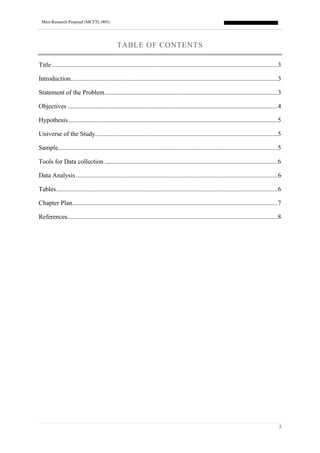
TABLE OF CONTENTS
Title............................................................................................................................................3
Introduction................................................................................................................................3
Statement of the Problem...........................................................................................................3
Objectives ..................................................................................................................................4
Hypothesis..................................................................................................................................5
Universe of the Study.................................................................................................................5
Sample........................................................................................................................................5
Tools for Data collection ...........................................................................................................6
Data Analysis.............................................................................................................................6
Tables.........................................................................................................................................6
Chapter Plan...............................................................................................................................7
References..................................................................................................................................8
Mini-Research Proposal (MCFTL-005)
3
TITLE
A study of the Prevalence of Behavioural Difficulties in Children in Urban India
INTRODUCTION
This study is a deep-dive into one dimension of an earlier study by this author - “A Study of
the Relationship between Parenting Practices and the Behavioural Strengths and Difficulties
of Children in Urban India” (Singh & Mahajan, 2016) conducted by Mohanjeet Singh under
the guidance of Dr. Namrata Mahajan.
Studying the prevalence of behavioural difficulties in children in urban India is important for
identifying, treating, and preventing mental health problems, improving educational and social
outcomes, and promoting public health.
Compared with the critical importance of the topic to the everyday life of humans, there has
been little research on the topic focusing on the Indian scenario. The Indian context is unique.
The socially acceptable parenting practices and the socially acceptable child behaviour is
quite different from the Western world.
However, the few studies that have happened have been localised efforts, leaving open the
opportunity for meta-research as well as pan-India research. This mini-research should also
contribute to improve our understanding about the feasibility, advantages and disadvantages
of conducting such a pan-India study.
STATEMENT OF THE PROBLEM
What is the prevalence of behavioural difficulties – specifically, emotional problems, conduct
problems, hyperactivity and peer problems – in urban Indian children?
Rationale: It is observed that children who appear to be clinically normal may still have
various behavioural difficulties. These difficulties may have their roots in different
underlying factors. However, there has been limited localised research on this subject in
India.
The studies conducted on the topic include:
Mini-Research Proposal (MCFTL-005)
4
• One study highlighted the impact of one of the key differentiators of the Indian social
construct, poverty, on the children. The results suggest that “Children living in BPL
families had more difficulties and low strengths as compared to APL children.
Significant correlations were found between loneliness experiences and other
variables under study.” (Devi, Verma, & Shekhar, 2013)
• In study titled “Assessment of determinants of behavioural problems among primary
school children in Mangalore city of South India” (Joseph, Sinha, & D'Souza, 2021)
8.7% of the children were found to have behavioural problems
• In “A descriptive study of behavioural problems in school going children” (Gupta,
Mongia, & Garg, 2017) about 22.7% of children showed behavioural, cognitive, or
emotional problems. Participants belonged to a government school in Kanpur, Uttar
Pradesh.
• In study titled “Prevalence of behavioural problems in school going children” (Gupta,
Verma, Singh, & Gupta, 2001) 14.6% of the children scored more than the cut-off of
9 points on the Rutter-B scale – out of which 45.6 % were found to have behavioural
problems, and 36.5% had significant problems. This study was focused on the school
children in Ludhiana.
• The study titled “The Need for National Data on Epidemiology of Child and Adolescent
Mental Disorders” (Sharan & Sagar, 2008) highlighted the need for further research
related to behavioural issues to better understand the problems faced by children as well
as develop a national database.
Therefore, here an attempt is being made to assess the prevalence of behavioural difficulties
in otherwise normal children. This is expected to prove very useful in the normal school and
home setting of the children. A study of this nature would be of significant benefit to the
society and the country as it would contribute to significantly improve the lives of the next
generation – the future leaders of our country.
OBJECTIVES
1. To assess the prevalence of emotional problems in children in urban India.
2. To assess the prevalence of conduct problems in children in urban India.
3. To assess the prevalence of hyperactivity in children in urban India.
4. To assess the prevalence of peer problems in children in urban India.
Mini-Research Proposal (MCFTL-005)
5
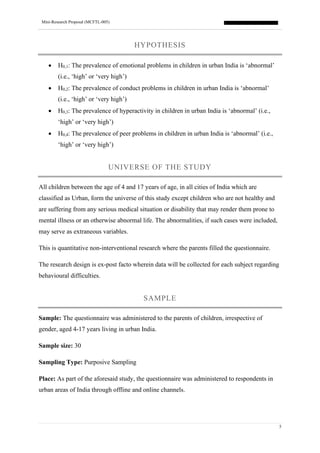
HYPOTHESIS
• H0,1: The prevalence of emotional problems in children in urban India is ‘abnormal’
(i.e., ‘high’ or ‘very high’)
• H0,2: The prevalence of conduct problems in children in urban India is ‘abnormal’
(i.e., ‘high’ or ‘very high’)
• H0,3: The prevalence of hyperactivity in children in urban India is ‘abnormal’ (i.e.,
‘high’ or ‘very high’)
• H0,4: The prevalence of peer problems in children in urban India is ‘abnormal’ (i.e.,
‘high’ or ‘very high’)
UNIVERSE OF THE STUDY
All children between the age of 4 and 17 years of age, in all cities of India which are
classified as Urban, form the universe of this study except children who are not healthy and
are suffering from any serious medical situation or disability that may render them prone to
mental illness or an otherwise abnormal life. The abnormalities, if such cases were included,
may serve as extraneous variables.
This is quantitative non-interventional research where the parents filled the questionnaire.
The research design is ex-post facto wherein data will be collected for each subject regarding
behavioural difficulties.
SAMPLE
Sample: The questionnaire was administered to the parents of children, irrespective of
gender, aged 4-17 years living in urban India.
Sample size: 30
Sampling Type: Purposive Sampling
Place: As part of the aforesaid study, the questionnaire was administered to respondents in
urban areas of India through offline and online channels.
Mini-Research Proposal (MCFTL-005)
6
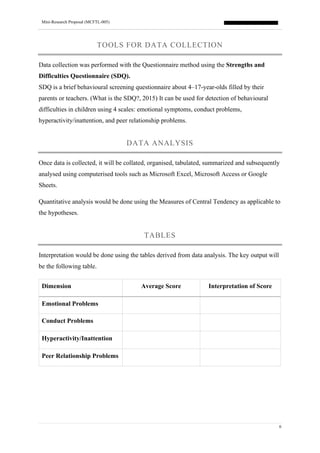
TOOLS FOR DATA COLLECTION
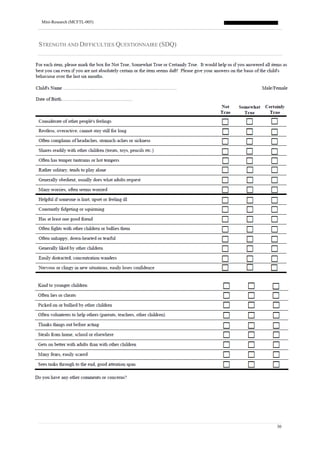
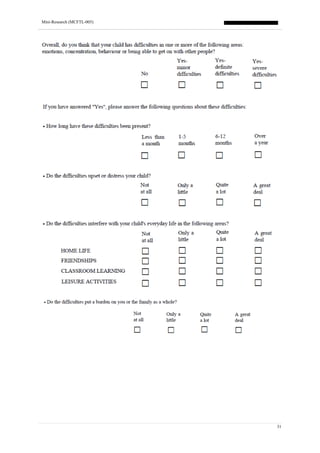
Data collection was performed with the Questionnaire method using the Strengths and
Difficulties Questionnaire (SDQ).
SDQ is a brief behavioural screening questionnaire about 4–17-year-olds filled by their
parents or teachers. (What is the SDQ?, 2015) It can be used for detection of behavioural
difficulties in children using 4 scales: emotional symptoms, conduct problems,
hyperactivity/inattention, and peer relationship problems.
DATA ANALYSIS
Once data is collected, it will be collated, organised, tabulated, summarized and subsequently
analysed using computerised tools such as Microsoft Excel, Microsoft Access or Google
Sheets.
Quantitative analysis would be done using the Measures of Central Tendency as applicable to
the hypotheses.
TABLES
Interpretation would be done using the tables derived from data analysis. The key output will
be the following table.
Dimension Average Score Interpretation of Score
Emotional Problems
Conduct Problems
Hyperactivity/Inattention
Peer Relationship Problems
Mini-Research Proposal (MCFTL-005)
7
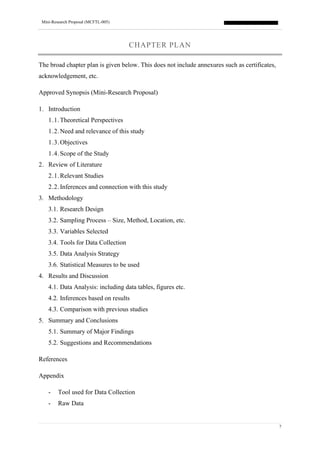
CHAPTER PLAN
The broad chapter plan is given below. This does not include annexures such as certificates,
acknowledgement, etc.
Approved Synopsis (Mini-Research Proposal)
1. Introduction
1.1.Theoretical Perspectives
1.2.Need and relevance of this study
1.3.Objectives
1.4.Scope of the Study
2. Review of Literature
2.1.Relevant Studies
2.2.Inferences and connection with this study
3. Methodology
3.1. Research Design
3.2. Sampling Process – Size, Method, Location, etc.
3.3. Variables Selected
3.4. Tools for Data Collection
3.5. Data Analysis Strategy
3.6. Statistical Measures to be used
4. Results and Discussion
4.1. Data Analysis: including data tables, figures etc.
4.2. Inferences based on results
4.3. Comparison with previous studies
5. Summary and Conclusions
5.1. Summary of Major Findings
5.2. Suggestions and Recommendations
References
Appendix
- Tool used for Data Collection
- Raw Data
Mini-Research Proposal (MCFTL-005)
8
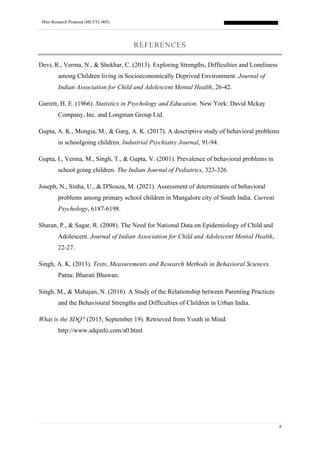
REFERENCES
Devi, R., Verma, N., & Shekhar, C. (2013). Exploring Strengths, Difficulties and Loneliness
among Children living in Socioeconomically Deprived Environment. Journal of
Indian Association for Child and Adolescent Mental Health, 26-42.
Garrett, H. E. (1966). Statistics in Psychology and Education. New York: David Mckay
Company, Inc. and Longman Group Ltd.
Gupta, A. K., Mongia, M., & Garg, A. K. (2017). A descriptive study of behavioral problems
in schoolgoing children. Industrial Psychiatry Journal, 91-94.
Gupta, I., Verma, M., Singh, T., & Gupta, V. (2001). Prevalence of behavioral problems in
school going children. The Indian Journal of Pediatrics, 323-326.
Joseph, N., Sinha, U., & D'Souza, M. (2021). Assessment of determinants of behavioral
problems among primary school children in Mangalore city of South India. Current
Psychology, 6187-6198.
Sharan, P., & Sagar, R. (2008). The Need for National Data on Epidemiology of Child and
Adolescent. Journal of Indian Association for Child and Adolescent Mental Health,
22-27.
Singh, A. K. (2013). Tests, Measurements and Research Methods in Behavioral Sciences.
Patna: Bharati Bhawan.
Singh, M., & Mahajan, N. (2016). A Study of the Relationship between Parenting Practices
and the Behavioural Strengths and Difficulties of Children in Urban India.
What is the SDQ? (2015, September 19). Retrieved from Youth in Mind:
http://www.sdqinfo.com/a0.html
Mini-Research (MCFTL-005)
30
STRENGTH AND DIFFICULTIES QUESTIONNAIRE (SDQ)
Mini-Research (MCFTL-005)
31

IGNOU Sample Practical File for MCFTL005 Mini-Research Proposal MS

  • 4.
    Mini-Research Proposal (MCFTL-005) 2 TABLEOF CONTENTS Title............................................................................................................................................3 Introduction................................................................................................................................3 Statement of the Problem...........................................................................................................3 Objectives ..................................................................................................................................4 Hypothesis..................................................................................................................................5 Universe of the Study.................................................................................................................5 Sample........................................................................................................................................5 Tools for Data collection ...........................................................................................................6 Data Analysis.............................................................................................................................6 Tables.........................................................................................................................................6 Chapter Plan...............................................................................................................................7 References..................................................................................................................................8
  • 5.
    Mini-Research Proposal (MCFTL-005) 3 TITLE Astudy of the Prevalence of Behavioural Difficulties in Children in Urban India INTRODUCTION This study is a deep-dive into one dimension of an earlier study by this author - “A Study of the Relationship between Parenting Practices and the Behavioural Strengths and Difficulties of Children in Urban India” (Singh & Mahajan, 2016) conducted by Mohanjeet Singh under the guidance of Dr. Namrata Mahajan. Studying the prevalence of behavioural difficulties in children in urban India is important for identifying, treating, and preventing mental health problems, improving educational and social outcomes, and promoting public health. Compared with the critical importance of the topic to the everyday life of humans, there has been little research on the topic focusing on the Indian scenario. The Indian context is unique. The socially acceptable parenting practices and the socially acceptable child behaviour is quite different from the Western world. However, the few studies that have happened have been localised efforts, leaving open the opportunity for meta-research as well as pan-India research. This mini-research should also contribute to improve our understanding about the feasibility, advantages and disadvantages of conducting such a pan-India study. STATEMENT OF THE PROBLEM What is the prevalence of behavioural difficulties – specifically, emotional problems, conduct problems, hyperactivity and peer problems – in urban Indian children? Rationale: It is observed that children who appear to be clinically normal may still have various behavioural difficulties. These difficulties may have their roots in different underlying factors. However, there has been limited localised research on this subject in India. The studies conducted on the topic include:
  • 6.
    Mini-Research Proposal (MCFTL-005) 4 •One study highlighted the impact of one of the key differentiators of the Indian social construct, poverty, on the children. The results suggest that “Children living in BPL families had more difficulties and low strengths as compared to APL children. Significant correlations were found between loneliness experiences and other variables under study.” (Devi, Verma, & Shekhar, 2013) • In study titled “Assessment of determinants of behavioural problems among primary school children in Mangalore city of South India” (Joseph, Sinha, & D'Souza, 2021) 8.7% of the children were found to have behavioural problems • In “A descriptive study of behavioural problems in school going children” (Gupta, Mongia, & Garg, 2017) about 22.7% of children showed behavioural, cognitive, or emotional problems. Participants belonged to a government school in Kanpur, Uttar Pradesh. • In study titled “Prevalence of behavioural problems in school going children” (Gupta, Verma, Singh, & Gupta, 2001) 14.6% of the children scored more than the cut-off of 9 points on the Rutter-B scale – out of which 45.6 % were found to have behavioural problems, and 36.5% had significant problems. This study was focused on the school children in Ludhiana. • The study titled “The Need for National Data on Epidemiology of Child and Adolescent Mental Disorders” (Sharan & Sagar, 2008) highlighted the need for further research related to behavioural issues to better understand the problems faced by children as well as develop a national database. Therefore, here an attempt is being made to assess the prevalence of behavioural difficulties in otherwise normal children. This is expected to prove very useful in the normal school and home setting of the children. A study of this nature would be of significant benefit to the society and the country as it would contribute to significantly improve the lives of the next generation – the future leaders of our country. OBJECTIVES 1. To assess the prevalence of emotional problems in children in urban India. 2. To assess the prevalence of conduct problems in children in urban India. 3. To assess the prevalence of hyperactivity in children in urban India. 4. To assess the prevalence of peer problems in children in urban India.
  • 7.
    Mini-Research Proposal (MCFTL-005) 5 HYPOTHESIS •H0,1: The prevalence of emotional problems in children in urban India is ‘abnormal’ (i.e., ‘high’ or ‘very high’) • H0,2: The prevalence of conduct problems in children in urban India is ‘abnormal’ (i.e., ‘high’ or ‘very high’) • H0,3: The prevalence of hyperactivity in children in urban India is ‘abnormal’ (i.e., ‘high’ or ‘very high’) • H0,4: The prevalence of peer problems in children in urban India is ‘abnormal’ (i.e., ‘high’ or ‘very high’) UNIVERSE OF THE STUDY All children between the age of 4 and 17 years of age, in all cities of India which are classified as Urban, form the universe of this study except children who are not healthy and are suffering from any serious medical situation or disability that may render them prone to mental illness or an otherwise abnormal life. The abnormalities, if such cases were included, may serve as extraneous variables. This is quantitative non-interventional research where the parents filled the questionnaire. The research design is ex-post facto wherein data will be collected for each subject regarding behavioural difficulties. SAMPLE Sample: The questionnaire was administered to the parents of children, irrespective of gender, aged 4-17 years living in urban India. Sample size: 30 Sampling Type: Purposive Sampling Place: As part of the aforesaid study, the questionnaire was administered to respondents in urban areas of India through offline and online channels.
  • 8.
    Mini-Research Proposal (MCFTL-005) 6 TOOLSFOR DATA COLLECTION Data collection was performed with the Questionnaire method using the Strengths and Difficulties Questionnaire (SDQ). SDQ is a brief behavioural screening questionnaire about 4–17-year-olds filled by their parents or teachers. (What is the SDQ?, 2015) It can be used for detection of behavioural difficulties in children using 4 scales: emotional symptoms, conduct problems, hyperactivity/inattention, and peer relationship problems. DATA ANALYSIS Once data is collected, it will be collated, organised, tabulated, summarized and subsequently analysed using computerised tools such as Microsoft Excel, Microsoft Access or Google Sheets. Quantitative analysis would be done using the Measures of Central Tendency as applicable to the hypotheses. TABLES Interpretation would be done using the tables derived from data analysis. The key output will be the following table. Dimension Average Score Interpretation of Score Emotional Problems Conduct Problems Hyperactivity/Inattention Peer Relationship Problems
  • 9.
    Mini-Research Proposal (MCFTL-005) 7 CHAPTERPLAN The broad chapter plan is given below. This does not include annexures such as certificates, acknowledgement, etc. Approved Synopsis (Mini-Research Proposal) 1. Introduction 1.1.Theoretical Perspectives 1.2.Need and relevance of this study 1.3.Objectives 1.4.Scope of the Study 2. Review of Literature 2.1.Relevant Studies 2.2.Inferences and connection with this study 3. Methodology 3.1. Research Design 3.2. Sampling Process – Size, Method, Location, etc. 3.3. Variables Selected 3.4. Tools for Data Collection 3.5. Data Analysis Strategy 3.6. Statistical Measures to be used 4. Results and Discussion 4.1. Data Analysis: including data tables, figures etc. 4.2. Inferences based on results 4.3. Comparison with previous studies 5. Summary and Conclusions 5.1. Summary of Major Findings 5.2. Suggestions and Recommendations References Appendix - Tool used for Data Collection - Raw Data
  • 10.
    Mini-Research Proposal (MCFTL-005) 8 REFERENCES Devi,R., Verma, N., & Shekhar, C. (2013). Exploring Strengths, Difficulties and Loneliness among Children living in Socioeconomically Deprived Environment. Journal of Indian Association for Child and Adolescent Mental Health, 26-42. Garrett, H. E. (1966). Statistics in Psychology and Education. New York: David Mckay Company, Inc. and Longman Group Ltd. Gupta, A. K., Mongia, M., & Garg, A. K. (2017). A descriptive study of behavioral problems in schoolgoing children. Industrial Psychiatry Journal, 91-94. Gupta, I., Verma, M., Singh, T., & Gupta, V. (2001). Prevalence of behavioral problems in school going children. The Indian Journal of Pediatrics, 323-326. Joseph, N., Sinha, U., & D'Souza, M. (2021). Assessment of determinants of behavioral problems among primary school children in Mangalore city of South India. Current Psychology, 6187-6198. Sharan, P., & Sagar, R. (2008). The Need for National Data on Epidemiology of Child and Adolescent. Journal of Indian Association for Child and Adolescent Mental Health, 22-27. Singh, A. K. (2013). Tests, Measurements and Research Methods in Behavioral Sciences. Patna: Bharati Bhawan. Singh, M., & Mahajan, N. (2016). A Study of the Relationship between Parenting Practices and the Behavioural Strengths and Difficulties of Children in Urban India. What is the SDQ? (2015, September 19). Retrieved from Youth in Mind: http://www.sdqinfo.com/a0.html
  • 11.
    Mini-Research (MCFTL-005) 30 STRENGTH ANDDIFFICULTIES QUESTIONNAIRE (SDQ)
  • 12.