IGNOU Sample Practical File for MCFTL005 Mini-Research Report MS
1.
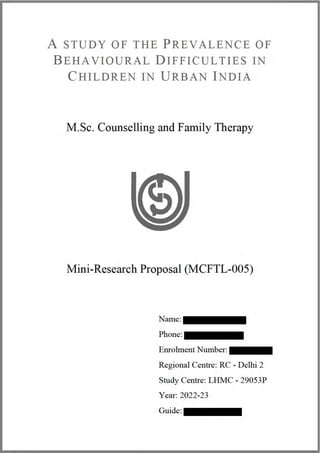
A STUDY OFTHE PREVALENCE OF
BEHAVIOURAL DIFFICULTIES IN
CHILDREN IN URBAN INDIA
Supervised Practicum for the Course
MCFTL-005
Conducted by:
Enrl. No.:
Under the guidance of:
4.
Mini-Research (MCFTL-005)
iii
ACKNOWLEDGEMENT
The successfulcompletion of this mini-research was made possible by the contributions of
several people. I acknowledge their contributions and would like to thank them for their help.
GUIDANCE
This project has been no less than a journey – the success of which has been made possible
by the support and help of my guide , Associate Professor at Lady Hardinge
Medical College. I am greatly indebted to him for his valuable guidance during the project.
I would also like to thank Director and HOD, Psychiatry Department at
LHMC, for his guidance throughout the course of this programme. I would like to express my
gratitude and extend my sincere thanks to him for the constant motivation and supervision.
I am also thankful to administrative assistant for the IGNOU programmes at
LHMC, for being responsive and helping with logistical support during the course.
PARTICIPATION AND SUPPORT WITH DATA COLLECTION
The findings of any project based on primary research can only be as good as the quantity
and quality of data they are based on. To ensure both can be a challenging task for the
researcher. I’m, therefore, thankful to all the subjects who participated in the data collection
exercise for my original thesis by filling the forms and sharing the extremely personal details
about them and their children.
I’m also thankful to all my classmates and friends who helped in the data collection exercise
by identifying the subjects and helping get the forms filled.
5.
Mini-Research (MCFTL-005)
iv
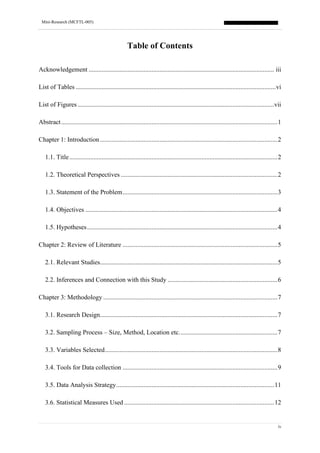
Table ofContents
Acknowledgement ................................................................................................................... iii
List of Tables ............................................................................................................................vi
List of Figures..........................................................................................................................vii
Abstract......................................................................................................................................1
Chapter 1: Introduction..............................................................................................................2
1.1. Title.................................................................................................................................2
1.2. Theoretical Perspectives .................................................................................................2
1.3. Statement of the Problem................................................................................................3
1.4. Objectives .......................................................................................................................4
1.5. Hypotheses......................................................................................................................4
Chapter 2: Review of Literature ................................................................................................5
2.1. Relevant Studies..............................................................................................................5
2.2. Inferences and Connection with this Study ....................................................................6
Chapter 3: Methodology ............................................................................................................7
3.1. Research Design..............................................................................................................7
3.2. Sampling Process – Size, Method, Location etc.............................................................7
3.3. Variables Selected...........................................................................................................8
3.4. Tools for Data collection ................................................................................................9
3.5. Data Analysis Strategy..................................................................................................11
3.6. Statistical Measures Used .............................................................................................12
6.
Mini-Research (MCFTL-005)
v
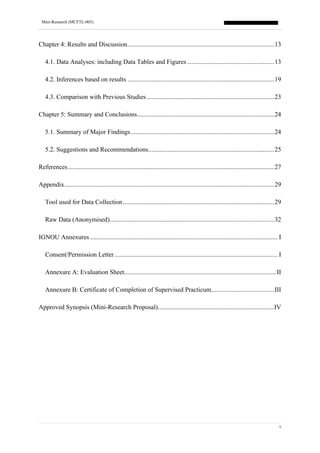
Chapter 4:Results and Discussion...........................................................................................13
4.1. Data Analyses: including Data Tables and Figures ......................................................13
4.2. Inferences based on results ...........................................................................................19
4.3. Comparison with Previous Studies...............................................................................23
Chapter 5: Summary and Conclusions.....................................................................................24
5.1. Summary of Major Findings.........................................................................................24
5.2. Suggestions and Recommendations..............................................................................25
References................................................................................................................................27
Appendix..................................................................................................................................29
Tool used for Data Collection..............................................................................................29
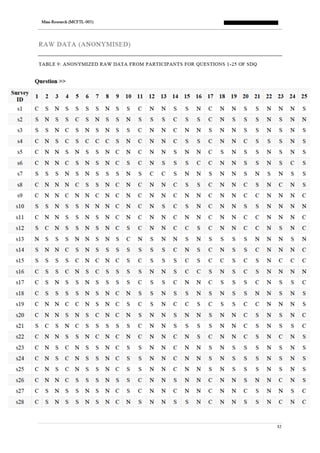
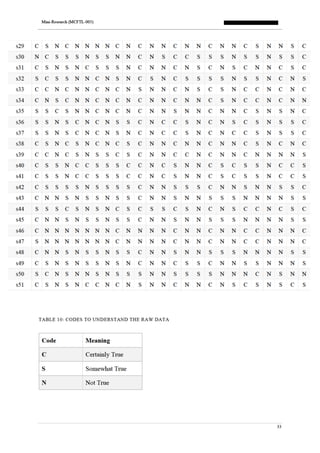
Raw Data (Anonymised)......................................................................................................32
IGNOU Annexures .................................................................................................................... I
Consent/Permission Letter..................................................................................................... I
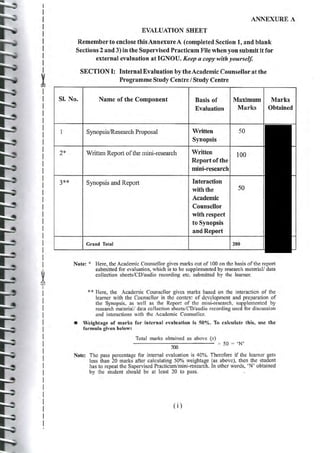
Annexure A: Evaluation Sheet..............................................................................................II
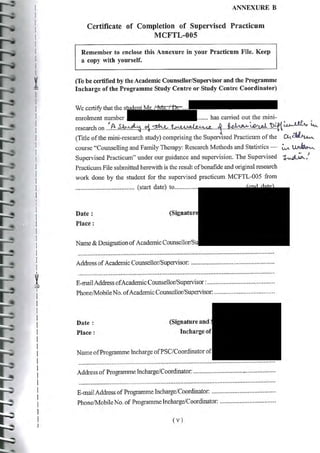
Annexure B: Certificate of Completion of Supervised Practicum.......................................III
Approved Synopsis (Mini-Research Proposal)........................................................................IV
7.
Mini-Research (MCFTL-005)
vi
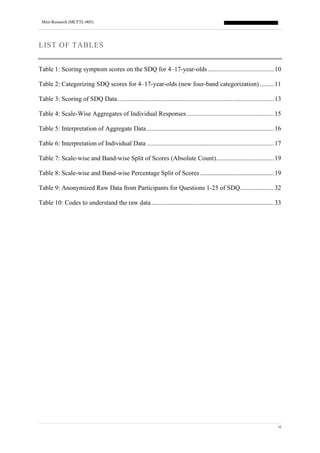
LIST OFTABLES
Table 1: Scoring symptom scores on the SDQ for 4–17-year-olds .........................................10
Table 2: Categorizing SDQ scores for 4–17-year-olds (new four-band categorization).........11
Table 3: Scoring of SDQ Data.................................................................................................13
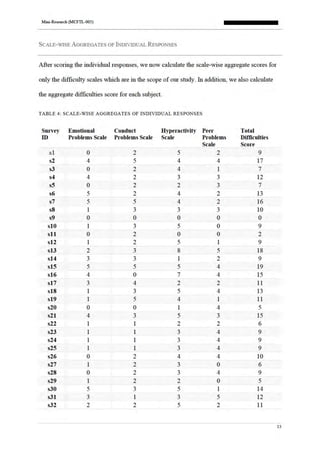
Table 4: Scale-Wise Aggregates of Individual Responses ......................................................15
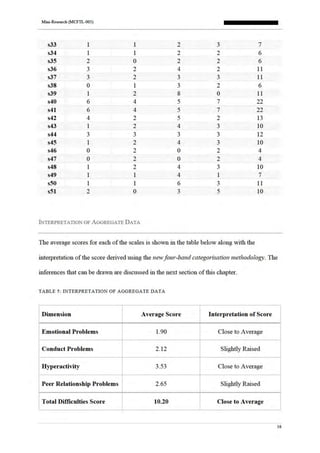
Table 5: Interpretation of Aggregate Data...............................................................................16
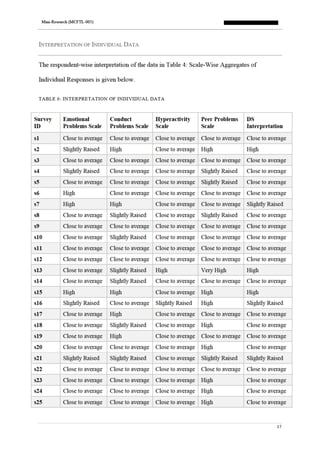
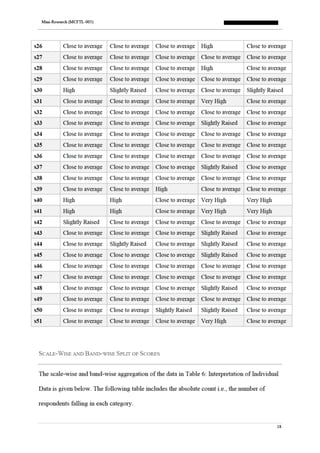
Table 6: Interpretation of Individual Data ...............................................................................17
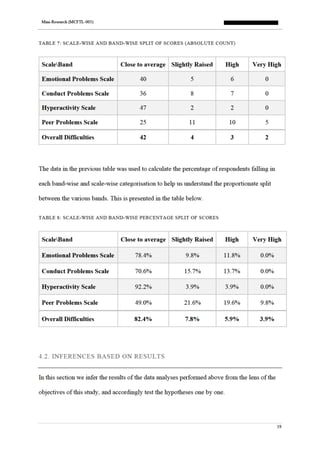
Table 7: Scale-wise and Band-wise Split of Scores (Absolute Count)....................................19
Table 8: Scale-wise and Band-wise Percentage Split of Scores..............................................19
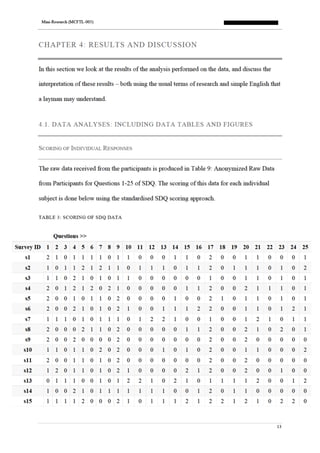
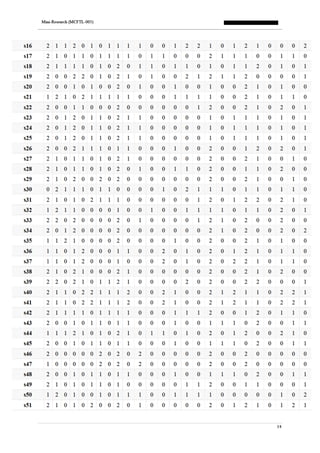
Table 9: Anonymized Raw Data from Participants for Questions 1-25 of SDQ.....................32
Table 10: Codes to understand the raw data ............................................................................33
8.
Mini-Research (MCFTL-005)
vii
LIST OFFIGURES
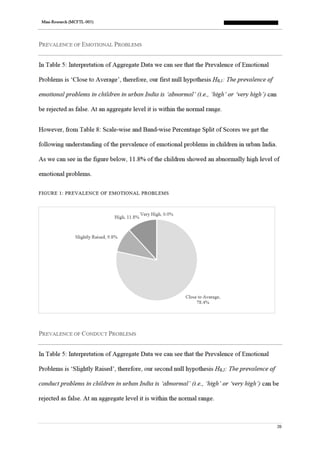
Figure 1: Prevalence of Emotional Problems ..........................................................................20
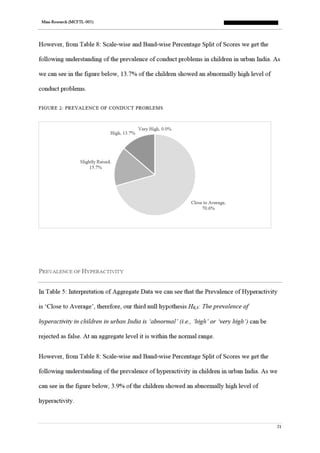
Figure 2: Prevalence of Conduct Problems .............................................................................21
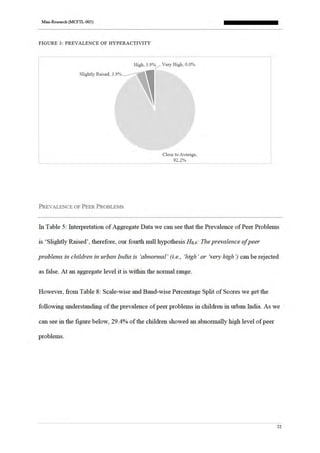
Figure 3: Prevalence of Hyperactivity.....................................................................................22
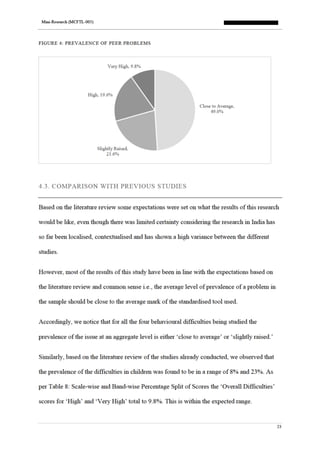
Figure 4: Prevalence of Peer Problems....................................................................................23
9.
Mini-Research (MCFTL-005)
1
ABSTRACT
This studywas undertaken to study the prevalence of behavioral difficulties in children in
urban India. This topic is of great relevance to the people and has widespread applicability in
daily life crossing all barriers of race, region, religion, sex, etc.
The study was conducted as a quantitative, non-interventional research, with an ex-post facto
co-relational research design. Data was collected from 51 parents of children aged between 4
and 12 years, selected by purposive sampling, using the standardized Strength and
Difficulties Questionnaire (SDQ).
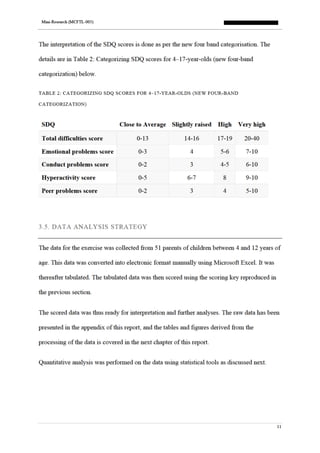
In the study it was found that at an aggregate level the prevalence of Emotional Problems and
Hyperactivity is ‘Close to Average’ and the prevalence of Conduct Problems and Peer
Problems are ‘Slightly Raised.’ All of these variables were thus not found to be in the
abnormal range.
Based on further analysis, it was found that 11.8% of the children showed an abnormally high
level of Emotional Problems, 13.7% of the children showed an abnormally high level of
Conduct Problems, 3.9% of the children showed an abnormally high level of Hyperactivity,
and 29.4% of the children showed an abnormally high level of Peer Problems. Thus, there is
high variance in the prevalence of the different difficulties faced by the children – and it may
not make sense to use the results of a study done at an overall level or for a certain kind of
problem to interpret the prevalence or epidemiology of another kind of problem.
At an overall level, the ‘Overall Difficulties’ scores for 9.8% of the children were found to be
in ‘High’ and ‘Very High’ as per SDQ classification. This is within the expected range based
on the literature review, indicating that the findings of this study are in line with the other
related studies.
10.
Mini-Research (MCFTL-005)
2
CHAPTER 1:INTRODUCTION
This study is a deep-dive into a specific component of an earlier study by this author - “A
Study of the Relationship between Parenting Practices and the Behavioural Strengths and
Difficulties of Children in Urban India” (Mahajan & Singh, 2016) conducted by Mohanjeet
Singh under the guidance of Dr. Namrata Mahajan.
1.1. TITLE
A study of the Prevalence of Behavioural Difficulties in Children in Urban India
1.2. THEORETICAL PERSPECTIVES
Behavioural difficulties in children refer to a range of disruptive behaviours that interfere
with their social, academic, and emotional functioning. It also refers to the patterns of
behaviour that are outside the norm for a child's age, and can also include aggression,
defiance, hyperactivity, and inattention, among others.
There are numerous theories and studies that have attempted to explain the origins of these
difficulties, as well as strategies for managing them:
1. Social learning theory by Albert Bandura: it suggests that children learn by
observing and imitating the behaviour of others around them. Children may develop
behavioural difficulties if they observe negative or aggressive behaviour from parents,
peers, or the media. A study (Anderson & Dill, 2000) found that children who were
exposed to violent media were more likely to exhibit aggressive behaviour.
2. Attachment theory by John Bowlby: it suggests that a secure attachment between a
child and their primary caregiver is crucial for healthy development. Children who
experience insecure attachment may be more likely to develop behavioural
11.
Mini-Research (MCFTL-005)
3
difficulties, suchas aggression and anxiety. A study (Fox, Hane, & Pine, 2007) found
that children who had a secure attachment to their mothers were less likely to exhibit
externalizing behaviours.
3. Additionally, some studies suggest that genetics can play a role in the development of
behavioural difficulties. A study (Rhee & Waldman, 2002) found that genetic factors
accounted for approximately 60% of the variance in children's conduct problems.
It is important for parents, caregivers, and educators to be aware of these potential factors and
to provide support and intervention as needed to promote healthy development and prevent
the development of more severe behavioural difficulties. And, therefore, it becomes
necessary to understand the prevalence of behavioural difficulties.
1.3. STATEMENT OF THE PROBLEM
What is the prevalence of behavioural difficulties – specifically, emotional problems, conduct
problems, hyperactivity and peer problems – in urban Indian children?
Rationale: It is observed that children who appear to be clinically normal may still have
various behavioural difficulties. These difficulties may have their roots in different
underlying factors.
Compared with the critical importance of the topic to the everyday life of humans, there has
been little research on the topic focusing on the Indian scenario. The Indian context is unique.
The socially acceptable parenting practices and the socially acceptable child behaviour is
quite different from the Western world.
However, the few studies that have happened have been localised efforts, leaving open the
opportunity for meta-research as well as pan-India research. This mini-research should also
12.
Mini-Research (MCFTL-005)
4
contribute toimprove our understanding about the feasibility, advantages and disadvantages
of conducting such a pan-India study.
1.4. OBJECTIVES
1. To assess the prevalence of emotional problems in children in urban India.
2. To assess the prevalence of conduct problems in children in urban India.
3. To assess the prevalence of hyperactivity in children in urban India.
4. To assess the prevalence of peer problems in children in urban India.
1.5. HYPOTHESES
• H0,1: The prevalence of emotional problems in children in urban India is ‘abnormal’
(i.e., ‘high’ or ‘very high’)
• H0,2: The prevalence of conduct problems in children in urban India is ‘abnormal’
(i.e., ‘high’ or ‘very high’)
• H0,3: The prevalence of hyperactivity in children in urban India is ‘abnormal’ (i.e.,
‘high’ or ‘very high’)
• H0,4: The prevalence of peer problems in children in urban India is ‘abnormal’ (i.e.,
‘high’ or ‘very high’)
13.
Mini-Research (MCFTL-005)
5
CHAPTER 2:REVIEW OF LITERATURE
2.1. RELEVANT STUDIES
The studies conducted on the topic include:
• In study titled “Assessment of determinants of behavioural problems among primary
school children in Mangalore city of South India” (Joseph, Sinha, & D'Souza, 2021)
8.7% of the children were found to have behavioural problems
• In “A descriptive study of behavioural problems in school going children” (Gupta,
Mongia, & Garg, 2017) about 22.7% of children showed behavioural, cognitive, or
emotional problems. Participants belonged to a government school in Kanpur, Uttar
Pradesh.
• One study highlighted the impact of one of the key differentiators of the Indian social
construct, poverty, on the children. The results suggest that “Children living in BPL
families had more difficulties and low strengths as compared to APL children.
Significant correlations were found between loneliness experiences and other
variables under study.” (Devi, Verma, & Shekhar, 2013)
• In study titled “Prevalence of behavioural problems in school going children” (Gupta,
Verma, Singh, & Gupta, 2001) 14.6% of the children scored more than the cut-off of
9 points on the Rutter-B scale – out of which 45.6 % were found to have behavioural
problems, and 36.5% had significant problems. This study was focused on the school
children in Ludhiana.
• The study titled “The Need for National Data on Epidemiology of Child and Adolescent
Mental Disorders” (Sharan & Sagar, 2008) highlighted the need for further research
14.
Mini-Research (MCFTL-005)
6
related tobehavioural issues to better understand the problems faced by children as well
as develop a national database.
2.2. INFERENCES AND CONNECTION WITH THIS STUDY
From the various studies that we have seen in the previous section, we can infer that:
• The prevalence of behavioural difficulties in children varies between 8% and 23%.
• Though, this is a very wide range, we can infer with confidence that the prevalence of
behavioural difficulties is high enough for this topic to be on the agenda of both
academicians and education policy-makers, apart from the clinical practitioners.
• We can see that the different studies were conducted in different contexts and
different locations using different assessment tools and this could be a contributing
factor to the wide variance that we see in their results.
To address this, we need to conduct pan-India research with a standardised methodology
using a single standardised tool which has shown some promise. In this research we attempt
something on these lines.
In this study an attempt is being made to assess the prevalence of behavioural difficulties in
otherwise normal children. This is expected to prove very useful in the normal school and
home setting of the children. A study of this nature would be of significant benefit to the
society and the country as it would contribute to significantly improve the lives of the next
generation – the future leaders of our country.
Studying the prevalence of behavioural difficulties in children in urban India is important for
identifying, treating, and preventing mental health problems, improving educational and
social outcomes, and promoting public health.
15.
Mini-Research (MCFTL-005)
7
CHAPTER 3:METHODOLOGY
3.1. RESEARCH DESIGN
The project is a Quantitative Non-Interventional Research: the parents of the children filled
the inventory of questions, which was thereafter quantitatively analysed.
The research design is Ex-post facto, wherein data pertaining to four separate variables
(scales) have been collected for each subject using a single questionnaire:
• first, regarding the emotional problems of the child
• second, regarding the conduct problems of the child
• third, regarding the presence of hyperactivity in the child
• fourth, regarding the peer problems of the child
These four groups of variables are then used for statistical data analyses which help in testing
the hypotheses of this study. More details are given below.
3.2. SAMPLING PROCESS – SIZE, METHOD, LOCATION ETC.
UNIVERSE OF THE STUDY
All children between the age of 4 and 17 years of age, in all cities of India which are
classified as Urban, form the universe of this study except children who are not healthy and
are suffering from any serious medical situation or disability that may render them prone to
mental illness or an otherwise abnormal life. The abnormalities, if such cases were included,
may serve as extraneous variables.
This is quantitative non-interventional research where the parents filled the questionnaire.
16.
Mini-Research (MCFTL-005)
8
The researchdesign is ex-post facto wherein data will be collected for each subject regarding
behavioural difficulties.
SAMPLE POPULATION
The questionnaire was administered to the parents of children, irrespective of gender, aged 4-
12 years living in urban India.
SAMPLE SIZE
51
SAMPLING METHOD
Purposive Sampling
LOCATION
As part of the aforesaid study, the questionnaire was administered to respondents in urban
areas of India through offline and online channels.
3.3. VARIABLES SELECTED
At the overall level: are the Difficulties scores. The difficulties score can be further broken
down into Externalising scores and Internalising scores. We do not use these variables.
Instead, we go a level deeper.
• The Externalising scores can be broken down into Conduct scores and Hyperactivity
scores.
• The Internalising scores can be broken down into Emotional scores and Peer Problem
scores. (Goodman, Lamping, & Ploubidis, 2010)
17.
Mini-Research (MCFTL-005)
9
This isthus a set of 1 variable at the top level, 2 at level 2 and 4 at level 3. In the research, an
attempt will be made to assess the behaviours of children at the deepest level – level 3.
3.4. TOOLS FOR DATA COLLECTION
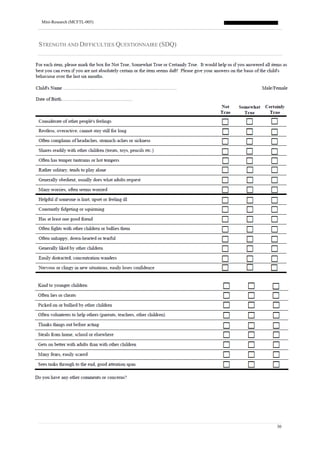
Data collection was performed with the Questionnaire method using the Strengths and
Difficulties Questionnaire (SDQ). SDQ is a brief behavioural screening questionnaire about
3–16-year-olds filled by their parents, teachers or the children themselves depending on the
version being used. We use the version that is filled by the parent.
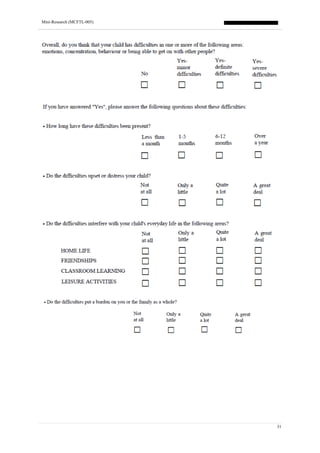
It exists in several versions to meet the needs of researchers, clinicians and educationalists. It
has 25 attributes, and 1 question per attribute. (What is the SDQ?, 2015) In this study we use
only the difficulties dimension of the questionnaire – the discussion below, therefore, does
not cover details about the Strengths dimension or the Impact score.
USE
SDQ is used for early detection of behavioural problems and strengths in children including
emotional symptoms, conduct problems, hyperactivity/inattention, ADHD, peer relationship
problems, and pro-social behaviour.
STRUCTURE
The difficulties part of SDQ comprises of 4 scales: emotional symptoms, conduct problems,
hyperactivity/ inattention, and peer relationship problems. These scales combine to give a
difficulties score. The questionnaire has 5 questions for each of these scales.
18.
Mini-Research (MCFTL-005)
10
SCORING
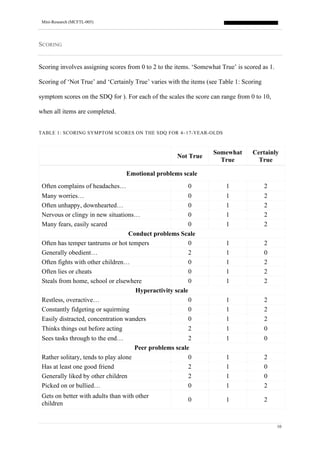
Scoring involvesassigning scores from 0 to 2 to the items. ‘Somewhat True’ is scored as 1.
Scoring of ‘Not True’ and ‘Certainly True’ varies with the items (see Table 1: Scoring
symptom scores on the SDQ for ). For each of the scales the score can range from 0 to 10,
when all items are completed.
TABLE 1: SCORING SYMPTOM SCORES ON THE SDQ FOR 4–17-YEAR-OLDS
Not True
Somewhat
True
Certainly
True
Emotional problems scale
Often complains of headaches… 0 1 2
Many worries… 0 1 2
Often unhappy, downhearted… 0 1 2
Nervous or clingy in new situations… 0 1 2
Many fears, easily scared 0 1 2
Conduct problems Scale
Often has temper tantrums or hot tempers 0 1 2
Generally obedient… 2 1 0
Often fights with other children… 0 1 2
Often lies or cheats 0 1 2
Steals from home, school or elsewhere 0 1 2
Hyperactivity scale
Restless, overactive… 0 1 2
Constantly fidgeting or squirming 0 1 2
Easily distracted, concentration wanders 0 1 2
Thinks things out before acting 2 1 0
Sees tasks through to the end… 2 1 0
Peer problems scale
Rather solitary, tends to play alone 0 1 2
Has at least one good friend 2 1 0
Generally liked by other children 2 1 0
Picked on or bullied… 0 1 2
Gets on better with adults than with other
children
0 1 2
20.
Mini-Research (MCFTL-005)
12
3.6. STATISTICALMEASURES USED
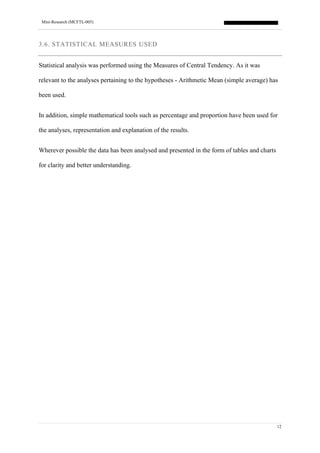
Statistical analysis was performed using the Measures of Central Tendency. As it was
relevant to the analyses pertaining to the hypotheses - Arithmetic Mean (simple average) has
been used.
In addition, simple mathematical tools such as percentage and proportion have been used for
the analyses, representation and explanation of the results.
Wherever possible the data has been analysed and presented in the form of tables and charts
for clarity and better understanding.
32.
Mini-Research (MCFTL-005)
24
CHAPTER 5:SUMMARY AND CONCLUSIONS
5.1. SUMMARY OF MAJOR FINDINGS
The major findings of this study are as follows:
1. Prevalence of Emotional Problems
1.1. The prevalence of Emotional Problems at an aggregate level is ‘Close to Average.’
As it is not in the abnormal range, the respective hypothesis was rejected.
1.2. Based on further analysis, we found that 11.8% of the children showed an
abnormally high level of Emotional Problems.
2. Prevalence of Conduct Problems
2.1. The prevalence of Conduct Problems at an aggregate level is ‘Slightly Raised.’ As it
is not in the abnormal range, the respective hypothesis was rejected.
2.2. Based on further analysis, we found that 13.7% of the children showed an
abnormally high level of Conduct Problems.
3. Prevalence of Hyperactivity
3.1. The prevalence of Hyperactivity at an aggregate level is ‘Close to Average.’ As it is
not in the abnormal range, the respective hypothesis was rejected.
3.2. Based on further analysis, we found that 3.9% of the children showed an abnormally
high level of Hyperactivity.
4. Prevalence of Peer Problems
4.1. The prevalence of Peer Problems at an aggregate level is ‘Slightly Raised.’ As it is
not in the abnormal range, the respective hypothesis was rejected.
4.2. Based on further analysis, we found that 29.4% of the children showed an
abnormally high level of Peer Problems.
33.
Mini-Research (MCFTL-005)
25
5. Prevalenceof Difficulties at an Overall Level
5.1. As per Table 8: Scale-wise and Band-wise Percentage Split of Scores the ‘Overall
Difficulties’ scores for ‘High’ and ‘Very High’ total to 9.8%.
5.2. This is within the expected range based on the literature review, indicating that the
findings of this study are in line with the other related studies.
5.2. SUGGESTIONS AND RECOMMENDATIONS
In this section we first look at the various limitations of the research conducted. These
limitations must be kept in mind while interpreting this report. This is accompanied by
suggestions for someone who wants to further this research, especially ways to possibly
overcome some of the limitations that are highlighted.
1. Sample:
a. Increasing size - Electronic Versions: Take permission from the authors and
conduct the survey electronically for a much bigger data set.
b. Improving representativeness: try to cover a wider segment of the sample – the
present sample is majorly focused on high income group families, mostly with
at least one parent within top 1% income group of the country.
2. Related to filling questionnaire: Due to time and other constraints it wasn’t possible to
monitor the conditions and mental state under which the subject filled the form with
strictness. Anyone using the results should keep this in mind.
3. Analysis:
a. Causality: No attempt has been made to establish the causality. Further
research maybe conducted to assess the causality for the findings.
34.
Mini-Research (MCFTL-005)
26
b. Agedifferences: This study looked at a broad age group of 4-12 years old.
Further research could be done to assess the differences between two or more
subgroups such as 4-8 yrs and 9-12 years using T-test.
4. Recommendations for Related research:
a. Relationship between parenting practices/family adjustment and anxiety levels
of the parents: The hypothesis could be that parents with high anxiety levels
typically indulge in parenting practices/family adjustment that are
unfavourable for the child.
b. Relationship between the parenting practices/family adjustment and anxiety
levels of the children: The hypothesis could be that the children exposed to
unfavourable parenting practices/family adjustment will have high levels of
both trait and state anxiety.
c. Similarly, it would be interesting to see the relationship of depression or other
psychological/psychiatric conditions in parents and the strengths and
difficulties in children
Apart from these, the other limitations that are faced by a researcher using a questionnaire,
and that too with limited number of open-ended questions were faced in this research too. For
examples, there was no opportunity to clarify in case any responses were on unexpected lines.
However, the researcher believes that even with these limitations, this research shows that it
is both feasible and very important to continue research in this area in India.
35.
Mini-Research (MCFTL-005)
27
REFERENCES
Anderson, C.A., & Dill, K. E. (2000). Video games and aggressive thoughts, feelings, and
behavior in the laboratory and in life. Journal of Personality and Social Psychology,
772-790.
Devi, R., Verma, N., & Shekhar, C. (2013). Exploring Strengths, Difficulties and Loneliness
among Children living in Socioeconomically Deprived Environment. Journal of
Indian Association for Child and Adolescent Mental Health, 26-42.
Fox, N. A., Hane, A. A., & Pine, D. S. (2007). Plasticity for Affective Neurocircuitry: How
the Environment Affects Gene Expression. Current Directions in Psychological
Science, 1-5.
Garrett, H. E. (1966). Statistics in Psychology and Education. New York: David Mckay
Company, Inc. and Longman Group Ltd.
Goodman, A., Lamping, D. L., & Ploubidis, G. B. (2010). When to use broader internalising
and externalising subscales instead of the hypothesised five subscales on the Strengths
and Difficulties Questionnaire (SDQ): data from British parents, teachers and
children. Journal of Abnormal Child Psychology, 1179-1191.
Gupta, A. K., Mongia, M., & Garg, A. K. (2017). A descriptive study of behavioral problems
in schoolgoing children. Industrial Psychiatry Journal, 91-94.
Gupta, I., Verma, M., Singh, T., & Gupta, V. (2001). Prevalence of behavioral problems in
school going children. The Indian Journal of Pediatrics, 323-326.
36.
Mini-Research (MCFTL-005)
28
Joseph, N.,Sinha, U., & D'Souza, M. (2021). Assessment of determinants of behavioral
problems among primary school children in Mangalore city of South India. Current
Psychology, 6187-6198.
Mahajan, N., & Singh, M. (2016). A Study of the Relationship between Parenting Practices
and the Behavioural Strengths and Difficulties of Children in Urban India.
Rhee, S. H., & Waldman, I. D. (2002). Genetic and environmental influences on antisocial
behavior: a meta-analysis of twin and adoption studies. Psychological Bulletin, 490-
529.
Sharan, P., & Sagar, R. (2008). The Need for National Data on Epidemiology of Child and
Adolescent. Journal of Indian Association for Child and Adolescent Mental Health,
22-27.
Singh, A. K. (2013). Tests, Measurements and Research Methods in Behavioral Sciences.
Patna: Bharati Bhawan.
What is the SDQ? (2015, September 19). Retrieved from Youth in Mind:
http://www.sdqinfo.com/a0.html
37.
Mini-Research (MCFTL-005)
29
APPENDIX
TOOL USEDFOR DATA COLLECTION
INTRODUCTION
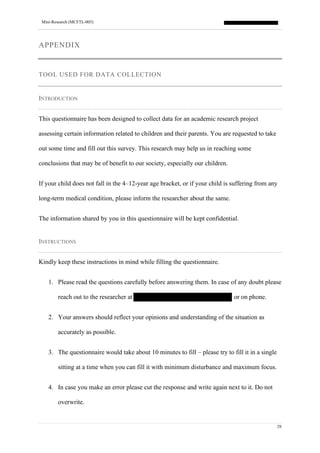
This questionnaire has been designed to collect data for an academic research project
assessing certain information related to children and their parents. You are requested to take
out some time and fill out this survey. This research may help us in reaching some
conclusions that may be of benefit to our society, especially our children.
If your child does not fall in the 4–12-year age bracket, or if your child is suffering from any
long-term medical condition, please inform the researcher about the same.
The information shared by you in this questionnaire will be kept confidential.
INSTRUCTIONS
Kindly keep these instructions in mind while filling the questionnaire.
1. Please read the questions carefully before answering them. In case of any doubt please
reach out to the researcher at or on phone.
2. Your answers should reflect your opinions and understanding of the situation as
accurately as possible.
3. The questionnaire would take about 10 minutes to fill – please try to fill it in a single
sitting at a time when you can fill it with minimum disturbance and maximum focus.
4. In case you make an error please cut the response and write again next to it. Do not
overwrite.
Mini-Research Proposal (MCFTL-005)
2
TABLEOF CONTENTS
Title............................................................................................................................................3
Introduction................................................................................................................................3
Statement of the Problem...........................................................................................................3
Objectives ..................................................................................................................................4
Hypothesis..................................................................................................................................5
Universe of the Study.................................................................................................................5
Sample........................................................................................................................................5
Tools for Data collection ...........................................................................................................6
Data Analysis.............................................................................................................................6
Tables.........................................................................................................................................6
Chapter Plan...............................................................................................................................7
References..................................................................................................................................8
58.
Mini-Research Proposal (MCFTL-005)
3
TITLE
Astudy of the Prevalence of Behavioural Difficulties in Children in Urban India
INTRODUCTION
This study is a deep-dive into one dimension of an earlier study by this author - “A Study of
the Relationship between Parenting Practices and the Behavioural Strengths and Difficulties
of Children in Urban India” (Singh & Mahajan, 2016) conducted by Mohanjeet Singh under
the guidance of Dr. Namrata Mahajan.
Studying the prevalence of behavioural difficulties in children in urban India is important for
identifying, treating, and preventing mental health problems, improving educational and social
outcomes, and promoting public health.
Compared with the critical importance of the topic to the everyday life of humans, there has
been little research on the topic focusing on the Indian scenario. The Indian context is unique.
The socially acceptable parenting practices and the socially acceptable child behaviour is
quite different from the Western world.
However, the few studies that have happened have been localised efforts, leaving open the
opportunity for meta-research as well as pan-India research. This mini-research should also
contribute to improve our understanding about the feasibility, advantages and disadvantages
of conducting such a pan-India study.
STATEMENT OF THE PROBLEM
What is the prevalence of behavioural difficulties – specifically, emotional problems, conduct
problems, hyperactivity and peer problems – in urban Indian children?
Rationale: It is observed that children who appear to be clinically normal may still have
various behavioural difficulties. These difficulties may have their roots in different
underlying factors. However, there has been limited localised research on this subject in
India.
The studies conducted on the topic include:
59.
Mini-Research Proposal (MCFTL-005)
4
•One study highlighted the impact of one of the key differentiators of the Indian social
construct, poverty, on the children. The results suggest that “Children living in BPL
families had more difficulties and low strengths as compared to APL children.
Significant correlations were found between loneliness experiences and other
variables under study.” (Devi, Verma, & Shekhar, 2013)
• In study titled “Assessment of determinants of behavioural problems among primary
school children in Mangalore city of South India” (Joseph, Sinha, & D'Souza, 2021)
8.7% of the children were found to have behavioural problems
• In “A descriptive study of behavioural problems in school going children” (Gupta,
Mongia, & Garg, 2017) about 22.7% of children showed behavioural, cognitive, or
emotional problems. Participants belonged to a government school in Kanpur, Uttar
Pradesh.
• In study titled “Prevalence of behavioural problems in school going children” (Gupta,
Verma, Singh, & Gupta, 2001) 14.6% of the children scored more than the cut-off of
9 points on the Rutter-B scale – out of which 45.6 % were found to have behavioural
problems, and 36.5% had significant problems. This study was focused on the school
children in Ludhiana.
• The study titled “The Need for National Data on Epidemiology of Child and Adolescent
Mental Disorders” (Sharan & Sagar, 2008) highlighted the need for further research
related to behavioural issues to better understand the problems faced by children as well
as develop a national database.
Therefore, here an attempt is being made to assess the prevalence of behavioural difficulties
in otherwise normal children. This is expected to prove very useful in the normal school and
home setting of the children. A study of this nature would be of significant benefit to the
society and the country as it would contribute to significantly improve the lives of the next
generation – the future leaders of our country.
OBJECTIVES
1. To assess the prevalence of emotional problems in children in urban India.
2. To assess the prevalence of conduct problems in children in urban India.
3. To assess the prevalence of hyperactivity in children in urban India.
4. To assess the prevalence of peer problems in children in urban India.
60.
Mini-Research Proposal (MCFTL-005)
5
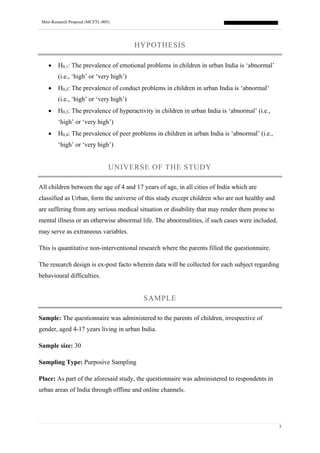
HYPOTHESIS
•H0,1: The prevalence of emotional problems in children in urban India is ‘abnormal’
(i.e., ‘high’ or ‘very high’)
• H0,2: The prevalence of conduct problems in children in urban India is ‘abnormal’
(i.e., ‘high’ or ‘very high’)
• H0,3: The prevalence of hyperactivity in children in urban India is ‘abnormal’ (i.e.,
‘high’ or ‘very high’)
• H0,4: The prevalence of peer problems in children in urban India is ‘abnormal’ (i.e.,
‘high’ or ‘very high’)
UNIVERSE OF THE STUDY
All children between the age of 4 and 17 years of age, in all cities of India which are
classified as Urban, form the universe of this study except children who are not healthy and
are suffering from any serious medical situation or disability that may render them prone to
mental illness or an otherwise abnormal life. The abnormalities, if such cases were included,
may serve as extraneous variables.
This is quantitative non-interventional research where the parents filled the questionnaire.
The research design is ex-post facto wherein data will be collected for each subject regarding
behavioural difficulties.
SAMPLE
Sample: The questionnaire was administered to the parents of children, irrespective of
gender, aged 4-17 years living in urban India.
Sample size: 30
Sampling Type: Purposive Sampling
Place: As part of the aforesaid study, the questionnaire was administered to respondents in
urban areas of India through offline and online channels.
61.
Mini-Research Proposal (MCFTL-005)
6
TOOLSFOR DATA COLLECTION
Data collection was performed with the Questionnaire method using the Strengths and
Difficulties Questionnaire (SDQ).
SDQ is a brief behavioural screening questionnaire about 4–17-year-olds filled by their
parents or teachers. (What is the SDQ?, 2015) It can be used for detection of behavioural
difficulties in children using 4 scales: emotional symptoms, conduct problems,
hyperactivity/inattention, and peer relationship problems.
DATA ANALYSIS
Once data is collected, it will be collated, organised, tabulated, summarized and subsequently
analysed using computerised tools such as Microsoft Excel, Microsoft Access or Google
Sheets.
Quantitative analysis would be done using the Measures of Central Tendency as applicable to
the hypotheses.
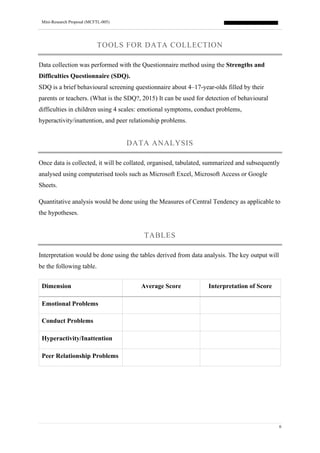
TABLES
Interpretation would be done using the tables derived from data analysis. The key output will
be the following table.
Dimension Average Score Interpretation of Score
Emotional Problems
Conduct Problems
Hyperactivity/Inattention
Peer Relationship Problems
62.
Mini-Research Proposal (MCFTL-005)
7
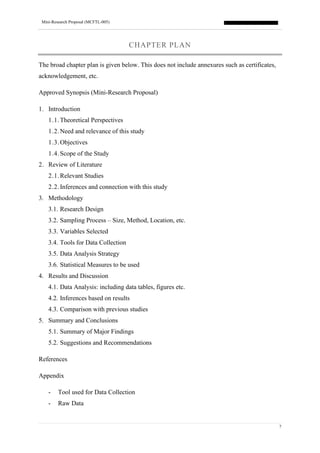
CHAPTERPLAN
The broad chapter plan is given below. This does not include annexures such as certificates,
acknowledgement, etc.
Approved Synopsis (Mini-Research Proposal)
1. Introduction
1.1.Theoretical Perspectives
1.2.Need and relevance of this study
1.3.Objectives
1.4.Scope of the Study
2. Review of Literature
2.1.Relevant Studies
2.2.Inferences and connection with this study
3. Methodology
3.1. Research Design
3.2. Sampling Process – Size, Method, Location, etc.
3.3. Variables Selected
3.4. Tools for Data Collection
3.5. Data Analysis Strategy
3.6. Statistical Measures to be used
4. Results and Discussion
4.1. Data Analysis: including data tables, figures etc.
4.2. Inferences based on results
4.3. Comparison with previous studies
5. Summary and Conclusions
5.1. Summary of Major Findings
5.2. Suggestions and Recommendations
References
Appendix
- Tool used for Data Collection
- Raw Data
63.
Mini-Research Proposal (MCFTL-005)
8
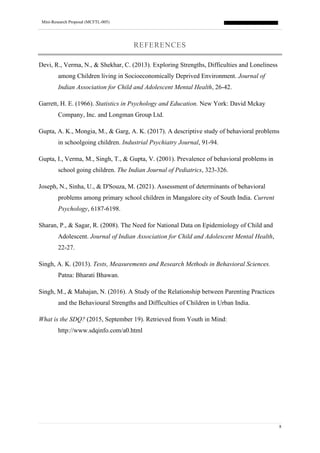
REFERENCES
Devi,R., Verma, N., & Shekhar, C. (2013). Exploring Strengths, Difficulties and Loneliness
among Children living in Socioeconomically Deprived Environment. Journal of
Indian Association for Child and Adolescent Mental Health, 26-42.
Garrett, H. E. (1966). Statistics in Psychology and Education. New York: David Mckay
Company, Inc. and Longman Group Ltd.
Gupta, A. K., Mongia, M., & Garg, A. K. (2017). A descriptive study of behavioral problems
in schoolgoing children. Industrial Psychiatry Journal, 91-94.
Gupta, I., Verma, M., Singh, T., & Gupta, V. (2001). Prevalence of behavioral problems in
school going children. The Indian Journal of Pediatrics, 323-326.
Joseph, N., Sinha, U., & D'Souza, M. (2021). Assessment of determinants of behavioral
problems among primary school children in Mangalore city of South India. Current
Psychology, 6187-6198.
Sharan, P., & Sagar, R. (2008). The Need for National Data on Epidemiology of Child and
Adolescent. Journal of Indian Association for Child and Adolescent Mental Health,
22-27.
Singh, A. K. (2013). Tests, Measurements and Research Methods in Behavioral Sciences.
Patna: Bharati Bhawan.
Singh, M., & Mahajan, N. (2016). A Study of the Relationship between Parenting Practices
and the Behavioural Strengths and Difficulties of Children in Urban India.
What is the SDQ? (2015, September 19). Retrieved from Youth in Mind:
http://www.sdqinfo.com/a0.html