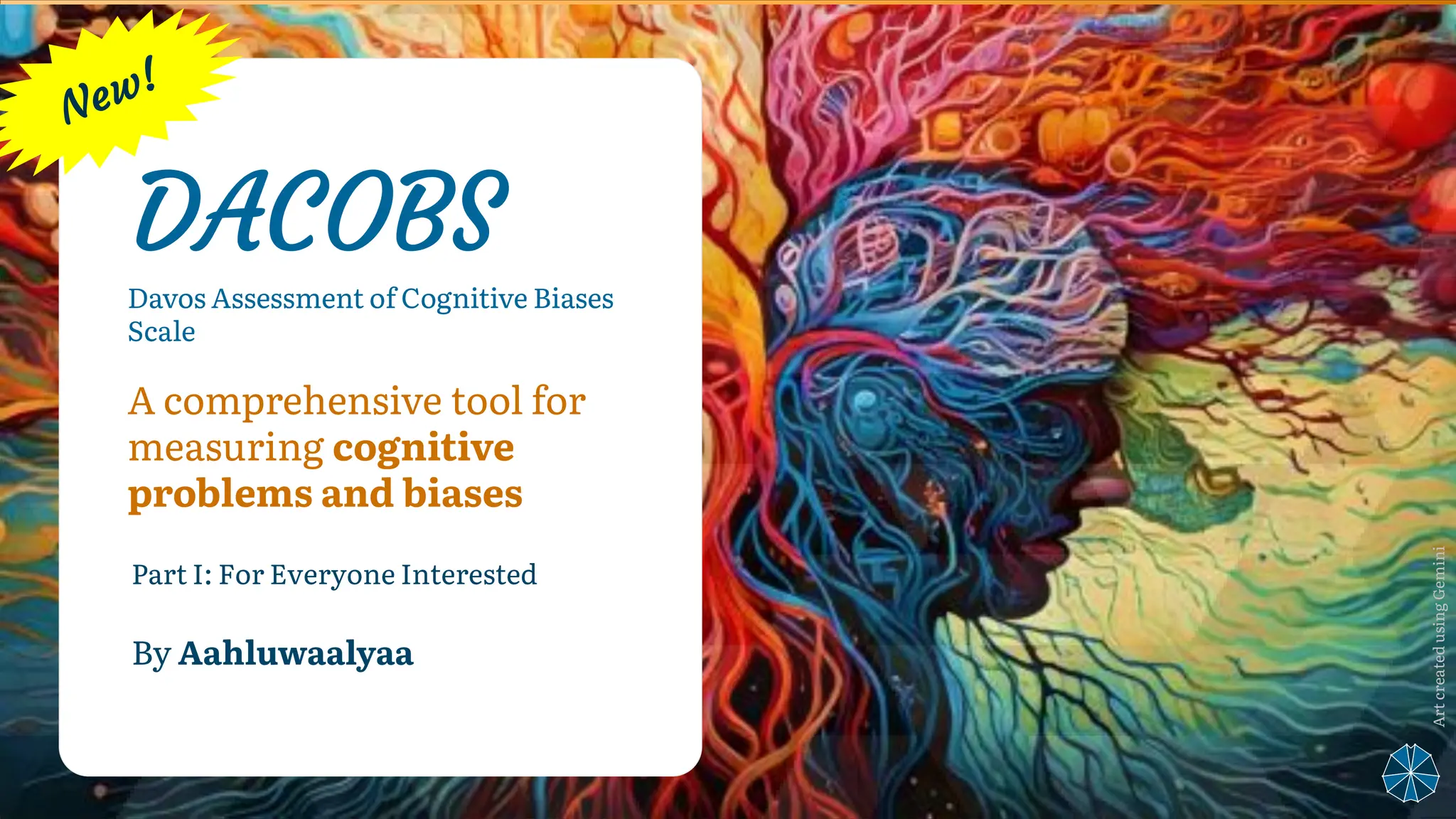
DACOBS
Davos Assessment of Cognitive Biases
Scale
A comprehensive tool for
measuring cognitive
problems and biases
Part I: For Everyone Interested
By Aahluwaalyaa
Art
created
using
Gemini
© 2025, PsychoTech Services
Trademarks
‘Super-Notes’, ‘All About’, ‘Psychology Learners’, ‘PsyLearners’, ‘M S Ahluwalia’, ‘PsychoTech Services’, ‘Real Happiness Center’, ‘FREE IGNOU Help Center’,
‘FIHC’ and the msa logo, the PsyLearners logo, FIHC logo, Star and Starji logos for Real Happiness Center and PsychoTech Services logo are trademarks of
M S Ahluwalia in India and other countries, and may not be used without explicit written permission.
All other trademarks are the property of their respective owners. PsychoTech Services and the owners thereof, are not associated with any product or
vendor mentioned in this book.
Limit of liability/disclaimer of warranty
The publisher and the author make no representations or warranties with respect to the accuracy or completeness of the contents of this work and
specifically disclaim all warranties, including without limitation warranties of fitness for a particular purpose. This book should not be used as a
replacement of expert opinion. No warranty may be created or extended by sales or promotional materials. The advice and strategies contained herein
may not be suitable for every situation. This work is sold with the understanding that the publisher is not engaged in rendering legal, accounting, or other
professional services. If professional assistance is required, the services of a competent professional person should be sought. Neither the publisher nor
the author shall be liable for damages arising herefrom. The fact that an organization or website is referred to in this work as a citation and/or a potential
source of further information does not mean that the author or the publisher endorses the information the organization or website may provide or
recommendations it may make. Further, readers should be aware that internet websites listed in this work may have changed or disappeared between
when this work was written and when it is read.
This document was prepared with the intent of helping students. Students are advised to be careful while using this. There may be errors in the
analysis/document considering it has not undergone peer review. In case you notice any errors or have any suggestions for the improvement of this
document, you can leave a detailed comment on the respective page on our site or other channel from where you got access to the document.
For general information on our other publications or for any kind of support or further information, you may visit our website.
Disclaimer
2
PsyLearners.PsychoTechServices.com
Psychology Learners
Psychology.PsychoTechServices.com
Click Here to Access
Click here for Super-Notes!
SuperNotes - Learn Better, Faster
A proprietary approach developed by bringing together the best of learning theories from
Psychology, design principles from the world of visualization, and pedagogical methods from
over a decade of training experience, that enables you to: Learn Better, Faster.
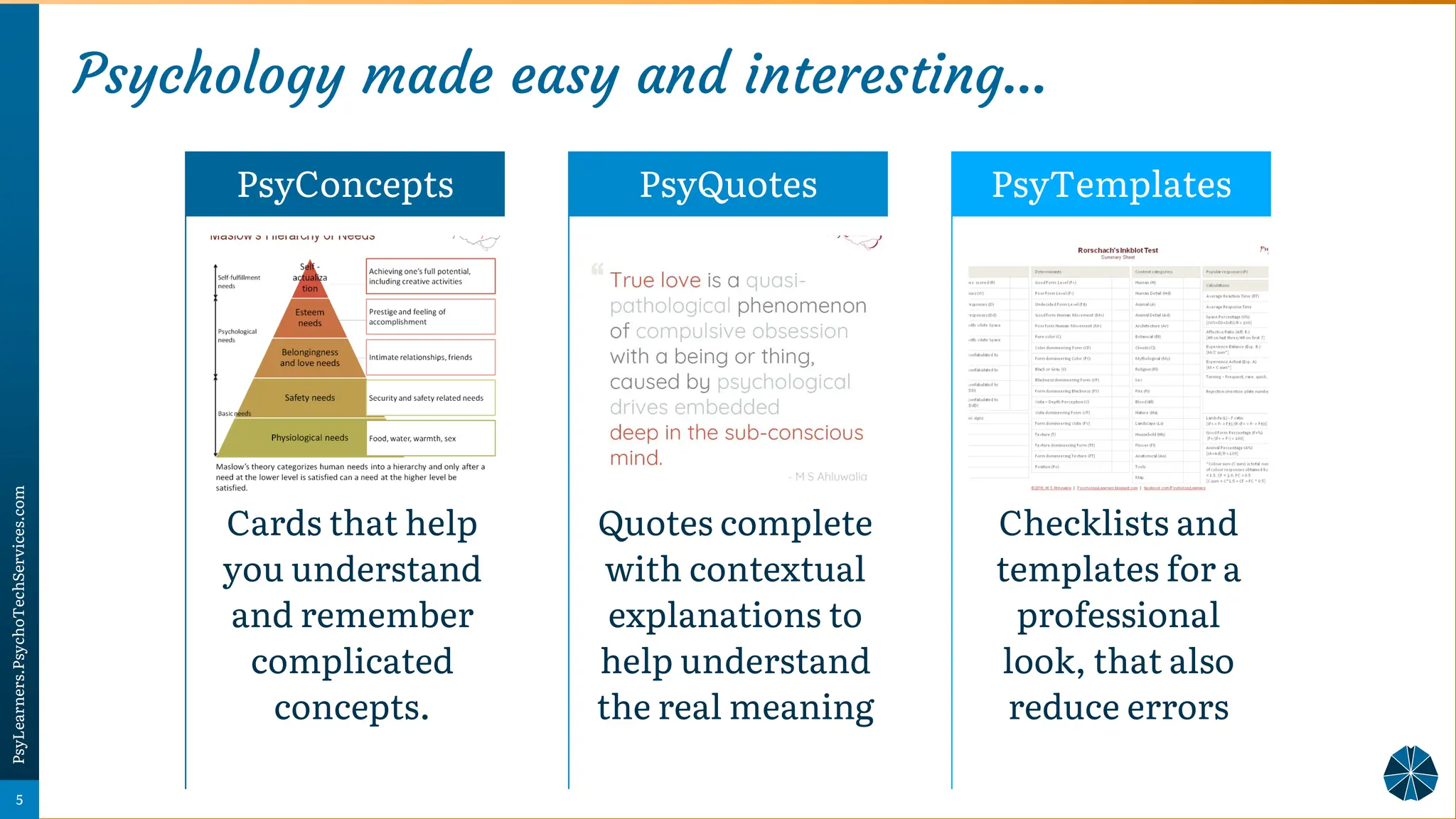
Psychology made easy and interesting…
• Psychology Super-Notes
PsyConcepts PsyQuotes
Checklists and templates for a professional look, that also reduce errors
PsyTemplates
Cards that help
you understand
and remember
complicated
concepts.
PsyConcepts
Quotes complete
with contextual
explanations to
help understand
the real meaning
PsyQuotes
Checklists and
templates for a
professional
look, that also
reduce errors
PsyTemplates
5
PsyLearners.PsychoTechServices.com
Super-Notes
Super-Notes
PsychoTech Services
PsychoTech Services
Psychology Learners
Psychology Learners
FREE IGNOU Help Center
The Real Happiness Center
We are here to help you…
It’s in our DNA.
We were born out of a project to help students!
We are here to help you!
• Psychology Super-Notes
If you are a faculty or student of psychology, this document may be just what you need!
Universities often have a vast syllabus, and there is limited support from the faculty and university. But the exams are tough.
Unfortunately, students often don’t get sufficient support for their exams.
We at PsychoTech Services have launched several efforts to help psychology students – if you haven’t visited our site yet,
now might be the right time – Click Here! Look for PsyConcepts, PsyQuotes, guidance for solving the assignments, practicals,
projects, and internships, our highly accurate ‘Exam Question Pattern Analysis’, and PsyTemplates - to make your submissions
look more professional and high quality.
Also, remember, your exams will test both your knowledge and your ability to present the answers well. So, work on both these
aspects – for some very useful tips on read How to Score More in your Exams!
We hope that all the resources we have created for you will help you to complete your course requirements successfully!
Good Luck!!!
7
PsyLearners.PsychoTechServices.com
Super-Notes
Super-Notes
ychoTech Services
PsychoTech Services
Psychology Learners
Psychology Learners
FREE IGNOU Help Center
The Real Happiness Center
Let’s Start…
Super-Notes
Super-Notes
PsychoTech Services
PsychoTech Services
Psychology Learners
Psychology Learners
FREE IGNOU Help Center
The Real Happiness Center
We do not see things
as they are,
we see them
as we are.
Footer
9
Contents
Part 1: What is DACOBS
1. Introduction to the Tool
2. History and Evolution
3. Theoretical Foundations
4. Structure
5. Psychometric Properties
DACOBS:
Davos
Assessment
of
Cognitive
Biases
Scale
–
Part
I
–
What
is
DACOBS
Footer
10
Part 2: How to use the DACOBS
1. Administration
2. Scoring
3. Interpretation
4. Applications
5. Advantages and Limitations
6. Usage Rights and Access
Introduction
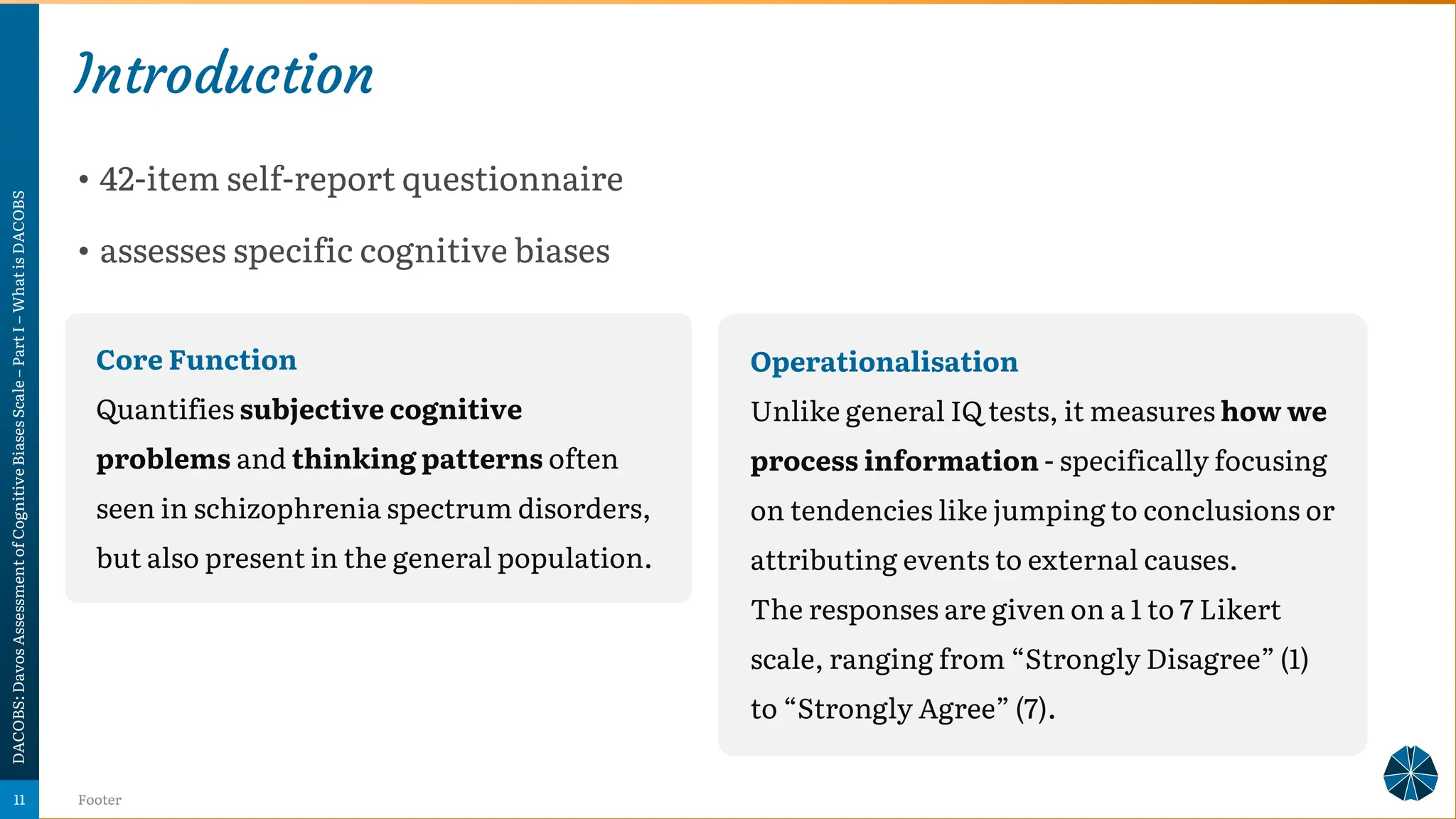
• 42-item self-report questionnaire
• assesses specific cognitive biases
DACOBS:
Davos
Assessment
of
Cognitive
Biases
Scale
–
Part
I
–
What
is
DACOBS
Footer
11
Operationalisation
Unlike general IQ tests, it measures how we
process information - specifically focusing
on tendencies like jumping to conclusions or
attributing events to external causes.
The responses are given on a 1 to 7 Likert
scale, ranging from “Strongly Disagree” (1)
to “Strongly Agree” (7).
Core Function
Quantifies subjective cognitive
problems and thinking patterns often
seen in schizophrenia spectrum disorders,
but also present in the general population.
History & Evolution: From DAS to DACOBS
• Development
• Developed By: Mark van der Gaag and colleagues (2013).
• Named after the Davos conference where the concepts were refined.
• Context:
• Created during the "cognitive turn" in psychosis research. Therapists needed
a way to measure the processes of delusional thinking, not just the content.
DACOBS:
Davos
Assessment
of
Cognitive
Biases
Scale
–
Part
I
–
What
is
DACOBS
Footer
12
Theoretical Foundations
• Rooted in Cognitive Behavioral Therapy for psychosis (CBTp).
• It posits that distinct biases (like 'data gathering bias') contribute to the
formation and maintenance of delusions.
DACOBS:
Davos
Assessment
of
Cognitive
Biases
Scale
–
Part
I
–
What
is
DACOBS
Footer
13
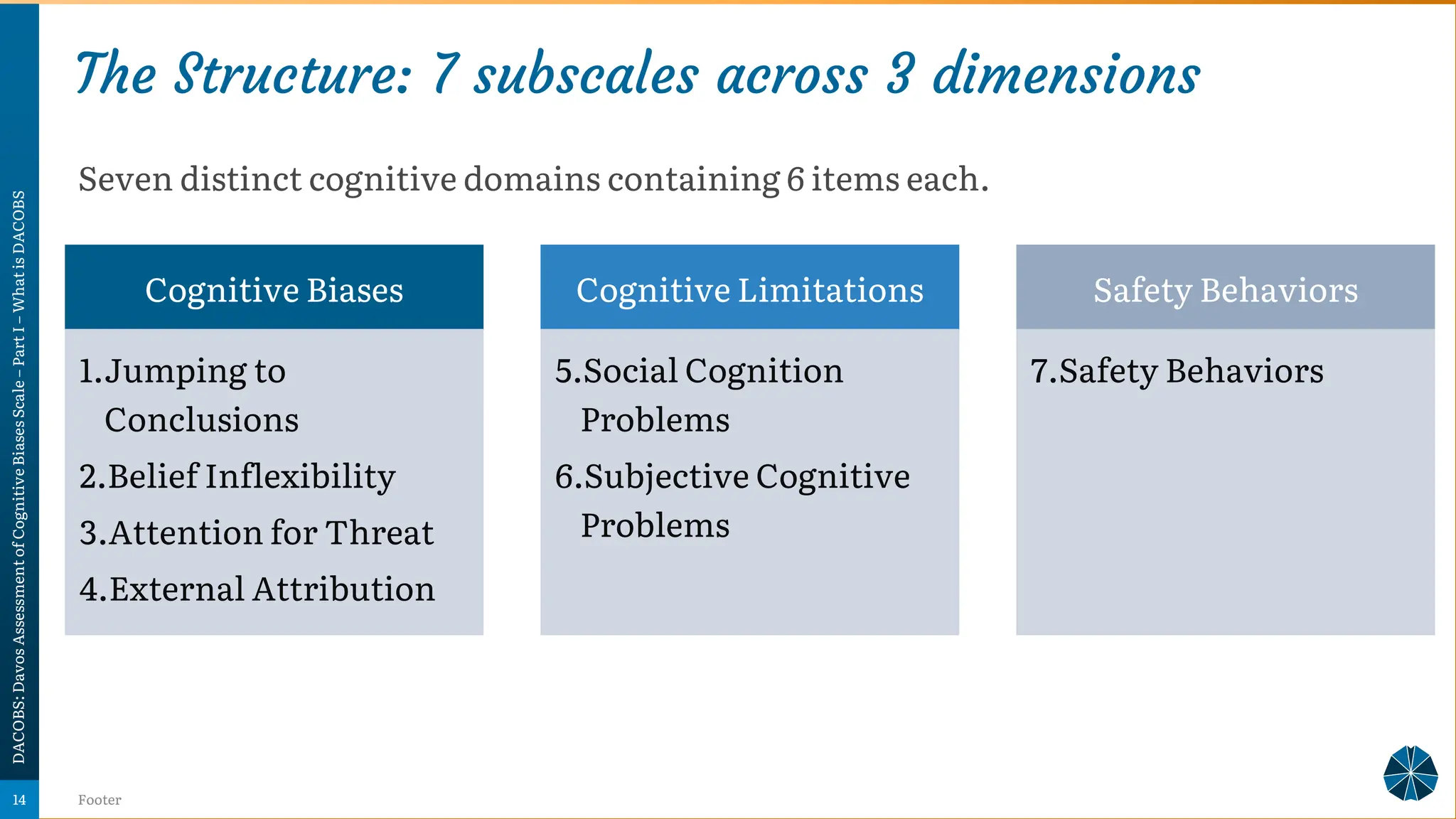
The Structure: 7 subscales across 3 dimensions
Seven distinct cognitive domains containing 6 items each.
DACOBS:
Davos
Assessment
of
Cognitive
Biases
Scale
–
Part
I
–
What
is
DACOBS
Footer
14
Cognitive Biases
1.Jumping to
Conclusions
2.Belief Inflexibility
3.Attention for Threat
4.External Attribution
Cognitive Limitations
5.Social Cognition
Problems
6.Subjective Cognitive
Problems
Safety Behaviors
7.Safety Behaviors
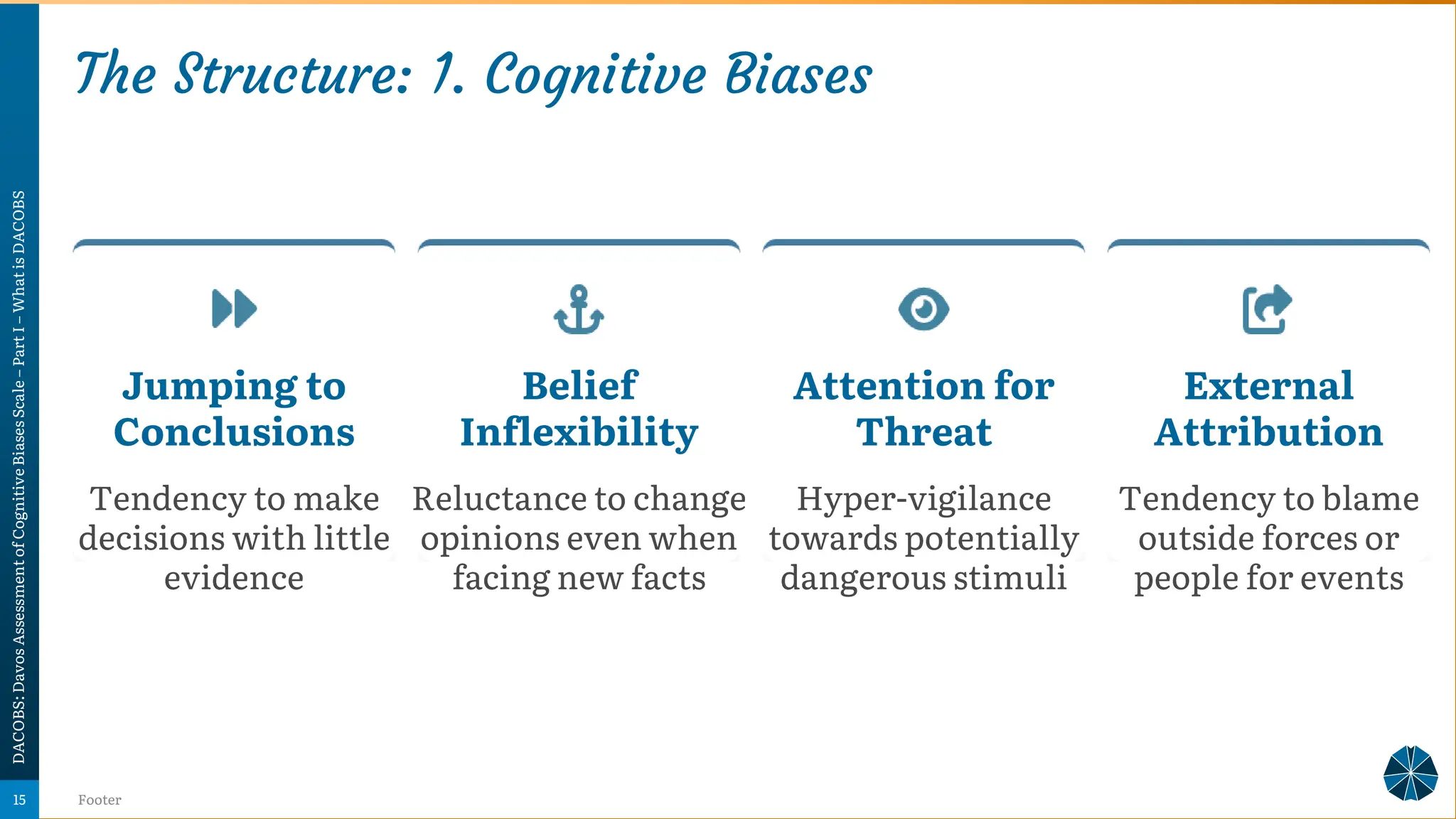
The Structure: 1. Cognitive Biases
DACOBS:
Davos
Assessment
of
Cognitive
Biases
Scale
–
Part
I
–
What
is
DACOBS
Footer
15
Jumping to
Conclusions
Tendency to make
decisions with little
evidence
Belief
Inflexibility
Reluctance to change
opinions even when
facing new facts
Attention for
Threat
Hyper-vigilance
towards potentially
dangerous stimuli
External
Attribution
Tendency to blame
outside forces or
people for events
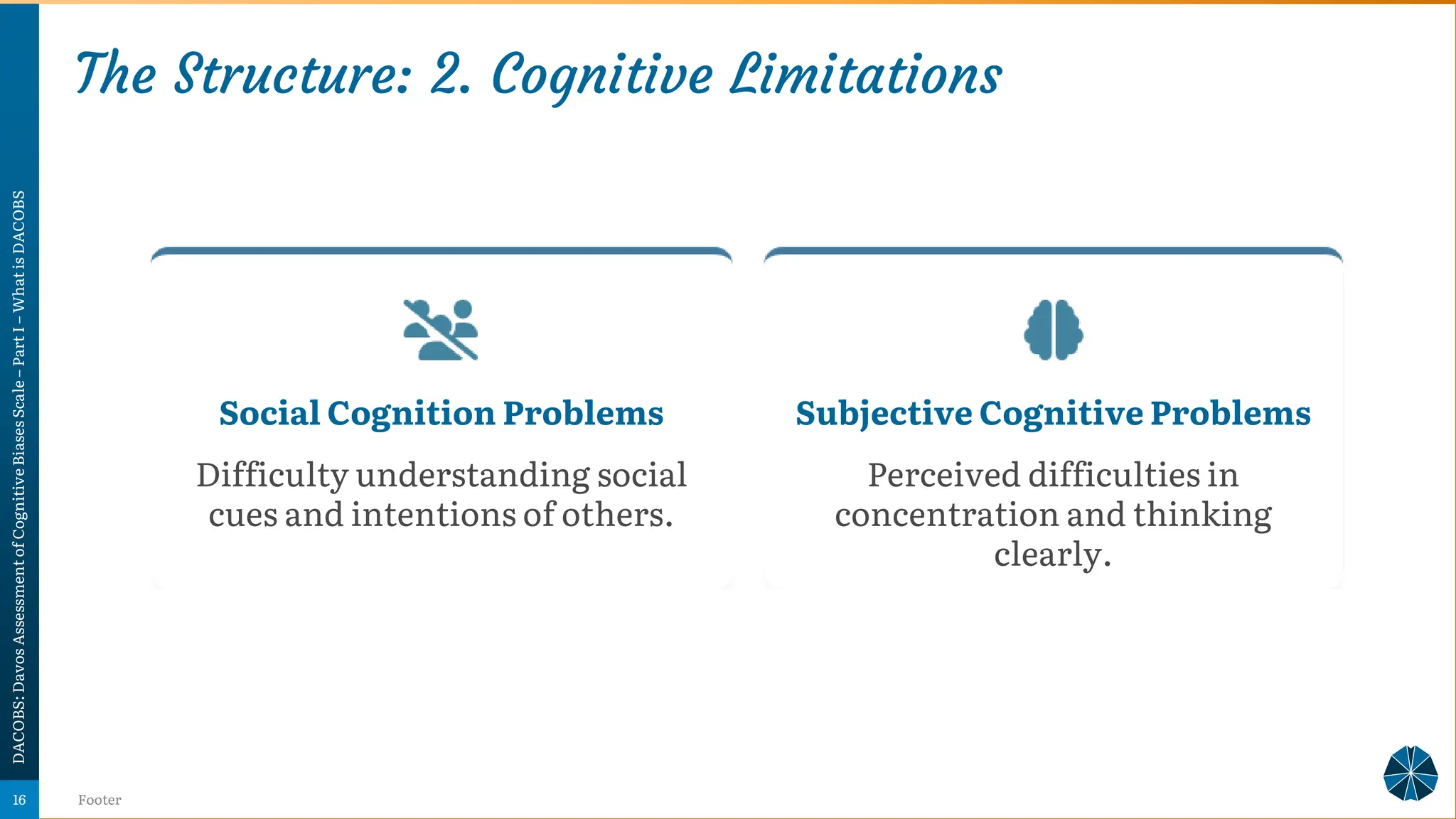
The Structure: 2. Cognitive Limitations
DACOBS:
Davos
Assessment
of
Cognitive
Biases
Scale
–
Part
I
–
What
is
DACOBS
Footer
16
Social Cognition Problems
Difficulty understanding social
cues and intentions of others.
Subjective Cognitive Problems
Perceived difficulties in
concentration and thinking
clearly.
The Structure: 3. Safety Behaviours
DACOBS:
Davos
Assessment
of
Cognitive
Biases
Scale
–
Part
I
–
What
is
DACOBS
Footer
17
Safety Behaviors
Actions taken to avoid perceived
threats or anxiety.
Psychometric Properties
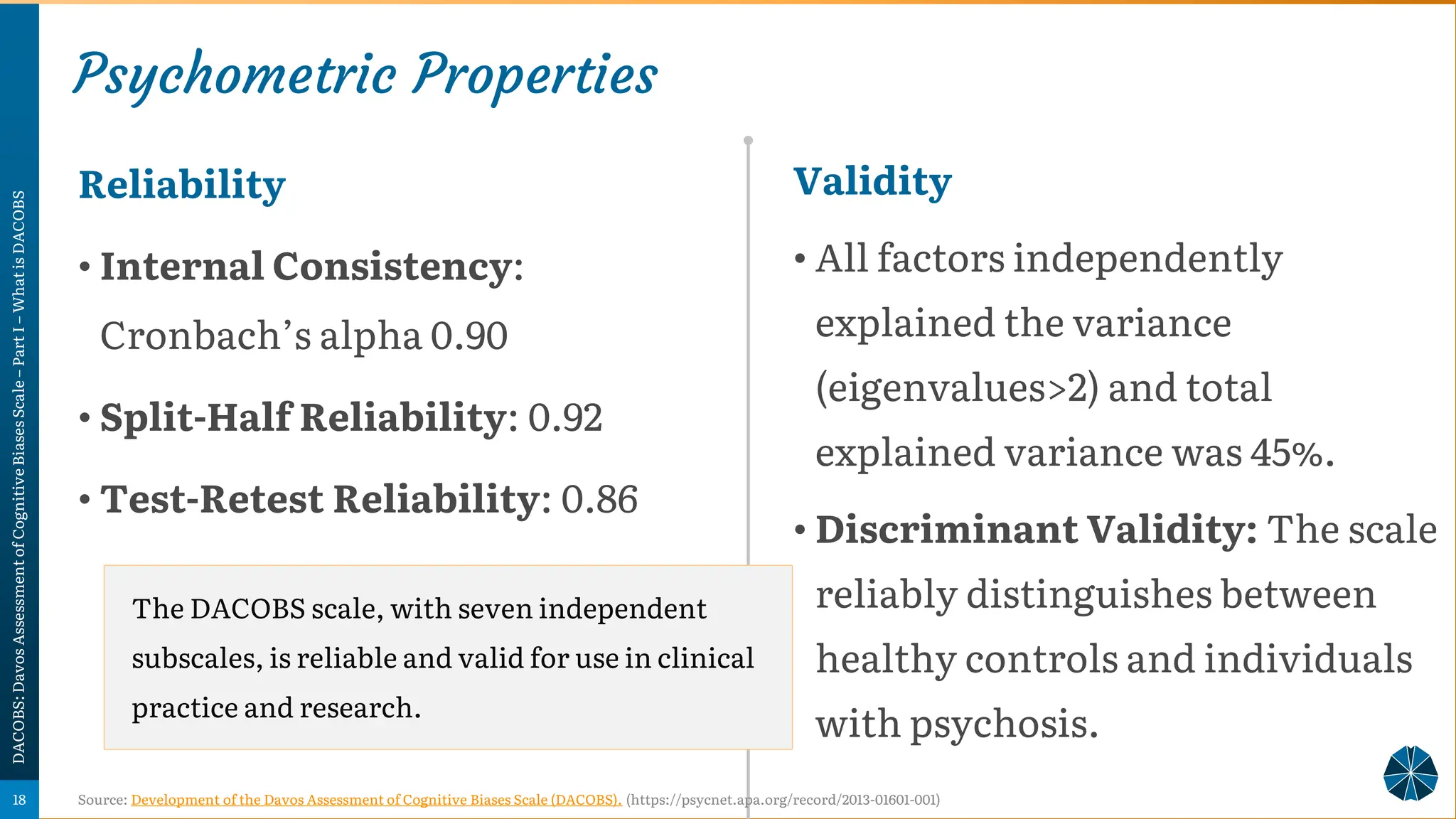
Reliability
• Internal Consistency:
Cronbach’s alpha 0.90
• Split-Half Reliability: 0.92
• Test-Retest Reliability: 0.86
Validity
• All factors independently
explained the variance
(eigenvalues>2) and total
explained variance was 45%.
• Discriminant Validity: The scale
reliably distinguishes between
healthy controls and individuals
with psychosis.
DACOBS:
Davos
Assessment
of
Cognitive
Biases
Scale
–
Part
I
–
What
is
DACOBS
Source: Development of the Davos Assessment of Cognitive Biases Scale (DACOBS). (https://psycnet.apa.org/record/2013-01601-001)
18
The DACOBS scale, with seven independent
subscales, is reliable and valid for use in clinical
practice and research.
Click Here to Access
Free Psychometrics Library
Scientific assessments to evaluate personality, strengths, wellbeing,
stress, happiness, and many other variables. Includes Psychodiagnostics.
Click Here to Access
19
Instructions
Kindly keep these instructions in mind while filling the questionnaire:
• This inventory lists different attitudes or beliefs which people sometimes hold.
• Read each statement carefully and decide how much you agree or disagree with the
statement.
• For each of the attitudes, choose the answer that best describes how you think.
• Because people are different, there is no right answer or wrong answer to these
statements.
• To decide whether a given attitude is typical of your way of looking at things, simply keep
in mind what you were like in the past two weeks.
• The questionnaire may take about 15 minutes to fill – please fill it in a single sitting at a time
when you can fill it with minimum disturbance and maximum focus.
DACOBS:
Davos
Assessment
of
Cognitive
Biases
Scale
–
Part
I
–
What
is
DACOBS
Footer
20
DACOBS
Part II: For Learners and Practitioners
By Aahluwaalyaa
Art
created
using
Gemini
Davos Assessment of Cognitive Biases
Scale
A comprehensive tool for
measuring cognitive
problems and biases
Contents
Part 1: What is DACOBS
1. Introduction to the Tool
2. History and Evolution
3. Theoretical Foundations
4. Structure
5. Psychometric Properties
DACOBS:
Davos
Assessment
of
Cognitive
Biases
Scale
–
Part
I
–
What
is
DACOBS
Footer
22
Part 2: How to use the DACOBS
1. Administration
2. Scoring
3. Interpretation
4. Applications
5. Advantages and Limitations
6. Usage Rights and Access
Administration
DACOBS:
Davos
Assessment
of
Cognitive
Biases
Scale
–
Part
II
–
How
to
use
the
DACOBS
Footer
23
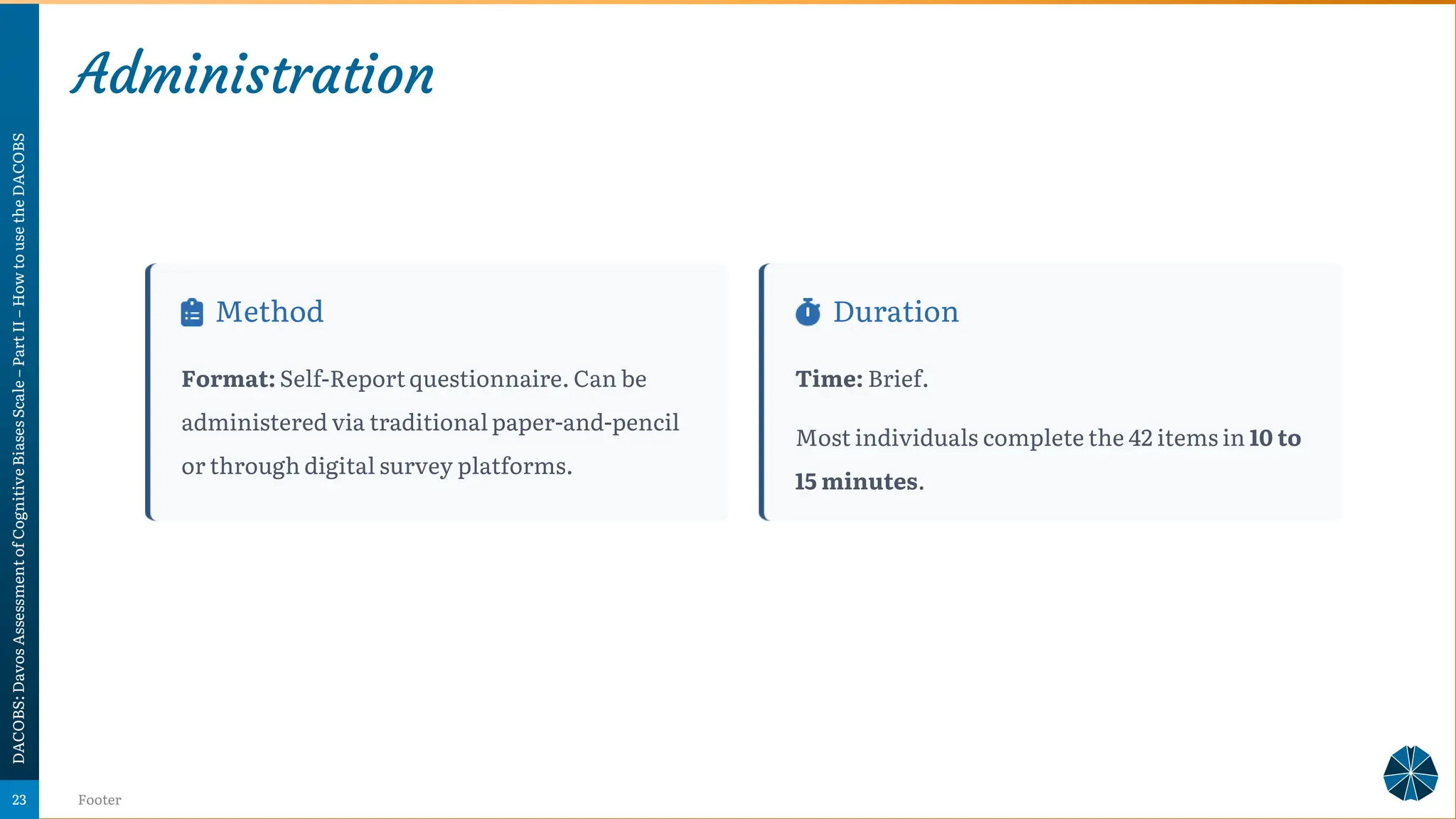
Method
Format: Self-Report questionnaire. Can be
administered via traditional paper-and-pencil
or through digital survey platforms.
Duration
Time: Brief.
Most individuals complete the 42 items in 10 to
15 minutes.
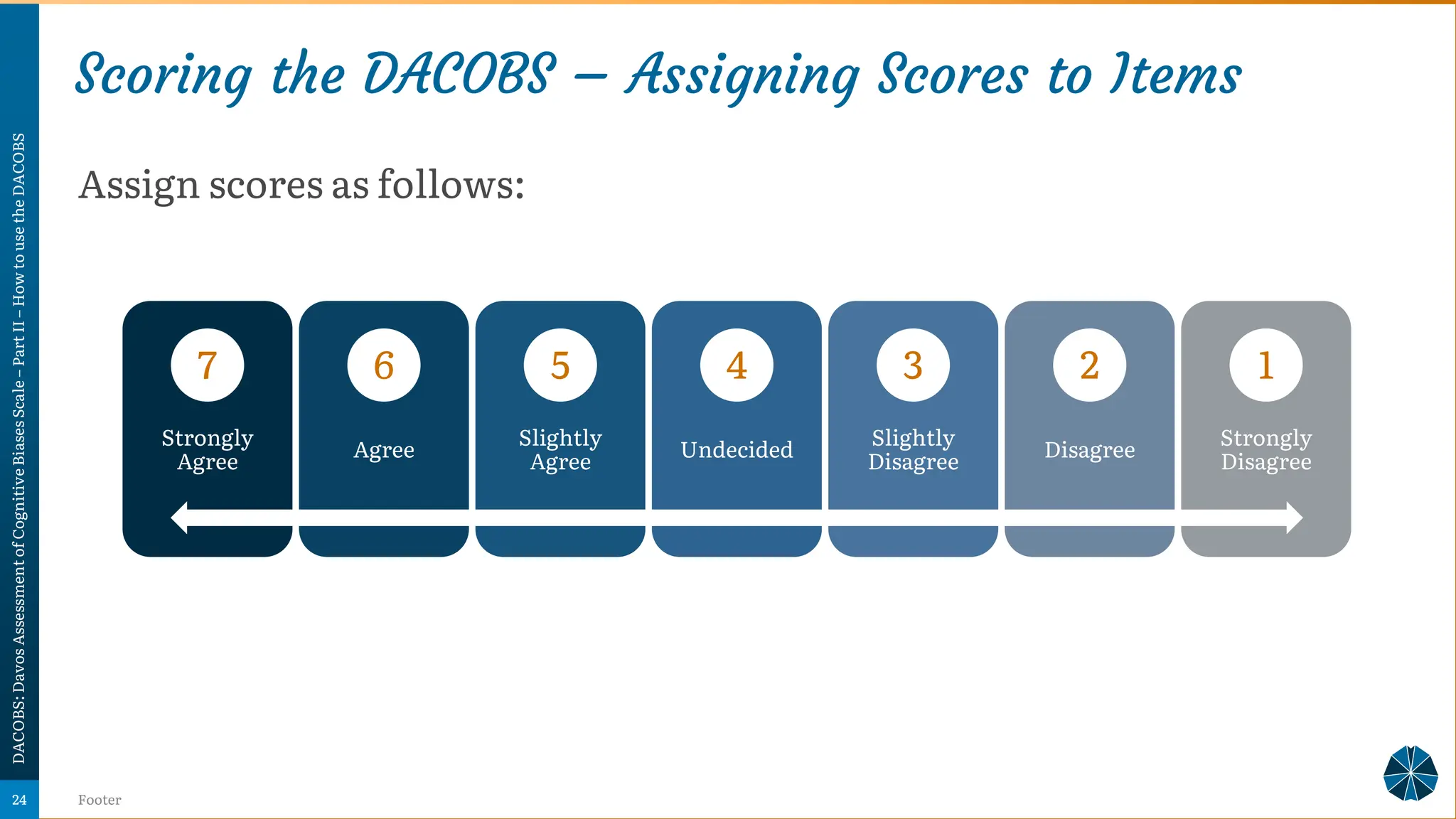
Scoring the DACOBS – Assigning Scores to Items
Assign scores as follows:
DACOBS:
Davos
Assessment
of
Cognitive
Biases
Scale
–
Part
II
–
How
to
use
the
DACOBS
Footer
24
Strongly
Agree
7
Agree
6
Slightly
Agree
5
Undecided
4
Slightly
Disagree
3
Disagree
2
Strongly
Disagree
1
Scoring the DACOBS – Calculating Subscale Scores
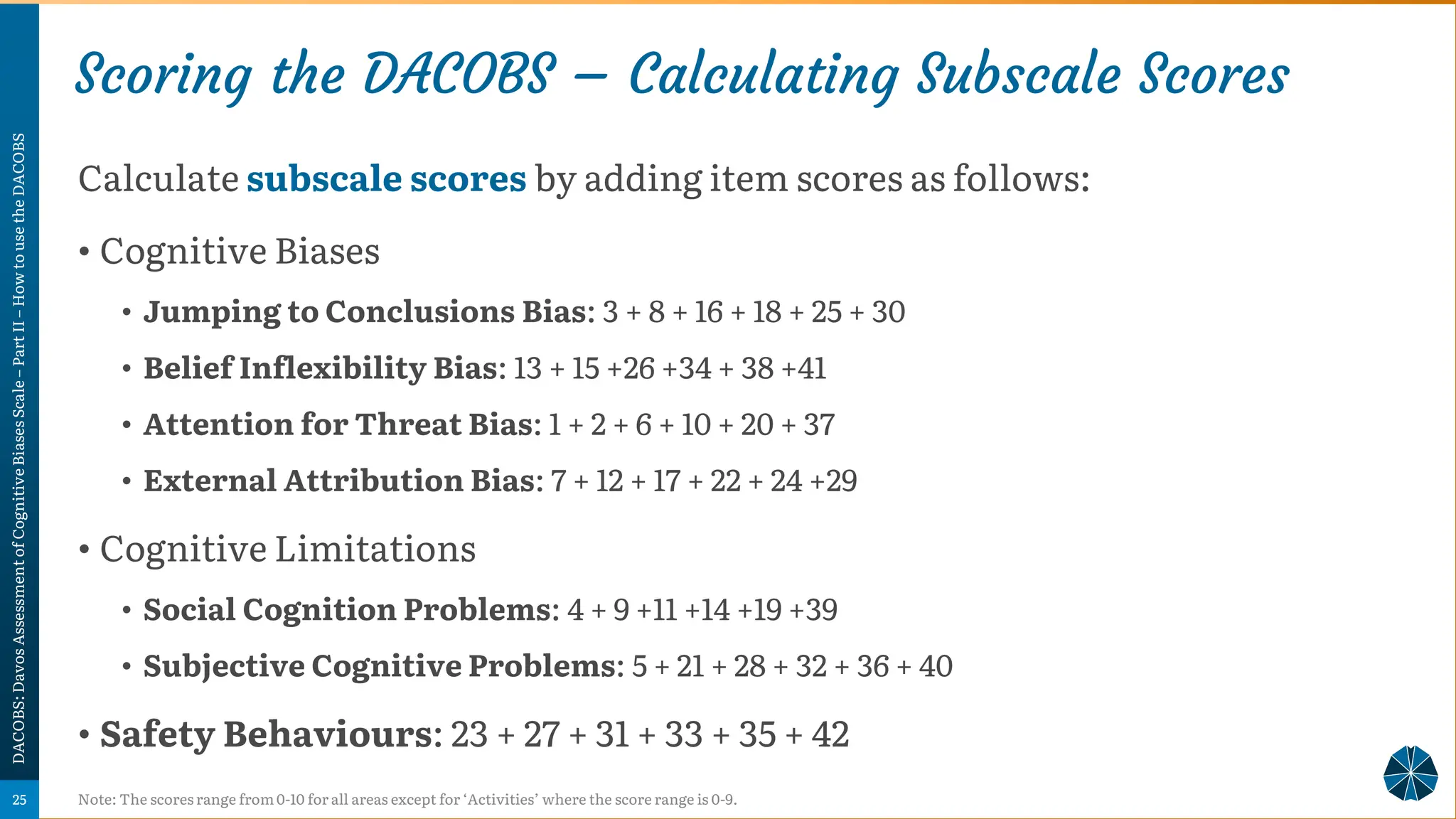
Calculate subscale scores by adding item scores as follows:
• Cognitive Biases
• Jumping to Conclusions Bias: 3 + 8 + 16 + 18 + 25 + 30
• Belief Inflexibility Bias: 13 + 15 +26 +34 + 38 +41
• Attention for Threat Bias: 1 + 2 + 6 + 10 + 20 + 37
• External Attribution Bias: 7 + 12 + 17 + 22 + 24 +29
• Cognitive Limitations
• Social Cognition Problems: 4 + 9 +11 +14 +19 +39
• Subjective Cognitive Problems: 5 + 21 + 28 + 32 + 36 + 40
• Safety Behaviours: 23 + 27 + 31 + 33 + 35 + 42
DACOBS:
Davos
Assessment
of
Cognitive
Biases
Scale
–
Part
II
–
How
to
use
the
DACOBS
Note: The scores range from 0-10 for all areas except for ‘Activities’ where the score range is 0-9.
25
Interpretation of Results
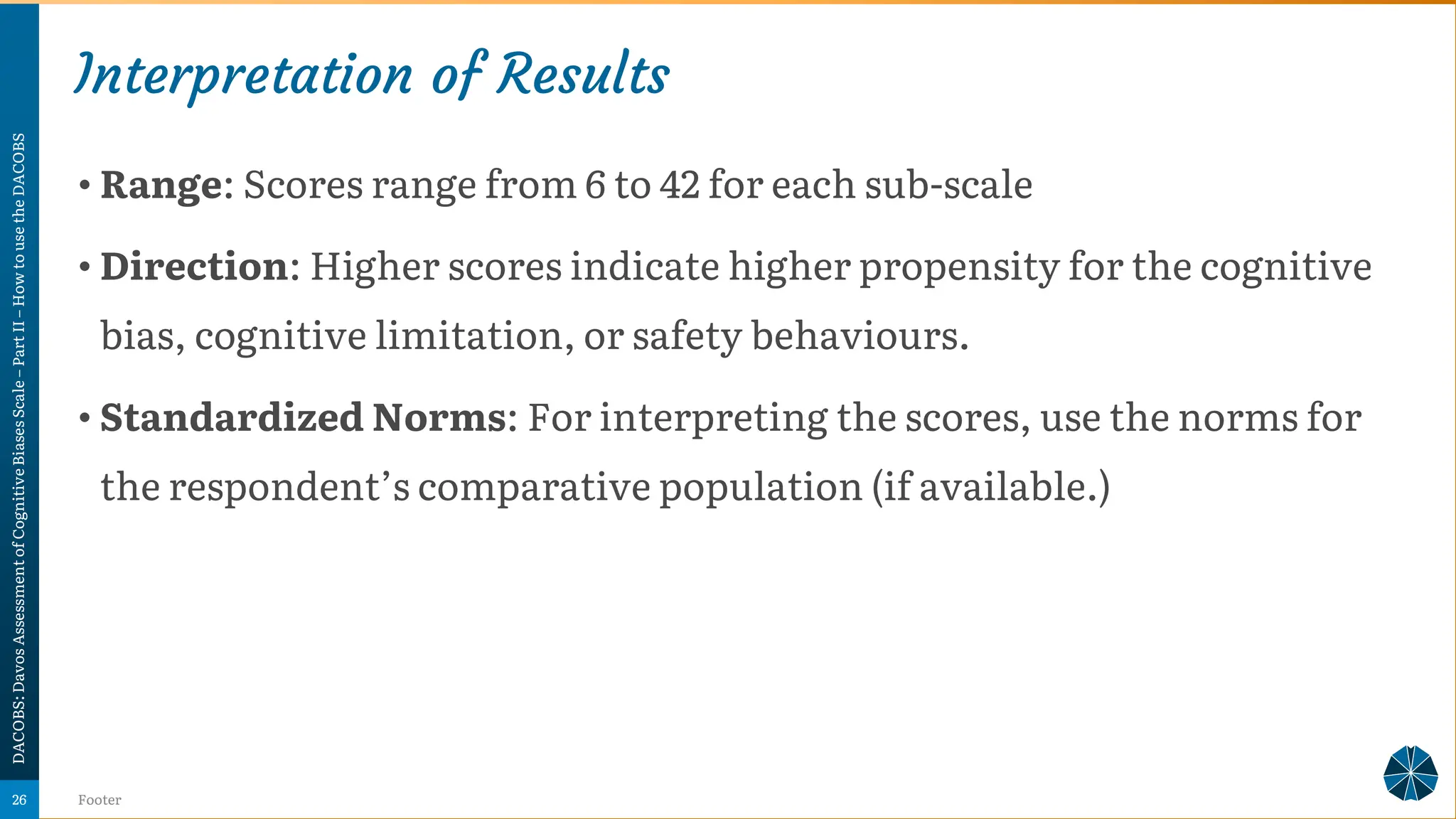
• Range: Scores range from 6 to 42 for each sub-scale
• Direction: Higher scores indicate higher propensity for the cognitive
bias, cognitive limitation, or safety behaviours.
• Standardized Norms: For interpreting the scores, use the norms for
the respondent’s comparative population (if available.)
DACOBS:
Davos
Assessment
of
Cognitive
Biases
Scale
–
Part
II
–
How
to
use
the
DACOBS
Footer
26
Real-World Applications
DACOBS:
Davos
Assessment
of
Cognitive
Biases
Scale
–
Part
II
–
How
to
use
the
DACOBS
Footer
27
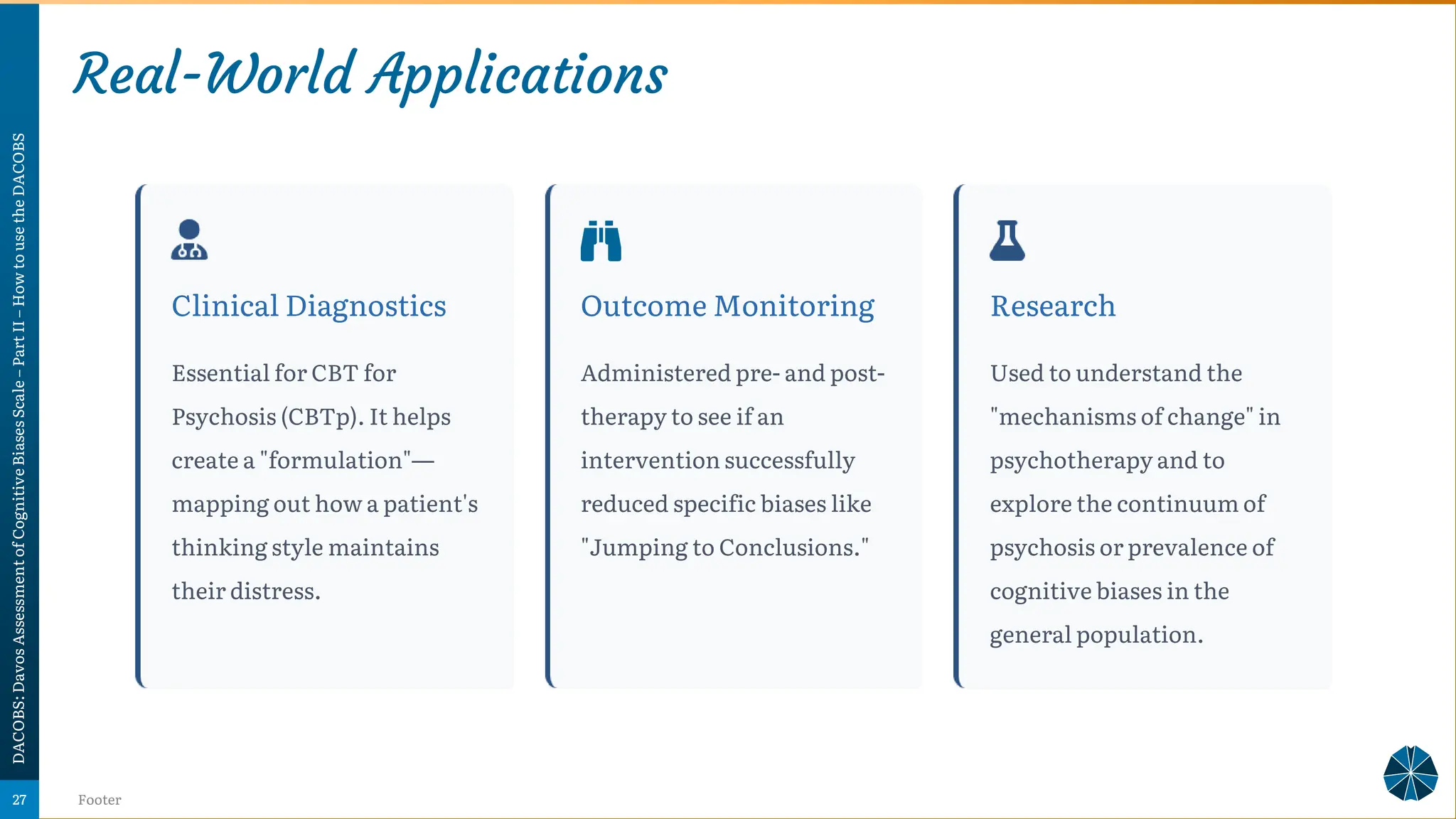
Clinical Diagnostics
Essential for CBT for
Psychosis (CBTp). It helps
create a "formulation"—
mapping out how a patient's
thinking style maintains
their distress.
Outcome Monitoring
Administered pre- and post-
therapy to see if an
intervention successfully
reduced specific biases like
"Jumping to Conclusions."
Research
Used to understand the
"mechanisms of change" in
psychotherapy and to
explore the continuum of
psychosis or prevalence of
cognitive biases in the
general population.
Critical Evaluation
DACOBS:
Davos
Assessment
of
Cognitive
Biases
Scale
–
Part
II
–
How
to
use
the
DACOBS
Footer
28
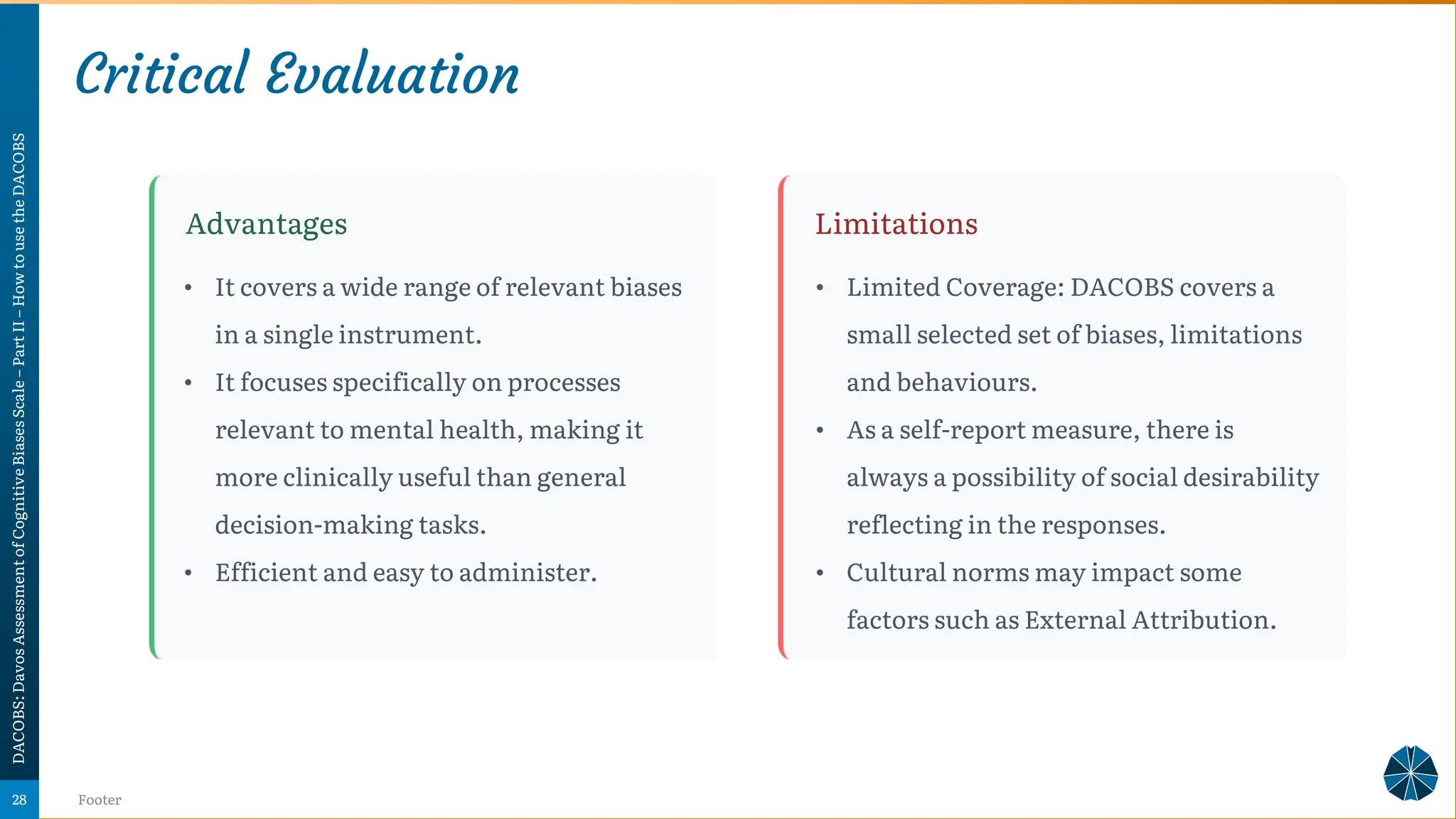
Advantages Limitations
• It covers a wide range of relevant biases
in a single instrument.
• It focuses specifically on processes
relevant to mental health, making it
more clinically useful than general
decision-making tasks.
• Efficient and easy to administer.
• Limited Coverage: DACOBS covers a
small selected set of biases, limitations
and behaviours.
• As a self-report measure, there is
always a possibility of social desirability
reflecting in the responses.
• Cultural norms may impact some
factors such as External Attribution.
Usage Rights & Access
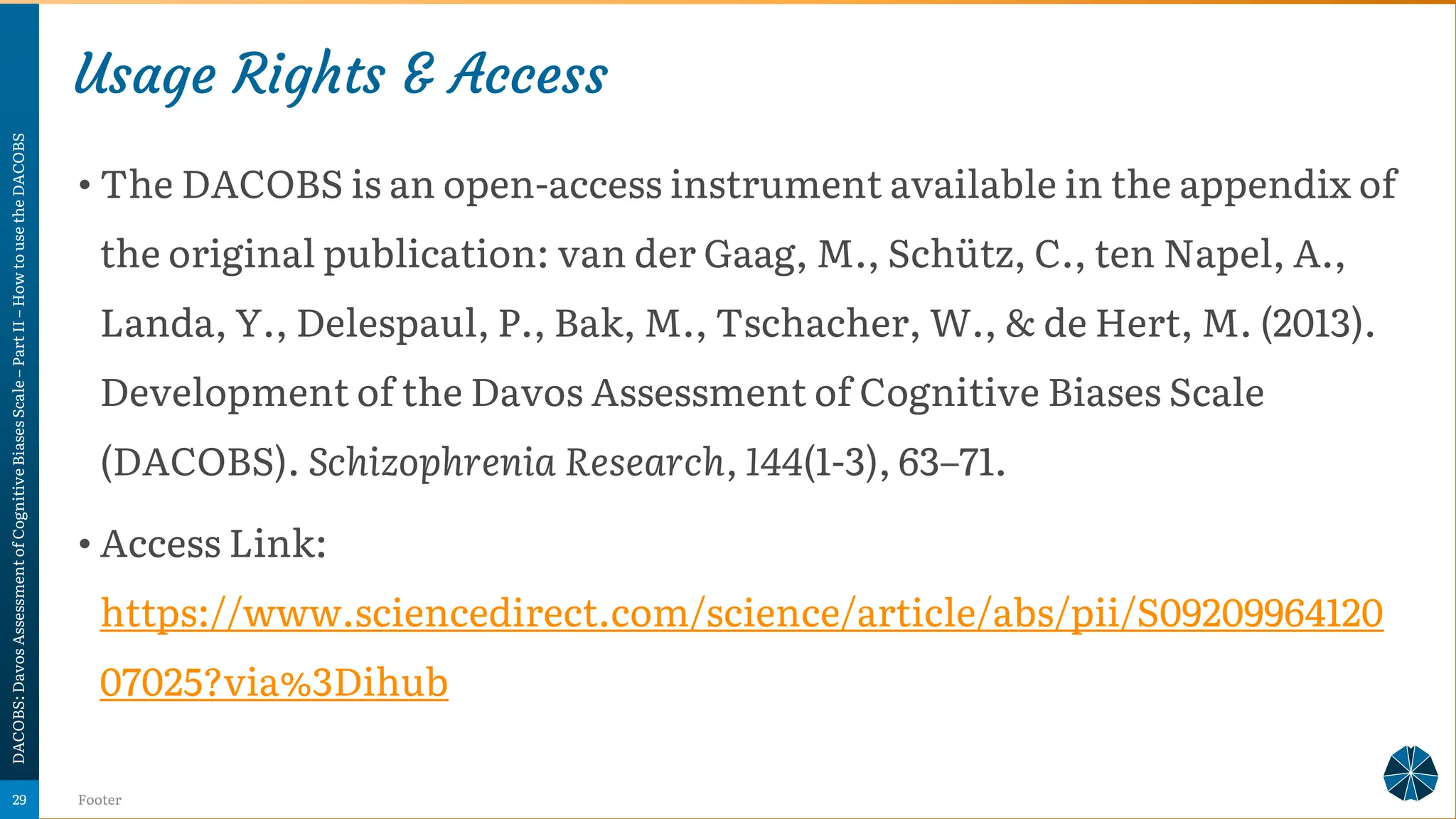
• The DACOBS is an open-access instrument available in the appendix of
the original publication: van der Gaag, M., Schütz, C., ten Napel, A.,
Landa, Y., Delespaul, P., Bak, M., Tschacher, W., & de Hert, M. (2013).
Development of the Davos Assessment of Cognitive Biases Scale
(DACOBS). Schizophrenia Research, 144(1-3), 63–71.
• Access Link:
https://www.sciencedirect.com/science/article/abs/pii/S09209964120
07025?via%3Dihub
DACOBS:
Davos
Assessment
of
Cognitive
Biases
Scale
–
Part
II
–
How
to
use
the
DACOBS
Footer
29
Click Here to Access
Free Psychometrics Library
Scientific assessments to evaluate personality, strengths, wellbeing,
stress, happiness, and many other variables. Includes PsychoDiagnostics.
Click Here to Access
30
Click Here to Access
Psychology Learners
Serving Psychology students since 2014!
Super-Notes
Super-Notes
PsychoTech Services
PsychoTech Services
Psychology Learners
Psychology Learners
FREE IGNOU Help Center
The Real Happiness Center
Stay Updated!
Join our Telegram Group:
Join Now
Join Now
Super-Notes
Super-Notes
PsychoTech Services
PsychoTech Services
Psychology Learners
Psychology Learners
FREE IGNOU Help Center
The Real Happiness Center
Do you have any questions
or suggestions?
Message Us
Message Us
Click Here to Access
Click Here!
Do you know: Watching movies is probably
the best way of learning about something?
We have curated a list of movies directly and indirectly related to psychology...
Click Here to Access
Click Here!
Are you looking for books to help you apply
the concepts of Psychology in real life?
We have a collection of reviews, previews, and legally free e-books for you…
www.RealHappinessCenter.com
The
Real Happiness
Center
The
Real Happiness
Center
Super-Notes
Super-Notes
PsychoTech Services
PsychoTech Services
Psychology Learners
Psychology Learners
FREE IGNOU Help Center
The Real Happiness Center
Free IGNOU Help Center
Helping IGNOU students since 2014!
All resources on FIHC – Assignments, Super-Notes, Study Material, Practical Files, Project Files, etc. are available FREE of cost!
Helping IGNOU students since 2014!
All resources on FIHC – Assignments, Super-Notes, Study Material,
Practical Files, Project Files, etc. are available FREE of cost!
Click Here to Access
IGNOU Psychology Hub
Helping IGNOU students since 2014!
Free IGNOU Help App
Now available for download on the Google Play Store
Click Here to Download
Free IGNOU Help App
Now available for download on the
Google Play Store
Click Here to Download
The Architecture of Thought: Understanding the DACOBS (Davos Assessment of Cognitive Biases Scale)

The Architecture of Thought: Understanding the DACOBS (Davos Assessment of Cognitive Biases Scale)

  • 1.
    DACOBS Davos Assessment ofCognitive Biases Scale A comprehensive tool for measuring cognitive problems and biases Part I: For Everyone Interested By Aahluwaalyaa Art created using Gemini
  • 2.
    © 2025, PsychoTechServices Trademarks ‘Super-Notes’, ‘All About’, ‘Psychology Learners’, ‘PsyLearners’, ‘M S Ahluwalia’, ‘PsychoTech Services’, ‘Real Happiness Center’, ‘FREE IGNOU Help Center’, ‘FIHC’ and the msa logo, the PsyLearners logo, FIHC logo, Star and Starji logos for Real Happiness Center and PsychoTech Services logo are trademarks of M S Ahluwalia in India and other countries, and may not be used without explicit written permission. All other trademarks are the property of their respective owners. PsychoTech Services and the owners thereof, are not associated with any product or vendor mentioned in this book. Limit of liability/disclaimer of warranty The publisher and the author make no representations or warranties with respect to the accuracy or completeness of the contents of this work and specifically disclaim all warranties, including without limitation warranties of fitness for a particular purpose. This book should not be used as a replacement of expert opinion. No warranty may be created or extended by sales or promotional materials. The advice and strategies contained herein may not be suitable for every situation. This work is sold with the understanding that the publisher is not engaged in rendering legal, accounting, or other professional services. If professional assistance is required, the services of a competent professional person should be sought. Neither the publisher nor the author shall be liable for damages arising herefrom. The fact that an organization or website is referred to in this work as a citation and/or a potential source of further information does not mean that the author or the publisher endorses the information the organization or website may provide or recommendations it may make. Further, readers should be aware that internet websites listed in this work may have changed or disappeared between when this work was written and when it is read. This document was prepared with the intent of helping students. Students are advised to be careful while using this. There may be errors in the analysis/document considering it has not undergone peer review. In case you notice any errors or have any suggestions for the improvement of this document, you can leave a detailed comment on the respective page on our site or other channel from where you got access to the document. For general information on our other publications or for any kind of support or further information, you may visit our website. Disclaimer 2 PsyLearners.PsychoTechServices.com
  • 3.
  • 4.
    Click Here toAccess Click Here to Access Click here for Super-Notes! SuperNotes - Learn Better, Faster A proprietary approach developed by bringing together the best of learning theories from Psychology, design principles from the world of visualization, and pedagogical methods from over a decade of training experience, that enables you to: Learn Better, Faster.
  • 5.
    Psychology made easyand interesting… • Psychology Super-Notes PsyConcepts PsyQuotes Checklists and templates for a professional look, that also reduce errors PsyTemplates Cards that help you understand and remember complicated concepts. PsyConcepts Quotes complete with contextual explanations to help understand the real meaning PsyQuotes Checklists and templates for a professional look, that also reduce errors PsyTemplates 5 PsyLearners.PsychoTechServices.com
  • 6.
    Super-Notes Super-Notes PsychoTech Services PsychoTech Services PsychologyLearners Psychology Learners FREE IGNOU Help Center FREE IGNOU Help Center The Real Happiness Center The Real Happiness Center We are here to help you… It’s in our DNA. We were born out of a project to help students!
  • 7.
    We are hereto help you! • Psychology Super-Notes If you are a faculty or student of psychology, this document may be just what you need! Universities often have a vast syllabus, and there is limited support from the faculty and university. But the exams are tough. Unfortunately, students often don’t get sufficient support for their exams. We at PsychoTech Services have launched several efforts to help psychology students – if you haven’t visited our site yet, now might be the right time – Click Here! Look for PsyConcepts, PsyQuotes, guidance for solving the assignments, practicals, projects, and internships, our highly accurate ‘Exam Question Pattern Analysis’, and PsyTemplates - to make your submissions look more professional and high quality. Also, remember, your exams will test both your knowledge and your ability to present the answers well. So, work on both these aspects – for some very useful tips on read How to Score More in your Exams! We hope that all the resources we have created for you will help you to complete your course requirements successfully! Good Luck!!! 7 PsyLearners.PsychoTechServices.com
  • 8.
    Super-Notes Super-Notes ychoTech Services PsychoTech Services PsychologyLearners Psychology Learners FREE IGNOU Help Center FREE IGNOU Help Center The Real Happiness Center The Real Happiness Center Let’s Start…
  • 9.
    Super-Notes Super-Notes PsychoTech Services PsychoTech Services PsychologyLearners Psychology Learners FREE IGNOU Help Center FREE IGNOU Help Center The Real Happiness Center The Real Happiness Center We do not see things as they are, we see them as we are. Footer 9
  • 10.
    Contents Part 1: Whatis DACOBS 1. Introduction to the Tool 2. History and Evolution 3. Theoretical Foundations 4. Structure 5. Psychometric Properties DACOBS: Davos Assessment of Cognitive Biases Scale – Part I – What is DACOBS Footer 10 Part 2: How to use the DACOBS 1. Administration 2. Scoring 3. Interpretation 4. Applications 5. Advantages and Limitations 6. Usage Rights and Access
  • 11.
    Introduction • 42-item self-reportquestionnaire • assesses specific cognitive biases DACOBS: Davos Assessment of Cognitive Biases Scale – Part I – What is DACOBS Footer 11 Operationalisation Unlike general IQ tests, it measures how we process information - specifically focusing on tendencies like jumping to conclusions or attributing events to external causes. The responses are given on a 1 to 7 Likert scale, ranging from “Strongly Disagree” (1) to “Strongly Agree” (7). Core Function Quantifies subjective cognitive problems and thinking patterns often seen in schizophrenia spectrum disorders, but also present in the general population.
  • 12.
    History & Evolution:From DAS to DACOBS • Development • Developed By: Mark van der Gaag and colleagues (2013). • Named after the Davos conference where the concepts were refined. • Context: • Created during the "cognitive turn" in psychosis research. Therapists needed a way to measure the processes of delusional thinking, not just the content. DACOBS: Davos Assessment of Cognitive Biases Scale – Part I – What is DACOBS Footer 12
  • 13.
    Theoretical Foundations • Rootedin Cognitive Behavioral Therapy for psychosis (CBTp). • It posits that distinct biases (like 'data gathering bias') contribute to the formation and maintenance of delusions. DACOBS: Davos Assessment of Cognitive Biases Scale – Part I – What is DACOBS Footer 13
  • 14.
    The Structure: 7subscales across 3 dimensions Seven distinct cognitive domains containing 6 items each. DACOBS: Davos Assessment of Cognitive Biases Scale – Part I – What is DACOBS Footer 14 Cognitive Biases 1.Jumping to Conclusions 2.Belief Inflexibility 3.Attention for Threat 4.External Attribution Cognitive Limitations 5.Social Cognition Problems 6.Subjective Cognitive Problems Safety Behaviors 7.Safety Behaviors
  • 15.
    The Structure: 1.Cognitive Biases DACOBS: Davos Assessment of Cognitive Biases Scale – Part I – What is DACOBS Footer 15 Jumping to Conclusions Tendency to make decisions with little evidence Belief Inflexibility Reluctance to change opinions even when facing new facts Attention for Threat Hyper-vigilance towards potentially dangerous stimuli External Attribution Tendency to blame outside forces or people for events
  • 16.
    The Structure: 2.Cognitive Limitations DACOBS: Davos Assessment of Cognitive Biases Scale – Part I – What is DACOBS Footer 16 Social Cognition Problems Difficulty understanding social cues and intentions of others. Subjective Cognitive Problems Perceived difficulties in concentration and thinking clearly.
  • 17.
    The Structure: 3.Safety Behaviours DACOBS: Davos Assessment of Cognitive Biases Scale – Part I – What is DACOBS Footer 17 Safety Behaviors Actions taken to avoid perceived threats or anxiety.
  • 18.
    Psychometric Properties Reliability • InternalConsistency: Cronbach’s alpha 0.90 • Split-Half Reliability: 0.92 • Test-Retest Reliability: 0.86 Validity • All factors independently explained the variance (eigenvalues>2) and total explained variance was 45%. • Discriminant Validity: The scale reliably distinguishes between healthy controls and individuals with psychosis. DACOBS: Davos Assessment of Cognitive Biases Scale – Part I – What is DACOBS Source: Development of the Davos Assessment of Cognitive Biases Scale (DACOBS). (https://psycnet.apa.org/record/2013-01601-001) 18 The DACOBS scale, with seven independent subscales, is reliable and valid for use in clinical practice and research.
  • 19.
    Click Here toAccess Click Here to Access Free Psychometrics Library Scientific assessments to evaluate personality, strengths, wellbeing, stress, happiness, and many other variables. Includes Psychodiagnostics. Click Here to Access Click Here to Access 19
  • 20.
    Instructions Kindly keep theseinstructions in mind while filling the questionnaire: • This inventory lists different attitudes or beliefs which people sometimes hold. • Read each statement carefully and decide how much you agree or disagree with the statement. • For each of the attitudes, choose the answer that best describes how you think. • Because people are different, there is no right answer or wrong answer to these statements. • To decide whether a given attitude is typical of your way of looking at things, simply keep in mind what you were like in the past two weeks. • The questionnaire may take about 15 minutes to fill – please fill it in a single sitting at a time when you can fill it with minimum disturbance and maximum focus. DACOBS: Davos Assessment of Cognitive Biases Scale – Part I – What is DACOBS Footer 20
  • 21.
    DACOBS Part II: ForLearners and Practitioners By Aahluwaalyaa Art created using Gemini Davos Assessment of Cognitive Biases Scale A comprehensive tool for measuring cognitive problems and biases
  • 22.
    Contents Part 1: Whatis DACOBS 1. Introduction to the Tool 2. History and Evolution 3. Theoretical Foundations 4. Structure 5. Psychometric Properties DACOBS: Davos Assessment of Cognitive Biases Scale – Part I – What is DACOBS Footer 22 Part 2: How to use the DACOBS 1. Administration 2. Scoring 3. Interpretation 4. Applications 5. Advantages and Limitations 6. Usage Rights and Access
  • 23.
    Administration DACOBS: Davos Assessment of Cognitive Biases Scale – Part II – How to use the DACOBS Footer 23 Method Format: Self-Report questionnaire.Can be administered via traditional paper-and-pencil or through digital survey platforms. Duration Time: Brief. Most individuals complete the 42 items in 10 to 15 minutes.
  • 24.
    Scoring the DACOBS– Assigning Scores to Items Assign scores as follows: DACOBS: Davos Assessment of Cognitive Biases Scale – Part II – How to use the DACOBS Footer 24 Strongly Agree 7 Agree 6 Slightly Agree 5 Undecided 4 Slightly Disagree 3 Disagree 2 Strongly Disagree 1
  • 25.
    Scoring the DACOBS– Calculating Subscale Scores Calculate subscale scores by adding item scores as follows: • Cognitive Biases • Jumping to Conclusions Bias: 3 + 8 + 16 + 18 + 25 + 30 • Belief Inflexibility Bias: 13 + 15 +26 +34 + 38 +41 • Attention for Threat Bias: 1 + 2 + 6 + 10 + 20 + 37 • External Attribution Bias: 7 + 12 + 17 + 22 + 24 +29 • Cognitive Limitations • Social Cognition Problems: 4 + 9 +11 +14 +19 +39 • Subjective Cognitive Problems: 5 + 21 + 28 + 32 + 36 + 40 • Safety Behaviours: 23 + 27 + 31 + 33 + 35 + 42 DACOBS: Davos Assessment of Cognitive Biases Scale – Part II – How to use the DACOBS Note: The scores range from 0-10 for all areas except for ‘Activities’ where the score range is 0-9. 25
  • 26.
    Interpretation of Results •Range: Scores range from 6 to 42 for each sub-scale • Direction: Higher scores indicate higher propensity for the cognitive bias, cognitive limitation, or safety behaviours. • Standardized Norms: For interpreting the scores, use the norms for the respondent’s comparative population (if available.) DACOBS: Davos Assessment of Cognitive Biases Scale – Part II – How to use the DACOBS Footer 26
  • 27.
    Real-World Applications DACOBS: Davos Assessment of Cognitive Biases Scale – Part II – How to use the DACOBS Footer 27 Clinical Diagnostics Essentialfor CBT for Psychosis (CBTp). It helps create a "formulation"— mapping out how a patient's thinking style maintains their distress. Outcome Monitoring Administered pre- and post- therapy to see if an intervention successfully reduced specific biases like "Jumping to Conclusions." Research Used to understand the "mechanisms of change" in psychotherapy and to explore the continuum of psychosis or prevalence of cognitive biases in the general population.
  • 28.
    Critical Evaluation DACOBS: Davos Assessment of Cognitive Biases Scale – Part II – How to use the DACOBS Footer 28 Advantages Limitations •It covers a wide range of relevant biases in a single instrument. • It focuses specifically on processes relevant to mental health, making it more clinically useful than general decision-making tasks. • Efficient and easy to administer. • Limited Coverage: DACOBS covers a small selected set of biases, limitations and behaviours. • As a self-report measure, there is always a possibility of social desirability reflecting in the responses. • Cultural norms may impact some factors such as External Attribution.
  • 29.
    Usage Rights &Access • The DACOBS is an open-access instrument available in the appendix of the original publication: van der Gaag, M., Schütz, C., ten Napel, A., Landa, Y., Delespaul, P., Bak, M., Tschacher, W., & de Hert, M. (2013). Development of the Davos Assessment of Cognitive Biases Scale (DACOBS). Schizophrenia Research, 144(1-3), 63–71. • Access Link: https://www.sciencedirect.com/science/article/abs/pii/S09209964120 07025?via%3Dihub DACOBS: Davos Assessment of Cognitive Biases Scale – Part II – How to use the DACOBS Footer 29
  • 30.
    Click Here toAccess Click Here to Access Free Psychometrics Library Scientific assessments to evaluate personality, strengths, wellbeing, stress, happiness, and many other variables. Includes PsychoDiagnostics. Click Here to Access Click Here to Access 30
  • 31.
    Click Here toAccess Click Here to Access Psychology Learners Serving Psychology students since 2014!
  • 32.
    Super-Notes Super-Notes PsychoTech Services PsychoTech Services PsychologyLearners Psychology Learners FREE IGNOU Help Center FREE IGNOU Help Center The Real Happiness Center The Real Happiness Center Stay Updated! Join our Telegram Group: Join Now Join Now
  • 33.
    Super-Notes Super-Notes PsychoTech Services PsychoTech Services PsychologyLearners Psychology Learners FREE IGNOU Help Center FREE IGNOU Help Center The Real Happiness Center The Real Happiness Center Do you have any questions or suggestions? Message Us Message Us
  • 34.
    Click Here toAccess Click Here to Access Click Here! Do you know: Watching movies is probably the best way of learning about something? We have curated a list of movies directly and indirectly related to psychology...
  • 35.
    Click Here toAccess Click Here to Access Click Here! Are you looking for books to help you apply the concepts of Psychology in real life? We have a collection of reviews, previews, and legally free e-books for you…
  • 36.
  • 37.
    Super-Notes Super-Notes PsychoTech Services PsychoTech Services PsychologyLearners Psychology Learners FREE IGNOU Help Center FREE IGNOU Help Center The Real Happiness Center The Real Happiness Center Free IGNOU Help Center Free IGNOU Help Center Helping IGNOU students since 2014! All resources on FIHC – Assignments, Super-Notes, Study Material, Practical Files, Project Files, etc. are available FREE of cost! Helping IGNOU students since 2014! All resources on FIHC – Assignments, Super-Notes, Study Material, Practical Files, Project Files, etc. are available FREE of cost! Click Here to Access Click Here to Access
  • 38.
    Click Here toAccess Click Here to Access IGNOU Psychology Hub Helping IGNOU students since 2014!
  • 39.
    Free IGNOU HelpApp Now available for download on the Google Play Store Click Here to Download Free IGNOU Help App Now available for download on the Google Play Store Click Here to Download