Presented by
Asheem Kumar Palo
Centurion University, INDIA
INTRODUCTION
Ignition systems are mainly of two types;
I. Spark ignition system
II. Compression ignition system
An ignition system obeys laws of conservation of energy.
Hence it can be treated as a balance of energy between;
i. That provided by an external source
ii. That released by chemical reaction
iii. That dissipated to the surroundings as thermal energy
REQUIREMENTS OF AN IGNITION SYSTEM
It should provide a good spark between the
electrodes of the plugs at the correct timing
It should function efficiently over the entire range of
engine speed.
It should be light, effective & reliable in service.
It should be compact and easy to maintain.
It should be cheap and convenient to handle.
TYPES OF IGNITION SYSTEMS
The ignition systems are classified depending
upon how the primary energy for operating the
circuit is made available as:
I. Battery Ignition System
II. Magneto ignition system
Battery Ignition System
Components of Battery Ignition System
o Battery
o Ignition switch
o Ballast resistor
o Contact breaker
o Capacitor
o Distributor
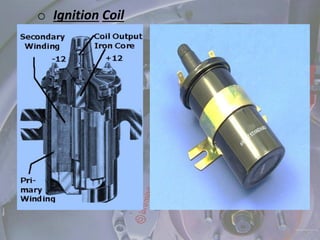
o Ignition Coil
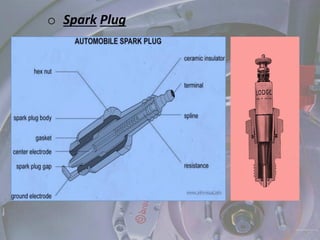
o Spark Plug
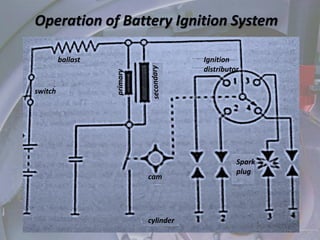
Operation of Battery Ignition System
cam
switch
ballast Ignition
distributor
Spark
plug
cylinder
primary
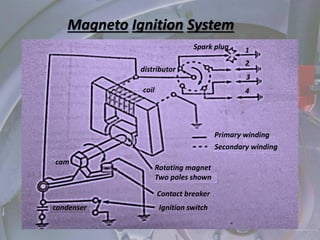
Magneto Ignition System
distributor
coil
cam
condenser
Spark plug
Secondary winding
Primary winding
Rotating magnet
Two poles shown
Contact breaker
Ignition switch
1
2
3
4
Modern Ignition Systems
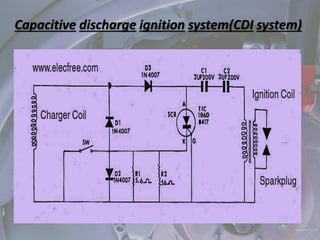
I. Capacitive discharge ignition system(CDI system)
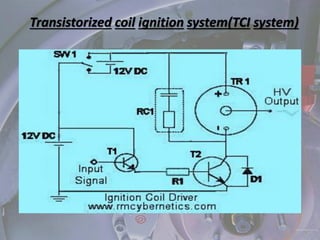
II. Transistorized coil ignition system(TCI system)
Capacitive discharge ignition system(CDI system)
Transistorized coil ignition system(TCI system)
Advantages
Reduced ignition system maintenance
Reduced wear of the components
Increased reliability
Extended spark plug life
Improved ignition of lean mixture
Ignition system

Ignition system

  • 1.
    Presented by Asheem KumarPalo Centurion University, INDIA
  • 2.
    INTRODUCTION Ignition systems aremainly of two types; I. Spark ignition system II. Compression ignition system An ignition system obeys laws of conservation of energy. Hence it can be treated as a balance of energy between; i. That provided by an external source ii. That released by chemical reaction iii. That dissipated to the surroundings as thermal energy
  • 3.
    REQUIREMENTS OF ANIGNITION SYSTEM It should provide a good spark between the electrodes of the plugs at the correct timing It should function efficiently over the entire range of engine speed. It should be light, effective & reliable in service. It should be compact and easy to maintain. It should be cheap and convenient to handle.
  • 4.
    TYPES OF IGNITIONSYSTEMS The ignition systems are classified depending upon how the primary energy for operating the circuit is made available as: I. Battery Ignition System II. Magneto ignition system
  • 5.
    Battery Ignition System Componentsof Battery Ignition System o Battery o Ignition switch o Ballast resistor o Contact breaker o Capacitor o Distributor
  • 6.
  • 7.
  • 8.
    Operation of BatteryIgnition System cam switch ballast Ignition distributor Spark plug cylinder primary
  • 9.
    Magneto Ignition System distributor coil cam condenser Sparkplug Secondary winding Primary winding Rotating magnet Two poles shown Contact breaker Ignition switch 1 2 3 4
  • 10.
    Modern Ignition Systems I.Capacitive discharge ignition system(CDI system) II. Transistorized coil ignition system(TCI system)
  • 11.
  • 12.
    Transistorized coil ignitionsystem(TCI system)
  • 13.
    Advantages Reduced ignition systemmaintenance Reduced wear of the components Increased reliability Extended spark plug life Improved ignition of lean mixture