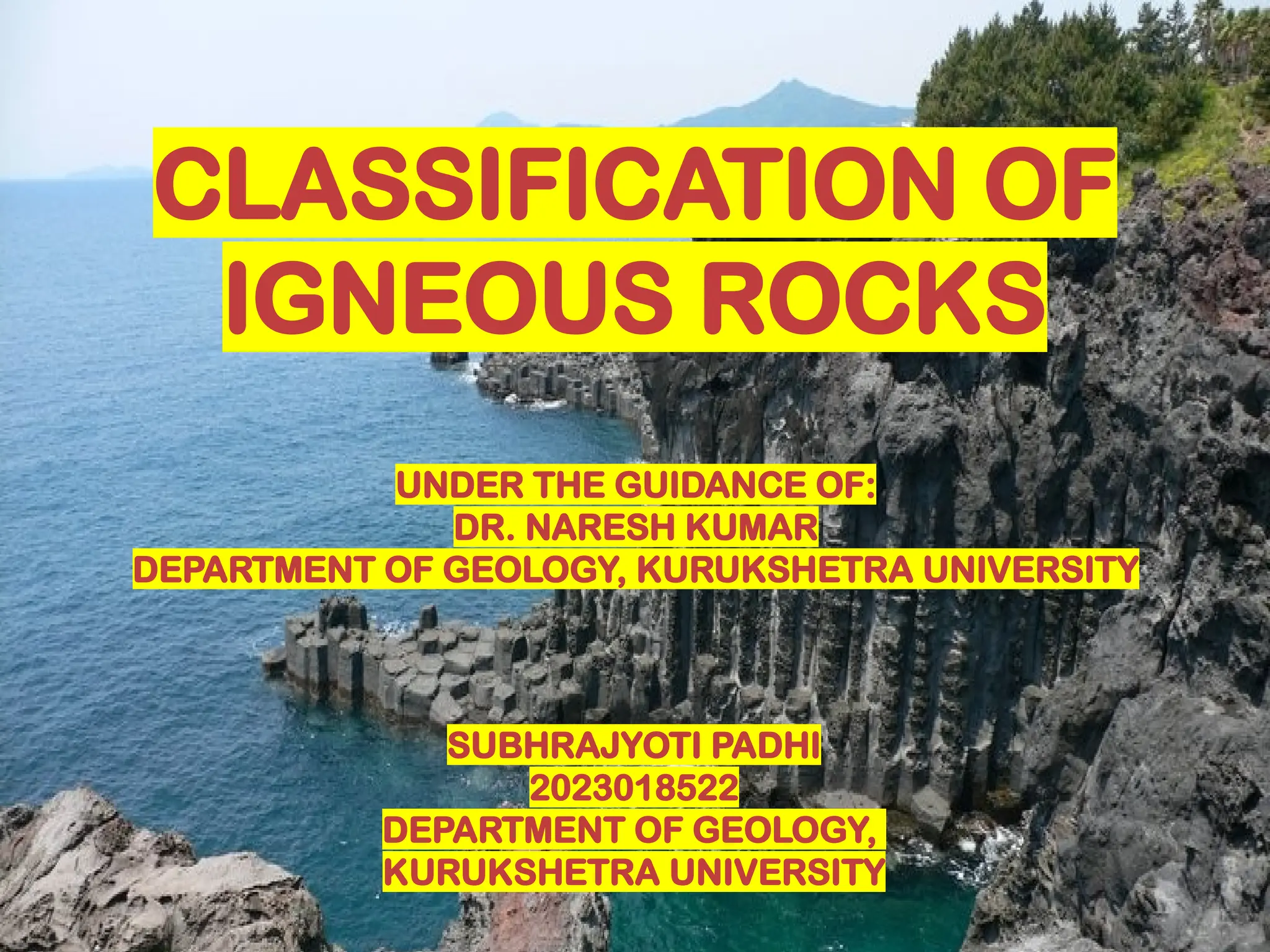
CLASSIFICATION OF
IGNEOUS ROCKS
SUBHRAJYOTI PADHI
2023018522
DEPARTMENT OF GEOLOGY,
KURUKSHETRA UNIVERSITY
UNDER THE GUIDANCE OF:
DR. NARESH KUMAR
DEPARTMENT OF GEOLOGY, KURUKSHETRA UNIVERSITY
CONTENTS
1
• INTRODUCTION
• TEXTURE CRITERION
• COMPOSITION CRITERION
• CLASSIFICATION BASED ON SiO₂%
• CLASSIFICATION BASED ON Al₂O₃%
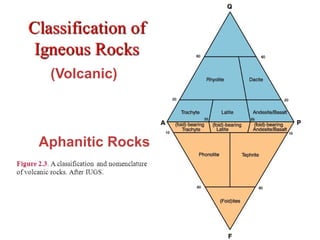
• IUGS CLASSIFICATION
INTRODUCTION
The study of melts (magma) and the rocks that crystallizes
from such melts, encompassing the processes of melting,
evolution, crystallization and eruption of rocks is referred
as Igneous Petrology.
The origin by process of crystallization from melt is
enough criterion for considering a rock to be igneous
rock.
The subject of classification of igneous rock is
perhapes one of the most throughly discussed
problem of petrology and yet without any
satisfactory outcome.
2
A number of classification have been subjected
by different workers in igneous petrology . But
not a single classification is free from limitations.
The preferred method for classifying any rock
(igneous, sedimentary, metamorphic) is based on
texture and composition criterion.
4
Texture criterion is considered first because texture
provides the best evidence for rock origin.
Firstly, Igneous rocks are classified on the three main
category:
a) Phaneritic: visible to naked eye (> 0.1 mm)
b) Aphanitic: not visible to naked eye (<0.1 mm)
c) Fragmental: rocks are composed of pieces of
disaggregated igneous material. (pyroclasts)
5
Further, the grain size (diameter) of phaneritic rocks
mattered and were subdivided as:
Fine grained (<1 mm)
Medium grained (1-5 mm)
Coarse grained (5-50 mm)
Very coarse grained (>50 mm)
Note: very coarse grained rocks are also termed as
pegmatitic (large sized grains present)
6
Grain size also varies in textural criteria as in case of
porphyritic texture, where the large sized grains are
surrounded by smaller grains.
larger grains are referred as PHENOCRYST.
smaller grains are referred as GROUNDMASS.
This is because porphyritic texture experiences two
distinct cooling phases, phenocryst are formed in slow
cooling magma while groundmass are formed in rapid
cooling magma.
7
Compositional criterion refers to chemical composition
of the rock or the proportion of minerals in it.
All igneous rocks are primarily composed of silicate
mineral, which are most commonly used in Bowen’s
Reaction Series:
Quartz, Plagioclase, Alkali Feldspar, Muscovite
Biotite, Hornblende, Pyroxene, Olivine
The first four members are referred as Felsic minerals.
The later four members are referred as Mafic minerals.
8
The term Felsic and Mafic refers to light and dark
coloured silicate minerals.
But however, it should be understood that, Rocks
composed primarily of light coloured minerals (felsic)
should be light coloured themselves (leucocratic).
However on the basis of compositional variation,
classification is on SiO %, Al O %, etc..
₂ ₂ ₃
9
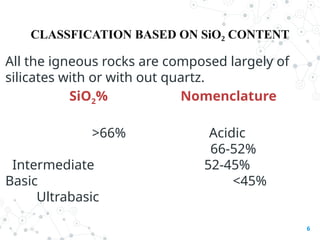
CLASSFICATION BASED ON SiO CONTENT
₂
All the igneous rocks are composed largely of
silicates with or with out quartz.
SiO2% Nomenclature
>66% Acidic
66-52%
Intermediate 52-45%
Basic <45%
Ultrabasic
6
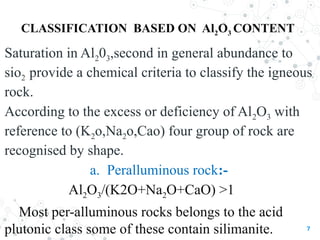
CLASSIFICATION BASED ON Al2O3 CONTENT
7
Saturation in Al203,second in general abundance to
sio2 provide a chemical criteria to classify the igneous
rock.
According to the excess or deficiency of Al2O3 with
reference to (K2o,Na2o,Cao) four group of rock are
recognised by shape.
a. Peralluminous rock:-
Al2O3/(K2O+Na2O+CaO) >1
Most per-alluminous rocks belongs to the acid
plutonic class some of these contain silimanite.
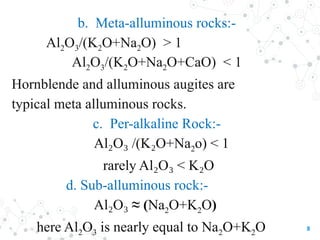
b. Meta-alluminous rocks:-
Al2O3/(K2O+Na2O) > 1
Al2O3/(K2O+Na2O+CaO) < 1
Hornblende and alluminous augites are
typical meta alluminous rocks.
c. Per-alkaline Rock:-
Al O /(K O+Na
₂ ₃ ₂ 2o) < 1
rarely Al O < K O
₂ ₃ ₂
d. Sub-alluminous rock:-
Al O
₂ ₃ ≈ (Na2O+K2O)
here Al2O3 is nearly equal to Na2O+K2O 8
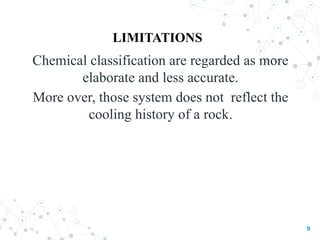
LIMITATIONS
Chemical classification are regarded as more
elaborate and less accurate.
More over, those system does not reflect the
cooling history of a rock.
9
The Final Classification,
IUGS CLASSIFICATION
In 1960s, the International Union of Geological
Sciences (IUGS) formed commission to study the
systematics of Igneous Rocks, to develop a
standardised and workable system of igneous
nomenclature worldwide accepted.
The latest version of classification was published by
Le Maitre et al. 2002.
We will be discussing John Winter’s (2013) approach
of classification hereon.
12
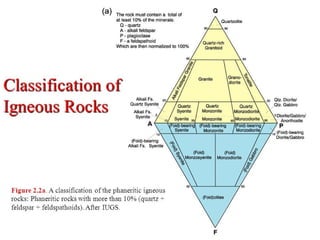
The International Union of Geological Sciences classifies
igneous rocks based on the modal (volume) percentages
of the constituent minerals.
To name a typical rock, one determines the modal
percentages of quartz minerals (Q'), Alkali feldspars (A'),
Plagioclase (P'), Feldspathoids (F'), and Mafics (M’).
15
If the rock has 90% or more Q’ + A’ + P’ + F’, the rock is
named by plotting the relative proportions of these mineral
constituents (normalized to 100%) on the appropriate
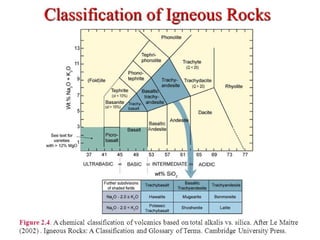
phaneritic or aphanitic diagram. Volcanic rocks in which a
mode is impossible to determine should be classified on the
basis of chemical composition on a total alkali versus silica
(TAS) diagram. Pyroclastic rocks are classified separately on
the basis of the size and nature of the fragments (pyroclasts)
that compose them, including a compositional name,
whenever possible
16
PHANERITIC ROCKS
12
MINERALOGICAL BASIS FOR
CLASSIFICATION
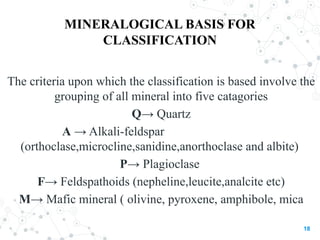
The criteria upon which the classification is based involve the
grouping of all mineral into five catagories
Q→ Quartz
A → Alkali-feldspar
(orthoclase,microcline,sanidine,anorthoclase and albite)
P→ Plagioclase
F→ Feldspathoids (nepheline,leucite,analcite etc)
M→ Mafic mineral ( olivine, pyroxene, amphibole, mica
18
Classification based on scheme of plutonic
19
20
Aphanitic Rocks
12
22
(Volcanic)
Aphanitic Rocks
PYROCLASTIC ROCKS
12
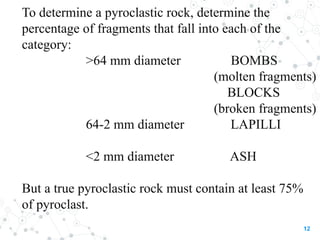
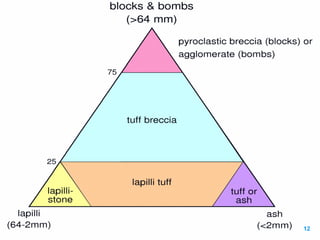
To determine a pyroclastic rock, determine the
percentage of fragments that fall into each of the
category:
>64 mm diameter BOMBS
(molten fragments)
BLOCKS
(broken fragments)
64-2 mm diameter LAPILLI
<2 mm diameter ASH
But a true pyroclastic rock must contain at least 75%
of pyroclast.
12
12
The IUGS classification provide the clear
idea about the varieties of igneous rock
especially the plutonic igneous rock,
signifying the plutonic rock classification to
be the hardest part because of the broad
division of the rocks.
This has to an end on classification of
igneous rocks.
26
REFERENCES
 Igneous petrology – Wikipedia
 Open Petrology – Free Textbook for College-Level Petrolo
gy Courses
 Principles of Igneous and Metamorphic Rocks by J D
Winter.
 Igneous Petrology by Tyrell.
27
CLASSIFICATION OF IGNEOUS ROCKS BY SUBHRAJYOTI

CLASSIFICATION OF IGNEOUS ROCKS BY SUBHRAJYOTI

  • 1.
    CLASSIFICATION OF IGNEOUS ROCKS SUBHRAJYOTIPADHI 2023018522 DEPARTMENT OF GEOLOGY, KURUKSHETRA UNIVERSITY UNDER THE GUIDANCE OF: DR. NARESH KUMAR DEPARTMENT OF GEOLOGY, KURUKSHETRA UNIVERSITY
  • 2.
    CONTENTS 1 • INTRODUCTION • TEXTURECRITERION • COMPOSITION CRITERION • CLASSIFICATION BASED ON SiO₂% • CLASSIFICATION BASED ON Al₂O₃% • IUGS CLASSIFICATION
  • 3.
    INTRODUCTION The study ofmelts (magma) and the rocks that crystallizes from such melts, encompassing the processes of melting, evolution, crystallization and eruption of rocks is referred as Igneous Petrology. The origin by process of crystallization from melt is enough criterion for considering a rock to be igneous rock. The subject of classification of igneous rock is perhapes one of the most throughly discussed problem of petrology and yet without any satisfactory outcome. 2
  • 4.
    A number ofclassification have been subjected by different workers in igneous petrology . But not a single classification is free from limitations. The preferred method for classifying any rock (igneous, sedimentary, metamorphic) is based on texture and composition criterion. 4
  • 5.
    Texture criterion isconsidered first because texture provides the best evidence for rock origin. Firstly, Igneous rocks are classified on the three main category: a) Phaneritic: visible to naked eye (> 0.1 mm) b) Aphanitic: not visible to naked eye (<0.1 mm) c) Fragmental: rocks are composed of pieces of disaggregated igneous material. (pyroclasts) 5
  • 6.
    Further, the grainsize (diameter) of phaneritic rocks mattered and were subdivided as: Fine grained (<1 mm) Medium grained (1-5 mm) Coarse grained (5-50 mm) Very coarse grained (>50 mm) Note: very coarse grained rocks are also termed as pegmatitic (large sized grains present) 6
  • 7.
    Grain size alsovaries in textural criteria as in case of porphyritic texture, where the large sized grains are surrounded by smaller grains. larger grains are referred as PHENOCRYST. smaller grains are referred as GROUNDMASS. This is because porphyritic texture experiences two distinct cooling phases, phenocryst are formed in slow cooling magma while groundmass are formed in rapid cooling magma. 7
  • 8.
    Compositional criterion refersto chemical composition of the rock or the proportion of minerals in it. All igneous rocks are primarily composed of silicate mineral, which are most commonly used in Bowen’s Reaction Series: Quartz, Plagioclase, Alkali Feldspar, Muscovite Biotite, Hornblende, Pyroxene, Olivine The first four members are referred as Felsic minerals. The later four members are referred as Mafic minerals. 8
  • 9.
    The term Felsicand Mafic refers to light and dark coloured silicate minerals. But however, it should be understood that, Rocks composed primarily of light coloured minerals (felsic) should be light coloured themselves (leucocratic). However on the basis of compositional variation, classification is on SiO %, Al O %, etc.. ₂ ₂ ₃ 9
  • 10.
    CLASSFICATION BASED ONSiO CONTENT ₂ All the igneous rocks are composed largely of silicates with or with out quartz. SiO2% Nomenclature >66% Acidic 66-52% Intermediate 52-45% Basic <45% Ultrabasic 6
  • 11.
    CLASSIFICATION BASED ONAl2O3 CONTENT 7 Saturation in Al203,second in general abundance to sio2 provide a chemical criteria to classify the igneous rock. According to the excess or deficiency of Al2O3 with reference to (K2o,Na2o,Cao) four group of rock are recognised by shape. a. Peralluminous rock:- Al2O3/(K2O+Na2O+CaO) >1 Most per-alluminous rocks belongs to the acid plutonic class some of these contain silimanite.
  • 12.
    b. Meta-alluminous rocks:- Al2O3/(K2O+Na2O)> 1 Al2O3/(K2O+Na2O+CaO) < 1 Hornblende and alluminous augites are typical meta alluminous rocks. c. Per-alkaline Rock:- Al O /(K O+Na ₂ ₃ ₂ 2o) < 1 rarely Al O < K O ₂ ₃ ₂ d. Sub-alluminous rock:- Al O ₂ ₃ ≈ (Na2O+K2O) here Al2O3 is nearly equal to Na2O+K2O 8
  • 13.
    LIMITATIONS Chemical classification areregarded as more elaborate and less accurate. More over, those system does not reflect the cooling history of a rock. 9
  • 14.
    The Final Classification, IUGSCLASSIFICATION In 1960s, the International Union of Geological Sciences (IUGS) formed commission to study the systematics of Igneous Rocks, to develop a standardised and workable system of igneous nomenclature worldwide accepted. The latest version of classification was published by Le Maitre et al. 2002. We will be discussing John Winter’s (2013) approach of classification hereon. 12
  • 15.
    The International Unionof Geological Sciences classifies igneous rocks based on the modal (volume) percentages of the constituent minerals. To name a typical rock, one determines the modal percentages of quartz minerals (Q'), Alkali feldspars (A'), Plagioclase (P'), Feldspathoids (F'), and Mafics (M’). 15
  • 16.
    If the rockhas 90% or more Q’ + A’ + P’ + F’, the rock is named by plotting the relative proportions of these mineral constituents (normalized to 100%) on the appropriate phaneritic or aphanitic diagram. Volcanic rocks in which a mode is impossible to determine should be classified on the basis of chemical composition on a total alkali versus silica (TAS) diagram. Pyroclastic rocks are classified separately on the basis of the size and nature of the fragments (pyroclasts) that compose them, including a compositional name, whenever possible 16
  • 17.
  • 18.
    MINERALOGICAL BASIS FOR CLASSIFICATION Thecriteria upon which the classification is based involve the grouping of all mineral into five catagories Q→ Quartz A → Alkali-feldspar (orthoclase,microcline,sanidine,anorthoclase and albite) P→ Plagioclase F→ Feldspathoids (nepheline,leucite,analcite etc) M→ Mafic mineral ( olivine, pyroxene, amphibole, mica 18
  • 19.
    Classification based onscheme of plutonic 19
  • 20.
  • 21.
  • 22.
  • 23.
  • 24.
    To determine apyroclastic rock, determine the percentage of fragments that fall into each of the category: >64 mm diameter BOMBS (molten fragments) BLOCKS (broken fragments) 64-2 mm diameter LAPILLI <2 mm diameter ASH But a true pyroclastic rock must contain at least 75% of pyroclast. 12
  • 25.
  • 26.
    The IUGS classificationprovide the clear idea about the varieties of igneous rock especially the plutonic igneous rock, signifying the plutonic rock classification to be the hardest part because of the broad division of the rocks. This has to an end on classification of igneous rocks. 26
  • 27.
    REFERENCES  Igneous petrology– Wikipedia  Open Petrology – Free Textbook for College-Level Petrolo gy Courses  Principles of Igneous and Metamorphic Rocks by J D Winter.  Igneous Petrology by Tyrell. 27