Classifications of Igneous Rocks
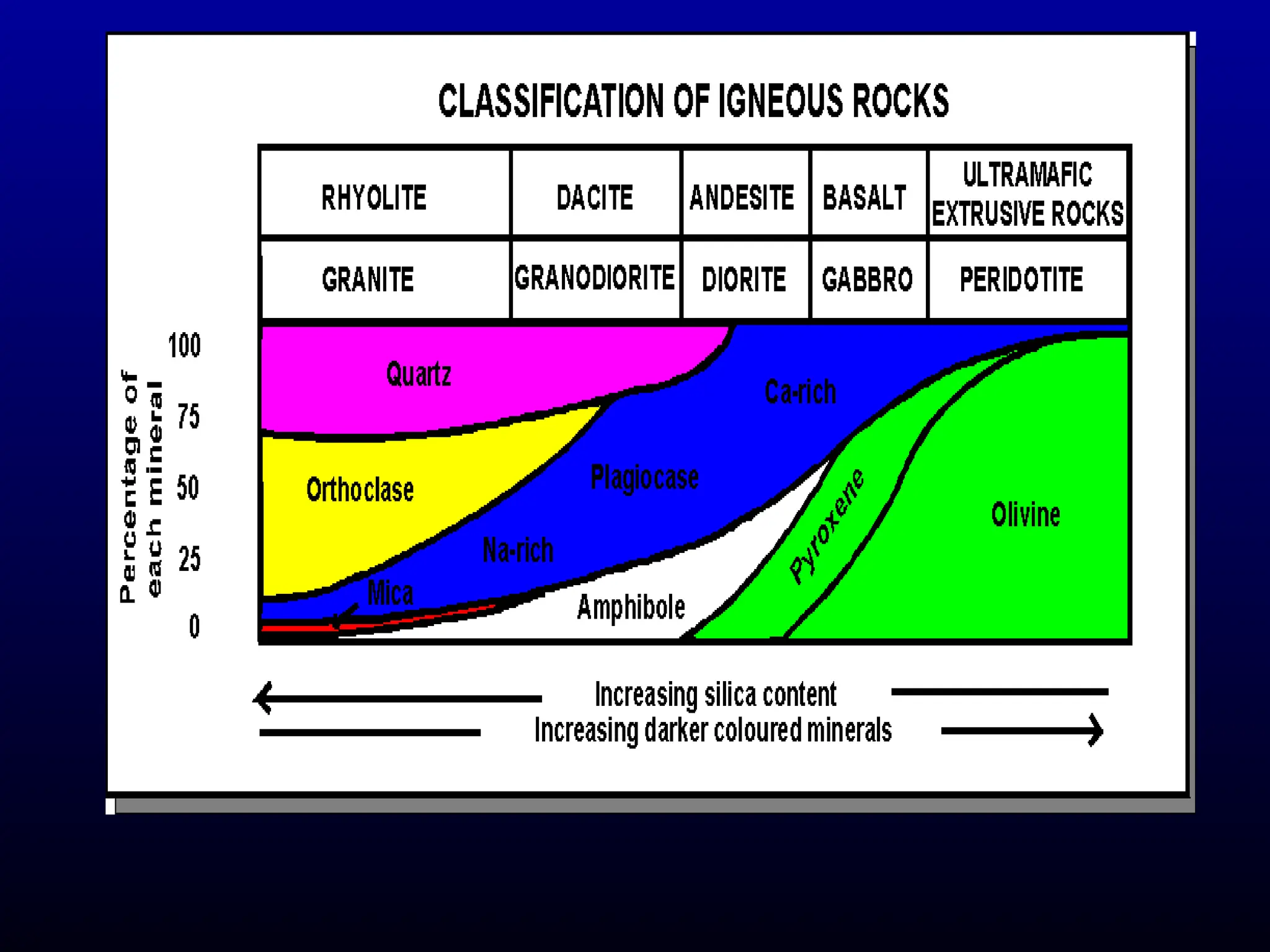
Classification of Igneous Rocks : Bases
texture
field relations
Chemical composition
Mineralogical
Classification based on texture
Aphanitic- crystals too small to see by eye
Phaneritic- can see the constituent minerals
Fine grained- < 1 mm diameter
Medium grained- 1-5 mm diameter
Coarse grained- 5-50 mm diameter
Very coarse grained- > 50 mm diameter
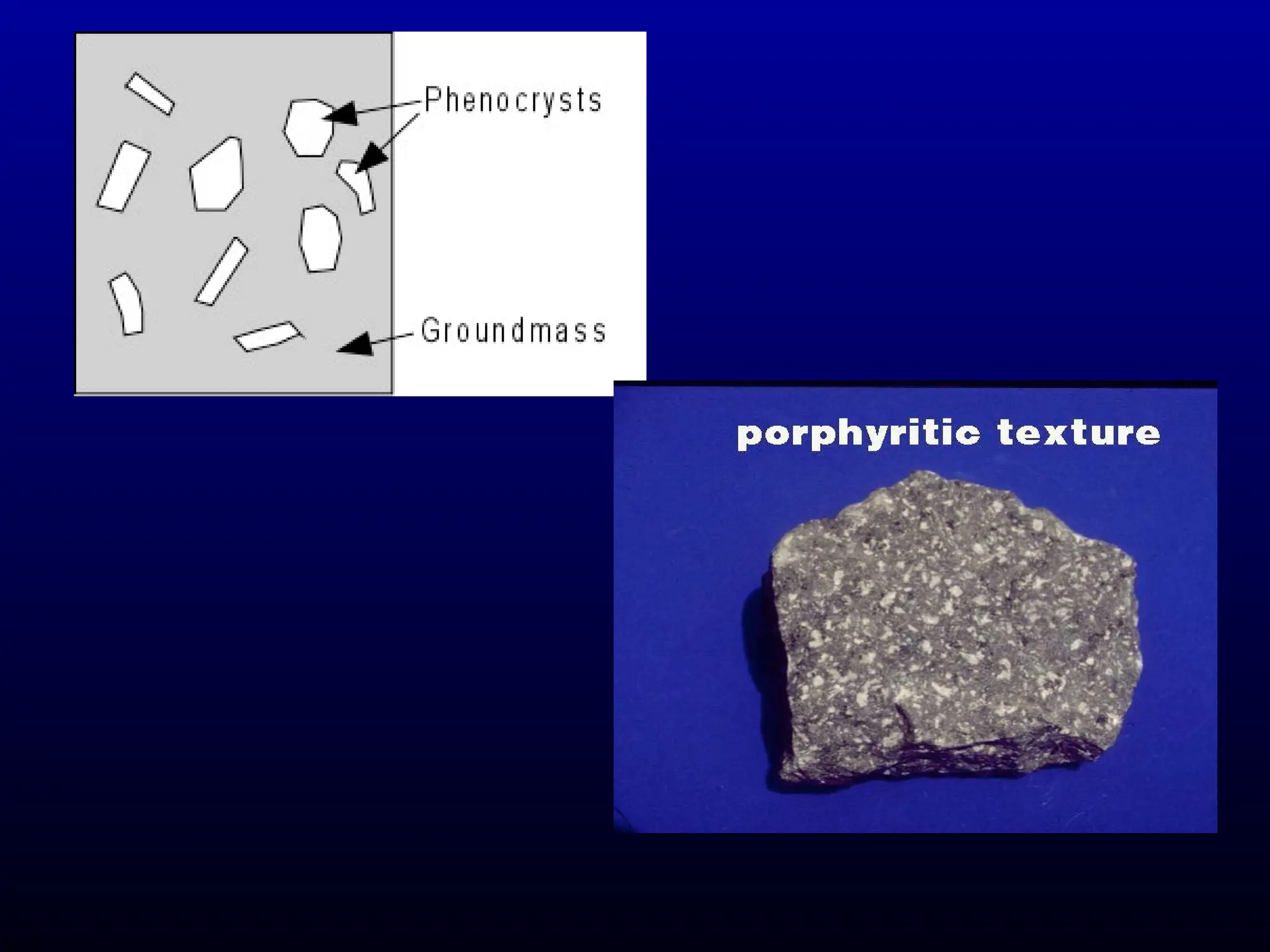
Porphyritic- bimodal grain size distribution
Glassy- no crystals formed
Field Relations
● Extrusive or volcanic rocks: typically
aphanitic or glassy.
● Many varieties are porphyritic and some have
fragmental (volcaniclastic) fabric.
● Intrusive or plutonic rocks: typically
phaneritic
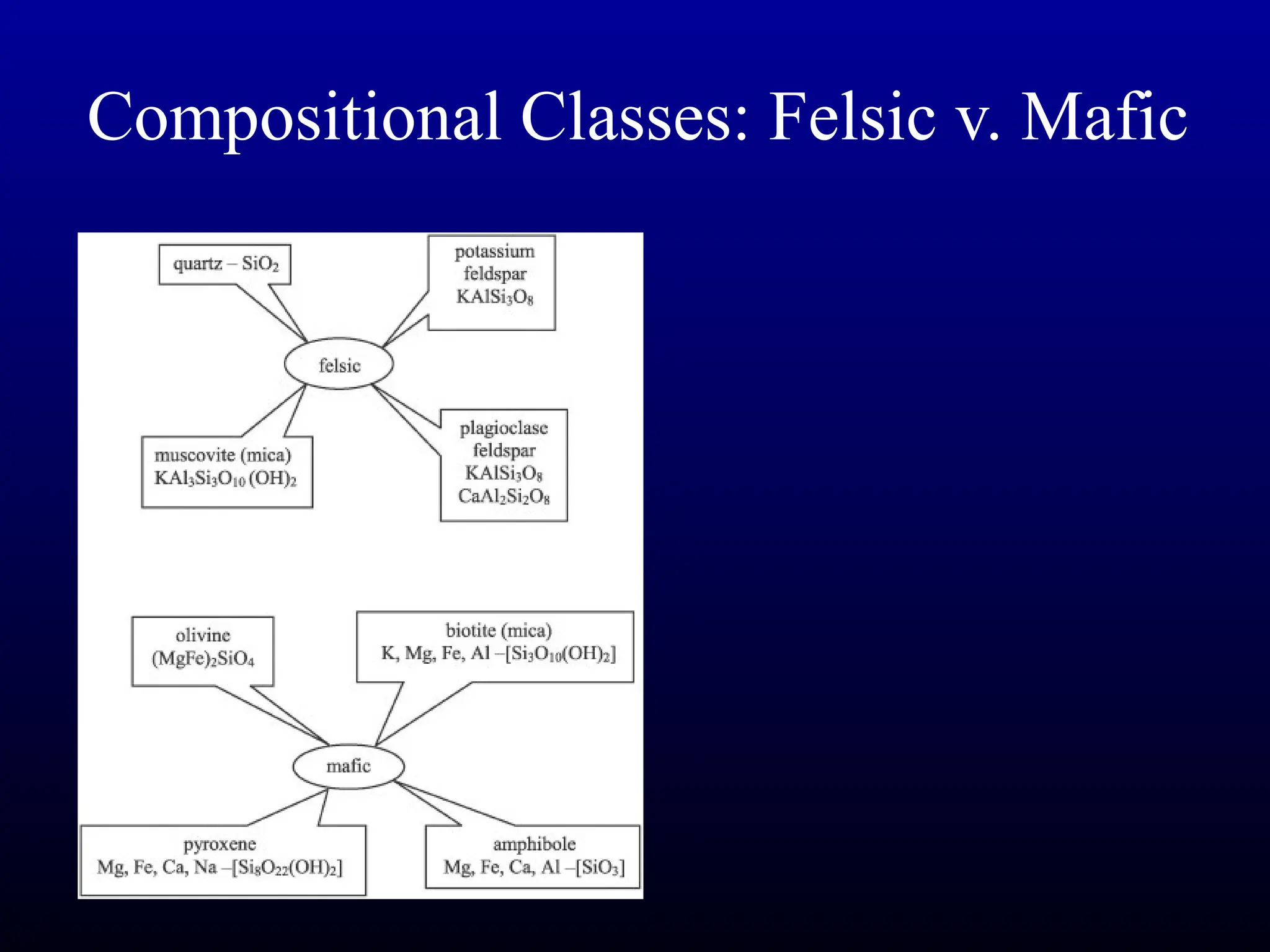
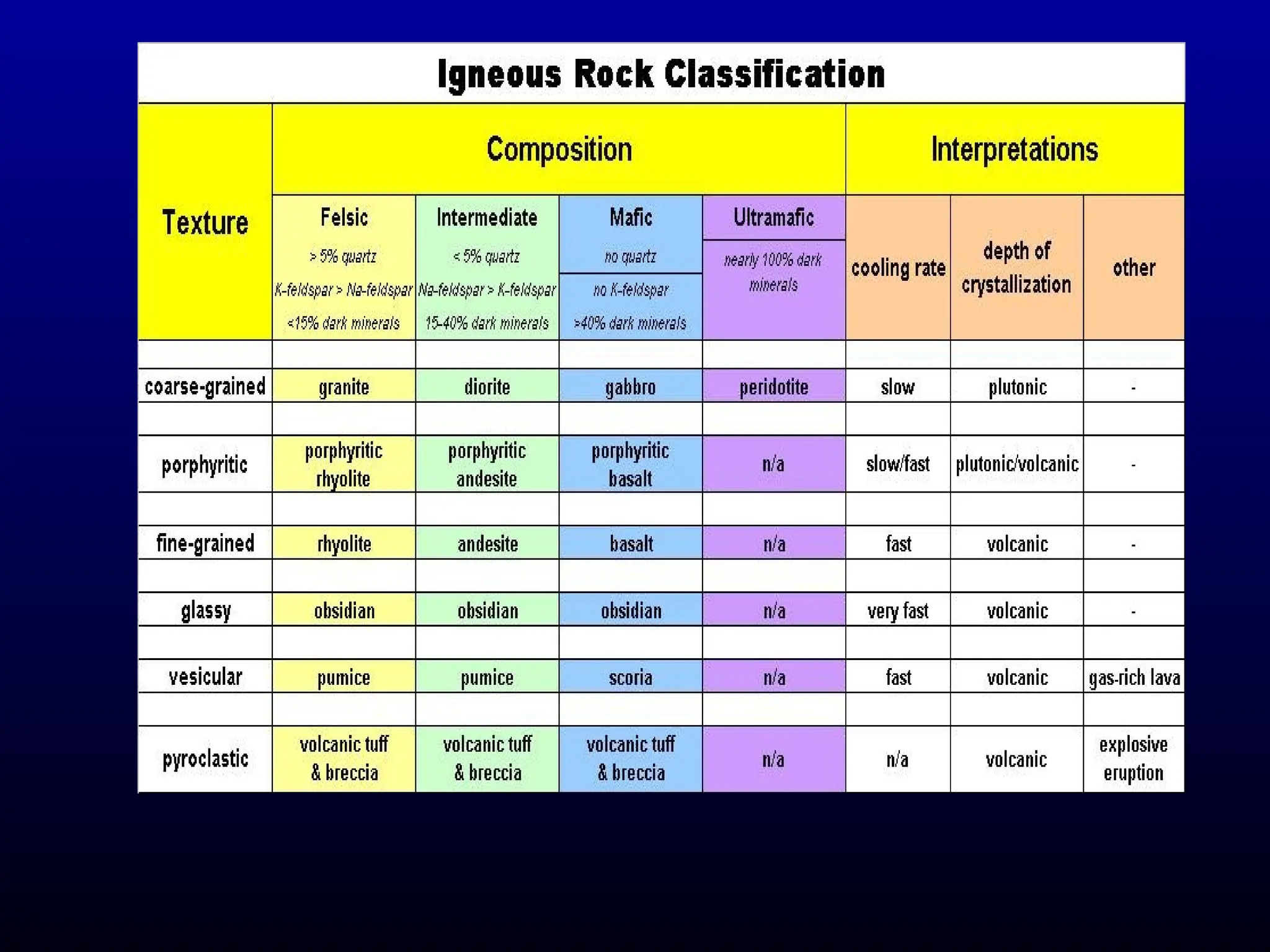
Compositional Classes: Felsic v. Mafic
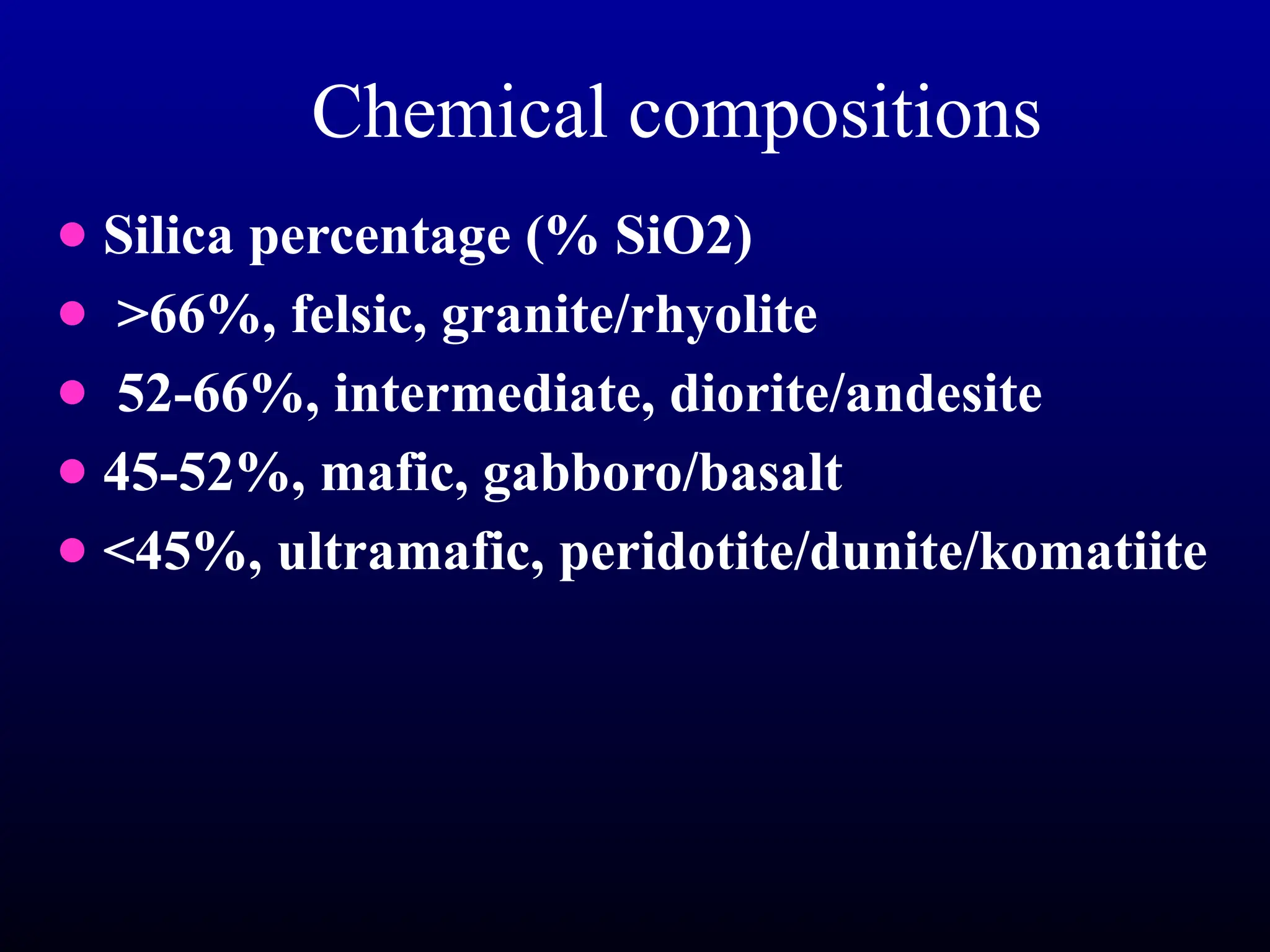
Chemical compositions
● Silica percentage (% SiO2)
● >66%, felsic, granite/rhyolite
● 52-66%, intermediate, diorite/andesite
● 45-52%, mafic, gabboro/basalt
● <45%, ultramafic, peridotite/dunite/komatiite
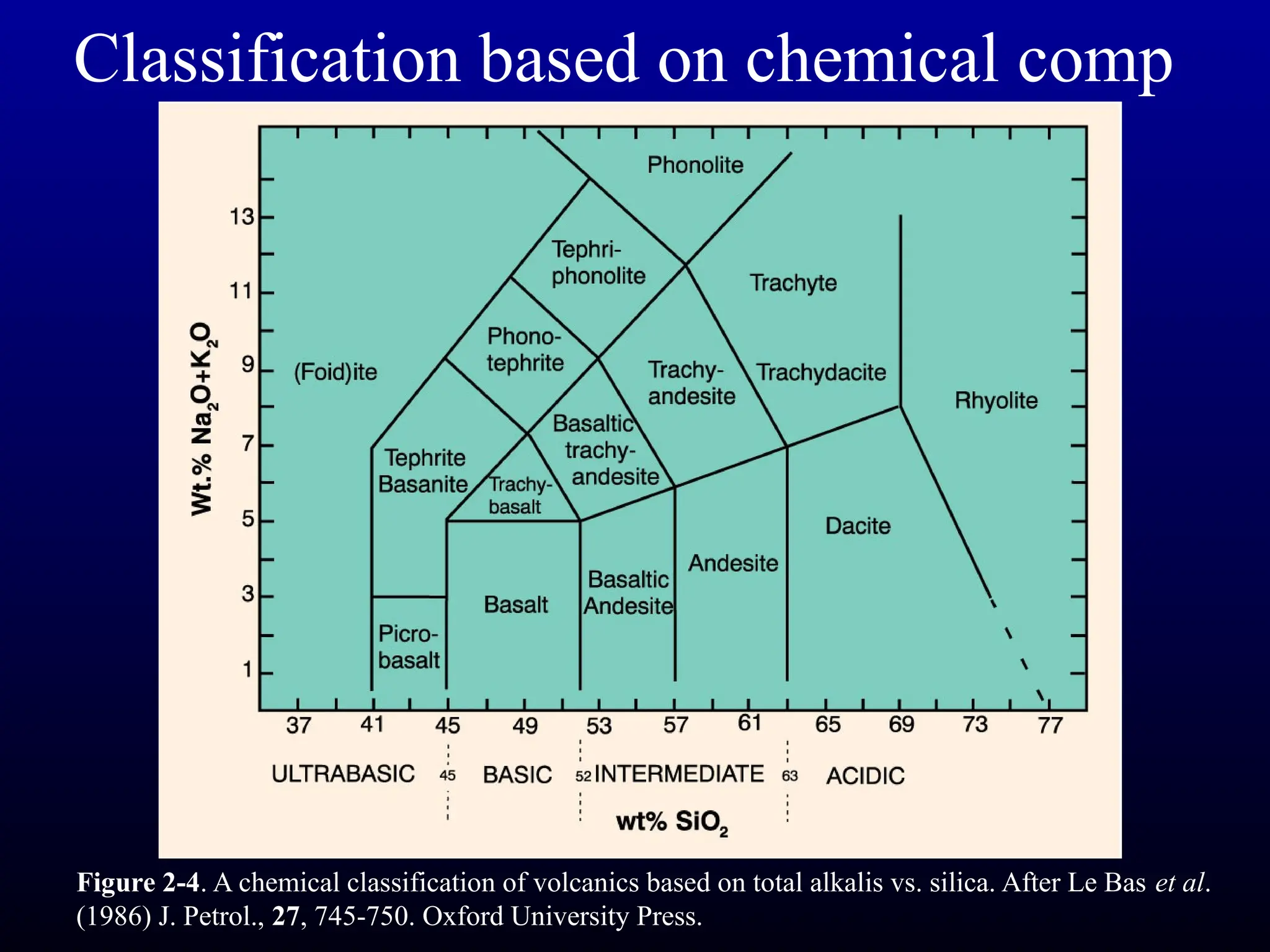
Chemical : Silica vs. alkaline elements
● SiO2 Vs. Na2O+K2O
● Calcic
● Calc-alkalic
● Alkalic-calcic
● Alkalic
Classification based on chemical comp
Figure 2-4. A chemical classification of volcanics based on total alkalis vs. silica. After Le Bas et al.
(1986) J. Petrol., 27, 745-750. Oxford University Press.
Chemical : Aluminum saturation (Al2O3 Vs.
Na2O+K2O+CaO)
● Peraluminous
● Metaaluminous
● Peralkaline
If there is an excess of Alumina over that required to form
feldspars, the rock is peraluminous :
This condition is expressed chemically on a molecular
basis as:
Al2O3 > (CaO + Na2O + K2O)
In peraluminous rocks we expect to find an Al2O3-rich
mineral present as a modal mineral such as muscovite
[KAl3Si3O10(OH)2], corundum [Al2O3], topaz
[Al2SiO4(OH,F)2], or an Al2SiO5- mineral like kyanite,
andalusite, or sillimanite.
Peraluminous rocks will have corundum [Al2O3] in the
CIPW norm and no diopside in the norm.
Peraluminous
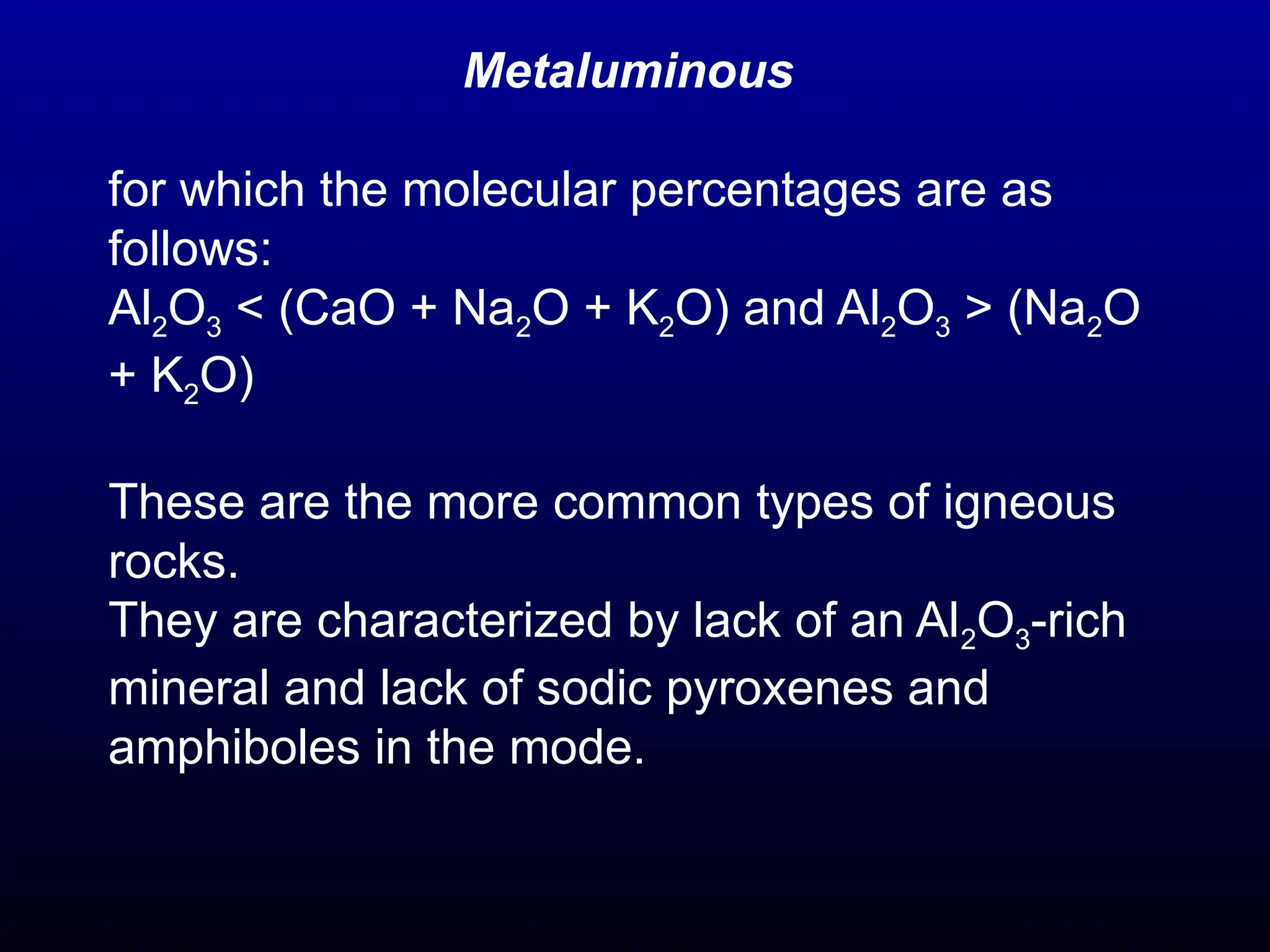
Metaluminous
for which the molecular percentages are as
follows:
Al2O3 < (CaO + Na2O + K2O) and Al2O3 > (Na2O
+ K2O)
These are the more common types of igneous
rocks.
They are characterized by lack of an Al2O3-rich
mineral and lack of sodic pyroxenes and
amphiboles in the mode.
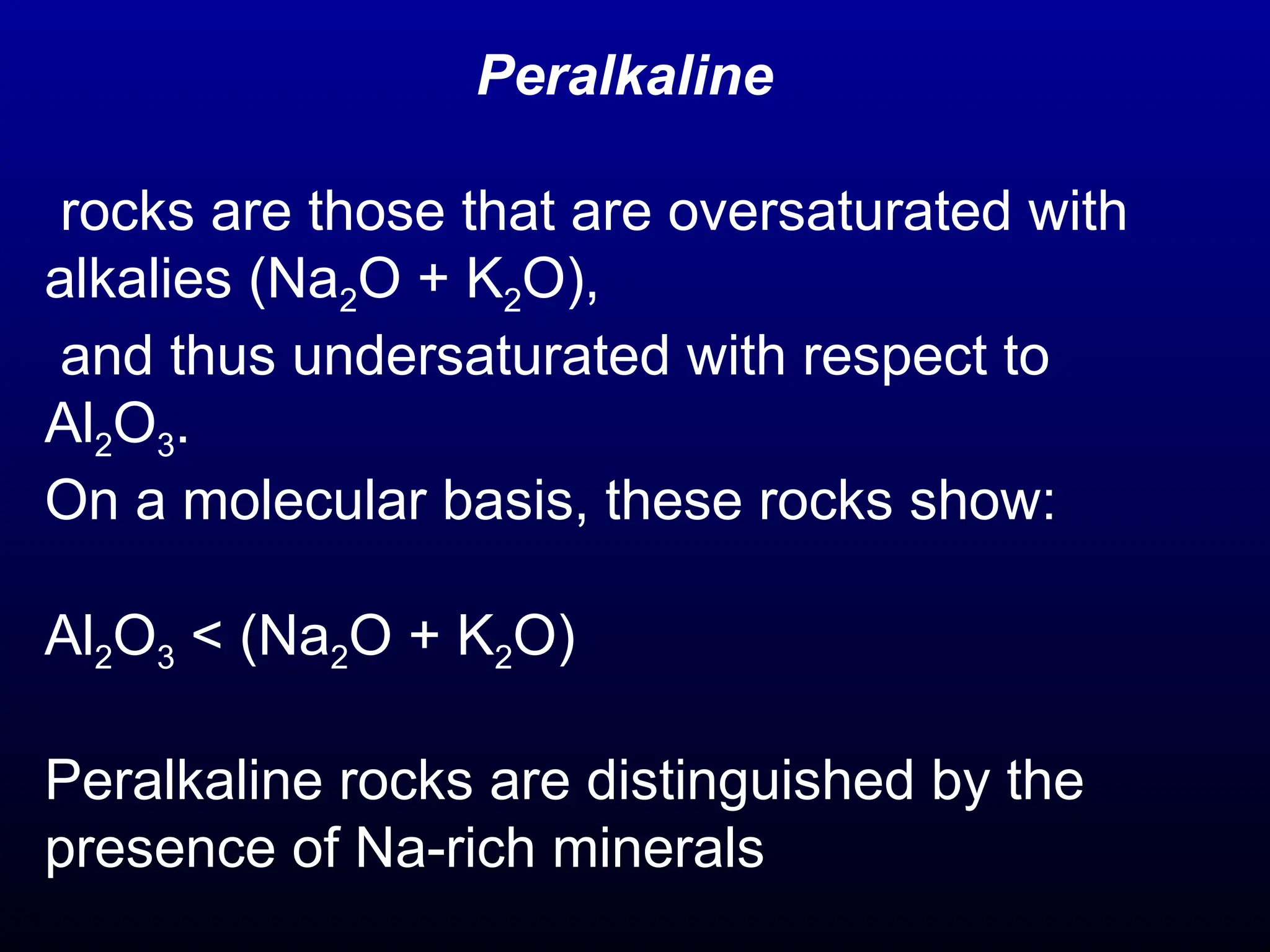
Peralkaline
rocks are those that are oversaturated with
alkalies (Na2O + K2O),
and thus undersaturated with respect to
Al2O3.
On a molecular basis, these rocks show:
Al2O3 < (Na2O + K2O)
Peralkaline rocks are distinguished by the
presence of Na-rich minerals
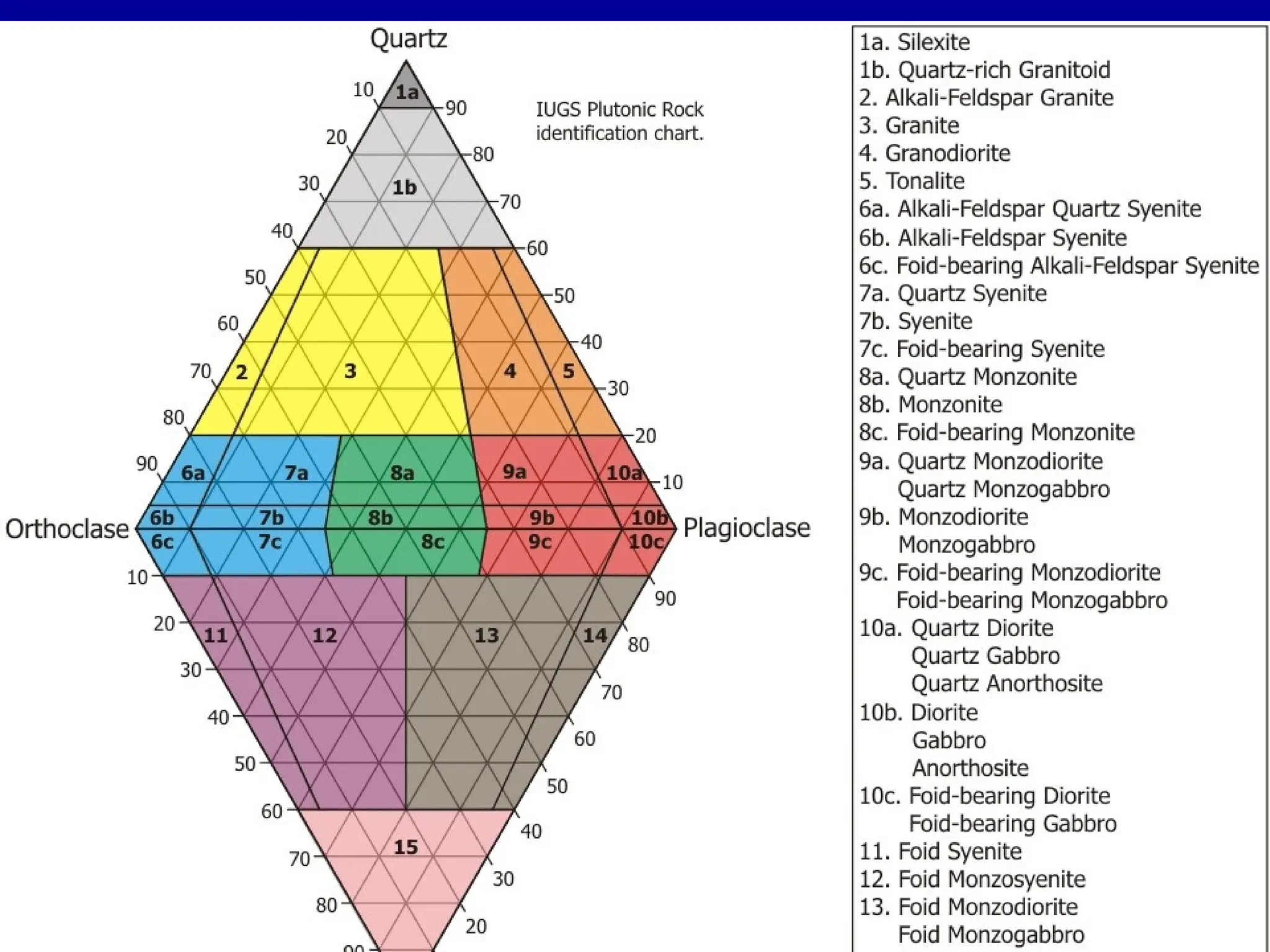
classification based on mineralogy
● Determine the modal mineralogy
● IUGS classification
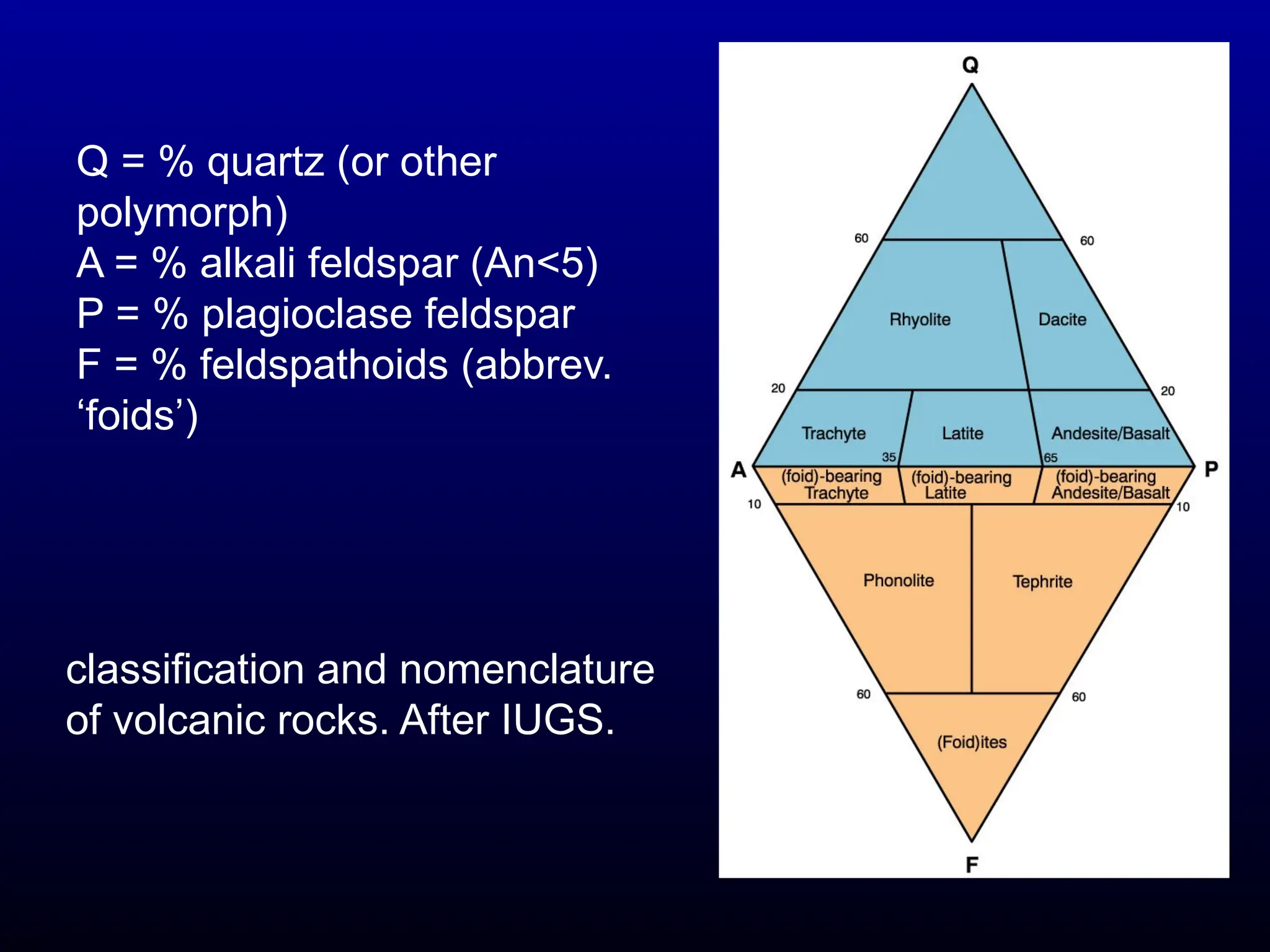
Q = % quartz (or other
polymorph)
A = % alkali feldspar (An<5)
P = % plagioclase feldspar
F = % feldspathoids (abbrev.
‘foids’)
classification and nomenclature
of volcanic rocks. After IUGS.
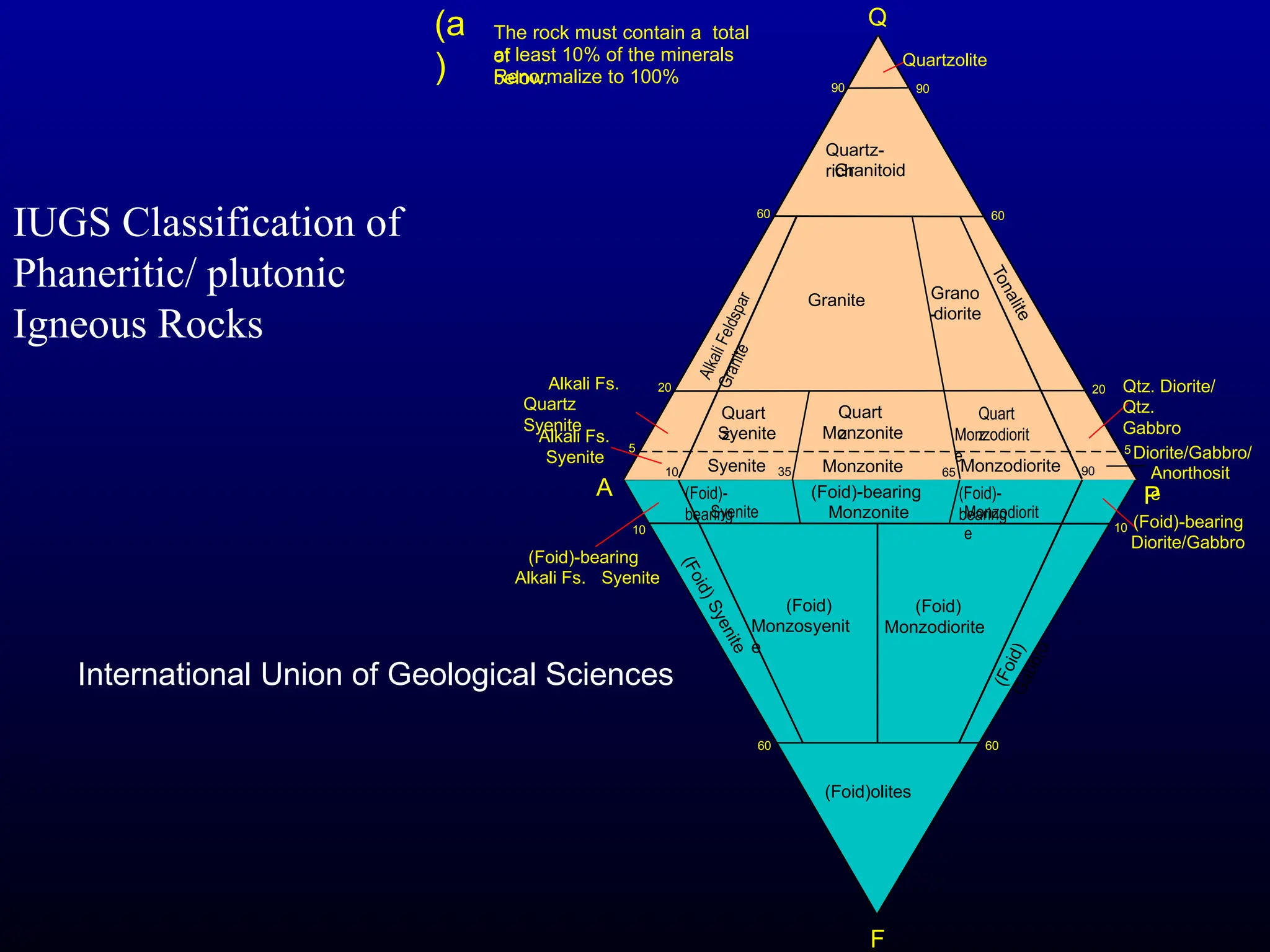
IUGS Classification of
Phaneritic/ plutonic
Igneous Rocks
The rock must contain a total
of
at least 10% of the minerals
below.
Renormalize to 100%
(a
)
Quartz-
rich
Granitoid
90
90
60
60
20
20
Alkali Fs.
Quartz
Syenite
Quart
z
Syenite
Quart
z
Monzonite
Quart
z
Monzodiorit
e
Syenite Monzonite Monzodiorite
(Foid)-
bearing
Syenite
5
10 35 65
(Foid)-bearing
Monzonite
(Foid)-
bearing
Monzodiorit
e
90
Alkali Fs.
Syenite
(Foid)-bearing
Alkali Fs. Syenite
10
(Foid)
Monzosyenit
e
(
F
o
i
d
)
S
y
e
n
i
t
e
(Foid)
Monzodiorite
(
F
o
i
d
)
G
a
b
b
r
o
Qtz. Diorite/
Qtz.
Gabbro
5
10
Diorite/Gabbro/
Anorthosit
e
(Foid)-bearing
Diorite/Gabbro
60
(Foid)olites
Quartzolite
Granite Grano
-diorite
T
o
n
a
l
i
t
e
A
l
k
a
l
i
F
e
l
d
s
p
a
r
G
r
a
n
i
t
e
Q
A P
F
60
International Union of Geological Sciences
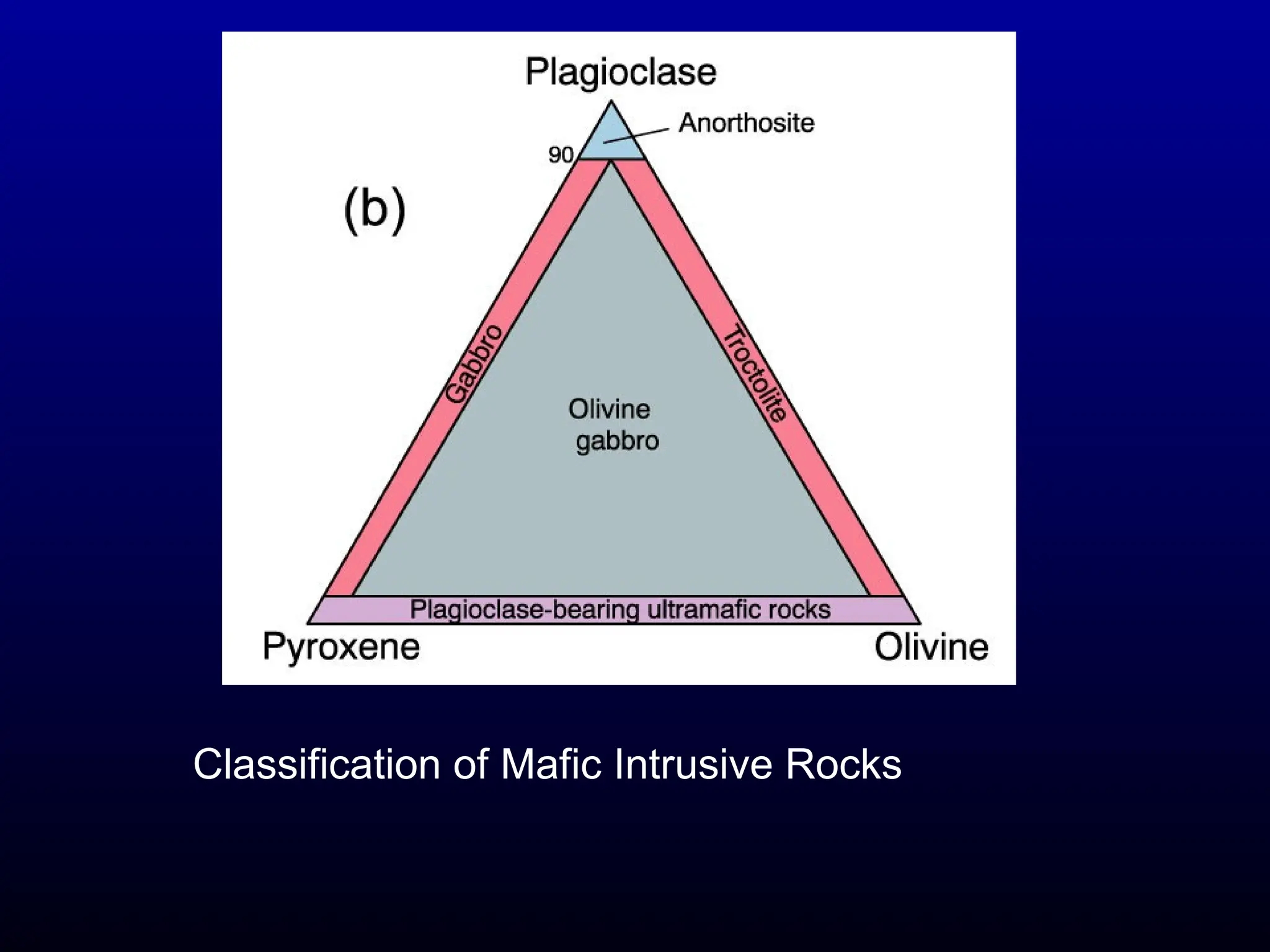
Classification of Mafic Intrusive Rocks
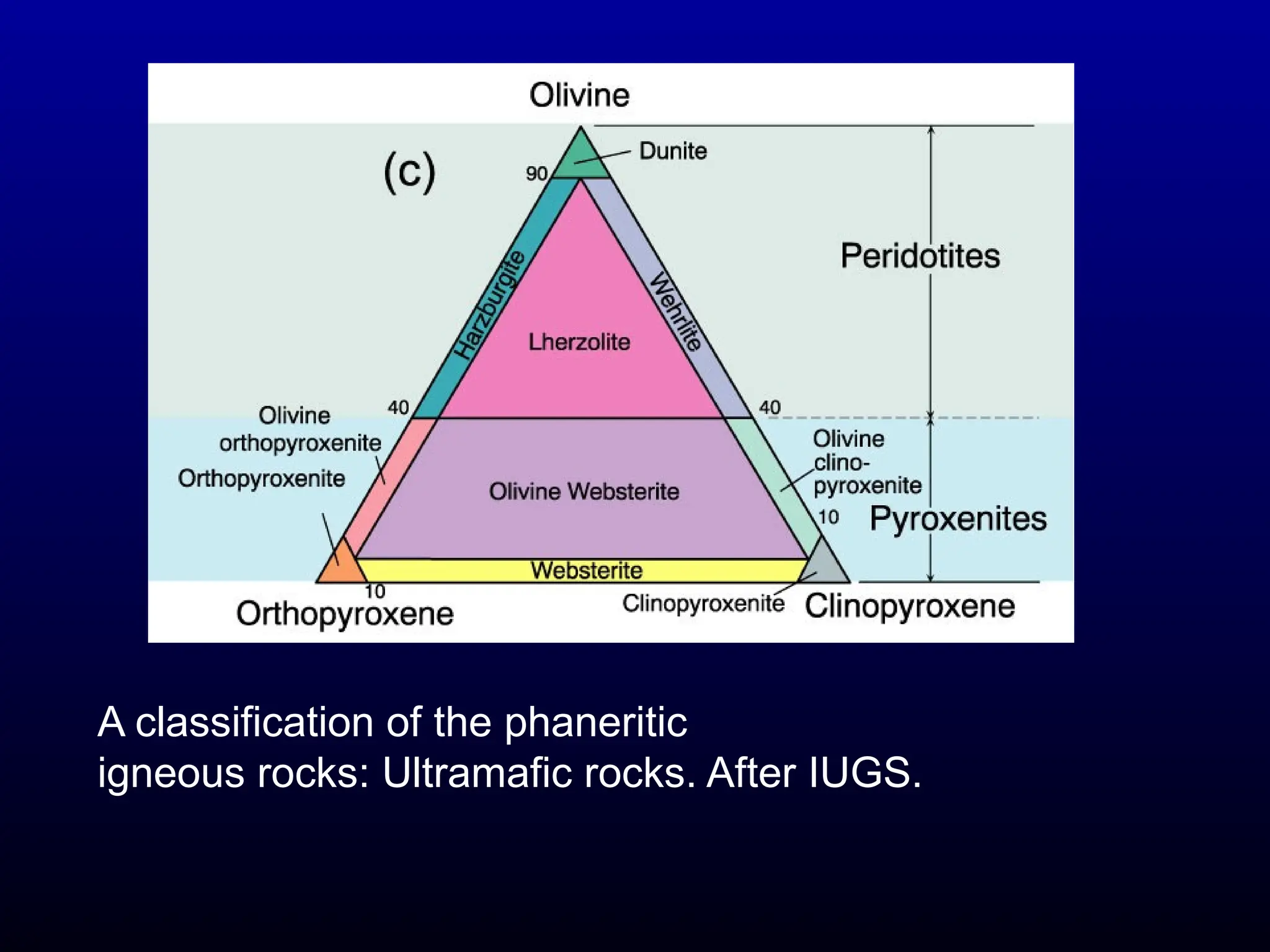
A classification of the phaneritic
igneous rocks: Ultramafic rocks. After IUGS.
Igneous Petrology-Classification of  igneous rocks

Igneous Petrology-Classification of igneous rocks

  • 1.
  • 2.
    Classification of IgneousRocks : Bases texture field relations Chemical composition Mineralogical
  • 3.
    Classification based ontexture Aphanitic- crystals too small to see by eye Phaneritic- can see the constituent minerals Fine grained- < 1 mm diameter Medium grained- 1-5 mm diameter Coarse grained- 5-50 mm diameter Very coarse grained- > 50 mm diameter Porphyritic- bimodal grain size distribution Glassy- no crystals formed
  • 5.
    Field Relations ● Extrusiveor volcanic rocks: typically aphanitic or glassy. ● Many varieties are porphyritic and some have fragmental (volcaniclastic) fabric. ● Intrusive or plutonic rocks: typically phaneritic
  • 6.
  • 7.
    Chemical compositions ● Silicapercentage (% SiO2) ● >66%, felsic, granite/rhyolite ● 52-66%, intermediate, diorite/andesite ● 45-52%, mafic, gabboro/basalt ● <45%, ultramafic, peridotite/dunite/komatiite
  • 8.
    Chemical : Silicavs. alkaline elements ● SiO2 Vs. Na2O+K2O ● Calcic ● Calc-alkalic ● Alkalic-calcic ● Alkalic
  • 9.
    Classification based onchemical comp Figure 2-4. A chemical classification of volcanics based on total alkalis vs. silica. After Le Bas et al. (1986) J. Petrol., 27, 745-750. Oxford University Press.
  • 10.
    Chemical : Aluminumsaturation (Al2O3 Vs. Na2O+K2O+CaO) ● Peraluminous ● Metaaluminous ● Peralkaline
  • 11.
    If there isan excess of Alumina over that required to form feldspars, the rock is peraluminous : This condition is expressed chemically on a molecular basis as: Al2O3 > (CaO + Na2O + K2O) In peraluminous rocks we expect to find an Al2O3-rich mineral present as a modal mineral such as muscovite [KAl3Si3O10(OH)2], corundum [Al2O3], topaz [Al2SiO4(OH,F)2], or an Al2SiO5- mineral like kyanite, andalusite, or sillimanite. Peraluminous rocks will have corundum [Al2O3] in the CIPW norm and no diopside in the norm. Peraluminous
  • 12.
    Metaluminous for which themolecular percentages are as follows: Al2O3 < (CaO + Na2O + K2O) and Al2O3 > (Na2O + K2O) These are the more common types of igneous rocks. They are characterized by lack of an Al2O3-rich mineral and lack of sodic pyroxenes and amphiboles in the mode.
  • 13.
    Peralkaline rocks are thosethat are oversaturated with alkalies (Na2O + K2O), and thus undersaturated with respect to Al2O3. On a molecular basis, these rocks show: Al2O3 < (Na2O + K2O) Peralkaline rocks are distinguished by the presence of Na-rich minerals
  • 15.
    classification based onmineralogy ● Determine the modal mineralogy ● IUGS classification
  • 16.
    Q = %quartz (or other polymorph) A = % alkali feldspar (An<5) P = % plagioclase feldspar F = % feldspathoids (abbrev. ‘foids’) classification and nomenclature of volcanic rocks. After IUGS.
  • 17.
    IUGS Classification of Phaneritic/plutonic Igneous Rocks The rock must contain a total of at least 10% of the minerals below. Renormalize to 100% (a ) Quartz- rich Granitoid 90 90 60 60 20 20 Alkali Fs. Quartz Syenite Quart z Syenite Quart z Monzonite Quart z Monzodiorit e Syenite Monzonite Monzodiorite (Foid)- bearing Syenite 5 10 35 65 (Foid)-bearing Monzonite (Foid)- bearing Monzodiorit e 90 Alkali Fs. Syenite (Foid)-bearing Alkali Fs. Syenite 10 (Foid) Monzosyenit e ( F o i d ) S y e n i t e (Foid) Monzodiorite ( F o i d ) G a b b r o Qtz. Diorite/ Qtz. Gabbro 5 10 Diorite/Gabbro/ Anorthosit e (Foid)-bearing Diorite/Gabbro 60 (Foid)olites Quartzolite Granite Grano -diorite T o n a l i t e A l k a l i F e l d s p a r G r a n i t e Q A P F 60 International Union of Geological Sciences
  • 19.
    Classification of MaficIntrusive Rocks
  • 20.
    A classification ofthe phaneritic igneous rocks: Ultramafic rocks. After IUGS.