Content
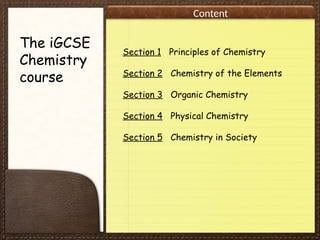
The iGCSE
Chemistry
course
Section 1Principles of Chemistry
Section 2 Chemistry of the Elements
Section 3 Organic Chemistry
Section 4 Physical Chemistry
Section 5 Chemistry in Society
3.
Content
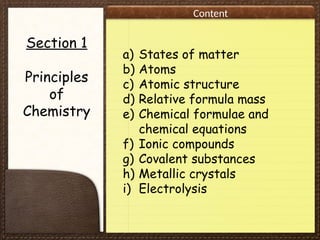
Section 1
Principles
of
Chemistry
a) Statesof matter
b) Atoms
c) Atomic structure
d) Relative formula mass
e) Chemical formulae and
chemical equations
f) Ionic compounds
g) Covalent substances
h) Metallic crystals
i) Electrolysis
4.
Content
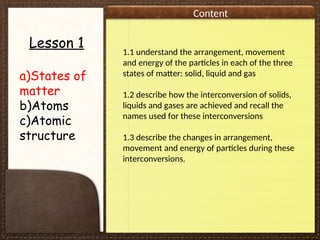
Lesson 1
a)States of
matter
b)Atoms
c)Atomic
structure
1.1understand the arrangement, movement
and energy of the particles in each of the three
states of matter: solid, liquid and gas
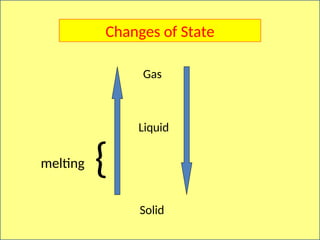
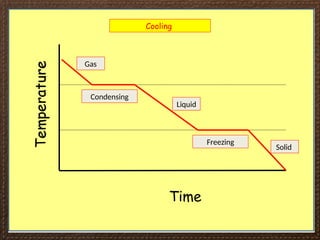
1.2 describe how the interconversion of solids,
liquids and gases are achieved and recall the
names used for these interconversions
1.3 describe the changes in arrangement,
movement and energy of particles during these
interconversions.
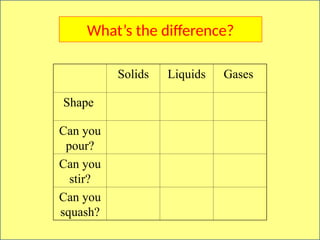
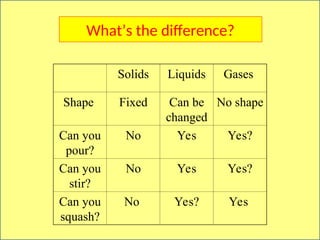
Solids Liquids Gases
ShapeFixed Can be
changed
No shape
Can you
pour?
No Yes Yes?
Can you
stir?
No Yes Yes?
Can you
squash?
No Yes? Yes
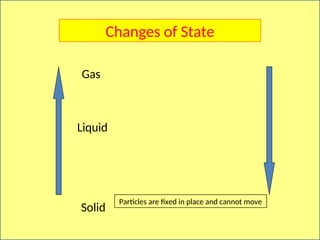
What’s the difference?
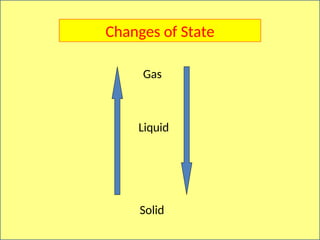
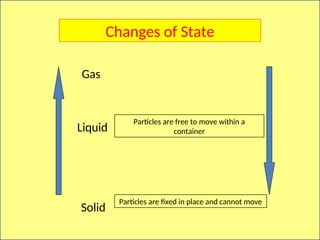
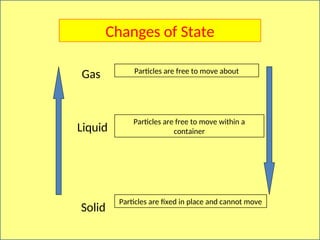
Solid
Liquid
Gas
Particles are fixedin place and cannot move
Particles are free to move within a
container
Particles are free to move about
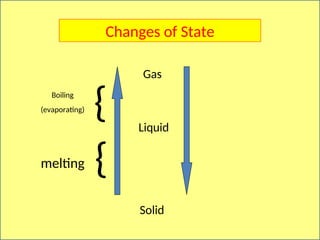
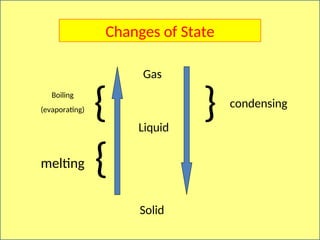
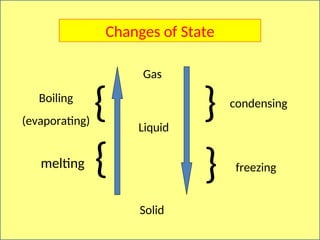
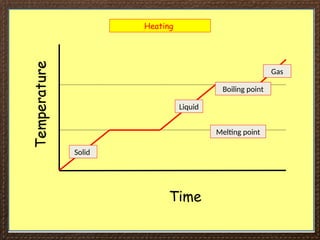
Changes of State
15.
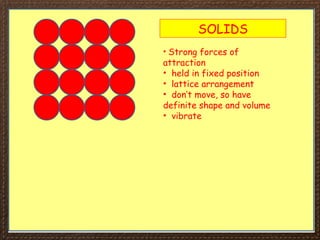
SOLIDS
• Strong forcesof
attraction
• held in fixed position
• lattice arrangement
• don’t move, so have
definite shape and volume
• vibrate
16.
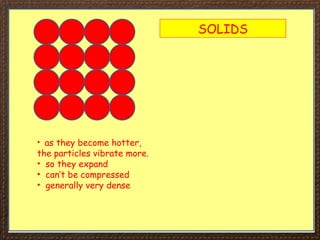
SOLIDS
• as theybecome hotter,
the particles vibrate more.
• so they expand
• can’t be compressed
• generally very dense
17.
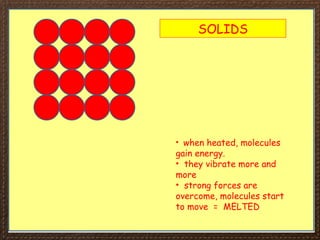
SOLIDS
• when heated,molecules
gain energy.
• they vibrate more and
more
• strong forces are
overcome, molecules start
to move = MELTED
18.
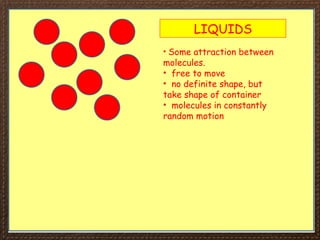
LIQUIDS
• Some attractionbetween
molecules.
• free to move
• no definite shape, but
take shape of container
• molecules in constantly
random motion
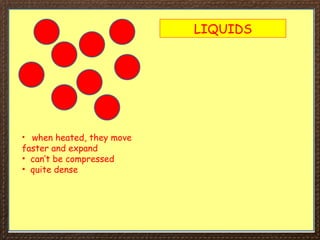
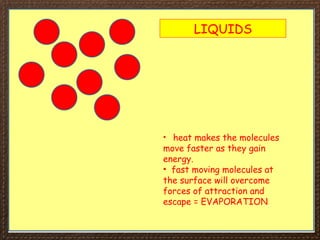
LIQUIDS
• heat makesthe molecules
move faster as they gain
energy.
• fast moving molecules at
the surface will overcome
forces of attraction and
escape = EVAPORATION
21.
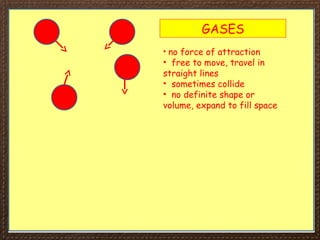
GASES
• no forceof attraction
• free to move, travel in
straight lines
• sometimes collide
• no definite shape or
volume, expand to fill space
22.
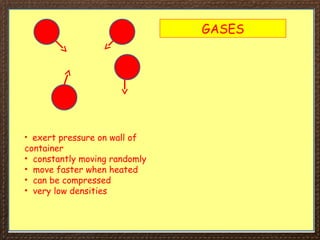
GASES
• exert pressureon wall of
container
• constantly moving randomly
• move faster when heated
• can be compressed
• very low densities
23.
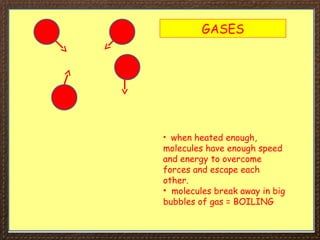
GASES
• when heatedenough,
molecules have enough speed
and energy to overcome
forces and escape each
other.
• molecules break away in big
bubbles of gas = BOILING
Content
Lesson 1
a)States of
matter
b)Atoms
c)Atomic
structure
1.4describe simple experiments leading to the
idea of the small size of particles and their
movement including:
i dilution of coloured solutions
ii diffusion experiments
1.5 understand the terms atom and molecule
1.6 understand the differences between
elements, compounds and mixtures
1.7 describe techniques for the separation of
mixtures, including simple distillation, fractional
distillation, filtration, crystallisation and paper
chromatography.
27.
Evidence of particles
Particlesare very, very small, but what evidence
do we have that they actually exist?
Two simple experiments help us to prove their
existence:
1.Dilution of coloured solutions
2.Diffusion experiments
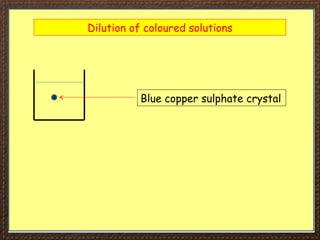
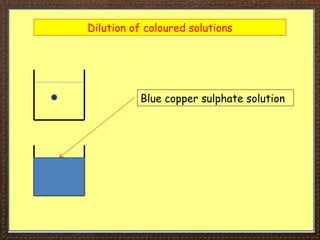
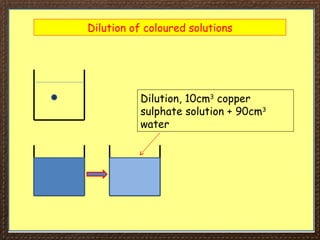
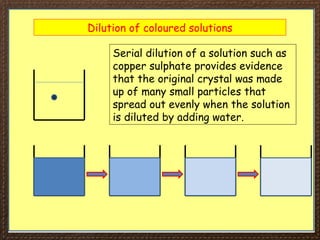
Dilution of colouredsolutions
Dilution, 10cm3
copper
sulphate solution + 90cm3
water
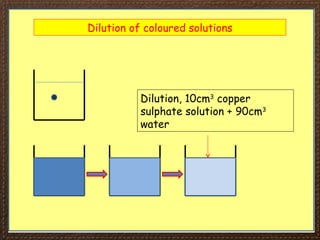
31.
Dilution of colouredsolutions
Dilution, 10cm3
copper
sulphate solution + 90cm3
water
32.
Dilution of colouredsolutions
Dilution, 10cm3
copper
sulphate solution + 90cm3
water
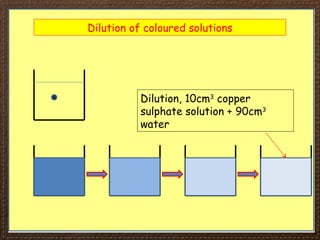
33.
Dilution of colouredsolutions
Serial dilution of a solution such as
copper sulphate provides evidence
that the original crystal was made
up of many small particles that
spread out evenly when the solution
is diluted by adding water.
34.
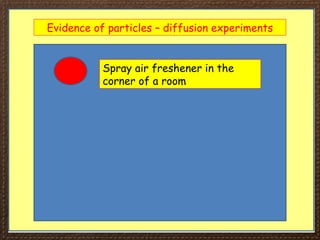
Evidence of particles– diffusion experiments
Spray air freshener in the
corner of a room
Evidence of particles– diffusion experiments
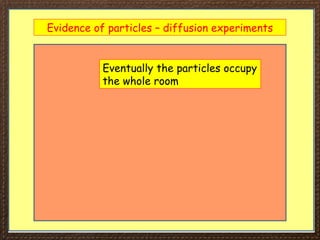
Eventually the particles occupy
the whole room
37.
Evidence of particles– diffusion experiments
Other examples of diffusion
include:
Smell of frying bacon from a
kitchen
Leaking of air from inside a
balloon
Sugar dissolving in a cup of tea
38.
Evidence of particles– diffusion experiments
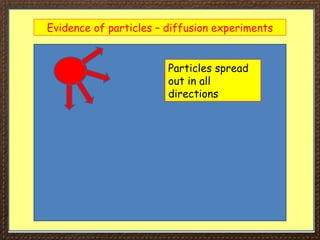
Diffusion is the movement of
particles from areas of high
concentration to areas of low
concentration until they are
evenly spread. Diffusion
depends upon the random
movement of particles.
39.
Evidence of particles– diffusion experiments
Diffusion is the movement of
particles from areas of high
concentration to areas of low
concentration until they are
evenly spread. Diffusion
depends upon the random
movement of particles.
Diffusion is slower in liquids
than in gases because liquid
particles are not as free to
move as gas particles.
40.
Atoms and Molecules
Thebasic building blocks of everything that we
see in the Universe are atoms. The word ‘atom’
basically means ‘indivisible’.
41.
Atoms and Molecules
Thebasic building blocks of everything that we
see in the Universe are atoms. The word ‘atom’
basically means ‘indivisible’.
Combinations of atoms are called molecules.
For example:
O2 - a molecule of oxygen
H2O - a molecule of water
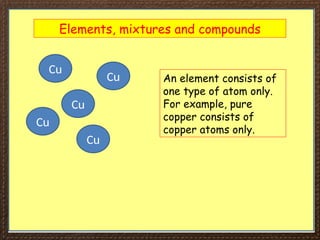
Elements, mixtures andcompounds
Cu
Cu
Cu
Cu
Cu
An element consists of
one type of atom only.
For example, pure
copper consists of
copper atoms only.
44.
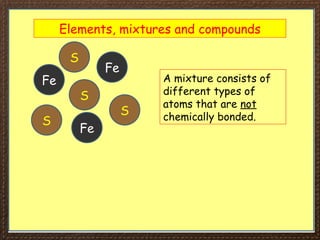
Elements, mixtures andcompounds
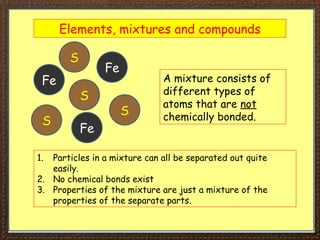
A mixture consists of
different types of
atoms that are not
chemically bonded.
Fe
Fe
Fe
S
S
S
S
45.
Elements, mixtures andcompounds
A mixture consists of
different types of
atoms that are not
chemically bonded.
Fe
Fe
Fe
S
S
S
S
1. Particles in a mixture can all be separated out quite
easily.
2. No chemical bonds exist
3. Properties of the mixture are just a mixture of the
properties of the separate parts.
46.
Elements, mixtures andcompounds
Fe
Fe
S
S
C
O O
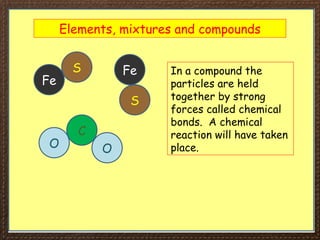
In a compound the
particles are held
together by strong
forces called chemical
bonds. A chemical
reaction will have taken
place.
47.
Elements, mixtures andcompounds
Fe
Fe
S
S
C
O O
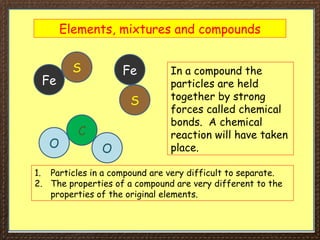
In a compound the
particles are held
together by strong
forces called chemical
bonds. A chemical
reaction will have taken
place.
1. Particles in a compound are very difficult to separate.
2. The properties of a compound are very different to the
properties of the original elements.
48.
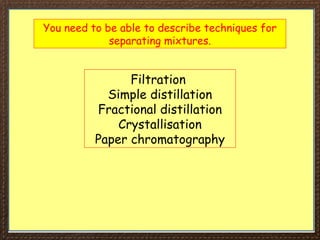
You need tobe able to describe techniques for
separating mixtures.
49.
You need tobe able to describe techniques for
separating mixtures.
Filtration
Simple distillation
Fractional distillation
Crystallisation
Paper chromatography
50.
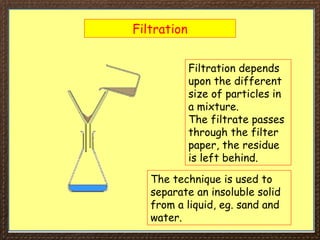
Filtration
Filtration depends
upon thedifferent
size of particles in
a mixture.
The filtrate passes
through the filter
paper, the residue
is left behind.
The technique is used to
separate an insoluble solid
from a liquid, eg. sand and
water.
51.
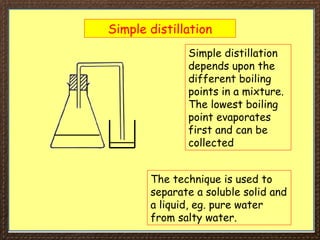
Simple distillation
Simple distillation
dependsupon the
different boiling
points in a mixture.
The lowest boiling
point evaporates
first and can be
collected
The technique is used to
separate a soluble solid and
a liquid, eg. pure water
from salty water.
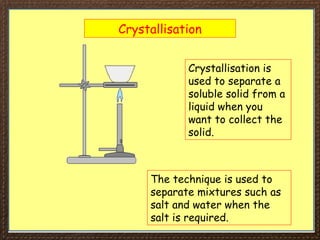
Crystallisation
Crystallisation is
used toseparate a
soluble solid from a
liquid when you
want to collect the
solid.
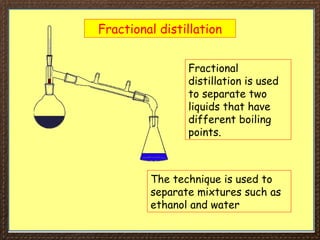
The technique is used to
separate mixtures such as
salt and water when the
salt is required.
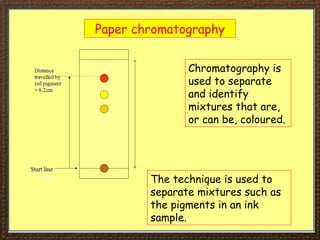
54.
Paper chromatography
Chromatography is
usedto separate
and identify
mixtures that are,
or can be, coloured.
The technique is used to
separate mixtures such as
the pigments in an ink
sample.
55.
Content
Lesson 1
a)States of
matter
b)Atoms
c)Atomic
structure
1.8recall that atoms consist of a central nucleus,
composed of protons and neutrons,
surrounded by electrons, orbiting in shells
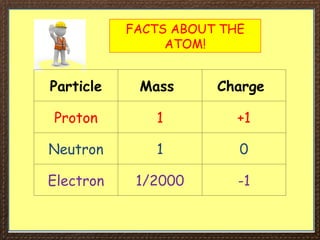
1.9 recall the relative mass and relative charge of a
proton, neutron and electron
1.10 understand the terms atomic number, mass
number, isotopes and relative atomic
mass (Ar)
1.11 calculate the relative atomic mass of an element
from the relative abundances of its
isotopes
1.12 understand that the Periodic Table is an
arrangement of elements in order of atomic
number
1.13 deduce the electronic configurations of the first
20 elements from their positions in the
Periodic Table
1.14 deduce the number of outer electrons in a main
group element from its position in the
Periodic Table.
56.
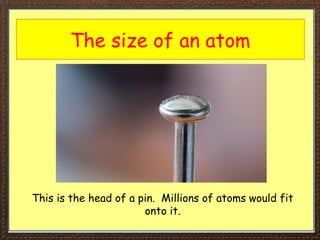
The size ofan atom
This is the head of a pin. Millions of atoms would fit
onto it.
57.
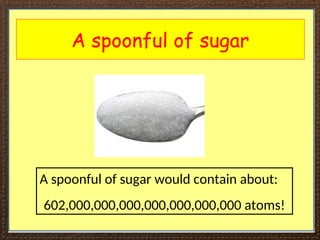
A spoonful ofsugar
A spoonful of sugar would contain about:
602,000,000,000,000,000,000,000 atoms!
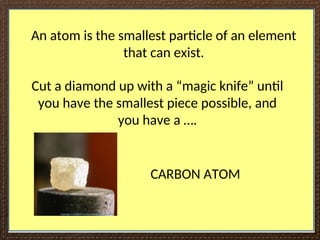
An atom isthe smallest particle of an element
that can exist.
Cut a diamond up with a “magic knife” until
you have the smallest piece possible, and
you have a ….
CARBON ATOM
60.
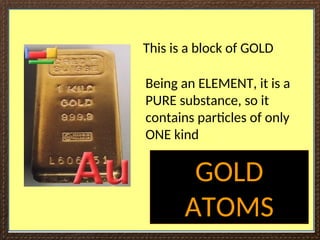
This is ablock of GOLD
Being an ELEMENT, it is a
PURE substance, so it
contains particles of only
ONE kind …
GOLD
ATOMS
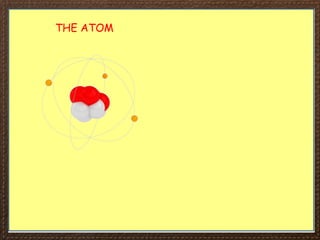
THE ATOM
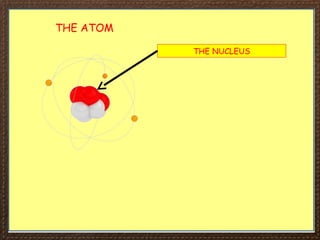
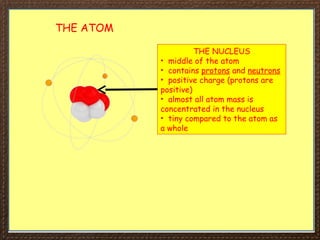
THE NUCLEUS
•middle of the atom
• contains protons and neutrons
• positive charge (protons are
positive)
• almost all atom mass is
concentrated in the nucleus
• tiny compared to the atom as
a whole
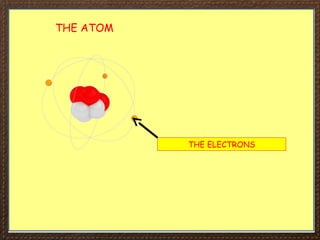
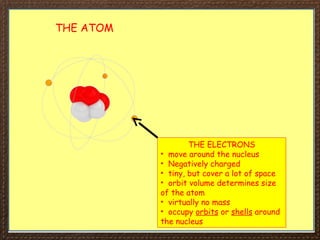
THE ATOM
THE ELECTRONS
•move around the nucleus
• Negatively charged
• tiny, but cover a lot of space
• orbit volume determines size
of the atom
• virtually no mass
• occupy orbits or shells around
the nucleus
FACTS ABOUT THE
ATOM!
1.NEUTRAL ATOMS HAVE NO CHARGE OVERALL
2. CHARGE ON THE ELECTRONS IS THE SAME SIZE AS THE
CHARGE ON THE PROTONS BUT OPPOSITE
3. IN A NEUTRAL ATOM THE NUMBER OF ELECTRONS
EQUALS THE NUMBER OF PROTONS
4. ELECTRONS MAY BE LOST OR GAINED. THE ATOM THEN
BECOMES CHARGED, AND IS KNOWN AS AN ION
5. NEUTRON NUMBERS ARE USUALLY JUST A BIT HIGHER
THAN PROTON NUMBERS, BUT CAN CHANGE
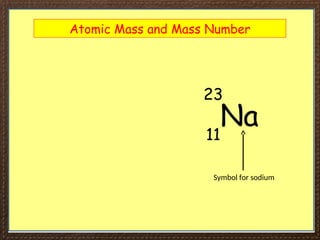
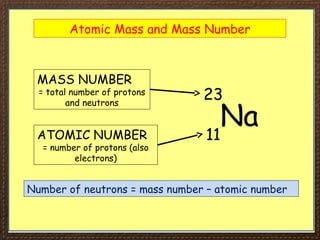
Atomic Mass andMass Number
Na
23
11
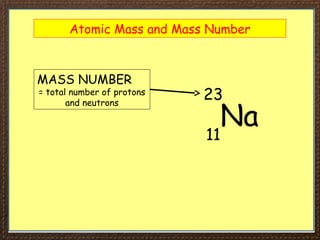
MASS NUMBER
= total number of protons
and neutrons
72.
Atomic Mass andMass Number
Na
23
11
MASS NUMBER
= total number of protons
and neutrons
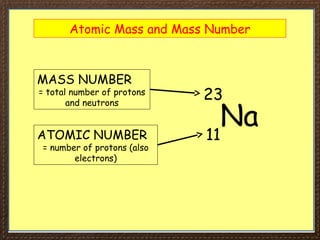
ATOMIC NUMBER
= number of protons (also
electrons)
73.
Atomic Mass andMass Number
Na
23
11
MASS NUMBER
= total number of protons
and neutrons
ATOMIC NUMBER
= number of protons (also
electrons)
Number of neutrons = mass number – atomic number
74.
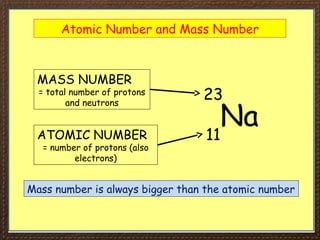
Atomic Number andMass Number
Na
23
11
MASS NUMBER
= total number of protons
and neutrons
ATOMIC NUMBER
= number of protons (also
electrons)
Mass number is always bigger than the atomic number
75.
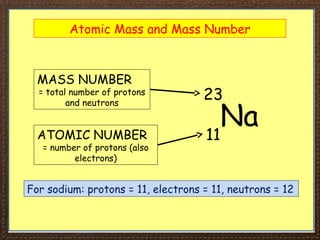
Atomic Mass andMass Number
Na
23
11
MASS NUMBER
= total number of protons
and neutrons
ATOMIC NUMBER
= number of protons (also
electrons)
For sodium: protons = 11, electrons = 11, neutrons = 12
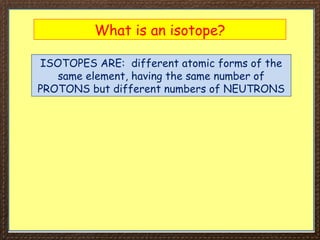
What is anisotope?
ISOTOPES ARE: different atomic forms of the
same element, having the same number of
PROTONS but different numbers of NEUTRONS
78.
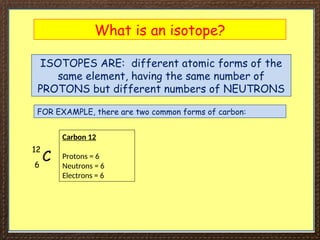
What is anisotope?
ISOTOPES ARE: different atomic forms of the
same element, having the same number of
PROTONS but different numbers of NEUTRONS
FOR EXAMPLE, there are two common forms of carbon:
C
12
6
Carbon 12
Protons = 6
Neutrons = 6
Electrons = 6
79.
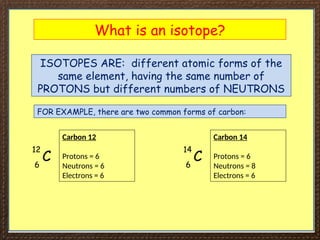
What is anisotope?
ISOTOPES ARE: different atomic forms of the
same element, having the same number of
PROTONS but different numbers of NEUTRONS
FOR EXAMPLE, there are two common forms of carbon:
C
12
6
Carbon 12
Protons = 6
Neutrons = 6
Electrons = 6
C
14
6
Carbon 14
Protons = 6
Neutrons = 8
Electrons = 6
80.
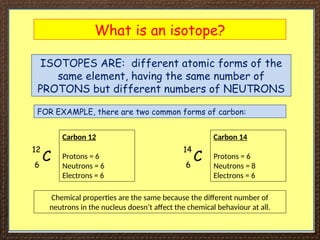
What is anisotope?
ISOTOPES ARE: different atomic forms of the
same element, having the same number of
PROTONS but different numbers of NEUTRONS
FOR EXAMPLE, there are two common forms of carbon:
C
12
6
Carbon 12
Protons = 6
Neutrons = 6
Electrons = 6
C
14
6
Carbon 14
Protons = 6
Neutrons = 8
Electrons = 6
Chemical properties are the same because the different number of
neutrons in the nucleus doesn’t affect the chemical behaviour at all.
81.
What is RELATIVEATOMIC MASS?
By definition: “mass of a particular atom
compared to the mass of an atom of hydrogen”
82.
What is RELATIVEATOMIC MASS?
By definition: “mass of a particular atom
compared to the mass of an atom of hydrogen”
Relative atomic mass is also the same as the
mass number – it’s that simple!
83.
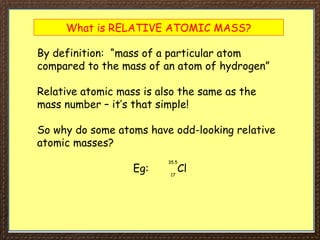
What is RELATIVEATOMIC MASS?
By definition: “mass of a particular atom
compared to the mass of an atom of hydrogen”
Relative atomic mass is also the same as the
mass number – it’s that simple!
So why do some atoms have odd-looking relative
atomic masses?
Eg: Cl
35.5
17
84.
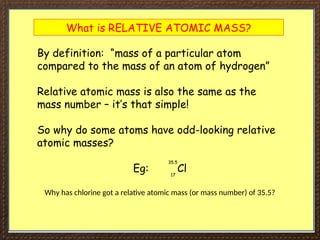
What is RELATIVEATOMIC MASS?
By definition: “mass of a particular atom
compared to the mass of an atom of hydrogen”
Relative atomic mass is also the same as the
mass number – it’s that simple!
So why do some atoms have odd-looking relative
atomic masses?
Eg: Cl
35.5
17
Why has chlorine got a relative atomic mass (or mass number) of 35.5?
85.
What is RELATIVEATOMIC MASS?
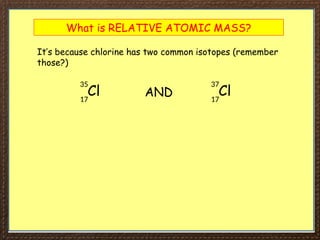
It’s because chlorine has two common isotopes (remember
those?)
Cl
35
17
Cl
37
17
AND
86.
What is RELATIVEATOMIC MASS?
It’s because chlorine has two common isotopes (remember
those?)
Cl
35
17
Cl
37
17
AND
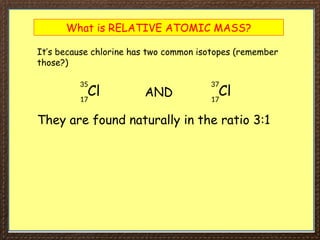
They are found naturally in the ratio 3:1
87.
What is RELATIVEATOMIC MASS?
It’s because chlorine has two common isotopes (remember
those?)
Cl
35
17
Cl
37
17
AND
They are found naturally in the ratio 3:1
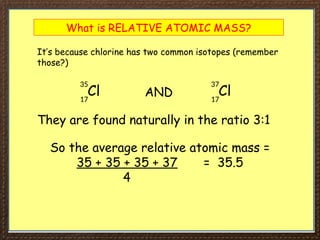
So the average relative atomic mass =
35 + 35 + 35 + 37 = 35.5
4
88.
What is RELATIVEATOMIC MASS?
It’s because chlorine has two common isotopes (remember
those?)
Cl
35
17
Cl
37
17
AND
They are found naturally in the ratio 3:1
So the average relative atomic mass =
35 + 35 + 35 + 37 = 35.5
4
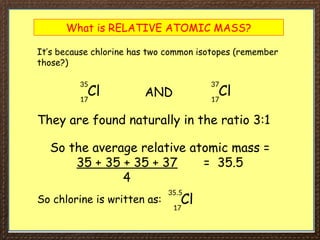
So chlorine is written as: Cl
35.5
17
89.
Where do wefind the relative
atomic mass and atomic number of
an element, and so calculate the
number of protons, neutrons and
electrons in an atom?
90.
Where do wefind the relative
atomic mass and atomic number of
an element, and so calculate the
number of protons, neutrons and
electrons in an atom?
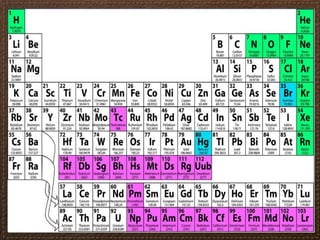
We look in
the
Periodic
Table!
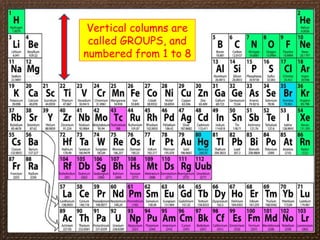
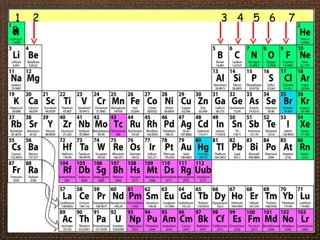
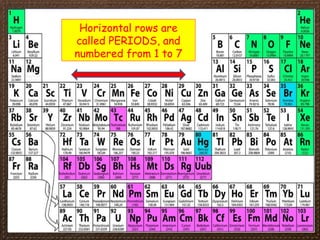
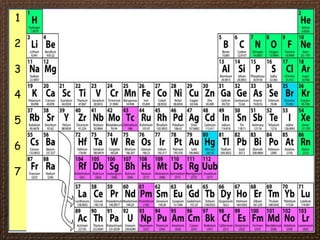
So for anygiven element we can
read off the group and period
number.
97.
So for anygiven element we can
read off the group and period
number.
For example:
Silicon (Si) is Group 4 and Period 3
98.
So for anygiven element we can
read off the group and period
number.
For example:
Silicon (Si) is Group 4 and Period 3
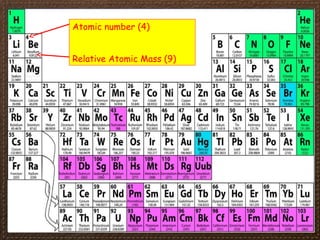
Also, for any given element we can
record the Atomic Number and
Relative Atomic Mass
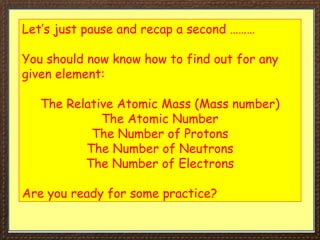
Let’s just pauseand recap a second ………
You should now know how to find out for any
given element:
The Relative Atomic Mass (Mass number)
The Atomic Number
The Number of Protons
The Number of Neutrons
The Number of Electrons
Are you ready for some practice?
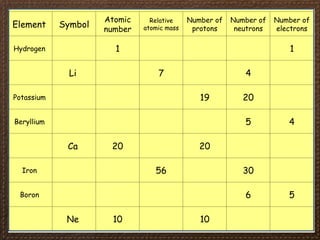
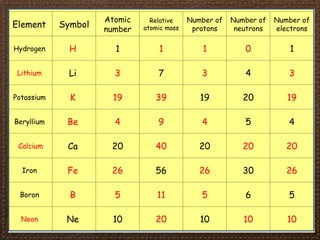
Element Symbol
Atomic
number
Relative
atomic mass
Numberof
protons
Number of
neutrons
Number of
electrons
Hydrogen H 1 1 1 0 1
Lithium Li 3 7 3 4 3
Potassium K 19 39 19 20 19
Beryllium Be 4 9 4 5 4
Calcium Ca 20 40 20 20 20
Iron Fe 26 56 26 30 26
Boron B 5 11 5 6 5
Neon Ne 10 20 10 10 10
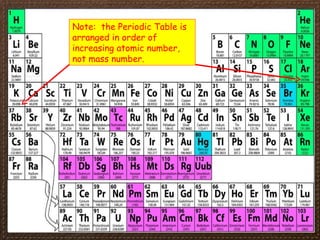
104.
Note: the PeriodicTable is
arranged in order of
increasing atomic number,
not mass number.
105.
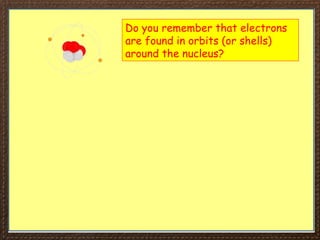
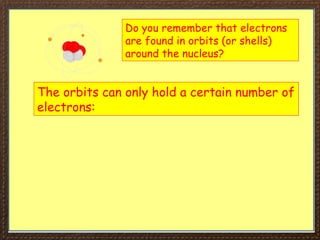
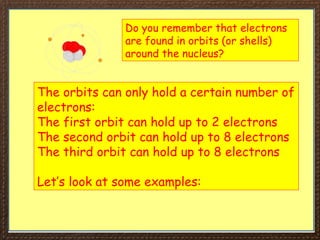
Do you rememberthat electrons
are found in orbits (or shells)
around the nucleus?
106.
Do you rememberthat electrons
are found in orbits (or shells)
around the nucleus?
The orbits can only hold a certain number of
electrons:
107.
Do you rememberthat electrons
are found in orbits (or shells)
around the nucleus?
The orbits can only hold a certain number of
electrons:
The first orbit can hold up to 2 electrons
The second orbit can hold up to 8 electrons
The third orbit can hold up to 8 electrons
Let’s look at some examples:
108.
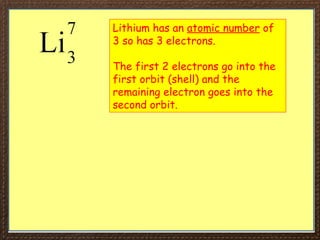
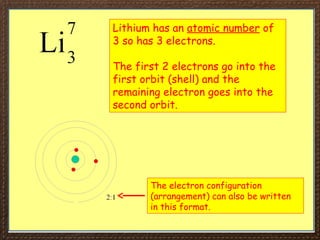
Lithium has anatomic number of
3 so has 3 electrons.
The first 2 electrons go into the
first orbit (shell) and the
remaining electron goes into the
second orbit.
109.
Lithium has anatomic number of
3 so has 3 electrons.
The first 2 electrons go into the
first orbit (shell) and the
remaining electron goes into the
second orbit.
The electron configuration
(arrangement) can also be written
in this format.
110.
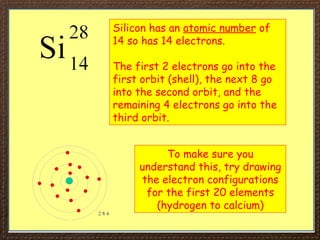
Silicon has anatomic number of
14 so has 14 electrons.
The first 2 electrons go into the
first orbit (shell), the next 8 go
into the second orbit, and the
remaining 4 electrons go into the
third orbit.
To make sure you
understand this, try drawing
the electron configurations
for the first 20 elements
(hydrogen to calcium)
111.
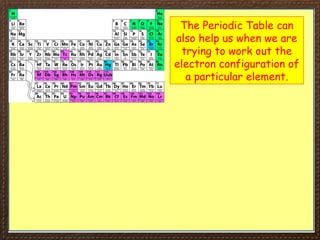
The Periodic Tablecan
also help us when we are
trying to work out the
electron configuration of
a particular element.
112.
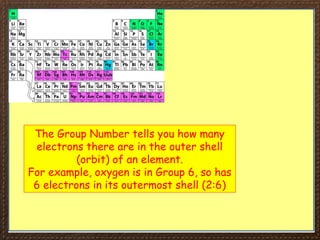
The Group Numbertells you how many
electrons there are in the outer shell
(orbit) of an element.
For example, oxygen is in Group 6, so has
6 electrons in its outermost shell (2:6)
113.
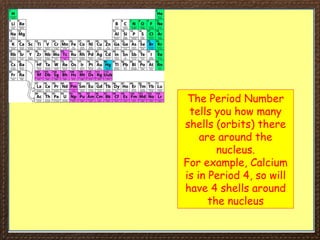
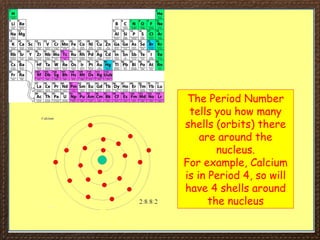
The Period Number
tellsyou how many
shells (orbits) there
are around the
nucleus.
For example, Calcium
is in Period 4, so will
have 4 shells around
the nucleus
114.
The Period Number
tellsyou how many
shells (orbits) there
are around the
nucleus.
For example, Calcium
is in Period 4, so will
have 4 shells around
the nucleus
115.
End of Lesson1
In this lesson we have covered:
States of Matter
Atoms
Atomic structure