1Guru IGCSE HYDROSPHERE
• About 70% of the earth’s surface is covered with water.
• Ninety-seven percent of the water on the earth is salt water..
• Two percent of the water on earth is glacier ice at the North and
South Poles.
• Less than 1% of all the water on earth is fresh water that we can
actually use.
• We use this small amount of water for drinking, transportation,
heating and cooling, industry, and many other purposes.
2Guru IGCSE HYDROSPHERE
3Guru IGCSE HYDROSPHERE
• Everything is made of atoms.
• An atom is the smallest particle of an
element, like oxygen or hydrogen.
Atoms join together to
form molecules.
• Water is made of Oxygen and
hydrogen
4Guru IGCSE HYDROSPHERE
Solid water—ice is frozen water. When water freezes, its
molecules move farther apart, making ice less dense than
water.
Liquid water is wet and fluid. This is the form of water
with which we are most familiar. We use liquid water in
many ways, including washing and drinking.
Water as a gas—vapor is always present in the air around
us. 5Guru IGCSE HYDROSPHERE
6Guru IGCSE HYDROSPHERE
• The cycle of water movement from the atmosphere to the
earth and back to the atmosphere through condensation,
precipitation, evaporation, and transpiration is called
WATER CYCLE
• The continual cycle of water between the land, the ocean
and the atmosphere.
• The water cycle, also known as the hydrologic cycle,
describes the continuous movement of water on, above
and below the surface of the Earth.
What is Water Cycle ?
7Guru IGCSE HYDROSPHERE
8Guru IGCSE HYDROSPHERE
9Guru IGCSE HYDROSPHERE
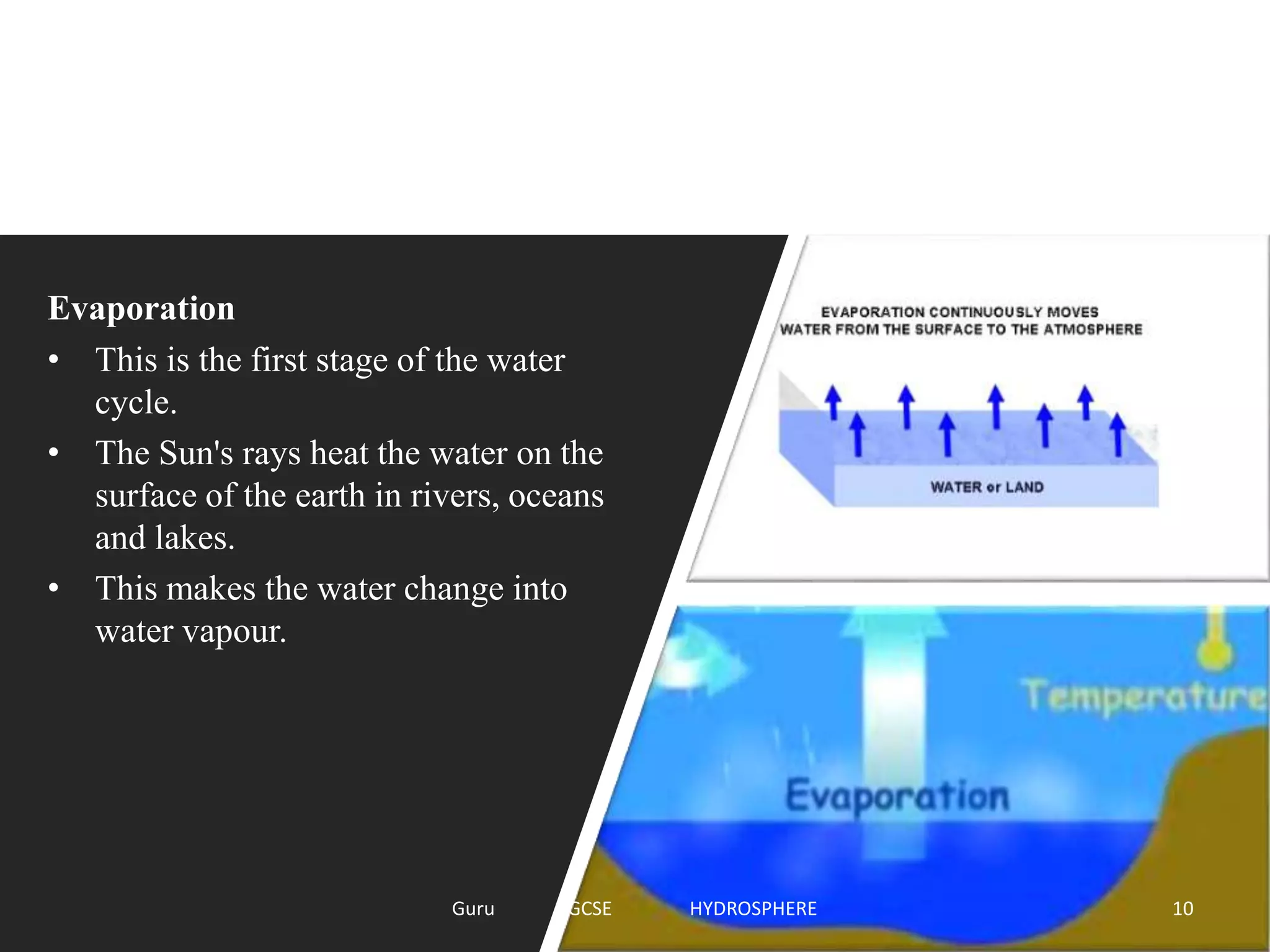
Evaporation
• This is the first stage of the water
cycle.
• The Sun's rays heat the water on the
surface of the earth in rivers, oceans
and lakes.
• This makes the water change into
water vapour.
10Guru IGCSE HYDROSPHERE
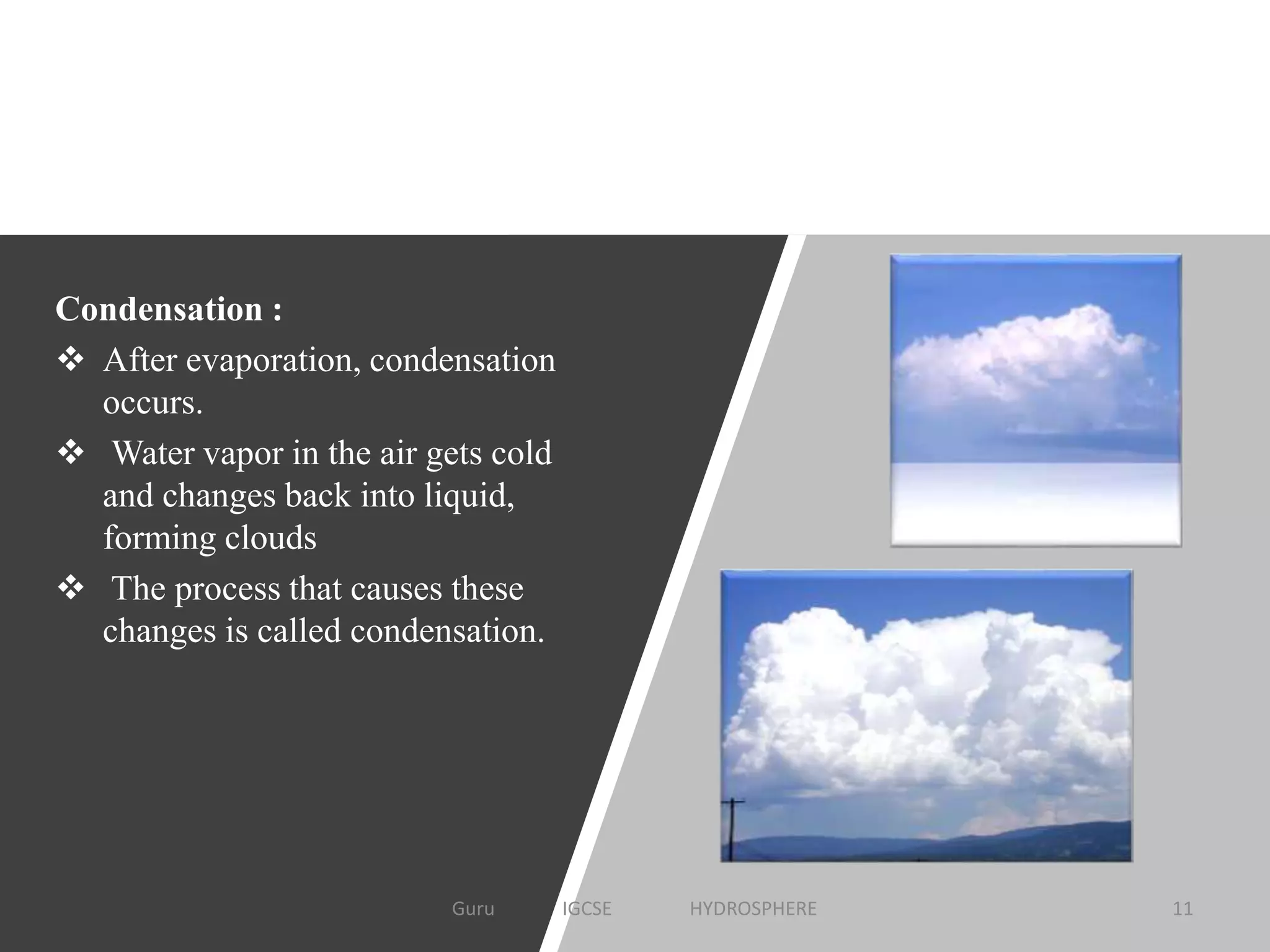
Condensation :
 After evaporation, condensation
occurs.
 Water vapor in the air gets cold
and changes back into liquid,
forming clouds
 The process that causes these
changes is called condensation.
11Guru IGCSE HYDROSPHERE
• Precipitation :
Precipitation occurs when so much
water has condensed that the air cannot
hold it anymore. The clouds get heavy
and water falls back to the earth in the
form of rain
• Collection
After precipitation comes the stage of
collection. The raindrops fall back into
the lakes, rivers and oceans or are
absorbed by the land. This process by
which rainwater gathers on earth is
called collection.
12Guru IGCSE HYDROSPHERE
What is
Fresh
water ?
• Fresh water is naturally
occurring water on the
Earth's surface in ice
sheets, ice caps, glaciers,
icebergs, ponds, lakes,
rivers and streams, and
underground as
groundwater in aquifers
and underground
streams.
13Guru IGCSE HYDROSPHERE
14Guru IGCSE HYDROSPHERE
Water
Rich
Countries
• Still, the statistical summary
gives a basic perspective on
the ten richest countries in
terms of the world’s total
freshwater resources,
estimated at some 55,273
cubic kilometers per year
(ckpy).
15Guru IGCSE HYDROSPHERE
2017
Report
1. Brazil… (14.9% of world
total)
2. Russia… (8.1%)
3. Canada… (6%)
4. United States… (5.6%)
5. Indonesia … (5.1%)
6. China… (5.1%)
7. Colombia … (3.9%)
8. Peru … (3.5%)
9. India … (3.5%)
10. Democratic Republic of
Congo … (2.3%)
16Guru IGCSE HYDROSPHERE
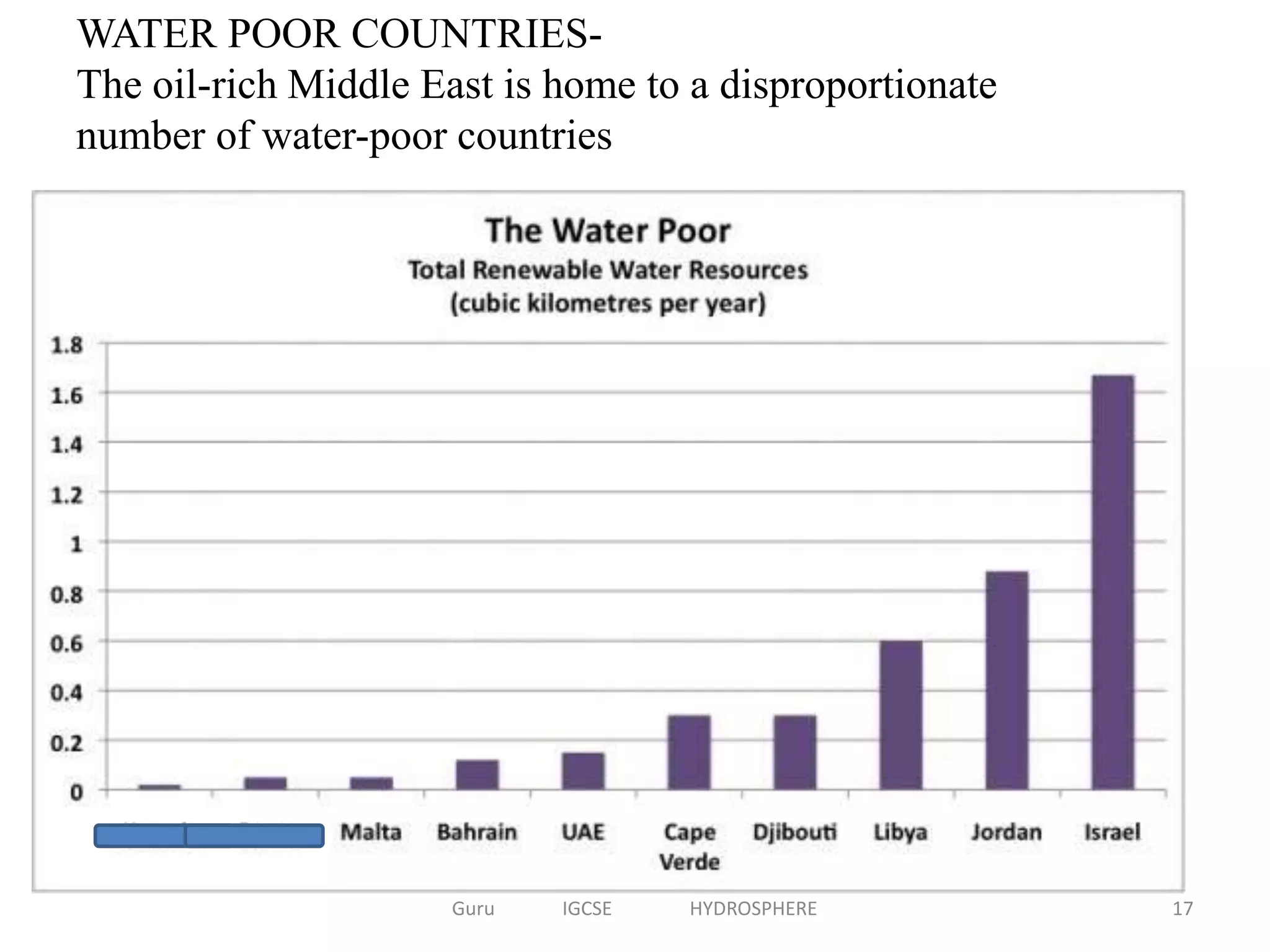
WATER POOR COUNTRIES-
The oil-rich Middle East is home to a disproportionate
number of water-poor countries
17Guru IGCSE HYDROSPHERE
Why is
Water an
Increasingly
Strategic
Resource?
1. The world’s population is
growing by about 80 million
people a year, implying
increased freshwater demand
of about 64 billion cubic
metres a year.
2. By 2025, 1.8 billion people
will be living in countries or
regions with absolute water
scarcity, and two-thirds of the
world population could be
under stress conditions.
18Guru IGCSE HYDROSPHERE
19Guru IGCSE HYDROSPHERE
What is Water crisis?
Water crisis is a general term used to describe a
situation where the available water within a
region is less than the region's demand.
The major aspects of the water crisis are
allegedly overall scarcity of usable water
and water pollution.
20Guru IGCSE HYDROSPHERE
21Guru IGCSE HYDROSPHERE
Water
CRISIS
• A global crisis
1. 884 million people in the world do
not have access to safe water. This
is roughly one in eight of the
world's population.
2. 2.6 billion people in the world do
not have access to adequate
sanitation, this is almost two
fifths of the world's population.
3. 1.4 million children die every year
from diarrhoea caused by unclean
water and poor sanitation
22Guru IGCSE HYDROSPHERE
What's the problem in Water?:
1. The population is growing rapidly, putting
more pressure on our water
supply (demand is increasing)
2. The amount of water is effectively reduced
by pollution and contamination (supply is
decreasing)
23Guru IGCSE HYDROSPHERE
24Guru IGCSE HYDROSPHERE
What are the Solutions?
• Improvements in the efficiency of water use
• Efficient management and modern technology
can stretch even scarce water supplies much
further.
• Water is often wasted because it is
underpriced. Direct and indirect subsidies
(especially for agricultural use) are still
common in both developed and developing
countries.
25Guru IGCSE HYDROSPHERE
Overview
of regions
suffering
crisis
impacts
1. The weight of water that women in
Africa and Asia carry on their heads
is commonly 20kg, the same as the
average UK airport luggage
allowance.
2. The average person in the developing
world uses 10 litres of water every
day for their drinking, washing and
cooking.
3. On current trends over the next 20
years humans will use 40% more
waterthan they do now. (UNEP)
4. Agriculture accounts for over 80% of
the world's water consumption.
26Guru IGCSE HYDROSPHERE
27Guru IGCSE HYDROSPHERE
Dam
28Guru IGCSE HYDROSPHERE
• A dam is a barrier that impounds water or
underground streams.
• Dams generally serve the primary purpose of
retaining water, while other structures such as
floodgates are used to manage or prevent
water flow into specific land regions.
What is a dam?
29Guru IGCSE HYDROSPHERE
Common
purpose of Dam
1. Power generation
2. Water supply
3. Stabilize water flow /
irrigation
4. Flood prevention
5. Water diversion
6. Recreation and aquatic
beauty
30Guru IGCSE HYDROSPHERE
Which is the biggest Dam in the
World?
31Guru IGCSE HYDROSPHERE
32Guru IGCSE HYDROSPHERE
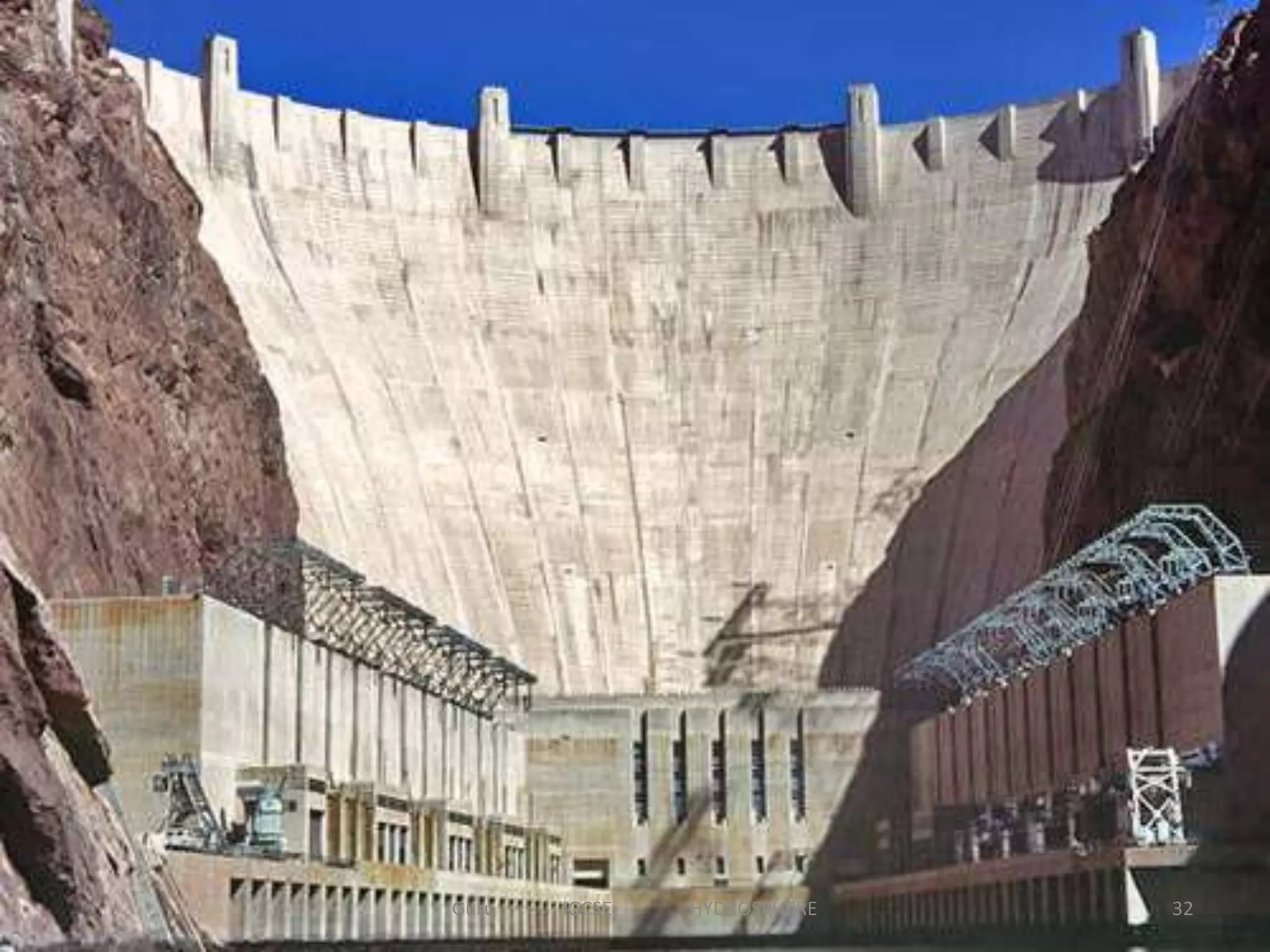
Hoover dam
33Guru IGCSE HYDROSPHERE
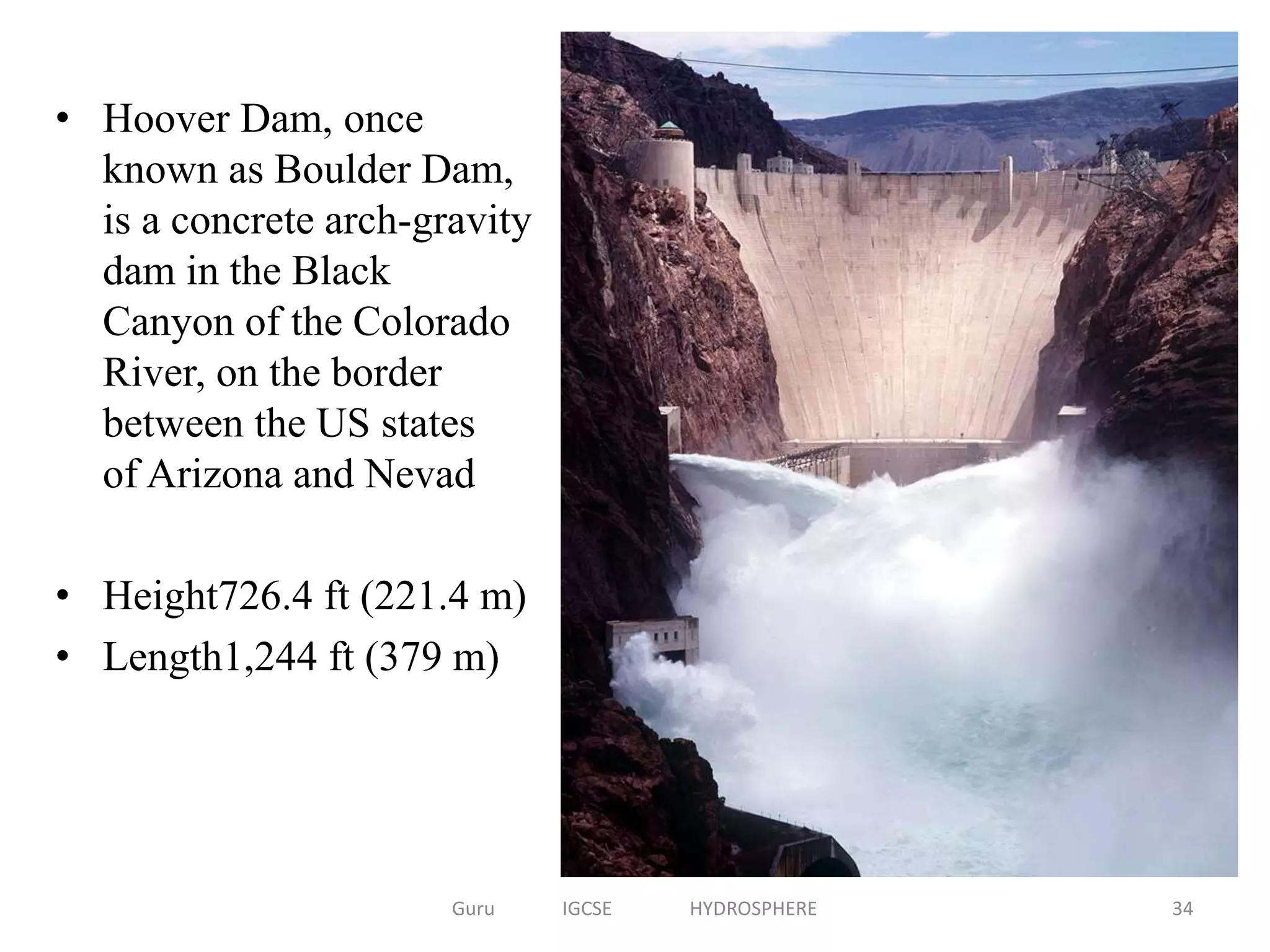
• Hoover Dam, once
known as Boulder Dam,
is a concrete arch-gravity
dam in the Black
Canyon of the Colorado
River, on the border
between the US states
of Arizona and Nevad
• Height726.4 ft (221.4 m)
• Length1,244 ft (379 m)
34Guru IGCSE HYDROSPHERE
Which is the biggest
dam in India?
35Guru IGCSE HYDROSPHERE
Hirakud Dam
36Guru IGCSE HYDROSPHERE
Hirakud Dam is built across the Mahanadi River,
about 15 km from Sambalpur in the state
of Orissa in India.
37Guru IGCSE HYDROSPHERE
• Hirakud Dam is the longest
man-made dam in the world,
about 16 mi (26 km) in
length
• Height60.96 m (200 ft)
• Length4.8 km (3 mi) (main
section)
25.8 km (16 mi) (entire
dam)
38Guru IGCSE HYDROSPHERE
1. Once a dam is constructed, electricity can be produced at
a constant rate.
2.
Dams are designed to last many decades and so can
contribute to the generation of electricity for many years.
3.
The lake that forms behind the dam can be used for water
sports and leisure / pleasure activities.
4. Often large dams become tourist attractions in their own
right.
5.
The lake's water can be used for irrigation purposes.
ADVANTAGES OF DAM
39Guru IGCSE HYDROSPHERE
Bhakra Dam is a concrete gravity dam across the Sutlej River and is
near the border between Punjab and Himachal Pradesh in
northern India.
40Guru IGCSE HYDROSPHERE
Bhakra Dam is India's second tallest at
225.55 m (740 ft) high
41Guru IGCSE HYDROSPHERE
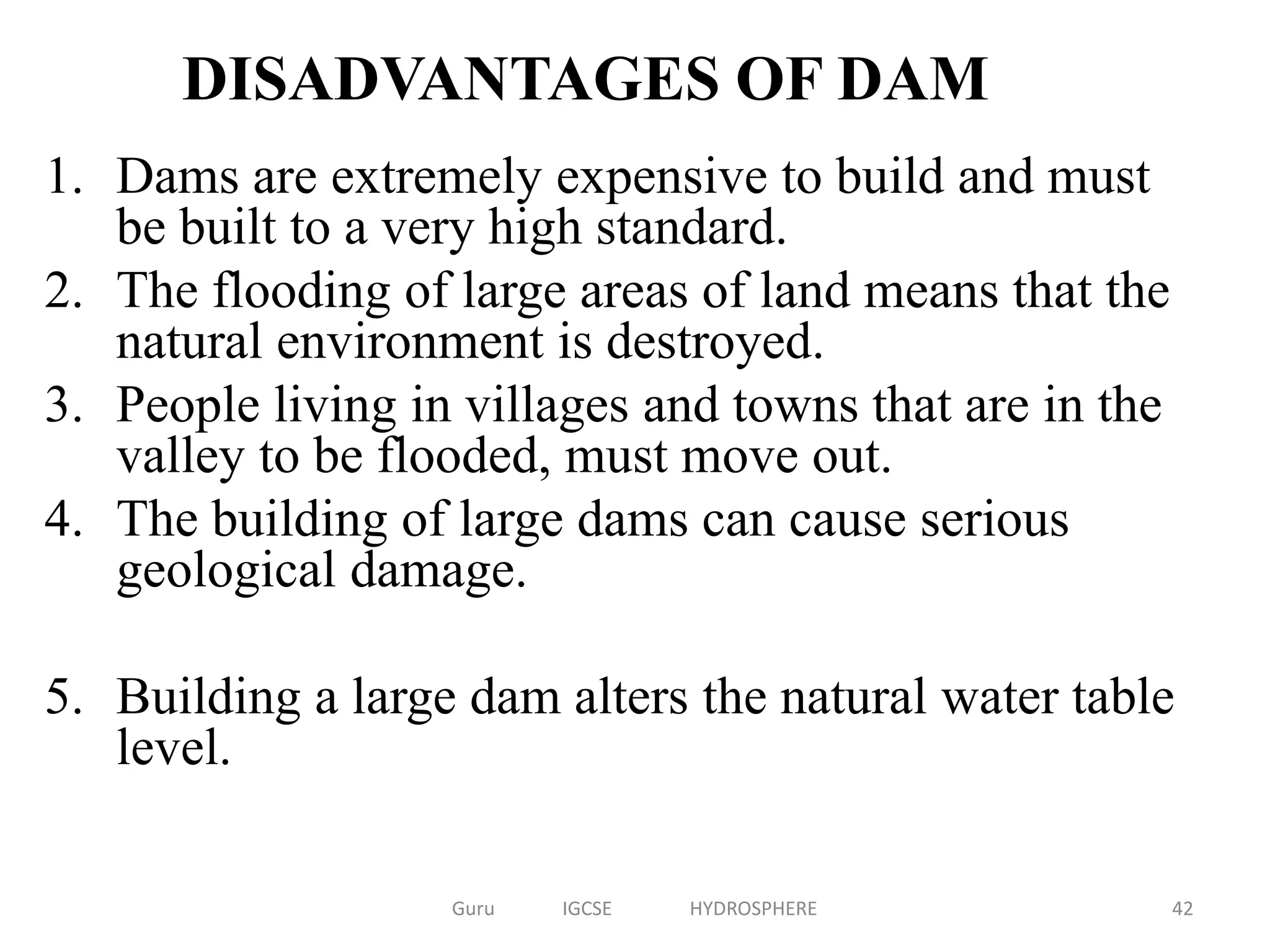
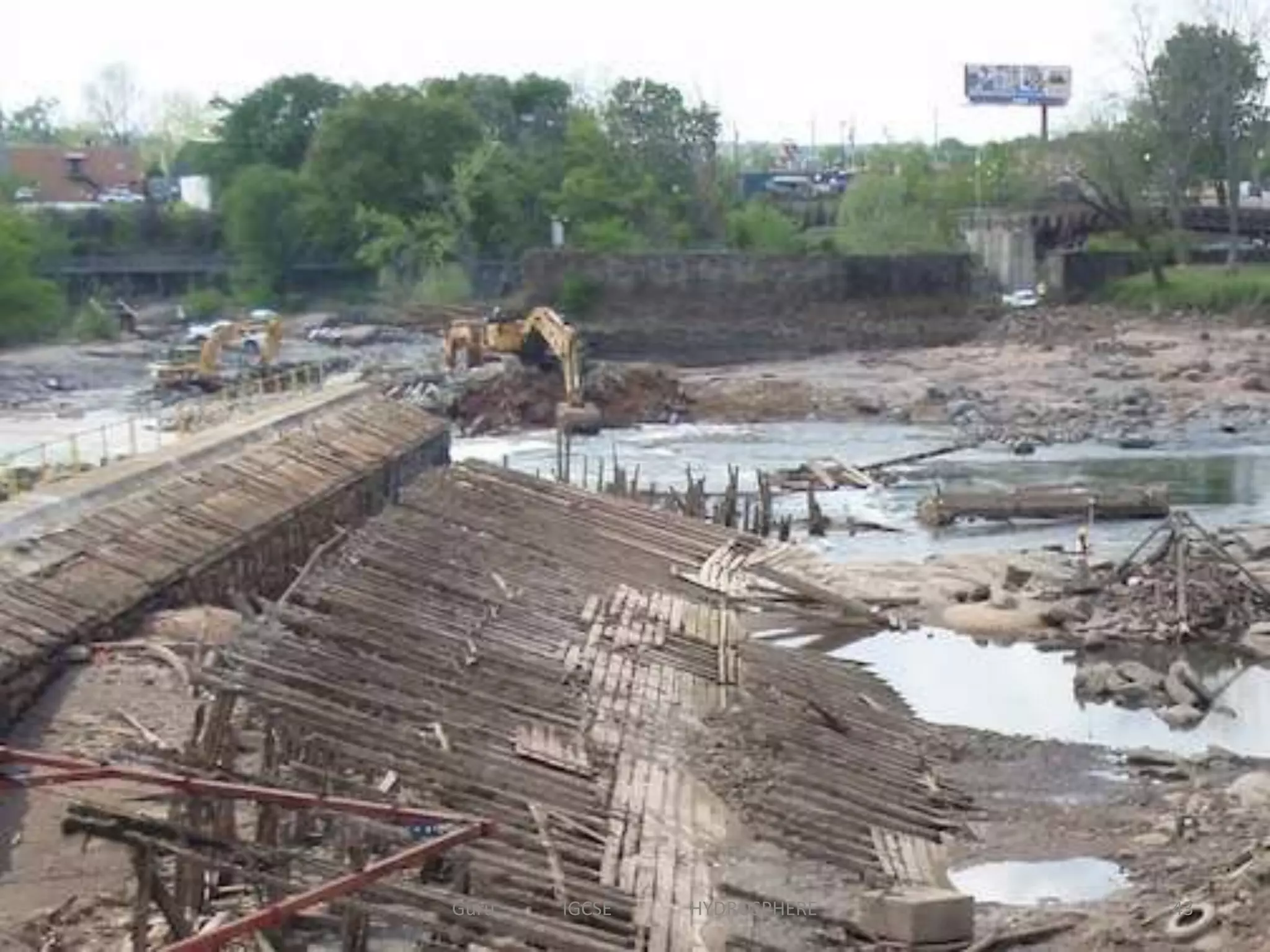
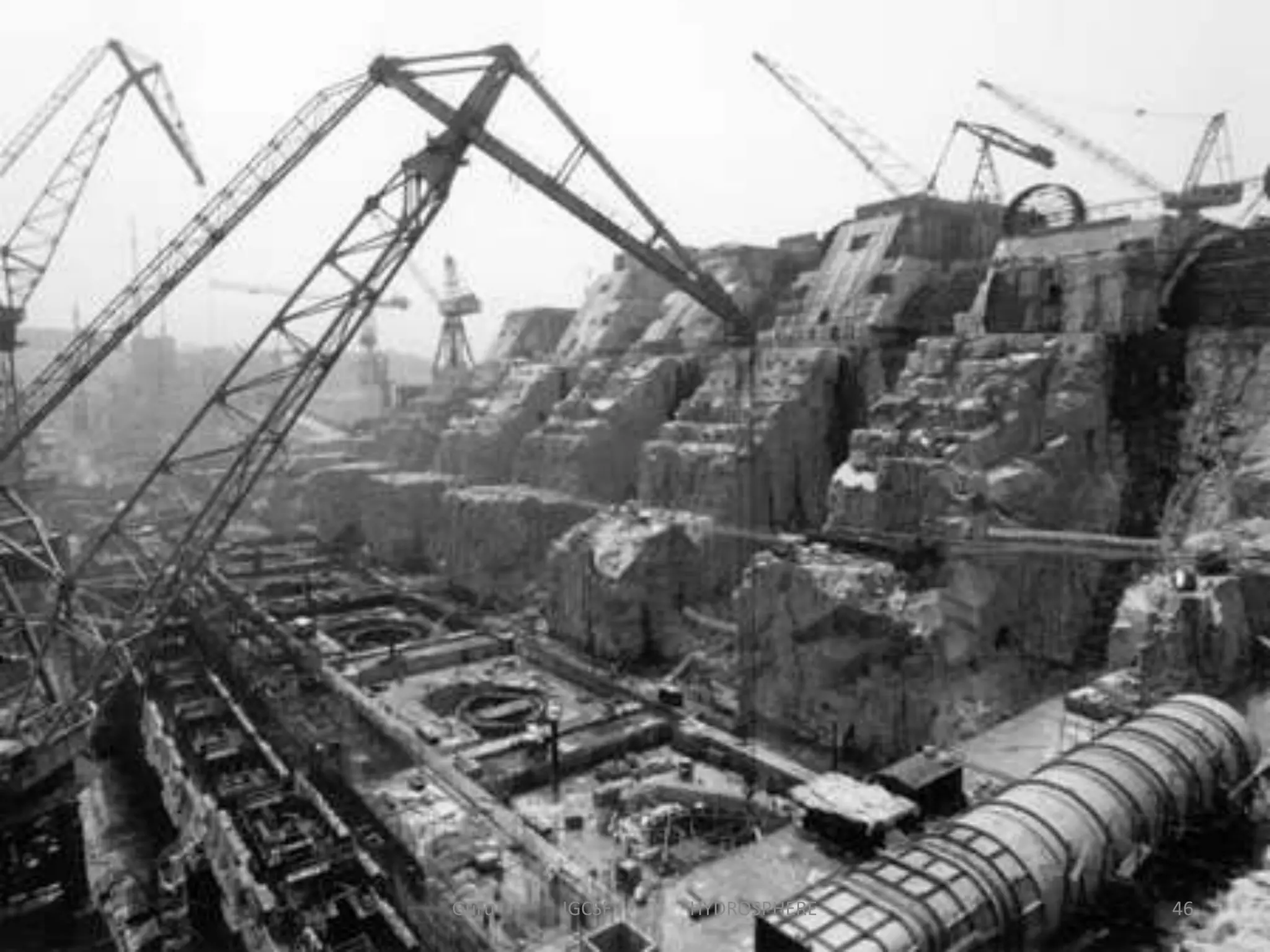
1. Dams are extremely expensive to build and must
be built to a very high standard.
2. The flooding of large areas of land means that the
natural environment is destroyed.
3. People living in villages and towns that are in the
valley to be flooded, must move out.
4. The building of large dams can cause serious
geological damage.
5. Building a large dam alters the natural water table
level.
DISADVANTAGES OF DAM
42Guru IGCSE HYDROSPHERE
43Guru IGCSE HYDROSPHERE
44Guru IGCSE HYDROSPHERE
45Guru IGCSE HYDROSPHERE
46Guru IGCSE HYDROSPHERE
47Guru IGCSE HYDROSPHERE
Impact assessment of
Dam
48Guru IGCSE HYDROSPHERE
Environmental impact
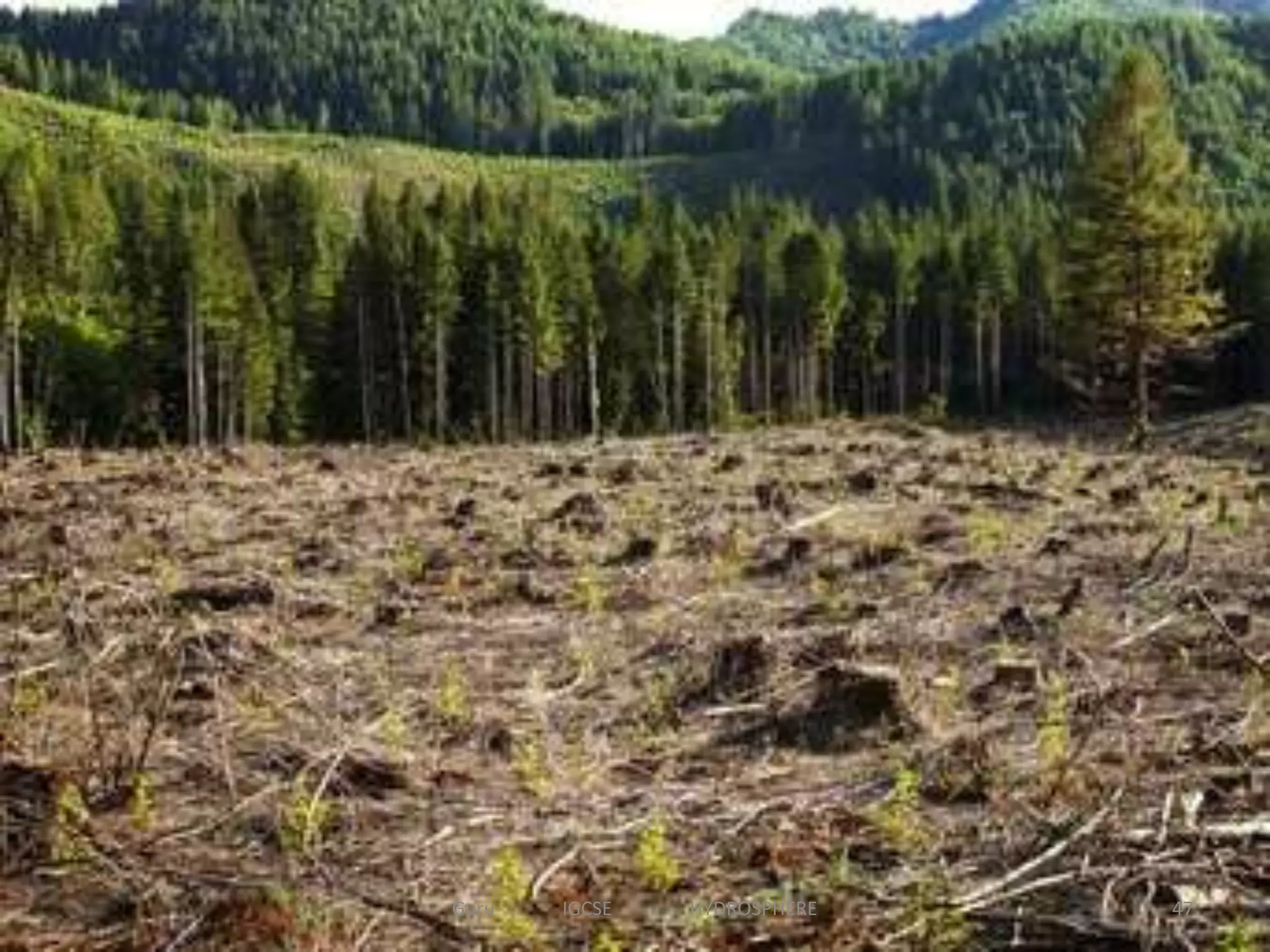
• 1.A large dam can cause the loss of entire ecospheres
including endangered and undiscovered species in the area,
and the replacement of the original environment by a new
inland lake.
• 2.Large reservoirs formed behind dams have been indicated
in the contribution of seismic activity, due to changes in
water load and/or the height of the water table.
49Guru IGCSE HYDROSPHERE
50Guru IGCSE HYDROSPHERE
51Guru IGCSE HYDROSPHERE
• 3.Dam can be particularly damaging in seasonal floodplains,
affecting deposits of nutrients as well as the lifecycles of
species that depend on these fluctuation` for feeding and
breeding grounds.
52Guru IGCSE HYDROSPHERE
2.Human social impact
• It is estimated that to date, 40-80 million people worldwide
have been physically displaced from their homes as a result of
dam construction
53Guru IGCSE HYDROSPHERE
Dams - blessing and curse?
Over 48,000 large dams are in
operation worldwide. And more
are being built to provide drinking
water, irrigate the land, produce
hydropower, and prevent floods.
Yet today: Over one billion people
do not have access to safe drinking
water
More than double that number
lack basic sanitation
Two billion people have no access
to electricity.
54Guru IGCSE HYDROSPHERE
55Guru IGCSE HYDROSPHERE
1. A flood is an overflow of an expanse of water
that submerges land.
2. Flooding may result from the volume of water
within a body of water, such as a river or lake,
which overflows or breaks levees, with the
result that some of the water escapes its usual
boundaries
What is Flood?
56Guru IGCSE HYDROSPHERE
57Guru IGCSE HYDROSPHERE
CAUSES OF
RIVER
FLOODING
• Riverine
1. Runoff from sustained rainfall or
rapid snow melt exceeding the
capacity of a river's channel.
2. Causes include heavy rains
from monsoons, hurricanes and
tropical depressions, foreign winds
and warm rain affecting snow pack
58Guru IGCSE HYDROSPHERE
59Guru IGCSE HYDROSPHERE
60Guru IGCSE HYDROSPHERE
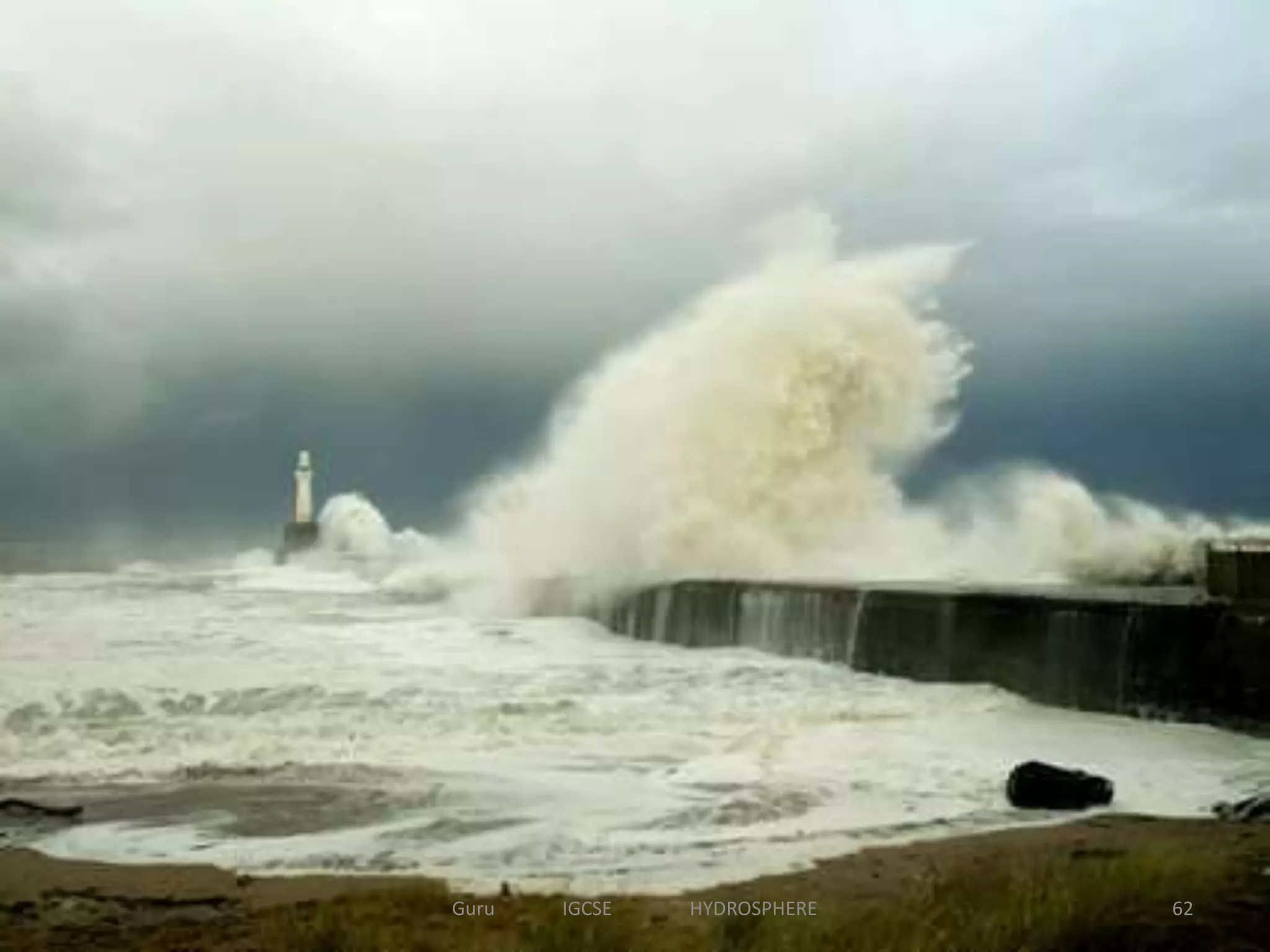
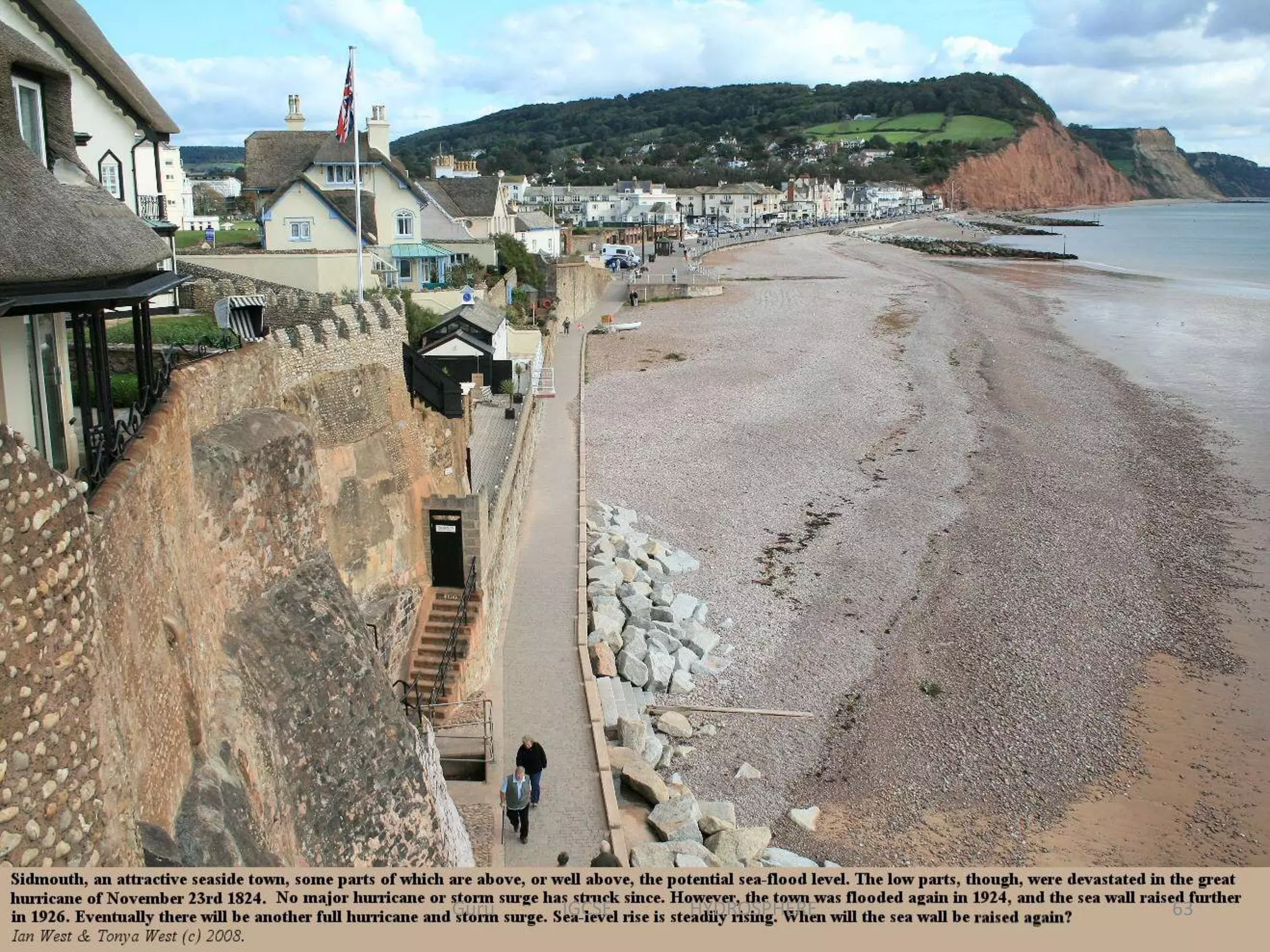
• Coastal
1. Caused by severe sea storms,
or as a result of another
hazard (e.g. tsunami or
hurricane).
2. A storm surge, from either
a tropical cyclone or an extra
tropical cyclone, falls within
this category
61Guru IGCSE HYDROSPHERE
62Guru IGCSE HYDROSPHERE
63Guru IGCSE HYDROSPHERE
EFFECTS OF RIVER
FLOODING
64Guru IGCSE HYDROSPHERE
There are many after effects of a
flood. Much of it is quiet deadly.
These effects of a flood are
divided into three key categories
which are :
1.Long-term Effect:
2.Secondary Effect:
3.Primary Effect:
65Guru IGCSE HYDROSPHERE
• 1.The long term effect of flood basically includes the Economic effect. A flood can
result in an economic hardship for the flood hit area. This results in rebuilding
costs, decline in tourism etc.
• 2.Secondary Effect includes contamination of water, diseases because of
unhygienic water.
• 3. Primary effects includes physical damage to everything and casualties amongst
people and livestock
66Guru IGCSE HYDROSPHERE
67Guru IGCSE HYDROSPHERE
68Guru IGCSE HYDROSPHERE
69Guru IGCSE HYDROSPHERE
70Guru IGCSE HYDROSPHERE
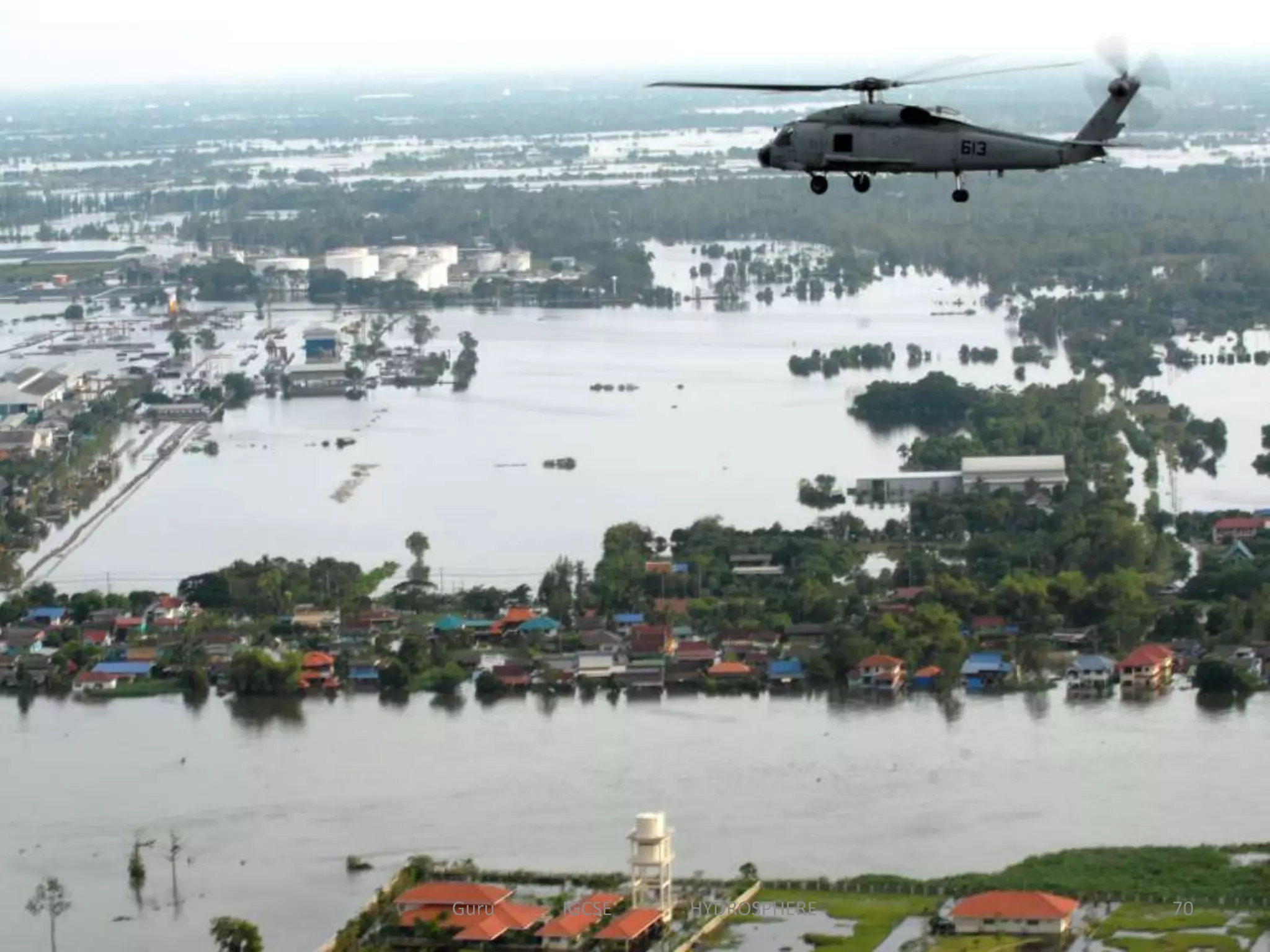
Some immediate effects
are: Primary Effects
1.Loss of human life
2.Damage to
infrastructure
3. Livestock carried
away
4.Communication
disputes
71Guru IGCSE HYDROSPHERE
• Short term effects
1.People in need of medical
treatment
2.Homeless people
3.Shortage of safe drinking water
4.Food shortage
Long term effects
1.Repair of infrastructure
2.reclamation of farmland
3. Restore public services
72Guru IGCSE HYDROSPHERE
73Guru IGCSE HYDROSPHERE
What is
Water
Pollution?
• Water pollution is the contamination
of water bodies
(e.g. lakes, rivers, oceans, and
groundwater). Water pollution occurs
when pollutants are discharged directly
or indirectly into water bodies without
adequate treatment to remove harmful
compounds.
74Guru IGCSE HYDROSPHERE
75Guru IGCSE HYDROSPHERE
76Guru IGCSE HYDROSPHERE
77Guru IGCSE HYDROSPHERE
• Types of Water Pollution
• Without getting too technical, water pollution is a result of various
things, but usually leads back to these sources:
1. Industry
2. Agriculture
78Guru IGCSE HYDROSPHERE
79Guru IGCSE HYDROSPHERE
• Industry
1. There are three main ways that
industries contribute to water pollution.
2. They pollute by disposing of waste
directly into waterways, emitting toxic
gases that cause acid rain and changing
the temperature of water with their
disposals into waterways.
80Guru IGCSE HYDROSPHERE
81Guru IGCSE HYDROSPHERE
• Agriculture pollution
• Its common for farmers to use fertilizers and other chemicals on
their crops to help them grow.
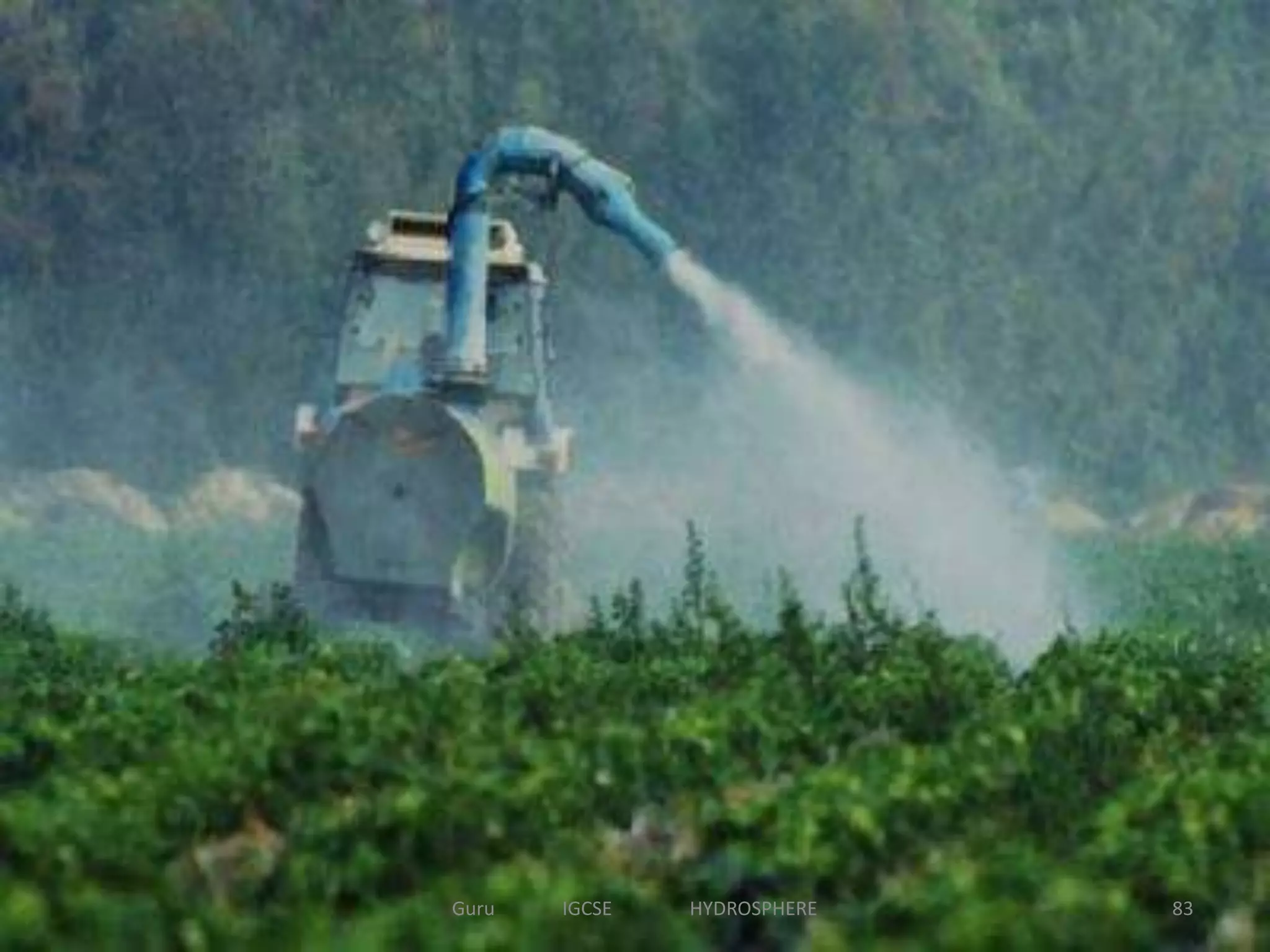
• Some application methods – such as pesticide spraying by
aeroplane – lead to pollution of adjacent land, rivers or wetlands.
• Due to inappropriate water management and irrigation
technology, fertilizers and pesticides also commonly run-off
from fields to adjacent rivers and lakes and contaminate
groundwater sources
82Guru IGCSE HYDROSPHERE
83Guru IGCSE HYDROSPHERE
84Guru IGCSE HYDROSPHERE
85Guru IGCSE HYDROSPHERE
1. Spread of disease: Drinking polluted water can
cause cholera or typhoid infections, along with
diarrhea.
2. Affects body organs: The consumption of highly
contaminated water can cause injury to the heart
and kidneys.
3. Harms the food chain: Toxins within water can
harm aquatic organisms, thus breaking a link in
the food chain.
4. Harms animals: Birds that get into oil-
contaminated water die from exposure
to cold water and air due to feather damage.
Other animals are affected when they eat dead
fish in contaminated streams.
86Guru IGCSE HYDROSPHERE
Consequences of water pollution
Effects on Ecosystem
Water pollution has effects on both physical and
chemical properties of water leading to hazardous
effects on the dependent life forms in water.
87Guru IGCSE HYDROSPHERE
Effects on Human Life
1. Water pollution can cause certain waterborne diseases like
diarrhea, typhoid, cholera, and jaundice.
2. These can be caused due to the dumping of human wastes and
sewage water.
3. Drinking contaminated water for longer period of time can damage
the liver and kidneys of a person.
4. Toxic water can result in causing skin disorders, ulcers, tumors etc.
88Guru IGCSE HYDROSPHERE
89Guru IGCSE HYDROSPHERE
90Guru IGCSE HYDROSPHERE
What is
Eutrophication?
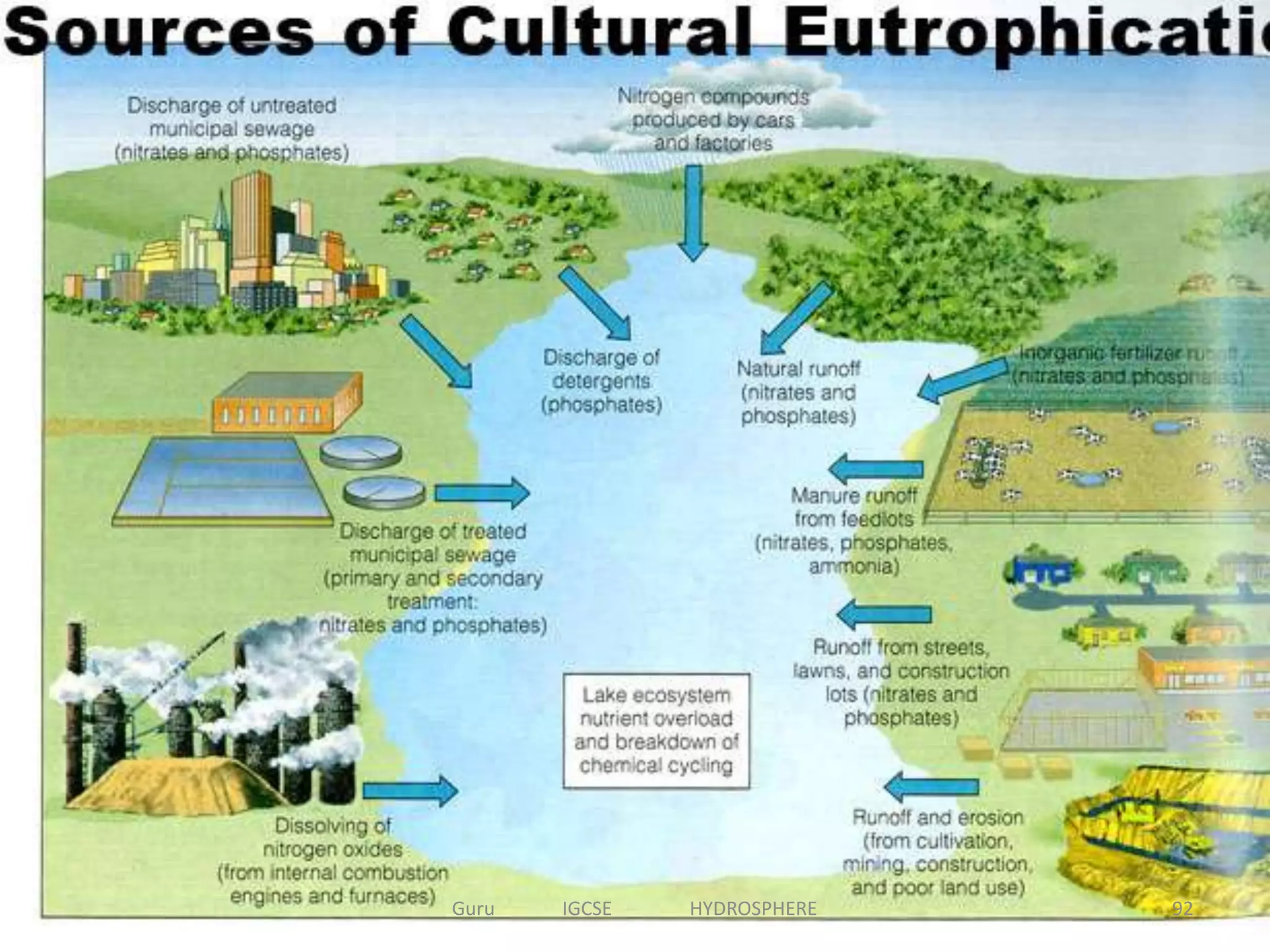
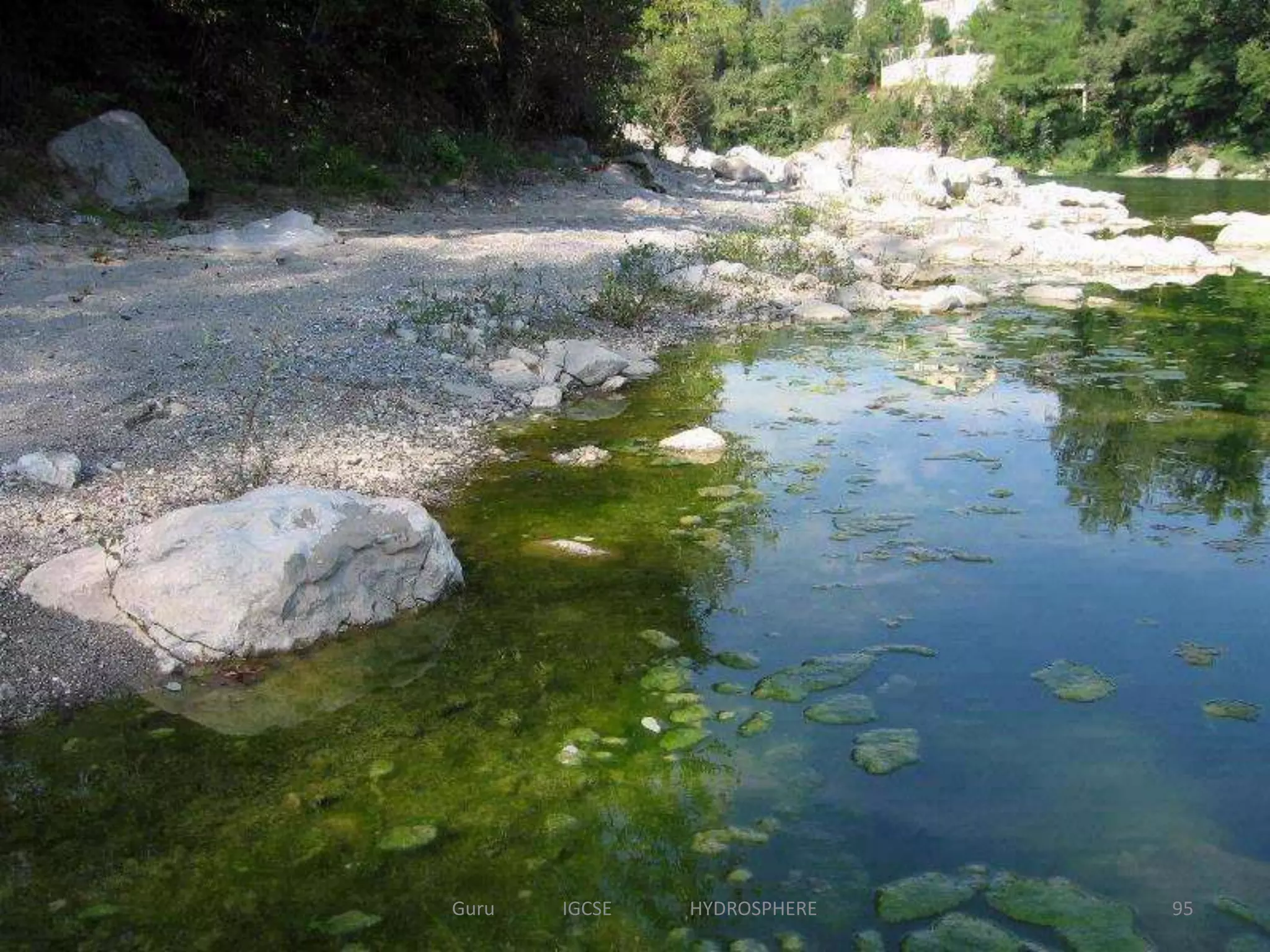
1. The process by which a body of water
acquires a high concentration
of nutrients, especially phosphates
and nitrates.
2. These typically promote excessive
growth of algae.
3. As the algae die and decompose, high
levels of organic matter and the
decomposing organisms deplete the
water of available oxygen, causing
the death of other organisms, such as
fish.
91Guru IGCSE HYDROSPHERE
92Guru IGCSE HYDROSPHERE
93Guru IGCSE HYDROSPHERE
• 4.This bloom of algae disrupts normal ecosystem
functioning and causes many problems.
• 5.The algae may use up all the oxygen in the water,
leaving none for other marine life. This results in the
death of many aquatic organisms such as fish, which
need the oxygen in the water to live.
• 6.The bloom of algae may also block sunlight from
photosynthetic marine plants under the water surface.
94Guru IGCSE HYDROSPHERE
95Guru IGCSE HYDROSPHERE
96Guru IGCSE HYDROSPHERE
97Guru IGCSE HYDROSPHERE
98Guru IGCSE HYDROSPHERE
What is
Water
related
Diseases?
1. Water related diseases are the
most common cause of deaths.
2. Water-borne diseases are
infectious diseases spread
primarily through
contaminated water.
3. Though these diseases are
spread either directly or
through flies or filth, water is
the chief medium for spread of
these diseases and hence they
are termed as water-borne
diseases.
99Guru IGCSE HYDROSPHERE
3 TYPES
Water-Borne
Diseases
Water-Based
Diseases
WATER BRED
DISEASES
100Guru IGCSE HYDROSPHERE
Water-
Borne
Diseases
• Water-borne diseases are "dirty-
water" diseases those caused by
water that has been
contaminated by human,
animal, or chemical wastes.
• Water borne disease- CHOLERA
101Guru IGCSE HYDROSPHERE
102Guru IGCSE HYDROSPHERE
• Water-Based Diseases
1) Water-based diseases are caused by aquatic organisms
that spend part of their life cycle in the water and
another part as parasites of animals.
2) These organisms can thrive in either polluted or
unpolluted water.
3) Water based disease- BILHARZIA
103Guru IGCSE HYDROSPHERE
104Guru IGCSE HYDROSPHERE
WATER
BRED
DISEASES
• The carrier breeds in water and
spreads disease by biting its
victim.
• The disease of this type which
affects most people worldwide is
malaria, transmitted by
mosquitoes.
•
Water bred disease- MALARIA
105Guru IGCSE HYDROSPHERE
106Guru IGCSE HYDROSPHERE
107Guru IGCSE HYDROSPHERE
1) Diarrhoea remains the most prevalent
water related disease in India.
2) It mostly affects children under the age of
5and often leads to death.
3) Diarrhoeal infection is spread through food
and drinking water that has been
contaminated.
4) Symptoms of diarrhoea include, severe
dizziness, loss of consciousness,
dehydration and pale skin, little or in some
case bloody stool.
Diarrhoea
108Guru IGCSE HYDROSPHERE
109Guru IGCSE HYDROSPHERE
110Guru IGCSE HYDROSPHERE
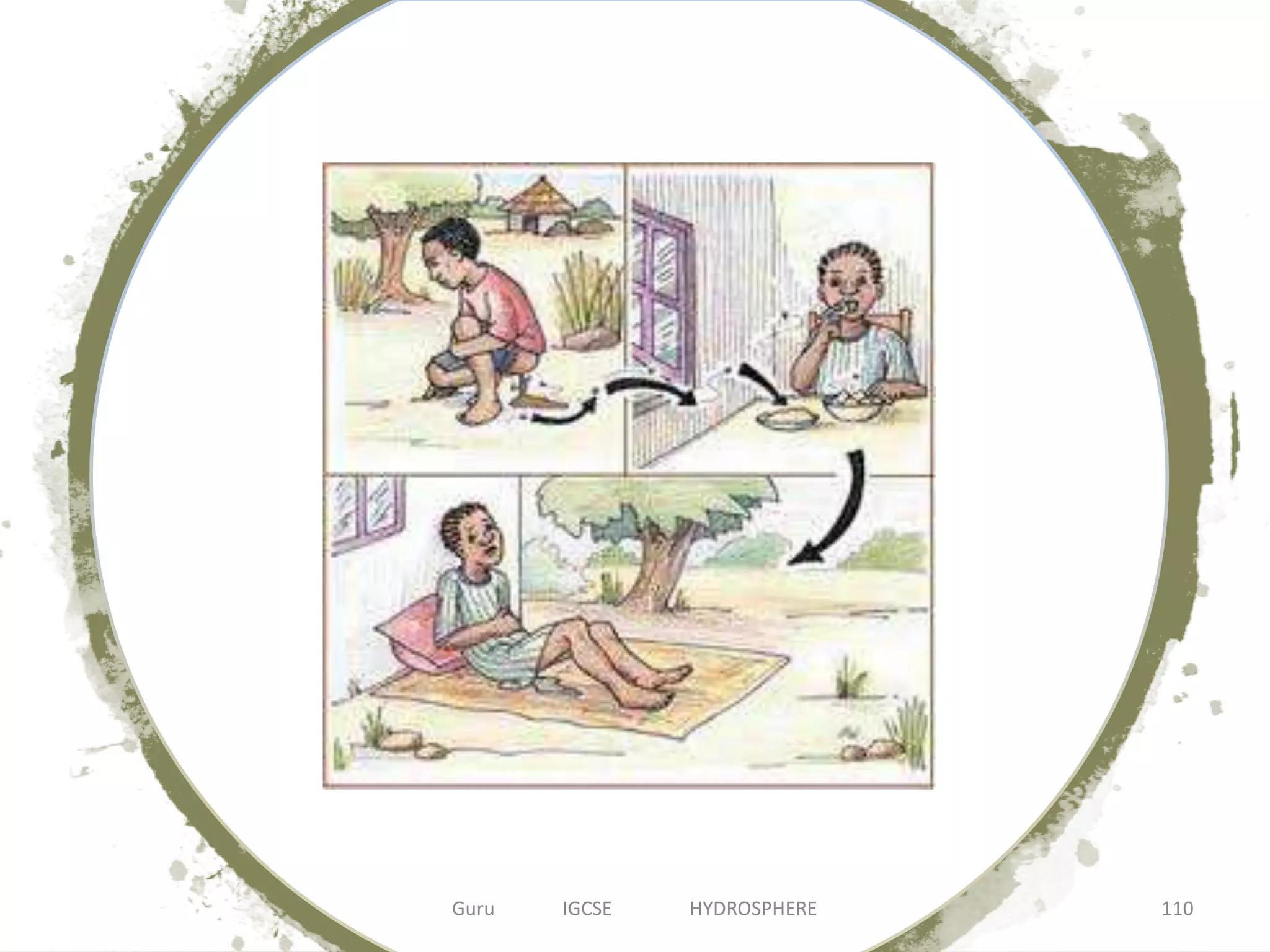
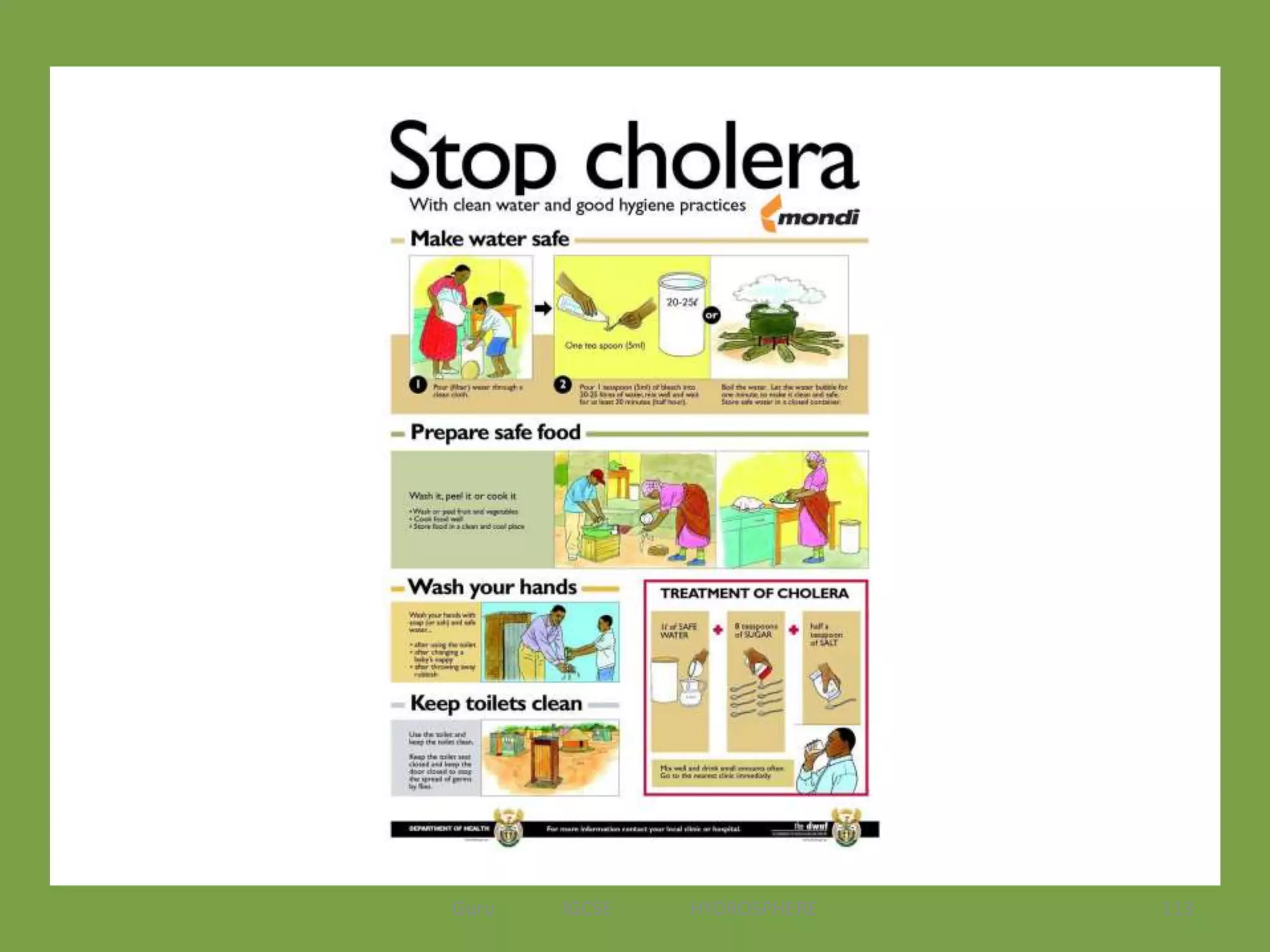
1. Cholera is a water related disease
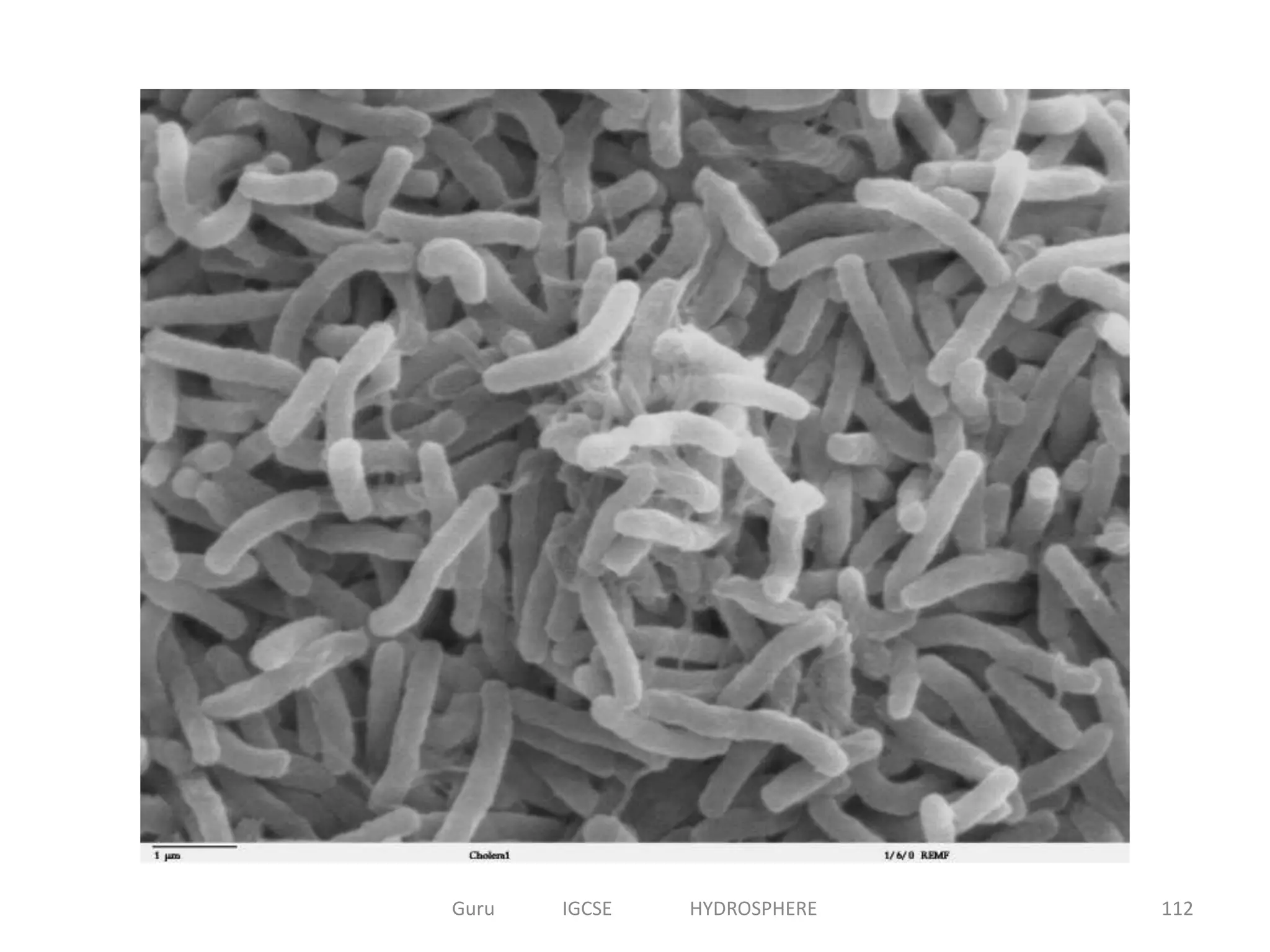
2. Cholera strikes when one ingests water
that is infested with the Vibrio Cholerae
bacterium.
3. Symptoms of cholera include watery
bowels and fever in certain cases.
4. Cholera can happen to both children
and adults.
Cholera
111Guru IGCSE HYDROSPHERE
112Guru IGCSE HYDROSPHERE
113Guru IGCSE HYDROSPHERE
114Guru IGCSE HYDROSPHERE
115Guru IGCSE HYDROSPHERE
116Guru IGCSE HYDROSPHERE
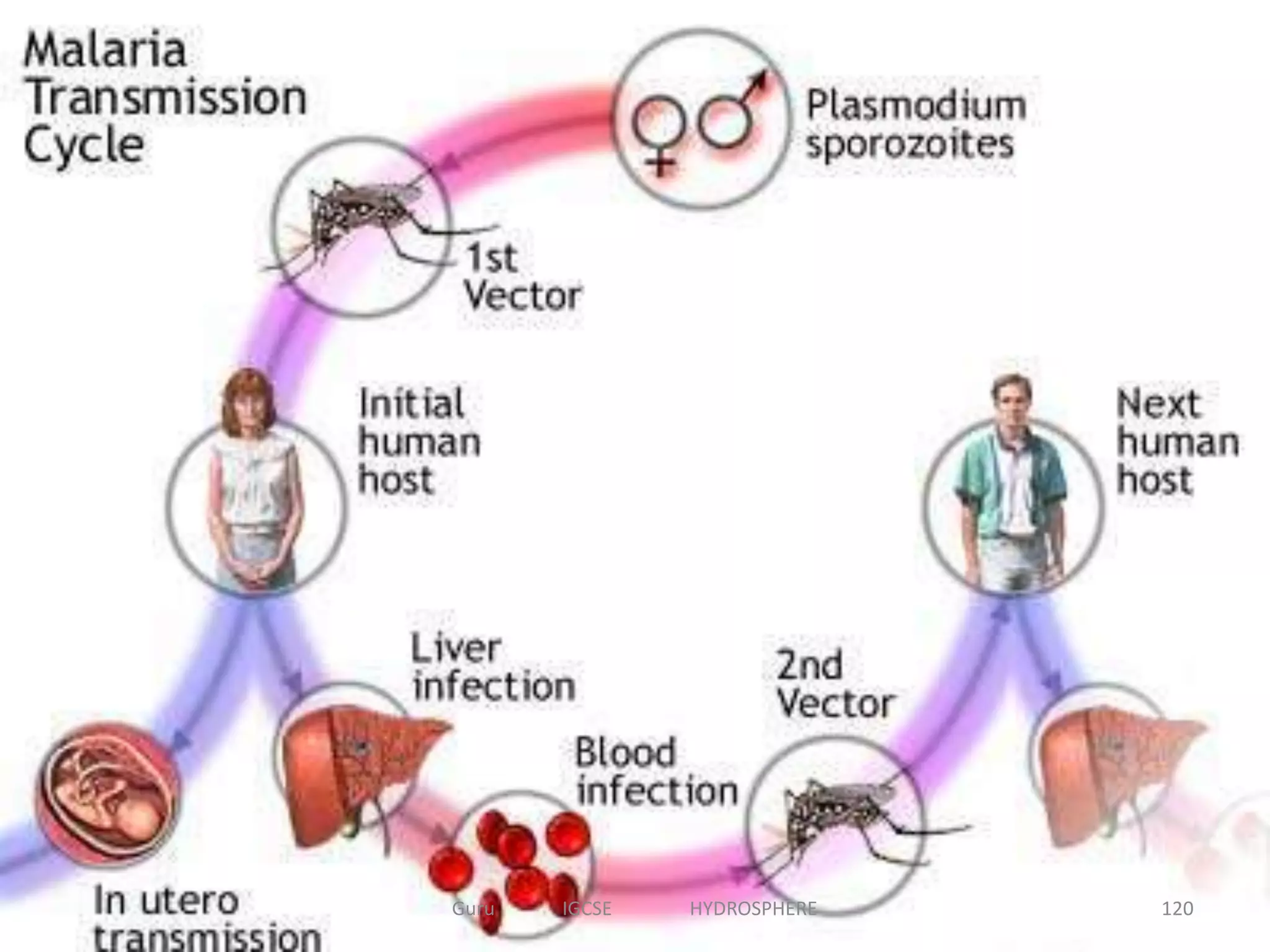
1. Malaria or Malarial fever is spread by
the Plasmodium parasite mosquito
that breeds in water bodies like lakes
.
2. Stagnant water is another favourite
breeding ground for these deadly
parasites.
3. Malarial fever symptoms include
fevers, chills, headaches and
vomiting. Sometimes these symptoms
are also coupled with anaemia.
Malaria
117Guru IGCSE HYDROSPHERE
118Guru IGCSE HYDROSPHERE
119Guru IGCSE HYDROSPHERE
120Guru IGCSE HYDROSPHERE
Prevent
mosquito
bites
Stay inside when it is dark
outside, preferably in a screened
or air-conditioned room.
Wear protective clothing (long
pants and long-sleeved shirts).
Use insect repellent with DEET
The repellent is available in
varying strengths up to 100%.
121Guru IGCSE HYDROSPHERE
Use bed nets (mosquito
netting) sprayed with or
soaked in an insecticide
such as permethrin or
deltamethrin.
se flying-insect spray
indoors around sleeping
areas.
Avoid areas where malaria
and mosquitoes are
present if you are at higher
risk
122Guru IGCSE HYDROSPHERE
BILHARZIA
1.
The bilharzia snail lives in
shallow water in tropical lands.
2. Larvae grow and multiply
inside the snail; worms emerge
after three to seven weeks.
they enter human bodies
usually through the soles of
people's feet;
3. Therefore people working in
fields, are most at risk. the
worms grow to maturity and
mate in the human body,
usually in the kidney or
bladder.
123Guru IGCSE HYDROSPHERE
124Guru IGCSE HYDROSPHERE
125Guru IGCSE HYDROSPHERE
126Guru IGCSE HYDROSPHERE
127Guru IGCSE HYDROSPHERE
128Guru IGCSE HYDROSPHERE
129Guru IGCSE HYDROSPHERE
Introduction
about Ocean
• The oceans of Earth serve many
functions, especially affecting the
weather and temperature.
• They moderate the Earth's
temperature by absorbing incoming
solar radiation (stored as heat
energy).
• The always-moving ocean currents
distribute this heat energy around
the globe.
• This heats the land and air during
winter and cools it during summer.
130Guru IGCSE HYDROSPHERE
• The World Ocean
or global ocean, is the
interconnected system
of the
Earth's oceanic waters
, and comprises the
bulk of
the hydrosphere
covering almost 71%
of the Earth's surface.
131Guru IGCSE HYDROSPHERE
Earth's oceans
1. Arctic Ocean
2. Atlantic Ocean
3. Indian Ocean
4. Pacific Ocean
5. Southern Ocean
132Guru IGCSE HYDROSPHERE
Pacific Ocean
The Pacific Ocean is the body of water between Asia and
Australia in the west, the Americas in the east, the Southern
Ocean to the south, and the Arctic Ocean to the north.
It is the largest named ocean and it covers one-third of the
surface of the entire world.
133Guru IGCSE HYDROSPHERE
134Guru IGCSE HYDROSPHERE
135Guru IGCSE HYDROSPHERE
136Guru IGCSE HYDROSPHERE
Atlantic
Ocean
The Atlantic Ocean is the world's
second largest ocean.
It covers approximately 20
percent of the Earth's surface.
The Atlantic Ocean is bounded
on the west by North and South
America. It connects to the Arctic
Ocean through the Denmark
Strait, Greenland Sea,
137Guru IGCSE HYDROSPHERE
138Guru IGCSE HYDROSPHERE
139Guru IGCSE HYDROSPHERE
Arctic
Ocean
The Arctic Ocean, located in the
Northern Hemisphere and mostly in the
Arctic north polar region, is the smallest
and shallowest of the world's five major
oceanic divisions.
Arctic Ocean, smallest of the world’s
oceans, centring approximately on the
North Pole.
The Arctic Ocean is partly covered by
sea ice throughout the yea
140Guru IGCSE HYDROSPHERE
141Guru IGCSE HYDROSPHERE
142Guru IGCSE HYDROSPHERE
143Guru IGCSE HYDROSPHERE
Antarctic
Ocean
Antarctica is the Earth's southernmost
continent. It is on the South Pole. It is
almost entirely south of the Antarctic
Circle.
About 98% of Antarctica is covered by
ice.
Few land plants grow in Antarctica.
Most are moss, lichen and algae. This is
because Antarctica does not have much
moisture (water), sunlight, good soil, or
a warm temperature.
144Guru IGCSE HYDROSPHERE
145Guru IGCSE HYDROSPHERE
Similarities and Differences between the
Arctic and the Antarctic
1. The Arctic has trees but Antarctic does not.
2. Antarctica is a continent land mass but the Arctic is a
sea with edges of other countries in the Arctic circle..
3. The Arctic has indigenous people and the Antarctic
doesn't.
4. The Arctic has tundra forest but not the Antarctic.
Environment
146Guru IGCSE HYDROSPHERE
what is
Phytoplankton?
Phytoplankton, also known as
microalgae, are similar to
terrestrial plants in that they
contain chlorophyll and
require sunlight in order to
live and grow.
Most phytoplankton are
buoyant and float in the
upper part of the ocean
147Guru IGCSE HYDROSPHERE
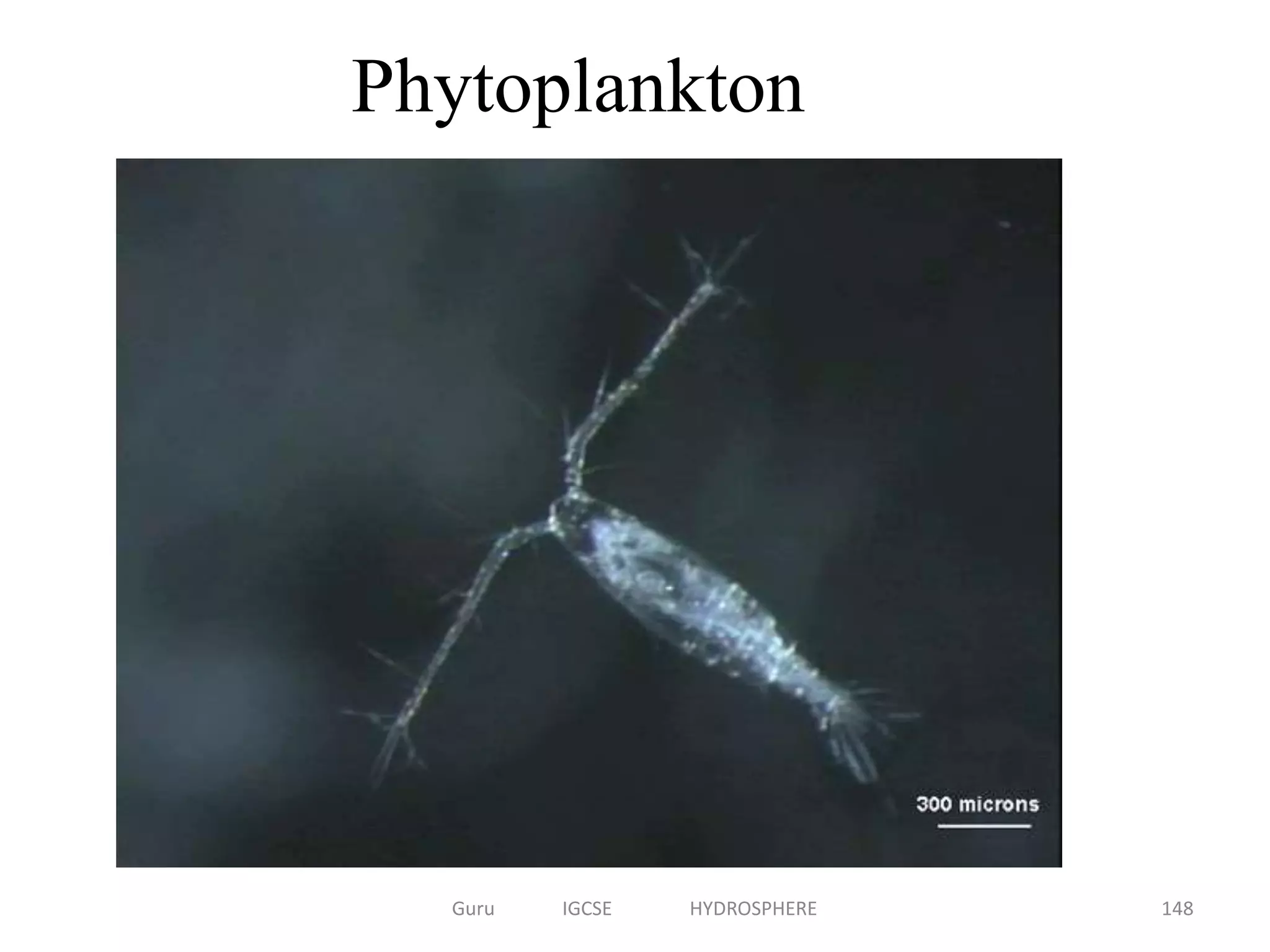
Phytoplankton
148Guru IGCSE HYDROSPHERE
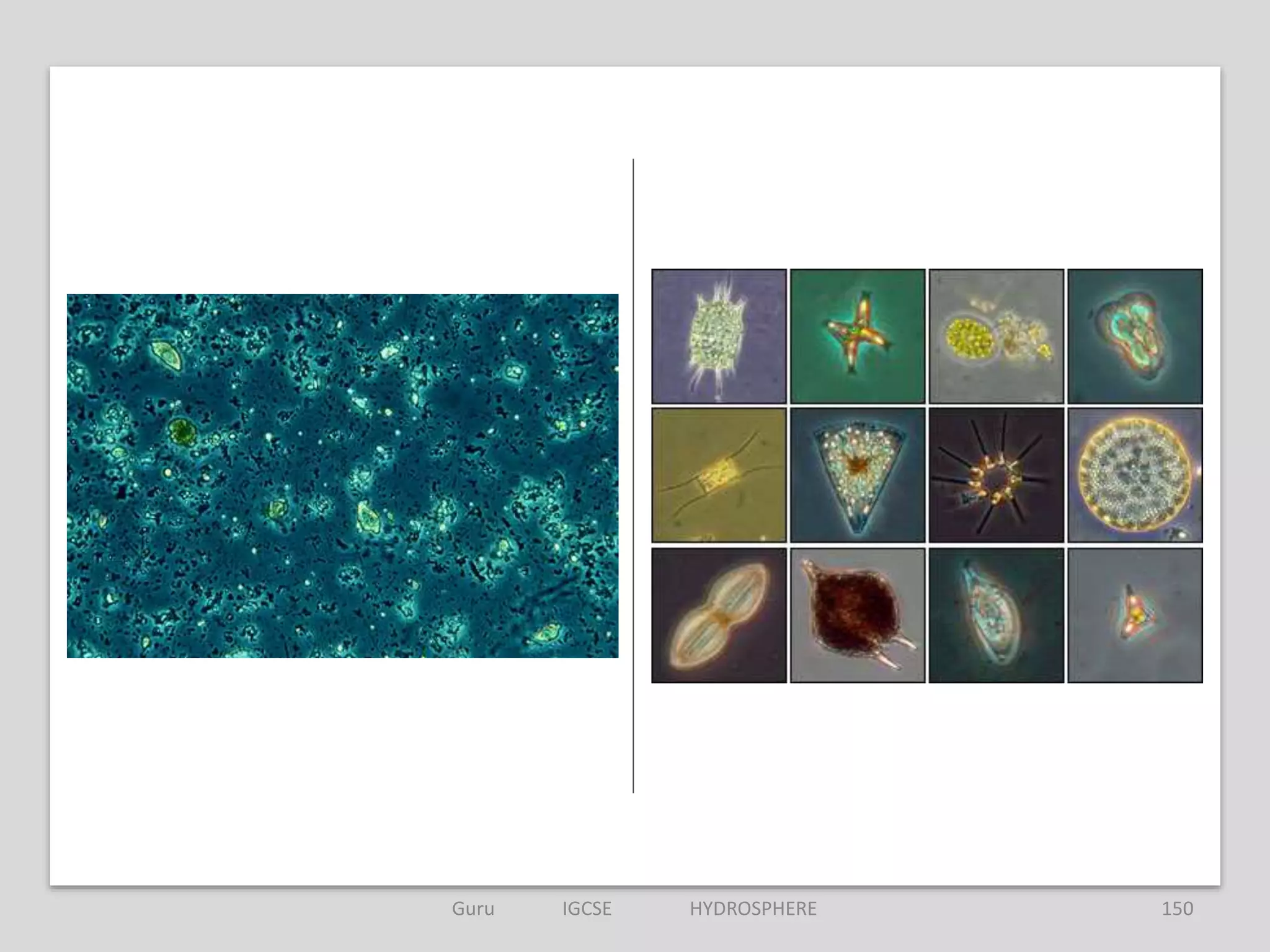
149Guru IGCSE HYDROSPHERE
150Guru IGCSE HYDROSPHERE
Zooplankton
151Guru IGCSE HYDROSPHERE
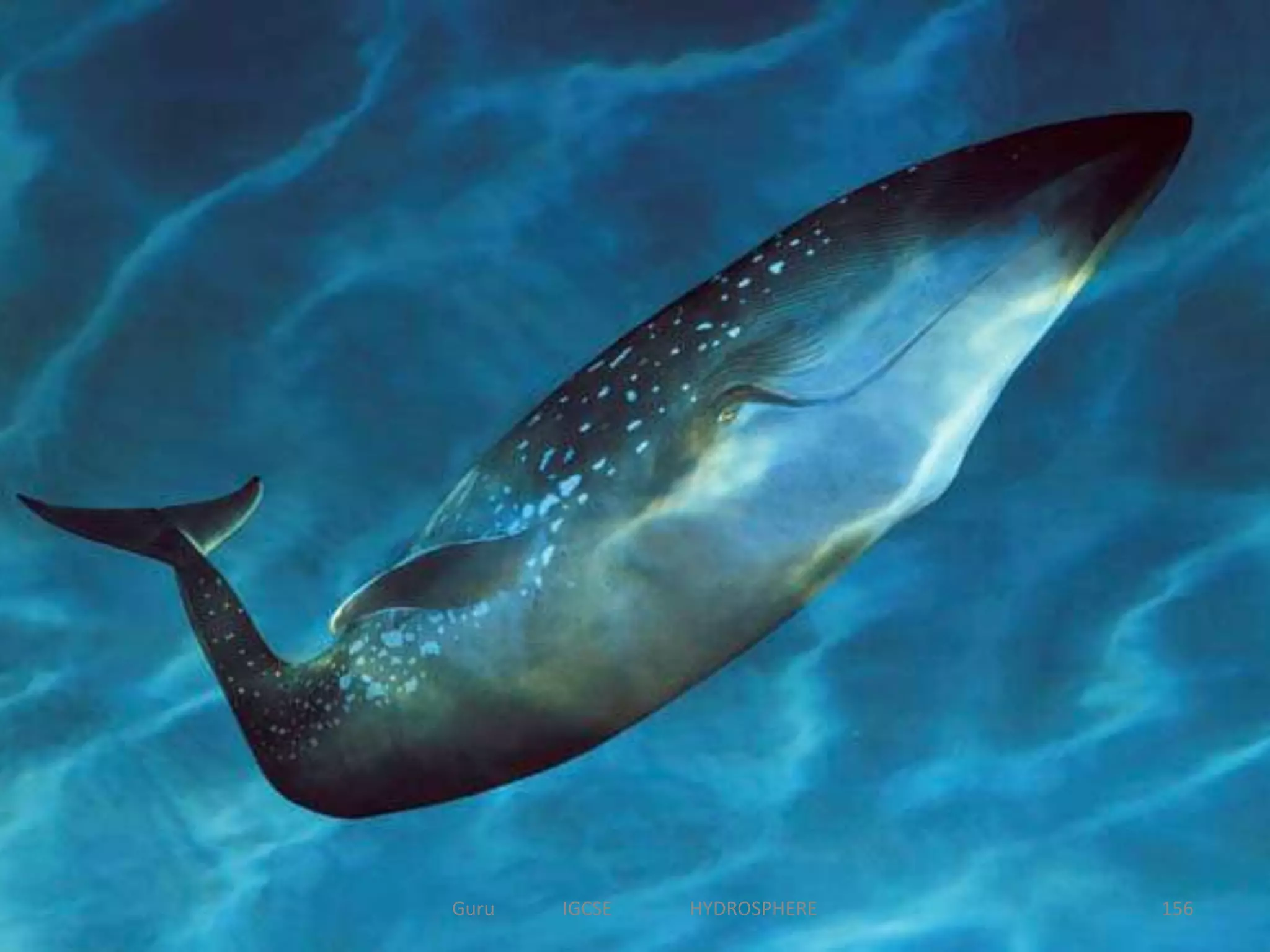
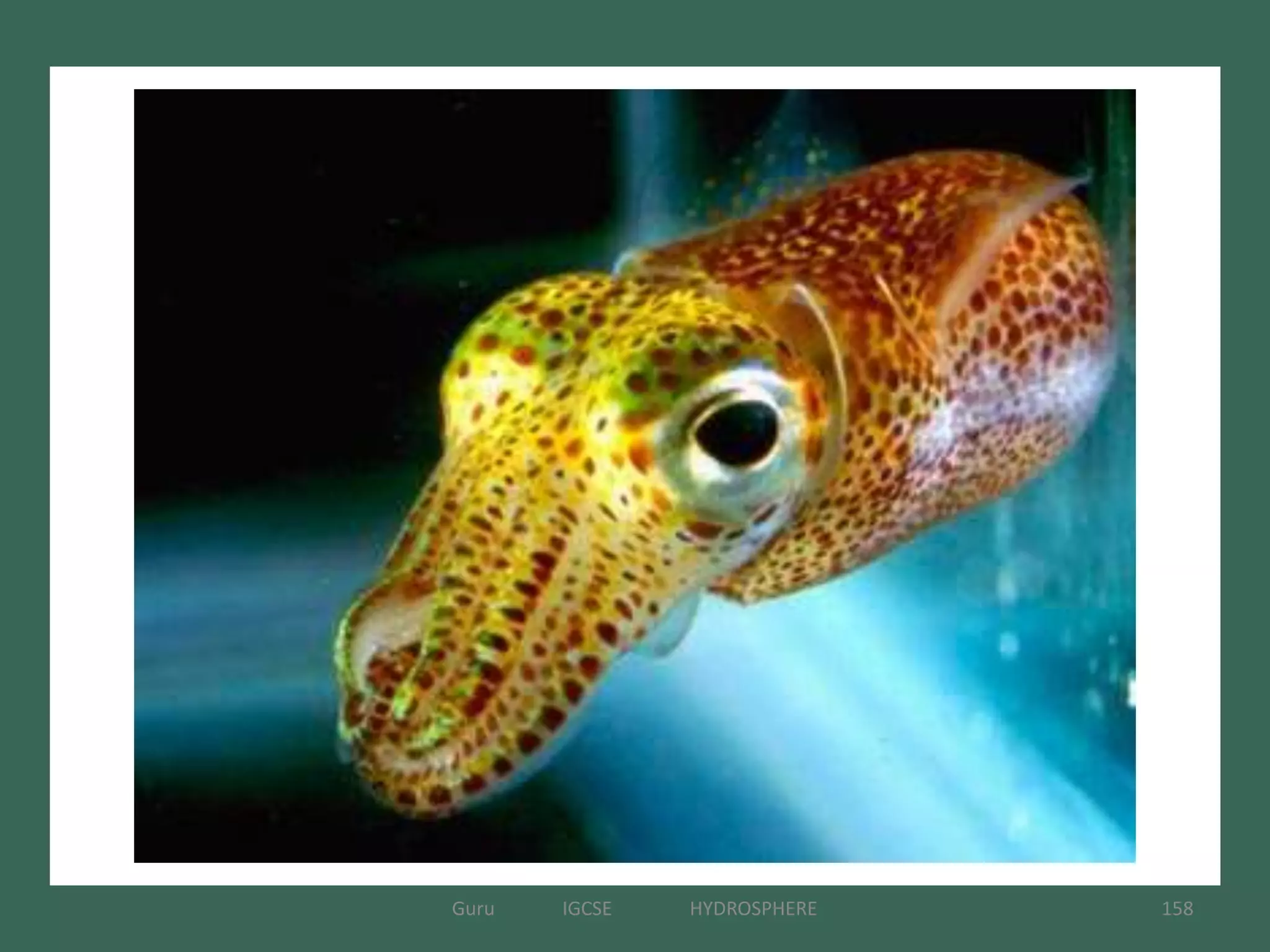
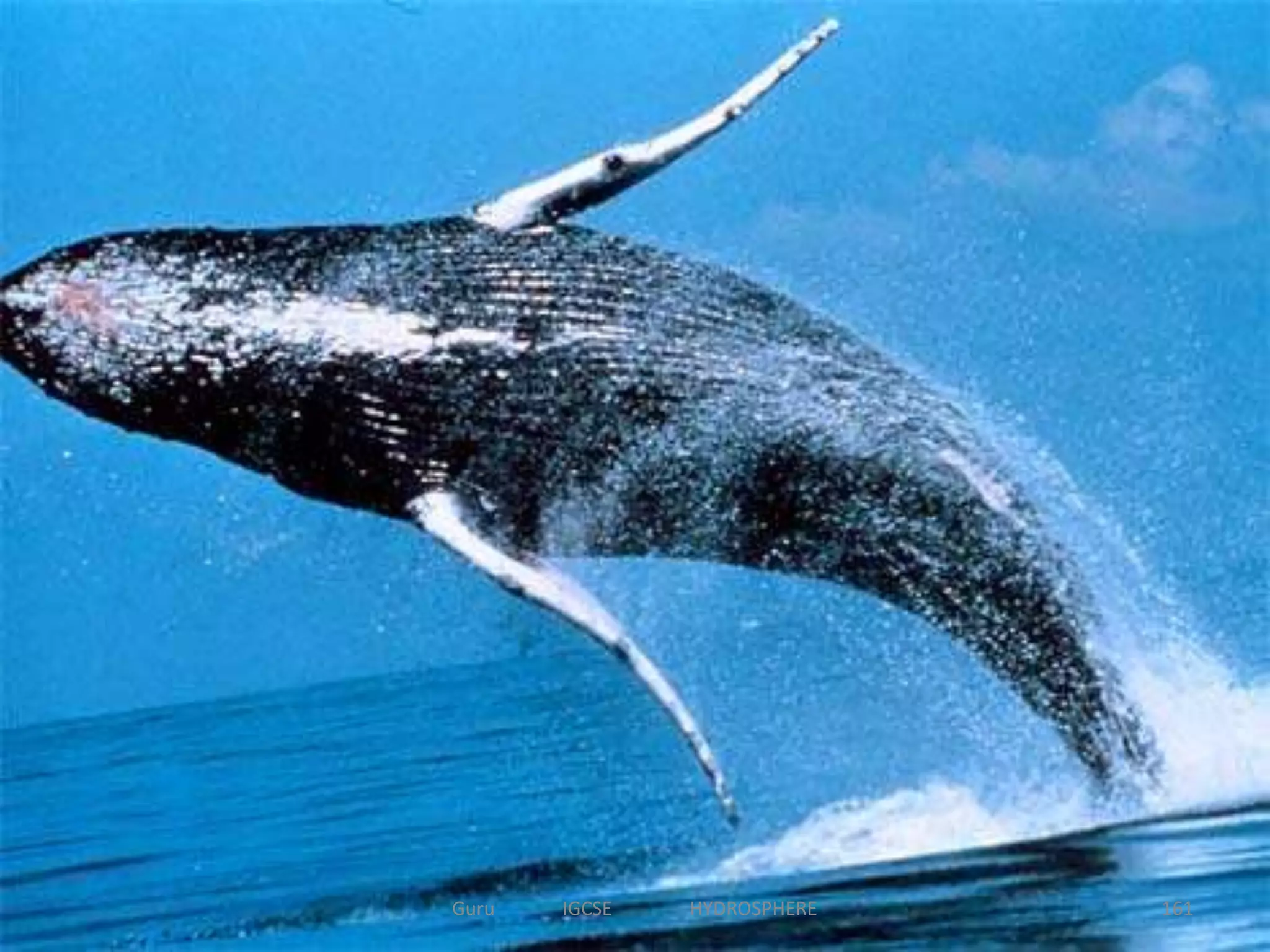
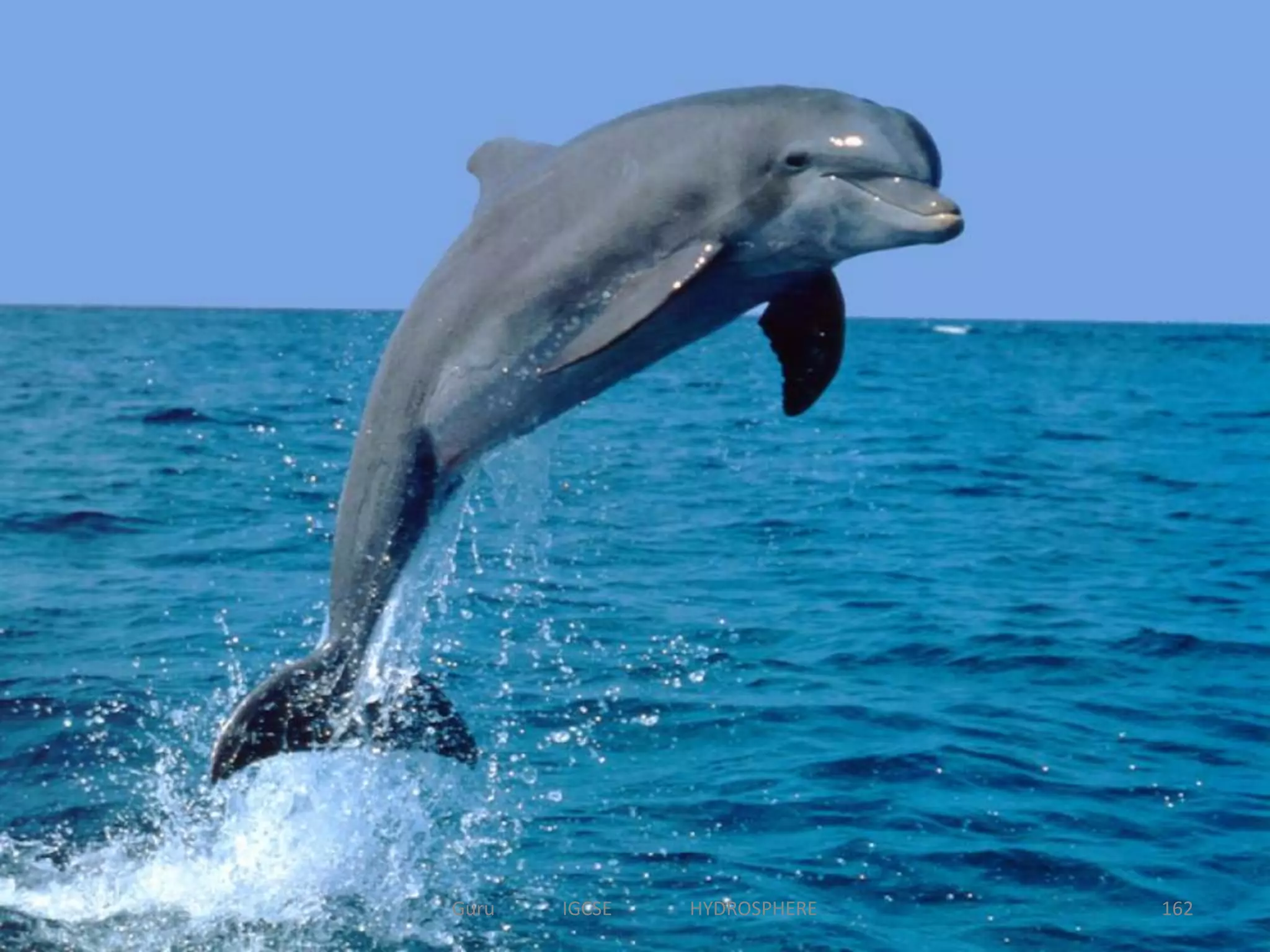
Life in the
Ocean
• Marine biology covers a great deal,
from the microscopic, including
most zooplankton and phytoplankton to
the huge whales which reach up to a
reported 30 meters (98 feet) in length.
152Guru IGCSE HYDROSPHERE
153Guru IGCSE HYDROSPHERE
Why are
protoplankton
and
phytoplankton
important?
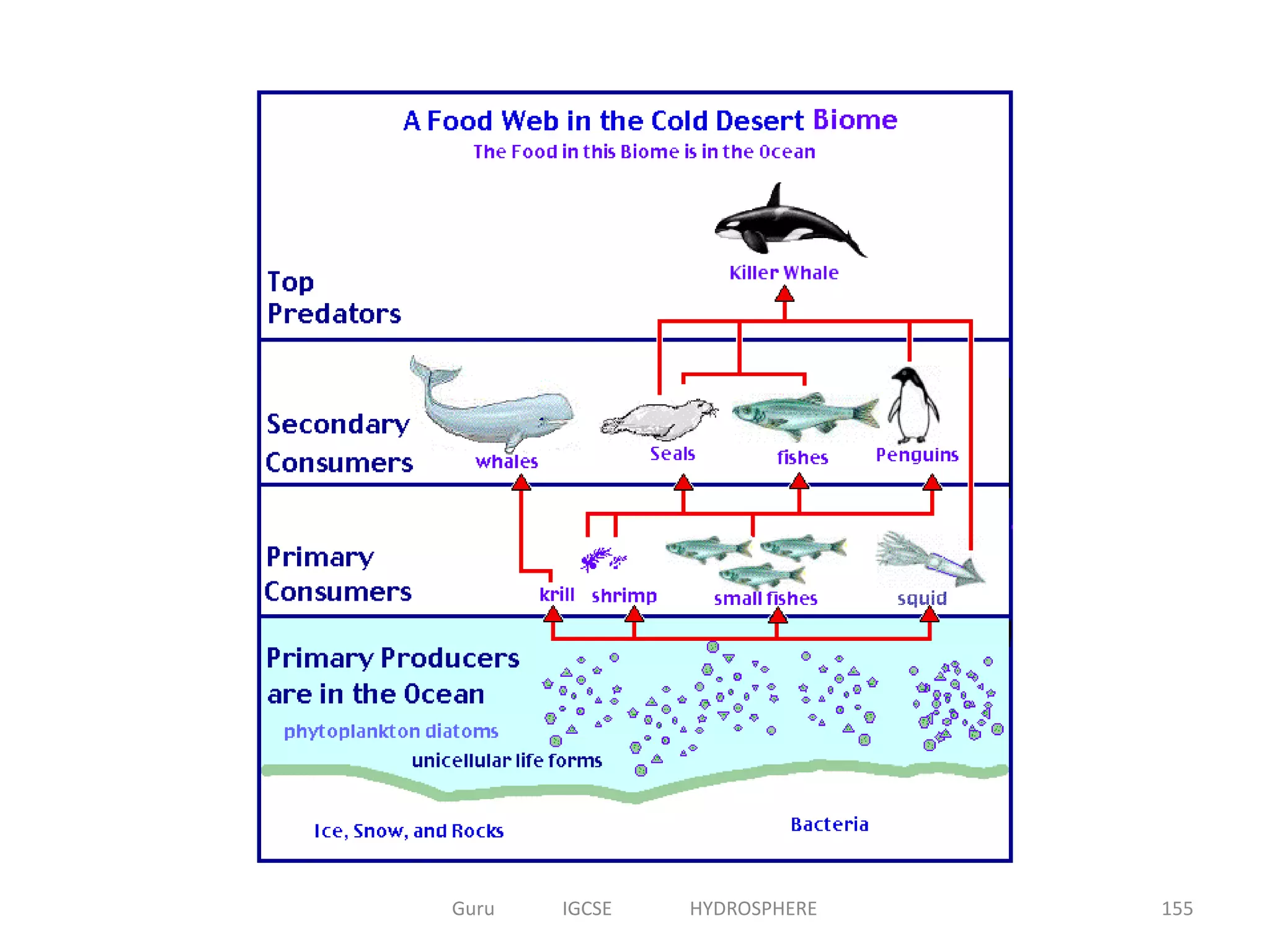
1. Photosynthetic phytoplankton are the
"grass" of aquatic habitats.
2. Together with aquatic higher plants,
they are the basis of freshwater food
chains.
3. Phytoplankton, together with other
algae and plants, are the source of
most of the oxygen in Earth's
atmosphere.
154Guru IGCSE HYDROSPHERE
155Guru IGCSE HYDROSPHERE
156Guru IGCSE HYDROSPHERE
157Guru IGCSE HYDROSPHERE
158Guru IGCSE HYDROSPHERE
159Guru IGCSE HYDROSPHERE
160Guru IGCSE HYDROSPHERE
161Guru IGCSE HYDROSPHERE
162Guru IGCSE HYDROSPHERE
163Guru IGCSE HYDROSPHERE
164Guru IGCSE HYDROSPHERE
165Guru IGCSE HYDROSPHERE
166Guru IGCSE HYDROSPHERE
167Guru IGCSE HYDROSPHERE
168Guru IGCSE HYDROSPHERE
169Guru IGCSE HYDROSPHERE
170Guru IGCSE HYDROSPHERE
171Guru IGCSE HYDROSPHERE
What is
Marine
Pollution?
• Marine pollution occurs when harmful,
or potentially harmful effects, can
result from the entry into the ocean of
chemicals, particles, industrial,
agricultural and residential waste.
172Guru IGCSE HYDROSPHERE
173Guru IGCSE HYDROSPHERE
OIL POLLUTION
174Guru IGCSE HYDROSPHERE
What is
Oil
Pollution?
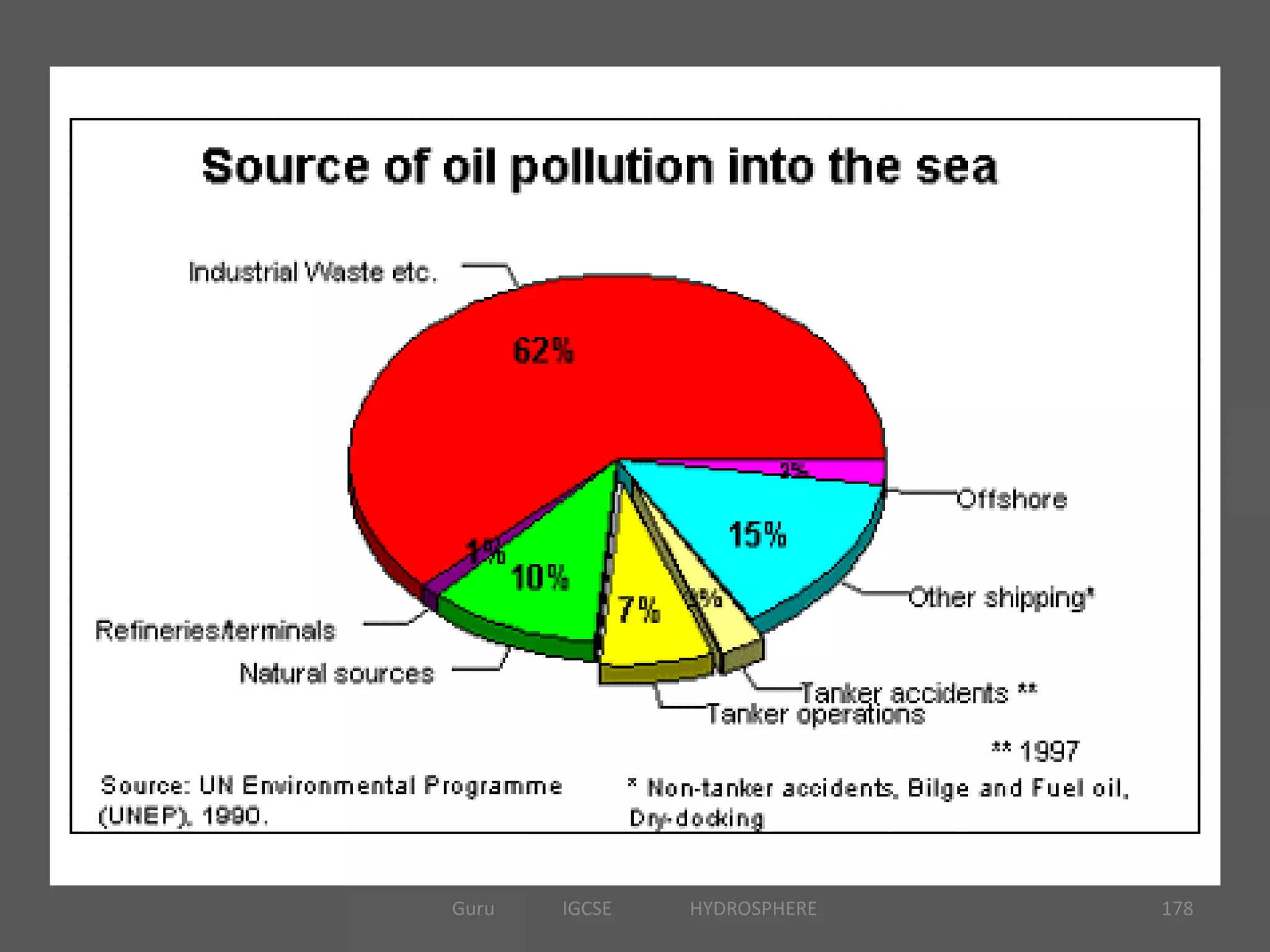
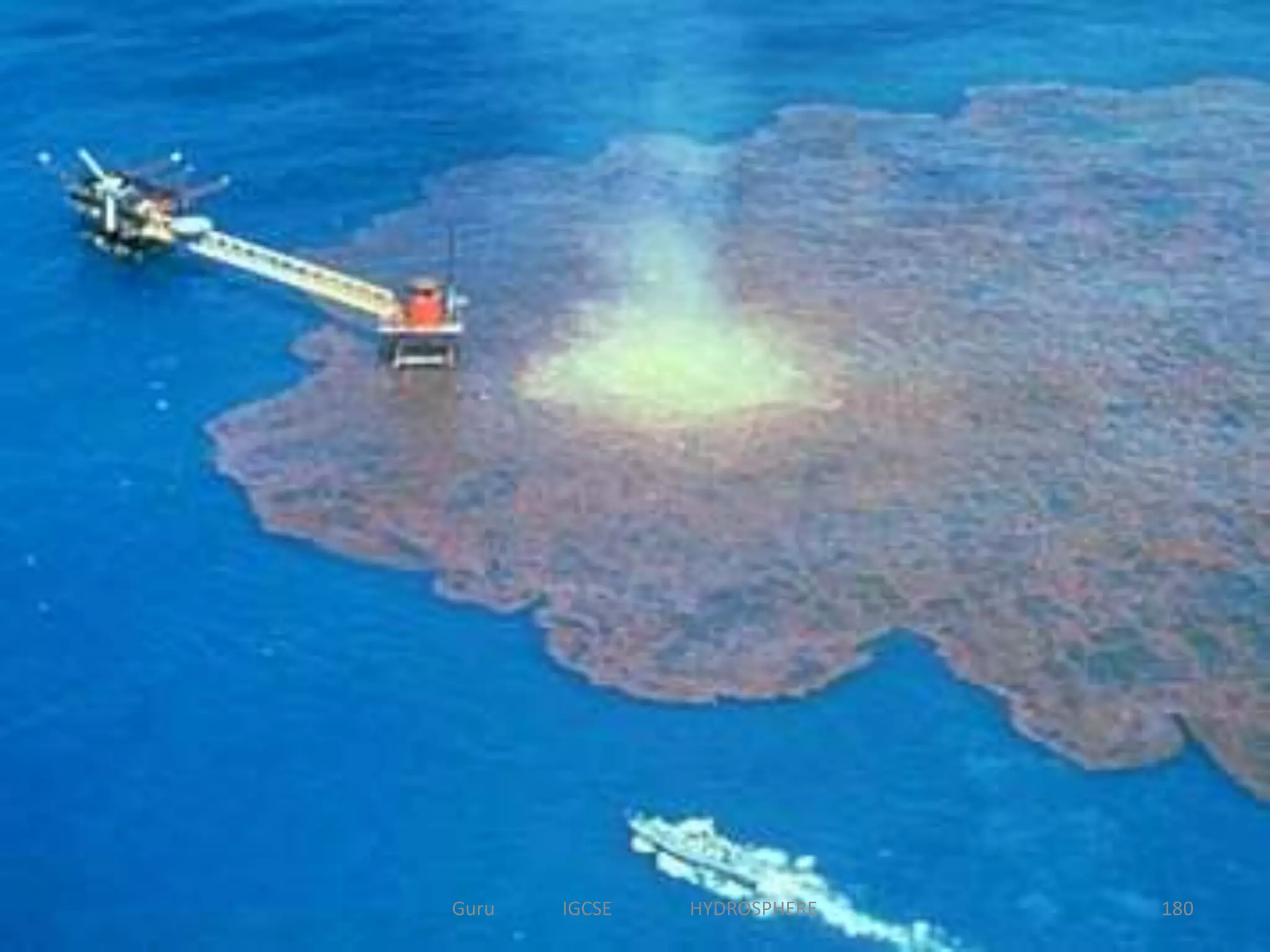
• Oil spills into rivers, bays, and the
ocean most often are caused by
accidents involving tankers, barges,
pipelines, refineries, drilling rigs, and
storage facilities.
• An oil spill from a tanker is a severe
problem because there is such a huge
quantity of oil being spilt into one
place.
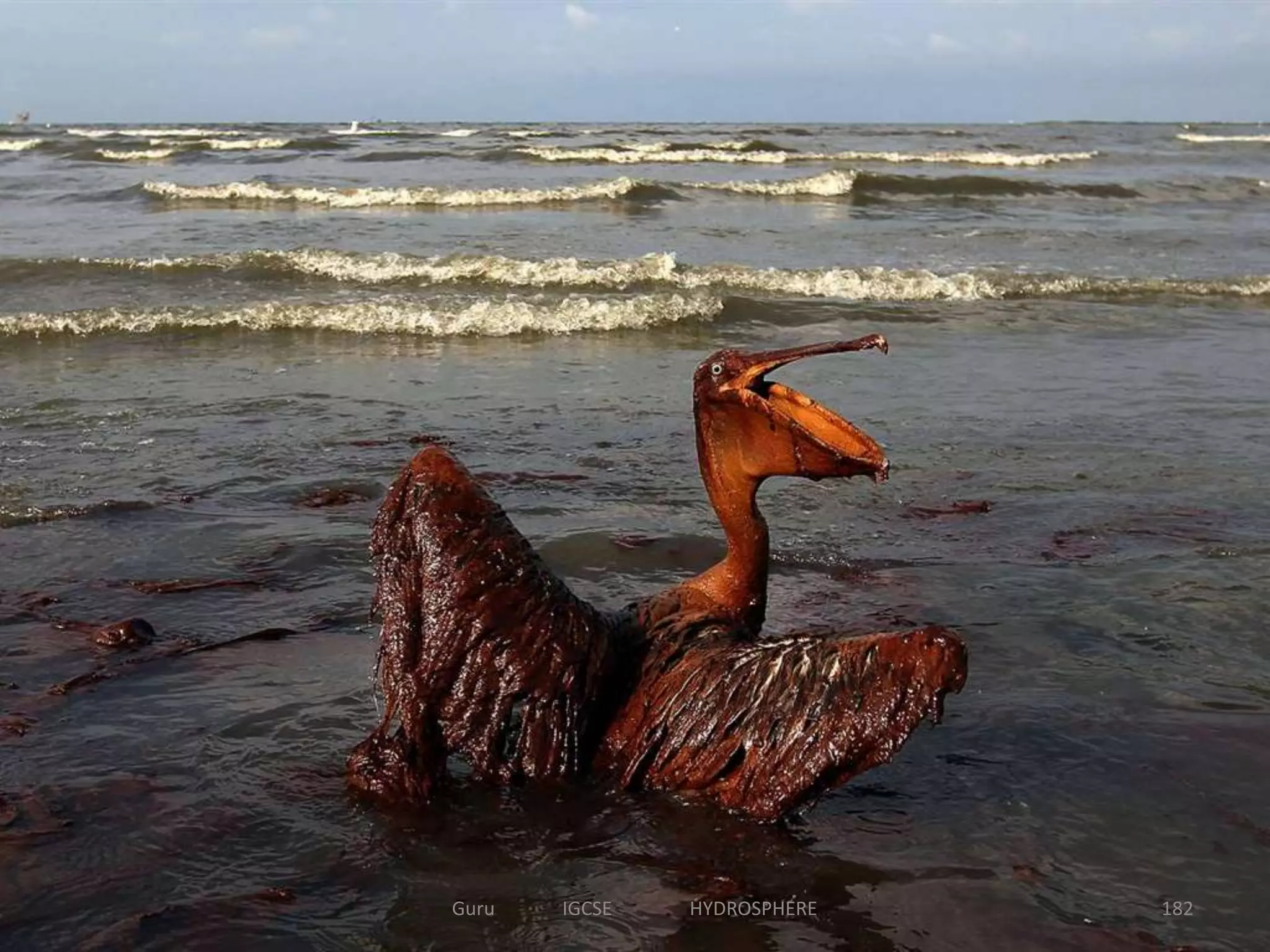
• Oil cannot dissolve in water and
forms a thick sludge in the water.
This suffocates fish, gets caught in
the feathers of marine birds stopping
them from flying and blocks light
from photosynthetic aquatic plants.
175Guru IGCSE HYDROSPHERE
CAUSES OF OIL
SPILLS
• Spills can be caused by:
• people making mistakes or
being careless.
• equipment breaking down.
• natural disasters such as
hurricanes.
• deliberate acts by terrorists,
countries at war, vandals, or
illegal dumpers.
176Guru IGCSE HYDROSPHERE
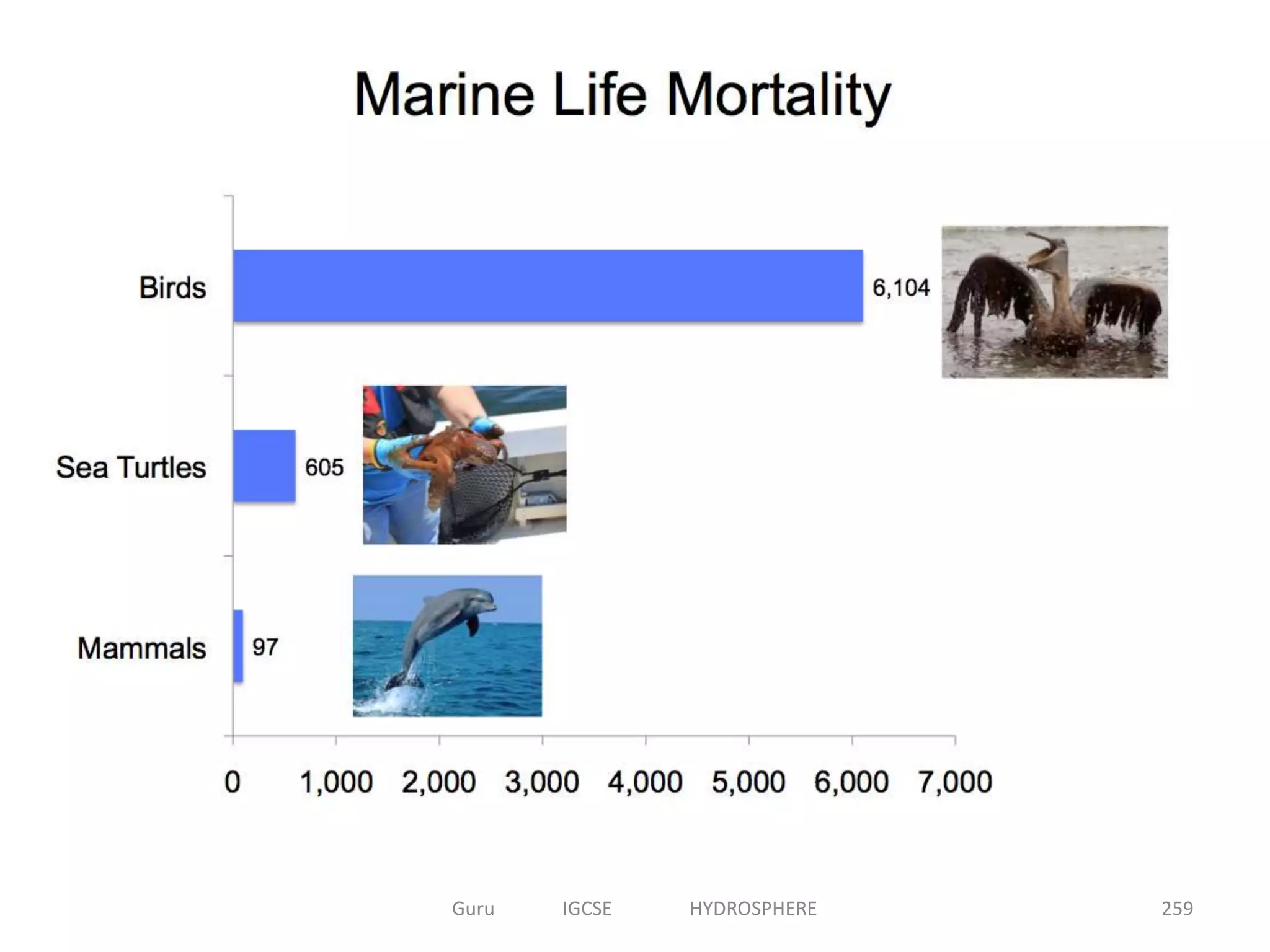
Effects of Oil Pollution
• Effects
1) Kills marine animals
2) It kills the seabird’s
3) Damages coastal ecosystems,
consequences can last
decades
4) Economically important
species of shell fish and fin
fish are easily killed by oil
pollution
177Guru IGCSE HYDROSPHERE
178Guru IGCSE HYDROSPHERE
179Guru IGCSE HYDROSPHERE
180Guru IGCSE HYDROSPHERE
181Guru IGCSE HYDROSPHERE
182Guru IGCSE HYDROSPHERE
183Guru IGCSE HYDROSPHERE
184Guru IGCSE HYDROSPHERE
185Guru IGCSE HYDROSPHERE
HOW TO
REOMOVE
OIL
SPILLS?
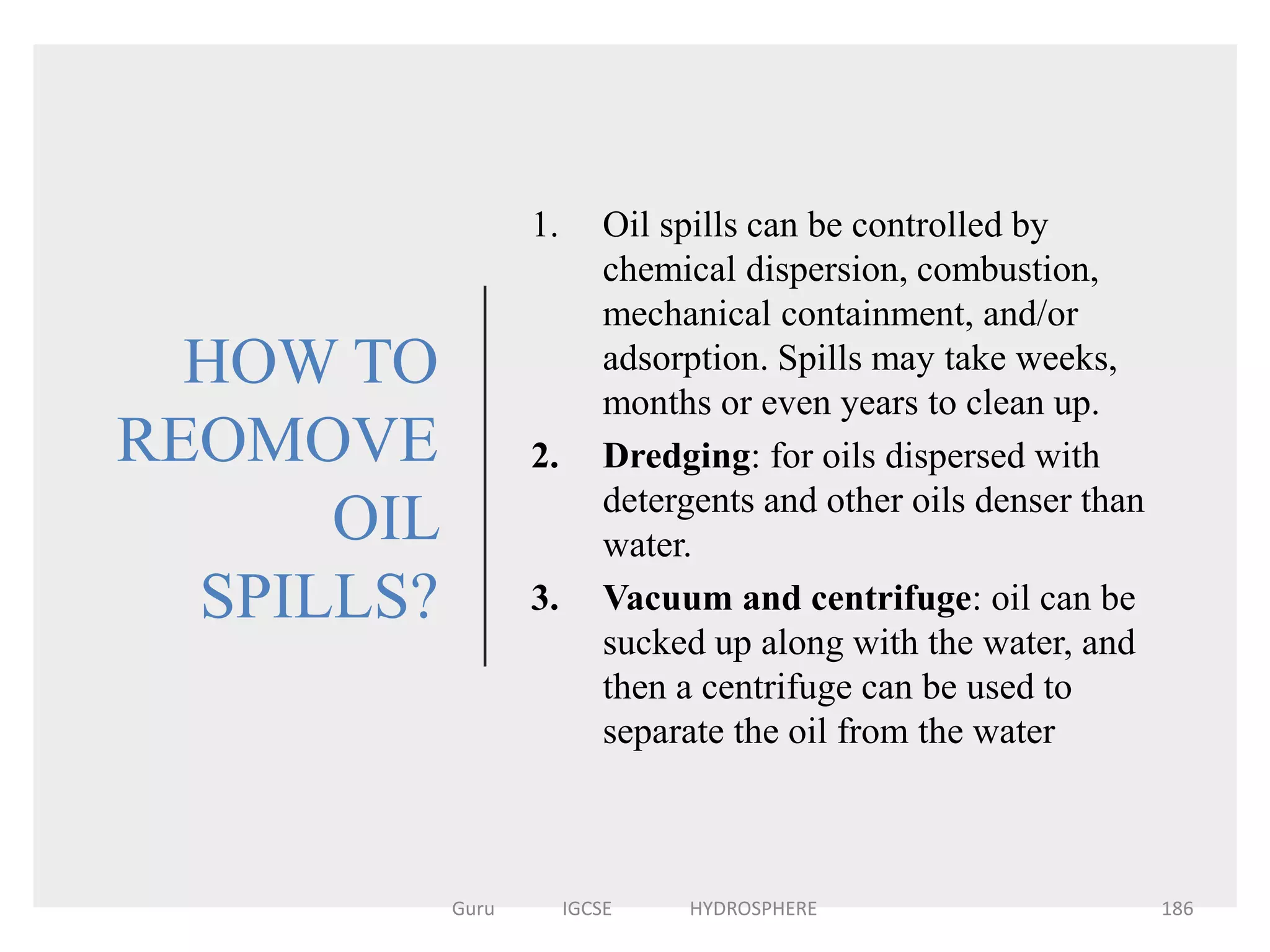
1. Oil spills can be controlled by
chemical dispersion, combustion,
mechanical containment, and/or
adsorption. Spills may take weeks,
months or even years to clean up.
2. Dredging: for oils dispersed with
detergents and other oils denser than
water.
3. Vacuum and centrifuge: oil can be
sucked up along with the water, and
then a centrifuge can be used to
separate the oil from the water
186Guru IGCSE HYDROSPHERE
187Guru IGCSE HYDROSPHERE
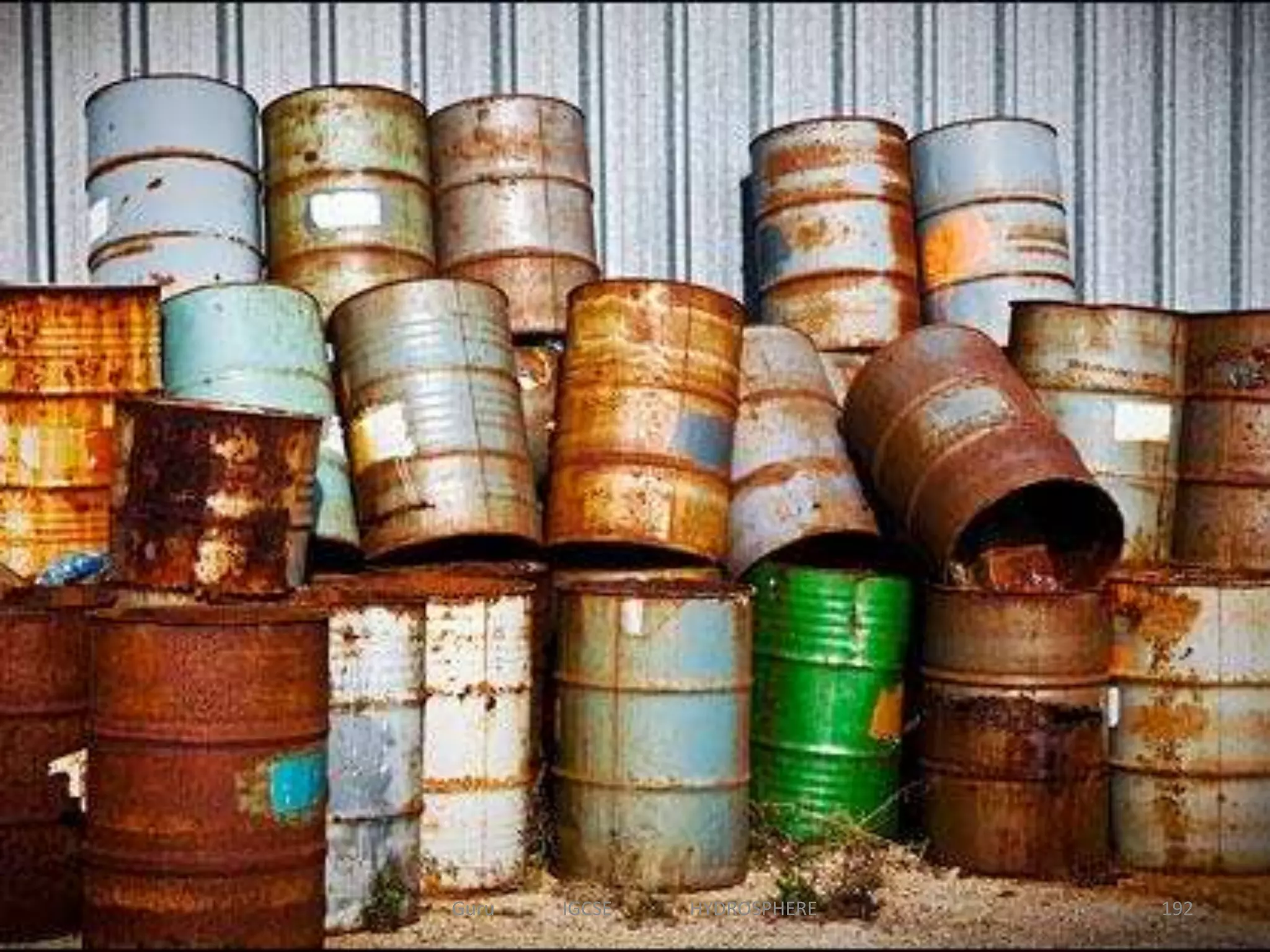
TOXIC POLLUTION
188Guru IGCSE HYDROSPHERE
What is
Toxic
Pollution?
• Toxic pollution occurs when
synthetic chemicals are discharged
or natural chemicals accumulate to
toxic levels in the environment,
causing reductions in wildlife
numbers, degrading ecosystem
functions and threatening human
health.
189Guru IGCSE HYDROSPHERE
190Guru IGCSE HYDROSPHERE
191Guru IGCSE HYDROSPHERE
192Guru IGCSE HYDROSPHERE
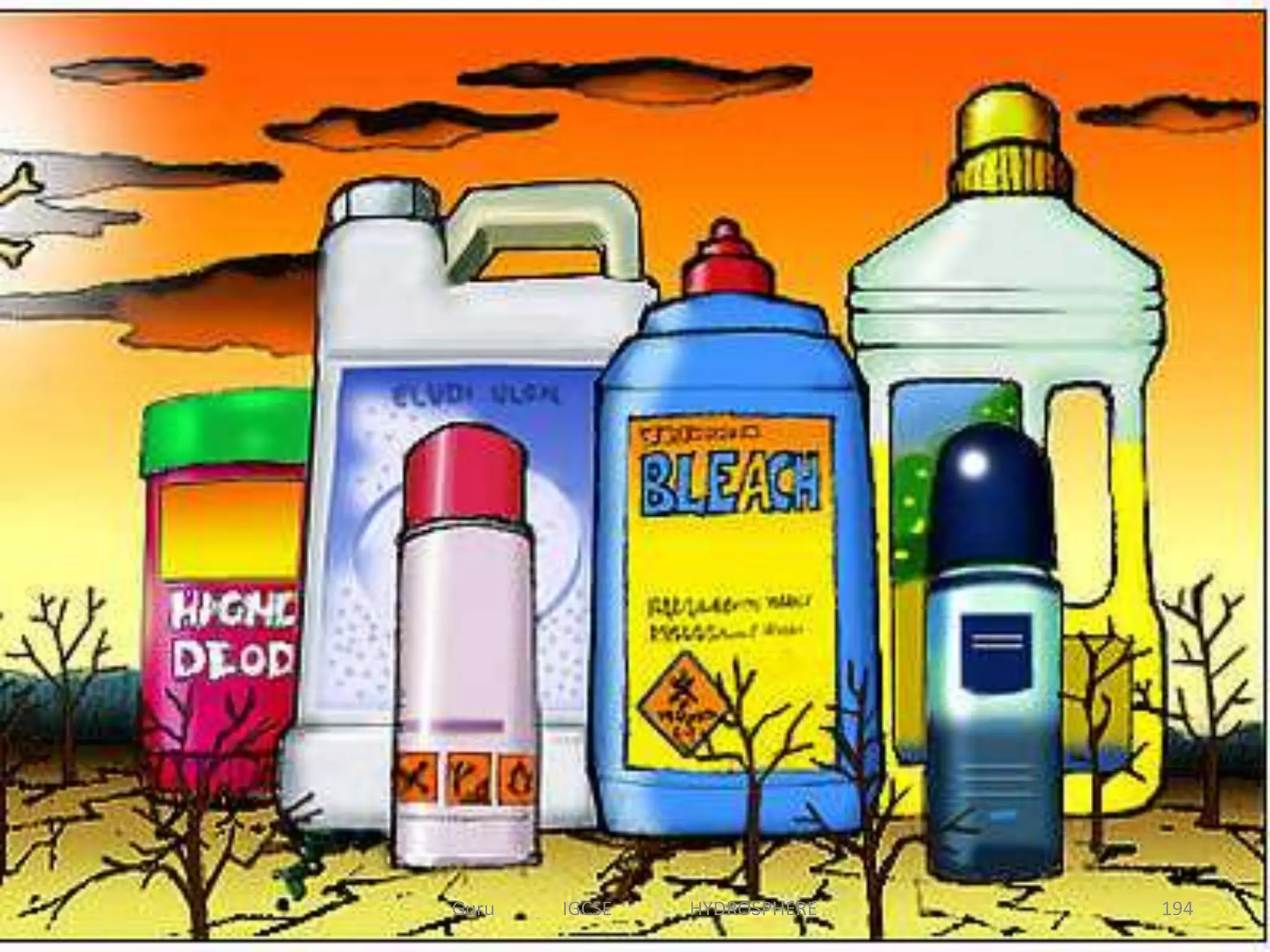
CAUSES OF
TOXIC
POLLUTION
• Toxic pollution occurs as a result of a
variety of human activities.
Industries and sewage treatment
plants discharge wastes which
contain toxic substances directly into
waterways.
• Toxic pesticides are dispersed
through the environment by rain
running off chemical-treated land
and flowing into lakes, rivers,
estuaries and coastal waters.
• Household cleaning and disinfecting
products are flushed into sewage
systems and out through treatment
plant discharge,
193Guru IGCSE HYDROSPHERE
194Guru IGCSE HYDROSPHERE
195Guru IGCSE HYDROSPHERE
SOLUTION
• Consumers can play a role by being
aware of manufacturing processes
and "clean" alternatives to products.
• International treaties can initiate
stronger efforts to reduce toxic
pollution worldwide. A new treaty
banning the production and use of
certain persistent organic pollutants
196Guru IGCSE HYDROSPHERE
197Guru IGCSE HYDROSPHERE
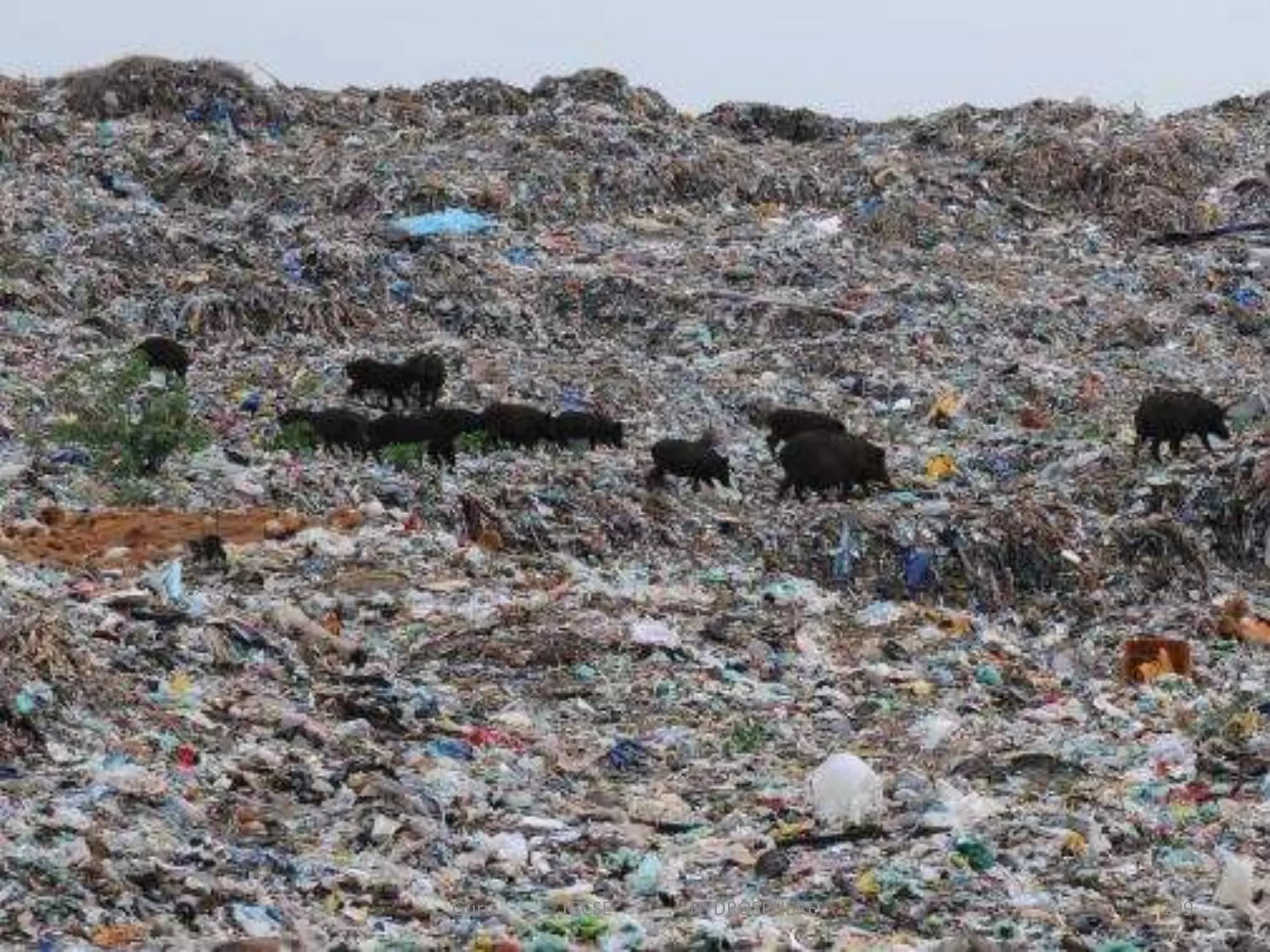
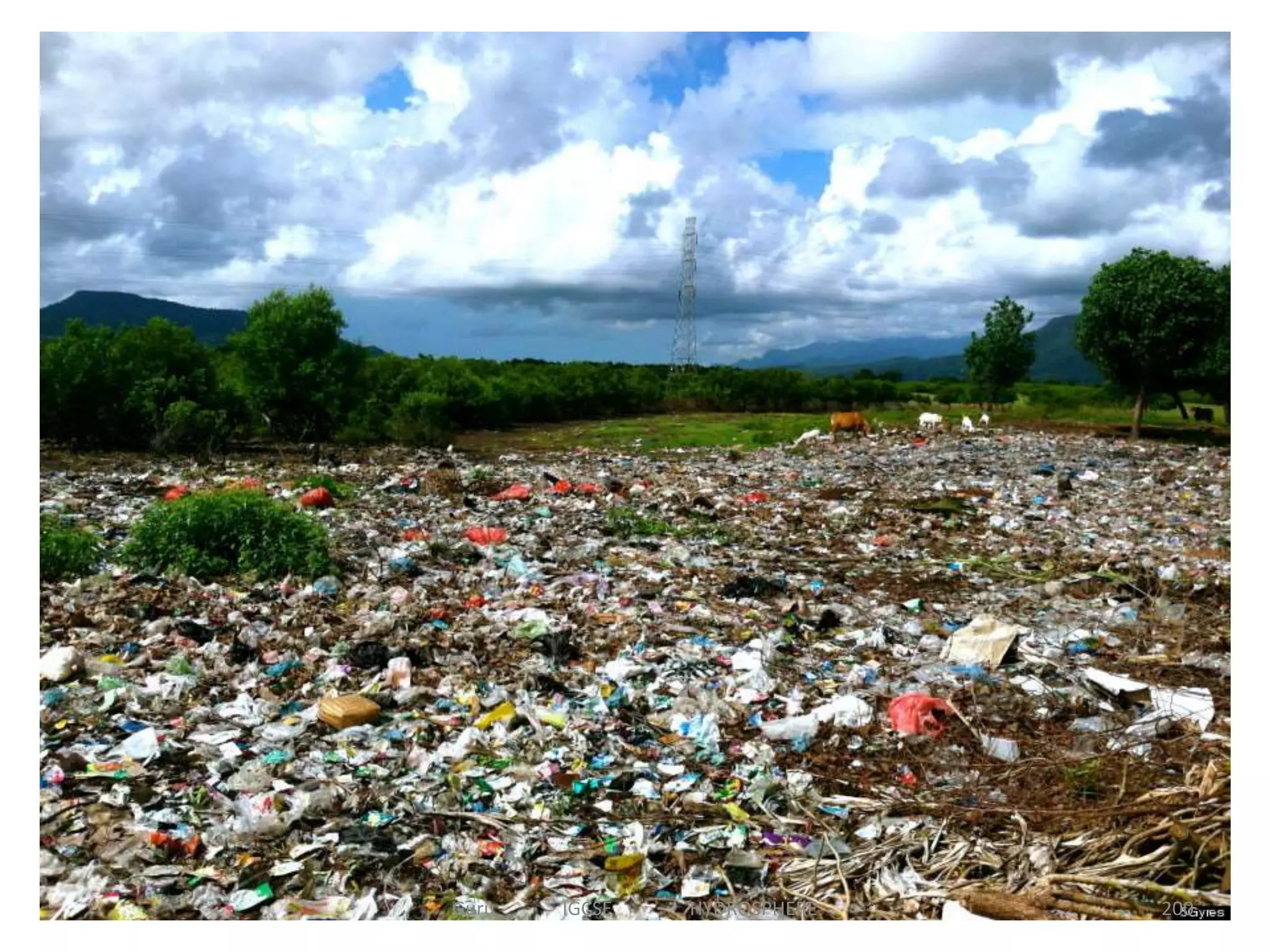
What is
Garbage
Pollution ?
• Garbage pollution means
littering civic waste
particularly household waste
into places not designated to
dispose it off.
• It is mainly caused by
mismanagement of solid
waste when garbage is not
lifted from streets and areas
to carry it to landfill sites for
its final disposal.
• It all happens owing to poor
system of either garbage
collection or its disposal.
198Guru IGCSE HYDROSPHERE
199Guru IGCSE HYDROSPHERE
200Guru IGCSE HYDROSPHERE
3.Garbage
Sources
1. Unregulated dumping of garbage from ships and coastal
communities
Effects
1. Large pieces of garbage can kill the marine animals
2. Many animals ingest the garbage, which can also kill
them.
201Guru IGCSE HYDROSPHERE
202Guru IGCSE HYDROSPHERE
Solutions
for
garbage
pollution
• The key solution for garbage
pollution lies in proper management
of solid waste.
• Apart from that there are three
slogans to address this issue; reduce,
reuse and recycle.
• In this way garbage pollution issue
could be solved with simply
community efforts.
203Guru IGCSE HYDROSPHERE
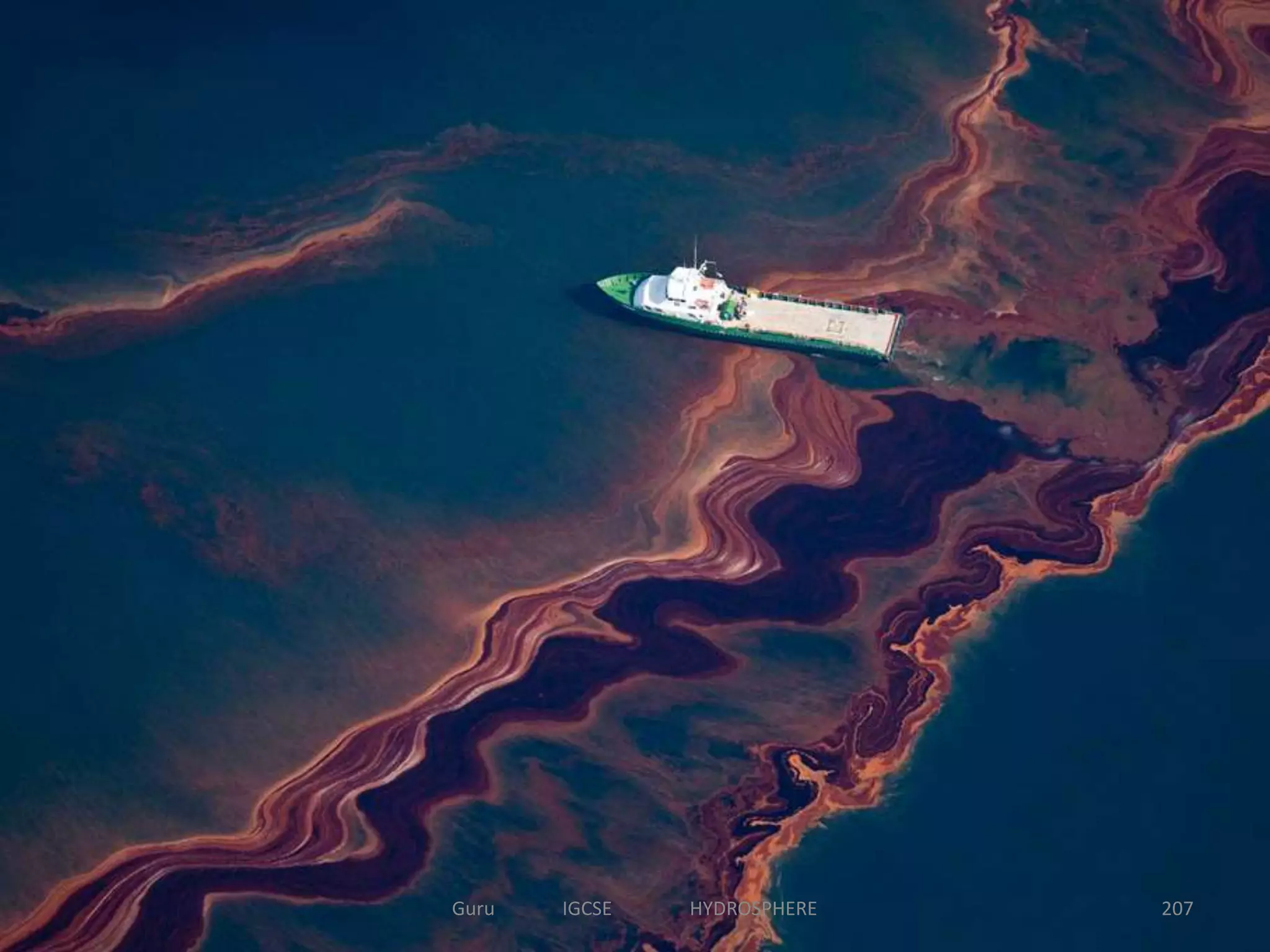
Deep water
Horizon oil spill
204Guru IGCSE HYDROSPHERE
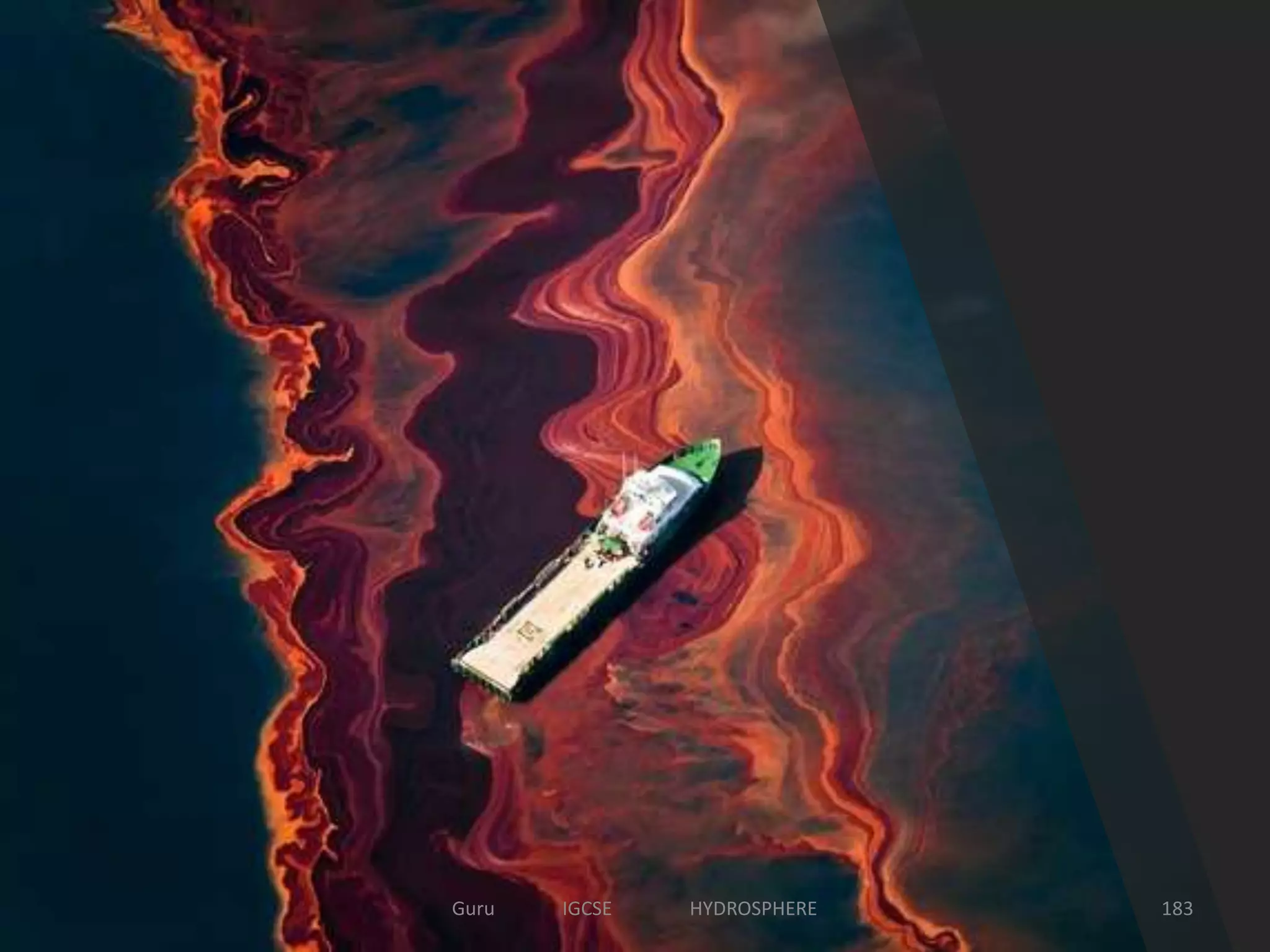
• The Deepwater Horizon oil
spill (also referred to as the BP oil
spill, the BP oil disaster, the Gulf of
Mexico oil spill, and the Macondo
blowout) was an oil spill in the Gulf
of Mexico on the BP-
operated Macondo Prospect,
considered the largest accidental
marine oil spill in the history of the
petroleum industry.
• Following the explosion and sinking
of the Deepwater Horizon oil rig,
which claimed 11 lives,a sea-floor oil
gusher flowed unabated for three
months in 2010.
• The gushing wellhead was not
capped until after 87 days, on 15 July
2010.The total discharge is estimated
at 4.9 million barrels
205Guru IGCSE HYDROSPHERE
206Guru IGCSE HYDROSPHERE
207Guru IGCSE HYDROSPHERE
208Guru IGCSE HYDROSPHERE
209Guru IGCSE HYDROSPHERE
210Guru IGCSE HYDROSPHERE
211Guru IGCSE HYDROSPHERE
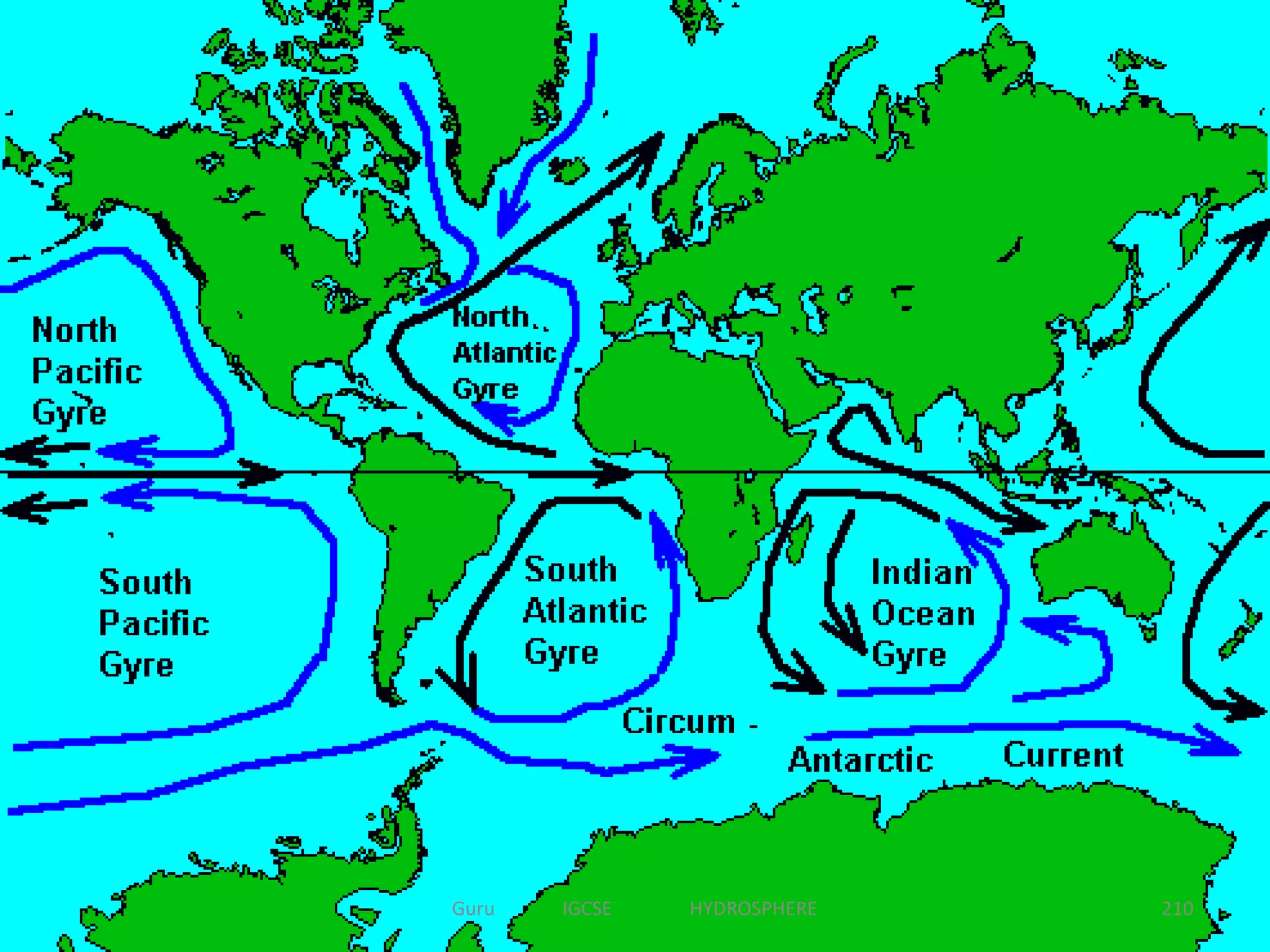
What is
ocean
current?
• An ocean current is a continuous,
directed movement of ocean
water generated by the forces acting
upon this mean flow, such as breaking
waves, wind,
temperature and salinity differences
and tides caused by the gravitational
pull of the Moon and the Sun.
212Guru IGCSE HYDROSPHERE
213Guru IGCSE HYDROSPHERE
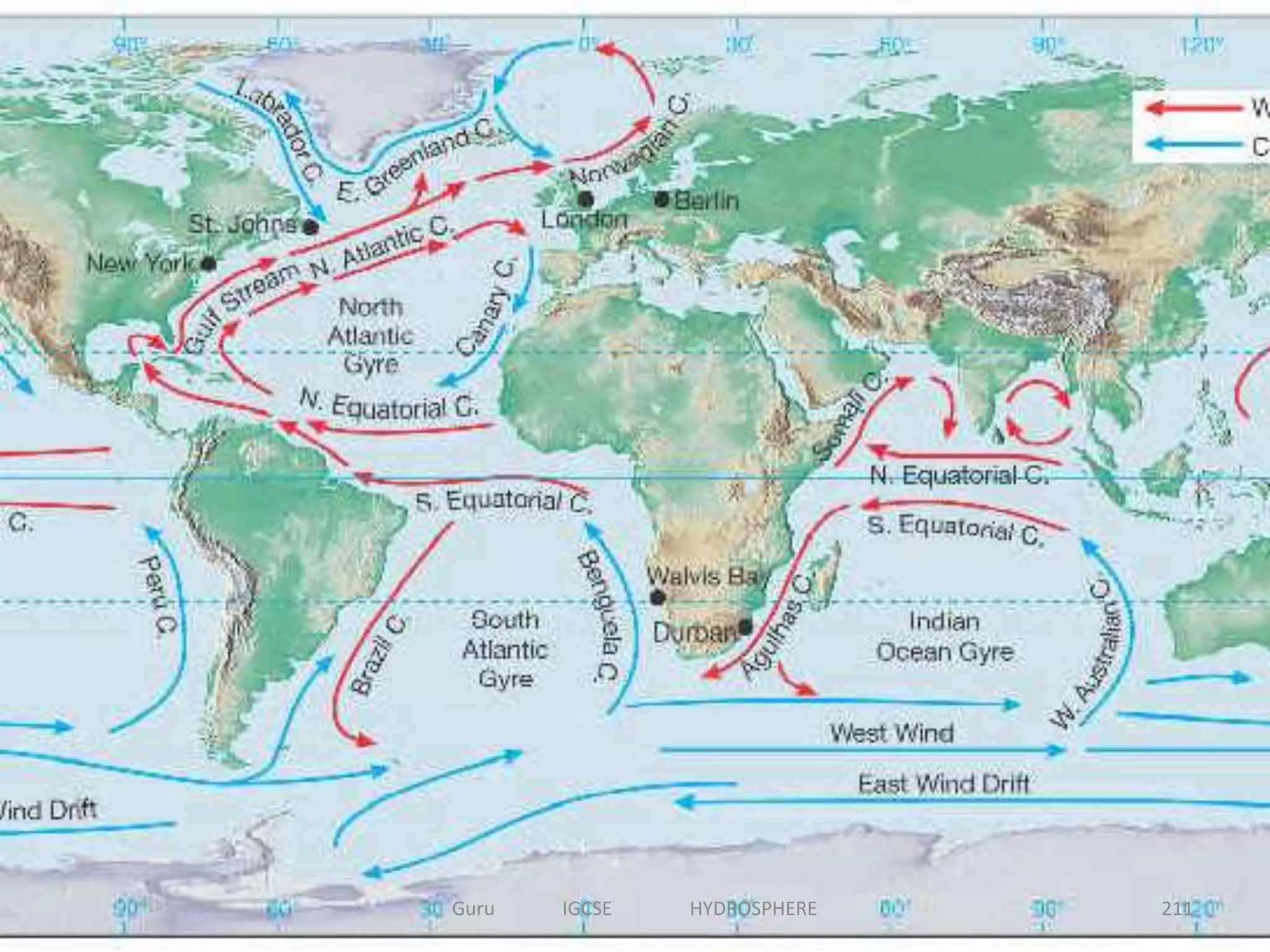
Ocean currents are of two types
• Warm & Cold
1) In a warm current the water is warmer than
would be expected at the latitude where it
is flowing, because it is moving warm
water from the Tropic towards the poles.
2) Cold ocean currents flow towards the
equator, since they are moving towards
form colder area of ocean
214Guru IGCSE HYDROSPHERE
215Guru IGCSE HYDROSPHERE
The
Importance
of Ocean
Currents
• Because ocean currents circulate water
worldwide, they have a significant
impact on the movement of energy and
moisture between the oceans and the
atmosphere. As a result, they are
important to the world’s weather.
216Guru IGCSE HYDROSPHERE
217Guru IGCSE HYDROSPHERE
218Guru IGCSE HYDROSPHERE
219Guru IGCSE HYDROSPHERE
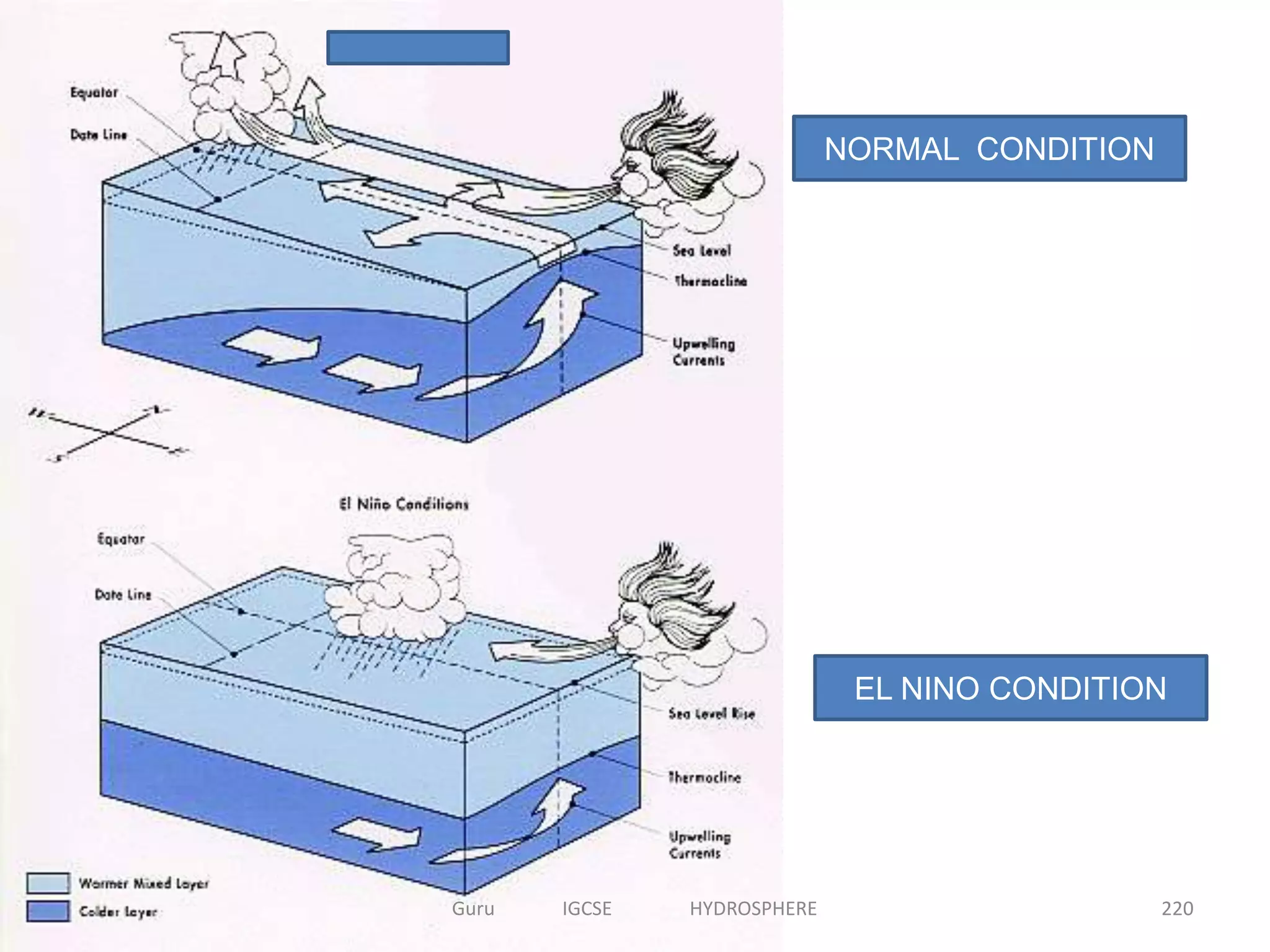
NORMAL CONDITION
EL NINO CONDITION
220Guru IGCSE HYDROSPHERE
WORD ORIGIN
• El Niño, which is Spanish for "the Boy
Child," because it comes about the
time of the celebration of the birth of
the Christ Child.
221Guru IGCSE HYDROSPHERE
Definition
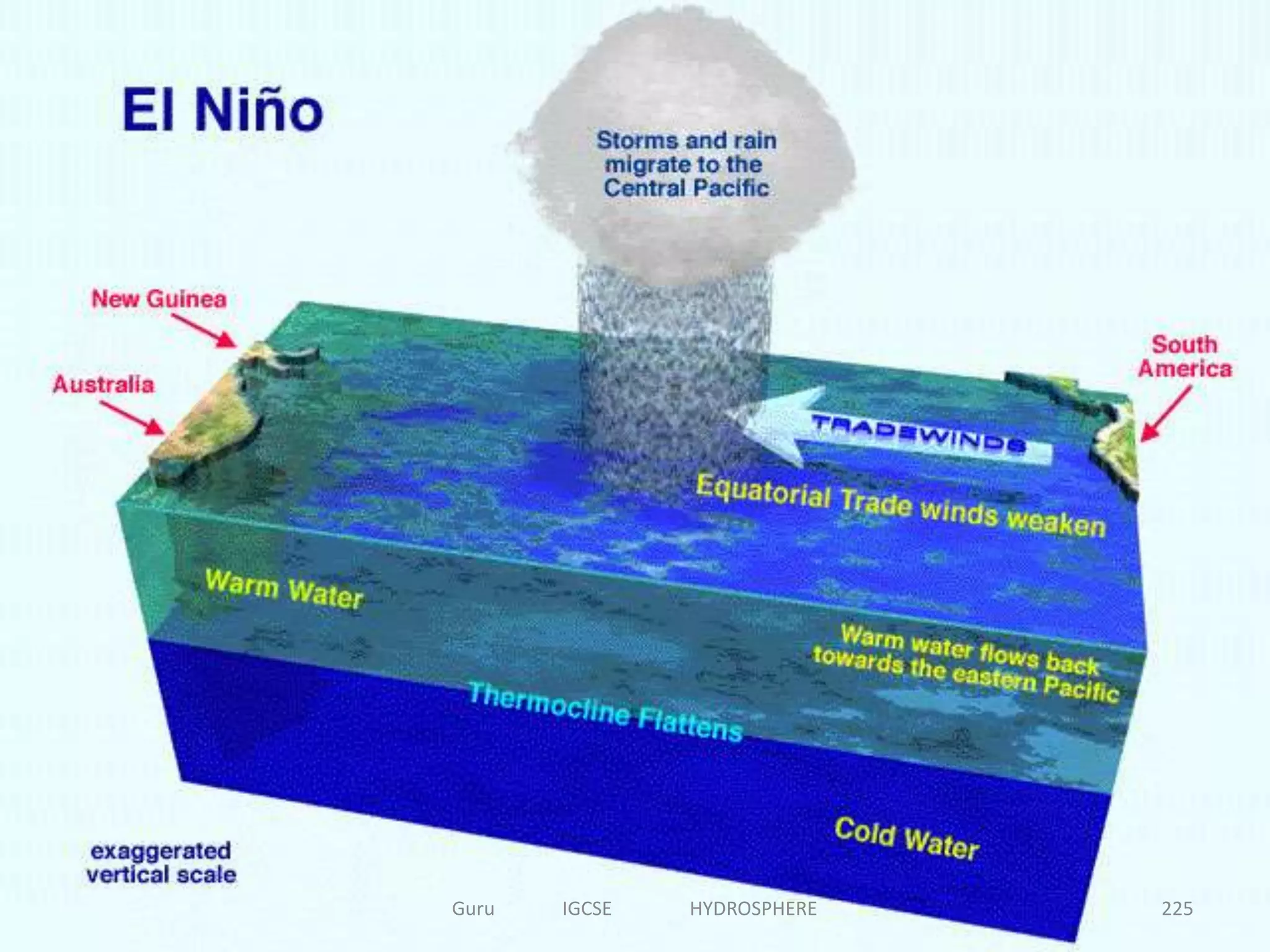
• El Nino, an abnormal warming
of surface ocean waters in the
eastern tropical Pacific, is one
part of what's called
the Southern Oscillation.
222Guru IGCSE HYDROSPHERE
223Guru IGCSE HYDROSPHERE
224Guru IGCSE HYDROSPHERE
225Guru IGCSE HYDROSPHERE
EL NINO-
FORMATION
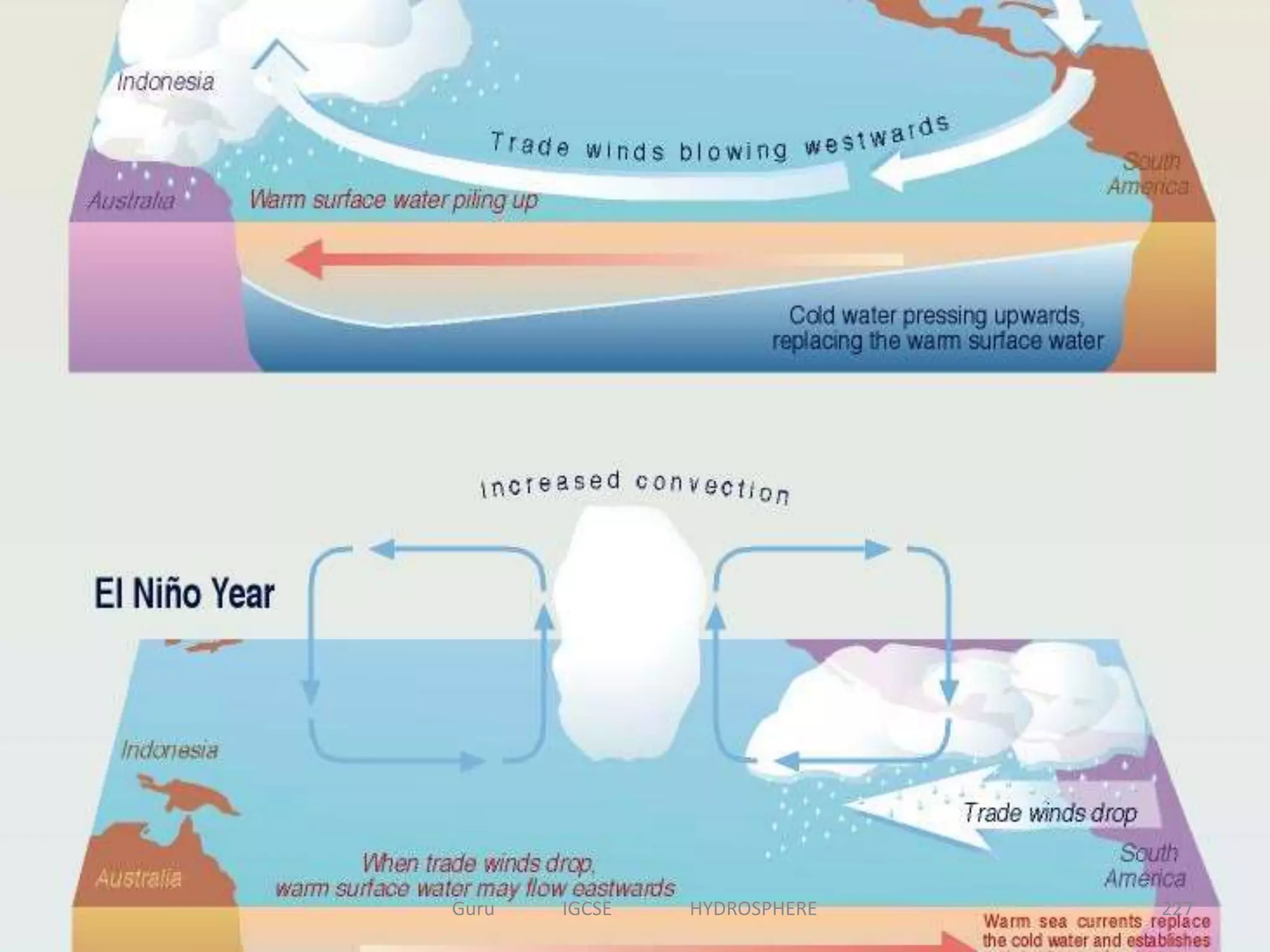
• When the surface pressure is
high in the eastern tropical
Pacific it is low in the western
tropical Pacific, and vice-versa.
• Because the ocean warming and
pressure reversals are, for the
most part, simultaneous,
scientists call this phenomenon
the El Nino/Southern
Oscillation or ENSO for short
226Guru IGCSE HYDROSPHERE
227Guru IGCSE HYDROSPHERE
EFFECTS
• The extremes of this climate
pattern's oscillations, El Niño
and La Niña, cause extreme
weather (such as floods and
droughts) in many regions of the
world.
• Developing countries dependent
upon agriculture and fishing,
particularly those bordering the
Pacific Ocean, are the most
affected.
228Guru IGCSE HYDROSPHERE
229Guru IGCSE HYDROSPHERE
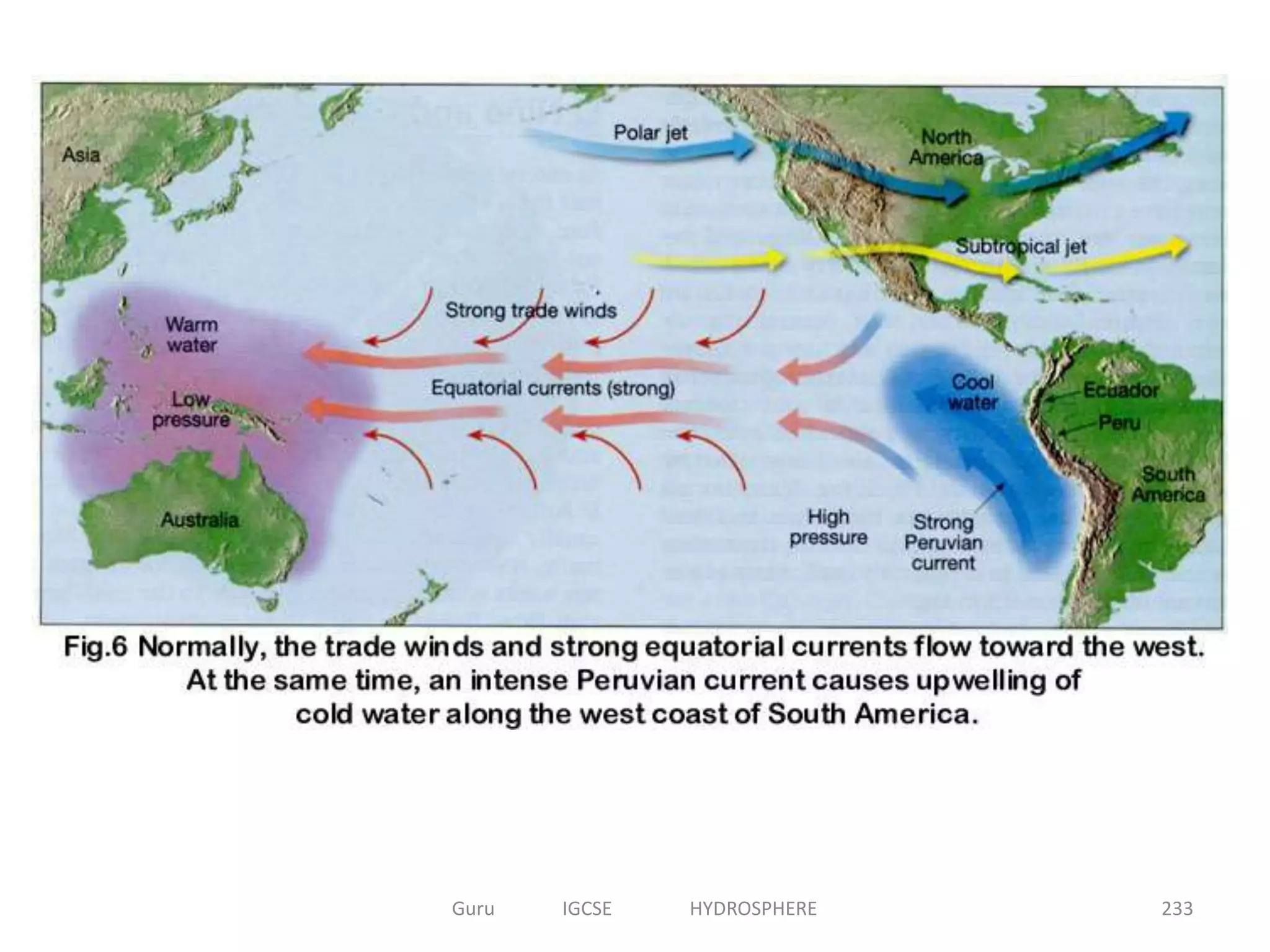
Normal Conditions (Non El Nino)
El Nino Conditions 230Guru IGCSE HYDROSPHERE
231Guru IGCSE HYDROSPHERE
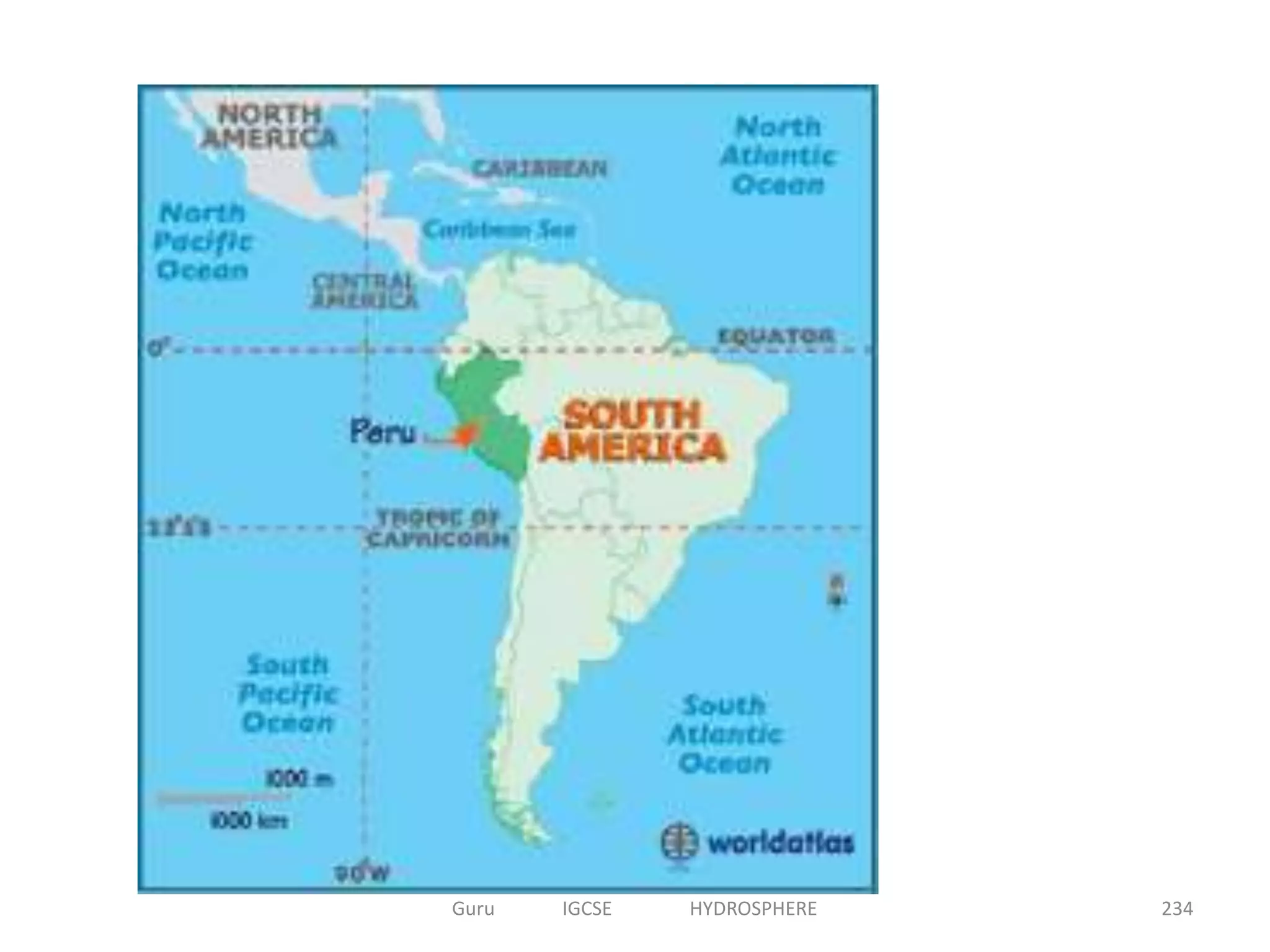
An El
Nino year
in Peru
• This effects is very common in
Peru, which is why Peruvian
fisherman gave it the name El
Niño, meaning the Christ child.
This happens every 3-8 years.
232Guru IGCSE HYDROSPHERE
233Guru IGCSE HYDROSPHERE
234Guru IGCSE HYDROSPHERE
235Guru IGCSE HYDROSPHERE
236Guru IGCSE HYDROSPHERE
237Guru IGCSE HYDROSPHERE
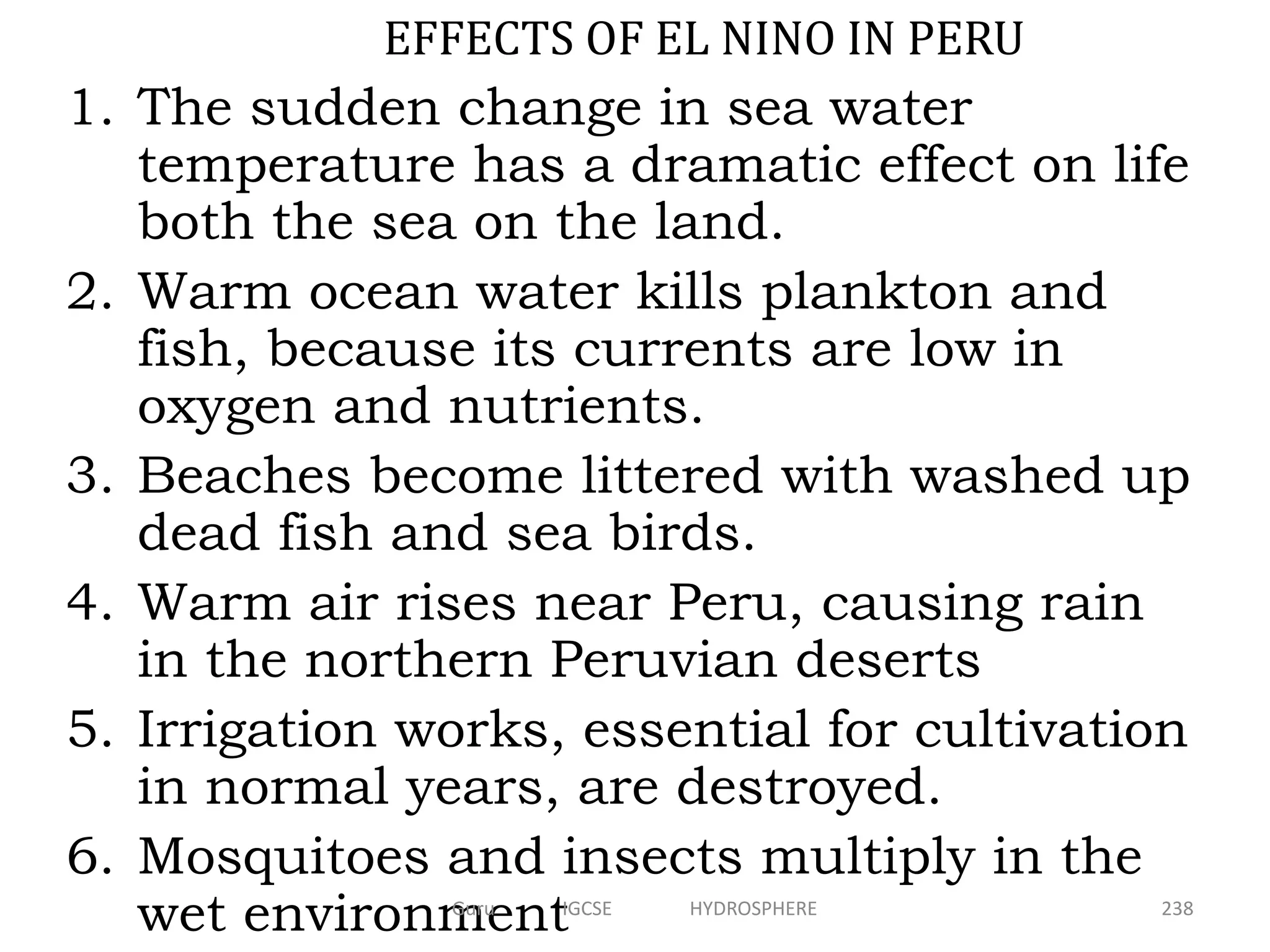
1. The sudden change in sea water
temperature has a dramatic effect on life
both the sea on the land.
2. Warm ocean water kills plankton and
fish, because its currents are low in
oxygen and nutrients.
3. Beaches become littered with washed up
dead fish and sea birds.
4. Warm air rises near Peru, causing rain
in the northern Peruvian deserts
5. Irrigation works, essential for cultivation
in normal years, are destroyed.
6. Mosquitoes and insects multiply in the
wet environment
EFFECTS OF EL NINO IN PERU
238Guru IGCSE HYDROSPHERE
239Guru IGCSE HYDROSPHERE
240Guru IGCSE HYDROSPHERE
241Guru IGCSE HYDROSPHERE
242Guru IGCSE HYDROSPHERE
243Guru IGCSE HYDROSPHERE
244Guru IGCSE HYDROSPHERE
SOME OF THE WORLD WIDE
EFFECTS OF EL NINO IN 1997-98
INDONESIA: Worst
drought, Forest fires,
No monsoon rains
CHINA: Hit by worst
drought for 20 years
Tanzania: Nationwide
crop failure du to
drought-3 million
suffered for food
shortage
ARGENTINA: Heavy
rains delayed
planting of crops
Venezuela: Yields of
most crops reduce by
flooding
Jamaica: Worst
drought for 40 years
245Guru IGCSE HYDROSPHERE
246Guru IGCSE HYDROSPHERE
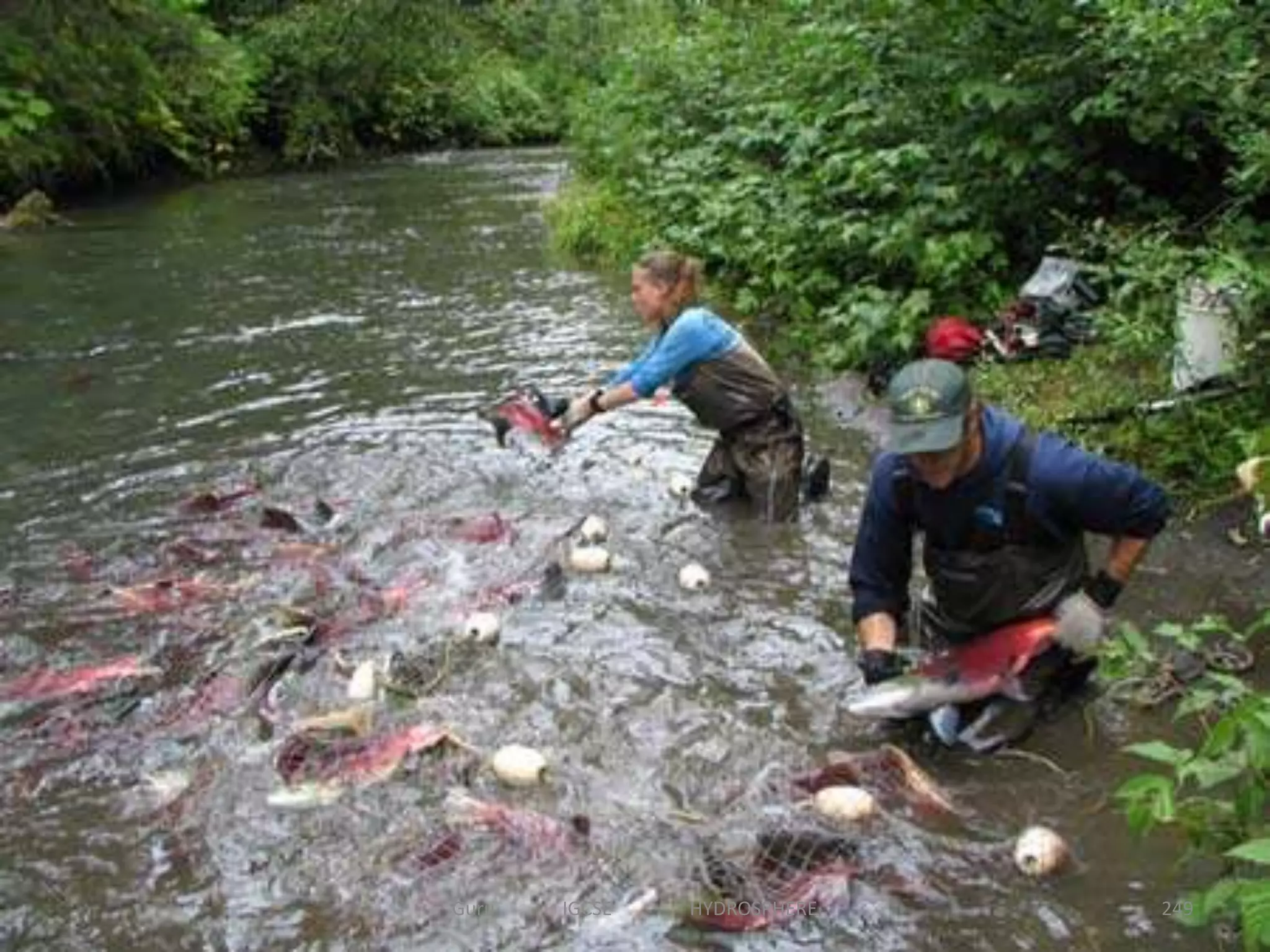
What is Fishery?
A fishery is an area with an
associated fish or aquatic population which is harvested
for its commercial value. Fisheries can be wild or farmed.
Most of the world's wild fisheries are in the ocean.
247Guru IGCSE HYDROSPHERE
248Guru IGCSE HYDROSPHERE
249Guru IGCSE HYDROSPHERE
250Guru IGCSE HYDROSPHERE
251Guru IGCSE HYDROSPHERE
252Guru IGCSE HYDROSPHERE
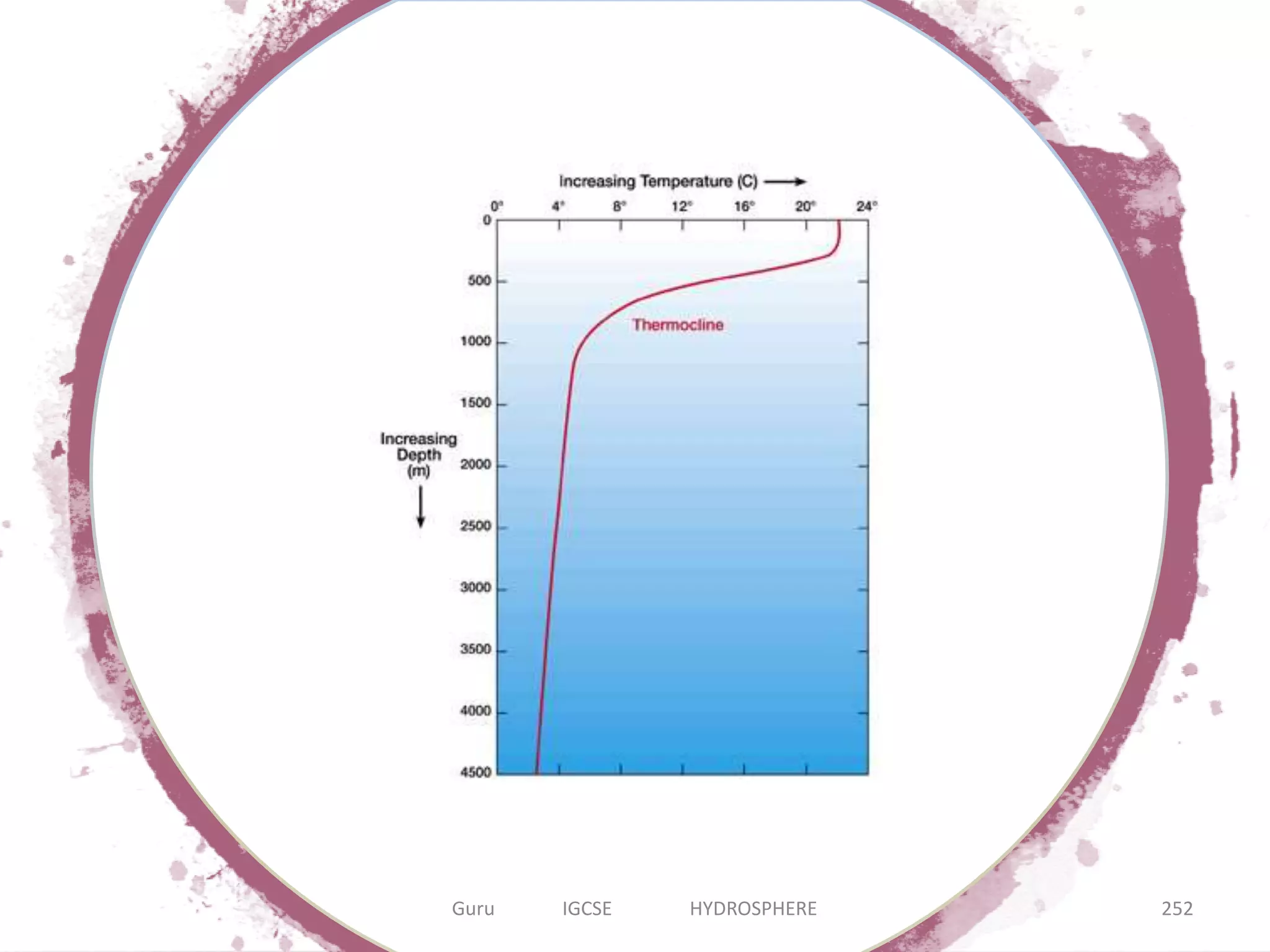
What is
THERMO-
LAYER?
• The thermo-layer is the heat
layer in the atmosphere or
water, at a different temperature
to the air or water above or
below it
253Guru IGCSE HYDROSPHERE
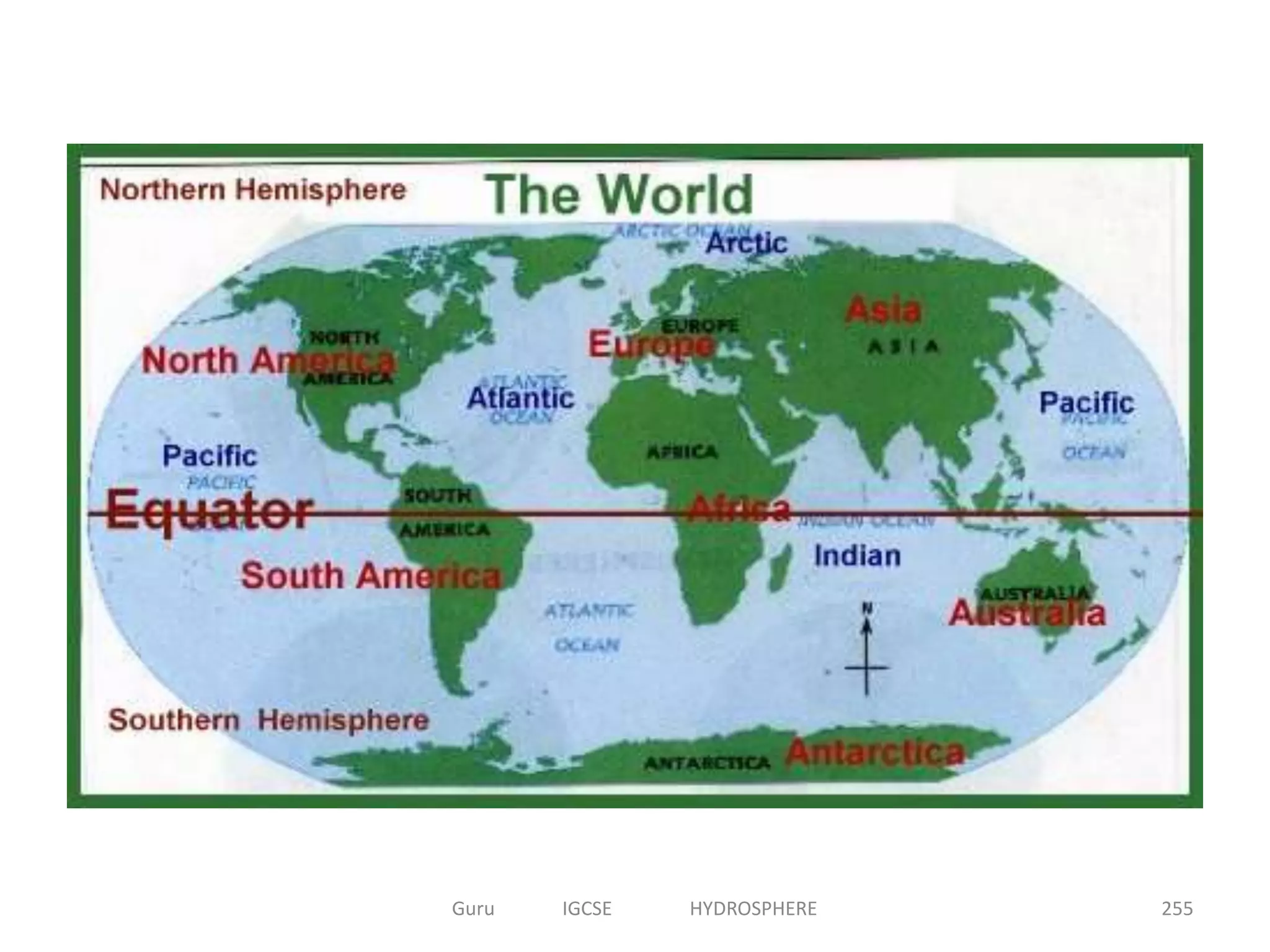
FISHING
GROUNDS
1. Traditional fishing ground are
located predominantly in the
temperature zone of the
northern hemisphere due to
natural factors.
2. These areas are naturally rich
in plankton because of their
shallow water.
3. The presence of mineral-
transporting ocean currents is
also great significance.
254Guru IGCSE HYDROSPHERE
255Guru IGCSE HYDROSPHERE
Warmer
Tropical
Waters
• In warmer tropical waters ,the
nutrients cycle does no function
so effectively because a thermo-
layer occurs because of the lack
of mixing between the warm
surface waters & the cold deeps
256Guru IGCSE HYDROSPHERE
257Guru IGCSE HYDROSPHERE
MARINE
SOURCES
1) Marine sources provide about
20% of the animal protein
eaten by humans.
2) Another 5% is provided
indirectly via livestock fed with
fish. 60% of fish
consumption is by the
developing world.
3) In Asia, about 1 billion people
rely on fish as
their primary source of
protein.
4) The fishing enterprise employs
some 200 million people
worldwide.
258Guru IGCSE HYDROSPHERE
259Guru IGCSE HYDROSPHERE
IMPORTANCE
OF FISH
PRODUCTS
1. Fish is one of our most valuable
sources of protein food.
2. World wide, people obtain about
25% of their animal protein from
fish and shell fish.
3. About 35% of all fish is eaten
fresh, chilled or frozen.
4. It is also cured or canned or
made into oil and fish meal .
5. Fish and marine products are
used as medicine, ground into
vitamins, or processed into
cosmetics and perfumes,
lubricants, varnishes, soap and
margarine.
260Guru IGCSE HYDROSPHERE
World fish production(2013)
RANK COUNTRY AMOUNT(MILLION
TONNES)
1 CHINA 11.3
2 PERU 9.4
3 INDIA 6.3
4 INDONESIA 5.6
261Guru IGCSE HYDROSPHERE
TYPES
OF
FISH
• The sea fish caught fall into two
groups, pelagic &demersal.
• Pelagic fish live near the ocean
surface including herring,
mackerel &sardine.
• Demersal fish are bottom
dwellers, living closer to the
floor of the contential shelf
• Cod,haddock,plaice.
• Other main marine animals are
• Crabs, lobsters
&crayfish,oysters,cockles &
whales
262Guru IGCSE HYDROSPHERE
263Guru IGCSE HYDROSPHERE
What is
Over
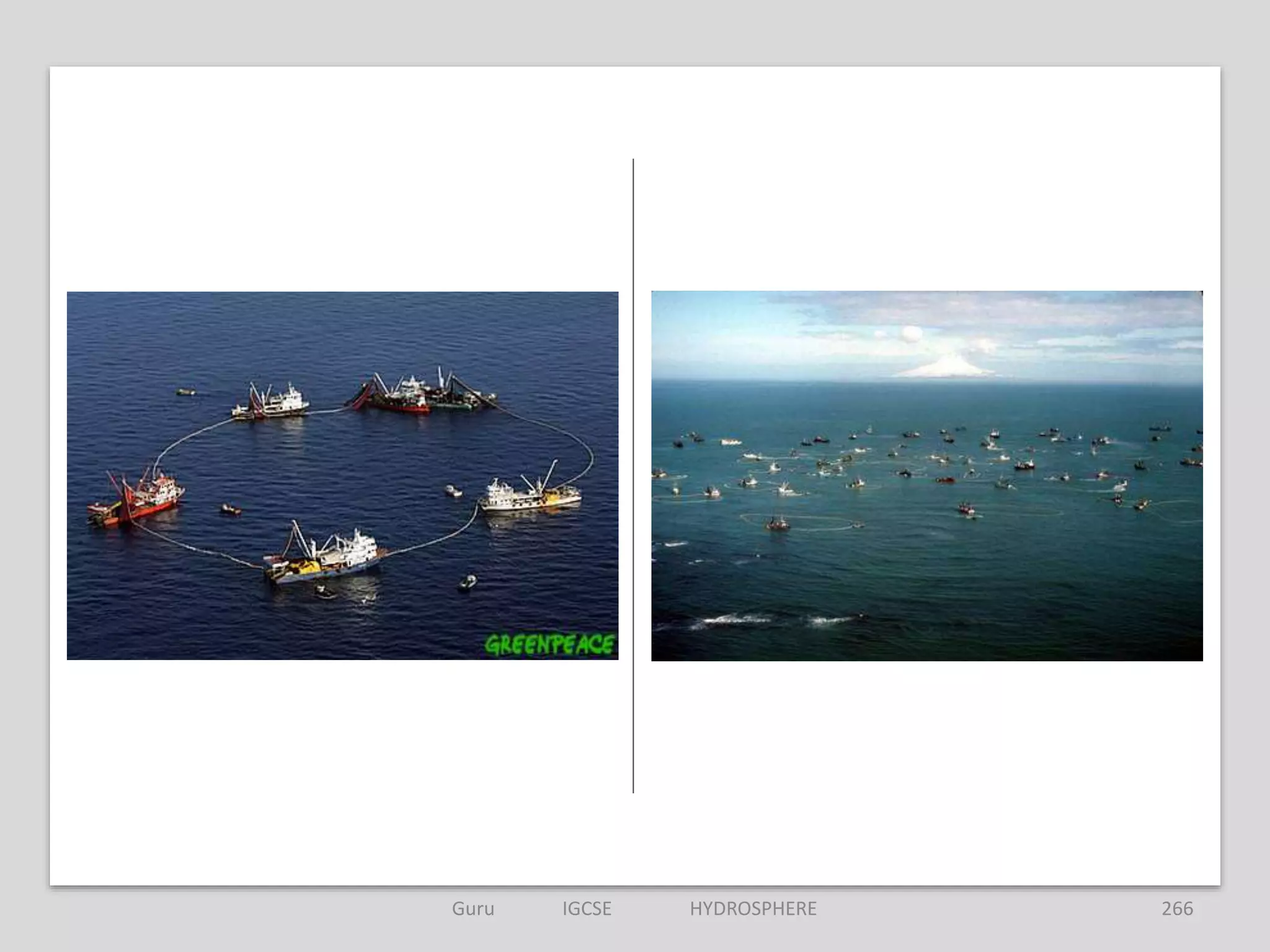
Fishing?
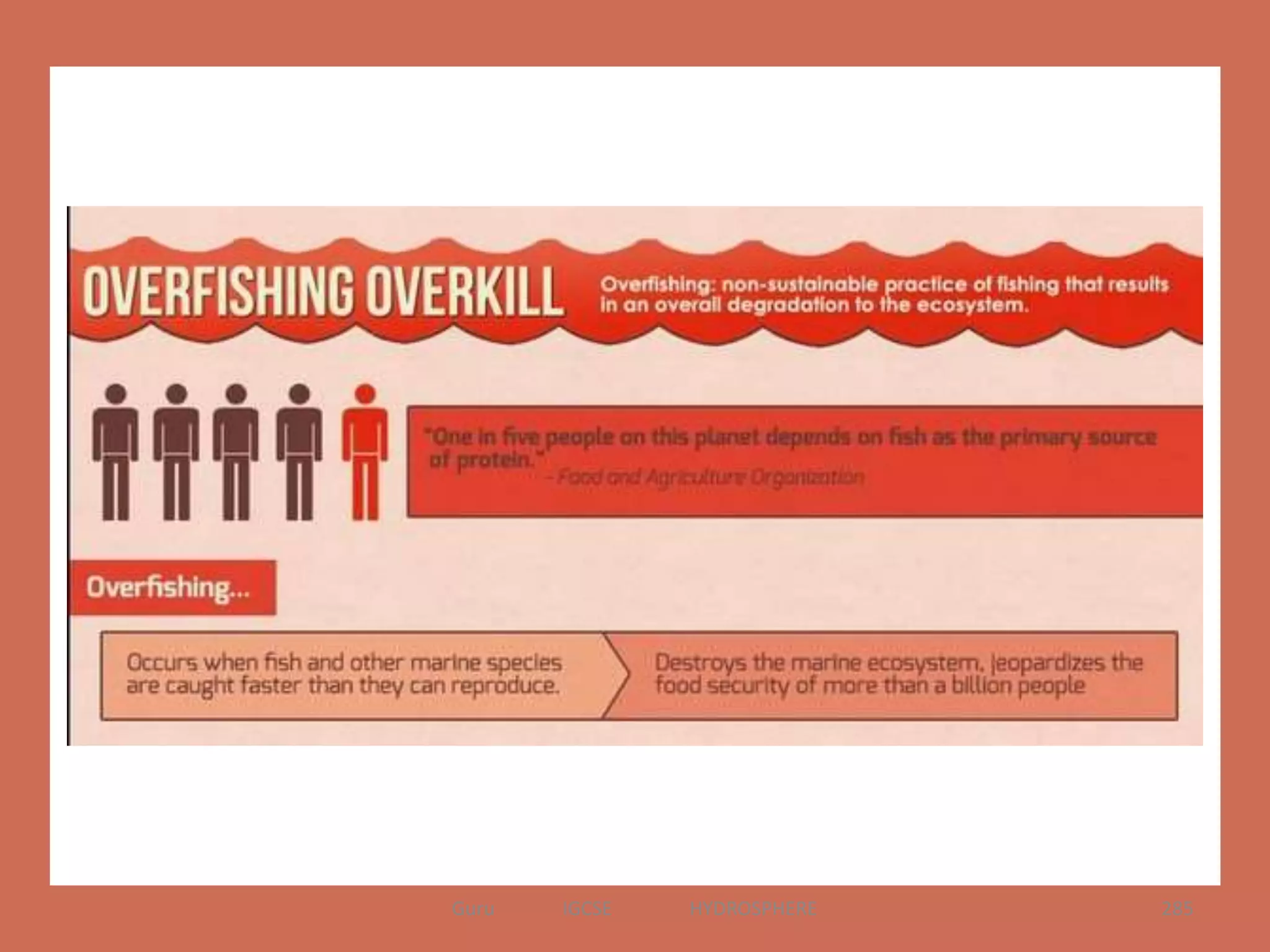
1. Overfishing occurs
when fishing activities
reduce fish stocks below an
acceptable level. This can
occur in any body of water
from a pond to the oceans.
2. The practice of commercial and
non-commercial fishing which
depletes a fishery by catching
so many adult fish that not
enough remain to breed and
replenish the population.
264Guru IGCSE HYDROSPHERE
265Guru IGCSE HYDROSPHERE
266Guru IGCSE HYDROSPHERE
267Guru IGCSE HYDROSPHERE
What is
causing
overfishing
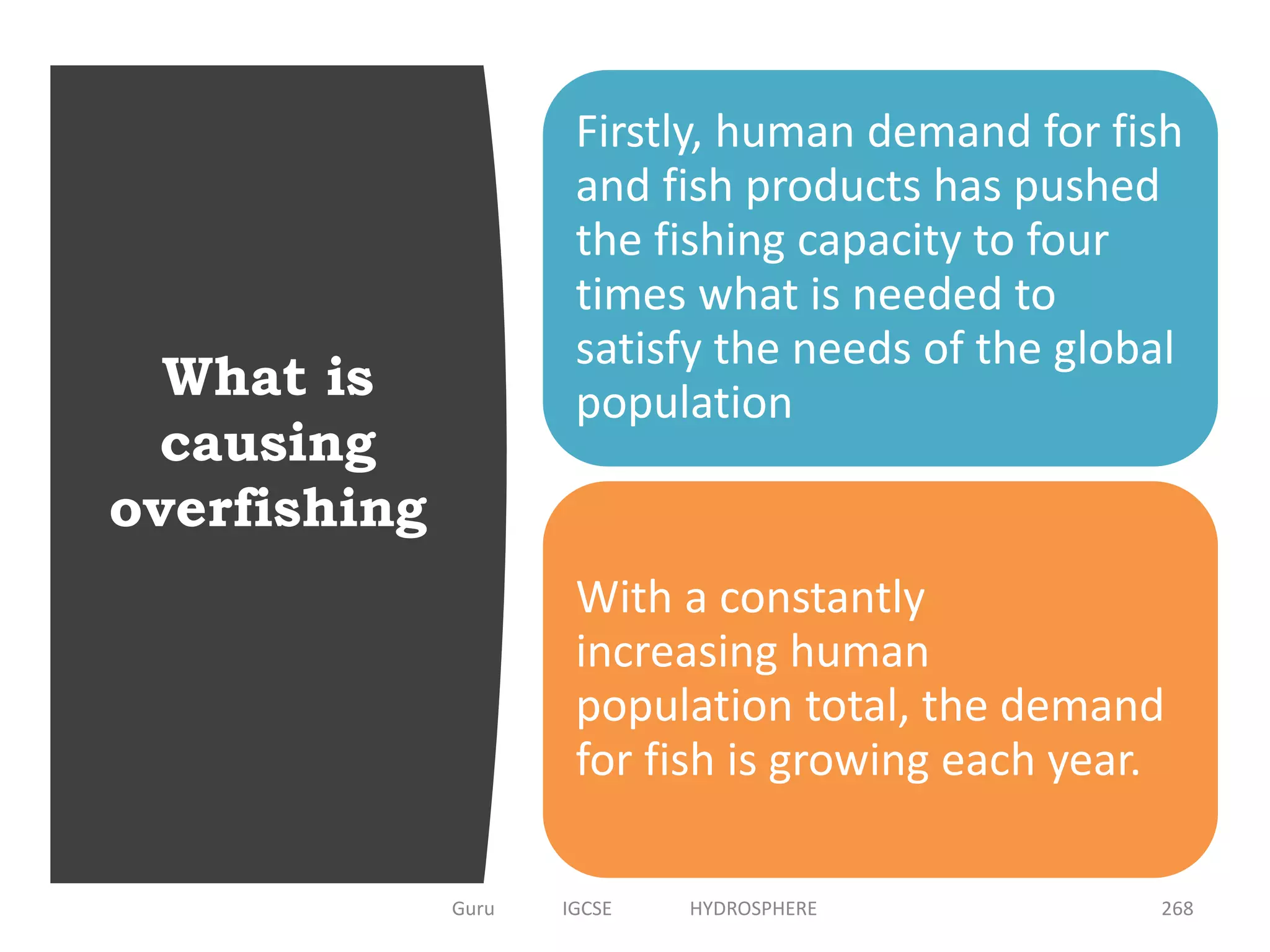
Firstly, human demand for fish
and fish products has pushed
the fishing capacity to four
times what is needed to
satisfy the needs of the global
population
With a constantly
increasing human
population total, the demand
for fish is growing each year.
268Guru IGCSE HYDROSPHERE
269Guru IGCSE HYDROSPHERE
270Guru IGCSE HYDROSPHERE
271Guru IGCSE HYDROSPHERE
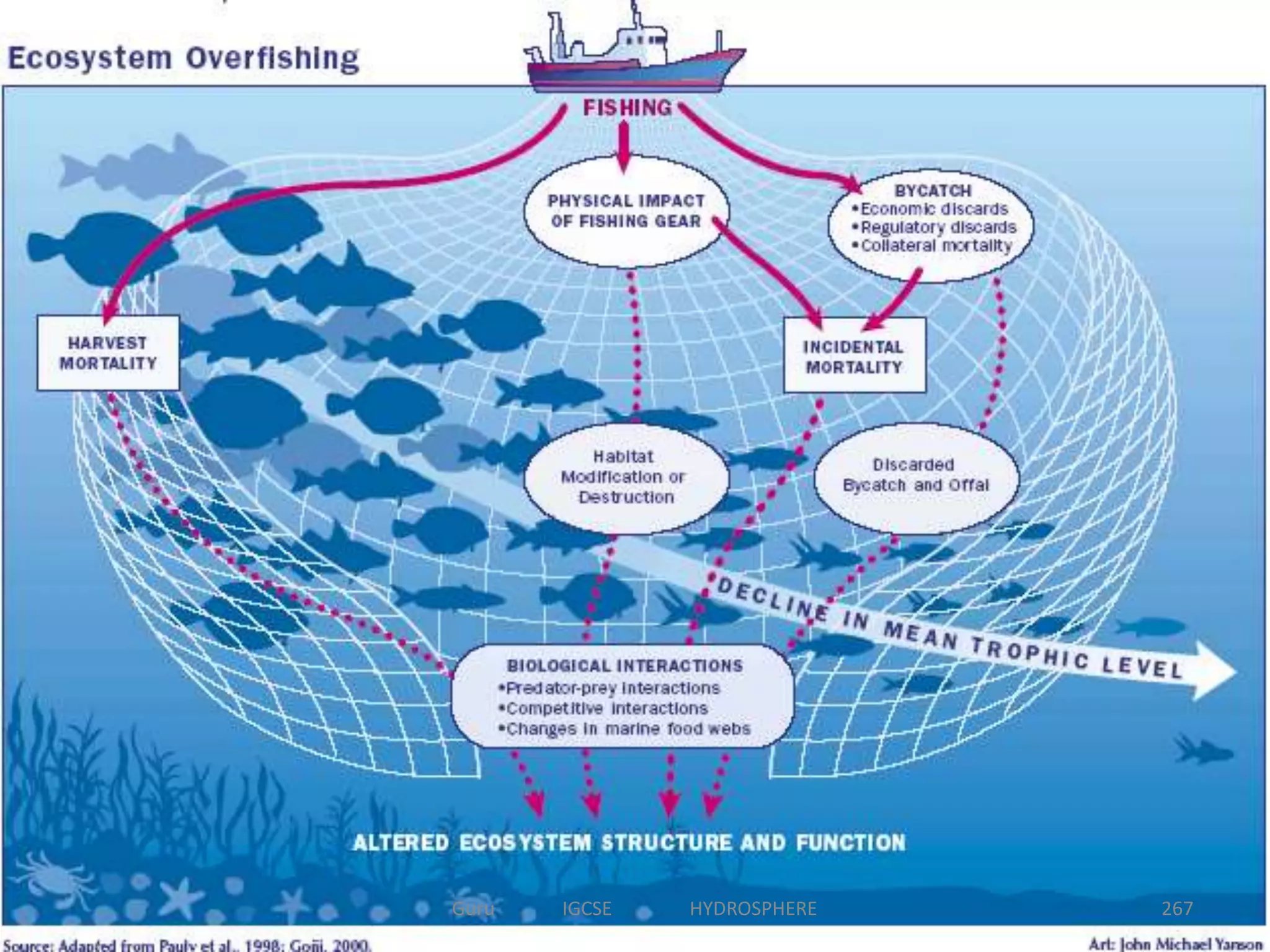
Secondly, the way in which fish is caught leads to
further unsustainable situations.
Habitat destruction, by means of dynamite fishing,
cyanide fishing and bottom trawling have been used
by commercial fishing ventures for year
272Guru IGCSE HYDROSPHERE
CONSEQUENCES
OF OVERFISHING
1. The removal of large numbers
of a certain type of fish can
also lead to a disruption of the
local food web, as predators
are left with too little food to
maintain their population
numbers.
2. Reckless overfishing through
illicit means can result into a
direct damage/contamination
of oceans, seas, etc.
3. Food chains – prey-predator
relationship will be altered.
The ecological balance will be
thrown off.
273Guru IGCSE HYDROSPHERE
274Guru IGCSE HYDROSPHERE
Hundreds of thousands of jobs in fishing and related
industries were lost in 1990’s
Small port communities in remote locations where
fishing is the only sources of employment, have
been badly hit
Long-term physical effects on the ocean ecology –
coral reefs, ocean floor, bottom grasses etc.
275Guru IGCSE HYDROSPHERE
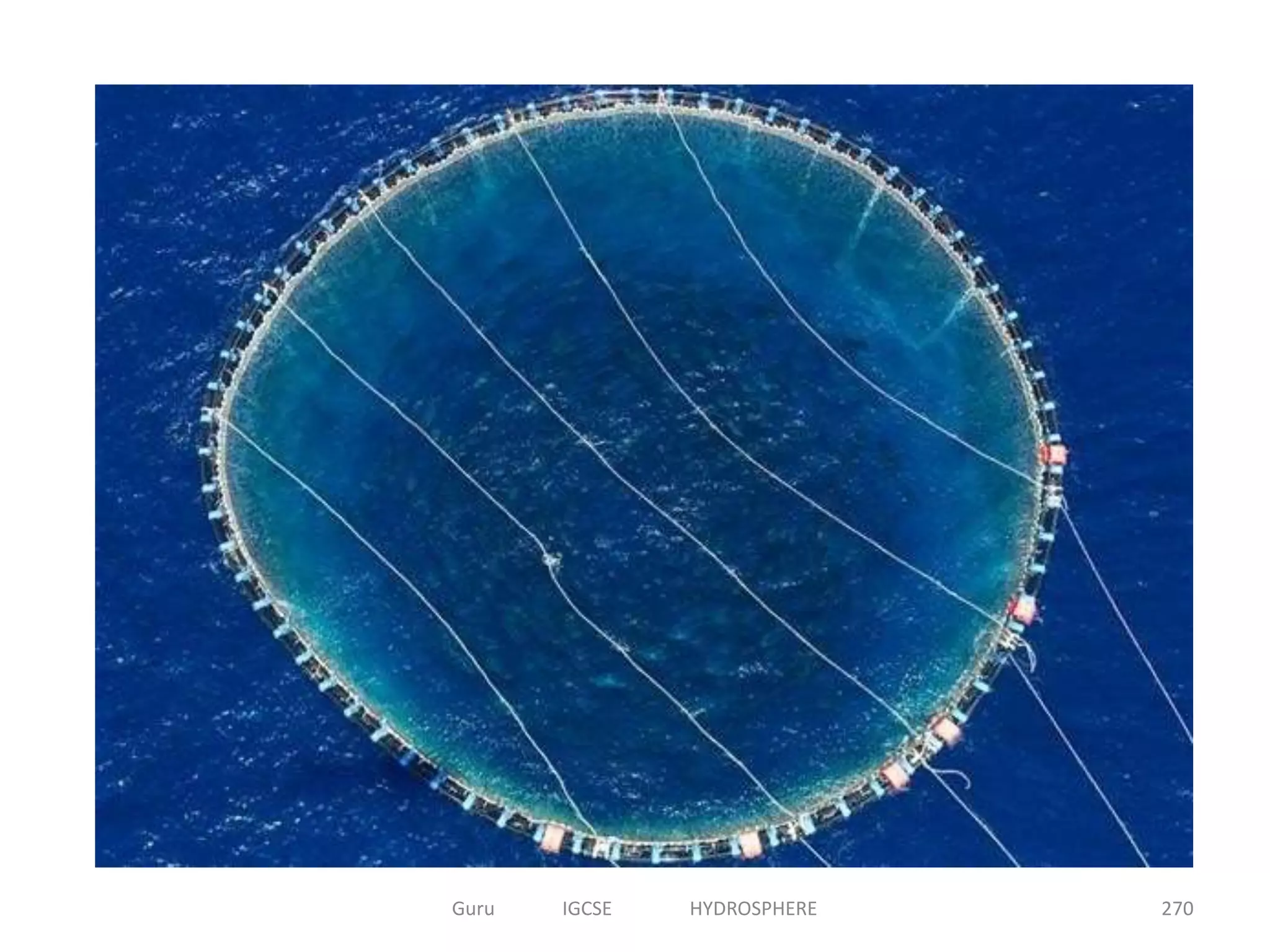
Modern
New
technology
- Fishing
boats
Up to 100m long
As many as 100 people
employed by a company
Radar & Sonar to find fish,
satellites for navigation &
weather data about fish
Nets at least 1km wide are
trailed that can scoop up
400 tonnes is one gulp
276Guru IGCSE HYDROSPHERE
277Guru IGCSE HYDROSPHERE
GREEN
PEACE
• Greenpeace is a non-
governmental environmental org
anization with offices in over
forty countries and with an
international coordinating body
in Amsterdam.
• Greenpeace spread to several
countries and started to
campaign on other
environmental issues such
as commercial
whaling and toxic waste
278Guru IGCSE HYDROSPHERE
279Guru IGCSE HYDROSPHERE
280Guru IGCSE HYDROSPHERE
Impact of
overfishing
Ecosystems Destruction
According to marine ecologists, unsustainable
fishing is the greatest threat to ocean
ecosystems.
The practice destroys the physical environments
of marine life, and distorts the entire food chain
in the oceans.
281Guru IGCSE HYDROSPHERE
282Guru IGCSE HYDROSPHERE
283Guru IGCSE HYDROSPHERE
• Biodiversity
Marine life is amazing and balanced
with millions of fish species and
other marine animals.
• Constantly fishing for particular
specie like the blue-fine tuna (which
is people’s favourite), means soon
that kind of fish will be extinct
284Guru IGCSE HYDROSPHERE
285Guru IGCSE HYDROSPHERE
286Guru IGCSE HYDROSPHERE
287Guru IGCSE HYDROSPHERE
288Guru IGCSE HYDROSPHERE
289Guru IGCSE HYDROSPHERE
• Pollution
Oil and liquid spills, chemical and
solid elements discharged into the
water by fishing boats, vessels and
trawlers often hurt marine life.
• It is very easy to think that the
oceans are so big and these are not
real threats, but a bit of pollution by
thousands of trawlers everyday
contribute to something very big and
disturbing
290Guru IGCSE HYDROSPHERE
K.GURU
CHARAN
KUMAR
291
IB ESS Teacher TOK facilitator
IGCSE EVM
Teacher
MYP Teacher
IB ESS Paper 1 & 2
Assist Examiner &
IB ESS IA
Examiner
GAT Leader-IB
World Student
Conference
Graphic Designer Photographer Quiz Master
Blogger Web Designer Taxonomist
Documentary
Maker
Adobe Specialist
School Clicking
Club Incharge
School Graphic
Designer and Field
Trip Organizer
Guru IGCSE HYDROSPHERE
Follow me
• Website: http://gurucharankumar.weebly.com/
• My YouTube Channel:
https://www.youtube.com/c/Gurucharankumar
• Twitter Account: @Greenguru2013 -
https://twitter.com/Greenguru2013
• Linked in: https://www.linkedin.com/in/gurucharankumar/
• SlideShare Link: http://www.slideshare.net/kingcobra2012
• SymbalooEDU link :
• https://edu.symbaloo.com/mix/edutools297
• Insta : gurumantra007 292Guru IGCSE HYDROSPHERE

IGCSE Environment Management Hydrosphere

  • 1.
  • 2.
    • About 70%of the earth’s surface is covered with water. • Ninety-seven percent of the water on the earth is salt water.. • Two percent of the water on earth is glacier ice at the North and South Poles. • Less than 1% of all the water on earth is fresh water that we can actually use. • We use this small amount of water for drinking, transportation, heating and cooling, industry, and many other purposes. 2Guru IGCSE HYDROSPHERE
  • 3.
  • 4.
    • Everything ismade of atoms. • An atom is the smallest particle of an element, like oxygen or hydrogen. Atoms join together to form molecules. • Water is made of Oxygen and hydrogen 4Guru IGCSE HYDROSPHERE
  • 5.
    Solid water—ice isfrozen water. When water freezes, its molecules move farther apart, making ice less dense than water. Liquid water is wet and fluid. This is the form of water with which we are most familiar. We use liquid water in many ways, including washing and drinking. Water as a gas—vapor is always present in the air around us. 5Guru IGCSE HYDROSPHERE
  • 6.
  • 7.
    • The cycleof water movement from the atmosphere to the earth and back to the atmosphere through condensation, precipitation, evaporation, and transpiration is called WATER CYCLE • The continual cycle of water between the land, the ocean and the atmosphere. • The water cycle, also known as the hydrologic cycle, describes the continuous movement of water on, above and below the surface of the Earth. What is Water Cycle ? 7Guru IGCSE HYDROSPHERE
  • 8.
  • 9.
  • 10.
    Evaporation • This isthe first stage of the water cycle. • The Sun's rays heat the water on the surface of the earth in rivers, oceans and lakes. • This makes the water change into water vapour. 10Guru IGCSE HYDROSPHERE
  • 11.
    Condensation :  Afterevaporation, condensation occurs.  Water vapor in the air gets cold and changes back into liquid, forming clouds  The process that causes these changes is called condensation. 11Guru IGCSE HYDROSPHERE
  • 12.
    • Precipitation : Precipitationoccurs when so much water has condensed that the air cannot hold it anymore. The clouds get heavy and water falls back to the earth in the form of rain • Collection After precipitation comes the stage of collection. The raindrops fall back into the lakes, rivers and oceans or are absorbed by the land. This process by which rainwater gathers on earth is called collection. 12Guru IGCSE HYDROSPHERE
  • 13.
    What is Fresh water ? •Fresh water is naturally occurring water on the Earth's surface in ice sheets, ice caps, glaciers, icebergs, ponds, lakes, rivers and streams, and underground as groundwater in aquifers and underground streams. 13Guru IGCSE HYDROSPHERE
  • 14.
  • 15.
    Water Rich Countries • Still, thestatistical summary gives a basic perspective on the ten richest countries in terms of the world’s total freshwater resources, estimated at some 55,273 cubic kilometers per year (ckpy). 15Guru IGCSE HYDROSPHERE
  • 16.
    2017 Report 1. Brazil… (14.9%of world total) 2. Russia… (8.1%) 3. Canada… (6%) 4. United States… (5.6%) 5. Indonesia … (5.1%) 6. China… (5.1%) 7. Colombia … (3.9%) 8. Peru … (3.5%) 9. India … (3.5%) 10. Democratic Republic of Congo … (2.3%) 16Guru IGCSE HYDROSPHERE
  • 17.
    WATER POOR COUNTRIES- Theoil-rich Middle East is home to a disproportionate number of water-poor countries 17Guru IGCSE HYDROSPHERE
  • 18.
    Why is Water an Increasingly Strategic Resource? 1.The world’s population is growing by about 80 million people a year, implying increased freshwater demand of about 64 billion cubic metres a year. 2. By 2025, 1.8 billion people will be living in countries or regions with absolute water scarcity, and two-thirds of the world population could be under stress conditions. 18Guru IGCSE HYDROSPHERE
  • 19.
  • 20.
    What is Watercrisis? Water crisis is a general term used to describe a situation where the available water within a region is less than the region's demand. The major aspects of the water crisis are allegedly overall scarcity of usable water and water pollution. 20Guru IGCSE HYDROSPHERE
  • 21.
  • 22.
    Water CRISIS • A globalcrisis 1. 884 million people in the world do not have access to safe water. This is roughly one in eight of the world's population. 2. 2.6 billion people in the world do not have access to adequate sanitation, this is almost two fifths of the world's population. 3. 1.4 million children die every year from diarrhoea caused by unclean water and poor sanitation 22Guru IGCSE HYDROSPHERE
  • 23.
    What's the problemin Water?: 1. The population is growing rapidly, putting more pressure on our water supply (demand is increasing) 2. The amount of water is effectively reduced by pollution and contamination (supply is decreasing) 23Guru IGCSE HYDROSPHERE
  • 24.
  • 25.
    What are theSolutions? • Improvements in the efficiency of water use • Efficient management and modern technology can stretch even scarce water supplies much further. • Water is often wasted because it is underpriced. Direct and indirect subsidies (especially for agricultural use) are still common in both developed and developing countries. 25Guru IGCSE HYDROSPHERE
  • 26.
    Overview of regions suffering crisis impacts 1. Theweight of water that women in Africa and Asia carry on their heads is commonly 20kg, the same as the average UK airport luggage allowance. 2. The average person in the developing world uses 10 litres of water every day for their drinking, washing and cooking. 3. On current trends over the next 20 years humans will use 40% more waterthan they do now. (UNEP) 4. Agriculture accounts for over 80% of the world's water consumption. 26Guru IGCSE HYDROSPHERE
  • 27.
  • 28.
  • 29.
    • A damis a barrier that impounds water or underground streams. • Dams generally serve the primary purpose of retaining water, while other structures such as floodgates are used to manage or prevent water flow into specific land regions. What is a dam? 29Guru IGCSE HYDROSPHERE
  • 30.
    Common purpose of Dam 1.Power generation 2. Water supply 3. Stabilize water flow / irrigation 4. Flood prevention 5. Water diversion 6. Recreation and aquatic beauty 30Guru IGCSE HYDROSPHERE
  • 31.
    Which is thebiggest Dam in the World? 31Guru IGCSE HYDROSPHERE
  • 32.
  • 33.
  • 34.
    • Hoover Dam,once known as Boulder Dam, is a concrete arch-gravity dam in the Black Canyon of the Colorado River, on the border between the US states of Arizona and Nevad • Height726.4 ft (221.4 m) • Length1,244 ft (379 m) 34Guru IGCSE HYDROSPHERE
  • 35.
    Which is thebiggest dam in India? 35Guru IGCSE HYDROSPHERE
  • 36.
  • 37.
    Hirakud Dam isbuilt across the Mahanadi River, about 15 km from Sambalpur in the state of Orissa in India. 37Guru IGCSE HYDROSPHERE
  • 38.
    • Hirakud Damis the longest man-made dam in the world, about 16 mi (26 km) in length • Height60.96 m (200 ft) • Length4.8 km (3 mi) (main section) 25.8 km (16 mi) (entire dam) 38Guru IGCSE HYDROSPHERE
  • 39.
    1. Once adam is constructed, electricity can be produced at a constant rate. 2. Dams are designed to last many decades and so can contribute to the generation of electricity for many years. 3. The lake that forms behind the dam can be used for water sports and leisure / pleasure activities. 4. Often large dams become tourist attractions in their own right. 5. The lake's water can be used for irrigation purposes. ADVANTAGES OF DAM 39Guru IGCSE HYDROSPHERE
  • 40.
    Bhakra Dam isa concrete gravity dam across the Sutlej River and is near the border between Punjab and Himachal Pradesh in northern India. 40Guru IGCSE HYDROSPHERE
  • 41.
    Bhakra Dam isIndia's second tallest at 225.55 m (740 ft) high 41Guru IGCSE HYDROSPHERE
  • 42.
    1. Dams areextremely expensive to build and must be built to a very high standard. 2. The flooding of large areas of land means that the natural environment is destroyed. 3. People living in villages and towns that are in the valley to be flooded, must move out. 4. The building of large dams can cause serious geological damage. 5. Building a large dam alters the natural water table level. DISADVANTAGES OF DAM 42Guru IGCSE HYDROSPHERE
  • 43.
  • 44.
  • 45.
  • 46.
  • 47.
  • 48.
  • 49.
    Environmental impact • 1.Alarge dam can cause the loss of entire ecospheres including endangered and undiscovered species in the area, and the replacement of the original environment by a new inland lake. • 2.Large reservoirs formed behind dams have been indicated in the contribution of seismic activity, due to changes in water load and/or the height of the water table. 49Guru IGCSE HYDROSPHERE
  • 50.
  • 51.
  • 52.
    • 3.Dam canbe particularly damaging in seasonal floodplains, affecting deposits of nutrients as well as the lifecycles of species that depend on these fluctuation` for feeding and breeding grounds. 52Guru IGCSE HYDROSPHERE
  • 53.
    2.Human social impact •It is estimated that to date, 40-80 million people worldwide have been physically displaced from their homes as a result of dam construction 53Guru IGCSE HYDROSPHERE
  • 54.
    Dams - blessingand curse? Over 48,000 large dams are in operation worldwide. And more are being built to provide drinking water, irrigate the land, produce hydropower, and prevent floods. Yet today: Over one billion people do not have access to safe drinking water More than double that number lack basic sanitation Two billion people have no access to electricity. 54Guru IGCSE HYDROSPHERE
  • 55.
  • 56.
    1. A floodis an overflow of an expanse of water that submerges land. 2. Flooding may result from the volume of water within a body of water, such as a river or lake, which overflows or breaks levees, with the result that some of the water escapes its usual boundaries What is Flood? 56Guru IGCSE HYDROSPHERE
  • 57.
  • 58.
    CAUSES OF RIVER FLOODING • Riverine 1.Runoff from sustained rainfall or rapid snow melt exceeding the capacity of a river's channel. 2. Causes include heavy rains from monsoons, hurricanes and tropical depressions, foreign winds and warm rain affecting snow pack 58Guru IGCSE HYDROSPHERE
  • 59.
  • 60.
  • 61.
    • Coastal 1. Causedby severe sea storms, or as a result of another hazard (e.g. tsunami or hurricane). 2. A storm surge, from either a tropical cyclone or an extra tropical cyclone, falls within this category 61Guru IGCSE HYDROSPHERE
  • 62.
  • 63.
  • 64.
  • 65.
    There are manyafter effects of a flood. Much of it is quiet deadly. These effects of a flood are divided into three key categories which are : 1.Long-term Effect: 2.Secondary Effect: 3.Primary Effect: 65Guru IGCSE HYDROSPHERE
  • 66.
    • 1.The longterm effect of flood basically includes the Economic effect. A flood can result in an economic hardship for the flood hit area. This results in rebuilding costs, decline in tourism etc. • 2.Secondary Effect includes contamination of water, diseases because of unhygienic water. • 3. Primary effects includes physical damage to everything and casualties amongst people and livestock 66Guru IGCSE HYDROSPHERE
  • 67.
  • 68.
  • 69.
  • 70.
  • 71.
    Some immediate effects are:Primary Effects 1.Loss of human life 2.Damage to infrastructure 3. Livestock carried away 4.Communication disputes 71Guru IGCSE HYDROSPHERE
  • 72.
    • Short termeffects 1.People in need of medical treatment 2.Homeless people 3.Shortage of safe drinking water 4.Food shortage Long term effects 1.Repair of infrastructure 2.reclamation of farmland 3. Restore public services 72Guru IGCSE HYDROSPHERE
  • 73.
  • 74.
    What is Water Pollution? • Waterpollution is the contamination of water bodies (e.g. lakes, rivers, oceans, and groundwater). Water pollution occurs when pollutants are discharged directly or indirectly into water bodies without adequate treatment to remove harmful compounds. 74Guru IGCSE HYDROSPHERE
  • 75.
  • 76.
  • 77.
  • 78.
    • Types ofWater Pollution • Without getting too technical, water pollution is a result of various things, but usually leads back to these sources: 1. Industry 2. Agriculture 78Guru IGCSE HYDROSPHERE
  • 79.
  • 80.
    • Industry 1. Thereare three main ways that industries contribute to water pollution. 2. They pollute by disposing of waste directly into waterways, emitting toxic gases that cause acid rain and changing the temperature of water with their disposals into waterways. 80Guru IGCSE HYDROSPHERE
  • 81.
  • 82.
    • Agriculture pollution •Its common for farmers to use fertilizers and other chemicals on their crops to help them grow. • Some application methods – such as pesticide spraying by aeroplane – lead to pollution of adjacent land, rivers or wetlands. • Due to inappropriate water management and irrigation technology, fertilizers and pesticides also commonly run-off from fields to adjacent rivers and lakes and contaminate groundwater sources 82Guru IGCSE HYDROSPHERE
  • 83.
  • 84.
  • 85.
  • 86.
    1. Spread ofdisease: Drinking polluted water can cause cholera or typhoid infections, along with diarrhea. 2. Affects body organs: The consumption of highly contaminated water can cause injury to the heart and kidneys. 3. Harms the food chain: Toxins within water can harm aquatic organisms, thus breaking a link in the food chain. 4. Harms animals: Birds that get into oil- contaminated water die from exposure to cold water and air due to feather damage. Other animals are affected when they eat dead fish in contaminated streams. 86Guru IGCSE HYDROSPHERE
  • 87.
    Consequences of waterpollution Effects on Ecosystem Water pollution has effects on both physical and chemical properties of water leading to hazardous effects on the dependent life forms in water. 87Guru IGCSE HYDROSPHERE
  • 88.
    Effects on HumanLife 1. Water pollution can cause certain waterborne diseases like diarrhea, typhoid, cholera, and jaundice. 2. These can be caused due to the dumping of human wastes and sewage water. 3. Drinking contaminated water for longer period of time can damage the liver and kidneys of a person. 4. Toxic water can result in causing skin disorders, ulcers, tumors etc. 88Guru IGCSE HYDROSPHERE
  • 89.
  • 90.
  • 91.
    What is Eutrophication? 1. Theprocess by which a body of water acquires a high concentration of nutrients, especially phosphates and nitrates. 2. These typically promote excessive growth of algae. 3. As the algae die and decompose, high levels of organic matter and the decomposing organisms deplete the water of available oxygen, causing the death of other organisms, such as fish. 91Guru IGCSE HYDROSPHERE
  • 92.
  • 93.
  • 94.
    • 4.This bloomof algae disrupts normal ecosystem functioning and causes many problems. • 5.The algae may use up all the oxygen in the water, leaving none for other marine life. This results in the death of many aquatic organisms such as fish, which need the oxygen in the water to live. • 6.The bloom of algae may also block sunlight from photosynthetic marine plants under the water surface. 94Guru IGCSE HYDROSPHERE
  • 95.
  • 96.
  • 97.
  • 98.
  • 99.
    What is Water related Diseases? 1. Waterrelated diseases are the most common cause of deaths. 2. Water-borne diseases are infectious diseases spread primarily through contaminated water. 3. Though these diseases are spread either directly or through flies or filth, water is the chief medium for spread of these diseases and hence they are termed as water-borne diseases. 99Guru IGCSE HYDROSPHERE
  • 100.
  • 101.
    Water- Borne Diseases • Water-borne diseasesare "dirty- water" diseases those caused by water that has been contaminated by human, animal, or chemical wastes. • Water borne disease- CHOLERA 101Guru IGCSE HYDROSPHERE
  • 102.
  • 103.
    • Water-Based Diseases 1)Water-based diseases are caused by aquatic organisms that spend part of their life cycle in the water and another part as parasites of animals. 2) These organisms can thrive in either polluted or unpolluted water. 3) Water based disease- BILHARZIA 103Guru IGCSE HYDROSPHERE
  • 104.
  • 105.
    WATER BRED DISEASES • The carrierbreeds in water and spreads disease by biting its victim. • The disease of this type which affects most people worldwide is malaria, transmitted by mosquitoes. • Water bred disease- MALARIA 105Guru IGCSE HYDROSPHERE
  • 106.
  • 107.
  • 108.
    1) Diarrhoea remainsthe most prevalent water related disease in India. 2) It mostly affects children under the age of 5and often leads to death. 3) Diarrhoeal infection is spread through food and drinking water that has been contaminated. 4) Symptoms of diarrhoea include, severe dizziness, loss of consciousness, dehydration and pale skin, little or in some case bloody stool. Diarrhoea 108Guru IGCSE HYDROSPHERE
  • 109.
  • 110.
  • 111.
    1. Cholera isa water related disease 2. Cholera strikes when one ingests water that is infested with the Vibrio Cholerae bacterium. 3. Symptoms of cholera include watery bowels and fever in certain cases. 4. Cholera can happen to both children and adults. Cholera 111Guru IGCSE HYDROSPHERE
  • 112.
  • 113.
  • 114.
  • 115.
  • 116.
  • 117.
    1. Malaria orMalarial fever is spread by the Plasmodium parasite mosquito that breeds in water bodies like lakes . 2. Stagnant water is another favourite breeding ground for these deadly parasites. 3. Malarial fever symptoms include fevers, chills, headaches and vomiting. Sometimes these symptoms are also coupled with anaemia. Malaria 117Guru IGCSE HYDROSPHERE
  • 118.
  • 119.
  • 120.
  • 121.
    Prevent mosquito bites Stay inside whenit is dark outside, preferably in a screened or air-conditioned room. Wear protective clothing (long pants and long-sleeved shirts). Use insect repellent with DEET The repellent is available in varying strengths up to 100%. 121Guru IGCSE HYDROSPHERE
  • 122.
    Use bed nets(mosquito netting) sprayed with or soaked in an insecticide such as permethrin or deltamethrin. se flying-insect spray indoors around sleeping areas. Avoid areas where malaria and mosquitoes are present if you are at higher risk 122Guru IGCSE HYDROSPHERE
  • 123.
    BILHARZIA 1. The bilharzia snaillives in shallow water in tropical lands. 2. Larvae grow and multiply inside the snail; worms emerge after three to seven weeks. they enter human bodies usually through the soles of people's feet; 3. Therefore people working in fields, are most at risk. the worms grow to maturity and mate in the human body, usually in the kidney or bladder. 123Guru IGCSE HYDROSPHERE
  • 124.
  • 125.
  • 126.
  • 127.
  • 128.
  • 129.
  • 130.
    Introduction about Ocean • Theoceans of Earth serve many functions, especially affecting the weather and temperature. • They moderate the Earth's temperature by absorbing incoming solar radiation (stored as heat energy). • The always-moving ocean currents distribute this heat energy around the globe. • This heats the land and air during winter and cools it during summer. 130Guru IGCSE HYDROSPHERE
  • 131.
    • The WorldOcean or global ocean, is the interconnected system of the Earth's oceanic waters , and comprises the bulk of the hydrosphere covering almost 71% of the Earth's surface. 131Guru IGCSE HYDROSPHERE
  • 132.
    Earth's oceans 1. ArcticOcean 2. Atlantic Ocean 3. Indian Ocean 4. Pacific Ocean 5. Southern Ocean 132Guru IGCSE HYDROSPHERE
  • 133.
    Pacific Ocean The PacificOcean is the body of water between Asia and Australia in the west, the Americas in the east, the Southern Ocean to the south, and the Arctic Ocean to the north. It is the largest named ocean and it covers one-third of the surface of the entire world. 133Guru IGCSE HYDROSPHERE
  • 134.
  • 135.
  • 136.
  • 137.
    Atlantic Ocean The Atlantic Oceanis the world's second largest ocean. It covers approximately 20 percent of the Earth's surface. The Atlantic Ocean is bounded on the west by North and South America. It connects to the Arctic Ocean through the Denmark Strait, Greenland Sea, 137Guru IGCSE HYDROSPHERE
  • 138.
  • 139.
  • 140.
    Arctic Ocean The Arctic Ocean,located in the Northern Hemisphere and mostly in the Arctic north polar region, is the smallest and shallowest of the world's five major oceanic divisions. Arctic Ocean, smallest of the world’s oceans, centring approximately on the North Pole. The Arctic Ocean is partly covered by sea ice throughout the yea 140Guru IGCSE HYDROSPHERE
  • 141.
  • 142.
  • 143.
  • 144.
    Antarctic Ocean Antarctica is theEarth's southernmost continent. It is on the South Pole. It is almost entirely south of the Antarctic Circle. About 98% of Antarctica is covered by ice. Few land plants grow in Antarctica. Most are moss, lichen and algae. This is because Antarctica does not have much moisture (water), sunlight, good soil, or a warm temperature. 144Guru IGCSE HYDROSPHERE
  • 145.
  • 146.
    Similarities and Differencesbetween the Arctic and the Antarctic 1. The Arctic has trees but Antarctic does not. 2. Antarctica is a continent land mass but the Arctic is a sea with edges of other countries in the Arctic circle.. 3. The Arctic has indigenous people and the Antarctic doesn't. 4. The Arctic has tundra forest but not the Antarctic. Environment 146Guru IGCSE HYDROSPHERE
  • 147.
    what is Phytoplankton? Phytoplankton, alsoknown as microalgae, are similar to terrestrial plants in that they contain chlorophyll and require sunlight in order to live and grow. Most phytoplankton are buoyant and float in the upper part of the ocean 147Guru IGCSE HYDROSPHERE
  • 148.
  • 149.
  • 150.
  • 151.
  • 152.
    Life in the Ocean •Marine biology covers a great deal, from the microscopic, including most zooplankton and phytoplankton to the huge whales which reach up to a reported 30 meters (98 feet) in length. 152Guru IGCSE HYDROSPHERE
  • 153.
  • 154.
    Why are protoplankton and phytoplankton important? 1. Photosyntheticphytoplankton are the "grass" of aquatic habitats. 2. Together with aquatic higher plants, they are the basis of freshwater food chains. 3. Phytoplankton, together with other algae and plants, are the source of most of the oxygen in Earth's atmosphere. 154Guru IGCSE HYDROSPHERE
  • 155.
  • 156.
  • 157.
  • 158.
  • 159.
  • 160.
  • 161.
  • 162.
  • 163.
  • 164.
  • 165.
  • 166.
  • 167.
  • 168.
  • 169.
  • 170.
  • 171.
  • 172.
    What is Marine Pollution? • Marinepollution occurs when harmful, or potentially harmful effects, can result from the entry into the ocean of chemicals, particles, industrial, agricultural and residential waste. 172Guru IGCSE HYDROSPHERE
  • 173.
  • 174.
  • 175.
    What is Oil Pollution? • Oilspills into rivers, bays, and the ocean most often are caused by accidents involving tankers, barges, pipelines, refineries, drilling rigs, and storage facilities. • An oil spill from a tanker is a severe problem because there is such a huge quantity of oil being spilt into one place. • Oil cannot dissolve in water and forms a thick sludge in the water. This suffocates fish, gets caught in the feathers of marine birds stopping them from flying and blocks light from photosynthetic aquatic plants. 175Guru IGCSE HYDROSPHERE
  • 176.
    CAUSES OF OIL SPILLS •Spills can be caused by: • people making mistakes or being careless. • equipment breaking down. • natural disasters such as hurricanes. • deliberate acts by terrorists, countries at war, vandals, or illegal dumpers. 176Guru IGCSE HYDROSPHERE
  • 177.
    Effects of OilPollution • Effects 1) Kills marine animals 2) It kills the seabird’s 3) Damages coastal ecosystems, consequences can last decades 4) Economically important species of shell fish and fin fish are easily killed by oil pollution 177Guru IGCSE HYDROSPHERE
  • 178.
  • 179.
  • 180.
  • 181.
  • 182.
  • 183.
  • 184.
  • 185.
  • 186.
    HOW TO REOMOVE OIL SPILLS? 1. Oilspills can be controlled by chemical dispersion, combustion, mechanical containment, and/or adsorption. Spills may take weeks, months or even years to clean up. 2. Dredging: for oils dispersed with detergents and other oils denser than water. 3. Vacuum and centrifuge: oil can be sucked up along with the water, and then a centrifuge can be used to separate the oil from the water 186Guru IGCSE HYDROSPHERE
  • 187.
  • 188.
  • 189.
    What is Toxic Pollution? • Toxicpollution occurs when synthetic chemicals are discharged or natural chemicals accumulate to toxic levels in the environment, causing reductions in wildlife numbers, degrading ecosystem functions and threatening human health. 189Guru IGCSE HYDROSPHERE
  • 190.
  • 191.
  • 192.
  • 193.
    CAUSES OF TOXIC POLLUTION • Toxicpollution occurs as a result of a variety of human activities. Industries and sewage treatment plants discharge wastes which contain toxic substances directly into waterways. • Toxic pesticides are dispersed through the environment by rain running off chemical-treated land and flowing into lakes, rivers, estuaries and coastal waters. • Household cleaning and disinfecting products are flushed into sewage systems and out through treatment plant discharge, 193Guru IGCSE HYDROSPHERE
  • 194.
  • 195.
  • 196.
    SOLUTION • Consumers canplay a role by being aware of manufacturing processes and "clean" alternatives to products. • International treaties can initiate stronger efforts to reduce toxic pollution worldwide. A new treaty banning the production and use of certain persistent organic pollutants 196Guru IGCSE HYDROSPHERE
  • 197.
  • 198.
    What is Garbage Pollution ? •Garbage pollution means littering civic waste particularly household waste into places not designated to dispose it off. • It is mainly caused by mismanagement of solid waste when garbage is not lifted from streets and areas to carry it to landfill sites for its final disposal. • It all happens owing to poor system of either garbage collection or its disposal. 198Guru IGCSE HYDROSPHERE
  • 199.
  • 200.
  • 201.
    3.Garbage Sources 1. Unregulated dumpingof garbage from ships and coastal communities Effects 1. Large pieces of garbage can kill the marine animals 2. Many animals ingest the garbage, which can also kill them. 201Guru IGCSE HYDROSPHERE
  • 202.
  • 203.
    Solutions for garbage pollution • The keysolution for garbage pollution lies in proper management of solid waste. • Apart from that there are three slogans to address this issue; reduce, reuse and recycle. • In this way garbage pollution issue could be solved with simply community efforts. 203Guru IGCSE HYDROSPHERE
  • 204.
    Deep water Horizon oilspill 204Guru IGCSE HYDROSPHERE
  • 205.
    • The DeepwaterHorizon oil spill (also referred to as the BP oil spill, the BP oil disaster, the Gulf of Mexico oil spill, and the Macondo blowout) was an oil spill in the Gulf of Mexico on the BP- operated Macondo Prospect, considered the largest accidental marine oil spill in the history of the petroleum industry. • Following the explosion and sinking of the Deepwater Horizon oil rig, which claimed 11 lives,a sea-floor oil gusher flowed unabated for three months in 2010. • The gushing wellhead was not capped until after 87 days, on 15 July 2010.The total discharge is estimated at 4.9 million barrels 205Guru IGCSE HYDROSPHERE
  • 206.
  • 207.
  • 208.
  • 209.
  • 210.
  • 211.
  • 212.
    What is ocean current? • Anocean current is a continuous, directed movement of ocean water generated by the forces acting upon this mean flow, such as breaking waves, wind, temperature and salinity differences and tides caused by the gravitational pull of the Moon and the Sun. 212Guru IGCSE HYDROSPHERE
  • 213.
  • 214.
    Ocean currents areof two types • Warm & Cold 1) In a warm current the water is warmer than would be expected at the latitude where it is flowing, because it is moving warm water from the Tropic towards the poles. 2) Cold ocean currents flow towards the equator, since they are moving towards form colder area of ocean 214Guru IGCSE HYDROSPHERE
  • 215.
  • 216.
    The Importance of Ocean Currents • Becauseocean currents circulate water worldwide, they have a significant impact on the movement of energy and moisture between the oceans and the atmosphere. As a result, they are important to the world’s weather. 216Guru IGCSE HYDROSPHERE
  • 217.
  • 218.
  • 219.
  • 220.
    NORMAL CONDITION EL NINOCONDITION 220Guru IGCSE HYDROSPHERE
  • 221.
    WORD ORIGIN • ElNiño, which is Spanish for "the Boy Child," because it comes about the time of the celebration of the birth of the Christ Child. 221Guru IGCSE HYDROSPHERE
  • 222.
    Definition • El Nino,an abnormal warming of surface ocean waters in the eastern tropical Pacific, is one part of what's called the Southern Oscillation. 222Guru IGCSE HYDROSPHERE
  • 223.
  • 224.
  • 225.
  • 226.
    EL NINO- FORMATION • Whenthe surface pressure is high in the eastern tropical Pacific it is low in the western tropical Pacific, and vice-versa. • Because the ocean warming and pressure reversals are, for the most part, simultaneous, scientists call this phenomenon the El Nino/Southern Oscillation or ENSO for short 226Guru IGCSE HYDROSPHERE
  • 227.
  • 228.
    EFFECTS • The extremesof this climate pattern's oscillations, El Niño and La Niña, cause extreme weather (such as floods and droughts) in many regions of the world. • Developing countries dependent upon agriculture and fishing, particularly those bordering the Pacific Ocean, are the most affected. 228Guru IGCSE HYDROSPHERE
  • 229.
  • 230.
    Normal Conditions (NonEl Nino) El Nino Conditions 230Guru IGCSE HYDROSPHERE
  • 231.
  • 232.
    An El Nino year inPeru • This effects is very common in Peru, which is why Peruvian fisherman gave it the name El Niño, meaning the Christ child. This happens every 3-8 years. 232Guru IGCSE HYDROSPHERE
  • 233.
  • 234.
  • 235.
  • 236.
  • 237.
  • 238.
    1. The suddenchange in sea water temperature has a dramatic effect on life both the sea on the land. 2. Warm ocean water kills plankton and fish, because its currents are low in oxygen and nutrients. 3. Beaches become littered with washed up dead fish and sea birds. 4. Warm air rises near Peru, causing rain in the northern Peruvian deserts 5. Irrigation works, essential for cultivation in normal years, are destroyed. 6. Mosquitoes and insects multiply in the wet environment EFFECTS OF EL NINO IN PERU 238Guru IGCSE HYDROSPHERE
  • 239.
  • 240.
  • 241.
  • 242.
  • 243.
  • 244.
  • 245.
    SOME OF THEWORLD WIDE EFFECTS OF EL NINO IN 1997-98 INDONESIA: Worst drought, Forest fires, No monsoon rains CHINA: Hit by worst drought for 20 years Tanzania: Nationwide crop failure du to drought-3 million suffered for food shortage ARGENTINA: Heavy rains delayed planting of crops Venezuela: Yields of most crops reduce by flooding Jamaica: Worst drought for 40 years 245Guru IGCSE HYDROSPHERE
  • 246.
  • 247.
    What is Fishery? Afishery is an area with an associated fish or aquatic population which is harvested for its commercial value. Fisheries can be wild or farmed. Most of the world's wild fisheries are in the ocean. 247Guru IGCSE HYDROSPHERE
  • 248.
  • 249.
  • 250.
  • 251.
  • 252.
  • 253.
    What is THERMO- LAYER? • Thethermo-layer is the heat layer in the atmosphere or water, at a different temperature to the air or water above or below it 253Guru IGCSE HYDROSPHERE
  • 254.
    FISHING GROUNDS 1. Traditional fishingground are located predominantly in the temperature zone of the northern hemisphere due to natural factors. 2. These areas are naturally rich in plankton because of their shallow water. 3. The presence of mineral- transporting ocean currents is also great significance. 254Guru IGCSE HYDROSPHERE
  • 255.
  • 256.
    Warmer Tropical Waters • In warmertropical waters ,the nutrients cycle does no function so effectively because a thermo- layer occurs because of the lack of mixing between the warm surface waters & the cold deeps 256Guru IGCSE HYDROSPHERE
  • 257.
  • 258.
    MARINE SOURCES 1) Marine sourcesprovide about 20% of the animal protein eaten by humans. 2) Another 5% is provided indirectly via livestock fed with fish. 60% of fish consumption is by the developing world. 3) In Asia, about 1 billion people rely on fish as their primary source of protein. 4) The fishing enterprise employs some 200 million people worldwide. 258Guru IGCSE HYDROSPHERE
  • 259.
  • 260.
    IMPORTANCE OF FISH PRODUCTS 1. Fishis one of our most valuable sources of protein food. 2. World wide, people obtain about 25% of their animal protein from fish and shell fish. 3. About 35% of all fish is eaten fresh, chilled or frozen. 4. It is also cured or canned or made into oil and fish meal . 5. Fish and marine products are used as medicine, ground into vitamins, or processed into cosmetics and perfumes, lubricants, varnishes, soap and margarine. 260Guru IGCSE HYDROSPHERE
  • 261.
    World fish production(2013) RANKCOUNTRY AMOUNT(MILLION TONNES) 1 CHINA 11.3 2 PERU 9.4 3 INDIA 6.3 4 INDONESIA 5.6 261Guru IGCSE HYDROSPHERE
  • 262.
    TYPES OF FISH • The seafish caught fall into two groups, pelagic &demersal. • Pelagic fish live near the ocean surface including herring, mackerel &sardine. • Demersal fish are bottom dwellers, living closer to the floor of the contential shelf • Cod,haddock,plaice. • Other main marine animals are • Crabs, lobsters &crayfish,oysters,cockles & whales 262Guru IGCSE HYDROSPHERE
  • 263.
  • 264.
    What is Over Fishing? 1. Overfishingoccurs when fishing activities reduce fish stocks below an acceptable level. This can occur in any body of water from a pond to the oceans. 2. The practice of commercial and non-commercial fishing which depletes a fishery by catching so many adult fish that not enough remain to breed and replenish the population. 264Guru IGCSE HYDROSPHERE
  • 265.
  • 266.
  • 267.
  • 268.
    What is causing overfishing Firstly, humandemand for fish and fish products has pushed the fishing capacity to four times what is needed to satisfy the needs of the global population With a constantly increasing human population total, the demand for fish is growing each year. 268Guru IGCSE HYDROSPHERE
  • 269.
  • 270.
  • 271.
  • 272.
    Secondly, the wayin which fish is caught leads to further unsustainable situations. Habitat destruction, by means of dynamite fishing, cyanide fishing and bottom trawling have been used by commercial fishing ventures for year 272Guru IGCSE HYDROSPHERE
  • 273.
    CONSEQUENCES OF OVERFISHING 1. Theremoval of large numbers of a certain type of fish can also lead to a disruption of the local food web, as predators are left with too little food to maintain their population numbers. 2. Reckless overfishing through illicit means can result into a direct damage/contamination of oceans, seas, etc. 3. Food chains – prey-predator relationship will be altered. The ecological balance will be thrown off. 273Guru IGCSE HYDROSPHERE
  • 274.
  • 275.
    Hundreds of thousandsof jobs in fishing and related industries were lost in 1990’s Small port communities in remote locations where fishing is the only sources of employment, have been badly hit Long-term physical effects on the ocean ecology – coral reefs, ocean floor, bottom grasses etc. 275Guru IGCSE HYDROSPHERE
  • 276.
    Modern New technology - Fishing boats Up to100m long As many as 100 people employed by a company Radar & Sonar to find fish, satellites for navigation & weather data about fish Nets at least 1km wide are trailed that can scoop up 400 tonnes is one gulp 276Guru IGCSE HYDROSPHERE
  • 277.
  • 278.
    GREEN PEACE • Greenpeace isa non- governmental environmental org anization with offices in over forty countries and with an international coordinating body in Amsterdam. • Greenpeace spread to several countries and started to campaign on other environmental issues such as commercial whaling and toxic waste 278Guru IGCSE HYDROSPHERE
  • 279.
  • 280.
  • 281.
    Impact of overfishing Ecosystems Destruction Accordingto marine ecologists, unsustainable fishing is the greatest threat to ocean ecosystems. The practice destroys the physical environments of marine life, and distorts the entire food chain in the oceans. 281Guru IGCSE HYDROSPHERE
  • 282.
  • 283.
  • 284.
    • Biodiversity Marine lifeis amazing and balanced with millions of fish species and other marine animals. • Constantly fishing for particular specie like the blue-fine tuna (which is people’s favourite), means soon that kind of fish will be extinct 284Guru IGCSE HYDROSPHERE
  • 285.
  • 286.
  • 287.
  • 288.
  • 289.
  • 290.
    • Pollution Oil andliquid spills, chemical and solid elements discharged into the water by fishing boats, vessels and trawlers often hurt marine life. • It is very easy to think that the oceans are so big and these are not real threats, but a bit of pollution by thousands of trawlers everyday contribute to something very big and disturbing 290Guru IGCSE HYDROSPHERE
  • 291.
    K.GURU CHARAN KUMAR 291 IB ESS TeacherTOK facilitator IGCSE EVM Teacher MYP Teacher IB ESS Paper 1 & 2 Assist Examiner & IB ESS IA Examiner GAT Leader-IB World Student Conference Graphic Designer Photographer Quiz Master Blogger Web Designer Taxonomist Documentary Maker Adobe Specialist School Clicking Club Incharge School Graphic Designer and Field Trip Organizer Guru IGCSE HYDROSPHERE
  • 292.
    Follow me • Website:http://gurucharankumar.weebly.com/ • My YouTube Channel: https://www.youtube.com/c/Gurucharankumar • Twitter Account: @Greenguru2013 - https://twitter.com/Greenguru2013 • Linked in: https://www.linkedin.com/in/gurucharankumar/ • SlideShare Link: http://www.slideshare.net/kingcobra2012 • SymbalooEDU link : • https://edu.symbaloo.com/mix/edutools297 • Insta : gurumantra007 292Guru IGCSE HYDROSPHERE