If else statement
And
Switch Case
While writing a program, there may be a situation when you need to adopt one out
of a given set of paths. In such cases, you need to use conditional statements that
allow your program to make correct decisions and perform right actions.
JavaScript supports conditional statements which are used to perform different
actions based on different conditions. Here we will explain the if..else statement.
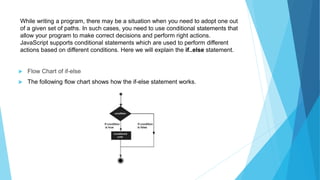
 Flow Chart of if-else
 The following flow chart shows how the if-else statement works.
JavaScript supports the following forms of if..else statement −
if statement
if...else statement
if...else if... statement.
 if statement
 The if statement is the fundamental control statement that allows JavaScript to
make decisions and execute statements conditionally.
 Syntax
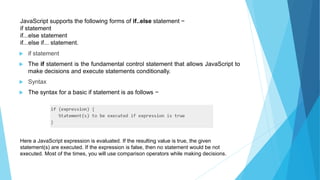
 The syntax for a basic if statement is as follows −
Here a JavaScript expression is evaluated. If the resulting value is true, the given
statement(s) are executed. If the expression is false, then no statement would be not
executed. Most of the times, you will use comparison operators while making decisions.
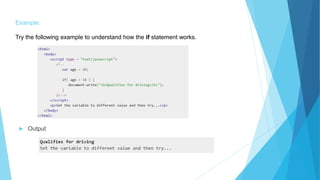
Example:
Try the following example to understand how the if statement works.
 Output
if...else statement
The 'if...else' statement is the next form of control statement that allows JavaScript
to execute statements in a more controlled way.
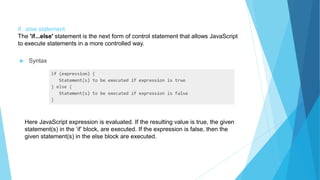
 Syntax
Here JavaScript expression is evaluated. If the resulting value is true, the given
statement(s) in the ‘if’ block, are executed. If the expression is false, then the
given statement(s) in the else block are executed.
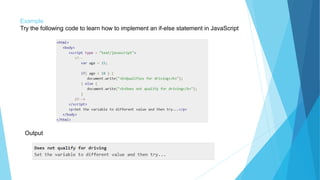
Example
Try the following code to learn how to implement an if-else statement in JavaScript
Output
if...else if... Statement
The if...else if... statement is an advanced form of if…else that allows JavaScript to make a
correct decision out of several conditions.
 Syntax
 The syntax of an if-else-if statement is as follows −
There is nothing special about this code. It is just a series of if statements, where
each if is a part of the else clause of the previous statement. Statement(s) are
executed based on the true condition, if none of the conditions is true, then
the else block is executed.
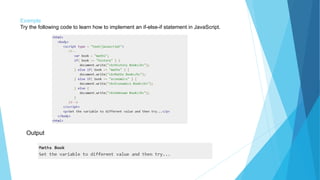
Example
Try the following code to learn how to implement an if-else-if statement in JavaScript.
Output
You can use multiple if...else…if statements, as in the previous chapter, to perform
a multiway branch. However, this is not always the best solution, especially when
all of the branches depend on the value of a single variable.
Starting with JavaScript 1.2, you can use a switch statement which handles
exactly this situation, and it does so more efficiently than repeated if...else
if statements.
 Flow Chart
 The following flow chart explains a switch-case statement works.
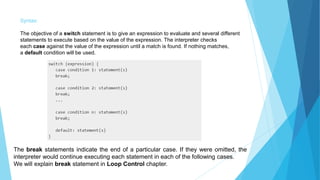
Syntax:
The objective of a switch statement is to give an expression to evaluate and several different
statements to execute based on the value of the expression. The interpreter checks
each case against the value of the expression until a match is found. If nothing matches,
a default condition will be used.
The break statements indicate the end of a particular case. If they were omitted, the
interpreter would continue executing each statement in each of the following cases.
We will explain break statement in Loop Control chapter.
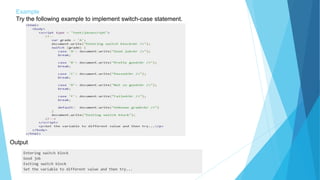
Example
Try the following example to implement switch-case statement.
Output
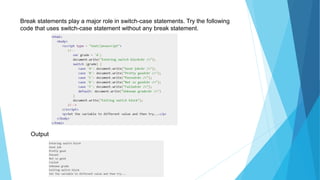
Break statements play a major role in switch-case statements. Try the following
code that uses switch-case statement without any break statement.
Output

If else statement 05 (js)

  • 1.
  • 2.
    While writing aprogram, there may be a situation when you need to adopt one out of a given set of paths. In such cases, you need to use conditional statements that allow your program to make correct decisions and perform right actions. JavaScript supports conditional statements which are used to perform different actions based on different conditions. Here we will explain the if..else statement.  Flow Chart of if-else  The following flow chart shows how the if-else statement works.
  • 3.
    JavaScript supports thefollowing forms of if..else statement − if statement if...else statement if...else if... statement.  if statement  The if statement is the fundamental control statement that allows JavaScript to make decisions and execute statements conditionally.  Syntax  The syntax for a basic if statement is as follows − Here a JavaScript expression is evaluated. If the resulting value is true, the given statement(s) are executed. If the expression is false, then no statement would be not executed. Most of the times, you will use comparison operators while making decisions.
  • 4.
    Example: Try the followingexample to understand how the if statement works.  Output
  • 5.
    if...else statement The 'if...else'statement is the next form of control statement that allows JavaScript to execute statements in a more controlled way.  Syntax Here JavaScript expression is evaluated. If the resulting value is true, the given statement(s) in the ‘if’ block, are executed. If the expression is false, then the given statement(s) in the else block are executed.
  • 6.
    Example Try the followingcode to learn how to implement an if-else statement in JavaScript Output
  • 7.
    if...else if... Statement Theif...else if... statement is an advanced form of if…else that allows JavaScript to make a correct decision out of several conditions.  Syntax  The syntax of an if-else-if statement is as follows − There is nothing special about this code. It is just a series of if statements, where each if is a part of the else clause of the previous statement. Statement(s) are executed based on the true condition, if none of the conditions is true, then the else block is executed.
  • 8.
    Example Try the followingcode to learn how to implement an if-else-if statement in JavaScript. Output
  • 9.
    You can usemultiple if...else…if statements, as in the previous chapter, to perform a multiway branch. However, this is not always the best solution, especially when all of the branches depend on the value of a single variable. Starting with JavaScript 1.2, you can use a switch statement which handles exactly this situation, and it does so more efficiently than repeated if...else if statements.  Flow Chart  The following flow chart explains a switch-case statement works.
  • 10.
    Syntax: The objective ofa switch statement is to give an expression to evaluate and several different statements to execute based on the value of the expression. The interpreter checks each case against the value of the expression until a match is found. If nothing matches, a default condition will be used. The break statements indicate the end of a particular case. If they were omitted, the interpreter would continue executing each statement in each of the following cases. We will explain break statement in Loop Control chapter.
  • 11.
    Example Try the followingexample to implement switch-case statement. Output
  • 12.
    Break statements playa major role in switch-case statements. Try the following code that uses switch-case statement without any break statement. Output