Learning C Programming
With
Dr. Gopika S
Kristu Jayanti College
CONTROL STATEMENTS/DECISION MAKING
Decision making structures require that the programmer specifies one or more
conditions to be evaluated or tested by the program, along with a statement or
statements to be executed if the condition is determined to be true, and optionally,
other statements to be executed if the condition is determined to be false.
There are the following variants of if statement in C language.
•If statement
•If-else statement
•If else-if ladder
•Nested if
IF STATEMENT
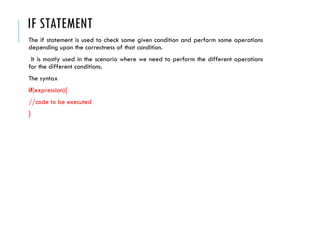
The if statement is used to check some given condition and perform some operations
depending upon the correctness of that condition.
It is mostly used in the scenario where we need to perform the different operations
for the different conditions.
The syntax
if(expression){
//code to be executed
}
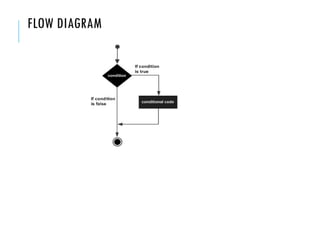
FLOW DIAGRAM
IF-ELSE STATEMENT
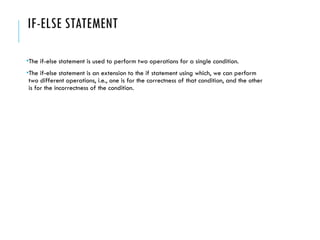
•The if-else statement is used to perform two operations for a single condition.
•The if-else statement is an extension to the if statement using which, we can perform
two different operations, i.e., one is for the correctness of that condition, and the other
is for the incorrectness of the condition.
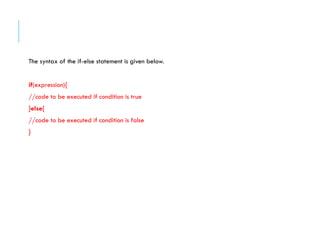
The syntax of the if-else statement is given below.
if(expression){
//code to be executed if condition is true
}else{
//code to be executed if condition is false
}
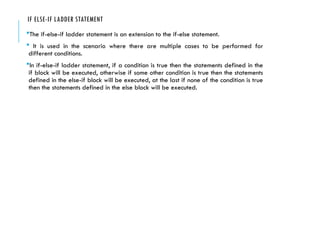
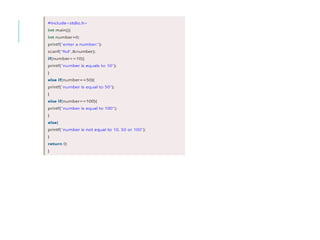
IF ELSE-IF LADDER STATEMENT
The if-else-if ladder statement is an extension to the if-else statement.
 It is used in the scenario where there are multiple cases to be performed for
different conditions.
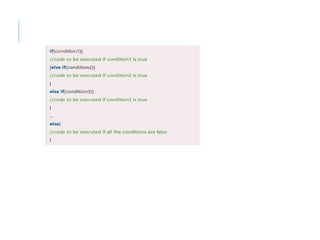
In if-else-if ladder statement, if a condition is true then the statements defined in the
if block will be executed, otherwise if some other condition is true then the statements
defined in the else-if block will be executed, at the last if none of the condition is true
then the statements defined in the else block will be executed.
SWITCH STATEMENT
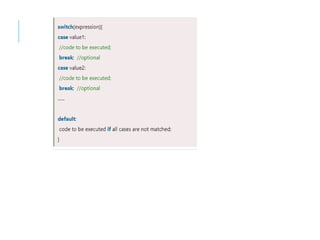
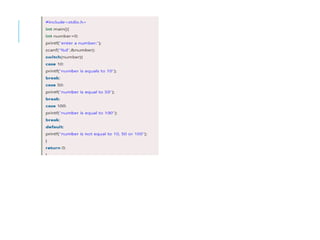
•The switch statement in C is an alternate to if-else-if ladder statement which allows us
to execute multiple operations for the different possibles values of a single variable
called switch variable.
•Here, We can define various statements in the multiple cases for the different values
of a single variable.
Conditional control statements explains the programming constructs

Conditional control statements explains the programming constructs

  • 1.
    Learning C Programming With Dr.Gopika S Kristu Jayanti College
  • 2.
  • 3.
    Decision making structuresrequire that the programmer specifies one or more conditions to be evaluated or tested by the program, along with a statement or statements to be executed if the condition is determined to be true, and optionally, other statements to be executed if the condition is determined to be false.
  • 4.
    There are thefollowing variants of if statement in C language. •If statement •If-else statement •If else-if ladder •Nested if
  • 5.
    IF STATEMENT The ifstatement is used to check some given condition and perform some operations depending upon the correctness of that condition. It is mostly used in the scenario where we need to perform the different operations for the different conditions. The syntax if(expression){ //code to be executed }
  • 6.
  • 8.
    IF-ELSE STATEMENT •The if-elsestatement is used to perform two operations for a single condition. •The if-else statement is an extension to the if statement using which, we can perform two different operations, i.e., one is for the correctness of that condition, and the other is for the incorrectness of the condition.
  • 9.
    The syntax ofthe if-else statement is given below. if(expression){ //code to be executed if condition is true }else{ //code to be executed if condition is false }
  • 11.
    IF ELSE-IF LADDERSTATEMENT The if-else-if ladder statement is an extension to the if-else statement.  It is used in the scenario where there are multiple cases to be performed for different conditions. In if-else-if ladder statement, if a condition is true then the statements defined in the if block will be executed, otherwise if some other condition is true then the statements defined in the else-if block will be executed, at the last if none of the condition is true then the statements defined in the else block will be executed.
  • 14.
    SWITCH STATEMENT •The switchstatement in C is an alternate to if-else-if ladder statement which allows us to execute multiple operations for the different possibles values of a single variable called switch variable. •Here, We can define various statements in the multiple cases for the different values of a single variable.