Integrating Climate Risks Information into the
NAPs
Amir H. Delju
Climate Prediction & Adaptation Branch
(sub-paragraph 7(c)) mentions: “strengthening scientific knowledge on
climate, including research, systematic observation of the climate system
and early warning systems, in a manner that informs climate services and
supports decision-making.” And CMA 1 decision: requesting WMO to
facilitate applications and methodologies, plus improving accessibility to
comprehensive climate information.
Paris
Agreement
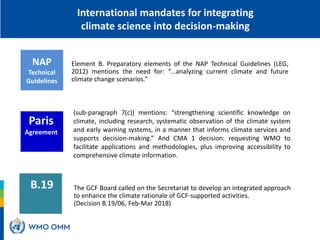
Element B. Preparatory elements of the NAP Technical Guidelines (LEG,
2012) mentions the need for: “...analyzing current climate and future
climate change scenarios.”
The GCF Board called on the Secretariat to develop an integrated approach
to enhance the climate rationale of GCF-supported activities.
(Decision B.19/06, Feb-Mar 2018)
NAP
Technical
Guidelines
International mandates for integrating
climate science into decision-making
GCF at
B.19
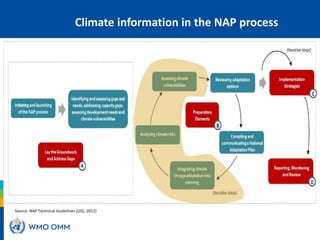
Source: NAP Technical Guidelines (LEG, 2012)
Climate information in the NAP process
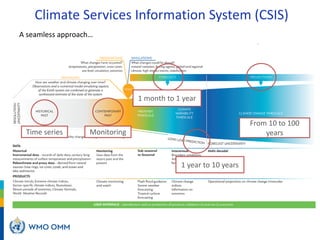
Climate Services Information System (CSIS)
Time series Monitoring
1 year to 10 years
From 10 to 100
years
1 month to 1 year
A seamless approach…
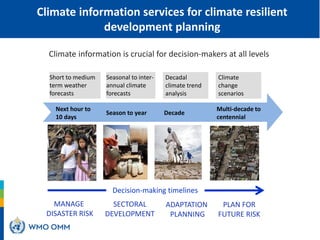
Season to year
Next hour to
10 days
Decade
Multi-decade to
centennial
Short to medium
term weather
forecasts
Seasonal to inter-
annual climate
forecasts
Decadal
climate trend
analysis
Climate
change
scenarios
Decision-making timelines
Climate information services for climate resilient
development planning
Climate information is crucial for decision-makers at all levels
ADAPTATION
PLANNING
SECTORAL
DEVELOPMENT
MANAGE
DISASTER RISK
PLAN FOR
FUTURE RISK
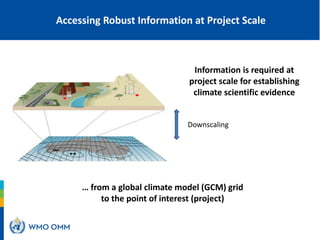
Accessing Robust Information at Project Scale
Information is required at
project scale for establishing
climate scientific evidence
Downscaling
… from a global climate model (GCM) grid
to the point of interest (project)
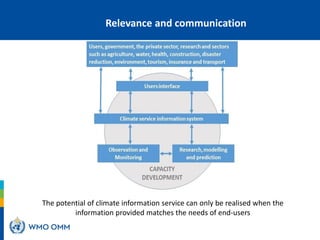
Relevance and communication
The potential of climate information service can only be realised when the
information provided matches the needs of end-users
Relevance and communication
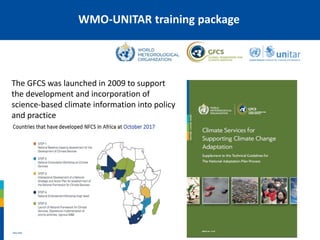
The GFCS was launched in 2009 to support
the development and incorporation of
science-based climate information into policy
and practice
WMO-UNITAR training package
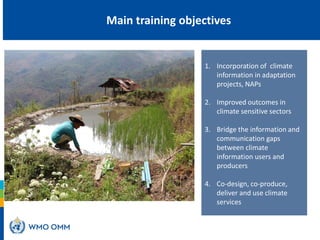
1. Incorporation of climate
information in adaptation
projects, NAPs
2. Improved outcomes in
climate sensitive sectors
3. Bridge the information and
communication gaps
between climate
information users and
producers
4. Co-design, co-produce,
deliver and use climate
services
What is the
role of CSIS
in NAPs?
Main training objectives
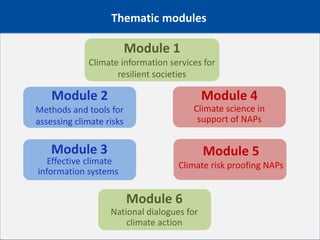
Module 2
Methods and tools for
assessing climate risks
Module 1
Climate information services for
resilient societies
Thematic modules
Module 3
Effective climate
information systems
Module 4
Climate science in
support of NAPs
Module 5
Climate risk proofing NAPs
Module 6
National dialogues for
climate action
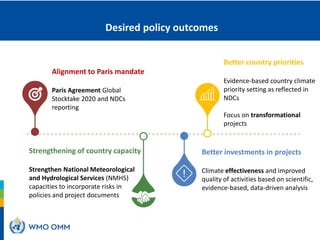
Alignment to Paris mandate
Paris Agreement Global
Stocktake 2020 and NDCs
reporting
Better country priorities
Evidence-based country climate
priority setting as reflected in
NDCs
Focus on transformational
projects
Strengthening of country capacity
Strengthen National Meteorological
and Hydrological Services (NMHS)
capacities to incorporate risks in
policies and project documents
Better investments in projects
Climate effectiveness and improved
quality of activities based on scientific,
evidence-based, data-driven analysis
Desired policy outcomes
Next setps
• To be Launched by end of June 2019
• Concept for F2F implementation in Region 1 Africa
• English, French, Spanish and Portuguese
• Delivery through WMO’s Regional Training Centres and
other institutions
(e.g. Agrhymet, ACMAD, etc.)
Thank you
Merci
adelju@wmo.int
public.wmo.int

Session 1.1.1. WMO GFCS Ecourse NAPs

  • 1.
    Integrating Climate RisksInformation into the NAPs Amir H. Delju Climate Prediction & Adaptation Branch
  • 2.
    (sub-paragraph 7(c)) mentions:“strengthening scientific knowledge on climate, including research, systematic observation of the climate system and early warning systems, in a manner that informs climate services and supports decision-making.” And CMA 1 decision: requesting WMO to facilitate applications and methodologies, plus improving accessibility to comprehensive climate information. Paris Agreement Element B. Preparatory elements of the NAP Technical Guidelines (LEG, 2012) mentions the need for: “...analyzing current climate and future climate change scenarios.” The GCF Board called on the Secretariat to develop an integrated approach to enhance the climate rationale of GCF-supported activities. (Decision B.19/06, Feb-Mar 2018) NAP Technical Guidelines International mandates for integrating climate science into decision-making GCF at B.19
  • 3.
    Source: NAP TechnicalGuidelines (LEG, 2012) Climate information in the NAP process
  • 4.
    Climate Services InformationSystem (CSIS) Time series Monitoring 1 year to 10 years From 10 to 100 years 1 month to 1 year A seamless approach…
  • 5.
    Season to year Nexthour to 10 days Decade Multi-decade to centennial Short to medium term weather forecasts Seasonal to inter- annual climate forecasts Decadal climate trend analysis Climate change scenarios Decision-making timelines Climate information services for climate resilient development planning Climate information is crucial for decision-makers at all levels ADAPTATION PLANNING SECTORAL DEVELOPMENT MANAGE DISASTER RISK PLAN FOR FUTURE RISK
  • 6.
    Accessing Robust Informationat Project Scale Information is required at project scale for establishing climate scientific evidence Downscaling … from a global climate model (GCM) grid to the point of interest (project)
  • 7.
    Relevance and communication Thepotential of climate information service can only be realised when the information provided matches the needs of end-users Relevance and communication
  • 8.
    The GFCS waslaunched in 2009 to support the development and incorporation of science-based climate information into policy and practice WMO-UNITAR training package
  • 9.
    1. Incorporation ofclimate information in adaptation projects, NAPs 2. Improved outcomes in climate sensitive sectors 3. Bridge the information and communication gaps between climate information users and producers 4. Co-design, co-produce, deliver and use climate services What is the role of CSIS in NAPs? Main training objectives
  • 10.
    Module 2 Methods andtools for assessing climate risks Module 1 Climate information services for resilient societies Thematic modules Module 3 Effective climate information systems Module 4 Climate science in support of NAPs Module 5 Climate risk proofing NAPs Module 6 National dialogues for climate action
  • 11.
    Alignment to Parismandate Paris Agreement Global Stocktake 2020 and NDCs reporting Better country priorities Evidence-based country climate priority setting as reflected in NDCs Focus on transformational projects Strengthening of country capacity Strengthen National Meteorological and Hydrological Services (NMHS) capacities to incorporate risks in policies and project documents Better investments in projects Climate effectiveness and improved quality of activities based on scientific, evidence-based, data-driven analysis Desired policy outcomes
  • 12.
    Next setps • Tobe Launched by end of June 2019 • Concept for F2F implementation in Region 1 Africa • English, French, Spanish and Portuguese • Delivery through WMO’s Regional Training Centres and other institutions (e.g. Agrhymet, ACMAD, etc.)
  • 13.