Identity, Security  and XML Web Services Jorgen Thelin Chief Scientist Cape Clear Software Inc. E-mail: Jorgen.Thelin@CapeClear.com
Abstract The use of security credentials and concepts of single-sign-on and “identity” play a big part in Web Services as developers start writing enterprise-grade line-of-business applications.  An overview is provided of the emerging XML security credential standards such as SAML, along with various “identity” standards such as Passport and Liberty.  We examine how “identity aware” Web Service implementations need to be, and the value a Web Services platform can add in reducing complexity in this area, with lessons drawn from experiences using J2EE technology for real-world security scenarios.
Agenda The Concept of Identity Web Services and Identity Interoperable XML Security and Identity Examples of Security Credentials in SOAP Single-sign-on Identity Awareness in Web Services
Cape Clear Software Inc. Start-up founded in 1999 by several executives from Iona Technologies Venture capital funding from Greylock and Accel Partners Offices in: Dublin, Ireland London, UK San Mateo, CA, USA Waltham, MA, USA The company is totally focused on XML Infrastructure, including Web Services Products: Web Services Development tool set XML Integration Server supporting Web Services FREE  WSDL Editor http://www.CapeClear.com http://www.CapeScience.com
A Definition of Identity Definition from Cambridge Dictionaries Online: Identity [ noun ] Who a person is, or the qualities of a person or group which make them different from others  http://dictionary.cambridge.org/define.asp?key=identity*1+0
What is Identity? At its most basic, the concept of Identity is about: Who you are How you prove who you are What that allows you to do
Identity – Who are you? An identity equates to a particular  subject  or principal For example: Joe Bloggs … …  Who lives at 123 My Street, Your Town Usually equates to a  person , but could also be a  group ,  corporation , or even something like an automated  software agent  component Subjects must be distinguishable May be another Joe Bloggs living at 12 5  My Street
Identity – Proof of identity How do you prove who you are? In real life, this is usually thru some official documents such as: Driving License Passport In computing terms, a user has a set of security credentials such as:  username + password X509 certificates
Identity – Permissions What does this identity prove about us? What does this identity allow us to do? Some real life examples: Holding a UK passport proves I am a UK Citizen Being a UK Citizen allows me to work in the UK Losing my passport does not stop me being a UK Citizen; it just makes it harder to prove that I am. A standard driving license shows I am allowed to drive a car I am not allowed to drive a Heavy Goods Vehicle unless I hold a HGV Driving License
Identity – Permissions and Credentials The  permissions  and entitlements for an identity is ultimately determined by the set of credentials that were presented to assert that identity. Permissions and credentials are use to make policy enforcement decisions Am I allowed to drive a Heavy Goods Vehicle? Am I allowed to work in the UK? Am I allowed to work in the US?
Web Services and Identity How does this affect Web Services? Security and Identity is a  fundamental  requirement of any  real-world  deployment of a Web Services application Ultimately all  security policy decisions  are based on the caller’s identity The challenge is to how to represent and prove a caller’s identity in an open and  interoperable  way.
Web Services and Identity 2 Security and identity considerations for a Web Services application: Authentication Who is the caller? How did they prove their identity? Do we trust the source of these credentials? Authorization What is the caller allowed to do? Attributes What other facts do we know about the caller? For example, e-mail address, department, employee number How do we use this attribute information in the application? For example, customizing the data returned based on display preferences
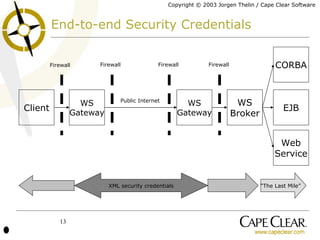
End-to-end Security Credentials Client WS Broker WS Gateway WS Gateway Firewall Firewall Firewall Firewall EJB Public Internet XML security credentials “ The Last Mile” Web Service CORBA
Interoperable Security Credentials To achieve interoperable security and identity, web services require the following Standard ways to: Representing security credential data in XML Eg. SAML – Security Assertions Markup Language specification Obtaining credential data Eg. Single-sign-on services such as Microsoft Passport or Liberty Alliance specifications Transport credential data in a SOAP message Eg. SOAP header fields defined in the WS-Security specification
WS-Security Owner:  Microsoft/IBM/Verisign – Now OASIS WSS-TC Status:  WIP for OASIS standardization process Purpose: Provides a model for many levels of security needed for web services.  A general-purpose mechanism to associate security-tokens with messages Describes how to encode binary security tokens in messages using SOAP Headers Includes enhancements to SOAP to provide quality of protection mechanisms Notes: Builds on top of XML Digital Signatures and XML Encryption specifications WS-Security Addendum adds  Facility for timestamp and TTL headers Provides greater protection when  passing around passwords and security certificates  More Info: http://www-106.ibm.com/developerworks/library/ws-secure/ http://www-106.ibm.com/developerworks/library/ws-secureadd.html WS-Security AppNotes - provide guidance to implementers of the WS-Security specification: http://www-106.ibm.com/developerworks/webservices/library/ws-secapp/
WS-Security - Types of Security Tokens The WS-Security specification set defines the following tokens: Unsigned security tokens Username Signed security tokens X.509 certificates (binary) Kerberos tickets (binary) XML security tokens Any XML token, such as SAML Usually self verifying / signed
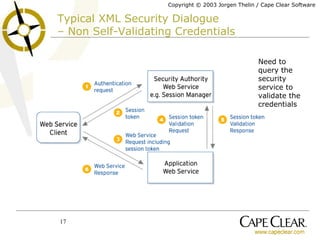
Typical XML Security Dialogue  – Non Self-Validating Credentials Need to query the security service to validate the credentials
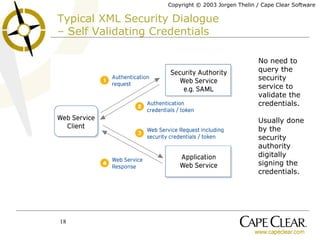
Typical XML Security Dialogue  – Self Validating Credentials No need to query the security service to validate the credentials. Usually done by the security authority digitally signing the credentials.
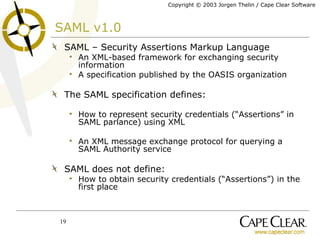
SAML v1.0 SAML – Security Assertions Markup Language An XML-based framework for exchanging security information A specification published by the OASIS organization The SAML specification defines: How to represent security credentials (“Assertions” in SAML parlance) using XML An XML message exchange protocol for querying a SAML Authority service SAML does not define: How to obtain security credentials (“Assertions”) in the first place
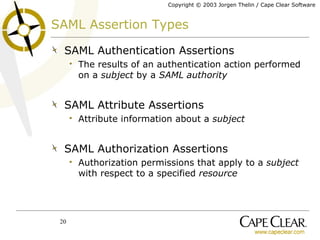
SAML Assertion Types SAML Authentication Assertions The results of an authentication action performed on a  subject  by a  SAML authority SAML Attribute Assertions Attribute information about a  subject SAML Authorization Assertions Authorization permissions that apply to a  subject  with respect to a specified  resource
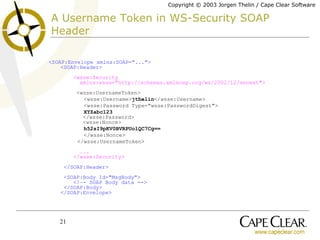
A Username Token in WS-Security SOAP Header <SOAP:Envelope xmlns:SOAP=&quot;...&quot;> <SOAP:Header>   <wsse:Security   xmlns:wsse=&quot;http://schemas.xmlsoap.org/ws/2002/12/secext&quot;>   <wsse:UsernameToken> <wsse:Username> jthelin </wsse:Username> <wsse:Password Type=&quot;wsse:PasswordDigest&quot;> XYZabc123   </wsse:Password>   <wsse:Nonce> h52sI9pKV0BVRPUolQC7Cg== </wsse:Nonce> </wsse:UsernameToken>   ...   </wsse:Security>  </SOAP:Header>  <SOAP:Body Id=&quot;MsgBody&quot;>   <!–- SOAP Body data -->  </SOAP:Body> </SOAP:Envelope>
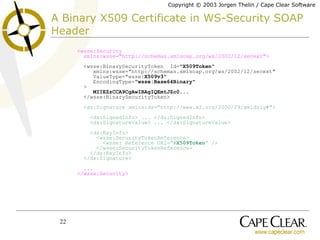
A Binary X509 Certificate in WS-Security SOAP Header   <wsse:Security   xmlns:wsse=&quot;http://schemas.xmlsoap.org/ws/2002/12/secext&quot;>   <wsse:BinarySecurityToken  Id=&quot; X509Token &quot;   xmlns:wsse=&quot;http://schemas.xmlsoap.org/ws/2002/12/secext&quot;   ValueType=&quot;wsse: X509v3 &quot;   EncodingType=&quot; wsse:Base64Binary &quot;    >   MIIEZzCCA9CgAwIBAgIQEmtJZc0...   </wsse:BinarySecurityToken>   <ds:Signature xmlns:ds=&quot;http://www.w3.org/2000/09/xmldsig#&quot;>   <ds:SignedInfo>  ...  </ds:SignedInfo>   <ds:SignatureValue>  ...  </ds:SignatureValue>   <ds:KeyInfo>   <wsse:SecurityTokenReference>   <wsse: Reference URI=”# X509Token ” />   </wsse:SecurityTokenReference>   </ds:KeyInfo>   </ds:Signature>   ...   </wsse:Security>
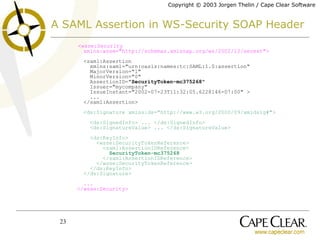
A SAML Assertion in WS-Security SOAP Header <wsse:Security   xmlns:wsse=&quot;http://schemas.xmlsoap.org/ws/2002/12/secext&quot;>   <saml:Assertion    xmlns:saml=&quot;urn:oasis:names:tc:SAML:1.0:assertion&quot;   MajorVersion=&quot;1&quot;    MinorVersion=&quot;0&quot;    AssertionID=&quot; SecurityToken-mc375268 &quot;    Issuer=&quot;mycompany&quot;    IssueInstant=&quot;2002-07-23T11:32:05.6228146-07:00&quot; >   ...     </saml:Assertion>   <ds:Signature xmlns:ds=&quot;http://www.w3.org/2000/09/xmldsig#&quot;>   <ds:SignedInfo>  ...  </ds:SignedInfo>   <ds:SignatureValue>  ...  </ds:SignatureValue>   <ds:KeyInfo>   <wsse:SecurityTokenReference>   <saml:AssertionIDReference>   SecurityToken-mc375268   </saml:AssertionIDReference>   </wsse:SecurityTokenReference>   </ds:KeyInfo>   </ds:Signature>   ...   </wsse:Security>
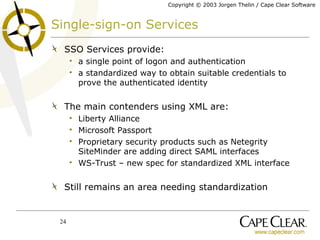
Single-sign-on Services SSO Services provide: a single point of logon and authentication a standardized way to obtain suitable credentials to prove the authenticated identity The main contenders using XML are: Liberty Alliance Microsoft Passport Proprietary security products such as Netegrity SiteMinder are adding direct SAML interfaces WS-Trust – new spec for standardized XML interface Still remains an area needing standardization
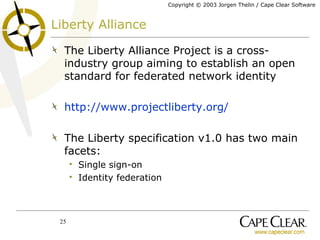
Liberty Alliance The Liberty Alliance Project is a cross-industry group aiming to  establish an open standard for federated network identity http://www.projectliberty.org/ The Liberty specification v1.0 has two main facets: Single sign-on Identity federation
Microsoft .NET Passport Microsoft .NET Passport is a suite of Web-based services that makes using the Internet and purchasing online easier and faster for users.  http://www.passport.com/ .NET Passport provides users with  Single sign-in (SSI)  Fast purchasing capability at participating sites Microsoft is upgrading the current Passport facilities to Provide an XML interface Support federation Use Kerberos v5 as the underlying mechanism for securely exchanging credentials
The Need for a Sign-on Standard  – WS-Trust The need remains for a “sign-on standard” to avoid reliance on proprietary interfaces WS-Trust A proposed specification in the WS-Security family Provides a standardized interface for  acquiring security tokens Still very  early  in the standardization process, but the most likely candidate for a common interface http://msdn.microsoft.com/library/en-us/dnglobspec/html/ws-trust.asp
WS-I Basic Security Profile From the charter for the new WS-I Basic Security Profile work group: The BSP-WG will develop an interoperability profile dealing with transport security, SOAP message security, and other Basic Profile-oriented security considerations of Web Services Although this will not cover all aspects of the emerging XML Security specifications, it will certainly solidify the base levels.
Identity-awareness in Web Services Do web services themselves need to be identity-aware? Not really , in most cases A mature web services platform product such as Cape Clear Server can handle almost all the “ boilerplate ” work of authentication and enforcement of access control lists
Identity-awareness in Web Services - 2 Most standard authentication and authorization functions are best done in a  uniform  manner by the  platform , rather than being implemented on an application-by-application basis Interceptor plugins allow this to be a  deployment  policy decision rather than an  implementation  decision
Identity-awareness in Web Services - 3 Web Service application only needs to be Identity-aware if it needs to use attributes asserted for the  caller   For example, reading the delivery address from the user’s MS Passport record
Desired Web Services platform security The goal will be  declarative security functions  for web services just like EJB So, having  declarative  statements of security  policy  for an Web Service application: Required transport security attributes (for example, “Callers must use encrypted / SSL connections”) Required message security attributes (for example, “Messages must be digitally signed”) Permitted authentication realms / single-sign-on services Role-based access control lists applied at the granularity of the operation / method call. This places control of security to application  administrators  rather than developers.
Summary “ Identity” is one of the  fundamental  concepts behind all the  security mechanisms in line-of-business Web Services Having a standard XML-based serialized form of  credentials  is vital for true  end-to-end interoperability   Standardization  of specifications for credential exchange and single-sign-on using XML and SOAP are still  incomplete , so true interoperability is not yet possible. WS-I Basic Security Profile  is working to guarantee interoperability of transport and message level security for Web Services Use a mature Web Services runtime platform such as Cape Clear Server to handle most “ boilerplate ” security tasks such as enforcing authentication and authorization requirements
Resources Cape Clear Software WSDL Editor Web Services Development tool set XML Integration Server supporting Web Services http://www.capeclear.com CapeScience Papers, articles, tutorials, and webcasts for Web Services developers http://www.capescience.com Jorgen Thelin’s Weblog Weblog covering enterprise systems development, and especially Web Services http://www.TheArchitect.co.uk/weblog/

Identity, Security and XML Web Services

  • 1.
    Identity, Security and XML Web Services Jorgen Thelin Chief Scientist Cape Clear Software Inc. E-mail: Jorgen.Thelin@CapeClear.com
  • 2.
    Abstract The useof security credentials and concepts of single-sign-on and “identity” play a big part in Web Services as developers start writing enterprise-grade line-of-business applications. An overview is provided of the emerging XML security credential standards such as SAML, along with various “identity” standards such as Passport and Liberty. We examine how “identity aware” Web Service implementations need to be, and the value a Web Services platform can add in reducing complexity in this area, with lessons drawn from experiences using J2EE technology for real-world security scenarios.
  • 3.
    Agenda The Conceptof Identity Web Services and Identity Interoperable XML Security and Identity Examples of Security Credentials in SOAP Single-sign-on Identity Awareness in Web Services
  • 4.
    Cape Clear SoftwareInc. Start-up founded in 1999 by several executives from Iona Technologies Venture capital funding from Greylock and Accel Partners Offices in: Dublin, Ireland London, UK San Mateo, CA, USA Waltham, MA, USA The company is totally focused on XML Infrastructure, including Web Services Products: Web Services Development tool set XML Integration Server supporting Web Services FREE WSDL Editor http://www.CapeClear.com http://www.CapeScience.com
  • 5.
    A Definition ofIdentity Definition from Cambridge Dictionaries Online: Identity [ noun ] Who a person is, or the qualities of a person or group which make them different from others http://dictionary.cambridge.org/define.asp?key=identity*1+0
  • 6.
    What is Identity?At its most basic, the concept of Identity is about: Who you are How you prove who you are What that allows you to do
  • 7.
    Identity – Whoare you? An identity equates to a particular subject or principal For example: Joe Bloggs … … Who lives at 123 My Street, Your Town Usually equates to a person , but could also be a group , corporation , or even something like an automated software agent component Subjects must be distinguishable May be another Joe Bloggs living at 12 5 My Street
  • 8.
    Identity – Proofof identity How do you prove who you are? In real life, this is usually thru some official documents such as: Driving License Passport In computing terms, a user has a set of security credentials such as: username + password X509 certificates
  • 9.
    Identity – PermissionsWhat does this identity prove about us? What does this identity allow us to do? Some real life examples: Holding a UK passport proves I am a UK Citizen Being a UK Citizen allows me to work in the UK Losing my passport does not stop me being a UK Citizen; it just makes it harder to prove that I am. A standard driving license shows I am allowed to drive a car I am not allowed to drive a Heavy Goods Vehicle unless I hold a HGV Driving License
  • 10.
    Identity – Permissionsand Credentials The permissions and entitlements for an identity is ultimately determined by the set of credentials that were presented to assert that identity. Permissions and credentials are use to make policy enforcement decisions Am I allowed to drive a Heavy Goods Vehicle? Am I allowed to work in the UK? Am I allowed to work in the US?
  • 11.
    Web Services andIdentity How does this affect Web Services? Security and Identity is a fundamental requirement of any real-world deployment of a Web Services application Ultimately all security policy decisions are based on the caller’s identity The challenge is to how to represent and prove a caller’s identity in an open and interoperable way.
  • 12.
    Web Services andIdentity 2 Security and identity considerations for a Web Services application: Authentication Who is the caller? How did they prove their identity? Do we trust the source of these credentials? Authorization What is the caller allowed to do? Attributes What other facts do we know about the caller? For example, e-mail address, department, employee number How do we use this attribute information in the application? For example, customizing the data returned based on display preferences
  • 13.
    End-to-end Security CredentialsClient WS Broker WS Gateway WS Gateway Firewall Firewall Firewall Firewall EJB Public Internet XML security credentials “ The Last Mile” Web Service CORBA
  • 14.
    Interoperable Security CredentialsTo achieve interoperable security and identity, web services require the following Standard ways to: Representing security credential data in XML Eg. SAML – Security Assertions Markup Language specification Obtaining credential data Eg. Single-sign-on services such as Microsoft Passport or Liberty Alliance specifications Transport credential data in a SOAP message Eg. SOAP header fields defined in the WS-Security specification
  • 15.
    WS-Security Owner: Microsoft/IBM/Verisign – Now OASIS WSS-TC Status: WIP for OASIS standardization process Purpose: Provides a model for many levels of security needed for web services. A general-purpose mechanism to associate security-tokens with messages Describes how to encode binary security tokens in messages using SOAP Headers Includes enhancements to SOAP to provide quality of protection mechanisms Notes: Builds on top of XML Digital Signatures and XML Encryption specifications WS-Security Addendum adds Facility for timestamp and TTL headers Provides greater protection when passing around passwords and security certificates More Info: http://www-106.ibm.com/developerworks/library/ws-secure/ http://www-106.ibm.com/developerworks/library/ws-secureadd.html WS-Security AppNotes - provide guidance to implementers of the WS-Security specification: http://www-106.ibm.com/developerworks/webservices/library/ws-secapp/
  • 16.
    WS-Security - Typesof Security Tokens The WS-Security specification set defines the following tokens: Unsigned security tokens Username Signed security tokens X.509 certificates (binary) Kerberos tickets (binary) XML security tokens Any XML token, such as SAML Usually self verifying / signed
  • 17.
    Typical XML SecurityDialogue – Non Self-Validating Credentials Need to query the security service to validate the credentials
  • 18.
    Typical XML SecurityDialogue – Self Validating Credentials No need to query the security service to validate the credentials. Usually done by the security authority digitally signing the credentials.
  • 19.
    SAML v1.0 SAML– Security Assertions Markup Language An XML-based framework for exchanging security information A specification published by the OASIS organization The SAML specification defines: How to represent security credentials (“Assertions” in SAML parlance) using XML An XML message exchange protocol for querying a SAML Authority service SAML does not define: How to obtain security credentials (“Assertions”) in the first place
  • 20.
    SAML Assertion TypesSAML Authentication Assertions The results of an authentication action performed on a subject by a SAML authority SAML Attribute Assertions Attribute information about a subject SAML Authorization Assertions Authorization permissions that apply to a subject with respect to a specified resource
  • 21.
    A Username Tokenin WS-Security SOAP Header <SOAP:Envelope xmlns:SOAP=&quot;...&quot;> <SOAP:Header> <wsse:Security xmlns:wsse=&quot;http://schemas.xmlsoap.org/ws/2002/12/secext&quot;> <wsse:UsernameToken> <wsse:Username> jthelin </wsse:Username> <wsse:Password Type=&quot;wsse:PasswordDigest&quot;> XYZabc123 </wsse:Password> <wsse:Nonce> h52sI9pKV0BVRPUolQC7Cg== </wsse:Nonce> </wsse:UsernameToken> ... </wsse:Security> </SOAP:Header> <SOAP:Body Id=&quot;MsgBody&quot;> <!–- SOAP Body data --> </SOAP:Body> </SOAP:Envelope>
  • 22.
    A Binary X509Certificate in WS-Security SOAP Header <wsse:Security xmlns:wsse=&quot;http://schemas.xmlsoap.org/ws/2002/12/secext&quot;> <wsse:BinarySecurityToken Id=&quot; X509Token &quot; xmlns:wsse=&quot;http://schemas.xmlsoap.org/ws/2002/12/secext&quot; ValueType=&quot;wsse: X509v3 &quot; EncodingType=&quot; wsse:Base64Binary &quot; > MIIEZzCCA9CgAwIBAgIQEmtJZc0... </wsse:BinarySecurityToken> <ds:Signature xmlns:ds=&quot;http://www.w3.org/2000/09/xmldsig#&quot;> <ds:SignedInfo> ... </ds:SignedInfo> <ds:SignatureValue> ... </ds:SignatureValue> <ds:KeyInfo> <wsse:SecurityTokenReference> <wsse: Reference URI=”# X509Token ” /> </wsse:SecurityTokenReference> </ds:KeyInfo> </ds:Signature> ... </wsse:Security>
  • 23.
    A SAML Assertionin WS-Security SOAP Header <wsse:Security xmlns:wsse=&quot;http://schemas.xmlsoap.org/ws/2002/12/secext&quot;> <saml:Assertion xmlns:saml=&quot;urn:oasis:names:tc:SAML:1.0:assertion&quot; MajorVersion=&quot;1&quot; MinorVersion=&quot;0&quot; AssertionID=&quot; SecurityToken-mc375268 &quot; Issuer=&quot;mycompany&quot; IssueInstant=&quot;2002-07-23T11:32:05.6228146-07:00&quot; > ... </saml:Assertion> <ds:Signature xmlns:ds=&quot;http://www.w3.org/2000/09/xmldsig#&quot;> <ds:SignedInfo> ... </ds:SignedInfo> <ds:SignatureValue> ... </ds:SignatureValue> <ds:KeyInfo> <wsse:SecurityTokenReference> <saml:AssertionIDReference> SecurityToken-mc375268 </saml:AssertionIDReference> </wsse:SecurityTokenReference> </ds:KeyInfo> </ds:Signature> ... </wsse:Security>
  • 24.
    Single-sign-on Services SSOServices provide: a single point of logon and authentication a standardized way to obtain suitable credentials to prove the authenticated identity The main contenders using XML are: Liberty Alliance Microsoft Passport Proprietary security products such as Netegrity SiteMinder are adding direct SAML interfaces WS-Trust – new spec for standardized XML interface Still remains an area needing standardization
  • 25.
    Liberty Alliance TheLiberty Alliance Project is a cross-industry group aiming to establish an open standard for federated network identity http://www.projectliberty.org/ The Liberty specification v1.0 has two main facets: Single sign-on Identity federation
  • 26.
    Microsoft .NET PassportMicrosoft .NET Passport is a suite of Web-based services that makes using the Internet and purchasing online easier and faster for users. http://www.passport.com/ .NET Passport provides users with Single sign-in (SSI) Fast purchasing capability at participating sites Microsoft is upgrading the current Passport facilities to Provide an XML interface Support federation Use Kerberos v5 as the underlying mechanism for securely exchanging credentials
  • 27.
    The Need fora Sign-on Standard – WS-Trust The need remains for a “sign-on standard” to avoid reliance on proprietary interfaces WS-Trust A proposed specification in the WS-Security family Provides a standardized interface for acquiring security tokens Still very early in the standardization process, but the most likely candidate for a common interface http://msdn.microsoft.com/library/en-us/dnglobspec/html/ws-trust.asp
  • 28.
    WS-I Basic SecurityProfile From the charter for the new WS-I Basic Security Profile work group: The BSP-WG will develop an interoperability profile dealing with transport security, SOAP message security, and other Basic Profile-oriented security considerations of Web Services Although this will not cover all aspects of the emerging XML Security specifications, it will certainly solidify the base levels.
  • 29.
    Identity-awareness in WebServices Do web services themselves need to be identity-aware? Not really , in most cases A mature web services platform product such as Cape Clear Server can handle almost all the “ boilerplate ” work of authentication and enforcement of access control lists
  • 30.
    Identity-awareness in WebServices - 2 Most standard authentication and authorization functions are best done in a uniform manner by the platform , rather than being implemented on an application-by-application basis Interceptor plugins allow this to be a deployment policy decision rather than an implementation decision
  • 31.
    Identity-awareness in WebServices - 3 Web Service application only needs to be Identity-aware if it needs to use attributes asserted for the caller For example, reading the delivery address from the user’s MS Passport record
  • 32.
    Desired Web Servicesplatform security The goal will be declarative security functions for web services just like EJB So, having declarative statements of security policy for an Web Service application: Required transport security attributes (for example, “Callers must use encrypted / SSL connections”) Required message security attributes (for example, “Messages must be digitally signed”) Permitted authentication realms / single-sign-on services Role-based access control lists applied at the granularity of the operation / method call. This places control of security to application administrators rather than developers.
  • 33.
    Summary “ Identity”is one of the fundamental concepts behind all the security mechanisms in line-of-business Web Services Having a standard XML-based serialized form of credentials is vital for true end-to-end interoperability Standardization of specifications for credential exchange and single-sign-on using XML and SOAP are still incomplete , so true interoperability is not yet possible. WS-I Basic Security Profile is working to guarantee interoperability of transport and message level security for Web Services Use a mature Web Services runtime platform such as Cape Clear Server to handle most “ boilerplate ” security tasks such as enforcing authentication and authorization requirements
  • 34.
    Resources Cape ClearSoftware WSDL Editor Web Services Development tool set XML Integration Server supporting Web Services http://www.capeclear.com CapeScience Papers, articles, tutorials, and webcasts for Web Services developers http://www.capescience.com Jorgen Thelin’s Weblog Weblog covering enterprise systems development, and especially Web Services http://www.TheArchitect.co.uk/weblog/