Web Services and  the Devices Profile  Jorgen Thelin Program Manager Connected Systems Division [email_address]
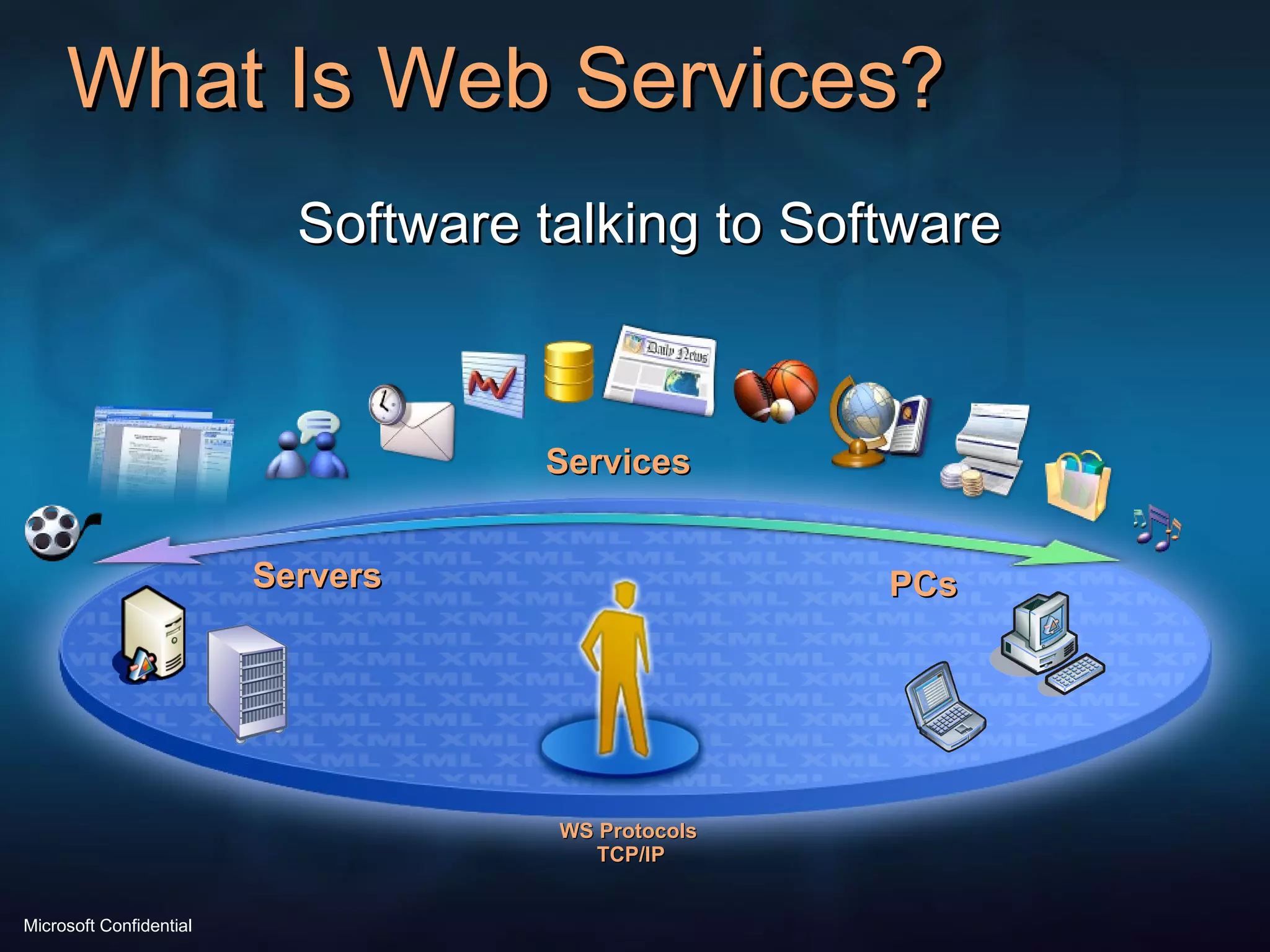
What Is Web Services? PCs Servers Services TCP/IP WS Protocols Software talking to Software
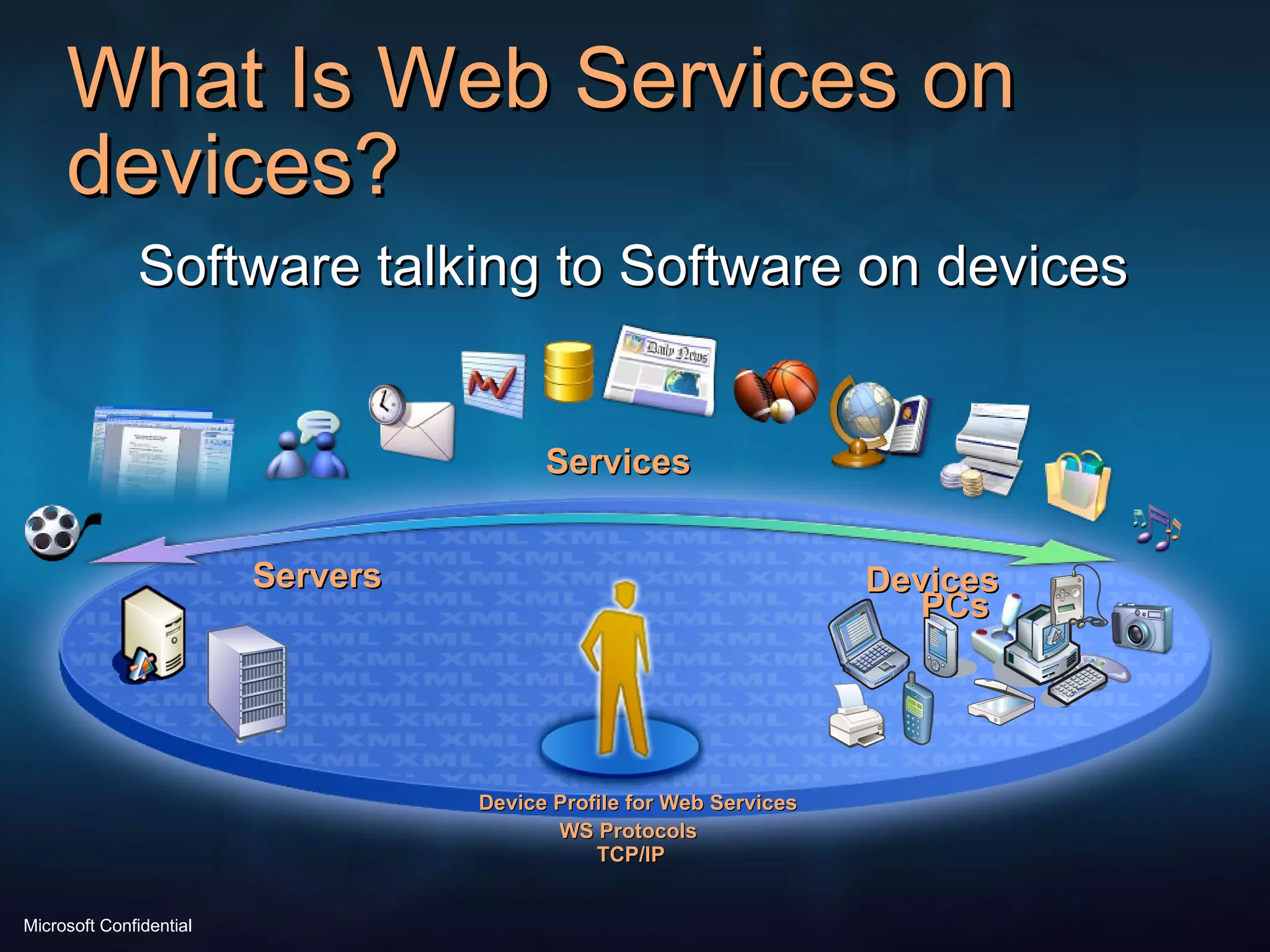
What Is Web Services on devices? PCs Devices Servers Services TCP/IP WS Protocols Device Profile for Web Services Software talking to Software on devices
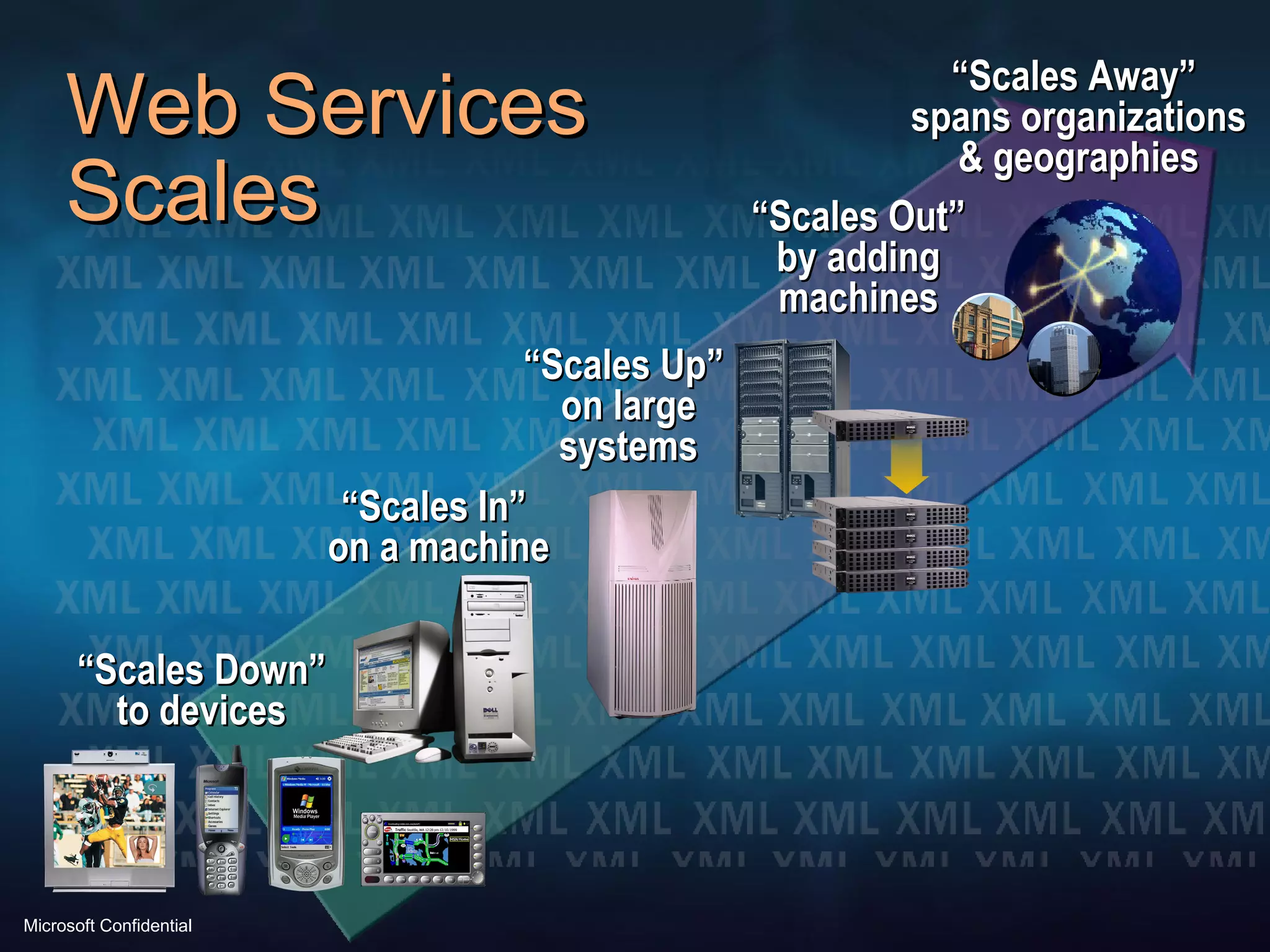
Web Services Scales “ Scales Down” to devices “ Scales In”  on a machine “ Scales Up”  on large systems “ Scales Away”  spans organizations & geographies “ Scales Out” by adding machines
Why Web Services Devices need to interoperate!  Building devices that work with 3 rd  party applications increases value to customer Build devices that work with Internet services could add revenue streams HTML and browsers are limited Browsers can’t automatically collect data Browsers can’t automatically control devices Custom protocols are costly
Quality WS protocols will be long-lived They’re general purpose and are being adopted by many large companies Enterprise-ready framework Already proven in the enterprise Allow your devices to move seamlessly between So-Ho and enterprise environments Multi-party reviews and interop events for each spec
Security Integrity, Confidentiality Channel-Based (TLS) Message-Based (WS-Security) Secure content Scenario – print job content securely over the wire, allowing devices to be implemented at secure sites Secure communications Scenario – secure check printing
The Device Profile  for Web Services Scaling WS to limited resource devices
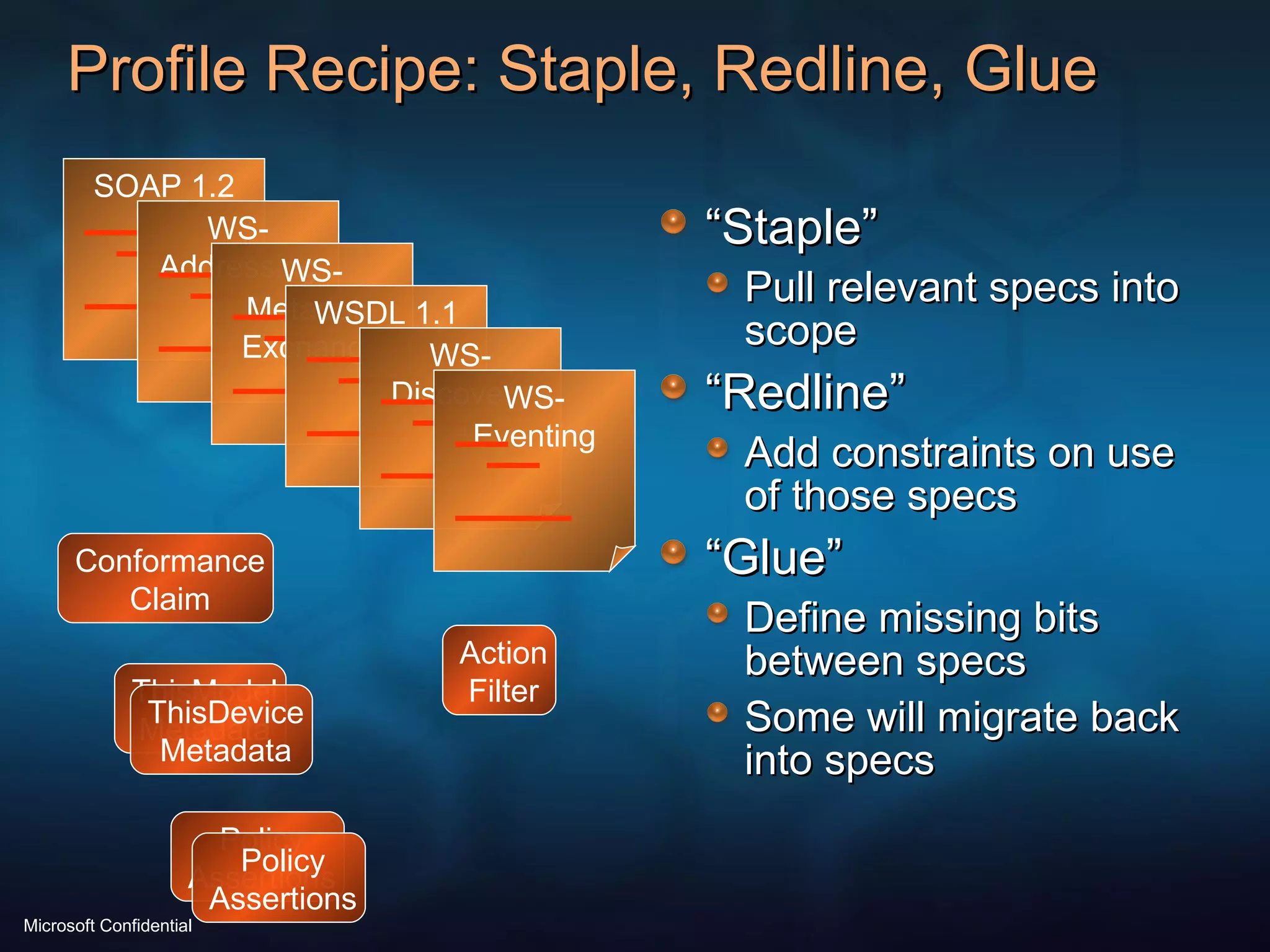
Profile Recipe: Staple, Redline, Glue “ Staple” Pull relevant specs into scope “ Redline” Add constraints on use of those specs “ Glue” Define missing bits between specs Some will migrate back into specs ThisModel Metadata ThisDevice Metadata Action Filter Conformance Claim Policy Assertions Policy Assertions SOAP 1.2 WS-Addressing WS-Metadata Exchange WSDL 1.1 WS-Discovery WS-Eventing
Device Profile for Web Services Lightweight subset of WS specifications Described in Device Profile for Web Services (DPWS) specification  Security based on SSL/TLS Shipping in Windows Vista and Windows CE
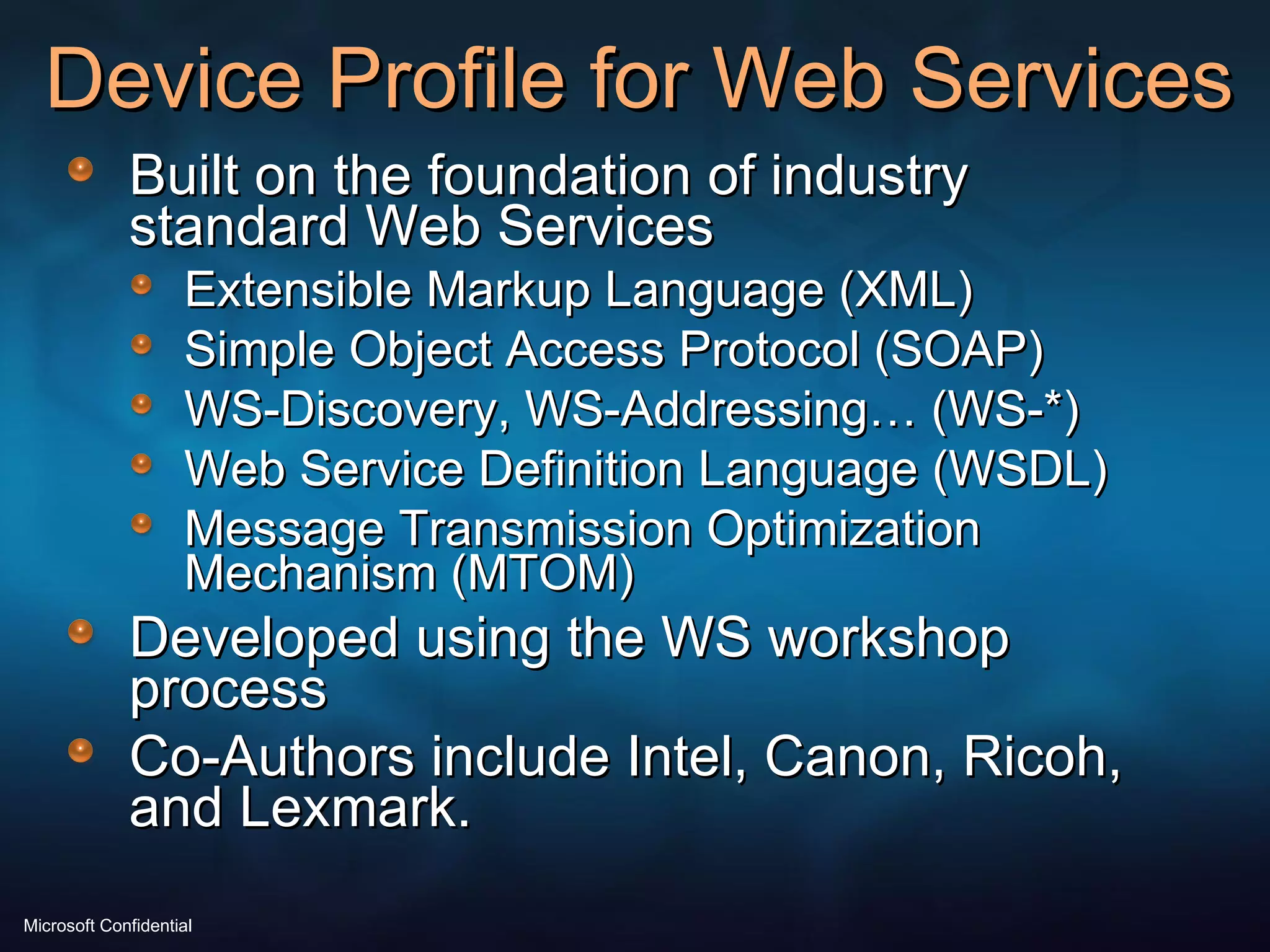
Device Profile for Web Services  Built on the foundation of industry standard Web Services Extensible Markup Language (XML) Simple Object Access Protocol (SOAP) WS-Discovery, WS-Addressing… (WS-*) Web Service Definition Language (WSDL)  Message Transmission Optimization Mechanism (MTOM) Developed using the WS workshop process Co-Authors include Intel, Canon, Ricoh, and Lexmark.
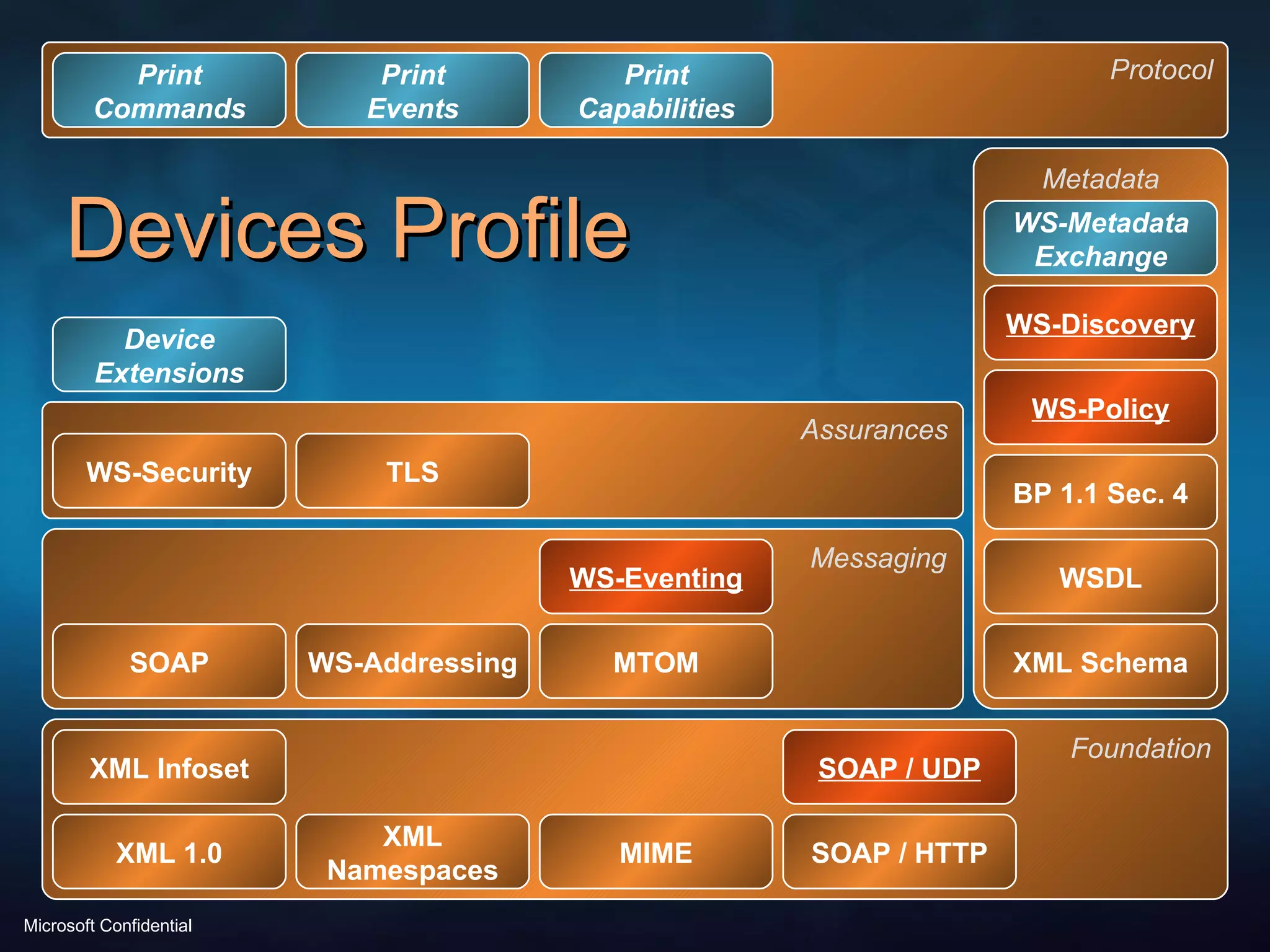
Devices Profile Protocol DMR Capabilities DMR Commands DMR Events Protocol IGD Capabilities IGD Commands IGD Events Assurances Messaging SOAP WS-Security MTOM WS-Addressing Metadata WS-Policy WSDL WS-Metadata Exchange XML Schema TLS Foundation SOAP / HTTP MIME XML Infoset XML 1.0 XML Namespaces BP 1.1 Sec. 4 WS-Discovery WS-Eventing Device Extensions SOAP / UDP Protocol Print Capabilities Print Commands Print Events
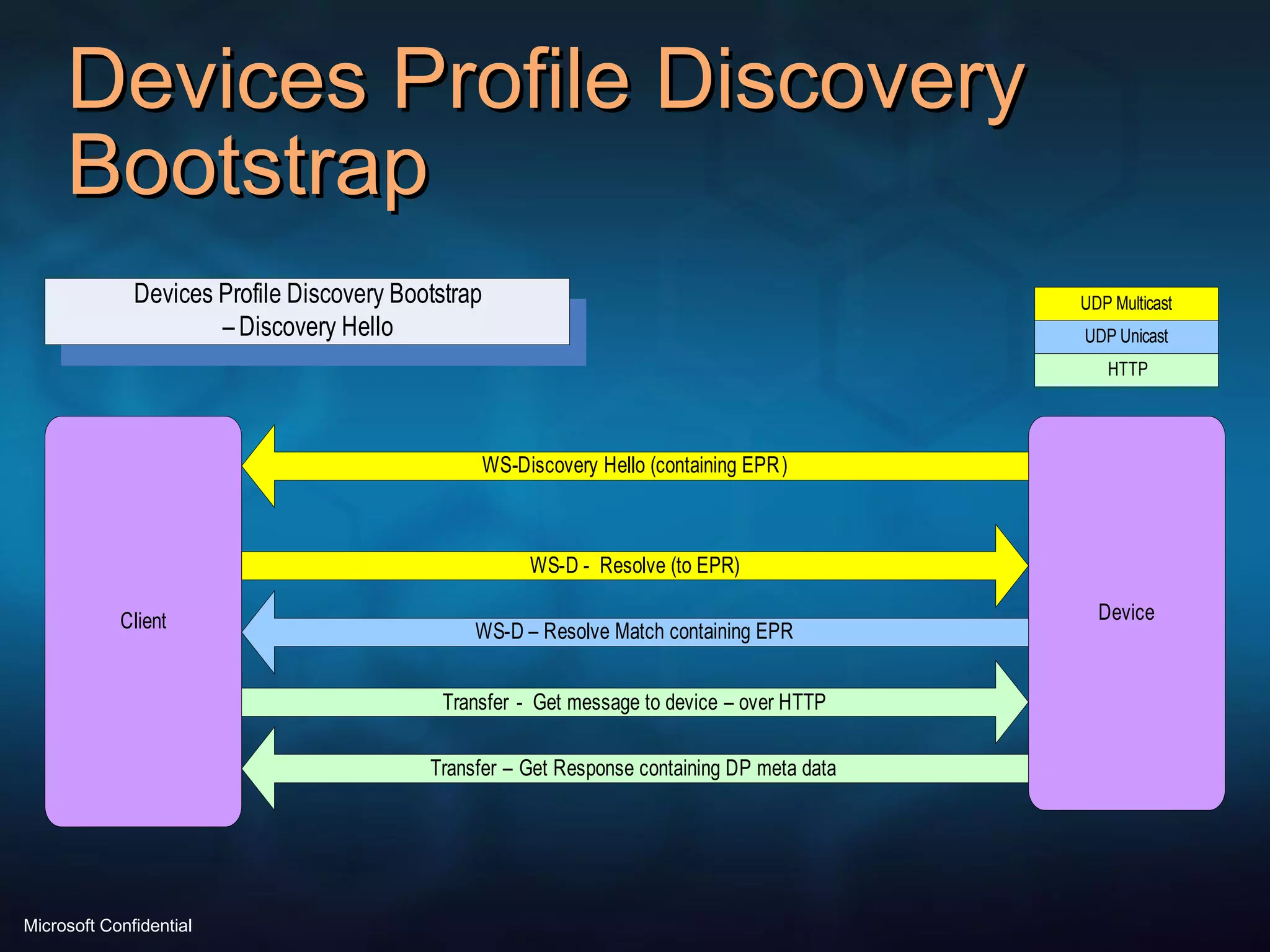
Devices Profile Discovery Bootstrap
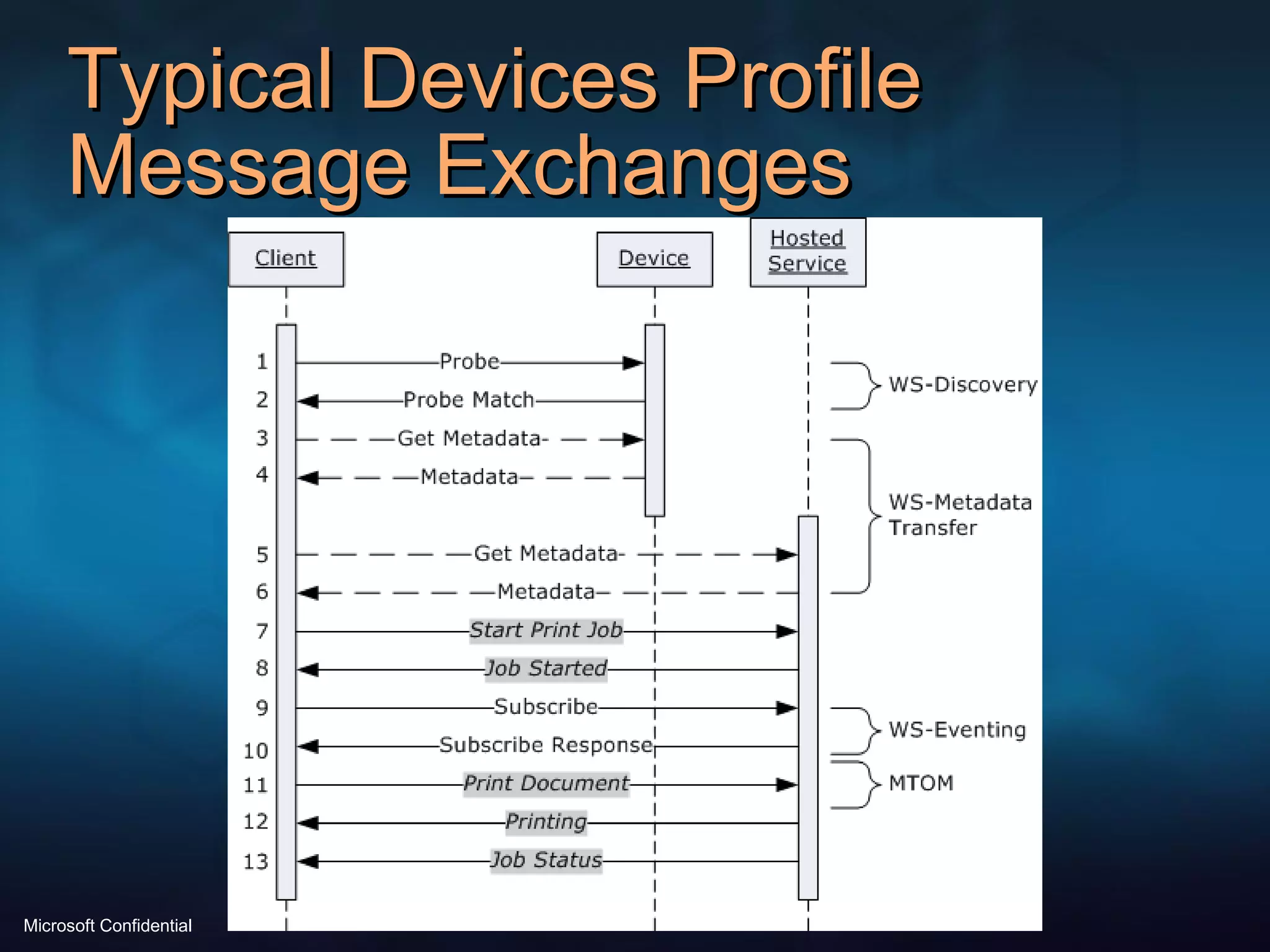
Typical Devices Profile Message Exchanges
Microsoft Implementations
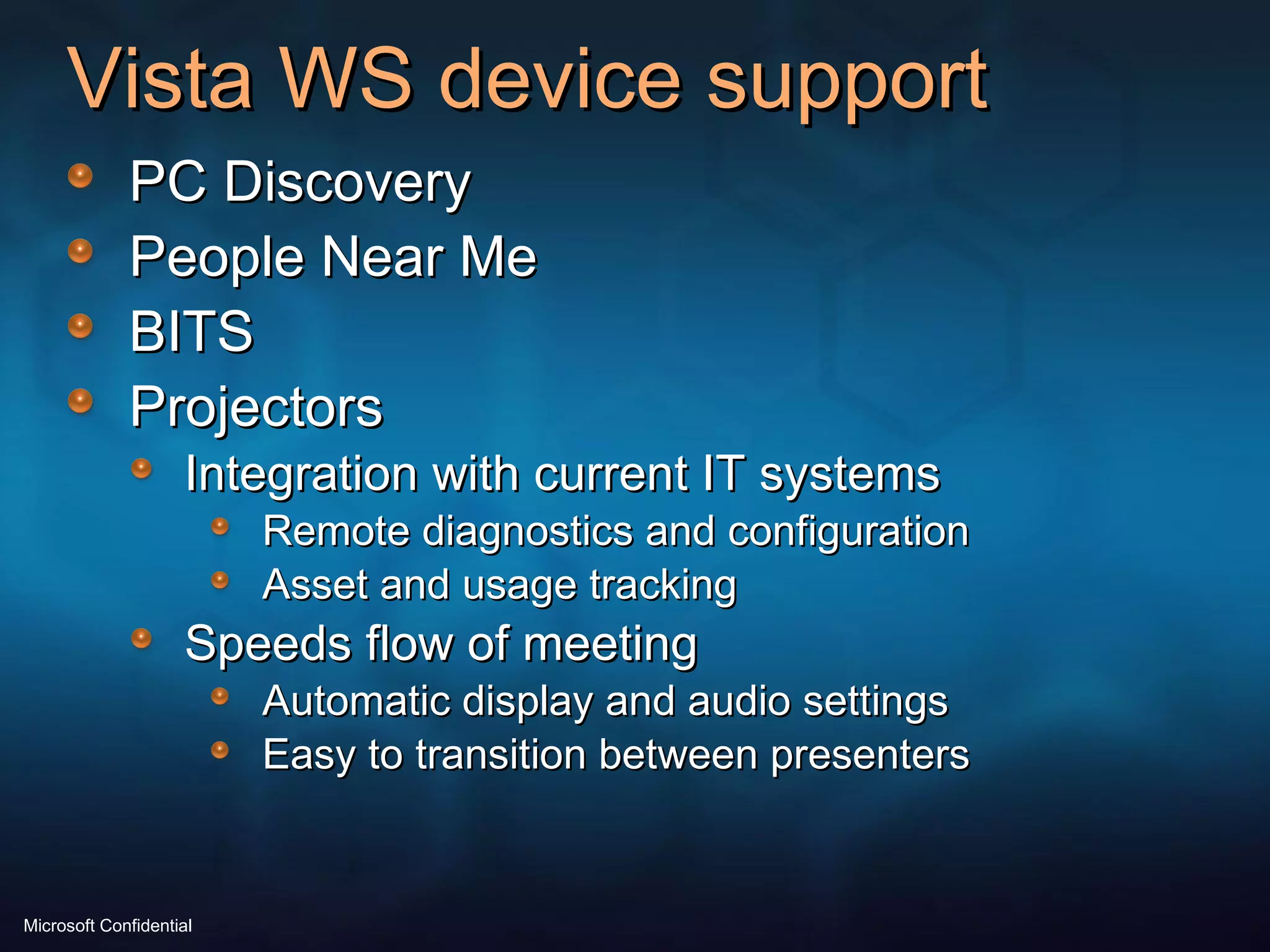
Vista WS device support PC Discovery People Near Me BITS Projectors Integration with current IT systems Remote diagnostics and configuration Asset and usage tracking  Speeds flow of meeting Automatic display and audio settings Easy to transition between presenters
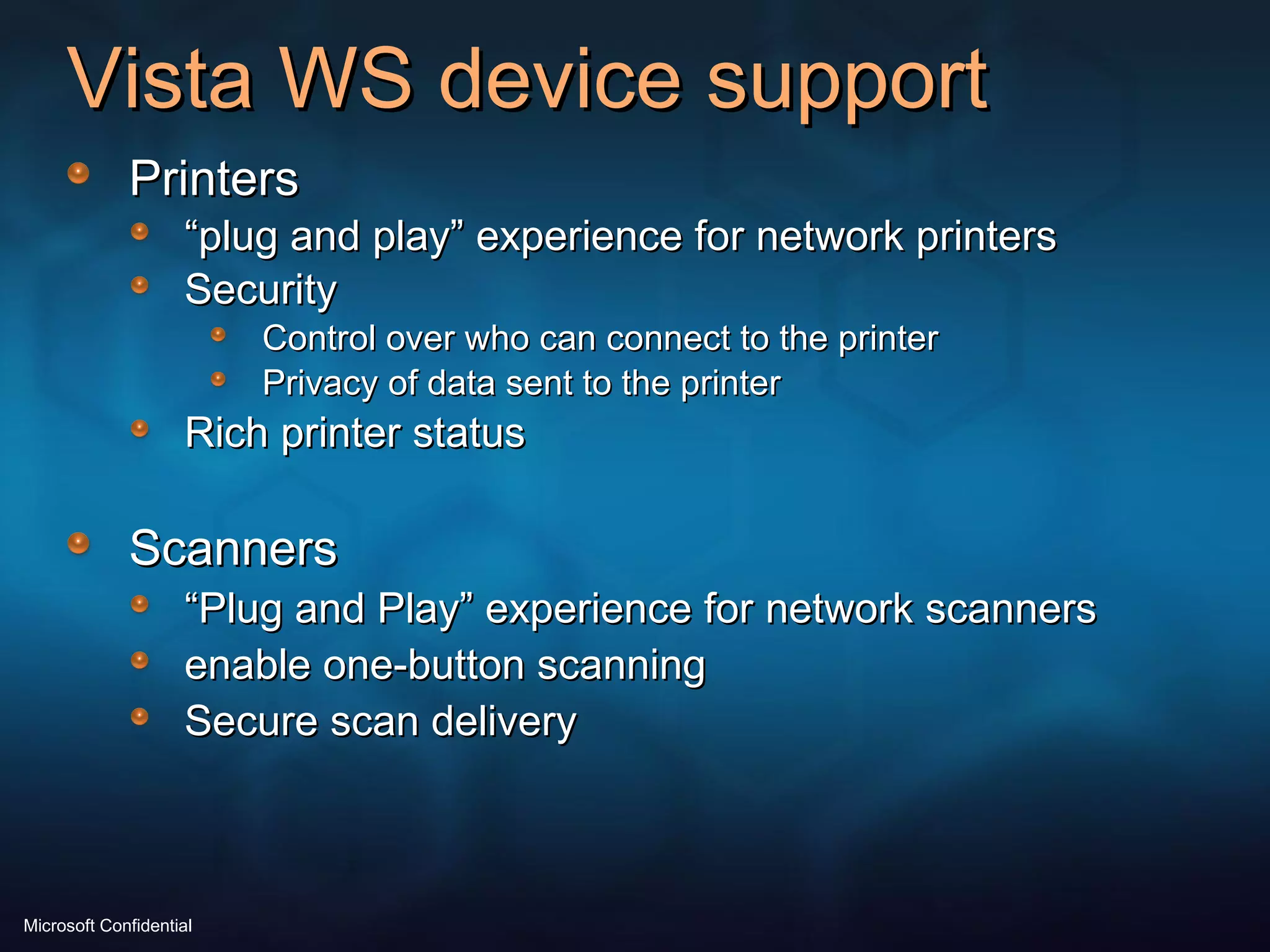
Vista WS device support Printers “ plug and play” experience for network printers Security Control over who can connect to the printer Privacy of data sent to the printer Rich printer status Scanners “ Plug and Play” experience for network scanners enable one-button scanning Secure scan delivery
Building Your Device
Building Embedded Implementation DPWS Protocol components HTTP & TCP/IP SOAP and XML parser TLS/SSL optional for security WS-* Specifications WS-Discovery WS-Transfer WS-Eventing Use 3 rd  Party stacks for rapid development eSOL
Building Custom Clients
Building WS on devices in WCF Indigo is now Windows Communication Foundation Managed code in C# for rapid development WCF Samples include WS-Discovery and SOAP over UDP transports. Interop tested with many industry stacks Great rapid prototype environment for both clients and devices
Building WSD Client/Server in Native Code WSDAPI.DLL is the foundation for Printer and Projector support. Abstracts WSD for the application developer WSD Client or Service Integrated with Plug and Play-X (PnP-X) Device Class component WSDL definition to drive codegen tool Codegen output becomes part of your application Application software Write to codegen generated functions
Web Services On Devices Resources WS and WSD Sites Web Services http://msdn.microsoft.com/webservices/default.aspx http://msdn.microsoft.com/windowsvista/connected/ Web Services Feedback Workshops http://msdn.microsoft.com/webservices/community/workshops/ Web Services Basics http://msdn.microsoft.com/webservices/understanding/webservicebasics/default.aspx Devices Profile for Web Services http://msdn.microsoft.com/ws/2006/02/devprof  (soon) http://msdn.microsoft.com/ws/2005/05/devprof   WS-Discovery http://msdn.microsoft.com/ws/2005/04/ws-discovery/
Questions?
Backup
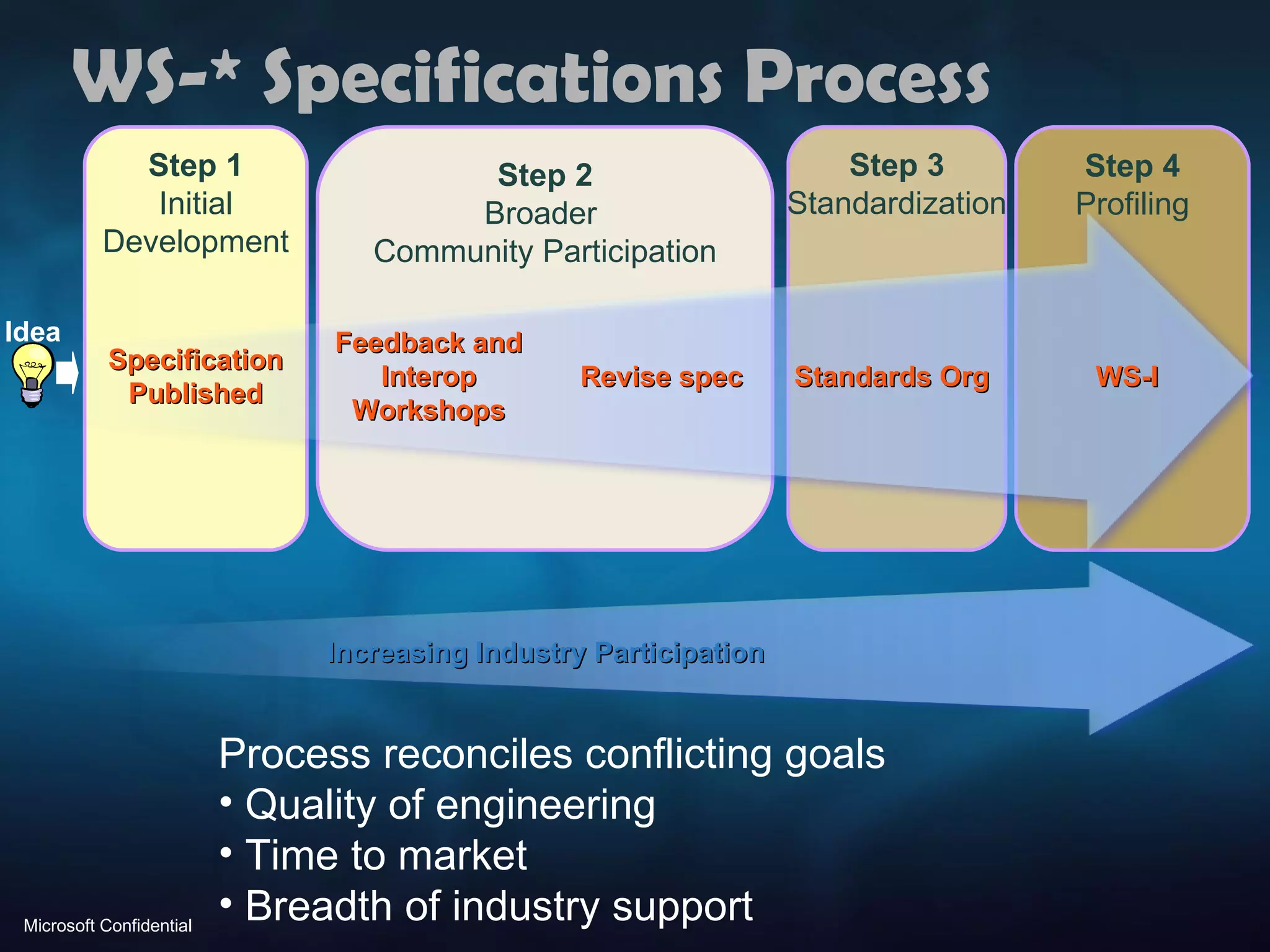
WS-* Specifications Process Step 2 Broader  Community Participation Step 1 Initial Development Process reconciles conflicting goals Quality of engineering Time to market Breadth of industry support Step 3 Standardization Step 4 Profiling Increasing Industry Participation Specification Published Feedback and Interop Workshops Revise spec Standards Org WS-I Idea
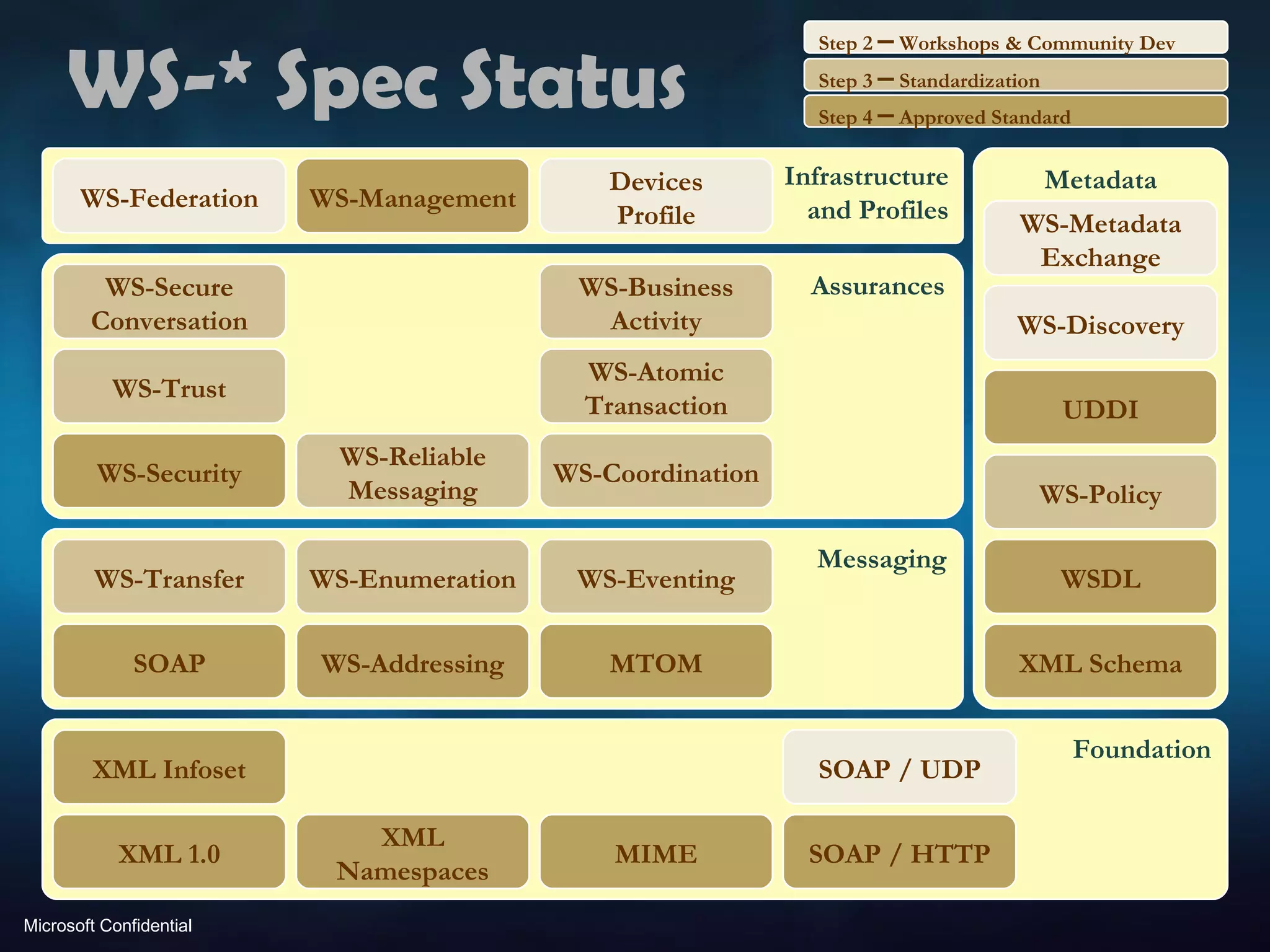
WS-* Spec Status Assurances Messaging SOAP WS-Security MTOM WS-Addressing Metadata WS-Policy WSDL WS-Discovery UDDI WS-Metadata Exchange WS-Transfer WS-Enumeration WS-Eventing XML Schema WS-Reliable Messaging WS-Coordination WS-Atomic Transaction WS-Business Activity WS-Trust WS-Secure Conversation Infrastructure and Profiles WS-Management WS-Federation Devices Profile Foundation SOAP / HTTP SOAP / UDP MIME XML Infoset XML 1.0 XML Namespaces Step 4  –  Approved Standard Step 3  –  Standardization Step 2  –  Workshops & Community Dev
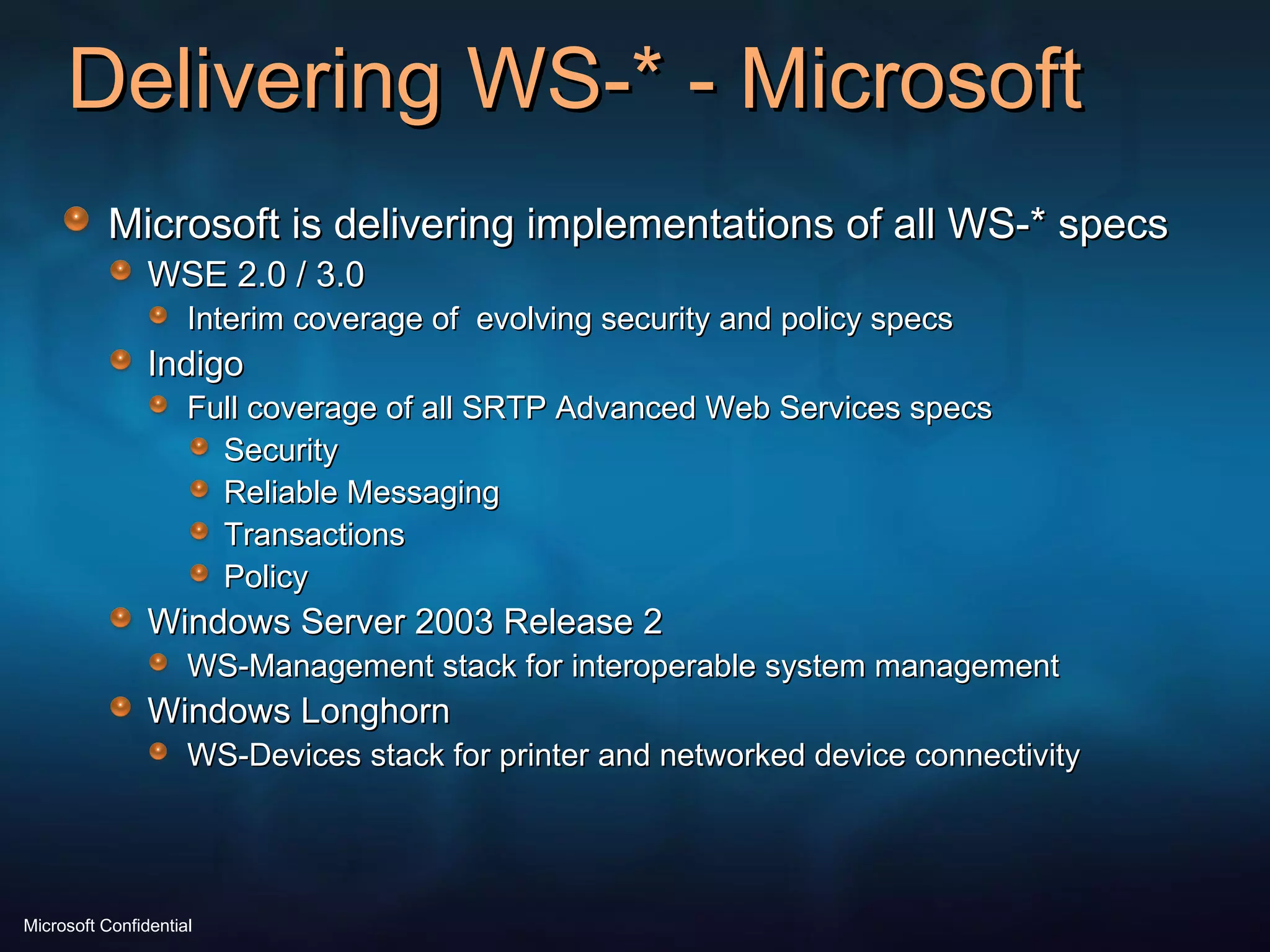
Delivering WS-* - Microsoft Microsoft is delivering implementations of all WS-* specs WSE 2.0 / 3.0 Interim coverage of  evolving security and policy specs Indigo Full coverage of all SRTP Advanced Web Services specs Security Reliable Messaging Transactions Policy Windows Server 2003 Release 2 WS-Management stack for interoperable system management Windows Longhorn WS-Devices stack for printer and networked device connectivity
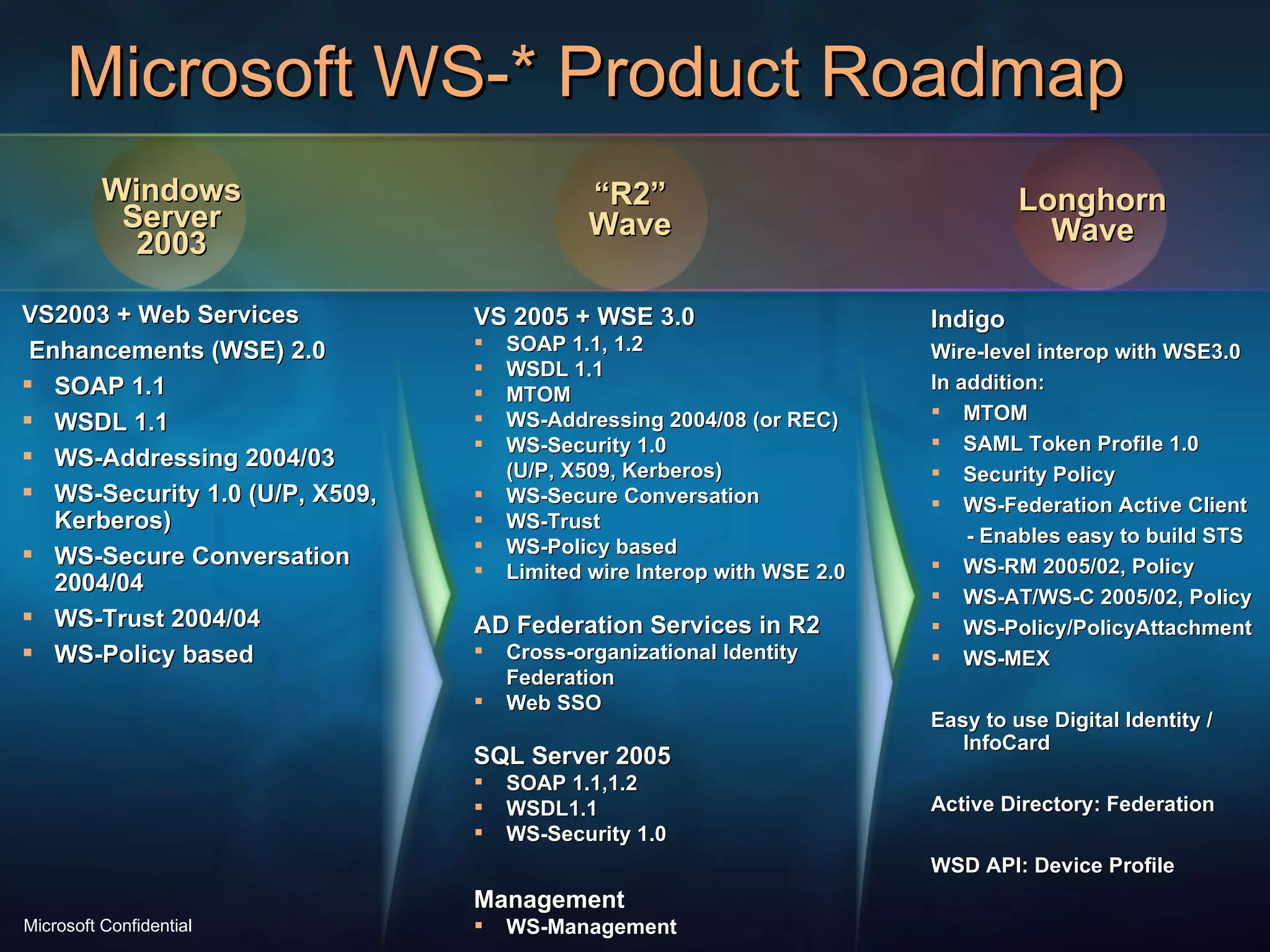
Microsoft WS-* Product Roadmap VS 2005 + WSE 3.0 SOAP 1.1, 1.2  WSDL 1.1  MTOM WS-Addressing 2004/08 (or REC) WS-Security 1.0  (U/P, X509, Kerberos) WS-Secure Conversation WS-Trust  WS-Policy based Limited wire Interop with WSE 2.0 AD Federation Services in R2 Cross-organizational Identity Federation Web SSO SQL Server 2005 SOAP 1.1,1.2  WSDL1.1 WS-Security 1.0 Management WS-Management VS2003 + Web Services  Enhancements (WSE) 2.0 SOAP 1.1 WSDL 1.1 WS-Addressing 2004/03 WS-Security 1.0 (U/P, X509, Kerberos) WS-Secure Conversation 2004/04 WS-Trust 2004/04 WS-Policy based Indigo Wire-level interop with WSE3.0 In addition: MTOM SAML Token Profile 1.0 Security Policy WS-Federation Active Client - Enables easy to build STS WS-RM 2005/02, Policy WS-AT/WS-C 2005/02, Policy WS-Policy/PolicyAttachment WS-MEX Easy to use Digital Identity / InfoCard Active Directory: Federation WSD API: Device Profile Longhorn Wave Windows Server 2003 “ R2” Wave
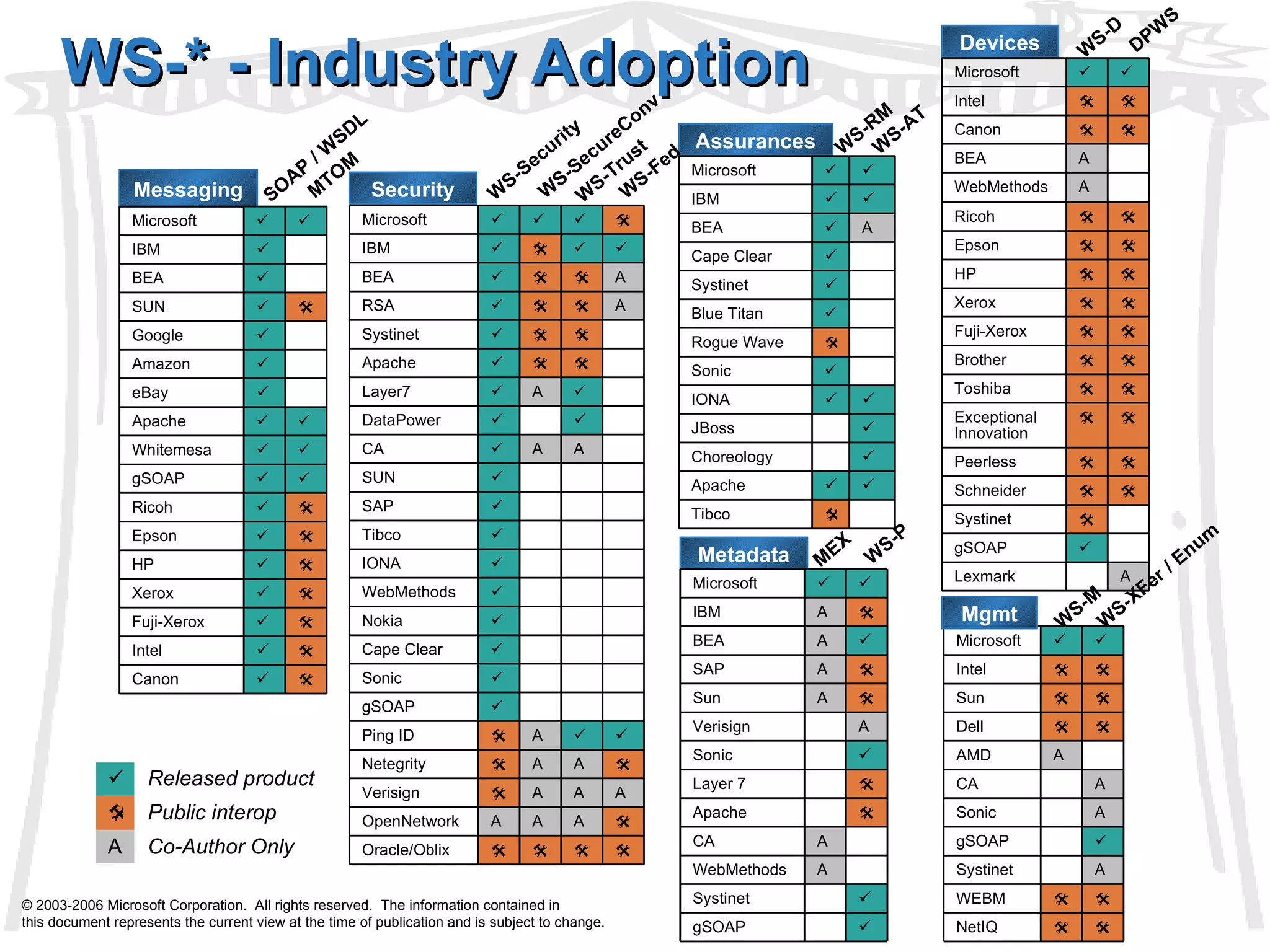
WS-* - Industry Adoption WS-P Messaging Security Assurances Devices Mgmt Metadata DPWS WS-SecureConv WS-Security WS-Trust WS-RM WS-AT MEX WS-D SOAP / WSDL MTOM © 2003-2006 Microsoft Corporation.  All rights reserved.  The information contained in  this document represents the current view at the time of publication and is subject to change. WS-M WS-XFer / Enum WS-Fed  gSOAP A AMD A Sonic A CA A Systinet        NetIQ  WEBM  Dell  Sun   Intel Microsoft Public interop  A  Released product Co-Author Only  Sonic  Tibco  Blue Titan  Choreology  Rogue Wave  JBoss   IONA        A   Apache Systinet Cape Clear BEA IBM Microsoft  Sonic  Cape Clear  gSOAP  SAP  A  Layer7   DataPower     Oracle/Oblix A A A  Verisign  SUN  Tibco  IONA  Nokia  WebMethods  A A A OpenNetwork  A A  Netegrity   A  Ping ID A       A  CA             A A   Apache Systinet RSA BEA IBM Microsoft  Amazon   Ricoh   Epson   HP   Xerox   Fuji-Xerox   Whitemesa   gSOAP               Canon Intel Apache eBay Google SUN BEA IBM Microsoft   Toshiba   Exceptional Innovation   Peerless   Schneider  gSOAP  Systinet A WebMethods A BEA   Epson   Fuji-Xerox   Xerox   Ricoh   HP   Brother    A    Lexmark Canon Intel Microsoft  Apache  Layer 7  Systinet  gSOAP A A A A A A   BEA WebMethods CA  Sun  Sonic A    Verisign SAP IBM Microsoft
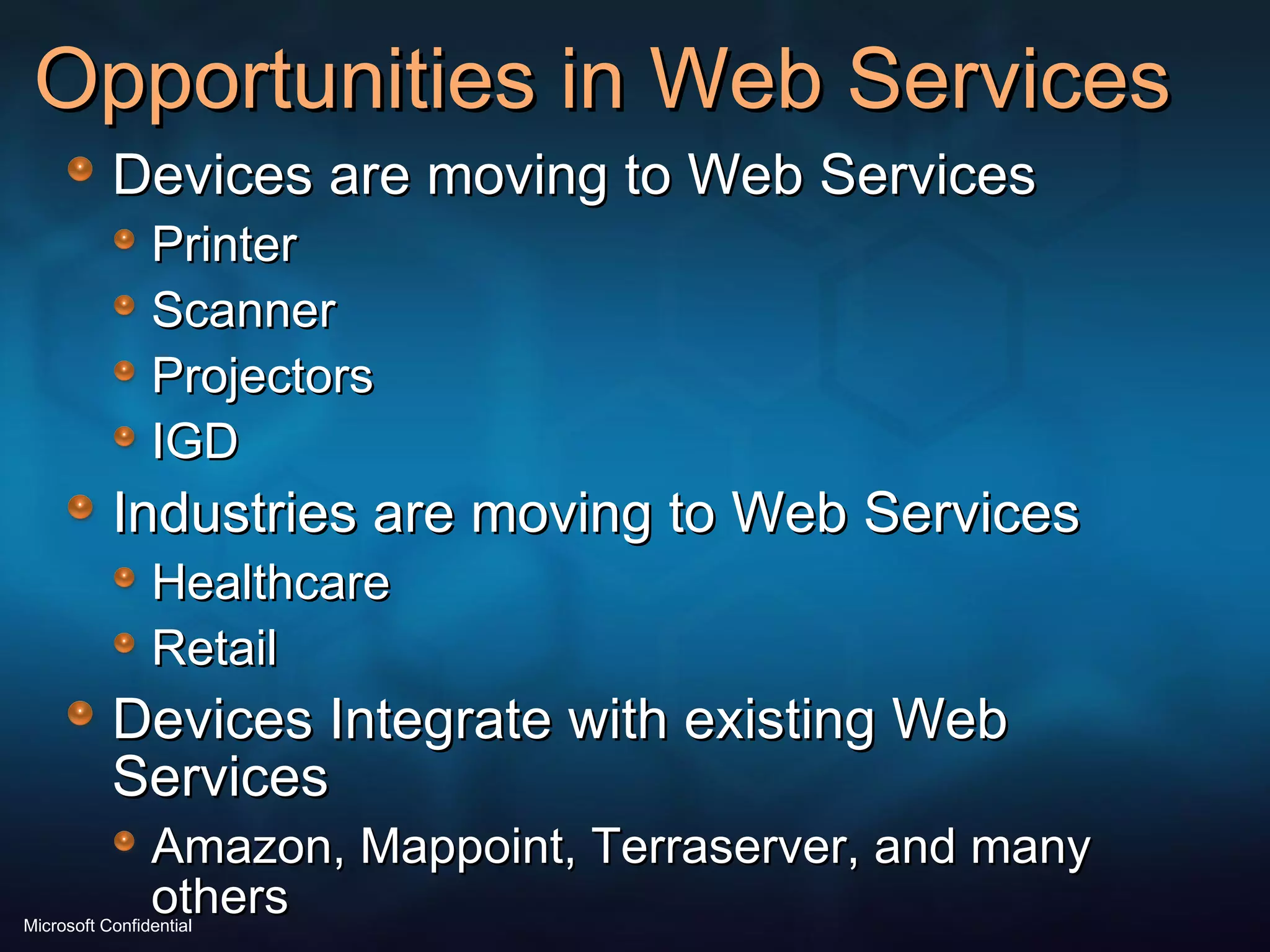
Opportunities in Web Services Devices are moving to Web Services Printer Scanner Projectors IGD Industries are moving to Web Services Healthcare Retail Devices Integrate with existing Web Services Amazon, Mappoint, Terraserver, and many others
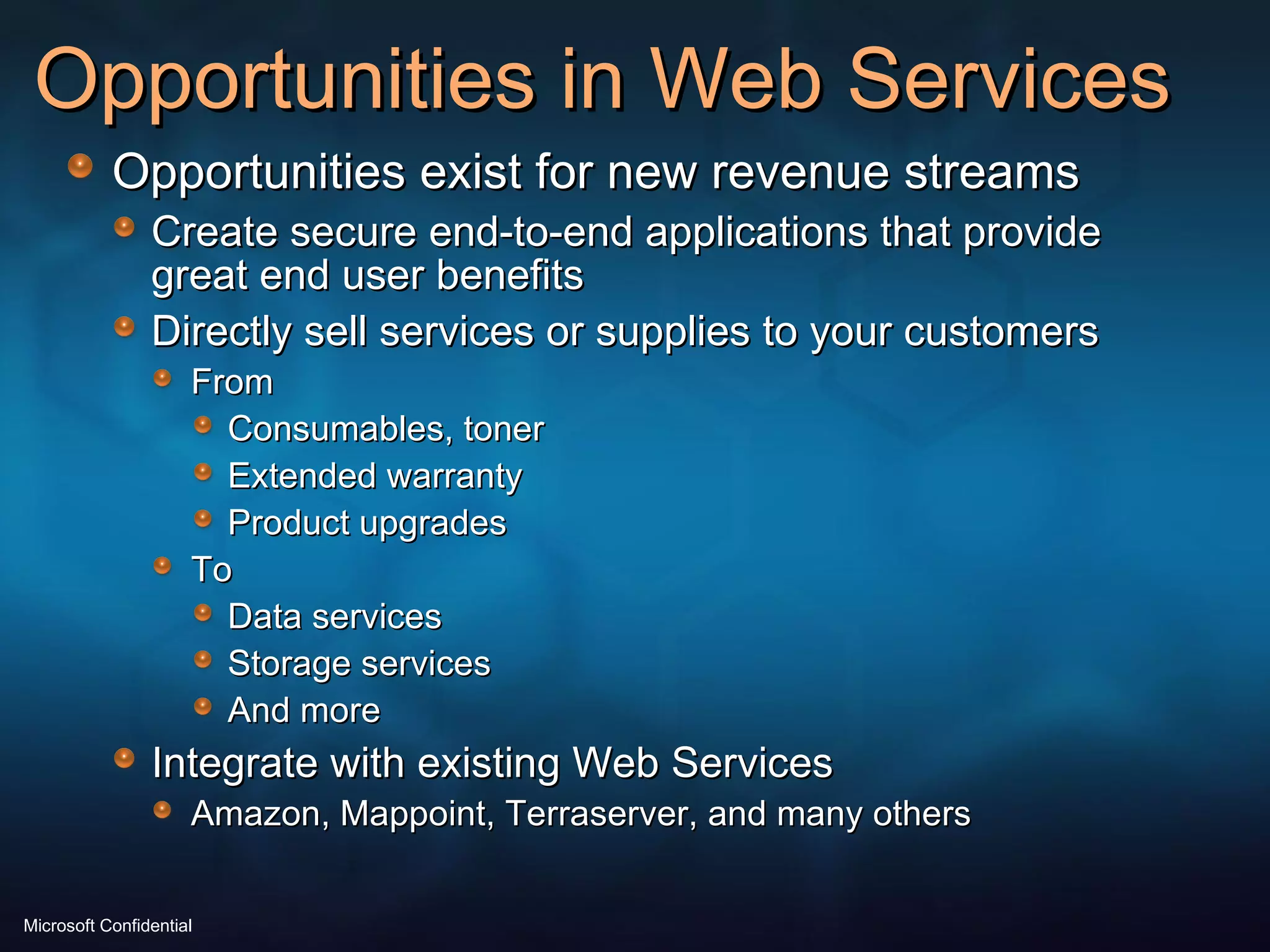
Opportunities in Web Services Opportunities exist for new revenue streams Create secure end-to-end applications that provide great end user benefits Directly sell services or supplies to your customers From Consumables, toner Extended warranty Product upgrades To Data services Storage services And more Integrate with existing Web Services Amazon, Mappoint, Terraserver, and many others

Web Services and Devices Profile for Web Services (DPWS)

  • 1.
    Web Services and the Devices Profile Jorgen Thelin Program Manager Connected Systems Division [email_address]
  • 2.
    What Is WebServices? PCs Servers Services TCP/IP WS Protocols Software talking to Software
  • 3.
    What Is WebServices on devices? PCs Devices Servers Services TCP/IP WS Protocols Device Profile for Web Services Software talking to Software on devices
  • 4.
    Web Services Scales“ Scales Down” to devices “ Scales In” on a machine “ Scales Up” on large systems “ Scales Away” spans organizations & geographies “ Scales Out” by adding machines
  • 5.
    Why Web ServicesDevices need to interoperate! Building devices that work with 3 rd party applications increases value to customer Build devices that work with Internet services could add revenue streams HTML and browsers are limited Browsers can’t automatically collect data Browsers can’t automatically control devices Custom protocols are costly
  • 6.
    Quality WS protocolswill be long-lived They’re general purpose and are being adopted by many large companies Enterprise-ready framework Already proven in the enterprise Allow your devices to move seamlessly between So-Ho and enterprise environments Multi-party reviews and interop events for each spec
  • 7.
    Security Integrity, ConfidentialityChannel-Based (TLS) Message-Based (WS-Security) Secure content Scenario – print job content securely over the wire, allowing devices to be implemented at secure sites Secure communications Scenario – secure check printing
  • 8.
    The Device Profile for Web Services Scaling WS to limited resource devices
  • 9.
    Profile Recipe: Staple,Redline, Glue “ Staple” Pull relevant specs into scope “ Redline” Add constraints on use of those specs “ Glue” Define missing bits between specs Some will migrate back into specs ThisModel Metadata ThisDevice Metadata Action Filter Conformance Claim Policy Assertions Policy Assertions SOAP 1.2 WS-Addressing WS-Metadata Exchange WSDL 1.1 WS-Discovery WS-Eventing
  • 10.
    Device Profile forWeb Services Lightweight subset of WS specifications Described in Device Profile for Web Services (DPWS) specification Security based on SSL/TLS Shipping in Windows Vista and Windows CE
  • 11.
    Device Profile forWeb Services Built on the foundation of industry standard Web Services Extensible Markup Language (XML) Simple Object Access Protocol (SOAP) WS-Discovery, WS-Addressing… (WS-*) Web Service Definition Language (WSDL) Message Transmission Optimization Mechanism (MTOM) Developed using the WS workshop process Co-Authors include Intel, Canon, Ricoh, and Lexmark.
  • 12.
    Devices Profile ProtocolDMR Capabilities DMR Commands DMR Events Protocol IGD Capabilities IGD Commands IGD Events Assurances Messaging SOAP WS-Security MTOM WS-Addressing Metadata WS-Policy WSDL WS-Metadata Exchange XML Schema TLS Foundation SOAP / HTTP MIME XML Infoset XML 1.0 XML Namespaces BP 1.1 Sec. 4 WS-Discovery WS-Eventing Device Extensions SOAP / UDP Protocol Print Capabilities Print Commands Print Events
  • 13.
  • 14.
    Typical Devices ProfileMessage Exchanges
  • 15.
  • 16.
    Vista WS devicesupport PC Discovery People Near Me BITS Projectors Integration with current IT systems Remote diagnostics and configuration Asset and usage tracking Speeds flow of meeting Automatic display and audio settings Easy to transition between presenters
  • 17.
    Vista WS devicesupport Printers “ plug and play” experience for network printers Security Control over who can connect to the printer Privacy of data sent to the printer Rich printer status Scanners “ Plug and Play” experience for network scanners enable one-button scanning Secure scan delivery
  • 18.
  • 19.
    Building Embedded ImplementationDPWS Protocol components HTTP & TCP/IP SOAP and XML parser TLS/SSL optional for security WS-* Specifications WS-Discovery WS-Transfer WS-Eventing Use 3 rd Party stacks for rapid development eSOL
  • 20.
  • 21.
    Building WS ondevices in WCF Indigo is now Windows Communication Foundation Managed code in C# for rapid development WCF Samples include WS-Discovery and SOAP over UDP transports. Interop tested with many industry stacks Great rapid prototype environment for both clients and devices
  • 22.
    Building WSD Client/Serverin Native Code WSDAPI.DLL is the foundation for Printer and Projector support. Abstracts WSD for the application developer WSD Client or Service Integrated with Plug and Play-X (PnP-X) Device Class component WSDL definition to drive codegen tool Codegen output becomes part of your application Application software Write to codegen generated functions
  • 23.
    Web Services OnDevices Resources WS and WSD Sites Web Services http://msdn.microsoft.com/webservices/default.aspx http://msdn.microsoft.com/windowsvista/connected/ Web Services Feedback Workshops http://msdn.microsoft.com/webservices/community/workshops/ Web Services Basics http://msdn.microsoft.com/webservices/understanding/webservicebasics/default.aspx Devices Profile for Web Services http://msdn.microsoft.com/ws/2006/02/devprof (soon) http://msdn.microsoft.com/ws/2005/05/devprof WS-Discovery http://msdn.microsoft.com/ws/2005/04/ws-discovery/
  • 24.
  • 25.
  • 26.
    WS-* Specifications ProcessStep 2 Broader Community Participation Step 1 Initial Development Process reconciles conflicting goals Quality of engineering Time to market Breadth of industry support Step 3 Standardization Step 4 Profiling Increasing Industry Participation Specification Published Feedback and Interop Workshops Revise spec Standards Org WS-I Idea
  • 27.
    WS-* Spec StatusAssurances Messaging SOAP WS-Security MTOM WS-Addressing Metadata WS-Policy WSDL WS-Discovery UDDI WS-Metadata Exchange WS-Transfer WS-Enumeration WS-Eventing XML Schema WS-Reliable Messaging WS-Coordination WS-Atomic Transaction WS-Business Activity WS-Trust WS-Secure Conversation Infrastructure and Profiles WS-Management WS-Federation Devices Profile Foundation SOAP / HTTP SOAP / UDP MIME XML Infoset XML 1.0 XML Namespaces Step 4 – Approved Standard Step 3 – Standardization Step 2 – Workshops & Community Dev
  • 28.
    Delivering WS-* -Microsoft Microsoft is delivering implementations of all WS-* specs WSE 2.0 / 3.0 Interim coverage of evolving security and policy specs Indigo Full coverage of all SRTP Advanced Web Services specs Security Reliable Messaging Transactions Policy Windows Server 2003 Release 2 WS-Management stack for interoperable system management Windows Longhorn WS-Devices stack for printer and networked device connectivity
  • 29.
    Microsoft WS-* ProductRoadmap VS 2005 + WSE 3.0 SOAP 1.1, 1.2 WSDL 1.1 MTOM WS-Addressing 2004/08 (or REC) WS-Security 1.0 (U/P, X509, Kerberos) WS-Secure Conversation WS-Trust WS-Policy based Limited wire Interop with WSE 2.0 AD Federation Services in R2 Cross-organizational Identity Federation Web SSO SQL Server 2005 SOAP 1.1,1.2 WSDL1.1 WS-Security 1.0 Management WS-Management VS2003 + Web Services Enhancements (WSE) 2.0 SOAP 1.1 WSDL 1.1 WS-Addressing 2004/03 WS-Security 1.0 (U/P, X509, Kerberos) WS-Secure Conversation 2004/04 WS-Trust 2004/04 WS-Policy based Indigo Wire-level interop with WSE3.0 In addition: MTOM SAML Token Profile 1.0 Security Policy WS-Federation Active Client - Enables easy to build STS WS-RM 2005/02, Policy WS-AT/WS-C 2005/02, Policy WS-Policy/PolicyAttachment WS-MEX Easy to use Digital Identity / InfoCard Active Directory: Federation WSD API: Device Profile Longhorn Wave Windows Server 2003 “ R2” Wave
  • 30.
    WS-* - IndustryAdoption WS-P Messaging Security Assurances Devices Mgmt Metadata DPWS WS-SecureConv WS-Security WS-Trust WS-RM WS-AT MEX WS-D SOAP / WSDL MTOM © 2003-2006 Microsoft Corporation. All rights reserved. The information contained in this document represents the current view at the time of publication and is subject to change. WS-M WS-XFer / Enum WS-Fed  gSOAP A AMD A Sonic A CA A Systinet        NetIQ  WEBM  Dell  Sun   Intel Microsoft Public interop  A  Released product Co-Author Only  Sonic  Tibco  Blue Titan  Choreology  Rogue Wave  JBoss   IONA        A   Apache Systinet Cape Clear BEA IBM Microsoft  Sonic  Cape Clear  gSOAP  SAP  A  Layer7   DataPower     Oracle/Oblix A A A  Verisign  SUN  Tibco  IONA  Nokia  WebMethods  A A A OpenNetwork  A A  Netegrity   A  Ping ID A       A  CA             A A   Apache Systinet RSA BEA IBM Microsoft  Amazon   Ricoh   Epson   HP   Xerox   Fuji-Xerox   Whitemesa   gSOAP               Canon Intel Apache eBay Google SUN BEA IBM Microsoft   Toshiba   Exceptional Innovation   Peerless   Schneider  gSOAP  Systinet A WebMethods A BEA   Epson   Fuji-Xerox   Xerox   Ricoh   HP   Brother    A    Lexmark Canon Intel Microsoft  Apache  Layer 7  Systinet  gSOAP A A A A A A   BEA WebMethods CA  Sun  Sonic A    Verisign SAP IBM Microsoft
  • 31.
    Opportunities in WebServices Devices are moving to Web Services Printer Scanner Projectors IGD Industries are moving to Web Services Healthcare Retail Devices Integrate with existing Web Services Amazon, Mappoint, Terraserver, and many others
  • 32.
    Opportunities in WebServices Opportunities exist for new revenue streams Create secure end-to-end applications that provide great end user benefits Directly sell services or supplies to your customers From Consumables, toner Extended warranty Product upgrades To Data services Storage services And more Integrate with existing Web Services Amazon, Mappoint, Terraserver, and many others