
Jorgen Thelin Senior Program Manager - Interoperability Standards Connected  Systems Division Microsoft Corporation Producing proven, well-engineered, quality Web services specifications
Many Systems == Development & Management Complexity FTP HL7 LDAP EDI WS-* SAP Oracle DB SNA DRDA TN3270 MQI Oracle LOB Siebel JD Edwards RLIO Tibco Clarify HTTP TCP/IP RosettaNet UPnP XML Swift HIPAA IBM DB2 Teradata (etc.) Database Clearing House Partner IBM Mainframe SAP Services Directory Remote Store Your Enterprise
Overview of Microsoft’s WS Strategy WS-* Specification Development Process WS-* Workshops WS-* Spec Progress Delivering WS-* Implementations Microsoft Customer Interop Executive Council (IEC)
Interoperability means  connecting people, data, and diverse systems It gives  customers control over the data they create  and want to share Vendors create  innovative solutions that bridge technologies  to address real customer needs in an innovative manner  The nature of software allows for  translatability in lieu of uniformity
Why Interoperability? Interoperability is  Connecting  People ,  Data  and Diverse  Systems http://www.microsoft.com/interop/ Interoperability is now as important to must customers as security or reliability But interoperability is still just a  means to an end Interoperability helps to: Reduce costs / Improve operational efficiencies Open access to new markets / Enable new business opportunities / Increase agility Maximize choice of solutions and vendors Ensure access to data across all applications
Enabling Wire Interoperability Metadata Data  Formats Protocols
Microsoft’s Commitment to Interoperability Bill Gates’ Executive E-mail – February 2005 –  “Building Software That Is Interoperable By Design”  http://www.microsoft.com/mscorp/execmail/2005/02-03interoperability.asp Plus deep commitment at the execution level Specification development and standardization WS-* Spec authorship Participation in Standards bodies – W3C, OASIS, DMTF, etc, etc Participation in WS-I – Web Services Interoperability Organization Shipping products: Early WS-* implementations (WSE) Strategic WS-* platform (WCF – Windows Communication Foundation) Easy-to-use development environment (Visual Studio) Community feedback and testing WS-* Workshop Process Plug-fests - Product testing of multi-vendor interop Adopting XML and WS-* as the universal glue  eg. Systems Management, Connected Devices, Identity Management
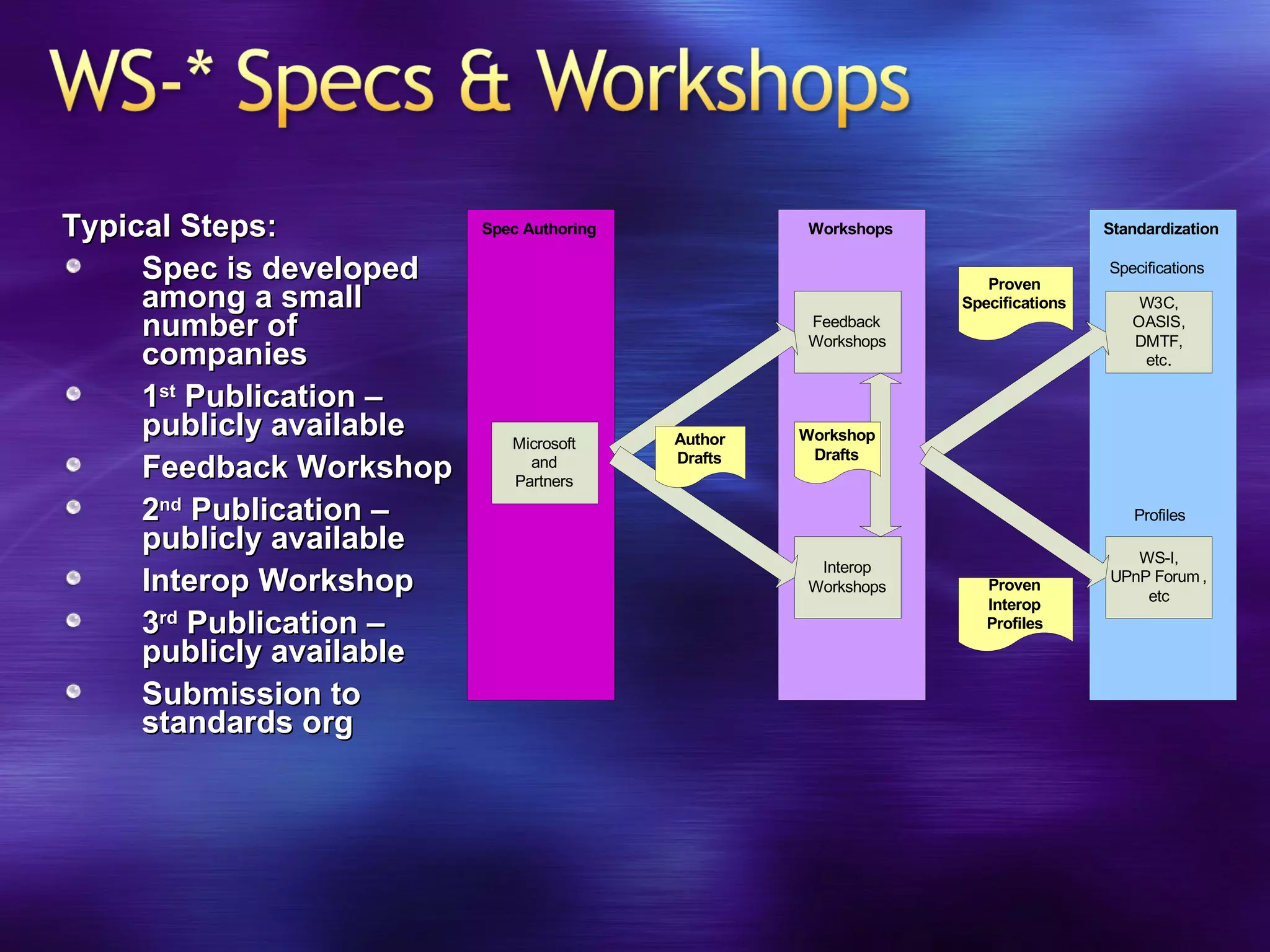
Step 2 Broader  Community Participation Step 1 Initial Development Process reconciles conflicting goals Quality of engineering Time to market Breadth of industry support Step 3 Standardization Step 4 Profiling Increasing Industry Participation Specification Published Feedback and Interop Workshops Revise spec Standards Org WS-I, ITU, ACORD WSP Idea
Main reason for the WS-* workshop process Produce well-engineered, quality specifications Secondary benefits of WS-* workshops: Proof of the interoperability of the WS-* specifications Discover inconsistencies with other WS-* specifications Gain implementation experience earlier  Foster community involvement  Apply software testing disciplines to specs Determine readiness for standardization
Feedback Workshops Open to everyone Obtain community feedback on specifications Interoperability Workshops Open to teams with implementations Demonstrate / prove spec interoperability Refine the important spec scenarios Ground the spec development efforts
Typical Steps: Spec is developed among a small number of companies 1 st  Publication – publicly available Feedback Workshop 2 nd  Publication – publicly available Interop Workshop 3 rd  Publication – publicly available Submission to standards org
The SOAP and WSDL specifications proceeded through a prototype version of the workshop process during 2001 and 2002 This experience led to the refined and formalized WS-* workshop process now in use.
Actional Fujitsu Newisys Sharp Labs AMD Grand Central Nokia Siebel American Megatrends Hewlett-Packard Oasis Semiconductor Software AG ANL IBM Oblix Sonic Software Apache Project iDesign OPC Foundation Sun Axalto Intel OpenNetwork Systinet BEA Intermec Oracle Tibco Blue Titan Iona OSA Technologies Toshiba Boeing IPO Group Peerless Tyco Safety Systems Brother Jboss Ping Identity Univ of Sydney Canon JibxSoap Printronix VeriSign Choreology KnowNow QuickTree Veritas CommerceOne Layer 7 Tech Quovadx Visa Computer Associates Lexmark Reactivity Vitria Content Guard Lockheed Martin Ricoh WRQ Cornell University Microsoft Roxio webMethods Dell Motive RSA Security WSO2 Epson NEC SAP Xerox Exceptional Innovation NEON Schneider Electric Zoran Feature Software Netegrity SeeBeyond Unaffiliated
 
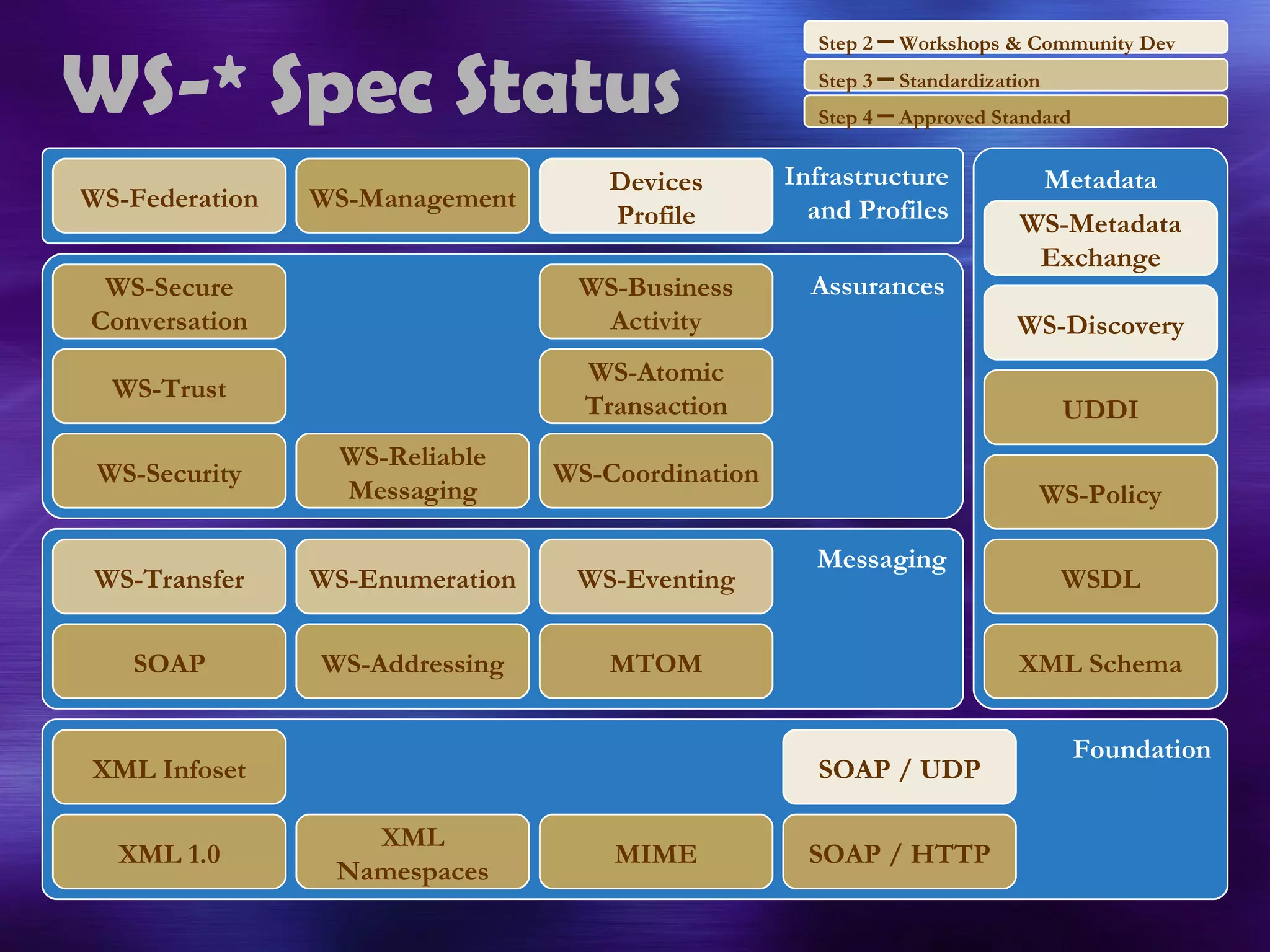
WS-* Spec Status Assurances Messaging SOAP WS-Security MTOM WS-Addressing Metadata WSDL WS-Discovery UDDI WS-Metadata Exchange WS-Transfer WS-Enumeration WS-Eventing XML Schema WS-Reliable Messaging WS-Coordination WS-Atomic Transaction WS-Business Activity WS-Trust WS-Secure Conversation Infrastructure and Profiles WS-Management WS-Federation Devices Profile Foundation SOAP / HTTP SOAP / UDP MIME XML Infoset XML 1.0 XML Namespaces Step 4  –  Approved Standard Step 3  –  Standardization Step 2  –  Workshops & Community Dev WS-Policy
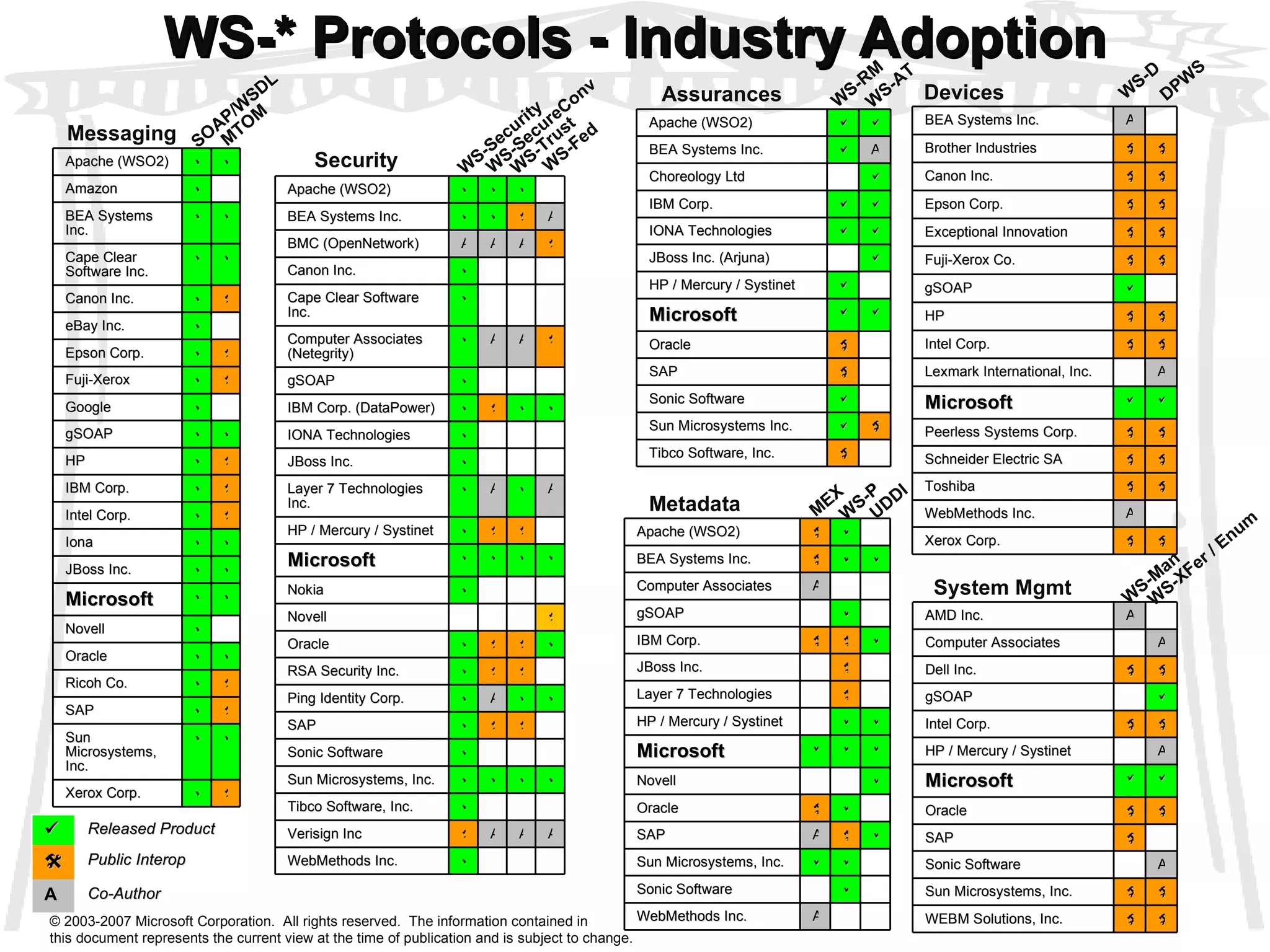
WS-* Protocols - Industry Adoption WS-P Messaging Security Assurances Devices System Mgmt Metadata DPWS WS-SecureConv WS-Security WS-Trust WS-RM WS-AT MEX WS-D SOAP/WSDL MTOM © 2003-2007 Microsoft Corporation.  All rights reserved.  The information contained in  this document represents the current view at the time of publication and is subject to change. WS-Man WS-XFer / Enum WS-Fed UDDI AMD Inc. A Computer Associates A Dell Inc.   gSOAP  Intel Corp.   HP / Mercury / Systinet A Microsoft   Oracle   SAP  Sonic Software A Sun Microsystems, Inc.   WEBM Solutions, Inc.    Released Product  Public Interop A Co-Author Apache (WSO2)   BEA Systems Inc.  A Choreology Ltd  IBM Corp.   IONA Technologies   JBoss Inc. (Arjuna)  HP / Mercury / Systinet  Microsoft   Oracle  SAP  Sonic Software  Sun Microsystems Inc.   Tibco Software, Inc.  Apache (WSO2)    BEA Systems Inc.    A BMC (OpenNetwork) A A A  Canon Inc.  Cape Clear Software Inc.  Computer Associates (Netegrity)  A A  gSOAP  IBM Corp. (DataPower)     IONA Technologies  JBoss Inc.  Layer 7 Technologies Inc.  A  A HP / Mercury / Systinet    Microsoft     Nokia  Novell  Oracle     RSA Security Inc.    Ping Identity Corp.  A   SAP    Sonic Software  Sun Microsystems, Inc.     Tibco Software, Inc.  Verisign Inc  A A A WebMethods Inc.  Apache (WSO2)   Amazon  BEA Systems Inc.   Cape Clear Software Inc.   Canon Inc.   eBay Inc.  Epson Corp.   Fuji-Xerox   Google  gSOAP   HP   IBM Corp.   Intel Corp.   Iona   JBoss Inc.   Microsoft   Novell  Oracle   Ricoh Co.   SAP   Sun Microsystems, Inc.   Xerox Corp.   BEA Systems Inc. A Brother Industries   Canon Inc.   Epson Corp.   Exceptional Innovation   Fuji-Xerox Co.   gSOAP  HP   Intel Corp.   Lexmark International, Inc. A Microsoft   Peerless Systems Corp.   Schneider Electric SA   Toshiba   WebMethods Inc. A Xerox Corp.   Apache (WSO2)   BEA Systems Inc.    Computer Associates A gSOAP  IBM Corp.    JBoss Inc.  Layer 7 Technologies  HP / Mercury / Systinet   Microsoft    Novell  Oracle   SAP A   Sun Microsystems, Inc.   Sonic Software  WebMethods Inc. A
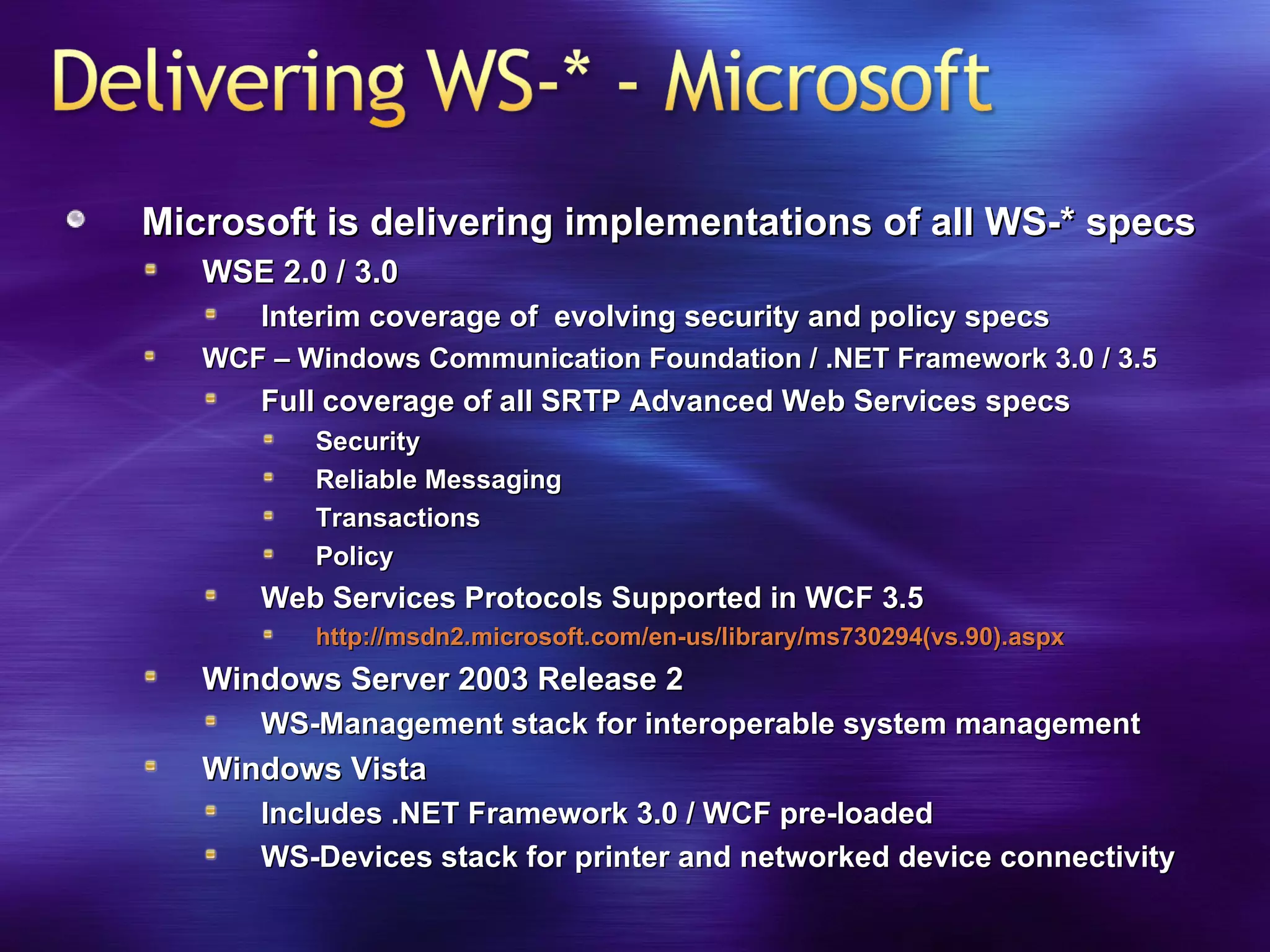
Microsoft is delivering implementations of all WS-* specs WSE 2.0 / 3.0 Interim coverage of  evolving security and policy specs WCF – Windows Communication Foundation / .NET Framework 3.0 / 3.5 Full coverage of all SRTP Advanced Web Services specs Security Reliable Messaging Transactions Policy Web Services Protocols Supported in WCF 3.5 http://msdn2.microsoft.com/en-us/library/ms730294(vs.90).aspx Windows Server 2003 Release 2 WS-Management stack for interoperable system management Windows Vista Includes .NET Framework 3.0 / WCF pre-loaded WS-Devices stack for printer and networked device connectivity
BEA  – WebLogic App Server IBM  – WS-* Feature Pack for WebSphere Novell  – Open Enterprise Server Oracle  – Oracle App Server Containers for JavaEE (OC4J) Red Hat  – JBoss App Server SAP  – NetWeaver App Server Sun  – GlassFish / Web Services Interoperability Technologies (WSIT/Tango) Apache Group  – Axis 2 WSO2  – Axis 2 / WSO2 Web Services App Server
Bob Muglia, SVP Server & Tools is host and member 30+ members, 2 plenary meetings, 20+ tech meetings
Workstream In progress Resolved
Run multiple frameworks on a single runtime environment Allow .NET framework to run on non-Windows platform (mono) Built-in support for third-party tools in Visual Studio and other products Need evidence of wider support and adoption of  WS-* standards and high-performance implementations SAML and other standards support Need for ECM features (workflow, search, record management) to work across multiple servers Management of virtualization environments from a single console and integration with VMWare
All WS-* specs are progressing through the WS-* Workshop Process WS-* Workshops Process drives specification revision Yields well-engineered specifications in a timely manner Microsoft is delivering implementations for the WS-* specs  Many other vendors also delivering implementations for WS-* specs too WS-* specs becoming part of the normal plumbing for connected systems dev
WS-* Workshop Process Overview http://msdn.microsoft.com/library/en-us/dnwebsrv/html/wkshopprocess.asp WS-* Workshops home page http://msdn.microsoft.com/webservices/community/workshops/ Microsoft Interoperabilty home page http://www.microsoft.com/interop WS-* Specifications index page http://msdn.microsoft.com/webservices/understanding/specs/ MSDN Web Services Developer Center http://msdn.microsoft.com/webservices/
© 2007 Microsoft Corporation. All rights reserved. Microsoft, Windows, Windows Vista and other product names are or may be registered trademarks and/or trademarks in the U.S. and/or other countries. The information herein is for informational purposes only and represents the current view of Microsoft Corporation as of the date of this presentation.  Because Microsoft must respond to changing market conditions, it should not be interpreted to be a commitment on the part of Microsoft, and Microsoft cannot guarantee the accuracy of any information provided after the date of this presentation.  MICROSOFT MAKES NO WARRANTIES, EXPRESS, IMPLIED OR STATUTORY, AS TO THE INFORMATION IN THIS PRESENTATION.
What Are Interop Profiles? Define a subset of specifications that are: Composable Scoped Work together Examples: Secure RM  – WS-ReliableMessaging + WS-Trust/SecureConversation/Security ACORD Messaging Profile  – WS-* + ACORD payload schemas Who defines the profile? Vertical domain org – eg. ACORD Horizontal org – eg. WS-I Customer – singly or in groups
Profile Recipe: Staple, Redline, Glue - Device Profile Example “ Staple” Pull relevant specs into scope “ Redline” Add constraints on use of those specs “ Glue” Define missing bits between specs Some will migrate back into specs ThisModel Metadata ThisDevice Metadata Action Filter Conformance Claim Policy Assertions Policy Assertions SOAP 1.2 WS-Addressing WS-Metadata Exchange WSDL 1.1 WS-Discovery WS-Eventing
Why Do We Need Interop Profiles? Need to constrain (soften) runtime options to achieve out-of-box interoperability WS-* Architecture is designed for general applicability across a wide range of industries / scenarios Often too much optionality in the base specifications Tailor to specific domain / environment E.g. Devices Profile only requires SOAP 1.2 not SOAP 1.1 to lower implementation footprint Guide implementation and deployment choices Achieve a proven composition of protocols and payloads Allows simplification of application deployment  e.g. WCF allows selection of interop profile to use
© 2007 Microsoft Corporation. All rights reserved. Microsoft, Windows, Windows Vista and other product names are or may be registered trademarks and/or trademarks in the U.S. and/or other countries. The information herein is for informational purposes only and represents the current view of Microsoft Corporation as of the date of this presentation.  Because Microsoft must respond to changing market conditions, it should not be interpreted to be a commitment on the part of Microsoft, and Microsoft cannot guarantee the accuracy of any information provided after the date of this presentation.  MICROSOFT MAKES NO WARRANTIES, EXPRESS, IMPLIED OR STATUTORY, AS TO THE INFORMATION IN THIS PRESENTATION.

WS-* Specifications Update 2007

  • 1.
    Jorgen Thelin SeniorProgram Manager - Interoperability Standards Connected Systems Division Microsoft Corporation Producing proven, well-engineered, quality Web services specifications
  • 2.
    Many Systems ==Development & Management Complexity FTP HL7 LDAP EDI WS-* SAP Oracle DB SNA DRDA TN3270 MQI Oracle LOB Siebel JD Edwards RLIO Tibco Clarify HTTP TCP/IP RosettaNet UPnP XML Swift HIPAA IBM DB2 Teradata (etc.) Database Clearing House Partner IBM Mainframe SAP Services Directory Remote Store Your Enterprise
  • 3.
    Overview of Microsoft’sWS Strategy WS-* Specification Development Process WS-* Workshops WS-* Spec Progress Delivering WS-* Implementations Microsoft Customer Interop Executive Council (IEC)
  • 4.
    Interoperability means connecting people, data, and diverse systems It gives customers control over the data they create and want to share Vendors create innovative solutions that bridge technologies to address real customer needs in an innovative manner The nature of software allows for translatability in lieu of uniformity
  • 5.
    Why Interoperability? Interoperabilityis Connecting People , Data and Diverse Systems http://www.microsoft.com/interop/ Interoperability is now as important to must customers as security or reliability But interoperability is still just a means to an end Interoperability helps to: Reduce costs / Improve operational efficiencies Open access to new markets / Enable new business opportunities / Increase agility Maximize choice of solutions and vendors Ensure access to data across all applications
  • 6.
    Enabling Wire InteroperabilityMetadata Data Formats Protocols
  • 7.
    Microsoft’s Commitment toInteroperability Bill Gates’ Executive E-mail – February 2005 – “Building Software That Is Interoperable By Design” http://www.microsoft.com/mscorp/execmail/2005/02-03interoperability.asp Plus deep commitment at the execution level Specification development and standardization WS-* Spec authorship Participation in Standards bodies – W3C, OASIS, DMTF, etc, etc Participation in WS-I – Web Services Interoperability Organization Shipping products: Early WS-* implementations (WSE) Strategic WS-* platform (WCF – Windows Communication Foundation) Easy-to-use development environment (Visual Studio) Community feedback and testing WS-* Workshop Process Plug-fests - Product testing of multi-vendor interop Adopting XML and WS-* as the universal glue eg. Systems Management, Connected Devices, Identity Management
  • 8.
    Step 2 Broader Community Participation Step 1 Initial Development Process reconciles conflicting goals Quality of engineering Time to market Breadth of industry support Step 3 Standardization Step 4 Profiling Increasing Industry Participation Specification Published Feedback and Interop Workshops Revise spec Standards Org WS-I, ITU, ACORD WSP Idea
  • 9.
    Main reason forthe WS-* workshop process Produce well-engineered, quality specifications Secondary benefits of WS-* workshops: Proof of the interoperability of the WS-* specifications Discover inconsistencies with other WS-* specifications Gain implementation experience earlier Foster community involvement Apply software testing disciplines to specs Determine readiness for standardization
  • 10.
    Feedback Workshops Opento everyone Obtain community feedback on specifications Interoperability Workshops Open to teams with implementations Demonstrate / prove spec interoperability Refine the important spec scenarios Ground the spec development efforts
  • 11.
    Typical Steps: Specis developed among a small number of companies 1 st Publication – publicly available Feedback Workshop 2 nd Publication – publicly available Interop Workshop 3 rd Publication – publicly available Submission to standards org
  • 12.
    The SOAP andWSDL specifications proceeded through a prototype version of the workshop process during 2001 and 2002 This experience led to the refined and formalized WS-* workshop process now in use.
  • 13.
    Actional Fujitsu NewisysSharp Labs AMD Grand Central Nokia Siebel American Megatrends Hewlett-Packard Oasis Semiconductor Software AG ANL IBM Oblix Sonic Software Apache Project iDesign OPC Foundation Sun Axalto Intel OpenNetwork Systinet BEA Intermec Oracle Tibco Blue Titan Iona OSA Technologies Toshiba Boeing IPO Group Peerless Tyco Safety Systems Brother Jboss Ping Identity Univ of Sydney Canon JibxSoap Printronix VeriSign Choreology KnowNow QuickTree Veritas CommerceOne Layer 7 Tech Quovadx Visa Computer Associates Lexmark Reactivity Vitria Content Guard Lockheed Martin Ricoh WRQ Cornell University Microsoft Roxio webMethods Dell Motive RSA Security WSO2 Epson NEC SAP Xerox Exceptional Innovation NEON Schneider Electric Zoran Feature Software Netegrity SeeBeyond Unaffiliated
  • 14.
  • 15.
    WS-* Spec StatusAssurances Messaging SOAP WS-Security MTOM WS-Addressing Metadata WSDL WS-Discovery UDDI WS-Metadata Exchange WS-Transfer WS-Enumeration WS-Eventing XML Schema WS-Reliable Messaging WS-Coordination WS-Atomic Transaction WS-Business Activity WS-Trust WS-Secure Conversation Infrastructure and Profiles WS-Management WS-Federation Devices Profile Foundation SOAP / HTTP SOAP / UDP MIME XML Infoset XML 1.0 XML Namespaces Step 4 – Approved Standard Step 3 – Standardization Step 2 – Workshops & Community Dev WS-Policy
  • 16.
    WS-* Protocols -Industry Adoption WS-P Messaging Security Assurances Devices System Mgmt Metadata DPWS WS-SecureConv WS-Security WS-Trust WS-RM WS-AT MEX WS-D SOAP/WSDL MTOM © 2003-2007 Microsoft Corporation. All rights reserved. The information contained in this document represents the current view at the time of publication and is subject to change. WS-Man WS-XFer / Enum WS-Fed UDDI AMD Inc. A Computer Associates A Dell Inc.   gSOAP  Intel Corp.   HP / Mercury / Systinet A Microsoft   Oracle   SAP  Sonic Software A Sun Microsystems, Inc.   WEBM Solutions, Inc.    Released Product  Public Interop A Co-Author Apache (WSO2)   BEA Systems Inc.  A Choreology Ltd  IBM Corp.   IONA Technologies   JBoss Inc. (Arjuna)  HP / Mercury / Systinet  Microsoft   Oracle  SAP  Sonic Software  Sun Microsystems Inc.   Tibco Software, Inc.  Apache (WSO2)    BEA Systems Inc.    A BMC (OpenNetwork) A A A  Canon Inc.  Cape Clear Software Inc.  Computer Associates (Netegrity)  A A  gSOAP  IBM Corp. (DataPower)     IONA Technologies  JBoss Inc.  Layer 7 Technologies Inc.  A  A HP / Mercury / Systinet    Microsoft     Nokia  Novell  Oracle     RSA Security Inc.    Ping Identity Corp.  A   SAP    Sonic Software  Sun Microsystems, Inc.     Tibco Software, Inc.  Verisign Inc  A A A WebMethods Inc.  Apache (WSO2)   Amazon  BEA Systems Inc.   Cape Clear Software Inc.   Canon Inc.   eBay Inc.  Epson Corp.   Fuji-Xerox   Google  gSOAP   HP   IBM Corp.   Intel Corp.   Iona   JBoss Inc.   Microsoft   Novell  Oracle   Ricoh Co.   SAP   Sun Microsystems, Inc.   Xerox Corp.   BEA Systems Inc. A Brother Industries   Canon Inc.   Epson Corp.   Exceptional Innovation   Fuji-Xerox Co.   gSOAP  HP   Intel Corp.   Lexmark International, Inc. A Microsoft   Peerless Systems Corp.   Schneider Electric SA   Toshiba   WebMethods Inc. A Xerox Corp.   Apache (WSO2)   BEA Systems Inc.    Computer Associates A gSOAP  IBM Corp.    JBoss Inc.  Layer 7 Technologies  HP / Mercury / Systinet   Microsoft    Novell  Oracle   SAP A   Sun Microsystems, Inc.   Sonic Software  WebMethods Inc. A
  • 17.
    Microsoft is deliveringimplementations of all WS-* specs WSE 2.0 / 3.0 Interim coverage of evolving security and policy specs WCF – Windows Communication Foundation / .NET Framework 3.0 / 3.5 Full coverage of all SRTP Advanced Web Services specs Security Reliable Messaging Transactions Policy Web Services Protocols Supported in WCF 3.5 http://msdn2.microsoft.com/en-us/library/ms730294(vs.90).aspx Windows Server 2003 Release 2 WS-Management stack for interoperable system management Windows Vista Includes .NET Framework 3.0 / WCF pre-loaded WS-Devices stack for printer and networked device connectivity
  • 18.
    BEA –WebLogic App Server IBM – WS-* Feature Pack for WebSphere Novell – Open Enterprise Server Oracle – Oracle App Server Containers for JavaEE (OC4J) Red Hat – JBoss App Server SAP – NetWeaver App Server Sun – GlassFish / Web Services Interoperability Technologies (WSIT/Tango) Apache Group – Axis 2 WSO2 – Axis 2 / WSO2 Web Services App Server
  • 19.
    Bob Muglia, SVPServer & Tools is host and member 30+ members, 2 plenary meetings, 20+ tech meetings
  • 20.
  • 21.
    Run multiple frameworkson a single runtime environment Allow .NET framework to run on non-Windows platform (mono) Built-in support for third-party tools in Visual Studio and other products Need evidence of wider support and adoption of WS-* standards and high-performance implementations SAML and other standards support Need for ECM features (workflow, search, record management) to work across multiple servers Management of virtualization environments from a single console and integration with VMWare
  • 22.
    All WS-* specsare progressing through the WS-* Workshop Process WS-* Workshops Process drives specification revision Yields well-engineered specifications in a timely manner Microsoft is delivering implementations for the WS-* specs Many other vendors also delivering implementations for WS-* specs too WS-* specs becoming part of the normal plumbing for connected systems dev
  • 23.
    WS-* Workshop ProcessOverview http://msdn.microsoft.com/library/en-us/dnwebsrv/html/wkshopprocess.asp WS-* Workshops home page http://msdn.microsoft.com/webservices/community/workshops/ Microsoft Interoperabilty home page http://www.microsoft.com/interop WS-* Specifications index page http://msdn.microsoft.com/webservices/understanding/specs/ MSDN Web Services Developer Center http://msdn.microsoft.com/webservices/
  • 24.
    © 2007 MicrosoftCorporation. All rights reserved. Microsoft, Windows, Windows Vista and other product names are or may be registered trademarks and/or trademarks in the U.S. and/or other countries. The information herein is for informational purposes only and represents the current view of Microsoft Corporation as of the date of this presentation. Because Microsoft must respond to changing market conditions, it should not be interpreted to be a commitment on the part of Microsoft, and Microsoft cannot guarantee the accuracy of any information provided after the date of this presentation. MICROSOFT MAKES NO WARRANTIES, EXPRESS, IMPLIED OR STATUTORY, AS TO THE INFORMATION IN THIS PRESENTATION.
  • 25.
    What Are InteropProfiles? Define a subset of specifications that are: Composable Scoped Work together Examples: Secure RM – WS-ReliableMessaging + WS-Trust/SecureConversation/Security ACORD Messaging Profile – WS-* + ACORD payload schemas Who defines the profile? Vertical domain org – eg. ACORD Horizontal org – eg. WS-I Customer – singly or in groups
  • 26.
    Profile Recipe: Staple,Redline, Glue - Device Profile Example “ Staple” Pull relevant specs into scope “ Redline” Add constraints on use of those specs “ Glue” Define missing bits between specs Some will migrate back into specs ThisModel Metadata ThisDevice Metadata Action Filter Conformance Claim Policy Assertions Policy Assertions SOAP 1.2 WS-Addressing WS-Metadata Exchange WSDL 1.1 WS-Discovery WS-Eventing
  • 27.
    Why Do WeNeed Interop Profiles? Need to constrain (soften) runtime options to achieve out-of-box interoperability WS-* Architecture is designed for general applicability across a wide range of industries / scenarios Often too much optionality in the base specifications Tailor to specific domain / environment E.g. Devices Profile only requires SOAP 1.2 not SOAP 1.1 to lower implementation footprint Guide implementation and deployment choices Achieve a proven composition of protocols and payloads Allows simplification of application deployment e.g. WCF allows selection of interop profile to use
  • 28.
    © 2007 MicrosoftCorporation. All rights reserved. Microsoft, Windows, Windows Vista and other product names are or may be registered trademarks and/or trademarks in the U.S. and/or other countries. The information herein is for informational purposes only and represents the current view of Microsoft Corporation as of the date of this presentation. Because Microsoft must respond to changing market conditions, it should not be interpreted to be a commitment on the part of Microsoft, and Microsoft cannot guarantee the accuracy of any information provided after the date of this presentation. MICROSOFT MAKES NO WARRANTIES, EXPRESS, IMPLIED OR STATUTORY, AS TO THE INFORMATION IN THIS PRESENTATION.