
Real-World Business Interoperability.  Connecting People, Data, & Diverse Systems Jorgen Thelin Connected Systems Division, Microsoft Corporation Erica Moe AdminServer Inc.
Abstract Real-world Business Interoperability This session shows how Microsoft’s Web services platform products can be used to create an integration solution for a real-world business interoperability scenario in the insurance industry. We show how standard WS-* web services protocols combined with vertical industry payload standards such as the ACORD Life schemas can deliver true multi-vendor business solutions - based on interoperability principles that can be applied across any industry .  Target Audience: CIO, Chief Architect, Architect
Microsoft’s Promises to IT
Interoperability means   connecting people, data, and diverse systems It gives  customers control over the data they create  and want to share Vendors create  innovative solutions that bridge technologies  to address real customer needs in an innovative manner  The nature of software allows for  translatability in lieu of uniformity
Many Systems == Development & Management Complexity FTP HL7 LDAP EDI WS-* SAP Oracle DB SNA DRDA TN3270 MQI Oracle LOB Siebel JD Edwards RLIO Tibco Clarify HTTP TCP/IP RosettaNet UPnP XML Swift HIPAA IBM DB2 Teradata (etc.) Database Clearing House Partner IBM Mainframe SAP Services Directory Remote Store Your Enterprise
Why Interoperability? Interoperability is  Connecting  People ,  Data   and Diverse  Systems http://www.microsoft.com/interop/ Interoperability is now as important to must customers as security or reliability But interoperability is still just a  means to an end Interoperability helps to: Reduce costs / Improve operational efficiencies Open access to new markets / Enable new business opportunities / Increase agility Maximize choice of solutions and vendors Ensure access to data across all applications
Achieving Interoperable Business Factors required for business interoperability (5 P’s) Interoperable Communications Payloads   – What to communicate – data formats Protocols   – How to communicate - message formats and exchange patterns Processes   – How to handle received communications Partners   – Who does the process need to work with – both internal and external People   – Who operates the process and deals with exceptions
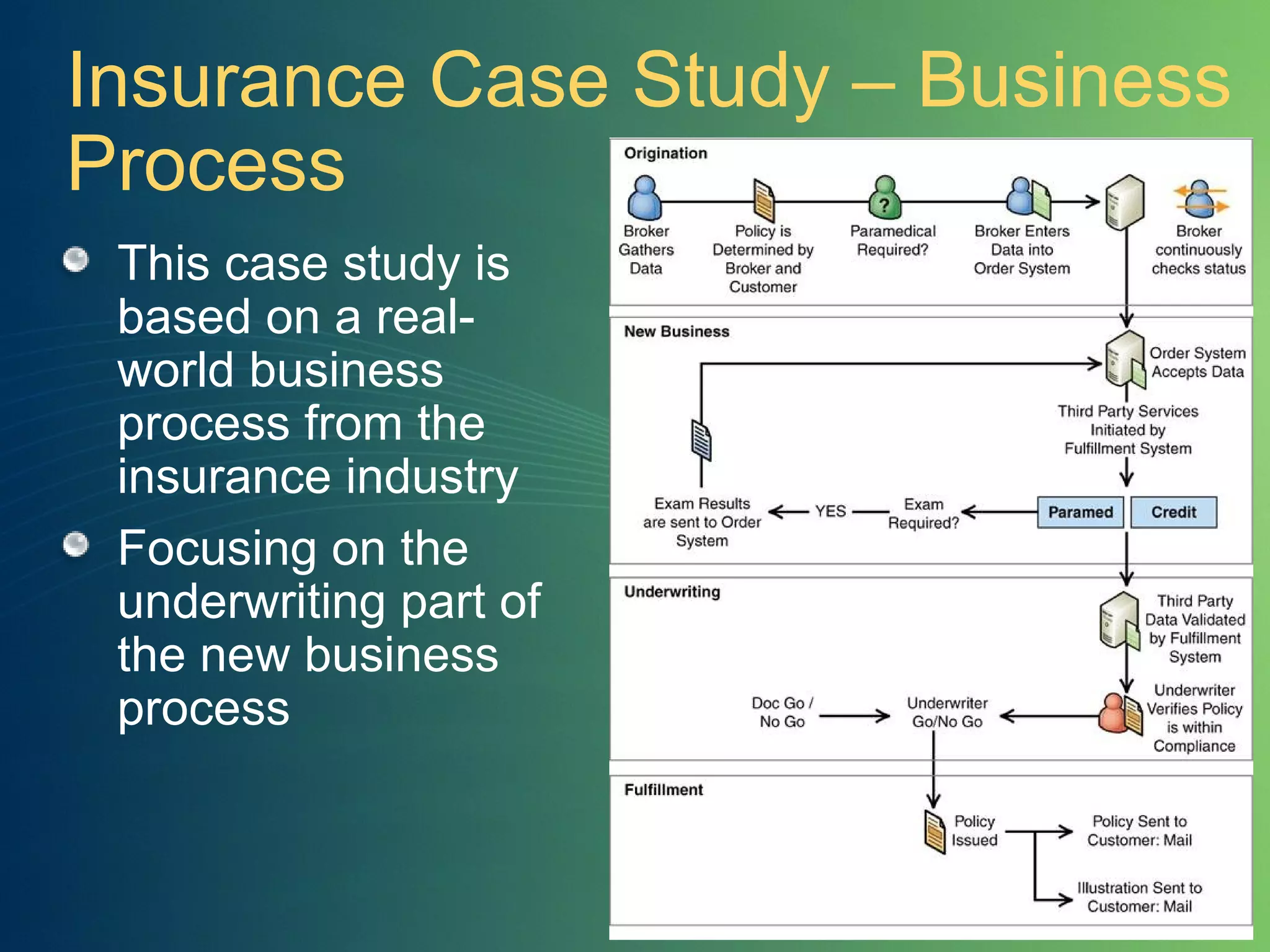
Insurance Case Study – Business Process This case study is based on a real-world business process from the insurance industry Focusing on the underwriting part of the new business process
Insurance Case Study – Architecture Overview
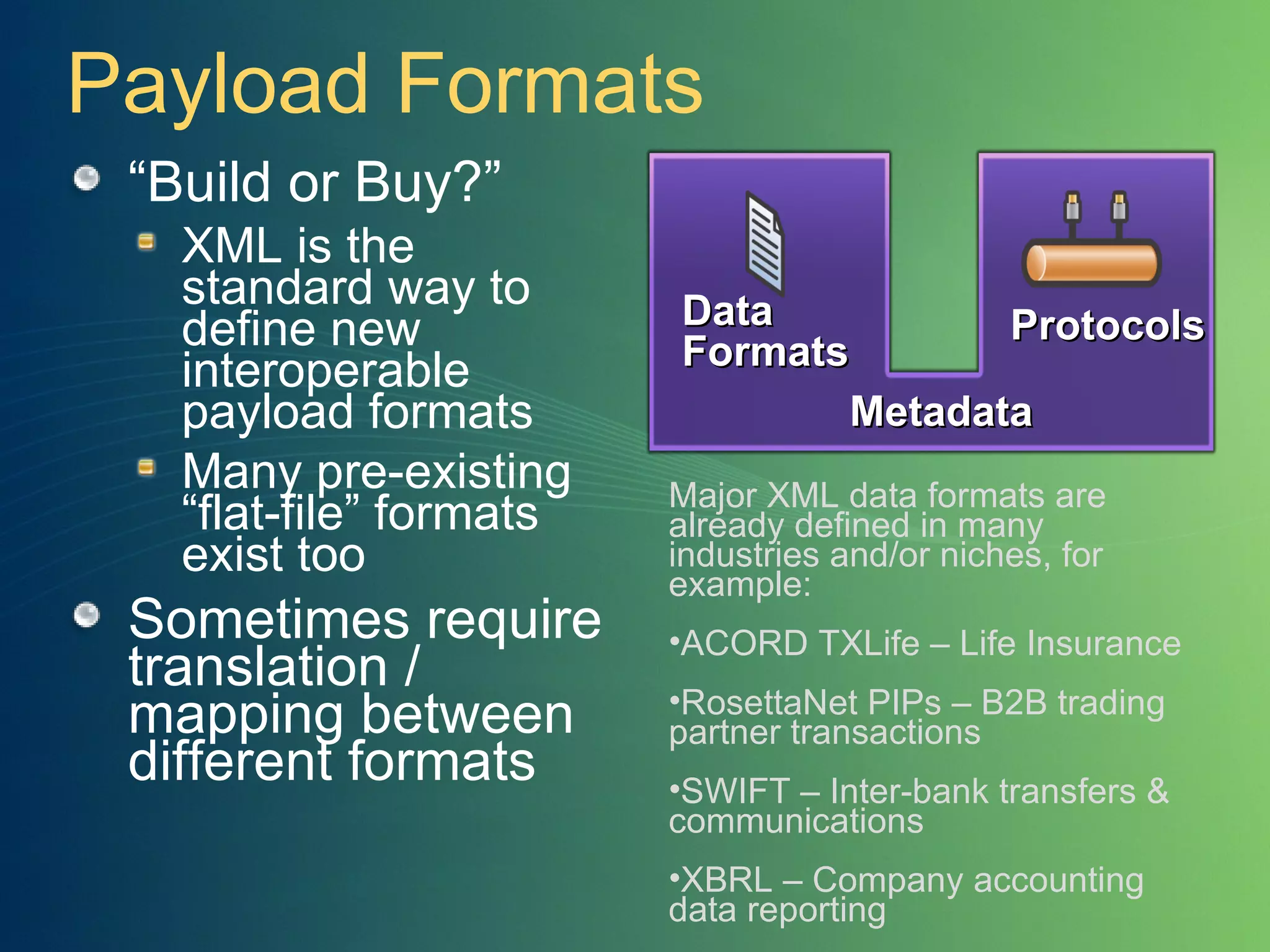
Payload Formats “ Build or Buy?” XML is the standard way to define new interoperable payload formats Many pre-existing “flat-file” formats exist too Sometimes require translation / mapping between different formats Major XML data formats are already defined in many industries and/or niches, for example: ACORD TXLife – Life Insurance RosettaNet PIPs – B2B trading partner transactions SWIFT – Inter-bank transfers & communications XBRL – Company accounting data reporting Metadata Data  Formats Protocols
Insurance Case Study – Message Flows
Interop Choices - Protocols “ Buy the Platform and then Build the config” Concentrate on the interop capabilities you need for your application E.g. Confidentiality, Reliability, Adressability Select appropriate WS-* protocols in the appropriate places E.g. WS-SecureConversation to protect long running conversation sessions Recommendation: Use the WS-* Architecture as a “menu” to choose the desired interop config
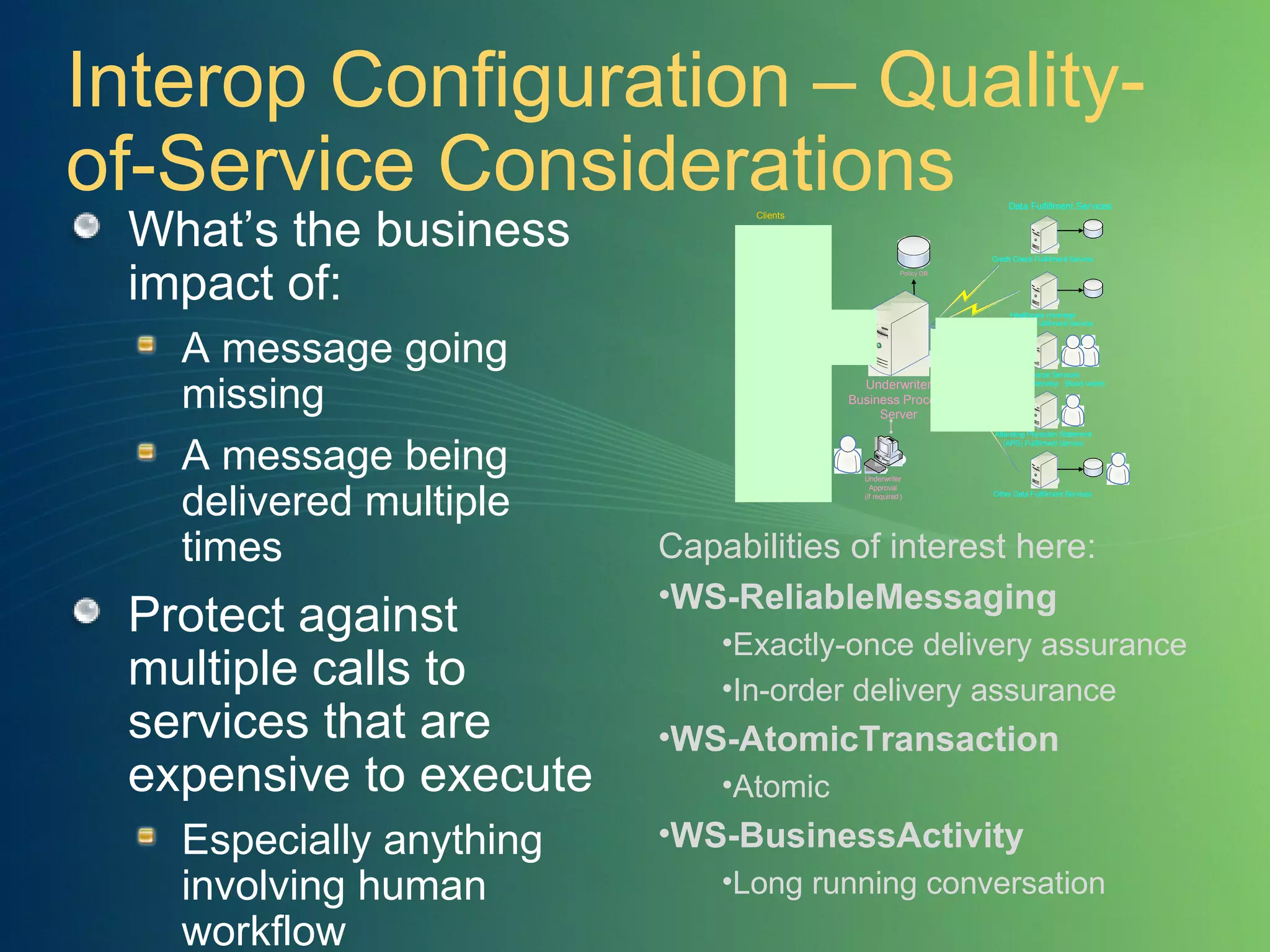
Interop Configuration – Quality-of-Service Considerations What’s the business impact of: A message going missing A message being delivered multiple times Protect against multiple calls to services that are expensive to execute Especially anything involving human workflow Capabilities of interest here: WS-ReliableMessaging Exactly-once delivery assurance In-order delivery assurance WS-AtomicTransaction Atomic WS-BusinessActivity Long running conversation
Interop Configuration – Security Considerations What is the business impact of: Interception of messages (confidentiality) Message alteration (tamper-proofing) Traffic routed through intermediary nodes Disclosure of personally identifiable information Required integrity guarantees Overall non-repudiation requirements Security processing overhead on throughput and latency Capabilities of interest here: WS-Security Basic XML encryption and signing, plus representations for various security tokens WS-SecureConversation Efficiently secure the exchange of multiple messages in a session WS-Trust Request and issue security tokens and to manage trust relationships WS-Federation Federation of identity and credentials across different trust realms
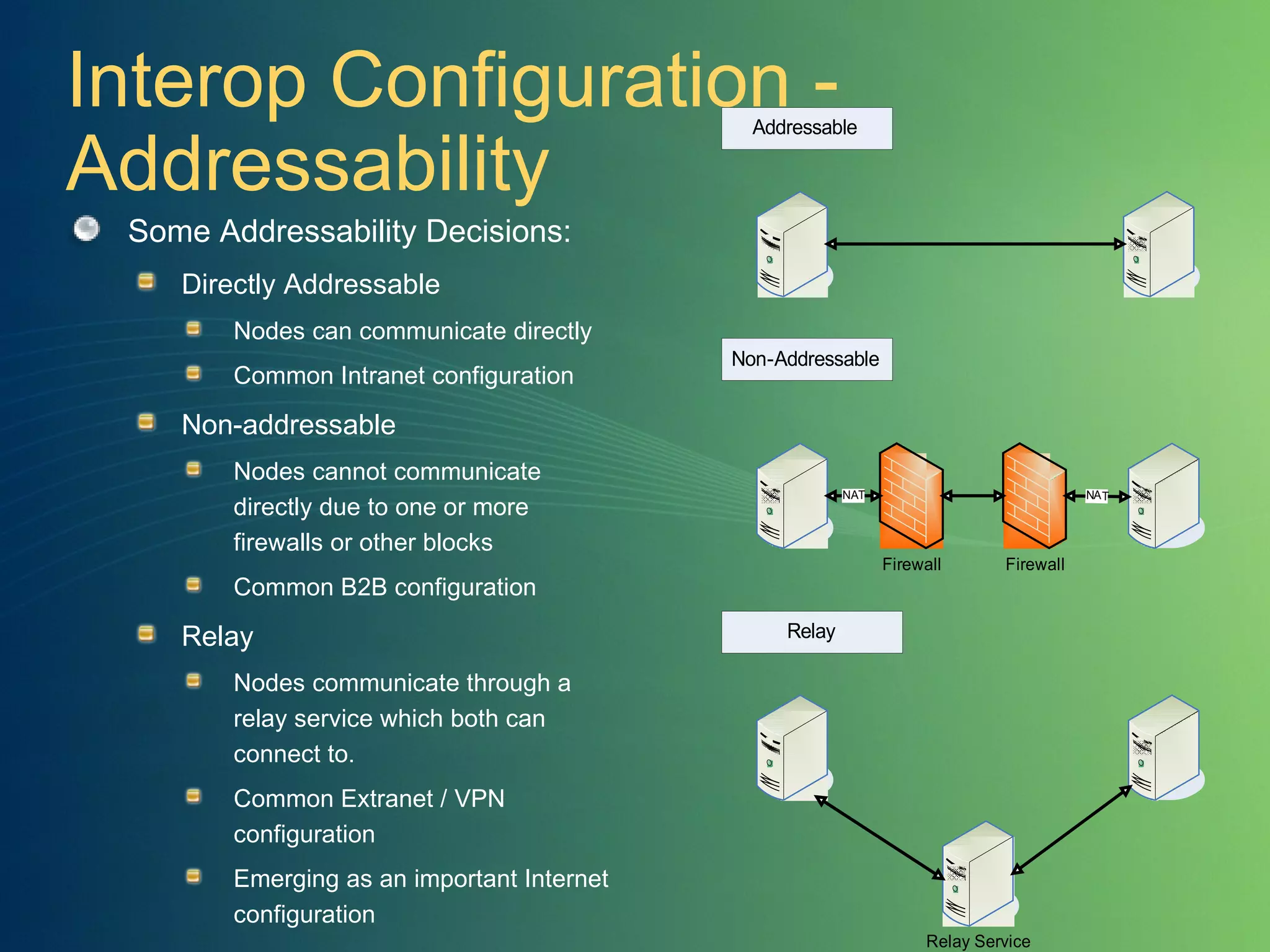
Interop Configuration - Addressability Some Addressability Decisions: Directly Addressable Nodes can communicate directly Common Intranet configuration Non-addressable  Nodes cannot communicate directly due to one or more firewalls or other blocks Common B2B configuration Relay Nodes communicate through a relay service which both can connect to. Common Extranet / VPN configuration Emerging as an important Internet configuration
Process Implementation “ Build or Buy?” BizTalk provides general purpose message processing, format mapping and workflow capabilities important  in this example Or vertical industry package products like AdminServer  provide automation of tailored business processes Process definitions are often not shared externally if viewed as a source of competitive advantage – focus on message interoperability instead
Insurance Marketplace Insurance is an important financial services market segment Microsoft works with ISV Partners to deliver full feature interoperable business solutions based on Microsoft platform products such as: Windows Server System .NET / Windows Communication Foundation Office BizTalk SQL Server AdminServer is a Microsoft ISV partner delivering a Policy Administration Server solution for the Insurance Industry AdminServer is using XML and Web Services to enrich the interoperability of their product
Leverage system constructs Enterprise rules library  Single repository for source code Certified on numerous technology stacks AdminServer – Systems Overview Modern Technology Platform Component-based Server-based Web-based Standards-based
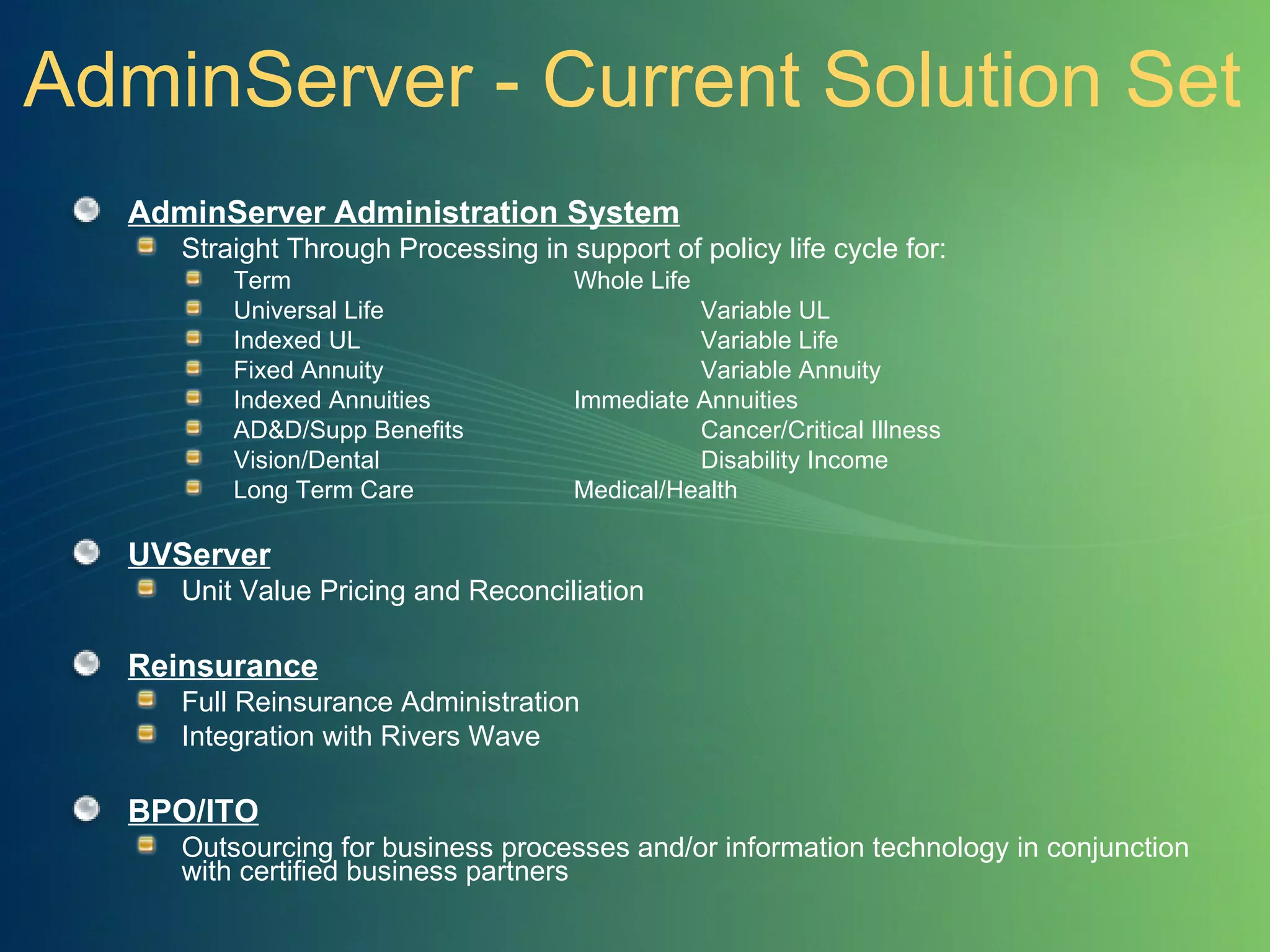
AdminServer - Current Solution Set AdminServer Administration System Straight Through Processing in support of policy life cycle for: Term Whole Life Universal Life Variable UL Indexed UL Variable Life Fixed Annuity Variable Annuity Indexed Annuities Immediate Annuities AD&D/Supp Benefits Cancer/Critical Illness Vision/Dental Disability Income Long Term Care Medical/Health UVServer Unit Value Pricing and Reconciliation  Reinsurance   Full Reinsurance Administration Integration with Rivers Wave BPO/ITO Outsourcing for business processes and/or information technology in conjunction with certified business partners
AdminServer - Future Solution Set Graphical Rules Interface (Beta) IllustrationServer (2007) Illustrations and re-projections Wealth management tools  NewBusinessServer (2007) Underwriting DistributionServer (2008) Licensing and appointments Hierarchy management Client Management System CRM capabilities Central Client repository Property & Casualty Personal Lines Commercial Lines
Summary Interoperability is connecting people, data, and diverse systems 5-P’s to achieve full business interoperability:  Payload, Protocols, Process, Partners and People XML and Web Services are the way to achieve high-fidelity, interoperable communications WS-* Architecture provides a “menu” of interoperability choices Focus on architectural decision criteria such as reliability, security, addressability to create an interoperability profile for your system
Resources Microsoft Interoperability Home Page http://www.microsoft.com/interop MSDN Web Services Home Page http://msdn.microsoft.com/webservices Microsoft Financial Services Industry Architecture Center http://msdn.microsoft.com/FinServArch AdminServer http://www.adminserver.com/
Q&A
© 2006 Microsoft Corporation. All rights reserved. Microsoft, Windows, Windows Vista and other product names are or may be registered trademarks and/or trademarks in the U.S. and/or other countries. The information herein is for informational purposes only and represents the current view of Microsoft Corporation as of the date of this presentation. Because Microsoft must respond to changing market conditions, it should not be interpreted to be a commitment on the part of Microsoft, and Microsoft cannot guarantee the accuracy of any information provided after the date of this presentation. MICROSOFT MAKES NO WARRANTIES, EXPRESS, IMPLIED OR STATUTORY, AS TO THE INFORMATION IN THIS PRESENTATION.
BACKUP SLIDES
Interoperability by Design “Connecting people, data, and diverse systems” Community Access Products Networking, UNIX systems, Data & Identity Commercial Community OSP (Open Specification Promise) Interoperability Executive Customer Council Collaboration Agreements Standards Document formats
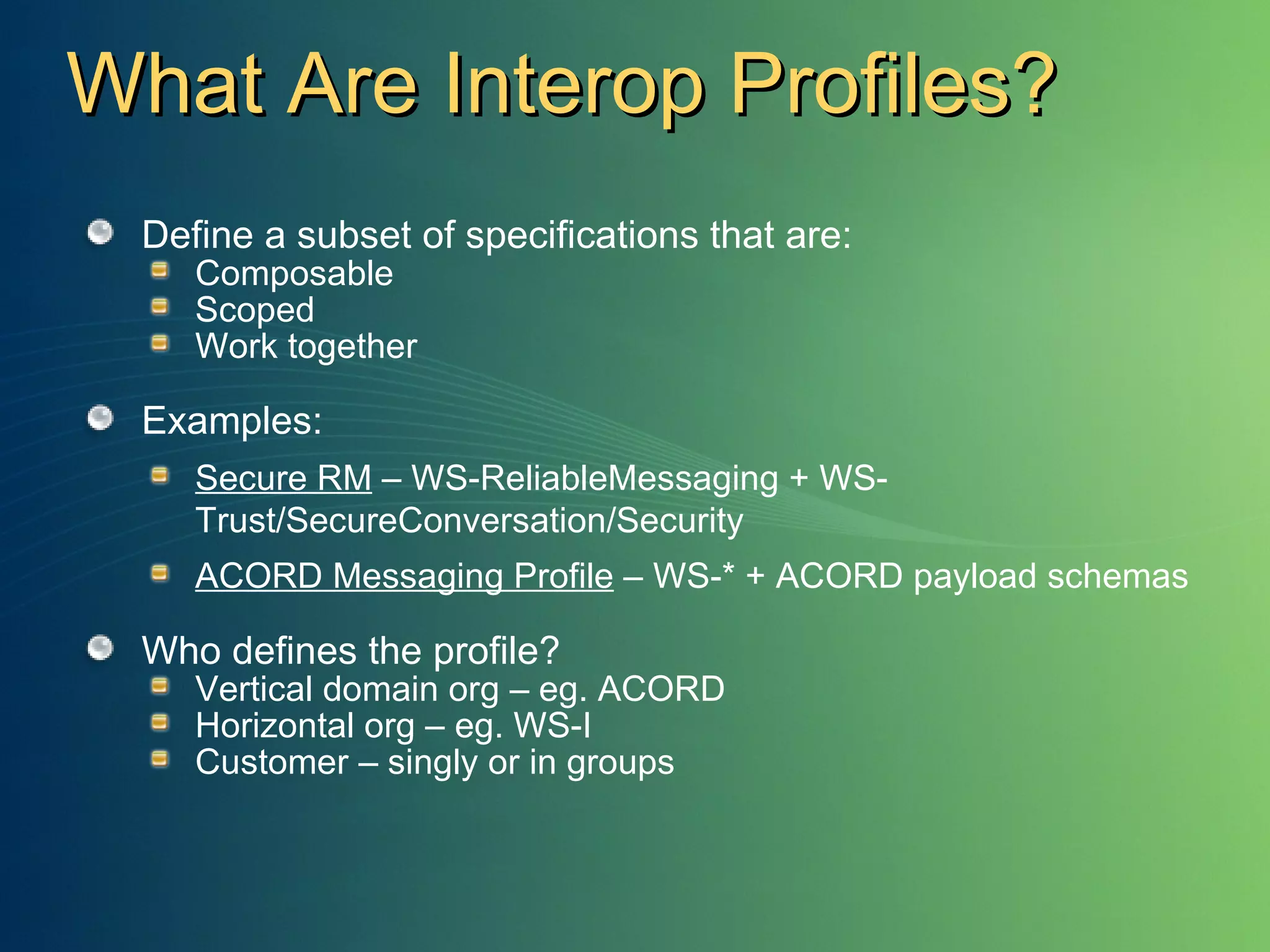
What Are Interop Profiles? Define a subset of specifications that are: Composable Scoped Work together Examples: Secure RM  – WS-ReliableMessaging + WS-Trust/SecureConversation/Security ACORD Messaging Profile  – WS-* + ACORD payload schemas Who defines the profile? Vertical domain org – eg. ACORD Horizontal org – eg. WS-I Customer – singly or in groups
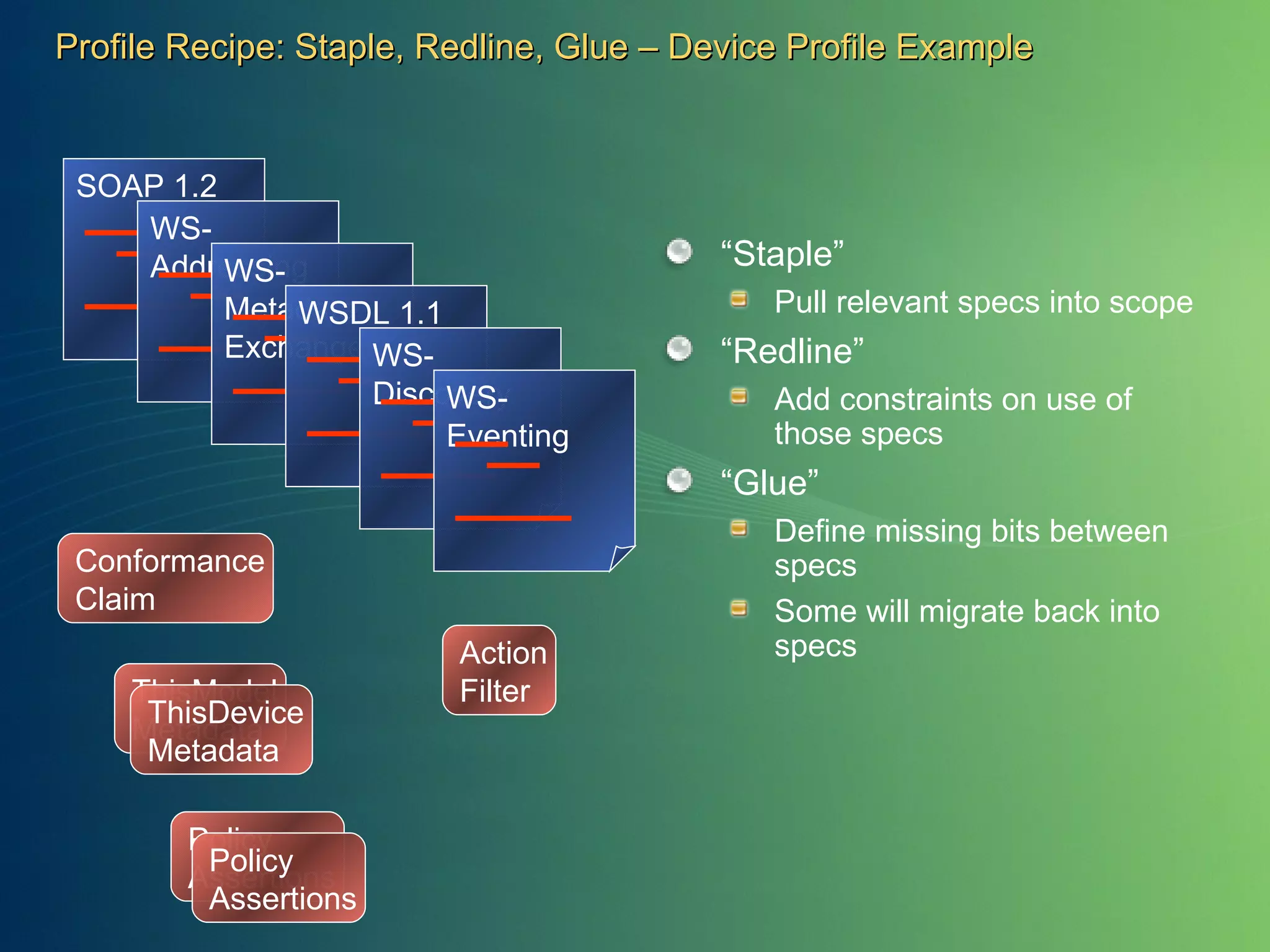
Profile Recipe: Staple, Redline, Glue – Device Profile Example “ Staple” Pull relevant specs into scope “ Redline” Add constraints on use of those specs “ Glue” Define missing bits between specs Some will migrate back into specs ThisModel Metadata ThisDevice Metadata Action Filter Conformance Claim Policy Assertions Policy Assertions SOAP 1.2 WS-Addressing WS-Metadata Exchange WSDL 1.1 WS-Discovery WS-Eventing
Why Do We Need Interop Profiles? Need to constrain (soften) runtime options to achieve out-of-box interoperability WS-* Architecture is designed for general applicability across a wide range of industries / scenarios Often too much optionality in the base specifications Tailor to specific domain / environment E.g. Devices Profile only requires SOAP 1.2 not SOAP 1.1 to lower implementation footprint Guide implementation and deployment choices Achieve a proven composition of protocols and payloads Allows simplification of application deployment  e.g. Microsoft Windows Communication Foundation product provides a pre-configured selection of common Web services interop profile to use
Interop Configuration – Message Exchange Patterns Some MEP Decisions: Request-Response Two-directional synchronous message flow Client initiates connection Duplex Bi-directional, asynchronous message flows One node initiates connection and the other establishes the return channel One-way Uni-directional message flow Client initiates connection Notification Uni-directional “reverse” flow Server initiates connection Callback Two-directional synchronous message flow Server initiates connection
Reliability Requirements
Security Requirements
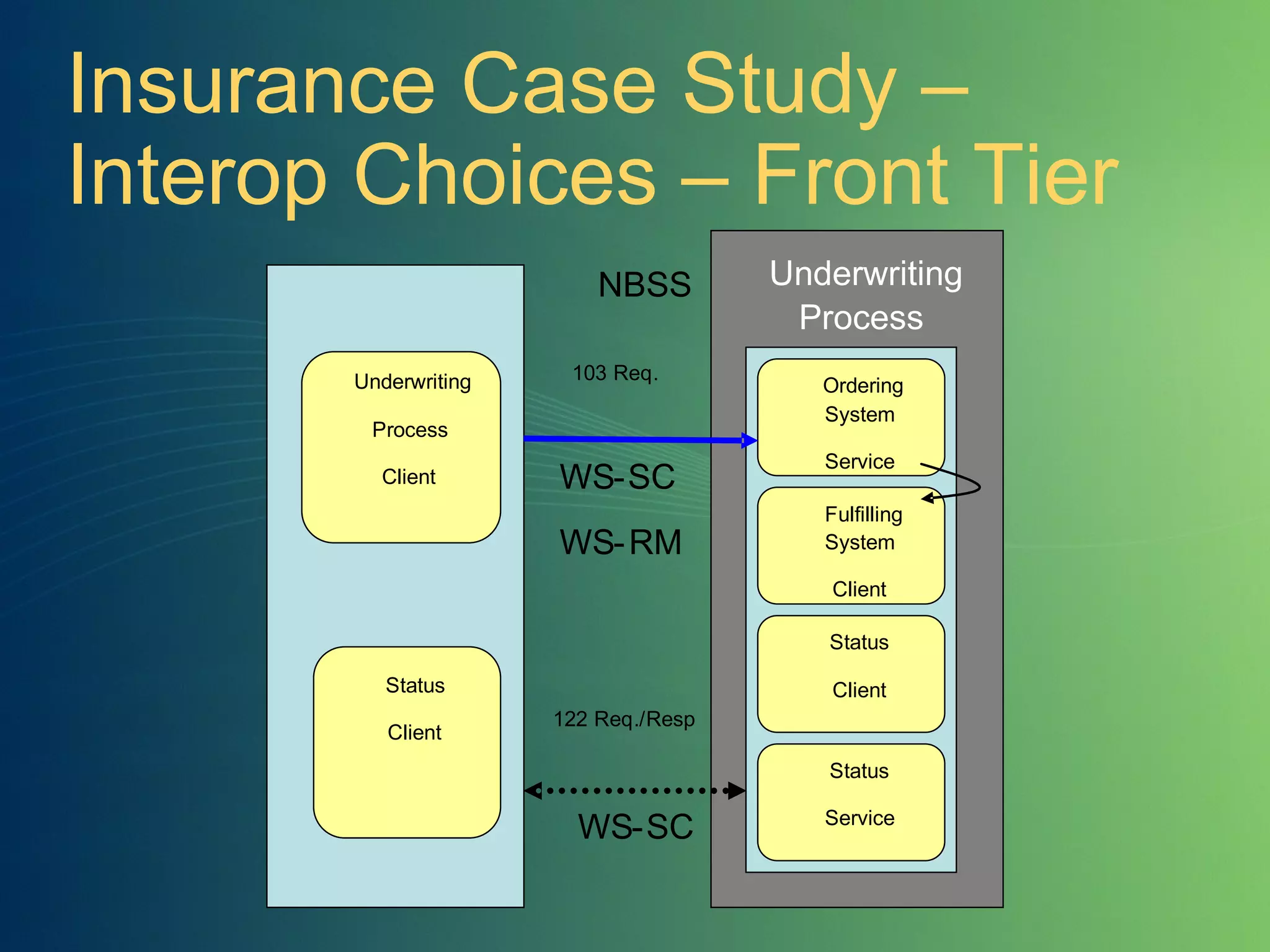
Insurance Case Study – Interop Choices – Front Tier
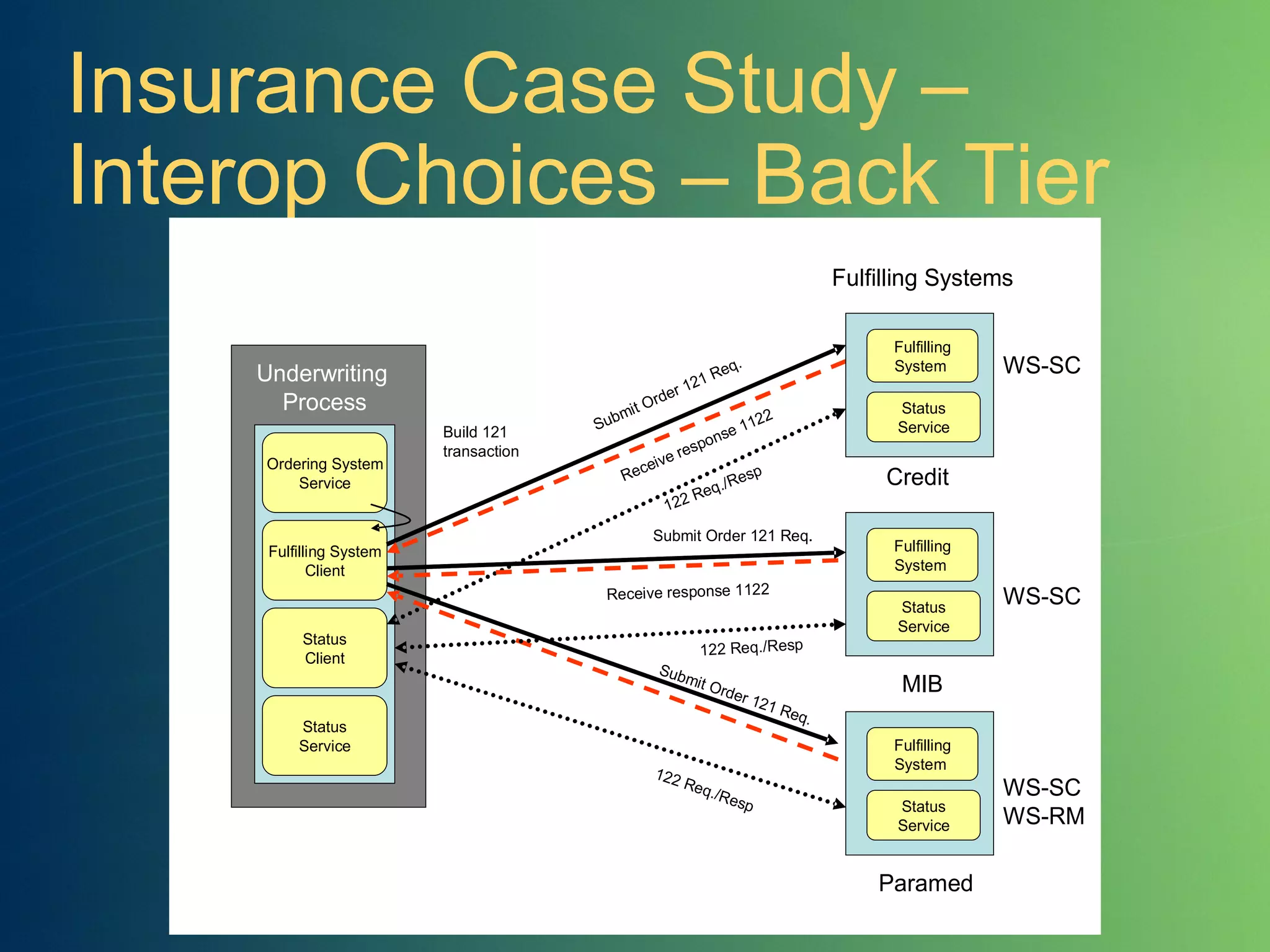
Insurance Case Study – Interop Choices – Back Tier
Microsoft Application Platform ASP.NET Services The Development Platform Shared Visual Studio experience Standard developer interactions: WCF: across services & messages ADO.Net: across data Active Directory Packaged or Custom Application ADO.net  WCF XML
WS-* Protocol Support XML Messaging Security Transactions Reliable Messaging Metadata

Real World Business Interoperability

  • 1.
    Real-World Business Interoperability. Connecting People, Data, & Diverse Systems Jorgen Thelin Connected Systems Division, Microsoft Corporation Erica Moe AdminServer Inc.
  • 2.
    Abstract Real-world BusinessInteroperability This session shows how Microsoft’s Web services platform products can be used to create an integration solution for a real-world business interoperability scenario in the insurance industry. We show how standard WS-* web services protocols combined with vertical industry payload standards such as the ACORD Life schemas can deliver true multi-vendor business solutions - based on interoperability principles that can be applied across any industry . Target Audience: CIO, Chief Architect, Architect
  • 3.
  • 4.
    Interoperability means connecting people, data, and diverse systems It gives customers control over the data they create and want to share Vendors create innovative solutions that bridge technologies to address real customer needs in an innovative manner The nature of software allows for translatability in lieu of uniformity
  • 5.
    Many Systems ==Development & Management Complexity FTP HL7 LDAP EDI WS-* SAP Oracle DB SNA DRDA TN3270 MQI Oracle LOB Siebel JD Edwards RLIO Tibco Clarify HTTP TCP/IP RosettaNet UPnP XML Swift HIPAA IBM DB2 Teradata (etc.) Database Clearing House Partner IBM Mainframe SAP Services Directory Remote Store Your Enterprise
  • 6.
    Why Interoperability? Interoperabilityis Connecting People , Data and Diverse Systems http://www.microsoft.com/interop/ Interoperability is now as important to must customers as security or reliability But interoperability is still just a means to an end Interoperability helps to: Reduce costs / Improve operational efficiencies Open access to new markets / Enable new business opportunities / Increase agility Maximize choice of solutions and vendors Ensure access to data across all applications
  • 7.
    Achieving Interoperable BusinessFactors required for business interoperability (5 P’s) Interoperable Communications Payloads – What to communicate – data formats Protocols – How to communicate - message formats and exchange patterns Processes – How to handle received communications Partners – Who does the process need to work with – both internal and external People – Who operates the process and deals with exceptions
  • 8.
    Insurance Case Study– Business Process This case study is based on a real-world business process from the insurance industry Focusing on the underwriting part of the new business process
  • 9.
    Insurance Case Study– Architecture Overview
  • 10.
    Payload Formats “Build or Buy?” XML is the standard way to define new interoperable payload formats Many pre-existing “flat-file” formats exist too Sometimes require translation / mapping between different formats Major XML data formats are already defined in many industries and/or niches, for example: ACORD TXLife – Life Insurance RosettaNet PIPs – B2B trading partner transactions SWIFT – Inter-bank transfers & communications XBRL – Company accounting data reporting Metadata Data Formats Protocols
  • 11.
    Insurance Case Study– Message Flows
  • 12.
    Interop Choices -Protocols “ Buy the Platform and then Build the config” Concentrate on the interop capabilities you need for your application E.g. Confidentiality, Reliability, Adressability Select appropriate WS-* protocols in the appropriate places E.g. WS-SecureConversation to protect long running conversation sessions Recommendation: Use the WS-* Architecture as a “menu” to choose the desired interop config
  • 13.
    Interop Configuration –Quality-of-Service Considerations What’s the business impact of: A message going missing A message being delivered multiple times Protect against multiple calls to services that are expensive to execute Especially anything involving human workflow Capabilities of interest here: WS-ReliableMessaging Exactly-once delivery assurance In-order delivery assurance WS-AtomicTransaction Atomic WS-BusinessActivity Long running conversation
  • 14.
    Interop Configuration –Security Considerations What is the business impact of: Interception of messages (confidentiality) Message alteration (tamper-proofing) Traffic routed through intermediary nodes Disclosure of personally identifiable information Required integrity guarantees Overall non-repudiation requirements Security processing overhead on throughput and latency Capabilities of interest here: WS-Security Basic XML encryption and signing, plus representations for various security tokens WS-SecureConversation Efficiently secure the exchange of multiple messages in a session WS-Trust Request and issue security tokens and to manage trust relationships WS-Federation Federation of identity and credentials across different trust realms
  • 15.
    Interop Configuration -Addressability Some Addressability Decisions: Directly Addressable Nodes can communicate directly Common Intranet configuration Non-addressable Nodes cannot communicate directly due to one or more firewalls or other blocks Common B2B configuration Relay Nodes communicate through a relay service which both can connect to. Common Extranet / VPN configuration Emerging as an important Internet configuration
  • 16.
    Process Implementation “Build or Buy?” BizTalk provides general purpose message processing, format mapping and workflow capabilities important in this example Or vertical industry package products like AdminServer provide automation of tailored business processes Process definitions are often not shared externally if viewed as a source of competitive advantage – focus on message interoperability instead
  • 17.
    Insurance Marketplace Insuranceis an important financial services market segment Microsoft works with ISV Partners to deliver full feature interoperable business solutions based on Microsoft platform products such as: Windows Server System .NET / Windows Communication Foundation Office BizTalk SQL Server AdminServer is a Microsoft ISV partner delivering a Policy Administration Server solution for the Insurance Industry AdminServer is using XML and Web Services to enrich the interoperability of their product
  • 18.
    Leverage system constructsEnterprise rules library Single repository for source code Certified on numerous technology stacks AdminServer – Systems Overview Modern Technology Platform Component-based Server-based Web-based Standards-based
  • 19.
    AdminServer - CurrentSolution Set AdminServer Administration System Straight Through Processing in support of policy life cycle for: Term Whole Life Universal Life Variable UL Indexed UL Variable Life Fixed Annuity Variable Annuity Indexed Annuities Immediate Annuities AD&D/Supp Benefits Cancer/Critical Illness Vision/Dental Disability Income Long Term Care Medical/Health UVServer Unit Value Pricing and Reconciliation Reinsurance Full Reinsurance Administration Integration with Rivers Wave BPO/ITO Outsourcing for business processes and/or information technology in conjunction with certified business partners
  • 20.
    AdminServer - FutureSolution Set Graphical Rules Interface (Beta) IllustrationServer (2007) Illustrations and re-projections Wealth management tools NewBusinessServer (2007) Underwriting DistributionServer (2008) Licensing and appointments Hierarchy management Client Management System CRM capabilities Central Client repository Property & Casualty Personal Lines Commercial Lines
  • 21.
    Summary Interoperability isconnecting people, data, and diverse systems 5-P’s to achieve full business interoperability: Payload, Protocols, Process, Partners and People XML and Web Services are the way to achieve high-fidelity, interoperable communications WS-* Architecture provides a “menu” of interoperability choices Focus on architectural decision criteria such as reliability, security, addressability to create an interoperability profile for your system
  • 22.
    Resources Microsoft InteroperabilityHome Page http://www.microsoft.com/interop MSDN Web Services Home Page http://msdn.microsoft.com/webservices Microsoft Financial Services Industry Architecture Center http://msdn.microsoft.com/FinServArch AdminServer http://www.adminserver.com/
  • 23.
  • 24.
    © 2006 MicrosoftCorporation. All rights reserved. Microsoft, Windows, Windows Vista and other product names are or may be registered trademarks and/or trademarks in the U.S. and/or other countries. The information herein is for informational purposes only and represents the current view of Microsoft Corporation as of the date of this presentation. Because Microsoft must respond to changing market conditions, it should not be interpreted to be a commitment on the part of Microsoft, and Microsoft cannot guarantee the accuracy of any information provided after the date of this presentation. MICROSOFT MAKES NO WARRANTIES, EXPRESS, IMPLIED OR STATUTORY, AS TO THE INFORMATION IN THIS PRESENTATION.
  • 25.
  • 26.
    Interoperability by Design“Connecting people, data, and diverse systems” Community Access Products Networking, UNIX systems, Data & Identity Commercial Community OSP (Open Specification Promise) Interoperability Executive Customer Council Collaboration Agreements Standards Document formats
  • 27.
    What Are InteropProfiles? Define a subset of specifications that are: Composable Scoped Work together Examples: Secure RM – WS-ReliableMessaging + WS-Trust/SecureConversation/Security ACORD Messaging Profile – WS-* + ACORD payload schemas Who defines the profile? Vertical domain org – eg. ACORD Horizontal org – eg. WS-I Customer – singly or in groups
  • 28.
    Profile Recipe: Staple,Redline, Glue – Device Profile Example “ Staple” Pull relevant specs into scope “ Redline” Add constraints on use of those specs “ Glue” Define missing bits between specs Some will migrate back into specs ThisModel Metadata ThisDevice Metadata Action Filter Conformance Claim Policy Assertions Policy Assertions SOAP 1.2 WS-Addressing WS-Metadata Exchange WSDL 1.1 WS-Discovery WS-Eventing
  • 29.
    Why Do WeNeed Interop Profiles? Need to constrain (soften) runtime options to achieve out-of-box interoperability WS-* Architecture is designed for general applicability across a wide range of industries / scenarios Often too much optionality in the base specifications Tailor to specific domain / environment E.g. Devices Profile only requires SOAP 1.2 not SOAP 1.1 to lower implementation footprint Guide implementation and deployment choices Achieve a proven composition of protocols and payloads Allows simplification of application deployment e.g. Microsoft Windows Communication Foundation product provides a pre-configured selection of common Web services interop profile to use
  • 30.
    Interop Configuration –Message Exchange Patterns Some MEP Decisions: Request-Response Two-directional synchronous message flow Client initiates connection Duplex Bi-directional, asynchronous message flows One node initiates connection and the other establishes the return channel One-way Uni-directional message flow Client initiates connection Notification Uni-directional “reverse” flow Server initiates connection Callback Two-directional synchronous message flow Server initiates connection
  • 31.
  • 32.
  • 33.
    Insurance Case Study– Interop Choices – Front Tier
  • 34.
    Insurance Case Study– Interop Choices – Back Tier
  • 35.
    Microsoft Application PlatformASP.NET Services The Development Platform Shared Visual Studio experience Standard developer interactions: WCF: across services & messages ADO.Net: across data Active Directory Packaged or Custom Application ADO.net WCF XML
  • 36.
    WS-* Protocol SupportXML Messaging Security Transactions Reliable Messaging Metadata

Editor's Notes

  • #2 06/06/09 15:48 © 2006 Microsoft Corporation. All rights reserved. Microsoft, Windows, Windows Vista and other product names are or may be registered trademarks and/or trademarks in the U.S. and/or other countries. The information herein is for informational purposes only and represents the current view of Microsoft Corporation as of the date of this presentation. Because Microsoft must respond to changing market conditions, it should not be interpreted to be a commitment on the part of Microsoft, and Microsoft cannot guarantee the accuracy of any information provided after the date of this presentation. MICROSOFT MAKES NO WARRANTIES, EXPRESS, IMPLIED OR STATUTORY, AS TO THE INFORMATION IN THIS PRESENTATION.