Identifying an Unknown Alcohol
Background Classification Tests  are qualitative tests which can indicate the presence of a particular functional group, such as an aldehyde or an alcohol. Two  inviolable rules  when performing classification tests: 1. Perform the test exactly as described. 2. Always perform tests on known compounds, one that will result in a positive test ( known positive ) and one that will result in a negative test ( known negative ) and then perform the tests on the  unknown compound .
Experimental Procedures Do this experiment before finishing the Grignard purification.   For all procedures in this lab, follow the lab manual exactly as written, but  change the order .  (Do Part 1 after Parts 2 & 3) New experimental order :  Part 2. Lucas Test    Part 3. TCICA Test: use gloves   Part 1. Derivative formation Omit  the refractive index and micro-boiling point sections. Do not cross contaminate the contents of your test tubes. There are three  Waste Bottles :  1. Recovered Lucas Solutions   2. Recovered TCICA Solutions   3. Recovered Alcohols Your lab report must state which type of alcohol is your unknown.
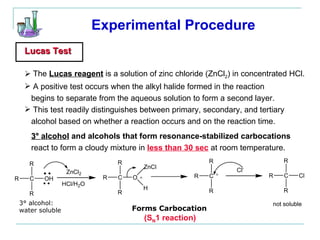
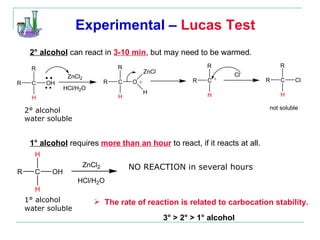
Experimental Procedure Lucas Test The  Lucas reagent  is a solution of zinc chloride (ZnCl 2 ) in concentrated HCl.  A positive test occurs when the alkyl halide formed in the reaction  begins to separate from the aqueous solution to form a second layer. This test readily distinguishes between primary, secondary, and tertiary  alcohol based on whether a reaction occurs and on the reaction time. 3°  alcohol  and alcohols that form resonance-stabilized carbocations   react to form a cloudy mixture in  less than 30 sec  at room temperature. 3° alcohol:  water soluble (S N 1 reaction) Forms Carbocation
Experimental –   Lucas Test 2° alcohol water soluble 2° alcohol  can react in  3-10 min , but may need to be warmed. 1° alcohol  requires  more than an hour  to react, if it reacts at all. NO REACTION in several hours 1° alcohol water soluble The rate of reaction is related to carbocation stability. 3° > 2° > 1°   alcohol
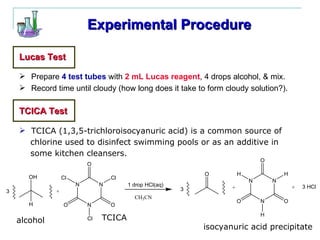
Lucas Test Prepare  4 test tubes  with  2 mL Lucas reagent , 4 drops alcohol, & mix. Record time until cloudy (how long does it take to form cloudy solution?). TCICA Test Experimental Procedure TCICA (1,3,5-trichloroisocyanuric acid) is a common source of  chlorine used to disinfect swimming pools or as an additive in  some kitchen cleansers. alcohol TCICA isocyanuric acid precipitate
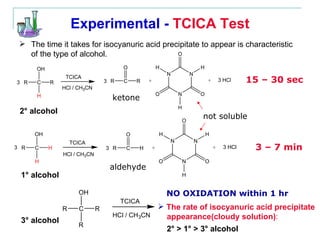
Experimental -   TCICA Test The time it takes for isocyanuric acid precipitate to appear is characteristic of the type of alcohol. 2° alcohol 15 – 30 sec 1° alcohol not soluble 3 – 7 min 3° alcohol NO OXIDATION within 1 hr ketone aldehyde The rate of isocyanuric acid precipitate  appearance(cloudy solution) :   2° > 1° >   3°   alcohol
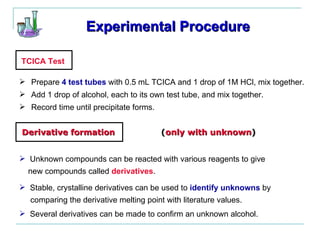
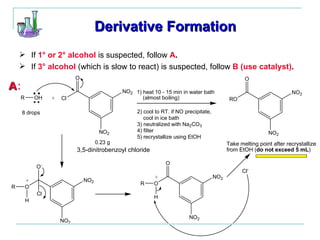
Experimental Procedure TCICA Test Prepare  4 test tubes  with 0.5 mL TCICA and 1 drop of 1M HCl, mix together. Add 1 drop of alcohol, each to its own test tube, and mix together. Record time until precipitate forms. Derivative formation   ( only with unknown ) Unknown compounds can be reacted with various reagents to give  new compounds called  derivatives . Stable, crystalline derivatives can be used to  identify unknowns  by  comparing the derivative melting point with literature values. Several derivatives can be made to confirm an unknown alcohol.
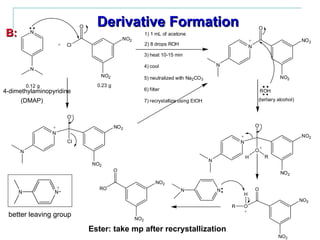
Derivative Formation If  1° or 2° alcohol  is suspected, follow  A . If  3° alcohol  (which is slow to react) is suspected, follow  B (use catalyst) . A : 3,5-dinitrobenzoyl chloride
Derivative Formation B: Ester: take mp after recrystallization better leaving group 4-dimethylaminopyridine (DMAP)
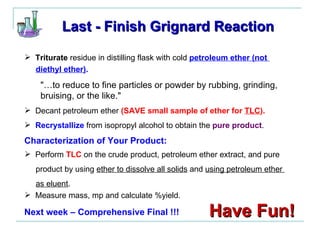
Last - Finish Grignard Reaction Triturate  residue in distilling flask with cold  petroleum ether (not  diethyl ether) . "…to reduce to fine particles or powder by rubbing, grinding, bruising, or the like."  Decant petroleum ether  (SAVE small sample of ether for  TLC ). Recrystallize  from isopropyl alcohol to obtain the  pure product . Perform  TLC  on the crude product, petroleum ether extract, and pure  product by using  ether to dissolve all solids  and  using petroleum ether  as eluent . Measure mass, mp and calculate %yield. Have Fun! Characterization of Your Product: Next week – Comprehensive Final !!!

Identifying Unknown Alcohol Fall 09

  • 1.
  • 2.
    Background Classification Tests are qualitative tests which can indicate the presence of a particular functional group, such as an aldehyde or an alcohol. Two inviolable rules when performing classification tests: 1. Perform the test exactly as described. 2. Always perform tests on known compounds, one that will result in a positive test ( known positive ) and one that will result in a negative test ( known negative ) and then perform the tests on the unknown compound .
  • 3.
    Experimental Procedures Dothis experiment before finishing the Grignard purification. For all procedures in this lab, follow the lab manual exactly as written, but change the order . (Do Part 1 after Parts 2 & 3) New experimental order : Part 2. Lucas Test Part 3. TCICA Test: use gloves Part 1. Derivative formation Omit the refractive index and micro-boiling point sections. Do not cross contaminate the contents of your test tubes. There are three Waste Bottles : 1. Recovered Lucas Solutions 2. Recovered TCICA Solutions 3. Recovered Alcohols Your lab report must state which type of alcohol is your unknown.
  • 4.
    Experimental Procedure LucasTest The Lucas reagent is a solution of zinc chloride (ZnCl 2 ) in concentrated HCl. A positive test occurs when the alkyl halide formed in the reaction begins to separate from the aqueous solution to form a second layer. This test readily distinguishes between primary, secondary, and tertiary alcohol based on whether a reaction occurs and on the reaction time. 3° alcohol and alcohols that form resonance-stabilized carbocations react to form a cloudy mixture in less than 30 sec at room temperature. 3° alcohol: water soluble (S N 1 reaction) Forms Carbocation
  • 5.
    Experimental – Lucas Test 2° alcohol water soluble 2° alcohol can react in 3-10 min , but may need to be warmed. 1° alcohol requires more than an hour to react, if it reacts at all. NO REACTION in several hours 1° alcohol water soluble The rate of reaction is related to carbocation stability. 3° > 2° > 1° alcohol
  • 6.
    Lucas Test Prepare 4 test tubes with 2 mL Lucas reagent , 4 drops alcohol, & mix. Record time until cloudy (how long does it take to form cloudy solution?). TCICA Test Experimental Procedure TCICA (1,3,5-trichloroisocyanuric acid) is a common source of chlorine used to disinfect swimming pools or as an additive in some kitchen cleansers. alcohol TCICA isocyanuric acid precipitate
  • 7.
    Experimental - TCICA Test The time it takes for isocyanuric acid precipitate to appear is characteristic of the type of alcohol. 2° alcohol 15 – 30 sec 1° alcohol not soluble 3 – 7 min 3° alcohol NO OXIDATION within 1 hr ketone aldehyde The rate of isocyanuric acid precipitate appearance(cloudy solution) : 2° > 1° > 3° alcohol
  • 8.
    Experimental Procedure TCICATest Prepare 4 test tubes with 0.5 mL TCICA and 1 drop of 1M HCl, mix together. Add 1 drop of alcohol, each to its own test tube, and mix together. Record time until precipitate forms. Derivative formation ( only with unknown ) Unknown compounds can be reacted with various reagents to give new compounds called derivatives . Stable, crystalline derivatives can be used to identify unknowns by comparing the derivative melting point with literature values. Several derivatives can be made to confirm an unknown alcohol.
  • 9.
    Derivative Formation If 1° or 2° alcohol is suspected, follow A . If 3° alcohol (which is slow to react) is suspected, follow B (use catalyst) . A : 3,5-dinitrobenzoyl chloride
  • 10.
    Derivative Formation B:Ester: take mp after recrystallization better leaving group 4-dimethylaminopyridine (DMAP)
  • 11.
    Last - FinishGrignard Reaction Triturate residue in distilling flask with cold petroleum ether (not diethyl ether) . "…to reduce to fine particles or powder by rubbing, grinding, bruising, or the like." Decant petroleum ether (SAVE small sample of ether for TLC ). Recrystallize from isopropyl alcohol to obtain the pure product . Perform TLC on the crude product, petroleum ether extract, and pure product by using ether to dissolve all solids and using petroleum ether as eluent . Measure mass, mp and calculate %yield. Have Fun! Characterization of Your Product: Next week – Comprehensive Final !!!