ALCOHOL
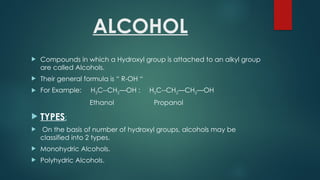
Compounds inwhich a Hydroxyl group is attached to an alkyl group
are called Alcohols.
Their general formula is “ R-OH “
For Example: H3C--CH2—OH : H3C--CH2—CH2—OH
Ethanol Propanol
TYPES:
On the basis of number of hydroxyl groups, alcohols may be
classified into 2 types.
Monohydric Alcohols.
Polyhydric Alcohols.
3.
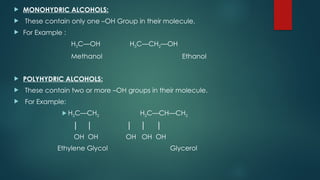
MONOHYDRIC ALCOHOLS:
These contain only one –OH Group in their molecule.
For Example :
H3C—OH H3C—CH2—OH
Methanol Ethanol
POLYHYDRIC ALCOHOLS:
These contain two or more –OH groups in their molecule.
For Example:
H2C—CH2 H2C—CH—CH2
│ │ │ │ │
OH OH OH OH OH
Ethylene Glycol Glycerol
4.
CLASSIFICATION OFMONOHYDRIC ALCOHOLS:
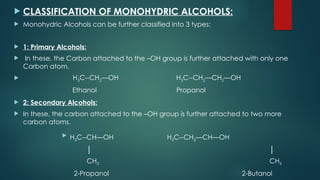
Monohydric Alcohols can be further classified into 3 types:
1: Primary Alcohols:
In these, the Carbon attached to the –OH group is further attached with only one
Carbon atom.
H3C--CH2—OH H3C--CH2—CH2—OH
Ethanol Propanol
2: Secondary Alcohols:
In these, the carbon attached to the –OH group is further attached to two more
carbon atoms.
H3C--CH—OH H3C--CH2—CH—OH
│ │
CH3 CH3
2-Propanol 2-Butanol
5.
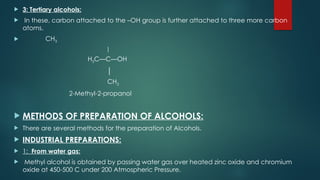
3: Tertiaryalcohols:
In these, carbon attached to the –OH group is further attached to three more carbon
atoms.
CH3
│
H3C—C—OH
│
CH3
2-Methyl-2-propanol
METHODS OF PREPARATION OF ALCOHOLS:
There are several methods for the preparation of Alcohols.
INDUSTRIAL PREPARATIONS:
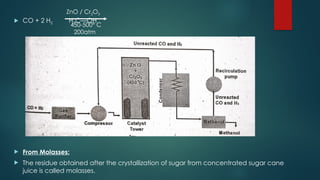
1: From water gas:
Methyl alcohol is obtained by passing water gas over heated zinc oxide and chromium
oxide at 450-500 C under 200 Atmospheric Pressure.
6.
CO +2 H2 H3C—OH
Methanol
From Molasses:
The residue obtained after the crystallization of sugar from concentrated sugar cane
juice is called molasses.
ZnO / Cr2O3
450-500° C
200atm
7.
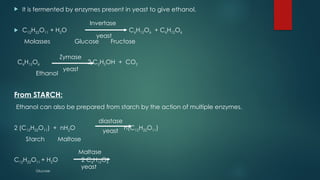
It isfermented by enzymes present in yeast to give ethanol.
C12H22O11 + H2O C6H12O6 + C6H12O6
Molasses Glucose Fructose
C6H12O6 2 C2H5OH + CO2
Ethanol
From STARCH:
Ethanol can also be prepared from starch by the action of multiple enzymes.
2 (C12H22O11) + nH2O n(C12H22O11)
Starch Maltose
C12H22O11 + H2O 2 C6H12O6
Glucose
Invertase
Zymase
yeast
yeast
yeast
yeast
diastase
Maltase
8.
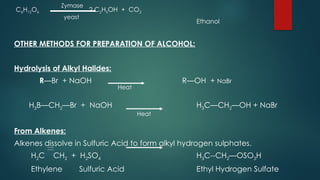
C6H12O6 2 C2H5OH+ CO2
Ethanol
OTHER METHODS FOR PREPARATION OF ALCOHOL:
Hydrolysis of Alkyl Halides:
R—Br + NaOH R—OH + NaBr
H3B—CH2—Br + NaOH H3C—CH2—OH + NaBr
From Alkenes:
Alkenes dissolve in Sulfuric Acid to form alkyl hydrogen sulphates.
H2C CH2 + H2SO4 H3C--CH2—OSO3H
Ethylene Sulfuric Acid Ethyl Hydrogen Sulfate
Zymase
yeast
Heat
Heat
9.
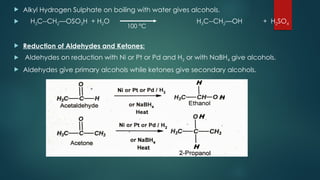
Alkyl HydrogenSulphate on boiling with water gives alcohols.
H3C--CH2—OSO3H + H2O H3C--CH2—OH + H2SO4
Reduction of Aldehydes and Ketones:
Aldehydes on reduction with Ni or Pt or Pd and H2 or with NaBH4 give alcohols.
Aldehydes give primary alcohols while ketones give secondary alcohols.
100 °C
10.
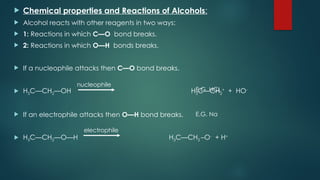
Chemical propertiesand Reactions of Alcohols:
Alcohol reacts with other reagents in two ways:
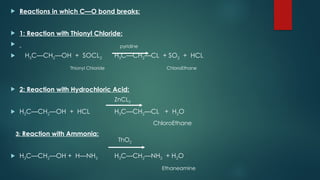
1: Reactions in which C—O bond breaks.
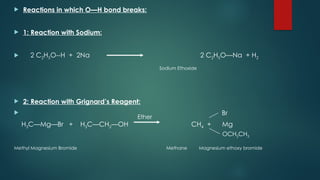
2: Reactions in which O—H bonds breaks.
If a nucleophile attacks then C—O bond breaks.
H3C—CH2—OH H3C—CH2
+
+ HO-
If an electrophile attacks then O—H bond breaks.
H3C—CH2—O—H H3C—CH2 –O-
+ H+
nucleophile
electrophile
E.G. HCL
E.G. Na
O O
H2SO4
H3C—CH2—OH + H3C—C—OH H3C—CH2—O—C—CH3 + H2O
Ethanol Acetic Acid Ethyl Acetate
Other Reactions of Alcohols:
1: Oxidation:
Oxidation of Alcohols forms aldehydes and ketones.
Primary alcohols give aldehydes, while secondary alcohols give ketones.
Best reagent for this purpose is Acid Dichromate.
H3C—CH2—OH + [O] + H3C—C — H + H2O
Ethanol Acetaldehyde
H3C H3C
CH—OH + [O] C
O
H3C
H3C
K2Cr2O7
K2Cr2O7
H2SO4
H2SO4
2-Propanol Acetone
3: Reaction with Acetic Acid:
14.
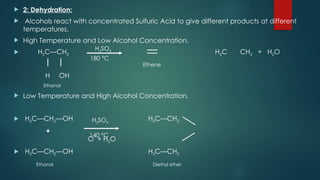
2: Dehydration:
Alcohols react with concentrated Sulfuric Acid to give different products at different
temperatures.
High Temperature and Low Alcohol Concentration.
H2C—CH2 H2C CH2 + H2O
Ethene
H OH
Ethanol
Low Temperature and High Alcohol Concentration.
H3C—CH2—OH H3C—CH2
+
O + H2O
H3C—CH2—OH H3C—CH2
Ethanol Diethyl ether
H2SO4
180 °C
140 °C
H2SO4
15.
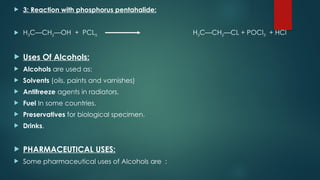
3: Reactionwith phosphorus pentahalide:
H3C—CH2—OH + PCL5 H3C—CH2—CL + POCl3 + HCl
Uses Of Alcohols:
Alcohols are used as:
Solvents (oils, paints and varnishes)
Antifreeze agents in radiators.
Fuel In some countries.
Preservatives for biological specimen.
Drinks.
PHARMACEUTICAL USES:
Some pharmaceutical uses of Alcohols are :
16.
Wound Dresser:Alcohol is used as an anti-septic as it has bactericidal effects.
E.g: Alcohol in Dettol.
Cough and Cold: Alcohol is found in most cough syrups as it has soothing effect on throat
and it also helps in curing cold and nose congestion.
Hand Disinfectant: It is the most common pharmaceutical use of Alcohol. It has anti-
fungal and anti-bacterial effects and thus, is used in most hand sanitizers.
In Filtration: Alcohol is also used in processes like filtration, distillation and removal of
impurities from a drug.
As Solvent: Alcohol is an excellent solvent for many drugs.
Temazepam: It is used in the treatment of insomnia and contains isopropyl and iso butyl
alcohol.
E.g. Brand name: Restoril.
17.
Amoxicillin Trihydrate:Amoxicillin is used to treat bacterial infections and dental
abscess. It contains alcohols, Iso-Propanol as active agents.
Brand Name: Amoxin And Larotid.
Bupropion Hydrochloride: It acts as anti-depressant and used in the treatment of
depressive disorder.
Brand Name: Wellbutrin.
Dental Gel: Corsodyl dental gel is used to treat gum diseases, recurring mouth ulcers,
prevent cavities and maintain mouth hygiene. It is made of 7.5% alcohol.
Codimol DM: (Dm = Dextromethophan)
It is used to treat symptoms caused by common cold , flu, allergies or other
breathing illnesses. It has Iso-propyl Alcohol and Iso-Butyl Alcohol.
E.g. : Brand name = Promethazine DM
Zonisamide: Zonisamide is an inhibitor that contains isopropyl alcohol and butyl
alcohol and is used in the treatment of seizure. Brand name: Zonegran.
Used as diluent: Alcohols act as diluent for many drugs, especially in homeopathy
treatment. A small amount of a drug can be diluted in alcohol , which is totally
harmless to the body.
18.
PHYSICAL PROPERTIES:
Lower alcohols are generally colorless liquids. (Methanol , Ethanol)
They have a characteristic sweet smell and burning taste.
Lower alcohols are readily soluble in water but solubility decreases in higher alcohols.
The solubility of alcohols is due to hydrogen bonding which is present in lower alcohols
but less in higher alcohols.
H+
—O+
- - - - H-
—O+
│ │
R H
Melting and boiling points of alcohols are higher than corresponding alkanes
E.g. Methyl alcohol and Ethyl Alcohols are liquids while methane and ethane are
gases.
This is also due to hydrogen bonding in alcohols.
19.
Identification Testsfor Alcohols:
1: Oxidation test (Dichromate test):
In this test, the alcohols are treated with sodium dichromate(Na2Cr2O7) In sulfuric acid
(Orange Solution). The rate of oxidation varies between primary, secondary and
tertiary alcohols .
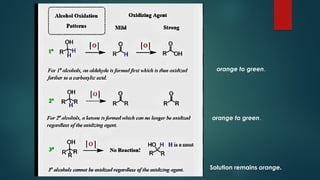
On the basis of their oxidation rates, alcohols can be distinguished as:
Primary alcohol gets easily oxidized to an aldehyde and further be oxidized to
carboxylic acid. There will be a change in color of solution from orange to green.
Secondary Alcohol gets oxidized to ketone but further oxidation is not possible .
There will be a change in color of solution from orange to green.
Tertiary alcohol doesn’t get oxidized. Solution remains orange.
2:Ceric ammoniumnitrate test:
Alcohol reacts with ceric ammonium nitrate (Yellow Colour) to form alkoxy
cerium compound (Pink or Red Colour)
2R—OH + (NH4)2Ce(NO3)6 (ROH)2Ce(NO3)4 +
2NH4NO3
Alcohol Ceric ammonium nitrate Alkoxy cerium compound
Ammonium Nitrate
Yellow Color Pink or Red Color
3:Sodium Metal Test:
When pure (Dried) Sodium metal is added to a solution containing alcohol, it creates
bubbles in the solution due to evolution of hydrogen gas. This evolution of hydrogen
gas indicates the presence of an alcohol.
This reaction is a vigorous reaction as Sodium metal reacts explosively.
R—OH + Na RO-
Na+
+ H2
22.
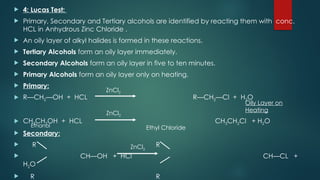
4: LucasTest:
Primary, Secondary and Tertiary alcohols are identified by reacting them with conc.
HCL in Anhydrous Zinc Chloride .
An oily layer of alkyl halides is formed in these reactions.
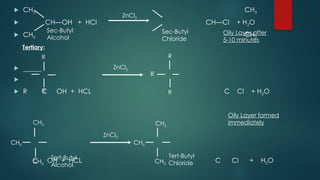
Tertiary Alcohols form an oily layer immediately.
Secondary Alcohols form an oily layer in five to ten minutes.
Primary Alcohols form an oily layer only on heating.
Primary:
R—CH2—OH + HCL R—CH2—Cl + H2O
CH3CH2OH + HCL CH3CH2Cl + H2O
Secondary:
R R
CH—OH + HCl CH—CL +
H2O
R R
ZnCl2
ZnCl2
ZnCl2
Ethanol Ethyl Chloride
Oily Layer on
Heating
23.
CH3 CH3
CH—OH + HCl CH—Cl + H2O
CH3 CH3
R C OH + HCL C Cl + H2O
C OH + HCL C Cl + H2O
ZnCl2
ZnCl2
R
R
R
R
R
ZnCl2
CH3
CH3
CH3
CH3
CH3
CH3
Tertiary:
Sec-Butyl
Alcohol
Sec-Butyl
Chloride
Tert-Butyl
Alcohol
Tert-Butyl
Chloride
Oily Layer after
5-10 minutes
Oily Layer formed
immediately

![O O
H2SO4
H3C—CH2—OH + H3C—C—OH H3C—CH2—O—C—CH3 + H2O
Ethanol Acetic Acid Ethyl Acetate
Other Reactions of Alcohols:
1: Oxidation:
Oxidation of Alcohols forms aldehydes and ketones.
Primary alcohols give aldehydes, while secondary alcohols give ketones.
Best reagent for this purpose is Acid Dichromate.
H3C—CH2—OH + [O] + H3C—C — H + H2O
Ethanol Acetaldehyde
H3C H3C
CH—OH + [O] C
O
H3C
H3C
K2Cr2O7
K2Cr2O7
H2SO4
H2SO4
2-Propanol Acetone
3: Reaction with Acetic Acid:](https://image.slidesharecdn.com/alcohol-260104182830-3e119dc8/85/ALCOHOL-pptxndndndndmdmdmdmdmmdmdmdmdmdmdmdmddmmddm-13-320.jpg)