Inclusion in
Secondary
Questions:
1.How would we know if the student is
progressing at a normal pace?
1.How would we identify a student who
has more than one Learning Need?
1.What strategies could we have in place
for students who have more than one
learning need?
Scaffold, Personalise,
Differentiate and Extend:
What questions do we ask to know if
progress is at normal pace?
Case Study #1 : Year 8, Female Student
× French and Filipina parentage
×Parents separated. Lives with father and
brother. Father often away.
× Speaks French but doesn’t write it.
×Internationally schooled for 4 years before GIS
in the French medium.
× Reading at Y8: 2C, Writing 3C.
×Few friends. Social English is well-developed.
× No interest in most academic subjects.
× Math skills below average.
×Handwriting is slow.
Case Study #2 : Year 7, Male Student
× Thai parentage in a blended family.
×Speaks Thai and English
× Doesn’t write Thai well.
× GIS primary to secondary for 4 years
×Reading at Y7: 2C, Writing 2A.
× Few friends. Social English not well-
developed.
×No interest in most academic subjects. Only
music. Homework issues.
× Math skills below average.
×Handwriting is slow.
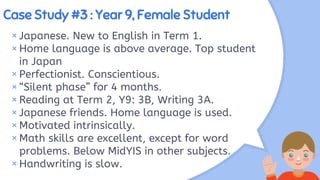
Case Study #3 : Year 9, Female Student
× Japanese. New to English in Term 1.
×Home language is above average. Top student
in Japan
× Perfectionist. Conscientious.
דSilent phase” for 4 months.
× Reading at Term 2, Y9: 3B, Writing 3A.
× Japanese friends. Home language is used.
×Motivated intrinsically.
× Math skills are excellent, except for word
problems. Below MidYIS in other subjects.
×Handwriting is slow.
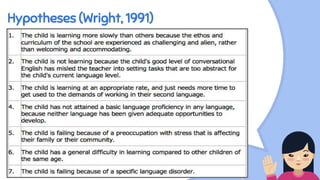
Hypotheses (Wright, 1991)
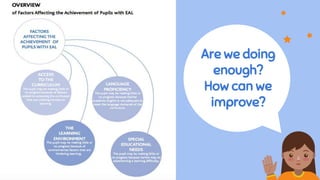
Are we doing
enough?
How can we
improve?
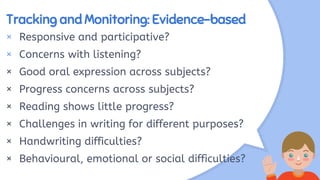
Tracking and Monitoring: Evidence-based
× Responsive and participative?
× Concerns with listening?
× Good oral expression across subjects?
× Progress concerns across subjects?
× Reading shows little progress?
× Challenges in writing for different purposes?
× Handwriting difficulties?
× Behavioural, emotional or social difficulties?
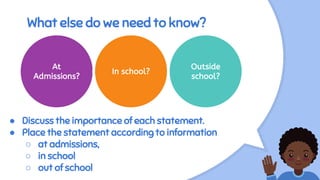
What else do we need to know?
At
Admissions?
Outside
school?
In school?
● Discuss the importance of each statement.
● Place the statement according to information
○ at admissions,
○ in school
○ out of school
How do we ensure
inclusion in our
classroom?
The inclusion checklist. See
how we rate!
Scaffold, Personalise,
Differentiate and Extend
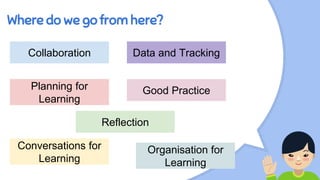
Where do we go from here?
Collaboration Data and Tracking
Good Practice
Reflection
Planning for
Learning
Conversations for
Learning
Organisation for
Learning
Collaboration
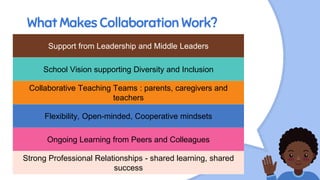
What Makes Collaboration Work?
Support from Leadership and Middle Leaders
School Vision supporting Diversity and Inclusion
Collaborative Teaching Teams : parents, caregivers and
teachers
Flexibility, Open-minded, Cooperative mindsets
Ongoing Learning from Peers and Colleagues
Strong Professional Relationships - shared learning, shared
success
Thanks!
Any questions?
You can find me at
× Sheila.s@gardenschool.edu.my
× Ms_SheilaD on Twitter
Citation
× Language Needs or Special Needs: Does it
Matter: NALDIC
× Distinguishing the Difference Between Language
Needs and SEN
× Guidance on the Assessment of EAL Learners
who may have SEN: Milton Keynes
× Distinguishing the Difference between SEN and
EAL: Step-by-Step Procedure

Identifying SEN and EAL learners

  • 1.
  • 2.
    Questions: 1.How would weknow if the student is progressing at a normal pace? 1.How would we identify a student who has more than one Learning Need? 1.What strategies could we have in place for students who have more than one learning need?
  • 3.
    Scaffold, Personalise, Differentiate andExtend: What questions do we ask to know if progress is at normal pace?
  • 4.
    Case Study #1: Year 8, Female Student × French and Filipina parentage ×Parents separated. Lives with father and brother. Father often away. × Speaks French but doesn’t write it. ×Internationally schooled for 4 years before GIS in the French medium. × Reading at Y8: 2C, Writing 3C. ×Few friends. Social English is well-developed. × No interest in most academic subjects. × Math skills below average. ×Handwriting is slow.
  • 5.
    Case Study #2: Year 7, Male Student × Thai parentage in a blended family. ×Speaks Thai and English × Doesn’t write Thai well. × GIS primary to secondary for 4 years ×Reading at Y7: 2C, Writing 2A. × Few friends. Social English not well- developed. ×No interest in most academic subjects. Only music. Homework issues. × Math skills below average. ×Handwriting is slow.
  • 6.
    Case Study #3: Year 9, Female Student × Japanese. New to English in Term 1. ×Home language is above average. Top student in Japan × Perfectionist. Conscientious. דSilent phase” for 4 months. × Reading at Term 2, Y9: 3B, Writing 3A. × Japanese friends. Home language is used. ×Motivated intrinsically. × Math skills are excellent, except for word problems. Below MidYIS in other subjects. ×Handwriting is slow.
  • 7.
  • 8.
    Are we doing enough? Howcan we improve?
  • 9.
    Tracking and Monitoring:Evidence-based × Responsive and participative? × Concerns with listening? × Good oral expression across subjects? × Progress concerns across subjects? × Reading shows little progress? × Challenges in writing for different purposes? × Handwriting difficulties? × Behavioural, emotional or social difficulties?
  • 10.
    What else dowe need to know? At Admissions? Outside school? In school? ● Discuss the importance of each statement. ● Place the statement according to information ○ at admissions, ○ in school ○ out of school
  • 11.
    How do weensure inclusion in our classroom? The inclusion checklist. See how we rate!
  • 12.
  • 13.
    Where do wego from here? Collaboration Data and Tracking Good Practice Reflection Planning for Learning Conversations for Learning Organisation for Learning
  • 14.
  • 15.
    What Makes CollaborationWork? Support from Leadership and Middle Leaders School Vision supporting Diversity and Inclusion Collaborative Teaching Teams : parents, caregivers and teachers Flexibility, Open-minded, Cooperative mindsets Ongoing Learning from Peers and Colleagues Strong Professional Relationships - shared learning, shared success
  • 17.
    Thanks! Any questions? You canfind me at × Sheila.s@gardenschool.edu.my × Ms_SheilaD on Twitter
  • 18.
    Citation × Language Needsor Special Needs: Does it Matter: NALDIC × Distinguishing the Difference Between Language Needs and SEN × Guidance on the Assessment of EAL Learners who may have SEN: Milton Keynes × Distinguishing the Difference between SEN and EAL: Step-by-Step Procedure

Editor's Notes

  • #8 The achievement of pupils learning EAL is affected by factors relating to four areas: (a) the pupil’s level of language proficiency (b) the extent to which the learning environment is supportive (c) the extent to which the pupil has access to the curriculum (d) whether the pupil has special educational needs. https://eal.britishcouncil.org/sites/default/files/document-files/Distinguishing%20the%20difference.pdf
  • #12 Pupils learning EAL may also be judged to be showing adequate progress by: progress in English language acquisition (i.e. EAL language phases) transfer of skills from first language strengths in first language progress when something is taught and assessed in first language ability to use self help skills to compensate for lack of English development of play skills acquiring non-verbal skills skills shown in different contexts e.g. community language classes, at home, in other areas of the curriculum
  • #16 Progress in second language acquisition is dependent upon the classroom environment and the teaching strategies used. Where a pupil is experiencing academic difficulties, teachers should first critically examine the range of teaching and learning on offer. Access to the curriculum is based upon understanding of the key vocabulary and conceptual language. Pupil progress in language acquisition and learning are accelerated where a range of effective strategies for supporting EAL learners are in place. Closes the attainment gap between the pupil and their peers Prevents the attainment gap getting wider Is similar to that of peers starting from the same baseline, even if less than the majority of peers matches or betters the pupil‟s previous rate of progress Enables the pupil to have full access to the curriculum shows improvement in self-help, social or personal skills shows improvement in the pupil‟s behaviour where that is of concern