Early Literacy: Helping Children on the Path to Reading Success Presented by: First Grade Teachers:   Melissa Hembrey, Amy Lederer, Whitney Malone, Jenny Pendleton  Reading Specialist:   Jeri Powers
Agenda Welcome and Introductions Why Early Literacy is Crucial Assessment of Early Literacy Fun Activities:  Break-Out Sessions Questions and Answers
Why Worry About Basic Early Literacy Skills? Reality:   Reading Trajectories are Established Early “ Overall, national longitudinal studies show that more than 17.5% of the nation’s children – about 10 million children – will encounter reading problems in the  crucial first three years of their schooling .” --National Reading Panel Progress Report, 2000
Good, R. H., Simmons, D. C., & Smith, S. B. (1998). Effective academic interventions in the United States: Evaluating and enhancing the acquisition of early reading skills.  School Psychology Review, 27 , 740-753.
Reality: Established Reading Trajectories  are Difficult to Change. “Approximately 75% of students identified with reading problems in the third grade are still reading disabled in the 9 th  grade.” --Shaywitz, et al., 1993; Francis et al., 1996
Good, R. H., Simmons, D. C., & Smith, S. B. (1998). Effective academic interventions in the United States: Evaluating and enhancing the acquisition of early reading skills.  School Psychology Review, 27 , 740-753.
Reality: Traditional  Direct Measures of Reading Identify Trajectories Too Late The  best solution  to the problem of reading failure is to allocate resources for  early identification   and prevention . It is a tragedy of the first order that while we know clearly the costs of waiting too long, few school districts have in place a mechanism to identify and help children before failure takes hold. Indeed, in the majority of cases, there is no  systematic identification  until third grade, by which time successful remediation is more difficult and more costly .  ---Joseph K. Torgeson, 1998
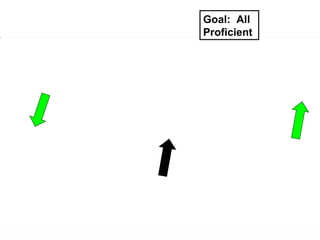
Goal:  All Proficient
How do Children Acquire Essential Early Literacy Skills? Family is the Root of a  Child’s Early Literacy  Experiences (IRA, 2003)
Characteristics of Families Whose Children Do Well in School Establish a  daily family routine Monitor and  set limits  on out-of-school activities Model the  value of learning, self discipline, hard work Express  high but realistic expectations  for achievement Encourage  children’s development and  progress in school Encourage  reading, writing, and  discussions  at home View  reading  as an  enjoyable activity   –  not homework Use  community resources
Time Spent Reading Each   Day
The Power of Parents… What young children learn…are  deeply affected by their relationships with parents, the behavior of parents,  and the environment of the homes in which they live.”  (Primavera, 2000) Helping children recognize letters Reading to children Assisting children with reading and writing assignments
How Do We Make Sure Children Don’t Fall Behind? The best solution to the problem of reading failure is to allocate resources for  early identification and prevention… ---Joseph K. Torgeson, 1998
Parents and Teachers Working Together… When schools work together with families to support learning, children tend to succeed not just in school but throughout life. --Henderson Research Study, 1997
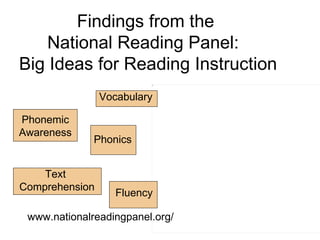
Findings from the  National Reading Panel:  Big Ideas for Reading Instruction Phonemic Awareness Phonics Vocabulary Text  Comprehension Fluency www.nationalreadingpanel.org/
Literacy Assessments:  An Ongoing Process Dynamic Indicators of Basic Early Literacy Skills (DIBELS) Benchmark Assessment Diagnostic Word Study Inventory Informal Teacher Assessments
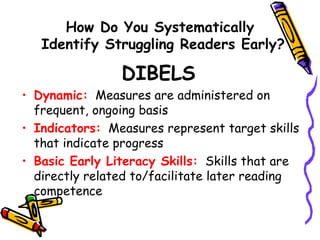
How Do You Systematically  Identify Struggling Readers Early? DIBELS  Dynamic:   Measures are administered on frequent, ongoing basis Indicators:   Measures represent target skills that indicate progress Basic Early Literacy Skills:   Skills that are directly related to/facilitate later reading competence
Purpose of DIBELS Identify children at-risk for reading difficulty EARLY Target early literacy skills that can be developed by instruction and learning opportunities Evaluate the effects of interventions to reduce risk
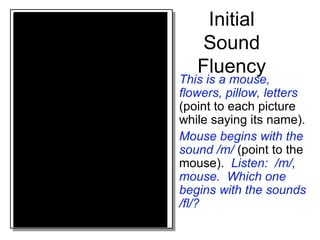
Initial Sound Fluency This is a mouse, flowers, pillow, letters  (point to each picture while saying its name). Mouse begins with the sound /m/  (point to the mouse).  Listen:  /m/, mouse.  Which one begins with the sounds /fl/?
 
Phoneme Segmentation Fluency I am going to say a word.  After I say it, you tell me all the sounds in the word.  So, if I say, “sam,” you would say /s/ /a/ /m/.  Let’s try one.  (one second pause).  Tell me the sounds in “mop” Ok.  Here is your first word.
DIBELS Nonsense Word Fluency Here are some more make-believe words   (point to the student probe).   Start here   (point to the first word)   and go across the page   (point across the page).   When I say, “begin”, read the words the best you can.  Point to each letter and tell me the sound  or  read the whole word.  Read the words the best you can.  Put your finger on the first word. Ready, begin.
DIBELS Oral Reading Fluency Please read this  (point)  out loud.  If you get stuck, I will tell you the word so you can keep reading.  When I say, “stop” I may ask you to tell me about what you read, so do your best reading.  Start here  (point to the first word of the passage).   Begin.
Benchmark Reading Assessment Authentic assessment that guides instruction. *Helps to identify the specific strengths our students have and the skill areas where they need support  *Helps to monitor students' growth and development over time.  *Ensure your teaching strategies are at the appropriate level
Analyzing Errors for Instructional Direction
Word Study The best differentiator between good and poor readers is repeatedly found to be their knowledge of  spelling patterns  and their proficiency with spelling-sound translations. Marilyn Adams,    Beginning to Read
Diagnostic Word Study Assessment Administered 3 times per year Helps to track students’ progress and guide instruction Allows for error analysis – determine what a child knows and doesn’t know
Word Study Stages There is remarkable consistency between the stages of spelling development and the stages of reading acquisition. (Ehri, 1997; Frith, 1985; Juel, 1991)
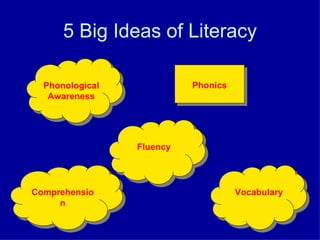
5 Big Ideas of Literacy Phonics Phonological Awareness Comprehension Vocabulary Fluency
Phonological Awareness “Playing with the Sounds of our Language” Ability to recognize and manipulate sounds in words without attaching printed letters.  Rhymes and alliterations  Syllables Sounds within words
Phonics The relationship between written letters and the sounds they produce Decode words when reading Encode words when spelling Sight words
Fluency Ability to read a text accurately, effortlessly, and with good expression.
Vocabulary Understanding what words mean when we see them in written materials, like books, or understanding words that people use when talking.
Comprehension Understanding what you read and the ability to communicate it to others. It is the reason for reading!  Predicting Summarizing Main Idea Answering and Generating Questions Prior knowledge Mental imagery Self monitoring Inferencing
Break-Out Sessions Designated tables are set up around the cafeteria. If you signed up for vocabulary, go to that station first. Other stations may be attended in any order. Timer will sound when time to rotate to next center.

Early literacy night 2007

  • 1.
    Early Literacy: HelpingChildren on the Path to Reading Success Presented by: First Grade Teachers: Melissa Hembrey, Amy Lederer, Whitney Malone, Jenny Pendleton Reading Specialist: Jeri Powers
  • 2.
    Agenda Welcome andIntroductions Why Early Literacy is Crucial Assessment of Early Literacy Fun Activities: Break-Out Sessions Questions and Answers
  • 3.
    Why Worry AboutBasic Early Literacy Skills? Reality: Reading Trajectories are Established Early “ Overall, national longitudinal studies show that more than 17.5% of the nation’s children – about 10 million children – will encounter reading problems in the crucial first three years of their schooling .” --National Reading Panel Progress Report, 2000
  • 4.
    Good, R. H.,Simmons, D. C., & Smith, S. B. (1998). Effective academic interventions in the United States: Evaluating and enhancing the acquisition of early reading skills. School Psychology Review, 27 , 740-753.
  • 5.
    Reality: Established ReadingTrajectories are Difficult to Change. “Approximately 75% of students identified with reading problems in the third grade are still reading disabled in the 9 th grade.” --Shaywitz, et al., 1993; Francis et al., 1996
  • 6.
    Good, R. H.,Simmons, D. C., & Smith, S. B. (1998). Effective academic interventions in the United States: Evaluating and enhancing the acquisition of early reading skills. School Psychology Review, 27 , 740-753.
  • 7.
    Reality: Traditional Direct Measures of Reading Identify Trajectories Too Late The best solution to the problem of reading failure is to allocate resources for early identification and prevention . It is a tragedy of the first order that while we know clearly the costs of waiting too long, few school districts have in place a mechanism to identify and help children before failure takes hold. Indeed, in the majority of cases, there is no systematic identification until third grade, by which time successful remediation is more difficult and more costly . ---Joseph K. Torgeson, 1998
  • 8.
    Goal: AllProficient
  • 9.
    How do ChildrenAcquire Essential Early Literacy Skills? Family is the Root of a Child’s Early Literacy Experiences (IRA, 2003)
  • 10.
    Characteristics of FamiliesWhose Children Do Well in School Establish a daily family routine Monitor and set limits on out-of-school activities Model the value of learning, self discipline, hard work Express high but realistic expectations for achievement Encourage children’s development and progress in school Encourage reading, writing, and discussions at home View reading as an enjoyable activity – not homework Use community resources
  • 11.
  • 12.
    The Power ofParents… What young children learn…are deeply affected by their relationships with parents, the behavior of parents, and the environment of the homes in which they live.” (Primavera, 2000) Helping children recognize letters Reading to children Assisting children with reading and writing assignments
  • 13.
    How Do WeMake Sure Children Don’t Fall Behind? The best solution to the problem of reading failure is to allocate resources for early identification and prevention… ---Joseph K. Torgeson, 1998
  • 14.
    Parents and TeachersWorking Together… When schools work together with families to support learning, children tend to succeed not just in school but throughout life. --Henderson Research Study, 1997
  • 15.
    Findings from the National Reading Panel: Big Ideas for Reading Instruction Phonemic Awareness Phonics Vocabulary Text Comprehension Fluency www.nationalreadingpanel.org/
  • 16.
    Literacy Assessments: An Ongoing Process Dynamic Indicators of Basic Early Literacy Skills (DIBELS) Benchmark Assessment Diagnostic Word Study Inventory Informal Teacher Assessments
  • 17.
    How Do YouSystematically Identify Struggling Readers Early? DIBELS Dynamic: Measures are administered on frequent, ongoing basis Indicators: Measures represent target skills that indicate progress Basic Early Literacy Skills: Skills that are directly related to/facilitate later reading competence
  • 18.
    Purpose of DIBELSIdentify children at-risk for reading difficulty EARLY Target early literacy skills that can be developed by instruction and learning opportunities Evaluate the effects of interventions to reduce risk
  • 19.
    Initial Sound FluencyThis is a mouse, flowers, pillow, letters (point to each picture while saying its name). Mouse begins with the sound /m/ (point to the mouse). Listen: /m/, mouse. Which one begins with the sounds /fl/?
  • 20.
  • 21.
    Phoneme Segmentation FluencyI am going to say a word. After I say it, you tell me all the sounds in the word. So, if I say, “sam,” you would say /s/ /a/ /m/. Let’s try one. (one second pause). Tell me the sounds in “mop” Ok. Here is your first word.
  • 22.
    DIBELS Nonsense WordFluency Here are some more make-believe words (point to the student probe). Start here (point to the first word) and go across the page (point across the page). When I say, “begin”, read the words the best you can. Point to each letter and tell me the sound or read the whole word. Read the words the best you can. Put your finger on the first word. Ready, begin.
  • 23.
    DIBELS Oral ReadingFluency Please read this (point) out loud. If you get stuck, I will tell you the word so you can keep reading. When I say, “stop” I may ask you to tell me about what you read, so do your best reading. Start here (point to the first word of the passage). Begin.
  • 24.
    Benchmark Reading AssessmentAuthentic assessment that guides instruction. *Helps to identify the specific strengths our students have and the skill areas where they need support *Helps to monitor students' growth and development over time. *Ensure your teaching strategies are at the appropriate level
  • 25.
    Analyzing Errors forInstructional Direction
  • 26.
    Word Study Thebest differentiator between good and poor readers is repeatedly found to be their knowledge of spelling patterns and their proficiency with spelling-sound translations. Marilyn Adams, Beginning to Read
  • 27.
    Diagnostic Word StudyAssessment Administered 3 times per year Helps to track students’ progress and guide instruction Allows for error analysis – determine what a child knows and doesn’t know
  • 28.
    Word Study StagesThere is remarkable consistency between the stages of spelling development and the stages of reading acquisition. (Ehri, 1997; Frith, 1985; Juel, 1991)
  • 29.
    5 Big Ideasof Literacy Phonics Phonological Awareness Comprehension Vocabulary Fluency
  • 30.
    Phonological Awareness “Playingwith the Sounds of our Language” Ability to recognize and manipulate sounds in words without attaching printed letters. Rhymes and alliterations Syllables Sounds within words
  • 31.
    Phonics The relationshipbetween written letters and the sounds they produce Decode words when reading Encode words when spelling Sight words
  • 32.
    Fluency Ability toread a text accurately, effortlessly, and with good expression.
  • 33.
    Vocabulary Understanding whatwords mean when we see them in written materials, like books, or understanding words that people use when talking.
  • 34.
    Comprehension Understanding whatyou read and the ability to communicate it to others. It is the reason for reading! Predicting Summarizing Main Idea Answering and Generating Questions Prior knowledge Mental imagery Self monitoring Inferencing
  • 35.
    Break-Out Sessions Designatedtables are set up around the cafeteria. If you signed up for vocabulary, go to that station first. Other stations may be attended in any order. Timer will sound when time to rotate to next center.

Editor's Notes

  • #5 Note: In spite of interventions!
  • #7 Note: In spite of interventions!
  • #10 Formal education is critical. Helps improve children’s language skills and heighten their interest in books.
  • #14 Torgeson goes on to add that it is a serious tragedy that we know clearly the cost of waiting too long but many school district don’t put into play mechanisms to identify and help children before failure takes hole.
  • #31 Segmenting and blending sounds, approximation. Predictor of future reading success.
  • #33 Important because time can be spent focusing on the meaning of what is being read. Close relationship between fluency and comprehension
  • #35 Don’t just focus on lower level thinking -