EV682 -
Developing a positive learning environment -
diversity and inclusion
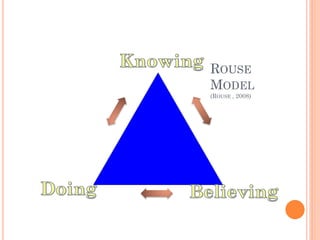
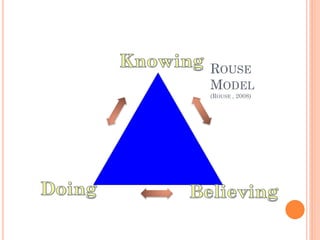
ROUSE
MODEL
(ROUSE , 2008)
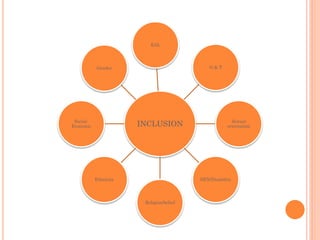
INCLUSION
EAL
G & T
Sexual
orientation
SEN/Disability
Religion/belief
Ethnicity
Social-
Economic
Gender
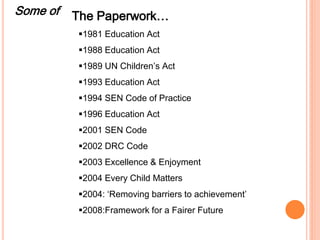
Some of The Paperwork…
1981 Education Act
1988 Education Act
1989 UN Children’s Act
1993 Education Act
1994 SEN Code of Practice
1996 Education Act
2001 SEN Code
2002 DRC Code
2003 Excellence & Enjoyment
2004 Every Child Matters
2004: ‘Removing barriers to achievement’
2008:Framework for a Fairer Future
. . . recent, current and most relevant for schools
 Equality Act (2010)
 Children and Families Act (2014)
 National Curriculum (2014)
 Special Educational Needs Code of Practice
(2014)
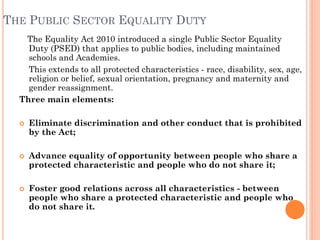
THE PUBLIC SECTOR EQUALITY DUTY
The Equality Act 2010 introduced a single Public Sector Equality
Duty (PSED) that applies to public bodies, including maintained
schools and Academies.
This extends to all protected characteristics - race, disability, sex, age,
religion or belief, sexual orientation, pregnancy and maternity and
gender reassignment.
Three main elements:
 Eliminate discrimination and other conduct that is prohibited
by the Act;
 Advance equality of opportunity between people who share a
protected characteristic and people who do not share it;
 Foster good relations across all characteristics - between
people who share a protected characteristic and people who
do not share it.
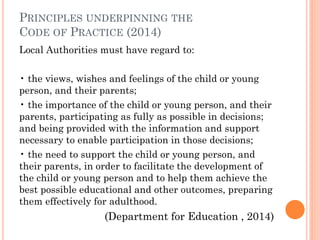
PRINCIPLES UNDERPINNING THE
CODE OF PRACTICE (2014)
Local Authorities must have regard to:
• the views, wishes and feelings of the child or young
person, and their parents;
• the importance of the child or young person, and their
parents, participating as fully as possible in decisions;
and being provided with the information and support
necessary to enable participation in those decisions;
• the need to support the child or young person, and
their parents, in order to facilitate the development of
the child or young person and to help them achieve the
best possible educational and other outcomes, preparing
them effectively for adulthood.
(Department for Education , 2014)
KEY ELEMENTS OF THE SEND CODE OF
PRACTICE
 Entitlement beyond 19…..to 25
 Greater participation of parents and children
 Education, Health and Care plans to replace
statements of SEN (Single plan)
 Option of a personal budget
 Local Offer
 Better joint commissioning of services
George: Yeah, so as soon as ..as soon as…people started asking
me what was wrong, I could talk and as soon as I realised that it
wasn’t actually about how people dealt with me but how I dealt
with it myself that it helped the most so it was really important
and it was a key thing that jolted my confidence into like forward
drive and that someone showed they were listening as opposed to
having this person talk about me or you know talk behind closed
doors about me
Candy: Did you feel that?
George: .yes absolutely, I mean if you’re getting moved around or
if you’re getting placed and given scores and things and without
actually talking to the people that are doing it, it alienates you
completely…
Candy: Right so you see a difference in say a level…but now
George: Yes exactly, it feels more personal and that gives me the
option and ability to voice my opinion and say what I think is
working
LOCAL OFFER
 Framework devised by parents
 Multiagency input alongside parents and
young people
 Level of detail and transparency a
challenge
 Maintenance and updating
 Expectations of all parties much clearer
 Gaps become clearer and can lead service
development
 Resource available for everyone
NATIONAL CURRICULUM INCLUSION
STATEMENT
Setting suitable challenges
 4.1 Teachers should set high expectations for every pupil. They
should plan stretching work for pupils whose attainment is
significantly above the expected standard. They have an even
greater obligation to plan lessons for pupils who have low levels
of prior attainment or come from disadvantaged backgrounds.
Teachers should use appropriate assessment to set targets
which are deliberately ambitious.
Responding to pupils’ needs and overcoming potential barriers for
individuals and groups of pupils:
 4.2 Teachers should take account of their duties under equal
opportunities legislation that covers race, disability, sex, religion
or belief, sexual orientation, pregnancy and maternity, and
gender reassignment.
SPECIAL EDUCATION PROVISION IN SCHOOLS
CODE OF PRACTICE (2014)
 High quality teaching, differentiated for
individual pupils, is the first step in responding
to pupils who have or may have SEN
 The identification of SEN should be built into the
overall approach to monitoring the progress and
development of all pupils
 Graduated approach: support should take the
form of a four part cycle: assess, plan, do, review
 Where a child continues to make little or no
progress, despite well -founded support that is
matched to the child’s area of need, the school
should consider involving specialists, including
those from outside agencies.
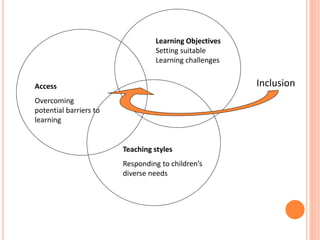
Learning Objectives
Setting suitable
Learning challenges
Access
Overcoming
potential barriers to
learning
Teaching styles
Responding to children’s
diverse needs
Inclusion
ROUSE
MODEL
(ROUSE , 2008)
USEFUL RESOURCES FOR SUPPORTING
THE INCLUSION OF ALL LEARNERS
INCLUDING THOSE WITH SEND
http://www.brighton.ac.uk/education/environment
/resources/sen.php?PageId=312

Ev682 developing a positve learning environment

  • 1.
    EV682 - Developing apositive learning environment - diversity and inclusion
  • 2.
  • 3.
  • 4.
    Some of ThePaperwork… 1981 Education Act 1988 Education Act 1989 UN Children’s Act 1993 Education Act 1994 SEN Code of Practice 1996 Education Act 2001 SEN Code 2002 DRC Code 2003 Excellence & Enjoyment 2004 Every Child Matters 2004: ‘Removing barriers to achievement’ 2008:Framework for a Fairer Future
  • 5.
    . . .recent, current and most relevant for schools  Equality Act (2010)  Children and Families Act (2014)  National Curriculum (2014)  Special Educational Needs Code of Practice (2014)
  • 6.
    THE PUBLIC SECTOREQUALITY DUTY The Equality Act 2010 introduced a single Public Sector Equality Duty (PSED) that applies to public bodies, including maintained schools and Academies. This extends to all protected characteristics - race, disability, sex, age, religion or belief, sexual orientation, pregnancy and maternity and gender reassignment. Three main elements:  Eliminate discrimination and other conduct that is prohibited by the Act;  Advance equality of opportunity between people who share a protected characteristic and people who do not share it;  Foster good relations across all characteristics - between people who share a protected characteristic and people who do not share it.
  • 7.
    PRINCIPLES UNDERPINNING THE CODEOF PRACTICE (2014) Local Authorities must have regard to: • the views, wishes and feelings of the child or young person, and their parents; • the importance of the child or young person, and their parents, participating as fully as possible in decisions; and being provided with the information and support necessary to enable participation in those decisions; • the need to support the child or young person, and their parents, in order to facilitate the development of the child or young person and to help them achieve the best possible educational and other outcomes, preparing them effectively for adulthood. (Department for Education , 2014)
  • 8.
    KEY ELEMENTS OFTHE SEND CODE OF PRACTICE  Entitlement beyond 19…..to 25  Greater participation of parents and children  Education, Health and Care plans to replace statements of SEN (Single plan)  Option of a personal budget  Local Offer  Better joint commissioning of services
  • 9.
    George: Yeah, soas soon as ..as soon as…people started asking me what was wrong, I could talk and as soon as I realised that it wasn’t actually about how people dealt with me but how I dealt with it myself that it helped the most so it was really important and it was a key thing that jolted my confidence into like forward drive and that someone showed they were listening as opposed to having this person talk about me or you know talk behind closed doors about me Candy: Did you feel that? George: .yes absolutely, I mean if you’re getting moved around or if you’re getting placed and given scores and things and without actually talking to the people that are doing it, it alienates you completely… Candy: Right so you see a difference in say a level…but now George: Yes exactly, it feels more personal and that gives me the option and ability to voice my opinion and say what I think is working
  • 10.
    LOCAL OFFER  Frameworkdevised by parents  Multiagency input alongside parents and young people  Level of detail and transparency a challenge  Maintenance and updating  Expectations of all parties much clearer  Gaps become clearer and can lead service development  Resource available for everyone
  • 11.
    NATIONAL CURRICULUM INCLUSION STATEMENT Settingsuitable challenges  4.1 Teachers should set high expectations for every pupil. They should plan stretching work for pupils whose attainment is significantly above the expected standard. They have an even greater obligation to plan lessons for pupils who have low levels of prior attainment or come from disadvantaged backgrounds. Teachers should use appropriate assessment to set targets which are deliberately ambitious. Responding to pupils’ needs and overcoming potential barriers for individuals and groups of pupils:  4.2 Teachers should take account of their duties under equal opportunities legislation that covers race, disability, sex, religion or belief, sexual orientation, pregnancy and maternity, and gender reassignment.
  • 12.
    SPECIAL EDUCATION PROVISIONIN SCHOOLS CODE OF PRACTICE (2014)  High quality teaching, differentiated for individual pupils, is the first step in responding to pupils who have or may have SEN  The identification of SEN should be built into the overall approach to monitoring the progress and development of all pupils  Graduated approach: support should take the form of a four part cycle: assess, plan, do, review
  • 13.
     Where achild continues to make little or no progress, despite well -founded support that is matched to the child’s area of need, the school should consider involving specialists, including those from outside agencies.
  • 14.
    Learning Objectives Setting suitable Learningchallenges Access Overcoming potential barriers to learning Teaching styles Responding to children’s diverse needs Inclusion
  • 15.
  • 16.
    USEFUL RESOURCES FORSUPPORTING THE INCLUSION OF ALL LEARNERS INCLUDING THOSE WITH SEND http://www.brighton.ac.uk/education/environment /resources/sen.php?PageId=312