IT/MPI -MEETING 6
A PRACTICAL GUIDE FOR
ENGLISH LECTURING
TOWARD PROFESSIONAL BASIC SKILLS ON
READING AND WRITING
MR. ADRIAN NABUNG
UNIVERSITAS KATOLIK INDONESIA SANTU PAULUS RUTENG
ONLINE COLLABORATIVE LESSON
• In this stage of learning modul (7),As a teacher "How to design an online collaborative lesson
effectively"? Well, here is my personal reflection and perspective: In my opinion/personal point of
view, designing an effective online collaborative lesson as a teacher requires thoughtful planning
and a focus on student engagement and interaction. First, identify clear learning objectives and
desired outcomes, aligning them with suitable online tools and platforms. Create a structured and
well-organized lesson plan, breaking down activities and setting clear guidelines for collaboration.
Promote active participation by assigning diverse roles and responsibilities, fostering a sense of
ownership and accountability among students. Encourage open communication channels, such as
discussion forums or video conferencing, to facilitate real-time interaction and idea sharing. Utilize
collaborative tools like shared documents, virtual whiteboards, and group projects to encourage
teamwork and collective problem-solving. Ensure accessibility and technical support for all
students, so they can fully participate. Periodically assess and provide feedback to monitor
progress and maintain motivation. Lastly, reflect on the experience, incorporating feedback to
continuously improve future collaborative lessons, fostering a dynamic and engaging online learning
environment.
THE ORGANIZATION
• Theoretical points
• The lecturing and learning cycle
• Literary principles in designing language classes
• Sample of lesson plan
ASSUMPTIONS UNDERLYING GBA
(FEEZ AND JOYCE, 1998: 24-27)
1
• Learning language is a social
activity.
2
• Learning occurs more effectively if
lecturers are explicit about what is
expected of students.
3
• The process of learning language is
a series of scaffolding
developmental steps which address
different aspects of language
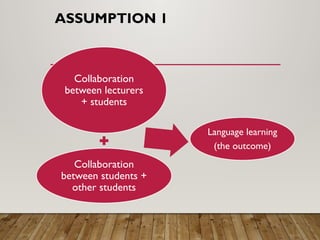
ASSUMPTION 1
Collaboration
between lecturers
+ students
Collaboration
between students +
other students
Language learning
(the outcome)
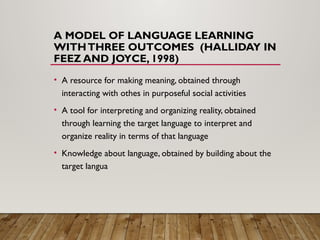
A MODEL OF LANGUAGE LEARNING
WITHTHREE OUTCOMES (HALLIDAY IN
FEEZ AND JOYCE, 1998)
• A resource for making meaning, obtained through
interacting with othes in purposeful social activities
• A tool for interpreting and organizing reality, obtained
through learning the target language to interpret and
organize reality in terms of that language
• Knowledge about language, obtained by building about the
target langua
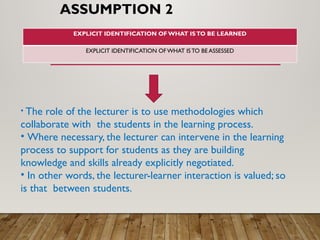
ASSUMPTION 2
EXPLICIT IDENTIFICATION OF WHAT ISTO BE LEARNED
EXPLICIT IDENTIFICATION OF WHAT ISTO BE ASSESSED
• The role of the lecturer is to use methodologies which
collaborate with the students in the learning process.
• Where necessary, the lecturer can intervene in the learning
process to support for students as they are building
knowledge and skills already explicitly negotiated.
• In other words, the lecturer-learner interaction is valued; so
is that between students.
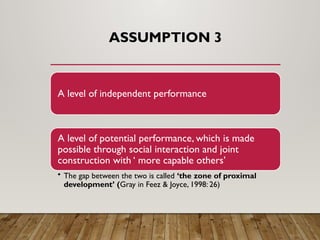
ASSUMPTION 3
A level of independent performance
A level of potential performance, which is made
possible through social interaction and joint
construction with ‘ more capable others’
• The gap between the two is called ‘the zone of proximal
development’ (Gray in Feez & Joyce, 1998: 26)
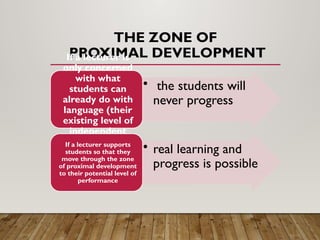
THE ZONE OF
PROXIMAL DEVELOPMENT
• the students will
never progress
If a lecturer is
only concerned
with what
students can
already do with
language (their
existing level of
independent
performance)
• real learning and
progress is possible
If a lecturer supports
students so that they
move through the zone
of proximal development
to their potential level of
performance
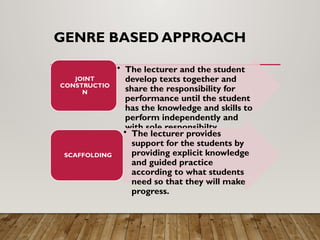
GENRE BASED APPROACH
• The lecturer and the student
develop texts together and
share the responsibility for
performance until the student
has the knowledge and skills to
perform independently and
with sole responsibilty
JOINT
CONSTRUCTIO
N
• The lecturer provides
support for the students by
providing explicit knowledge
and guided practice
according to what students
need so that they will make
progress.
SCAFFOLDING
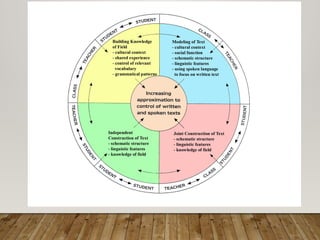
THE LEARNING/LEARNING
CYCLE
TWO CYCLES – FOUR STAGES
(The five-stage cycle is recommended to encourage
students to learn to broaden their perspective and
think progressively)
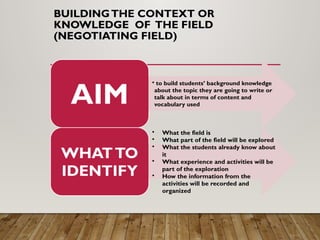
BUILDINGTHE CONTEXT OR
KNOWLEDGE OF THE FIELD
(NEGOTIATING FIELD)
AIM
• to build students’ background knowledge
about the topic they are going to write or
talk about in terms of content and
vocabulary used
WHATTO
IDENTIFY
• What the field is
• What part of the field will be explored
• What the students already know about
it
• What experience and activities will be
part of the exploration
• How the information from the
activities will be recorded and
organized
STUDENTS’ ACTIVITIES
• Being introduced to the social context of an authentic
model of the text-type being studied
• Exploring features of the general context in which the text-
type is used and the social purposes the text-type achieves
• Exploring the immediate context of situation by
investigating the register of a model text which has been
selected on the basis of the course objectives and learner
need
AN EXPLORATION OF
REGISTER
• Building knowledge of the topic of the model text and
knowledge of the social activity in which this text is used
• Understanding the roles and relationships of the people
using the text and how these are established and
maintained
• Understanding the channel of communication being used
CONTEXT
-BUILDING
ACTIVITIES
• Presenting the context through pictures, audio-visual
material, realia, excursions, field-trips, guest speakers, etc
• Establishing the social purpose through discussions or
surveys
• Cross cultural activities
• Related research activities
• Comparing the model text with other texts of the same
genre or contrasting type
NOTES
• lecturers should create activities which help students to
comprehend the content of the text, including the roles of
the people involved, the purposes of the text, the function
of the text, and the type of situation.
• The questions may be multiple choice in their form,
completion, or essay, depending on the level of learning.
MODELLING AND
DECONSTRUCTING THE TEXT
• STUDENTS investigate the structural patterns and language
features of the model text
• STUDENTS compare the model with other examples of
the text-type
NOTES:
• Use diagnostic assessment “to decide how much time to
devote to particular language feature and what kind of
presentation or practice students need with each feature
• Conduct the activity at both the whole text level and that
the clause level and expression level
• Use various techniques for dealing with grammar and text
structures
PLEASE ALWAYS DO THE BEST OF YOURS, TRY SPEAKING
ENGLISH ANYTIME, ANY WERE; KEEP HEALTHY AND
HAPPY, ALWAYS WEAR YOUR MASKER AND DO SOCIAL
DISTANCING...THANK YOU AND GOOD LUCK...
THANKYOU AND GOOD LUCK
IT/MPI - MEETING 7
A PRACTICAL GUIDE FOR
ENGLISH LECTURING
TOWARD PROFESSIONAL BASIC SKILLS ON
READING AND WRITING
MR. ADRIAN NABUNG
POLITEKNIK ELBAJO COMMODUS
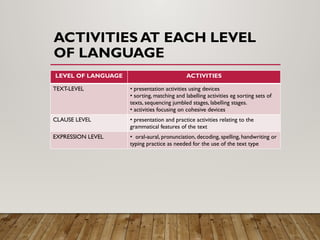
ACTIVITIES AT EACH LEVEL
OF LANGUAGE
LEVEL OF LANGUAGE ACTIVITIES
TEXT-LEVEL • presentation activities using devices
• sorting, matching and labelling activities eg sorting sets of
texts, sequencing jumbled stages, labelling stages.
• activities focusing on cohesive devices
CLAUSE LEVEL • presentation and practice activities relating to the
grammatical features of the text
EXPRESSION LEVEL • oral-aural, pronunciation, decoding, spelling, handwriting or
typing practice as needed for the use of the text type
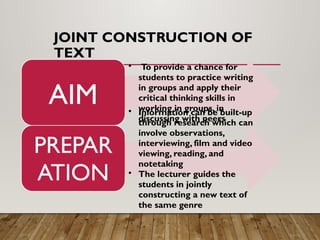
JOINT CONSTRUCTION OF
TEXT
AIM
• To provide a chance for
students to practice writing
in groups and apply their
critical thinking skills in
working in groups, in
discussing with peers
PREPAR
ATION
• Information can be built-up
through research which can
involve observations,
interviewing, film and video
viewing, reading, and
notetaking
• The lecturer guides the
students in jointly
constructing a new text of
the same genre
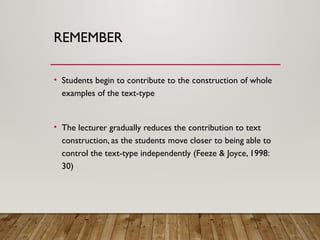
REMEMBER
• Students begin to contribute to the construction of whole
examples of the text-type
• The lecturer gradually reduces the contribution to text
construction, as the students move closer to being able to
control the text-type independently (Feeze & Joyce, 1998:
30)
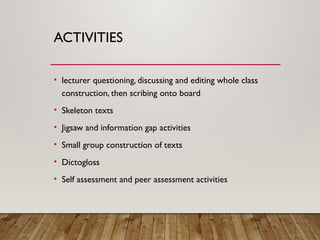
ACTIVITIES
• lecturer questioning, discussing and editing whole class
construction, then scribing onto board
• Skeleton texts
• Jigsaw and information gap activities
• Small group construction of texts
• Dictogloss
• Self assessment and peer assessment activities
INDEPENDENT CONSTRUCTION
OF TEXT
AIM
• give students a chance to practise
individually the speaking or writing skills
they have acquired from the previous stages
IMPORTAN
T POINT
•Have students construct a
new text, be it oral or written
ACTIVITIES
Independent construction activities include:
• Listening tasks, e.g., comprehension activities in
response to live or recorded material, such as
performing a task, sequencing pictures, numbering,
ticking or underlining material on a worksheet,
answering questions
• Listening and speaking tasks, e.g., role plays, simulated
or authentic dialogs
…ACTIVITIES
• Speaking tasks, e.g., spoken presentation to class,
community organization, or workplace
• Reading tasks, e.g., comprehension activities in response
to written material such as performing a task,
sequencing pictures, numbering, ticking or underlining
material on a worksheet, answering questions
• Writing tasks which demand that students draft and
present whole texts
LINKING TO RELATEDTEXTS
In this stage, students investigate how what they have learned
in this lecturing/learning cycle can be related to:
• other texts in the same or similar context
• future or past cycles of lecturing and learning
ACTIVITIES
• Comparing the use of the text-type across different fields
• Researching other text-types used in the same field
• Role-playing what happens if the same text-type is used by
people with different roles and relationships
• Comparing spoken and written models of the same text-type
• Researching how a key language feature used in this text-type
is used in other text-types
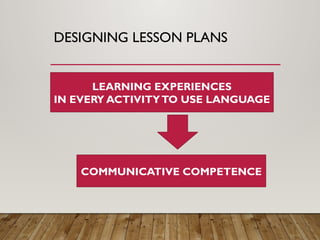
DESIGNING LESSON PLANS
LEARNING EXPERIENCES
IN EVERY ACTIVITYTO USE LANGUAGE
COMMUNICATIVE COMPETENCE
LITERACY PRINCIPLES
FOR PLANNING LANGUAGE
CLASSES
Literacy is "the use of socially-, historically-, and culturally-
situated practices of creating and interpreting meaning
through texts. It entails at least a tacit awareness of the
relationships between textual conventions and their
contexts of use and, ideally, the ability to reflect critically on
those relationships […] It draws on a wide range of
cognitive abilities, on knowledge of written and spoken
language, on knowledge of genres, and on cultural
knowledge.”
–Kern, 2000, p. 16
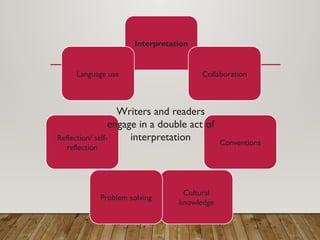
Interpretation
Collaboration
Conventions
Cultural
knowledge
Problem solving
Reflection/ self-
reflection
Language use
Writers and readers
engage in a double act of
interpretation
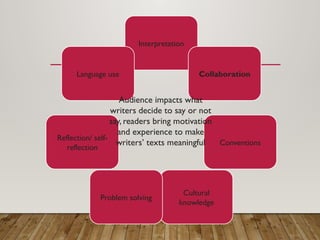
Interpretation
Collaboration
Conventions
Cultural
knowledge
Problem solving
Reflection/ self-
reflection
Language use
Audience impacts what
writers decide to say or not
say, readers bring motivation
and experience to make
writers’ texts meaningful
Interpretation
Collaboration
Conventions
Cultural
knowledge
Problem solving
Reflection/ self-
reflection
Language use
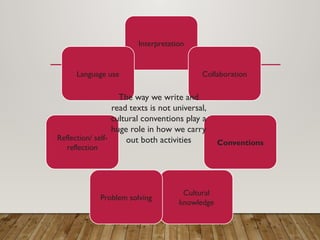
The way we write and
read texts is not universal,
cultural conventions play a
huge role in how we carry
out both activities
Interpretation
Collaboration
Conventions
Cultural
knowledge
Problem solving
Reflection/ self-
reflection
Language use
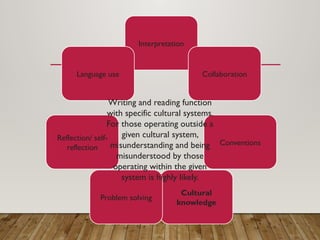
Writing and reading function
with specific cultural systems.
For those operating outside a
given cultural system,
misunderstanding and being
misunderstood by those
operating within the given
system is highly likely.
Interpretation
Collaboration
Conventions
Cultural
knowledge
Problem solving
Reflection/ self-
reflection
Language use
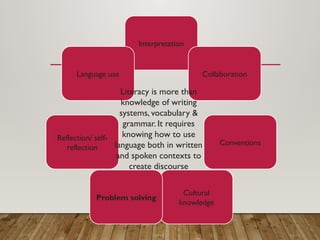
Literacy is more than
knowledge of writing
systems, vocabulary &
grammar. It requires
knowing how to use
language both in written
and spoken contexts to
create discourse
Interpretation
Collaboration
Conventions
Cultural
knowledge
Problem solving
Reflection/ self-
reflection
Language use
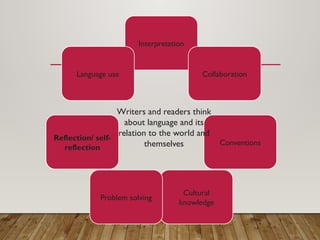
Writers and readers think
about language and its
relation to the world and
themselves
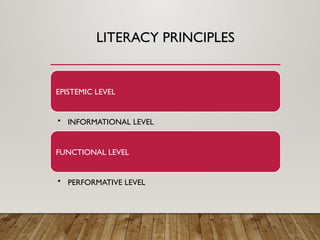
LITERACY PRINCIPLES
EPISTEMIC LEVEL
• INFORMATIONAL LEVEL
FUNCTIONAL LEVEL
• PERFORMATIVE LEVEL
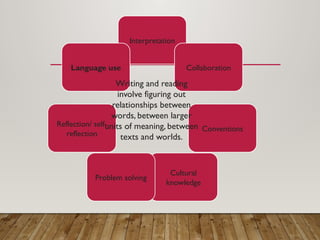
Interpretation
Collaboration
Conventions
Cultural
knowledge
Problem solving
Reflection/ self-
reflection
Language use
Writing and reading
involve figuring out
relationships between
words, between larger
units of meaning, between
texts and worlds.
PLEASE ALWAYS DO THE BEST OF YOURS, TRY SPEAKING
ENGLISH ANYTIME, ANY WERE; KEEP HEALTHY AND
HAPPY, ALWAYS WEAR YOUR MASKER AND DO SOCIAL
DISTANCING...THANK YOU AND GOOD LUCK...
THANKYOU AND GOOD LUCK

9ba5b89c4385482dbdce55d721d98c16_collaborative-learning_adrian.pptx

  • 1.
    IT/MPI -MEETING 6 APRACTICAL GUIDE FOR ENGLISH LECTURING TOWARD PROFESSIONAL BASIC SKILLS ON READING AND WRITING MR. ADRIAN NABUNG UNIVERSITAS KATOLIK INDONESIA SANTU PAULUS RUTENG
  • 2.
    ONLINE COLLABORATIVE LESSON •In this stage of learning modul (7),As a teacher "How to design an online collaborative lesson effectively"? Well, here is my personal reflection and perspective: In my opinion/personal point of view, designing an effective online collaborative lesson as a teacher requires thoughtful planning and a focus on student engagement and interaction. First, identify clear learning objectives and desired outcomes, aligning them with suitable online tools and platforms. Create a structured and well-organized lesson plan, breaking down activities and setting clear guidelines for collaboration. Promote active participation by assigning diverse roles and responsibilities, fostering a sense of ownership and accountability among students. Encourage open communication channels, such as discussion forums or video conferencing, to facilitate real-time interaction and idea sharing. Utilize collaborative tools like shared documents, virtual whiteboards, and group projects to encourage teamwork and collective problem-solving. Ensure accessibility and technical support for all students, so they can fully participate. Periodically assess and provide feedback to monitor progress and maintain motivation. Lastly, reflect on the experience, incorporating feedback to continuously improve future collaborative lessons, fostering a dynamic and engaging online learning environment.
  • 3.
    THE ORGANIZATION • Theoreticalpoints • The lecturing and learning cycle • Literary principles in designing language classes • Sample of lesson plan
  • 4.
    ASSUMPTIONS UNDERLYING GBA (FEEZAND JOYCE, 1998: 24-27) 1 • Learning language is a social activity. 2 • Learning occurs more effectively if lecturers are explicit about what is expected of students. 3 • The process of learning language is a series of scaffolding developmental steps which address different aspects of language
  • 5.
    ASSUMPTION 1 Collaboration between lecturers +students Collaboration between students + other students Language learning (the outcome)
  • 6.
    A MODEL OFLANGUAGE LEARNING WITHTHREE OUTCOMES (HALLIDAY IN FEEZ AND JOYCE, 1998) • A resource for making meaning, obtained through interacting with othes in purposeful social activities • A tool for interpreting and organizing reality, obtained through learning the target language to interpret and organize reality in terms of that language • Knowledge about language, obtained by building about the target langua
  • 7.
    ASSUMPTION 2 EXPLICIT IDENTIFICATIONOF WHAT ISTO BE LEARNED EXPLICIT IDENTIFICATION OF WHAT ISTO BE ASSESSED • The role of the lecturer is to use methodologies which collaborate with the students in the learning process. • Where necessary, the lecturer can intervene in the learning process to support for students as they are building knowledge and skills already explicitly negotiated. • In other words, the lecturer-learner interaction is valued; so is that between students.
  • 8.
    ASSUMPTION 3 A levelof independent performance A level of potential performance, which is made possible through social interaction and joint construction with ‘ more capable others’ • The gap between the two is called ‘the zone of proximal development’ (Gray in Feez & Joyce, 1998: 26)
  • 9.
    THE ZONE OF PROXIMALDEVELOPMENT • the students will never progress If a lecturer is only concerned with what students can already do with language (their existing level of independent performance) • real learning and progress is possible If a lecturer supports students so that they move through the zone of proximal development to their potential level of performance
  • 10.
    GENRE BASED APPROACH •The lecturer and the student develop texts together and share the responsibility for performance until the student has the knowledge and skills to perform independently and with sole responsibilty JOINT CONSTRUCTIO N • The lecturer provides support for the students by providing explicit knowledge and guided practice according to what students need so that they will make progress. SCAFFOLDING
  • 11.
    THE LEARNING/LEARNING CYCLE TWO CYCLES– FOUR STAGES (The five-stage cycle is recommended to encourage students to learn to broaden their perspective and think progressively)
  • 13.
    BUILDINGTHE CONTEXT OR KNOWLEDGEOF THE FIELD (NEGOTIATING FIELD) AIM • to build students’ background knowledge about the topic they are going to write or talk about in terms of content and vocabulary used WHATTO IDENTIFY • What the field is • What part of the field will be explored • What the students already know about it • What experience and activities will be part of the exploration • How the information from the activities will be recorded and organized
  • 14.
    STUDENTS’ ACTIVITIES • Beingintroduced to the social context of an authentic model of the text-type being studied • Exploring features of the general context in which the text- type is used and the social purposes the text-type achieves • Exploring the immediate context of situation by investigating the register of a model text which has been selected on the basis of the course objectives and learner need
  • 15.
    AN EXPLORATION OF REGISTER •Building knowledge of the topic of the model text and knowledge of the social activity in which this text is used • Understanding the roles and relationships of the people using the text and how these are established and maintained • Understanding the channel of communication being used
  • 16.
    CONTEXT -BUILDING ACTIVITIES • Presenting thecontext through pictures, audio-visual material, realia, excursions, field-trips, guest speakers, etc • Establishing the social purpose through discussions or surveys • Cross cultural activities • Related research activities • Comparing the model text with other texts of the same genre or contrasting type
  • 17.
    NOTES • lecturers shouldcreate activities which help students to comprehend the content of the text, including the roles of the people involved, the purposes of the text, the function of the text, and the type of situation. • The questions may be multiple choice in their form, completion, or essay, depending on the level of learning.
  • 18.
    MODELLING AND DECONSTRUCTING THETEXT • STUDENTS investigate the structural patterns and language features of the model text • STUDENTS compare the model with other examples of the text-type
  • 19.
    NOTES: • Use diagnosticassessment “to decide how much time to devote to particular language feature and what kind of presentation or practice students need with each feature • Conduct the activity at both the whole text level and that the clause level and expression level • Use various techniques for dealing with grammar and text structures
  • 20.
    PLEASE ALWAYS DOTHE BEST OF YOURS, TRY SPEAKING ENGLISH ANYTIME, ANY WERE; KEEP HEALTHY AND HAPPY, ALWAYS WEAR YOUR MASKER AND DO SOCIAL DISTANCING...THANK YOU AND GOOD LUCK... THANKYOU AND GOOD LUCK
  • 21.
    IT/MPI - MEETING7 A PRACTICAL GUIDE FOR ENGLISH LECTURING TOWARD PROFESSIONAL BASIC SKILLS ON READING AND WRITING MR. ADRIAN NABUNG POLITEKNIK ELBAJO COMMODUS
  • 22.
    ACTIVITIES AT EACHLEVEL OF LANGUAGE LEVEL OF LANGUAGE ACTIVITIES TEXT-LEVEL • presentation activities using devices • sorting, matching and labelling activities eg sorting sets of texts, sequencing jumbled stages, labelling stages. • activities focusing on cohesive devices CLAUSE LEVEL • presentation and practice activities relating to the grammatical features of the text EXPRESSION LEVEL • oral-aural, pronunciation, decoding, spelling, handwriting or typing practice as needed for the use of the text type
  • 23.
    JOINT CONSTRUCTION OF TEXT AIM •To provide a chance for students to practice writing in groups and apply their critical thinking skills in working in groups, in discussing with peers PREPAR ATION • Information can be built-up through research which can involve observations, interviewing, film and video viewing, reading, and notetaking • The lecturer guides the students in jointly constructing a new text of the same genre
  • 24.
    REMEMBER • Students beginto contribute to the construction of whole examples of the text-type • The lecturer gradually reduces the contribution to text construction, as the students move closer to being able to control the text-type independently (Feeze & Joyce, 1998: 30)
  • 25.
    ACTIVITIES • lecturer questioning,discussing and editing whole class construction, then scribing onto board • Skeleton texts • Jigsaw and information gap activities • Small group construction of texts • Dictogloss • Self assessment and peer assessment activities
  • 26.
    INDEPENDENT CONSTRUCTION OF TEXT AIM •give students a chance to practise individually the speaking or writing skills they have acquired from the previous stages IMPORTAN T POINT •Have students construct a new text, be it oral or written
  • 27.
    ACTIVITIES Independent construction activitiesinclude: • Listening tasks, e.g., comprehension activities in response to live or recorded material, such as performing a task, sequencing pictures, numbering, ticking or underlining material on a worksheet, answering questions • Listening and speaking tasks, e.g., role plays, simulated or authentic dialogs
  • 28.
    …ACTIVITIES • Speaking tasks,e.g., spoken presentation to class, community organization, or workplace • Reading tasks, e.g., comprehension activities in response to written material such as performing a task, sequencing pictures, numbering, ticking or underlining material on a worksheet, answering questions • Writing tasks which demand that students draft and present whole texts
  • 29.
    LINKING TO RELATEDTEXTS Inthis stage, students investigate how what they have learned in this lecturing/learning cycle can be related to: • other texts in the same or similar context • future or past cycles of lecturing and learning
  • 30.
    ACTIVITIES • Comparing theuse of the text-type across different fields • Researching other text-types used in the same field • Role-playing what happens if the same text-type is used by people with different roles and relationships • Comparing spoken and written models of the same text-type • Researching how a key language feature used in this text-type is used in other text-types
  • 31.
    DESIGNING LESSON PLANS LEARNINGEXPERIENCES IN EVERY ACTIVITYTO USE LANGUAGE COMMUNICATIVE COMPETENCE
  • 32.
    LITERACY PRINCIPLES FOR PLANNINGLANGUAGE CLASSES Literacy is "the use of socially-, historically-, and culturally- situated practices of creating and interpreting meaning through texts. It entails at least a tacit awareness of the relationships between textual conventions and their contexts of use and, ideally, the ability to reflect critically on those relationships […] It draws on a wide range of cognitive abilities, on knowledge of written and spoken language, on knowledge of genres, and on cultural knowledge.” –Kern, 2000, p. 16
  • 33.
  • 34.
    Interpretation Collaboration Conventions Cultural knowledge Problem solving Reflection/ self- reflection Languageuse Audience impacts what writers decide to say or not say, readers bring motivation and experience to make writers’ texts meaningful
  • 35.
    Interpretation Collaboration Conventions Cultural knowledge Problem solving Reflection/ self- reflection Languageuse The way we write and read texts is not universal, cultural conventions play a huge role in how we carry out both activities
  • 36.
    Interpretation Collaboration Conventions Cultural knowledge Problem solving Reflection/ self- reflection Languageuse Writing and reading function with specific cultural systems. For those operating outside a given cultural system, misunderstanding and being misunderstood by those operating within the given system is highly likely.
  • 37.
    Interpretation Collaboration Conventions Cultural knowledge Problem solving Reflection/ self- reflection Languageuse Literacy is more than knowledge of writing systems, vocabulary & grammar. It requires knowing how to use language both in written and spoken contexts to create discourse
  • 38.
    Interpretation Collaboration Conventions Cultural knowledge Problem solving Reflection/ self- reflection Languageuse Writers and readers think about language and its relation to the world and themselves
  • 39.
    LITERACY PRINCIPLES EPISTEMIC LEVEL •INFORMATIONAL LEVEL FUNCTIONAL LEVEL • PERFORMATIVE LEVEL
  • 40.
    Interpretation Collaboration Conventions Cultural knowledge Problem solving Reflection/ self- reflection Languageuse Writing and reading involve figuring out relationships between words, between larger units of meaning, between texts and worlds.
  • 41.
    PLEASE ALWAYS DOTHE BEST OF YOURS, TRY SPEAKING ENGLISH ANYTIME, ANY WERE; KEEP HEALTHY AND HAPPY, ALWAYS WEAR YOUR MASKER AND DO SOCIAL DISTANCING...THANK YOU AND GOOD LUCK... THANKYOU AND GOOD LUCK