Muruli N
Research Scholar
Department of Library and Information Science
University of Mysore
Measuring Scientific Productivity
(Citation Databases, Impact Factor and its variants, h-index, SNIP, SJR, Unique Author Identification Systems)
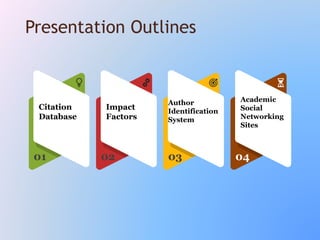
01
Citation
Database
02
Impact
Factors
03
Author
Identification
System
04
Academic
Social
Networking
Sites
Presentation Outlines
What is Scholarly Writings/ Research
Paper/ Academic Paper?
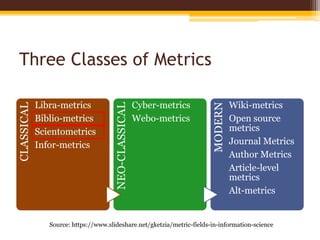
Three Classes of Metrics
CLASSICAL
Libra-metrics
Biblio-metrics
Scientometrics
Infor-metrics
NEO-CLASSICAL
Cyber-metrics
Webo-metrics
MODERN
Wiki-metrics
Open source
metrics
Journal Metrics
Author Metrics
Article-level
metrics
Alt-metrics
Source: https://www.slideshare.net/gketzia/metric-fields-in-information-science
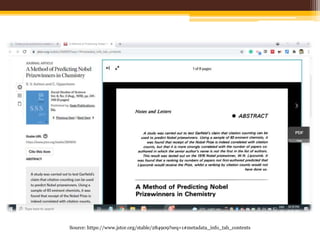
Source: https://www.jstor.org/stable/284909?seq=1#metadata_info_tab_contents
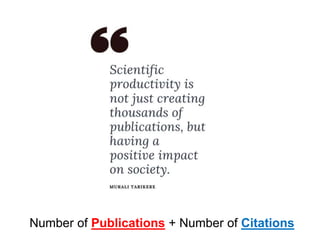
What is Scientific Productivity?
Number of Publications + Number of Citations
Part 1-
Citation Databases
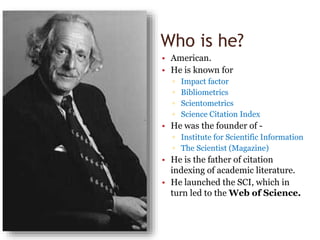
Who is he?
• American.
• He is known for
▫ Impact factor
▫ Bibliometrics
▫ Scientometrics
▫ Science Citation Index
• He was the founder of -
▫ Institute for Scientific Information
▫ The Scientist (Magazine)
• He is the father of citation
indexing of academic literature.
• He launched the SCI, which in
turn led to the Web of Science.
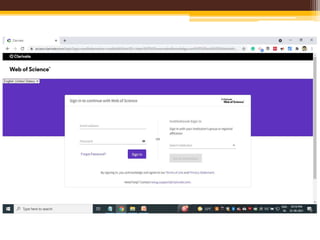
Web of Science
• Subscription-based database : Web of Science is a website that
provides subscription-based access to multiple databases that provide
comprehensive citation data for many different academic disciplines.
• Previously known as Web of Knowledge.
• Originally produced by the Institute for Scientific Information
• Currently maintained by Clarivate Analytics
• Previously maintained by Thomson Reuters.
• Negotiated Rates (2018): For Core E Shodh Sindhu Members -
11,550 (USD) + 18% GST
• Coverage – 1900 to present.
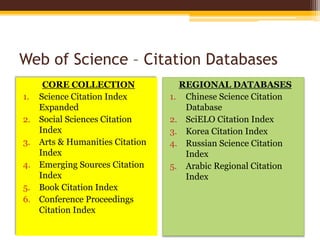
Web of Science – Citation Databases
CORE COLLECTION
1. Science Citation Index
Expanded
2. Social Sciences Citation
Index
3. Arts & Humanities Citation
Index
4. Emerging Sources Citation
Index
5. Book Citation Index
6. Conference Proceedings
Citation Index
REGIONAL DATABASES
1. Chinese Science Citation
Database
2. SciELO Citation Index
3. Korea Citation Index
4. Russian Science Citation
Index
5. Arabic Regional Citation
Index
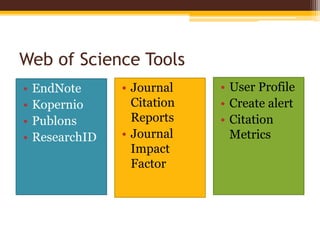
Web of Science Tools
• EndNote
• Kopernio
• Publons
• ResearchID
• Journal
Citation
Reports
• Journal
Impact
Factor
• User Profile
• Create alert
• Citation
Metrics
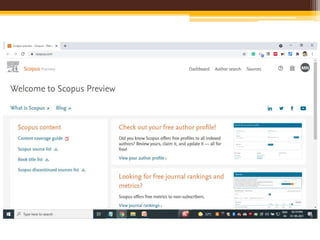
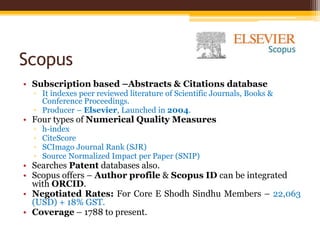
Scopus
• Subscription based –Abstracts & Citations database
▫ It indexes peer reviewed literature of Scientific Journals, Books &
Conference Proceedings.
▫ Producer – Elsevier, Launched in 2004.
• Four types of Numerical Quality Measures
▫ h-index
▫ CiteScore
▫ SCImago Journal Rank (SJR)
▫ Source Normalized Impact per Paper (SNIP)
• Searches Patent databases also.
• Scopus offers – Author profile & Scopus ID can be integrated
with ORCID.
• Negotiated Rates: For Core E Shodh Sindhu Members – 22,063
(USD) + 18% GST.
• Coverage – 1788 to present.
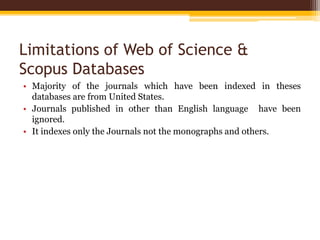
Limitations of Web of Science &
Scopus Databases
• Majority of the journals which have been indexed in theses
databases are from United States.
• Journals published in other than English language have been
ignored.
• It indexes only the Journals not the monographs and others.
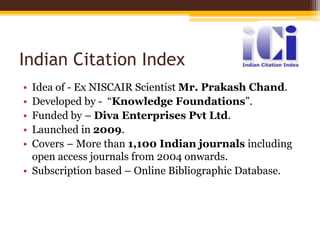
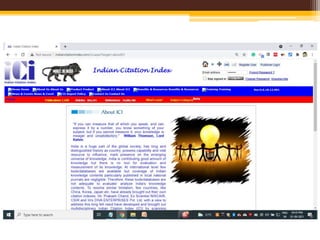
Indian Citation Index
• Idea of - Ex NISCAIR Scientist Mr. Prakash Chand.
• Developed by - “Knowledge Foundations”.
• Funded by – Diva Enterprises Pvt Ltd.
• Launched in 2009.
• Covers – More than 1,100 Indian journals including
open access journals from 2004 onwards.
• Subscription based – Online Bibliographic Database.
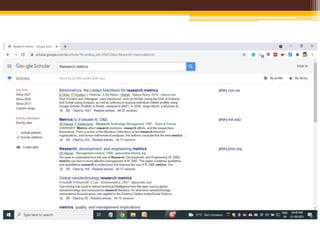
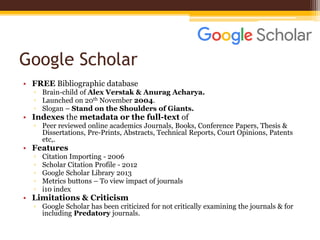
Google Scholar
• FREE Bibliographic database
▫ Brain-child of Alex Verstak & Anurag Acharya.
▫ Launched on 20th November 2004.
▫ Slogan – Stand on the Shoulders of Giants.
• Indexes the metadata or the full-text of
▫ Peer reviewed online academics Journals, Books, Conference Papers, Thesis &
Dissertations, Pre-Prints, Abstracts, Technical Reports, Court Opinions, Patents
etc,.
• Features
▫ Citation Importing - 2006
▫ Scholar Citation Profile - 2012
▫ Google Scholar Library 2013
▫ Metrics buttons – To view impact of journals
▫ i10 index
• Limitations & Criticism
▫ Google Scholar has been criticized for not critically examining the journals & for
including Predatory journals.
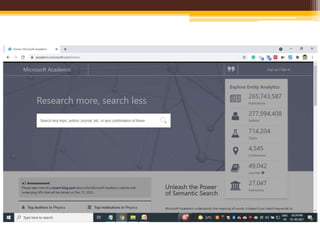
Microsoft Academic
• FREE –web search engine for academic publications.

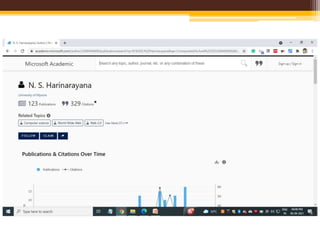
• Competitor – to Google Scholar and other.
• Developed by – Microsoft Research.
• Re-Launched in 2016.
• Previously known as – Microsoft Academic Search.
Part 2-
Impact Factors & it’s variants
Introduction
• Research Metrics have become important in many fields.
• Research metrics are sometimes controversial.
• Each metric may offer a different emphasis based on its
▫ Data source,
▫ Method of calculation, or
▫ Context of use.
• Strengths and weaknesses of metrics - Don’t judge by a single
metric, because all metrics have some limitations.
• Golden Rules
▫ Always use both qualitative and quantitative input for decisions
▫ Always use more than one research metric as the quantitative input.
• Therefore, using more than one metrics can help to provide a more
complete picture and reflect different aspects of research
productivity and impact in the final assessment.
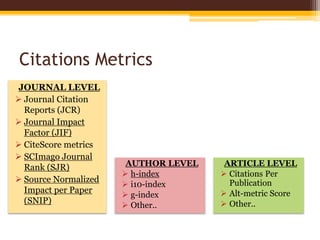
Citations Metrics
JOURNAL LEVEL
 Journal Citation
Reports (JCR)
 Journal Impact
Factor (JIF)
 CiteScore metrics
 SCImago Journal
Rank (SJR)
 Source Normalized
Impact per Paper
(SNIP)
AUTHOR LEVEL
 h-index
 i10-index
 g-index
 Other..
ARTICLE LEVEL
 Citations Per
Publication
 Alt-metric Score
 Other..
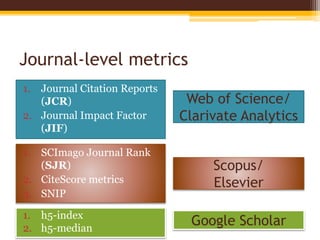
Journal-level metrics
1. Journal Citation Reports
(JCR)
2. Journal Impact Factor
(JIF)
1. SCImago Journal Rank
(SJR)
2. CiteScore metrics
3. SNIP
Web of Science/
Clarivate Analytics
Scopus/
Elsevier
1. h5-index
2. h5-median
Google Scholar
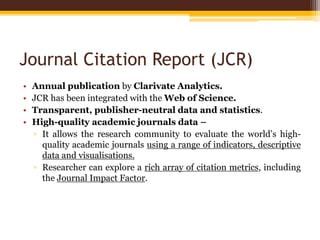
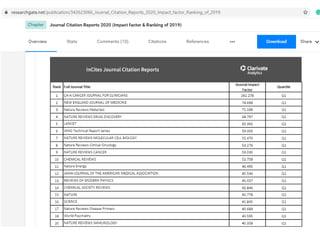
Journal Citation Report (JCR)
• Annual publication by Clarivate Analytics.
• JCR has been integrated with the Web of Science.
• Transparent, publisher-neutral data and statistics.
• High-quality academic journals data –
▫ It allows the research community to evaluate the world’s high-
quality academic journals using a range of indicators, descriptive
data and visualisations.
▫ Researcher can explore a rich array of citation metrics, including
the Journal Impact Factor.
Journal Impact Factor (JIF)
• Devised by Eugene Garfield.
• Journals with higher impact factor carry more prestige in
their respective fields, than those with lower values.
• Mean number of citations of articles published in the last
two years in a given journal.
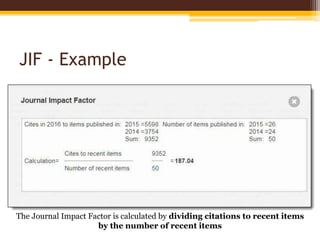
JIF - Example
The Journal Impact Factor is calculated by dividing citations to recent items
by the number of recent items
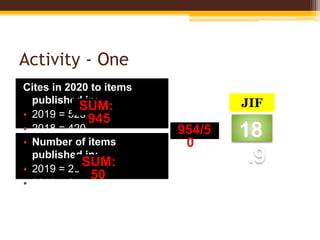
Activity - One
Cites in 2020 to items
published in:
• 2019 = 525
• 2018 = 420 954/5
0
• Number of items
published in:
• 2019 = 26
• 2018 = 24
SUM:
945
SUM:
50
18
.9
JIF
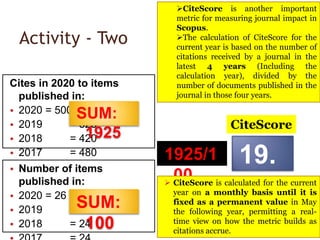
Activity - Two
Cites in 2020 to items
published in:
• 2020 = 500
• 2019 = 525
• 2018 = 420
• 2017 = 480 1925/1
00
• Number of items
published in:
• 2020 = 26
• 2019 = 26
• 2018 = 24
SUM:
1925
19.
25
SUM:
100
CiteScore
CiteScore is another important
metric for measuring journal impact in
Scopus.
The calculation of CiteScore for the
current year is based on the number of
citations received by a journal in the
latest 4 years (Including the
calculation year), divided by the
number of documents published in the
journal in those four years.
 CiteScore is calculated for the current
year on a monthly basis until it is
fixed as a permanent value in May
the following year, permitting a real-
time view on how the metric builds as
citations accrue.
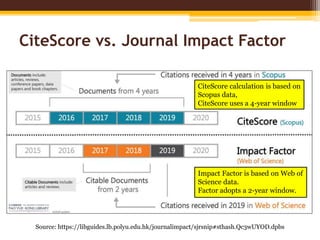
CiteScore vs. Journal Impact Factor
CiteScore calculation is based on
Scopus data,
CiteScore uses a 4-year window
Impact Factor is based on Web of
Science data.
Factor adopts a 2-year window.
Source: https://libguides.lb.polyu.edu.hk/journalimpact/sjrsnip#sthash.Qc3wUYOD.dpbs
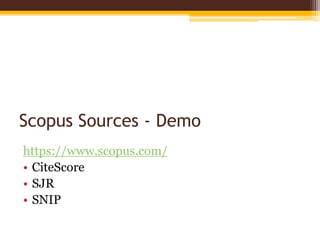
Scopus Sources - Demo
https://www.scopus.com/
• CiteScore
• SJR
• SNIP
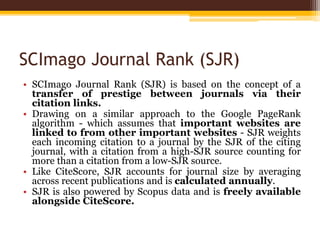
SCImago Journal Rank (SJR)
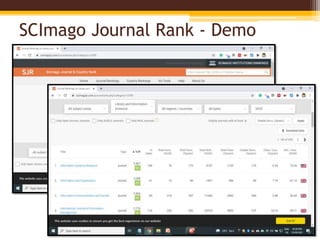
• SCImago Journal Rank (SJR) is based on the concept of a
transfer of prestige between journals via their
citation links.
• Drawing on a similar approach to the Google PageRank
algorithm - which assumes that important websites are
linked to from other important websites - SJR weights
each incoming citation to a journal by the SJR of the citing
journal, with a citation from a high-SJR source counting for
more than a citation from a low-SJR source.
• Like CiteScore, SJR accounts for journal size by averaging
across recent publications and is calculated annually.
• SJR is also powered by Scopus data and is freely available
alongside CiteScore.
SCImago Journal Rank - Demo
Source Normalized Impact per Paper (SNIP)
• SNIP is a sophisticated metric that intrinsically accounts for field-
specific differences in citation practices.
• It does so by comparing each journal’s citations per
publication with the citation potential of its field, defined as
the set of publications citing that journal.
• SNIP therefore measures contextual citation impact and
enables direct comparison of journals in different subject
fields, since the value of a single citation is greater for journals in
fields where citations are less likely, and vice versa.
• SNIP is calculated annually from Scopus data and is freely
available at www.scopus.com/sources.
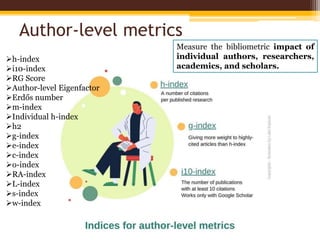
Author-level metrics
Measure the bibliometric impact of
individual authors, researchers,
academics, and scholars.
h-index
i10-index
RG Score
Author-level Eigenfactor
Erdős number
m-index
Individual h-index
h2
g-index
e-index
c-index
o-index
RA-index
L-index
s-index
w-index
Author-level-metrics
h-index i10-index
• It was invented by Jorge
Hirsch in 2005.
• The h-index is an author-level
metric that attempts to
measure both the productivity
and citation impact of the
publications of a scientist or
scholar.
• The h-index- Author/journal
has published at least h papers
that have each been cited at
least h times
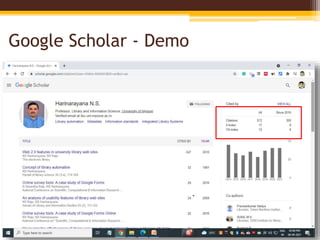
• Created by Google Scholar and
used in Google's My Citations
feature.
• i10-index = the number of
publications with at least 10
citations.
• Very simple and
straightforward to calculate.
• Google Scholar is free and easy
to use.
• Limitation - Used only in
Google Scholar
Google Scholar - Demo
Part 3 –
Unique Author Identification Systems
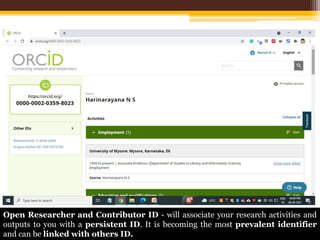
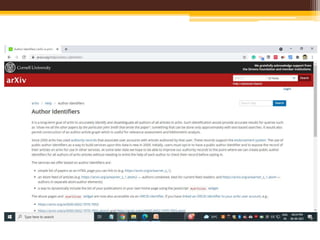
Open Researcher and Contributor ID - will associate your research activities and
outputs to you with a persistent ID. It is becoming the most prevalent identifier
and can be linked with others ID.
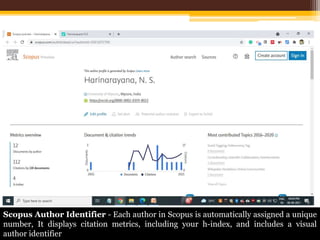
Scopus Author Identifier - Each author in Scopus is automatically assigned a unique
number, It displays citation metrics, including your h-index, and includes a visual
author identifier
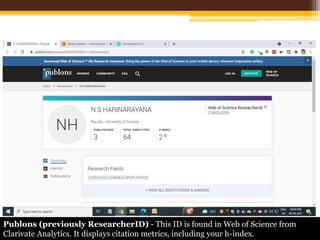
Publons (previously ResearcherID) - This ID is found in Web of Science from
Clarivate Analytics. It displays citation metrics, including your h-index.
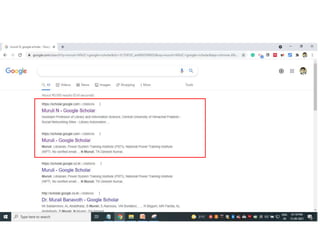
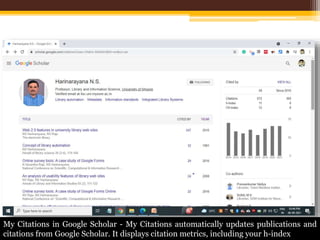
My Citations in Google Scholar - My Citations automatically updates publications and
citations from Google Scholar. It displays citation metrics, including your h-index
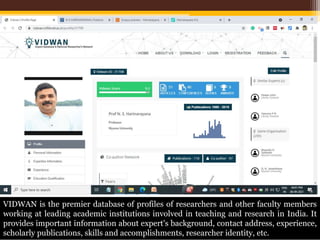
VIDWAN is the premier database of profiles of researchers and other faculty members
working at leading academic institutions involved in teaching and research in India. It
provides important information about expert's background, contact address, experience,
scholarly publications, skills and accomplishments, researcher identity, etc.
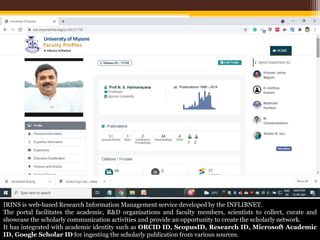
IRINS is web-based Research Information Management service developed by the INFLIBNET.
The portal facilitates the academic, R&D organisations and faculty members, scientists to collect, curate and
showcase the scholarly communication activities and provide an opportunity to create the scholarly network.
It has integrated with academic identity such as ORCID ID, ScopusID, Research ID, Microsoft Academic
ID, Google Scholar ID for ingesting the scholarly publication from various sources.
Part 4 –
Academic Social Networking Sites
https://medium.com/@NurdinLawal/top-five-academic-social-networking-sites-for-scholars-and-students-5b146e674f84
https://www.timeshighereducation.com/a-z-social-media
Conti...
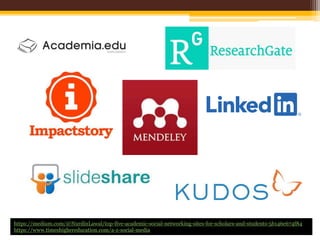
• ResearchGate - Creating a profile on ResearchGate
may help you stay connected to other researchers in
your field.
• Academia.edu - You can follow other researchers
in your field and it also offers analytics on your profile
and on your individual papers.
• ImpactStory - Create an ImpactStory profile to see
how often you are cited, saved by scholars, or
discussed by the public.
• Kudos - Create a Kudos profile to describe and share
your research outputs and view alternative
metrics.
Quiz..
1. Name any TWO important subscription based Citation Databases.
2. ______ is the Indian based Citation Database.
3. Name any TWO important Free Citation Databases.
4. Who is the Founder of JIF?
5. Name any FOUR Journal level metrics.
6. SJR stands for...
7. Name any TWO Author level metrics.
8. Name any FOUR important Unique Author Identification
Systems.
9. Name any FOUR important Academic Social Networking
platforms.
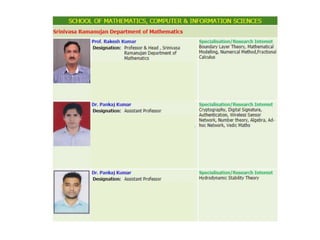
10. As per Google Scholar, who has highest h-index in DLIS, UoM?
Conclusion....
References
• Impact metrics: Author impact: H-index, g-index... LibGuides. (n.d.).
Retrieved September 14, 2021, from
https://libguides.graduateinstitute.ch/metrics/author_impact.
• Journal impact: CITESCORE. Guides & Tutorials. (n.d.). Retrieved
September 14, 2021, from
https://libguides.lb.polyu.edu.hk/journalimpact/citescore#sthash.O2CZ13
CK.HaUPMQzZ.dpbs.
• Measuring your impact: Impact factor, citation analysis, and other
metrics: Measuring your impact. Subject and Course Guides. (n.d.).
Retrieved September 14, 2021, from
https://researchguides.uic.edu/if/yourimpact.
• Measuring your research impact: I10-index. LibGuides. (n.d.). Retrieved
September 14, 2021, from
https://ucsd.libguides.com/c.php?g=704382&p=5000890.
Websites/ Additional Resources
• https://medium.com/@NurdinLawal/top-five-academic-social-networking-sites-for-scholars-
and-students-5b146e674f84
• https://www.timeshighereducation.com/a-z-social-media
• https://clarivate.com/webofsciencegroup/solutions/journal-citation-reports/
• https://www.researchinformation.info/news/journal-citation-reports-2021-published-clarivate
• https://en.wikipedia.org/wiki/Impact_factor
• https://www.elsevier.com/authors/tools-and-resources/measuring-a-journals-impact
• https://en.wikipedia.org/wiki/SCImago_Journal_Rank
• https://libguides.lb.polyu.edu.hk/journalimpact/sjrsnip#sthash.Qc3wUYOD.dpbs
• https://libraryguides.mcgill.ca/impact/profiles
Thank You 

Measuring Scientific Productivity

  • 1.
    Muruli N Research Scholar Departmentof Library and Information Science University of Mysore Measuring Scientific Productivity (Citation Databases, Impact Factor and its variants, h-index, SNIP, SJR, Unique Author Identification Systems)
  • 2.
  • 3.
    What is ScholarlyWritings/ Research Paper/ Academic Paper?
  • 5.
    Three Classes ofMetrics CLASSICAL Libra-metrics Biblio-metrics Scientometrics Infor-metrics NEO-CLASSICAL Cyber-metrics Webo-metrics MODERN Wiki-metrics Open source metrics Journal Metrics Author Metrics Article-level metrics Alt-metrics Source: https://www.slideshare.net/gketzia/metric-fields-in-information-science
  • 6.
  • 8.
    What is ScientificProductivity?
  • 10.
    Number of Publications+ Number of Citations
  • 11.
  • 14.
    Who is he? •American. • He is known for ▫ Impact factor ▫ Bibliometrics ▫ Scientometrics ▫ Science Citation Index • He was the founder of - ▫ Institute for Scientific Information ▫ The Scientist (Magazine) • He is the father of citation indexing of academic literature. • He launched the SCI, which in turn led to the Web of Science.
  • 16.
    Web of Science •Subscription-based database : Web of Science is a website that provides subscription-based access to multiple databases that provide comprehensive citation data for many different academic disciplines. • Previously known as Web of Knowledge. • Originally produced by the Institute for Scientific Information • Currently maintained by Clarivate Analytics • Previously maintained by Thomson Reuters. • Negotiated Rates (2018): For Core E Shodh Sindhu Members - 11,550 (USD) + 18% GST • Coverage – 1900 to present.
  • 17.
    Web of Science– Citation Databases CORE COLLECTION 1. Science Citation Index Expanded 2. Social Sciences Citation Index 3. Arts & Humanities Citation Index 4. Emerging Sources Citation Index 5. Book Citation Index 6. Conference Proceedings Citation Index REGIONAL DATABASES 1. Chinese Science Citation Database 2. SciELO Citation Index 3. Korea Citation Index 4. Russian Science Citation Index 5. Arabic Regional Citation Index
  • 18.
    Web of ScienceTools • EndNote • Kopernio • Publons • ResearchID • Journal Citation Reports • Journal Impact Factor • User Profile • Create alert • Citation Metrics
  • 20.
    Scopus • Subscription based–Abstracts & Citations database ▫ It indexes peer reviewed literature of Scientific Journals, Books & Conference Proceedings. ▫ Producer – Elsevier, Launched in 2004. • Four types of Numerical Quality Measures ▫ h-index ▫ CiteScore ▫ SCImago Journal Rank (SJR) ▫ Source Normalized Impact per Paper (SNIP) • Searches Patent databases also. • Scopus offers – Author profile & Scopus ID can be integrated with ORCID. • Negotiated Rates: For Core E Shodh Sindhu Members – 22,063 (USD) + 18% GST. • Coverage – 1788 to present.
  • 21.
    Limitations of Webof Science & Scopus Databases • Majority of the journals which have been indexed in theses databases are from United States. • Journals published in other than English language have been ignored. • It indexes only the Journals not the monographs and others.
  • 22.
    Indian Citation Index •Idea of - Ex NISCAIR Scientist Mr. Prakash Chand. • Developed by - “Knowledge Foundations”. • Funded by – Diva Enterprises Pvt Ltd. • Launched in 2009. • Covers – More than 1,100 Indian journals including open access journals from 2004 onwards. • Subscription based – Online Bibliographic Database.
  • 25.
    Google Scholar • FREEBibliographic database ▫ Brain-child of Alex Verstak & Anurag Acharya. ▫ Launched on 20th November 2004. ▫ Slogan – Stand on the Shoulders of Giants. • Indexes the metadata or the full-text of ▫ Peer reviewed online academics Journals, Books, Conference Papers, Thesis & Dissertations, Pre-Prints, Abstracts, Technical Reports, Court Opinions, Patents etc,. • Features ▫ Citation Importing - 2006 ▫ Scholar Citation Profile - 2012 ▫ Google Scholar Library 2013 ▫ Metrics buttons – To view impact of journals ▫ i10 index • Limitations & Criticism ▫ Google Scholar has been criticized for not critically examining the journals & for including Predatory journals.
  • 27.
    Microsoft Academic • FREE–web search engine for academic publications. • Competitor – to Google Scholar and other. • Developed by – Microsoft Research. • Re-Launched in 2016. • Previously known as – Microsoft Academic Search.
  • 30.
    Part 2- Impact Factors& it’s variants
  • 31.
    Introduction • Research Metricshave become important in many fields. • Research metrics are sometimes controversial. • Each metric may offer a different emphasis based on its ▫ Data source, ▫ Method of calculation, or ▫ Context of use. • Strengths and weaknesses of metrics - Don’t judge by a single metric, because all metrics have some limitations. • Golden Rules ▫ Always use both qualitative and quantitative input for decisions ▫ Always use more than one research metric as the quantitative input. • Therefore, using more than one metrics can help to provide a more complete picture and reflect different aspects of research productivity and impact in the final assessment.
  • 32.
    Citations Metrics JOURNAL LEVEL Journal Citation Reports (JCR)  Journal Impact Factor (JIF)  CiteScore metrics  SCImago Journal Rank (SJR)  Source Normalized Impact per Paper (SNIP) AUTHOR LEVEL  h-index  i10-index  g-index  Other.. ARTICLE LEVEL  Citations Per Publication  Alt-metric Score  Other..
  • 33.
    Journal-level metrics 1. JournalCitation Reports (JCR) 2. Journal Impact Factor (JIF) 1. SCImago Journal Rank (SJR) 2. CiteScore metrics 3. SNIP Web of Science/ Clarivate Analytics Scopus/ Elsevier 1. h5-index 2. h5-median Google Scholar
  • 34.
    Journal Citation Report(JCR) • Annual publication by Clarivate Analytics. • JCR has been integrated with the Web of Science. • Transparent, publisher-neutral data and statistics. • High-quality academic journals data – ▫ It allows the research community to evaluate the world’s high- quality academic journals using a range of indicators, descriptive data and visualisations. ▫ Researcher can explore a rich array of citation metrics, including the Journal Impact Factor.
  • 36.
    Journal Impact Factor(JIF) • Devised by Eugene Garfield. • Journals with higher impact factor carry more prestige in their respective fields, than those with lower values. • Mean number of citations of articles published in the last two years in a given journal.
  • 37.
    JIF - Example TheJournal Impact Factor is calculated by dividing citations to recent items by the number of recent items
  • 39.
    Activity - One Citesin 2020 to items published in: • 2019 = 525 • 2018 = 420 954/5 0 • Number of items published in: • 2019 = 26 • 2018 = 24 SUM: 945 SUM: 50 18 .9 JIF
  • 40.
    Activity - Two Citesin 2020 to items published in: • 2020 = 500 • 2019 = 525 • 2018 = 420 • 2017 = 480 1925/1 00 • Number of items published in: • 2020 = 26 • 2019 = 26 • 2018 = 24 SUM: 1925 19. 25 SUM: 100 CiteScore CiteScore is another important metric for measuring journal impact in Scopus. The calculation of CiteScore for the current year is based on the number of citations received by a journal in the latest 4 years (Including the calculation year), divided by the number of documents published in the journal in those four years.  CiteScore is calculated for the current year on a monthly basis until it is fixed as a permanent value in May the following year, permitting a real- time view on how the metric builds as citations accrue.
  • 41.
    CiteScore vs. JournalImpact Factor CiteScore calculation is based on Scopus data, CiteScore uses a 4-year window Impact Factor is based on Web of Science data. Factor adopts a 2-year window. Source: https://libguides.lb.polyu.edu.hk/journalimpact/sjrsnip#sthash.Qc3wUYOD.dpbs
  • 42.
    Scopus Sources -Demo https://www.scopus.com/ • CiteScore • SJR • SNIP
  • 43.
    SCImago Journal Rank(SJR) • SCImago Journal Rank (SJR) is based on the concept of a transfer of prestige between journals via their citation links. • Drawing on a similar approach to the Google PageRank algorithm - which assumes that important websites are linked to from other important websites - SJR weights each incoming citation to a journal by the SJR of the citing journal, with a citation from a high-SJR source counting for more than a citation from a low-SJR source. • Like CiteScore, SJR accounts for journal size by averaging across recent publications and is calculated annually. • SJR is also powered by Scopus data and is freely available alongside CiteScore.
  • 44.
  • 45.
    Source Normalized Impactper Paper (SNIP) • SNIP is a sophisticated metric that intrinsically accounts for field- specific differences in citation practices. • It does so by comparing each journal’s citations per publication with the citation potential of its field, defined as the set of publications citing that journal. • SNIP therefore measures contextual citation impact and enables direct comparison of journals in different subject fields, since the value of a single citation is greater for journals in fields where citations are less likely, and vice versa. • SNIP is calculated annually from Scopus data and is freely available at www.scopus.com/sources.
  • 46.
    Author-level metrics Measure thebibliometric impact of individual authors, researchers, academics, and scholars. h-index i10-index RG Score Author-level Eigenfactor Erdős number m-index Individual h-index h2 g-index e-index c-index o-index RA-index L-index s-index w-index
  • 47.
    Author-level-metrics h-index i10-index • Itwas invented by Jorge Hirsch in 2005. • The h-index is an author-level metric that attempts to measure both the productivity and citation impact of the publications of a scientist or scholar. • The h-index- Author/journal has published at least h papers that have each been cited at least h times • Created by Google Scholar and used in Google's My Citations feature. • i10-index = the number of publications with at least 10 citations. • Very simple and straightforward to calculate. • Google Scholar is free and easy to use. • Limitation - Used only in Google Scholar
  • 48.
  • 49.
    Part 3 – UniqueAuthor Identification Systems
  • 53.
    Open Researcher andContributor ID - will associate your research activities and outputs to you with a persistent ID. It is becoming the most prevalent identifier and can be linked with others ID.
  • 54.
    Scopus Author Identifier- Each author in Scopus is automatically assigned a unique number, It displays citation metrics, including your h-index, and includes a visual author identifier
  • 55.
    Publons (previously ResearcherID)- This ID is found in Web of Science from Clarivate Analytics. It displays citation metrics, including your h-index.
  • 56.
    My Citations inGoogle Scholar - My Citations automatically updates publications and citations from Google Scholar. It displays citation metrics, including your h-index
  • 57.
    VIDWAN is thepremier database of profiles of researchers and other faculty members working at leading academic institutions involved in teaching and research in India. It provides important information about expert's background, contact address, experience, scholarly publications, skills and accomplishments, researcher identity, etc.
  • 58.
    IRINS is web-basedResearch Information Management service developed by the INFLIBNET. The portal facilitates the academic, R&D organisations and faculty members, scientists to collect, curate and showcase the scholarly communication activities and provide an opportunity to create the scholarly network. It has integrated with academic identity such as ORCID ID, ScopusID, Research ID, Microsoft Academic ID, Google Scholar ID for ingesting the scholarly publication from various sources.
  • 61.
    Part 4 – AcademicSocial Networking Sites
  • 63.
  • 64.
    Conti... • ResearchGate -Creating a profile on ResearchGate may help you stay connected to other researchers in your field. • Academia.edu - You can follow other researchers in your field and it also offers analytics on your profile and on your individual papers. • ImpactStory - Create an ImpactStory profile to see how often you are cited, saved by scholars, or discussed by the public. • Kudos - Create a Kudos profile to describe and share your research outputs and view alternative metrics.
  • 65.
    Quiz.. 1. Name anyTWO important subscription based Citation Databases. 2. ______ is the Indian based Citation Database. 3. Name any TWO important Free Citation Databases. 4. Who is the Founder of JIF? 5. Name any FOUR Journal level metrics. 6. SJR stands for... 7. Name any TWO Author level metrics. 8. Name any FOUR important Unique Author Identification Systems. 9. Name any FOUR important Academic Social Networking platforms. 10. As per Google Scholar, who has highest h-index in DLIS, UoM?
  • 66.
  • 67.
    References • Impact metrics:Author impact: H-index, g-index... LibGuides. (n.d.). Retrieved September 14, 2021, from https://libguides.graduateinstitute.ch/metrics/author_impact. • Journal impact: CITESCORE. Guides & Tutorials. (n.d.). Retrieved September 14, 2021, from https://libguides.lb.polyu.edu.hk/journalimpact/citescore#sthash.O2CZ13 CK.HaUPMQzZ.dpbs. • Measuring your impact: Impact factor, citation analysis, and other metrics: Measuring your impact. Subject and Course Guides. (n.d.). Retrieved September 14, 2021, from https://researchguides.uic.edu/if/yourimpact. • Measuring your research impact: I10-index. LibGuides. (n.d.). Retrieved September 14, 2021, from https://ucsd.libguides.com/c.php?g=704382&p=5000890.
  • 68.
    Websites/ Additional Resources •https://medium.com/@NurdinLawal/top-five-academic-social-networking-sites-for-scholars- and-students-5b146e674f84 • https://www.timeshighereducation.com/a-z-social-media • https://clarivate.com/webofsciencegroup/solutions/journal-citation-reports/ • https://www.researchinformation.info/news/journal-citation-reports-2021-published-clarivate • https://en.wikipedia.org/wiki/Impact_factor • https://www.elsevier.com/authors/tools-and-resources/measuring-a-journals-impact • https://en.wikipedia.org/wiki/SCImago_Journal_Rank • https://libguides.lb.polyu.edu.hk/journalimpact/sjrsnip#sthash.Qc3wUYOD.dpbs • https://libraryguides.mcgill.ca/impact/profiles
  • 69.