Presentation
On
Software Piracy
Made By :
Pallavi Agarwal
1
1. Introduction
2. Types of software piracy
3. Why Software Piracy
4. Effects On Users
5. Effect on a Business
6. How to stop piracy
7. Punishment
8. Organizations For Protecting Piracy
9. References
2
 Software piracy is the illegally using, copying and
reselling of software without the consent of the
software creator.
 The unauthorized copying may be done for
personal use or business use. [1]
3
1. Soft Lifting
2. Hard Disk Loading
3. Renting
4. OEM Unbundling
5. Counterfeiting
6. Online Piracy[2]
4
Soft Lifting
 means sharing a program with someone who is not
authorized by the license agreement to use it.
 Also known as soft loading/end-user piracy.
 A common form of soft lifting involves purchasing
a single licensed copy of software and then loading
the software onto several computers
5
Hard Disk Loading
 Often committed by hardware dealers
 This form of piracy involves loading a unauthorized
copy of software onto a computer being sold to the end
user
 To attract customers
6
Renting
 Renting involves someone renting out a copy of
software for temporary use, without the permission
of the copyright holder.
 The practice, similar to that of renting a video from
Blockbuster, violates the license agreement of
software.
7
OEM Unbundling
 Original Equipment Manufacturer Unbundling
 means selling stand-alone software originally
meant to be included with a specific
accompanying product.
 An example of this form of piracy is someone
providing drivers to a specific printer without
authorization.
8
Counterfeiting
 means producing fake copies of software, making it
look authentic.
 This involves providing the box, CDs, and manuals,
all designed to look as much like the original
product as possible.
9
Online Piracy
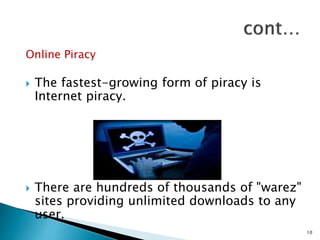
 The fastest-growing form of piracy is
Internet piracy.
 There are hundreds of thousands of "warez"
sites providing unlimited downloads to any
user.
10
 Expensive
 Availability
 Not convenient to buy for each computer
 Ask to buy new version although having
original one
 The CD/backup damaged
11
1. Lower productivity
2. Malware Infection
3. Subject to raid
12
Lower productivity
 Pirated software often
includes incomplete or
damaged programs
13
Malware Infection
 Pirated software can also include computer viruses
(malware) which can destroy data on a user’s hard
drive.
 Computer viruses can have a devastating impact on
any computer user -- from the home user to a
large business.
14
Subject to raid
 Companies can also be subject to raids by
the SIIA (Software & Information Industry
Association).
15
Distribution Methods
 Pirated material is distributed in two ways.
◦ Unknowing consumers buy pirated items.
◦ Others buy pirated items knowing they are
pirated.
16
Revenue Diverson
 Piracy diverts money away from producers
and distributors of items such as audio
recordings, making those companies who
make an investment in production and
distribution less profitable.
17
Tax Revenues
 Except in the case where pirated items are sold
through retail channels and taxed, tax revenue
is not generated from pirated items.
 For example, when music is downloaded with
no tax charged when it is supposed to be, as
dictated by tax laws, that revenue is lost as
well. Lost tax revenue reduces funds available
by the taxing government to spend.
18
Lessening Piracy
 To lessen the effect of piracy on a
business, businesses can implement
methods to discourage software piracy,
such as changes to how software is
distributed to make it harder to download.
 Another way to lessen piracy is to educate
the public about the impact of piracy on
their lives. [6]
19
 Purchase only legitimate software products.
 When buying software, it is necessary to be sure to get
genuine disks, manuals and license documentation.
 When one purchases illegal or counterfeit copies, his
money goes straight into the pockets of software
pirates .
 Buy from an authorized dealer.
 Check the prices and ask for receipts.
20
PUBLIC DOMAIN SOFTWARE
 These software are not under the copyright act.
They are free programs & can be used w/o
restrictions. It means the user of the software can
copy, distribute & even modify the software.
21
FREEWARE
 It is a copyright software which is given free by its author.
The user of the software redistribute the software but
cannot be modified by the end user. It also covers
1. Donation ware : A donation is required by the author or
to the 3rd party from the user of the software
2. Postcard ware : The user has to send a post card to the
creator of the software.
3. Abandon ware : The abandoned software are in this
category.
4. Ad ware : To promote the s/w as advertisement the
software’s are given free of cost. 22
SHAREWARE SOFTWARE
 Shareware or trialware is the software, which
comes with the permission for the people to
redistribute copies for a limited period. So far a
continues use of the software one have to pay for
the software.
 E.g. Winzip
23
COMMERCIAL SOFTWARE
 These are the software purchased from the
software publishers. It is available in stores & has
some objective to fulfill.
 E.g. Windows software, Ms Office etc.
24
OPEN SOURCE SOFTWARE
 These are created by generous programmers &
related to the public use. The programming code is
available to the users so that they can read it and
make changes according to their use & needs. They
can build the new versions of the software by using
the same code.
 E.g. Linux software.
25
PROPRIETY SOFTWARE
 It describes a technology or product that is owned
exclusively by a single company that carefully
guards the knowledge about the technology and
the product internal working. Some proprietary
product can function when used with other
products owned by some other company.
 E.g. Acrobat reader PDF (Portable document
format).
26
FIRM WARE SOFTWARE
 It is a combination of the software and h/w which
is permanently stored in the memory. It is a
program or data that has been written onto ROM.
27
 In India, the copyright of computer software is
protected under the Indian Copyright Act of 1957.
 The minimum jail term for software copyright
infringement(violation of law) is seven days and the
maximum jail term is three years.
 Fines range from a minimum of 50,000 to a
maximum of 200,000 rupees.
28
BSA
(Business Software Alliance)
 It established in 1988 and
representing a number of
the world's largest software
makers
 Its principal activity is trying
to stop copyright
infringement of software
produced by its members.
29
SIIA
(Software & Information Industry
Association)
 It offers global services in
business development,
government relations,
corporate education, and
intellectual property protection
to companies
 It also advocates a legal and
regulatory environment that
benefits the entire industry.
30
CAAST
(Canadian Alliance Against
Software Theft )
 Its mission statement is to
"reduce software piracy in
Canada through
education, public policy
and enforcement.”
 The CAAST was
established in 1990.
31
FAST
(Federation Against Software
Theft)
 It was set up in 1984 by the
British Computer Society's
Copyright Committee, and was
the first software copyright
organization in the U.K.
 Its first action was to raise the
awareness of software piracy
32
[1]Laurie E. MacDonald, Kenneth T. Fougere, Bryant College, Smithfield,
“Software Piracy: A Study of the Extent Of Coverage in Introductory MIS
Textbooks,” Journal of Information Systems Education, vol. 13, no. 4.
[2]http://cs.stanford.edu/people/eroberts/cs181/projects/software-
piracy/types.html
[3] http://www.ehow.com/list_6810994_software-piracy-laws-india.html
[4] http://whatis.techtarget.com/definition/piracy
[5] http://www.computerhope.com/jargon/s/softpira.htm
[6] http://smallbusiness.chron.com/effect-piracy-business-24541.html
[7]http://in.mathworks.com/company/aboutus/policies_statements/pirac
y.html
[8] www.fast.org.uk
[9] www.bsa.org
[10] www.caast.org
[11] www.siia.net
33
34

Presentation on Software Piracy

  • 1.
  • 2.
    1. Introduction 2. Typesof software piracy 3. Why Software Piracy 4. Effects On Users 5. Effect on a Business 6. How to stop piracy 7. Punishment 8. Organizations For Protecting Piracy 9. References 2
  • 3.
     Software piracyis the illegally using, copying and reselling of software without the consent of the software creator.  The unauthorized copying may be done for personal use or business use. [1] 3
  • 4.
    1. Soft Lifting 2.Hard Disk Loading 3. Renting 4. OEM Unbundling 5. Counterfeiting 6. Online Piracy[2] 4
  • 5.
    Soft Lifting  meanssharing a program with someone who is not authorized by the license agreement to use it.  Also known as soft loading/end-user piracy.  A common form of soft lifting involves purchasing a single licensed copy of software and then loading the software onto several computers 5
  • 6.
    Hard Disk Loading Often committed by hardware dealers  This form of piracy involves loading a unauthorized copy of software onto a computer being sold to the end user  To attract customers 6
  • 7.
    Renting  Renting involvessomeone renting out a copy of software for temporary use, without the permission of the copyright holder.  The practice, similar to that of renting a video from Blockbuster, violates the license agreement of software. 7
  • 8.
    OEM Unbundling  OriginalEquipment Manufacturer Unbundling  means selling stand-alone software originally meant to be included with a specific accompanying product.  An example of this form of piracy is someone providing drivers to a specific printer without authorization. 8
  • 9.
    Counterfeiting  means producingfake copies of software, making it look authentic.  This involves providing the box, CDs, and manuals, all designed to look as much like the original product as possible. 9
  • 10.
    Online Piracy  Thefastest-growing form of piracy is Internet piracy.  There are hundreds of thousands of "warez" sites providing unlimited downloads to any user. 10
  • 11.
     Expensive  Availability Not convenient to buy for each computer  Ask to buy new version although having original one  The CD/backup damaged 11
  • 12.
    1. Lower productivity 2.Malware Infection 3. Subject to raid 12
  • 13.
    Lower productivity  Piratedsoftware often includes incomplete or damaged programs 13
  • 14.
    Malware Infection  Piratedsoftware can also include computer viruses (malware) which can destroy data on a user’s hard drive.  Computer viruses can have a devastating impact on any computer user -- from the home user to a large business. 14
  • 15.
    Subject to raid Companies can also be subject to raids by the SIIA (Software & Information Industry Association). 15
  • 16.
    Distribution Methods  Piratedmaterial is distributed in two ways. ◦ Unknowing consumers buy pirated items. ◦ Others buy pirated items knowing they are pirated. 16
  • 17.
    Revenue Diverson  Piracydiverts money away from producers and distributors of items such as audio recordings, making those companies who make an investment in production and distribution less profitable. 17
  • 18.
    Tax Revenues  Exceptin the case where pirated items are sold through retail channels and taxed, tax revenue is not generated from pirated items.  For example, when music is downloaded with no tax charged when it is supposed to be, as dictated by tax laws, that revenue is lost as well. Lost tax revenue reduces funds available by the taxing government to spend. 18
  • 19.
    Lessening Piracy  Tolessen the effect of piracy on a business, businesses can implement methods to discourage software piracy, such as changes to how software is distributed to make it harder to download.  Another way to lessen piracy is to educate the public about the impact of piracy on their lives. [6] 19
  • 20.
     Purchase onlylegitimate software products.  When buying software, it is necessary to be sure to get genuine disks, manuals and license documentation.  When one purchases illegal or counterfeit copies, his money goes straight into the pockets of software pirates .  Buy from an authorized dealer.  Check the prices and ask for receipts. 20
  • 21.
    PUBLIC DOMAIN SOFTWARE These software are not under the copyright act. They are free programs & can be used w/o restrictions. It means the user of the software can copy, distribute & even modify the software. 21
  • 22.
    FREEWARE  It isa copyright software which is given free by its author. The user of the software redistribute the software but cannot be modified by the end user. It also covers 1. Donation ware : A donation is required by the author or to the 3rd party from the user of the software 2. Postcard ware : The user has to send a post card to the creator of the software. 3. Abandon ware : The abandoned software are in this category. 4. Ad ware : To promote the s/w as advertisement the software’s are given free of cost. 22
  • 23.
    SHAREWARE SOFTWARE  Sharewareor trialware is the software, which comes with the permission for the people to redistribute copies for a limited period. So far a continues use of the software one have to pay for the software.  E.g. Winzip 23
  • 24.
    COMMERCIAL SOFTWARE  Theseare the software purchased from the software publishers. It is available in stores & has some objective to fulfill.  E.g. Windows software, Ms Office etc. 24
  • 25.
    OPEN SOURCE SOFTWARE These are created by generous programmers & related to the public use. The programming code is available to the users so that they can read it and make changes according to their use & needs. They can build the new versions of the software by using the same code.  E.g. Linux software. 25
  • 26.
    PROPRIETY SOFTWARE  Itdescribes a technology or product that is owned exclusively by a single company that carefully guards the knowledge about the technology and the product internal working. Some proprietary product can function when used with other products owned by some other company.  E.g. Acrobat reader PDF (Portable document format). 26
  • 27.
    FIRM WARE SOFTWARE It is a combination of the software and h/w which is permanently stored in the memory. It is a program or data that has been written onto ROM. 27
  • 28.
     In India,the copyright of computer software is protected under the Indian Copyright Act of 1957.  The minimum jail term for software copyright infringement(violation of law) is seven days and the maximum jail term is three years.  Fines range from a minimum of 50,000 to a maximum of 200,000 rupees. 28
  • 29.
    BSA (Business Software Alliance) It established in 1988 and representing a number of the world's largest software makers  Its principal activity is trying to stop copyright infringement of software produced by its members. 29
  • 30.
    SIIA (Software & InformationIndustry Association)  It offers global services in business development, government relations, corporate education, and intellectual property protection to companies  It also advocates a legal and regulatory environment that benefits the entire industry. 30
  • 31.
    CAAST (Canadian Alliance Against SoftwareTheft )  Its mission statement is to "reduce software piracy in Canada through education, public policy and enforcement.”  The CAAST was established in 1990. 31
  • 32.
    FAST (Federation Against Software Theft) It was set up in 1984 by the British Computer Society's Copyright Committee, and was the first software copyright organization in the U.K.  Its first action was to raise the awareness of software piracy 32
  • 33.
    [1]Laurie E. MacDonald,Kenneth T. Fougere, Bryant College, Smithfield, “Software Piracy: A Study of the Extent Of Coverage in Introductory MIS Textbooks,” Journal of Information Systems Education, vol. 13, no. 4. [2]http://cs.stanford.edu/people/eroberts/cs181/projects/software- piracy/types.html [3] http://www.ehow.com/list_6810994_software-piracy-laws-india.html [4] http://whatis.techtarget.com/definition/piracy [5] http://www.computerhope.com/jargon/s/softpira.htm [6] http://smallbusiness.chron.com/effect-piracy-business-24541.html [7]http://in.mathworks.com/company/aboutus/policies_statements/pirac y.html [8] www.fast.org.uk [9] www.bsa.org [10] www.caast.org [11] www.siia.net 33
  • 34.

Editor's Notes

  • #4 It is the copying and reuse of software by large corporations. It is copying software and distributing it on the Web.
  • #6 It is not for commercial purpose
  • #7 It is for commercial purpose
  • #11 warez Commercial software that has been pirated and made available to the public via a BBS or the Internet.
  • #20 Lessening Piracy To lessen the effect of piracy on a business, businesses can implement methods to discourage software piracy, such as changes to how software is distributed to make it harder to download. Another way to lessen piracy is to educate the public about the impact of piracy on their lives. For example, piracy causes items to be more expensive because a company does not realize the income it is entitled to and has to charge higher prices for its products to make up for lost revenue.[6]
  • #21 Constraints of Open Source Software Quality Not user friendly Rapid change Documentation Lack of focus on UI
  • #29 Copyright protection for software with an individual author lasts for the duration of the author's life and continues 60 years after the author's death. Government agencies such as the Ministry of Information Technology and the Ministry of Human Resource Development have played an active role in aiding the Indian law enforcement authorities in protecting software copyright holders.
  • #30 MathWorks is a member of the Business Software Alliance (BSA), a global organization formed to advance free and open world transfer for legitimate software by advocating strong intellectual property protection. The BSA represents leading software and e-commerce developers in 65 countries. For more information about the BSA or to report software piracy, visit the BSA Web site at www.bsa.org.
  • #31 The Software & Information Industry Association (SIIA) is a trade organization for the software and digital content industry. SIIA offers global services in business development, government relations, corporate education, and intellectual property protection to companies. It also advocates a legal and regulatory environment that benefits the entire industry. For more information about SIIA or to report software piracy, visit the SIIA Web site at www.siia.net.
  • #32 The Canadian Alliance Against Software Theft (CAAST) is an industry alliance of software manufacturers that share the common goal of reducing software piracy. CAAST provides educational information to corporations, consumers, academic institutions, and resellers about software theft and its implications. CAAST works with BSA. For more information about CAAST or to report software piracy, vast the CAAST Web site at www.caast.org or call the hotline (from Canada only) at 800-263-9700.
  • #33 The Federation Against Software Theft was set up in 1984 by the British Computer Society's Copyright Committee, and was the first software copyright organization in the U.K. Its first action was to raise the awareness of software piracy and to lobby the U.K. Parliament for changes in the Copyright Act of 1956 to reflect the needs of software authors and publishers. This campaign was successful, and FAST has since been able to influence other legislation that impacts the proper safeguarding of software. The work of FAST in this area has directly influenced the way software copyright law and investigations are carried out in many other countries. To learn more, visit www.fastiis.org.