THE COMUNICATION OF THE
PAST…
IN THE PREHISTORY…
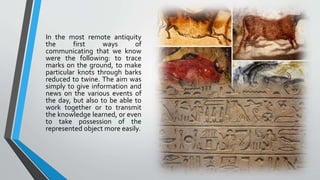
The prehistoric period has left us many testimonies
of communication for example the cave paintings.
Later, however, it was understood that they also
represented the systematic attempt of prehistoric
men to use certain symbols to record information
about the natural environment in which they lived.
Many scholars say that it was precisely with the
origin of the Sumerians and the Egyptians that
writing was born.
In the most remote antiquity
the first ways of
communicating that we know
were the following: to trace
marks on the ground, to make
particular knots through barks
reduced to twine. The aim was
simply to give information and
news on the various events of
the day, but also to be able to
work together or to transmit
the knowledge learned, or even
to take possession of the
represented object more easily.
THE STORY…
The birth of "written communication" marks the
transition
from prehistory to history. The invention of writing,
presumably took place about 5-6 thousand years ago, is
flanked by the memory to which the news to be handed
down were hitherto entrusted. The "memory" is then
engraved on clay tablets or other material to be handed
down over time.
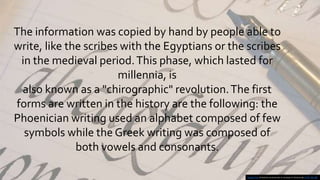
The information was copied by hand by people able to
write, like the scribes with the Egyptians or the scribes
in the medieval period.This phase, which lasted for
millennia, is
also known as a "chirographic" revolution.The first
forms are written in the history are the following: the
Phoenician writing used an alphabet composed of few
symbols while the Greek writing was composed of
both vowels and consonants.
Questa foto di Autore sconosciuto è concesso in licenza da CC BY-NC-ND
IN THE 1400…
The invention of printing with movable type, invented by
Gutemberg in the fifteenth century, further extends the
tools
of communication, allowing the production and
dissemination of books or newspapers that until then were
manuscripts and therefore disseminated in a very large
number of copies limited. The first newspapers and books
were born, which became cheaper and therefore became
within reach of a greater number of people.
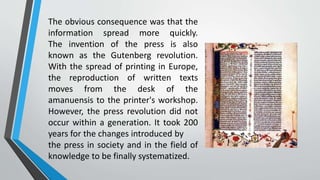
The obvious consequence was that the
information spread more quickly.
The invention of the press is also
known as the Gutenberg revolution.
With the spread of printing in Europe,
the reproduction of written texts
moves from the desk of the
amanuensis to the printer's workshop.
However, the press revolution did not
occur within a generation. It took 200
years for the changes introduced by
the press in society and in the field of
knowledge to be finally systematized.
IN THE 1800…
The electric communication begins with the birth of the
telegraph invented by Samuel Morse in the nineteenth
century and continues to this day with the unstoppable
technological development that in the span of a century
has
led to the emergence of electronic communication with
radio, television and instruments advanced digital
communication (internet).These innovations are also
known
as an electric revolution or electronic communication
revolution.
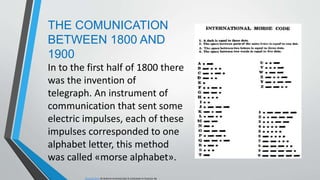
THE COMUNICATION
BETWEEN 1800 AND
1900
In to the first half of 1800 there
was the invention of
telegraph. An instrument of
communication that sent some
electric impulses, each of these
impulses corresponded to one
alphabet letter, this method
was called «morse alphabet».
Questa foto di Autore sconosciuto è concesso in licenza da
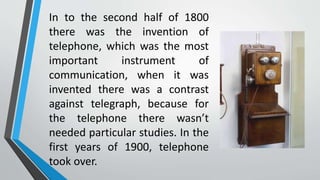
In to the second half of 1800
there was the invention of
telephone, which was the most
important instrument of
communication, when it was
invented there was a contrast
against telegraph, because for
the telephone there wasn’t
needed particular studies. In the
first years of 1900, telephone
took over.
THE ADVENT OF COMPUTER
The computer as we know it today had its beginning with
a 19thcentury English mathematics professor called
Charles Babbage. He has designed the Analytical Engine
and it was this design that the basic framework of the
computers of today are based on.
Generally speaking, computers can be classified into
three generations. Each generation lasted for a certain
period of time, and each gave us either a new and
improvement to the existing of computer.
First generation: 1937-1946. In 1937 the first electronic digital computer was built by
Dr. John V.Atanasoff and Clifford Berry. It was called the Atanasoff-Berry
Computer(ABC). In 1943 an electronic computer name the Colossus was built for the
military. Other developments continued until in 1946 the first general-purpose digital
computer, the Electronic Numerical Integrator and Computer(ENIAC) was built.
Computers of this generation could only perform single task, and they had no
operating system. Second
generation: 1947-1962. This generation of computers used transistors instead of
vacuum tubes which were more reliable. In 1951 the first computer for commercial
use was introduced to the public; the Universal Automatic Computer(UNIVAC 1).
During this generation of computers had memory and operating systems. Storage
media such as tape and disk were in use also were printers for output.
Third generation: 1963-present. The invention of integrated
circuit brought us the third generation of computers. With
this invention computers became smaller, more powerful
more reliable and they are able to run many different
programs at the same time. In 1980 Microsoft Disk Oerating
System(MS-Dos) was born and in 1981 IBM introduced the
personal computer(PC)for home and office use.
As a result of the various improvements to the development
of the computer we have seen the computer being used in all
areas of life. It is a very useful tool that will continue to
experience new development as time passes.
Internet story
The history of the Internet begins with the development of electronic computers
in the 1950s in several computer science laboratories in the United States, United
Kingdom, and France. The U.S. Department of Defense created ARPANET project,
which had the objective to build a secure telecomunication system even in case of
war. The first message was sent over the ARPANET in 1969 from computer science
Professor Leonard Kleinrock’s laboratory at University of California, Los
Angeles(UCLA) to the second network node at Stanford Research Institute(SRI).
The Internet protocol suite(TCP/IP) was developed by Robert E.Kahn and Vint Cerf
in the 1970s and became the standard networking protocol on the ARPANET. In
the early 1980s was funded the establishment for national supercomputing
centers at several universities, and provided interconnectivity in 1986 with the
NSFNET project.
In the 1980s a British computer scientist Tim Berners-Lee resulted in
the World Widw Web, linking documents into an information system,
accessible from any node on the network. Since the mid-1990s, the
Internet has had a revolutionary impact on culture, commerce, and
technology, including the rise of near-instant communication by
electronic mail, instant messaaging, telephone calls, and video calls,
and the World Wide Web. The research and education community
continues to develop and use advanced networks and increasing
amounts of data are transmitted at higher and higher speeds like fiber
optic networks. Today the Internet continues to grow, giving many
online information, commerce, entertainment, and social networking.
PASTVS PRESENT
All we know that all the people of 20th century think that the communication
of the present has a lot of advantage to the type of communication of the past,
and yes obviusly it is the right answer but in our opinion the comunication of
the past could be more interesting becouse it leaves room for imagination and
it let us know the origins of communication, so even if our modern
communication is easier and faster, the type of communication that was in the
past rest the most beautiful type of communication to see and to remember.
The invention of the first phone was so much important because it has
facilitated the communication and it has reduced distances. We’re sure that
people in that period were enthusiasts and curios of this strange object, that
now is one of the most important object to communicate and now we can use
this in his most evolute form.
Mobile Phone
The mobile phone first appeared in India sometime in the nineties. It was a
bulky box quite similar to the landlines we still use today. It had an equally big
antenna and was heavy and cumbersome to carry. That was just the beginning.
Very soon they were all over the place. With the alarming speed at which they
shrunk in size, these pocket sized wonders, sure packed a punch. The mobiles
of today are gizmos that can do multiple functions. They can send text
messages, they can send and receive video messages and they have a host of
facilities that somehow make the “talk on the move” function seem redundant.
In India almost every one, everywhere, seems to have one. The vegetable
vendor, the bus conductor, students, the office goers, almost everybody
irrespective of economic status has a cell phone. This little midget has taken
the world by storm. Thanks to the cell phone everybody is available almost all
of the time.
Mobile Phone
It’s a boon for people who do a lot of field work. It means the offices they work for can keep in touch
with them. Also in cases of emergency, like you are stuck in a road jam or in some catastrophe, all you
have to do is whip out your phone and call for help or call your family to put their minds at ease. You can
text one message to several people at the same time. Through your cell you can go online and check your
email. You can play games on your cell phone to kill time, not the best of uses, but a use nonetheless.
Everywhere you go, you are swarmed by people glued to their cell phones. It has reached the
proportions where often one sees a young couple walking down the beach hand in hand; both their
other hands holding on to their individual cells talking to other people. The invention of the cell phone
it's sure a good thing but on the other hand, there are also disadvantages. Using a lot mobile phone can
harm your brain, particularly teenager and children who are under 16 years old. If you use mobile phones
too much, you will get bad effects like dizzy, blood-brain barrier, or ears problems. In addition, when you
use mobile phones while you are driving, you will get an accident. It is essential not good for you and
others. Moreover, “radiations emitted from the phone are dead harmful for the eardrum”, has proved by
many scientist. Owning a mobile phone in your hand is you can solve many issues and hold most of
information around the world. Even though is not good for your health and you have to protect yourself
from bad effects of mobile phones if you choose to have one.
Social Media
Social media and social networking seem to play an imperative part of peoples lives around the world.
There are some who debate whether it is improving or crippling communication skills. Sitting behind a
computer communicating with cyber friends can be easy and fun but can weaken a person’s verbal
communication skills. I will not only focus on the negative impacts on communication because there are
some positive impacts on communication through social media. I will explore how social media and
networking strengthens and weakens communication. Accessibility that one has to the internet
through smart phones, tablets, computers, and other mobile devices has made accessing information
and connecting with people a touch away in some cases. People are communicating almost all day
every day through texting, e-mail, and the ever-expanding social media. Because it has had such a
modern explosion in popularity and usage, social media has become the new norm when it comes to
communicating everything from huge life events like engagements and the birth of children to minute
particulars like what one ate for dinner. Social media has had one of the most substantial impacts on
how people communicate within the past decade.The internet has a greater impact on people today
than ever before. It has been a continual source of news, entertainment, and education for users around
the world for more than 20 years. However, the most innovative of its technologies, social media, did
not achieve mainstream popularity until about ten years ago.
Social Media
Facebook,Twitter, and similar services are becoming the most visited destinations on the internet.These
websites allow users to quickly and easily share pictures, links, ideas, and messages with other users;
theoretically facilitating social interaction.These services, through a combination of accessibility,
simplicity, and intuitive design promote positive social behavior by encouraging interaction among friends,
relatives, and co-workers; facilitating communication between individuals, and fostering a profound sense
of community.There are other social sites likeYouTube that give users a platform to upload and share
videos. Here, users post videos of themselves for other users to view.YouTube has been a great platform
for musicians and film producers as their fans can easily access their music videos.Other social sites like
MySpace have also given users the platform to post videos on their profiles. Such sites enable easy access
to a variety of videos like music, sports, documentaries, and movies. Social media has lessened the use
verbal communication and increased the use of online messaging. People nowadays can have ‘phone
conversations’ over their computers.This has been enabled by the development of social sites such as
Skype. Here, people that are connected will communicate by word of mouth.This is unlike Facebook and
Twitter where the mode of communication is by writing. Most of the social sites have now incorporated
webcams for their subscribers.Webcams enables ‘friends’ to have a one on one conversation while at the
same time watching each other
Social Media
This communication is more private and very effective as subscribers get to see each other.There has really
been an increase in popularity in webcam conversations. It is important to realize that as social media evolves
the realm of communication changes.The technological advances added to social media changes the way we
communicate with people on daily basis. It has made communication quicker and more efficient. Social media
sites like Facebook send daily reminder of friend birthdays. Instead of picking up the phone and traditionally
wishing someone birthday greetings, you can simply type your birthday greeting on their page.This has
eliminated the need to make a phone call or send a greeting card.While receiving a birthday message from
your friends online is okay, it feels impersonal.The feeling of opening a greeting card and reading a message
someone picked out for you, fills my heart with warmth.That personal effect is not felt from a message left on
a page I have created online and in most cases, I do not read them.The negative effects of social media on
communication are the effect it can have on kids through cyber bullying and unwanted exposure.Younger
people are using mass communication without the without realizing the consequences. Anyone who has a
Facebook,Twitter or Instagram account have seen the user who is logged in all the time.There are some users
who post everything they are doing throughout the day, which can be dangerous.
Social Media
Facebook also lets you to make groups, have applications and have as many friends as you want –
this assists you with getting in touch with people who like what you like, play games online, and
make additional friends. One thing it lacks in is security from pedophiles.There is no ‘report
button’ to report users, even if they are irritating you. It also has a social bookmarking websites,
allowing you to keep your favorite websites in one place, as well as all your friends. Another
wonderful idea only integrated by Facebook is the friend finder. It permits you to find friends in an
instant, allowing you to connect to friends.The best way to protect your privacy is to be mindful of
what you post and who can access and view what you are posting. I suggest not posting anything
on the social media and networking sites that you do not want broadcasting to everyone.
Although you believe your family and friends are viewing what you are posting, anyone can access
it. Communication has improved greatly by emerges and continual growth of social media.
Everyone from churches to schools use it to communicate with users. Social media has evolved
communication to new heights.The ease of access and growth makes it very beneficial to
everyone from pastors to politicians.As social media evolves, communication will improve and
continue to soar to new heights.The positive impact on communication definitely overcomes the
negative and makes it very beneficial.
Netiquette
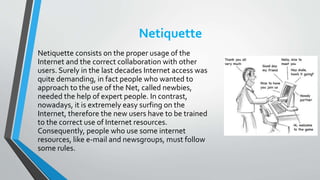
Netiquette consists on the proper usage of the
Internet and the correct collaboration with other
users. Surely in the last decades Internet access was
quite demanding, in fact people who wanted to
approach to the use of the Net, called newbies,
needed the help of expert people. In contrast,
nowadays, it is extremely easy surfing on the
Internet, therefore the new users have to be trained
to the correct use of Internet resources.
Consequently, people who use some internet
resources, like e-mail and newsgroups, must follow
some rules.
E-mail
E-mail is the most used by people Internet resource who let
everyone to send messages all over the world. For this reason,
it is necessary to follow some rules, for example:
Every day everyone ought to open his email account and reply
within 48 hours giving the confirmation of the viewed
document to the sender
A correct email shouldn’t contain an enormous quantity of
words. Especially if we reply to a previous email, when we
report the content of the message, it is good manner to write
only the relevant parts of the text
It is suitable to write lowercase and using uppercase only for
the title because an unappropriated use of uppercase is a
synonymous of shouting out.
The message dimension shouldn’t exceed 100-200 kb avoiding
files with too long name and particular letters .
Newsgroups
A newsgroup is a Net platform where groups of people with a
specific interest to a topic discuss together and give their
opinion. In order to enroll to a newsgroup it is compulsory to
follow some instructions:
It is not allowed each type of advertisement;
If you are a new member of this platform you have to read
carefully FAQs (Frequently asked Questions) and lurking what
others write.
If you decide to send your own article to a newsgroup, it is
well-mannered clarify its content using as good as you can
the “Subject” field of the message letterhead.Therefore, if
you cross-post a message you should highlight it, letting
other regular client to know it and avoiding reading the same
article more than once.
Everyone should avoid letting everyone be known of the
content of a private message unless the author license
Power point inglese

Power point inglese

  • 1.
  • 2.
    IN THE PREHISTORY… Theprehistoric period has left us many testimonies of communication for example the cave paintings. Later, however, it was understood that they also represented the systematic attempt of prehistoric men to use certain symbols to record information about the natural environment in which they lived. Many scholars say that it was precisely with the origin of the Sumerians and the Egyptians that writing was born.
  • 3.
    In the mostremote antiquity the first ways of communicating that we know were the following: to trace marks on the ground, to make particular knots through barks reduced to twine. The aim was simply to give information and news on the various events of the day, but also to be able to work together or to transmit the knowledge learned, or even to take possession of the represented object more easily.
  • 4.
    THE STORY… The birthof "written communication" marks the transition from prehistory to history. The invention of writing, presumably took place about 5-6 thousand years ago, is flanked by the memory to which the news to be handed down were hitherto entrusted. The "memory" is then engraved on clay tablets or other material to be handed down over time.
  • 5.
    The information wascopied by hand by people able to write, like the scribes with the Egyptians or the scribes in the medieval period.This phase, which lasted for millennia, is also known as a "chirographic" revolution.The first forms are written in the history are the following: the Phoenician writing used an alphabet composed of few symbols while the Greek writing was composed of both vowels and consonants. Questa foto di Autore sconosciuto è concesso in licenza da CC BY-NC-ND
  • 6.
    IN THE 1400… Theinvention of printing with movable type, invented by Gutemberg in the fifteenth century, further extends the tools of communication, allowing the production and dissemination of books or newspapers that until then were manuscripts and therefore disseminated in a very large number of copies limited. The first newspapers and books were born, which became cheaper and therefore became within reach of a greater number of people.
  • 7.
    The obvious consequencewas that the information spread more quickly. The invention of the press is also known as the Gutenberg revolution. With the spread of printing in Europe, the reproduction of written texts moves from the desk of the amanuensis to the printer's workshop. However, the press revolution did not occur within a generation. It took 200 years for the changes introduced by the press in society and in the field of knowledge to be finally systematized.
  • 8.
    IN THE 1800… Theelectric communication begins with the birth of the telegraph invented by Samuel Morse in the nineteenth century and continues to this day with the unstoppable technological development that in the span of a century has led to the emergence of electronic communication with radio, television and instruments advanced digital communication (internet).These innovations are also known as an electric revolution or electronic communication revolution.
  • 9.
    THE COMUNICATION BETWEEN 1800AND 1900 In to the first half of 1800 there was the invention of telegraph. An instrument of communication that sent some electric impulses, each of these impulses corresponded to one alphabet letter, this method was called «morse alphabet». Questa foto di Autore sconosciuto è concesso in licenza da
  • 10.
    In to thesecond half of 1800 there was the invention of telephone, which was the most important instrument of communication, when it was invented there was a contrast against telegraph, because for the telephone there wasn’t needed particular studies. In the first years of 1900, telephone took over.
  • 11.
    THE ADVENT OFCOMPUTER The computer as we know it today had its beginning with a 19thcentury English mathematics professor called Charles Babbage. He has designed the Analytical Engine and it was this design that the basic framework of the computers of today are based on. Generally speaking, computers can be classified into three generations. Each generation lasted for a certain period of time, and each gave us either a new and improvement to the existing of computer.
  • 12.
    First generation: 1937-1946.In 1937 the first electronic digital computer was built by Dr. John V.Atanasoff and Clifford Berry. It was called the Atanasoff-Berry Computer(ABC). In 1943 an electronic computer name the Colossus was built for the military. Other developments continued until in 1946 the first general-purpose digital computer, the Electronic Numerical Integrator and Computer(ENIAC) was built. Computers of this generation could only perform single task, and they had no operating system. Second generation: 1947-1962. This generation of computers used transistors instead of vacuum tubes which were more reliable. In 1951 the first computer for commercial use was introduced to the public; the Universal Automatic Computer(UNIVAC 1). During this generation of computers had memory and operating systems. Storage media such as tape and disk were in use also were printers for output.
  • 13.
    Third generation: 1963-present.The invention of integrated circuit brought us the third generation of computers. With this invention computers became smaller, more powerful more reliable and they are able to run many different programs at the same time. In 1980 Microsoft Disk Oerating System(MS-Dos) was born and in 1981 IBM introduced the personal computer(PC)for home and office use. As a result of the various improvements to the development of the computer we have seen the computer being used in all areas of life. It is a very useful tool that will continue to experience new development as time passes.
  • 14.
    Internet story The historyof the Internet begins with the development of electronic computers in the 1950s in several computer science laboratories in the United States, United Kingdom, and France. The U.S. Department of Defense created ARPANET project, which had the objective to build a secure telecomunication system even in case of war. The first message was sent over the ARPANET in 1969 from computer science Professor Leonard Kleinrock’s laboratory at University of California, Los Angeles(UCLA) to the second network node at Stanford Research Institute(SRI). The Internet protocol suite(TCP/IP) was developed by Robert E.Kahn and Vint Cerf in the 1970s and became the standard networking protocol on the ARPANET. In the early 1980s was funded the establishment for national supercomputing centers at several universities, and provided interconnectivity in 1986 with the NSFNET project.
  • 15.
    In the 1980sa British computer scientist Tim Berners-Lee resulted in the World Widw Web, linking documents into an information system, accessible from any node on the network. Since the mid-1990s, the Internet has had a revolutionary impact on culture, commerce, and technology, including the rise of near-instant communication by electronic mail, instant messaaging, telephone calls, and video calls, and the World Wide Web. The research and education community continues to develop and use advanced networks and increasing amounts of data are transmitted at higher and higher speeds like fiber optic networks. Today the Internet continues to grow, giving many online information, commerce, entertainment, and social networking.
  • 16.
    PASTVS PRESENT All weknow that all the people of 20th century think that the communication of the present has a lot of advantage to the type of communication of the past, and yes obviusly it is the right answer but in our opinion the comunication of the past could be more interesting becouse it leaves room for imagination and it let us know the origins of communication, so even if our modern communication is easier and faster, the type of communication that was in the past rest the most beautiful type of communication to see and to remember. The invention of the first phone was so much important because it has facilitated the communication and it has reduced distances. We’re sure that people in that period were enthusiasts and curios of this strange object, that now is one of the most important object to communicate and now we can use this in his most evolute form.
  • 17.
    Mobile Phone The mobilephone first appeared in India sometime in the nineties. It was a bulky box quite similar to the landlines we still use today. It had an equally big antenna and was heavy and cumbersome to carry. That was just the beginning. Very soon they were all over the place. With the alarming speed at which they shrunk in size, these pocket sized wonders, sure packed a punch. The mobiles of today are gizmos that can do multiple functions. They can send text messages, they can send and receive video messages and they have a host of facilities that somehow make the “talk on the move” function seem redundant. In India almost every one, everywhere, seems to have one. The vegetable vendor, the bus conductor, students, the office goers, almost everybody irrespective of economic status has a cell phone. This little midget has taken the world by storm. Thanks to the cell phone everybody is available almost all of the time.
  • 18.
    Mobile Phone It’s aboon for people who do a lot of field work. It means the offices they work for can keep in touch with them. Also in cases of emergency, like you are stuck in a road jam or in some catastrophe, all you have to do is whip out your phone and call for help or call your family to put their minds at ease. You can text one message to several people at the same time. Through your cell you can go online and check your email. You can play games on your cell phone to kill time, not the best of uses, but a use nonetheless. Everywhere you go, you are swarmed by people glued to their cell phones. It has reached the proportions where often one sees a young couple walking down the beach hand in hand; both their other hands holding on to their individual cells talking to other people. The invention of the cell phone it's sure a good thing but on the other hand, there are also disadvantages. Using a lot mobile phone can harm your brain, particularly teenager and children who are under 16 years old. If you use mobile phones too much, you will get bad effects like dizzy, blood-brain barrier, or ears problems. In addition, when you use mobile phones while you are driving, you will get an accident. It is essential not good for you and others. Moreover, “radiations emitted from the phone are dead harmful for the eardrum”, has proved by many scientist. Owning a mobile phone in your hand is you can solve many issues and hold most of information around the world. Even though is not good for your health and you have to protect yourself from bad effects of mobile phones if you choose to have one.
  • 19.
    Social Media Social mediaand social networking seem to play an imperative part of peoples lives around the world. There are some who debate whether it is improving or crippling communication skills. Sitting behind a computer communicating with cyber friends can be easy and fun but can weaken a person’s verbal communication skills. I will not only focus on the negative impacts on communication because there are some positive impacts on communication through social media. I will explore how social media and networking strengthens and weakens communication. Accessibility that one has to the internet through smart phones, tablets, computers, and other mobile devices has made accessing information and connecting with people a touch away in some cases. People are communicating almost all day every day through texting, e-mail, and the ever-expanding social media. Because it has had such a modern explosion in popularity and usage, social media has become the new norm when it comes to communicating everything from huge life events like engagements and the birth of children to minute particulars like what one ate for dinner. Social media has had one of the most substantial impacts on how people communicate within the past decade.The internet has a greater impact on people today than ever before. It has been a continual source of news, entertainment, and education for users around the world for more than 20 years. However, the most innovative of its technologies, social media, did not achieve mainstream popularity until about ten years ago.
  • 20.
    Social Media Facebook,Twitter, andsimilar services are becoming the most visited destinations on the internet.These websites allow users to quickly and easily share pictures, links, ideas, and messages with other users; theoretically facilitating social interaction.These services, through a combination of accessibility, simplicity, and intuitive design promote positive social behavior by encouraging interaction among friends, relatives, and co-workers; facilitating communication between individuals, and fostering a profound sense of community.There are other social sites likeYouTube that give users a platform to upload and share videos. Here, users post videos of themselves for other users to view.YouTube has been a great platform for musicians and film producers as their fans can easily access their music videos.Other social sites like MySpace have also given users the platform to post videos on their profiles. Such sites enable easy access to a variety of videos like music, sports, documentaries, and movies. Social media has lessened the use verbal communication and increased the use of online messaging. People nowadays can have ‘phone conversations’ over their computers.This has been enabled by the development of social sites such as Skype. Here, people that are connected will communicate by word of mouth.This is unlike Facebook and Twitter where the mode of communication is by writing. Most of the social sites have now incorporated webcams for their subscribers.Webcams enables ‘friends’ to have a one on one conversation while at the same time watching each other
  • 21.
    Social Media This communicationis more private and very effective as subscribers get to see each other.There has really been an increase in popularity in webcam conversations. It is important to realize that as social media evolves the realm of communication changes.The technological advances added to social media changes the way we communicate with people on daily basis. It has made communication quicker and more efficient. Social media sites like Facebook send daily reminder of friend birthdays. Instead of picking up the phone and traditionally wishing someone birthday greetings, you can simply type your birthday greeting on their page.This has eliminated the need to make a phone call or send a greeting card.While receiving a birthday message from your friends online is okay, it feels impersonal.The feeling of opening a greeting card and reading a message someone picked out for you, fills my heart with warmth.That personal effect is not felt from a message left on a page I have created online and in most cases, I do not read them.The negative effects of social media on communication are the effect it can have on kids through cyber bullying and unwanted exposure.Younger people are using mass communication without the without realizing the consequences. Anyone who has a Facebook,Twitter or Instagram account have seen the user who is logged in all the time.There are some users who post everything they are doing throughout the day, which can be dangerous.
  • 22.
    Social Media Facebook alsolets you to make groups, have applications and have as many friends as you want – this assists you with getting in touch with people who like what you like, play games online, and make additional friends. One thing it lacks in is security from pedophiles.There is no ‘report button’ to report users, even if they are irritating you. It also has a social bookmarking websites, allowing you to keep your favorite websites in one place, as well as all your friends. Another wonderful idea only integrated by Facebook is the friend finder. It permits you to find friends in an instant, allowing you to connect to friends.The best way to protect your privacy is to be mindful of what you post and who can access and view what you are posting. I suggest not posting anything on the social media and networking sites that you do not want broadcasting to everyone. Although you believe your family and friends are viewing what you are posting, anyone can access it. Communication has improved greatly by emerges and continual growth of social media. Everyone from churches to schools use it to communicate with users. Social media has evolved communication to new heights.The ease of access and growth makes it very beneficial to everyone from pastors to politicians.As social media evolves, communication will improve and continue to soar to new heights.The positive impact on communication definitely overcomes the negative and makes it very beneficial.
  • 23.
    Netiquette Netiquette consists onthe proper usage of the Internet and the correct collaboration with other users. Surely in the last decades Internet access was quite demanding, in fact people who wanted to approach to the use of the Net, called newbies, needed the help of expert people. In contrast, nowadays, it is extremely easy surfing on the Internet, therefore the new users have to be trained to the correct use of Internet resources. Consequently, people who use some internet resources, like e-mail and newsgroups, must follow some rules.
  • 24.
    E-mail E-mail is themost used by people Internet resource who let everyone to send messages all over the world. For this reason, it is necessary to follow some rules, for example: Every day everyone ought to open his email account and reply within 48 hours giving the confirmation of the viewed document to the sender A correct email shouldn’t contain an enormous quantity of words. Especially if we reply to a previous email, when we report the content of the message, it is good manner to write only the relevant parts of the text It is suitable to write lowercase and using uppercase only for the title because an unappropriated use of uppercase is a synonymous of shouting out. The message dimension shouldn’t exceed 100-200 kb avoiding files with too long name and particular letters .
  • 25.
    Newsgroups A newsgroup isa Net platform where groups of people with a specific interest to a topic discuss together and give their opinion. In order to enroll to a newsgroup it is compulsory to follow some instructions: It is not allowed each type of advertisement; If you are a new member of this platform you have to read carefully FAQs (Frequently asked Questions) and lurking what others write. If you decide to send your own article to a newsgroup, it is well-mannered clarify its content using as good as you can the “Subject” field of the message letterhead.Therefore, if you cross-post a message you should highlight it, letting other regular client to know it and avoiding reading the same article more than once. Everyone should avoid letting everyone be known of the content of a private message unless the author license