ICT in Education
Prof. Priya Kale
Asst. Prof. MAEER’s MIT school of
Education and Research, Pune
Objectives
1. To know the meaning of ICT
2. To understand the features of ICT
3. To know the role of ICT teacher
4. To know various tools used for evaluation
5. To compare the paradigm shift due to ICT
Information
• Information means facts or knowledge provided
or learned. Meaningful data which is obtained
after processing data is known as information.
• We can get information by so many mediums.
For example :- T.V., Radio, Net, Newspaper, etc.
Communication
Communication
• Latin word ‘communis’ means common
experience. So communication means : to send
any idea to another. In communication a person
gives some instructions & the other reacts or
gives response.
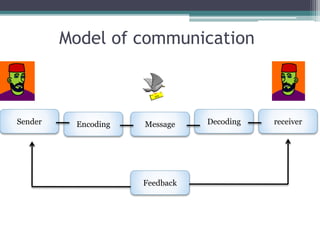
Model of communication
Sender receiverEncoding DecodingMessage
Feedback
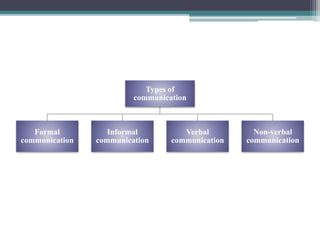
Types of
communication
Formal
communication
Informal
communication
Verbal
communication
Non-verbal
communication
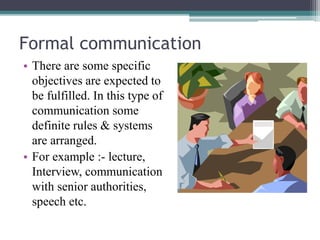
Formal communication
• There are some specific
objectives are expected to
be fulfilled. In this type of
communication some
definite rules & systems
are arranged.
• For example :- lecture,
Interview, communication
with senior authorities,
speech etc.
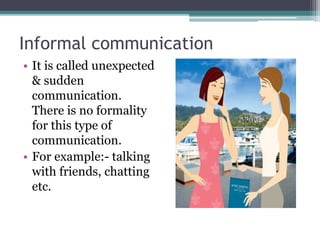
Informal communication
• It is called unexpected
& sudden
communication.
There is no formality
for this type of
communication.
• For example:- talking
with friends, chatting
etc.
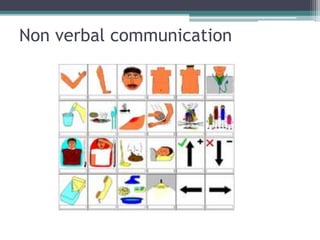
Nonverbal communication
• Nonverbal communication between people
is communication through sending and receiving
wordless clues.
• It includes the use of visual cues such as body
language (kinesics), distance (proxemics) and
physical environments/appearance, of voice
(paralanguage) and of touch (haptics).[1] It can also
include chronemics (the use of time)
and oculesics (eye contact and the actions of looking
while talking and listening, frequency of glances,
patterns of fixation, pupil dilation, and blink rate).
Non verbal communication
Verbal Communication
• The sharing of information between individuals
by using speech. Individuals working within a
business need to effectively use verbal
communication that employs readily understood
spoken words, as well as ensuring that the
enunciation, stress and tone of voice with which
the words are expressed is appropriate.
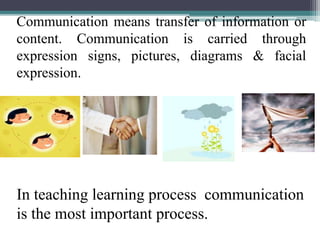
Communication means transfer of information or
content. Communication is carried through
expression signs, pictures, diagrams & facial
expression.
In teaching learning process communication
is the most important process.
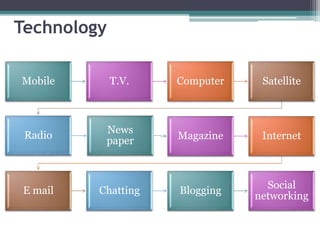
Technology
Mobile T.V. Computer Satellite
Radio
News
paper Magazine Internet
E mail Chatting Blogging
Social
networking
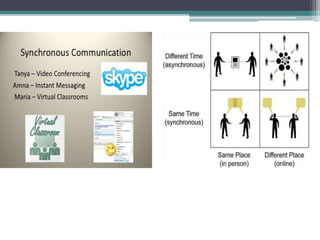
Synchronous communcation
In general, synchronous (pronounced SIHN-kro-nuhs, from Greek syn-, meaning
"with," and chronos, meaning "time") is an adjective describing objects or events that
are coordinated in time. In information technology, the term has several different
usages.
1) In telecommunication signaling within a network or between networks,
synchronous signals are those that occur at the same clock rate when all clocks are
based on a single reference clock. (Plesiochronous signals are almost but not quite in
synchronization and asynchronous signals are those that run from different clocks or
at a different transition rate.)
The word synchronous means working together at the same time, and in the
online learning world, chat rooms and online conferences are good examples of
synchronous communication. In a chat room, people's comments to each other are
relayed immediately, enabling a real-time discourse. Similarly, online
conferencing with the benefit of voice over Internet protocol (VOIP) tools enable
real-time conversations to take place online. Learning from synchronous
communication is enhanced because real-time conversations allow people to
explore, through writing or talking, the class concepts. The act of verbalizing helps
students build bridges between different ideas and concepts, thus helping them
retain information more effectively.
Asynchronous communication
• Asynchronous communication is the relay of information
with a time lag. Discussion forums and email are two
examples of how asynchronous communication is
employed in online learning. It is very helpful to
communicate in this way, because students have plenty
of time to formulate thoughts. By communicating via
email, students are able to respond in detail to a question
or topic that they might have answered incompletely in a
real-time conversation. This time lag in communication
helps students internalize information by giving them
time to research certain ideas or merely extra time for
contemplation. The main disadvantage to asynchronous
communication is time lost waiting for a response.
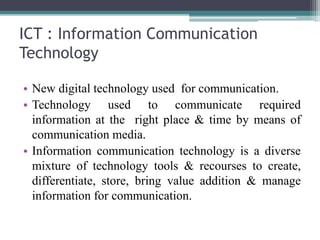
ICT : Information Communication
Technology
• New digital technology used for communication.
• Technology used to communicate required
information at the right place & time by means of
communication media.
• Information communication technology is a diverse
mixture of technology tools & recourses to create,
differentiate, store, bring value addition & manage
information for communication.
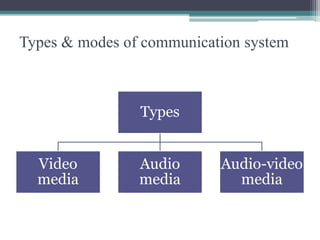
Types & modes of communication system
Types
Video
media
Audio
media
Audio-video
media
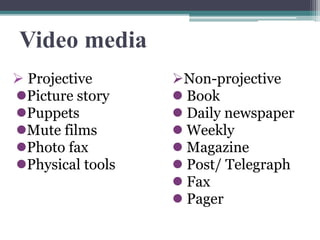
 Projective Non-projective
Picture story  Book
Puppets  Daily newspaper
Mute films  Weekly
Photo fax  Magazine
Physical tools  Post/ Telegraph
 Fax
 Pager
Video media
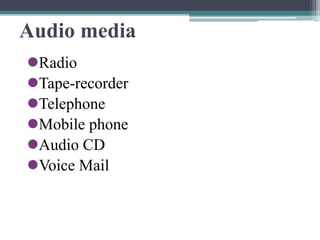
Audio media
Radio
Tape-recorder
Telephone
Mobile phone
Audio CD
Voice Mail
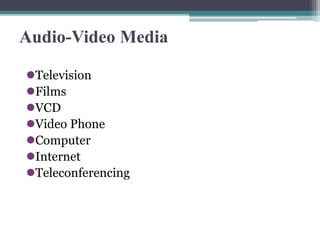
Audio-Video Media
Television
Films
VCD
Video Phone
Computer
Internet
Teleconferencing
The main purpose of ICT is to
COMMUNICATE through
Technology
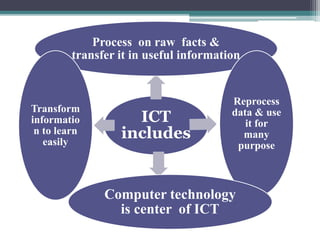
ICT
includes
Process on raw facts &
transfer it in useful information
Reprocess
data & use
it for
many
purpose
Computer technology
is center of ICT
Transform
informatio
n to learn
easily
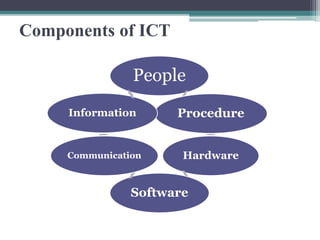
Components of ICT
People
Procedure
Hardware
Software
Communication
Information
Characteristics / need / importance
1. Information received through ICT is
believable & exact.
2. ICT can update information whenever there
is change & addition in the information.
3. Implementation of the action becomes very
fast when information is passed via ICT.
4. Telephonic communication is of oral type &
immediate decision is possible by this
communication.
5. Communication between a sender & receiver
becomes very easy in any part of the world as
can be seen through the example of the
telephone.
6. The process of communicating via message
is possible with speed due to electronic
devices.
7. Digital messages stored can be used for proofs
or evidence.
8. Communication has also become cheaper due
to the advancement in ICT.
9. Communicating to the masses through radio &
T.V. has revolutionized the process of
communication.
Benefits of ICTs in education
Global access to knowledge
Instant sharing of experiences and best practices
Self paced and self based learning
Simulations and experiential learning
Learning becomes interactive and joyful through
multimedia tools
Opening windows for new thinking, an atmosphere
of innovation
Bringing excitement and motivation: proud of
owning technology, feeling of-in-a-way being ahead
of times
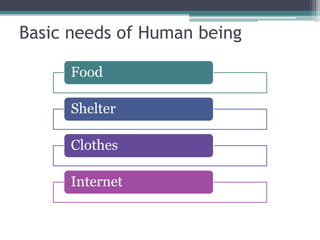
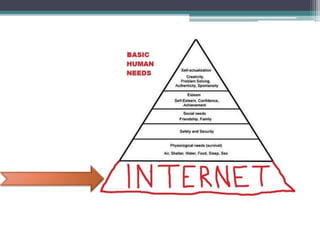
Basic needs of Human being
Food
Shelter
Clothes
Internet
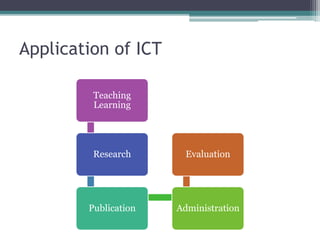
Application of ICT
Teaching
Learning
Research
Publication Administration
Evaluation
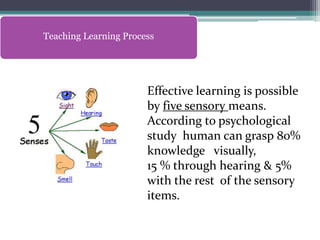
Teaching Learning Process
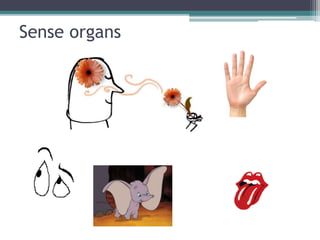
Effective learning is possible
by five sensory means.
According to psychological
study human can grasp 80%
knowledge visually,
15 % through hearing & 5%
with the rest of the sensory
items.
Sense organs
• So it becomes necessary to present the
content by attractive means. Computer
technology helps us to provide rich
presentation.
• To provide rich presentation, it is necessary
to use the various components like:-
1. Text matter presentation
2. Animation presentation
3. Graphic presentation
4. Audio presentation
5. Video presentation
Computer Aided Teaching has become
popular now a days.
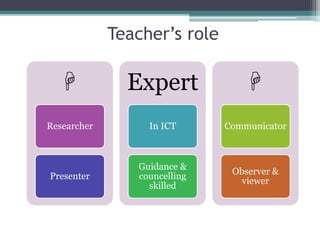
Teacher’s role

Researcher
Presenter
Expert
In ICT
Guidance &
councelling
skilled

Communicator
Observer &
viewer
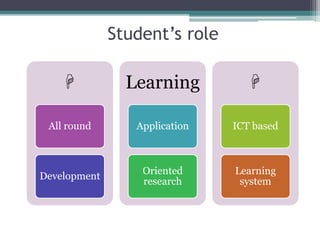
Student’s role

All round
Development
Learning
Application
Oriented
research

ICT based
Learning
system
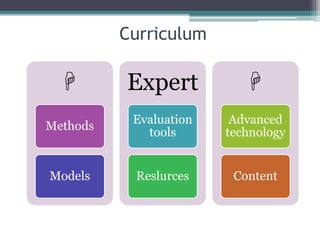
Curriculum

Methods
Models
Expert
Evaluation
tools
Reslurces

Advanced
technology
Content
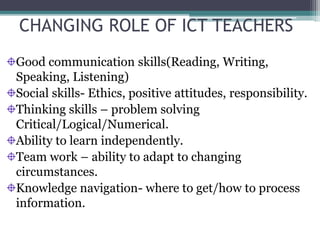
CHANGING ROLE OF ICT TEACHERS
Good communication skills(Reading, Writing,
Speaking, Listening)
Social skills- Ethics, positive attitudes, responsibility.
Thinking skills – problem solving
Critical/Logical/Numerical.
Ability to learn independently.
Team work – ability to adapt to changing
circumstances.
Knowledge navigation- where to get/how to process
information.
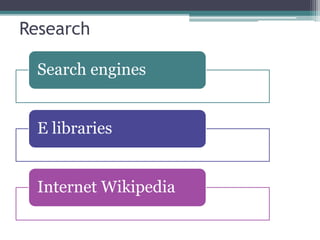
Research
Search engines
E libraries
Internet Wikipedia
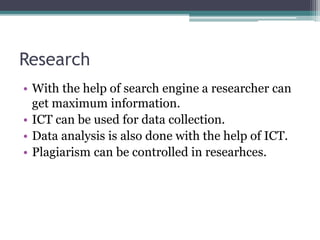
Research
• With the help of search engine a researcher can
get maximum information.
• ICT can be used for data collection.
• Data analysis is also done with the help of ICT.
• Plagiarism can be controlled in researhces.
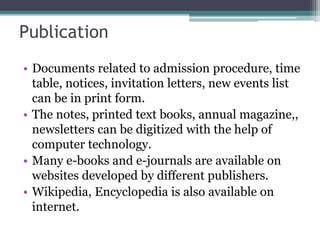
Publication
• Documents related to admission procedure, time
table, notices, invitation letters, new events list
can be in print form.
• The notes, printed text books, annual magazine,,
newsletters can be digitized with the help of
computer technology.
• Many e-books and e-journals are available on
websites developed by different publishers.
• Wikipedia, Encyclopedia is also available on
internet.
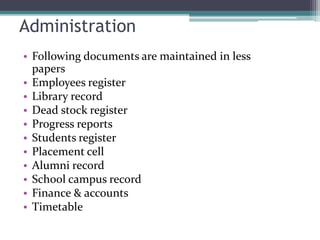
Administration
• Following documents are maintained in less
papers
• Employees register
• Library record
• Dead stock register
• Progress reports
• Students register
• Placement cell
• Alumni record
• School campus record
• Finance & accounts
• Timetable
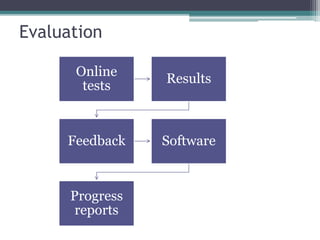
Online
tests
Results
Feedback Software
Progress
reports
Evaluation
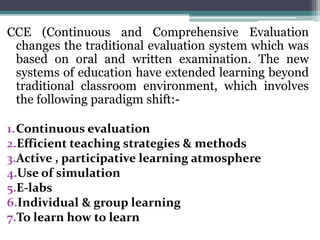
CCE (Continuous and Comprehensive Evaluation
changes the traditional evaluation system which was
based on oral and written examination. The new
systems of education have extended learning beyond
traditional classroom environment, which involves
the following paradigm shift:-
1.Continuous evaluation
2.Efficient teaching strategies & methods
3.Active , participative learning atmosphere
4.Use of simulation
5.E-labs
6.Individual & group learning
7.To learn how to learn
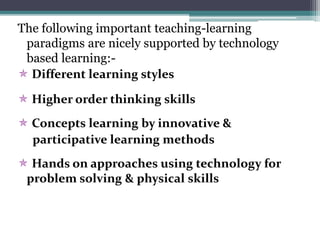
The following important teaching-learning
paradigms are nicely supported by technology
based learning:-
 Different learning styles
 Higher order thinking skills
 Concepts learning by innovative &
participative learning methods
 Hands on approaches using technology for
problem solving & physical skills
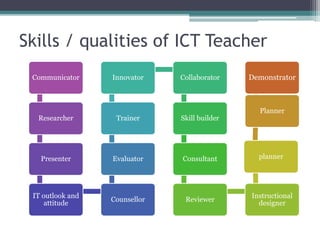
Skills / qualities of ICT Teacher
Communicator
Researcher
Presenter
IT outlook and
attitude
Counsellor
Evaluator
Trainer
Innovator Collaborator
Skill builder
Consultant
Reviewer
Instructional
designer
planner
Planner
Demonstrator
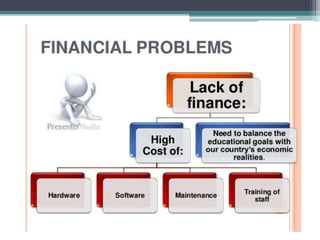
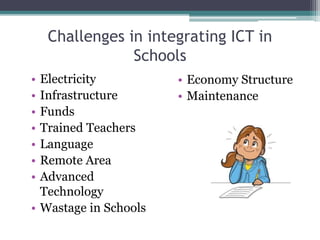
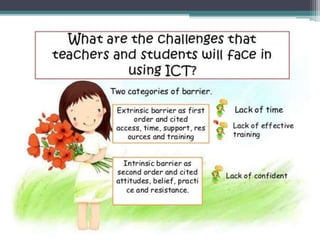
Challenges in integrating ICT in
Schools
• Economy Structure
• Maintenance
• Electricity
• Infrastructure
• Funds
• Trained Teachers
• Language
• Remote Area
• Advanced
Technology
• Wastage in Schools
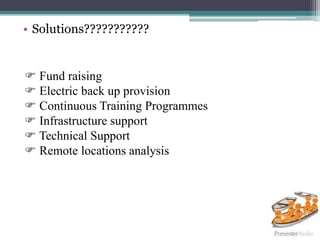
• Solutions???????????
 Fund raising
 Electric back up provision
 Continuous Training Programmes
 Infrastructure support
 Technical Support
 Remote locations analysis
Exercise
1. What is mean by ICT? Explain the need and
importance of ICT in education.
2. Discuss the application of ICT with following
points:-
a. teaching learning process b. evaluation
3. What are the challenges in integrating ICT in
schools? Suggest remedies for them.
4. How will you use ICT in a classroom? Explain
with suitable examples.
Assignment
1. Prepare a poster on ICT in Education.
2. Share your views regarding Scope of IC T on
the blog.
References:-
• https://www.google.co.in/search?q=challenges+
in+integrating+ict+in+schools&espv=2&biw=12
80&bih=662&tbm=isch&source=lnms&sa=X&v
ed=0ahUKEwi81_mi2LnQAhUEpI8KHU22DV
MQ_AUIBygC
• https://www.google.co.in/webhp?sourceid=chro
me-instant&ion=1&espv=2&ie=UTF-
8#tbm=vid&q=wikipedia
Thank You

Ict in education

  • 1.
    ICT in Education Prof.Priya Kale Asst. Prof. MAEER’s MIT school of Education and Research, Pune
  • 2.
    Objectives 1. To knowthe meaning of ICT 2. To understand the features of ICT 3. To know the role of ICT teacher 4. To know various tools used for evaluation 5. To compare the paradigm shift due to ICT
  • 3.
    Information • Information meansfacts or knowledge provided or learned. Meaningful data which is obtained after processing data is known as information. • We can get information by so many mediums. For example :- T.V., Radio, Net, Newspaper, etc.
  • 4.
  • 5.
    Communication • Latin word‘communis’ means common experience. So communication means : to send any idea to another. In communication a person gives some instructions & the other reacts or gives response.
  • 6.
    Model of communication SenderreceiverEncoding DecodingMessage Feedback
  • 7.
  • 8.
    Formal communication • Thereare some specific objectives are expected to be fulfilled. In this type of communication some definite rules & systems are arranged. • For example :- lecture, Interview, communication with senior authorities, speech etc.
  • 9.
    Informal communication • Itis called unexpected & sudden communication. There is no formality for this type of communication. • For example:- talking with friends, chatting etc.
  • 10.
    Nonverbal communication • Nonverbalcommunication between people is communication through sending and receiving wordless clues. • It includes the use of visual cues such as body language (kinesics), distance (proxemics) and physical environments/appearance, of voice (paralanguage) and of touch (haptics).[1] It can also include chronemics (the use of time) and oculesics (eye contact and the actions of looking while talking and listening, frequency of glances, patterns of fixation, pupil dilation, and blink rate).
  • 11.
  • 12.
    Verbal Communication • Thesharing of information between individuals by using speech. Individuals working within a business need to effectively use verbal communication that employs readily understood spoken words, as well as ensuring that the enunciation, stress and tone of voice with which the words are expressed is appropriate.
  • 13.
    Communication means transferof information or content. Communication is carried through expression signs, pictures, diagrams & facial expression. In teaching learning process communication is the most important process.
  • 14.
    Technology Mobile T.V. ComputerSatellite Radio News paper Magazine Internet E mail Chatting Blogging Social networking
  • 15.
    Synchronous communcation In general,synchronous (pronounced SIHN-kro-nuhs, from Greek syn-, meaning "with," and chronos, meaning "time") is an adjective describing objects or events that are coordinated in time. In information technology, the term has several different usages. 1) In telecommunication signaling within a network or between networks, synchronous signals are those that occur at the same clock rate when all clocks are based on a single reference clock. (Plesiochronous signals are almost but not quite in synchronization and asynchronous signals are those that run from different clocks or at a different transition rate.) The word synchronous means working together at the same time, and in the online learning world, chat rooms and online conferences are good examples of synchronous communication. In a chat room, people's comments to each other are relayed immediately, enabling a real-time discourse. Similarly, online conferencing with the benefit of voice over Internet protocol (VOIP) tools enable real-time conversations to take place online. Learning from synchronous communication is enhanced because real-time conversations allow people to explore, through writing or talking, the class concepts. The act of verbalizing helps students build bridges between different ideas and concepts, thus helping them retain information more effectively.
  • 16.
    Asynchronous communication • Asynchronouscommunication is the relay of information with a time lag. Discussion forums and email are two examples of how asynchronous communication is employed in online learning. It is very helpful to communicate in this way, because students have plenty of time to formulate thoughts. By communicating via email, students are able to respond in detail to a question or topic that they might have answered incompletely in a real-time conversation. This time lag in communication helps students internalize information by giving them time to research certain ideas or merely extra time for contemplation. The main disadvantage to asynchronous communication is time lost waiting for a response.
  • 18.
    ICT : InformationCommunication Technology • New digital technology used for communication. • Technology used to communicate required information at the right place & time by means of communication media. • Information communication technology is a diverse mixture of technology tools & recourses to create, differentiate, store, bring value addition & manage information for communication.
  • 19.
    Types & modesof communication system Types Video media Audio media Audio-video media
  • 20.
     Projective Non-projective Picturestory  Book Puppets  Daily newspaper Mute films  Weekly Photo fax  Magazine Physical tools  Post/ Telegraph  Fax  Pager Video media
  • 21.
  • 22.
  • 23.
    The main purposeof ICT is to COMMUNICATE through Technology
  • 24.
    ICT includes Process on rawfacts & transfer it in useful information Reprocess data & use it for many purpose Computer technology is center of ICT Transform informatio n to learn easily
  • 25.
  • 26.
    Characteristics / need/ importance 1. Information received through ICT is believable & exact. 2. ICT can update information whenever there is change & addition in the information. 3. Implementation of the action becomes very fast when information is passed via ICT.
  • 27.
    4. Telephonic communicationis of oral type & immediate decision is possible by this communication. 5. Communication between a sender & receiver becomes very easy in any part of the world as can be seen through the example of the telephone. 6. The process of communicating via message is possible with speed due to electronic devices.
  • 28.
    7. Digital messagesstored can be used for proofs or evidence. 8. Communication has also become cheaper due to the advancement in ICT. 9. Communicating to the masses through radio & T.V. has revolutionized the process of communication.
  • 29.
    Benefits of ICTsin education Global access to knowledge Instant sharing of experiences and best practices Self paced and self based learning Simulations and experiential learning Learning becomes interactive and joyful through multimedia tools Opening windows for new thinking, an atmosphere of innovation Bringing excitement and motivation: proud of owning technology, feeling of-in-a-way being ahead of times
  • 30.
    Basic needs ofHuman being Food Shelter Clothes Internet
  • 32.
  • 33.
    Teaching Learning Process Effectivelearning is possible by five sensory means. According to psychological study human can grasp 80% knowledge visually, 15 % through hearing & 5% with the rest of the sensory items.
  • 34.
  • 35.
    • So itbecomes necessary to present the content by attractive means. Computer technology helps us to provide rich presentation. • To provide rich presentation, it is necessary to use the various components like:- 1. Text matter presentation 2. Animation presentation 3. Graphic presentation 4. Audio presentation 5. Video presentation Computer Aided Teaching has become popular now a days.
  • 36.
    Teacher’s role  Researcher Presenter Expert In ICT Guidance& councelling skilled  Communicator Observer & viewer
  • 37.
  • 38.
  • 39.
    CHANGING ROLE OFICT TEACHERS Good communication skills(Reading, Writing, Speaking, Listening) Social skills- Ethics, positive attitudes, responsibility. Thinking skills – problem solving Critical/Logical/Numerical. Ability to learn independently. Team work – ability to adapt to changing circumstances. Knowledge navigation- where to get/how to process information.
  • 40.
  • 41.
    Research • With thehelp of search engine a researcher can get maximum information. • ICT can be used for data collection. • Data analysis is also done with the help of ICT. • Plagiarism can be controlled in researhces.
  • 42.
    Publication • Documents relatedto admission procedure, time table, notices, invitation letters, new events list can be in print form. • The notes, printed text books, annual magazine,, newsletters can be digitized with the help of computer technology. • Many e-books and e-journals are available on websites developed by different publishers. • Wikipedia, Encyclopedia is also available on internet.
  • 43.
    Administration • Following documentsare maintained in less papers • Employees register • Library record • Dead stock register • Progress reports • Students register • Placement cell • Alumni record • School campus record • Finance & accounts • Timetable
  • 44.
  • 45.
    CCE (Continuous andComprehensive Evaluation changes the traditional evaluation system which was based on oral and written examination. The new systems of education have extended learning beyond traditional classroom environment, which involves the following paradigm shift:- 1.Continuous evaluation 2.Efficient teaching strategies & methods 3.Active , participative learning atmosphere 4.Use of simulation 5.E-labs 6.Individual & group learning 7.To learn how to learn
  • 46.
    The following importantteaching-learning paradigms are nicely supported by technology based learning:-  Different learning styles  Higher order thinking skills  Concepts learning by innovative & participative learning methods  Hands on approaches using technology for problem solving & physical skills
  • 47.
    Skills / qualitiesof ICT Teacher Communicator Researcher Presenter IT outlook and attitude Counsellor Evaluator Trainer Innovator Collaborator Skill builder Consultant Reviewer Instructional designer planner Planner Demonstrator
  • 48.
    Challenges in integratingICT in Schools • Economy Structure • Maintenance • Electricity • Infrastructure • Funds • Trained Teachers • Language • Remote Area • Advanced Technology • Wastage in Schools
  • 53.
    • Solutions???????????  Fundraising  Electric back up provision  Continuous Training Programmes  Infrastructure support  Technical Support  Remote locations analysis
  • 54.
    Exercise 1. What ismean by ICT? Explain the need and importance of ICT in education. 2. Discuss the application of ICT with following points:- a. teaching learning process b. evaluation 3. What are the challenges in integrating ICT in schools? Suggest remedies for them. 4. How will you use ICT in a classroom? Explain with suitable examples.
  • 55.
    Assignment 1. Prepare aposter on ICT in Education. 2. Share your views regarding Scope of IC T on the blog.
  • 56.
  • 57.