EPC-3
(Critical Understanding of ICT)
Mrs. Rekha Sharma
Astt. Prof.
Sant Nischal Singh College of
Education for Women,
Yamuna Nagar
Important Questions for ICT
1. What do you mean by EPC?
Ans. EPC stands for Enhancing Professional
Capacities.
2. What is the full nomenclature of EPC-3?
Ans. Critical Understanding of ICT.
3. What is the full form of ICT?
Ans. ICT stands for Information and Communication
Technology.
4. Describe ICT?
Ans. ICT can be defined as “ diverse set of tools and
resources used to communicate, to create, to store
and manage information.” The technologies include
computers, the internet, broadcasting technologies
(Radio & television) and telephony.
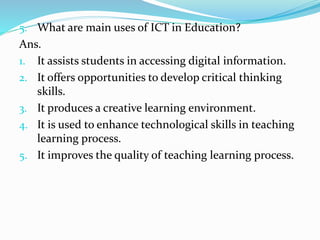
5. What are main uses of ICT in Education?
Ans.
1. It assists students in accessing digital information.
2. It offers opportunities to develop critical thinking
skills.
3. It produces a creative learning environment.
4. It is used to enhance technological skills in teaching
learning process.
5. It improves the quality of teaching learning process.
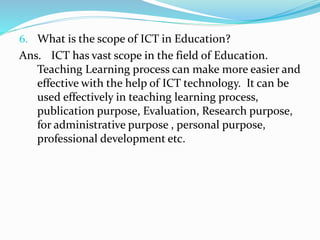
6. What is the scope of ICT in Education?
Ans. ICT has vast scope in the field of Education.
Teaching Learning process can make more easier and
effective with the help of ICT technology. It can be
used effectively in teaching learning process,
publication purpose, Evaluation, Research purpose,
for administrative purpose , personal purpose,
professional development etc.
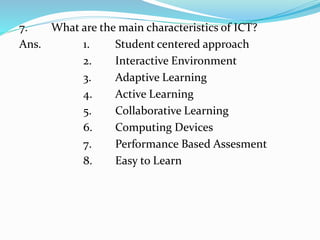
7. What are the main characteristics of ICT?
Ans. 1. Student centered approach
2. Interactive Environment
3. Adaptive Learning
4. Active Learning
5. Collaborative Learning
6. Computing Devices
7. Performance Based Assesment
8. Easy to Learn
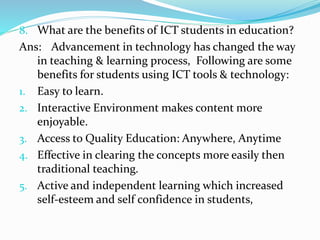
8. What are the benefits of ICT students in education?
Ans: Advancement in technology has changed the way
in teaching & learning process, Following are some
benefits for students using ICT tools & technology:
1. Easy to learn.
2. Interactive Environment makes content more
enjoyable.
3. Access to Quality Education: Anywhere, Anytime
4. Effective in clearing the concepts more easily then
traditional teaching.
5. Active and independent learning which increased
self-esteem and self confidence in students,
10. What are the main challenges for implementing ICT
in Education?
Ans.
1. Lack of qualified teachers to teach ICT in schools.
2. Lack of Internet connectivity.
3. Lack of funding.
4. Lack of frequent supply of electricity.
5. Lack of knowledge about govt. policies.
6. Malfunction of computing devices.
7. Issue of adequate infrastructure.
8. Lack of interest in teachers and administration.
9. Cost and availability issues.
10. Lack of pedagogical knowledge and limited access to
ICT facilities by most teachers and pupils.
9. What are the benefits of ICT for teachers in Teaching
Learning Process?
Ans. Here are some benefits for teachers:
1. ICT helps Teacher to motivate students and create more
interest in learning.
2. It helps teachers to design interactive educational
environment.
3. Using ICT tools makes teaching more innovative.
4. ICT prepare teachers to enhance their skills in classroom
environment by using various technologies such as word
processing, databases, spreadsheets, presentations etc.
5. It plays an important role in student evaluation.
6. It provide ICT tools to teachers help in learning using
animations, motion pictures, model presentation etc.
7. It helps teachers in professional development and
educational management.
References:
 ICT in Education (2006), Information and
communication technologies in teacher education: A
planning guide.
 Goel.D.R. (2003), ICT in Education, changes and
challenges in ICT in Education, M.S. University,
Baroda.
 Critical understanding of ICT.pdf by bdu.ac.in
 www.google.com.
 www.wikipedia.org.
Next Topic will be available soon.
All the very best 
Thank You

EPC-3

  • 1.
    EPC-3 (Critical Understanding ofICT) Mrs. Rekha Sharma Astt. Prof. Sant Nischal Singh College of Education for Women, Yamuna Nagar
  • 2.
    Important Questions forICT 1. What do you mean by EPC? Ans. EPC stands for Enhancing Professional Capacities. 2. What is the full nomenclature of EPC-3? Ans. Critical Understanding of ICT.
  • 3.
    3. What isthe full form of ICT? Ans. ICT stands for Information and Communication Technology. 4. Describe ICT? Ans. ICT can be defined as “ diverse set of tools and resources used to communicate, to create, to store and manage information.” The technologies include computers, the internet, broadcasting technologies (Radio & television) and telephony.
  • 4.
    5. What aremain uses of ICT in Education? Ans. 1. It assists students in accessing digital information. 2. It offers opportunities to develop critical thinking skills. 3. It produces a creative learning environment. 4. It is used to enhance technological skills in teaching learning process. 5. It improves the quality of teaching learning process.
  • 5.
    6. What isthe scope of ICT in Education? Ans. ICT has vast scope in the field of Education. Teaching Learning process can make more easier and effective with the help of ICT technology. It can be used effectively in teaching learning process, publication purpose, Evaluation, Research purpose, for administrative purpose , personal purpose, professional development etc.
  • 6.
    7. What arethe main characteristics of ICT? Ans. 1. Student centered approach 2. Interactive Environment 3. Adaptive Learning 4. Active Learning 5. Collaborative Learning 6. Computing Devices 7. Performance Based Assesment 8. Easy to Learn
  • 7.
    8. What arethe benefits of ICT students in education? Ans: Advancement in technology has changed the way in teaching & learning process, Following are some benefits for students using ICT tools & technology: 1. Easy to learn. 2. Interactive Environment makes content more enjoyable. 3. Access to Quality Education: Anywhere, Anytime 4. Effective in clearing the concepts more easily then traditional teaching. 5. Active and independent learning which increased self-esteem and self confidence in students,
  • 8.
    10. What arethe main challenges for implementing ICT in Education? Ans. 1. Lack of qualified teachers to teach ICT in schools. 2. Lack of Internet connectivity. 3. Lack of funding. 4. Lack of frequent supply of electricity. 5. Lack of knowledge about govt. policies. 6. Malfunction of computing devices. 7. Issue of adequate infrastructure. 8. Lack of interest in teachers and administration. 9. Cost and availability issues. 10. Lack of pedagogical knowledge and limited access to ICT facilities by most teachers and pupils.
  • 9.
    9. What arethe benefits of ICT for teachers in Teaching Learning Process? Ans. Here are some benefits for teachers: 1. ICT helps Teacher to motivate students and create more interest in learning. 2. It helps teachers to design interactive educational environment. 3. Using ICT tools makes teaching more innovative. 4. ICT prepare teachers to enhance their skills in classroom environment by using various technologies such as word processing, databases, spreadsheets, presentations etc. 5. It plays an important role in student evaluation. 6. It provide ICT tools to teachers help in learning using animations, motion pictures, model presentation etc. 7. It helps teachers in professional development and educational management.
  • 10.
    References:  ICT inEducation (2006), Information and communication technologies in teacher education: A planning guide.  Goel.D.R. (2003), ICT in Education, changes and challenges in ICT in Education, M.S. University, Baroda.  Critical understanding of ICT.pdf by bdu.ac.in  www.google.com.  www.wikipedia.org.
  • 11.
    Next Topic willbe available soon. All the very best  Thank You

Editor's Notes