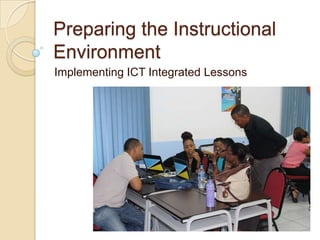
Preparing the Instructional
Environment
Implementing ICT Integrated Lessons
How do we define this
environment?
In making the decision to use
technology, the teacher must be
aware that the environment is
supportive of using the specific
technology or array of technologies.
 There may be a large gap between
the “ideal” and the reality.
 Importantly, there are some
components about the environment
that the teacher cannot have too much
influence over.

21st Century Learning
Environment


Recall that in our discussion of 21st
Century skills we noted that it is
necessary to develop the
infrastructure to support 21st Century
learning. This support infrastructure
includes:
◦
◦
◦
◦

Standards and Assessment
Curriculum and Infrastructure
Professional Development
Learning Environment
What is this learning
environment?
The learning environment involves:
 Physical Spaces
 Cyber spaces
 Technological infrastructure
 Human Support
 Policy and Administrative frameworks
 Social and Cultural context
 Curriculum and Assessment practices
…

21st Century Learning
Environment


Create learning practices, human
support and physical environments
that will support the teaching and
learning of 21st century skill outcomes
◦ (Social) Constructivist approach to
learning
◦ Teaching assistants, IT Technicians
◦ Access to devices and the Internet
21st Century Learning
Environment


Support professional learning
communities that enable educators to
collaborate, share best practices and
integrate 21st century skills into
classroom practice
◦ Strengthen links among teachers
◦ Motivate teachers to share
◦ Insist on teacher dialogue on
 Professional Development
 Curriculum Development
21st Century Learning
Environment


Enable students to learn in relevant,
real world 21st century contexts (e.g.,
through project-based or other applied
work)
◦ Make the learning task relevant!
◦ Promote problem solving skills by
occupying students with activities that
have an impact on their lives.
◦ Promote collaboration and social
development by assigning student group
tasks and projects.
21st Century Learning
Environment


Allow equitable access to quality
learning tools, technologies and
resources
◦ Students should be guaranteed access to
technology at school
◦ Care should be taken that digital
resources are suitable
◦ Issues of Internet safety must be
addressed
◦ It is crucial that students understand that
their behavior in the digital world is just as
important as in the real world – Internet
21st Century Learning
Environment


Provide 21st century architectural and
interior designs for group, team and
individual learning
◦ Learning can now take place anywhere
and at anytime – school, home, society…
◦ Classroom layout should be conducive to
both individual instruction and group
interaction
◦ The design of the cyber classroom must
be intelligent, intuitive, simple and
effective
21st Century Learning
Environment


Support expanded community and
international involvement in learning,
both face-to-face and online
◦ Learning is global and lifelong
◦ Learn how to learn and to achieve
transfer of knowledge
◦ Research is critical to developing practice
◦ Technology supports much more than
student engagement – parent
involvement, access to real world
problems, alternatives and solutions
The local Learning
Environment
Have we assessed how much access
that schools, principals, teachers and
students have to technology?
 What exactly is the government’s and
the Ministry of Education’s policy
position on ICT Integration?
 What are the attitudes of the DEO’s,
Curriculum Officers, Assessment
Officers and Principals to ICT
Integration?

The local Learning
Environment
Do we have the budgets to fund and
maintain technological integration?
 Can we find alternative sources of
funding?
 What FREE resources can we take
advantage of!?
 What ICT strategies might best suit a
particular school?

The local Learning
Environment
How can we use technology to improve
teacher professional development?
 Are teachers prepared to deal with the
initial work and fatigue that ICT
Integration may cause?
 Are teachers inclined to take on
professional development activities for
self improvement?
 Can we as teachers, help accelerate the
capacity of teachers to deal with
technological integration?

Ict environment

Ict environment

  • 1.
  • 2.
    How do wedefine this environment? In making the decision to use technology, the teacher must be aware that the environment is supportive of using the specific technology or array of technologies.  There may be a large gap between the “ideal” and the reality.  Importantly, there are some components about the environment that the teacher cannot have too much influence over. 
  • 3.
    21st Century Learning Environment  Recallthat in our discussion of 21st Century skills we noted that it is necessary to develop the infrastructure to support 21st Century learning. This support infrastructure includes: ◦ ◦ ◦ ◦ Standards and Assessment Curriculum and Infrastructure Professional Development Learning Environment
  • 4.
    What is thislearning environment? The learning environment involves:  Physical Spaces  Cyber spaces  Technological infrastructure  Human Support  Policy and Administrative frameworks  Social and Cultural context  Curriculum and Assessment practices … 
  • 5.
    21st Century Learning Environment  Createlearning practices, human support and physical environments that will support the teaching and learning of 21st century skill outcomes ◦ (Social) Constructivist approach to learning ◦ Teaching assistants, IT Technicians ◦ Access to devices and the Internet
  • 6.
    21st Century Learning Environment  Supportprofessional learning communities that enable educators to collaborate, share best practices and integrate 21st century skills into classroom practice ◦ Strengthen links among teachers ◦ Motivate teachers to share ◦ Insist on teacher dialogue on  Professional Development  Curriculum Development
  • 7.
    21st Century Learning Environment  Enablestudents to learn in relevant, real world 21st century contexts (e.g., through project-based or other applied work) ◦ Make the learning task relevant! ◦ Promote problem solving skills by occupying students with activities that have an impact on their lives. ◦ Promote collaboration and social development by assigning student group tasks and projects.
  • 8.
    21st Century Learning Environment  Allowequitable access to quality learning tools, technologies and resources ◦ Students should be guaranteed access to technology at school ◦ Care should be taken that digital resources are suitable ◦ Issues of Internet safety must be addressed ◦ It is crucial that students understand that their behavior in the digital world is just as important as in the real world – Internet
  • 9.
    21st Century Learning Environment  Provide21st century architectural and interior designs for group, team and individual learning ◦ Learning can now take place anywhere and at anytime – school, home, society… ◦ Classroom layout should be conducive to both individual instruction and group interaction ◦ The design of the cyber classroom must be intelligent, intuitive, simple and effective
  • 10.
    21st Century Learning Environment  Supportexpanded community and international involvement in learning, both face-to-face and online ◦ Learning is global and lifelong ◦ Learn how to learn and to achieve transfer of knowledge ◦ Research is critical to developing practice ◦ Technology supports much more than student engagement – parent involvement, access to real world problems, alternatives and solutions
  • 11.
    The local Learning Environment Havewe assessed how much access that schools, principals, teachers and students have to technology?  What exactly is the government’s and the Ministry of Education’s policy position on ICT Integration?  What are the attitudes of the DEO’s, Curriculum Officers, Assessment Officers and Principals to ICT Integration? 
  • 12.
    The local Learning Environment Dowe have the budgets to fund and maintain technological integration?  Can we find alternative sources of funding?  What FREE resources can we take advantage of!?  What ICT strategies might best suit a particular school? 
  • 13.
    The local Learning Environment Howcan we use technology to improve teacher professional development?  Are teachers prepared to deal with the initial work and fatigue that ICT Integration may cause?  Are teachers inclined to take on professional development activities for self improvement?  Can we as teachers, help accelerate the capacity of teachers to deal with technological integration? 

Editor's Notes

  • #3 Access to resources, parents, MOE…
  • #5 This is not an exhaustive list