Information Communication Technology to support sustainable urban planning …  non entri alcuno che ignori la Geometria (Platone) Arch. Antonio Caperna, PhD [email_address] http://www.biourbanism.org   Università Roma 3 - Dipartimento di Progettazione e Studio dell’Architettura Dottorato di Ricerca in Progetto Urbano Sostenibile (XVII Ciclo)
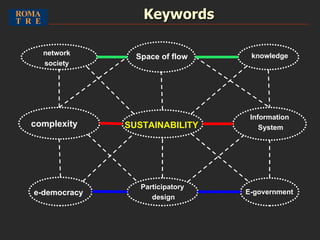
Keywords complexity   SUSTAINABILITY Participatory  design network society E-government Information  System knowledge Space of flow e-democracy
C o n t e n t s Subject of investigation Theoretical framework Background Complexity as new paradigm Towns like complex system Information architecture Territorial network based on I nformation Communication Technology (ICT) Cultural and political actions able to define a  sustainable use of ICT To  develop knowledge  in order to: reinforcement of e-democracy and e-government; to  understand the environmental transformation , social, economical and changing use of the land A. Caperna: ICT to support  Sustainable Urban Planning
Objectives Cultural and political actions able to define a  sustainable use of ICT to develop knowledge in order to: reinforcement of e-democracy and e-government; to understand the environmental transformation (social, economical and changing use of the land) in order that will be possible to address this changing in a sustainable way
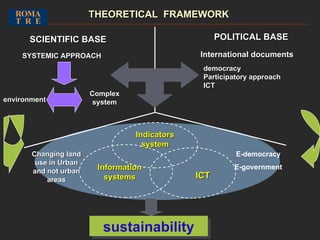
THEORETICAL  FRAMEWORK SCIENTIFIC BASE POLITICAL BASE SYSTEMIC APPROACH environment Complex system International documents democracy Participatory approach ICT sustainability Information systems ICT Indicators system Changing land use in Urban and not urban areas E-democracy E-government
Background Contemporary cities as a complex system This complexity can be read through the network concept (network society, network economy and so on) Complexity as new paradigm “ The construction and structure of graphs or networks is the key to understanding the complex world around us” (Barabási) Information it describe an “architecture” that provide a basis to understand living cities and for diagnosing urban  problem
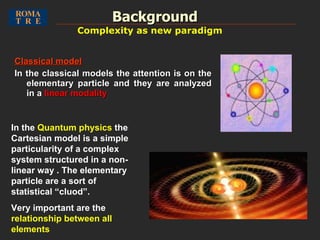
Classical model In the classical models the attention is on the elementary particle and they are analyzed in a  linear modality Background In the  Quantum physics  the Cartesian model is a simple particularity of a complex system structured in a non-linear way . The elementary particle are a sort of statistical “cluod”.  Very important are the  relationship between all elements Complexity as new paradigm
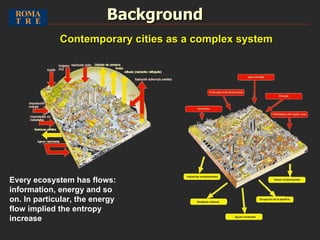
Every ecosystem has flows: information, energy and so on. In particular, the energy flow implied the entropy increase Background Contemporary cities as a complex system
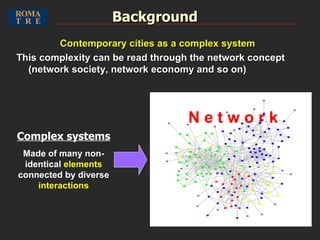
Complex systems Made of many non-identical  elements  connected by diverse  interactions Background N e t w o r k Contemporary cities as a complex system This complexity can be read through the network concept (network society, network economy and so on)
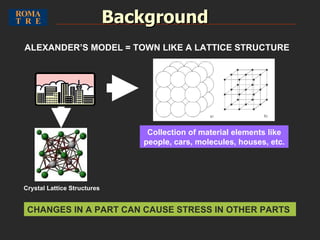
ALEXANDER’S MODEL = TOWN LIKE A LATTICE STRUCTURE Collection of material elements like people, cars, molecules, houses, etc. CHANGES IN A PART CAN CAUSE STRESS IN OTHER PARTS Crystal Lattice Structures Background
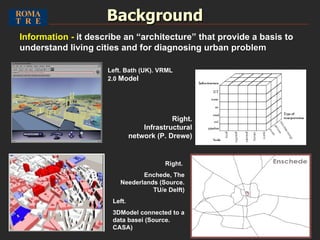
Left. Bath (UK). VRML 2.0  Model Right. Infrastructural network (P. Drewe) Background Information -  it describe an “architecture” that provide a basis to understand living cities and for diagnosing urban  problem Right.  Enchede, The Neederlands (Source. TU/e Delft) Left.  3DModel connected to a data basei (Source. CASA)
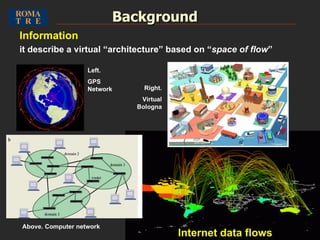
Internet data flows Information it describe a virtual “architecture” based on “ space of flow ” Background Right. Virtual Bologna Left. GPS Network Above. Computer network
Territorial network based on ICT
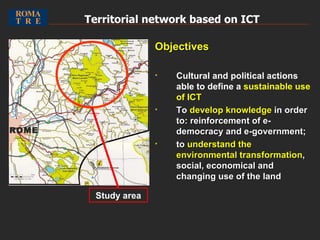
Territorial network based on ICT   Objectives Cultural and political actions able to define a  sustainable use of ICT To  develop knowledge  in order to: reinforcement of e-democracy and e-government; to  understand the environmental transformation , social, economical and changing use of the land Study area ROME
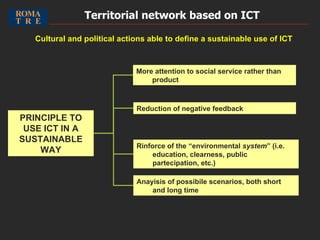
PRINCIPLE TO USE ICT IN A SUSTAINABLE WAY More attention to social service rather than product Anayisis of possibile scenarios, both short and long time Reduction of negative feedback Rinforce of the “environmental  system ” (i.e. education, clearness, public partecipation, etc.) Territorial network based on ICT   Cultural and political actions able to define a sustainable use of ICT
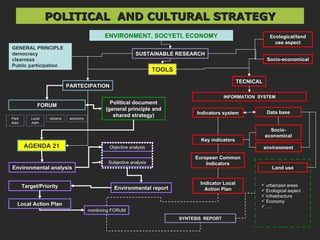
POLITICAL  AND CULTURAL STRATEGY GENERAL PRINCIPLE democracy clearness Public participation ENVIRONMENT, SOCYETI, ECONOMY SUSTAINABLE RESEARCH TOOLS TECNICAL PARTECIPATION FORUM AGENDA 21 Objective analysis Environmental report Target/Priority monitoring FORUM INFORMATION  SYSTEM Indicators system Park Adm Local Adm citizens economy Political document (general principle and shared strategy) Environmental analysis Subjective analysis SYNTESIS  REPORT Local Action Plan Socio-economical urbanized areas Ecological aspect Infrastracture Economy … . Ecological/land use aspect Key indicators European Common Indicators Indicator Local Action Plan environment Data base Socio-economical Land use
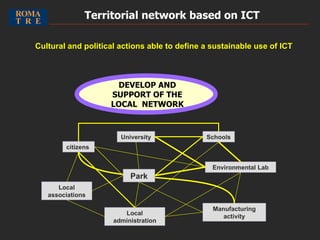
DEVELOP AND SUPPORT OF THE LOCAL  NETWORK University Schools Environmental Lab citizens  Local associations Local administration Manufacturing activity Park Territorial network based on ICT   Cultural and political actions able to define a sustainable use of ICT
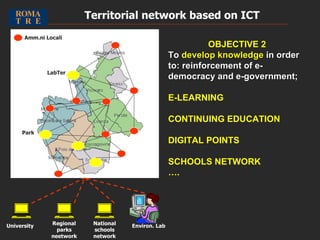
OBJECTIVE 2 To  develop knowledge  in order to: reinforcement of e-democracy and e-government; E-LEARNING CONTINUING EDUCATION DIGITAL POINTS SCHOOLS NETWORK … . Park LabTer Amm.ni Locali University Regional parks neetwork National schools network Environ. Lab Territorial network based on ICT
OBJECTIVE 3 to understand the environmental transformation, social, economical and urban changing Steps. Development of: 1 – environmental model  2 – E.D.A.V.I. –  Environmental Data-flow Analysis and Visualizing Information Territorial network based on ICT
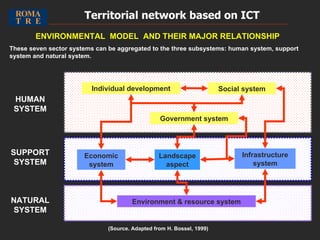
Social system Individual development Government system Infrastructure system Economic system Environment & resource system HUMAN SYSTEM SUPPORT SYSTEM NATURAL SYSTEM ENVIRONMENTAL  MODEL  AND THEIR MAJOR RELATIONSHIP   These seven sector systems can be aggregated to the three subsystems: human system, support system and natural system.  Landscape aspect Territorial network based on ICT   (Source. Adapted from H. Bossel, 1999)
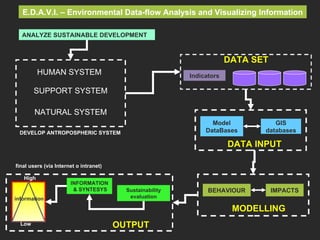
E.D.A.V.I. –  Environmental Data-flow Analysis and Visualizing Information ANALYZE  SUSTAINABLE DEVELOPMENT DEVELOP ANTROPOSPHERIC SYSTEM DATA SET Model DataBases Indicators GIS databases DATA INPUT HUMAN SYSTEM SUPPORT SYSTEM NATURAL SYSTEM MODELLING OUTPUT BEHAVIOUR IMPACTS final users (via Internet o intranet) information Low High Sustainability evaluation INFORMATION & SYNTESYS
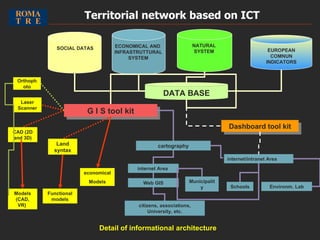
EUROPEAN COMNUN INDICATORS NATURAL SYSTEM SOCIAL DATAS G I S tool kit cartography internet Area  internet/intranet Area ECONOMICAL AND  INFRASTRUTTURAL SYSTEM Web GIS Municipality Schools citizens, associations, University, etc. Environm. Lab Orthophoto Laser Scanner Land syntax economical Models Functional models CAD (2D and 3D) Models (CAD, VR)  Dashboard tool kit DATA BASE Territorial network based on ICT   Detail of informational architecture
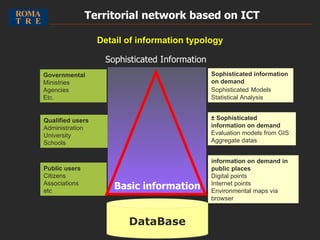
Governmental  Ministries Agencies Etc. Qualified users Administration University Schools Public users Citizens Associations etc Sophisticated information on demand Sophisticated   Models Statistical Analysis ±  Sophisticated information on demand Evaluation models from GIS Aggregate datas information on demand in public places Digital points Internet points Environmental maps via browser Sophisticated Information Basic information DataBase Territorial network based on ICT   Detail of information typology
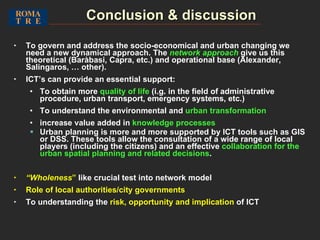
Conclusion & discussion To govern and address the socio-economical and urban changing   we need a new dynamical approach. The  network approach  give us this theoretical (Baràbasi, Capra, etc.) and operational base (Alexander, Salingaros, … other). ICT’s can provide an essential support :  To obtain more  quality of life  (i.g. in the field of administrative procedure, urban transport, emergency systems, etc.) To understand the environmental and  urban transformation increase value added in  knowledge processes Urban planning is more and more supported by ICT tools such as GIS or DSS. These tools allow the consultation of a wide range of local players (including the citizens) and an effective  collaboration for the urban spatial planning and related decisions . “ Wholeness ”  like crucial test into network model Role of local authorities/city governments To understanding the  risk, opportunity and implication  of ICT

ICT AND URBAN PLANNING. By Antonio Caperna

  • 1.
    Information Communication Technologyto support sustainable urban planning … non entri alcuno che ignori la Geometria (Platone) Arch. Antonio Caperna, PhD [email_address] http://www.biourbanism.org Università Roma 3 - Dipartimento di Progettazione e Studio dell’Architettura Dottorato di Ricerca in Progetto Urbano Sostenibile (XVII Ciclo)
  • 2.
    Keywords complexity SUSTAINABILITY Participatory design network society E-government Information System knowledge Space of flow e-democracy
  • 3.
    C o nt e n t s Subject of investigation Theoretical framework Background Complexity as new paradigm Towns like complex system Information architecture Territorial network based on I nformation Communication Technology (ICT) Cultural and political actions able to define a sustainable use of ICT To develop knowledge in order to: reinforcement of e-democracy and e-government; to understand the environmental transformation , social, economical and changing use of the land A. Caperna: ICT to support Sustainable Urban Planning
  • 4.
    Objectives Cultural andpolitical actions able to define a sustainable use of ICT to develop knowledge in order to: reinforcement of e-democracy and e-government; to understand the environmental transformation (social, economical and changing use of the land) in order that will be possible to address this changing in a sustainable way
  • 5.
    THEORETICAL FRAMEWORKSCIENTIFIC BASE POLITICAL BASE SYSTEMIC APPROACH environment Complex system International documents democracy Participatory approach ICT sustainability Information systems ICT Indicators system Changing land use in Urban and not urban areas E-democracy E-government
  • 6.
    Background Contemporary citiesas a complex system This complexity can be read through the network concept (network society, network economy and so on) Complexity as new paradigm “ The construction and structure of graphs or networks is the key to understanding the complex world around us” (Barabási) Information it describe an “architecture” that provide a basis to understand living cities and for diagnosing urban problem
  • 7.
    Classical model Inthe classical models the attention is on the elementary particle and they are analyzed in a linear modality Background In the Quantum physics the Cartesian model is a simple particularity of a complex system structured in a non-linear way . The elementary particle are a sort of statistical “cluod”. Very important are the relationship between all elements Complexity as new paradigm
  • 8.
    Every ecosystem hasflows: information, energy and so on. In particular, the energy flow implied the entropy increase Background Contemporary cities as a complex system
  • 9.
    Complex systems Madeof many non-identical elements connected by diverse interactions Background N e t w o r k Contemporary cities as a complex system This complexity can be read through the network concept (network society, network economy and so on)
  • 10.
    ALEXANDER’S MODEL =TOWN LIKE A LATTICE STRUCTURE Collection of material elements like people, cars, molecules, houses, etc. CHANGES IN A PART CAN CAUSE STRESS IN OTHER PARTS Crystal Lattice Structures Background
  • 11.
    Left. Bath (UK).VRML 2.0 Model Right. Infrastructural network (P. Drewe) Background Information - it describe an “architecture” that provide a basis to understand living cities and for diagnosing urban problem Right. Enchede, The Neederlands (Source. TU/e Delft) Left. 3DModel connected to a data basei (Source. CASA)
  • 12.
    Internet data flowsInformation it describe a virtual “architecture” based on “ space of flow ” Background Right. Virtual Bologna Left. GPS Network Above. Computer network
  • 13.
  • 14.
    Territorial network basedon ICT Objectives Cultural and political actions able to define a sustainable use of ICT To develop knowledge in order to: reinforcement of e-democracy and e-government; to understand the environmental transformation , social, economical and changing use of the land Study area ROME
  • 15.
    PRINCIPLE TO USEICT IN A SUSTAINABLE WAY More attention to social service rather than product Anayisis of possibile scenarios, both short and long time Reduction of negative feedback Rinforce of the “environmental system ” (i.e. education, clearness, public partecipation, etc.) Territorial network based on ICT Cultural and political actions able to define a sustainable use of ICT
  • 16.
    POLITICAL ANDCULTURAL STRATEGY GENERAL PRINCIPLE democracy clearness Public participation ENVIRONMENT, SOCYETI, ECONOMY SUSTAINABLE RESEARCH TOOLS TECNICAL PARTECIPATION FORUM AGENDA 21 Objective analysis Environmental report Target/Priority monitoring FORUM INFORMATION SYSTEM Indicators system Park Adm Local Adm citizens economy Political document (general principle and shared strategy) Environmental analysis Subjective analysis SYNTESIS REPORT Local Action Plan Socio-economical urbanized areas Ecological aspect Infrastracture Economy … . Ecological/land use aspect Key indicators European Common Indicators Indicator Local Action Plan environment Data base Socio-economical Land use
  • 17.
    DEVELOP AND SUPPORTOF THE LOCAL NETWORK University Schools Environmental Lab citizens Local associations Local administration Manufacturing activity Park Territorial network based on ICT Cultural and political actions able to define a sustainable use of ICT
  • 18.
    OBJECTIVE 2 To develop knowledge in order to: reinforcement of e-democracy and e-government; E-LEARNING CONTINUING EDUCATION DIGITAL POINTS SCHOOLS NETWORK … . Park LabTer Amm.ni Locali University Regional parks neetwork National schools network Environ. Lab Territorial network based on ICT
  • 19.
    OBJECTIVE 3 tounderstand the environmental transformation, social, economical and urban changing Steps. Development of: 1 – environmental model 2 – E.D.A.V.I. – Environmental Data-flow Analysis and Visualizing Information Territorial network based on ICT
  • 20.
    Social system Individualdevelopment Government system Infrastructure system Economic system Environment & resource system HUMAN SYSTEM SUPPORT SYSTEM NATURAL SYSTEM ENVIRONMENTAL MODEL AND THEIR MAJOR RELATIONSHIP These seven sector systems can be aggregated to the three subsystems: human system, support system and natural system. Landscape aspect Territorial network based on ICT (Source. Adapted from H. Bossel, 1999)
  • 21.
    E.D.A.V.I. – Environmental Data-flow Analysis and Visualizing Information ANALYZE SUSTAINABLE DEVELOPMENT DEVELOP ANTROPOSPHERIC SYSTEM DATA SET Model DataBases Indicators GIS databases DATA INPUT HUMAN SYSTEM SUPPORT SYSTEM NATURAL SYSTEM MODELLING OUTPUT BEHAVIOUR IMPACTS final users (via Internet o intranet) information Low High Sustainability evaluation INFORMATION & SYNTESYS
  • 22.
    EUROPEAN COMNUN INDICATORSNATURAL SYSTEM SOCIAL DATAS G I S tool kit cartography internet Area internet/intranet Area ECONOMICAL AND INFRASTRUTTURAL SYSTEM Web GIS Municipality Schools citizens, associations, University, etc. Environm. Lab Orthophoto Laser Scanner Land syntax economical Models Functional models CAD (2D and 3D) Models (CAD, VR) Dashboard tool kit DATA BASE Territorial network based on ICT Detail of informational architecture
  • 23.
    Governmental MinistriesAgencies Etc. Qualified users Administration University Schools Public users Citizens Associations etc Sophisticated information on demand Sophisticated Models Statistical Analysis ± Sophisticated information on demand Evaluation models from GIS Aggregate datas information on demand in public places Digital points Internet points Environmental maps via browser Sophisticated Information Basic information DataBase Territorial network based on ICT Detail of information typology
  • 24.
    Conclusion & discussionTo govern and address the socio-economical and urban changing we need a new dynamical approach. The network approach give us this theoretical (Baràbasi, Capra, etc.) and operational base (Alexander, Salingaros, … other). ICT’s can provide an essential support : To obtain more quality of life (i.g. in the field of administrative procedure, urban transport, emergency systems, etc.) To understand the environmental and urban transformation increase value added in knowledge processes Urban planning is more and more supported by ICT tools such as GIS or DSS. These tools allow the consultation of a wide range of local players (including the citizens) and an effective collaboration for the urban spatial planning and related decisions . “ Wholeness ” like crucial test into network model Role of local authorities/city governments To understanding the risk, opportunity and implication of ICT