Pawar Chander, Dr. Y Padmasai / International Journal of Engineering Research and
                   Applications (IJERA) ISSN: 2248-9622 www.ijera.com
                      Vol. 3, Issue 1, January -February 2013, pp.618-621

       FPGA Implementation of Discrete Wavelet Transform For
                 Electroencephalogram Analysis
                                 Pawar Chander$, Dr. Y Padmasai#
                                           $
                                          SRES COE,Kopargaon, M.H.
                         #
                             VNR Vignana Jyothi Inst. of Engg and Tech., Hyderabad, AP.


Abstract:
         Neurological disorders affect about five            The number of nerve cells in the brain has been
percent of the population. Approximately one                estimated to be on the order of 1011. Cortical neurons
percent of this group has been found to be                  are strongly interconnected. Here the surface of a
epileptic. Epilepsy is a chronic neurological               single neuron may be covered with 1,000-100,000
disorder characterized by recurrent, unprovoked             synapses (Nunez, 1981). The resting voltage is
seizures. These seizures are due to abnormal,               around -70 mV, and the peak of the action potential
excessive, episodic neuronal activity in the brain.         is positive. The amplitude of the nerve impulse is
Diagnosis of epilepsy calls for long-term video             about 100 mV; it lasts about 1ms.
EEG monitoring. This technique is not routinely                     Electroencephalogram       is   a     valuable
used because of its high cost and inconvenience to          diagnostic tool in medicine and useful in the
the subject as the subject has to be in the hospital        diagnosis of the epilepsy, sleep status, etc. EEG
for longer time (typically one week to 10 days).            analysis would also support the research an
Electroencephalogram (EEG) is an important tool             intellihent robot and assisted tools for the disabled.
in the diagnosis of certain neurological disorders.         The study has been found to be time consuming,
The ability of the wavelet transform to capture             tedious and inefficient. Application of digital
the signal energy in a few transforms coefficients          processing techniques to the recorded data or real
and provide time and frequency information from             time data results in helping the neurologist in speedy
the transient signal make it a very attractive tool         and accurate diagnosis in addition to data
for signal processing applications in several fields.       compression and ease of transmission for remote
In other words, The Discrete Wavelet Transform              diagnosis. These techniques help in reviewing the
(DWT) has gained the reputation of being a very             records quickly, reduce human error making the
effective signal analysis tool for many practical           expert neurologists’ services available to a larger
applications. However, due to its computation               populace. A powerful theory was proposed in late
intensive nature, current implementations of the            1980’s to perform time –scale analysis of signals: the
transform fall short of meeting real-time                   wavelet theory. This theory provides a unified
processing requirements of most applications.               framework for different techniques which have been
This paper describes implementation of the                  developed for various applications [5]. The Wavelet
Electroencephalogram data using Discrete                    Transform (WT) is appropriate for analysis of non-
Wavelet Transform and it’s inverse.                         stationary signals and this represents a major
Key Words: Electroencephalogram, Epilepsy,                  advantage over spectral analysis. Hence the WT is
Discrete Wavelet Transform, Analysis and Synthesis          well suited to locating transient events such as
filters                                                     spikes, which occur during epileptic seizures. The
                                                            authors in their previous work demonstrated the use
  I.     Introduction:                                      of Continuous Wavelet Transforms in Epilepsy
        One of the most developing researches in            detection and its performance [6]. Now in the present
Engineering that utilizes the extensive research in         analysis DWT is implemented. The aim of this work
medicine is Biomedical Engineering. This area seeks         is to classify normal and epileptic subjects based on
to help and improve our everyday life by applying           Discrete Wavelet Transform (DWT) and to
engineering and medical knowledge with the                  implement this using a digital signal processor
growing power of computers. The computers are               (DSP).
efficient, straight forward and never get tired or sick,
while humans though are smart and creative, become          1.1 Materials
sick, weak and limited. Communication between                       EEG is the measurement of brain electrical
humans seem usually much simple than the one                activities using electrodes, which are placed on a
involves humans and machines. This difficulty               patient’s scalp following the international 10-20
increases when a person is disabled. However,               system.
especially this kind of people has more to gain by                  The first recording of the electric field of the
assisting a machine in their everyday life.                 human brain was made by the German psychiatrist


                                                                                                   618 | P a g e
Pawar Chander, Dr. Y Padmasai / International Journal of Engineering Research and
                   Applications (IJERA) ISSN: 2248-9622 www.ijera.com
                      Vol. 3, Issue 1, January -February 2013, pp.618-621

Hans Berger in 1924 in Jena. He gave this recording       synthesis of the original signal, with a significant
the name electroencephalogram (EEG). (Berger,             reduction in the computation time.
1929).(From 1929 to 1938 he published 20 scientific       The DWT means choosing subsets of the scales a
papers on the EEG under the same title "Über das          and position b of the mother wavelet ψ (t)
Elektroenkephalogram des Menschen".). The                       ψ (a, b) (t) = 2a/2 ψ (2-a/2 (t-b)) → eq. 1
amplitude of the EEG is about 100 µV when                 Choosing scales and positions are based on powers
measured on the scalp, and about 1-2 mV when              of two, which are called dyadic scales and positions
measured on the surface of the brain. The bandwidth       {a j =2-j; b j , k =2-j k } (j and k are integers). Eq. (1)
of this signal is from under 1 Hz to about 50 Hz.         shows that it is possible to build a wavelet for any
         Different frequency components exist in the      function by dilating a function ψ (t) with a
measured signals. EEG waves are classified into five      coefficient 2j , and translating the resulting function
frequency bands. Each frequency band is generated         on a grid whose interval is proportional to 2-j .
by different regions of the brain and indicates certain   Contracted (compressed) versions of the wavelet
features in the patient such as his depth of sleep.       function match the high-frequency components,
        The recorded EEG signals are used as input        while dilated (stretched) versions match the low-
for health care monitoring and diagnosis, such as         frequency components. Then, by correlating the
epileptic seizure detection, emotion monitoring,          original signal with wavelet functions of different
sleep monitoring, etc. For instance, one of the early     sizes, the details of the signal can be obtained at
signs of epileptic seizure is the presence of             several scales. These correlations with the different
characteristic transient waveforms (spikes and sharp      wavelet functions can be arranged in a hierarchical
waves) in EEG data.                                       scheme called multi-resolution decomposition. The
        The amount of data contained in                   multi-resolution decomposition algorithm separates
electroencephalogram (EEG) recordings is quite            the signal into “details” at different scales and a
massive and this places constraints on bandwidth and      coarser representation of the signal named
storage. The requirement of online transmission of        “approximation” [7-10].
data needs a scheme that allows higher performance                  The algorithm of the DWT decomposition
with lower computation [16]. Among the most               and reconstruction can be summarized by following
popular are wavelet transform (WT), Fourier               procedure:
transform (FT), autoregressive model and bi-spectral                Consider an EEG signal x(n) of length n,
analysis. Since the EEG signals are non-stationary,       starting from x(n), the first step produces two sets of
(discrete) wavelet transform (DWT) is widely used         coefficients: approximation coefficients a1 and detail
for EEG analysis [1]-[3] and [4]. This is because the     coefficients d1.These vectors are obtained by
DWT maintains both time and frequency resolution,         convolving x(n) with the low-pass filter for
which is essential for non-stationary signals.            approximation and with the high-pass filter for
      The original EEG data in epileptic and normal       detail, followed by dyadic decimation. This is shown
situation is provided by Nizam Institute of Medical       in Fig. 1. The length of each filter is equal to 2N. If n
Sciences (NIMS), Hyderabad.                               = length (x (n)), the signals F and G are of length n +
                                                          2N - 1, and then the coefficients a1 and d1 are of
 II.     Methods                                          length
         2.1. Wavelet Transform Algorithm                           Floor ((n-1)/2) +N            → eq. 2
         The problem of an adequate interpretation                  The approximation coefficients are further
of epileptic EEG recordings is of great importance in     decomposed into two parts using the same scheme,
the understanding, recognition and treatment of           replacing s by a1 and producing a2 and d2 and so on.
epilepsy. Wavelet theory provides a unified               So, the wavelet decomposition of the signal s
framework for a number of techniques developed for        analyzed at level i has the following structure: [ai,
various signal processing applications like detection     di... d1]. Conversely, starting from ai and di, the
of unknown transient signals [7-9]. The Discrete          Inverse Discrete Wavelet Transform (IDWT)
Wavelet Transform (DWT) is simply a sampled               reconstructs ai -1, inverting the decomposition step
version of the Continuous Wavelet Transform               by inserting zeros and convolving the results with the
(CWT) [10, 11], and the information it provides is        reconstruction filters, as shown in Fig. 1. Fourier
highly redundant as far as the reconstruction of the      analysis is extremely useful for data analysis, as it
signal is concerned. This redundancy, on the other        breaks down a signal into constituent sinusoids of
hand, requires a significant amount of computation        different frequencies. The Fast Fourier transform
time and resources. DWT, on the other hand,               (FFT) is an efficient algorithm for computing the
provides sufficient information both for analysis and     DFT of a sequence.


                                                                                                   619 | P a g e
Pawar Chander, Dr. Y Padmasai / International Journal of Engineering Research and
                   Applications (IJERA) ISSN: 2248-9622 www.ijera.com
                      Vol. 3, Issue 1, January -February 2013, pp.618-621


                   Fig.1: The algorithm of the DWT/IDWT for one level Decomposition

     2.2 Field Programmable Gate Arrays                  The original signal x(n) can be reconstructed by the
     Field programmable gate Arrays (FPGA’s) now         process of IDWT. The input samples are being
possess sufficient performance and logic capacity to     processed using discrete wavelet transform with the
implement a number of digital signal processing          help of MODELSIM software environment.
(DSP) algorithms effectively. The DSP algorithms         Selection of filter coefficients is being done using
can be implemented in an FPGA with levels of             Matlab wavelet toolbox.
performance unattainable using a traditional single-
chip processor [12]. The specific system simulator                 3.1 Decomposition of EEG data
used in this investigation is Simulink [13], which                 The analysis procedure using EEG samples
runs     within    the   MATLAB       programming        & filter coefficients are shown below
environment [14].The design parameters relating to       The Shifted EEG Samples are:
the DWT are entered in the Simulink block and
passed to the HDL generic map and port map in the        X={12,1B,18,12,12,1A,25,25,1B,19,1F,2A,2B,25,1F
elaboration process. In this flow a parameterized        ,24}
DWT HDL design has been completed and only               The Shifted scaling coefficients are:
needs to be instantiated by the elaborator. In a                 h0=FF h1=04 h2=03 h3=E9 h4=FD h5=50
similar flow the IDWT design process can take           h5=5B h7=1D
place.                                                   The Shifted wavelet coefficients are:
                                                                 g0=1D g1=A5 g2=50 g3=03 g4=E9 g5=FD
III.     Results and Discussions                         g5=04 g7= 01
          The EEG off-line data of both normal and       The input data is fed and convolution is performed
epileptic subjects are used in this analysis. In the     between the above coefficients and the input data.
current analysis 16 samples of the EEG data are          The results are displayed in the command window
considered and its DWT coefficients are computed         Fig.2.
for all 4 channels. These four channels are
considered because it is concluded in the paper [15],
that only 4 electrode positions are sufficient for
classifying the subject.
          In this case, a two-level multi-resolution
decomposition using db8 wavelet is implemented.


                            Fig.2: Synthesis waveform for I stage decomposition


                                                                                             620 | P a g e
Pawar Chander, Dr. Y Padmasai / International Journal of Engineering Research and
                  Applications (IJERA) ISSN: 2248-9622 www.ijera.com
                     Vol. 3, Issue 1, January -February 2013, pp.618-621

         The decomposed data is as follows:                         3.2 Reconstruction of EEG data:
                                                                    During reconstruction, the decomposed data
               LPF Decomposed outputs are:               is being taken as input and the reverse process is
         yl1 = {24, 17, 29, 30, 24, 3A, 34, 27}           done using the same filter coefficients as selected
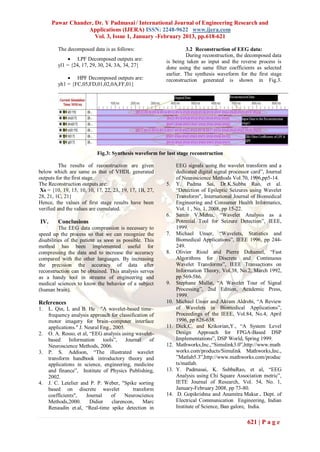
                                                          earlier. The synthesis waveform for the first stage
              HPF Decomposed outputs are:                reconstruction generated is shown in Fig.3.
         yh1 = {FC,05,FD,01,02,0A,FF,01}


                            Fig.3: Synthesis waveform for last stage reconstruction

          The results of reconstruction are given               EEG signals using the wavelet transform and a
below which are same as that of VHDL generated                  dedicated digital signal processor card”, Journal
outputs for the first stage.                                    of Neuroscience Methods Vol.70, 1996,pp5-14.
The Reconstruction outputs are:                           5.    Y. Padma Sai, Dr.K.Subba Rao, et al.
 Xs = {10, 19, 15, 10, 10, 17, 22, 23, 19, 17, 1B, 27,          “Detection of Epileptic Seizures using Wavelet
28, 21, 1C, 21}                                                 Transform”, International Journal of Biomedical
Hence, the values of first stage results have been              Engineering and Consumer Health Informatics,
verified and the values are cumulated.                          Vol. 1 , No. 1, 2008, pp 15-22.
                                                          6.    Samir V.Mehta, “Wavelet Analysis as a
IV.      Conclusions                                            Potential Tool for Seizure Detection”, IEEE,
          The EEG data compression is necessary to              1999.
speed up the process so that we can recognize the         7.    Michael Unser, “Wavelets, Statistics and
disabilities of the patient as soon as possible. This           Biomedical Applications”, IEEE 1996, pp 244-
method has been implemented useful for                          249.
compressing the data and to increase the accuracy         8.    Olivier Rioul and Pierre Duhamel, “Fast
compared with the other languages. By increasing                Algorithms for Discrete and Continuous
the precision the accuracy of data after                        Wavelet Transforms”, IEEE Transactions on
reconstruction can be obtained. This analysis serves            Information Theory, Vol.38, No.2, March 1992,
as a handy tool in streams of engineering and                   pp 569-586.
medical sciences to know the behavior of a subject        9.    Stephane Mallat, “A Wavelet Tour of Signal
(human brain).                                                  Processing”, 2nd Edition, Academic Press,
                                                                1999.
References                                                10.   Michael Unser and Akram Aldrobi, “A Review
1.   L. Qin, L and B. He . "A wavelet-based time–               of Wavelets in Biomedical Applications”,
     frequency analysis approach for classification of          Proceedings of the IEEE, Vol.84, No.4, April
     motor imagery for brain–computer interface                 1996, pp 626-638.
     applications." J. Neural Eng., 2005.                 11.   Dick,C. and Krikorian,Y., “A System Level
2.   O. A. Rosso, et al, “EEG analysis using wavelet-           Design Approach for FPGA-Based DSP
     based     Information      tools”,   Journal    of         Implementations”, DSP World, Spring 1999.
     Neuroscience Methods, 2006.                          12.   Mathworks,Inc.,“Simulink3.0”,http://www.math
3.   P. S. Addison, “The illustrated wavelet                    works.com/products/Simulink Mathworks,Inc.,
     transform handbook introductory theory and                 ”Matlab5.3”,http://www.mathworks.com/produc
     applications in science, engineering, medicine             ts/matlab.
     and finance”, Institute of Physics Publishing,       13.   Y. Padmasai, K. SubbaRao, et al, “EEG
     2002.                                                      Analysis using Chi Square Association metric”,
4.   J. C. Letelier and P. P. Weber, "Spike sorting             IETE Journal of Research, Vol. 54, No. 1,
     based on discrete wavelet               transform          January-February 2008, pp 73-80.
     coefficients",     Journal     of    Neuroscience    14.    D. Gopikrishna and Anamitra Makur . Dept. of
     Methods,2000.       Didier     clarencon,    Marc          Electrical Communication Engineering, Indian
     Renaudin et.al, “Real-time spike detection in              Institute of Science, Ban galore, India.

                                                                                                 621 | P a g e

Cr31618621

  • 1.
    Pawar Chander, Dr.Y Padmasai / International Journal of Engineering Research and Applications (IJERA) ISSN: 2248-9622 www.ijera.com Vol. 3, Issue 1, January -February 2013, pp.618-621 FPGA Implementation of Discrete Wavelet Transform For Electroencephalogram Analysis Pawar Chander$, Dr. Y Padmasai# $ SRES COE,Kopargaon, M.H. # VNR Vignana Jyothi Inst. of Engg and Tech., Hyderabad, AP. Abstract: Neurological disorders affect about five The number of nerve cells in the brain has been percent of the population. Approximately one estimated to be on the order of 1011. Cortical neurons percent of this group has been found to be are strongly interconnected. Here the surface of a epileptic. Epilepsy is a chronic neurological single neuron may be covered with 1,000-100,000 disorder characterized by recurrent, unprovoked synapses (Nunez, 1981). The resting voltage is seizures. These seizures are due to abnormal, around -70 mV, and the peak of the action potential excessive, episodic neuronal activity in the brain. is positive. The amplitude of the nerve impulse is Diagnosis of epilepsy calls for long-term video about 100 mV; it lasts about 1ms. EEG monitoring. This technique is not routinely Electroencephalogram is a valuable used because of its high cost and inconvenience to diagnostic tool in medicine and useful in the the subject as the subject has to be in the hospital diagnosis of the epilepsy, sleep status, etc. EEG for longer time (typically one week to 10 days). analysis would also support the research an Electroencephalogram (EEG) is an important tool intellihent robot and assisted tools for the disabled. in the diagnosis of certain neurological disorders. The study has been found to be time consuming, The ability of the wavelet transform to capture tedious and inefficient. Application of digital the signal energy in a few transforms coefficients processing techniques to the recorded data or real and provide time and frequency information from time data results in helping the neurologist in speedy the transient signal make it a very attractive tool and accurate diagnosis in addition to data for signal processing applications in several fields. compression and ease of transmission for remote In other words, The Discrete Wavelet Transform diagnosis. These techniques help in reviewing the (DWT) has gained the reputation of being a very records quickly, reduce human error making the effective signal analysis tool for many practical expert neurologists’ services available to a larger applications. However, due to its computation populace. A powerful theory was proposed in late intensive nature, current implementations of the 1980’s to perform time –scale analysis of signals: the transform fall short of meeting real-time wavelet theory. This theory provides a unified processing requirements of most applications. framework for different techniques which have been This paper describes implementation of the developed for various applications [5]. The Wavelet Electroencephalogram data using Discrete Transform (WT) is appropriate for analysis of non- Wavelet Transform and it’s inverse. stationary signals and this represents a major Key Words: Electroencephalogram, Epilepsy, advantage over spectral analysis. Hence the WT is Discrete Wavelet Transform, Analysis and Synthesis well suited to locating transient events such as filters spikes, which occur during epileptic seizures. The authors in their previous work demonstrated the use I. Introduction: of Continuous Wavelet Transforms in Epilepsy One of the most developing researches in detection and its performance [6]. Now in the present Engineering that utilizes the extensive research in analysis DWT is implemented. The aim of this work medicine is Biomedical Engineering. This area seeks is to classify normal and epileptic subjects based on to help and improve our everyday life by applying Discrete Wavelet Transform (DWT) and to engineering and medical knowledge with the implement this using a digital signal processor growing power of computers. The computers are (DSP). efficient, straight forward and never get tired or sick, while humans though are smart and creative, become 1.1 Materials sick, weak and limited. Communication between EEG is the measurement of brain electrical humans seem usually much simple than the one activities using electrodes, which are placed on a involves humans and machines. This difficulty patient’s scalp following the international 10-20 increases when a person is disabled. However, system. especially this kind of people has more to gain by The first recording of the electric field of the assisting a machine in their everyday life. human brain was made by the German psychiatrist 618 | P a g e
  • 2.
    Pawar Chander, Dr.Y Padmasai / International Journal of Engineering Research and Applications (IJERA) ISSN: 2248-9622 www.ijera.com Vol. 3, Issue 1, January -February 2013, pp.618-621 Hans Berger in 1924 in Jena. He gave this recording synthesis of the original signal, with a significant the name electroencephalogram (EEG). (Berger, reduction in the computation time. 1929).(From 1929 to 1938 he published 20 scientific The DWT means choosing subsets of the scales a papers on the EEG under the same title "Über das and position b of the mother wavelet ψ (t) Elektroenkephalogram des Menschen".). The ψ (a, b) (t) = 2a/2 ψ (2-a/2 (t-b)) → eq. 1 amplitude of the EEG is about 100 µV when Choosing scales and positions are based on powers measured on the scalp, and about 1-2 mV when of two, which are called dyadic scales and positions measured on the surface of the brain. The bandwidth {a j =2-j; b j , k =2-j k } (j and k are integers). Eq. (1) of this signal is from under 1 Hz to about 50 Hz. shows that it is possible to build a wavelet for any Different frequency components exist in the function by dilating a function ψ (t) with a measured signals. EEG waves are classified into five coefficient 2j , and translating the resulting function frequency bands. Each frequency band is generated on a grid whose interval is proportional to 2-j . by different regions of the brain and indicates certain Contracted (compressed) versions of the wavelet features in the patient such as his depth of sleep. function match the high-frequency components, The recorded EEG signals are used as input while dilated (stretched) versions match the low- for health care monitoring and diagnosis, such as frequency components. Then, by correlating the epileptic seizure detection, emotion monitoring, original signal with wavelet functions of different sleep monitoring, etc. For instance, one of the early sizes, the details of the signal can be obtained at signs of epileptic seizure is the presence of several scales. These correlations with the different characteristic transient waveforms (spikes and sharp wavelet functions can be arranged in a hierarchical waves) in EEG data. scheme called multi-resolution decomposition. The The amount of data contained in multi-resolution decomposition algorithm separates electroencephalogram (EEG) recordings is quite the signal into “details” at different scales and a massive and this places constraints on bandwidth and coarser representation of the signal named storage. The requirement of online transmission of “approximation” [7-10]. data needs a scheme that allows higher performance The algorithm of the DWT decomposition with lower computation [16]. Among the most and reconstruction can be summarized by following popular are wavelet transform (WT), Fourier procedure: transform (FT), autoregressive model and bi-spectral Consider an EEG signal x(n) of length n, analysis. Since the EEG signals are non-stationary, starting from x(n), the first step produces two sets of (discrete) wavelet transform (DWT) is widely used coefficients: approximation coefficients a1 and detail for EEG analysis [1]-[3] and [4]. This is because the coefficients d1.These vectors are obtained by DWT maintains both time and frequency resolution, convolving x(n) with the low-pass filter for which is essential for non-stationary signals. approximation and with the high-pass filter for The original EEG data in epileptic and normal detail, followed by dyadic decimation. This is shown situation is provided by Nizam Institute of Medical in Fig. 1. The length of each filter is equal to 2N. If n Sciences (NIMS), Hyderabad. = length (x (n)), the signals F and G are of length n + 2N - 1, and then the coefficients a1 and d1 are of II. Methods length 2.1. Wavelet Transform Algorithm Floor ((n-1)/2) +N → eq. 2 The problem of an adequate interpretation The approximation coefficients are further of epileptic EEG recordings is of great importance in decomposed into two parts using the same scheme, the understanding, recognition and treatment of replacing s by a1 and producing a2 and d2 and so on. epilepsy. Wavelet theory provides a unified So, the wavelet decomposition of the signal s framework for a number of techniques developed for analyzed at level i has the following structure: [ai, various signal processing applications like detection di... d1]. Conversely, starting from ai and di, the of unknown transient signals [7-9]. The Discrete Inverse Discrete Wavelet Transform (IDWT) Wavelet Transform (DWT) is simply a sampled reconstructs ai -1, inverting the decomposition step version of the Continuous Wavelet Transform by inserting zeros and convolving the results with the (CWT) [10, 11], and the information it provides is reconstruction filters, as shown in Fig. 1. Fourier highly redundant as far as the reconstruction of the analysis is extremely useful for data analysis, as it signal is concerned. This redundancy, on the other breaks down a signal into constituent sinusoids of hand, requires a significant amount of computation different frequencies. The Fast Fourier transform time and resources. DWT, on the other hand, (FFT) is an efficient algorithm for computing the provides sufficient information both for analysis and DFT of a sequence. 619 | P a g e
  • 3.
    Pawar Chander, Dr.Y Padmasai / International Journal of Engineering Research and Applications (IJERA) ISSN: 2248-9622 www.ijera.com Vol. 3, Issue 1, January -February 2013, pp.618-621 Fig.1: The algorithm of the DWT/IDWT for one level Decomposition 2.2 Field Programmable Gate Arrays The original signal x(n) can be reconstructed by the Field programmable gate Arrays (FPGA’s) now process of IDWT. The input samples are being possess sufficient performance and logic capacity to processed using discrete wavelet transform with the implement a number of digital signal processing help of MODELSIM software environment. (DSP) algorithms effectively. The DSP algorithms Selection of filter coefficients is being done using can be implemented in an FPGA with levels of Matlab wavelet toolbox. performance unattainable using a traditional single- chip processor [12]. The specific system simulator 3.1 Decomposition of EEG data used in this investigation is Simulink [13], which The analysis procedure using EEG samples runs within the MATLAB programming & filter coefficients are shown below environment [14].The design parameters relating to The Shifted EEG Samples are: the DWT are entered in the Simulink block and passed to the HDL generic map and port map in the X={12,1B,18,12,12,1A,25,25,1B,19,1F,2A,2B,25,1F elaboration process. In this flow a parameterized ,24} DWT HDL design has been completed and only The Shifted scaling coefficients are: needs to be instantiated by the elaborator. In a h0=FF h1=04 h2=03 h3=E9 h4=FD h5=50 similar flow the IDWT design process can take h5=5B h7=1D place. The Shifted wavelet coefficients are: g0=1D g1=A5 g2=50 g3=03 g4=E9 g5=FD III. Results and Discussions g5=04 g7= 01 The EEG off-line data of both normal and The input data is fed and convolution is performed epileptic subjects are used in this analysis. In the between the above coefficients and the input data. current analysis 16 samples of the EEG data are The results are displayed in the command window considered and its DWT coefficients are computed Fig.2. for all 4 channels. These four channels are considered because it is concluded in the paper [15], that only 4 electrode positions are sufficient for classifying the subject. In this case, a two-level multi-resolution decomposition using db8 wavelet is implemented. Fig.2: Synthesis waveform for I stage decomposition 620 | P a g e
  • 4.
    Pawar Chander, Dr.Y Padmasai / International Journal of Engineering Research and Applications (IJERA) ISSN: 2248-9622 www.ijera.com Vol. 3, Issue 1, January -February 2013, pp.618-621 The decomposed data is as follows: 3.2 Reconstruction of EEG data: During reconstruction, the decomposed data  LPF Decomposed outputs are: is being taken as input and the reverse process is yl1 = {24, 17, 29, 30, 24, 3A, 34, 27} done using the same filter coefficients as selected earlier. The synthesis waveform for the first stage  HPF Decomposed outputs are: reconstruction generated is shown in Fig.3. yh1 = {FC,05,FD,01,02,0A,FF,01} Fig.3: Synthesis waveform for last stage reconstruction The results of reconstruction are given EEG signals using the wavelet transform and a below which are same as that of VHDL generated dedicated digital signal processor card”, Journal outputs for the first stage. of Neuroscience Methods Vol.70, 1996,pp5-14. The Reconstruction outputs are: 5. Y. Padma Sai, Dr.K.Subba Rao, et al. Xs = {10, 19, 15, 10, 10, 17, 22, 23, 19, 17, 1B, 27, “Detection of Epileptic Seizures using Wavelet 28, 21, 1C, 21} Transform”, International Journal of Biomedical Hence, the values of first stage results have been Engineering and Consumer Health Informatics, verified and the values are cumulated. Vol. 1 , No. 1, 2008, pp 15-22. 6. Samir V.Mehta, “Wavelet Analysis as a IV. Conclusions Potential Tool for Seizure Detection”, IEEE, The EEG data compression is necessary to 1999. speed up the process so that we can recognize the 7. Michael Unser, “Wavelets, Statistics and disabilities of the patient as soon as possible. This Biomedical Applications”, IEEE 1996, pp 244- method has been implemented useful for 249. compressing the data and to increase the accuracy 8. Olivier Rioul and Pierre Duhamel, “Fast compared with the other languages. By increasing Algorithms for Discrete and Continuous the precision the accuracy of data after Wavelet Transforms”, IEEE Transactions on reconstruction can be obtained. This analysis serves Information Theory, Vol.38, No.2, March 1992, as a handy tool in streams of engineering and pp 569-586. medical sciences to know the behavior of a subject 9. Stephane Mallat, “A Wavelet Tour of Signal (human brain). Processing”, 2nd Edition, Academic Press, 1999. References 10. Michael Unser and Akram Aldrobi, “A Review 1. L. Qin, L and B. He . "A wavelet-based time– of Wavelets in Biomedical Applications”, frequency analysis approach for classification of Proceedings of the IEEE, Vol.84, No.4, April motor imagery for brain–computer interface 1996, pp 626-638. applications." J. Neural Eng., 2005. 11. Dick,C. and Krikorian,Y., “A System Level 2. O. A. Rosso, et al, “EEG analysis using wavelet- Design Approach for FPGA-Based DSP based Information tools”, Journal of Implementations”, DSP World, Spring 1999. Neuroscience Methods, 2006. 12. Mathworks,Inc.,“Simulink3.0”,http://www.math 3. P. S. Addison, “The illustrated wavelet works.com/products/Simulink Mathworks,Inc., transform handbook introductory theory and ”Matlab5.3”,http://www.mathworks.com/produc applications in science, engineering, medicine ts/matlab. and finance”, Institute of Physics Publishing, 13. Y. Padmasai, K. SubbaRao, et al, “EEG 2002. Analysis using Chi Square Association metric”, 4. J. C. Letelier and P. P. Weber, "Spike sorting IETE Journal of Research, Vol. 54, No. 1, based on discrete wavelet transform January-February 2008, pp 73-80. coefficients", Journal of Neuroscience 14. D. Gopikrishna and Anamitra Makur . Dept. of Methods,2000. Didier clarencon, Marc Electrical Communication Engineering, Indian Renaudin et.al, “Real-time spike detection in Institute of Science, Ban galore, India. 621 | P a g e