ADVERSE EVENT
REPORTING SYSTEM
Presented By:
Mr. Rajat Goyal
Assistant Professor
MMCP, MM(DU)
WHO definition of
pharmacovigilance
It is the science and activities relating to the detection, assessment,
understanding and prevention of adverse effects or any other
medicine related problem.
1] Detection
2] Assessment and understanding
3] Prevention of adverse effects
Pharmacovigilance
Reason forAdverse event
collection and reporting
• The most important responsibilities of investigator and sponsor in
clinical research studies.
• Protection of human subjects.
• Collection of clean and reproducible data.
• They need to analyze the data and determine Risk/benefits before
giving permission market.
ADVERSE EVENT:
Definition- Any unwanted medical occurrence in a patient or clinical
investigation subject administered a pharmaceutical product and which
does not necessarily to a casual relationship with this treatment. As per
ICH E2A
ADVERSE EVENT[AE]
• Any unfavorable and
unintended sign.
• Including an abnormal
laboratory finding
• Symptom
• Disease
UNWANTED EFFECTS
• Symptoms [headache,
nausea]
• Physical findings [BP,
lump, edema]
• Abnormal lab values
[increased liver enzymes,
decreased hemoglobin]
• Overdoses important to
define what% cut-off to
be taken as adverse
events.
Examples
Unfavorable deviation from baseline health, which
includes-
• Headache present at baseline was mild, now become severe.
• Worsening of conditions present at onset of the study.
Unfavorable deviation from baseline health, which
includes-
• Patient deterioration due to primary disease.
• BPH study-patient going into acute retention of urine.
• Antibiotic study: URTI progressing to lower respiratory tract
infection.
Adverse drug reaction [ADR]
In the pre-approval clinical experience:
Defined as all noxious and unintented responsed to a medicinal
product related to any dose should be considered adverse drug
reactions.
The phrase ‘ response to a medical products’ means that a casual
relationship between a medicinal product and an adverse event is
at least a reasonable possibility, i.e. relationship can’t be ruled
out.
CONTT..
UNEXPECTED ADVERSE DRUG REACTION:
An adverse reaction, the nature or severity of which is not
consistent with the applicable product information.
[E.g. Investigator’s brochure for an unapproved investigational
medicinal product]
SERIOUS ADVERSE DRUG REACTION:
• Results in death.
• Life-threatening
• Requires inpatient hospitalization or prolongation of existing.
• Hospitalization.
• Birth defect.
LIFE-THREATENING
• Any AE that places the patient or subject, in the view of the
investigator, at immediate risk of death from the reaction as it
occurred.
• Does not include a reaction that, had it occurred in a more
severe form, might have caused death.
• EXAMPLES-
1. Pacemaker failure
2. Gastrointestinal hemorrhage
3. Infusion pump failure
4. Excessive IV fluid dosing
5. Toxic drug levels
INTENSITY
• Severity of the Adverse Event [ WHO Classification ]
1.MILD: Awareness of sign, symptom, or event, but easily
tolerated.
2.MODERATE: Discomfort enough to cause interference with
usual activity and may warrant intervention.
3.SEVERE: Incapacitating with inability to do usual activities or
significantly affects clinical status, and warrants intervention
required.
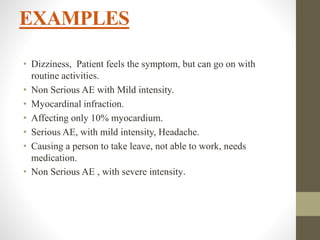
EXAMPLES
• Dizziness, Patient feels the symptom, but can go on with
routine activities.
• Non Serious AE with Mild intensity.
• Myocardinal infraction.
• Affecting only 10% myocardium.
• Serious AE, with mild intensity, Headache.
• Causing a person to take leave, not able to work, needs
medication.
• Non Serious AE , with severe intensity.
REPORTING TIME FRAMES
• 1.REGULATORY 2.IRB/IEC 3.PARTICIPATING
INVESTIGATORS
• Serious Unexpected Fatal or Life-threatening unexpected
ADRs
• Fatal or life-threatening, unexpected ADRs occurring in
clinical investigations qualify for every rapid reporting.
• Regulatory agencies should be notified [e.g. By telephone ,
facsimile transmission, or in writing] as soon as possible but
no later than 7 calendar days after first knowledge by the
sponsor that a case qualifies, followed by within 8 additional
calendar days the complete report.
• This report should include an assessment of the importance
and implication of the findings including relevant previous
experience with the same or similar medicinal products.
Adverse Event & Reporting system and Forms.pptx

Adverse Event & Reporting system and Forms.pptx

  • 1.
    ADVERSE EVENT REPORTING SYSTEM PresentedBy: Mr. Rajat Goyal Assistant Professor MMCP, MM(DU)
  • 2.
    WHO definition of pharmacovigilance Itis the science and activities relating to the detection, assessment, understanding and prevention of adverse effects or any other medicine related problem. 1] Detection 2] Assessment and understanding 3] Prevention of adverse effects Pharmacovigilance
  • 3.
    Reason forAdverse event collectionand reporting • The most important responsibilities of investigator and sponsor in clinical research studies. • Protection of human subjects. • Collection of clean and reproducible data. • They need to analyze the data and determine Risk/benefits before giving permission market. ADVERSE EVENT: Definition- Any unwanted medical occurrence in a patient or clinical investigation subject administered a pharmaceutical product and which does not necessarily to a casual relationship with this treatment. As per ICH E2A
  • 4.
    ADVERSE EVENT[AE] • Anyunfavorable and unintended sign. • Including an abnormal laboratory finding • Symptom • Disease UNWANTED EFFECTS • Symptoms [headache, nausea] • Physical findings [BP, lump, edema] • Abnormal lab values [increased liver enzymes, decreased hemoglobin] • Overdoses important to define what% cut-off to be taken as adverse events.
  • 5.
    Examples Unfavorable deviation frombaseline health, which includes- • Headache present at baseline was mild, now become severe. • Worsening of conditions present at onset of the study. Unfavorable deviation from baseline health, which includes- • Patient deterioration due to primary disease. • BPH study-patient going into acute retention of urine. • Antibiotic study: URTI progressing to lower respiratory tract infection.
  • 6.
    Adverse drug reaction[ADR] In the pre-approval clinical experience: Defined as all noxious and unintented responsed to a medicinal product related to any dose should be considered adverse drug reactions. The phrase ‘ response to a medical products’ means that a casual relationship between a medicinal product and an adverse event is at least a reasonable possibility, i.e. relationship can’t be ruled out.
  • 7.
    CONTT.. UNEXPECTED ADVERSE DRUGREACTION: An adverse reaction, the nature or severity of which is not consistent with the applicable product information. [E.g. Investigator’s brochure for an unapproved investigational medicinal product] SERIOUS ADVERSE DRUG REACTION: • Results in death. • Life-threatening • Requires inpatient hospitalization or prolongation of existing. • Hospitalization. • Birth defect.
  • 8.
    LIFE-THREATENING • Any AEthat places the patient or subject, in the view of the investigator, at immediate risk of death from the reaction as it occurred. • Does not include a reaction that, had it occurred in a more severe form, might have caused death. • EXAMPLES- 1. Pacemaker failure 2. Gastrointestinal hemorrhage 3. Infusion pump failure 4. Excessive IV fluid dosing 5. Toxic drug levels
  • 9.
    INTENSITY • Severity ofthe Adverse Event [ WHO Classification ] 1.MILD: Awareness of sign, symptom, or event, but easily tolerated. 2.MODERATE: Discomfort enough to cause interference with usual activity and may warrant intervention. 3.SEVERE: Incapacitating with inability to do usual activities or significantly affects clinical status, and warrants intervention required.
  • 10.
    EXAMPLES • Dizziness, Patientfeels the symptom, but can go on with routine activities. • Non Serious AE with Mild intensity. • Myocardinal infraction. • Affecting only 10% myocardium. • Serious AE, with mild intensity, Headache. • Causing a person to take leave, not able to work, needs medication. • Non Serious AE , with severe intensity.
  • 11.
    REPORTING TIME FRAMES •1.REGULATORY 2.IRB/IEC 3.PARTICIPATING INVESTIGATORS • Serious Unexpected Fatal or Life-threatening unexpected ADRs • Fatal or life-threatening, unexpected ADRs occurring in clinical investigations qualify for every rapid reporting. • Regulatory agencies should be notified [e.g. By telephone , facsimile transmission, or in writing] as soon as possible but no later than 7 calendar days after first knowledge by the sponsor that a case qualifies, followed by within 8 additional calendar days the complete report. • This report should include an assessment of the importance and implication of the findings including relevant previous experience with the same or similar medicinal products.