Guideline on good pharmacovigilance practices
(GVP)
Module VI – Management and reporting of
adverse reactions to medicinal products (Rev 1)
Effective date: 16-09-2014
By: Dr. Bipin Chandra Bhagath. L
MBBS,MD, PGDCR
Manager Pharmacovigilance Physician & Clinical Microbiologist
3/5/2017 1
Outline
 A. Terminology
 B. Structure and Processes
 Collection of Reports
 Validation of Reports
 Follow-up of Reports
 Data Management.
 Quality Management.
 Special Situations
 Reporting of ICSRs
 Reporting Modalities
 C. Operation of EU Network
3/5/2017 2
TERMINOLOGY
 Medicinal product:
 any substance or combination of substances
 Properties-treating or preventing disease in human
beings.
 used in or administered to human beings either with a
view to restoring, correcting or modifying physiological
functions by exerting a pharmacological, immunological
or metabolic action, or to making a medical diagnosis.
3/5/2017 3
 Adverse Reaction:
 response to a medicinal product which is noxious and
unintended.
 causal relationship must be at least suspected by the
medical practitioner.
 Adverse Event:
 any untoward medical occurrence in a patient
administered a medicinal product and which does not
necessarily have to have a causal relationship with this
treatment.”
3/5/2017 4
Strom LB, Kimmel ES, Hennessy S. Pharmacoepidemiology 5th ed. John Wiley & Sons, Ltd.,UK 2012:138-9
 Primary Source:
 Healthcare professional
 physician, dentist, pharmacist, nurse, coroner or as otherwise
specified by local regulations
 Consumer
 patient, lawyer, friend, relative of a patient or carer.
3/5/2017 5
 Seriousness/ Serious adverse reaction
 medical occurrence that at any dose results in death, is life-
threatening, requires inpatient hospitalisation or
prolongation of existing hospitalisation, results in
persistent or significant disability or incapacity, or is a
congenital anomaly/birth defect.
3/5/2017 6
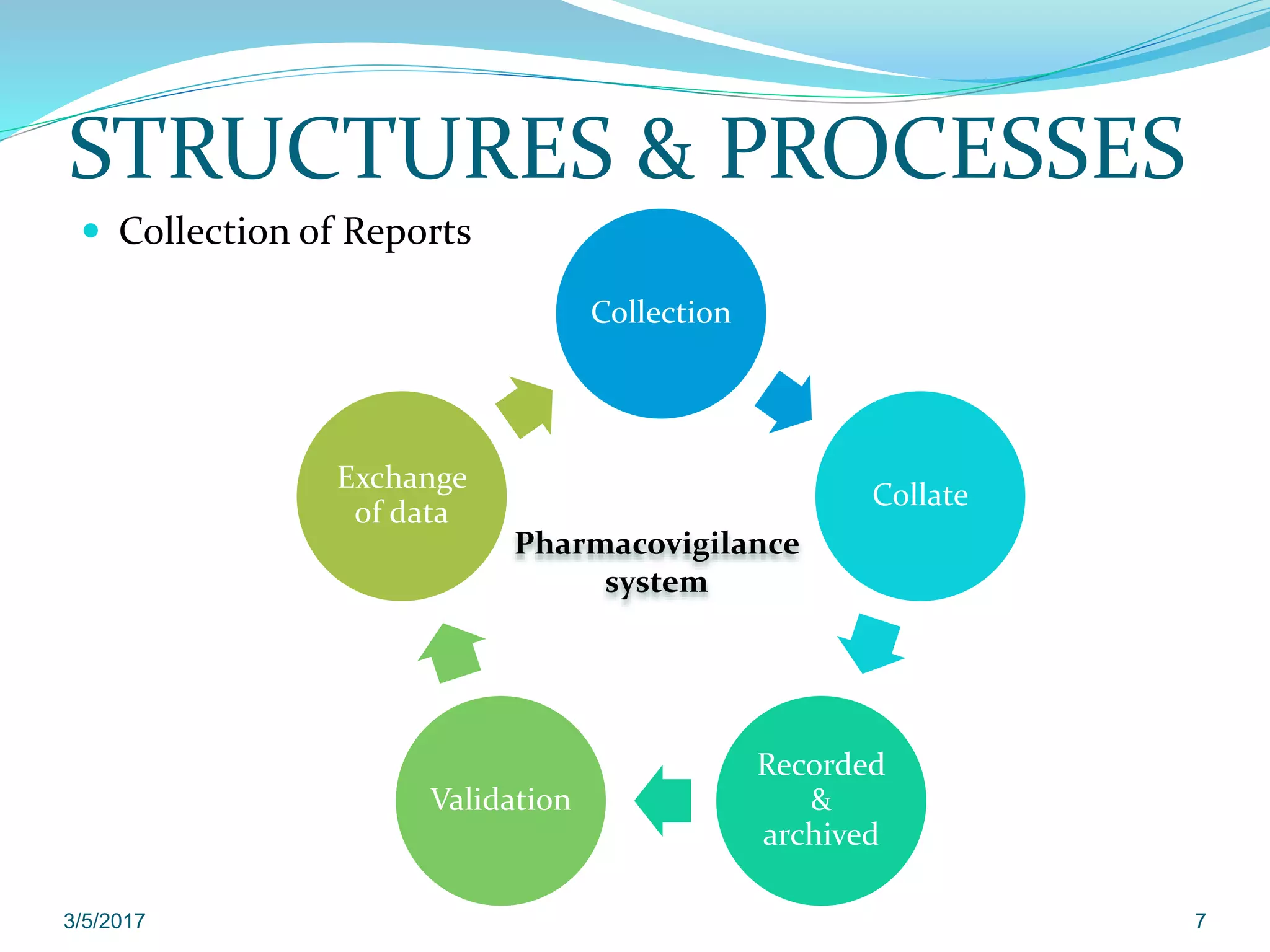
STRUCTURES & PROCESSES
 Collection of Reports
3/5/2017 7
Collection
Collate
Recorded
&
archived
Validation
Exchange
of data
Pharmacovigilance
system
Types of Reports
Reports
Unsolicited
Sources
Spontaneous
Reports
Literature Reports Other sources
Press
Internet
Digital media
Solicited Sources
Organized data
collection reports
3/5/2017 8
3/5/2017 9
Validation of Reports
Complete
4 minimum criteria
Valid ICSR
Incomplete
Lack of any of 4
minimum criteria
Validation of Reports
1. at least one identifiable reporter
2. one single identifiable patient
3. at least one suspect adverse
reaction and
4. at least one suspect medicinal
product.
Follow-up
1. Unspecified & Type of ADR
2. Only outcome/Consequence
3. No clinical circumstances
4. Primary source has not
indicated possible causal
relationship with suspected
medicinal product.
Follow-up Reports
 Incomplete reports
 Missing minimum information.
 Supplementary detailed information
 Events monitored with special interest
 Prospective reports of pregnancy cases.
 Cases notified patients death
 Cases reporting new risks/changes in known risk.
3/5/2017 10
Data Management
 Data security
 Confidentiality
 Strict access control- documents & databases
 Quality assurance auditing –Data entry
 Appropriate coding practices
 Electronic data storage- audit trail
 Transfer of data and Reconciliation process
 Identification & Management of Duplicates- data
entry and Aggregrate reporting.
3/5/2017 11
Quality Management
 Compliance with necessary Quality standards
 every stage of case documentation.
 Clear written SOPs
 Appropriate training in pharmacovigilance legislation
and guidelines
3/5/2017 12
Special situations
 Pregnancy/Breast feeding
 Pediatric/Elderly population
 Overdose, abuse, off label use, misuse, medication
error/Occupational exposure
 Lack of therapeutic efficacy
3/5/2017 13
Pregnancy/Breast feeding
 Reports, where the embryo or foetus may have been exposed to medicinal
products (either through maternal exposure or transmission of a medicinal
product via semen following paternal exposure)- Follow up.
 Individual cases DEP– abnormal outcome- Classified Serious and Should be
reported.
 reports of congenital anomalies or developmental delay, in the foetus or the child;
 reports of foetal death and spontaneous abortion; and
 reports of suspected adverse reactions in the neonate that are classified as serious.
 Individual cases DEP–normal outcome- DEP- Not to be reported, but
collected & discussed in PSUR.
 induced termination of pregnancy without information on congenital malformation,
 reports of pregnancy exposure without outcome data or reports which have a normal
outcome
3/5/2017 14
Exceptional cases: notified immediately
 Pregnancy exposure to medicinal products contraindicated in
pregnancy or medicinal products with a special need for surveillance
because of a high teratogenic potential. (e.g. thalidomide, isotretinoin).
 A signal of a possible teratogen effect (e.g. through a cluster of similar
abnormal outcomes)
Breast feeding
 Suspected adverse reactions which occur in infants following exposure
to a medicinal product from breast milk should be reported.
3/5/2017 15
Pediatric/Elderly population
 age or age group- Mandatory
Key elements in the revised guideline paediatric
population *
Existing products used in the pediatric population -spontaneous
reporting
 inclusion of patient age or age group as mandatory field for spontaneous ADR
reports
 Signal detection to be conducted in stratified to age/groups
 Paediatric specific ADRs should be flagged in the MedDRA coding data
structures
 medicinal products with a potential for - off-label use - medication error -
misuse - intentional or unintentional overdose should be referred to
intensified monitoring
3/5/2017 16
*Guideline on conduct of pharmacovigilance for medicines used by the paediatric population
Overdose, abuse, off label use, misuse,
medication error/Occupational exposure
 no associated adverse reaction should not be reported
as ICSRs.
 considered in periodic safety update reports as
applicable.
3/5/2017 17
Lack of therapeutic efficacy
 When to report:
 Medicinal products used in critical conditions or for the
treatment of life-threatening diseases, vaccines,
contraceptives.
 Time to report: within 15 day time frame
 Do not report:
 If reporter has specifically stated that the outcome was
due to disease progression and was not related to the
medicinal product.
3/5/2017 18
 Antibiotics:
 Report: within 15 day time frame
 threatening infection, where the lack of therapeutic efficacy
appears to be due to the development of a newly resistant
strain of a bacterium previously regarded as susceptible.
 Do not report:
 antibiotic used in a life-threatening situation where the
medicinal product was not in fact appropriate for the infective
agent.
 Vaccine failures:- Separate guidelines
3/5/2017 19
Reporting of ICSRs
 Only valid ICSRs – Reported
 Day Zero:
 first day when a receiver gains knowledge of a valid ICSR,
irrespective of whether the information is received during a
weekend or public holiday.
 Reporting timelines are based on calendar days.
 Scientific and medical literature: clock starts (day zero) with
awareness of a publication containing the minimum information
for reporting.
 For literature searches and/or report valid ICSRs (day zero) as per
agreement with MAH.
3/5/2017 20
Reporting time frames
3/5/2017 21
Type of ICSRs Time frame
Serious valid ICSRs
For initial and follow-up
information.
as soon as possible, but in no case
later than 15 calendar days after
initial receipt of the information.
A case initially reported as serious
becomes non-serious, based on
new follow-up information
should still be reported within 15
days;
If subsequent follow-up reports. the reporting time frame for non-
serious reports should then be
applied
Non-serious valid ICSRs in the
EU
within 90 days from the date of
receipt of the reports
Articles 107(3) and 107a(4) of Directive 2001/83/EC
Reporting modalities
 Internationally agreed ICH guidelines and standards:
 ICH M1 terminology - Medical Dictionary for Regulatory Activities
(MedDRA)
 MedDRA Term Selection: Points to Consider Document - The latest
version of the ICH-endorsed Guide for MedDRA Users.
 ICH E2B(R2) - Maintenance of the ICH Guideline on Clinical Safety
Data Management: Data Elements for Transmission of Individual
Case Safety Reports.
 ICH E2B Implementation Working Group - Questions & Answers
(R5) (March 3, 2005)
3/5/2017 22ICH=International Conference on Harmonisation
Operations of the EU Network
1. Reporting Rules
2. Collection of Reports
3. Reporting Time frames
4. Reporting Modalities
5. Collaboration with the World Health Organization and the European
Monitoring Centre for Drugs and Drug Addiction.
6. Electronic exchange of safety information in the EU
3/5/2017 23
Reporting Rules
3/5/2017 24
Diagram illustrating different types of clinical trials and studies in the EU
Directive 2001/20/EC.
sections A, B, C and D
Directive 2001/83/EC
and Regulation (EC) No
726/2004.
sections E & F
suspected adverse reactions
(serious and non-serious)
3/5/2017 25

GVP module VI

  • 1.
    Guideline on goodpharmacovigilance practices (GVP) Module VI – Management and reporting of adverse reactions to medicinal products (Rev 1) Effective date: 16-09-2014 By: Dr. Bipin Chandra Bhagath. L MBBS,MD, PGDCR Manager Pharmacovigilance Physician & Clinical Microbiologist 3/5/2017 1
  • 2.
    Outline  A. Terminology B. Structure and Processes  Collection of Reports  Validation of Reports  Follow-up of Reports  Data Management.  Quality Management.  Special Situations  Reporting of ICSRs  Reporting Modalities  C. Operation of EU Network 3/5/2017 2
  • 3.
    TERMINOLOGY  Medicinal product: any substance or combination of substances  Properties-treating or preventing disease in human beings.  used in or administered to human beings either with a view to restoring, correcting or modifying physiological functions by exerting a pharmacological, immunological or metabolic action, or to making a medical diagnosis. 3/5/2017 3
  • 4.
     Adverse Reaction: response to a medicinal product which is noxious and unintended.  causal relationship must be at least suspected by the medical practitioner.  Adverse Event:  any untoward medical occurrence in a patient administered a medicinal product and which does not necessarily have to have a causal relationship with this treatment.” 3/5/2017 4 Strom LB, Kimmel ES, Hennessy S. Pharmacoepidemiology 5th ed. John Wiley & Sons, Ltd.,UK 2012:138-9
  • 5.
     Primary Source: Healthcare professional  physician, dentist, pharmacist, nurse, coroner or as otherwise specified by local regulations  Consumer  patient, lawyer, friend, relative of a patient or carer. 3/5/2017 5
  • 6.
     Seriousness/ Seriousadverse reaction  medical occurrence that at any dose results in death, is life- threatening, requires inpatient hospitalisation or prolongation of existing hospitalisation, results in persistent or significant disability or incapacity, or is a congenital anomaly/birth defect. 3/5/2017 6
  • 7.
    STRUCTURES & PROCESSES Collection of Reports 3/5/2017 7 Collection Collate Recorded & archived Validation Exchange of data Pharmacovigilance system
  • 8.
    Types of Reports Reports Unsolicited Sources Spontaneous Reports LiteratureReports Other sources Press Internet Digital media Solicited Sources Organized data collection reports 3/5/2017 8
  • 9.
    3/5/2017 9 Validation ofReports Complete 4 minimum criteria Valid ICSR Incomplete Lack of any of 4 minimum criteria Validation of Reports 1. at least one identifiable reporter 2. one single identifiable patient 3. at least one suspect adverse reaction and 4. at least one suspect medicinal product. Follow-up 1. Unspecified & Type of ADR 2. Only outcome/Consequence 3. No clinical circumstances 4. Primary source has not indicated possible causal relationship with suspected medicinal product.
  • 10.
    Follow-up Reports  Incompletereports  Missing minimum information.  Supplementary detailed information  Events monitored with special interest  Prospective reports of pregnancy cases.  Cases notified patients death  Cases reporting new risks/changes in known risk. 3/5/2017 10
  • 11.
    Data Management  Datasecurity  Confidentiality  Strict access control- documents & databases  Quality assurance auditing –Data entry  Appropriate coding practices  Electronic data storage- audit trail  Transfer of data and Reconciliation process  Identification & Management of Duplicates- data entry and Aggregrate reporting. 3/5/2017 11
  • 12.
    Quality Management  Compliancewith necessary Quality standards  every stage of case documentation.  Clear written SOPs  Appropriate training in pharmacovigilance legislation and guidelines 3/5/2017 12
  • 13.
    Special situations  Pregnancy/Breastfeeding  Pediatric/Elderly population  Overdose, abuse, off label use, misuse, medication error/Occupational exposure  Lack of therapeutic efficacy 3/5/2017 13
  • 14.
    Pregnancy/Breast feeding  Reports,where the embryo or foetus may have been exposed to medicinal products (either through maternal exposure or transmission of a medicinal product via semen following paternal exposure)- Follow up.  Individual cases DEP– abnormal outcome- Classified Serious and Should be reported.  reports of congenital anomalies or developmental delay, in the foetus or the child;  reports of foetal death and spontaneous abortion; and  reports of suspected adverse reactions in the neonate that are classified as serious.  Individual cases DEP–normal outcome- DEP- Not to be reported, but collected & discussed in PSUR.  induced termination of pregnancy without information on congenital malformation,  reports of pregnancy exposure without outcome data or reports which have a normal outcome 3/5/2017 14
  • 15.
    Exceptional cases: notifiedimmediately  Pregnancy exposure to medicinal products contraindicated in pregnancy or medicinal products with a special need for surveillance because of a high teratogenic potential. (e.g. thalidomide, isotretinoin).  A signal of a possible teratogen effect (e.g. through a cluster of similar abnormal outcomes) Breast feeding  Suspected adverse reactions which occur in infants following exposure to a medicinal product from breast milk should be reported. 3/5/2017 15
  • 16.
    Pediatric/Elderly population  ageor age group- Mandatory Key elements in the revised guideline paediatric population * Existing products used in the pediatric population -spontaneous reporting  inclusion of patient age or age group as mandatory field for spontaneous ADR reports  Signal detection to be conducted in stratified to age/groups  Paediatric specific ADRs should be flagged in the MedDRA coding data structures  medicinal products with a potential for - off-label use - medication error - misuse - intentional or unintentional overdose should be referred to intensified monitoring 3/5/2017 16 *Guideline on conduct of pharmacovigilance for medicines used by the paediatric population
  • 17.
    Overdose, abuse, offlabel use, misuse, medication error/Occupational exposure  no associated adverse reaction should not be reported as ICSRs.  considered in periodic safety update reports as applicable. 3/5/2017 17
  • 18.
    Lack of therapeuticefficacy  When to report:  Medicinal products used in critical conditions or for the treatment of life-threatening diseases, vaccines, contraceptives.  Time to report: within 15 day time frame  Do not report:  If reporter has specifically stated that the outcome was due to disease progression and was not related to the medicinal product. 3/5/2017 18
  • 19.
     Antibiotics:  Report:within 15 day time frame  threatening infection, where the lack of therapeutic efficacy appears to be due to the development of a newly resistant strain of a bacterium previously regarded as susceptible.  Do not report:  antibiotic used in a life-threatening situation where the medicinal product was not in fact appropriate for the infective agent.  Vaccine failures:- Separate guidelines 3/5/2017 19
  • 20.
    Reporting of ICSRs Only valid ICSRs – Reported  Day Zero:  first day when a receiver gains knowledge of a valid ICSR, irrespective of whether the information is received during a weekend or public holiday.  Reporting timelines are based on calendar days.  Scientific and medical literature: clock starts (day zero) with awareness of a publication containing the minimum information for reporting.  For literature searches and/or report valid ICSRs (day zero) as per agreement with MAH. 3/5/2017 20
  • 21.
    Reporting time frames 3/5/201721 Type of ICSRs Time frame Serious valid ICSRs For initial and follow-up information. as soon as possible, but in no case later than 15 calendar days after initial receipt of the information. A case initially reported as serious becomes non-serious, based on new follow-up information should still be reported within 15 days; If subsequent follow-up reports. the reporting time frame for non- serious reports should then be applied Non-serious valid ICSRs in the EU within 90 days from the date of receipt of the reports Articles 107(3) and 107a(4) of Directive 2001/83/EC
  • 22.
    Reporting modalities  Internationallyagreed ICH guidelines and standards:  ICH M1 terminology - Medical Dictionary for Regulatory Activities (MedDRA)  MedDRA Term Selection: Points to Consider Document - The latest version of the ICH-endorsed Guide for MedDRA Users.  ICH E2B(R2) - Maintenance of the ICH Guideline on Clinical Safety Data Management: Data Elements for Transmission of Individual Case Safety Reports.  ICH E2B Implementation Working Group - Questions & Answers (R5) (March 3, 2005) 3/5/2017 22ICH=International Conference on Harmonisation
  • 23.
    Operations of theEU Network 1. Reporting Rules 2. Collection of Reports 3. Reporting Time frames 4. Reporting Modalities 5. Collaboration with the World Health Organization and the European Monitoring Centre for Drugs and Drug Addiction. 6. Electronic exchange of safety information in the EU 3/5/2017 23
  • 24.
    Reporting Rules 3/5/2017 24 Diagramillustrating different types of clinical trials and studies in the EU Directive 2001/20/EC. sections A, B, C and D Directive 2001/83/EC and Regulation (EC) No 726/2004. sections E & F suspected adverse reactions (serious and non-serious)
  • 25.