CDSCO
The Central Drugs Standard
Control Organization
Harsh Joshi
M.Pharm(1st semester)
Pharmaceutics
Parul institute of pharmacy.
contents
 Introduction
 Major functions of CDSCO
 Organization chart
 Drug approval process
 Clinical trial process
 Cosmetics
 Medical devices
 References
 Introduction
 The CDSCO of India is main regulatory body for
regulation of pharmaceutical, medical devices and
Clinical Trials.
 Head office of CDSCO is located in NEW DELHI and
functioning under the control of Directorate
General of Health Services, ministry of health and
family welfare Government of India.
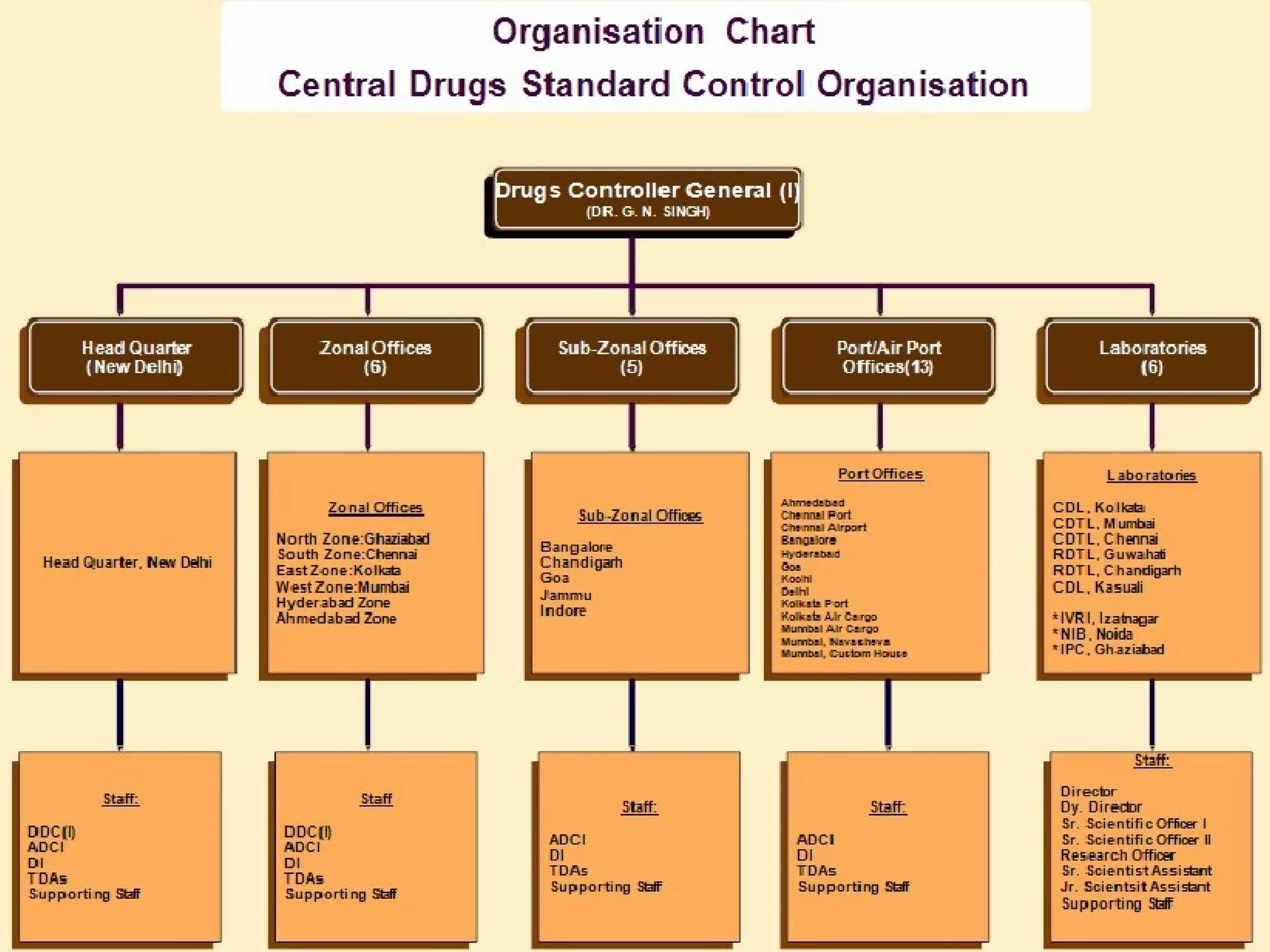
  CDSCO has six zonal offices, four sub-zonal
offices, thirteen port offices and seven
laboratories under its control.
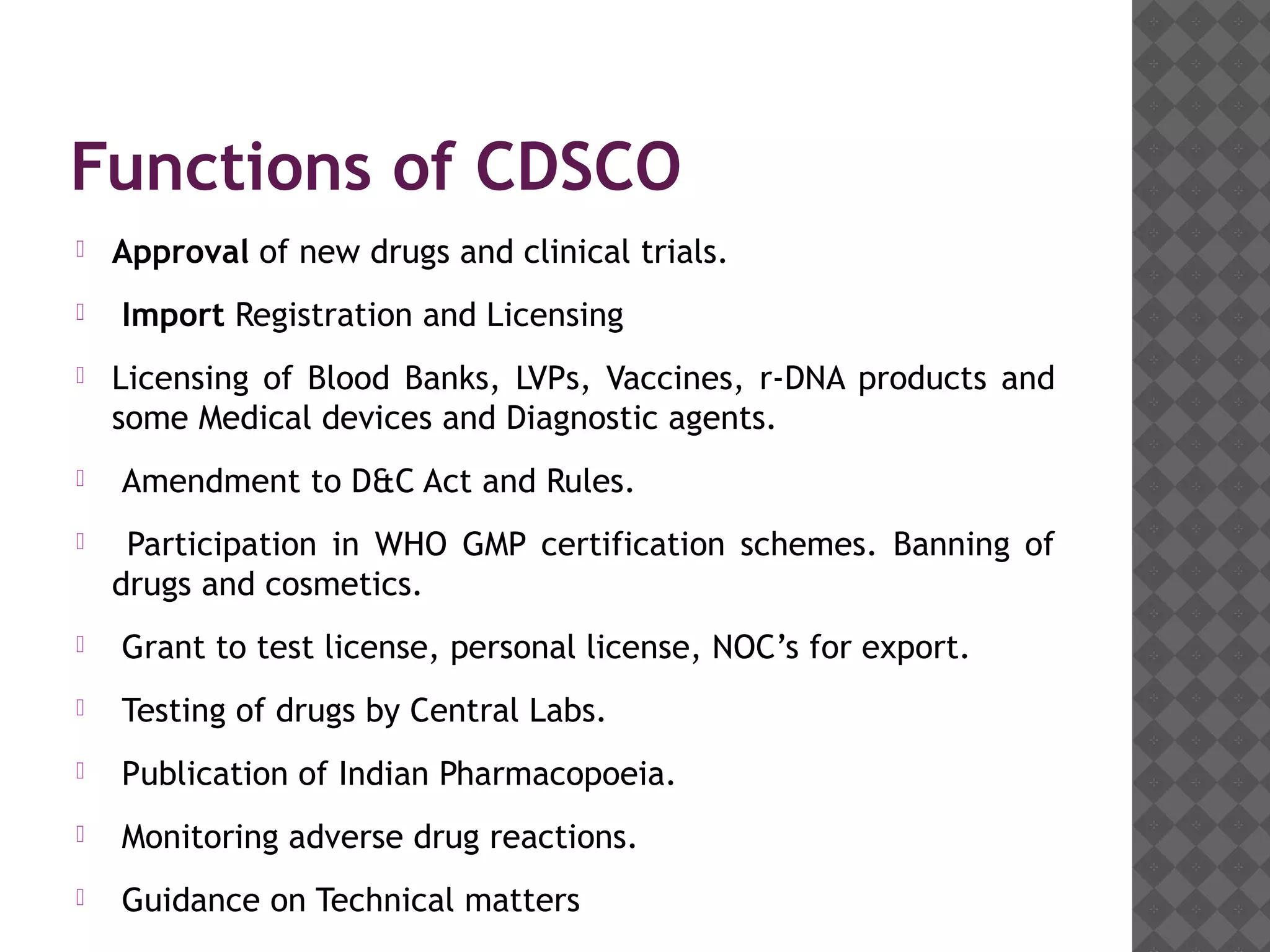
Functions of CDSCO
 Approval of new drugs and clinical trials.
 Import Registration and Licensing
 Licensing of Blood Banks, LVPs, Vaccines, r-DNA products and
some Medical devices and Diagnostic agents.
 Amendment to D&C Act and Rules.
 Participation in WHO GMP certification schemes. Banning of
drugs and cosmetics.
 Grant to test license, personal license, NOC’s for export.
 Testing of drugs by Central Labs.
 Publication of Indian Pharmacopoeia.
 Monitoring adverse drug reactions.
 Guidance on Technical matters
Organization Chart
Approval For New Drugs
 New drugs are permitted to be marketed in
country in accordance with the permission
granted by DCGI after ensuring that these
drugs are
 Safe
 Effective
 Comply with requirement of schedule Y of
the Drug and Cosmetic rules.
 Applicants are required to provide technical
data in respect of safety and efficacy before
these could be permitted to be marketed in
country
 Definition of new drug also includes fixed
dose combination which are required to be
marketed for the 1st time in country.
Clinical Trials
 Schedule Y of drugs and cosmetics act
explain the guideline for grant of permission
for conducting clinical trials in India.
 The protocol for such trials are examined by
the office of DCGI before the permission are
granted.
 Office of DCGI also grants permission for
conducting bioequivalence studies
 a. Registration of clinical trials has been
made mandatory with centralized clinical
trial registry of ICMR with effect from 15th
2009.
 b. Drug and Cosmetic rules are being
amended to make mandatory the registration
of clinical research organizations.
 c. Drug and Cosmetic act is proposed to be
amended to include a separate chapter on
clinical trials.
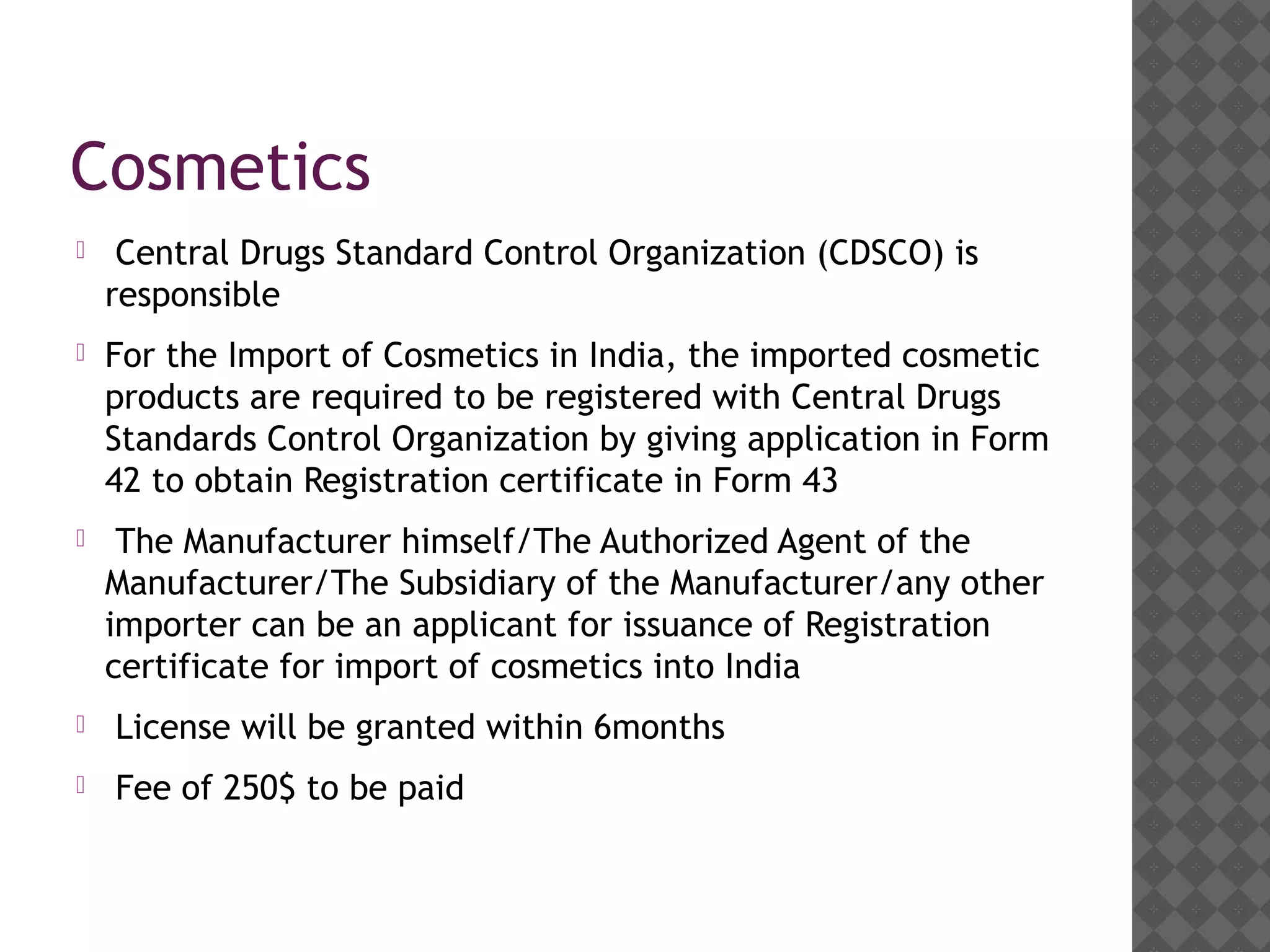
Cosmetics
 Central Drugs Standard Control Organization (CDSCO) is
responsible
 For the Import of Cosmetics in India, the imported cosmetic
products are required to be registered with Central Drugs
Standards Control Organization by giving application in Form
42 to obtain Registration certificate in Form 43
 The Manufacturer himself/The Authorized Agent of the
Manufacturer/The Subsidiary of the Manufacturer/any other
importer can be an applicant for issuance of Registration
certificate for import of cosmetics into India
 License will be granted within 6months
 Fee of 250$ to be paid
  The following licenses are required for
cosmetic product manufacturing & market in
India according to Drug and Cosmetics Act,
1940.
 License on form 32 is issued for manufacture/
sale distribute of cosmetics. (Form no 31)
 License on form 32-A is issued for loan license
for manufacture/ sale distribute of
cosmetics. (Form no. 31-A)
 SLA will give license to manufacture
cosmetics
 Fee of 2500 to be paid.
Medical device rules, 2016
 On 17,October.2016 the union health ministry of India
published the new medical device rules draft., which will
be effective from Jan1, 2018
 The risk based classification for medical devices ranging
from
 Class A low risk (Thermometer, Tongue depressor)
 Class B low moderate risk (suction equipment, hypodermic
needle)
 Class C high moderate risk(ventilator, bone fixation plate)
 Class D high risk (heart valves, AICD)
References
  www.cdsco.nic.in/
 https://www.cdscoonline.gov.in/
 http://www.pharmainfo.net/reviews/new-
drug-approval-process- regulatory-view
 Regulatory environment for clinical research:
Recent past and expected future
 http://www.morulaa.com/cdsco/regulatory-india-medica
 https://www.slideshare.net/viveksachithananthan/
 https://www.slideshare.net/bdvfgbdhg/

CDSCO (regulatory affairs)

  • 1.
    CDSCO The Central DrugsStandard Control Organization Harsh Joshi M.Pharm(1st semester) Pharmaceutics Parul institute of pharmacy.
  • 2.
    contents  Introduction  Majorfunctions of CDSCO  Organization chart  Drug approval process  Clinical trial process  Cosmetics  Medical devices  References
  • 3.
     Introduction  The CDSCOof India is main regulatory body for regulation of pharmaceutical, medical devices and Clinical Trials.  Head office of CDSCO is located in NEW DELHI and functioning under the control of Directorate General of Health Services, ministry of health and family welfare Government of India.   CDSCO has six zonal offices, four sub-zonal offices, thirteen port offices and seven laboratories under its control.
  • 4.
    Functions of CDSCO Approval of new drugs and clinical trials.  Import Registration and Licensing  Licensing of Blood Banks, LVPs, Vaccines, r-DNA products and some Medical devices and Diagnostic agents.  Amendment to D&C Act and Rules.  Participation in WHO GMP certification schemes. Banning of drugs and cosmetics.  Grant to test license, personal license, NOC’s for export.  Testing of drugs by Central Labs.  Publication of Indian Pharmacopoeia.  Monitoring adverse drug reactions.  Guidance on Technical matters
  • 5.
  • 6.
    Approval For NewDrugs  New drugs are permitted to be marketed in country in accordance with the permission granted by DCGI after ensuring that these drugs are  Safe  Effective  Comply with requirement of schedule Y of the Drug and Cosmetic rules.
  • 7.
     Applicants arerequired to provide technical data in respect of safety and efficacy before these could be permitted to be marketed in country  Definition of new drug also includes fixed dose combination which are required to be marketed for the 1st time in country.
  • 8.
    Clinical Trials  ScheduleY of drugs and cosmetics act explain the guideline for grant of permission for conducting clinical trials in India.  The protocol for such trials are examined by the office of DCGI before the permission are granted.  Office of DCGI also grants permission for conducting bioequivalence studies
  • 9.
     a. Registrationof clinical trials has been made mandatory with centralized clinical trial registry of ICMR with effect from 15th 2009.  b. Drug and Cosmetic rules are being amended to make mandatory the registration of clinical research organizations.  c. Drug and Cosmetic act is proposed to be amended to include a separate chapter on clinical trials.
  • 10.
    Cosmetics  Central DrugsStandard Control Organization (CDSCO) is responsible  For the Import of Cosmetics in India, the imported cosmetic products are required to be registered with Central Drugs Standards Control Organization by giving application in Form 42 to obtain Registration certificate in Form 43  The Manufacturer himself/The Authorized Agent of the Manufacturer/The Subsidiary of the Manufacturer/any other importer can be an applicant for issuance of Registration certificate for import of cosmetics into India  License will be granted within 6months  Fee of 250$ to be paid
  • 11.
      The followinglicenses are required for cosmetic product manufacturing & market in India according to Drug and Cosmetics Act, 1940.  License on form 32 is issued for manufacture/ sale distribute of cosmetics. (Form no 31)  License on form 32-A is issued for loan license for manufacture/ sale distribute of cosmetics. (Form no. 31-A)  SLA will give license to manufacture cosmetics  Fee of 2500 to be paid.
  • 12.
    Medical device rules,2016  On 17,October.2016 the union health ministry of India published the new medical device rules draft., which will be effective from Jan1, 2018  The risk based classification for medical devices ranging from  Class A low risk (Thermometer, Tongue depressor)  Class B low moderate risk (suction equipment, hypodermic needle)  Class C high moderate risk(ventilator, bone fixation plate)  Class D high risk (heart valves, AICD)
  • 13.
    References   www.cdsco.nic.in/  https://www.cdscoonline.gov.in/ http://www.pharmainfo.net/reviews/new- drug-approval-process- regulatory-view  Regulatory environment for clinical research: Recent past and expected future  http://www.morulaa.com/cdsco/regulatory-india-medica  https://www.slideshare.net/viveksachithananthan/  https://www.slideshare.net/bdvfgbdhg/

Editor's Notes

  • #7 Dcgi-drug controller general of india <number>
  • #10 Icmr-indian council of medical research <number>
  • #12 SLA-service level agreement <number>