

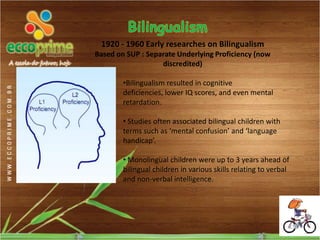

















1. Early research from 1920-1960 associated bilingualism with cognitive deficiencies, lower IQ scores, and even mental retardation. Bilingual children were seen as having terms like "mental confusion" and being up to 3 years behind monolingual peers. 2. Later research in the 1980s established the Common Underlying Proficiency (CUP) model which found that bilingualism does not lead to cognitive delays and that both languages share a common foundation that supports cognitive development. 3. Bilingual education utilizes two or more languages for literacy and knowledge acquisition. The degree to which each language is used can vary between bilingual programs.


