INTERNET LINGUISTICS
•What is Internet linguistics?
•Issues on Internet linguistics
•Internet language: writing vs. speech
•Internet and language change
WHAT IS INTERNET LINGUISTICS?
•The study of language on the Internet and all forms of
electronically meditated communication
• How language is changed by the Internet
WHAT IS INTERNET LINGUISTICS?
•Internet linguistics is in the beginning stage.
•We can anticipate studies of
• Internet syntax
• Internet morphology
• Internet means of transmission (phonological, discourse, etc.)
• Internet’s communicative purposes and effects
• Applied Internet linguistics
WHAT IS INTERNET LINGUISTICS?
•The jungle of terminology
• Computer-meditated communication (CMC)
• Electronically-meditated communication (EMC)
• Netspeak
• the kind of language that is typically used when communicating
on the internet, for example short forms of words, initials, symbols
• Internet language
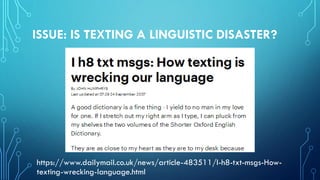
ISSUE: IS TEXTING A LINGUISTIC DISASTER?
https://www.dailymail.co.uk/news/article-483511/I-h8-txt-msgs-How-
texting-wrecking-language.html
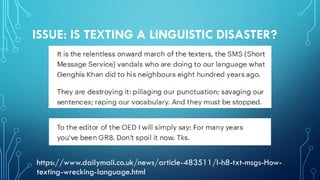
ISSUE: IS TEXTING A LINGUISTIC DISASTER?
https://www.dailymail.co.uk/news/article-483511/I-h8-txt-msgs-How-
texting-wrecking-language.html
ISSUE: IS TEXTING A LINGUISTIC DISASTER?
•Text messages are not full with abbreviations.
• In a Norwegian study: Just 6%
•Many of abbreviations was used before the arrival of
mobile phones or the Internet.
• “Cos” (because) have been in OED since 1828.
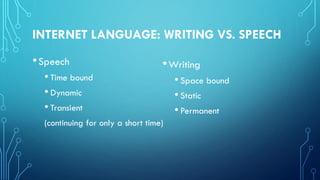
INTERNET LANGUAGE: WRITING VS. SPEECH
•Speech
• Time bound
• Dynamic
• Transient
(continuing for only a short time)
•Writing
• Space bound
• Static
• Permanent
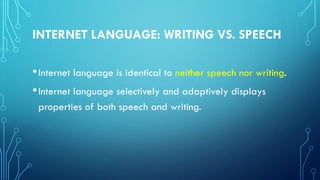
INTERNET LANGUAGE: WRITING VS. SPEECH
•Internet language is identical to neither speech nor writing.
•Internet language selectively and adaptively displays
properties of both speech and writing.
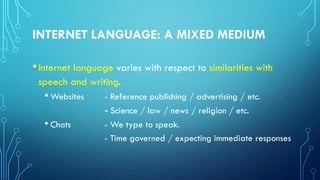
INTERNET LANGUAGE: A MIXED MEDIUM
•Internet language varies with respect to similarities with
speech and writing.
• Websites - Reference publishing / advertising / etc.
- Science / law / news / religion / etc.
• Chats - We type to speak.
- Time governed / expecting immediate responses
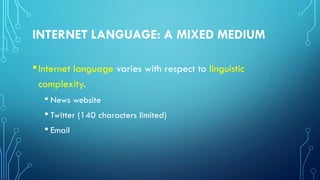
INTERNET LANGUAGE: A MIXED MEDIUM
•Internet language varies with respect to linguistic
complexity.
• News website
• Twitter (140 characters limited)
• Email
INTERNET LANGUAGE: A MIXED MEDIUM
•Internet language varies with respect to communicative
functions.
• Factual or social content in - Websites?
- Emails?
- Chatrooms?
INTERNET LANGUAGE: A MIXED MEDIUM
•One difference between Internet language and speech is
simultaneous feedback.
• Vocalizations (hmm, really?)
• Facial expressions
• Gesture (nodding, hand movements)
•The lack of simultaneous feedback creates misunderstandings.
INTERNET LANGUAGE: A MIXED MEDIUM
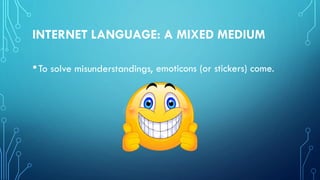
•To solve misunderstandings, emoticons (or stickers) come.
INTERNET LANGUAGE: A MIXED MEDIUM
•Do emoticons (or stickers) solve misunderstandings?
• The sematic role of emoticons is still limited.
• An emoticon allows many readings.
• They can allow misunderstandings as well.
INTERNET AND LANGUAGE CHANGE:
CULT DIALECTS
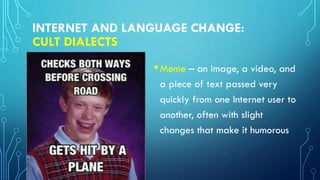
•Meme – an image, a video, and
a piece of text passed very
quickly from one Internet user to
another, often with slight
changes that make it humorous
INTERNET AND LANGUAGE CHANGE:
CULT DIALECTS
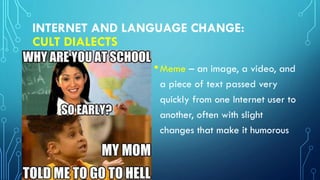
•Meme – an image, a video, and
a piece of text passed very
quickly from one Internet user to
another, often with slight
changes that make it humorous
INTERNET AND LANGUAGE CHANGE:
CULT DIALECTS
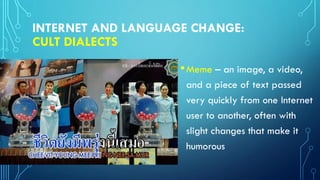
•Meme – an image, a video,
and a piece of text passed
very quickly from one Internet
user to another, often with
slight changes that make it
humorous
INTERNET AND LANGUAGE CHANGE:
CULT DIALECTS
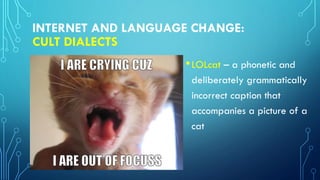
•LOLcat – a phonetic and
deliberately grammatically
incorrect caption that
accompanies a picture of a
cat
INTERNET AND LANGUAGE CHANGE:
CULT DIALECTS
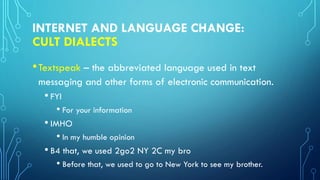
•Textspeak – the abbreviated language used in text
messaging and other forms of electronic communication.
• FYI
• For your information
• IMHO
• In my humble opinion
• B4 that, we used 2go2 NY 2C my bro
• Before that, we used to go to New York to see my brother.
INTERNET AND LANGUAGE CHANGE:
CULT DIALECTS
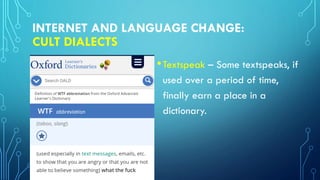
•Textspeak – Some textspeaks, if
used over a period of time,
finally earn a place in a
dictionary.
INTERNET AND LANGUAGE CHANGE:
VOCABULARY
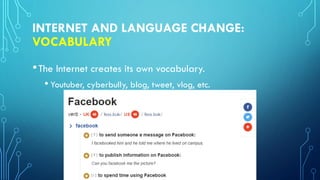
•The Internet creates its own vocabulary.
• Youtuber, cyberbully, blog, tweet, vlog, etc.
INTERNET AND LANGUAGE CHANGE:
VOCABULARY
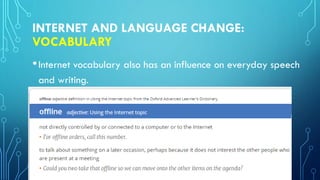
•Internet vocabulary also has an influence on everyday speech
and writing.
INTERNET AND LANGUAGE CHANGE:
VOCABULARY
•With over a million lexical items in English, a few thousand
Internet vocabulary is hardly of great significance.
INTERNET AND LANGUAGE CHANGE:
SYNTAX
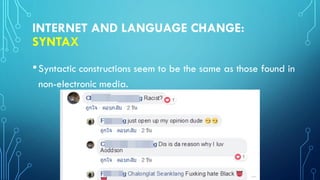
•Syntactic constructions seem to be the same as those found in
non-electronic media.
INTERNET AND LANGUAGE CHANGE:
SYNTAX
•However, there are significance differences in sentence
length, types, and complexity, related to the constraints of
several outputs.
INTERNET AND LANGUAGE CHANGE:
PRAGMATICS
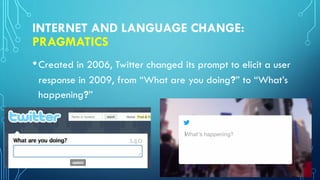
•Analyze these two speech acts. How would you answer them?
• What are you doing?
• What’s happening?
INTERNET AND LANGUAGE CHANGE:
PRAGMATICS
•Created in 2006, Twitter changed its prompt to elicit a user
response in 2009, from “What are you doing?” to “What’s
happening?”
INTERNET AND LANGUAGE CHANGE:
STYLISTICS
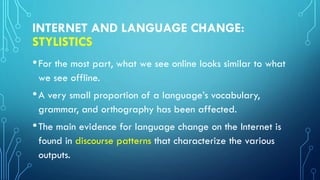
•For the most part, what we see online looks similar to what
we see offline.
•A very small proportion of a language’s vocabulary,
grammar, and orthography has been affected.
•The main evidence for language change on the Internet is
found in discourse patterns that characterize the various
outputs.
INTERNET AND LANGUAGE CHANGE:
STYLISTICS
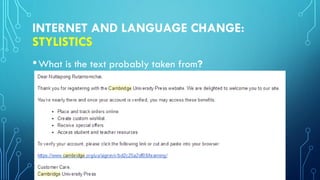
•What is the text probably taken from?
INTERNET AND LANGUAGE CHANGE:
STYLISTICS
•During each advance in communication technology, there has
been the emergence of language management strategies.
•The same process has happened with the Internet.
• Domain names
• Emails
• Online games
• Facebook
• Etc.
INTERNET LINGUISTICS:
CONTRIBUTION TO ENGLISH LANGUAGE TEACHING
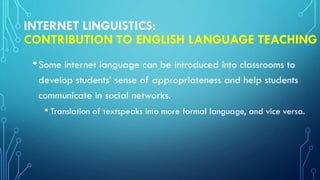
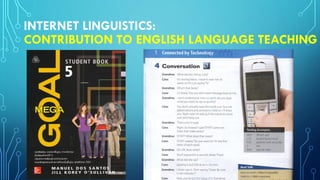
•Some Internet language can be introduced into classrooms to
develop students’ sense of appropriateness and help students
communicate in social networks.
• Translation of textspeaks into more formal language, and vice versa.
INTERNET LINGUISTICS:
CONTRIBUTION TO ENGLISH LANGUAGE TEACHING
Sociolinguistics - Internet Linguistics

Sociolinguistics - Internet Linguistics

  • 2.
    INTERNET LINGUISTICS •What isInternet linguistics? •Issues on Internet linguistics •Internet language: writing vs. speech •Internet and language change
  • 3.
    WHAT IS INTERNETLINGUISTICS? •The study of language on the Internet and all forms of electronically meditated communication • How language is changed by the Internet
  • 4.
    WHAT IS INTERNETLINGUISTICS? •Internet linguistics is in the beginning stage. •We can anticipate studies of • Internet syntax • Internet morphology • Internet means of transmission (phonological, discourse, etc.) • Internet’s communicative purposes and effects • Applied Internet linguistics
  • 5.
    WHAT IS INTERNETLINGUISTICS? •The jungle of terminology • Computer-meditated communication (CMC) • Electronically-meditated communication (EMC) • Netspeak • the kind of language that is typically used when communicating on the internet, for example short forms of words, initials, symbols • Internet language
  • 6.
    ISSUE: IS TEXTINGA LINGUISTIC DISASTER? https://www.dailymail.co.uk/news/article-483511/I-h8-txt-msgs-How- texting-wrecking-language.html
  • 7.
    ISSUE: IS TEXTINGA LINGUISTIC DISASTER? https://www.dailymail.co.uk/news/article-483511/I-h8-txt-msgs-How- texting-wrecking-language.html
  • 8.
    ISSUE: IS TEXTINGA LINGUISTIC DISASTER? •Text messages are not full with abbreviations. • In a Norwegian study: Just 6% •Many of abbreviations was used before the arrival of mobile phones or the Internet. • “Cos” (because) have been in OED since 1828.
  • 9.
    INTERNET LANGUAGE: WRITINGVS. SPEECH •Speech • Time bound • Dynamic • Transient (continuing for only a short time) •Writing • Space bound • Static • Permanent
  • 10.
    INTERNET LANGUAGE: WRITINGVS. SPEECH •Internet language is identical to neither speech nor writing. •Internet language selectively and adaptively displays properties of both speech and writing.
  • 11.
    INTERNET LANGUAGE: AMIXED MEDIUM •Internet language varies with respect to similarities with speech and writing. • Websites - Reference publishing / advertising / etc. - Science / law / news / religion / etc. • Chats - We type to speak. - Time governed / expecting immediate responses
  • 12.
    INTERNET LANGUAGE: AMIXED MEDIUM •Internet language varies with respect to linguistic complexity. • News website • Twitter (140 characters limited) • Email
  • 13.
    INTERNET LANGUAGE: AMIXED MEDIUM •Internet language varies with respect to communicative functions. • Factual or social content in - Websites? - Emails? - Chatrooms?
  • 14.
    INTERNET LANGUAGE: AMIXED MEDIUM •One difference between Internet language and speech is simultaneous feedback. • Vocalizations (hmm, really?) • Facial expressions • Gesture (nodding, hand movements) •The lack of simultaneous feedback creates misunderstandings.
  • 15.
    INTERNET LANGUAGE: AMIXED MEDIUM •To solve misunderstandings, emoticons (or stickers) come.
  • 16.
    INTERNET LANGUAGE: AMIXED MEDIUM •Do emoticons (or stickers) solve misunderstandings? • The sematic role of emoticons is still limited. • An emoticon allows many readings. • They can allow misunderstandings as well.
  • 17.
    INTERNET AND LANGUAGECHANGE: CULT DIALECTS •Meme – an image, a video, and a piece of text passed very quickly from one Internet user to another, often with slight changes that make it humorous
  • 18.
    INTERNET AND LANGUAGECHANGE: CULT DIALECTS •Meme – an image, a video, and a piece of text passed very quickly from one Internet user to another, often with slight changes that make it humorous
  • 19.
    INTERNET AND LANGUAGECHANGE: CULT DIALECTS •Meme – an image, a video, and a piece of text passed very quickly from one Internet user to another, often with slight changes that make it humorous
  • 20.
    INTERNET AND LANGUAGECHANGE: CULT DIALECTS •LOLcat – a phonetic and deliberately grammatically incorrect caption that accompanies a picture of a cat
  • 21.
    INTERNET AND LANGUAGECHANGE: CULT DIALECTS •Textspeak – the abbreviated language used in text messaging and other forms of electronic communication. • FYI • For your information • IMHO • In my humble opinion • B4 that, we used 2go2 NY 2C my bro • Before that, we used to go to New York to see my brother.
  • 22.
    INTERNET AND LANGUAGECHANGE: CULT DIALECTS •Textspeak – Some textspeaks, if used over a period of time, finally earn a place in a dictionary.
  • 23.
    INTERNET AND LANGUAGECHANGE: VOCABULARY •The Internet creates its own vocabulary. • Youtuber, cyberbully, blog, tweet, vlog, etc.
  • 24.
    INTERNET AND LANGUAGECHANGE: VOCABULARY •Internet vocabulary also has an influence on everyday speech and writing.
  • 25.
    INTERNET AND LANGUAGECHANGE: VOCABULARY •With over a million lexical items in English, a few thousand Internet vocabulary is hardly of great significance.
  • 26.
    INTERNET AND LANGUAGECHANGE: SYNTAX •Syntactic constructions seem to be the same as those found in non-electronic media.
  • 27.
    INTERNET AND LANGUAGECHANGE: SYNTAX •However, there are significance differences in sentence length, types, and complexity, related to the constraints of several outputs.
  • 28.
    INTERNET AND LANGUAGECHANGE: PRAGMATICS •Analyze these two speech acts. How would you answer them? • What are you doing? • What’s happening?
  • 29.
    INTERNET AND LANGUAGECHANGE: PRAGMATICS •Created in 2006, Twitter changed its prompt to elicit a user response in 2009, from “What are you doing?” to “What’s happening?”
  • 30.
    INTERNET AND LANGUAGECHANGE: STYLISTICS •For the most part, what we see online looks similar to what we see offline. •A very small proportion of a language’s vocabulary, grammar, and orthography has been affected. •The main evidence for language change on the Internet is found in discourse patterns that characterize the various outputs.
  • 31.
    INTERNET AND LANGUAGECHANGE: STYLISTICS •What is the text probably taken from?
  • 32.
    INTERNET AND LANGUAGECHANGE: STYLISTICS •During each advance in communication technology, there has been the emergence of language management strategies. •The same process has happened with the Internet. • Domain names • Emails • Online games • Facebook • Etc.
  • 33.
    INTERNET LINGUISTICS: CONTRIBUTION TOENGLISH LANGUAGE TEACHING •Some Internet language can be introduced into classrooms to develop students’ sense of appropriateness and help students communicate in social networks. • Translation of textspeaks into more formal language, and vice versa.
  • 34.
    INTERNET LINGUISTICS: CONTRIBUTION TOENGLISH LANGUAGE TEACHING