ICD-10 Overview
ICD-10 Defined
2
 ICD-10-CM is the United States’ clinical modification of the World Health
Organization’s (WHO) International Classification of Diseases (ICD) Tenth
Revision. It is used to classify diseases and causes of illness recorded on
health records, claims, and other vital information.
 ICD-10-PCS is the procedure classification system that is used to report
hospital inpatient procedures.
 The U.S. Department of Health and Human Services (HHS) will require
covered entities (i.e., health plans, health care providers, and health care
clearinghouses) that conduct electronic HIPAA standard transactions to
move from ICD-9 to the next generation ICD-10 code sets by October 1,
2015.
 CPT code and HCPCS sets are not affected
Difference Between ICD-10 and ICD-9
3
 Generally, ICD-10-CM and ICD-10-PCS (Procedure Coding System)
allow for a higher level of specificity over the ICD-9 code set.
 ICD-9-CM versus ICD-10-CM:
• ICD-9-CM and ICD-10-CM have the same hierarchical structure; however,
there are changes in the organization of the code set.
• ICD-10-CM allows for more characters (from three to seven) and requires a
decimal point.
• ICD-10-CM codes are alphanumeric, which provides a greater level of
specificity.
• ICD-10-CM is more specific left versus right , initial encounter, subsequent
encounter etc.
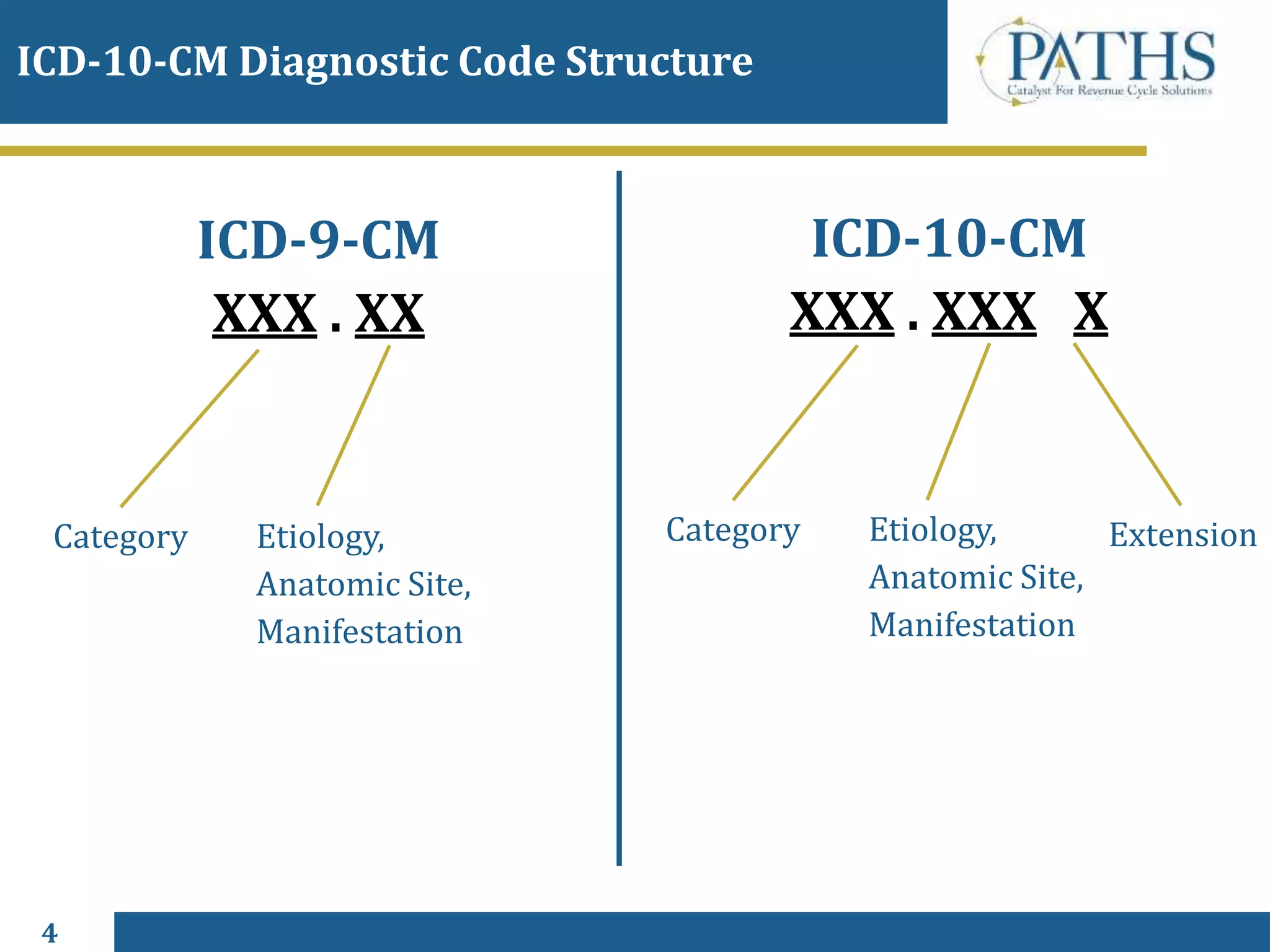
ICD-10-CM Diagnostic Code Structure
4
ICD-9-CM
XXX . XX
ICD-10-CM
XXX . XXX X
Category Etiology,
Anatomic Site,
Manifestation
Category Etiology,
Anatomic Site,
Manifestation
Extension
ICD-10 Implementation Date
5
 Background: HHS announced in January 2009 that ICD-10-CM and ICD-
10-PCS must be implemented into the HIPAA-mandated code set by
October 1, 2013. Then, in April 2012, HHS delayed ICD-10
implementation for one year. Again in 2014, ICD-10 was delayed for one
more year to its current implementation date of October 1, 2015.
 The ICD-10 implementation date is October 1, 2015. This is a CMS
Mandate for Medicare Claims Processing and Health plans, health care
providers, and health care clearinghouses that conduct standard health
care transactions must use ICD-10-CM diagnosis codes for services
occurring on or after October 1, 2015, and ICD-10-PCS codes for
discharges occurring on or after October 1, 2015.
 Other payers are encouraged to implement this ICD-10 CMS
mandate, however they may opt to continue use of ICD-9 code set. Early
indications are that Auto and Workers Compensation carriers may
continue to use ICD-9.
ICD-10 Resources
6
 ICD-10-CM at: www.cms.hhs.gov/ICD10/
 www.icd10codesearch.com
 www.icd9data.com
 Other coding resources (eg. Find a code, etc.)
 Other Payers conducting regular updates via calls and portal
updates.
ICD-10 Possible Impacts 10-01-2015
7
 14,000 to 70,000 codes
 CMS UB 04 and 1500 Form will accommodate the ICD 10
fields
 Vendors may not be completely ready
 Payers may not be completely ready
 Training and knowledge for billing, coding and clinical staff
 Cost and Cash flow impact
ICD-10 Who’s Involved
8
 Providers
 Clinical Staff
 Administrative Staff
 Management
 Billing Staff
Revenue Cycle ICD-10
9
Process for mechanical up front billing rejections
 PATHS Contact person for resolution
 Software vendor contact person for resolution
 Clearinghouse assistance
• Identify reason for rejected claims
 837 Files require a leading indicator of 9 or 10 to specify which ICD code
 Review Functional Acknowledgement report- (999/TA1)
 Review Pending ICD rejections on 277 Status reports
 Review 835 Rejected claims on payer remits
• How to fix rejected claims
 Missing Data
 Incomplete Data
Revenue Cycle ICD-10
10
Claim billing requirements for services prior and after
10/01/15.
 Generally do not place September 2015 services with October 2015
services on the same claim form, except for the following which go by the
Discharge (Through) Date.
Bill Type Facility Type/Services
11x Inpatient Hospitals
18x Swing Beds
21x Skilled Nursing Inpatient Part A
32x Home Health Inpatient Part B
3day/1day bundled outpatient services
Split Claims for Dates Prior to 10-01-2015
11
Claim
Form UB- 04
Bill Type Facility Type/Services
12X Inpatient Part B Hospital Services
13X Outpatient Hospital
Emergency Department
Observation Claims
14X Non Patient Laboratory Services
22X Skilled Nursing Faculties Inpatient Part B
23X Skilled Nursing Faculties Outpatient
34X Home Health Outpatient
71X Rural Health Clinics
72X End Stage Renal Disease (ESRD)
74X Outpatient Therapy
75X Comprehensive Outpatient Rehab Facilities
76X Community Mental Health Clinics
77X Federally Qualified Health Clinics
81X Hospice Hospital
82X Hospice- Non Hospital
85X Critical Access Hospital
Claim
Form 1500
Professional Billing Services
Revenue Cycle ICD-10
12
Assessing denials for resolution
 Technical denials
• Claim form data errors
 Leading 9 or 0 on UB block 66
 Leading 9 or 0 CMS 1500 block 21 (ICD Ind.)
 Logic – based denials
• Ex: anatomy side dx not matching procedure
 Denials for unspecified codes
 Denials for invalid codes
Revenue Cycle ICD-10
13
 Identify top payers in advance of ICD-10 conversion for all outsource
projects
• Access high dollar procedures in advance of ICD-10 conversion date
 Gather list of insurance provider representatives based on claim
submission frequency
• PATHS disseminated matrix of providers
• Managing each individual payer issue
• Internal triage process (supervisor’s role)
• Create scorecard with payers with real-time feedback
 Additional FTE’s for AR follow up (resources)
• PATHS can back fill AR follow up through temporary staffing
 Aerotek
 KFORCE
 Emerson
• Assessment of additional needed staff based on initial denial trending
Revenue Cycle ICD-10
14
Possible impacts due to ICD-10 Coding change
 CMS concession to coding accuracy
• No denials first year for coding errors if the code is in the “appropriate family” of
ICD-10 codes
 PATHS staff will monitor through billing and follow up activity
 Reimbursement assessment for Grouper 31 version APR-DRG due to ICD-10
 Pro fee claims are paid off CPT and HCPCS
 May continue to need ICD-9 coding on claims for Other payers (Auto,
Worker’s Comp)
Revenue Cycle ICD-10
15
Denial trending prior and post ICD-10 conversion
 Access top 10 denials prior to ICD-10 conversion
 Immediately compare denial percentages
 Number of denials
• By physician
• By diagnosis
• By location
• By payer
 Report overall trending data by denial type
• Technical
• Coding
• Clinical
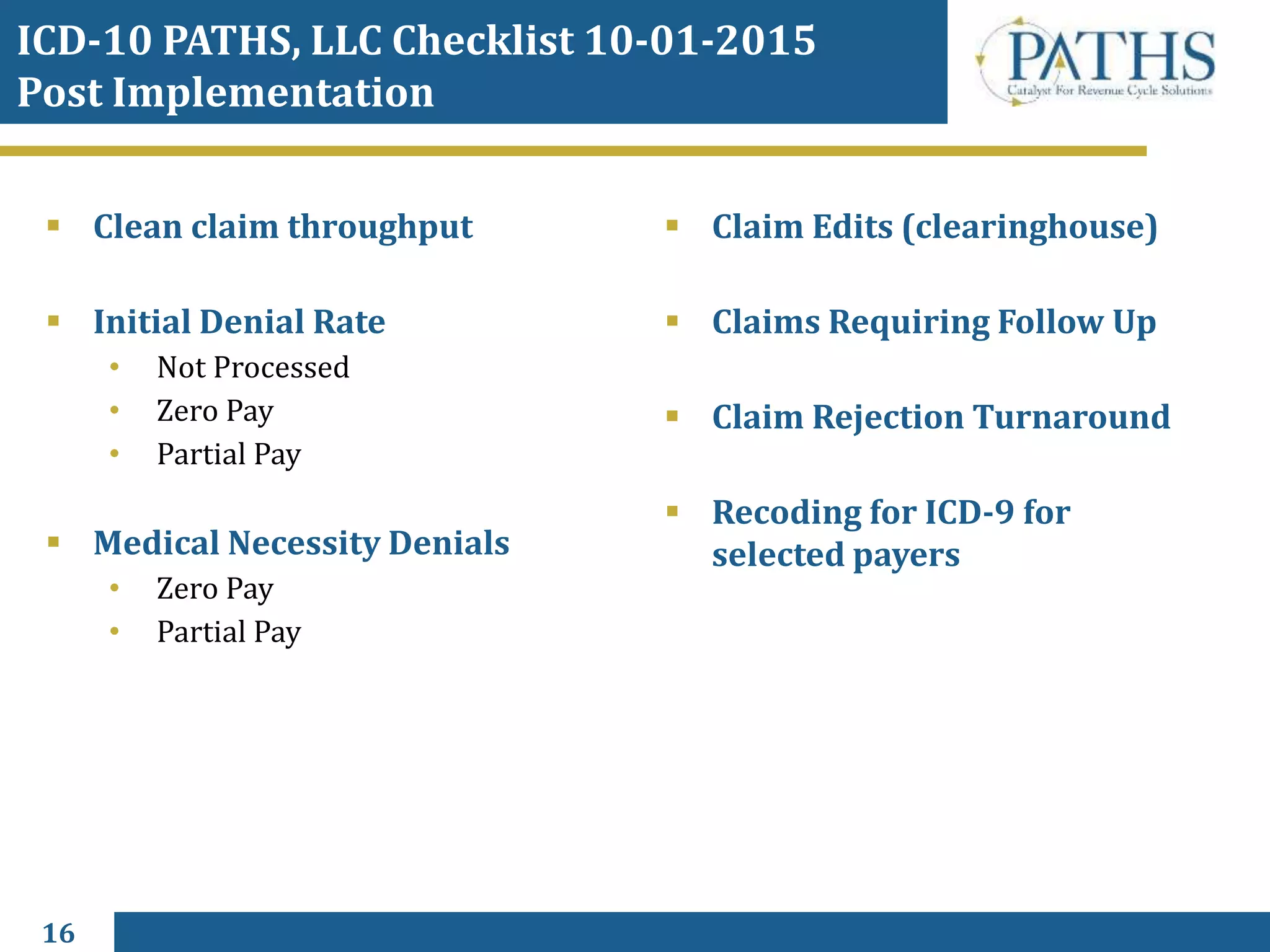
16
 Clean claim throughput
 Initial Denial Rate
• Not Processed
• Zero Pay
• Partial Pay
 Medical Necessity Denials
• Zero Pay
• Partial Pay
 Claim Edits (clearinghouse)
 Claims Requiring Follow Up
 Claim Rejection Turnaround
 Recoding for ICD-9 for
selected payers
ICD-10 PATHS, LLC Checklist 10-01-2015
Post Implementation
CMS ICD-10 Quick Start Guide
17
 Make a Plan
• Outline timelines
• Obtain access to ICD-10 Codes
(available through multiple
sources)
• Role of your clearinghouse
 Train Your Staff
• Multiple resource (CME,
bulletins, emails, webinars, etc.)
 Update Your Processes
• Capturing all new coding
documentation
• Update forms and electronic
pathways
• Identify top diagnosis ICD-10
utilization for your entity
 Talk to Your Vendors and
Health Plans
• Health plans
• Clearinghouses
• Third party billers
 Test Your Systems and
Processes
• Generate a claim
• Code an encounter
Industry ICD Readiness
18
June 2015, Navicure Survey of Physician Practices
(about 500 respondents):
 33% on track
 36% not started/only developed or discussed a plan
 31% started, but not on track
 63% physicians are aware, but do not know details
 32% providers are aware and understand what they need to do
 48% installed PMS update
 45% installed EMR update
 70% plan to install IT updates between July and September
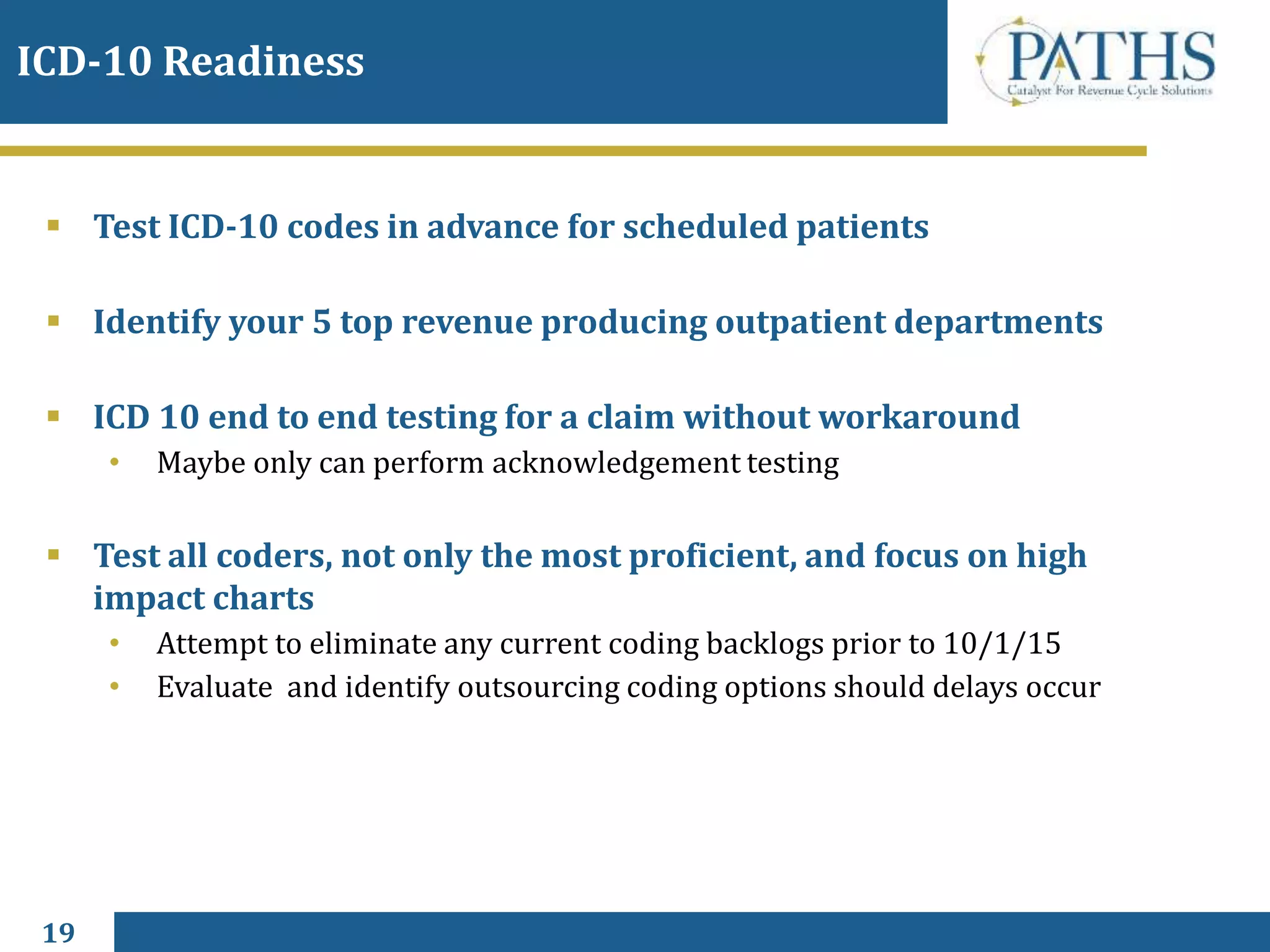
ICD-10 Readiness
19
 Test ICD-10 codes in advance for scheduled patients
 Identify your 5 top revenue producing outpatient departments
 ICD 10 end to end testing for a claim without workaround
• Maybe only can perform acknowledgement testing
 Test all coders, not only the most proficient, and focus on high
impact charts
• Attempt to eliminate any current coding backlogs prior to 10/1/15
• Evaluate and identify outsourcing coding options should delays occur

ICD-10 Overview

  • 1.
  • 2.
    ICD-10 Defined 2  ICD-10-CMis the United States’ clinical modification of the World Health Organization’s (WHO) International Classification of Diseases (ICD) Tenth Revision. It is used to classify diseases and causes of illness recorded on health records, claims, and other vital information.  ICD-10-PCS is the procedure classification system that is used to report hospital inpatient procedures.  The U.S. Department of Health and Human Services (HHS) will require covered entities (i.e., health plans, health care providers, and health care clearinghouses) that conduct electronic HIPAA standard transactions to move from ICD-9 to the next generation ICD-10 code sets by October 1, 2015.  CPT code and HCPCS sets are not affected
  • 3.
    Difference Between ICD-10and ICD-9 3  Generally, ICD-10-CM and ICD-10-PCS (Procedure Coding System) allow for a higher level of specificity over the ICD-9 code set.  ICD-9-CM versus ICD-10-CM: • ICD-9-CM and ICD-10-CM have the same hierarchical structure; however, there are changes in the organization of the code set. • ICD-10-CM allows for more characters (from three to seven) and requires a decimal point. • ICD-10-CM codes are alphanumeric, which provides a greater level of specificity. • ICD-10-CM is more specific left versus right , initial encounter, subsequent encounter etc.
  • 4.
    ICD-10-CM Diagnostic CodeStructure 4 ICD-9-CM XXX . XX ICD-10-CM XXX . XXX X Category Etiology, Anatomic Site, Manifestation Category Etiology, Anatomic Site, Manifestation Extension
  • 5.
    ICD-10 Implementation Date 5 Background: HHS announced in January 2009 that ICD-10-CM and ICD- 10-PCS must be implemented into the HIPAA-mandated code set by October 1, 2013. Then, in April 2012, HHS delayed ICD-10 implementation for one year. Again in 2014, ICD-10 was delayed for one more year to its current implementation date of October 1, 2015.  The ICD-10 implementation date is October 1, 2015. This is a CMS Mandate for Medicare Claims Processing and Health plans, health care providers, and health care clearinghouses that conduct standard health care transactions must use ICD-10-CM diagnosis codes for services occurring on or after October 1, 2015, and ICD-10-PCS codes for discharges occurring on or after October 1, 2015.  Other payers are encouraged to implement this ICD-10 CMS mandate, however they may opt to continue use of ICD-9 code set. Early indications are that Auto and Workers Compensation carriers may continue to use ICD-9.
  • 6.
    ICD-10 Resources 6  ICD-10-CMat: www.cms.hhs.gov/ICD10/  www.icd10codesearch.com  www.icd9data.com  Other coding resources (eg. Find a code, etc.)  Other Payers conducting regular updates via calls and portal updates.
  • 7.
    ICD-10 Possible Impacts10-01-2015 7  14,000 to 70,000 codes  CMS UB 04 and 1500 Form will accommodate the ICD 10 fields  Vendors may not be completely ready  Payers may not be completely ready  Training and knowledge for billing, coding and clinical staff  Cost and Cash flow impact
  • 8.
    ICD-10 Who’s Involved 8 Providers  Clinical Staff  Administrative Staff  Management  Billing Staff
  • 9.
    Revenue Cycle ICD-10 9 Processfor mechanical up front billing rejections  PATHS Contact person for resolution  Software vendor contact person for resolution  Clearinghouse assistance • Identify reason for rejected claims  837 Files require a leading indicator of 9 or 10 to specify which ICD code  Review Functional Acknowledgement report- (999/TA1)  Review Pending ICD rejections on 277 Status reports  Review 835 Rejected claims on payer remits • How to fix rejected claims  Missing Data  Incomplete Data
  • 10.
    Revenue Cycle ICD-10 10 Claimbilling requirements for services prior and after 10/01/15.  Generally do not place September 2015 services with October 2015 services on the same claim form, except for the following which go by the Discharge (Through) Date. Bill Type Facility Type/Services 11x Inpatient Hospitals 18x Swing Beds 21x Skilled Nursing Inpatient Part A 32x Home Health Inpatient Part B 3day/1day bundled outpatient services
  • 11.
    Split Claims forDates Prior to 10-01-2015 11 Claim Form UB- 04 Bill Type Facility Type/Services 12X Inpatient Part B Hospital Services 13X Outpatient Hospital Emergency Department Observation Claims 14X Non Patient Laboratory Services 22X Skilled Nursing Faculties Inpatient Part B 23X Skilled Nursing Faculties Outpatient 34X Home Health Outpatient 71X Rural Health Clinics 72X End Stage Renal Disease (ESRD) 74X Outpatient Therapy 75X Comprehensive Outpatient Rehab Facilities 76X Community Mental Health Clinics 77X Federally Qualified Health Clinics 81X Hospice Hospital 82X Hospice- Non Hospital 85X Critical Access Hospital Claim Form 1500 Professional Billing Services
  • 12.
    Revenue Cycle ICD-10 12 Assessingdenials for resolution  Technical denials • Claim form data errors  Leading 9 or 0 on UB block 66  Leading 9 or 0 CMS 1500 block 21 (ICD Ind.)  Logic – based denials • Ex: anatomy side dx not matching procedure  Denials for unspecified codes  Denials for invalid codes
  • 13.
    Revenue Cycle ICD-10 13 Identify top payers in advance of ICD-10 conversion for all outsource projects • Access high dollar procedures in advance of ICD-10 conversion date  Gather list of insurance provider representatives based on claim submission frequency • PATHS disseminated matrix of providers • Managing each individual payer issue • Internal triage process (supervisor’s role) • Create scorecard with payers with real-time feedback  Additional FTE’s for AR follow up (resources) • PATHS can back fill AR follow up through temporary staffing  Aerotek  KFORCE  Emerson • Assessment of additional needed staff based on initial denial trending
  • 14.
    Revenue Cycle ICD-10 14 Possibleimpacts due to ICD-10 Coding change  CMS concession to coding accuracy • No denials first year for coding errors if the code is in the “appropriate family” of ICD-10 codes  PATHS staff will monitor through billing and follow up activity  Reimbursement assessment for Grouper 31 version APR-DRG due to ICD-10  Pro fee claims are paid off CPT and HCPCS  May continue to need ICD-9 coding on claims for Other payers (Auto, Worker’s Comp)
  • 15.
    Revenue Cycle ICD-10 15 Denialtrending prior and post ICD-10 conversion  Access top 10 denials prior to ICD-10 conversion  Immediately compare denial percentages  Number of denials • By physician • By diagnosis • By location • By payer  Report overall trending data by denial type • Technical • Coding • Clinical
  • 16.
    16  Clean claimthroughput  Initial Denial Rate • Not Processed • Zero Pay • Partial Pay  Medical Necessity Denials • Zero Pay • Partial Pay  Claim Edits (clearinghouse)  Claims Requiring Follow Up  Claim Rejection Turnaround  Recoding for ICD-9 for selected payers ICD-10 PATHS, LLC Checklist 10-01-2015 Post Implementation
  • 17.
    CMS ICD-10 QuickStart Guide 17  Make a Plan • Outline timelines • Obtain access to ICD-10 Codes (available through multiple sources) • Role of your clearinghouse  Train Your Staff • Multiple resource (CME, bulletins, emails, webinars, etc.)  Update Your Processes • Capturing all new coding documentation • Update forms and electronic pathways • Identify top diagnosis ICD-10 utilization for your entity  Talk to Your Vendors and Health Plans • Health plans • Clearinghouses • Third party billers  Test Your Systems and Processes • Generate a claim • Code an encounter
  • 18.
    Industry ICD Readiness 18 June2015, Navicure Survey of Physician Practices (about 500 respondents):  33% on track  36% not started/only developed or discussed a plan  31% started, but not on track  63% physicians are aware, but do not know details  32% providers are aware and understand what they need to do  48% installed PMS update  45% installed EMR update  70% plan to install IT updates between July and September
  • 19.
    ICD-10 Readiness 19  TestICD-10 codes in advance for scheduled patients  Identify your 5 top revenue producing outpatient departments  ICD 10 end to end testing for a claim without workaround • Maybe only can perform acknowledgement testing  Test all coders, not only the most proficient, and focus on high impact charts • Attempt to eliminate any current coding backlogs prior to 10/1/15 • Evaluate and identify outsourcing coding options should delays occur