

ICD CODING FOR COMMON
       CANCERS


  DR. DEBARSHI LAHIRI, M.D.
           KOLKATA, INDIA
ICD
INTERNATIONAL CLASSIFICATION OF DISEASES
  (and related health problems) published by the
 WHO (the 10th revision of which (WHO, 1992) is in
                    current use)

It is used to code and classify diseases and other
health problems recorded on many types of health
and vital records including death certificates.

Designed to promote international comparability in
the collection, processing, classification, and
presentation of morbidity and mortality statistics.
ICD-10


 Translates diagnoses of diseases and other health problems
from words into an alphanumeric code, which permits easy
          storage, retrieval and analysis of the data.
    (Till ICD-9 , Numeric coding system was followed)
      (ICD-10 is an Alpha numeric coding system)
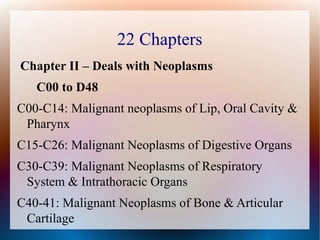
22 Chapters
Chapter II – Deals with Neoplasms
   C00 to D48
C00-C14: Malignant neoplasms of Lip, Oral Cavity &
 Pharynx
C15-C26: Malignant Neoplasms of Digestive Organs
C30-C39: Malignant Neoplasms of Respiratory
 System & Intrathoracic Organs
C40-41: Malignant Neoplasms of Bone & Articular
 Cartilage
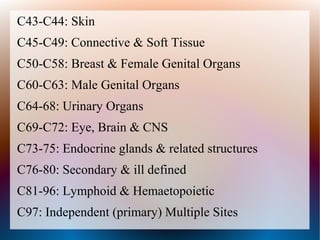
C43-C44: Skin
C45-C49: Connective & Soft Tissue
C50-C58: Breast & Female Genital Organs
C60-C63: Male Genital Organs
C64-68: Urinary Organs
C69-C72: Eye, Brain & CNS
C73-75: Endocrine glands & related structures
C76-80: Secondary & ill defined
C81-96: Lymphoid & Hemaetopoietic
C97: Independent (primary) Multiple Sites
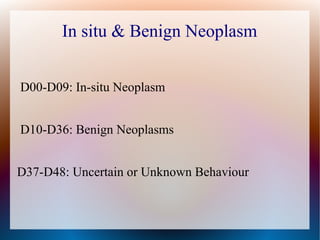
In situ & Benign Neoplasm


D00-D09: In-situ Neoplasm


D10-D36: Benign Neoplasms


D37-D48: Uncertain or Unknown Behaviour
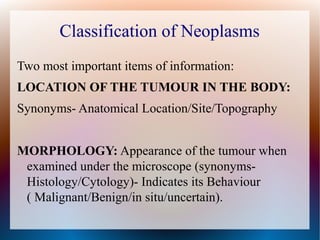
Classification of Neoplasms
Two most important items of information:
LOCATION OF THE TUMOUR IN THE BODY:
Synonyms- Anatomical Location/Site/Topography


MORPHOLOGY: Appearance of the tumour when
 examined under the microscope (synonyms-
 Histology/Cytology)- Indicates its Behaviour
 ( Malignant/Benign/in situ/uncertain).
ICD Classification- Describes only
 Topography and Behaviour
MORPHOLOGY ??
CARCINOMA LUNG NOS: C34.9 doesn't
 distinguish between NSCLC
 (adeno/Squamous)/SCLC/other morphology
Benign Neoplasm: D14.3
In situ: D02.2
Cancer Registries were coding for
Morphology even before ICD-O came
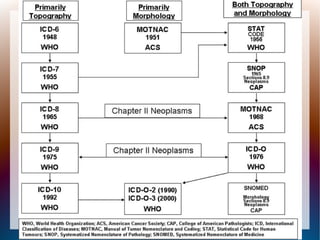
1951- 1st coding manual for Morphology developed by
  American Cancer Society ( MOTNAC)- Manual of Tumour
  Nomenclature & Coding (Cancer Registries at that time
  used malignant neoplasm section of ICD-6 for coding
  Topography and MOTNAC for Morphology)

 WHO-1956- published Statistical Code for Human Tumors
 (based on Topography code based on ICD-7 and
 Morphology, including behaviour code of MOTNAC)

 CAP in 1965 published SNOP (systematized nomenclature
 of Pathology)
1968- ACS Revised MOTNAC-Topography
 based on ICD-8, Morphology code taken from
 SNOP
1976-WHO and IARC collaborated- The
 worldwide need for a logical, coherent and
 detailed classification for neoplasms was
 recognised- Developed the International
 Classification of Diseases for Oncology
 (ICD-O).-Topography based on ICD-9 and
 Morphology on MOTNAC- which was further
 modified.
1977-CAP revised SNOP to SNOMED
 Incorporated the ICD-O morphology section.
What is ICD-O?
Not a true classification system:
Includes codes from multiple classification
 Systems.
Actually a coded nomenclature for :

Topography (primary site of origin)


Morphology (histology, behavior, grade)
Rationale for ICD-O
To Standardize Cancer Data Collection


To Compare Data:
Regional
National
International
ICD O3 TOPOGRAPHY
3rd Edition of ICD-O, Published in Year 2000
TOPOGRAPHY- ICD 10 Classification codes of
 Malignant Neoplasms applied for all types of
 tumours(whether malignant/Benign/In
 situ/uncertain)
Four digit code: C_ _._ ; 3 Digits for the Primary site
 followed by Sub-site after a Point.
RANGE: C00.0 – C80.9
Topography Code, Examples
LIP:
C00.0: External Upper Lip
C00.1: External Lower Lip
C00.2: External Lip, NOS
C00.3: Mucosa of the Upper Lip
C00.4: Mucosa of the Lower Lip
C00.5: Mucosa of the Lip, NOS
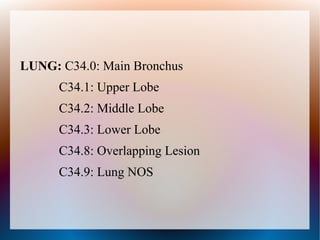
LUNG: C34.0: Main Bronchus
      C34.1: Upper Lobe
      C34.2: Middle Lobe
      C34.3: Lower Lobe
      C34.8: Overlapping Lesion
      C34.9: Lung NOS
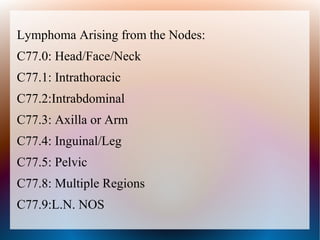
Lymphoma Arising from the Nodes:
C77.0: Head/Face/Neck
C77.1: Intrathoracic
C77.2:Intrabdominal
C77.3: Axilla or Arm
C77.4: Inguinal/Leg
C77.5: Pelvic
C77.8: Multiple Regions
C77.9:L.N. NOS
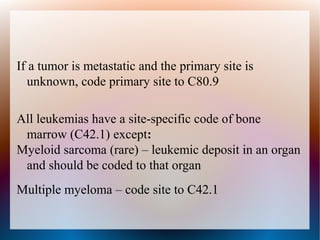
If a tumor is metastatic and the primary site is
   unknown, code primary site to C80.9

All leukemias have a site-specific code of bone
 marrow (C42.1) except:
Myeloid sarcoma (rare) – leukemic deposit in an organ
 and should be coded to that organ
Multiple myeloma – code site to C42.1
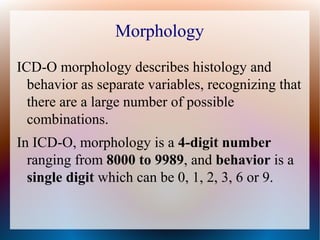
Morphology
ICD-O morphology describes histology and
  behavior as separate variables, recognizing that
  there are a large number of possible
  combinations.
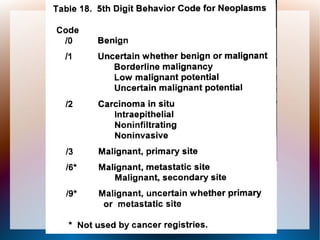
In ICD-O, morphology is a 4-digit number
  ranging from 8000 to 9989, and behavior is a
  single digit which can be 0, 1, 2, 3, 6 or 9.
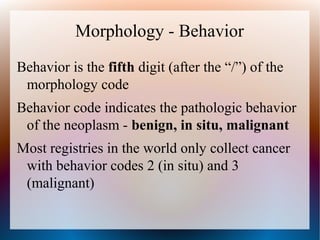
Morphology - Behavior
Behavior is the fifth digit (after the “/”) of the
 morphology code
Behavior code indicates the pathologic behavior
 of the neoplasm - benign, in situ, malignant
Most registries in the world only collect cancer
 with behavior codes 2 (in situ) and 3
 (malignant)
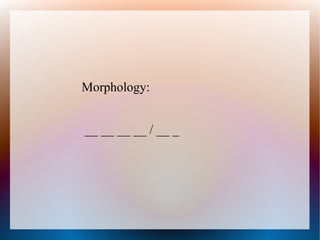
Morphology:


__ __ __ __ / __ _
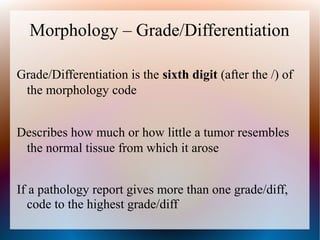
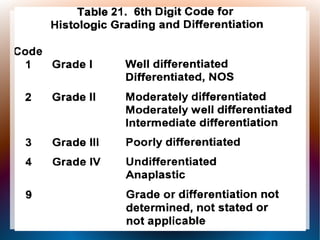
Morphology – Grade/Differentiation

Grade/Differentiation is the sixth digit (after the /) of
 the morphology code


Describes how much or how little a tumor resembles
 the normal tissue from which it arose


If a pathology report gives more than one grade/diff,
  code to the highest grade/diff
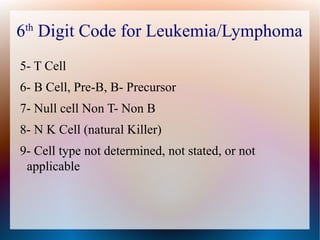
6 Digit Code for Leukemia/Lymphoma
 th


5- T Cell
6- B Cell, Pre-B, B- Precursor
7- Null cell Non T- Non B
8- N K Cell (natural Killer)
9- Cell type not determined, not stated, or not
 applicable
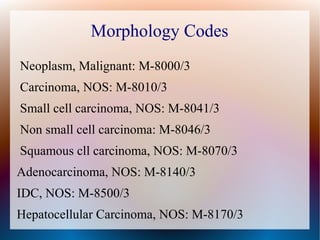
Morphology Codes
Neoplasm, Malignant: M-8000/3
Carcinoma, NOS: M-8010/3
Small cell carcinoma, NOS: M-8041/3
Non small cell carcinoma: M-8046/3
Squamous cll carcinoma, NOS: M-8070/3
Adenocarcinoma, NOS: M-8140/3
IDC, NOS: M-8500/3
Hepatocellular Carcinoma, NOS: M-8170/3
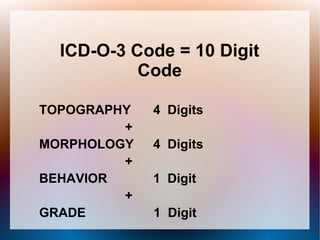
ICD-O-3 Code = 10 Digit
           Code

TOPOGRAPHY   4 Digits
         +
MORPHOLOGY   4 Digits
         +
BEHAVIOR     1 Digit
         +
GRADE        1 Digit
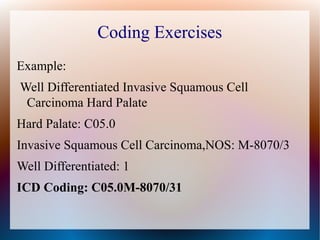
Coding Exercises
Example:
Well Differentiated Invasive Squamous Cell
 Carcinoma Hard Palate
Hard Palate: C05.0
Invasive Squamous Cell Carcinoma,NOS: M-8070/3
Well Differentiated: 1
ICD Coding: C05.0M-8070/31
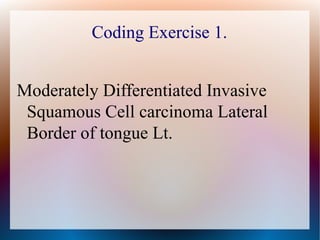
Coding Exercise 1.


Moderately Differentiated Invasive
 Squamous Cell carcinoma Lateral
 Border of tongue Lt.
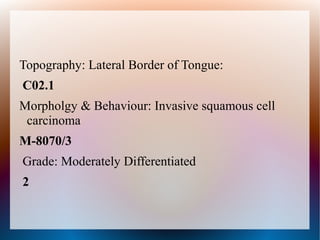
Topography: Lateral Border of Tongue:
C02.1
Morpholgy & Behaviour: Invasive squamous cell
 carcinoma
M-8070/3
Grade: Moderately Differentiated
2
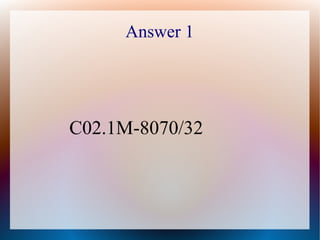
Answer 1


C02.1M-8070/32
Coding Exercise 2


Well Differentiated Adenocarcinoma
Lower Lobe of Lung Lt.
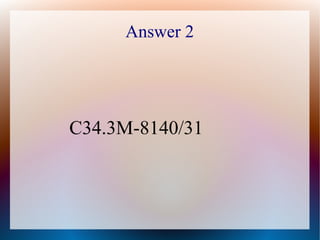
Answer 2


C34.3M-8140/31
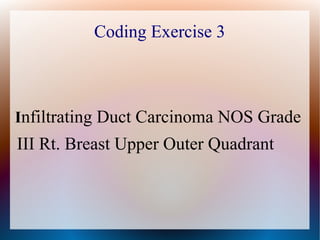
Coding Exercise 3


Infiltrating Duct Carcinoma NOS Grade
III Rt. Breast Upper Outer Quadrant
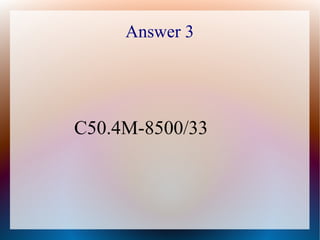
Answer 3


C50.4M-8500/33
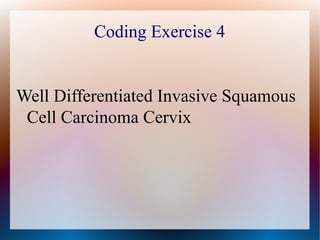
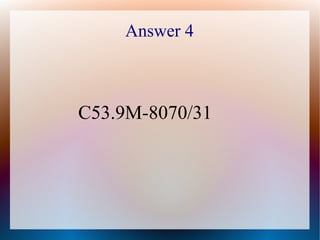
Coding Exercise 4


Well Differentiated Invasive Squamous
 Cell Carcinoma Cervix
Answer 4


C53.9M-8070/31
ICD-O-3 Training

 ICD-O-3 Training Web Site
www.training.seer.cancer.gov

   ICD O 3 (3 Edition),
              rd

     WHO Publication
THANK

YOU

Icd presentation

  • 1.
    ICD CODING FORCOMMON CANCERS DR. DEBARSHI LAHIRI, M.D. KOLKATA, INDIA
  • 2.
    ICD INTERNATIONAL CLASSIFICATION OFDISEASES (and related health problems) published by the WHO (the 10th revision of which (WHO, 1992) is in current use) It is used to code and classify diseases and other health problems recorded on many types of health and vital records including death certificates. Designed to promote international comparability in the collection, processing, classification, and presentation of morbidity and mortality statistics.
  • 3.
    ICD-10 Translates diagnosesof diseases and other health problems from words into an alphanumeric code, which permits easy storage, retrieval and analysis of the data. (Till ICD-9 , Numeric coding system was followed) (ICD-10 is an Alpha numeric coding system)
  • 4.
    22 Chapters Chapter II– Deals with Neoplasms C00 to D48 C00-C14: Malignant neoplasms of Lip, Oral Cavity & Pharynx C15-C26: Malignant Neoplasms of Digestive Organs C30-C39: Malignant Neoplasms of Respiratory System & Intrathoracic Organs C40-41: Malignant Neoplasms of Bone & Articular Cartilage
  • 5.
    C43-C44: Skin C45-C49: Connective& Soft Tissue C50-C58: Breast & Female Genital Organs C60-C63: Male Genital Organs C64-68: Urinary Organs C69-C72: Eye, Brain & CNS C73-75: Endocrine glands & related structures C76-80: Secondary & ill defined C81-96: Lymphoid & Hemaetopoietic C97: Independent (primary) Multiple Sites
  • 6.
    In situ &Benign Neoplasm D00-D09: In-situ Neoplasm D10-D36: Benign Neoplasms D37-D48: Uncertain or Unknown Behaviour
  • 7.
    Classification of Neoplasms Twomost important items of information: LOCATION OF THE TUMOUR IN THE BODY: Synonyms- Anatomical Location/Site/Topography MORPHOLOGY: Appearance of the tumour when examined under the microscope (synonyms- Histology/Cytology)- Indicates its Behaviour ( Malignant/Benign/in situ/uncertain).
  • 8.
    ICD Classification- Describesonly Topography and Behaviour MORPHOLOGY ?? CARCINOMA LUNG NOS: C34.9 doesn't distinguish between NSCLC (adeno/Squamous)/SCLC/other morphology Benign Neoplasm: D14.3 In situ: D02.2
  • 9.
    Cancer Registries werecoding for Morphology even before ICD-O came 1951- 1st coding manual for Morphology developed by American Cancer Society ( MOTNAC)- Manual of Tumour Nomenclature & Coding (Cancer Registries at that time used malignant neoplasm section of ICD-6 for coding Topography and MOTNAC for Morphology) WHO-1956- published Statistical Code for Human Tumors (based on Topography code based on ICD-7 and Morphology, including behaviour code of MOTNAC) CAP in 1965 published SNOP (systematized nomenclature of Pathology)
  • 10.
    1968- ACS RevisedMOTNAC-Topography based on ICD-8, Morphology code taken from SNOP 1976-WHO and IARC collaborated- The worldwide need for a logical, coherent and detailed classification for neoplasms was recognised- Developed the International Classification of Diseases for Oncology (ICD-O).-Topography based on ICD-9 and Morphology on MOTNAC- which was further modified. 1977-CAP revised SNOP to SNOMED Incorporated the ICD-O morphology section.
  • 12.
    What is ICD-O? Nota true classification system: Includes codes from multiple classification Systems. Actually a coded nomenclature for : Topography (primary site of origin) Morphology (histology, behavior, grade)
  • 13.
    Rationale for ICD-O ToStandardize Cancer Data Collection To Compare Data: Regional National International
  • 14.
    ICD O3 TOPOGRAPHY 3rdEdition of ICD-O, Published in Year 2000 TOPOGRAPHY- ICD 10 Classification codes of Malignant Neoplasms applied for all types of tumours(whether malignant/Benign/In situ/uncertain) Four digit code: C_ _._ ; 3 Digits for the Primary site followed by Sub-site after a Point. RANGE: C00.0 – C80.9
  • 15.
    Topography Code, Examples LIP: C00.0:External Upper Lip C00.1: External Lower Lip C00.2: External Lip, NOS C00.3: Mucosa of the Upper Lip C00.4: Mucosa of the Lower Lip C00.5: Mucosa of the Lip, NOS
  • 16.
    LUNG: C34.0: MainBronchus C34.1: Upper Lobe C34.2: Middle Lobe C34.3: Lower Lobe C34.8: Overlapping Lesion C34.9: Lung NOS
  • 17.
    Lymphoma Arising fromthe Nodes: C77.0: Head/Face/Neck C77.1: Intrathoracic C77.2:Intrabdominal C77.3: Axilla or Arm C77.4: Inguinal/Leg C77.5: Pelvic C77.8: Multiple Regions C77.9:L.N. NOS
  • 18.
    If a tumoris metastatic and the primary site is unknown, code primary site to C80.9 All leukemias have a site-specific code of bone marrow (C42.1) except: Myeloid sarcoma (rare) – leukemic deposit in an organ and should be coded to that organ Multiple myeloma – code site to C42.1
  • 19.
    Morphology ICD-O morphology describeshistology and behavior as separate variables, recognizing that there are a large number of possible combinations. In ICD-O, morphology is a 4-digit number ranging from 8000 to 9989, and behavior is a single digit which can be 0, 1, 2, 3, 6 or 9.
  • 20.
    Morphology - Behavior Behavioris the fifth digit (after the “/”) of the morphology code Behavior code indicates the pathologic behavior of the neoplasm - benign, in situ, malignant Most registries in the world only collect cancer with behavior codes 2 (in situ) and 3 (malignant)
  • 21.
  • 23.
    Morphology – Grade/Differentiation Grade/Differentiationis the sixth digit (after the /) of the morphology code Describes how much or how little a tumor resembles the normal tissue from which it arose If a pathology report gives more than one grade/diff, code to the highest grade/diff
  • 25.
    6 Digit Codefor Leukemia/Lymphoma th 5- T Cell 6- B Cell, Pre-B, B- Precursor 7- Null cell Non T- Non B 8- N K Cell (natural Killer) 9- Cell type not determined, not stated, or not applicable
  • 26.
    Morphology Codes Neoplasm, Malignant:M-8000/3 Carcinoma, NOS: M-8010/3 Small cell carcinoma, NOS: M-8041/3 Non small cell carcinoma: M-8046/3 Squamous cll carcinoma, NOS: M-8070/3 Adenocarcinoma, NOS: M-8140/3 IDC, NOS: M-8500/3 Hepatocellular Carcinoma, NOS: M-8170/3
  • 27.
    ICD-O-3 Code =10 Digit Code TOPOGRAPHY 4 Digits + MORPHOLOGY 4 Digits + BEHAVIOR 1 Digit + GRADE 1 Digit
  • 28.
    Coding Exercises Example: Well DifferentiatedInvasive Squamous Cell Carcinoma Hard Palate Hard Palate: C05.0 Invasive Squamous Cell Carcinoma,NOS: M-8070/3 Well Differentiated: 1 ICD Coding: C05.0M-8070/31
  • 29.
    Coding Exercise 1. ModeratelyDifferentiated Invasive Squamous Cell carcinoma Lateral Border of tongue Lt.
  • 30.
    Topography: Lateral Borderof Tongue: C02.1 Morpholgy & Behaviour: Invasive squamous cell carcinoma M-8070/3 Grade: Moderately Differentiated 2
  • 31.
  • 32.
    Coding Exercise 2 WellDifferentiated Adenocarcinoma Lower Lobe of Lung Lt.
  • 33.
  • 34.
    Coding Exercise 3 InfiltratingDuct Carcinoma NOS Grade III Rt. Breast Upper Outer Quadrant
  • 35.
  • 36.
    Coding Exercise 4 WellDifferentiated Invasive Squamous Cell Carcinoma Cervix
  • 37.
  • 38.
    ICD-O-3 Training ICD-O-3Training Web Site www.training.seer.cancer.gov ICD O 3 (3 Edition), rd WHO Publication
  • 39.