





ICD-­‐10	
  	
  
Disclaimer:	
  Nothing	
  that	
  we	
  are	
  sharing	
  is	
  intended	
  as	
  legally	
  binding	
  or	
  prescrip7ve	
  advice.	
  This	
  
presenta7on	
  is	
  a	
  synthesis	
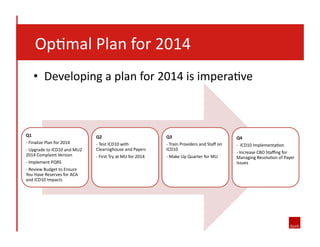
  of	
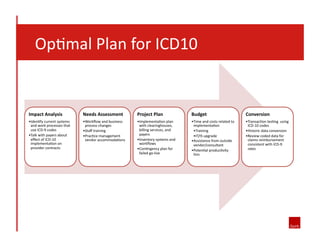
  publically	
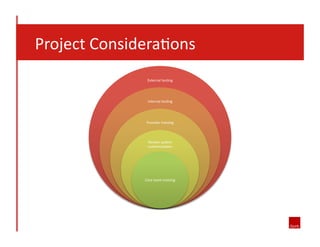
  available	
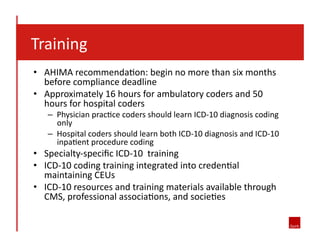
  informa7on	
  and	
  best	
  prac7ces.	


  About	
  Quirk	
  Healthcare	
  Solu8ons	
  
Based	
  in	
  South	
  Florida,	
  we	
  partner	
  with	
  
healthcare	
  providers	
  and	
  organiza8ons,	
  helping	
  
them	
  develop	
  strategies	
  and	
  systems	
  for	
  
naviga8ng	
  the	
  new	
  landscape	
  of	
  the	
  healthcare	
  
industry.	
  Our	
  clients	
  have	
  enjoyed	
  remarkable	
  
success,	
  including	
  award	
  of	
  the	
  Medicare	
  
Advantage	
  5-­‐star	
  ra8ng	
  by	
  the	
  Centers	
  for	
  
Medicare	
  &	
  Medicaid	
  Services	
  (CMS).	
  	
  
WHY	
  IS	
  THIS	
  IMPORTANT?	


  Quick	
  Overview	
  
October	
  1,	
  2014	
  hard	
  cut-­‐off	
  
Affects	
  all	
  en88es	
  covered	
  by	
  HIPAA	
  
14,000	
  ICD-­‐9	
  codes	
  grow	
  to	
  68,000	
  ICD-­‐10	
  codes	
  
Version	
  5010	
  standards	
  
Significant	
  changes	
  to	
  clinical	
  and	
  revenue	
  cycle	
  
systems	
  	
  
•  Complex	
  conversion	
  to	
  updated	
  codes	
  
•  System	
  upgrades	
  to	
  expand	
  data	
  fields	
  for	
  longer	
  
codes	
  	
  
•  Staff	
  retraining	
  on	
  new	
  versions	
  and	
  codes	
  
• 
• 
• 
• 
• 


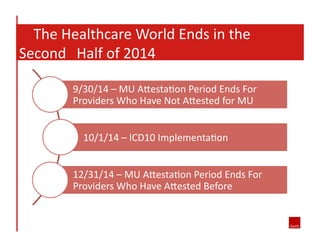
  The	
  Healthcare	
  World	
  Ends	
  in	
  the	
  
Second	
   	
  Half	
  of	
  2014	
  
9/30/14	
  –	
  MU	
  A`esta8on	
  Period	
  Ends	
  For	
  
Providers	
  Who	
  Have	
  Not	
  A`ested	
  for	
  MU	
  
10/1/14	
  –	
  ICD10	
  Implementa8on	
  
12/31/14	
  –	
  MU	
  A`esta8on	
  Period	
  Ends	
  For	
  
Providers	
  Who	
  Have	
  A`ested	
  Before	


  In	
  Addi8on…	
  
•  Affordable	
  Care	
  Act	
  –	
  High	
  deduc8bles	
  already	
  
increasing	
  importance	
  of	
  self	
  pay	
  and	
  
impac8ng	
  prac8ces’	
  bo`om	
  lines	
  
•  Medicare	
  Reimbursement	
  Cuts	
  
•  Sequestra8on	
  
•  PQRS	
  Penal8es	
  and	
  Scoring	
  Publica8on	
  
WHAT	
  IS	
  ICD10?	


  ICD-­‐10	
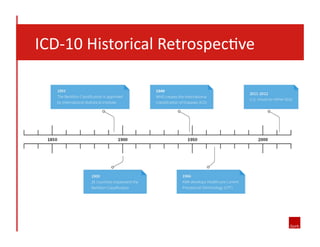
  Historical	
  Retrospec8ve	


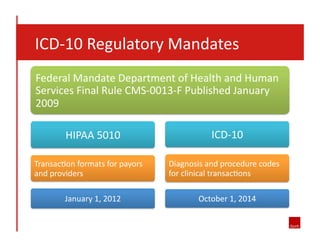
  ICD-­‐10	
  Regulatory	
  Mandates	
  
Federal	
  Mandate	
  Department	
  of	
  Health	
  and	
  Human	
  
Services	
  Final	
  Rule	
  CMS-­‐0013-­‐F	
  Published	
  January	
  
2009	
  
HIPAA	
  5010	
  
Transac8on	
  formats	
  for	
  payors	
  
and	
  providers	
  
January	
  1,	
  2012	
  

ICD-­‐10	
  
Diagnosis	
  and	
  procedure	
  codes	
  
for	
  clinical	
  transac8ons	
  
October	
  1,	
  2014	


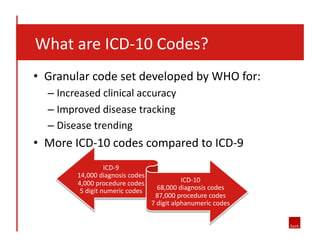
  What	
  are	
  ICD-­‐10	
  Codes?	
  
•  Granular	
  code	
  set	
  developed	
  by	
  WHO	
  for:	
  
–  Increased	
  clinical	
  accuracy	
  
–  Improved	
  disease	
  tracking	
  
–  Disease	
  trending	
  

•  More	
  ICD-­‐10	
  codes	
  compared	
  to	
  ICD-­‐9	
  
ICD-­‐9	
  
14,000	
  diagnosis	
  codes	
  
4,000	
  procedure	
  codes	
  
5	
  digit	
  numeric	
  codes	
  

ICD-­‐10	
  
68,000	
  diagnosis	
  codes	
  
87,000	
  procedure	
  codes	
  
7	
  digit	
  alphanumeric	
  codes	
  
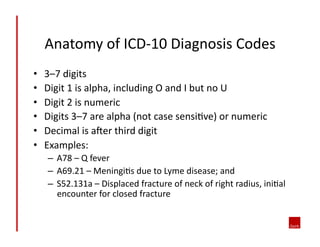
Anatomy	
  of	
  ICD-­‐10	
  Diagnosis	
  Codes	
  
• 
• 
• 
• 
• 
• 

3–7	
  digits	
  
Digit	
  1	
  is	
  alpha,	
  including	
  O	
  and	
  I	
  but	
  no	
  U	
  
Digit	
  2	
  is	
  numeric	
  
Digits	
  3–7	
  are	
  alpha	
  (not	
  case	
  sensi8ve)	
  or	
  numeric	
  
Decimal	
  is	
  aker	
  third	
  digit	
  
Examples:	
  
–  A78	
  –	
  Q	
  fever	
  
–  A69.21	
  –	
  Meningi8s	
  due	
  to	
  Lyme	
  disease;	
  and	
  
–  S52.131a	
  –	
  Displaced	
  fracture	
  of	
  neck	
  of	
  right	
  radius,	
  ini8al	
  
encounter	
  for	
  closed	
  fracture	


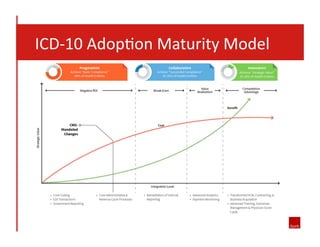
  ICD-­‐10	
  Adop8on	
  Maturity	
  Model	
  
HOW	
  DOES	
  ICD10	
  RELATE	
  TO	
  
SNOMED?	


  What	
  is	
  SNOMED?	
  
•  Acronym	
  for	
  Systema8zed	
  Nomenclature	
  Of	
  
Medicine	
  –	
  Clinical	
  Terminology	
  
•  Interna8onal	
  standard	
  for	
  comprehensive	
  clinical	
  
terminology	
  
•  Available	
  at	
  no	
  cost	
  through	
  the	
  Na8onal	
  Library	
  
of	
  Medicine	
  
•  Enables	
  providers	
  and	
  EHRs	
  to	
  communicate	
  in	
  
common	
  language	
  
–  Increased	
  quality	
  of	
  pa8ent	
  care	
  across	
  special8es	
  
–  Improved	
  accuracy	
  of	
  pa8ent	
  data	
  analysis	


  What	
  is	
  SNOMED?	
  Con7nued	
  
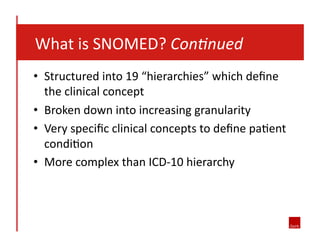
•  Structured	
  into	
  19	
  “hierarchies”	
  which	
  define	
  
the	
  clinical	
  concept	
  
•  Broken	
  down	
  into	
  increasing	
  granularity	
  	
  
•  Very	
  specific	
  clinical	
  concepts	
  to	
  define	
  pa8ent	
  
condi8on	
  
•  More	
  complex	
  than	
  ICD-­‐10	
  hierarchy	


  Why	
  is	
  it	
  important?	
  
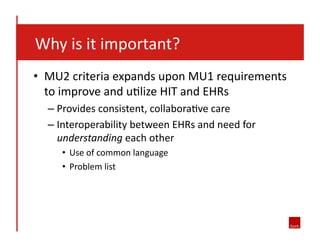
•  MU2	
  criteria	
  expands	
  upon	
  MU1	
  requirements	
  
to	
  improve	
  and	
  u8lize	
  HIT	
  and	
  EHRs	
  
–  Provides	
  consistent,	
  collabora8ve	
  care	
  	
  
–  Interoperability	
  between	
  EHRs	
  and	
  need	
  for	
  
understanding	
  each	
  other	
  
•  Use	
  of	
  common	
  language	
  
•  Problem	
  list	


  The	
  ICD-­‐10	
  /	
  SNOMED	
  Rela8onship	
  
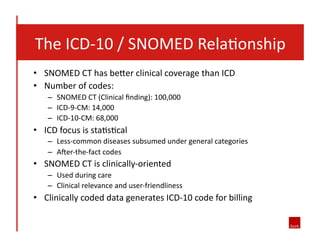
•  SNOMED	
  CT	
  has	
  be`er	
  clinical	
  coverage	
  than	
  ICD	
  
•  Number	
  of	
  codes:	
  
–  SNOMED	
  CT	
  (Clinical	
  finding):	
  100,000	
  
–  ICD-­‐9-­‐CM:	
  14,000	
  
–  ICD-­‐10-­‐CM:	
  68,000	
  

•  ICD	
  focus	
  is	
  sta8s8cal	
  
–  Less-­‐common	
  diseases	
  subsumed	
  under	
  general	
  categories	
  
–  Aker-­‐the-­‐fact	
  codes	
  

•  SNOMED	
  CT	
  is	
  clinically-­‐oriented	
  
–  Used	
  during	
  care	
  
–  Clinical	
  relevance	
  and	
  user-­‐friendliness	
  

•  Clinically	
  coded	
  data	
  generates	
  ICD-­‐10	
  code	
  for	
  billing	
  
WHAT	
  CAN	
  I	
  DO?	


  Leverage	
  the	
  Resources	
  Available	
  to	
  You	
  
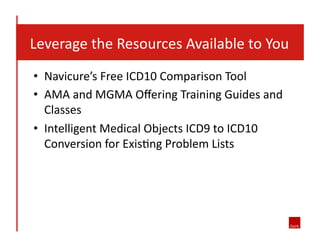
•  Navicure’s	
  Free	
  ICD10	
  Comparison	
  Tool	
  
•  AMA	
  and	
  MGMA	
  Offering	
  Training	
  Guides	
  and	
  
Classes	
  
•  Intelligent	
  Medical	
  Objects	
  ICD9	
  to	
  ICD10	
  
Conversion	
  for	
  Exis8ng	
  Problem	
  Lists	


  Op8mal	
  Plan	
  for	
  2014	
  
•  Developing	
  a	
  plan	
  for	
  2014	
  is	
  impera8ve	
  

Q1	
  
-­‐	
  Finalize	
  Plan	
  for	
  2014	
  
-­‐	
  Upgrade	
  to	
  ICD10	
  and	
  MU2	
  
2014	
  Complaint	
  Version	
  
-­‐	
  Implement	
  PQRS	
  
-­‐	
  Review	
  Budget	
  to	
  Ensure	
  
You	
  Have	
  Reserves	
  for	
  ACA	
  
and	
  ICD10	
  Impacts	
  

Q2	
  
-­‐	
  Test	
  ICD10	
  with	
  
Clearinghouse	
  and	
  Payers	
  
-­‐	
  First	
  Try	
  at	
  MU	
  for	
  2014	
  

Q3	
  	
  
-­‐	
  Train	
  Providers	
  and	
  Staff	
  on	
  
ICD10	
  
-­‐	
  Make	
  Up	
  Quarter	
  for	
  MU	


Q4	
  
-­‐	
  	
  ICD10	
  Implementa8on	
  
-­‐	
  Increase	
  CBO	
  Staffing	
  for	
  
Managing	
  Resolu8on	
  of	
  Payer	
  
Issues	


  Op8mal	
  Plan	
  for	
  ICD10	
  

Impact	
  Analysis	
  

Needs	
  Assessment	
  

Project	
  Plan	
  

Budget	
  

Conversion	


• Iden8fy	
  current	
  systems	
  
and	
  work	
  processes	
  that	
  
use	
  ICD-­‐9	
  codes	
  
• Talk	
  with	
  payers	
  about	
  
effect	
  of	
  ICD-­‐10	
  
implementa8on	
  on	
  
provider	
  contracts	


• Workflow	
  and	
  business	
  
process	
  changes	
  
• Staff	
  training	
  
• Prac8ce	
  management	
  
vendor	
  accommoda8ons	
  

• Implementa8on	
  plan	
  
with	
  clearinghouses,	
  
billing	
  services,	
  and	
  
payers	
  
• Inventory	
  systems	
  and	
  
workflows	
  
• Con8ngency	
  plan	
  for	
  
failed	
  go-­‐live	
  

• Time	
  and	
  costs	
  related	
  to	
  	
  
implementa8on	
  
• Training	
  
• IT/IS	
  upgrade	
  
• Assistance	
  from	
  outside	
  
vendor/consultant	
  
• Poten8al	
  produc8vity	
  
loss	
  

• Transac8on	
  tes8ng	
  	
  using	
  
ICD-­‐10	
  codes	
  
• Historic	
  data	
  conversion	
  
• Review	
  coded	
  data	
  for	
  
claims	
  reimbursement	
  
consistent	
  with	
  ICD-­‐9	
  
rates	


  Project	
  Considera8ons	
  
External	
  tes8ng	
  

Internal	
  tes8ng	
  

Provider	
  training	
  

Review	
  system	
  
customiza8ons	
  

Core	
  team	
  training	


  Training	
  
•  AHIMA	
  recommenda8on:	
  begin	
  no	
  more	
  than	
  six	
  months	
  
before	
  compliance	
  deadline	
  
•  Approximately	
  16	
  hours	
  for	
  ambulatory	
  coders	
  and	
  50	
  
hours	
  for	
  hospital	
  coders	
  

–  Physician	
  prac8ce	
  coders	
  should	
  learn	
  ICD-­‐10	
  diagnosis	
  coding	
  
only	
  
–  Hospital	
  coders	
  should	
  learn	
  both	
  ICD-­‐10	
  diagnosis	
  and	
  ICD-­‐10	
  
inpa8ent	
  procedure	
  coding	
  

•  Specialty-­‐specific	
  ICD-­‐10	
  	
  training	
  
•  ICD-­‐10	
  coding	
  training	
  integrated	
  into	
  creden8al	
  
maintaining	
  CEUs	
  
•  ICD-­‐10	
  resources	
  and	
  training	
  materials	
  available	
  through	
  
CMS,	
  professional	
  associa8ons,	
  and	
  socie8es	


  Best	
  Prac8ces	
  
•  Find	
  diagnosis	
  search	
  tools	
  (in	
  EHR	
  or	
  Intelligent	
  
Medical	
  Objects).	
  Paper	
  Superbills	
  and	
  Cheat	
  
Sheets	
  will	
  no	
  longer	
  work.	
  
•  Begin	
  coding	
  in	
  ICD10	
  before	
  the	
  deadline	
  and	
  let	
  
Navicure	
  downcode	
  for	
  you.	
  
•  Keep	
  in	
  close	
  contact	
  with	
  payers	
  who	
  aren’t	
  
ready.	
  Work	
  with	
  Navicure	
  to	
  con8nue	
  
downcoding	
  aker	
  10/1/14	
  for	
  these	
  payers.	
  
•  Understand	
  that	
  not	
  all	
  payers	
  will	
  be	
  ready	
  and	
  
your	
  A/R	
  will	
  be	
  impacted.	
  
QUESTIONS?	
  
Quirk	
  Healthcare	
  Solu8ons	
  
info@quirkhealthcare.com	
  
888-­‐WE-­‐QUIRK	
  

Quirk Healthcare: Impacts of ICD-10

  • 1.
    ICD-­‐10     Disclaimer:  Nothing  that  we  are  sharing  is  intended  as  legally  binding  or  prescrip7ve  advice.  This   presenta7on  is  a  synthesis  of  publically  available  informa7on  and  best  prac7ces.  
  • 2.
           About  Quirk  Healthcare  Solu8ons   Based  in  South  Florida,  we  partner  with   healthcare  providers  and  organiza8ons,  helping   them  develop  strategies  and  systems  for   naviga8ng  the  new  landscape  of  the  healthcare   industry.  Our  clients  have  enjoyed  remarkable   success,  including  award  of  the  Medicare   Advantage  5-­‐star  ra8ng  by  the  Centers  for   Medicare  &  Medicaid  Services  (CMS).    
  • 3.
    WHY  IS  THIS  IMPORTANT?  
  • 4.
           Quick  Overview   October  1,  2014  hard  cut-­‐off   Affects  all  en88es  covered  by  HIPAA   14,000  ICD-­‐9  codes  grow  to  68,000  ICD-­‐10  codes   Version  5010  standards   Significant  changes  to  clinical  and  revenue  cycle   systems     •  Complex  conversion  to  updated  codes   •  System  upgrades  to  expand  data  fields  for  longer   codes     •  Staff  retraining  on  new  versions  and  codes   •  •  •  •  • 
  • 5.
           The  Healthcare  World  Ends  in  the   Second    Half  of  2014   9/30/14  –  MU  A`esta8on  Period  Ends  For   Providers  Who  Have  Not  A`ested  for  MU   10/1/14  –  ICD10  Implementa8on   12/31/14  –  MU  A`esta8on  Period  Ends  For   Providers  Who  Have  A`ested  Before    
  • 6.
           In  Addi8on…   •  Affordable  Care  Act  –  High  deduc8bles  already   increasing  importance  of  self  pay  and   impac8ng  prac8ces’  bo`om  lines   •  Medicare  Reimbursement  Cuts   •  Sequestra8on   •  PQRS  Penal8es  and  Scoring  Publica8on  
  • 7.
  • 8.
           ICD-­‐10  Historical  Retrospec8ve  
  • 9.
           ICD-­‐10  Regulatory  Mandates   Federal  Mandate  Department  of  Health  and  Human   Services  Final  Rule  CMS-­‐0013-­‐F  Published  January   2009   HIPAA  5010   Transac8on  formats  for  payors   and  providers   January  1,  2012   ICD-­‐10   Diagnosis  and  procedure  codes   for  clinical  transac8ons   October  1,  2014  
  • 10.
           What  are  ICD-­‐10  Codes?   •  Granular  code  set  developed  by  WHO  for:   –  Increased  clinical  accuracy   –  Improved  disease  tracking   –  Disease  trending   •  More  ICD-­‐10  codes  compared  to  ICD-­‐9   ICD-­‐9   14,000  diagnosis  codes   4,000  procedure  codes   5  digit  numeric  codes   ICD-­‐10   68,000  diagnosis  codes   87,000  procedure  codes   7  digit  alphanumeric  codes  
  • 11.
    Anatomy  of  ICD-­‐10  Diagnosis  Codes   •  •  •  •  •  •  3–7  digits   Digit  1  is  alpha,  including  O  and  I  but  no  U   Digit  2  is  numeric   Digits  3–7  are  alpha  (not  case  sensi8ve)  or  numeric   Decimal  is  aker  third  digit   Examples:   –  A78  –  Q  fever   –  A69.21  –  Meningi8s  due  to  Lyme  disease;  and   –  S52.131a  –  Displaced  fracture  of  neck  of  right  radius,  ini8al   encounter  for  closed  fracture  
  • 12.
           ICD-­‐10  Adop8on  Maturity  Model  
  • 13.
    HOW  DOES  ICD10  RELATE  TO   SNOMED?  
  • 14.
           What  is  SNOMED?   •  Acronym  for  Systema8zed  Nomenclature  Of   Medicine  –  Clinical  Terminology   •  Interna8onal  standard  for  comprehensive  clinical   terminology   •  Available  at  no  cost  through  the  Na8onal  Library   of  Medicine   •  Enables  providers  and  EHRs  to  communicate  in   common  language   –  Increased  quality  of  pa8ent  care  across  special8es   –  Improved  accuracy  of  pa8ent  data  analysis  
  • 15.
           What  is  SNOMED?  Con7nued   •  Structured  into  19  “hierarchies”  which  define   the  clinical  concept   •  Broken  down  into  increasing  granularity     •  Very  specific  clinical  concepts  to  define  pa8ent   condi8on   •  More  complex  than  ICD-­‐10  hierarchy  
  • 16.
           Why  is  it  important?   •  MU2  criteria  expands  upon  MU1  requirements   to  improve  and  u8lize  HIT  and  EHRs   –  Provides  consistent,  collabora8ve  care     –  Interoperability  between  EHRs  and  need  for   understanding  each  other   •  Use  of  common  language   •  Problem  list  
  • 17.
           The  ICD-­‐10  /  SNOMED  Rela8onship   •  SNOMED  CT  has  be`er  clinical  coverage  than  ICD   •  Number  of  codes:   –  SNOMED  CT  (Clinical  finding):  100,000   –  ICD-­‐9-­‐CM:  14,000   –  ICD-­‐10-­‐CM:  68,000   •  ICD  focus  is  sta8s8cal   –  Less-­‐common  diseases  subsumed  under  general  categories   –  Aker-­‐the-­‐fact  codes   •  SNOMED  CT  is  clinically-­‐oriented   –  Used  during  care   –  Clinical  relevance  and  user-­‐friendliness   •  Clinically  coded  data  generates  ICD-­‐10  code  for  billing  
  • 18.
  • 19.
         Leverage  the  Resources  Available  to  You   •  Navicure’s  Free  ICD10  Comparison  Tool   •  AMA  and  MGMA  Offering  Training  Guides  and   Classes   •  Intelligent  Medical  Objects  ICD9  to  ICD10   Conversion  for  Exis8ng  Problem  Lists  
  • 20.
           Op8mal  Plan  for  2014   •  Developing  a  plan  for  2014  is  impera8ve   Q1   -­‐  Finalize  Plan  for  2014   -­‐  Upgrade  to  ICD10  and  MU2   2014  Complaint  Version   -­‐  Implement  PQRS   -­‐  Review  Budget  to  Ensure   You  Have  Reserves  for  ACA   and  ICD10  Impacts   Q2   -­‐  Test  ICD10  with   Clearinghouse  and  Payers   -­‐  First  Try  at  MU  for  2014   Q3     -­‐  Train  Providers  and  Staff  on   ICD10   -­‐  Make  Up  Quarter  for  MU             Q4   -­‐    ICD10  Implementa8on   -­‐  Increase  CBO  Staffing  for   Managing  Resolu8on  of  Payer   Issues            
  • 21.
           Op8mal  Plan  for  ICD10   Impact  Analysis   Needs  Assessment   Project  Plan   Budget   Conversion     • Iden8fy  current  systems   and  work  processes  that   use  ICD-­‐9  codes   • Talk  with  payers  about   effect  of  ICD-­‐10   implementa8on  on   provider  contracts     • Workflow  and  business   process  changes   • Staff  training   • Prac8ce  management   vendor  accommoda8ons   • Implementa8on  plan   with  clearinghouses,   billing  services,  and   payers   • Inventory  systems  and   workflows   • Con8ngency  plan  for   failed  go-­‐live   • Time  and  costs  related  to     implementa8on   • Training   • IT/IS  upgrade   • Assistance  from  outside   vendor/consultant   • Poten8al  produc8vity   loss   • Transac8on  tes8ng    using   ICD-­‐10  codes   • Historic  data  conversion   • Review  coded  data  for   claims  reimbursement   consistent  with  ICD-­‐9   rates  
  • 22.
           Project  Considera8ons   External  tes8ng   Internal  tes8ng   Provider  training   Review  system   customiza8ons   Core  team  training  
  • 23.
         Training   •  AHIMA  recommenda8on:  begin  no  more  than  six  months   before  compliance  deadline   •  Approximately  16  hours  for  ambulatory  coders  and  50   hours  for  hospital  coders   –  Physician  prac8ce  coders  should  learn  ICD-­‐10  diagnosis  coding   only   –  Hospital  coders  should  learn  both  ICD-­‐10  diagnosis  and  ICD-­‐10   inpa8ent  procedure  coding   •  Specialty-­‐specific  ICD-­‐10    training   •  ICD-­‐10  coding  training  integrated  into  creden8al   maintaining  CEUs   •  ICD-­‐10  resources  and  training  materials  available  through   CMS,  professional  associa8ons,  and  socie8es  
  • 24.
         Best  Prac8ces   •  Find  diagnosis  search  tools  (in  EHR  or  Intelligent   Medical  Objects).  Paper  Superbills  and  Cheat   Sheets  will  no  longer  work.   •  Begin  coding  in  ICD10  before  the  deadline  and  let   Navicure  downcode  for  you.   •  Keep  in  close  contact  with  payers  who  aren’t   ready.  Work  with  Navicure  to  con8nue   downcoding  aker  10/1/14  for  these  payers.   •  Understand  that  not  all  payers  will  be  ready  and   your  A/R  will  be  impacted.  
  • 25.
  • 26.
    Quirk  Healthcare  Solu8ons   info@quirkhealthcare.com   888-­‐WE-­‐QUIRK