





Risk Adjustment
Documentation and Coding Overview
Scott Quick, CEO
LucidHub
• Know what Risk Adjustment (RA) is and why it is important to
Medicare Advantage providers
• Understand Hierarchical Condition Categories (HCCs)
• Become familiar with Risk Adjustment Documentation and
Coding Requirements
2
Objectives
Risk Adjustment for Medicare Advantage
SECTION 1
Federal, state and commercial health plans—such as Medicare Advantage—use risk
adjustment to predict health care costs based on the health status and other risk factors
of its enrollees.
Forms of risk adjustment include:
• Adjusted Clinical Groups (ACGs)
• Chronic Illness and Disability Payment System (CDPS) (Managed Medicaid)
• Diagnostic Cost Groups (DxCGs)
• Medical Hierarchical Condition Categories (HCCs)
- CMS-HCCs (Managed Medicare)
- HHS-HCCs (Managed Commercial in Health Insurance Exchange)
• Pharmacy (RxHCC)
• ESRD
DRGs (Medicare Severity- and All Patient Refined-) are also forms of Risk Adjustment
4
Risk Adjustment (RA) is Everywhere
Per Member Per Month (PMPM) capitation payments to Medicare
Advantage carriers are calculated on a patient’s total Risk Adjustment
Factor (RAF) score.
For Medicare Advantage (MA) plans the model includes demographic
and condition factors used to predict costs:
• Demographics
• Eligibility
• Diagnosed Conditions (reported via HCCs)
• Disease Interactions
The CMS-HCC model is a prospective model—diagnoses in one year
are used to predict costs in the following year.
5
Risk Adjustment Factors
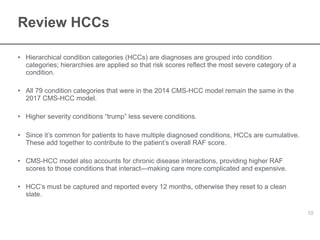
• Hierarchical condition categories (HCCs) are diagnoses are grouped into condition
categories; hierarchies are applied so that risk scores reflect the most severe category of a
condition.
• All 79 condition categories that were in the 2014 CMS-HCC model remain the same in the
2017 CMS-HCC model.
• Higher severity conditions “trump” less severe conditions.
• Since it’s common for patients to have multiple diagnosed conditions, HCCs are cumulative.
These add together to contribute to the patient’s overall RAF score.
• CMS-HCC model also accounts for chronic disease interactions, providing higher RAF
scores to those conditions that interact—making care more complicated and expensive.
• HCC’s must be captured and reported every 12 months, otherwise they reset to a clean
slate.
6
Hierarchical Condition Categories (HCC)
7
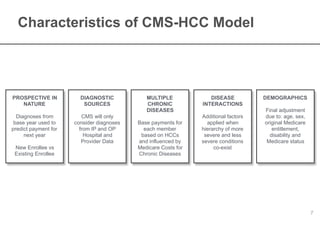
Characteristics of CMS-HCC Model
PROSPECTIVE IN
NATURE
Diagnoses from
base year used to
predict payment for
next year
New Enrollee vs
Existing Enrollee
DIAGNOSTIC
SOURCES
CMS will only
consider diagnoses
from IP and OP
Hospital and
Provider Data
MULTIPLE
CHRONIC
DISEASES
Base payments for
each member
based on HCCs
and influenced by
Medicare Costs for
Chronic Diseases
DISEASE
INTERACTIONS
Additional factors
applied when
hierarchy of more
severe and less
severe conditions
co-exist
DEMOGRAPHICS
Final adjustment
due to: age, sex,
original Medicare
entitlement,
disability and
Medicare status
8
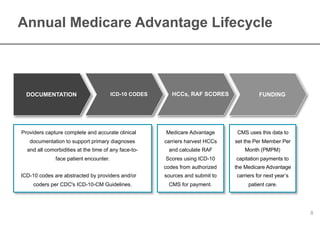
Annual Medicare Advantage Lifecycle
DOCUMENTATION ICD-10 CODES HCCs, RAF SCORES FUNDING
Providers capture complete and accurate clinical
documentation to support primary diagnoses
and all comorbidities at the time of any face-to-
face patient encounter.
ICD-10 codes are abstracted by providers and/or
coders per CDC's ICD-10-CM Guidelines.
Medicare Advantage
carriers harvest HCCs
and calculate RAF
Scores using ICD-10
codes from authorized
sources and submit to
CMS for payment.
CMS uses this data to
set the Per Member Per
Month (PMPM)
capitation payments to
the Medicare Advantage
carriers for next year’s
patient care.
Understanding Hierarchical Condition
Categories (HCCs)
SECTION 2
• Hierarchical condition categories (HCCs) are diagnoses are grouped into condition
categories; hierarchies are applied so that risk scores reflect the most severe category of a
condition.
• All 79 condition categories that were in the 2014 CMS-HCC model remain the same in the
2017 CMS-HCC model.
• Higher severity conditions “trump” less severe conditions.
• Since it’s common for patients to have multiple diagnosed conditions, HCCs are cumulative.
These add together to contribute to the patient’s overall RAF score.
• CMS-HCC model also accounts for chronic disease interactions, providing higher RAF
scores to those conditions that interact—making care more complicated and expensive.
• HCC’s must be captured and reported every 12 months, otherwise they reset to a clean
slate.
10
Review HCCs
11
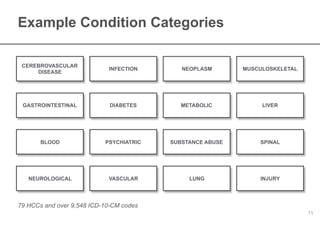
Example Condition Categories
INFECTION
CEREBROVASCULAR
DISEASE
NEOPLASM MUSCULOSKELETAL
DIABETESGASTROINTESTINAL METABOLIC LIVER
PSYCHIATRICBLOOD SUBSTANCE ABUSE SPINAL
VASCULARNEUROLOGICAL LUNG INJURY
79 HCCs and over 9,548 ICD-10-CM codes
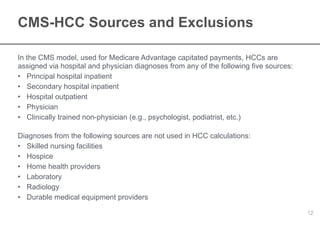
In the CMS model, used for Medicare Advantage capitated payments, HCCs are
assigned via hospital and physician diagnoses from any of the following five sources:
• Principal hospital inpatient
• Secondary hospital inpatient
• Hospital outpatient
• Physician
• Clinically trained non-physician (e.g., psychologist, podiatrist, etc.) 

Diagnoses from the following sources are not used in HCC calculations:
• Skilled nursing facilities
• Hospice
• Home health providers
• Laboratory
• Radiology
• Durable medical equipment providers
12
CMS-HCC Sources and Exclusions
13
Trumps and Disease Interactions
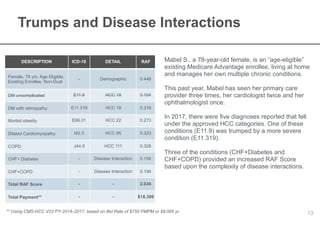
DESCRIPTION ICD-10 DETAIL RAF
Female, 78 y/o, Age Eligible,
Existing Enrollee, Non-Dual
- Demographic 0.448
DM uncomplicated E11.9 HCC 19 0.104
DM with retinopathy E11.319 HCC 18 0.318
Morbid obesity E66.01 HCC 22 0.273
Dilated Cardiomyopathy I42.0 HCC 85 0.323
COPD J44.9 HCC 111 0.328
CHF+ Diabetes - Disease Interaction 0.154
CHF+COPD - Disease Interaction 0.194
Total RAF Score - - 2.034
Total Payment** - - $18,306
Mabel S., a 78-year-old female, is an “age-eligible”
existing Medicare Advantage enrollee, living at home
and manages her own multiple chronic conditions.
This past year, Mabel has seen her primary care
provider three times, her cardiologist twice and her
ophthalmologist once.
In 2017, there were five diagnoses reported that fell
under the approved HCC categories. One of these
conditions (E11.9) was trumped by a more severe
condition (E11.319).
Three of the conditions (CHF+Diabetes and
CHF+COPD) provided an increased RAF Score
based upon the complexity of disease interactions.
** Using CMS-HCC V22 PY 2014–2017, based on Bid Rate of $750 PMPM or $9,000 yr.
14
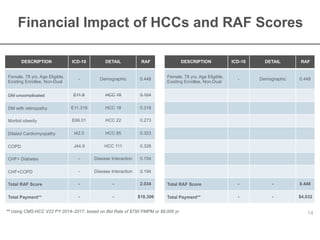
Financial Impact of HCCs and RAF Scores
DESCRIPTION ICD-10 DETAIL RAF
Female, 78 y/o, Age Eligible,
Existing Enrollee, Non-Dual
- Demographic 0.448
DM uncomplicated E11.9 HCC 19 0.104
DM with retinopathy E11.319 HCC 18 0.318
Morbid obesity E66.01 HCC 22 0.273
Dilated Cardiomyopathy I42.0 HCC 85 0.323
COPD J44.9 HCC 111 0.328
CHF+ Diabetes - Disease Interaction 0.154
CHF+COPD - Disease Interaction 0.194
Total RAF Score - - 2.034
Total Payment** - - $18,306
** Using CMS-HCC V22 PY 2014–2017, based on Bid Rate of $750 PMPM or $9,000 yr.
DESCRIPTION ICD-10 DETAIL RAF
Female, 78 y/o, Age Eligible,
Existing Enrollee, Non-Dual
- Demographic 0.448
Total RAF Score - - 0.448
Total Payment** - - $4,032
Risk Adjustment Documentation and Coding
Requirements
SECTION 3
16
Documentation: Legal Authority
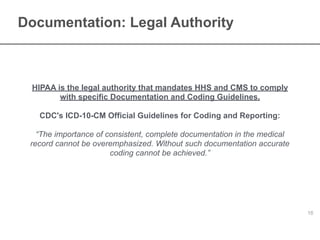
HIPAA is the legal authority that mandates HHS and CMS to comply
with specific Documentation and Coding Guidelines.
CDC's ICD-10-CM Official Guidelines for Coding and Reporting:
“The importance of consistent, complete documentation in the medical
record cannot be overemphasized. Without such documentation accurate
coding cannot be achieved.”
17
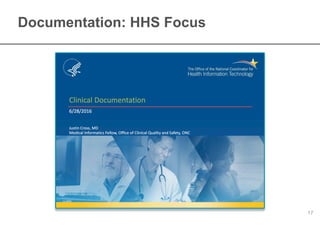
Documentation: HHS Focus
18
Documentation: Standards Body Mandate
American Health Information Management Association (AHIMA)
Ethical Standards for Clinical Documentation Improvement (CDI)
Professionals:
“Facilitate accurate, complete, and consistent clinical documentation
within the health record to demonstrate quality care, support coding and
reporting of high-quality healthcare data used for both individual patients
and aggregate reporting.”
19
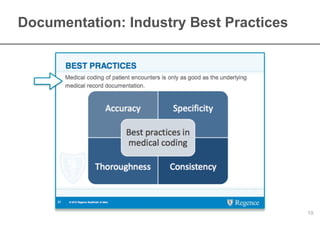
Documentation: Industry Best Practices
20
Documentation: Industry Best Practices
M.E.A.T. is an acronym frequently used in Risk Adjustment as the criteria for
documenting a diagnosis code. For a code to be abstracted, the documentation
must clearly state that the specific diagnosis was either Monitored, Evaluated,
Assessed or Treated during the face-to-face encounter on that date of service.
Only one element of M.E.A.T. is required to support a diagnosis—not all four.
MONITOR—signs, symptoms, disease progression, disease regression. Documentation Examples: B/P
reading 120/80; HgbA1c 5.5; Last lipid panel was within normal limits.
EVALUATE—test results, medication effectiveness, response to treatment. Documentation Examples:
lungs clear to A/P, ostomy site w/o infection appears clean & dry)
ASSESS—ordering tests, discussion, review records, counseling. Documentation Examples: stable;
controlled, worsening; unchanged, uncontrolled.
TREAT—medications, therapies, other modalities. Documentation Examples: Taking Fosamax for
osteoporosis; taking tamoxifen for breast cancer “treatment”, DM controlled on insulin.
21
Coding: Legal Authorities
HIPAA is the legal authority that mandates HHS and CMS to comply
with specific Documentation and Coding Guidelines.
CDC's ICD-10-CM Official Guidelines for Coding and Reporting,
Section IV. Diagnostic Coding and Reporting Guidelines for
Outpatient Services:
Section IV, G.: ICD-10-CM code for the diagnosis, condition, problem, or other reason for
encounter/visit List first the ICD-10-CM code for the diagnosis, condition, problem, or other
reason for encounter/visit shown in the medical record to be chiefly responsible for the
services provided. List additional codes that describe any coexisting conditions. In some
cases the first-listed diagnosis may be a symptom when a diagnosis has not been established
(confirmed) by the physician.
Section IV, J.: Code all documented conditions that coexist Code all documented
conditions that coexist at the time of the encounter/visit, and require or affect patient
care treatment or management. Do not code conditions that were previously treated and no
longer exist. However, history codes (categories Z80- Z87) may be used as secondary codes if
the historical condition or family history has an impact on current care or influences treatment.
22
Coding: Regulatory Guidelines
CMS Establishes Additional Coding Guidelines.
AHA Coding Clinic. Medicare recommends coders follow American
Hospital Association (AHA) Coding Clinic determinations on utilization of
diagnosis codes.
CMS Risk Adjustment Participant Guide. The Risk Adjustment
Participant Guide supports coding all current diagnoses. It provides
guidance on the use of “history of” in clinical documentation. It also
provides guidance on how to code from various parts of the provider
documentation.
23
Coding from Provider Documentation
The purpose is to code for all known health conditions at the time of a
face-to-face encounter, but must be supported with complete and
accurate documentation.
Diagnoses can be abstracted from any portion of the record to include:
• Chief Complaint (CC)
• History of Present Illness (HPI)
• Past Medical History (PMH) if still current
• Problem Lists: Current, Ongoing, or Active
• Review of Systems (ROS)
• Exam
• Assessment and Plan
24
Code for All Conditions
Capturing Z Codes and Health Status is Essential:
• Transplants
• Dialysis
• Old MI
• Paraplegia and Quadriplegia
• Amputations
• AIDS or HIV+ status
• Chronic or debilitating neurological conditions: MS, ALS,
Huntington s Disease, myasthenia, epilepsy
• Ostomies (respiration, feeding, or elimination)
• Ventilators
25
Common Coding Questions
Use of “Symptoms or Signs”
CDC's ICD-10-CM Official Guidelines for Coding and Reporting, Section IV.
Diagnostic Coding and Reporting Guidelines for Outpatient Services D.
Code that describe symptoms and signs
“Codes that describe symptoms and signs, as opposed to diagnoses, are
acceptable for reporting purposes when a diagnosis has not been established
(confirmed) by the provider.”
26
Common Coding Questions
27
Common Coding Questions
Uncertain Diagnosis - Inpatient:
• Handled differently than outpatient settings.
• Uncertain diagnosis maybe coded as actual diagnosis if the
suspected diagnosis isn’t ruled out by time of discharged.
• For example, a possible heart attack maybe coded as a heart attack if
not ruled out by the time of discharge.
“Consistent with”
• AHA Coding Clinic ruled “consistent with” is the same as “suspected”
and is therefore not sufficient to establish a diagnosis.
• “Consistent with” maybe coded in the inpatient setting as an uncertain
diagnosis as long as it remains uncertain at the time of discharge.
28
Common Coding Questions
Use of Up (↑) or Down (↓) Arrows
• In 2011, AHA Coding Clinic ruled that the use of up or down
arrows in establishing a diagnosis: “It is not appropriate for the
coder to report a diagnosis based upon up and down arrows.”
• “Up and down arrows can have variable interpretations and do
not necessarily mean ‘abnormal.’ They could simply be
indicating a change (including improvement) over past results.”
29
Opportunities for Improvement
• Think beyond Fee-For-Service
• Complete and accurate clinical documentation is the foundation
to Risk Adjustment coding
• Document all existing conditions during face-to-face encounters
• Use M.E.A.T. criteria as the documentation minimum standard
• Code each diagnosis to highest level of specificity and severity
possible, but only as it is supported by M.E.A.T.
30
Opportunities for Improvement
Enhanced Annual Wellness Visits
• A typical visit lasts 45-60 minutes, at no-cost to the
patient, including preventive labs
• The goal is to see every Medicare patient every year and
for this service to be billed once per calendar year
• The benefit refreshes January 1 of every year; no need
to wait 365 days between visits
• In addition to the traditional AWV CPT codes G0438 and
G0439, Premera allows for an additional code of S0250
(3.0 RVU) to cover the extra time of assessing chronic
conditions
• Visits need to be performed by a primary care physician,
contracted nurse practitioner, or PA
Thank you!
Scott Quick
503-730-0704
scott.quick@lucidhub.com

Risk adjustment documentation and coding overview

  • 1.
    Risk Adjustment Documentation andCoding Overview Scott Quick, CEO LucidHub
  • 2.
    • Know whatRisk Adjustment (RA) is and why it is important to Medicare Advantage providers • Understand Hierarchical Condition Categories (HCCs) • Become familiar with Risk Adjustment Documentation and Coding Requirements 2 Objectives
  • 3.
    Risk Adjustment forMedicare Advantage SECTION 1
  • 4.
    Federal, state andcommercial health plans—such as Medicare Advantage—use risk adjustment to predict health care costs based on the health status and other risk factors of its enrollees. Forms of risk adjustment include: • Adjusted Clinical Groups (ACGs) • Chronic Illness and Disability Payment System (CDPS) (Managed Medicaid) • Diagnostic Cost Groups (DxCGs) • Medical Hierarchical Condition Categories (HCCs) - CMS-HCCs (Managed Medicare) - HHS-HCCs (Managed Commercial in Health Insurance Exchange) • Pharmacy (RxHCC) • ESRD DRGs (Medicare Severity- and All Patient Refined-) are also forms of Risk Adjustment 4 Risk Adjustment (RA) is Everywhere
  • 5.
    Per Member PerMonth (PMPM) capitation payments to Medicare Advantage carriers are calculated on a patient’s total Risk Adjustment Factor (RAF) score. For Medicare Advantage (MA) plans the model includes demographic and condition factors used to predict costs: • Demographics • Eligibility • Diagnosed Conditions (reported via HCCs) • Disease Interactions The CMS-HCC model is a prospective model—diagnoses in one year are used to predict costs in the following year. 5 Risk Adjustment Factors
  • 6.
    • Hierarchical conditioncategories (HCCs) are diagnoses are grouped into condition categories; hierarchies are applied so that risk scores reflect the most severe category of a condition. • All 79 condition categories that were in the 2014 CMS-HCC model remain the same in the 2017 CMS-HCC model. • Higher severity conditions “trump” less severe conditions. • Since it’s common for patients to have multiple diagnosed conditions, HCCs are cumulative. These add together to contribute to the patient’s overall RAF score. • CMS-HCC model also accounts for chronic disease interactions, providing higher RAF scores to those conditions that interact—making care more complicated and expensive. • HCC’s must be captured and reported every 12 months, otherwise they reset to a clean slate. 6 Hierarchical Condition Categories (HCC)
  • 7.
    7 Characteristics of CMS-HCCModel PROSPECTIVE IN NATURE Diagnoses from base year used to predict payment for next year New Enrollee vs Existing Enrollee DIAGNOSTIC SOURCES CMS will only consider diagnoses from IP and OP Hospital and Provider Data MULTIPLE CHRONIC DISEASES Base payments for each member based on HCCs and influenced by Medicare Costs for Chronic Diseases DISEASE INTERACTIONS Additional factors applied when hierarchy of more severe and less severe conditions co-exist DEMOGRAPHICS Final adjustment due to: age, sex, original Medicare entitlement, disability and Medicare status
  • 8.
    8 Annual Medicare AdvantageLifecycle DOCUMENTATION ICD-10 CODES HCCs, RAF SCORES FUNDING Providers capture complete and accurate clinical documentation to support primary diagnoses and all comorbidities at the time of any face-to- face patient encounter. ICD-10 codes are abstracted by providers and/or coders per CDC's ICD-10-CM Guidelines. Medicare Advantage carriers harvest HCCs and calculate RAF Scores using ICD-10 codes from authorized sources and submit to CMS for payment. CMS uses this data to set the Per Member Per Month (PMPM) capitation payments to the Medicare Advantage carriers for next year’s patient care.
  • 9.
  • 10.
    • Hierarchical conditioncategories (HCCs) are diagnoses are grouped into condition categories; hierarchies are applied so that risk scores reflect the most severe category of a condition. • All 79 condition categories that were in the 2014 CMS-HCC model remain the same in the 2017 CMS-HCC model. • Higher severity conditions “trump” less severe conditions. • Since it’s common for patients to have multiple diagnosed conditions, HCCs are cumulative. These add together to contribute to the patient’s overall RAF score. • CMS-HCC model also accounts for chronic disease interactions, providing higher RAF scores to those conditions that interact—making care more complicated and expensive. • HCC’s must be captured and reported every 12 months, otherwise they reset to a clean slate. 10 Review HCCs
  • 11.
    11 Example Condition Categories INFECTION CEREBROVASCULAR DISEASE NEOPLASMMUSCULOSKELETAL DIABETESGASTROINTESTINAL METABOLIC LIVER PSYCHIATRICBLOOD SUBSTANCE ABUSE SPINAL VASCULARNEUROLOGICAL LUNG INJURY 79 HCCs and over 9,548 ICD-10-CM codes
  • 12.
    In the CMSmodel, used for Medicare Advantage capitated payments, HCCs are assigned via hospital and physician diagnoses from any of the following five sources: • Principal hospital inpatient • Secondary hospital inpatient • Hospital outpatient • Physician • Clinically trained non-physician (e.g., psychologist, podiatrist, etc.) 
 Diagnoses from the following sources are not used in HCC calculations: • Skilled nursing facilities • Hospice • Home health providers • Laboratory • Radiology • Durable medical equipment providers 12 CMS-HCC Sources and Exclusions
  • 13.
    13 Trumps and DiseaseInteractions DESCRIPTION ICD-10 DETAIL RAF Female, 78 y/o, Age Eligible, Existing Enrollee, Non-Dual - Demographic 0.448 DM uncomplicated E11.9 HCC 19 0.104 DM with retinopathy E11.319 HCC 18 0.318 Morbid obesity E66.01 HCC 22 0.273 Dilated Cardiomyopathy I42.0 HCC 85 0.323 COPD J44.9 HCC 111 0.328 CHF+ Diabetes - Disease Interaction 0.154 CHF+COPD - Disease Interaction 0.194 Total RAF Score - - 2.034 Total Payment** - - $18,306 Mabel S., a 78-year-old female, is an “age-eligible” existing Medicare Advantage enrollee, living at home and manages her own multiple chronic conditions. This past year, Mabel has seen her primary care provider three times, her cardiologist twice and her ophthalmologist once. In 2017, there were five diagnoses reported that fell under the approved HCC categories. One of these conditions (E11.9) was trumped by a more severe condition (E11.319). Three of the conditions (CHF+Diabetes and CHF+COPD) provided an increased RAF Score based upon the complexity of disease interactions. ** Using CMS-HCC V22 PY 2014–2017, based on Bid Rate of $750 PMPM or $9,000 yr.
  • 14.
    14 Financial Impact ofHCCs and RAF Scores DESCRIPTION ICD-10 DETAIL RAF Female, 78 y/o, Age Eligible, Existing Enrollee, Non-Dual - Demographic 0.448 DM uncomplicated E11.9 HCC 19 0.104 DM with retinopathy E11.319 HCC 18 0.318 Morbid obesity E66.01 HCC 22 0.273 Dilated Cardiomyopathy I42.0 HCC 85 0.323 COPD J44.9 HCC 111 0.328 CHF+ Diabetes - Disease Interaction 0.154 CHF+COPD - Disease Interaction 0.194 Total RAF Score - - 2.034 Total Payment** - - $18,306 ** Using CMS-HCC V22 PY 2014–2017, based on Bid Rate of $750 PMPM or $9,000 yr. DESCRIPTION ICD-10 DETAIL RAF Female, 78 y/o, Age Eligible, Existing Enrollee, Non-Dual - Demographic 0.448 Total RAF Score - - 0.448 Total Payment** - - $4,032
  • 15.
    Risk Adjustment Documentationand Coding Requirements SECTION 3
  • 16.
    16 Documentation: Legal Authority HIPAAis the legal authority that mandates HHS and CMS to comply with specific Documentation and Coding Guidelines. CDC's ICD-10-CM Official Guidelines for Coding and Reporting: “The importance of consistent, complete documentation in the medical record cannot be overemphasized. Without such documentation accurate coding cannot be achieved.”
  • 17.
  • 18.
    18 Documentation: Standards BodyMandate American Health Information Management Association (AHIMA) Ethical Standards for Clinical Documentation Improvement (CDI) Professionals: “Facilitate accurate, complete, and consistent clinical documentation within the health record to demonstrate quality care, support coding and reporting of high-quality healthcare data used for both individual patients and aggregate reporting.”
  • 19.
  • 20.
    20 Documentation: Industry BestPractices M.E.A.T. is an acronym frequently used in Risk Adjustment as the criteria for documenting a diagnosis code. For a code to be abstracted, the documentation must clearly state that the specific diagnosis was either Monitored, Evaluated, Assessed or Treated during the face-to-face encounter on that date of service. Only one element of M.E.A.T. is required to support a diagnosis—not all four. MONITOR—signs, symptoms, disease progression, disease regression. Documentation Examples: B/P reading 120/80; HgbA1c 5.5; Last lipid panel was within normal limits. EVALUATE—test results, medication effectiveness, response to treatment. Documentation Examples: lungs clear to A/P, ostomy site w/o infection appears clean & dry) ASSESS—ordering tests, discussion, review records, counseling. Documentation Examples: stable; controlled, worsening; unchanged, uncontrolled. TREAT—medications, therapies, other modalities. Documentation Examples: Taking Fosamax for osteoporosis; taking tamoxifen for breast cancer “treatment”, DM controlled on insulin.
  • 21.
    21 Coding: Legal Authorities HIPAAis the legal authority that mandates HHS and CMS to comply with specific Documentation and Coding Guidelines. CDC's ICD-10-CM Official Guidelines for Coding and Reporting, Section IV. Diagnostic Coding and Reporting Guidelines for Outpatient Services: Section IV, G.: ICD-10-CM code for the diagnosis, condition, problem, or other reason for encounter/visit List first the ICD-10-CM code for the diagnosis, condition, problem, or other reason for encounter/visit shown in the medical record to be chiefly responsible for the services provided. List additional codes that describe any coexisting conditions. In some cases the first-listed diagnosis may be a symptom when a diagnosis has not been established (confirmed) by the physician. Section IV, J.: Code all documented conditions that coexist Code all documented conditions that coexist at the time of the encounter/visit, and require or affect patient care treatment or management. Do not code conditions that were previously treated and no longer exist. However, history codes (categories Z80- Z87) may be used as secondary codes if the historical condition or family history has an impact on current care or influences treatment.
  • 22.
    22 Coding: Regulatory Guidelines CMSEstablishes Additional Coding Guidelines. AHA Coding Clinic. Medicare recommends coders follow American Hospital Association (AHA) Coding Clinic determinations on utilization of diagnosis codes. CMS Risk Adjustment Participant Guide. The Risk Adjustment Participant Guide supports coding all current diagnoses. It provides guidance on the use of “history of” in clinical documentation. It also provides guidance on how to code from various parts of the provider documentation.
  • 23.
    23 Coding from ProviderDocumentation The purpose is to code for all known health conditions at the time of a face-to-face encounter, but must be supported with complete and accurate documentation. Diagnoses can be abstracted from any portion of the record to include: • Chief Complaint (CC) • History of Present Illness (HPI) • Past Medical History (PMH) if still current • Problem Lists: Current, Ongoing, or Active • Review of Systems (ROS) • Exam • Assessment and Plan
  • 24.
    24 Code for AllConditions Capturing Z Codes and Health Status is Essential: • Transplants • Dialysis • Old MI • Paraplegia and Quadriplegia • Amputations • AIDS or HIV+ status • Chronic or debilitating neurological conditions: MS, ALS, Huntington s Disease, myasthenia, epilepsy • Ostomies (respiration, feeding, or elimination) • Ventilators
  • 25.
    25 Common Coding Questions Useof “Symptoms or Signs” CDC's ICD-10-CM Official Guidelines for Coding and Reporting, Section IV. Diagnostic Coding and Reporting Guidelines for Outpatient Services D. Code that describe symptoms and signs “Codes that describe symptoms and signs, as opposed to diagnoses, are acceptable for reporting purposes when a diagnosis has not been established (confirmed) by the provider.”
  • 26.
  • 27.
    27 Common Coding Questions UncertainDiagnosis - Inpatient: • Handled differently than outpatient settings. • Uncertain diagnosis maybe coded as actual diagnosis if the suspected diagnosis isn’t ruled out by time of discharged. • For example, a possible heart attack maybe coded as a heart attack if not ruled out by the time of discharge. “Consistent with” • AHA Coding Clinic ruled “consistent with” is the same as “suspected” and is therefore not sufficient to establish a diagnosis. • “Consistent with” maybe coded in the inpatient setting as an uncertain diagnosis as long as it remains uncertain at the time of discharge.
  • 28.
    28 Common Coding Questions Useof Up (↑) or Down (↓) Arrows • In 2011, AHA Coding Clinic ruled that the use of up or down arrows in establishing a diagnosis: “It is not appropriate for the coder to report a diagnosis based upon up and down arrows.” • “Up and down arrows can have variable interpretations and do not necessarily mean ‘abnormal.’ They could simply be indicating a change (including improvement) over past results.”
  • 29.
    29 Opportunities for Improvement •Think beyond Fee-For-Service • Complete and accurate clinical documentation is the foundation to Risk Adjustment coding • Document all existing conditions during face-to-face encounters • Use M.E.A.T. criteria as the documentation minimum standard • Code each diagnosis to highest level of specificity and severity possible, but only as it is supported by M.E.A.T.
  • 30.
    30 Opportunities for Improvement EnhancedAnnual Wellness Visits • A typical visit lasts 45-60 minutes, at no-cost to the patient, including preventive labs • The goal is to see every Medicare patient every year and for this service to be billed once per calendar year • The benefit refreshes January 1 of every year; no need to wait 365 days between visits • In addition to the traditional AWV CPT codes G0438 and G0439, Premera allows for an additional code of S0250 (3.0 RVU) to cover the extra time of assessing chronic conditions • Visits need to be performed by a primary care physician, contracted nurse practitioner, or PA
  • 31.