ICD-10
Boot Camp
Part 2- Conventions and Guidelines
2
Presented by Evan M. Gwilliam, DC MBA BS
CPC CCPC NCICS CCCPC CPC-I MCS-P CPMA
Chief Product Officer
Dr. Evan Gwilliam
• Education
• Bachelor’s of Science, Accounting - Brigham Young University
• Master’s of Business Administration - Broadview University
• Doctor of Chiropractic, Valedictorian - Palmer College of Chiropractic
• Certifications
• Certified Professional Coder (CPC) - AAPC
• Nationally Certified Insurance Coding Specialist (NCICS) - NCCT
• Certified Chiropractic Professional Coder (CCPC) - AAPC
• ChiroCode Certified Chiropractic Professional Coder (CCCPC) - ChiroCode
• Certified Professional Coder – Instructor (CPC-I) - AAPC
• Medical Compliance Specialist – Physician (MCS-P) - MCS
• Certified Professional Medical Auditor (CPMA) – AAPC, NAMAS
• Certified ICD-10 Trainer - AAPC
3
Overview
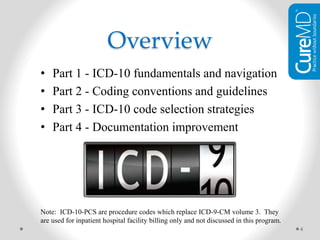
• Part 1 - ICD-10 fundamentals and navigation
• Part 2 - Coding conventions and guidelines
• Part 3 - ICD-10 code selection strategies
• Part 4 - Documentation improvement
Note: ICD-10-PCS are procedure codes which replace ICD-9-CM volume 3. They
are used for inpatient hospital facility billing only and not discussed in this program.
4
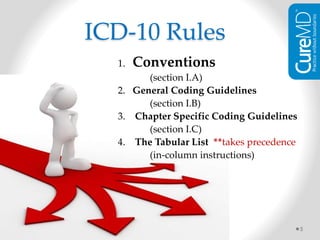
1. Conventions
(section I.A)
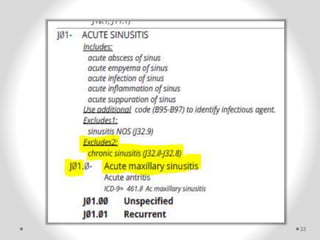
2. General Coding Guidelines
(section I.B)
3. Chapter Specific Coding Guidelines
(section I.C)
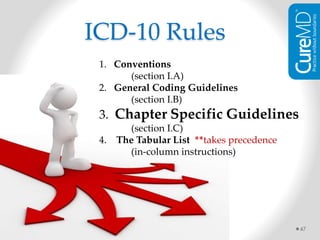
4. The Tabular List **takes precedence
(in-column instructions)
5
ICD-10 Rules
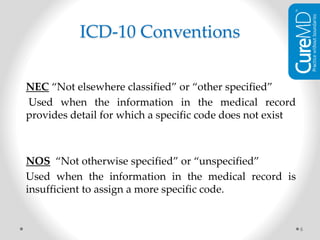
NEC “Not elsewhere classified” or “other specified”
Used when the information in the medical record
provides detail for which a specific code does not exist
NOS “Not otherwise specified” or “unspecified”
Used when the information in the medical record is
insufficient to assign a more specific code.
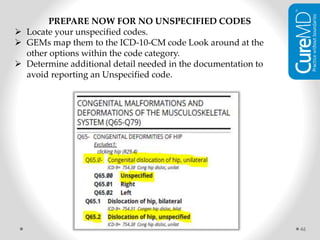
6
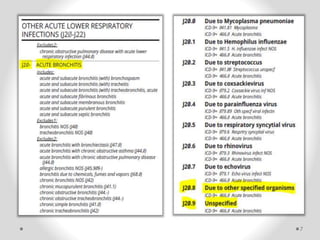
ICD-10 Conventions
7
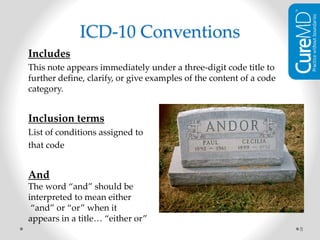
Includes
This note appears immediately under a three-digit code title to
further define, clarify, or give examples of the content of a code
category.
Inclusion terms
List of conditions assigned to
that code
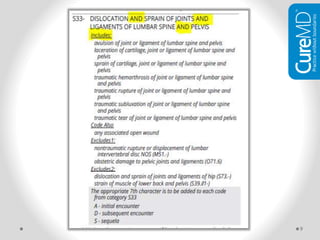
And
The word “and” should be
interpreted to mean either
“and” or “or” when it
appears in a title… “either or”
8
ICD-10 Conventions
9
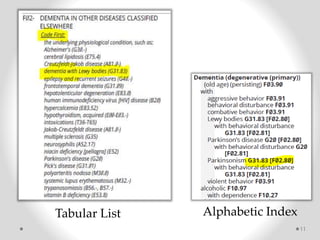
Etiology/manifestation
The condition is sequenced first, followed by the
manifestation
o Etiology code will have a “use additional” note
o Manifestation code will have a “code first” note
• Also usually says “in diseases classified elsewhere”
o Brackets surround the manifestation code in the alpha
index
Code Also
Alerts the coder that more than one code may be required
to fully describe the condition. The sequencing of the codes
depends on the severity and/or the reason for the
encounter. 10
ICD-10 Conventions
11
Tabular List Alphabetic Index
Excludes ***Different in ICD-10***
Excludes1 – is used when two conditions cannot occur
together or “NOT CODED HERE!” Mutually exclusive
codes; two conditions that cannot be reported together.
Excludes2 – indicates “NOT INCLUDED HERE.”
Although the excluded condition is not part of the
condition, it is excluded from, a patient may have both
conditions at the same time. The excluded code and the
code above the excludes can be used together if the
documentation supports them.
12
ICD-10 Conventions
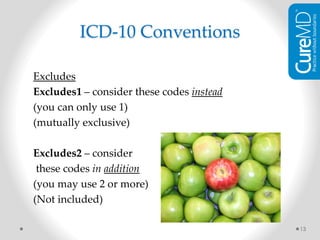
Excludes
Excludes1 – consider these codes instead
(you can only use 1)
(mutually exclusive)
Excludes2 – consider
these codes in addition
(you may use 2 or more)
(Not included)
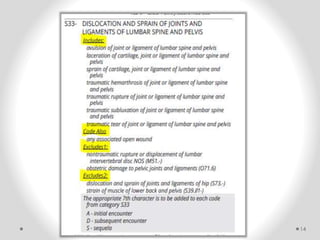
13
ICD-10 Conventions
14
15
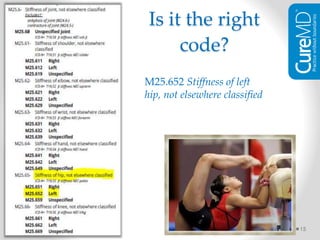
M25.652 Stiffness of left
hip, not elsewhere classified
Is it the right
code?
16
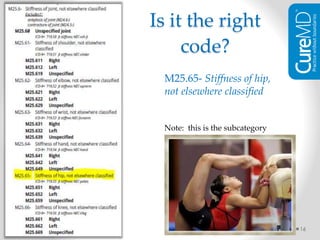
M25.65- Stiffness of hip,
not elsewhere classified
Note: this is the subcategory
Is it the right
code?
17
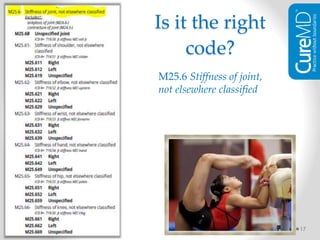
M25.6 Stiffness of joint,
not elsewhere classified
Is it the right
code?
18
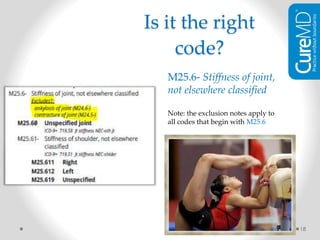
M25.6- Stiffness of joint,
not elsewhere classified
Note: the exclusion notes apply to
all codes that begin with M25.6
Is it the right
code?
19
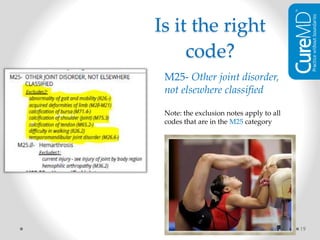
M25- Other joint disorder,
not elsewhere classified
Note: the exclusion notes apply to all
codes that are in the M25 category
Is it the right
code?
20
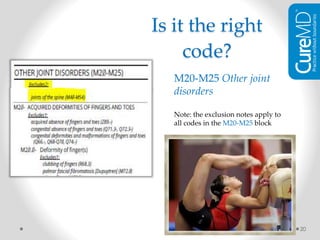
M20-M25 Other joint
disorders
Note: the exclusion notes apply to
all codes in the M20-M25 block
Is it the right
code?
21
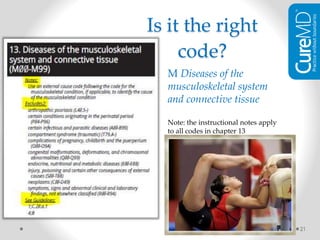
M Diseases of the
musculoskeletal system
and connective tissue
Note: the instructional notes apply
to all codes in chapter 13
Is it the right
code?
22
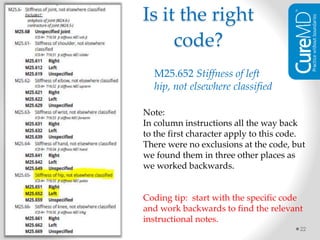
M25.652 Stiffness of left
hip, not elsewhere classified
Note:
In column instructions all the way back
to the first character apply to this code.
There were no exclusions at the code, but
we found them in three other places as
we worked backwards.
Coding tip: start with the specific code
and work backwards to find the relevant
instructional notes.
Is it the right
code?
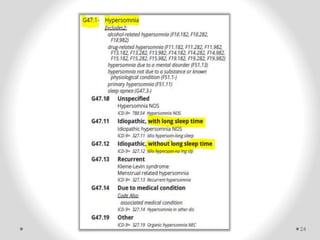
With/without
• “with” means “associated with” or “due to”
• default is always “without”
23
ICD-10 Conventions
24
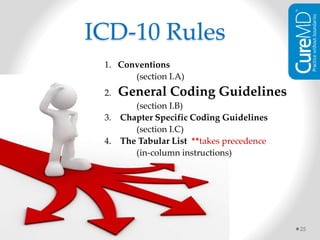
1. Conventions
(section I.A)
2. General Coding Guidelines
(section I.B)
3. Chapter Specific Coding Guidelines
(section I.C)
4. The Tabular List **takes precedence
(in-column instructions)
25
ICD-10 Rules
General Coding
Guidelines
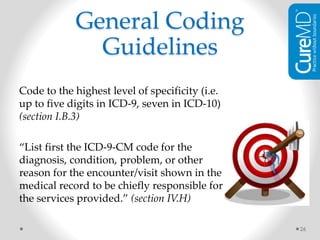
Code to the highest level of specificity (i.e.
up to five digits in ICD-9, seven in ICD-10)
(section I.B.3)
“List first the ICD-9-CM code for the
diagnosis, condition, problem, or other
reason for the encounter/visit shown in the
medical record to be chiefly responsible for
the services provided.” (section IV.H)
26
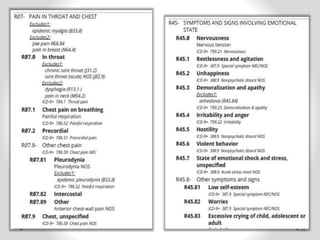
“Code signs and symptoms when a related definitive
diagnosis has not been established (confirmed) by the
provider” (section I.B.6)
o mostly 780-799 in ICD-9
o mostly R00-R99 in ICD-10
27
General Coding
Guidelines
28
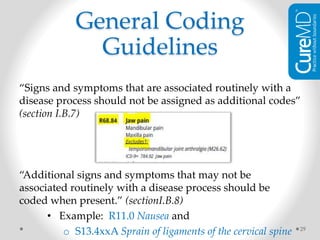
“Signs and symptoms that are associated routinely with a
disease process should not be assigned as additional codes”
(section I.B.7)
“Additional signs and symptoms that may not be
associated routinely with a disease process should be
coded when present.” (sectionI.B.8)
• Example: R11.0 Nausea and
o S13.4xxA Sprain of ligaments of the cervical spine 29
General Coding
Guidelines
“Do not code diagnoses documented as ‘probable’,
‘suspected’, ‘questionable’, ‘rule out’, or ‘working
diagnosis’ or other similar terms indicating uncertainty.”
(section IV.I)
30
General Coding
Guidelines
“Code all documented conditions
that coexist at the time of the
encounter/visit and require or
affect patient care treatment or
management.” (sectionIV.K)
31
General Coding
Guidelines
Diabetes? Pregnancy (Z33.1)? Cancer?
Acute and chronic
o The acute condition should always be listed before
the chronic condition if both are present.
32
General Coding
Guidelines
33
Combination codes are used to classify:
• Two diagnoses, or
• A diagnosis with an associated
secondary process (manifestation)
• A diagnosis with an associated
complication
34
General Coding
Guidelines
35
Sequela (late effects)
• Residual effect after the acute phase of an illness or
injury has terminated
o Example: paralysis after cerebral infarction
• Code first the condition being treated, and second the
illness or injury that led to it.
• Never code the acute phase of the illness or injury with a
sequela
36
General Coding
Guidelines
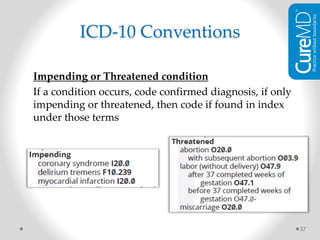
Impending or Threatened condition
If a condition occurs, code confirmed diagnosis, if only
impending or threatened, then code if found in index
under those terms
37
ICD-10 Conventions
Laterality
o If the condition is bilateral and there is no
bilateral code, then you have to list the left and
right code separately.
o Sixth character (usually)
• 1=right
• 2=left
o List unspecified if laterality is not described
38
General Coding
Guidelines
39
Always document laterality for
any body part or organ that is
bilateral in nature.
ICD-10-CM does not
always provide a bilateral
code. Sometimes it is only
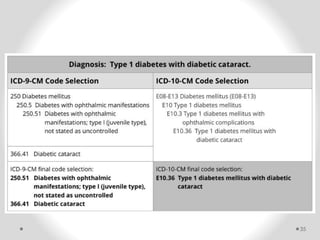
Right, Left or Unspecified.
General Coding
Guidelines
40
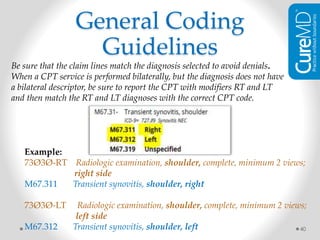
Be sure that the claim lines match the diagnosis selected to avoid denials.
When a CPT service is performed bilaterally, but the diagnosis does not have
a bilateral descriptor, be sure to report the CPT with modifiers RT and LT
and then match the RT and LT diagnoses with the correct CPT code.
Example:
73Ø3Ø-RT Radiologic examination, shoulder, complete, minimum 2 views;
right side
M67.311 Transient synovitis, shoulder, right
73Ø3Ø-LT Radiologic examination, shoulder, complete, minimum 2 views;
left side
M67.312 Transient synovitis, shoulder, left
General Coding
Guidelines
41
Placeholder “x” character
ICD-10-CM utilizes a placeholder
character “x” in positions 4, 5, and/or 6
in certain codes to allow for future
expansion.
7th Characters
Certain ICD-10-CM categories have
applicable 7th characters. The 7th
character must always be the 7th
character in the data field. If a code that
requires a 7th character is not 6
characters, a placeholder “x” must be
used to fill in the empty characters.
General Coding
Guidelines
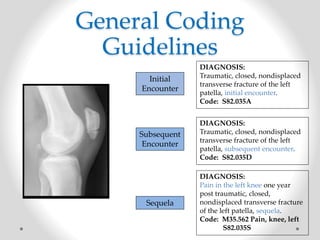
DIAGNOSIS:
Traumatic, closed, nondisplaced
transverse fracture of the left
patella, initial encounter.
Code: S82.035A
DIAGNOSIS:
Traumatic, closed, nondisplaced
transverse fracture of the left
patella, subsequent encounter.
Code: S82.035D
DIAGNOSIS:
Pain in the left knee one year
post traumatic, closed,
nondisplaced transverse fracture
of the left patella, sequela.
Code: M35.562 Pain, knee, left
S82.035S
Initial
Encounter
Subsequent
Encounter
Sequela
General Coding
Guidelines
43
General Coding
Guidelines
The seventh character (encounter):
• A – initial encounter, while patient is receiving active
treatment including continuing treatment by the same
or a different physician
• D – subsequent encounter, routine care during the
healing or recovery phase, such as aftercare and
follow up
• S – sequela, complications or conditions that arise as a
direct result of a condition, such as a scar formation
after a burn.
44
The seventh character (encounter):
Which character is correct?
• Is the patient receiving active treatment?
• Is the patient in the middle of a treatment plan?
• Has the patient’s condition stabilized?
• Is the patient receiving supportive care?
• Is the patient in a healing or recovery phase?
• Is the patient being treated for a complication that is the
direct result of some other condition that is no longer
present?
General Coding
Guidelines
A
A
D
D
D
S
o An unspecified code should be reported only when it
is the code that most accurately reflects what is
known about the patient’s condition at the time of
that particular encounter.
*Note: payers are likely to deny unspecified codes
o It is inappropriate to select a specific code that is not
supported by the health record documentation
o It is inappropriate to conduct medically unnecessary
diagnostic testing in order to determine a more
specific code.
. 45
General Coding
Guidelines
46
PREPARE NOW FOR NO UNSPECIFIED CODES
 Locate your unspecified codes.
 GEMs map them to the ICD-10-CM code Look around at the
other options within the code category.
 Determine additional detail needed in the documentation to
avoid reporting an Unspecified code.
1. Conventions
(section I.A)
2. General Coding Guidelines
(section I.B)
3. Chapter Specific Guidelines
(section I.C)
4. The Tabular List **takes precedence
(in-column instructions)
47
ICD-10 Rules
48
49
50
51
52
53

ICD-10 Conventions and Guidelines

  • 2.
    ICD-10 Boot Camp Part 2-Conventions and Guidelines 2 Presented by Evan M. Gwilliam, DC MBA BS CPC CCPC NCICS CCCPC CPC-I MCS-P CPMA Chief Product Officer
  • 3.
    Dr. Evan Gwilliam •Education • Bachelor’s of Science, Accounting - Brigham Young University • Master’s of Business Administration - Broadview University • Doctor of Chiropractic, Valedictorian - Palmer College of Chiropractic • Certifications • Certified Professional Coder (CPC) - AAPC • Nationally Certified Insurance Coding Specialist (NCICS) - NCCT • Certified Chiropractic Professional Coder (CCPC) - AAPC • ChiroCode Certified Chiropractic Professional Coder (CCCPC) - ChiroCode • Certified Professional Coder – Instructor (CPC-I) - AAPC • Medical Compliance Specialist – Physician (MCS-P) - MCS • Certified Professional Medical Auditor (CPMA) – AAPC, NAMAS • Certified ICD-10 Trainer - AAPC 3
  • 4.
    Overview • Part 1- ICD-10 fundamentals and navigation • Part 2 - Coding conventions and guidelines • Part 3 - ICD-10 code selection strategies • Part 4 - Documentation improvement Note: ICD-10-PCS are procedure codes which replace ICD-9-CM volume 3. They are used for inpatient hospital facility billing only and not discussed in this program. 4
  • 5.
    1. Conventions (section I.A) 2.General Coding Guidelines (section I.B) 3. Chapter Specific Coding Guidelines (section I.C) 4. The Tabular List **takes precedence (in-column instructions) 5 ICD-10 Rules
  • 6.
    NEC “Not elsewhereclassified” or “other specified” Used when the information in the medical record provides detail for which a specific code does not exist NOS “Not otherwise specified” or “unspecified” Used when the information in the medical record is insufficient to assign a more specific code. 6 ICD-10 Conventions
  • 7.
  • 8.
    Includes This note appearsimmediately under a three-digit code title to further define, clarify, or give examples of the content of a code category. Inclusion terms List of conditions assigned to that code And The word “and” should be interpreted to mean either “and” or “or” when it appears in a title… “either or” 8 ICD-10 Conventions
  • 9.
  • 10.
    Etiology/manifestation The condition issequenced first, followed by the manifestation o Etiology code will have a “use additional” note o Manifestation code will have a “code first” note • Also usually says “in diseases classified elsewhere” o Brackets surround the manifestation code in the alpha index Code Also Alerts the coder that more than one code may be required to fully describe the condition. The sequencing of the codes depends on the severity and/or the reason for the encounter. 10 ICD-10 Conventions
  • 11.
  • 12.
    Excludes ***Different inICD-10*** Excludes1 – is used when two conditions cannot occur together or “NOT CODED HERE!” Mutually exclusive codes; two conditions that cannot be reported together. Excludes2 – indicates “NOT INCLUDED HERE.” Although the excluded condition is not part of the condition, it is excluded from, a patient may have both conditions at the same time. The excluded code and the code above the excludes can be used together if the documentation supports them. 12 ICD-10 Conventions
  • 13.
    Excludes Excludes1 – considerthese codes instead (you can only use 1) (mutually exclusive) Excludes2 – consider these codes in addition (you may use 2 or more) (Not included) 13 ICD-10 Conventions
  • 14.
  • 15.
    15 M25.652 Stiffness ofleft hip, not elsewhere classified Is it the right code?
  • 16.
    16 M25.65- Stiffness ofhip, not elsewhere classified Note: this is the subcategory Is it the right code?
  • 17.
    17 M25.6 Stiffness ofjoint, not elsewhere classified Is it the right code?
  • 18.
    18 M25.6- Stiffness ofjoint, not elsewhere classified Note: the exclusion notes apply to all codes that begin with M25.6 Is it the right code?
  • 19.
    19 M25- Other jointdisorder, not elsewhere classified Note: the exclusion notes apply to all codes that are in the M25 category Is it the right code?
  • 20.
    20 M20-M25 Other joint disorders Note:the exclusion notes apply to all codes in the M20-M25 block Is it the right code?
  • 21.
    21 M Diseases ofthe musculoskeletal system and connective tissue Note: the instructional notes apply to all codes in chapter 13 Is it the right code?
  • 22.
    22 M25.652 Stiffness ofleft hip, not elsewhere classified Note: In column instructions all the way back to the first character apply to this code. There were no exclusions at the code, but we found them in three other places as we worked backwards. Coding tip: start with the specific code and work backwards to find the relevant instructional notes. Is it the right code?
  • 23.
    With/without • “with” means“associated with” or “due to” • default is always “without” 23 ICD-10 Conventions
  • 24.
  • 25.
    1. Conventions (section I.A) 2.General Coding Guidelines (section I.B) 3. Chapter Specific Coding Guidelines (section I.C) 4. The Tabular List **takes precedence (in-column instructions) 25 ICD-10 Rules
  • 26.
    General Coding Guidelines Code tothe highest level of specificity (i.e. up to five digits in ICD-9, seven in ICD-10) (section I.B.3) “List first the ICD-9-CM code for the diagnosis, condition, problem, or other reason for the encounter/visit shown in the medical record to be chiefly responsible for the services provided.” (section IV.H) 26
  • 27.
    “Code signs andsymptoms when a related definitive diagnosis has not been established (confirmed) by the provider” (section I.B.6) o mostly 780-799 in ICD-9 o mostly R00-R99 in ICD-10 27 General Coding Guidelines
  • 28.
  • 29.
    “Signs and symptomsthat are associated routinely with a disease process should not be assigned as additional codes” (section I.B.7) “Additional signs and symptoms that may not be associated routinely with a disease process should be coded when present.” (sectionI.B.8) • Example: R11.0 Nausea and o S13.4xxA Sprain of ligaments of the cervical spine 29 General Coding Guidelines
  • 30.
    “Do not codediagnoses documented as ‘probable’, ‘suspected’, ‘questionable’, ‘rule out’, or ‘working diagnosis’ or other similar terms indicating uncertainty.” (section IV.I) 30 General Coding Guidelines
  • 31.
    “Code all documentedconditions that coexist at the time of the encounter/visit and require or affect patient care treatment or management.” (sectionIV.K) 31 General Coding Guidelines Diabetes? Pregnancy (Z33.1)? Cancer?
  • 32.
    Acute and chronic oThe acute condition should always be listed before the chronic condition if both are present. 32 General Coding Guidelines
  • 33.
  • 34.
    Combination codes areused to classify: • Two diagnoses, or • A diagnosis with an associated secondary process (manifestation) • A diagnosis with an associated complication 34 General Coding Guidelines
  • 35.
  • 36.
    Sequela (late effects) •Residual effect after the acute phase of an illness or injury has terminated o Example: paralysis after cerebral infarction • Code first the condition being treated, and second the illness or injury that led to it. • Never code the acute phase of the illness or injury with a sequela 36 General Coding Guidelines
  • 37.
    Impending or Threatenedcondition If a condition occurs, code confirmed diagnosis, if only impending or threatened, then code if found in index under those terms 37 ICD-10 Conventions
  • 38.
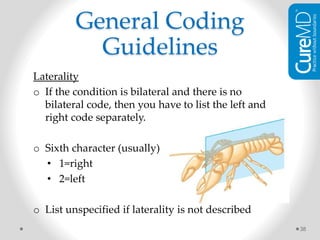
    Laterality o If thecondition is bilateral and there is no bilateral code, then you have to list the left and right code separately. o Sixth character (usually) • 1=right • 2=left o List unspecified if laterality is not described 38 General Coding Guidelines
  • 39.
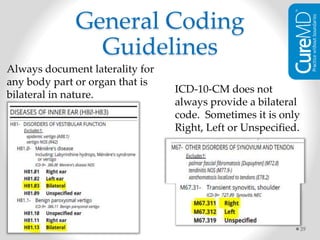
    39 Always document lateralityfor any body part or organ that is bilateral in nature. ICD-10-CM does not always provide a bilateral code. Sometimes it is only Right, Left or Unspecified. General Coding Guidelines
  • 40.
    40 Be sure thatthe claim lines match the diagnosis selected to avoid denials. When a CPT service is performed bilaterally, but the diagnosis does not have a bilateral descriptor, be sure to report the CPT with modifiers RT and LT and then match the RT and LT diagnoses with the correct CPT code. Example: 73Ø3Ø-RT Radiologic examination, shoulder, complete, minimum 2 views; right side M67.311 Transient synovitis, shoulder, right 73Ø3Ø-LT Radiologic examination, shoulder, complete, minimum 2 views; left side M67.312 Transient synovitis, shoulder, left General Coding Guidelines
  • 41.
    41 Placeholder “x” character ICD-10-CMutilizes a placeholder character “x” in positions 4, 5, and/or 6 in certain codes to allow for future expansion. 7th Characters Certain ICD-10-CM categories have applicable 7th characters. The 7th character must always be the 7th character in the data field. If a code that requires a 7th character is not 6 characters, a placeholder “x” must be used to fill in the empty characters. General Coding Guidelines
  • 42.
    DIAGNOSIS: Traumatic, closed, nondisplaced transversefracture of the left patella, initial encounter. Code: S82.035A DIAGNOSIS: Traumatic, closed, nondisplaced transverse fracture of the left patella, subsequent encounter. Code: S82.035D DIAGNOSIS: Pain in the left knee one year post traumatic, closed, nondisplaced transverse fracture of the left patella, sequela. Code: M35.562 Pain, knee, left S82.035S Initial Encounter Subsequent Encounter Sequela General Coding Guidelines
  • 43.
    43 General Coding Guidelines The seventhcharacter (encounter): • A – initial encounter, while patient is receiving active treatment including continuing treatment by the same or a different physician • D – subsequent encounter, routine care during the healing or recovery phase, such as aftercare and follow up • S – sequela, complications or conditions that arise as a direct result of a condition, such as a scar formation after a burn.
  • 44.
    44 The seventh character(encounter): Which character is correct? • Is the patient receiving active treatment? • Is the patient in the middle of a treatment plan? • Has the patient’s condition stabilized? • Is the patient receiving supportive care? • Is the patient in a healing or recovery phase? • Is the patient being treated for a complication that is the direct result of some other condition that is no longer present? General Coding Guidelines A A D D D S
  • 45.
    o An unspecifiedcode should be reported only when it is the code that most accurately reflects what is known about the patient’s condition at the time of that particular encounter. *Note: payers are likely to deny unspecified codes o It is inappropriate to select a specific code that is not supported by the health record documentation o It is inappropriate to conduct medically unnecessary diagnostic testing in order to determine a more specific code. . 45 General Coding Guidelines
  • 46.
    46 PREPARE NOW FORNO UNSPECIFIED CODES  Locate your unspecified codes.  GEMs map them to the ICD-10-CM code Look around at the other options within the code category.  Determine additional detail needed in the documentation to avoid reporting an Unspecified code.
  • 47.
    1. Conventions (section I.A) 2.General Coding Guidelines (section I.B) 3. Chapter Specific Guidelines (section I.C) 4. The Tabular List **takes precedence (in-column instructions) 47 ICD-10 Rules
  • 48.
  • 49.
  • 50.
  • 51.
  • 52.
  • 53.

Editor's Notes

  • #3 ICD-10 can be overwhelming, but, with some strategizing and planning it can be managed. In this presentation we will look at a few ICD-10 fundamentals, then familiarize ourselves with three methods for finding the right ICD-10 code. Each one is a different path, but all lead to the same destination: the right code.
  • #9 For example, a code might say “hand and forearm”. The code would cover a diagnosis that effected just the hand, just the forearm, or both.
  • #43 What will the audience be able to do after this training is complete? Briefly describe each objective and how the audience will benefit from this presentation. Etiology: Document any underlying conditions clearly in the note.