


By
Dr:Abdelrahman Shawky Ahmed
ICD 10 trainer-MOHP
Master of Child Health and Nutrition
Master of Pediatrics
Ph.D studies in Care of Children with Special Needs
Agenda
1. What is ICD-10 ?
2. History
3. Benefits Of Using ICD
4. Uses of ICD-10 & Grouping
5. Basic structures of ICD-10
6. How to code ?
7. Conclusion
What is ICD-10 ?
International Statistical Classification of Diseases and
Related Health Problems (Tenth Revision) is a system of
coding created by the World Health Organization (WHO)
that notes various medical records including diseases,
symptoms, abnormal findings and external causes of injury.
Classification= Standard (established Common Language)
Grouping Of Diseases by a set of principles.
International= as this Classification that is agreed upon by 195
countries.
Disease= any Deviation from normal health.
MentalPhysical
Social Spiritual
Health=the Dynamic State Of Complete
Wellbeing & Not Merely AbsenceOf
A Disease Or Infirmity
What is ICD-10 ?
• ICD: is International Classification of Diseases
introduced by WHO which translate diagnosis of
diseases and other health problems from Words
into an Alphanumerical Code to be used
universally.
Version vs Revision
 There are 9 Revisions produced by WHO before
the current revision which is ICD 10.
‫المراجعة‬
 Each Revision was subjected to change so many
Versions were produced.
‫الطبعة‬
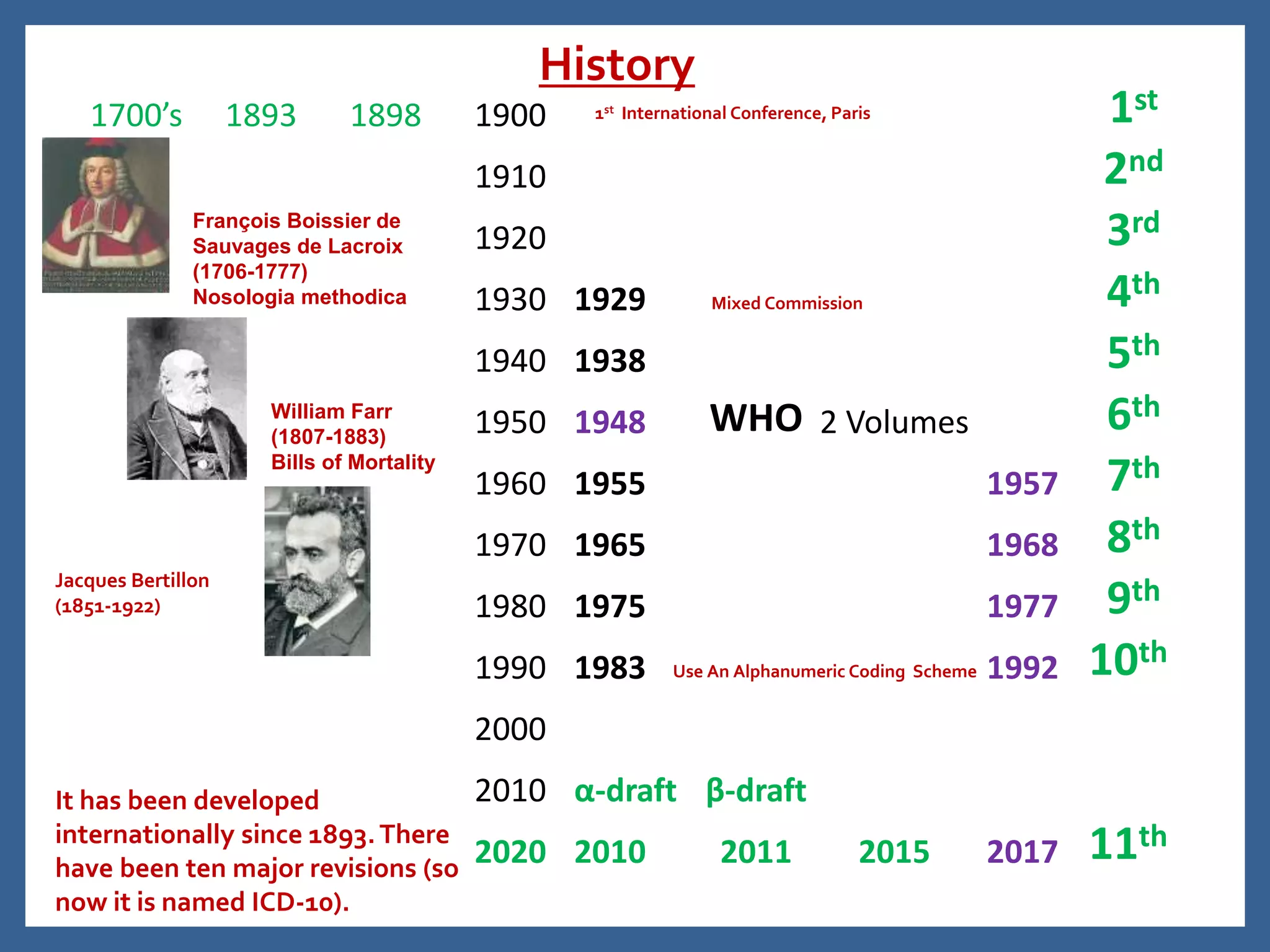
1700’s 1893 1898 1900 1st
1910 2nd
1920 3rd
1930 1929 4th
1940 1938 5th
1950 1948 WHO 2 Volumes 6th
1960 1955 1957 7th
1970 1965 1968 8th
1980 1975 1977 9th
1990 1983 1992 10th
2000
2010 α-draft β-draft
2020 2010 2011 2015 2017 11th
It has been developed
internationally since 1893.There
have been ten major revisions (so
now it is named ICD-10).
François Boissier de
Sauvages de Lacroix
(1706-1777)
Nosologia methodica
William Farr
(1807-1883)
Bills of Mortality
Jacques Bertillon
(1851-1922)
History
1st International Conference, Paris
WHO met in Geneva
Use An Alphanumeric Coding Scheme
Mixed Commission
WHO Family of International
Classifications(FIC)
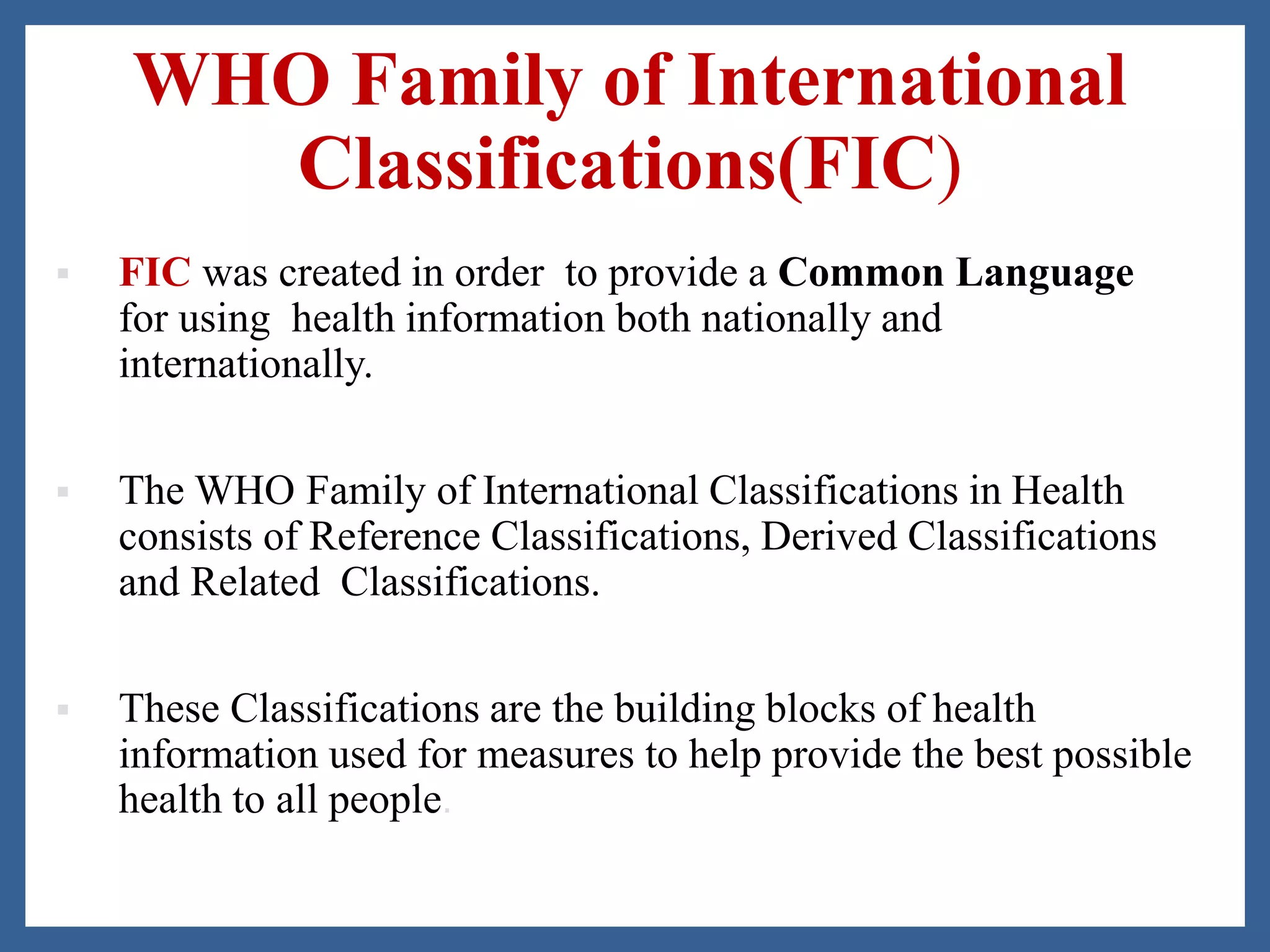
 FIC was created in order to provide a Common Language
for using health information both nationally and
internationally.
 The WHO Family of International Classifications in Health
consists of Reference Classifications, Derived Classifications
and Related Classifications.
 These Classifications are the building blocks of health
information used for measures to help provide the best possible
health to all people.
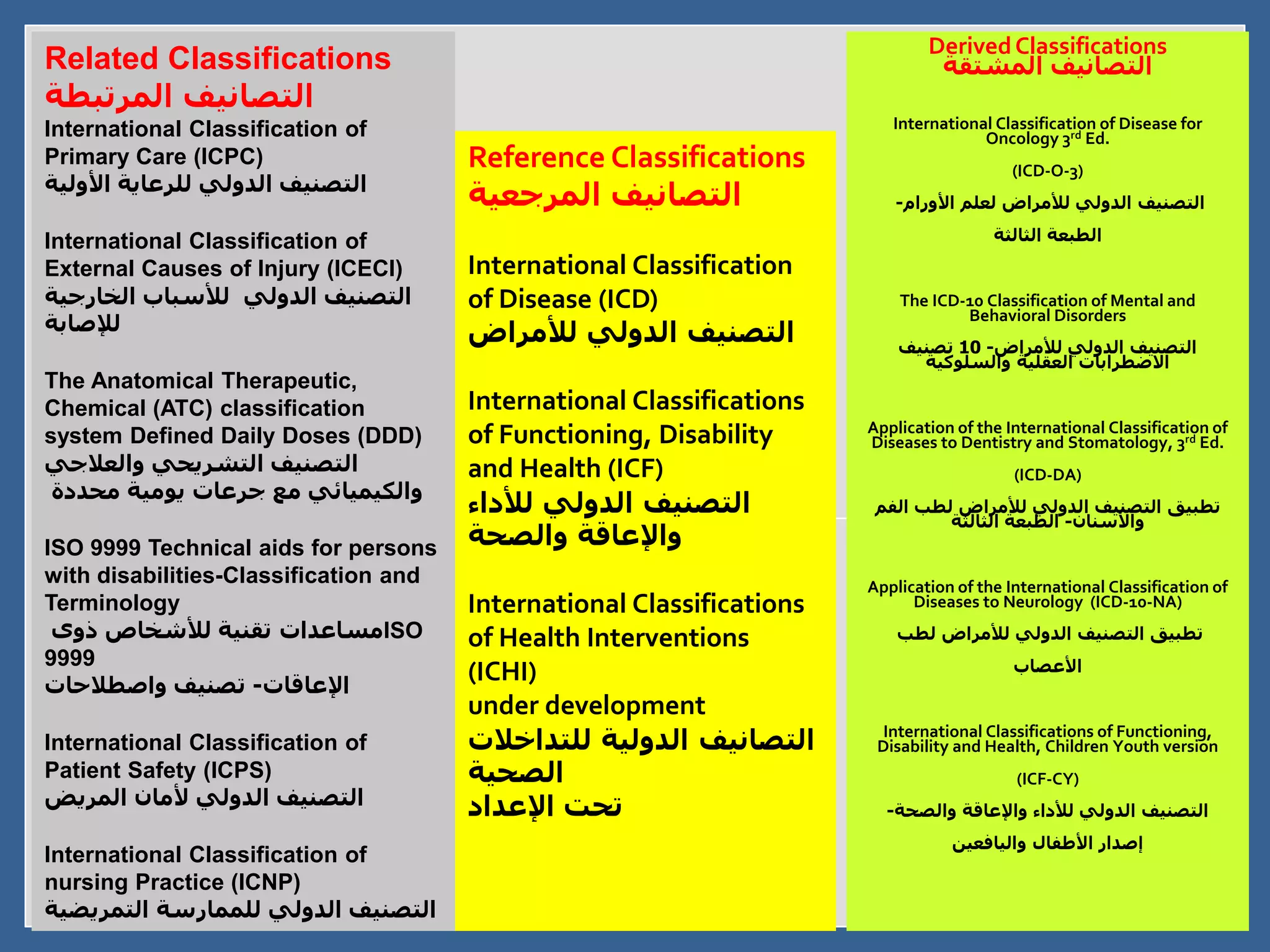
DerivedClassifications
‫التصانيف‬‫المشتقة‬
International Classification of Disease for
Oncology 3rd Ed.
(ICD-O-3)
‫التصنيف‬‫األورام‬ ‫لعلم‬ ‫لألمراض‬ ‫الدولي‬-
‫الثالثة‬ ‫الطبعة‬
The ICD-10 Classification of Mental and
Behavioral Disorders
‫لألمراض‬ ‫الدولي‬ ‫التصنيف‬-10‫تصنيف‬
‫العقلية‬ ‫االضطرابات‬‫والسلوكية‬
Application of the International Classification of
Diseases to Dentistry and Stomatology, 3rd Ed.
(ICD-DA)
‫تطبيق‬‫الفم‬ ‫لطب‬ ‫لألمراض‬ ‫الدولي‬ ‫التصنيف‬
‫واألسنان‬-‫الطبعة‬‫الثالثة‬
Application of the International Classification of
Diseases to Neurology (ICD-10-NA)
‫لألمراض‬ ‫الدولي‬ ‫التصنيف‬ ‫تطبيق‬‫لطب‬
‫األعصاب‬
International Classifications of Functioning,
Disability and Health, Children Youth version
(ICF-CY)
‫واإلعاقة‬ ‫لألداء‬ ‫الدولي‬ ‫التصنيف‬‫والصحة‬-
‫واليافعين‬ ‫األطفال‬ ‫إصدار‬
Reference Classifications
‫المرجعية‬ ‫التصانيف‬
International Classification
of Disease (ICD)
‫لألمراض‬ ‫الدولي‬ ‫التصنيف‬
International Classifications
of Functioning, Disability
and Health (ICF)
‫لألداء‬ ‫الدولي‬ ‫التصنيف‬
‫والصحة‬ ‫واإلعاقة‬
International Classifications
of Health Interventions
(ICHI)
under development
‫التصانيف‬‫الدولي‬‫ة‬‫للتد‬‫ا‬‫خالت‬
‫الصحية‬
‫اإلعداد‬ ‫تحت‬
Related Classifications
‫التصانيف‬‫المرتبطة‬
International Classification of
Primary Care (ICPC)
‫األولية‬ ‫للرعاية‬ ‫الدولي‬ ‫التصنيف‬
International Classification of
External Causes of Injury (ICECI)
‫الخارجية‬ ‫لألسباب‬ ‫الدولي‬ ‫التصنيف‬
‫لإلصابة‬
The Anatomical Therapeutic,
Chemical (ATC) classification
system Defined Daily Doses (DDD)
‫والعالجي‬ ‫التشريحي‬ ‫التصنيف‬
‫يومية‬ ‫جرعات‬ ‫مع‬ ‫والكيميائي‬‫محددة‬
ISO 9999 Technical aids for persons
with disabilities-Classification and
Terminology
‫مساعدات‬‫ذوى‬ ‫لألشخاص‬ ‫تقنية‬ ISO
9999
‫اإلعاقات‬-‫واصطالحات‬ ‫تصنيف‬
International Classification of
Patient Safety (ICPS)
‫المريض‬ ‫ألمان‬ ‫الدولي‬ ‫التصنيف‬
International Classification of
nursing Practice (ICNP)
‫التمريض‬ ‫للممارسة‬ ‫الدولي‬ ‫التصنيف‬‫ية‬
So, Classifications are Essential
•There are many diseases, and one needs to establish a
Common Language for reporting and data analysis.
•Standard grouping of diseases by a set of principles is
called classification.
ICD makes Diseases count
•To make people count, we first need to be able to count
people.
• ICD allows the counting of diseases, injuries, symptoms,
reasons for factors that influence health status, and external
causes of disease and death, such as accidents.
Benefits &purpose Of Using ICD
ICD
• Data Standardization and interpretation
ICD
• Easy Data Storage, retrieval & documentation
ICD
• Allow Counting for diseases,injuries, symptoms, reasons for encounter
ICD
• Allow counting for factors that influence health status, and external causes
of disease and death, such as accidents
ICD
• forming a Common Framework and language to report, compare and use
health information both nationally and internationally
ICD
• Data Comparison within populations over time and between different
population at the same point of time
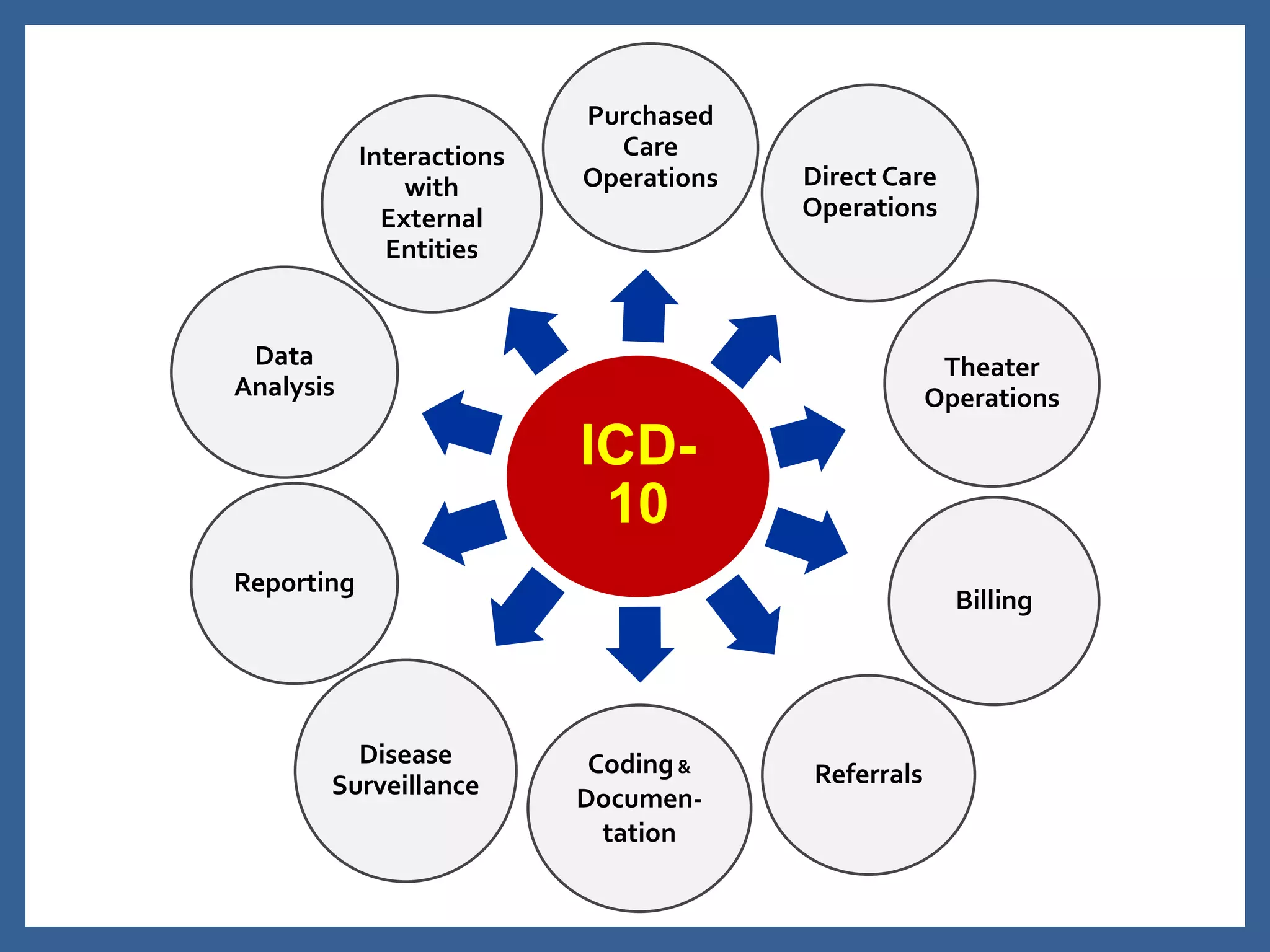
ICD-
10
Purchased
Care
Operations Direct Care
Operations
Theater
Operations
Billing
ReferralsCoding&
Documen-
tation
Disease
Surveillance
Reporting
Data
Analysis
Interactions
with
External
Entities
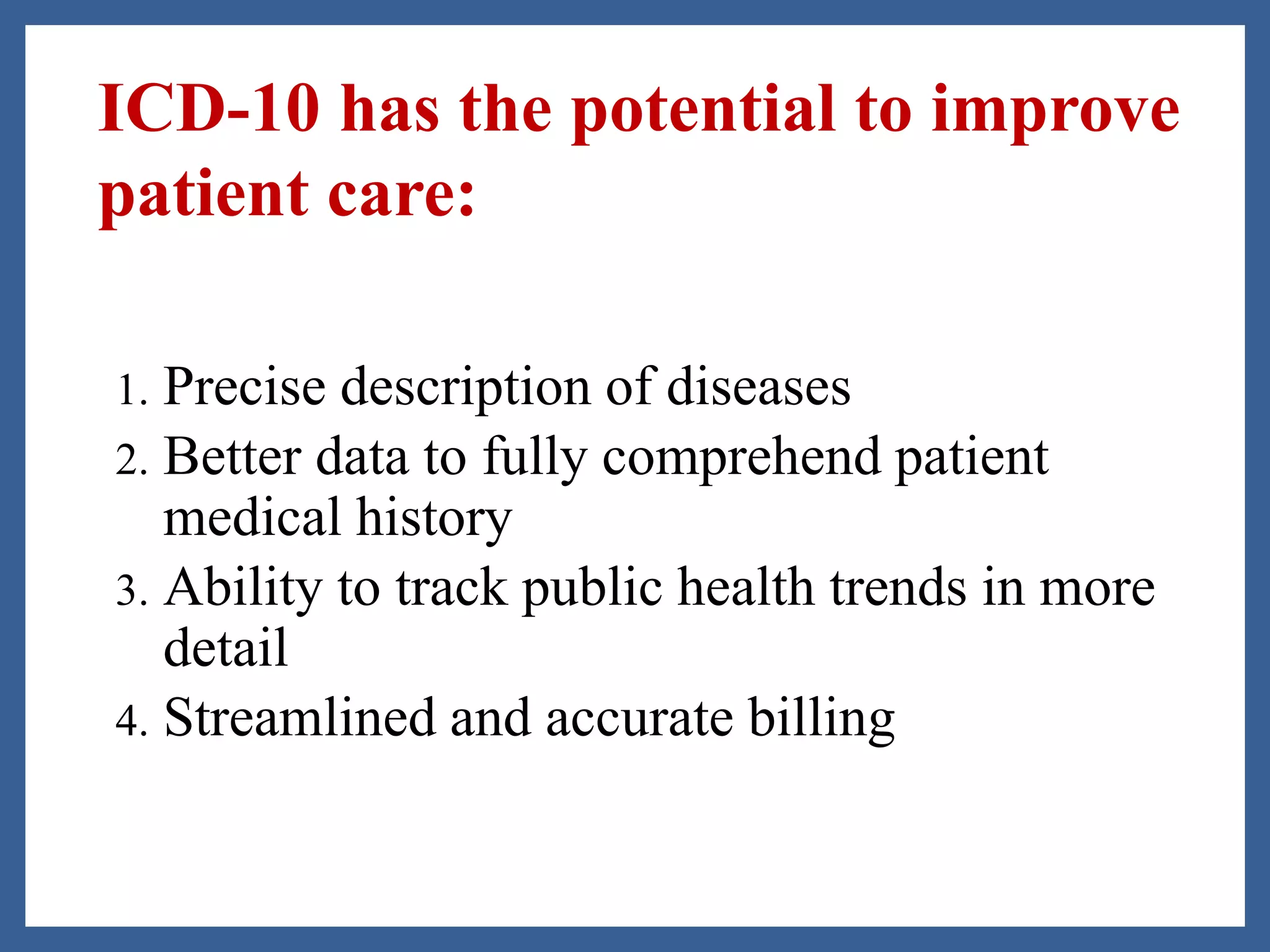
ICD-10 has the potential to improve
patient care:
1. Precise description of diseases
2. Better data to fully comprehend patient
medical history
3. Ability to track public health trends in more
detail
4. Streamlined and accurate billing
Use of ICD Codes
•The ICD is designed to serve Mortality & Morbidity in:
Public Health, Epidemiology, Prevention, Managing
Health Care, Allocation Of Resources, Outcomes
Monitoring, In Research, Clinical Context And Primary
Care.
•Information is Reported, Categorized, Analyzed,
Presented, and decisions are based on these information
at any level of a health system.
WHO
Country
Profile
“Egypt
2014”
ICD-10 Grouping
•In ICD-10 the information about Diseases and Conditions
and their causes is grouped as follows:
• Communicable diseases
• General diseases that affect the whole body
• Local diseases arranged by site
• Developmental diseases
• Injuries
• External causes
Variable Axial
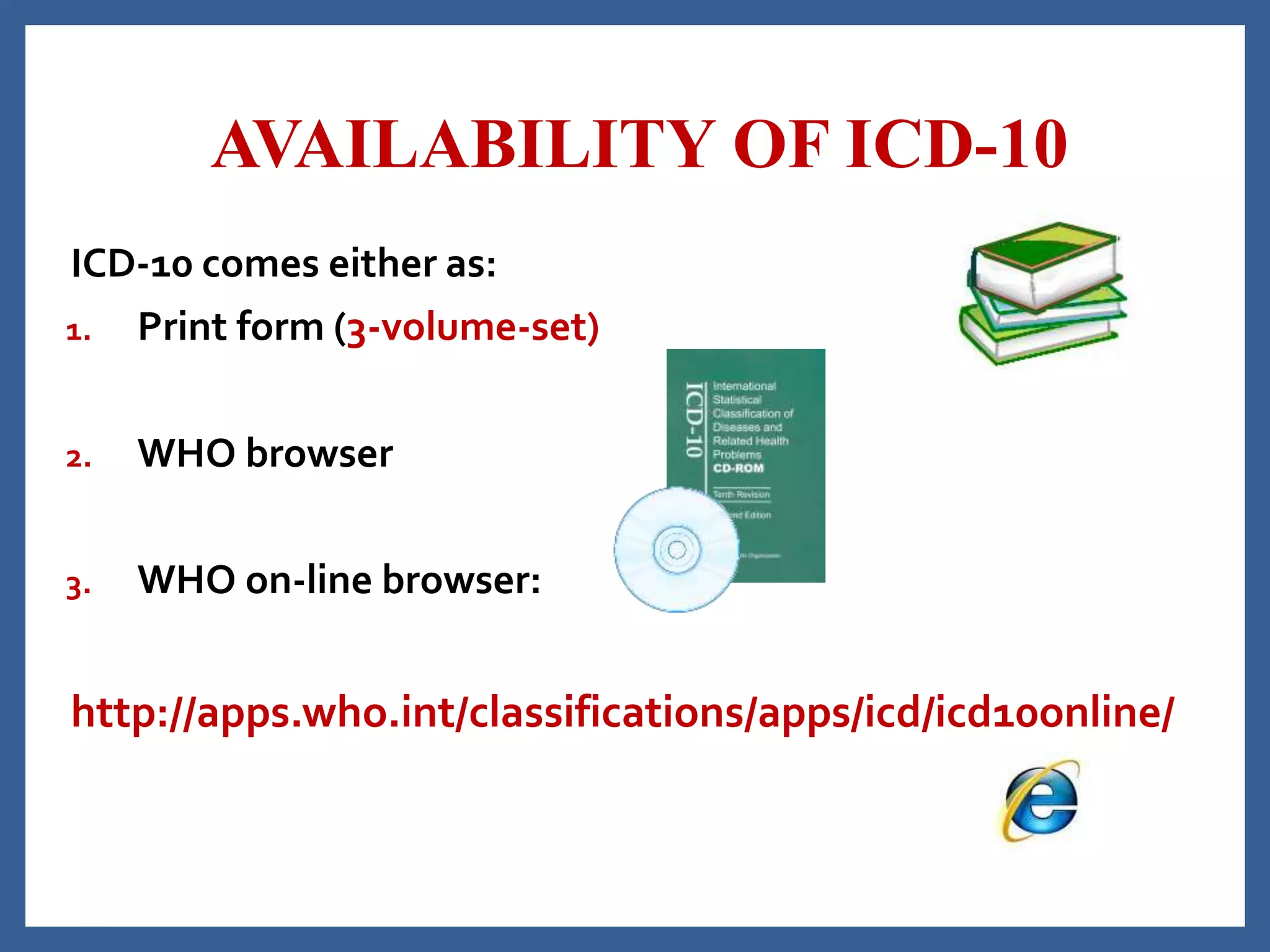
AVAILABILITY OF ICD-10
ICD-10 comes either as:
1. Print form (3-volume-set)
2. WHO browser
3. WHO on-line browser:
http://apps.who.int/classifications/apps/icd/icd10online/
COMPONENTS OF ICD-10
ICD-10 comes as a 3-volume-set of manuals
I - Tabular List of Disease Conditions
II - Instructions for Coding
III - Alphabetic Index of Disease Conditions
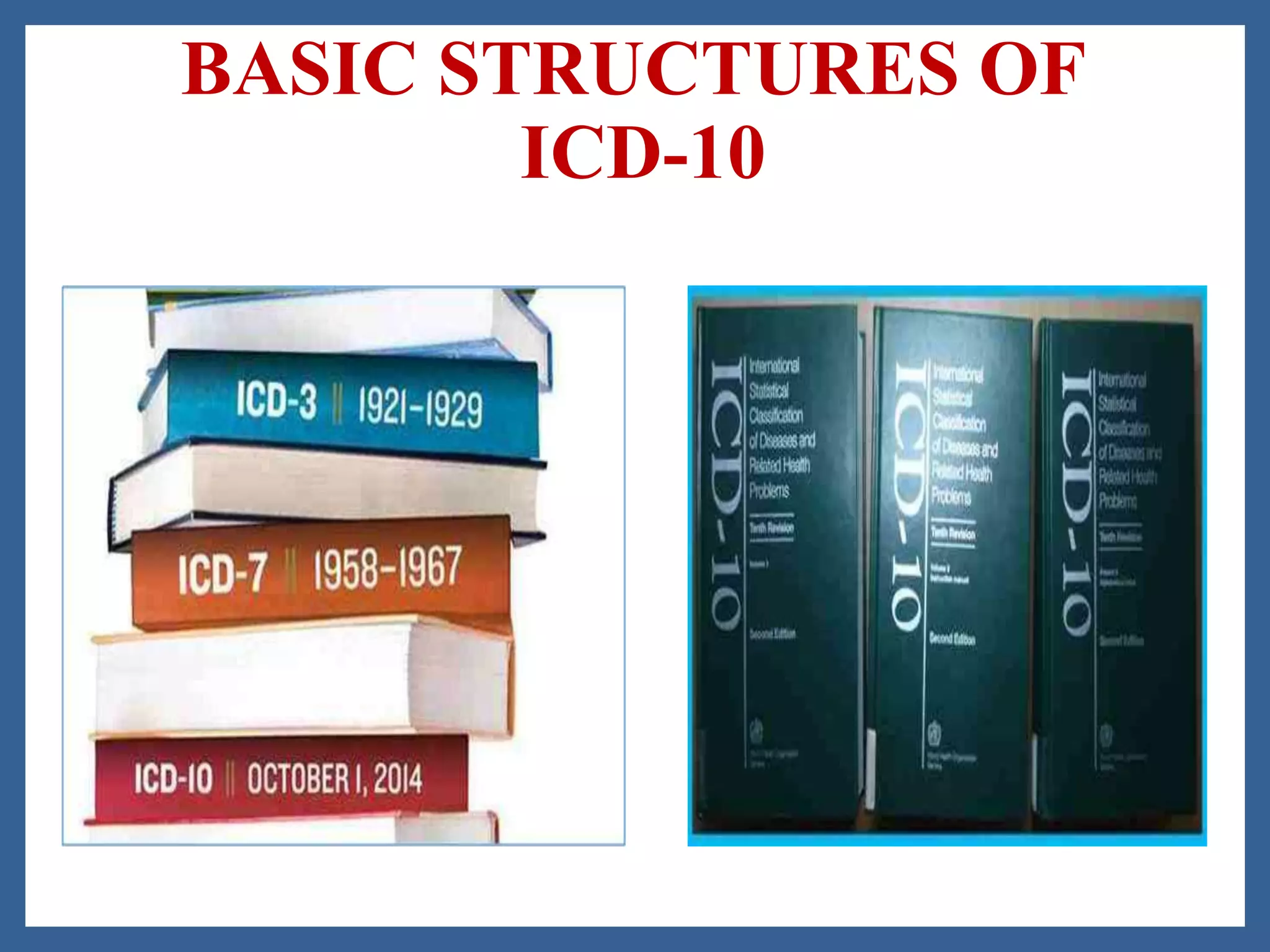
BASIC STRUCTURES OF
ICD-10
BASIC STRUCTURES OF ICD-10
1. Volumes.
2. Chapters.
A. Blocks.
B. Three-character categories.
C. Four-character subcategories.
Volume 1
(Tabular List)
I-Volume 1
The Tabular List, is an alphanumeric listing of diseases,
disease groups and health related problems in 22 chapters. It
contains Inclusions and Exclusions notes and some coding
rules.
Volume I has 4 main components:-
•A short list of 3-character Categories
•A detailed list of (4& 5)-character Subcategories for all
diseases & causes of injury
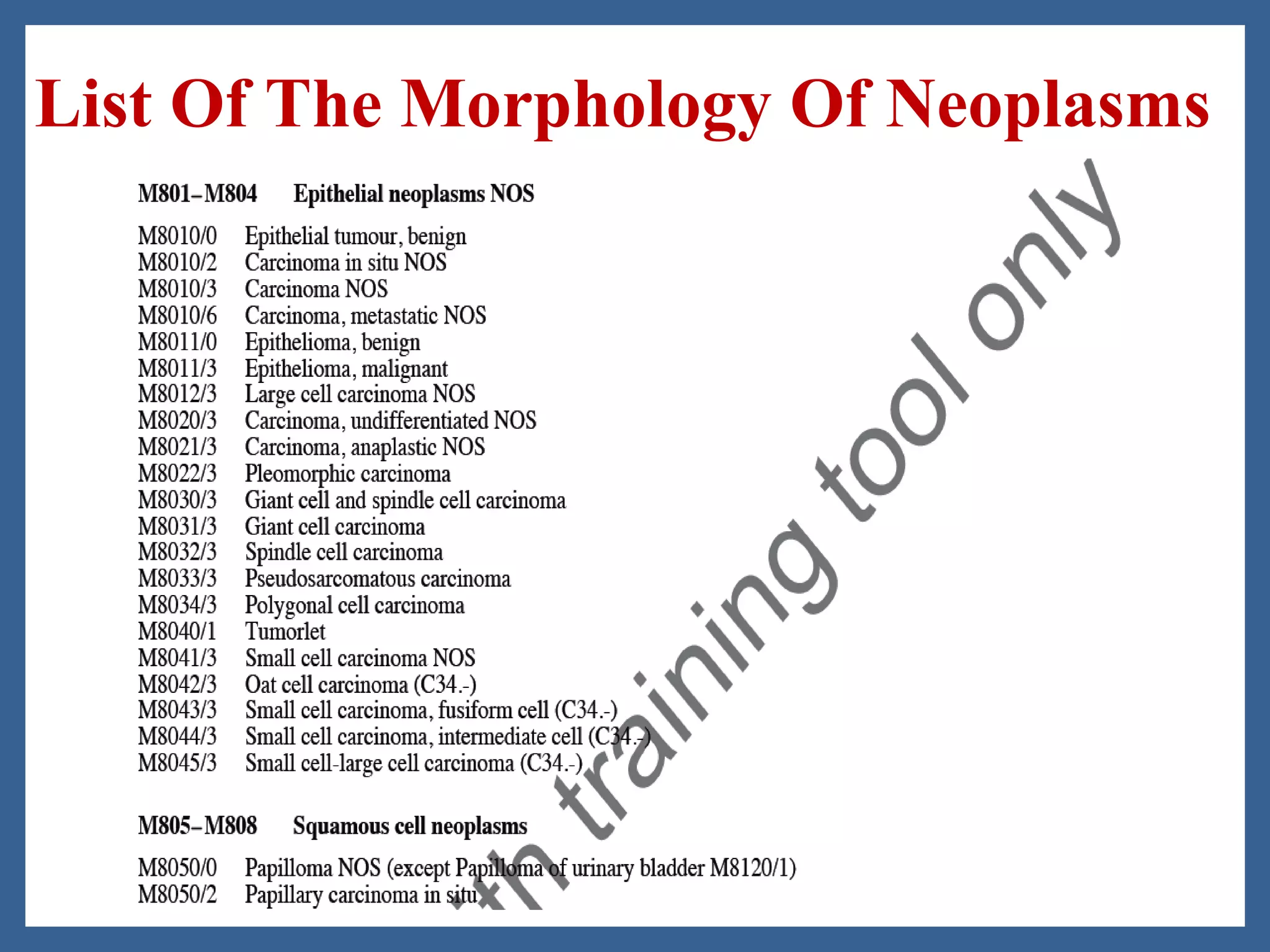
•A comprehensive list of the Morphology of Neoplasms.
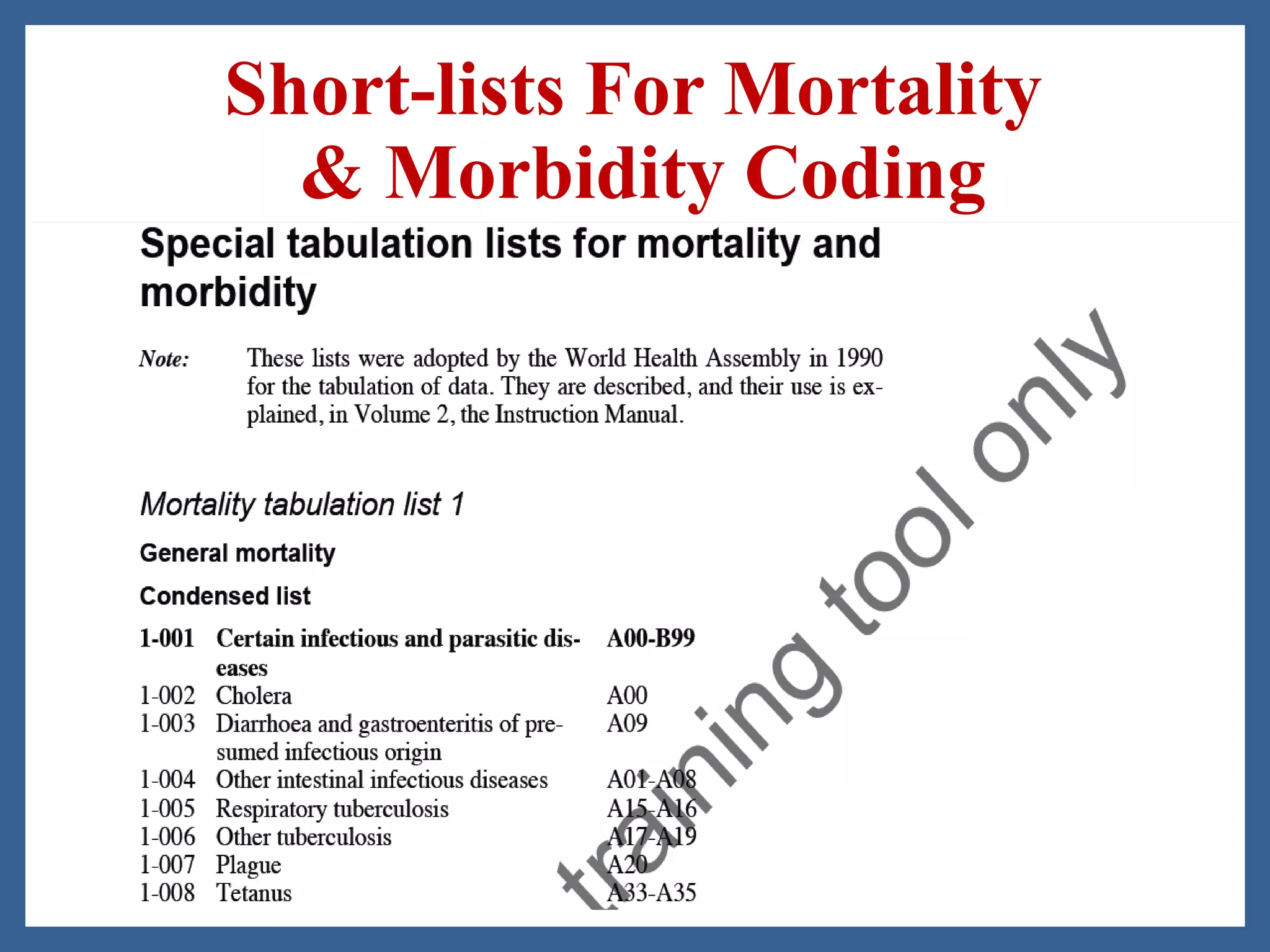
•Specialized short-lists for mortality & morbidity coding.
VOLUME 1
CHAPTERS
eg. Chapter X=Diseases of the Respiratory System (J00-J99)
BLOCKS
eg. Acute Lower Respiratory Infections (J20-J22)
3-CHARACTER CATEGORIES
eg. Acute Bronchitis (J20)
4-CHARACTER SUB-CATEGORIES
eg. Acute Bronchitis due to Streptococcus (J20.2)
Is divided into
Which have
Which are divided into
Which contain the
Chapters of Volume 1
has 22 Chapters: arranged in Latin Numbers
NB: When referring to a chapter, you should call it by
its chapter number and not by the letters of the
codes associated with it.
• Chapters I – XVII provide codes to all diseases
• Chapter XVIII covers Symptoms & Signs
• Chapter XIX codes for physical injuries & poisonings
• Chapter XX provides codes only for EXTERNAL causes
of morbidity & mortality
• Chapter XXI compiles codes for all factors influencing health
status & contact with health services of a person NOT
currently sick (eg. Fitness tests, immunizations, contraceptive
management, ante- & postnatal care, etc.)
• Chapter XXII codes for Special Purposes
Chapters I – XVII (A-Q) provide codes to all Diseases
• Some are associated with Particular Body Systems.
Chapter XI relates to Diseases of the digestive system
Chapter X is for Diseases of the respiratory system.
•Others are associated with Special Diseases – (these are to capture
types of diseases which might affect either the Whole body or many
different sites or are considered Systemic).
 Chapter II Neoplasms
Chapter XV Pregnancy, Childbirth and the Puerperium.
Diseases of a specific body system
VI-Nervous
VII-Eye
VIII-Ear
IX-Circulatory
X-Respiratory
XI-Digestive
XII-Skin
XIII-MsSk
XIV-GU
XXII-Special Purposes
Special diseases
I-Infections
II-Neoplasms
III-Blood
IV-Endocrine
V-Psych
XV-Obestet
XVI-Perinatal
XVII-C Anomalies
XIX-Nature of Inj &Pois
Chapter XX is for coding External causes of morbidity and
mortality.
Chapter XXI is for coding Factors influencing health status
and contact with health services.
We call these external factors.
Chapter XVIII is used to code Symptoms, signs and abnormal clinical and
laboratory findings, not elsewhere classified.
IT IS THE ONLY GENERAL CHAPTER
Chapters of Volume 1
A+B = AntiBiotic = infection (bacterial & others) = 1
C+½D = Cancer = 2
½D = blooD = 3
E = Endocrinal (+ nut. & metab.) = 4
F = Foolish = Psychiatric = 5
G = NeuroloGical = 6
H = Head
I = Ischemic Heart = 9
J = = 10
K = exKreta = GIT = 11
L = DermatoLogy = 12
M = MsSk = 13
N = uriNe = GU = 14
O = Obs = 15
P = Paby = Perinatal = 16
Q = Qongenital = 17
R = Rest = Symptoms & Signs = 18
ST = SiTe (nature) of injuries & poisonings = 19
VWXY = EXTERNAL causes of injuries & poisonings = 20
Z = ViZit = contact with health services, not currently sick = 21
U = codes for Special PUrposes = 22
Eye =⅔H = 7
Ear =⅓H = 8
Chapter number
Title of the chapter
Range of the chapter (3-character categories)
Inclusions & exclusions at the
chapter level
Within each chapter, codes are grouped into blocks.
Blocks are groups which represent related conditions.
You will see a list of the blocks at the beginning of each
chapter.
Volume 1
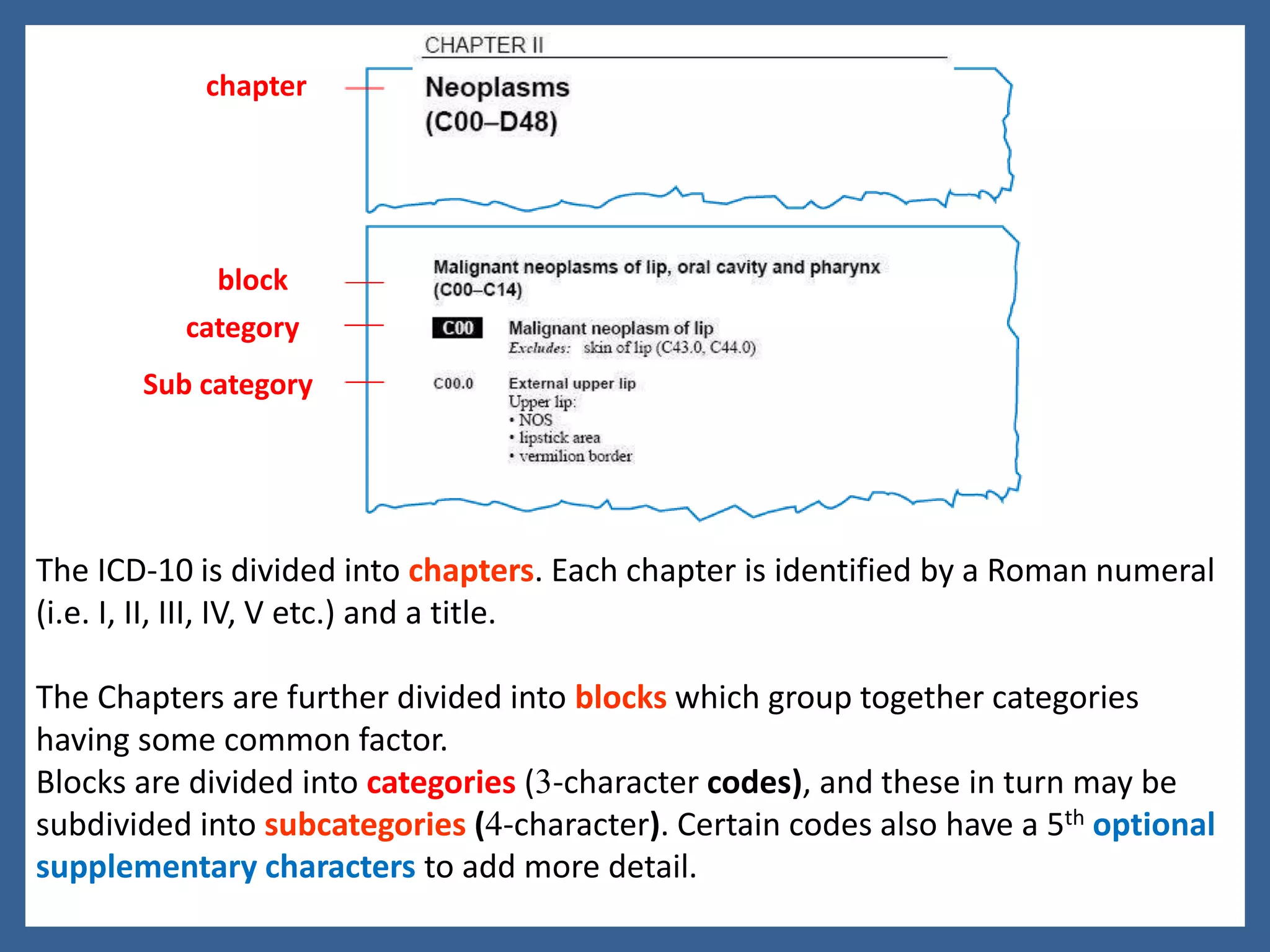
The ICD-10 is divided into chapters. Each chapter is identified by a Roman numeral
(i.e. I, II, III, IV, V etc.) and a title.
The Chapters are further divided into blocks which group together categories
having some common factor.
Blocks are divided into categories (3-character codes), and these in turn may be
subdivided into subcategories (4-character). Certain codes also have a 5th optional
supplementary characters to add more detail.
chapter
Sub category
block
category
List Of The Morphology Of Neoplasms
Short-lists For Mortality
& Morbidity Coding
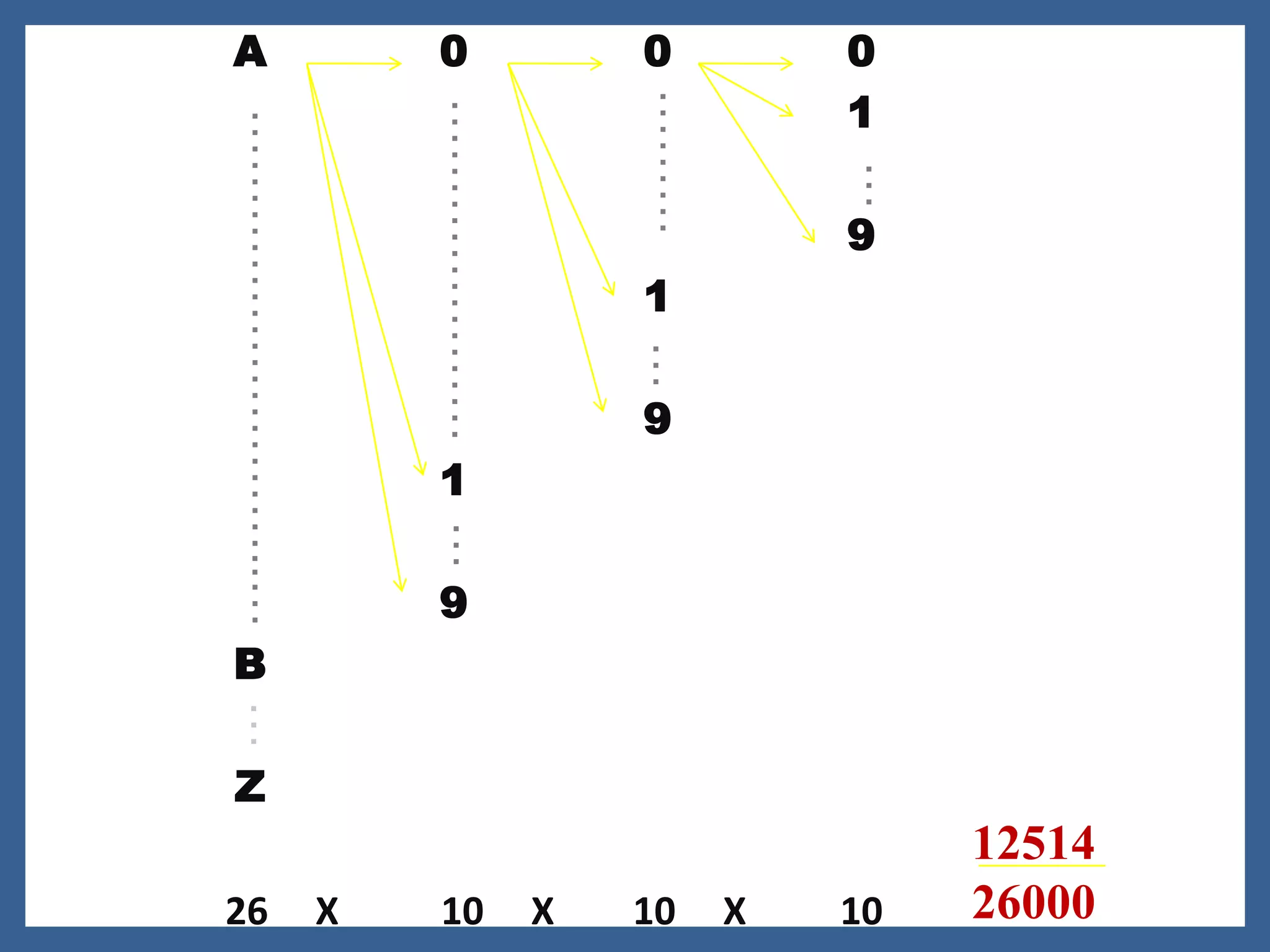
A Typical ICD-10 Code Look Like This:
J 2 0 . 2
1st Character 2nd & 3rd Characters A Decimal Point 4th Character
(A – Z) (Numbers 00-99) ( . ) (Numbers 0-9)
A 0 0 0
1
9
1
9
1
9
B
Z
26 X 10 X 10 X 10
………
…………………
…
…
…
…………………………..…
12514
26000
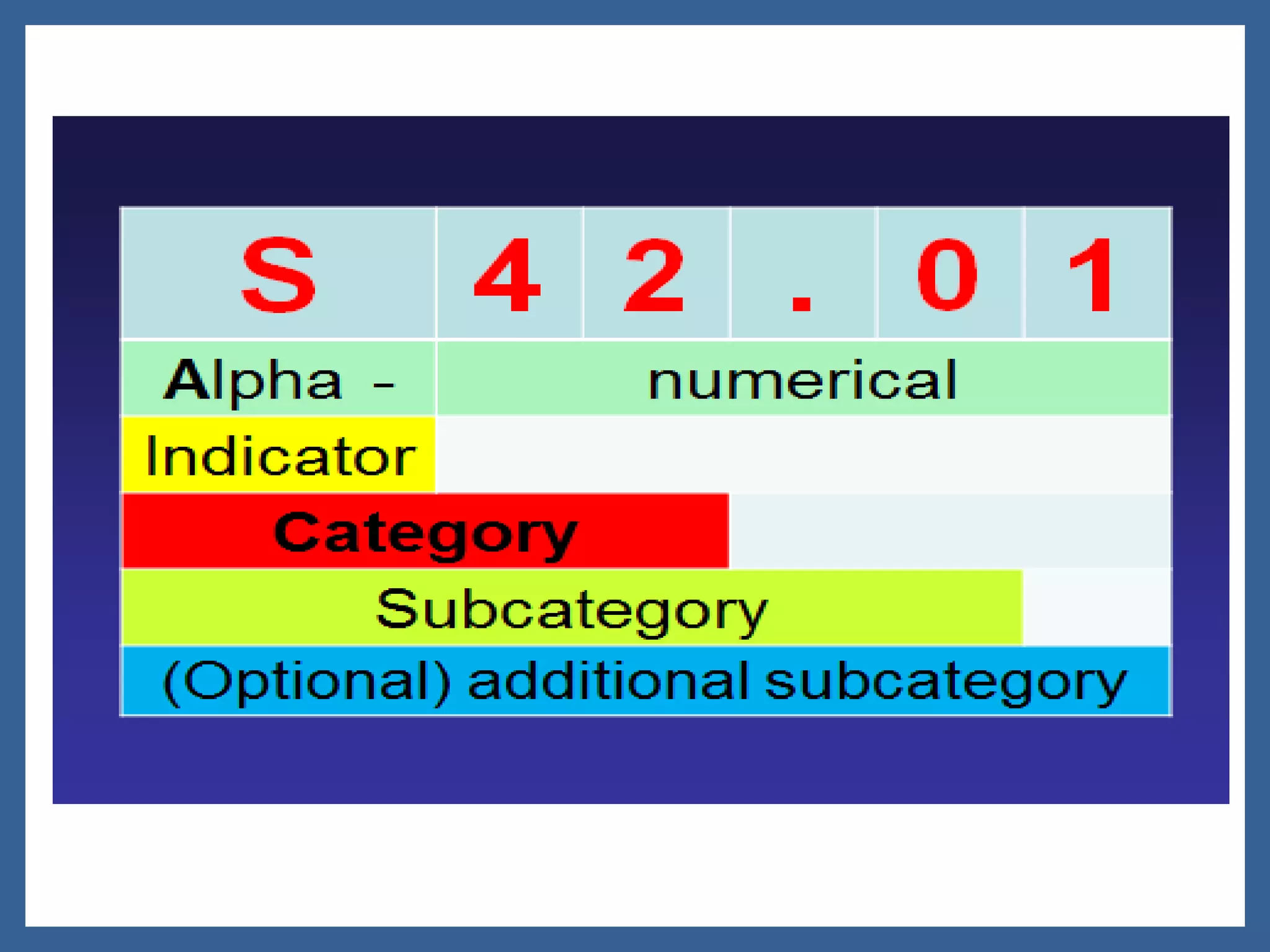
5-character additional (optional) sub-categories:
ICD-10 allows certain conditions to be classified at the
5th Character level.
These additional SUB-CATEGORIES are found in:
Chapter XIII
Subdivisions by anatomical site (M46.25)
Chapter XIX
Subdivisions to indicate open & close fractures.
Also, internal injuries, with or without open wound
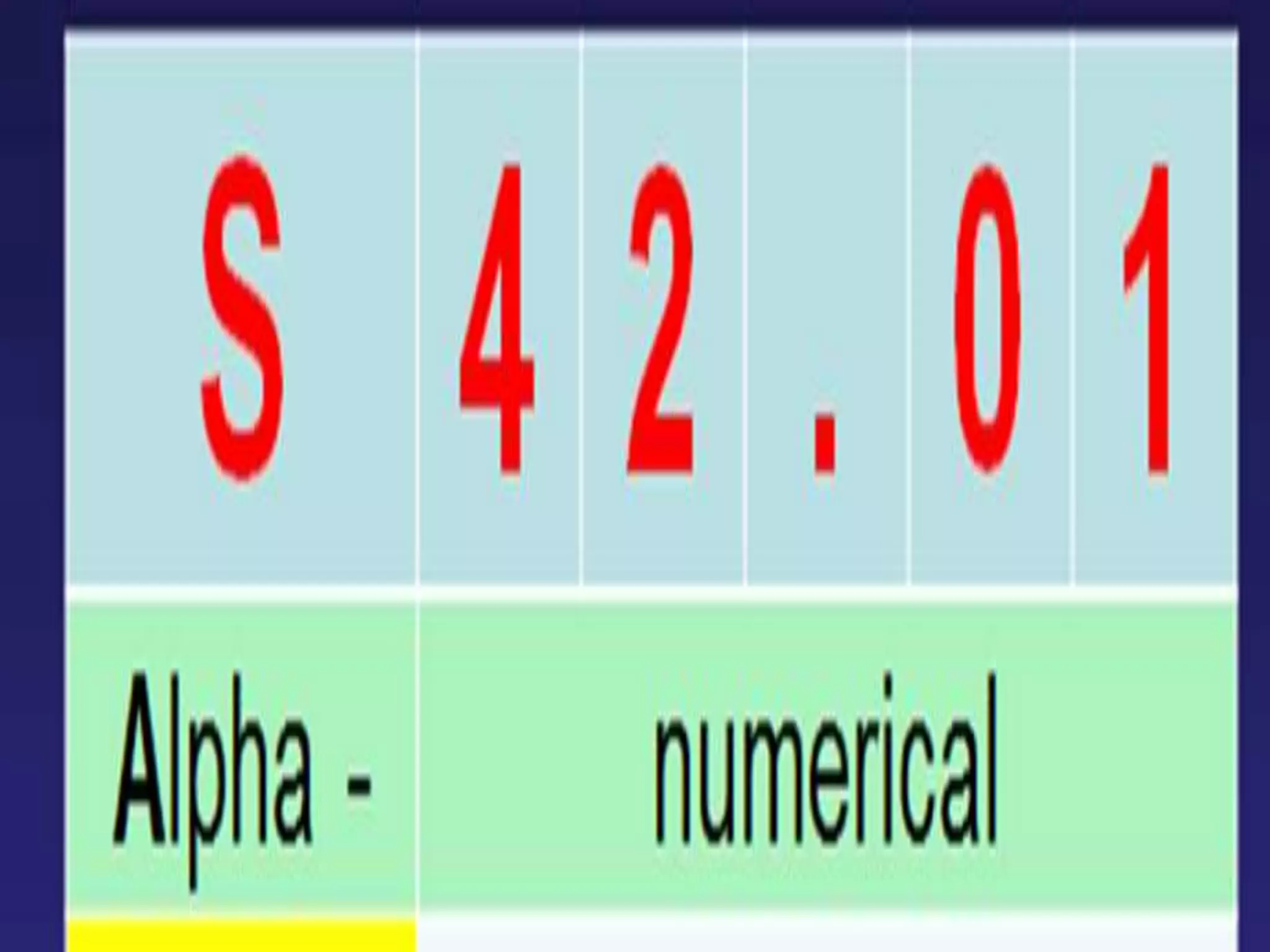
(S42.21)
Chapter XX
Subdivisions to indicate the type of activity being
undertaken at the time of the event (V05.13)
Notes
In some countries and data collection
systems, the point before the 4th character
may not be used, but for the purposes of
this course the point should be included in
all exercises.
Wherever possible, you should code to the 4-
character level because health information is
more useful if it is more specific.
Not all codes in ICD-10 have 4th characters,
e.g. G20 for Parkinson’s disease.
(M462)
(M46.2)
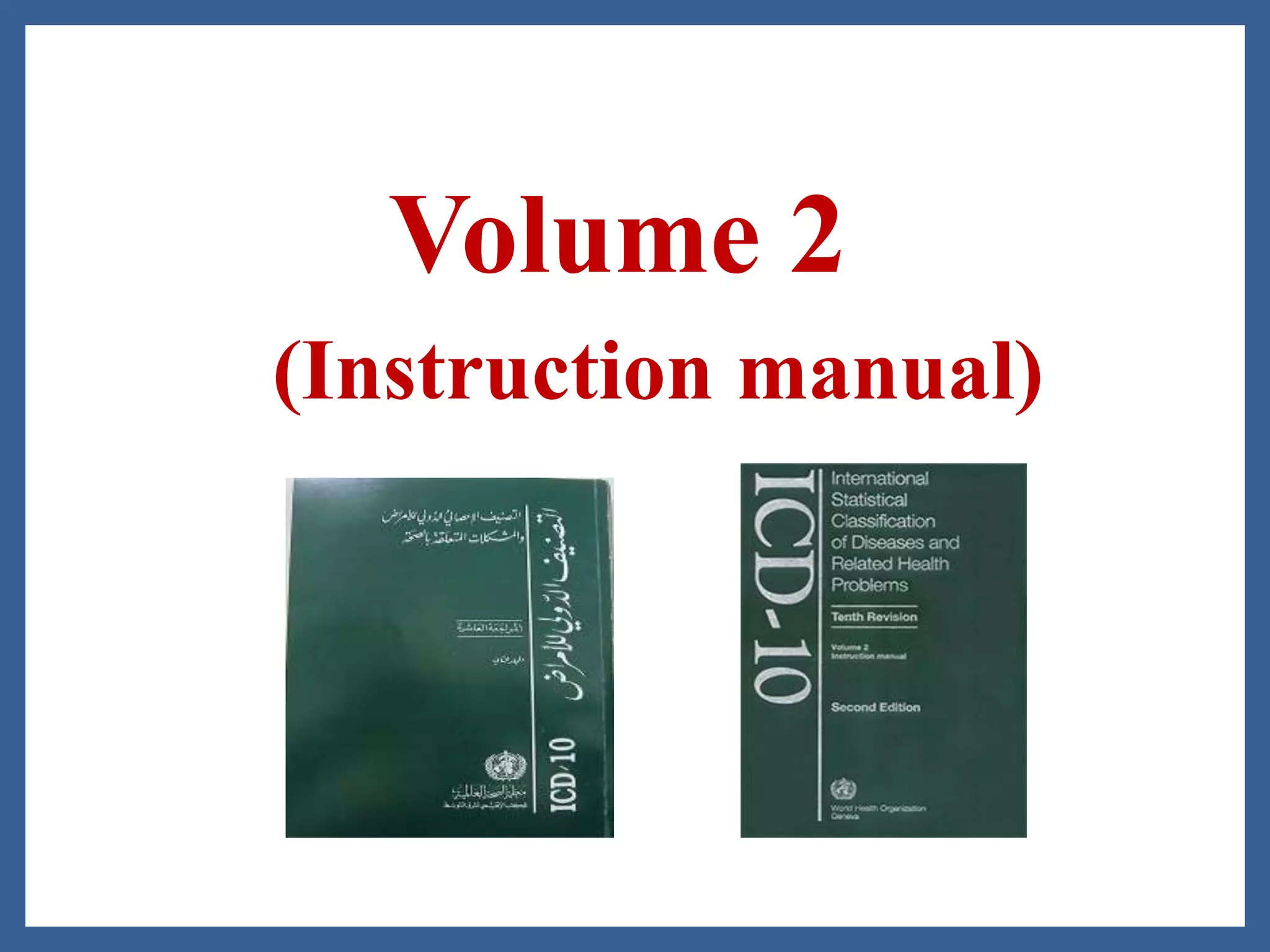
Volume 2
(Instruction manual)
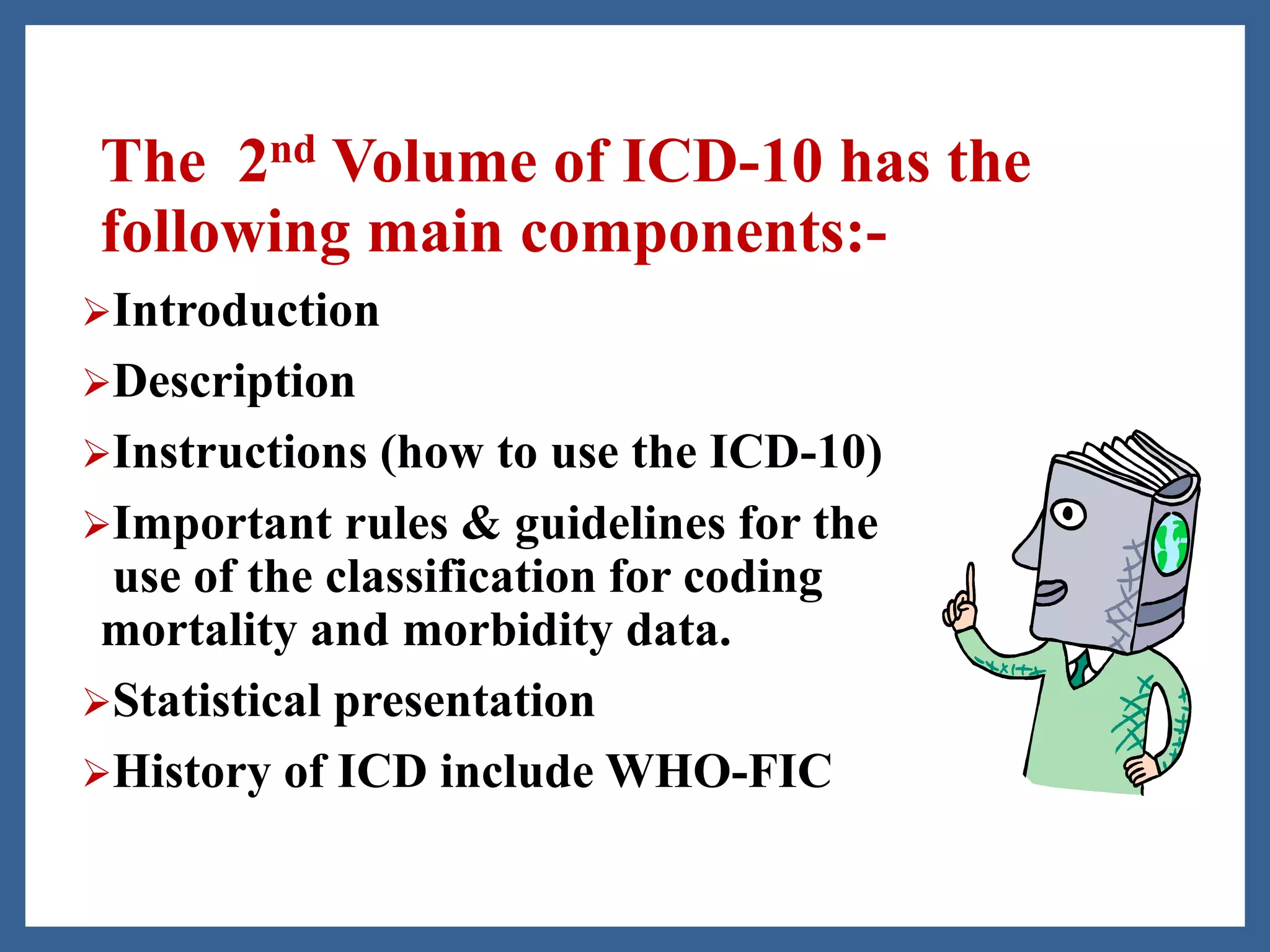
The 2nd Volume of ICD-10 has the
following main components:-
Introduction
Description
Instructions (how to use the ICD-10)
Important rules & guidelines for the
use of the classification for coding
mortality and morbidity data.
Statistical presentation
History of ICD include WHO-FIC
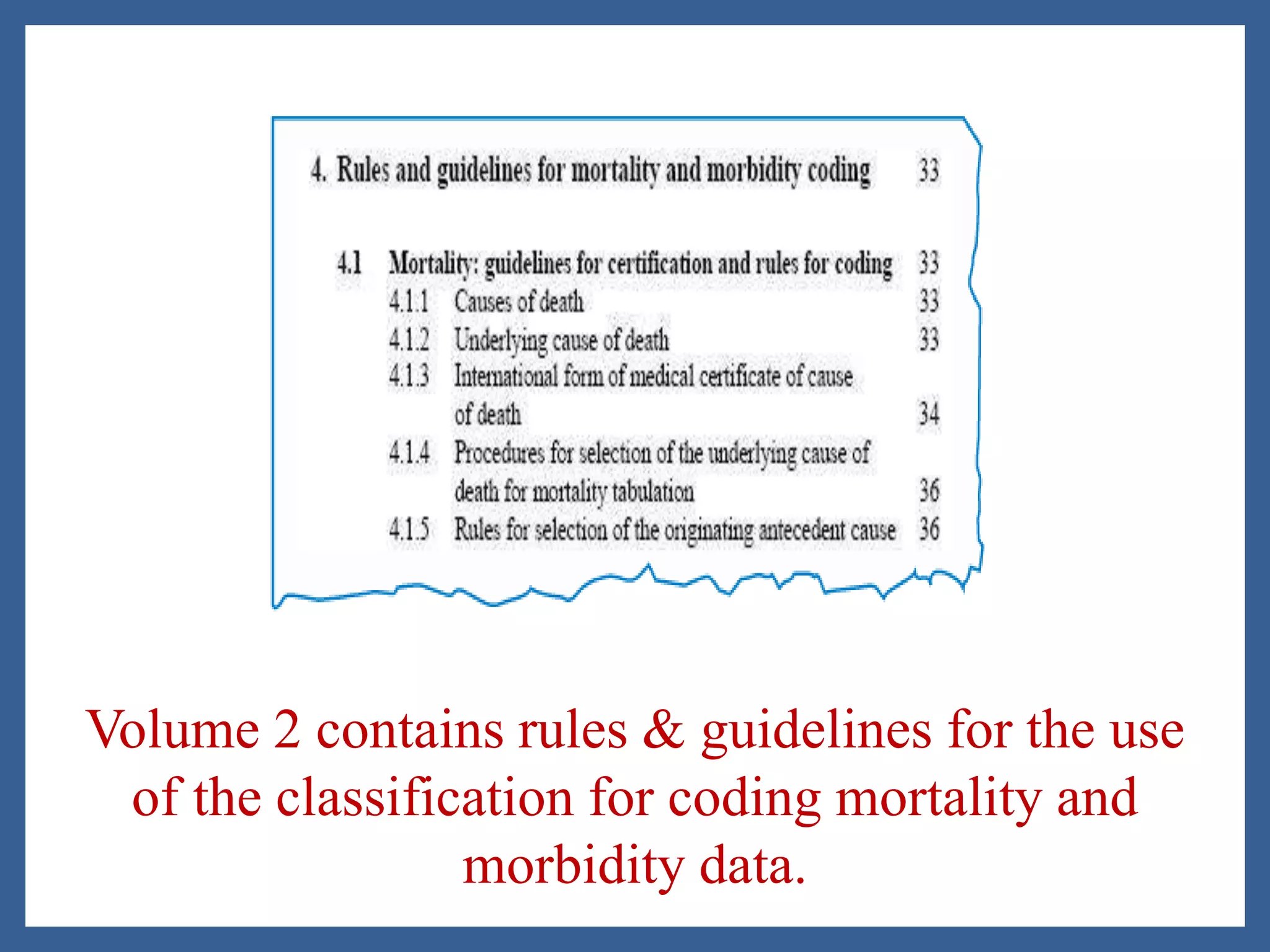
Volume 2 contains rules & guidelines for the use
of the classification for coding mortality and
morbidity data.
Volume 3
(Alphabetical Index)
The 3rd Volume is the INDEX to Volume 1.
 It has 3 sections:-
1. Alphabetical Index to all known diseases &
causes of injuries
2. External causes of injury
3. Tables of Drugs & Chemicals
Volume 3
The Alphabetical Index, is an Alphabetical List of the
diseases and conditions which have codes in the
Tabular List.
Volume 3
External causes of injuries
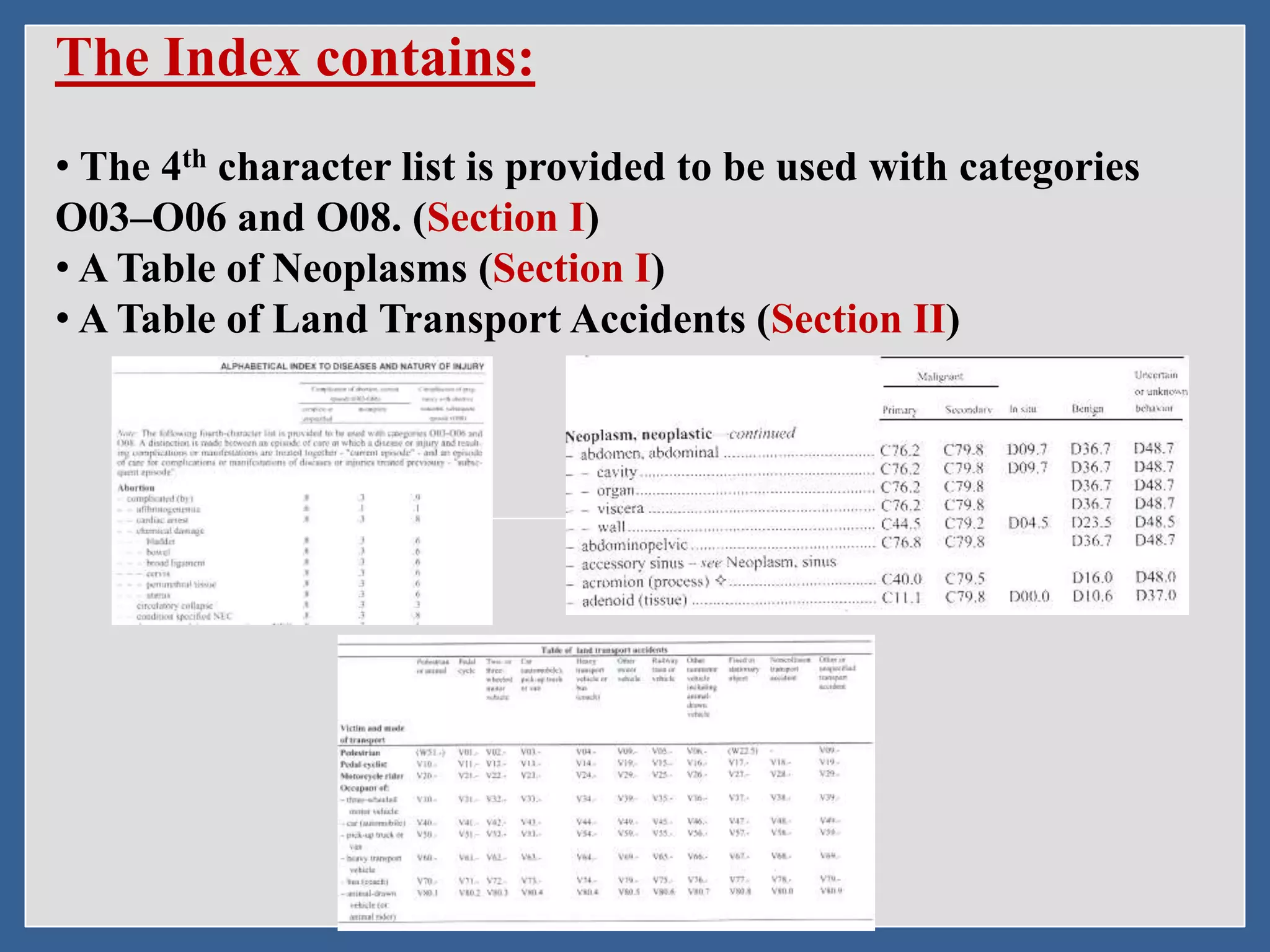
The Index contains:
• The 4th character list is provided to be used with categories
O03–O06 and O08. (Section I)
• A Table of Neoplasms (Section I)
• A Table of Land Transport Accidents (Section II)
How to code ?
Rule Number 1
Volumes 1 and 3 must be used together
( inseparable) to correctly find codes for each case
(e.g. cause of death or diagnosis).
 First, check the Index for a code representing your
diseases. Then, confirm your choice in the Tabular List
Rule Number 2
The Special Disease Categories Take Priority
Over The Body System Categories.
Example
Ali has a Neoplasm of the lung.
Would his illness be coded under:
•Chapter II Neoplasms or
•Chapter X Diseases of the Respiratory System?
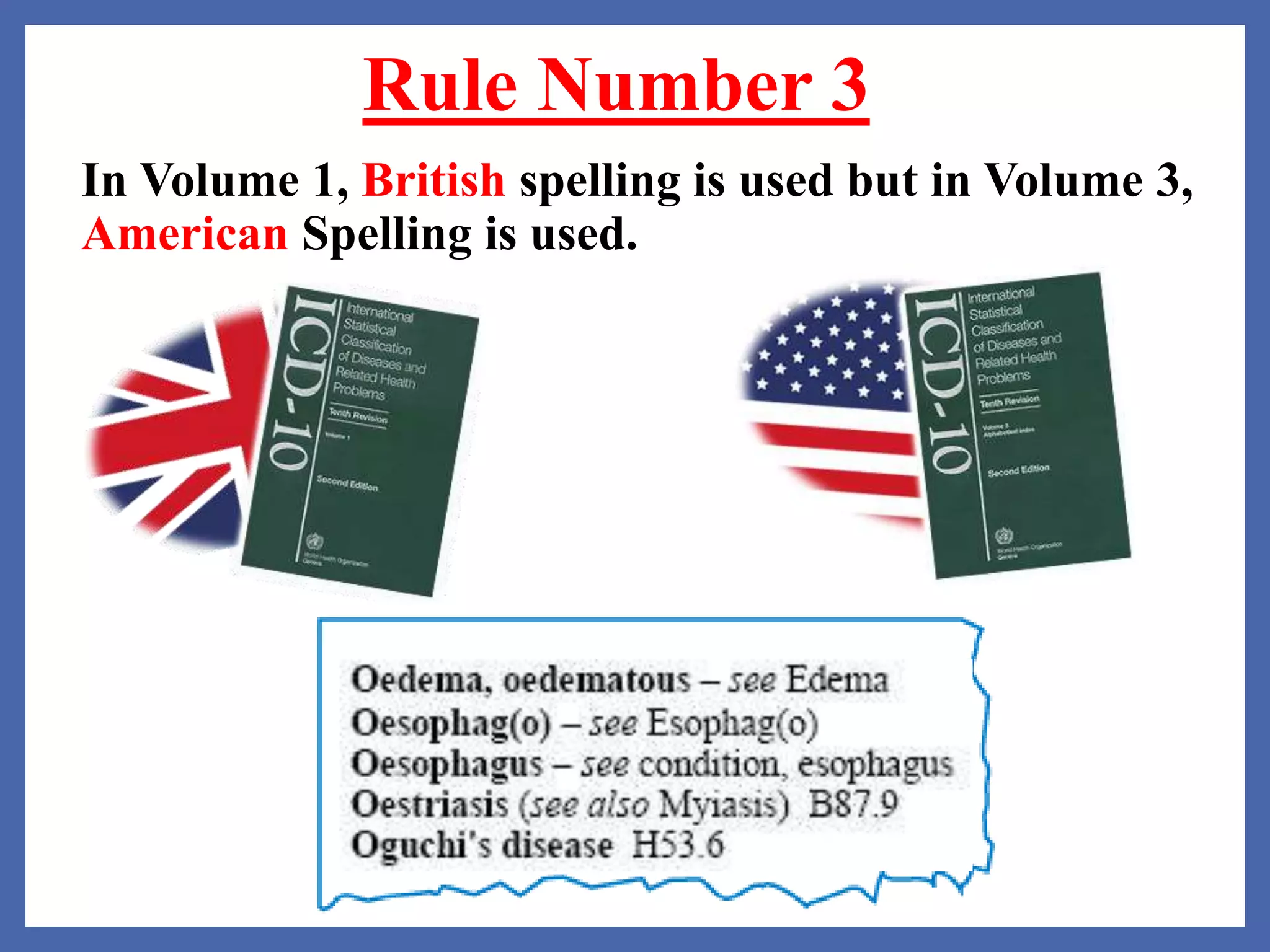
Rule Number 3
In Volume 1, British spelling is used but in Volume 3,
American Spelling is used.
NOTE
Example:
Doctor’s diagnosis:
“Chronic Viral Hepatitis, Type ‘C’ ”
Hepatitis K75.9
- Viral (Acute) B19.9
- - Chronic B18.9
- - - - Type‘C’ B18.2
The correct code: B18.2
Conclusion
The International Classification of Diseases is
 A way to capture mortality and morbidity data for
reporting
 Allows comparison of frequencies of e.g. causes of
death from community level up to the whole world.
Dr.abdelrahman training icd10 intro

Dr.abdelrahman training icd10 intro

  • 1.
    By Dr:Abdelrahman Shawky Ahmed ICD10 trainer-MOHP Master of Child Health and Nutrition Master of Pediatrics Ph.D studies in Care of Children with Special Needs
  • 2.
    Agenda 1. What isICD-10 ? 2. History 3. Benefits Of Using ICD 4. Uses of ICD-10 & Grouping 5. Basic structures of ICD-10 6. How to code ? 7. Conclusion
  • 3.
    What is ICD-10? International Statistical Classification of Diseases and Related Health Problems (Tenth Revision) is a system of coding created by the World Health Organization (WHO) that notes various medical records including diseases, symptoms, abnormal findings and external causes of injury. Classification= Standard (established Common Language) Grouping Of Diseases by a set of principles. International= as this Classification that is agreed upon by 195 countries. Disease= any Deviation from normal health.
  • 4.
    MentalPhysical Social Spiritual Health=the DynamicState Of Complete Wellbeing & Not Merely AbsenceOf A Disease Or Infirmity
  • 5.
    What is ICD-10? • ICD: is International Classification of Diseases introduced by WHO which translate diagnosis of diseases and other health problems from Words into an Alphanumerical Code to be used universally.
  • 7.
    Version vs Revision There are 9 Revisions produced by WHO before the current revision which is ICD 10. ‫المراجعة‬  Each Revision was subjected to change so many Versions were produced. ‫الطبعة‬
  • 8.
    1700’s 1893 18981900 1st 1910 2nd 1920 3rd 1930 1929 4th 1940 1938 5th 1950 1948 WHO 2 Volumes 6th 1960 1955 1957 7th 1970 1965 1968 8th 1980 1975 1977 9th 1990 1983 1992 10th 2000 2010 α-draft β-draft 2020 2010 2011 2015 2017 11th It has been developed internationally since 1893.There have been ten major revisions (so now it is named ICD-10). François Boissier de Sauvages de Lacroix (1706-1777) Nosologia methodica William Farr (1807-1883) Bills of Mortality Jacques Bertillon (1851-1922) History 1st International Conference, Paris WHO met in Geneva Use An Alphanumeric Coding Scheme Mixed Commission
  • 9.
    WHO Family ofInternational Classifications(FIC)  FIC was created in order to provide a Common Language for using health information both nationally and internationally.  The WHO Family of International Classifications in Health consists of Reference Classifications, Derived Classifications and Related Classifications.  These Classifications are the building blocks of health information used for measures to help provide the best possible health to all people.
  • 10.
    DerivedClassifications ‫التصانيف‬‫المشتقة‬ International Classification ofDisease for Oncology 3rd Ed. (ICD-O-3) ‫التصنيف‬‫األورام‬ ‫لعلم‬ ‫لألمراض‬ ‫الدولي‬- ‫الثالثة‬ ‫الطبعة‬ The ICD-10 Classification of Mental and Behavioral Disorders ‫لألمراض‬ ‫الدولي‬ ‫التصنيف‬-10‫تصنيف‬ ‫العقلية‬ ‫االضطرابات‬‫والسلوكية‬ Application of the International Classification of Diseases to Dentistry and Stomatology, 3rd Ed. (ICD-DA) ‫تطبيق‬‫الفم‬ ‫لطب‬ ‫لألمراض‬ ‫الدولي‬ ‫التصنيف‬ ‫واألسنان‬-‫الطبعة‬‫الثالثة‬ Application of the International Classification of Diseases to Neurology (ICD-10-NA) ‫لألمراض‬ ‫الدولي‬ ‫التصنيف‬ ‫تطبيق‬‫لطب‬ ‫األعصاب‬ International Classifications of Functioning, Disability and Health, Children Youth version (ICF-CY) ‫واإلعاقة‬ ‫لألداء‬ ‫الدولي‬ ‫التصنيف‬‫والصحة‬- ‫واليافعين‬ ‫األطفال‬ ‫إصدار‬ Reference Classifications ‫المرجعية‬ ‫التصانيف‬ International Classification of Disease (ICD) ‫لألمراض‬ ‫الدولي‬ ‫التصنيف‬ International Classifications of Functioning, Disability and Health (ICF) ‫لألداء‬ ‫الدولي‬ ‫التصنيف‬ ‫والصحة‬ ‫واإلعاقة‬ International Classifications of Health Interventions (ICHI) under development ‫التصانيف‬‫الدولي‬‫ة‬‫للتد‬‫ا‬‫خالت‬ ‫الصحية‬ ‫اإلعداد‬ ‫تحت‬ Related Classifications ‫التصانيف‬‫المرتبطة‬ International Classification of Primary Care (ICPC) ‫األولية‬ ‫للرعاية‬ ‫الدولي‬ ‫التصنيف‬ International Classification of External Causes of Injury (ICECI) ‫الخارجية‬ ‫لألسباب‬ ‫الدولي‬ ‫التصنيف‬ ‫لإلصابة‬ The Anatomical Therapeutic, Chemical (ATC) classification system Defined Daily Doses (DDD) ‫والعالجي‬ ‫التشريحي‬ ‫التصنيف‬ ‫يومية‬ ‫جرعات‬ ‫مع‬ ‫والكيميائي‬‫محددة‬ ISO 9999 Technical aids for persons with disabilities-Classification and Terminology ‫مساعدات‬‫ذوى‬ ‫لألشخاص‬ ‫تقنية‬ ISO 9999 ‫اإلعاقات‬-‫واصطالحات‬ ‫تصنيف‬ International Classification of Patient Safety (ICPS) ‫المريض‬ ‫ألمان‬ ‫الدولي‬ ‫التصنيف‬ International Classification of nursing Practice (ICNP) ‫التمريض‬ ‫للممارسة‬ ‫الدولي‬ ‫التصنيف‬‫ية‬
  • 11.
    So, Classifications areEssential •There are many diseases, and one needs to establish a Common Language for reporting and data analysis. •Standard grouping of diseases by a set of principles is called classification.
  • 12.
    ICD makes Diseasescount •To make people count, we first need to be able to count people. • ICD allows the counting of diseases, injuries, symptoms, reasons for factors that influence health status, and external causes of disease and death, such as accidents.
  • 13.
    Benefits &purpose OfUsing ICD ICD • Data Standardization and interpretation ICD • Easy Data Storage, retrieval & documentation ICD • Allow Counting for diseases,injuries, symptoms, reasons for encounter ICD • Allow counting for factors that influence health status, and external causes of disease and death, such as accidents ICD • forming a Common Framework and language to report, compare and use health information both nationally and internationally ICD • Data Comparison within populations over time and between different population at the same point of time
  • 14.
  • 15.
    ICD-10 has thepotential to improve patient care: 1. Precise description of diseases 2. Better data to fully comprehend patient medical history 3. Ability to track public health trends in more detail 4. Streamlined and accurate billing
  • 16.
    Use of ICDCodes •The ICD is designed to serve Mortality & Morbidity in: Public Health, Epidemiology, Prevention, Managing Health Care, Allocation Of Resources, Outcomes Monitoring, In Research, Clinical Context And Primary Care. •Information is Reported, Categorized, Analyzed, Presented, and decisions are based on these information at any level of a health system.
  • 17.
  • 18.
    ICD-10 Grouping •In ICD-10the information about Diseases and Conditions and their causes is grouped as follows: • Communicable diseases • General diseases that affect the whole body • Local diseases arranged by site • Developmental diseases • Injuries • External causes Variable Axial
  • 19.
    AVAILABILITY OF ICD-10 ICD-10comes either as: 1. Print form (3-volume-set) 2. WHO browser 3. WHO on-line browser: http://apps.who.int/classifications/apps/icd/icd10online/
  • 20.
    COMPONENTS OF ICD-10 ICD-10comes as a 3-volume-set of manuals I - Tabular List of Disease Conditions II - Instructions for Coding III - Alphabetic Index of Disease Conditions
  • 21.
  • 22.
    BASIC STRUCTURES OFICD-10 1. Volumes. 2. Chapters. A. Blocks. B. Three-character categories. C. Four-character subcategories.
  • 23.
  • 24.
    I-Volume 1 The TabularList, is an alphanumeric listing of diseases, disease groups and health related problems in 22 chapters. It contains Inclusions and Exclusions notes and some coding rules. Volume I has 4 main components:- •A short list of 3-character Categories •A detailed list of (4& 5)-character Subcategories for all diseases & causes of injury •A comprehensive list of the Morphology of Neoplasms. •Specialized short-lists for mortality & morbidity coding.
  • 25.
    VOLUME 1 CHAPTERS eg. ChapterX=Diseases of the Respiratory System (J00-J99) BLOCKS eg. Acute Lower Respiratory Infections (J20-J22) 3-CHARACTER CATEGORIES eg. Acute Bronchitis (J20) 4-CHARACTER SUB-CATEGORIES eg. Acute Bronchitis due to Streptococcus (J20.2) Is divided into Which have Which are divided into Which contain the
  • 27.
    Chapters of Volume1 has 22 Chapters: arranged in Latin Numbers NB: When referring to a chapter, you should call it by its chapter number and not by the letters of the codes associated with it. • Chapters I – XVII provide codes to all diseases • Chapter XVIII covers Symptoms & Signs • Chapter XIX codes for physical injuries & poisonings • Chapter XX provides codes only for EXTERNAL causes of morbidity & mortality • Chapter XXI compiles codes for all factors influencing health status & contact with health services of a person NOT currently sick (eg. Fitness tests, immunizations, contraceptive management, ante- & postnatal care, etc.) • Chapter XXII codes for Special Purposes
  • 28.
    Chapters I –XVII (A-Q) provide codes to all Diseases • Some are associated with Particular Body Systems. Chapter XI relates to Diseases of the digestive system Chapter X is for Diseases of the respiratory system. •Others are associated with Special Diseases – (these are to capture types of diseases which might affect either the Whole body or many different sites or are considered Systemic).  Chapter II Neoplasms Chapter XV Pregnancy, Childbirth and the Puerperium.
  • 29.
    Diseases of aspecific body system VI-Nervous VII-Eye VIII-Ear IX-Circulatory X-Respiratory XI-Digestive XII-Skin XIII-MsSk XIV-GU XXII-Special Purposes Special diseases I-Infections II-Neoplasms III-Blood IV-Endocrine V-Psych XV-Obestet XVI-Perinatal XVII-C Anomalies XIX-Nature of Inj &Pois
  • 30.
    Chapter XX isfor coding External causes of morbidity and mortality. Chapter XXI is for coding Factors influencing health status and contact with health services. We call these external factors.
  • 31.
    Chapter XVIII isused to code Symptoms, signs and abnormal clinical and laboratory findings, not elsewhere classified. IT IS THE ONLY GENERAL CHAPTER
  • 32.
    Chapters of Volume1 A+B = AntiBiotic = infection (bacterial & others) = 1 C+½D = Cancer = 2 ½D = blooD = 3 E = Endocrinal (+ nut. & metab.) = 4 F = Foolish = Psychiatric = 5 G = NeuroloGical = 6 H = Head I = Ischemic Heart = 9 J = = 10 K = exKreta = GIT = 11 L = DermatoLogy = 12 M = MsSk = 13 N = uriNe = GU = 14 O = Obs = 15 P = Paby = Perinatal = 16 Q = Qongenital = 17 R = Rest = Symptoms & Signs = 18 ST = SiTe (nature) of injuries & poisonings = 19 VWXY = EXTERNAL causes of injuries & poisonings = 20 Z = ViZit = contact with health services, not currently sick = 21 U = codes for Special PUrposes = 22 Eye =⅔H = 7 Ear =⅓H = 8
  • 33.
    Chapter number Title ofthe chapter Range of the chapter (3-character categories) Inclusions & exclusions at the chapter level
  • 34.
    Within each chapter,codes are grouped into blocks. Blocks are groups which represent related conditions. You will see a list of the blocks at the beginning of each chapter. Volume 1
  • 35.
    The ICD-10 isdivided into chapters. Each chapter is identified by a Roman numeral (i.e. I, II, III, IV, V etc.) and a title. The Chapters are further divided into blocks which group together categories having some common factor. Blocks are divided into categories (3-character codes), and these in turn may be subdivided into subcategories (4-character). Certain codes also have a 5th optional supplementary characters to add more detail. chapter Sub category block category
  • 36.
    List Of TheMorphology Of Neoplasms
  • 37.
  • 38.
    A Typical ICD-10Code Look Like This: J 2 0 . 2 1st Character 2nd & 3rd Characters A Decimal Point 4th Character (A – Z) (Numbers 00-99) ( . ) (Numbers 0-9)
  • 40.
    A 0 00 1 9 1 9 1 9 B Z 26 X 10 X 10 X 10 ……… ………………… … … … …………………………..… 12514 26000
  • 41.
    5-character additional (optional)sub-categories: ICD-10 allows certain conditions to be classified at the 5th Character level. These additional SUB-CATEGORIES are found in: Chapter XIII Subdivisions by anatomical site (M46.25) Chapter XIX Subdivisions to indicate open & close fractures. Also, internal injuries, with or without open wound (S42.21) Chapter XX Subdivisions to indicate the type of activity being undertaken at the time of the event (V05.13)
  • 42.
    Notes In some countriesand data collection systems, the point before the 4th character may not be used, but for the purposes of this course the point should be included in all exercises. Wherever possible, you should code to the 4- character level because health information is more useful if it is more specific. Not all codes in ICD-10 have 4th characters, e.g. G20 for Parkinson’s disease. (M462) (M46.2)
  • 43.
  • 44.
    The 2nd Volumeof ICD-10 has the following main components:- Introduction Description Instructions (how to use the ICD-10) Important rules & guidelines for the use of the classification for coding mortality and morbidity data. Statistical presentation History of ICD include WHO-FIC
  • 45.
    Volume 2 containsrules & guidelines for the use of the classification for coding mortality and morbidity data.
  • 46.
  • 47.
    The 3rd Volumeis the INDEX to Volume 1.  It has 3 sections:- 1. Alphabetical Index to all known diseases & causes of injuries 2. External causes of injury 3. Tables of Drugs & Chemicals
  • 48.
    Volume 3 The AlphabeticalIndex, is an Alphabetical List of the diseases and conditions which have codes in the Tabular List.
  • 49.
  • 50.
    The Index contains: •The 4th character list is provided to be used with categories O03–O06 and O08. (Section I) • A Table of Neoplasms (Section I) • A Table of Land Transport Accidents (Section II)
  • 51.
  • 52.
    Rule Number 1 Volumes1 and 3 must be used together ( inseparable) to correctly find codes for each case (e.g. cause of death or diagnosis).  First, check the Index for a code representing your diseases. Then, confirm your choice in the Tabular List
  • 53.
    Rule Number 2 TheSpecial Disease Categories Take Priority Over The Body System Categories.
  • 54.
    Example Ali has aNeoplasm of the lung. Would his illness be coded under: •Chapter II Neoplasms or •Chapter X Diseases of the Respiratory System?
  • 55.
    Rule Number 3 InVolume 1, British spelling is used but in Volume 3, American Spelling is used.
  • 56.
    NOTE Example: Doctor’s diagnosis: “Chronic ViralHepatitis, Type ‘C’ ” Hepatitis K75.9 - Viral (Acute) B19.9 - - Chronic B18.9 - - - - Type‘C’ B18.2 The correct code: B18.2
  • 57.
    Conclusion The International Classificationof Diseases is  A way to capture mortality and morbidity data for reporting  Allows comparison of frequencies of e.g. causes of death from community level up to the whole world.