Building Your Path
to ICD-10
Embracing ICD-10 with Confidence
An educational program presented by the
Cooperative of American Physicians, Inc.
2
Today’s Agenda
 Overview of ICD-10-CM
 An Up-to-Date Review
 The Effects of ICD-10-CM on Your Practice
 Using Technology Effectively
 Differences Between ICD-9 and ICD-10
 What You Need to Know
 Determining Your Most Commonly Used Codes
 Clinical Documentation
 Provider Challenges 3
The New (Latest) Deadline
October 1, 2015
4
Why ICD-10?
 Improve Clinical Communications
 More (better) data
 Signs
 Symptoms
 Risk Factors
 Comorbidities
 Allow U.S. to exchange information internationally
5
What Is ICD-10?
 International Classification of Diseases
 ICD-10-CM: diagnosis code set
Updated version of ICD-10-CM Volumes 1 and 2
 ICD-10-PCS: code set of inpatient procedure
codes
Updated version of ICD-9-CM Volume 3
6
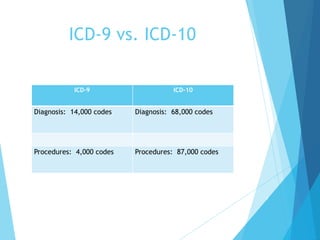
ICD-9 vs. ICD-10
ICD-9 ICD-10
Diagnosis: 14,000 codes Diagnosis: 68,000 codes
Procedures: 4,000 codes Procedures: 87,000 codes
7
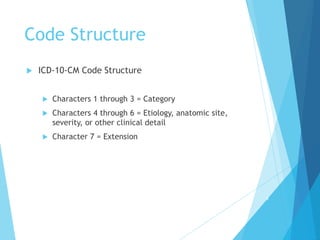
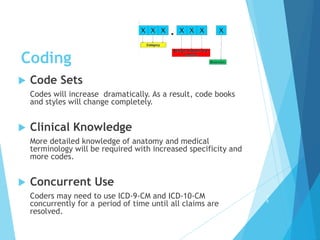
Code Structure
 ICD-10-CM Code Structure
 Characters 1 through 3 = Category
 Characters 4 through 6 = Etiology, anatomic site,
severity, or other clinical detail
 Character 7 = Extension
8
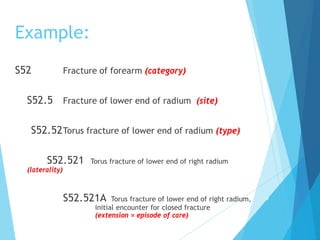
Example:
S52 Fracture of forearm (category)
S52.5 Fracture of lower end of radium (site)
S52.52Torus fracture of lower end of radium (type)
S52.521 Torus fracture of lower end of right radium
(laterality)
S52.521A Torus fracture of lower end of right radium,
initial encounter for closed fracture
(extension = episode of care)
9
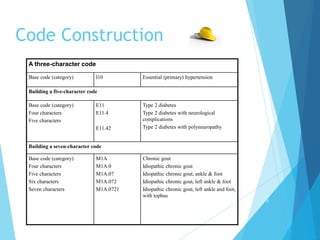
Code Construction
A three-character code
Base code (category) I10 Essential (primary) hypertension
Building a five-character code
Base code (category)
Four characters
Five characters
E11
E11.4
E11.42
Type 2 diabetes
Type 2 diabetes with neurological
complications
Type 2 diabetes with polyneuropathy
Building a seven-character code
Base code (category)
Four characters
Five characters
Six characters
Seven characters
M1A
M1A.0
M1A.07
M1A.072
M1A.0721
Chronic gout
Idiopathic chronic gout
Idiopathic chronic gout, ankle & foot
Idiopathic chronic gout, left ankle & foot
Idiopathic chronic gout, left ankle and foot,
with tophus 1
0
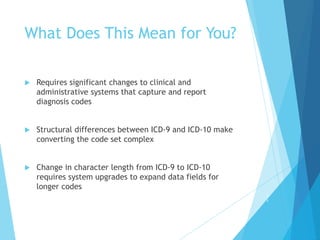
What Does This Mean for You?
 Requires significant changes to clinical and
administrative systems that capture and report
diagnosis codes
 Structural differences between ICD-9 and ICD-10 make
converting the code set complex
 Change in character length from ICD-9 to ICD-10
requires system upgrades to expand data fields for
longer codes
1
1
ICD-10
And YOUR Practice
Front Desk
 HIPAA
Privacy policies may need to be revised and patients
will need to sign the new forms
 SYSTEMS
Updates to systems are likely required and may impact
patient encounters
1
3
Clinical Areas
 Patient Coverage
Health plan policies, payment limitations, and new ABN
forms are likely
 Superbills
Revisions required – paper superbills may be impossible
 ABNs
Health plans will revise all policies linked to LCDs or
NCDs, etc., ABN forms must be reformatted and patients
will require education
1
4
Nurses / Medical Assistants
 Forms
Every order must be revised or recreated
 Documentation
Must use increased specificity
 Prior Authorizations
Policies may change, requiring training and updates
1
5
Physicians & Extenders
 Documentation
The need for specificity dramatically increases by
requiring laterality, stages of healing, weeks in
pregnancy, episodes of care, and much more
 Code Training
Codes increase from 17,000 to 140,000 – Physicians
must be trained
1
6
Lab
 Documentation
Must use increased specificity
 Reporting
Health plans will have new requirements for the
ordering and reporting of services
1
7
Coding
 Code Sets
Codes will increase dramatically. As a result, code books
and styles will change completely.
 Clinical Knowledge
More detailed knowledge of anatomy and medical
terminology will be required with increased specificity and
more codes.
 Concurrent Use
Coders may need to use ICD-9-CM and ICD-10-CM
concurrently for a period of time until all claims are
resolved.
1
8
BILLING
 Policies & Procedures
All payer reimbursement policies may be revised.
 Training
Billing department must be trained on new policies and
procedures and the ICD-10-CM code set.
1
9
Managers
 New Policies & Procedures
Any policy or procedure associated with a diagnosis code,
disease management, tracking, or PQRS must be revised.
 Vendor & Payer Contracts
All contracts must be evaluated and updated.
 Budgets
Changes to software, training, new contracts, new
paperwork will have to be paid for.
 Training Plan
Everyone in the practice will need training on the
changes.
2
0
Let’s Get Moving!
2
1
It Comes Down to These Four Things!
1. Prepare a Project Plan
2. Perform an Impact Analysis
3. Begin Implementation
4. Convert to ICD-10 and Monitor
2
2
Let’s Get Started!
Get Your Team Together!
2
3
Eight Tasks to Get Started
1. Identify your current systems and work processes
that use ICD-9 codes
i. Administrative
ii. Clinical
iii. Reporting
2. Talk with your practice management system
vendor about accommodations for ICD-10 codes
i. Review current contract
ii. Is there an expense?
2
4
Tasks:
3. Discuss implementation plans with all
clearinghouses, billing services, and payers to
facilitate a smooth transition
i. Know their implementation plans
ii. Can they accommodate both code sets?
4. Talk with payers about how ICD-10
implementation might affect provider contracts
i. Coverage determination policies
ii. Payment schedules 2
5
Tasks
5. Identify potential change to workflow and
business processes
i. Clinical documentation
ii. Encounter forms or “superbills”
iii. Quality reporting
iv. Public health reporting
2
6
Tasks
6. Assess staff training needs
i. Focus on learning ICD-10 code set and any workflow
changes
a. Clinical – understand how documentation will affect the
ability to code and bill
b. Administrative – understand the effects on
preauthorization and referrals
c. Coding – may need the most training
2
7
Tasks
7. Conduct test transactions using ICD-10 codes
with payers and clearinghouses
i. Consider “dual” coding
a. Coding and Billing in both ICD-9 and ICD-10
 Helps you prepare for ICD-10 and mitigate the risk of
denied claims
ii. Watch for testing periods
 Clearinghouse
 Payers 2
8
Tasks
8. Budget for time and costs related to ICD-10
implementation
i. System changes
ii. Resource materials
iii. Training
iv. Reserve fund
2
9
Technology
and
ICD-10
31
Assessing Your Systems
Survey Your Technology Vendors Now . . . .
It is imperative that you understand their plans, so you
can make your transitions plans. ASK:
 What are they doing for ICD-10?
 When are they doing it?
 Will you have access to both ICD-9 and ICD-
10 in your PMS & EMR?
 Will GEMs be to used to convert current
code databases?
32
Prepare for the Transition
 Identify all internal systems that utilize ICD-10
 Understand the changes that are being made to
each
 Database changes to one application/system CAN
affect all other interfaced systems
 Determine the impacts on staff, process, and
other systems
33
Prepare for the Transition
 Create a transition timeline by system
 Identify any new technologies you require
 EMR *
 Code Mapping
 Project Management Tools
*If you are not currently using an EMR, ICD-10 is
the time to seriously consider this addition to
your practice.
34
Understanding GEMs
 Technology vendors most likely are going
to utilize or offer you some variation of
GEMs. The GEMs act as a translation
dictionary to bridge the language gap
between ICD-9–CM and ICD-10-CM/PCS
 The General Equivalency Mappings (GEMs)
database was created by CMS and CDC to
help users understand, analyze, and
manage the translation of one code set to
the other. They also help users create
their own applied mappings as needed.
35
Understanding GEMs
 GET FAMILIAR with this database. It has
both the potential to help tremendously
with this transition to ICD-10 and cause
confusion. ICD-10 is not as simple as one-
to-one mapping in many cases, and level
of detail required will create the need to
evaluate many codes that come from the
mapping
Translation Programs / Software
 Some come with your software
 Some can be purchased
 Some are free
 Icd9data.com and icd10data.com
 AAPC
Beware: Use in conjunction with your books – not instead of!
Some are not detailed enough!
36
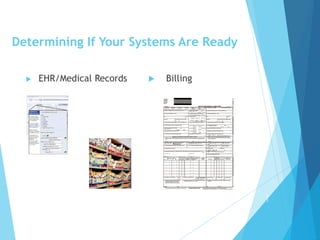
Determining If Your Systems Are Ready
 EHR/Medical Records  Billing
3
7
Ask Vendors
 How will your application, business processes, or system
address my needs during the ICD-10 implementation?
 What is your timeline for the ICD-10 transition?
 What is your migration strategy for making the change to
ICD-10?
3
8
Ask Vendors
 Do you offer an ICD-9/ICD-10 Comparison Utility ?
 When will we test our system with trading partners?
 Will you be upgrading my current system to
accommodate the ICD-10 codes?
 Are you training your staff on the ICD-10 system
updates? 3
9
Ask Vendors
 Can we use your products to search for codes by
the ICD-10 alphabetic and tabular indexes?
 Do you allow our staff to search codes by clinical
concept?
 Will you maintain tables for each code set?
 How long will ICD-9 be available for use? 4
0
Ask Vendors
 Will you ensure we have the right tools in place to
help select the more specific diagnosis codes?
 Will you provide specific provider templates for each
specialty?
4
1
ICD-9-CM vs. ICD-10-CM
The Differences You Need to Know
42
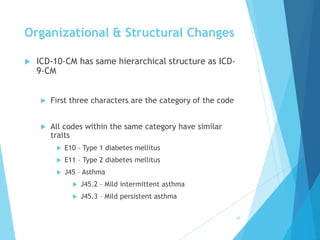
Organizational & Structural Changes
 ICD-10-CM has same hierarchical structure as ICD-
9-CM
 First three characters are the category of the code
 All codes within the same category have similar
traits
 E10 – Type 1 diabetes mellitus
 E11 – Type 2 diabetes mellitus
 J45 – Asthma
 J45.2 – Mild intermittent asthma
 J45.3 – Mild persistent asthma
43
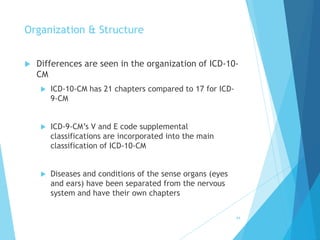
Organization & Structure
 Differences are seen in the organization of ICD-10-
CM
 ICD-10-CM has 21 chapters compared to 17 for ICD-
9-CM
 ICD-9-CM’s V and E code supplemental
classifications are incorporated into the main
classification of ICD-10-CM
 Diseases and conditions of the sense organs (eyes
and ears) have been separated from the nervous
system and have their own chapters
44
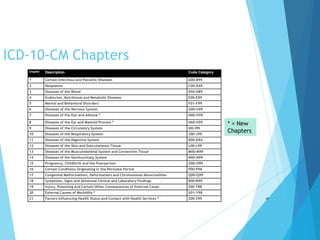
Chapter Description Code Category
1 Certain Infectious and Parasitic Diseases A00-B99
2 Neoplasms C00-D49
3 Diseases of the Blood D50-D89
4 Endocrine, Nutritional and Metabolic Diseases E00-E89
5 Mental and Behavioral Disorders F01-F99
6 Diseases of the Nervous System G00-G99
7 Diseases of the Eye and Adnexa * H00-H59
8 Diseases of the Ear and Mastoid Process * H60-H95
9 Diseases of the Circulatory System I00-I99
10 Diseases of the Respiratory System J00-J99
11 Diseases of the Digestive System K00-K94
12 Diseases of the Skin and Subcutaneous Tissue L00-L99
13 Diseases of the Musculoskeletal System and Connective Tissue M00-M99
14 Diseases of the Genitourinaty System N00-N99
15 Pregnancy, Childbirth and the Puerperium O00-O99
16 Certain Conditions Originating in the Perinatal Period P00-P96
17 Congenital Malformations, Deformations and Chromosomal Abnormalities Q00-Q99
18 Symptoms, Signs and Abnormal Clinical and Laboratory Findings R00-R99
19 Injury, Poisoning and Certain Other Consequences of External Cause S00-T88
20 External Causes of Morbidity * V01-Y98
21 Factors Influencing Health Status and Contact with Health Services * Z00-Z99 45
ICD-10-CM Chapters
* = New
Chapters
Differences from ICD-9 to ICD-10
 Certain diseases have been reclassified (or
reassigned) to a more appropriate chapter in
ICD-10-CM
 Gout has been reclassified from the endocrine
chapter in ICD-9 to the musculoskeletal chapter
in ICD-10
4
6
Differences
 ICD-9-CM classified injuries by type; ICD-10-CM
groups injuries first by specific site (e.g., head,
arm, leg) and then by type of injury (e.g.,
fracture, open wound)
 Post-operative complications have been moved
to procedure-specific body system chapters
47
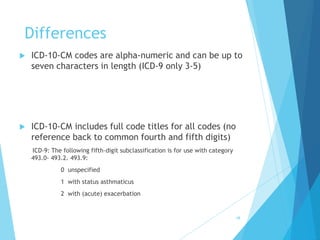
Differences
 ICD-10-CM codes are alpha-numeric and can be up to
seven characters in length (ICD-9 only 3-5)
 ICD-10-CM includes full code titles for all codes (no
reference back to common fourth and fifth digits)
ICD-9: The following fifth-digit subclassification is for use with category
493.0- 493.2. 493.9:
0 unspecified
1 with status asthmaticus
2 with (acute) exacerbation
48
Differences
 Addition of sixth character in some chapters
 Addition of seventh character for obstetrics,
injuries, and external causes of injuries
 Addition of placeholder X
49
Using A Placeholder
 Placeholder Character
 “X” is used as a placeholder at certain codes to allow for
future expansion
 Poisoning, adverse effect, and underdosing codes (T36-T50)
 T36.0X1A Poisoning by penicillins, accidental (unintentional),
initial encounter
 T36.0X2A Poisoning by penicillins, intentional self-harm
 T36.0X3A Poisoning by penicillins, assault
 T36.0X4A Poisoning by penicillins, undetermined
 T36.0X5A Adverse effect of penicillins
 T36.0X6A Underdosing of penicillins
50
Another Placeholder Example
 Contact with a cat
 W55.0
 W55.01XD Bitten by a cat, subsequent encounter
 W55.03XD Scratched by cat, subsequent
encounter
 W55.09XD Other contact with cat
51
7th Characters
 Certain ICD-10-CM categories have applicable 7th
characters. The applicable 7th character is
required for all codes within the category, or as
the notes in the Tabular List instruct. The 7th
character must always be the 7th character in
the data field. If a code that requires a 7th
character is not 6 characters, a placeholder X
must be used to fill in the empty characters.
52
New Features in ICD-10-CM
 Combination codes for conditions and common
symptoms or manifestations
 E10.21, Type 1 diabetes mellitus with diabetic
nephropathy
 I25.110, Atherosclerotic heart disease of native coronary
artery with unstable angina pectoris
 K50.112, Crohn’s disease of large intestine with
intestinal obstruction
 Combination codes for poisonings and external causes
 T36.0X1D, Poisoning by penicillin, accidental
(unintentional), subsequent encounter
 T42.4X5A, Adverse effect of benzodiazepines, initial
encounter
5
3
New Features
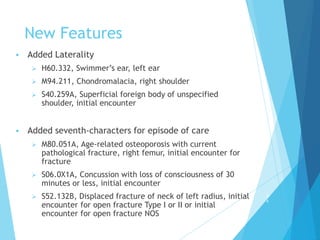
 Added Laterality
 H60.332, Swimmer’s ear, left ear
 M94.211, Chondromalacia, right shoulder
 S40.259A, Superficial foreign body of unspecified
shoulder, initial encounter
 Added seventh-characters for episode of care
 M80.051A, Age-related osteoporosis with current
pathological fracture, right femur, initial encounter for
fracture
 S06.0X1A, Concussion with loss of consciousness of 30
minutes or less, initial encounter
 S52.132B, Displaced fracture of neck of left radius, initial
encounter for open fracture Type I or II or initial
encounter for open fracture NOS
5
4
New Features
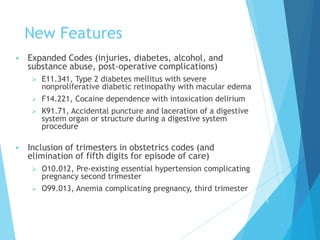
 Expanded Codes (injuries, diabetes, alcohol, and
substance abuse, post-operative complications)
 E11.341, Type 2 diabetes mellitus with severe
nonproliferative diabetic retinopathy with macular edema
 F14.221, Cocaine dependence with intoxication delirium
 K91.71, Accidental puncture and laceration of a digestive
system organ or structure during a digestive system
procedure
 Inclusion of trimesters in obstetrics codes (and
elimination of fifth digits for episode of care)
 O10.012, Pre-existing essential hypertension complicating
pregnancy second trimester
 O99.013, Anemia complicating pregnancy, third trimester
5
5
New Features
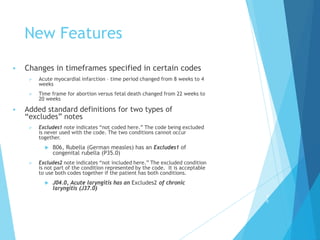
 Changes in timeframes specified in certain codes
 Acute myocardial infarction – time period changed from 8 weeks to 4
weeks
 Time frame for abortion versus fetal death changed from 22 weeks to
20 weeks
 Added standard definitions for two types of
“excludes” notes
 Excludes1 note indicates “not coded here.” The code being excluded
is never used with the code. The two conditions cannot occur
together.
 B06, Rubella (German measles) has an Excludes1 of
congenital rubella (P35.0)
 Excludes2 note indicates “not included here.” The excluded condition
is not part of the condition represented by the code. It is acceptable
to use both codes together if the patient has both conditions.
 J04.0, Acute laryngitis has an Excludes2 of chronic
laryngitis (J37.0)
5
6
Determining
Your Most Commonly Used
Codes
57
Begin Now:
1. Generate a report from your practice management
system that identifies all ICD-9 codes used for the past
12 months
1. Sort by frequency
2. Determine your 25-50 most frequently used codes
3. Convert those codes to ICD-10-CM codes
1. Determine differences from ICD-9-CM
2. Determine documentation variables
4. Audit clinical documentation to make sure it supports
the coding 58
Clinical Documentation
Challenges with ICD-10-CM
59
Clinical Documentation
 Golden Rule: If it’s not documented by the physician/provider,
it did not happen; therefore, it cannot be coded or billed
 Objective: To ensure medical record documentation is
documented to the fullest extent possible in order to support
the greater specificity afforded in the ICD-10-CM (Clinical
Modification) code set
 Some documentation issues will require physicians/providers to
capture new information
 Others involve updated, modified, and otherwise expanded
documentation needs
60
Some Facts:
 ICD-10-CM contains multiple combination codes, so
documentation must reflect the association between
conditions
Example:
ICD-10: K50.814 – Crohn’s disease of both small and
large intestine with abscess
ICD-9: 555.2 – Regional enteritis, small intestine with
large intestine and
569.5 – Abscess of intestine
61
Facts:
 Laterality needs to be documented
Example:
ICD-10: M05.271 – Rheumatoid vasculitis with
rheumatoid arthritis of right
ankle and foot
ICD-9: 714.27 – Rheumatoid arthritis with visceral or
systemic involvement, ankle and foot
62
Documentation Challenges
 Diabetes Mellitus
 ICD-10 = 200 codes
 ICD-9 = 59 codes
 Multiple combination codes are available – the provider will
need to document complications to allow for accurate code
selection
 E10.40 Type 1 diabetes mellitus with diabetic neuropathy,
unspecified
 E10.41 Type 1 diabetes mellitus with diabetic mononeuropathy
 E10.42 Type 1 diabetes mellitus with diabetic polyneuropathy
 E10.43 Type 1 diabetes mellitus with diabetic autonomic
(poly)neuropathy
 E10.44 Type 1 diabetes mellitus with diabetic amyotrophy
 E10.49 Type 1 diabetes mellitus with other diabetic neurological
complication
 An additional code must be used to report insulin use – Z79.4
63
Documentation Challenges
 Injuries – ICD-10-CM features an expanded category for
injuries
 Seventh character extension identifies the encounter type:
 A = initial encounter
 D = subsequent encounter for fracture with routine healing
 G = subsequent encounter for fracture with delayed healing
 S = sequela of fracture
 Size and depth of the injury must be coded – needs to be captured
from provider’s documentation
 Cause of the injury should be documented and coded
64
Documentation Challenges
 Drug Underdosing – a new code in ICD-10-CM that identifies
situations in which a patient has taken less of a medication than
prescribed by the physician
 Medical condition is sequenced first
 Underdosing code is listed as a secondary diagnosis
 Additional code explains why the patient is not taking the
medication (e.g., financial reasons)
Since this is new, many physicians will not be in the habit of
documenting a patient’s reasons for underdosing in the record.
65
Documentation Challenges
 Cerebral Infarctions
 Late effects of stroke are differentiated by type of stroke
 Combination codes for common etiologies/manifestations
are included
 I63.012 designates cerebral infarction due to thrombosis of left
vertebral artery
 I63.031 designates cerebral infarction due to right carotid artery
 I63.212 designates cerebral infarction due to unspecified occlusion
or stenosis of left vertebral arteries
66
Documentation Challenges
 Acute Myocardial Infarction (AMI)
 Age definition for AMI has changed to four weeks rather
than eight weeks
 New categories for subsequent AMI and for
complications within 28 days of AMI
 Different terminology is used and laterality is included
 I21.01 designates ST elevation (STEMI) myocardial infarction
involving left main coronary artery
 I21.02 designates ST elevation myocardial infarction (STEMI)
involving left anterior descending coronary artery
 I21.09 designates ST elevation (STEMI) myocardial infarction
involving other coronary artery of anterior wall
67
Documentation Challenges
 Musculoskeletal Conditions
 ICD-9 has 8 codes for pathologic fractures; ICD-10-CM has 150+
codes
 7th character is used to designate episode of care
 Traumatic fractures require
 Type of Fracture
 Laterality
 Episode of Care
68
A Warning About “Unspecified” – some may be tempted to take the easy road and code
“unspecified” if documentation doesn’t support more specific codes. We warn against
this!! While there is an unspecified code in ICD-10, and you can code it all you want, in 2-3
years when you review your severity and risk scores you will be in bad shape because you
won’t have the specificity in your codes that you need to justify higher levels and better
reimbursement.
Documentation Challenges
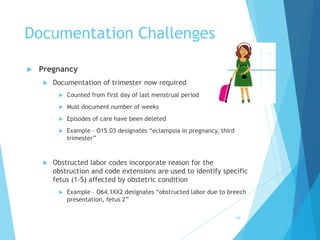
 Pregnancy
 Documentation of trimester now required
 Counted from first day of last menstrual period
 Must document number of weeks
 Episodes of care have been deleted
 Example – O15.03 designates “eclampsia in pregnancy, third
trimester”
 Obstructed labor codes incorporate reason for the
obstruction and code extensions are used to identify specific
fetus (1-5) affected by obstetric condition
 Example – O64.1XX2 designates “obstructed labor due to breech
presentation, fetus 2”
69
Documentation Challenges
 Respiratory / Vents
 Some codes require time frames attached to them,
which note if a patient has been on a ventilator for
 less than 24 consecutive hours
 24-96 consecutive hours
 Greater than 96 hours
70
Some Final Reminders
For an Efficient and Effective Transition
71
Transition Tips
 Important Reminders
 While clearinghouses can help, they cannot provide the same
level of support for the ICD-10 transition as they did for the
Version 5010 upgrade (5010 was IT-driven only; ICD-10 is both
business process and IT-driven)
 ICD-10 codes describe a medical diagnosis or procedure and
must be selected by the provider and not the clearinghouse,
coder or biller
 Expect audits to focus on clinical documentation to determine if
it supports the specificity of ICD-10 codes
 Keep in mind that covered entities are not to use the ICD-10
code in production (outside of a testing environment) prior to
October 1, 2015
 CMS Recommends
 Regular documentation audits after ICD-10 implementation to
make sure your clinical documentation supports your ICD-10
coding
72
Thanks for Your Participation!
Mary Jean Sage
The Sage Associates
897-309 Oak Park Blvd., Pismo Beach CA 93449
Tel: 805-904-6311; Fax: 805-904-6313
Email: mjsage@thesageassociates.com
Web: www.thesageassociates.com
73

Cap Icd-10 Webinar

  • 1.
    Building Your Path toICD-10 Embracing ICD-10 with Confidence
  • 2.
    An educational programpresented by the Cooperative of American Physicians, Inc. 2
  • 3.
    Today’s Agenda  Overviewof ICD-10-CM  An Up-to-Date Review  The Effects of ICD-10-CM on Your Practice  Using Technology Effectively  Differences Between ICD-9 and ICD-10  What You Need to Know  Determining Your Most Commonly Used Codes  Clinical Documentation  Provider Challenges 3
  • 4.
    The New (Latest)Deadline October 1, 2015 4
  • 5.
    Why ICD-10?  ImproveClinical Communications  More (better) data  Signs  Symptoms  Risk Factors  Comorbidities  Allow U.S. to exchange information internationally 5
  • 6.
    What Is ICD-10? International Classification of Diseases  ICD-10-CM: diagnosis code set Updated version of ICD-10-CM Volumes 1 and 2  ICD-10-PCS: code set of inpatient procedure codes Updated version of ICD-9-CM Volume 3 6
  • 7.
    ICD-9 vs. ICD-10 ICD-9ICD-10 Diagnosis: 14,000 codes Diagnosis: 68,000 codes Procedures: 4,000 codes Procedures: 87,000 codes 7
  • 8.
    Code Structure  ICD-10-CMCode Structure  Characters 1 through 3 = Category  Characters 4 through 6 = Etiology, anatomic site, severity, or other clinical detail  Character 7 = Extension 8
  • 9.
    Example: S52 Fracture offorearm (category) S52.5 Fracture of lower end of radium (site) S52.52Torus fracture of lower end of radium (type) S52.521 Torus fracture of lower end of right radium (laterality) S52.521A Torus fracture of lower end of right radium, initial encounter for closed fracture (extension = episode of care) 9
  • 10.
    Code Construction A three-charactercode Base code (category) I10 Essential (primary) hypertension Building a five-character code Base code (category) Four characters Five characters E11 E11.4 E11.42 Type 2 diabetes Type 2 diabetes with neurological complications Type 2 diabetes with polyneuropathy Building a seven-character code Base code (category) Four characters Five characters Six characters Seven characters M1A M1A.0 M1A.07 M1A.072 M1A.0721 Chronic gout Idiopathic chronic gout Idiopathic chronic gout, ankle & foot Idiopathic chronic gout, left ankle & foot Idiopathic chronic gout, left ankle and foot, with tophus 1 0
  • 11.
    What Does ThisMean for You?  Requires significant changes to clinical and administrative systems that capture and report diagnosis codes  Structural differences between ICD-9 and ICD-10 make converting the code set complex  Change in character length from ICD-9 to ICD-10 requires system upgrades to expand data fields for longer codes 1 1
  • 12.
  • 13.
    Front Desk  HIPAA Privacypolicies may need to be revised and patients will need to sign the new forms  SYSTEMS Updates to systems are likely required and may impact patient encounters 1 3
  • 14.
    Clinical Areas  PatientCoverage Health plan policies, payment limitations, and new ABN forms are likely  Superbills Revisions required – paper superbills may be impossible  ABNs Health plans will revise all policies linked to LCDs or NCDs, etc., ABN forms must be reformatted and patients will require education 1 4
  • 15.
    Nurses / MedicalAssistants  Forms Every order must be revised or recreated  Documentation Must use increased specificity  Prior Authorizations Policies may change, requiring training and updates 1 5
  • 16.
    Physicians & Extenders Documentation The need for specificity dramatically increases by requiring laterality, stages of healing, weeks in pregnancy, episodes of care, and much more  Code Training Codes increase from 17,000 to 140,000 – Physicians must be trained 1 6
  • 17.
    Lab  Documentation Must useincreased specificity  Reporting Health plans will have new requirements for the ordering and reporting of services 1 7
  • 18.
    Coding  Code Sets Codeswill increase dramatically. As a result, code books and styles will change completely.  Clinical Knowledge More detailed knowledge of anatomy and medical terminology will be required with increased specificity and more codes.  Concurrent Use Coders may need to use ICD-9-CM and ICD-10-CM concurrently for a period of time until all claims are resolved. 1 8
  • 19.
    BILLING  Policies &Procedures All payer reimbursement policies may be revised.  Training Billing department must be trained on new policies and procedures and the ICD-10-CM code set. 1 9
  • 20.
    Managers  New Policies& Procedures Any policy or procedure associated with a diagnosis code, disease management, tracking, or PQRS must be revised.  Vendor & Payer Contracts All contracts must be evaluated and updated.  Budgets Changes to software, training, new contracts, new paperwork will have to be paid for.  Training Plan Everyone in the practice will need training on the changes. 2 0
  • 21.
  • 22.
    It Comes Downto These Four Things! 1. Prepare a Project Plan 2. Perform an Impact Analysis 3. Begin Implementation 4. Convert to ICD-10 and Monitor 2 2
  • 23.
    Let’s Get Started! GetYour Team Together! 2 3
  • 24.
    Eight Tasks toGet Started 1. Identify your current systems and work processes that use ICD-9 codes i. Administrative ii. Clinical iii. Reporting 2. Talk with your practice management system vendor about accommodations for ICD-10 codes i. Review current contract ii. Is there an expense? 2 4
  • 25.
    Tasks: 3. Discuss implementationplans with all clearinghouses, billing services, and payers to facilitate a smooth transition i. Know their implementation plans ii. Can they accommodate both code sets? 4. Talk with payers about how ICD-10 implementation might affect provider contracts i. Coverage determination policies ii. Payment schedules 2 5
  • 26.
    Tasks 5. Identify potentialchange to workflow and business processes i. Clinical documentation ii. Encounter forms or “superbills” iii. Quality reporting iv. Public health reporting 2 6
  • 27.
    Tasks 6. Assess stafftraining needs i. Focus on learning ICD-10 code set and any workflow changes a. Clinical – understand how documentation will affect the ability to code and bill b. Administrative – understand the effects on preauthorization and referrals c. Coding – may need the most training 2 7
  • 28.
    Tasks 7. Conduct testtransactions using ICD-10 codes with payers and clearinghouses i. Consider “dual” coding a. Coding and Billing in both ICD-9 and ICD-10  Helps you prepare for ICD-10 and mitigate the risk of denied claims ii. Watch for testing periods  Clearinghouse  Payers 2 8
  • 29.
    Tasks 8. Budget fortime and costs related to ICD-10 implementation i. System changes ii. Resource materials iii. Training iv. Reserve fund 2 9
  • 30.
  • 31.
    31 Assessing Your Systems SurveyYour Technology Vendors Now . . . . It is imperative that you understand their plans, so you can make your transitions plans. ASK:  What are they doing for ICD-10?  When are they doing it?  Will you have access to both ICD-9 and ICD- 10 in your PMS & EMR?  Will GEMs be to used to convert current code databases?
  • 32.
    32 Prepare for theTransition  Identify all internal systems that utilize ICD-10  Understand the changes that are being made to each  Database changes to one application/system CAN affect all other interfaced systems  Determine the impacts on staff, process, and other systems
  • 33.
    33 Prepare for theTransition  Create a transition timeline by system  Identify any new technologies you require  EMR *  Code Mapping  Project Management Tools *If you are not currently using an EMR, ICD-10 is the time to seriously consider this addition to your practice.
  • 34.
    34 Understanding GEMs  Technologyvendors most likely are going to utilize or offer you some variation of GEMs. The GEMs act as a translation dictionary to bridge the language gap between ICD-9–CM and ICD-10-CM/PCS  The General Equivalency Mappings (GEMs) database was created by CMS and CDC to help users understand, analyze, and manage the translation of one code set to the other. They also help users create their own applied mappings as needed.
  • 35.
    35 Understanding GEMs  GETFAMILIAR with this database. It has both the potential to help tremendously with this transition to ICD-10 and cause confusion. ICD-10 is not as simple as one- to-one mapping in many cases, and level of detail required will create the need to evaluate many codes that come from the mapping
  • 36.
    Translation Programs /Software  Some come with your software  Some can be purchased  Some are free  Icd9data.com and icd10data.com  AAPC Beware: Use in conjunction with your books – not instead of! Some are not detailed enough! 36
  • 37.
    Determining If YourSystems Are Ready  EHR/Medical Records  Billing 3 7
  • 38.
    Ask Vendors  Howwill your application, business processes, or system address my needs during the ICD-10 implementation?  What is your timeline for the ICD-10 transition?  What is your migration strategy for making the change to ICD-10? 3 8
  • 39.
    Ask Vendors  Doyou offer an ICD-9/ICD-10 Comparison Utility ?  When will we test our system with trading partners?  Will you be upgrading my current system to accommodate the ICD-10 codes?  Are you training your staff on the ICD-10 system updates? 3 9
  • 40.
    Ask Vendors  Canwe use your products to search for codes by the ICD-10 alphabetic and tabular indexes?  Do you allow our staff to search codes by clinical concept?  Will you maintain tables for each code set?  How long will ICD-9 be available for use? 4 0
  • 41.
    Ask Vendors  Willyou ensure we have the right tools in place to help select the more specific diagnosis codes?  Will you provide specific provider templates for each specialty? 4 1
  • 42.
    ICD-9-CM vs. ICD-10-CM TheDifferences You Need to Know 42
  • 43.
    Organizational & StructuralChanges  ICD-10-CM has same hierarchical structure as ICD- 9-CM  First three characters are the category of the code  All codes within the same category have similar traits  E10 – Type 1 diabetes mellitus  E11 – Type 2 diabetes mellitus  J45 – Asthma  J45.2 – Mild intermittent asthma  J45.3 – Mild persistent asthma 43
  • 44.
    Organization & Structure Differences are seen in the organization of ICD-10- CM  ICD-10-CM has 21 chapters compared to 17 for ICD- 9-CM  ICD-9-CM’s V and E code supplemental classifications are incorporated into the main classification of ICD-10-CM  Diseases and conditions of the sense organs (eyes and ears) have been separated from the nervous system and have their own chapters 44
  • 45.
    Chapter Description CodeCategory 1 Certain Infectious and Parasitic Diseases A00-B99 2 Neoplasms C00-D49 3 Diseases of the Blood D50-D89 4 Endocrine, Nutritional and Metabolic Diseases E00-E89 5 Mental and Behavioral Disorders F01-F99 6 Diseases of the Nervous System G00-G99 7 Diseases of the Eye and Adnexa * H00-H59 8 Diseases of the Ear and Mastoid Process * H60-H95 9 Diseases of the Circulatory System I00-I99 10 Diseases of the Respiratory System J00-J99 11 Diseases of the Digestive System K00-K94 12 Diseases of the Skin and Subcutaneous Tissue L00-L99 13 Diseases of the Musculoskeletal System and Connective Tissue M00-M99 14 Diseases of the Genitourinaty System N00-N99 15 Pregnancy, Childbirth and the Puerperium O00-O99 16 Certain Conditions Originating in the Perinatal Period P00-P96 17 Congenital Malformations, Deformations and Chromosomal Abnormalities Q00-Q99 18 Symptoms, Signs and Abnormal Clinical and Laboratory Findings R00-R99 19 Injury, Poisoning and Certain Other Consequences of External Cause S00-T88 20 External Causes of Morbidity * V01-Y98 21 Factors Influencing Health Status and Contact with Health Services * Z00-Z99 45 ICD-10-CM Chapters * = New Chapters
  • 46.
    Differences from ICD-9to ICD-10  Certain diseases have been reclassified (or reassigned) to a more appropriate chapter in ICD-10-CM  Gout has been reclassified from the endocrine chapter in ICD-9 to the musculoskeletal chapter in ICD-10 4 6
  • 47.
    Differences  ICD-9-CM classifiedinjuries by type; ICD-10-CM groups injuries first by specific site (e.g., head, arm, leg) and then by type of injury (e.g., fracture, open wound)  Post-operative complications have been moved to procedure-specific body system chapters 47
  • 48.
    Differences  ICD-10-CM codesare alpha-numeric and can be up to seven characters in length (ICD-9 only 3-5)  ICD-10-CM includes full code titles for all codes (no reference back to common fourth and fifth digits) ICD-9: The following fifth-digit subclassification is for use with category 493.0- 493.2. 493.9: 0 unspecified 1 with status asthmaticus 2 with (acute) exacerbation 48
  • 49.
    Differences  Addition ofsixth character in some chapters  Addition of seventh character for obstetrics, injuries, and external causes of injuries  Addition of placeholder X 49
  • 50.
    Using A Placeholder Placeholder Character  “X” is used as a placeholder at certain codes to allow for future expansion  Poisoning, adverse effect, and underdosing codes (T36-T50)  T36.0X1A Poisoning by penicillins, accidental (unintentional), initial encounter  T36.0X2A Poisoning by penicillins, intentional self-harm  T36.0X3A Poisoning by penicillins, assault  T36.0X4A Poisoning by penicillins, undetermined  T36.0X5A Adverse effect of penicillins  T36.0X6A Underdosing of penicillins 50
  • 51.
    Another Placeholder Example Contact with a cat  W55.0  W55.01XD Bitten by a cat, subsequent encounter  W55.03XD Scratched by cat, subsequent encounter  W55.09XD Other contact with cat 51
  • 52.
    7th Characters  CertainICD-10-CM categories have applicable 7th characters. The applicable 7th character is required for all codes within the category, or as the notes in the Tabular List instruct. The 7th character must always be the 7th character in the data field. If a code that requires a 7th character is not 6 characters, a placeholder X must be used to fill in the empty characters. 52
  • 53.
    New Features inICD-10-CM  Combination codes for conditions and common symptoms or manifestations  E10.21, Type 1 diabetes mellitus with diabetic nephropathy  I25.110, Atherosclerotic heart disease of native coronary artery with unstable angina pectoris  K50.112, Crohn’s disease of large intestine with intestinal obstruction  Combination codes for poisonings and external causes  T36.0X1D, Poisoning by penicillin, accidental (unintentional), subsequent encounter  T42.4X5A, Adverse effect of benzodiazepines, initial encounter 5 3
  • 54.
    New Features  AddedLaterality  H60.332, Swimmer’s ear, left ear  M94.211, Chondromalacia, right shoulder  S40.259A, Superficial foreign body of unspecified shoulder, initial encounter  Added seventh-characters for episode of care  M80.051A, Age-related osteoporosis with current pathological fracture, right femur, initial encounter for fracture  S06.0X1A, Concussion with loss of consciousness of 30 minutes or less, initial encounter  S52.132B, Displaced fracture of neck of left radius, initial encounter for open fracture Type I or II or initial encounter for open fracture NOS 5 4
  • 55.
    New Features  ExpandedCodes (injuries, diabetes, alcohol, and substance abuse, post-operative complications)  E11.341, Type 2 diabetes mellitus with severe nonproliferative diabetic retinopathy with macular edema  F14.221, Cocaine dependence with intoxication delirium  K91.71, Accidental puncture and laceration of a digestive system organ or structure during a digestive system procedure  Inclusion of trimesters in obstetrics codes (and elimination of fifth digits for episode of care)  O10.012, Pre-existing essential hypertension complicating pregnancy second trimester  O99.013, Anemia complicating pregnancy, third trimester 5 5
  • 56.
    New Features  Changesin timeframes specified in certain codes  Acute myocardial infarction – time period changed from 8 weeks to 4 weeks  Time frame for abortion versus fetal death changed from 22 weeks to 20 weeks  Added standard definitions for two types of “excludes” notes  Excludes1 note indicates “not coded here.” The code being excluded is never used with the code. The two conditions cannot occur together.  B06, Rubella (German measles) has an Excludes1 of congenital rubella (P35.0)  Excludes2 note indicates “not included here.” The excluded condition is not part of the condition represented by the code. It is acceptable to use both codes together if the patient has both conditions.  J04.0, Acute laryngitis has an Excludes2 of chronic laryngitis (J37.0) 5 6
  • 57.
  • 58.
    Begin Now: 1. Generatea report from your practice management system that identifies all ICD-9 codes used for the past 12 months 1. Sort by frequency 2. Determine your 25-50 most frequently used codes 3. Convert those codes to ICD-10-CM codes 1. Determine differences from ICD-9-CM 2. Determine documentation variables 4. Audit clinical documentation to make sure it supports the coding 58
  • 59.
  • 60.
    Clinical Documentation  GoldenRule: If it’s not documented by the physician/provider, it did not happen; therefore, it cannot be coded or billed  Objective: To ensure medical record documentation is documented to the fullest extent possible in order to support the greater specificity afforded in the ICD-10-CM (Clinical Modification) code set  Some documentation issues will require physicians/providers to capture new information  Others involve updated, modified, and otherwise expanded documentation needs 60
  • 61.
    Some Facts:  ICD-10-CMcontains multiple combination codes, so documentation must reflect the association between conditions Example: ICD-10: K50.814 – Crohn’s disease of both small and large intestine with abscess ICD-9: 555.2 – Regional enteritis, small intestine with large intestine and 569.5 – Abscess of intestine 61
  • 62.
    Facts:  Laterality needsto be documented Example: ICD-10: M05.271 – Rheumatoid vasculitis with rheumatoid arthritis of right ankle and foot ICD-9: 714.27 – Rheumatoid arthritis with visceral or systemic involvement, ankle and foot 62
  • 63.
    Documentation Challenges  DiabetesMellitus  ICD-10 = 200 codes  ICD-9 = 59 codes  Multiple combination codes are available – the provider will need to document complications to allow for accurate code selection  E10.40 Type 1 diabetes mellitus with diabetic neuropathy, unspecified  E10.41 Type 1 diabetes mellitus with diabetic mononeuropathy  E10.42 Type 1 diabetes mellitus with diabetic polyneuropathy  E10.43 Type 1 diabetes mellitus with diabetic autonomic (poly)neuropathy  E10.44 Type 1 diabetes mellitus with diabetic amyotrophy  E10.49 Type 1 diabetes mellitus with other diabetic neurological complication  An additional code must be used to report insulin use – Z79.4 63
  • 64.
    Documentation Challenges  Injuries– ICD-10-CM features an expanded category for injuries  Seventh character extension identifies the encounter type:  A = initial encounter  D = subsequent encounter for fracture with routine healing  G = subsequent encounter for fracture with delayed healing  S = sequela of fracture  Size and depth of the injury must be coded – needs to be captured from provider’s documentation  Cause of the injury should be documented and coded 64
  • 65.
    Documentation Challenges  DrugUnderdosing – a new code in ICD-10-CM that identifies situations in which a patient has taken less of a medication than prescribed by the physician  Medical condition is sequenced first  Underdosing code is listed as a secondary diagnosis  Additional code explains why the patient is not taking the medication (e.g., financial reasons) Since this is new, many physicians will not be in the habit of documenting a patient’s reasons for underdosing in the record. 65
  • 66.
    Documentation Challenges  CerebralInfarctions  Late effects of stroke are differentiated by type of stroke  Combination codes for common etiologies/manifestations are included  I63.012 designates cerebral infarction due to thrombosis of left vertebral artery  I63.031 designates cerebral infarction due to right carotid artery  I63.212 designates cerebral infarction due to unspecified occlusion or stenosis of left vertebral arteries 66
  • 67.
    Documentation Challenges  AcuteMyocardial Infarction (AMI)  Age definition for AMI has changed to four weeks rather than eight weeks  New categories for subsequent AMI and for complications within 28 days of AMI  Different terminology is used and laterality is included  I21.01 designates ST elevation (STEMI) myocardial infarction involving left main coronary artery  I21.02 designates ST elevation myocardial infarction (STEMI) involving left anterior descending coronary artery  I21.09 designates ST elevation (STEMI) myocardial infarction involving other coronary artery of anterior wall 67
  • 68.
    Documentation Challenges  MusculoskeletalConditions  ICD-9 has 8 codes for pathologic fractures; ICD-10-CM has 150+ codes  7th character is used to designate episode of care  Traumatic fractures require  Type of Fracture  Laterality  Episode of Care 68 A Warning About “Unspecified” – some may be tempted to take the easy road and code “unspecified” if documentation doesn’t support more specific codes. We warn against this!! While there is an unspecified code in ICD-10, and you can code it all you want, in 2-3 years when you review your severity and risk scores you will be in bad shape because you won’t have the specificity in your codes that you need to justify higher levels and better reimbursement.
  • 69.
    Documentation Challenges  Pregnancy Documentation of trimester now required  Counted from first day of last menstrual period  Must document number of weeks  Episodes of care have been deleted  Example – O15.03 designates “eclampsia in pregnancy, third trimester”  Obstructed labor codes incorporate reason for the obstruction and code extensions are used to identify specific fetus (1-5) affected by obstetric condition  Example – O64.1XX2 designates “obstructed labor due to breech presentation, fetus 2” 69
  • 70.
    Documentation Challenges  Respiratory/ Vents  Some codes require time frames attached to them, which note if a patient has been on a ventilator for  less than 24 consecutive hours  24-96 consecutive hours  Greater than 96 hours 70
  • 71.
    Some Final Reminders Foran Efficient and Effective Transition 71
  • 72.
    Transition Tips  ImportantReminders  While clearinghouses can help, they cannot provide the same level of support for the ICD-10 transition as they did for the Version 5010 upgrade (5010 was IT-driven only; ICD-10 is both business process and IT-driven)  ICD-10 codes describe a medical diagnosis or procedure and must be selected by the provider and not the clearinghouse, coder or biller  Expect audits to focus on clinical documentation to determine if it supports the specificity of ICD-10 codes  Keep in mind that covered entities are not to use the ICD-10 code in production (outside of a testing environment) prior to October 1, 2015  CMS Recommends  Regular documentation audits after ICD-10 implementation to make sure your clinical documentation supports your ICD-10 coding 72
  • 73.
    Thanks for YourParticipation! Mary Jean Sage The Sage Associates 897-309 Oak Park Blvd., Pismo Beach CA 93449 Tel: 805-904-6311; Fax: 805-904-6313 Email: mjsage@thesageassociates.com Web: www.thesageassociates.com 73