Presenter
Dr. Jai Parkash
JR 2
Moderator
Dr. R.B. Jain
Professor
Department of Community Medicine, PGIMS Rohtak
Contents
• Introduction
• Historical background
• Types of classification
• Purpose & Application
• ICD 10
I. Volumes
II. Chapters
III. Basic coding guidelines
• ICD 11 at a glance
• PGIMS Scenario
• References
• The International Statistical Classification of Diseases and
Related Health Problems 10th version (ICD 10) is the
international standard prescribed by WHO.
Introduction
Why do we need this?
• So that the morbidity & mortality databases are comparable
within the various region/states of the country and between
countries of region/world.
• Such reliable information is essential for meaningful
conclusion on the health status of the population and for
planning the development of facilities for medical and health
care and their efficient functioning.
• ICD 10 coding was introduced by WHO in the year 1993 and
India adopted the same in the year 2000
Introduction (Contd..)
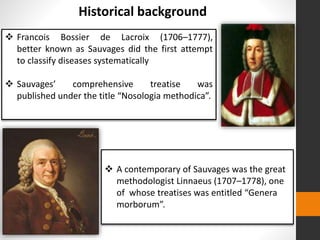
 Francois Bossier de Lacroix (1706–1777),
better known as Sauvages did the first attempt
to classify diseases systematically
 Sauvages’ comprehensive treatise was
published under the title “Nosologia methodica”.
Historical background
 A contemporary of Sauvages was the great
methodologist Linnaeus (1707–1778), one
of whose treatises was entitled “Genera
morborum”.
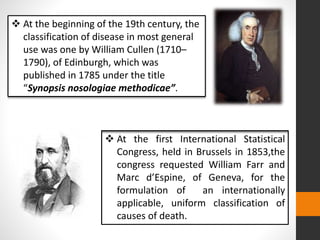
 At the beginning of the 19th century, the
classification of disease in most general
use was one by William Cullen (1710–
1790), of Edinburgh, which was
published in 1785 under the title
“Synopsis nosologiae methodicae”.
 At the first International Statistical
Congress, held in Brussels in 1853,the
congress requested William Farr and
Marc d’Espine, of Geneva, for the
formulation of an internationally
applicable, uniform classification of
causes of death.
• At the next congress, in Paris in 1855, Farr and d’Espine
submitted two separate lists, which were based on very
different principles.
• Farr’s classification was arranged under five groups:
1. epidemic diseases,
2. constitutional (general) diseases,
3. local diseases arranged according to anatomical site,
4. Developmental diseases and
5. diseases that are the direct result of violence
• d’Espine classified diseases according to their nature (gouty,
herpetic, haematic, etc.).
• The congress adopted a compromise list of 139 rubrics
• In 1864, this classification was revised in Paris, on the basis
of Farr’s model, and was subsequently further revised in
1874, 1880 and 1886.
• Although this classification was never universally accepted,
the general arrangement proposed by Farr, including the
principle of classifying diseases by anatomical site, survived
as the basis of the International list of causes of death.
• Jacques Bertillon (1851–1922), Chief of Statistical Services of
the City of Paris prepared a classification of causes of death.
• This classification was based on the principle, adopted by Farr,
of distinguishing between general diseases and those localized
to a particular organ or anatomical site.
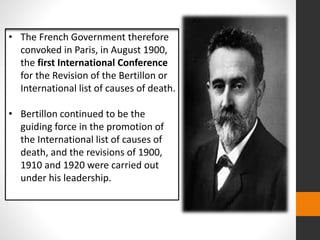
• The French Government therefore
convoked in Paris, in August 1900,
the first International Conference
for the Revision of the Bertillon or
International list of causes of death.
• Bertillon continued to be the
guiding force in the promotion of
the International list of causes of
death, and the revisions of 1900,
1910 and 1920 were carried out
under his leadership.
• The 2nd conference was held in 1909, and the Government of
France called succeeding conferences in 1920, 1929 and 1938.
• ‘Mixed Commission’, was created with an equal number of
representatives from the International Statistical Institute
and the Health Organization of the League of Nations.
• This commission drafted the proposals for the Fourth (1929)
and the Fifth (1938) revisions of the International list of
causes of death.
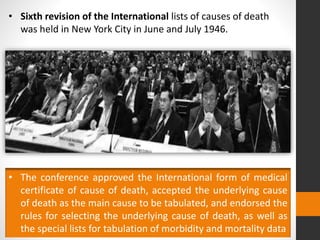
• Sixth revision of the International lists of causes of death
was held in New York City in June and July 1946.
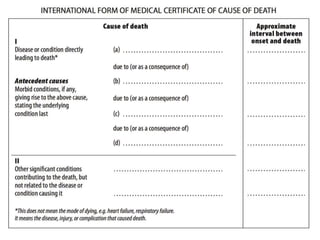
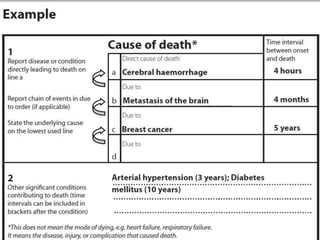
• The conference approved the International form of medical
certificate of cause of death, accepted the underlying cause
of death as the main cause to be tabulated, and endorsed the
rules for selecting the underlying cause of death, as well as
the special lists for tabulation of morbidity and mortality data
• The International Conference for the Seventh Revision of
the International Classification of Diseases was held in
Paris under the auspices of WHO, in February 1955.
• The Eighth Revision Conference convened by WHO met in
Geneva, from 6 to 12 July 1965.
• The International Conference for the Ninth Revision
convened by WHO in Geneva from 30 September to 6
October 1975.
• For the benefit of users, the ninth revision included an
optional alternative method of classifying diagnostic
statements, including information about both an underlying
general disease and a manifestation in a particular organ or
site.
• This system became known as the dagger and asterisk system
and is retained in the 10th revision.
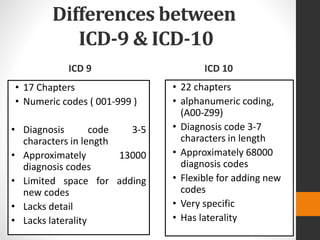
Differences between
ICD-9 & ICD-10
ICD 9
• 17 Chapters
• Numeric codes ( 001-999 )
• Diagnosis code 3-5
characters in length
• Approximately 13000
diagnosis codes
• Limited space for adding
new codes
• Lacks detail
• Lacks laterality
ICD 10
• 22 chapters
• alphanumeric coding,
(A00-Z99)
• Diagnosis code 3-7
characters in length
• Approximately 68000
diagnosis codes
• Flexible for adding new
codes
• Very specific
• Has laterality
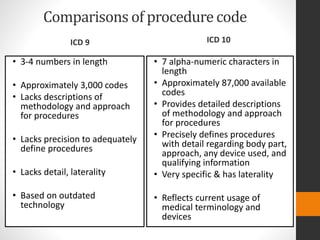
Comparisons of procedurecode
ICD 9
• 3-4 numbers in length
• Approximately 3,000 codes
• Lacks descriptions of
methodology and approach
for procedures
• Lacks precision to adequately
define procedures
• Lacks detail, laterality
• Based on outdated
technology
ICD 10
• 7 alpha-numeric characters in
length
• Approximately 87,000 available
codes
• Provides detailed descriptions
of methodology and approach
for procedures
• Precisely defines procedures
with detail regarding body part,
approach, any device used, and
qualifying information
• Very specific & has laterality
• Reflects current usage of
medical terminology and
devices
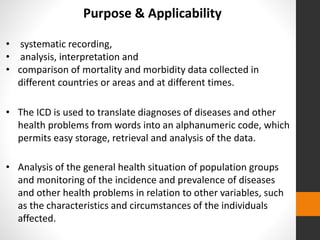
• systematic recording,
• analysis, interpretation and
• comparison of mortality and morbidity data collected in
different countries or areas and at different times.
Purpose & Applicability
• The ICD is used to translate diagnoses of diseases and other
health problems from words into an alphanumeric code, which
permits easy storage, retrieval and analysis of the data.
• Analysis of the general health situation of population groups
and monitoring of the incidence and prevalence of diseases
and other health problems in relation to other variables, such
as the characteristics and circumstances of the individuals
affected.
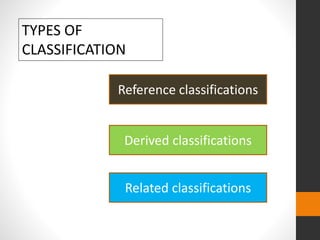
TYPES OF
CLASSIFICATION
Reference classifications
Derived classifications
Related classifications
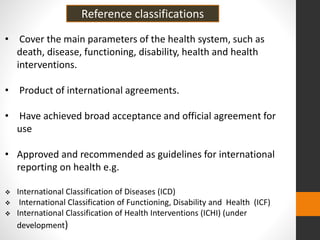
• Cover the main parameters of the health system, such as
death, disease, functioning, disability, health and health
interventions.
• Product of international agreements.
• Have achieved broad acceptance and official agreement for
use
• Approved and recommended as guidelines for international
reporting on health e.g.
 International Classification of Diseases (ICD)
 International Classification of Functioning, Disability and Health (ICF)
 International Classification of Health Interventions (ICHI) (under
development)
Reference classifications
• Based upon reference classifications.
• May be prepared by adopting the reference classification
structure and classes.
or
• Providing additional detail beyond that provided by the
reference classification.
Derived classifications
• May be prepared through rearrangement or aggregation of
items from one or more reference classifications.
• Tailored for use at the national or international level.
e.g.
 International Classification of Diseases for Oncology, (ICD-O)
 The ICD-10 classification of mental and behavioural disorders
 Application of the ICD to dentistry and stomatology
 Application of the ICD to neurology (ICD-NA)
 Application of the ICD to dermatology
 Application of the ICD to paediatrics
 Application of the ICD to rheumatology and orthopaedics (ICD-R & 0)
Cont..
• Partially refer to reference classifications,
or
• Associated with the reference classification at specific levels
of the structure only e.g.
 International Classification of Primary Care (ICPC)
 International Classification of External Causes of Injury (ICECI)
 The Anatomical therapeutic chemical classification (ATC) with defined
daily doses (ATC/DDD)
 Technical aids for persons with disabilities: classification and terminology
(ISO9999)
Related classifications
ICD-10
3VOLUMES
• Volume 1. Tabular List. This contains the report of the
International Conference, the classification itself at the three-
and four-character levels, morphology of neoplasms, special
tabulation lists for mortality and morbidity, definitions, and
the nomenclature regulations.
• Volume 2. Instruction Manual. Contains notes on certification
and classification with a good deal of new background and
instructional matter and guidance on the use of Volume 1, on
tabulations, and on planning for the use of ICD.
• It also includes the historical material formerly presented in
the introduction to Volume 1.
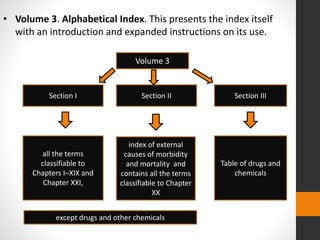
• Volume 3. Alphabetical Index. This presents the index itself
with an introduction and expanded instructions on its use.
Volume 3
Section I Section II Section III
all the terms
classifiable to
Chapters I–XIX and
Chapter XXI,
index of external
causes of morbidity
and mortality and
contains all the terms
classifiable to Chapter
XX
Table of drugs and
chemicals
except drugs and other chemicals
ICD-10
22CHAPTERS
• The first character of the ICD code is a letter, and each letter is
associated with a particular chapter, except for the letter D,
which is used in both Chapter II (Neoplasms ) and Chapter III
(Diseases of the blood and blood-forming organs and certain
disorders involving the immune mechanism)
• The letter H, used in both Chapter VII (Diseases of the eye and
adnexa) and Chapter VIII (Diseases of the ear and mastoid
process).
Four chapters (Chapters I, II, XIX and XX) use more than one
letter in the first position of their codes.
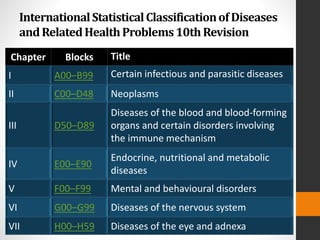
InternationalStatisticalClassificationof Diseases
andRelatedHealthProblems10th Revision
Chapter Blocks Title
I A00–B99 Certain infectious and parasitic diseases
II C00–D48 Neoplasms
III D50–D89
Diseases of the blood and blood-forming
organs and certain disorders involving
the immune mechanism
IV E00–E90
Endocrine, nutritional and metabolic
diseases
V F00–F99 Mental and behavioural disorders
VI G00–G99 Diseases of the nervous system
VII H00–H59 Diseases of the eye and adnexa
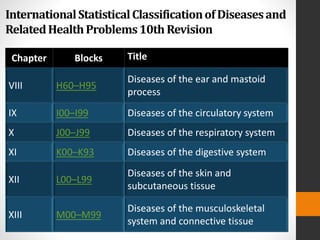
InternationalStatisticalClassificationofDiseasesand
RelatedHealthProblems10th Revision
Chapter Blocks Title
VIII H60–H95
Diseases of the ear and mastoid
process
IX I00–I99 Diseases of the circulatory system
X J00–J99 Diseases of the respiratory system
XI K00–K93 Diseases of the digestive system
XII L00–L99
Diseases of the skin and
subcutaneous tissue
XIII M00–M99
Diseases of the musculoskeletal
system and connective tissue
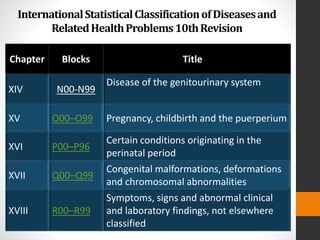
InternationalStatisticalClassificationofDiseasesand
RelatedHealthProblems10thRevision
Chapter Blocks Title
XIV N00-N99
Disease of the genitourinary system
XV O00–O99 Pregnancy, childbirth and the puerperium
XVI P00–P96
Certain conditions originating in the
perinatal period
XVII Q00–Q99
Congenital malformations, deformations
and chromosomal abnormalities
XVIII R00–R99
Symptoms, signs and abnormal clinical
and laboratory findings, not elsewhere
classified
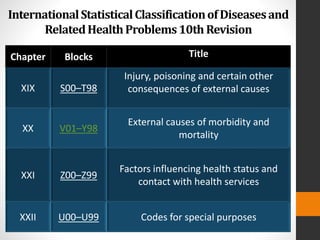
InternationalStatisticalClassificationofDiseasesand
RelatedHealthProblems10th Revision
Chapter Blocks Title
XIX S00–T98
Injury, poisoning and certain other
consequences of external causes
XX V01–Y98
External causes of morbidity and
mortality
XXI Z00–Z99
Factors influencing health status and
contact with health services
XXII U00–U99 Codes for special purposes
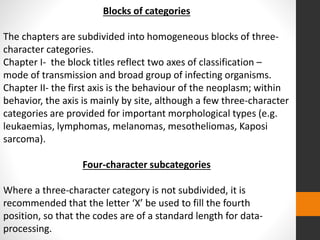
Blocks of categories
The chapters are subdivided into homogeneous blocks of three-
character categories.
Chapter I- the block titles reflect two axes of classification –
mode of transmission and broad group of infecting organisms.
Chapter II- the first axis is the behaviour of the neoplasm; within
behavior, the axis is mainly by site, although a few three-character
categories are provided for important morphological types (e.g.
leukaemias, lymphomas, melanomas, mesotheliomas, Kaposi
sarcoma).
Four-character subcategories
Where a three-character category is not subdivided, it is
recommended that the letter ‘X’ be used to fill the fourth
position, so that the codes are of a standard length for data-
processing.
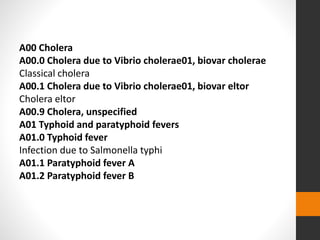
A00 Cholera
A00.0 Cholera due to Vibrio cholerae01, biovar cholerae
Classical cholera
A00.1 Cholera due to Vibrio cholerae01, biovar eltor
Cholera eltor
A00.9 Cholera, unspecified
A01 Typhoid and paratyphoid fevers
A01.0 Typhoid fever
Infection due to Salmonella typhi
A01.1 Paratyphoid fever A
A01.2 Paratyphoid fever B
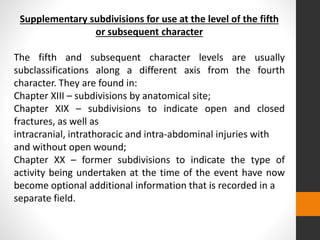
Supplementary subdivisions for use at the level of the fifth
or subsequent character
The fifth and subsequent character levels are usually
subclassifications along a different axis from the fourth
character. They are found in:
Chapter XIII – subdivisions by anatomical site;
Chapter XIX – subdivisions to indicate open and closed
fractures, as well as
intracranial, intrathoracic and intra-abdominal injuries with
and without open wound;
Chapter XX – former subdivisions to indicate the type of
activity being undertaken at the time of the event have now
become optional additional information that is recorded in a
separate field.
The ‘dagger and asterisk’ system
• ICD-9 introduced a system, continued in ICD-10, whereby
there are two codes.
 The primary code is for the underlying disease and is marked
with a dagger (†); an optional additional code for the
manifestation is marked with an asterisk (*).
 It is a principle of the ICD that the dagger code is the primary
code and must always be used.
• For coding, the asterisk code must never be used alone.
However, for morbidity coding, the dagger and asterisk
sequence may be reversed when the manifestations of a
disease are the primary focus of care.
e.g.:
• A17.0† Tuberculous meningitis (G01*)
• Tuberculosis of meninges (cerebral) (spinal)
• Tuberculous leptomeningitis
• If the symbol (†) and the alternative asterisk code both appear
in the rubric heading, all terms classifiable to that rubric are
subject to dual classification and all have the same alternative
code,
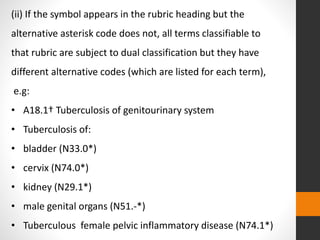
(ii) If the symbol appears in the rubric heading but the
alternative asterisk code does not, all terms classifiable to
that rubric are subject to dual classification but they have
different alternative codes (which are listed for each term),
e.g:
• A18.1† Tuberculosis of genitourinary system
• Tuberculosis of:
• bladder (N33.0*)
• cervix (N74.0*)
• kidney (N29.1*)
• male genital organs (N51.-*)
• Tuberculous female pelvic inflammatory disease (N74.1*)
(iii) If neither the symbol nor the alternative code appears in the
title, the rubric as a whole is not subject to dual classification
but individual inclusion terms may be; if so, these terms will be
marked with the symbol and their alternative codes given,
e.g.:
• A54.8 Other gonococcal infections
• Gonococcal
• peritonitis† (K67.1*)
• pneumonia† (J17.0*)
Conventions used in the Tabular list
Parentheses ( )
• used to enclose supplementary words, which may follow
a diagnostic term without affecting the code number
For example, in I10, the inclusion term, ‘Hypertension
(arterial)(benign)(essential)(malignant) (primary)(systemic)’,
implies that I10 is the code number
• used to enclose the code to which an exclusion term refers.
Square brackets [ ]
• for enclosing synonyms, alternative words or explanatory
phrases; e.g.
A30 Leprosy [Hansen disease]
• for referring to previous notes
WHO: Help-Line
• There are nine WHO Collaborating Centres for Classification of
Diseases, who assist countries with problems encountered in
the development and use of health-related classifications and,
in particular, in the use of the ICD
• Australia, England and USA for English knowing countries.
• Besides, there are at France, Russia, China, Venezuela
Sweden, Brazil
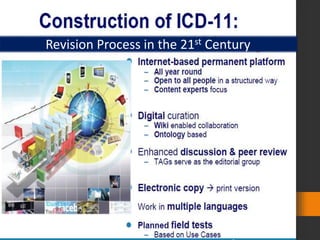
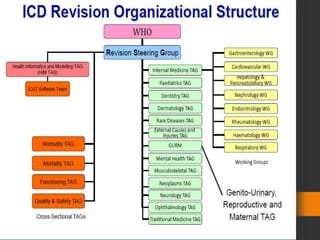
Revision Process in the 21st Century
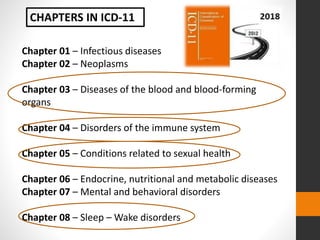
Chapter 01 – Infectious diseases
Chapter 02 – Neoplasms
Chapter 03 – Diseases of the blood and blood-forming
organs
Chapter 04 – Disorders of the immune system
Chapter 05 – Conditions related to sexual health
Chapter 06 – Endocrine, nutritional and metabolic diseases
Chapter 07 – Mental and behavioral disorders
Chapter 08 – Sleep – Wake disorders
CHAPTERS IN ICD-11
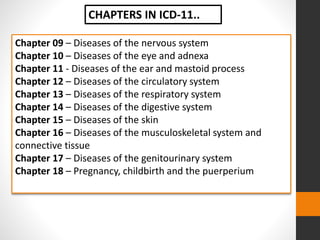
Chapter 09 – Diseases of the nervous system
Chapter 10 – Diseases of the eye and adnexa
Chapter 11 - Diseases of the ear and mastoid process
Chapter 12 – Diseases of the circulatory system
Chapter 13 – Diseases of the respiratory system
Chapter 14 – Diseases of the digestive system
Chapter 15 – Diseases of the skin
Chapter 16 – Diseases of the musculoskeletal system and
connective tissue
Chapter 17 – Diseases of the genitourinary system
Chapter 18 – Pregnancy, childbirth and the puerperium
CHAPTERS IN ICD-11..
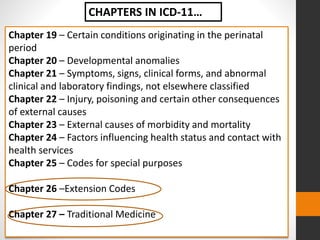
Chapter 19 – Certain conditions originating in the perinatal
period
Chapter 20 – Developmental anomalies
Chapter 21 – Symptoms, signs, clinical forms, and abnormal
clinical and laboratory findings, not elsewhere classified
Chapter 22 – Injury, poisoning and certain other consequences
of external causes
Chapter 23 – External causes of morbidity and mortality
Chapter 24 – Factors influencing health status and contact with
health services
Chapter 25 – Codes for special purposes
Chapter 26 –Extension Codes
Chapter 27 – Traditional Medicine
CHAPTERS IN ICD-11…
Highlights of the meeting :
• Gave feedback on the terminology used, a decision was
taken to rename the Joint Linearization for Mortality and
Morbidity statistics as the International Classification of
Diseases, 11th Revision, for Mortality and Morbidity
Statistics (ICD-11-MMS).
In April 2016, the Joint Task Force (JTF) met in Cologne,
Germany to further progress the work on the ICD-11 Tokyo
release.
Joint Task Force Meet
2016
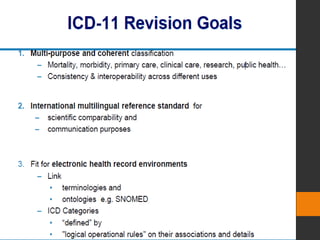
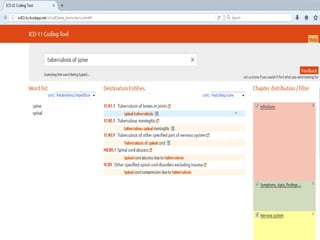
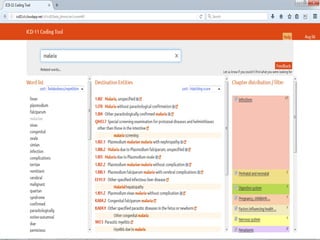
• ICD-11 is built for an electronic environment, facilitating
the classification of information in electronic health
records, with technology assistance including coding tools,
browsers, and different web services, focusing on ease of
use and improved specificity and consistency of the coded
data.
• A release of the ICD-11-MMS will take place at the ICD
Revision Conference from 12-14 October 2016 in Tokyo,
Japan.
• A multi-lingual coding platform to support translations
Important to note, the Tokyo Release will not be the “final”
version of ICD-11, nor will it be ready for implementation in
countries. This release will represent a high-level overview of
the structure of the ICD-11-MMS to support discussion about
national requirements and support for implementation .
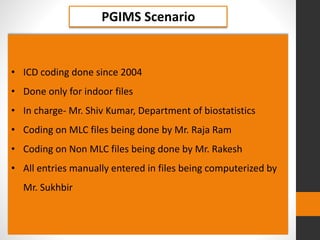
PGIMS Scenario
• ICD coding done since 2004
• Done only for indoor files
• In charge- Mr. Shiv Kumar, Department of biostatistics
• Coding on MLC files being done by Mr. Raja Ram
• Coding on Non MLC files being done by Mr. Rakesh
• All entries manually entered in files being computerized by
Mr. Sukhbir
References
• International statistical classification of diseases and related
health problems 10th revision, Volume 2, Instruction manual
Fifth edition 2016
• ICD- 10 Volume 1
• ICD- 10 2e Volume 3
• World Health Organization – Health Data Standards and
Informatics June 2016, ICD-11 Update
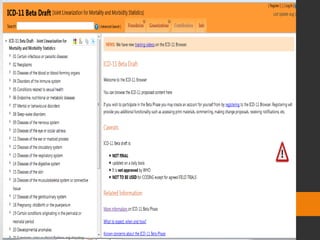
• http://apps.who.int/classifications/icd11/browse/l-m/en
THANK YOU !

Icd 10

  • 1.
    Presenter Dr. Jai Parkash JR2 Moderator Dr. R.B. Jain Professor Department of Community Medicine, PGIMS Rohtak
  • 2.
    Contents • Introduction • Historicalbackground • Types of classification • Purpose & Application • ICD 10 I. Volumes II. Chapters III. Basic coding guidelines • ICD 11 at a glance • PGIMS Scenario • References
  • 3.
    • The InternationalStatistical Classification of Diseases and Related Health Problems 10th version (ICD 10) is the international standard prescribed by WHO. Introduction Why do we need this? • So that the morbidity & mortality databases are comparable within the various region/states of the country and between countries of region/world.
  • 4.
    • Such reliableinformation is essential for meaningful conclusion on the health status of the population and for planning the development of facilities for medical and health care and their efficient functioning. • ICD 10 coding was introduced by WHO in the year 1993 and India adopted the same in the year 2000 Introduction (Contd..)
  • 5.
     Francois Bossierde Lacroix (1706–1777), better known as Sauvages did the first attempt to classify diseases systematically  Sauvages’ comprehensive treatise was published under the title “Nosologia methodica”. Historical background  A contemporary of Sauvages was the great methodologist Linnaeus (1707–1778), one of whose treatises was entitled “Genera morborum”.
  • 6.
     At thebeginning of the 19th century, the classification of disease in most general use was one by William Cullen (1710– 1790), of Edinburgh, which was published in 1785 under the title “Synopsis nosologiae methodicae”.  At the first International Statistical Congress, held in Brussels in 1853,the congress requested William Farr and Marc d’Espine, of Geneva, for the formulation of an internationally applicable, uniform classification of causes of death.
  • 7.
    • At thenext congress, in Paris in 1855, Farr and d’Espine submitted two separate lists, which were based on very different principles. • Farr’s classification was arranged under five groups: 1. epidemic diseases, 2. constitutional (general) diseases, 3. local diseases arranged according to anatomical site, 4. Developmental diseases and 5. diseases that are the direct result of violence • d’Espine classified diseases according to their nature (gouty, herpetic, haematic, etc.). • The congress adopted a compromise list of 139 rubrics
  • 8.
    • In 1864,this classification was revised in Paris, on the basis of Farr’s model, and was subsequently further revised in 1874, 1880 and 1886. • Although this classification was never universally accepted, the general arrangement proposed by Farr, including the principle of classifying diseases by anatomical site, survived as the basis of the International list of causes of death. • Jacques Bertillon (1851–1922), Chief of Statistical Services of the City of Paris prepared a classification of causes of death. • This classification was based on the principle, adopted by Farr, of distinguishing between general diseases and those localized to a particular organ or anatomical site.
  • 9.
    • The FrenchGovernment therefore convoked in Paris, in August 1900, the first International Conference for the Revision of the Bertillon or International list of causes of death. • Bertillon continued to be the guiding force in the promotion of the International list of causes of death, and the revisions of 1900, 1910 and 1920 were carried out under his leadership.
  • 10.
    • The 2ndconference was held in 1909, and the Government of France called succeeding conferences in 1920, 1929 and 1938. • ‘Mixed Commission’, was created with an equal number of representatives from the International Statistical Institute and the Health Organization of the League of Nations. • This commission drafted the proposals for the Fourth (1929) and the Fifth (1938) revisions of the International list of causes of death.
  • 11.
    • Sixth revisionof the International lists of causes of death was held in New York City in June and July 1946. • The conference approved the International form of medical certificate of cause of death, accepted the underlying cause of death as the main cause to be tabulated, and endorsed the rules for selecting the underlying cause of death, as well as the special lists for tabulation of morbidity and mortality data
  • 14.
    • The InternationalConference for the Seventh Revision of the International Classification of Diseases was held in Paris under the auspices of WHO, in February 1955. • The Eighth Revision Conference convened by WHO met in Geneva, from 6 to 12 July 1965. • The International Conference for the Ninth Revision convened by WHO in Geneva from 30 September to 6 October 1975.
  • 15.
    • For thebenefit of users, the ninth revision included an optional alternative method of classifying diagnostic statements, including information about both an underlying general disease and a manifestation in a particular organ or site. • This system became known as the dagger and asterisk system and is retained in the 10th revision.
  • 16.
    Differences between ICD-9 &ICD-10 ICD 9 • 17 Chapters • Numeric codes ( 001-999 ) • Diagnosis code 3-5 characters in length • Approximately 13000 diagnosis codes • Limited space for adding new codes • Lacks detail • Lacks laterality ICD 10 • 22 chapters • alphanumeric coding, (A00-Z99) • Diagnosis code 3-7 characters in length • Approximately 68000 diagnosis codes • Flexible for adding new codes • Very specific • Has laterality
  • 17.
    Comparisons of procedurecode ICD9 • 3-4 numbers in length • Approximately 3,000 codes • Lacks descriptions of methodology and approach for procedures • Lacks precision to adequately define procedures • Lacks detail, laterality • Based on outdated technology ICD 10 • 7 alpha-numeric characters in length • Approximately 87,000 available codes • Provides detailed descriptions of methodology and approach for procedures • Precisely defines procedures with detail regarding body part, approach, any device used, and qualifying information • Very specific & has laterality • Reflects current usage of medical terminology and devices
  • 18.
    • systematic recording, •analysis, interpretation and • comparison of mortality and morbidity data collected in different countries or areas and at different times. Purpose & Applicability • The ICD is used to translate diagnoses of diseases and other health problems from words into an alphanumeric code, which permits easy storage, retrieval and analysis of the data. • Analysis of the general health situation of population groups and monitoring of the incidence and prevalence of diseases and other health problems in relation to other variables, such as the characteristics and circumstances of the individuals affected.
  • 19.
    TYPES OF CLASSIFICATION Reference classifications Derivedclassifications Related classifications
  • 20.
    • Cover themain parameters of the health system, such as death, disease, functioning, disability, health and health interventions. • Product of international agreements. • Have achieved broad acceptance and official agreement for use • Approved and recommended as guidelines for international reporting on health e.g.  International Classification of Diseases (ICD)  International Classification of Functioning, Disability and Health (ICF)  International Classification of Health Interventions (ICHI) (under development) Reference classifications
  • 21.
    • Based uponreference classifications. • May be prepared by adopting the reference classification structure and classes. or • Providing additional detail beyond that provided by the reference classification. Derived classifications
  • 22.
    • May beprepared through rearrangement or aggregation of items from one or more reference classifications. • Tailored for use at the national or international level. e.g.  International Classification of Diseases for Oncology, (ICD-O)  The ICD-10 classification of mental and behavioural disorders  Application of the ICD to dentistry and stomatology  Application of the ICD to neurology (ICD-NA)  Application of the ICD to dermatology  Application of the ICD to paediatrics  Application of the ICD to rheumatology and orthopaedics (ICD-R & 0) Cont..
  • 23.
    • Partially referto reference classifications, or • Associated with the reference classification at specific levels of the structure only e.g.  International Classification of Primary Care (ICPC)  International Classification of External Causes of Injury (ICECI)  The Anatomical therapeutic chemical classification (ATC) with defined daily doses (ATC/DDD)  Technical aids for persons with disabilities: classification and terminology (ISO9999) Related classifications
  • 24.
  • 25.
    • Volume 1.Tabular List. This contains the report of the International Conference, the classification itself at the three- and four-character levels, morphology of neoplasms, special tabulation lists for mortality and morbidity, definitions, and the nomenclature regulations. • Volume 2. Instruction Manual. Contains notes on certification and classification with a good deal of new background and instructional matter and guidance on the use of Volume 1, on tabulations, and on planning for the use of ICD. • It also includes the historical material formerly presented in the introduction to Volume 1.
  • 26.
    • Volume 3.Alphabetical Index. This presents the index itself with an introduction and expanded instructions on its use. Volume 3 Section I Section II Section III all the terms classifiable to Chapters I–XIX and Chapter XXI, index of external causes of morbidity and mortality and contains all the terms classifiable to Chapter XX Table of drugs and chemicals except drugs and other chemicals
  • 27.
  • 28.
    • The firstcharacter of the ICD code is a letter, and each letter is associated with a particular chapter, except for the letter D, which is used in both Chapter II (Neoplasms ) and Chapter III (Diseases of the blood and blood-forming organs and certain disorders involving the immune mechanism) • The letter H, used in both Chapter VII (Diseases of the eye and adnexa) and Chapter VIII (Diseases of the ear and mastoid process). Four chapters (Chapters I, II, XIX and XX) use more than one letter in the first position of their codes.
  • 29.
    InternationalStatisticalClassificationof Diseases andRelatedHealthProblems10th Revision ChapterBlocks Title I A00–B99 Certain infectious and parasitic diseases II C00–D48 Neoplasms III D50–D89 Diseases of the blood and blood-forming organs and certain disorders involving the immune mechanism IV E00–E90 Endocrine, nutritional and metabolic diseases V F00–F99 Mental and behavioural disorders VI G00–G99 Diseases of the nervous system VII H00–H59 Diseases of the eye and adnexa
  • 30.
    InternationalStatisticalClassificationofDiseasesand RelatedHealthProblems10th Revision Chapter BlocksTitle VIII H60–H95 Diseases of the ear and mastoid process IX I00–I99 Diseases of the circulatory system X J00–J99 Diseases of the respiratory system XI K00–K93 Diseases of the digestive system XII L00–L99 Diseases of the skin and subcutaneous tissue XIII M00–M99 Diseases of the musculoskeletal system and connective tissue
  • 31.
    InternationalStatisticalClassificationofDiseasesand RelatedHealthProblems10thRevision Chapter Blocks Title XIVN00-N99 Disease of the genitourinary system XV O00–O99 Pregnancy, childbirth and the puerperium XVI P00–P96 Certain conditions originating in the perinatal period XVII Q00–Q99 Congenital malformations, deformations and chromosomal abnormalities XVIII R00–R99 Symptoms, signs and abnormal clinical and laboratory findings, not elsewhere classified
  • 32.
    InternationalStatisticalClassificationofDiseasesand RelatedHealthProblems10th Revision Chapter BlocksTitle XIX S00–T98 Injury, poisoning and certain other consequences of external causes XX V01–Y98 External causes of morbidity and mortality XXI Z00–Z99 Factors influencing health status and contact with health services XXII U00–U99 Codes for special purposes
  • 33.
    Blocks of categories Thechapters are subdivided into homogeneous blocks of three- character categories. Chapter I- the block titles reflect two axes of classification – mode of transmission and broad group of infecting organisms. Chapter II- the first axis is the behaviour of the neoplasm; within behavior, the axis is mainly by site, although a few three-character categories are provided for important morphological types (e.g. leukaemias, lymphomas, melanomas, mesotheliomas, Kaposi sarcoma). Four-character subcategories Where a three-character category is not subdivided, it is recommended that the letter ‘X’ be used to fill the fourth position, so that the codes are of a standard length for data- processing.
  • 34.
    A00 Cholera A00.0 Choleradue to Vibrio cholerae01, biovar cholerae Classical cholera A00.1 Cholera due to Vibrio cholerae01, biovar eltor Cholera eltor A00.9 Cholera, unspecified A01 Typhoid and paratyphoid fevers A01.0 Typhoid fever Infection due to Salmonella typhi A01.1 Paratyphoid fever A A01.2 Paratyphoid fever B
  • 35.
    Supplementary subdivisions foruse at the level of the fifth or subsequent character The fifth and subsequent character levels are usually subclassifications along a different axis from the fourth character. They are found in: Chapter XIII – subdivisions by anatomical site; Chapter XIX – subdivisions to indicate open and closed fractures, as well as intracranial, intrathoracic and intra-abdominal injuries with and without open wound; Chapter XX – former subdivisions to indicate the type of activity being undertaken at the time of the event have now become optional additional information that is recorded in a separate field.
  • 36.
    The ‘dagger andasterisk’ system • ICD-9 introduced a system, continued in ICD-10, whereby there are two codes.  The primary code is for the underlying disease and is marked with a dagger (†); an optional additional code for the manifestation is marked with an asterisk (*).  It is a principle of the ICD that the dagger code is the primary code and must always be used.
  • 37.
    • For coding,the asterisk code must never be used alone. However, for morbidity coding, the dagger and asterisk sequence may be reversed when the manifestations of a disease are the primary focus of care.
  • 38.
    e.g.: • A17.0† Tuberculousmeningitis (G01*) • Tuberculosis of meninges (cerebral) (spinal) • Tuberculous leptomeningitis • If the symbol (†) and the alternative asterisk code both appear in the rubric heading, all terms classifiable to that rubric are subject to dual classification and all have the same alternative code,
  • 39.
    (ii) If thesymbol appears in the rubric heading but the alternative asterisk code does not, all terms classifiable to that rubric are subject to dual classification but they have different alternative codes (which are listed for each term), e.g: • A18.1† Tuberculosis of genitourinary system • Tuberculosis of: • bladder (N33.0*) • cervix (N74.0*) • kidney (N29.1*) • male genital organs (N51.-*) • Tuberculous female pelvic inflammatory disease (N74.1*)
  • 40.
    (iii) If neitherthe symbol nor the alternative code appears in the title, the rubric as a whole is not subject to dual classification but individual inclusion terms may be; if so, these terms will be marked with the symbol and their alternative codes given, e.g.: • A54.8 Other gonococcal infections • Gonococcal • peritonitis† (K67.1*) • pneumonia† (J17.0*)
  • 41.
    Conventions used inthe Tabular list Parentheses ( ) • used to enclose supplementary words, which may follow a diagnostic term without affecting the code number For example, in I10, the inclusion term, ‘Hypertension (arterial)(benign)(essential)(malignant) (primary)(systemic)’, implies that I10 is the code number • used to enclose the code to which an exclusion term refers. Square brackets [ ] • for enclosing synonyms, alternative words or explanatory phrases; e.g. A30 Leprosy [Hansen disease] • for referring to previous notes
  • 42.
    WHO: Help-Line • Thereare nine WHO Collaborating Centres for Classification of Diseases, who assist countries with problems encountered in the development and use of health-related classifications and, in particular, in the use of the ICD • Australia, England and USA for English knowing countries. • Besides, there are at France, Russia, China, Venezuela Sweden, Brazil
  • 44.
    Revision Process inthe 21st Century
  • 46.
    Chapter 01 –Infectious diseases Chapter 02 – Neoplasms Chapter 03 – Diseases of the blood and blood-forming organs Chapter 04 – Disorders of the immune system Chapter 05 – Conditions related to sexual health Chapter 06 – Endocrine, nutritional and metabolic diseases Chapter 07 – Mental and behavioral disorders Chapter 08 – Sleep – Wake disorders CHAPTERS IN ICD-11
  • 47.
    Chapter 09 –Diseases of the nervous system Chapter 10 – Diseases of the eye and adnexa Chapter 11 - Diseases of the ear and mastoid process Chapter 12 – Diseases of the circulatory system Chapter 13 – Diseases of the respiratory system Chapter 14 – Diseases of the digestive system Chapter 15 – Diseases of the skin Chapter 16 – Diseases of the musculoskeletal system and connective tissue Chapter 17 – Diseases of the genitourinary system Chapter 18 – Pregnancy, childbirth and the puerperium CHAPTERS IN ICD-11..
  • 48.
    Chapter 19 –Certain conditions originating in the perinatal period Chapter 20 – Developmental anomalies Chapter 21 – Symptoms, signs, clinical forms, and abnormal clinical and laboratory findings, not elsewhere classified Chapter 22 – Injury, poisoning and certain other consequences of external causes Chapter 23 – External causes of morbidity and mortality Chapter 24 – Factors influencing health status and contact with health services Chapter 25 – Codes for special purposes Chapter 26 –Extension Codes Chapter 27 – Traditional Medicine CHAPTERS IN ICD-11…
  • 49.
    Highlights of themeeting : • Gave feedback on the terminology used, a decision was taken to rename the Joint Linearization for Mortality and Morbidity statistics as the International Classification of Diseases, 11th Revision, for Mortality and Morbidity Statistics (ICD-11-MMS). In April 2016, the Joint Task Force (JTF) met in Cologne, Germany to further progress the work on the ICD-11 Tokyo release. Joint Task Force Meet 2016
  • 50.
    • ICD-11 isbuilt for an electronic environment, facilitating the classification of information in electronic health records, with technology assistance including coding tools, browsers, and different web services, focusing on ease of use and improved specificity and consistency of the coded data. • A release of the ICD-11-MMS will take place at the ICD Revision Conference from 12-14 October 2016 in Tokyo, Japan.
  • 51.
    • A multi-lingualcoding platform to support translations Important to note, the Tokyo Release will not be the “final” version of ICD-11, nor will it be ready for implementation in countries. This release will represent a high-level overview of the structure of the ICD-11-MMS to support discussion about national requirements and support for implementation .
  • 55.
    PGIMS Scenario • ICDcoding done since 2004 • Done only for indoor files • In charge- Mr. Shiv Kumar, Department of biostatistics • Coding on MLC files being done by Mr. Raja Ram • Coding on Non MLC files being done by Mr. Rakesh • All entries manually entered in files being computerized by Mr. Sukhbir
  • 56.
    References • International statisticalclassification of diseases and related health problems 10th revision, Volume 2, Instruction manual Fifth edition 2016 • ICD- 10 Volume 1 • ICD- 10 2e Volume 3 • World Health Organization – Health Data Standards and Informatics June 2016, ICD-11 Update • http://apps.who.int/classifications/icd11/browse/l-m/en
  • 57.

Editor's Notes

  • #27 lists for each substance the codes for poisonings and adverse effects of drugs classifiable to Chapter XIX, and the Chapter XX codes that indicate whether the poisoning was accidental, deliberate (self-harm), undetermined, or an adverse effect of a correct substance properly administered.