Presentation on
Rating concepts and methodologies
CA Smita Rajpurkar
Date June 28, 2014
About CARE
4
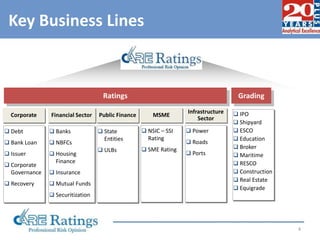
Key Business Lines
Ratings Grading
Corporate
 Debt
 Bank Loan
 Issuer
 Corporate
Governance
 Recovery
Financial Sector
 Banks
 NBFCs
 Housing
Finance
 Insurance
 Mutual Funds
 Securitization
Public Finance
 State
Entities
 ULBs
 IPO
 Shipyard
 ESCO
 Education
 Broker
 Maritime
 RESCO
 Construction
 Real Estate
 Equigrade
Infrastructure
Sector
 Power
 Roads
 Ports
MSME
 NSIC – SSI
Rating
 SME Rating
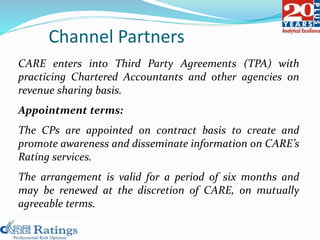
CARE enters into Third Party Agreements (TPA) with
practicing Chartered Accountants and other agencies on
revenue sharing basis.
Appointment terms:
The CPs are appointed on contract basis to create and
promote awareness and disseminate information on CARE’s
Rating services.
The arrangement is valid for a period of six months and
may be renewed at the discretion of CARE, on mutually
agreeable terms.
Channel Partners
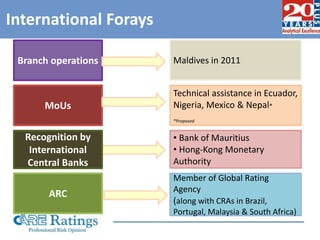
International Forays
MoUs
ARC
Branch operations
Technical assistance in Ecuador,
Nigeria, Mexico & Nepal*
*Proposed
Maldives in 2011
Member of Global Rating
Agency
(along with CRAs in Brazil,
Portugal, Malaysia & South Africa)
Recognition by
International
Central Banks
• Bank of Mauritius
• Hong-Kong Monetary
Authority
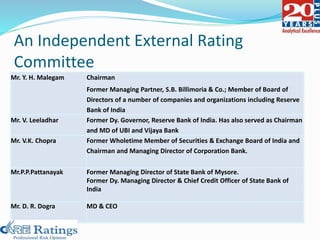
Mr. Y. H. Malegam Chairman
Former Managing Partner, S.B. Billimoria & Co.; Member of Board of
Directors of a number of companies and organizations including Reserve
Bank of India
Mr. V. Leeladhar Former Dy. Governor, Reserve Bank of India. Has also served as Chairman
and MD of UBI and Vijaya Bank
Mr. V.K. Chopra Former Wholetime Member of Securities & Exchange Board of India and
Chairman and Managing Director of Corporation Bank.
Mr.P.P.Pattanayak Former Managing Director of State Bank of Mysore.
Former Dy. Managing Director & Chief Credit Officer of State Bank of
India
Mr. D. R. Dogra MD & CEO
An Independent External Rating
Committee
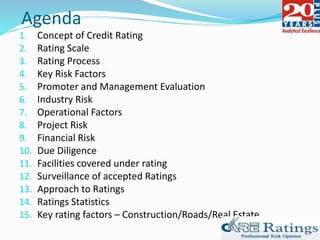
Agenda
1. Concept of Credit Rating
2. Rating Scale
3. Rating Process
4. Key Risk Factors
5. Promoter and Management Evaluation
6. Industry Risk
7. Operational Factors
8. Project Risk
9. Financial Risk
10. Due Diligence
11. Facilities covered under rating
12. Surveillance of accepted Ratings
13. Approach to Ratings
14. Ratings Statistics
15. Key rating factors – Construction/Roads/Real Estate
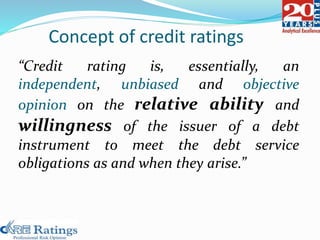
“Credit rating is, essentially, an
independent, unbiased and objective
opinion on the relative ability and
willingness of the issuer of a debt
instrument to meet the debt service
obligations as and when they arise.”
Concept of credit ratings
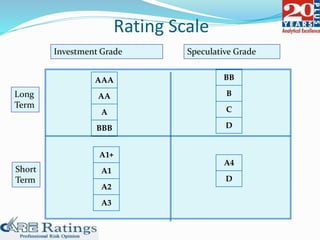
Rating Scale
Investment Grade Speculative Grade
Long
Term
Short
Term
AAA
AA
A
BBB
BB
B
C
D
A1+
A1
A2
A3
A4
D
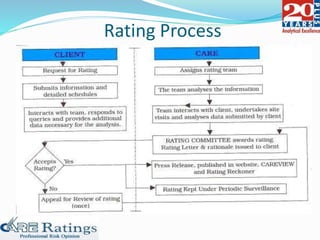
Rating Process
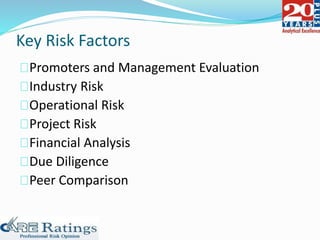
Key Risk Factors
Promoters and Management Evaluation
Industry Risk
Operational Risk
Project Risk
Financial Analysis
Due Diligence
Peer Comparison
Promoters and Management Profile
Experience in the industry / related industries
Qualification of management
Independence of management
Resourcefulness of promoters
Integrity and track record
Ability to perform/deliver under stress
Industry Risk
Peculiarities of the industry
Cyclical / non-cyclical
Seasonal / Perennial
Regulated / semi regulated
Competitive / Oligopolistic / Monopolistic
Capital / Technology / Labour intensive
Any specific accounting policies / practices
Raw Material/ Fuel /Finished goods
Need for long-term tie-up
Dependence on imports/exports
Entity vis-à-vis Industry
Position in value chain within industry
Position and Size with respect to other players
Operational Factors
Location of the plant / site
Operating Risks
Age of Plant and Machinery
Level of Technology
Labour
Utilities Arrangements
Level of Integration
Range of Products offered
Raw Material Supply Agreements
Marketing/Sale/Distribution Arrangements
Off-taker Profile Evaluation (counter party risk)
Concentration /diversity of customer
Project Risk
Integration of Project w.r.t Entity’s existing set-up
Size of Project vis-à-vis current level of operations of entity
Source of financing of project
Impact on current financial position
Cost of project vis-à-vis industry norms
Financial closure
Equipment supply and Technology
Raw material/fuel supply arrangements
Marketing / product off-take arrangements
Clearances
Progress of the project (cost, milestones achieved, timelines
etc)
Financial Risk
Analysis of Past as well as projected trend
Revenue - growth, contribution, volatility
Movement of major cost heads
Gross, PBILDT, Operating, PAT Margins
Working Capital levels & Liquidity position
Quality of current assets and investments
Cash flows – Past and Future
Ratios
Profitability
Capital structure and Solvency
Coverage ratios (Interest and DSCR)
Due Diligence
Interaction with Auditors
Adherence to accounting standards and policies
Internal controls of the company
Repayment of dues
Any other issues coming up in audit
Interaction with Bankers
Track record of repayment
Status of account (standard, NPA etc)
Internal Rating
Interest rate charged
Facilities covered under rating
Long term Bank Facilities
LT Rupee Term Loan
Foreign Currency Borrowings
Fund based working capital borrowings (Cash credit, etc)
Any other LT borrowings
Short term Bank Facilities
Non fund based working capital facilities (LC, BG etc)
Working capital demand loan
ST Loans
Any other ST borrowings
Surveillance
Continuous– any major developments affecting the credit
profile of the entity
Annual Surveillance (On expiry of one year from date of
initial rating exercise ) - Full fledged review
Quarterly
Limited review
Quarterly results
Due Diligence
Key developments
Approach to rating
Should not be viewed as a cost.
It is not a mere compliance exercise.
Companies should invest time and effort to prepare
information.
Plant visit and detailed discussions with Management.
Ask for key rating considerations before accepting the
rating.
Update the rating agency constantly on the
developments, positive or negative.
Rating statistics
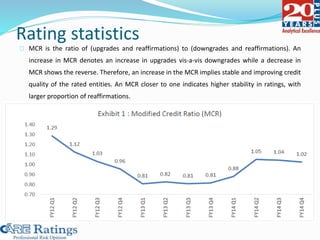
MCR is the ratio of (upgrades and reaffirmations) to (downgrades and reaffirmations). An
increase in MCR denotes an increase in upgrades vis-a-vis downgrades while a decrease in
MCR shows the reverse. Therefore, an increase in the MCR implies stable and improving credit
quality of the rated entities. An MCR closer to one indicates higher stability in ratings, with
larger proportion of reaffirmations.
Key rating factors – Construction
Expected infra spending, industrial and realty growth
driving demand
Size and past track record
Revenue visibility – Order book to Gross Sales
Type of contracts
Execution capability
Cash flow extremely critical
Key rating factors – Roads
Sponsor related Risk
Project execution Risk
Revenue Risk
O&M Risk
Regulatory & Political Risk
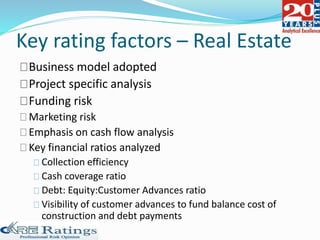
Key rating factors – Real Estate
Business model adopted
Project specific analysis
Funding risk
Marketing risk
Emphasis on cash flow analysis
Key financial ratios analyzed
Collection efficiency
Cash coverage ratio
Debt: Equity:Customer Advances ratio
Visibility of customer advances to fund balance cost of
construction and debt payments
Q & A
THANK YOU
27

Credit Rating

  • 2.
    Presentation on Rating conceptsand methodologies CA Smita Rajpurkar Date June 28, 2014
  • 3.
  • 4.
    4 Key Business Lines RatingsGrading Corporate  Debt  Bank Loan  Issuer  Corporate Governance  Recovery Financial Sector  Banks  NBFCs  Housing Finance  Insurance  Mutual Funds  Securitization Public Finance  State Entities  ULBs  IPO  Shipyard  ESCO  Education  Broker  Maritime  RESCO  Construction  Real Estate  Equigrade Infrastructure Sector  Power  Roads  Ports MSME  NSIC – SSI Rating  SME Rating
  • 5.
    CARE enters intoThird Party Agreements (TPA) with practicing Chartered Accountants and other agencies on revenue sharing basis. Appointment terms: The CPs are appointed on contract basis to create and promote awareness and disseminate information on CARE’s Rating services. The arrangement is valid for a period of six months and may be renewed at the discretion of CARE, on mutually agreeable terms. Channel Partners
  • 6.
    International Forays MoUs ARC Branch operations Technicalassistance in Ecuador, Nigeria, Mexico & Nepal* *Proposed Maldives in 2011 Member of Global Rating Agency (along with CRAs in Brazil, Portugal, Malaysia & South Africa) Recognition by International Central Banks • Bank of Mauritius • Hong-Kong Monetary Authority
  • 7.
    Mr. Y. H.Malegam Chairman Former Managing Partner, S.B. Billimoria & Co.; Member of Board of Directors of a number of companies and organizations including Reserve Bank of India Mr. V. Leeladhar Former Dy. Governor, Reserve Bank of India. Has also served as Chairman and MD of UBI and Vijaya Bank Mr. V.K. Chopra Former Wholetime Member of Securities & Exchange Board of India and Chairman and Managing Director of Corporation Bank. Mr.P.P.Pattanayak Former Managing Director of State Bank of Mysore. Former Dy. Managing Director & Chief Credit Officer of State Bank of India Mr. D. R. Dogra MD & CEO An Independent External Rating Committee
  • 8.
    Agenda 1. Concept ofCredit Rating 2. Rating Scale 3. Rating Process 4. Key Risk Factors 5. Promoter and Management Evaluation 6. Industry Risk 7. Operational Factors 8. Project Risk 9. Financial Risk 10. Due Diligence 11. Facilities covered under rating 12. Surveillance of accepted Ratings 13. Approach to Ratings 14. Ratings Statistics 15. Key rating factors – Construction/Roads/Real Estate
  • 9.
    “Credit rating is,essentially, an independent, unbiased and objective opinion on the relative ability and willingness of the issuer of a debt instrument to meet the debt service obligations as and when they arise.” Concept of credit ratings
  • 10.
    Rating Scale Investment GradeSpeculative Grade Long Term Short Term AAA AA A BBB BB B C D A1+ A1 A2 A3 A4 D
  • 11.
  • 12.
    Key Risk Factors Promotersand Management Evaluation Industry Risk Operational Risk Project Risk Financial Analysis Due Diligence Peer Comparison
  • 13.
    Promoters and ManagementProfile Experience in the industry / related industries Qualification of management Independence of management Resourcefulness of promoters Integrity and track record Ability to perform/deliver under stress
  • 14.
    Industry Risk Peculiarities ofthe industry Cyclical / non-cyclical Seasonal / Perennial Regulated / semi regulated Competitive / Oligopolistic / Monopolistic Capital / Technology / Labour intensive Any specific accounting policies / practices Raw Material/ Fuel /Finished goods Need for long-term tie-up Dependence on imports/exports Entity vis-à-vis Industry Position in value chain within industry Position and Size with respect to other players
  • 15.
    Operational Factors Location ofthe plant / site Operating Risks Age of Plant and Machinery Level of Technology Labour Utilities Arrangements Level of Integration Range of Products offered Raw Material Supply Agreements Marketing/Sale/Distribution Arrangements Off-taker Profile Evaluation (counter party risk) Concentration /diversity of customer
  • 16.
    Project Risk Integration ofProject w.r.t Entity’s existing set-up Size of Project vis-à-vis current level of operations of entity Source of financing of project Impact on current financial position Cost of project vis-à-vis industry norms Financial closure Equipment supply and Technology Raw material/fuel supply arrangements Marketing / product off-take arrangements Clearances Progress of the project (cost, milestones achieved, timelines etc)
  • 17.
    Financial Risk Analysis ofPast as well as projected trend Revenue - growth, contribution, volatility Movement of major cost heads Gross, PBILDT, Operating, PAT Margins Working Capital levels & Liquidity position Quality of current assets and investments Cash flows – Past and Future Ratios Profitability Capital structure and Solvency Coverage ratios (Interest and DSCR)
  • 18.
    Due Diligence Interaction withAuditors Adherence to accounting standards and policies Internal controls of the company Repayment of dues Any other issues coming up in audit Interaction with Bankers Track record of repayment Status of account (standard, NPA etc) Internal Rating Interest rate charged
  • 19.
    Facilities covered underrating Long term Bank Facilities LT Rupee Term Loan Foreign Currency Borrowings Fund based working capital borrowings (Cash credit, etc) Any other LT borrowings Short term Bank Facilities Non fund based working capital facilities (LC, BG etc) Working capital demand loan ST Loans Any other ST borrowings
  • 20.
    Surveillance Continuous– any majordevelopments affecting the credit profile of the entity Annual Surveillance (On expiry of one year from date of initial rating exercise ) - Full fledged review Quarterly Limited review Quarterly results Due Diligence Key developments
  • 21.
    Approach to rating Shouldnot be viewed as a cost. It is not a mere compliance exercise. Companies should invest time and effort to prepare information. Plant visit and detailed discussions with Management. Ask for key rating considerations before accepting the rating. Update the rating agency constantly on the developments, positive or negative.
  • 22.
    Rating statistics MCR isthe ratio of (upgrades and reaffirmations) to (downgrades and reaffirmations). An increase in MCR denotes an increase in upgrades vis-a-vis downgrades while a decrease in MCR shows the reverse. Therefore, an increase in the MCR implies stable and improving credit quality of the rated entities. An MCR closer to one indicates higher stability in ratings, with larger proportion of reaffirmations.
  • 23.
    Key rating factors– Construction Expected infra spending, industrial and realty growth driving demand Size and past track record Revenue visibility – Order book to Gross Sales Type of contracts Execution capability Cash flow extremely critical
  • 24.
    Key rating factors– Roads Sponsor related Risk Project execution Risk Revenue Risk O&M Risk Regulatory & Political Risk
  • 25.
    Key rating factors– Real Estate Business model adopted Project specific analysis Funding risk Marketing risk Emphasis on cash flow analysis Key financial ratios analyzed Collection efficiency Cash coverage ratio Debt: Equity:Customer Advances ratio Visibility of customer advances to fund balance cost of construction and debt payments
  • 26.
  • 27.